X generated $2.5 billion in revenue in 2024, and 68% of that came from ads, so the honest answer is this, twitter monetization is real, but native payouts are usually not the main event. If you want money from X (formerly Twitter), treat the platform as an attention engine first and a payout source second.
The popular advice gets this backward. People obsess over creator payouts, but the bigger opportunity is turning posts, replies, and profile visits into products, services, sponsorships, affiliate revenue, and leads that you control.
Why Twitter Monetization Is Mostly an Indirect Game
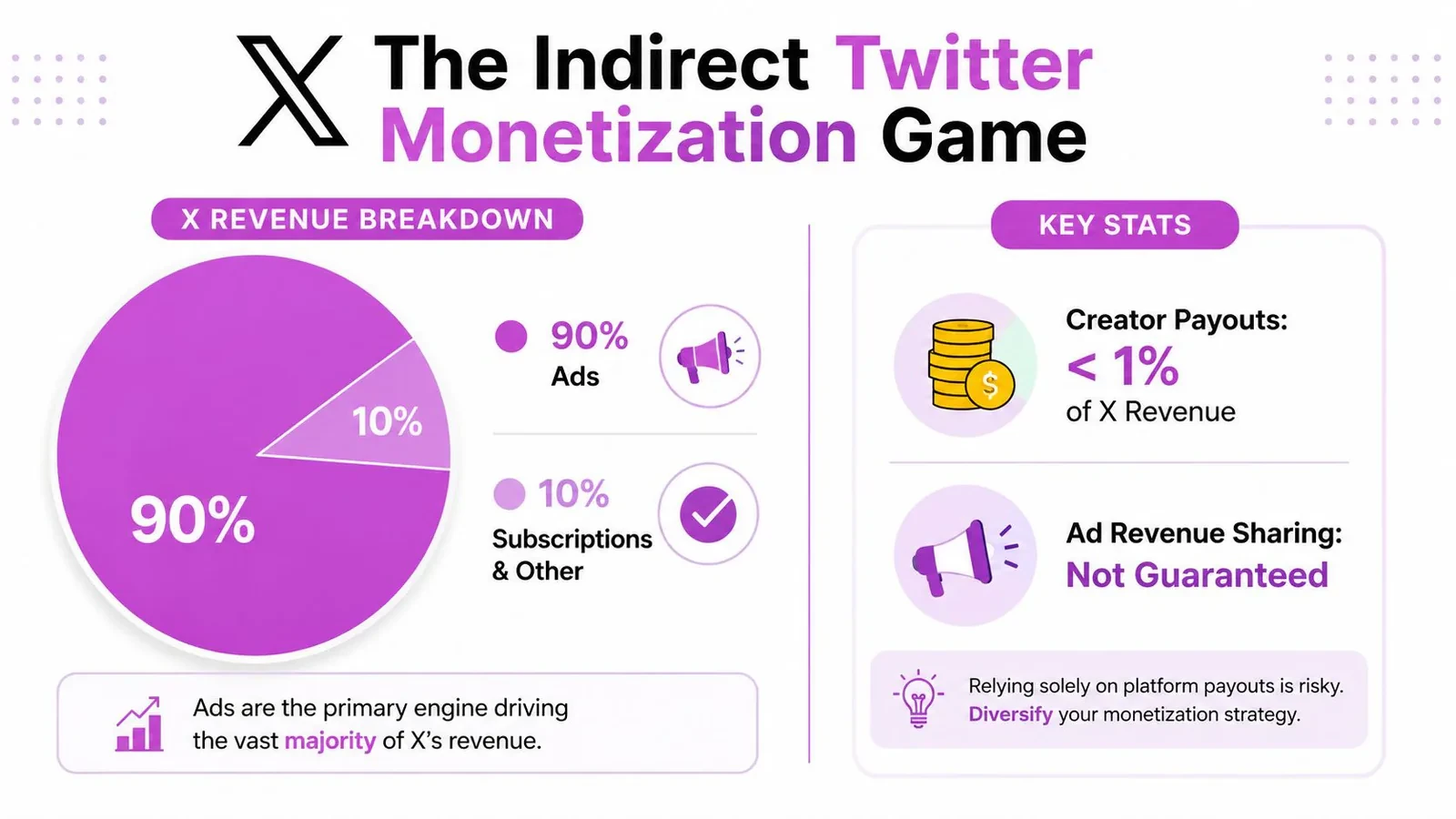
Most twitter monetization guides start with thresholds and end with hope. That framing misses how X works. X is still mostly an ad marketplace, not a direct-payment platform for creators, and Business of Apps reports that 68% of X’s $2.5 billion in 2024 revenue came from ads, even after the platform’s major changes. Business of Apps makes the point plainly, X still lives or dies on attention, inventory, and advertiser confidence.
That is why the most reliable money on X usually comes from people discovering you on X, then buying somewhere else. That can mean a software trial, a consulting package, a paid newsletter, a sponsorship, or an affiliate offer.
Treat X as distribution, not the checkout page
The practical shift is simple. Stop asking, “How do I get X to pay me?” Start asking, “How do I use X to create demand?” That is the more durable play, especially for founders and niche experts who already have something to sell.
The path is authority, conversion, and follow-through. A post creates awareness. A profile visit creates evaluation. A clear offer turns that attention into revenue. If any one of those steps is weak, the post can still look successful while the business earns nothing.
Practical rule: if your bio, pinned post, and offer do not align, your impressions are just expensive entertainment.
That is also why a strong personal brand matters more than chasing one-off payouts. A useful starting point is this guide on personal branding on Twitter, because monetization starts with being legible enough that the right people know what you do.
For more on tweet automation for apps, see tweet automation for apps.
Native payouts are real, but they are not the core business
X has creator monetization features, but they sit on top of the larger ad system, not instead of it. X revenue fell 13.7% year-on-year in 2024, which is a useful reminder that platform economics can shift even when creator features get more attention. That is the right baseline here, because it shows why native monetization is a supplement, not a plan.
The better mindset is direct. Use X to build a buyer-qualified audience, then monetize through something you own. If native payouts show up too, treat them as a bonus signal that your content is resonating.
What X Actually Pays You For
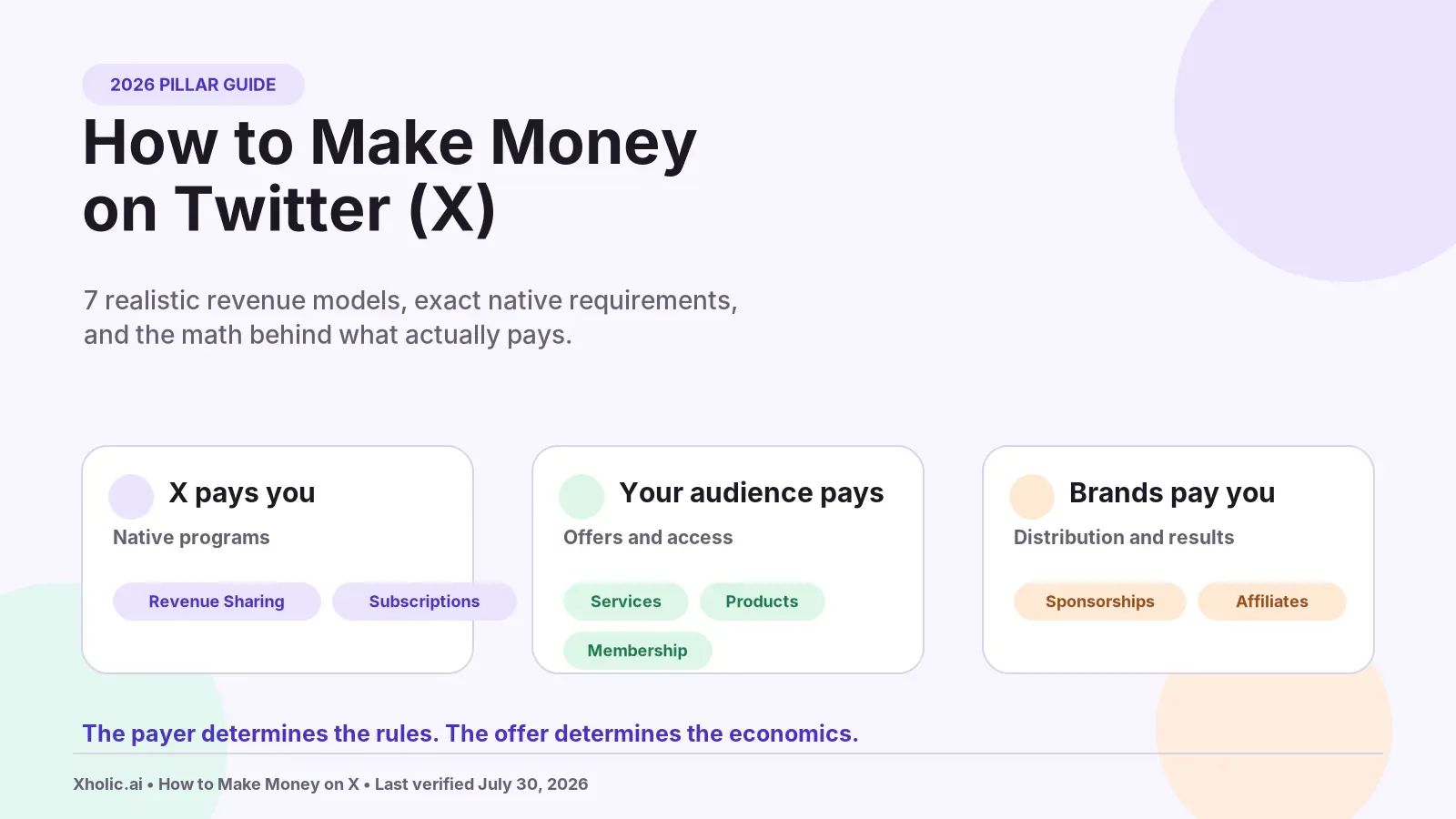
X doesn’t just have one monetization model. It has a handful of surfaces, and they pay for very different things. If you don’t separate them, you’ll waste time optimizing the wrong one.
The main native surfaces
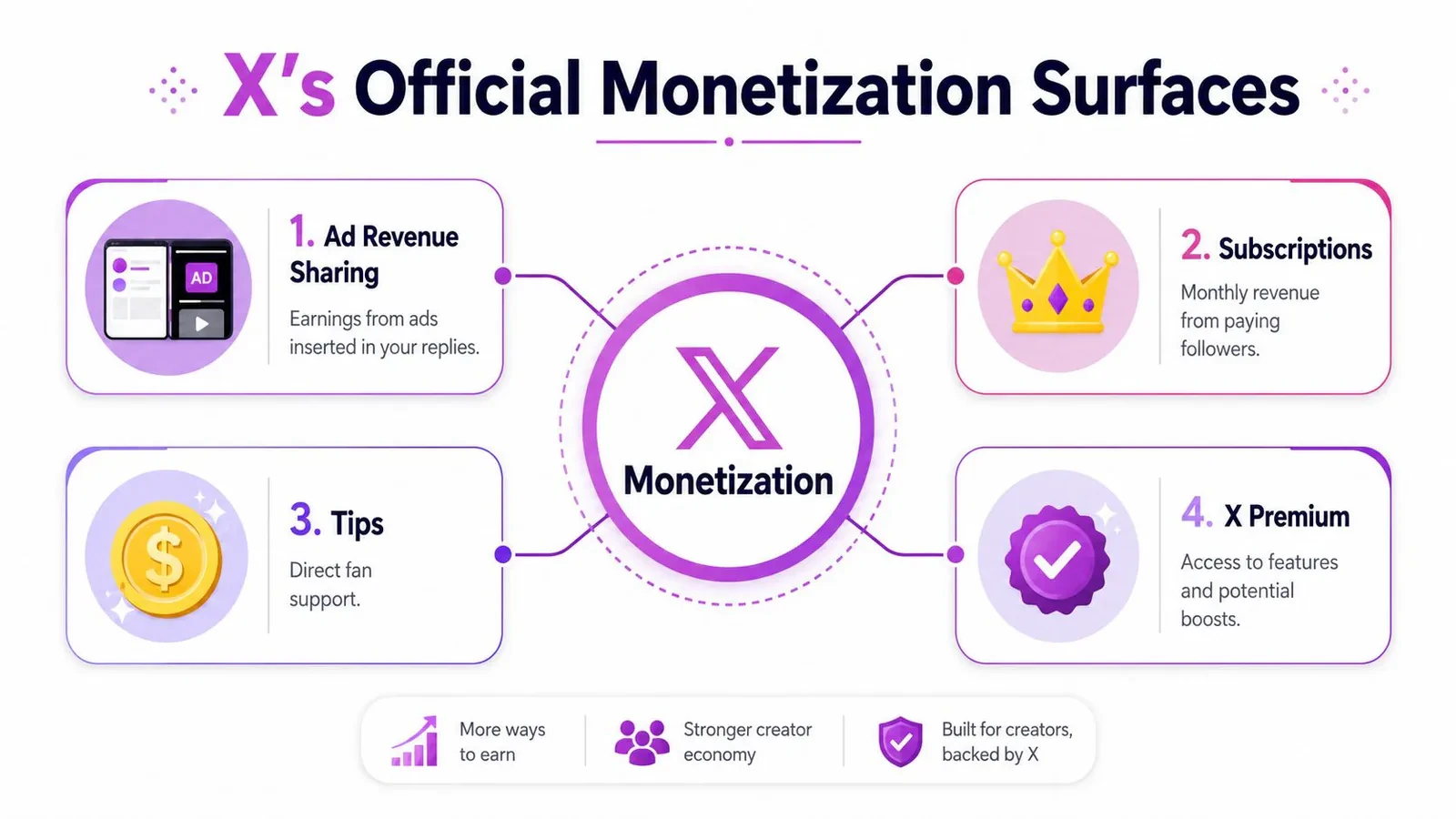
The core programs are straightforward:
- Ad Revenue Sharing. X’s creator revenue-sharing model is driven by ads inserted into reply threads. The money comes from the conversation around your post, not just the post itself. The Help Center says payouts are calculated from verified engagements such as likes and replies, so quality participation matters. X Help Center
- Subscriptions. This is the recurring direct-to-creator layer. Historically, Twitter’s Super Follows used a $2.99, $4.99, or $9.99 monthly price range, and creators reportedly kept 97% of revenue until $50,000 in lifetime sales, after which the creator share dropped to 80%. Stanford Law PDF
- Tips. This is simple fan support. It’s useful for audience members who want to send money directly, but it’s not a reliable business model on its own.
- X Premium. This is a paid access layer that provides features and can be part of eligibility for other surfaces. It’s not a monetization engine by itself, but it often sits in the stack.
What each one is really for
Ad sharing rewards accounts that can create discussion with monetizable reply inventory. Subscriptions reward creators who can package recurring access, deeper insight, or exclusive distribution. Tips reward goodwill, not systemized demand. Premium mostly grants participation and tooling.
The biggest mistake is assuming all of these are equivalent revenue paths. They’re not. Some are monetization. Some are a badge. Some are just support buttons.
Short version: if your content doesn’t create replies, trust, or a reason to come back, the native options won’t save it.
For a broader look at how monetization systems compare, how to choose a monetization platform is a useful external reference for thinking through trade-offs without assuming one model fits everyone.
Eligibility, Mechanics, and the Math Behind Payouts
The public checklist gets repeated so often that people mistake it for strategy. Eligibility is just the door. The question is what happens after you walk through it.
The usual entry requirements
Independent reporting says the clearest baseline rules for X creator revenue sharing are a paid X Premium subscription, at least 500 followers, and 5 million organic impressions in the last 3 months, and those reports also note that X processes payouts through Stripe, so creators must be in a country Stripe supports. Mashable is useful here because it condenses the practical entry conditions into a single view.
The older monetization model shows how quickly the economics changed once payouts became meaningful. Super Follows used the $2.99, $4.99, or $9.99 price range, and the creator revenue share shifted from 97% to 80% after $50,000 in lifetime sales. Stanford Law PDF is the clearest source on that history.
What actually drives payout size
The payout mechanism matters more than the headline threshold. X’s help documentation says revenue sharing is tied to ads inside reply threads and measured through verified engagements like likes and replies. That means a post can collect plenty of visible attention and still earn little if the replies do not create monetizable inventory.
| Program | What it pays for | Best suited for | Main trade-off |
|---|---|---|---|
| Ad Revenue Sharing | Ads in reply threads | Accounts that spark real discussion | Earnings depend on reply quality and ad inventory |
| Subscriptions | Recurring follower payments | Creators with repeatable premium value | You need a reason to keep people paying |
| Tips | Direct fan support | Small, loyal audiences | Usually sporadic and hard to forecast |
| X Premium | Access and eligibility layers | Users who need platform features | It’s an input, not a revenue stream |
That table is the useful mental model. A big impression count is not the same thing as money. A smaller, more conversational post can be more valuable if it drives the right kind of engagement.
If you want to measure that gap properly, use a dashboard that tracks more than likes. A Twitter analytics dashboard helps you follow the path from post to profile to click to conversion, which is where indirect revenue usually shows up first.
How to Set Up Each Native Program Step by Step
The setup work is unglamorous, but it’s where most creators either qualify cleanly or get stuck on avoidable friction. If you want native monetization active, do the account plumbing first.
Start with access and eligibility
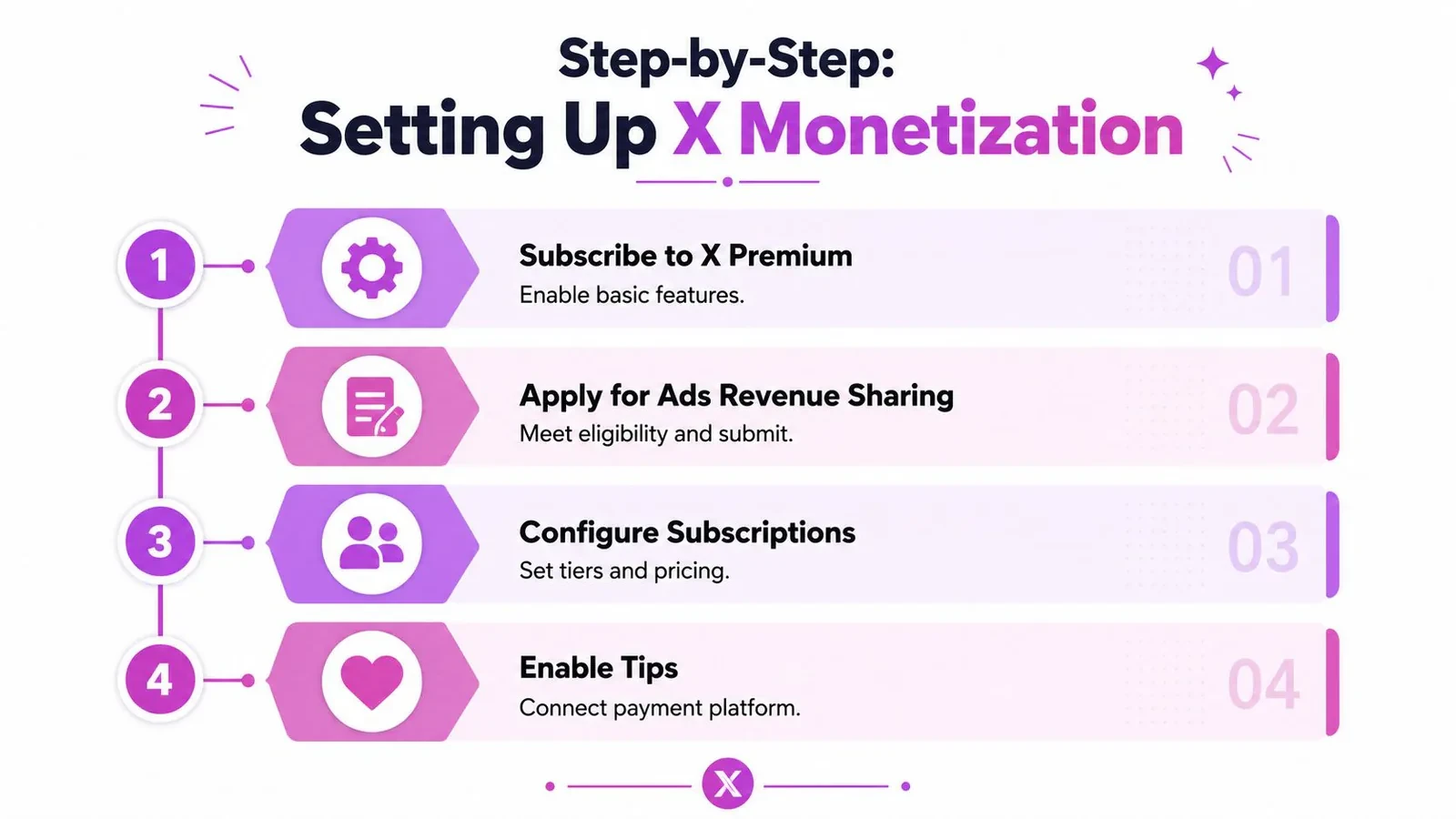
- Subscribe to X Premium. Without it, you’re usually not even in the right lane for the creator monetization surfaces people care about.
- Confirm your identity and payout country. If your region isn’t supported by the payment processor, the setup stops there.
- Review monetization standards. Content that strays into restricted categories can block or reduce eligibility.
Then turn on the surfaces that fit your account
- Ads Revenue Sharing. Apply inside the creator monetization area once you meet the posted eligibility requirements. If your account is still thin on verified engagement, don’t expect a fast approval path.
- Subscriptions. Set a clear subscriber promise before enabling this. People don’t pay for vague access.
- Tips. Connect the payment flow only if your audience already treats your account like a useful place to support.
- Ticketed Spaces. If live sessions are part of your niche, use them for paid access only when you already have an audience that shows up consistently.
- Stripe payouts. Make sure your payout details are complete and accurate, because payment friction often looks like a platform problem when it’s a profile problem.
The most common rejection patterns are boring but predictable, incomplete verification, unsupported country, and content that gets flagged under monetization standards. If you’re missing something basic, X usually won’t reward optimism.
A good profile helps here more than people think. If your account still looks vague or off-topic, fix that first with the kind of structure covered in Twitter profile optimization.
Building the Indirect Revenue Stack on Top of X
Native payouts are a nice layer. They’re not the engine. The engine is whatever you can sell because X made the right people trust you enough to click.
The revenue streams that actually compound
The strongest indirect paths are the ones that match your audience type:
- Products and SaaS. Posts and replies create demand, then your profile and link send interested people to a trial or checkout.
- Services and consulting. X is excellent for surfacing expertise in public. That makes it easier for the right buyer to reach out.
- Sponsorships and partnerships. Visibility plus topical authority can create inbound inquiries, especially when your audience is clearly defined.
- Affiliate and partner offers. These work when you recommend tools or workflows that fit your niche.
- Paid newsletters and communities. X can be the top of funnel that drives people into a more stable recurring asset.
- Courses, templates, and office hours. These work well when your content repeatedly answers the same category of problem.
The important question is not “Can this post go viral?” It’s “Does this post attract the kind of person who buys?” That’s a much better filter for founders and niche creators.
Track demand, not ego metrics
Many creators track impressions and stop there. That’s insufficient. You want to know which replies, posts, and threads create profile visits, link clicks, qualified DMs, trial sign-ups, and paid conversions. That’s the path that matters.
If you’re trying to choose the right revenue model for your audience, the cleanest way is to map the content to the offer first. A useful framework is: public post for attention, profile for credibility, pinned post for clarity, landing page for conversion. If the chain breaks, the revenue does too.
For creators building a more deliberate funnel, Twitter sales funnel is the right mental model, because X should be treated like a discovery layer, not the entire customer journey.
A Worked Example of a Niche Creator Monetizing on X
A solo developer posts short, specific threads about shipping bugs, product decisions, and lessons from customer feedback. None of it is polished influencer content. It’s just useful enough that the right people pay attention.
What the month looks like
In week one, the creator posts one strong idea and spends time in replies under adjacent accounts. In week two, a couple of those replies lead to profile visits. The profile does the heavy lifting because the bio says exactly who the creator helps, the pinned post explains the offer, and the link goes to one clear page.
By week three, a few visitors move from curiosity to action. One signs up for a trial, another sends a DM asking about consulting, and a third bookmarks the page for later. That’s the point where X starts acting like a lead source rather than a social feed.
What gets measured
The creator ignores follower count as a primary success metric. It’s too blunt. Instead, they watch:
- Profile visits to see whether the post created interest
- Link clicks to see whether the offer is compelling
- Qualified DMs to see whether the market understands the value
- Trial sign-ups to see whether curiosity turned into intent
- Paying customers to see whether the loop closed
The native payouts sit on top of that, but they’re not the core thesis. If they show up, great. If not, the account still earns by moving the right people toward a real offer.
That’s the honest version of X monetization for a niche creator. The account works because the content, profile, and offer all point in the same direction. Without that alignment, even good posts just create noise.
Workflows and Tools for Sustainable Monetization
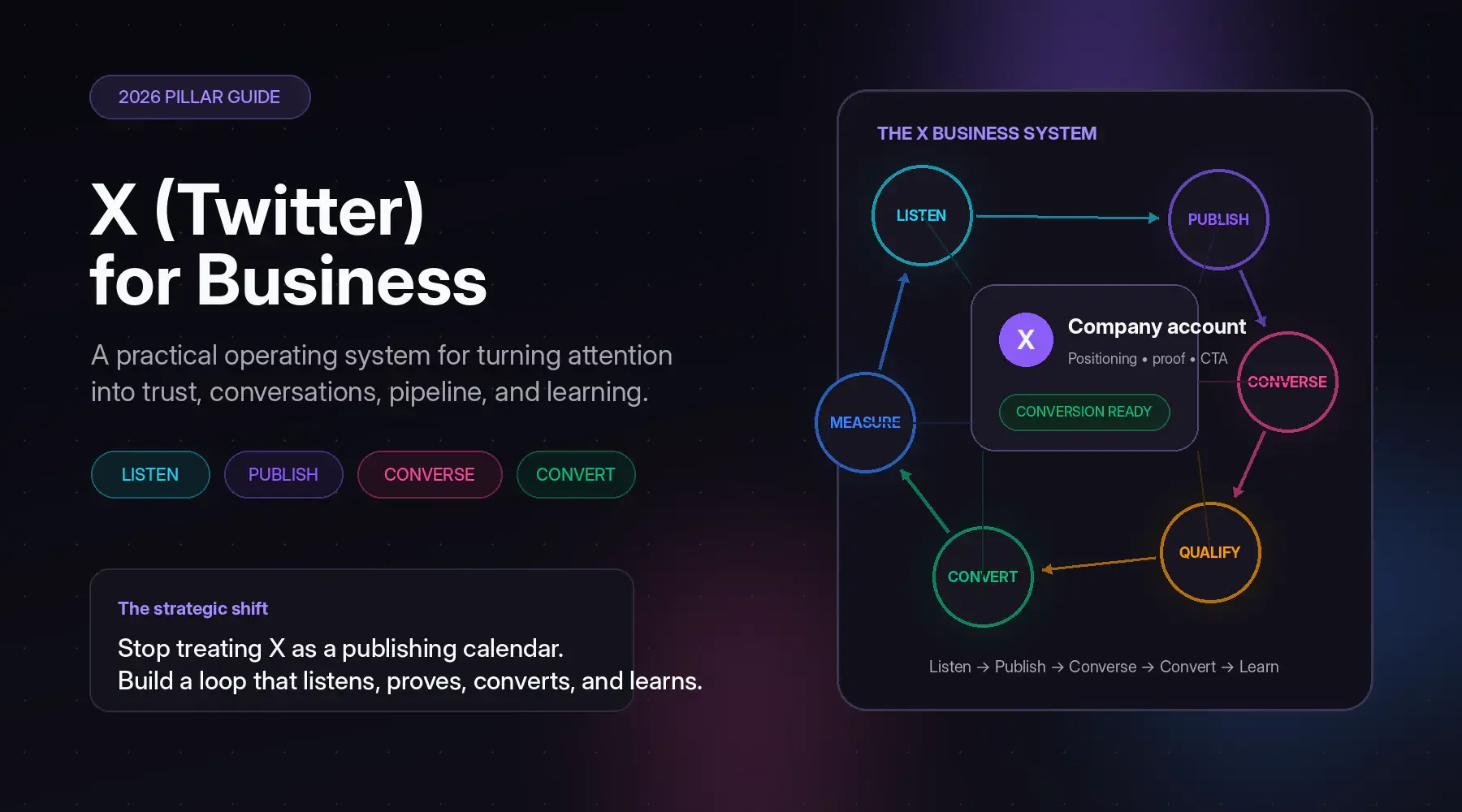
You don’t monetize X by posting whenever you feel like it. You monetize it by running a repeatable workflow that helps you find good conversations, say something useful, and keep the pipeline alive.
A weekly operating rhythm
Start with research. Study hooks, formats, and replies that already work in your niche. Save the ones that feel structurally useful, not just flashy. Then pick the conversations worth joining, because the right reply often outperforms another standalone post.
Draft your replies and posts with a consistent voice. Keep them specific, useful, and tied to the problem your audience already has. Then schedule the pieces that don’t need to be live in the moment, so your account stays active without eating the whole day.
Useful habit: review what led to profile visits and qualified DMs, not just what got liked.
Where tools make sense
A good tool stack helps with three things: discovery, consistency, and review. That can be a scheduler, a notes app, an analytics dashboard, or an AI workflow that helps you draft faster without losing your voice. One example is Xholic AI, which uses personalized context and memory to help with replies, content ideas, scheduling, and content analysis while keeping the user in control.
The point isn’t automation for its own sake. It’s reducing the time you spend staring at a blank box so you can spend more time on the parts that convert. If you can’t maintain the workflow, the monetization won’t last.
The best setup is simple. Find conversations, write better responses, publish consistently, review the results, and keep tightening the offer behind the content. That loop is what makes X useful as a business channel instead of a hobby feed.
Common Pitfalls, Policy Traps, and Your Next Move
The biggest mistake is chasing impressions without a conversion path. If your profile doesn’t explain what you do, your pinned post doesn’t support it, and your link goes somewhere vague, the audience leaves without acting.
Avoid the traps that kill monetization
X also has explicit content monetization restrictions. TechCrunch reported that ad revenue sharing excludes sexual content, pyramid schemes or get-rich-quick schemes, violence, criminal behaviors, gambling, and drugs and alcohol. TechCrunch matters here because those categories can wipe out eligibility if your content drifts.
A few other mistakes show up over and over:
- Treating tips like a business. Tips are support, not a predictable revenue model.
- Assuming subscriptions will convert by default. People pay for an ongoing promise, not a badge.
- Mixing sales messaging into every post. That usually lowers trust faster than it raises conversion.
- Ignoring reply quality. If your replies are generic, you’re leaving the monetizable part of X unused.
- Optimizing for one post instead of one system. Monetization comes from repeated, aligned touchpoints.
The next move
Pick one indirect revenue stream, then make your account support it. Tighten the bio, update the pinned post, make the link relevant, and turn on one native monetization surface that fits your niche. Don’t try to activate everything at once. That’s how people get a busy account and no revenue.
If you want a faster way to turn X activity into something usable, Xholic AI helps with personalized replies, conversation selection, content ideas, and workflow consistency without handing control over to a bot. It’s built for people who want X to create demand, not just impressions, and it fits this monetization model well when you’re ready to turn attention into qualified traffic.