Those who struggle with personal branding on X (formerly Twitter) aren’t failing at writing. They’re failing at operating a system. They post when they feel inspired, disappear when work gets busy, chase random topics, and then wonder why the account feels invisible. Personal branding on Twitter works better when you treat it like a growth engine: clear positioning in, consistent content and replies out, analytics back in, and better decisions each week.
That shift matters because X still gives you direct access to a large professional audience. The platform had an estimated 561 million monthly active users globally as of July 2025, and 59.2% of users are in the 25 to 49 age group, which is exactly the career-building audience most founders, creators, operators, and indie hackers want to reach, according to Backlinko’s Twitter user analysis.
Laying the Foundation Your Profile and Brand Voice
Before your posts can do any work, your profile has to convert attention into follows. Someone sees a reply, clicks your name, scans your profile, and decides fast whether you’re worth tracking. That decision window is tiny. Users have less than 5 seconds to convince a visitor to stay, and complete profiles receive significantly more opportunities. The same source also notes that 86% of consumers support brands with authentic voices, which is why polished but generic profiles usually underperform in this YouTube breakdown.
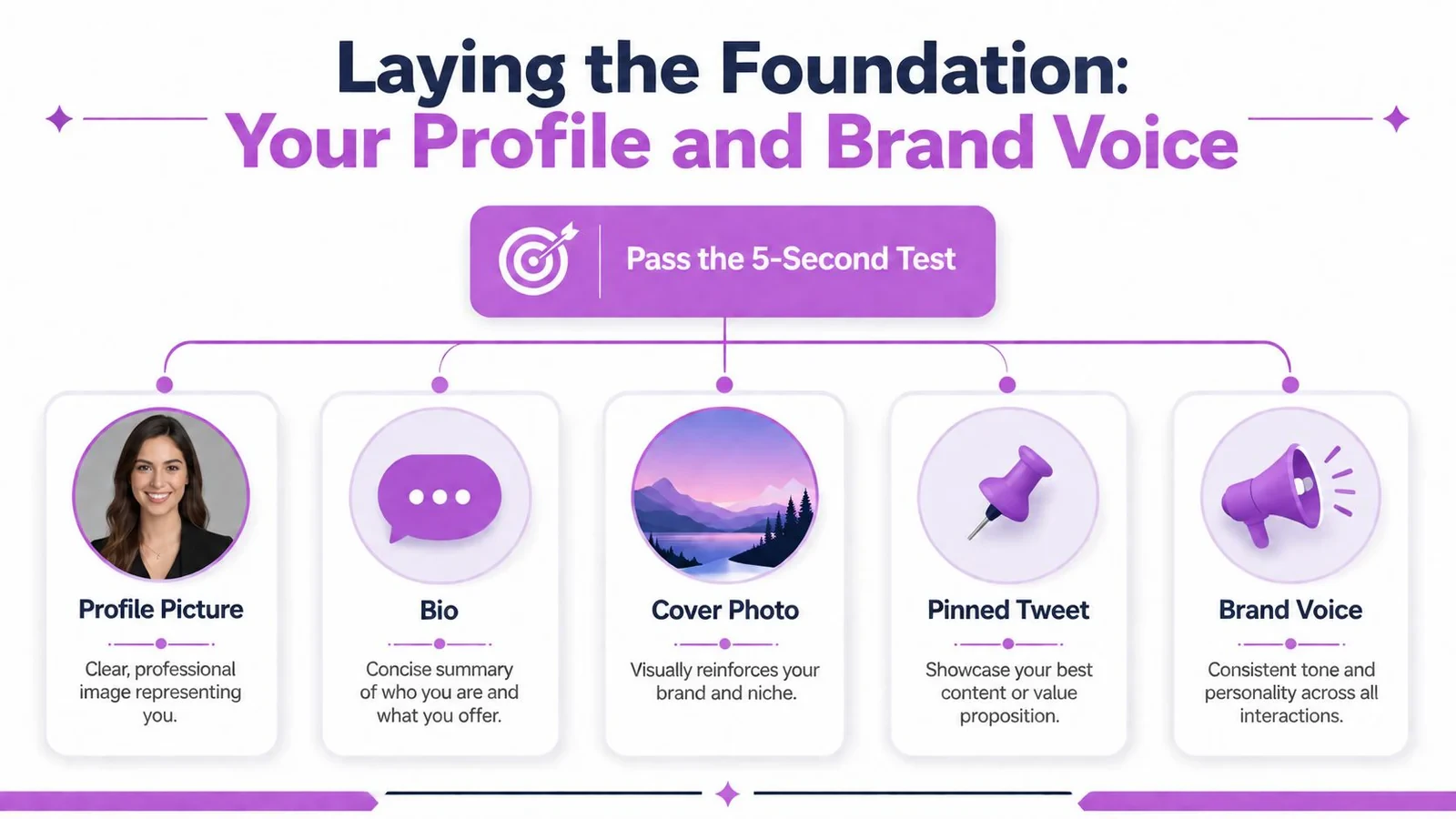
Pass the five second test
A strong profile answers four questions immediately:
- Who are you. Use a clear headshot or a recognizable personal image.
- What do you talk about. Your bio should name the domain, not hide behind vague titles.
- Why should someone follow. Give a concrete reason, such as sharing experiments, breakdowns, lessons, or product-building insight.
- What proves it. Your pinned tweet should show your thinking in action.
The pinned tweet’s importance is frequently underestimated. A bio can describe you. A pinned tweet can demonstrate your taste, honesty, and usefulness. For founder-led accounts, the best pinned posts usually do one of three things: explain the mission, document the live experiment, or point to your strongest body of work.
If you want a practical teardown of each profile element, this guide to Twitter profile optimization is worth keeping open while you edit your account.
Practical rule: If a stranger can’t tell what you do, who you help, and why you’re credible in a few seconds, your profile is still unfinished.
Choose three words before you choose formats
Most weak personal brands don’t have a content problem. They have a voice problem.
A useful way to define voice is to pick three words that describe how you want to show up. Mine would be: transparent, practical, experimental. Transparent means sharing mistakes and uncertainty, not just wins. Practical means favoring examples and frameworks over vague advice. Experimental means testing formats, ideas, and assumptions in public.
If you’re still shaping your tone, this explanation of what is brand voice is a helpful reference because it separates style from empty personality traits.
Try this quick exercise:
- List your most natural posts or ideas. Not your most polished ones.
- Look for repeated traits. Honest, analytical, sharp, curious, technical, contrarian, calm.
- Cut it to three words. More than that gets fuzzy.
- Test those words against your replies. Your voice should appear in conversations, not only in planned posts.
Turn your voice into content pillars
Once your three words are clear, build 2 to 4 content pillars. These are the recurring topics that make your account memorable.
A founder building in public might use a set like this:
| Pillar | What it includes | Why it works |
|---|---|---|
| Build logs | shipping updates, decisions, dead ends | shows momentum and reality |
| Growth lessons | hooks, replies, analytics, experiments | builds authority around process |
| Product thinking | user pain, feature trade-offs, positioning | attracts relevant peers and customers |
| Honest failures | wrong bets, weak results, changed opinions | creates trust and sharper conversation |
This is the difference between a random account and a recognizable one. A random account posts whatever feels interesting that day. A strong one repeats a few themes with enough variation that followers know what they’ll get.
Designing Your Content Engine and Cadence
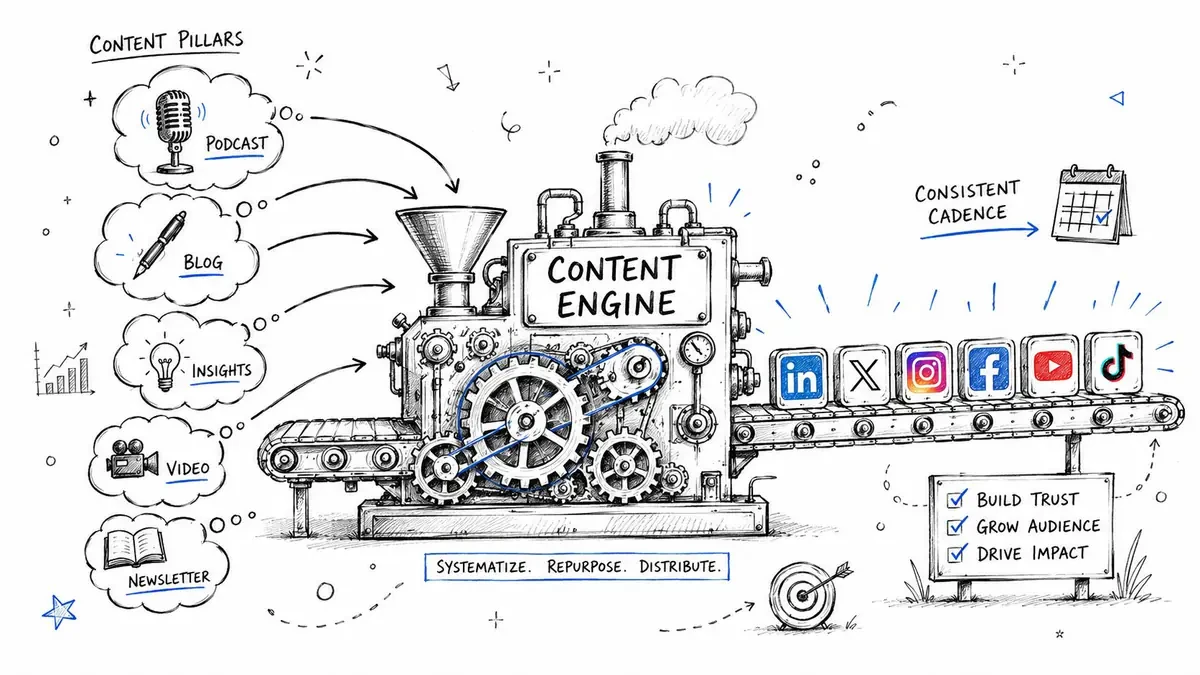
A content strategy on X breaks when it depends on inspiration. You need a repeatable way to turn a few core themes into many usable posts.
A proven method for personal branding on X suggests posting a minimum of 50 times to identify authentic voice patterns, and it also notes that creators tend to do better when they maintain a consistent frequency, such as 1 tweet per day for at least 6 months, because consistency compounds over time, according to AutoTweet’s guide to personal branding on X.
Build from pillars not moods
Start with one pillar and create multiple angles from it. For example, if your pillar is product building, you can turn it into:
- An observation about what users misunderstand
- A mistake you made in onboarding or messaging
- A decision memo about why you chose one feature over another
- A short lesson from support calls or user research
- A behind-the-scenes note on something that didn’t work
That approach gives you a backlog fast. It also prevents the common trap of sounding like you’re switching industries every week.
If you need a structured way to turn raw notes into actual posts, this guide to content ideation for X can help you build a repeatable pipeline.
Match the format to the job
Not every idea deserves the same format. Use the format that fits the message.
Single posts work well for sharp opinions, compact lessons, and hooks that create profile visits.
Threads are better when the reader needs sequence. If you’re breaking down a system, a postmortem, or a tactical workflow, a thread gives you room to build tension and payoff. The strongest thread length on X is 4 to 7 posts, with a strong opening hook and a clear CTA at the end, based on this X thread analysis summary.
Polls and questions are useful when your goal is conversation or market learning, not authority alone.
The biggest mistake is using threads to say what a single post could have said faster.
Set a cadence you can actually keep
The wrong cadence is the one you can’t sustain.
A lot of people start with a burst. They post aggressively for a week, burn out, disappear, and reset the account’s momentum. A better approach is to choose a minimum viable cadence you can keep during normal work weeks, travel, and low-energy days.
A simple founder-friendly rhythm looks like this:
- Main posts three to five times per week
- Replies daily
- One thread when you have a topic that demands structure
- One weekly review of what earned saves, replies, profile visits, and useful conversations
This works because the engine is balanced. Posts create surface area. Replies create distribution. Review creates improvement.
Mastering High-Value Engagement Strategies
If your account is small or mid-sized, the biggest growth lever usually isn’t publishing more original posts. It’s writing better replies in the right rooms.
Data shows that 60 to 70% of new follower growth for mid-tier creators comes from high-signal replies, not original posts. The same source says creators who fail to treat replies as brand-building assets can lose over 40% of their potential growth, according to Tweet Hunter’s guide to using Twitter for personal brand growth.

Why replies outperform more posts
Replies borrow distribution from accounts that already have attention. But that only works when the reply adds signal.
A low-value reply says:
- Agreement only. “Exactly.” “Great post.” “So true.”
- Recycled advice. Same point, no angle.
- Visible networking. Written to be seen, not to be useful.
A high-value reply does something else:
- Adds an example
- Introduces a trade-off
- Pushes the idea one level deeper
- Disagrees clearly without becoming hostile
- Connects the post to lived operator experience
That difference is why some replies drive profile clicks and others disappear.
What a high value reply looks like
Here are three better reply patterns for founders and creators:
-
Add missing context
If someone shares a tactic, explain when it fails.
Example structure: “This works when the audience already understands the problem. It breaks when the post asks readers to care before you’ve earned context.” -
Offer a concrete example
Turn abstraction into something usable.
Example structure: “A simpler version of this is using your pinned tweet as the proof layer. The bio makes the claim. The pin shows the evidence.” -
Share a changed opinion
This is stronger than pretending certainty.
Example structure: “I used to think volume solved this. What changed my mind was seeing that weak replies created activity without trust.”
If you want a deeper breakdown of what improves engagement quality on X, this guide to Twitter engagement is a useful companion.
Good replies don’t summarize the post. They extend it.
How to find conversations worth joining
Manual discovery still works. A focused routine is often enough:
- Check target creators early. New posts give your reply a better chance to get seen.
- Prioritize adjacent accounts. Similar niche, slightly larger audience, active discussion.
- Look for posts with tension. Strong opinions, tactical advice, trade-offs, mistakes, or product lessons.
- Skip crowded generic topics. If the conversation already has dozens of shallow replies, your effort is probably better spent elsewhere.
For people who don’t want to search manually, tools can reduce the scrolling cost. Xholic AI is one example. Its Engage surfaces relevant conversations, and its personalized AI replies inside X use account context, voice, niche, and product information to help draft replies that sound specific rather than generic. It stays human-in-the-loop, so you still review and decide what gets posted.
Activating Growth Levers and Measuring What Matters
Posting and replying without review creates motion, not progress. The useful part of analytics is simple: identify what earns attention from the right people, then do more of that with better execution.

Use engagement rate as your quality filter
Impressions are seductive because they’re easy to screenshot. They don’t tell you enough on their own.
A more useful operating metric is engagement rate. A good engagement rate on X currently ranges from 0.5% to 1%, and the formula is (Total Engagements / Total Impressions) × 100, according to Neal Schaffer’s Twitter analytics guide. Engagements include likes, replies, reposts, profile clicks, link clicks, detail expands, and other click types.
That means a post with modest reach but strong interaction can be more valuable than a high-impression post that nobody acts on.
Use a quick review table like this each week:
| Post type | Topic | Engagement rate | Profile visits | What to do next |
|---|---|---|---|---|
| single post | founder mistake | strong | high | write variations |
| thread | tactical framework | moderate | moderate | improve hook |
| reply-driven day | product positioning | n/a at post level | high | repeat conversation type |
If you’re tracking your account more closely, this walkthrough of Twitter analytics can help you separate useful signals from vanity metrics.
Review patterns not isolated wins
One strong post can be luck. A recurring pattern is strategy.
Look across a few dimensions:
- Topic. Which pillar keeps generating thoughtful replies?
- Format. Are short takes outperforming threads for your account?
- Hook style. Does direct language beat curiosity hooks?
- Audience fit. Which posts bring relevant followers, DMs, or profile visits?
For broader brand visibility beyond your own account, it can also help to learn how people measure brand presence across conversations. This breakdown of MyMentions insights on calculating SOV is useful if you want to think beyond a single tweet and toward category presence.
A good review habit is to save posts that worked, then deconstruct them. Ask why the opening line held attention, where the tension appeared, and what payoff made people respond.
Here is a useful video if you want a more visual walkthrough of performance review on X:
Scaling Your Workflow with Tools and Systems
At a certain point, personal branding on Twitter stops being a writing challenge and becomes an operations challenge. You need a routine that keeps your voice consistent even when you’re busy building, shipping, selling, or hiring.
Research on personal branding emphasizes that visibility frequency and consistency directly shape recognition and influence, and that tools supporting consistency are essential parts of the workflow, according to Tenet’s personal branding statistics overview.
A weekly operating rhythm for X
A practical weekly system usually has five stages:
-
Discovery
Save promising tweets, questions, and live conversations from your niche. -
Ideation
Turn those raw signals into angles: lessons, disagreements, frameworks, stories, or product observations. -
Creation
Draft posts in batches. Keep some short, some structured, and some reactive. -
Scheduling
Queue the evergreen or planned content so your consistency doesn’t depend on mood. -
Analysis
Review what created quality engagement and where your audience leaned in.
This is why consistency is easier when your workflow is modular. You don’t need to create everything in one sitting. You need to keep each stage moving.
Where tools actually help
Tools are useful when they reduce friction without flattening your voice.
A few examples:
- Research libraries help you study patterns without copying them.
- Semantic search helps you find relevant hooks and conversations faster.
- Schedulers help you maintain rhythm during busy periods.
- Collections and bookmarks keep ideas organized instead of scattered across tabs.
- Reply assistance can speed up drafting, but only if it respects context and still leaves judgment to you.
If you’re comparing category options, the broader idea of a personal branding tool is worth thinking about across platforms: the useful tools aren’t the ones that generate the most content. They’re the ones that help you make better decisions repeatedly.
The trade-off is straightforward. More automation can increase output, but too much automation can make your account sound interchangeable. The right system should preserve your point of view, not replace it.
Personal branding works best as part of a complete growth system, so connect this positioning work to the broader How to Grow on Twitter guide. It also helps to understand how the X algorithm distributes the content your profile promises.
Frequently Asked Questions About Personal Branding on X
How long does it take to build a personal brand on X
Longer than typically desired, and faster than it looks once compounding starts. The early phase often feels quiet because you’re still refining positioning, voice, and audience fit. Treat the first stretch as data collection, not public validation.
Should I focus on tweets or replies
Do both, but don’t split effort evenly by default. If your account is still building recognition, replies are often the faster path to profile visits and relevant conversations. Original posts matter because they give visitors a reason to follow after they click through.
Do I need to post every day
You need consistency more than you need intensity. A lower cadence you can maintain beats a bursty schedule that collapses after a week. If daily original posts are unrealistic, keep a lighter posting schedule and stay active through thoughtful replies and planned content.
If you want help turning this into a repeatable system, Xholic AI is built for that workflow. It helps you decide what to say next, find conversations worth joining, study successful ideas, and stay consistent with personalized context and memory while you remain in control of what gets published.