Twitter content pillars work best when you limit them to 3 to 5 core themes, then publish them with a clear weighting such as 50/30/20 across your primary, secondary, and tertiary pillars. On X (Twitter), that focus matters because the platform favors accounts that use a constrained vocabulary and link patterns, which helps your posts show up in topic feeds instead of relying on random viral hits.
It’s widely recognized that one should “pick a few pillars.” That advice is incomplete. The fundamental problem isn’t choosing topics. It’s building a system that tells you what to post, what to stop posting, when to shift emphasis, and how to keep your account recognizable while still reacting to what’s happening in real time.
If your timeline feels scattered, your replies aren’t compounding, and your account looks like a mix of unrelated thoughts, your pillars are either too broad, too many, or too static. Good Twitter content pillars fix all three.
Why Content Pillars Are Your Most Important Growth Lever on X
You post a strong thread on Monday, a sharp reply chain on Tuesday, and a product update on Wednesday. Each post performs in isolation, but the account still feels scattered. New followers do not know what to expect next, and the algorithm has a weak read on who should see your content.
That is the job of content pillars on X. They create repeatable signal.
The best accounts on X can change format without losing clarity. They move from one-liners to threads to replies to screenshots, but the themes stay tight. Followers know the account’s territory. New readers can place it fast. That makes every good post more likely to turn into a follow, a profile visit, or an inbound lead.
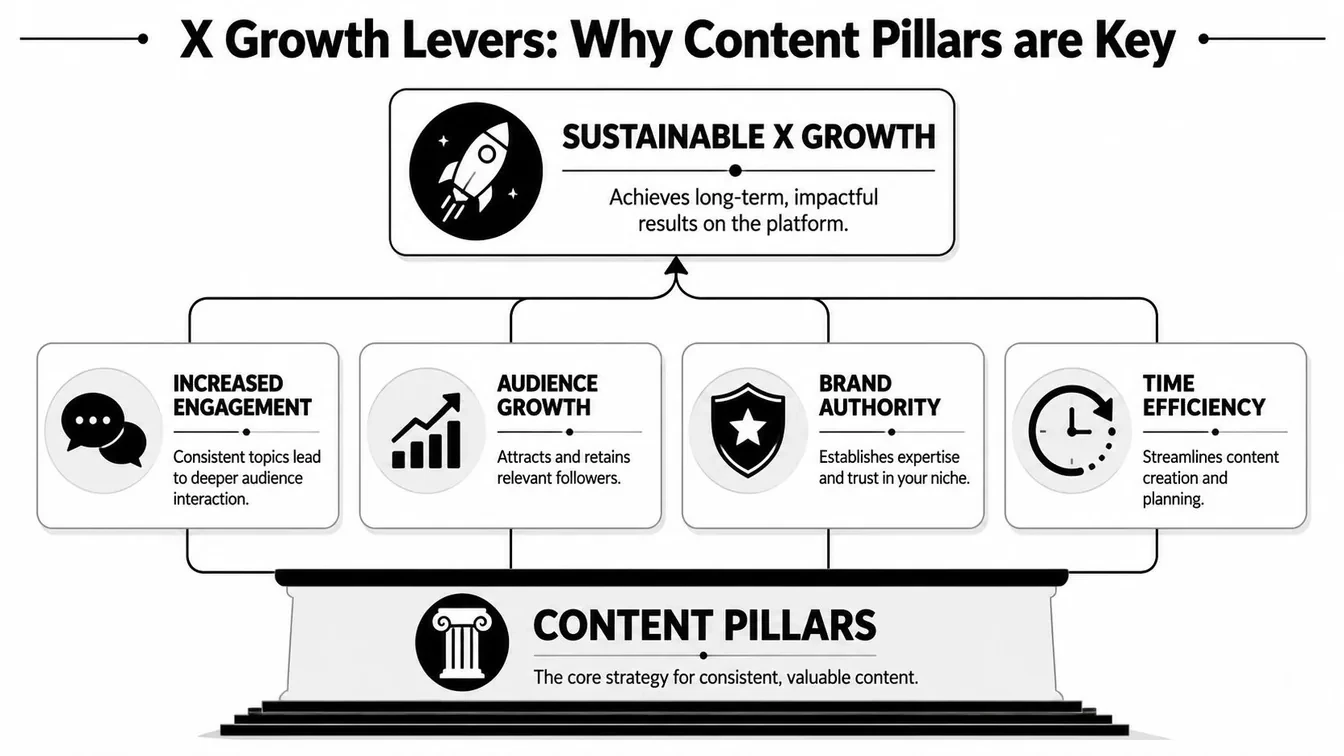
Pillars create signal you can measure
Pillars help in two directions at once. They make your account easier for people to understand, and they make your content easier to evaluate internally.
Without pillars, posting turns into content roulette. One post attracts founders, the next attracts other creators, the next is an off-topic opinion that gets likes but brings in the wrong audience. Reach can still happen, but it rarely compounds into a stronger brand or better conversion.
With clear Twitter content pillars, each post has a job:
- Audience fit: People who liked one post are more likely to care about the next one.
- Topical authority: Repetition around a few themes makes your account feel specialized.
- Faster execution: You spend less time searching for ideas and more time refining angles.
- Cleaner conversion paths: Profile visitors can tell what you do and whether they should keep reading.
This is also why static advice like “pick 3 pillars” is incomplete. The key advantage comes from operating a pillar system. Tag posts by pillar. Review which themes drive follows, replies, profile clicks, bookmarks, and qualified inbound. Then shift volume based on what is working, instead of treating your content mix like a fixed identity.
If you need a practical way to keep that system full, this guide to content ideation for X creators pairs well with a pillar-based workflow.
Pillars reduce guesswork, not creativity
A common concern I hear from creators is that pillars will make them repetitive. In practice, the opposite happens. Constraints remove the blank-page problem.
A good pillar is narrow enough to build recognition and broad enough to support multiple formats and angles. One pillar can produce tutorials, contrarian takes, build-in-public updates, teardown posts, stories from mistakes, and reply-driven mini threads. The theme stays stable. The expression changes.
That trade-off matters. If a pillar is too broad, the account gets fuzzy. If it is too narrow, you run out of useful things to say and start repeating yourself.
Here’s what usually fails:
- Broad labels: “marketing,” “business,” or “tech”
- Promotion disguised as strategy: every post points back to the product
- Too many pillars: enough topics to confuse the audience and your own planning
Here’s what holds up better:
| Weak pillar | Stronger pillar |
|---|---|
| Marketing | X growth for SaaS founders |
| AI | How AI changes creator workflows on X |
| Startups | Building a niche SaaS in public |
| Productivity | Systems for posting, replying, and research |
The strongest pillar sets are not permanent. They start as hypotheses, then earn their place through performance. I usually keep a pillar only if it does at least one of three things well: brings in the right followers, creates strong engagement from the right people, or supports a business goal such as demo requests, email signups, or qualified DMs.
AI makes this easier to run at scale. Use it to cluster past posts by topic, generate variations inside each pillar, and spot format fatigue before you feel it. If you also repurpose your X themes into short-form video, this guide on how to build your AI video content calendar is a useful extension of the same system.
How to Define Your 3 Core Content Pillars
The easiest way to choose bad pillars is to pick topics you can talk about. The better way is to pick topics at the intersection of what helps your business, what your audience wants, and what you can speak on with real credibility.
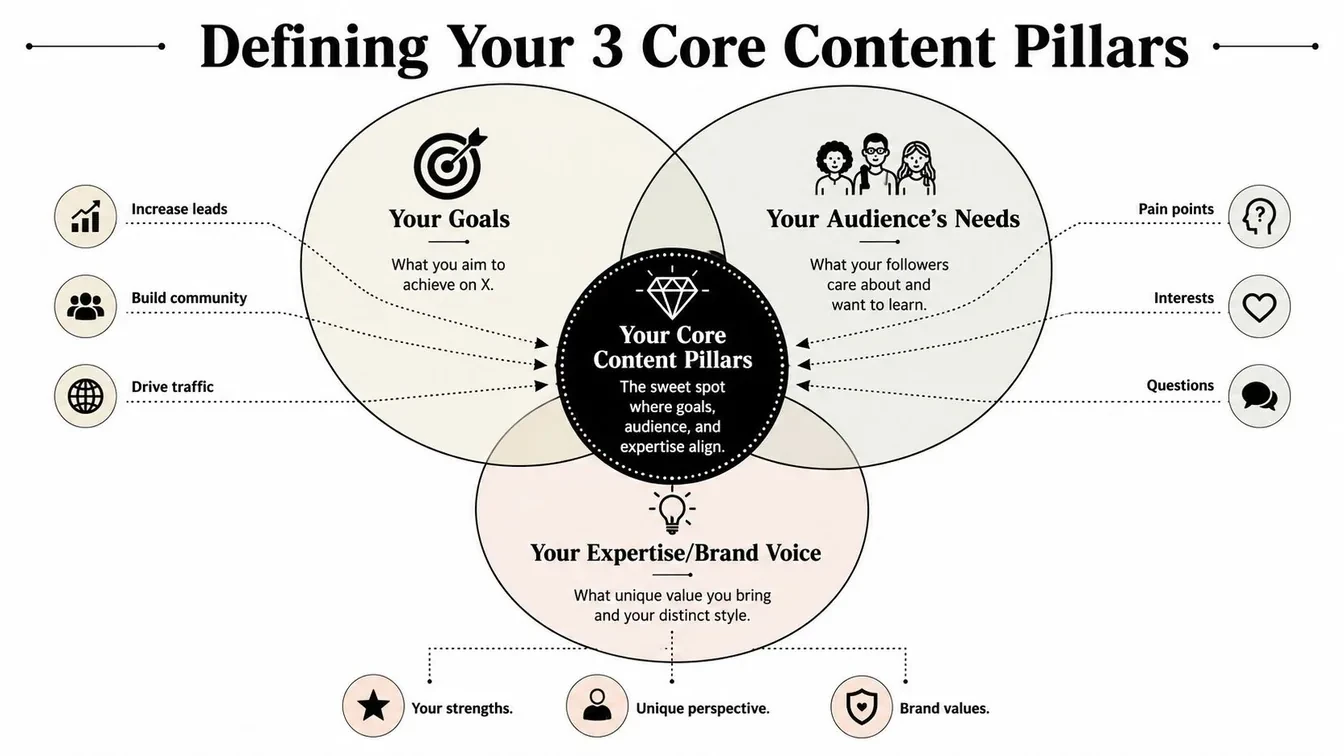
Start with the overlap
Use three filters.
-
Your goals
What should the account do for you? Build trust, attract users, create inbound interest, support a launch, or stay top of mind. -
Your audience’s needs
What problems are they trying to solve on X? Better replies, better hooks, more profile clicks, stronger posting systems, sharper positioning. -
Your expertise and voice
What can you talk about from actual experience? Not theory. Not borrowed advice. Real lessons, decisions, mistakes, and frameworks.
When those three line up, your pillars stop feeling forced.
Practical rule: If a topic gets attention but doesn’t connect to your audience or business, it’s a distraction, not a pillar.
A lot of people find it useful to sketch those ideas visually before they build a calendar. If you’re also repurposing into video, this guide on how to build your AI video content calendar is a good companion resource because it helps turn recurring themes into an actual production rhythm.
Later, once the pillars are clear, idea generation becomes much easier. A solid next step is reviewing examples of content ideation for X so each pillar turns into repeatable post angles instead of one-off topics.
Here’s a useful explainer on pillar thinking in video form:
A practical example
My favorite real-world example is the Xholic founder’s setup because the pillars overlap naturally instead of feeling manufactured:
- Building Xholic in public
- Practical X growth advice
- Perspective on AI and the future of X
Those work because each one supports the others.
The building-in-public pillar creates lived experience. The practical growth pillar turns that experience into useful frameworks. The AI and X pillar expands the conversation into where the platform is going and why it matters for creators and founders.
That overlap is why the account can post about product decisions, reply strategy, profile optimization, creator workflows, and platform shifts without looking scattered.
A quick test helps. For each pillar, ask:
- Can I post on this every week without faking expertise?
- Will the right followers care about this repeatedly?
- Does this create profile interest, not just casual likes?
- Can this topic connect back to what I build, sell, or stand for?
If the answer is weak on two or more, it probably belongs in your occasional content bucket, not your core pillars.
Real-World Content Pillar Examples and Tweet Ideas
Abstract pillar advice is where most articles lose people. The better question is simple. What does a good pillar look like on the timeline?
The easiest way to understand it is by persona.
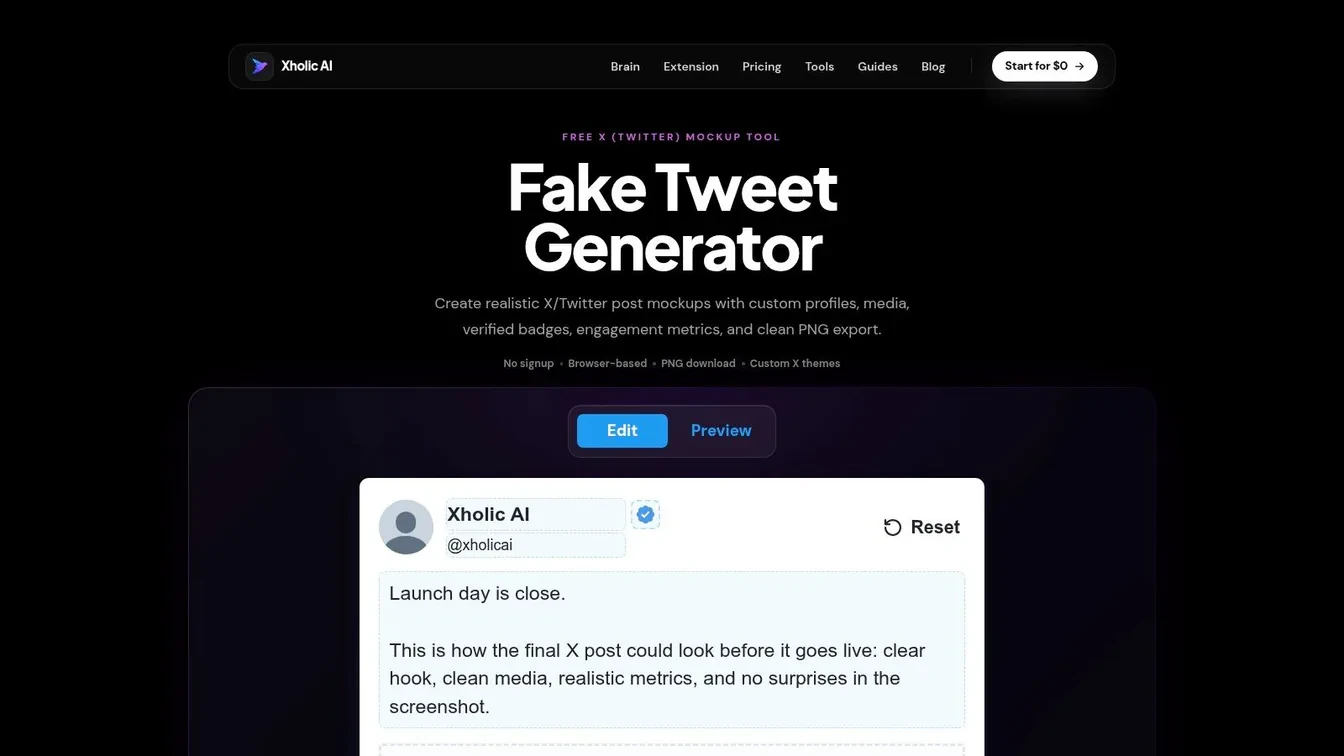
If you need examples to workshop internal drafts or campaign approvals, a fake tweet mockup tool is useful for testing how a post reads in-feed before it goes live. Mockups should always be labeled clearly when needed and shouldn’t be used to impersonate people or mislead viewers.
Founder example
A founder’s pillars often work best when they combine product, customer pain, and market perspective.
One strong building-in-public post from the Xholic founder started with:
The Xholic Twitter account and the Xholic app both have the same problem. People do not trust them enough yet.
That works because it’s honest, specific, and useful. It doesn’t posture. It names a real problem, which invites better replies than a polished “shipping update” ever will.
Possible founder pillars:
- Building in public
- Customer pain and workflow observations
- Industry shifts
Sample tweet ideas:
- “We shipped the feature. Nobody cared. The problem wasn’t distribution. It was that we explained the tool before we explained the pain.”
- “Most early SaaS updates are written from the builder’s perspective. Users care about the friction, not the architecture.”
- “A feature announcement is weak content. The user problem behind that feature is often a much better post.”
Creator example
Creators usually do better with pillars that mix education, opinion, and documentation.
One of the strongest practical X growth posts from the same founder focused on why most replies don’t help people grow. The angle wasn’t generic engagement advice. It broke down why replies fail when they’re vague, too long, or add nothing new.
That’s a strong creator pillar because it teaches through contrast.
Sample post format:
| Pillar | Hook | Follow-through |
|---|---|---|
| Reply strategy | “Most replies don’t grow your account.” | Show weak vs useful examples |
| Hook writing | “Good hooks promise a payoff. Bad hooks just sound dramatic.” | Rewrite 3 hooks live |
| Profile positioning | “If someone visits your profile after one strong tweet, can they tell what you do?” | Audit headline, bio, pinned post |
If you manage content for a team, this roundup of content ideas for marketing teams is worth bookmarking because it helps turn one broad pillar into multiple campaign-ready variations.
For more examples of post formats that fit clear pillars, this list of tweets that actually work is a practical reference.
Trader or analyst example
A trader or analyst needs tighter thematic discipline than most creators because the timeline moves fast and broad takes get ignored.
Useful pillars here might be:
- Market interpretation
- Process and risk thinking
- Reaction to breaking narratives
Sample tweets:
- “I care less about the headline move and more about what the second-order reaction tells me.”
- “This setup isn’t interesting because it looks bullish. It’s interesting because of the widespread anchoring to yesterday’s story.”
- “Good analysis posts don’t just call direction. They show what would invalidate the view.”
A practical way to generate more ideas inside any pillar is to reverse-engineer structure instead of copying topics. Take a post that worked, break down the hook, tension, and payoff, then reuse that shape with your own context. That’s usually more durable than chasing surface-level trends.
A Workflow to Operationalize and Schedule Your Pillars
Monday starts with good intentions. By Thursday, the queue is a mix of half-finished ideas, reactive posts, and one tweet that did well so you keep rewriting it in slightly different ways. That is what pillar drift looks like in practice.
A usable system fixes that. I like starting with a 50/30/20 mix across primary, secondary, and tertiary pillars, then treating that ratio as a working hypothesis, not a rule. Keep it long enough to generate signal. Adjust it when one pillar earns more reach, replies, profile clicks, or qualified inbound than its share of output.
Build a weekly operating rhythm
Run your week in four content lanes:
- Primary pillar posts: your clearest topic and strongest association
- Secondary pillar posts: adjacent ideas that expand your authority
- Tertiary pillar posts: lighter posts that add range and personality
- Live reactions: timely posts tied back to one of the three pillars
The key is separating ideation, production, and distribution. Founders who blur those steps usually post whatever feels easiest that day, which makes the account look inconsistent even when the ideas are solid.
A simple weekly cadence:
- Collect raw material from customer calls, product decisions, sales objections, screenshots, notes, and strong replies you have already written.
- Tag each idea by pillar before you draft it. If a post does not fit a pillar, either rewrite it so it does or drop it.
- Create multiple executions from one idea. A founder lesson can become a short post, a thread, and three reply angles.
- Schedule the stable posts and leave open space for live commentary.
- Review distribution at the end of the week so you can see whether your actual mix matched the planned one.
If you want the execution side spelled out in more detail, this guide on how to schedule posts on Twitter breaks down drafting, queueing, and publishing.
AI helps here if you use it for throughput, not strategy. Feed it your pillar definitions, past top posts, and source notes. Then use it to generate variations, tighten hooks, or turn one idea into several formats. Do not let it decide what your account should be about. That decision comes from audience response and business goals.
Use replies as part of the system
Replies deserve their own workflow because they shape distribution and positioning faster than scheduled posts do.
A common mistake is leaving empty replies on big accounts. “Great point.” “So true.” “This.” That activity creates volume, but it does not build recognition. Useful replies do one of three things: add evidence, sharpen the framing, or introduce a respectful counterpoint.
Match reply targets to your pillars:
- X growth pillar: reply to posts about hooks, formatting, distribution, and profile conversion
- Build in public pillar: reply to operators discussing churn, hiring, pricing, trust, and go-to-market decisions
- AI creator tools pillar: reply to posts on workflows, prompts, product design, and how creators are using the tools
At this point, pillar strategy becomes operational instead of decorative. Your posting calendar says what you want to be known for. Your replies prove it in public, every day.
One more constraint matters. Do not let replies become random busywork. Track them by pillar the same way you track posts. If your AI pillar replies get profile visits and follows, but your tertiary humor posts get likes with no downstream action, shift the mix. For teams tying content output back to business results, this guide to measuring content ROI is a useful reference.
The best pillar systems are not static. They start with a schedule, collect evidence, and get sharper each month.
How to Measure and Refine Your Pillar Performance
Most pillar strategies fail for one reason. People never review them with enough structure to tell whether the problem is the topic or the execution.
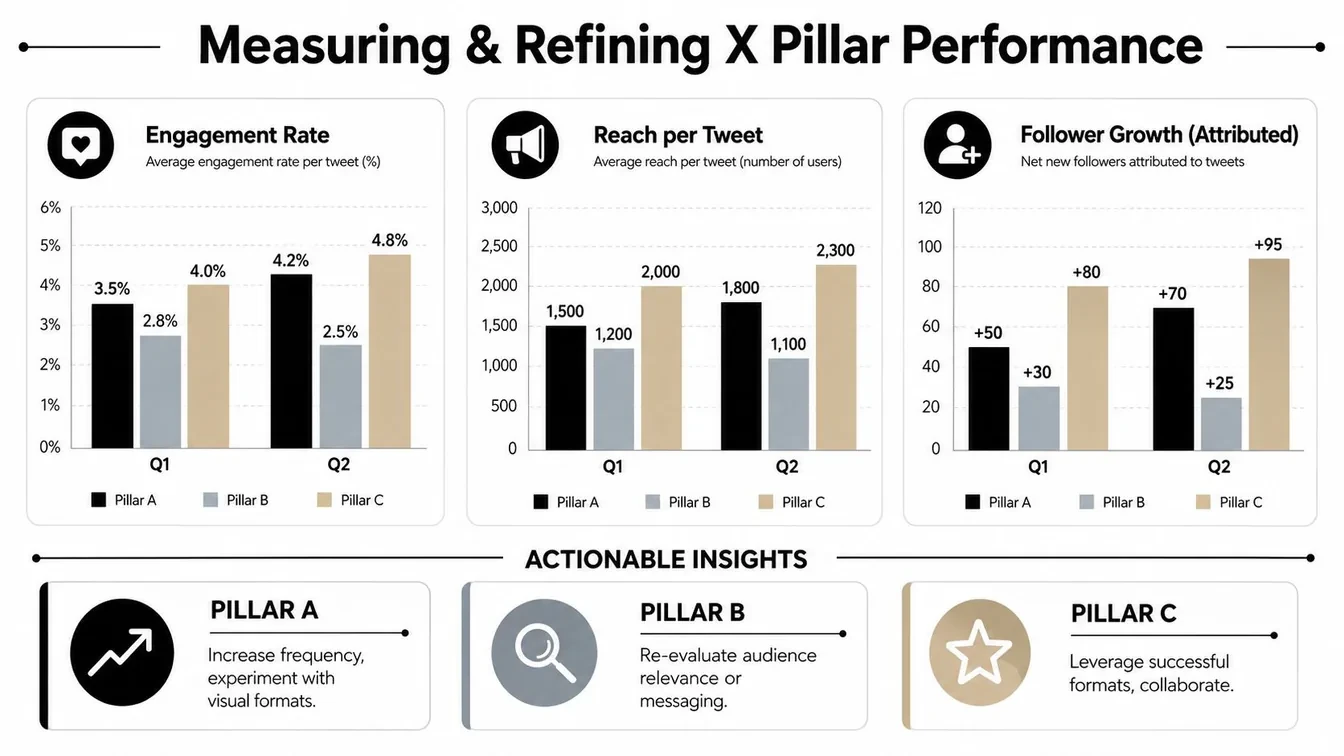
A usable review process is simple. Track your posts by pillar, review them weekly, and look for patterns after enough data has accumulated.
Run a 90-day audit
The most practical review cadence is to review engagement weekly and tag the top 10 tweets by content pillar, then use three months of that data to see which pillars drive impressions and profile clicks, based on Buffer’s guide to using Twitter.
You can make the audit more useful by checking three things for each pillar:
- Percent of posts
- Percent of impressions
- Percent of engagements
Those ratios matter because a pillar that gets posted often but contributes little engagement is probably over-weighted. A pillar that appears less often but consistently drives strong profile interest may deserve more room.
For teams trying to connect posting decisions to actual business outcomes, this guide to measuring content ROI is a useful companion because it pushes the review beyond vanity metrics.
If you want to get more systematic with platform review, this walkthrough on Twitter analytics is a good place to start.
Diagnose the pillar before you kill it
A weak post doesn’t always mean a weak pillar.
That distinction matters. A good category can underperform because the hook was vague, the example was too generic, or the post didn’t connect the lesson back to the audience.
Before you reduce a pillar, test the same idea in different formats and different framings.
A practical example from the Xholic founder makes the point well. A direct feature update might underperform. But a post about the user problem that led to the feature can generate a much better conversation. Same underlying topic. Better execution.
Here’s a simple decision table:
| Situation | Better move |
|---|---|
| Topic feels useful but post flopped | Rewrite the hook and tighten the example |
| Multiple posts in the pillar get ignored | Reduce frequency and test a new angle |
| Pillar attracts attention but wrong audience | Narrow the framing |
| Pillar performs best through replies, not posts | Keep the pillar, change the format mix |
Common Mistakes to Avoid With Your Content Pillars
The first mistake is choosing too many pillars. If everything is a pillar, nothing is. Many individuals need fewer themes and better repetition, not more variety.
The second mistake is picking categories that are too broad to guide actual writing. “Business” doesn’t tell you what to post today. “X growth for founders building in public” does.
The traps that quietly weaken your account
- Too much self-promotion: Product updates can work, but only when they connect to a user pain, lesson, or decision.
- Equal weighting by default: Your three pillars do not need equal airtime.
- Static planning: Real momentum shifts fast on X.
That last point matters more than most pillar guides admit. Static 40/30/20 or 50/30/20 models are useful starting points, but they don’t answer how to rebalance when a topic suddenly becomes timely. As Tweet Hunter’s personal brand guide notes, most mainstream frameworks don’t quantify how creators should dynamically adjust pillar weighting when momentum changes quickly on X.
What to do instead
Use your pillar split as a base, not a rule.
If one pillar suddenly has strong audience overlap with a live conversation, push it harder for a short stretch. If a pillar keeps missing, don’t protect it just because it’s in your document. Test a new angle, connect it to a stronger category, or post it less often.
The purpose of pillars is direction. It isn’t to force content that nobody wants.
Put the pillars into practice with a working Twitter content calendar and a dependable source of Twitter content ideas. For the complete account-level system, continue with How to Grow on Twitter.
Frequently Asked Questions
How many content pillars should you have on X
Start with 3 to 5 core themes.
That range gives you enough variety to avoid sounding repetitive, while keeping your account clear enough that people know what to expect when they follow. Early-stage creators usually do better with three. If you already post daily and have clear audience segments, four or five can work.
How often should you post if you’re using content pillars
Post as often as you can maintain quality, fast feedback, and consistent coverage across your best-performing pillars. As noted earlier, Tweet Archivist recommends a relatively high posting cadence. In practice, the right volume depends on your capacity to test ideas, reply, and review results each week.
I’ve found that a smaller number of strong posts beats forced volume. If five posts a day makes your writing worse or pushes you into filler, cut back and protect quality.
What’s a good engagement rate on X
Use engagement rate as a directional metric, not a vanity target. A solid baseline often falls in the low single digits, but the better question is whether each pillar earns enough attention to justify its slot.
For example, a niche conversion-focused pillar may get fewer likes than a broad opinion pillar, yet still drive more profile visits, replies from the right people, or inbound leads. Judge pillars by the outcome they produce, not just surface engagement.
Should all pillars get equal attention
No. Pillars should be weighted based on performance, audience fit, and timing.
A practical starting point is to give your proven pillar the largest share, keep one pillar for experimentation, and reduce any pillar that keeps missing after a fair test window. Rebalance weekly or biweekly. If one topic starts pulling stronger reach and better replies, increase its share for the next batch of posts. If another draws weak response across multiple formats, change the angle or replace it.
Can AI help manage content pillars without making posts sound generic
Yes, if you use AI for execution instead of outsourcing your judgment to it.
AI is useful for turning one idea into multiple tweet angles, clustering past posts by pillar, spotting patterns in replies, and helping you maintain a repeatable posting workflow. It should not decide your voice, your point of view, or what your audience cares about. The operator still matters. The best setup is simple: use AI to speed up research, drafting, and organization, then use performance data to decide which pillars deserve more attention.
Strong Twitter content pillars give you focus, make posting easier, and help your account build real authority instead of scattered attention. If you want a faster workflow for finding high-momentum conversations, drafting better replies, organizing ideas, and scheduling approved posts, try Xholic AI.