Audience and buyer research
Use customer conversations, sales calls, community language, competitor audiences, and buyer objections to decide what to publish and whom it should reach.
36%
Best tweets about Content Marketing
Explore the best tweets about content marketing, featuring strategy, research, distribution, formats, measurement, repurposing, and audience growth.
Content strategy, audience research, production, distribution, repurposing, measurement, attribution, and demonstrated business outcomes.
Original Xholic analysis
The conversation frames content marketing as more than publishing: research buyer problems, develop a distinct point of view, distribute deliberately, and connect content to an offer. Reported outcomes include views, inquiries and leads, but these are not interchangeable with revenue or retention. AI-assisted production draws interest alongside warnings against replacing audience judgment with output volume. (2002956540723232881, 2038458696783507740, 2081566089322868948, 2075130521093382170, 2060320546676437080)
40% of posts
All-time engagement
100% of posts
Published in 90 days
Conversation map
Use customer conversations, sales calls, community language, competitor audiences, and buyer objections to decide what to publish and whom it should reach.
36%
Connect content to products and offers with relevant proof, product mentions, lead magnets, calls to action, and trust-appropriate next steps.
36%
Choose a distinctive perspective, translate expertise for a defined audience, and plan content around buyer beliefs rather than generic topics or posting quotas.
36%
Promote content through platform-native posts, communities, newsletters, podcasts, video, collaborations, and thoughtful reuse across formats.
30%
Publish to discover what resonates, study hooks and responses, adjust formats and cadence, and expand ideas validated by audience feedback.
28%
Measure traffic, engagement, qualified leads, revenue, retention, and channel economics instead of treating reach or follower growth as the final outcome.
26%
Build repeatable creation workflows using editorial planning, proven formats, human judgment, and AI assistance for research, drafting, and updating existing content.
22%
Tone and stance
Performance benchmark
Posts with media make up 34% of this collection. Their median all-time score is 11.0, compared with 5.72 for text-only posts.
Format mix
Consensus and debate
Shared view
Contributors recommend using customer insights, sales calls and buyer objections to choose topics and language. One practitioner credits two user insights for guiding an Instagram campaign, while another urges teams to mine sales transcripts. (2002956540723232881, 2057954952492818516, 2054526637736075513)
Shared view
Posts distinguish attracting an audience from reaching qualified buyers. They call for relevant product mentions, clear offers and next steps matched to the audience’s trust level. (2037733920951681387, 2036034154526117917, 2041439334860013876)
Open debate
One founder argues that strategy emerges from posting and observing responses; others advocate researching competitors and audiences before drafting, or working backward from the offer. These are different starting points, not evidence that either works universally. (2080939063293493542, 2082371593297133929, 2073053399738658928)
Open debate
An Ahrefs marketer rejects automatically slicing one long piece into many short posts, preferring to expand ideas tested in shorter formats. Another creator says inexpensive LinkedIn articles repurposed from a newsletter proved more valuable to her than costly video production. (2042652832260575710, 2085445605711573059)
What performs
A reported Instagram campaign reached 5 million views in 10 weeks; other accounts report messages about an offer, leads or booked calls. These examples describe different stages of performance, not a common measure of sales. The supplied analytics give performance and business impact a 26% theme share. (2002956540723232881, 2075130521093382170, 2080804897214038057)
A startup-channel ranking lists content marketing at $8M, but explicitly says channels are self-reported. Its figures should not be read as attribution or proof of incremental return; a separate practitioner describes auditing whether high-traffic articles even mention relevant products. (2079586201686950269, 2036034154526117917)
Statistical standouts
Creator landscape
The five most represented creators account for 20% of the selected posts.
1. Alexa | Startup founder
@alexabelonix
2 posts
2. Doug Kennedy
@DougKennedy93
2 posts
3. Blake Emal
@heyblake
2 posts
4. Marcos
@itsmarcosruiz
2 posts
5. Kaleigh Moore
@kaleighf
2 posts
6. Miracle Adishi
@miracleadishi
2 posts
Practitioners describe AI-assisted article updates and faster experimentation, while stressing human review and audience understanding. In the supplied analytics, content production and AI has a median all-time score of 18.252; that engagement measure does not establish business impact. (2060320546676437080, 2002956540723232881)
Since the previous snapshot
Themes, sentiment, stance, and post format are classified per tweet. All counts, shares, medians, creator concentration, freshness, and performance comparisons are then calculated directly from the published snapshot.
Xholic's all-time score compares engagement while accounting for reach, post age, and creator consistency. It is used for relative comparisons within this collection.
This report analyzes the exact 50-post snapshot shown below. AI identifies editorial categories and drafts explanations; all statistics are calculated from the snapshot, and every narrative claim is checked against cited posts before publication.
Best Content Marketing tweets
Ranked 01–50

@omoalhajaabiola ·
To learn content management and social media marketing, here's a 60-day plan, spending 2 hours per day to develop comprehensive skills. This study plan covers topics such as content strategy, social media platforms, analytics, SEO, and more. Phase 1: Content Management (Days 1–30) Day 1–3: Content Strategy Fundamentals Topics: What is content strategy, setting goals, audience research, content types Resources: https://t.co/DXsx8LYStq https://t.co/K05DNoeNB7 Day 4–6: Creating Content Plans Topics: Editorial calendars, content creation workflows, setting deadlines Resources: https://t.co/zpWHtFZv83 Day 7–9: Content Writing and Copywriting Basics Topics: Copywriting essentials, writing for different platforms, persuasive writing Resources: https://t.co/2gefjOfs5M https://t.co/9CSXYKdpW2 Day 10–12: Visual Content Creation Topics: Basics of graphic design, creating visuals for social media, design tools (Canva) Resources: https://t.co/YYj0fRaSfs Day 13–16: SEO Basics for Content Topics: On-page SEO, keyword research, optimizing blog posts, meta tags Resources: https://t.co/0h6MdBmoW1 https://t.co/b2z2A7dJmk Day 17–20: Content Management Systems (CMS) Topics: Introduction to WordPress, creating blog posts, managing media, themes and plugins Resources: https://t.co/48M4w0v8XB Day 21–23: Content Repurposing and Curation Topics: Repurposing content, using content curation tools, creating value with curated content Resources: https://t.co/oc845NybWE https://t.co/Pp7Esq4At7 Day 24–27: Content Performance and Analytics Topics: Analyzing content performance, setting up Google Analytics, tracking KPIs (engagement, traffic, conversions) Resources: https://t.co/ch5Dz9EADL Day 28–30: Case Study and Practice Topics: Research successful content marketing case studies, create a content plan for a mock brand Resources: https://t.co/8a4QLLDmaf Phase 2: Social Media Marketing (Days 31–60) Day 31–33: Social Media Marketing Basics Topics: Introduction to social media marketing, key platforms (Facebook, Instagram, Twitter, LinkedIn), choosing the right platform Resources: https://t.co/1kdEg17q2a Day 34–37: Audience Building and Engagement Topics: Understanding target audiences, creating engaging content, community building Resources: https://t.co/2rJwx2HzYa https://t.co/9zeEwvOSk9 Day 38–40: Creating Social Media Content Topics: Best practices for different platforms (videos, images, posts), visual content creation tools (Canva) Resources: https://t.co/OVYXjYWROa https://t.co/WD3HPGFi2n Day 41–43: Scheduling and Managing Social Media Topics: Using tools like Hootsuite, Buffer, and Later to schedule posts, social media calendars Resources: https://t.co/KNvRAfmfUb https://t.co/GWXPjWrNgk Day 44–46: Facebook and Instagram Marketing Topics: Creating Facebook and Instagram ads, organic growth strategies, boosting posts Resources: https://t.co/RSYV6JUhIK https://t.co/2fZ0wQXdq5 Day 47–50: LinkedIn and Twitter Marketing Topics: Building professional networks, using LinkedIn for content marketing, Twitter trends, hashtags Resources: https://t.co/GZWoTthcTk Day 51–53: Influencer and Affiliate Marketing Topics: Working with influencers, finding affiliate partners, influencer outreach strategies Resources: https://t.co/FCur9dSxs2 Day 54–57: Paid Social Media Campaigns Topics: Facebook Ads Manager, Google Ads for social media, campaign management, budgeting Resources: https://t.co/AGPIk3aMQP Day 58–60: Social Media Analytics and Reporting Topics: Analyzing social media metrics, using platform analytics tools (Facebook Insights, Twitter Analytics), reporting to clients Resources: https://t.co/srUqE2BLpq

@marclou ·
Top marketing channels for startups on @trust_mrr: 🔎 SEO — $10.3M ✍️ Content marketing — $8M 📸 Instagram — $7.6M 👍 Facebook — $6M 🗣️ Word of mouth — $5.7M 📝 Blog — $5M 🔵 Google Ads — $4.8M 🤝 Affiliate — $4.8M 🎯 Meta Ads — $4.5M 🎵 TikTok — $4M n=1,162 (channels are self-reported)


@MedusaOnchain ·
pro tip (content strategy): unless you're experimenting or already a big account don’t post more than 3-4 times a day too much volume dilutes your attention capital people get fatigued seeing your content frequently & they start scrolling past results in lower engagement

@businessbarista ·
New content strategy: be the Robinhood of AI Take concepts/products/best practices from Token Street (SF/X/engineering bubble) & translate for Main Street (non-technical knowledge workers/execs). WTF is loop engineering vs. graph engineering? WTF are evals & how to set up for knowledge work? WTF is model-routing & how can you set it up? WTF is finetuning and how can you finetune a model? What do you think? What topics should I def cover?

@thinking_slow ·
content marketing is going through the biggest step-change since Google appeared. one personal example: i have an old website i built a decade ago. the content was old, the design was old, i had no time to improve it. resigned to a slow death. c'est la vie. but now: i migrated the website from Squarespace to static HTML. i vibe-coded a brand new design with tons of custom widgets. i hooked it up to Codex and now, every day, Codex chooses one old article to improve, automatically. it pulls performance data from the Ahrefs MCP. it reviews top-ranking articles. it finds content gaps, adds new sections, generates new images, improves internal linking, and generates a preview for me to provide feedback on. it takes me about 10-minutes to review and finalise the article, and Codex saves my feedback to a memory file that it reviews the next time it goes to update an article. it is literally like having a team working for me, to my exact specification, reviving all of my old projects, and it costs me $20/m. and this is just a dumb hobby project: imagine what content marketing is about to look like at successful, tech-literate companies with big budgets and bigger revenue goals? imagine what a skilled team of marketers could achieve working in unison with a system like Agent A? of course, it's a classic monkey paw: the same technology that is automating high-quality content marketing is also nerfing the value companies can derive from it. but i think there will always be value (and reward) for extremely high-quality content, and strangely, i think AI is about to become essential for making competitive, high-quality content. how can "traditional" content marketing compete with automated content updating, with deeper research, with unique data visualisations and custom-coded page experiences? content marketing is absolutely crazy right now, and frankly i am having the best time

@GurpriyaSidhu ·
I am consulting with an early stage brand that wanted to grow its social media. In just 10 weeks it has crossed 5 million views on Instagram. There's no in-house team. We didn't use influencers (nothing against influencers, but influencer marketing is not a 'content strategy'). We did this with 2 freelancers who know their craft well and 2 user insights that told us what to create for our audience. We used AI to reduce our cost of creation and experiment faster but AI is no replacement for user understanding. To know your audience and what will resonate with them is the only defensible moat right now. Blitzkrieging your way through content by using AI tools is not a strategy. Volume means nothing. It's what you choose to do and how you decide to do it. I read a tweet sometime ago (I will link it in the comments), that I think hits the nail on the head: "If you use AI to guide your strategy, you are opting for mediocrity at scale. "Taste" - the human ability to curate, to select the outlier, to understand nuance and subtext - becomes the only defensible moat. The future of marketing is about who has the taste to know what *not* to create."

@paolo_scales ·
You can reverse engineer your entire competitor LinkedIn strategy in a weekend with a content agent Here's how: Find your 10 closest competitors on LinkedIn and use Phantombuster to scrape every post they've published in the last 6 months, hooks, CTAs, lead magnet angles, comment sections, everything structured by post type and engagement level Build a composite database of every content angle they've ever used, which topics they keep returning to, which formats consistently outperform, and critically which pain points they hammer but never fully solve in the content itself Then go deeper, use Clay to enrich every person who commented on their top 10 posts, job title, company size, industry, seniority level, this tells you exactly who their content is actually resonating with and whether that audience overlaps with your ICP or not Use Exa AI to cross reference this with reddit, pulling the raw unfiltered language your shared ICP uses when they talk about these problems privately, the frustrations they admit on reddit that they'd never say publicly on linkedin Record a 30 minute voice memo of your raw opinions on the industry, your contrarian takes, your client results, the things no competitor could ever say because they didn't live them Feed all of this into claude, the competitor database, the commenter enrichment data, the reddit sentiment, and your voice memo, and have it build a full content strategy that targets the exact gaps competitors are leaving open, written in your voice with demand signals already validated Then have claude write your first 30 posts, score each one against your ICP profile before anything goes live, and flag the ones most likely to generate inbound from buyers not just engagement from other creators Schedule everything across your founder accounts in one shot using taplio Connect your LinkedIn into a Clay table that auto-enriches every new profile visitor and flags anyone who matches your ICP so your team can follow up before they've even sent a DM Every month pull your analytics, rerun the competitor scrape, identify the angles they just started winning on, and have claude generate a fresh batch of content targeting those gaps before they compound their lead You're now running a full blown linkedin intelligence operation while your competitors are still guessing what to post

@ashnichrist ·
Streaming is about to blow up. But so are other forms of content: - vlogs - emotional, honest interviews - walk & talk vibes Anything that builds a parasocial experience. Start including these in your content strategy now. Brands are already clocking this movement…

@alexabelonix ·
people here keep asking: “how do i build a personal brand?” “what’s my content strategy?” “how do i create a founder-led profile?” absurd. when you build a startup, do you spend 6 months building the whole product and only then test if anyone wants it? hopefully not. content works the same way. just start posting. turn off the overthinking. post some completely random shit if the alternative is waiting another month for your “perfect strategy” then slowly collect data: > what feels natural to post > what makes you want to delete your account immediately > what people actually find valuable > what brings followers > what brings users > what nobody gives a fuck about your content strategy is not something you invent in Notion. you discover it by posting. the absolute minimum you should understand: — twitter needs signals about who you are and who should see your content — start with one niche — can’t niche down by topic? niche down by audience — create different content for the same type of person — valuable but boring doesn’t work — education + entertainment = content PMF — every content system should convert somewhere stop trying to design the perfect founder-led brand before publishing tweet #1 ship the ugly MVP. then iterate in public. i made a free workbook to help you find your account bottleneck and build a practical 30-day growth plan. link in bio.


@LoganTGott ·
How to dominate LinkedIn as a B2B SaaS: 1. Mine your sales call transcripts for your content strategy. 2. Drive content to demos and free trials, not sales calls. 3. Lead magnets should be the manual version of your product. 4. Build in public with real numbers, not vague milestones. 5. Find a post going viral in your niche this week and adapt it. 6. Comment on your ICP's posts before you DM them. 7. Commit to 90 days before you evaluate ROI.

@aigleeson ·
A brand DM'd me in a panic last year because their competitor went from 4K to 400K Instagram followers in 6 weeks with no ads, no influencers, and no sponsorships. They were convinced it was bots, and honestly I understood why because the growth curve looked completely synthetic. It wasn't bots. The second they showed me the account, I recognized the exact playbook because I'd reverse-engineered a nearly identical case six months earlier when a solo creator in the finance niche pulled off the same thing using nothing but a free Google tool that most people treat like a glorified PDF reader. They were using NotebookLM, and not in the way anyone talks about it. Most people dump documents into NotebookLM and ask it to summarize things, which is roughly as useful as buying a Ferrari to drive to the corner store. This creator uploaded every single top-performing post in their niche from the last 90 days, competitor content, comment sections, saved audio overviews, and then asked NotebookLM one question that most people would never think to ask: "What specific emotional triggers appear in every post that crossed 50K views in this niche, and what format pattern do they all share?" The output was a structural blueprint, not a content calendar, not a list of topics, but a repeatable emotional architecture that explained exactly why certain content stopped thumbs and certain content got scrolled past in under a second. They then fed that blueprint back into NotebookLM with their own draft posts and asked it to identify every place where their content broke the pattern, and they fixed every single one before publishing. The result was a posting system where every piece of content was pre-optimized against a data-backed model of what actually worked in their specific niche at that specific moment in time. A repeatable system built from real performance data that most creators in that niche didn't even know existed because they were too busy consuming content about growth instead of analyzing the mechanics behind it. The brand that DM'd me had better design, a larger team, and a content strategy their agency charged them $8K a month to manage. They got outgrown in six weeks by one person with a free tool and a smarter question.

@thinking_slow ·
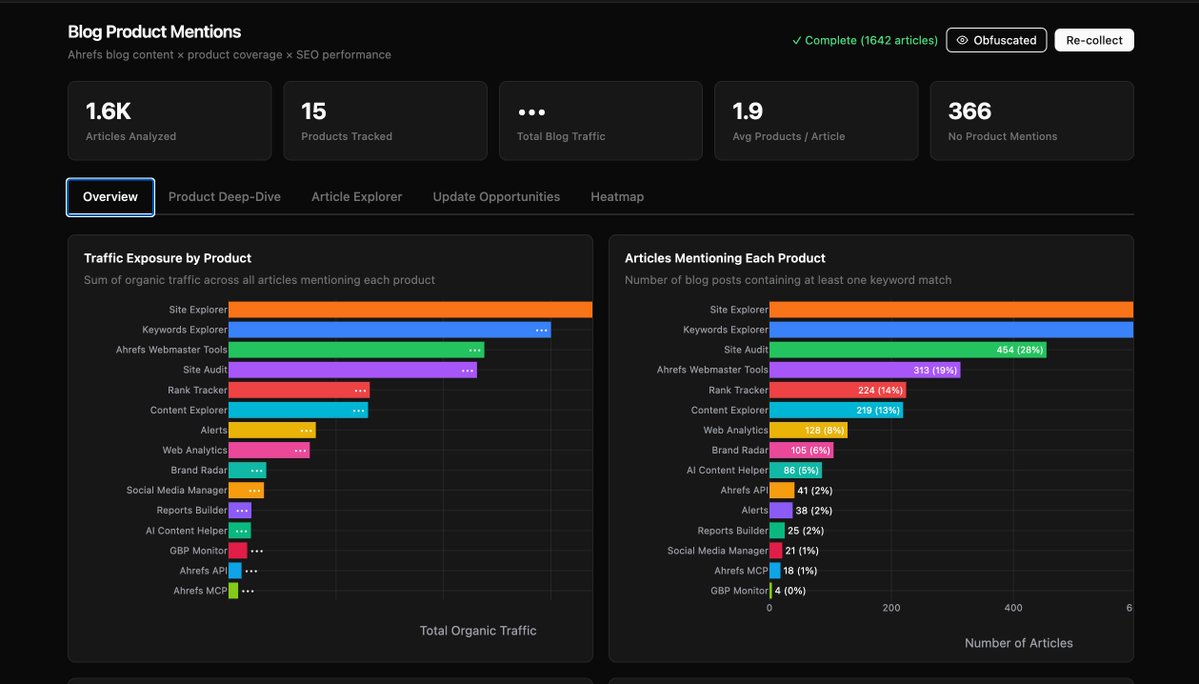
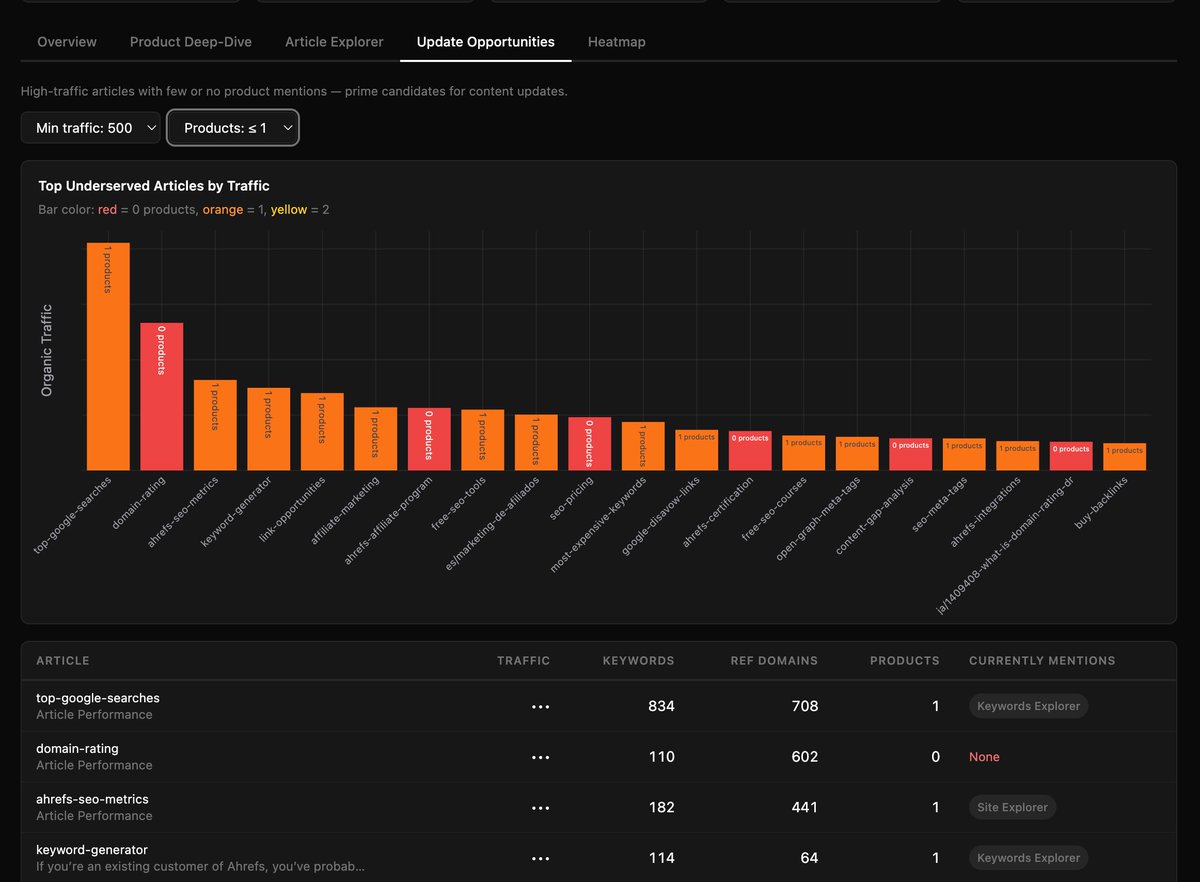
we have 1,642 articles on the .@ahrefs blog, and over 15 core products. but as it turns out: • 366 articles don't explicitly mention a single Ahrefs product(!!!) • Site Explorer appears in 47% of posts, but GBP Monitor just 0.2% • 50 articles get 500+ monthly organic traffic, but mention <2 products • our newer products (Brand Radar, AI Content Helper, Ahrefs MCP, Social Media Manager) appear in fewer than 6% of articles each content marketing exists to help sell your products, but it's actually pretty difficult to analyse how well your content is doing that job at scale (especially when you have multiple products and thousands of posts, like we do) well, no longer. i built a tool that: → scrapes your blog articles and extracts their full page content → analyses every article for mentions of each of your products → scores mention context and intensity (how heavily each product is referenced, not just yes/no) → pulls organic traffic, keywords, referring domains, URL Rating, and much more for every page → visualises which products get the most traffic exposure, which are barely mentioned, and where the biggest gaps are → creates a prioritized roadmap of content updates to boost the visibility of your most important products want this for yourself? easy: https://t.co/qJC691VoH8


@Rakshaweb3 ·
Your content strategy should do 3 things: Attract the right people Repel the wrong ones Convert the ready ones Most people only focus on #1 and wonder why their leads aren't qualified.
@Rakshaweb3 ·
If your content strategy doesn't include: → A strong point of view → Repeating your core message → Clear calls to what you offer You're building an audience, not a business.

@timsoulo ·
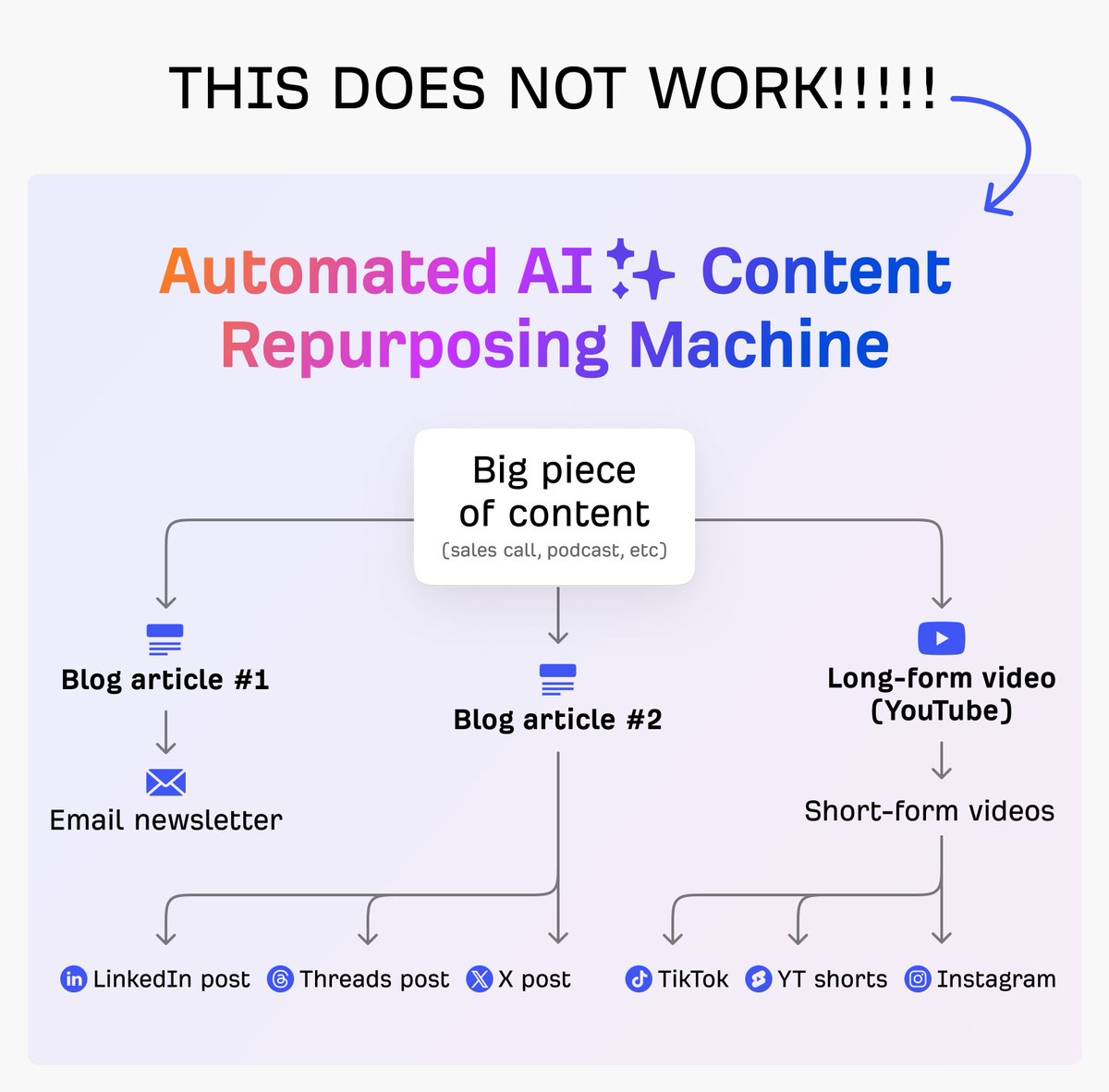
The biggest lie in content marketing is the "AI content machine" that automatically turns one big piece of content into ten small ones. Last year: ▪️ I got 9M+ impressions on my LinkedIn posts ▪️ Ahrefs Blog got 3M+ unique visitors ▪️ Ahrefs YouTube channel got 3.5M+ views …which hopefully gives me enough credibility to call out bogus content marketing tactics. Enter the problem: There’s this notion that you can take a single long-form piece of content (a sales call or a podcast interview) and use AI to break it down to lots of short-form content like social posts, articles and email newsletters. That works, yes. But the content you get is royal sh*t. That long-form piece of content just doesn’t have enough signal to break it down to lots of smaller pieces that would perform well. You're just spreading one vague idea thinner and thinner across different channels. So at @Ahrefs, we do the opposite. We turn SMALL into BIG: 1. Start with a LinkedIn post. Test your idea. Test the way you frame it. See if anyone cares. Read what people say in the comments. 2. If the post resonates, turn it into a full article. Use the comments as your brief. People literally tell you what's missing, what's confusing, what they want more of. 3. Take your five best articles and rework them into a conference talk. Five validated ideas in one presentation - that’s pure signal. 4. Then discuss that presentation on a podcast. New format, same proven ideas, but now with the depth of a real conversation. 5. Take a few presentations and you got yourself a video course. Get the idea? With every step you add more: more signal, more context, more depth. If you want to create meaningful content with AI, you should configure your "content machine" to work from small to big, not the other way around. …or at least that's what works for us at Ahrefs.

@semrush ·
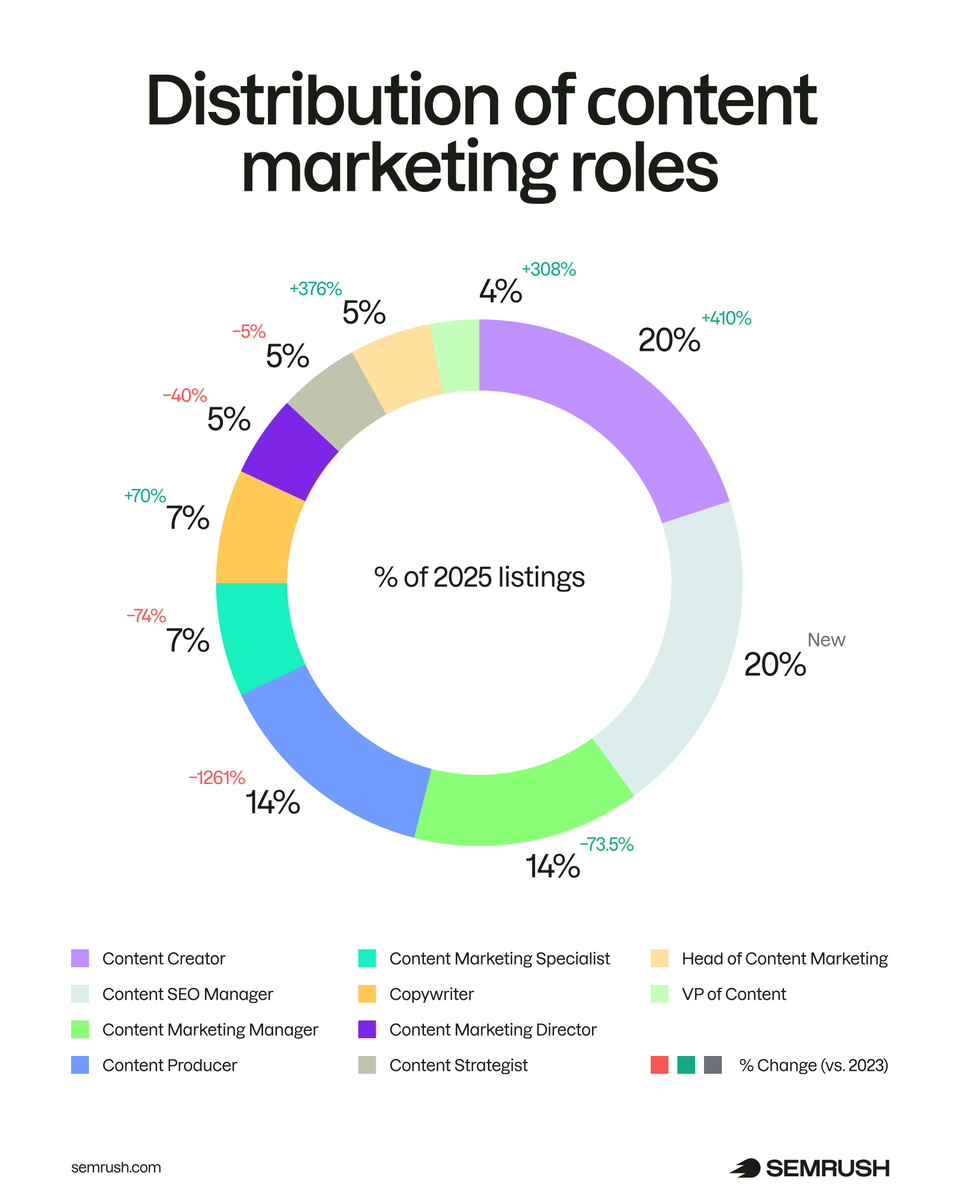
Content marketing hiring is shifting – and titles don’t fully reflect it. We analyzed 8,000+ job listings, and the pattern is clear: the bar is moving from “can you write?” to “can you build content that performs?” Top candidates in 2026 operate end to end. They connect audience insights → narrative → distribution → measurement – and iterate based on results. That’s why analytics, storytelling, and cross-functional collaboration consistently emerge as core requirements, whether explicitly listed or not. AI skills are increasingly expected, but they’re not the differentiator. Competitive advantage comes from judgment, strategy, and the ability to prove impact. If you’re hiring, define ownership around outcomes, not tasks. If you’re applying, show results – one strong case study is more effective than ten writing samples. Full analysis and key takeaways: https://t.co/8yyOxaOQyE.

@AnthonyGaenzle ·
The problem with copying someone else’s content strategy is that you also inherit their audience, goals, schedule, and personality. A strategy can work perfectly for them and make absolutely no sense for you.

@JamesonCamp ·
The highest leverage thing I’ve ever done in my life has been yapping on the internet I can literally attribute millions of dollars to it already and I’m hyper confident it will become the reason for 10s of millions more “But you just use AI to write your tweets” HA! You wish it was that simple… We all have Claude. How many people all of a sudden have a massive audience because of it? If it’s so easy, how come everyone doesn’t? A lot of my tweets I still just tweet from the hip. That’s personality. That’s just what I’m good at and I love doing it AI has maybe given me a 25% lift on the writing itself. The real edge is output and using data to understand what works so I hit bangers more often than not But it’s still trained on 6gb of my tweet data, I still have to feed it my ideas, spend 20 mins re-prompting and tweaking, then 5-10 mins cleaning it up by hand That’s the point. Great content marketers 10x their output with these tools. It doesn’t mean everyone is all of a sudden amazing It just raises the bar for what amazing looks like and it raises the bar for output This is why I’ve considered advising on GTM the content marketing. The expertise is still super important. It’s not just “use Claude”. If you wanna yap, just start yapping. The more you do it the better you get. AI is not going to do it for you. But if you get decent at it, and you only get decent through trial and error, it will 10x you

@DeRonin_ ·
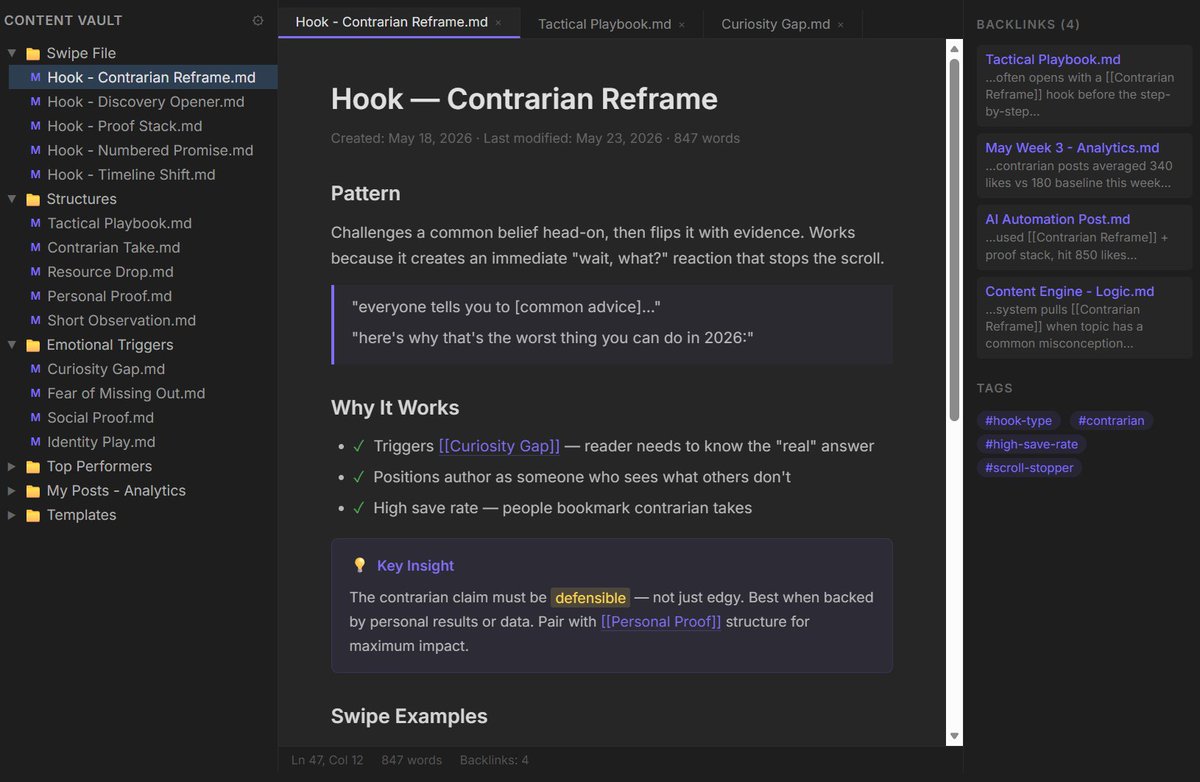
one underrated content strategy nobody talks about: building a memory layer for every piece of content that ever worked... let me explain every day on X you see a viral hook, a thread format, a post that blows up and you think "i need to remember this" most people bookmark it and never open it again or worse.. they screenshot 200 posts into a folder they'll never revisit here's what i do instead: every time i see a post that hits (mine or someone else's), i drop it into Obsidian with 3 things: > the hook and why it stopped the scroll > the structure (how it's built, what goes where) > the emotional trigger (curiosity, fear, proof, contrarian take) over time this becomes a living library of every piece of content that ever worked... not a graveyard of screenshots now when i sit down to write, i don't stare at a blank screen i open my vault, search by topic or format, and pull proven structures that already performed Content Engine runs on this exact logic.. it analyzes what worked, stores the patterns, and feeds them back to you when you need them the difference between creators who post consistently and creators who burn out is simple: one has a system, the other is guessing every time *so happy that i moved from second category to first (i've been stacked there for 2.5 years and it was burning out my potential) recommendation: start small.. next 7 days, save 10 posts that stopped YOUR scroll and tag them by hook type. that alone will change how you write

@onlinedopamine ·
here's a content strategy everyone can adopt the account in question promotes deel, which some of you might know for being a hr saas and others for their lawsuit anyways, this entire account is basically funny text overlays coupled with music and some light background action deel is then being plugged in the captions and in the bio find 3-5 of these accounts in your niche, film yourself, can use same song (esp if it's trending), then slightly adjust copy and caption

 Watch video
@ItsMeBenChan ·
Quote-retweeting your own article is an absolutely busted strategy on Twitter right now We’ve taken articles from 200 views and pushed them past 200,000 on multiple occasions Exact same article, just with a different angle on the quote retweet. A quote-retweet is NOT a repost. It’s your second chance to change how the reader sees the article before they even click on it. We tested this with a client in the sales space. Article was something along the lines of “20 lessons I learned in sales” Good content, barely any views. We quote-retweeted it from a different angle. Spoke to a different desire and handled a different layer of resistance. Added 25,000 views overnight. If you aren’t including articles in your content strategy you’re losing out on a ton of mental real estate

@neilpatel ·
AI doesn't eleminate all of the steps in content marketing, but it does make it 37.5% more efficient. On average, the 300 marketers we surveyed have 8 steps in their content creation process. When they use AI they on average are able to eliminate 3 of the steps.


@miracleadishi ·
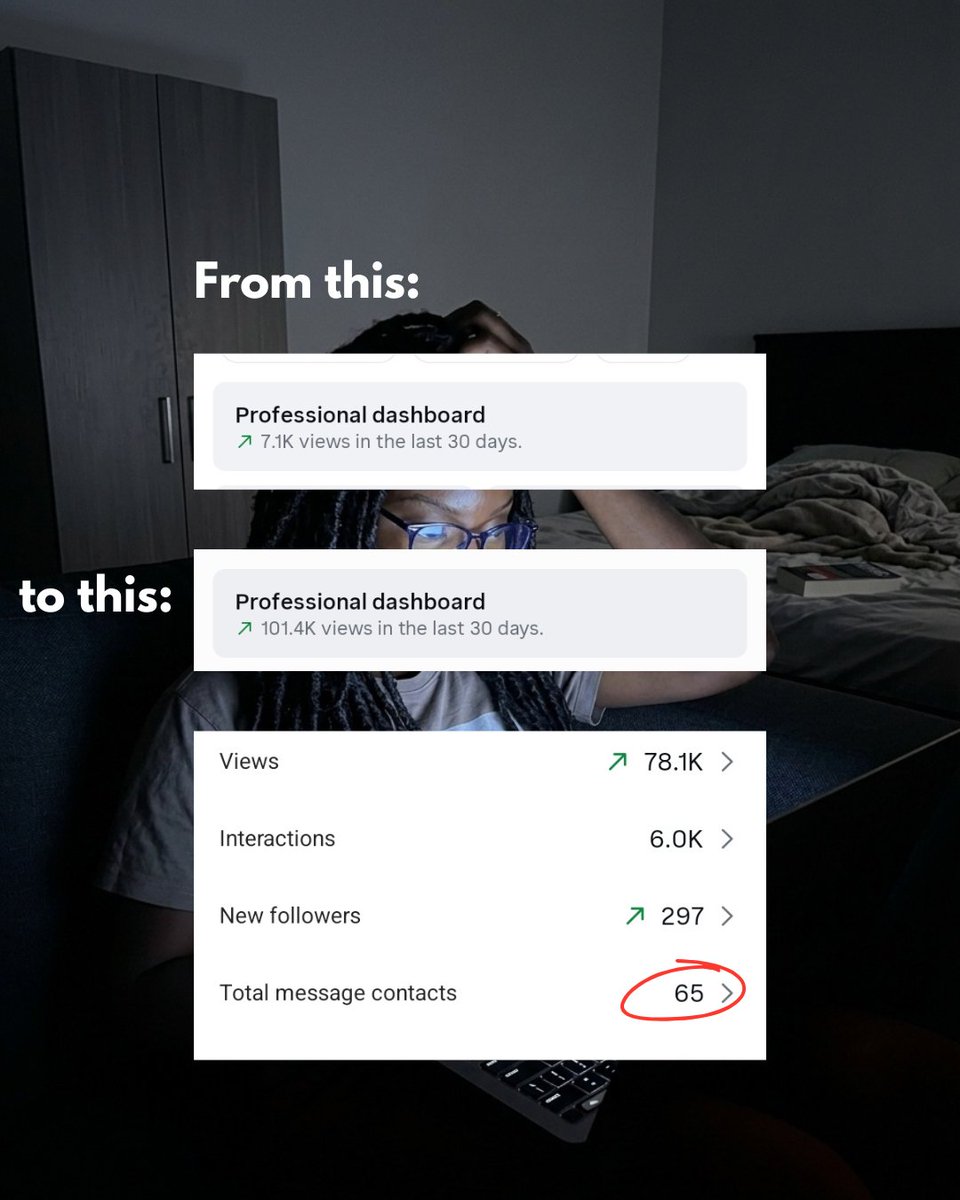
It took me 2 weeks to make this happen. Know the offer. Talk about the offer in "outcomes" language, because people like imagining themselves getting what they want. Explain it in a way that makes people feel like if they don't make a decision now, it might be too late. This is organic content that brought in 60+ messages. And more people are still sending messages to get the main offer my client created. That's how content marketing works. P.s a DTC brand. I work with brands that sells directly to the customer.

@FedotOff90 ·
Hot take: organic content doesn't scale ecom brands. Paid ads scale ecom brands. Organic content builds audiences. Audiences don't pay 3PL fees. I see founders spending 20 hours a week on TikTok organic hoping to go viral while their Meta ads are bleeding at 1.4x ROAS and they haven't tested a new creative in 6 weeks. That's not a content strategy problem. That's a priorities problem. The brands doing $100k/day are obsessing over their ad creative systems, their landing page conversion, their backend economics. Not their posting schedule. Organic is a bonus. Paid is the business.

@DougKennedy93 ·
One thing founders and executives consistently tell me: “I didn’t expect leads this fast.” People assume personal branding takes six months before it starts working. When you already have expertise, a clear offer, and the right strategy, results can come much sooner. Recent examples: • 5 booked calls in 24 hours for a tech founder raising capital. • 6 qualified leads for a commercial real estate executive. • First inbound lead within two weeks for two coaching clients. So what actually happens behind the scenes? 1. I start with a 60-minute deep dive. I uncover your expertise, biggest wins, ideal clients, offers, objections, and the stories only you can tell. Most importantly, I figure out why clients choose you over everyone else. 2. I define your positioning. I research your competitors, audience, market, content gaps, and LinkedIn presence. The goal is simple: make people instantly understand who you help, how you help them, and why you’re different. 3. I build your content strategy. Using my 4P Framework, I create a balanced mix of: • Personal posts that build trust. • Professional posts that teach. • Perspective posts that differentiate. • Proof posts that generate opportunities. 4. I create your content. I turn your stories, client work, expertise, and experiences into content that builds authority and earns attention. Every post has a purpose and sounds like you. 5. I build your messaging system. Attention creates conversations. Conversations create pipeline. I develop personalized outreach that starts meaningful conversations instead of sending generic pitches. When positioning, content, and outreach work together, LinkedIn becomes a business development engine. That’s why founders and executives are often surprised by how quickly the right opportunities start showing up.


@connorrolain ·
organic social is the one first marketing activity to do when launching a brand. make native iphone content that’s relevant to the category 👉 attract ICP 👉 get content distribution (views, engagement) going literally nothing else to do first. even branding. slap some $200 fiver branding on your ig and tiktok and post content while developing the real brand identity. imagine launching a product but you already have tens of thousands of followers and hundreds of thousands of views that aren’t getting the meta cpm tax and what does this do for your creator marketing strategy? creators are more likely to work with a pre launch brand w 30k followers and great distribution. and what does this do for your meta ads strategy? meta targets based on web traffic signal. organic web traffic seasons your pixel faster. this effect is the real sauce of organic social… organic social creates the best flywheel. “but i don’t know what to make” well don’t launch a product in a market you don’t know how to speak to “but i dont know how to make content im not creator” hire one! heck, hire 5! pay them $ per video. any brand can run fb ads or pay influencers… huge arb opportunity in organic social distribution and what it sets in motion.

@TheCoolestCool ·
Content marketing is a two-word industry. Content. Marketing. Most teams have mastered the first word and completely ignored the second. They’ll spend six weeks on a report and 40 minutes on the plan to get anyone to read it. You have to market the content. That’s the whole job.

@itsmarcosruiz ·
If you only read content marketing Twitter you're going to write like every other content marketing account. The best ideas I've had came from actually talking to people. Go outside your niche or your niche is all you'll ever be.
@TheCoolestCool ·
How to do better content marketing: 🤡 WHAT 80% DO: - Change the plan every quarter - Chase the latest trend - Set unrealistic goals - Overvalue quantity 🚀 WHAT THE TOP 20% DO: - Embrace collaborations - Start with research - Distribute forever - Goals driven - Experiment
@itsmarcosruiz ·
Most people's content strategy and their offer are two completely different conversations. Their posts talk about mindset and motivation. Their offer is a premium monthly service. The audience they're building has zero overlap with the audience that would buy. Then they blame the algorithm when nobody converts. Match the content to the buyer. If you sell to business owners doing $50K+/month, your content should sound like someone who operates at that level. Speak their language, their lingo. The follower count will be smaller but the sales will be bigger.

@rcmisk ·
hot take: your content strategy doesn't need to be better. it needs to actually exist. most founders post in bursts, go dark for two weeks, then wonder why nothing sticks. the algorithm doesn't care about your best week. it rewards your worst one.

@rushabtated4 ·
@vatsal_sanghvi cooked this overnight, and now we know the weekly content strategy of every app in our niche things we are tracking 1. no. of accounts and posting frequency 2. trends and video formats 3. top used and performing hooks

@alexabelonix ·
Content marketing works best when offers match risk level. No-risk offers: blogs, videos, podcasts, interviews Low-risk offers: ebooks, templates, guides, reports Higher-commitment assets: webinars, demos, trials Match the ask to the trust level.

@itspairaw ·
The customers who buy from a single twitter post almost never become your best clients This is something most founders don't realize until they've been running content for 18 months and start comparing their LTV by acquisition source The buyer who DMs you after reading one viral tweet is buying on impulse. They liked the energy of the post, the result you flexed, the confidence of the take. They bought a feeling The buyer who DMs you after watching you post for four months is buying on conviction. They've watched you handle objections in your replies, seen the consistency of your thinking, evaluated whether your worldview matches their actual problem. They bought you (no slave shit) These two buyers look identical on the day they sign They behave completely differently for the next 18 months The impulse buyer churns at 1 to 4 months. They tend to be more demanding because they came in hot. They expect immediate results because the post that hooked them implied immediacy. They blame you when their business situation is what's actually slowing things down The conviction buyer stays for 6 to 24 months. They're more patient because they understand the strategy before they buy. They refer you because they're psychologically invested in being right about choosing you. They renew at higher tiers because they trust you with more of their operation This has a counterintuitive implication for how you should think about your content Most founders optimize their twitter for the impulse buyer They write hooks designed to make a cold reader DM them within minutes Big number flexes, controversial takes, urgency-driven CTAs This produces a steady stream of low LTV customers who churn quickly and complain loudly The companies who build the best brands on twitter optimize for the opposite They write content designed to be the third or eighth or fifteenth post a buyer reads from them, not the first Their goal isn't to convert on a single post. Their goal is to be unforgettable across 30 posts so the eventual conversation is already pre-sold This is a totally different content strategy and produces a totally different business Here's how you do this for twitter: 1/ get traction from viral posts, as usual 2/ take the traction, nurture the views with longforms and proof of concept 3/ 1% of the people from your viral post will remain. They will become lifetime fans and soon buyers. Most founders never figure this out because the impulse buyer feels like proof the content is working. The DMs roll in, the deals close, the dopamine hits Six months later they wonder why their retention is bad and their average deal size keeps shrinking The content was working. But it was working for the wrong buyer

@kaleighf ·
I've spent more than $37,000 on video production and related professional services in 2026. Plus advertising spend I haven't included in that total. Reader: This is more than I made in an entire year at my first FT role out of college. I realize, in the grand scheme of marketing, this is a very small dollar amount for companies that have big budgets. But this is a lot for me. I never had to advertise my content marketing agency work because I had so many inbound referrals, which meant I never had to spend a dime on marketing my business. This is a whole new line item for me. Over the last 10 weeks, I went hard on in-studio video shoots, heavy edits, the polished thing. I got swept up in it. I told myself production quality was the differentiator, and I bought an expensive version of that belief. Guess what? It shrank my margin. This investment wasn't strategic (I don't regret the channel and am still invested in my YouTube presence); it was just that I optimized for how the work looked before I understood what actually drove the outcomes that got me paid. Thus far, the most valuable thing I've produced this year are my LinkedIn articles, which are really just a repurposing of my newsletter sends each week, which costs me a tiny fraction of what video does. I found that out after the invoices were paid. Woof. That said, it’s not going to stop me from doing more video work down the road. I do believe that video is the easiest format of content to digest, and it allows me to distill long-form ideas I'm covering in LinkedIn content into a much more accessible and digestible format.


@adrien_brbr ·
"Content marketing takes 12 months to work." My first paying customer came from a Reddit post. Day 30. I stopped posting in r/startups where founders clap for each other. Started posting in r/smallbusiness where owners complain about real problems. Content doesn't take 12 months. Posting to the wrong audience does.

@heyblake ·
There's a mental model I use called the Content Depth Ladder. Rung one is observations. "Positioning matters." "Content builds trust." "Your messaging should be simple." These are true and useless. Everyone agrees. Nobody acts on them. They generate likes from peers and zero pipeline from buyers. Rung two is frameworks. "Here's my 3-step process for positioning a SaaS company." Better. Now you're giving people something to use. Frameworks get saved and shared because they're transferable. But they're still one level above the interesting stuff. Rung three is earned insights. Things you can only know by doing the work. "I repositioned 30 companies and the ones that grew fastest all had one thing in common, their founder could explain the positioning in a single sentence while walking." This is where trust lives. You can't fake rung three because it requires real experience. Rung four is prediction. "Based on what I've seen across 200+ positioning projects, the companies that will win in the next 3 years are the ones positioning against AI, and here's the specific playbook." Rung four is rung three plus the ability to recognize what keeps showing up plus the willingness to bet publicly on a future outcome. Your content strategy should have a target rung for every post. If more than half your posts live on rung one, you're producing filler that feels productive.

@RossHudgens ·
Here’s how to successfully promote content on Reddit: Represent yourself authentically, as the brand. Attach a premium image that makes sense out of context of the post and would work as a standalone asset even if you never visited the website. Include a title that speaks in Reddit’s voice, while also intriguing the reader. Share content that’s unique and Redditors would love (unique data, news, behind-the-scenes takes), not a recycled keyword-focused post. Submit to niche, hyper-relevant subreddits only, and don’t overdo submission volume. Emphasize quality, not quantity. Overall, The Athletic does this well via their owned account. The submissions don’t always hit a home run, and that’s okay. They add enough authentic value that The Athletic never needs to be worried about being banned for their approach. That’s how you successfully scale a content distribution approach on the network.


@cem_hasoglu ·
I know a guy who got to $20M ARR with a podcast, a newsletter about the podcast, and clips from the podcast that's the whole content strategy most companies want a 40-slide deck and a 6-month rollout plan before they'll consider doing anything which is exactly why they stay invisible

@CliftonSellers ·
If I was the CEO of @perplexity_ai I would launch a founder-led content strategy that covered product + personal stories + future of AI That would funnel not only to the product but a community platform where they went over use cases + set up weekly mastermind calls Oh, and I would launch content-first strategies across as many employees as possible Organic is the future

@jonbrosio ·
The clearest path to knowing what content to make: what to say, who to say it to, what platform to say it on, etcetera; is to build the offer first and work backwards. The offer answers every question the content strategy couldn't.
@kaleighf ·
Content marketing used to be a play for brand awareness + keyword ranking. Now, with AI search, brands need to work to be known as the *topical authority* on their product/service within their niche + for their target customer. It should always have been this way.
 Watch video
@heyblake ·
Owning a lane is not the same as posting about a topic. The difference is what determines whether your content builds a pipeline or just builds a following. Posting about a topic means you cover it. Owning a lane means you have a position on it that no one else is willing to take. The first gets you impressions from people who follow that topic. The second gets you the specific buyer who has been looking for someone who thinks exactly this way. Those are different outcomes. Here's a framework I call the "Lane Test" Ask yourself: If someone asked your last ten clients why they hired you over every other option available, would they describe a topic or would they describe a perspective? Topics are interchangeable. Perspectives, not so much. A founder who posts about content strategy competes with everyone who posts about content strategy. A founder who has a specific and counterintuitive take on why standard content strategy thinking fails competes with no one. The lane is the perspective. The topic is just the address. So how do ya build a lane? 1/ Identify the belief your ideal buyer holds before they find you 2/ Find the version of that belief you disagree with 3/ State your disagreement publicly and consistently The buyers who agree with your version of the truth will self-select toward you. The buyers who disagree will leave. Both outcomes are great! Owning a lane requires a willingness to lose the wrong audience on purpose.
@miracleadishi ·
A client came to me with an aesthetic page on IG and Tiktok. But with dried DMs. Not even a "Please is this available in black" I could see the problem before they pointed it. I walked them through why they're experiencing such problems and how it is affecting messages from coming in. We changed one thing: stopped posting about the product, started posting about the person who uses it. That's where UGC content marketing comes in. Inquiries started entering that same month. Sometimes the customer using the product needs to be seen more than the product. This is only applicable for product based business as we have implemented the strategies I have shared with them and swang into action.


@suraj_sharma14 ·
New Content Strategy: Positioning as the Robinhood of Artificial Intelligence Objective: Adapt concepts, products, and best practices from Token Street (San Francisco/X/engineering community) for Main Street audiences (non-technical knowledge workers and executives). Key Topics for Clarification: - The distinction between loop engineering and graph engineering. - The definition of evaluations and their implementation for knowledge work. - The concept of model routing and its setup procedures. - The process of fine-tuning and methods for fine-tuning models. Request for Feedback: What are your recommendations? Which topics should be prioritized for coverage?

@thePhilRivers ·
Use ‘Little Bighorn’ emails to drive revenue without destroying your margins: → Restocks → Customer stories → Product spotlights → Content repurposing → Testimonial spotlights → Myths vs. facts content → Us vs. them brand comparisons Lead with content and throw in a soft sell CTA. Works like a charm.

@acagamic ·
🚨 Most experts have the wrong mental model of what makes someone the go-to voice in their field. We assume visibility is the product of consistency. Post more, stay top-of-mind, repeat. Wrong. Visibility is a positioning problem disguised as a volume problem. Your expertise is a vast web of connected reasoning - nuanced, hard-won, irreplaceable. But what you're publishing is just conclusions. You strip out every "why," every derivation, every chain of logic that actually makes your thinking different from someone with a tenth of your experience. The result? Your content looks identical to every other credentialed expert online. Not because you lack depth. Because you're only surfacing the surface. The fix isn't to post more. It's to make your reasoning visible: The specific, opinionated, first-principles thinking that connects your conclusions back to something real. That's not a content strategy. That's just positioning. When your audience can see *how* you think, not just *what* you think, you stop being one of many and start being the only one. Your expertise was never the problem. Burying its structure was.
@RossHudgens ·
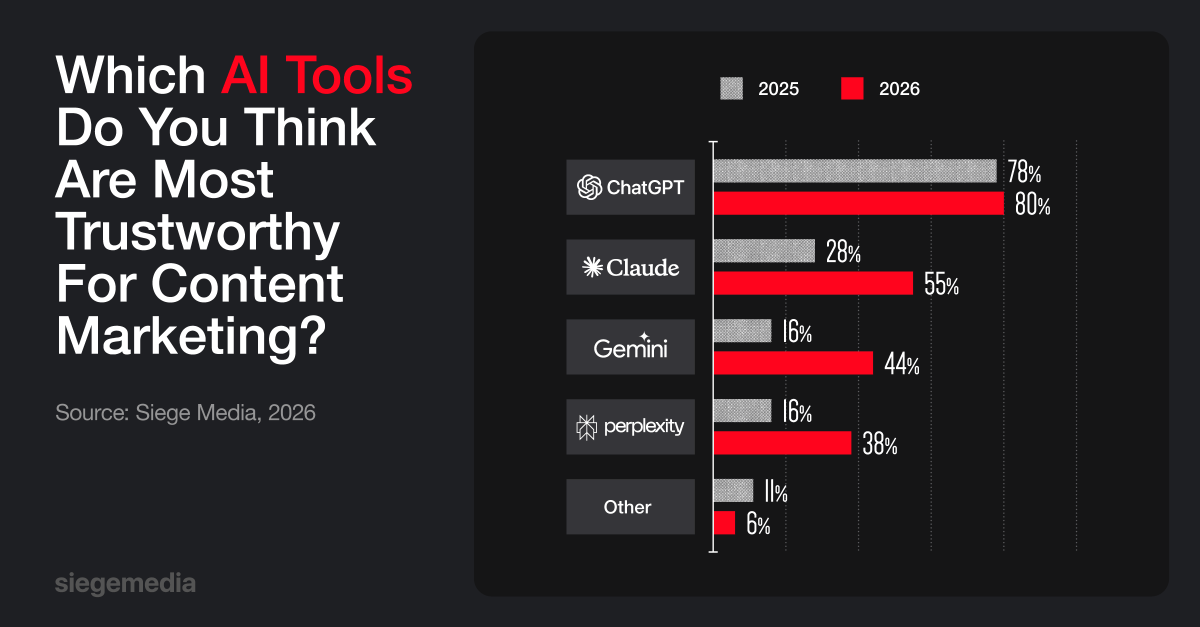
Content marketers' trust in Claude improved by 96% year-over-year. Trust in Gemini went up by 275%. In a multiple choice poll of 353 marketers, the overall theme is that trust in AI for content marketing went up significantly across the board.
@DougKennedy93 ·
A real content strategy isn’t “3 posts a week.” It’s: → what beliefs need to change → what objections keep repeating → what risk the buyer is trying to avoid That’s the stuff that actually drives pipeline.

@sharyph_ ·
the skill that will matter most in 2026 isn't content creation it's audience translation everyone's racing to learn the latest platform threads growth hacks viral reels formulas the newest AI content tool But here's what i've noticed working with creators: the people building real income aren't the ones with the best content skills they're the ones who can connect their expertise to actual audience problems Let me explain: i've seen "content experts" who can write circles around me create stunning visuals explain every algorithm but they can't sell a $97 product because they don't understand: → what their audience is actually struggling with today → why someone would pay for a solution vs. consume free content → what keeps their ideal customer up at night meanwhile i've seen creators with average content skills making $10K+ per month because they understand the audience problem first then create content that bridges to their offer the gap isn't creative anymore the tools are getting easier every month AI writes better posts than most creators canva designs anything in minutes the creation part is solved what's NOT solved: knowing which problem your audience will actually pay to solve understanding what transformation they're really buying translating "i want to help people" into "here's the specific outcome worth $200" that's audience translation not content expertise market understanding the best creator businesses i know: → spent time in their audience's shoes → understand the real pain behind surface problems → learned content as a tool, not an identity → can speak to beginners and experts in the same post the worst ones: → learned content creation first → have no audience context → build beautiful content nobody buys from → wonder why followers don't convert specialists go deep on one skill translators connect expertise to transformation content skills are becoming a commodity audience understanding is becoming the moat the creator who understands: their niche's daily frustrations AND content strategy what transformation is worth paying for AND how to package it the gap between free value AND paid solutions beats the creator who only understands content every single time because audiences don't buy content they buy solutions to problems they're struggling to solve and only someone who understands their world knows what those problems actually are stop trying to be the best content creator in your niche start trying to be the one who understands what your audience actually needs that's the game now
Best Content Marketing tweets
Xholic studies what works in your niche, drafts posts in your voice and schedules them for the hours your audience is online.
$0 today · Cancel anytime
Browse all tweet collectionsKeep exploring