Most X users don’t need more hashtags. They need a better decision about when a hashtag earns space in a post at all. A practical Twitter hashtag strategy uses one or two highly relevant tags, and sometimes uses none, depending on whether the post needs niche discovery, event participation, community signaling, or simple categorization. Generic “best hashtags” lists usually create clutter because they ignore the post’s intent, audience, timing, and conversation context.
X, formerly Twitter, is a conversation platform first. Hashtags can help people find a live topic, recognize a recurring community, or follow a coordinated campaign, but they won’t rescue a weak hook or replace replies, quote posts, useful ideas, and audience fit. The workflow below treats hashtags as a testable distribution choice, not a decoration added at the end.
Why Most Hashtag Advice Fails on X
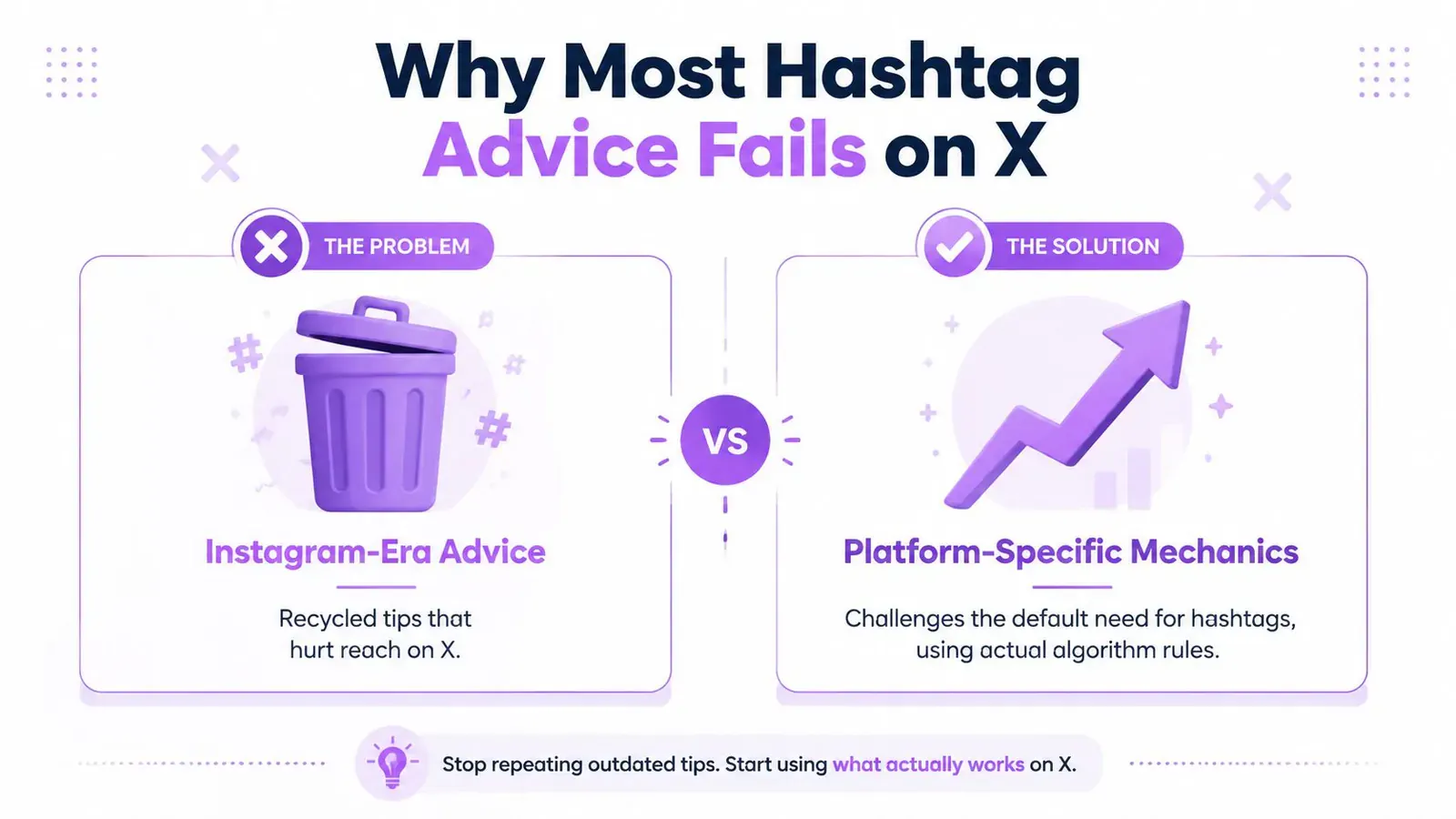
The assumption that every post needs hashtags comes from advice built for other platforms. On X, a hashtag can open a discovery path, but it can also interrupt a clean sentence, make a post look promotional, or attach your message to a noisy stream where the audience has little reason to care.
That doesn’t mean hashtags are useless. Twitter said users were sending more than 125 million hashtags per day when the hashtag reached its 10th anniversary in 2021, a scale that turned hashtags into a major public attention layer rather than a minor labeling feature. That volume made topic clustering, trend participation, and conversation monitoring strategically relevant, while also making broad tags harder to use precisely. (Mashable’s coverage of Twitter’s hashtag milestone describes that evolution.)
The three jobs a hashtag can do
Before adding a tag, assign it one clear job:
- Discovery: Help a person searching for a narrow topic find your post.
- Community: Signal participation in a recurring discussion, event, or audience group.
- Categorization: Clarify what the post covers, especially when the topic could be interpreted several ways.
If a tag doesn’t support one of those jobs, skip it. A post about a founder’s pricing lesson probably doesn’t need a pile of broad labels. A post responding to a scheduled community chat may benefit from its official tag because the tag acts as the room identifier.
Recurring hashtags deserve special attention. A computational study of Twitter communities found that hashtags used in recurring contexts, including television discussions and weekly community chats, were at least 6.5% more engaging than other hashtag types on average. The research also found that periodically recurring chats were about 130% more engaging than other periodically occurring hashtags. (The ICWSM computational study connects that result to familiarity, rhythm, and community expectation.)
Practical rule: Add a hashtag when it gives the reader a useful route into a conversation. Don’t add one merely because an empty space remains in the character count.
Three common failure modes
Generic volume tags place your post beside too much unrelated content. A broad tag may look discoverable in theory, but relevance matters more than apparent popularity.
Keyword thinking treats hashtags like search-engine keywords. On X, a tag often works better as a social signal. It tells people which conversation you’re joining, not just which words appear in your post.
One strategy for every format creates friction. A live event update, a founder lesson, a product announcement, and a reply to a niche expert have different distribution needs. A strong explanation of the X algorithm can help you think beyond tags and evaluate the broader signals your post needs.
The Hashtag Types That Drive Engagement
A hashtag portfolio works best when each tag has a defined job. Choose one to reach a niche audience, coordinate an event conversation, organize a campaign, or give existing followers a consistent label. The decision should follow the post’s goal and the community you want to join.
A longitudinal Swedish study reported that users tweeting with hashtags gained 2.88 followers on average, compared with 0.88 for users tweeting without hashtags. (The Swedish study provides that comparison.) The finding does not predict the result of every tagged post. It does show how active, relevant hashtag communities can connect topic visibility with audience growth.
Five functional categories
Branded hashtags identify a product, project, or recurring series. They help collect customer posts and organize launches. Discovery remains limited until an audience recognizes the brand or begins using the tag.
Niche community tags connect a post with people who share a specific interest. Tags such as #BuildInPublic or #IndieHackers fit posts that contribute useful ideas, progress updates, or questions to those communities. The tag’s value depends on genuine participation within the group.
Trending and event tags provide access to a live conversation. Use them when the post adds timely information, a clear opinion, or a useful response. A trend that generates impressions without relevant replies may produce little business or audience value.
Descriptive tags label a topic, such as #SaaS or #AI. They can clarify context, especially when the subject is ambiguous. Broad labels often add less reach or engagement than a precise community or event tag.
Campaign-specific tags coordinate posts from multiple people or organizations around a defined initiative. They work best when participants use the same phrase repeatedly. Without shared activity, the tag remains a label without a dependable audience.
| Hashtag Type | Primary Function | Engagement Impact | Best Use Case |
|---|---|---|---|
| Branded | Identity and collection | Useful for existing audiences | Product series, customer posts, launches |
| Niche community | Belonging and discovery | Often stronger when the community is active | Founder, creator, technical, or professional discussions |
| Trending or event | Live conversation access | Variable, relevance-dependent | Conferences, breaking discussions, broadcasts |
| Descriptive | Topic clarification | Often limited when broad | Clarifying an ambiguous subject |
| Campaign-specific | Coordination | Strongest with repeated, shared participation | Advocacy, launches, challenges, organized campaigns |
Context can change the outcome. A 2024 climate-related hashtag study found that certain categories connected to sustainability, COVID-19, and digital strikes generated more engagement and connective actions in that setting. (The study of hashtag activism and climate-related tweets shows why popularity and effectiveness require separate evaluation.)
A hashtag can also serve as a coordination point at considerable scale. One neurology community tag produced 216,558 posts from 61,326 users and more than 11.1 million impressions in 12 months, according to the cited analysis. (The longitudinal hashtag analysis documents that example.) Evaluate the activity, relevance, and participation around a tag before adding it. A generic list cannot show whether the community will respond to your post.
How to Research Hashtags for Your Niche
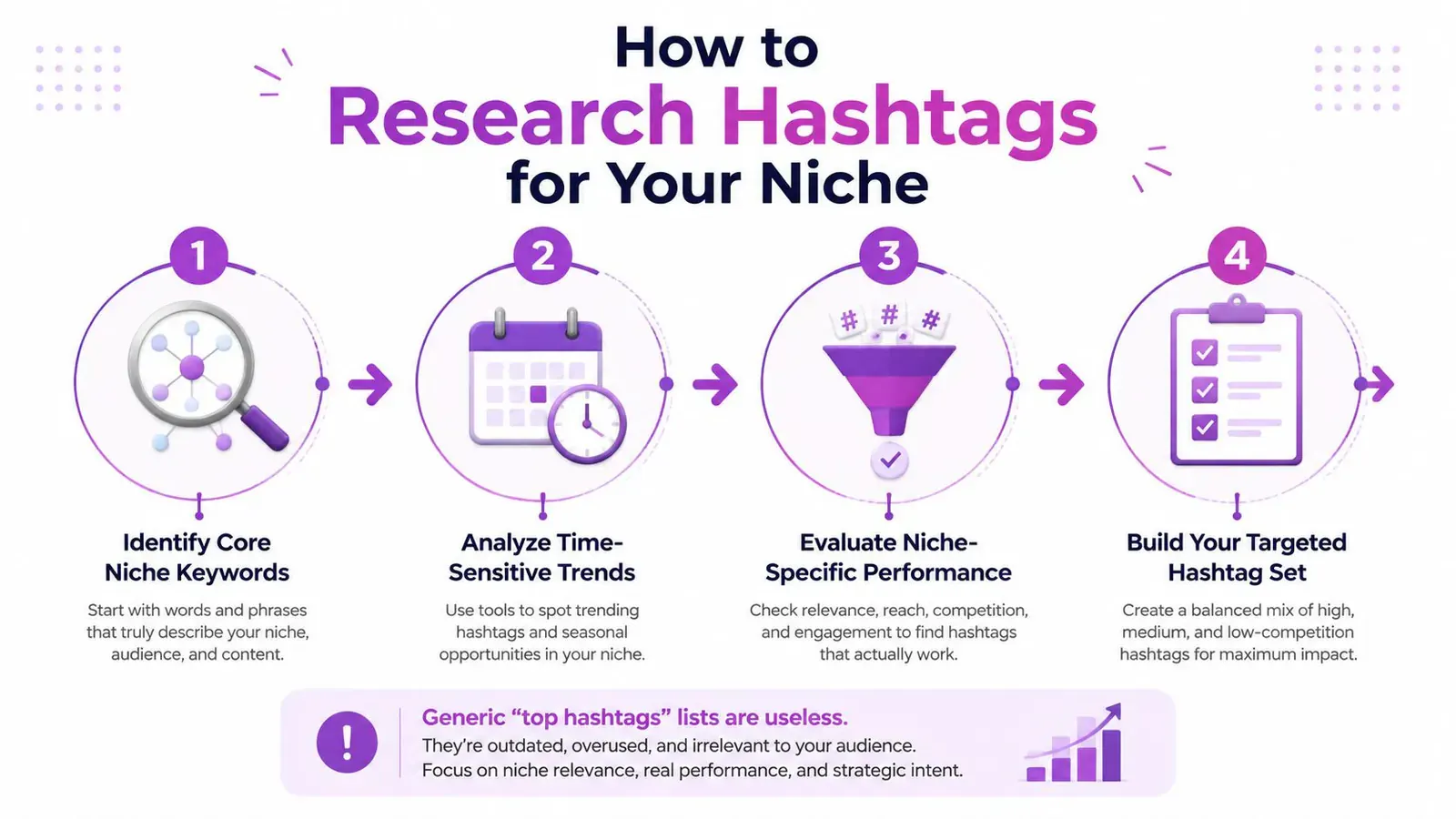
Generic “top hashtags” lists are weak starting points since they strip away the context that makes a tag useful. Begin with the people and conversations you want to reach, then identify the language those users already choose. The goal is a short list of candidates you can test, not a large collection that makes every post look crowded.
Build a working hashtag bank
-
Start with native search. Search a narrow topic and inspect recent posts, not only popular results. Try combinations such as
#buildinpublic pricing,#indiehackers launch, or#SaaS onboarding. Record recurring tags used by people your audience already follows. -
Study peer accounts. Review competitors, customers, and respected practitioners. Find tags attached to their strongest conversations, while separating correlation from cause. Record the topic, format, timing, replies, and whether the tag shaped the conversation or merely appeared beside it.
-
Watch community hubs. Lists, Spaces, event threads, and reply chains show how people use tags in live discussions. Search by meaning as well as by hashtag. Relevant posts may discuss your topic without including any tag.
-
Check recent activity manually. Open each candidate and review recent posts for relevance, real discussion, and genuine participation. A feed dominated by unrelated promotion or low-quality automation signals poor audience fit.
-
Organize candidates by intent. Separate community, event, campaign, product identity, and topic-description tags. Add a brief note stating the job each candidate might perform.
A simple spreadsheet keeps the review consistent:
| Candidate Tag | Audience | Intended Job | Recent Relevance | Test Notes |
|---|---|---|---|---|
| Tag name | Who uses it | Discovery, community, or category | Active, mixed, or weak | Posts and outcomes to review |
For larger research projects, structured collection may be more practical than manual browsing. Scrapfly’s X (Twitter) data scraping guide explains approaches for gathering public X data responsibly for analysis. Follow platform rules, and treat collected counts as context rather than evidence that a tag caused engagement.
Finish with a small, usable set. Keep candidates that repeatedly match your niche, and remove tags attracting irrelevant posts, stale activity, or audiences that rarely respond to your content. X’s advanced search helps narrow the review by words, accounts, dates, or engagement signals. The guide to advanced search on mobile shows how to configure those filters. Test the remaining tags against comparable posts, then retain the ones that improve qualified discovery or conversation rather than just increasing visual activity.
Placement and Frequency Rules That Work
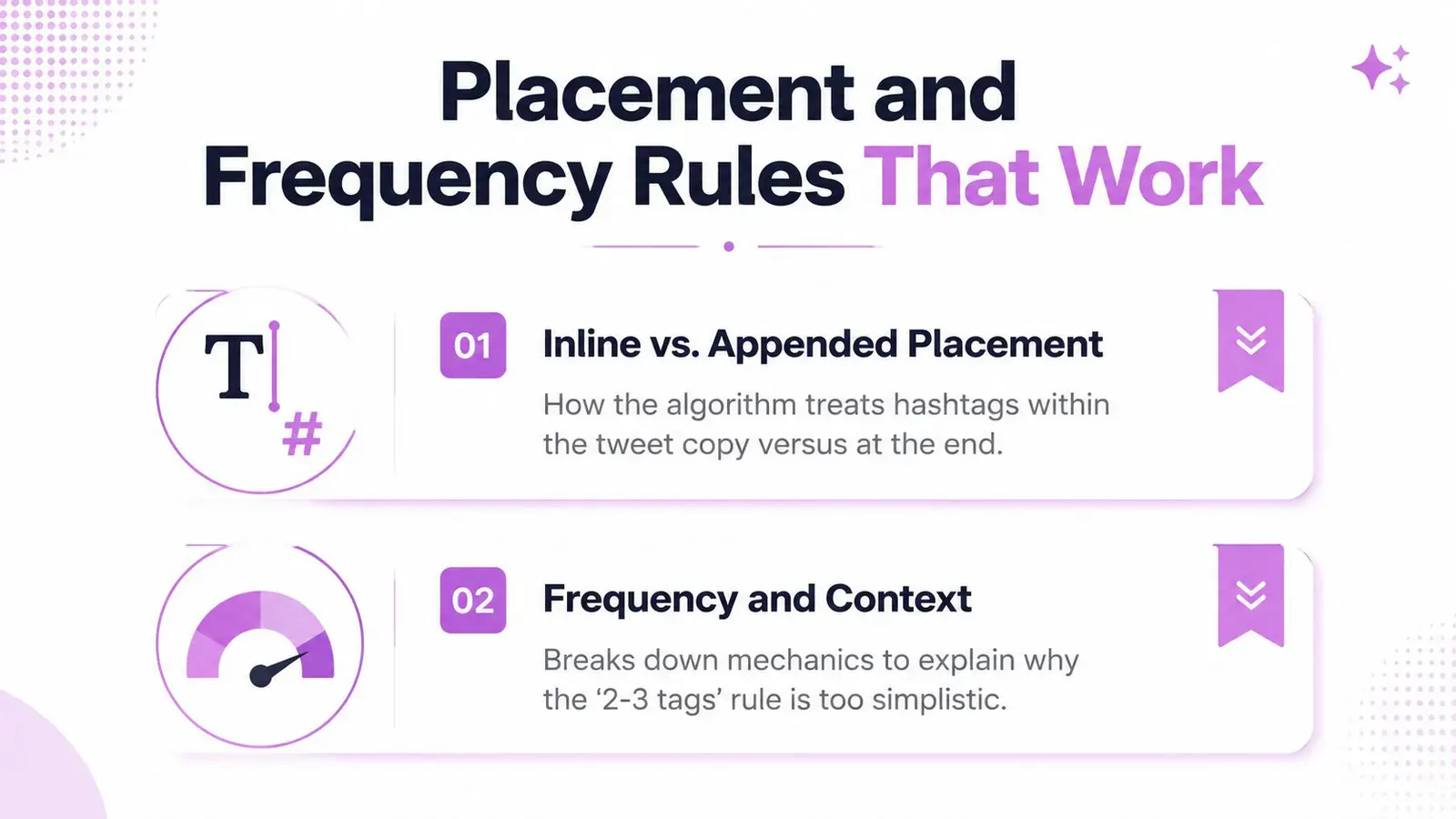
Treat hashtags as a distribution choice, not a posting requirement. A practical starting point is one or two highly relevant hashtags per post. Independent summaries of hashtag-performance research report weaker engagement once posts exceed two hashtags, while one-hashtag posts often outperform broader counts. (The cited hashtag strategy review describes the finding and presents selection as a precision problem.)
Use fewer tags when the post already has a clear audience or strong hook. A discovery-led event update benefits from an official tag, while a polished founder observation often performs better without one. Community education may gain from a niche tag, provided it identifies the subject instead of decorating the copy.
Match placement to the post
Inline placement suits a tag that belongs in the sentence and is immediately understandable. “I’m sharing the onboarding teardown in #BuildInPublic” reads naturally because the tag names the context rather than adding an unrelated label.
End placement protects the main thought’s readability. Choose it for an event or community identifier when the post remains clear without the tag.
First-reply placement keeps the published copy visually clean while offering a route into a topic stream. It works best when the tag supports discovery but is not needed to interpret the post.
Put the claim, question, or useful detail first. A row of tags before the hook can push the substance below the initial mobile scan and make the post resemble an advertisement.
A clean post with no hashtag is often stronger than a crowded post with two irrelevant ones.
Use a frequency policy, not a superstition
Set the rule by content objective:
- Pure insight or storytelling: Test zero tags first.
- Niche education: Add one precise community or subject tag when it expands qualified discovery.
- Live event coverage: Use the official event tag when the post contributes to the conversation.
- Campaign coordination: Apply the campaign tag consistently to relevant posts.
- Product promotion: Use a branded tag for a real series, launch, or customer discussion.
Rotate tags when the topic or audience changes, not merely to create visual variety. Keep the policy flexible enough to remove a tag when it adds no clear job. The guide to posting frequency on Twitter provides broader publishing context, but your hashtag decisions should still follow post-level testing rather than a rigid schedule.
Measuring Hashtag Impact with Real Experiments
Impressions show distribution, but they do not reveal whether a hashtag drove discovery, whether the topic pulled readers in, or whether timing played the larger role. Treat each tag as a variable to test, not as proof that a post performed well.
Keep the content and publishing conditions as similar as practical. Compare posts with and without hashtags, or compare one precise tag with another, then review replies, profile visits, follows, bookmarks, and link activity alongside impressions.
A simple test design
| Experiment Element | Control Group | Test Group | Success Metric |
|---|---|---|---|
| Hashtag presence | Same style of post with no tag | Same style with one relevant tag | Profile visits, replies, follows |
| Tag choice | One niche tag | One event or campaign tag | Relevant replies and audience quality |
| Placement | Tag omitted or placed in reply | Tag included in post copy | Readability and discovery indicators |
| Content objective | Insight post | Similar insight post | Outcome tied to the post’s purpose |
One post cannot establish a winner. Publish enough comparable examples to identify a repeatable pattern, keeping the topic, audience, timing, and format as consistent as possible. X does not publicly expose every detail of distribution, so analytics support a working hypothesis rather than a complete explanation.
Track the right signals
Discovery signals include impressions from people outside your existing audience, profile visits, and follows that arrive with relevant topic participation.
Conversation signals include replies from people who understand the niche, quote posts that add context, and bookmarks that indicate future usefulness.
Business signals include link clicks, qualified replies, and product-page visits. Use tagged links when appropriate, so downstream activity can be compared without assigning every visit to the hashtag.
A hashtag analytics workflow can supplement native reporting. Trendy’s guide to boost engagement with Trendy offers a framework for organizing hashtag observations, while the decision should remain tied to your account goals and audience.
Keep an experiment log with four fields: hypothesis, variable changed, observation window, and decision. A tag appearing on a high-performing post may reflect a strong topic or a live event rather than the tag itself. Separate normal posts from trend-driven posts before drawing a conclusion.
For broader metric definitions and reporting habits, use this guide to Twitter analytics metrics. Review the results at a consistent interval, record the next test, and remove tags that repeatedly add no qualified discovery or business value.
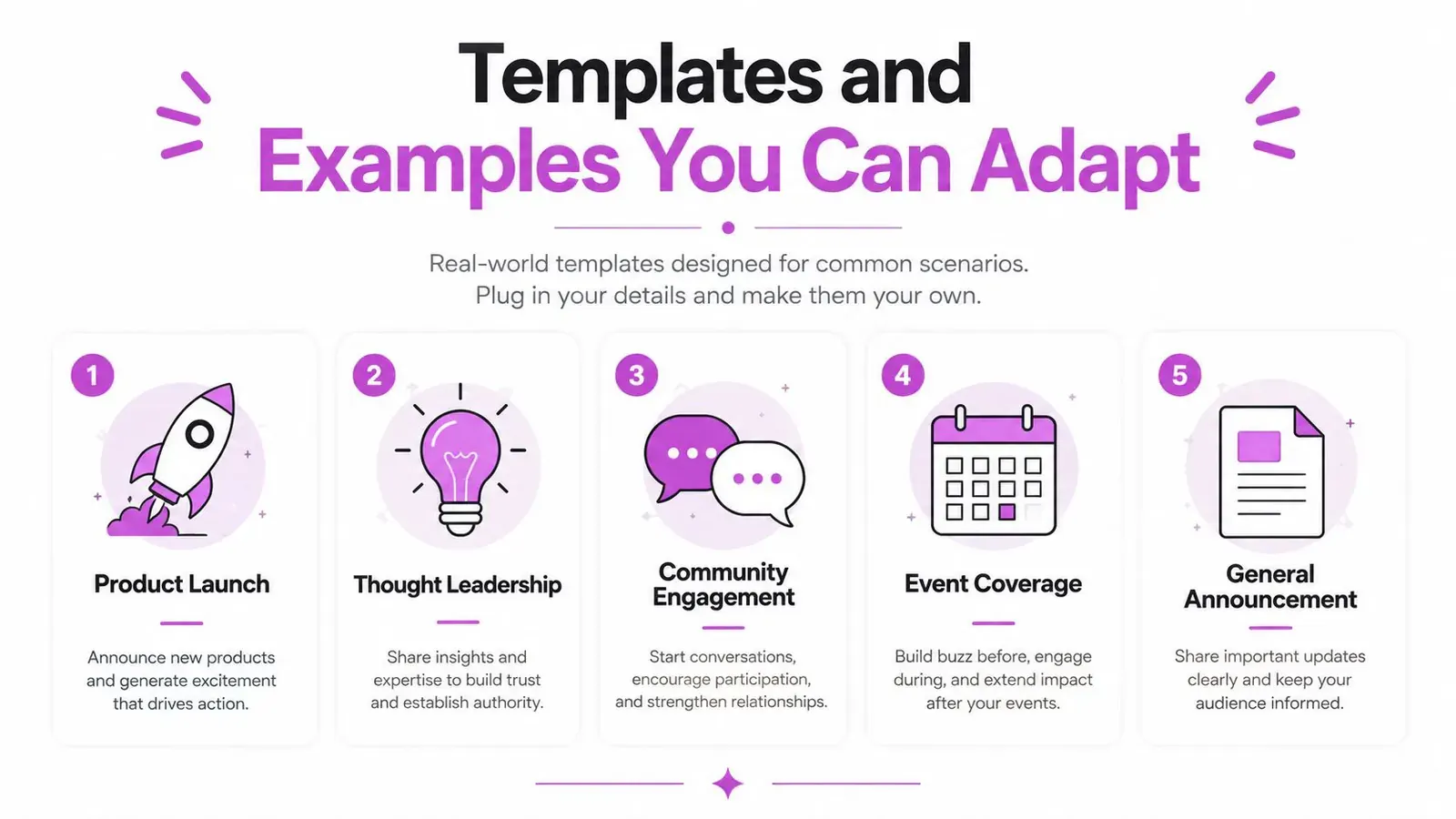
Templates and Examples You Can Adapt
Templates work best as constraints, not scripts. The tag should support the post’s purpose, and the copy should still make sense if the reader ignores the tag completely.
Product launch
Structure: Lead with the problem, explain what changed, then add one branded or niche tag.
We rebuilt our onboarding flow around the first successful outcome, not the signup screen. The new version helps users reach value with fewer confusing choices. #BuildInPublic
Use a branded tag only if customers, teammates, or launch participants will use it too. A new brand tag without coordination won’t create an audience by itself.
Thought leadership thread
Structure: Put the argument in the opening post and leave hashtags out unless the thread belongs to a defined community.
Most pricing advice starts with competitor research. I’d start with the moment a customer decides the problem is expensive enough to solve.
A thread already asks readers to follow a sequence. Extra labels can distract from the argument. If the topic belongs to a recurring community, add one relevant tag to the final post or first reply.
Community engagement
Structure: Ask a specific question, mention the relevant community, and use one established niche tag.
Indie hackers, what’s the first activation event you track after signup? I’m comparing product habits, not vanity metrics. #IndieHackers
The question does the engagement work. The hashtag helps identify the room.
Event coverage
Structure: State what happened, add an observation, and use the official event tag.
The strongest lesson from today’s founder panel wasn’t about acquisition. It was the repeated focus on removing steps between interest and first value. #EventName
Replace #EventName with the event tag only after checking that it’s the one participants use.
Niche education
Structure: Teach one narrow idea and add one descriptive or community tag if it helps the intended audience find the explanation.
A product demo should answer one question before it lists features: what can the user do now that they couldn’t do before? #SaaS
Build your own library around three layers: audience, problem, and conversation. Add a small set of branded candidates, then keep a rotating collection of niche tags organized by post objective. Don’t copy a competitor’s full stack. Their authority, audience relationships, timing, and content quality may be doing most of the work.
Streamlining Your Workflow with Xholic
A reliable hashtag workflow handles four tasks: finding relevant conversations, studying examples, scheduling controlled variations, and recording outcomes. The operator chooses whether a post needs a tag, which conversation fits, and what result justifies repeating the approach. Tools reduce browsing and bookkeeping while leaving that judgment with the person running the account.
Xholic AI supports this process with personalized context and memory. Its Context settings hold your style guide, About You, products, interests, and rules, and replies also learn from your past replies, posts, and edits. Recommendations can therefore stay tied to your positioning instead of producing generic hashtag bundles.
For research, the Inspiration Library, with more than 12 million indexed tweets, provides semantic search across posts, hooks, formats, creators, and topics. Send a successful post to Ask Xholic to break down its hook, structure, tension, flow, and payoff. Tweet Remixer then helps adapt the underlying idea to your product, audience, and voice instead of copying the original.
Human review remains part of the workflow. You edit, approve, or reject each suggestion before publishing. A tool can spot topical relevance, but you still need to judge whether a live conversation suits your reputation, relationships, and current business objective.
Use Smart Scheduler to plan approved variants and compare similar posting conditions. Collections can keep tags beside the posts that used them, while the streak heatmap in Analytics supports a consistent review habit. Engage feeds can surface relevant posts when a thoughtful reply offers more value than adding another hashtag.
Xholic AI helps assess hashtag need, select worthwhile conversations, and turn tested patterns into context-aware drafts. Visit Xholic AI to research, review, schedule, and improve your X growth workflow while retaining control over every published post.