You’re staring at a blank X profile, or posting about everything from startups to productivity to personal finance, and wondering why nobody knows what to follow you for. The right way to choose a Twitter niche is to find the overlap between your real experience, active audience demand, and a steady supply of daily conversations on X, then test that niche before committing. Don’t choose a topic because it sounds profitable. Choose a specific audience, a useful outcome, and a repeatable angle you can prove through consistent posts, replies, impressions, engagement, and follows.
Why Most People Pick the Wrong Niche on X
Niche selection isn’t a permanent identity decision. It’s a hypothesis about where your experience and an audience’s attention might overlap. Treating it as permanent makes creators overthink the label, while treating it as testable lets them gather evidence before spending months building around the wrong topic.
The most common mistake is choosing a broad category such as “marketing,” “fitness,” “finance,” or “AI.” Those labels describe subjects, not positioning. A stronger niche identifies who you help, what you help them do, and the perspective you bring. “Marketing” is vague. “Organic acquisition for early-stage SaaS founders” gives you a defined audience and a clear set of problems to discuss.

Audience fit matters
X has a concentrated audience that affects which topics have a natural starting advantage. In 2026, X’s global user base was estimated at 557 million monthly active users, with the largest age band at 25–34 years old, 37.5%, and a gender split of about 64.4% male to 35.4% female, according to Sprout Social’s social media demographics data. That profile can align well with business, technology, startups, investing, news, and creator education.
This doesn’t mean lifestyle or entertainment niches can’t work. It means you should understand the platform’s audience before choosing a lane. In the U.S., 21% of adults said they ever use X, while usage reached 33% among adults aged 18–29, 25% among adults aged 30–49, and 10% among adults aged 65+, as reported in the same source. Your niche should match the people who are likely to see and value your posts.
Conversation flow is the real test
A niche can look attractive in a spreadsheet and still fail on X if nobody discusses it regularly. Before committing, search for fresh posts, active replies, recurring questions, product launches, market changes, and disagreements that create natural opportunities for commentary.
If you’re exploring video creation as part of a broader creator niche, TransClipper’s vlogging starter guide can help you understand the practical problems beginners face. Those problems may become useful content angles, such as documenting equipment decisions, editing workflows, or audience-building lessons.
Your profile should make the lane obvious in seconds. Avoid vague bios, and use these Twitter bio mistakes to avoid when you turn your niche into a clear public promise.
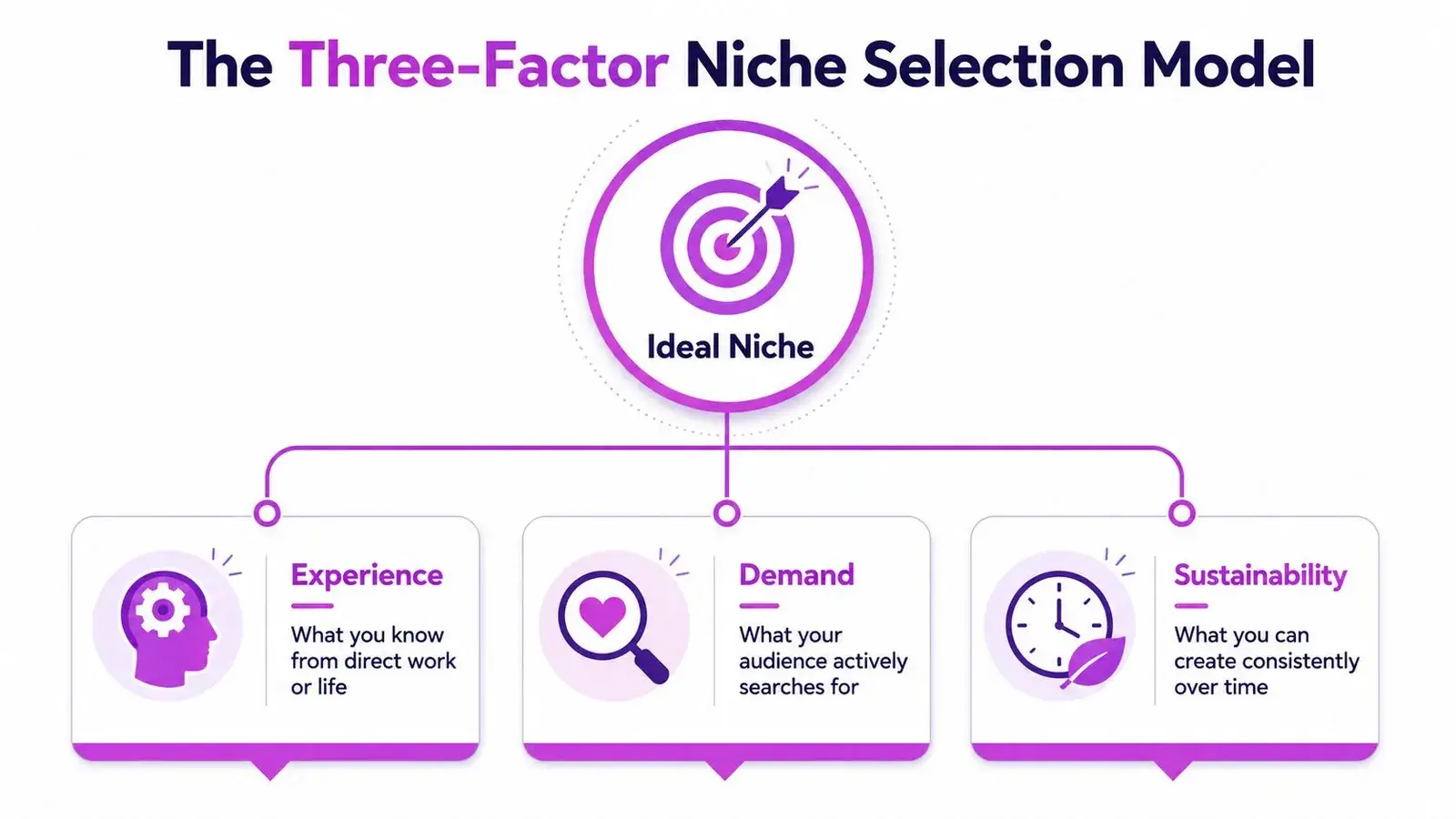
The Three-Factor Niche Selection Model
A viable X niche sits at the intersection of experience, demand, and sustainability. Remove any one of those factors and the niche becomes fragile. You might know the subject but have no audience, find demand but lack credibility, or attract attention briefly and then run out of ideas.
Start with experience
List 10–15 topics drawn from your work, projects, mistakes, research, or lived experience, following the framework described by AutoTweet’s niche strategy guidance. Don’t limit the list to formal expertise. A founder can write about customer interviews, failed launches, pricing decisions, hiring, distribution, and product development. An analyst can write about research methods, data interpretation, industry changes, and common analytical errors.
Look for experiences that give you access to original observations. “I’m interested in AI” is weak. “I’ve tested AI workflows for customer-support teams” gives you a source of specific lessons, examples, and opinions.
Translate demand into a concrete audience
Demand isn’t just a popular keyword. It appears as repeated questions, active conversations, unresolved pain points, and people asking for recommendations. Search X for the topics on your list, then inspect whether recent posts receive meaningful replies and follow-up questions.
Turn broad subjects into sub-niches by combining an audience with an outcome:
- Broad: Startup marketing
- Sharper: Distribution systems for bootstrapped SaaS founders
- Broad: Crypto
- Sharper: On-chain research methods for independent analysts
- Broad: Creator education
- Sharper: Short-form video systems for technical founders
Test sustainability before you publish
Convert your list into 3–5 repeatable content pillars, then write a one-sentence positioning statement. A useful structure is: “I help [audience] achieve [outcome] through [specific perspective or method].”
For example: “I help indie hackers find their first repeatable acquisition channel through public experiments and teardown-based lessons.” If you can’t generate a set of distinct post ideas from the statement, the niche is either too narrow or not connected to enough real experience.
Decision rule: Choose a niche you can explain clearly, support with firsthand insight, and continue discussing when the initial excitement disappears.
A niche can also support a business, newsletter, consulting offer, or product. This guide to Twitter monetization is useful once you’ve connected your audience’s problem to a legitimate offer.
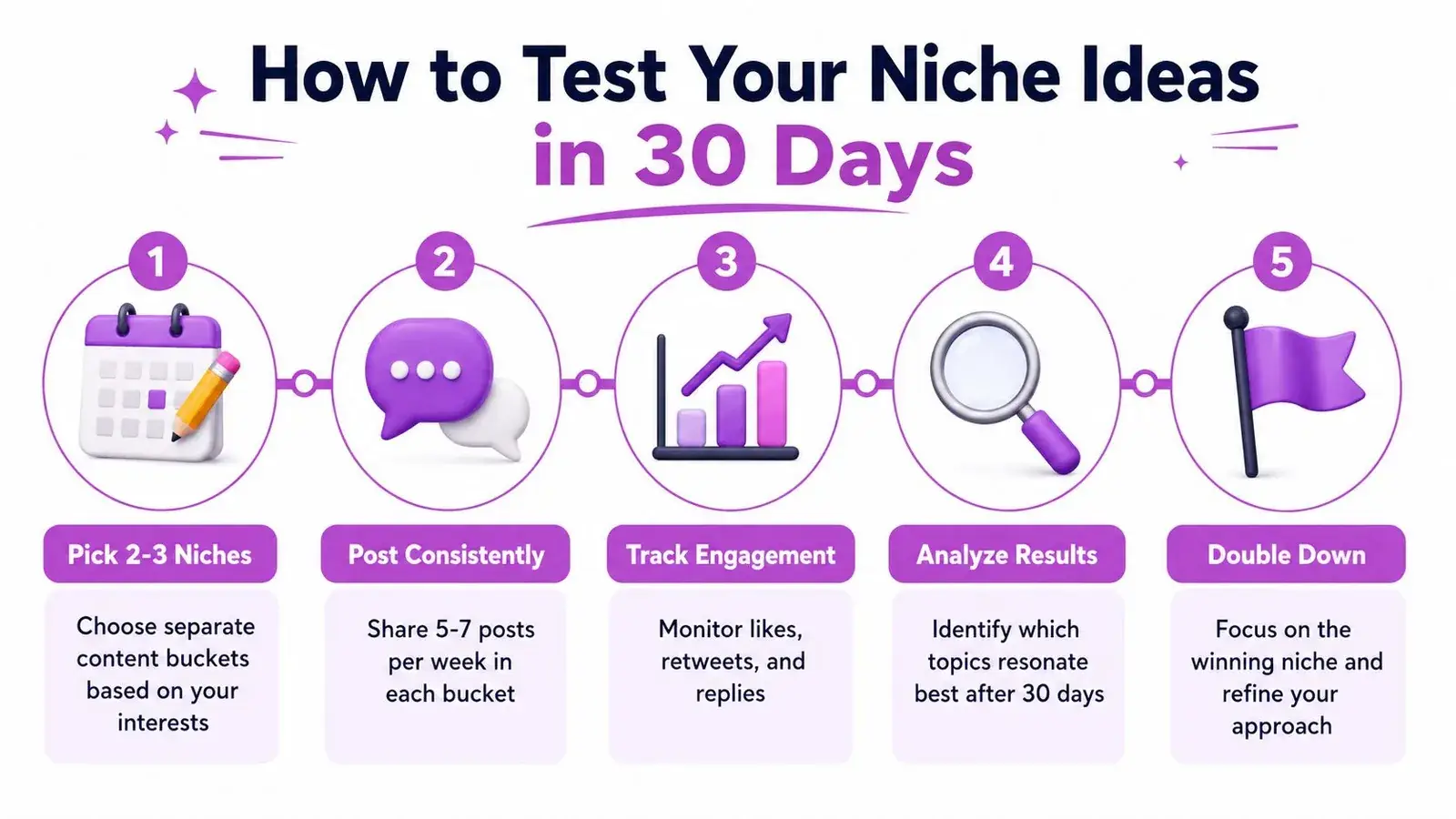
How to Test Your Niche Ideas in 30 Days
Don’t decide based on your first impressive post. Run a controlled content test that compares separate ideas under reasonably similar conditions. The practical workflow is to test 2–3 niche ideas as separate content buckets for 30 days, then compare impressions, engagement, and follows, as outlined by XPatla’s niche-testing workflow.
Set up the experiment
Pick two or three candidate niches and define the same basic rules for each. Keep your posting formats, writing effort, and general cadence reasonably consistent. If one bucket receives short observations and another receives polished long-form threads, you’re testing formats as much as topics.
Create a simple tracking sheet with one row per post and columns for:
- Niche bucket, the topic category assigned before publishing.
- Format, such as a short post, thread, reply, or quote post.
- Impressions, which show how many times the post was displayed.
- Engagement, including likes, reposts, replies, and other visible actions.
- Follows, especially whether the post appears to attract profile visits and new followers.
- Reply quality, including questions, objections, and detailed responses.
- Bookmarks, when available, because saves can indicate practical usefulness.
Likes are easy to notice, but they’re not enough to choose a niche. Replies, follow-up questions, bookmarks, and follower velocity reveal whether people want more from you.
Keep variables stable
The biggest technical error is changing the hook, format, timing, and topic at the same time. If one post goes viral because of a particularly strong opening, you won’t know whether the audience wanted the niche or responded to that format.
Use similar opening styles across your buckets, record what you changed, and avoid making a final decision from a single outlier. Review the results at the end of the test, then ask which niche produced the most qualified attention, not merely the largest raw reach.
For a cleaner review, use X analytics guidance to understand impressions, engagement, and follower signals before you start recording results.
The test should also include replies and quote posts, not only original content. A niche with active conversations gives you more ways to participate and learn what the audience cares about.
Building Content Pillars and Hook Strategies
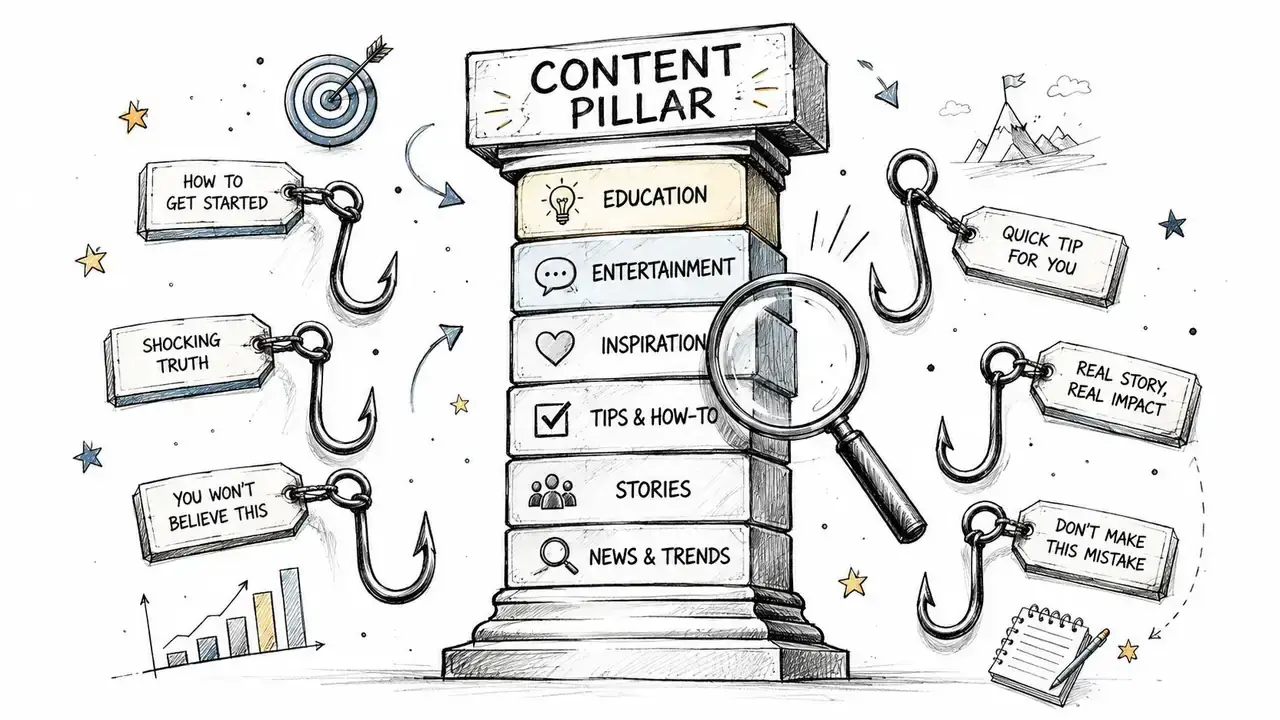
A niche becomes useful only when it turns into a repeatable publishing system. Start with 3–5 recurring content pillars, then assign each post to one pillar before you draft it. This prevents your account from drifting into unrelated observations that confuse both new visitors and existing followers.
Build pillars from recurring problems
Suppose your niche is organic growth for bootstrapped SaaS. Your pillars might include acquisition experiments, landing-page analysis, founder lessons, customer research, and distribution mistakes. Those pillars give you different content shapes without abandoning the same audience.
Each pillar should have its own source of ideas:
- Experiments: What you tried, what changed, and what you learned.
- Teardowns: Why a product, landing page, or campaign works or fails.
- Frameworks: A process readers can apply to their own situation.
- Commentary: Your interpretation of current events or industry changes.
- Conversation: Questions, disagreements, and replies to relevant accounts.
During a niche test, keep every post connected to the selected lane. Variety in format is helpful, but random topic switching makes the data harder to interpret.
Write hooks that identify the value
X is a high-attention, low-patience environment. In 2026, estimated daily time spent on X was about 28 minutes globally, while U.S. users averaged around 34 minutes per day in one statistics roundup, and one market report said power users could spend 62 minutes daily, according to SQ Magazine’s Twitter statistics roundup. These figures suggest that users often scan quickly, so vague positioning creates unnecessary friction.
A strong hook tells readers what they’re about to gain or reconsider:
- “Most early SaaS teams don’t have a traffic problem. They have a feedback problem.”
- “I reviewed five onboarding flows. The same activation mistake appeared in all of them.”
- “A simple way to separate a real customer objection from a polite excuse.”
- “The best founder-led posts usually begin with a decision, not a lesson.”
Make the opening specific enough to signal expertise, then deliver the promised value. Direct-value posts can include tactical observations, lessons from your own work, frameworks, and informed takes on what’s happening in the niche.
Mix authority with participation
Don’t turn every post into a lecture. Use original posts to explain ideas, replies to join active conversations, quote posts to add a distinct interpretation, and questions to surface audience problems. The combination builds recognition without making your account feel like a content feed detached from people.
For a deeper system, use this guide to Twitter content pillars to map themes to formats and recurring ideas.
Common Niche Selection Mistakes to Avoid
The most damaging niche mistake is choosing a topic without checking its daily conversation flow. Look for active conversations every day, recent posts that are still fresh, and accounts that are gaining engagement and followers, as emphasized by AutoTweet’s guidance on growing niches on X.
A niche with no visible activity may be too small, too new, or inactive on X. A crowded niche isn’t automatically bad, but it requires a narrower audience, a stronger perspective, or more credible evidence. These consultant niche positioning tips can help you turn a broad professional category into a sharper promise.
Compare the signals before committing
| Validation signal | Higher-potential pattern | Warning pattern |
|---|---|---|
| Audience activity | Fresh posts and recurring replies | Old posts with little ongoing discussion |
| Content supply | News, launches, market changes, or recurring pain points | Occasional ideas with no reliable source |
| Account landscape | A visible group of active creators | No credible accounts at all |
| Competition | Several strong accounts with identifiable gaps | Either no proven demand or overwhelming saturation |
| Engagement quality | Questions, detailed replies, and useful debate | Mostly passive likes or weak interaction |
| Positioning | A defined audience and outcome | A category that could describe everyone |
A practical benchmark is to find 3–10 credible creators already performing well in the space. Zero active accounts can indicate an unproven or undersized niche. Hundreds of large creators usually signal saturation, so you’ll need a more precise sub-niche rather than copying the category.
Don’t confuse interest with an operating lane
You may enjoy reading about productivity, but that doesn’t mean you can produce useful posts about it every day. You may understand marketing, but that doesn’t mean you have a memorable angle within the category.
Ask whether the niche gives you reasons to post, reply, research, and learn. If it only gives you a list of abstract subjects, it isn’t ready.
Your 30 and 90-Day Action Plan
Use the first 30 days to test the niche and the following 60 days to build consistency around what the test reveals. Don’t treat the end of the test as a victory lap. Treat it as the point where you stop guessing and start operating with a clearer content system.
Days 1 through 30 for testing
Begin by scoring each candidate niche from 1 to 5 on five criteria: audience demand, content volume potential, monetization potential, credibility advantage, and your ability to stay consistent. This scoring framework is described in Tweetstorm’s niche creator guidance.
Then define two or three content buckets and write a short positioning statement for each. Before publishing, draft 20 post ideas across the candidate niche, group them into recurring pillars, and review three relevant accounts to identify gaps rather than imitate their surface style.
During the test:
- Publish ideas from each bucket using comparable formats.
- Record impressions, engagement, follows, replies, and bookmarks.
- Save questions that appear repeatedly in comments.
- Mark which pillars produce ideas without forcing them.
- Note whether people ask for examples, resources, or follow-up explanations.
At the end of the month, choose the bucket with the strongest combination of audience response, content supply, and personal credibility. Don’t choose solely on impressions if another bucket creates better conversations and more qualified profile interest.
Days 31 through 90 for building
Commit to the leading niche for the next 60 days, while leaving room to refine the angle. Build a library of drafts from your strongest pillars, maintain a collection of useful research, and schedule approved posts so consistency doesn’t depend on having inspiration every morning.
Spend part of each session in relevant conversations. Xholic AI can support this workflow with Engage feeds for surfacing worthwhile conversations and Ask Xholic for analyzing the hooks, structure, tension, flow, and payoff of successful posts. Use those insights to understand patterns, then rebuild the underlying idea for your own audience instead of copying wording.
Review performance regularly, but don’t reinvent the niche after every weak post. Refine the audience, outcome, and angle when the evidence points to a positioning problem. Keep your publishing decisions human-reviewed, especially when product context or sensitive industry commentary is involved.
Final Checklist for Committing to Your Niche
Before you commit, make sure the niche passes this checklist:
- Experience: Can you support the topic with direct work, research, experiments, or lived knowledge?
- Audience: Can you name the specific people who benefit from following you?
- Outcome: Can you explain what those people will learn, improve, decide, or avoid?
- Conversation flow: Are there fresh discussions, questions, launches, changes, or pain points to join regularly?
- Content pillars: Have you defined 3–5 recurring themes that produce different types of posts?
- Positioning: Can you state your audience, outcome, and unique angle in one sentence?
- Test evidence: Have you compared separate niche buckets using impressions, engagement, replies, bookmarks, and follows?
- Competitive gap: Have you studied active accounts and found a perspective they aren’t serving well?
- Sustainability: Can you keep learning and publishing in this lane without forcing ideas?
- Business fit: Does the niche connect naturally to a product, service, newsletter, community, or other legitimate goal?
Your niche doesn’t need to stay identical forever. The audience may reveal a stronger subtopic, your experience may expand, or a new source of daily conversation may emerge. Keep the core promise stable while refining the angle based on real responses.
The strongest niche isn’t the one that sounds most impressive in a bio. It’s the one that gives you daily reasons to contribute, helps a specific audience recognize your value, and creates enough useful evidence to improve your decisions.
Xholic AI helps you validate and maintain an X niche with personalized replies, conversation discovery, content analysis, and context-aware recommendations shaped by the context you give Xholic. Start your 30-day niche test with clearer research and drafting workflows by visiting Xholic AI.