Positioning and differentiation
Define who a brand serves, what it stands for, and why customers should choose it over alternatives in crowded markets.
58%
Best tweets about Brand Strategy
Discover the best tweets about brand strategy, covering positioning, differentiation, messaging, identity, category design, research, and brand growth.
Brand positioning, differentiation, audience research, messaging, category design, identity, measurement, and concrete business examples.
Original Xholic analysis
The conversation treats brand strategy as a choice about audience, meaning and differentiation—not simply posting frequency or visual polish. Research and identity systems have relatively high theme scores in this sample, while contributors debate guideline rigidity, brand defensibility and when positioning should be formalized.
54% of posts
All-time engagement
44% of posts
Published in 90 days
Conversation map
Define who a brand serves, what it stands for, and why customers should choose it over alternatives in crowded markets.
58%
Make the offer easy to understand and remember through a clear promise, distinct point of view, consistent story, and recognizable tone.
38%
Examine how brand meaning, experience, and cultural signals create preference, loyalty, pricing power, or defensibility, with examples from consumer products, retail, SaaS, and AI.
28%
Build authority and trust through niche-specific content, lived experience, proof, and a coherent founder perspective rather than posting volume alone.
28%
Carry positioning through content, ads, customer experience, and launches; use performance and customer feedback to refine it without reducing brand to surface-level consistency.
26%
Use customer pains, buying behavior, creative briefs, and competitor gaps to ground brand and campaign decisions.
24%
Treat logos, color, typography, and guidelines as an interconnected decision framework that works across products and touchpoints.
20%
Create or shift category associations, position for a valuable customer segment, and adapt a brand’s story when entering new markets.
10%
Tone and stance
Performance benchmark
Posts with media make up 30% of this collection. Their median all-time score is 17.4, compared with 7.46 for text-only posts.
Format mix
Consensus and debate
Shared view
Positioning and differentiation accounts for 29 tweets (58%). Contributors advocate a specific audience and memorable association rather than generic claims or simply posting more. The SalesRobot founder recounts the limitations of positioning for multiple customer segments.
Shared view
Client questionnaires, competitor-angle mapping and ICP pain points provide inputs for audience, tone and offer decisions. These posts advocate specificity grounded in client, customer or competitor information.
Shared view
Contributors argue that brand guidelines should resolve practical touchpoint decisions, not merely list colors and fonts. Designers describe interdependent visual choices and frameworks that prevent preference alone from determining design decisions.
Shared view
The Salt & Stone post frames fragrance as identity; the Apple store analysis emphasizes control over experience and prestige. A SaaS category-shift post argues that new positioning needs coordinated on-site and off-site execution, not just a launch page.
Open debate
One contributor calls comprehensive guidelines a decision-making framework; another warns that approval edits made in the name of being 'on brand' can erase distinctive social ideas. The tension is practical consistency versus enforced sameness.
Open debate
One post argues that brand is the moat in commodity categories. Another questions broad cultural differentiation as audiences fragment, favoring local brands and smaller communities instead. These are competing assessments, not demonstrated market-wide outcomes.
Open debate
The SalesRobot founder urges early commitment to the strongest customer segment. An identity designer cautions that pre-traction positioning remains a hypothesis, recounting an unused identity after conditions changed. The posts emphasize different risks: overly broad positioning and premature lock-in.
Open debate
One tutorial recommends building around an angle found in a competitor's ad library. A critique warns that copying visible ads misses economics, personas and research. These posts differ in the strategic value they assign to visible competitor advertising, although selecting an angle and copying an ad are not identical practices.
What performs
Visual identity and brand systems has a median all-time score of 20.35; audience and competitor research has 18.77, versus 8.2 for positioning and differentiation. These supplied theme medians describe this sample, not causal effects.
The critique of incomplete brand systems scores 179.59, or the supplied 16.19 times the median of 11.09. The client questionnaire post scores 80.49, or the supplied 7.26 times the median. Both discuss concrete branding decisions and working processes.
Tutorials have a median all-time score of 11.76 across 10 posts; case studies have 1.25 across 6. The competitor-angle tutorial and Apple and Zara analyses illustrate those formats; the figures do not establish that format caused performance.
Statistical standouts
Creator landscape
The five most represented creators account for 20% of the selected posts.
1. charlota
@0xCharlota
2 posts
2. melissa 🇦🇷
@0xmelissa19
2 posts
3. Alexa | Startup founder
@alexabelonix
2 posts
4. Olabode
@bodefreelance
2 posts
5. Blake Emal
@heyblake
2 posts
6. Luke
@LukeADesign
2 posts
@0xmelissa19 has 2 tweets and a median all-time score of 54.32. Both distinguish positioning from posting, emphasizing recognizable expertise, narrative consistency and a specific audience.
@LukeADesign has 2 tweets and a median all-time score of 51.88. The pair describes discovery questionnaires and presentation sequencing: reaffirm the brief, explain competitive context, then show concepts in real-world mockups.
@0xCharlota has 2 tweets and a median all-time score of 22.46. The revision analogy and contextual color questions present identity as a functional system rather than a collection of isolated aesthetic preferences.
Since the previous snapshot
Themes, sentiment, stance, and post format are classified per tweet. All counts, shares, medians, creator concentration, freshness, and performance comparisons are then calculated directly from the published snapshot.
Xholic's all-time score compares engagement while accounting for reach, post age, and creator consistency. It is used for relative comparisons within this collection.
This report analyzes the exact 50-post snapshot shown below. AI identifies editorial categories and drafts explanations; all statistics are calculated from the snapshot, and every narrative claim is checked against cited posts before publication.
Best Brand Strategy tweets
Ranked 01–50

@alex_barashkov ·
Sometimes, during calls with leads, I’m asked whether we do branding. Yes, we do - and we’ve done it for every project in our portfolio, without exception. Even companies that thought they already had branding often did not. Branding is not just a font and a color palette chosen at random five years ago by a freelance designer. It is a system: a collection of rules, approaches, techniques, and effects that work together. It is also a decision-making framework that explains why something should or should not be done. Your brand guidelines should answer practical questions. How should your UI look on the web? What should your presentations, diagrams, and blog covers look like? Can you use 3D elements or line illustrations? Which combinations of effects are appropriate? If your brand book does not answer these questions, I have bad news: you probably just have a random set of colors, a font, and a logo. They may work well enough for the few visuals your designer created, but they do not form a complete brand system.
 Watch video
@LukeADesign ·
Here's exactly what we send clients before any branding work: 45-question Google form. Where we get things like: - Brand overview: Who they are and what they do. - Target audience: Who they want to appeal to. - Personality & Tone: How they want to sound. - Competitors: Who they're up against. - Visual identity: Do they have an existing one, likes dislikes etc. - Logo specifics: Likes and dislikes, anything integral etc. - Brand goals: whats their plans for the future. After that, we usually send 20-30 logos that we source from Cosmos or Pinterest to see what they love/hate (hate is most important). This way, when you present the brand concepts, they won't be like "what the fu*k is this?"


@0xmelissa19 ·
A marketing lesson I learned late: More content doesn’t automatically create more growth. There was a time I thought the solution was always: “Post more.” But the real problem wasn’t volume. It was positioning. Because every post teaches people how to see you. If your content is random, people remember nothing. If your content consistently solves a specific problem, people start associating your name with that solution. That’s where opportunities come from. Another thing I learned: Reach gets attention. Reputation gets hired. I’ve seen people with smaller audiences land better opportunities because people clearly understood what they were good at. Now before posting, I ask: “Does this strengthen my positioning?” Because marketing isn’t just about being seen. It’s about being remembered for the right thing. What’s one thing you want people to immediately associate with your name? 👇


@GrammarHippy ·
Here’s how to take a bite out of the big dogs in your market: Open ads library. Find their brand. See the angles they use. Map the angles out and pick one. Build a competitor product ONLY around that angle. The ads. The funnel. The audience. Only that one angle. You turn that angle into your big idea. Your messaging becomes stronger to that one angle than the big dog. And you steal some of that market share.

@wizofecom ·
If 90% of your personal brand is STRATEGY: • Define your ICP • Pick your niche + authority angle • Identify your unique POV • Study 5 competitors and find the gap CONTENT PILLARS: • Pick 3-5 topics you'll own • Map each pillar to a pain point your ICP has • Rotate between education, story, conviction, and opinion WRITING: • Identify good hooks • Write in sequences • Lead with curiosity • Every post is one idea, one journey, one takeaway DESIGN: • Consistent brand colors + fonts • Thumbnail templates that pop in feed • Doc-style for long-form value • Profile photo + banner that display authority POSTING: • Batch content weekly • Post at peak engagement windows • Mix formats: short posts, threads, carousels, articles • Always have 1 week of content loaded ENGAGEMENT: • Reply to 10+ accounts in your niche daily • Quote tweet with opinions • Join the trending conversations in your space • Build relationships OPTIMIZATION: • Track what format gets the most engagement • Double down on winners • Kill what's not working fast • Incubate 1 new style every week Then you have the stack to become an authority in your industry.
@0xmelissa19 ·
One thing that separates strong Web3 marketers from average ones: They understand positioning. Not just posting. Not just graphics. Positioning. Because the truth is: A lot of projects are saying similar things. “Fast.” “Scalable.” “Community-driven.” “AI-powered.” “Next generation.” After a while, everything starts sounding the same. That’s why positioning matters. Good positioning answers: Why should people remember YOU specifically? And honestly, I learned this late. In the beginning, I thought marketing was mostly about visibility. Now I understand: Visibility without identity creates weak communities. The projects that grow strongest usually own a clear narrative. People instantly know: • What they stand for • Who they’re for • Why they exist • What makes them different And this applies to personal brands too. If your page looks like everyone else, people forget you fast. One thing I started doing differently was asking: “What do I want people to associate with my name immediately?” That question changes how you post. Another lesson: Great marketing is not about trying to attract everybody. The best brands usually become powerful because they speak deeply to a specific type of person first. Clarity attracts stronger communities than randomness. And honestly, one of the biggest marketing mistakes I see in Web3 is chasing trends without direction. Every week: New narrative. New personality. New strategy. No consistency. No identity. No long-term trust. Now I think differently. Good marketing should create: Recognition. Trust. Retention. And eventually advocacy. That’s when community members stop being followers and start becoming believers. If I were starting again, I’d focus earlier on: • Positioning • Narrative consistency • Audience psychology • Long-term trust building Because attention might bring people in. But identity is what makes them stay. What’s one Web3 project with strong positioning in your opinion? 👇


@i_amdott ·
What most projects need in branding is clarity. Clear message, clear audience, and a clear voice people can recognize instantly. When people don’t understand what you do or who you’re speaking to, they scroll past. Consistency in how you show up, how you communicate, and what you stand for is what builds trust and keeps people around.

@Extrastiv ·
PERSONAL BRANDING PROMPT FOR BEGINNERS ON LINKEDIN & X 🗞️ ↪ Take a screenshot of your bio. ↪ Copy 10 each of your top performing posts on both platforms - especially the ones relevant to your niche. ↪ Upload it on Claude and insert this prompt: "I am a [your profession/title - e.g. content marketer, SaaS founder, career coach] who helps [your target audience — e.g. early-stage startups, 9-5 professionals, female entrepreneurs] achieve [specific outcome - e.g. consistent clients, career pivots, revenue growth] through [your method/approach - e.g. content marketing, storytelling, systems]. I have uploaded my LinkedIn and X bios + 10 top-performing posts from each platform. Do the following: 1. AUDIT MY POSITIONING Based on my bios and posts, tell me exactly how a stranger would describe what I do and who I help. Be brutally honest. Flag any confusion, contradiction, or vagueness. 2. IDENTIFY MY CONTENT PILLARS From my top posts, extract the 3–4 themes I keep returning to. Label them clearly. Tell me which one resonates most based on engagement patterns and specificity of language. 3. FIND MY SIGNATURE VOICE Pull 5 phrases, sentences, or structural patterns from my posts that sound uniquely like me. These are my voice fingerprints. List them so I can write more content that sounds like this intentionally. 4. SPOT THE GAPS What topics, pain points, or content formats is my audience likely expecting from someone in my niche that I am completely missing? Give me 5 specific gap opportunities. 5. REWRITE MY BIO Give me two versions of my bio for each platform. One that is authority-first (leads with credibility), one that is outcome-first (leads with what my audience gets). Keep it under 160 characters for X and under 220 words for LinkedIn. 6. GIVE ME A 30-DAY CONTENT PLAN Based on my niche ([insert niche]), audience ([insert audience]), and content pillars you identified, give me a 30-day posting plan. Mix educational, conversational, and conversion posts. Include specific post angles, not just categories. 7. WRITE MY FIRST 5 POSTS Using my voice fingerprints, write 5 ready-to-publish posts. Two for LinkedIn (long-form), three for X (punchy, single idea). Each post should speak directly to [your audience's biggest pain point — e.g. inconsistent income, fear of niching down, imposter syndrome]. My goal is [your specific 90-day goal — e.g. to land 3 new clients from content, to grow from 500 to 5,000 followers, to launch my first digital product to my audience]. Treat me like a client who is paying you to fix their personal brand from the ground up. Do not give generic advice. Everything must be specific to what you see in my content." Save this. Use it every 90 days. I hope this helps someone🤞

A former pro snowboarder built a deodorant brand around fragrance and just sold it for $500M+. Not function. Not clean ingredients. Fragrance. Last week on the podcast, Sam Kaplan of Five Seasons Ventures said if you have a nuanced take on fragrance, he wants to hear from you. His thesis: take the boom in niche fragrance and apply it to adjacent categories. Touchland in hand sanitizer. Sol de Janeiro in body care. Tallow & Ash in laundry. Purdy & Figgg in surface cleaners. This week, Advent paid $500M+ for Salt & Stone. Sam called it. $165M revenue in 2025. DTC at 40%. 1,700+ locations across 40 countries. One deodorant every five seconds. One institutional round, Humble Growth, August 2024. Eighteen months later, out at $500M+. The fragrance isn't a feature. It's the identity. Body care as a fragrance delivery system. Fragrance-led isn't a brand strategy anymore. It's an acquisition thesis.


@itsmarcosruiz ·
How to build a personal brand better than 99% of people: • Post personal stories • Post social proof weekly • Invest in experiences worth posting about • Give your honest opinions on things in your industry • Share your actual numbers publicly to build authority • Make your content bookmarkable, not copy-pasteable • Create frameworks and systems people associate with your name • Post expertise content through listicles, frameworks, and how-tos • Take advantage of trending topics in your space for organic reach • Use your life experiences and different interests to create unique angles • Stop trying to appeal to everyone and start polarizing people in your space • Own one category completely before expanding into adjacent topics • Treat your personal brand as a business asset

@shushant_l ·
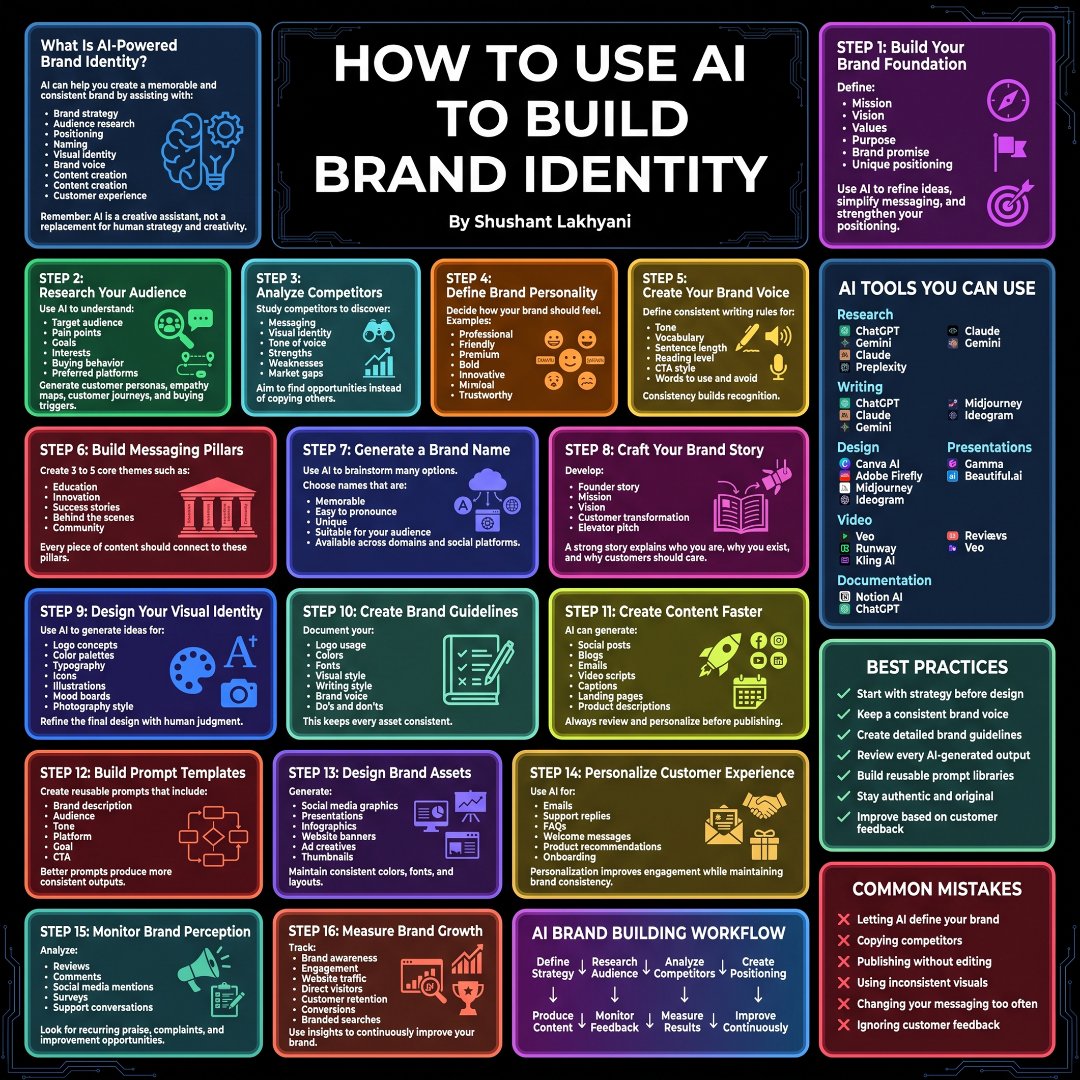
I'm shocked most people still spend weeks building a memorable brand by hand. Here's how to build a complete brand identity with AI in minutes. --- 📂 AI Brand Identity ┃ ┣ 📂 Foundation ┃ ┣ 📂 Mission ┃ ┣ 📂 Vision ┃ ┣ 📂 Values ┃ ┣ 📂 Purpose ┃ ┣ 📂 Brand Promise ┃ ┗ 📂 Unique Positioning ┃ ┣ 📂 Audience Research ┃ ┣ 📂 Target Audience ┃ ┣ 📂 Pain Points ┃ ┣ 📂 Goals ┃ ┣ 📂 Interests ┃ ┣ 📂 Buying Behavior ┃ ┗ 📂 Customer Personas ┃ ┣ 📂 Competitor Analysis ┃ ┣ 📂 Messaging ┃ ┣ 📂 Visual Identity ┃ ┣ 📂 Tone Of Voice ┃ ┣ 📂 Strengths ┃ ┣ 📂 Weaknesses ┃ ┗ 📂 Market Gaps ┃ ┣ 📂 Brand Personality ┃ ┣ 📂 Professional ┃ ┣ 📂 Friendly ┃ ┣ 📂 Premium ┃ ┣ 📂 Bold ┃ ┣ 📂 Innovative ┃ ┗ 📂 Trustworthy ┃ ┣ 📂 Brand Voice ┃ ┣ 📂 Tone ┃ ┣ 📂 Vocabulary ┃ ┣ 📂 Sentence Length ┃ ┣ 📂 Reading Level ┃ ┣ 📂 CTA Style ┃ ┗ 📂 Writing Consistency ┃ ┣ 📂 Messaging Pillars ┃ ┣ 📂 Education ┃ ┣ 📂 Innovation ┃ ┣ 📂 Success Stories ┃ ┣ 📂 Behind The Scenes ┃ ┗ 📂 Community ┃ ┣ 📂 Brand Naming ┃ ┣ 📂 Memorable ┃ ┣ 📂 Easy To Pronounce ┃ ┣ 📂 Unique ┃ ┣ 📂 Audience Fit ┃ ┗ 📂 Domain Availability ┃ ┣ 📂 Brand Story ┃ ┣ 📂 Founder Story ┃ ┣ 📂 Mission ┃ ┣ 📂 Vision ┃ ┣ 📂 Customer Transformation ┃ ┗ 📂 Elevator Pitch ┃ ┣ 📂 Visual Identity ┃ ┣ 📂 Logo Ideas ┃ ┣ 📂 Color Palette ┃ ┣ 📂 Typography ┃ ┣ 📂 Icons ┃ ┣ 📂 Illustrations ┃ ┣ 📂 Photography Style ┃ ┗ 📂 Mood Board ┃ ┣ 📂 Brand Guidelines ┃ ┣ 📂 Logo Usage ┃ ┣ 📂 Colors ┃ ┣ 📂 Fonts ┃ ┣ 📂 Visual Style ┃ ┣ 📂 Writing Style ┃ ┣ 📂 Brand Voice ┃ ┗ 📂 Do's And Don'ts ┃ ┣ 📂 Content Creation ┃ ┣ 📂 Social Posts ┃ ┣ 📂 Blogs ┃ ┣ 📂 Emails ┃ ┣ 📂 Video Scripts ┃ ┣ 📂 Captions ┃ ┣ 📂 Landing Pages ┃ ┗ 📂 Product Descriptions ┃ ┣ 📂 Prompt Library ┃ ┣ 📂 Brand Description ┃ ┣ 📂 Audience ┃ ┣ 📂 Tone ┃ ┣ 📂 Platform ┃ ┣ 📂 Goal ┃ ┗ 📂 CTA ┃ ┣ 📂 Brand Assets ┃ ┣ 📂 Social Graphics ┃ ┣ 📂 Presentations ┃ ┣ 📂 Infographics ┃ ┣ 📂 Website Banners ┃ ┣ 📂 Ad Creatives ┃ ┗ 📂 Thumbnails ┃ ┣ 📂 Customer Experience ┃ ┣ 📂 Emails ┃ ┣ 📂 Support Replies ┃ ┣ 📂 FAQs ┃ ┣ 📂 Welcome Messages ┃ ┣ 📂 Product Recommendations ┃ ┗ 📂 Onboarding ┃ ┣ 📂 Brand Analytics ┃ ┣ 📂 Reviews ┃ ┣ 📂 Comments ┃ ┣ 📂 Social Mentions ┃ ┣ 📂 Surveys ┃ ┣ 📂 Brand Awareness ┃ ┣ 📂 Engagement ┃ ┣ 📂 Website Traffic ┃ ┣ 📂 Conversions ┃ ┗ 📂 Customer Retention ┃ ┣ 📂 AI Toolkit ┃ ┣ 📂 ChatGPT ┃ ┣ 📂 Claude ┃ ┣ 📂 Gemini ┃ ┣ 📂 Perplexity ┃ ┣ 📂 Midjourney ┃ ┣ 📂 Ideogram ┃ ┣ 📂 Canva AI ┃ ┣ 📂 Adobe Firefly ┃ ┣ 📂 Gamma ┃ ┣ 📂 Beautiful AI ┃ ┣ 📂 Veo ┃ ┣ 📂 Runway ┃ ┗ 📂 Notion AI ┃ ┣ 📂 Best Practices ┃ ┣ 📂 Strategy First ┃ ┣ 📂 Consistent Voice ┃ ┣ 📂 Detailed Guidelines ┃ ┣ 📂 Review AI Output ┃ ┣ 📂 Reusable Prompts ┃ ┣ 📂 Stay Authentic ┃ ┗ 📂 Improve From Feedback ┃ ┗ 📂 Avoid These Mistakes ┣ 📂 Letting AI Define Your Brand ┣ 📂 Copying Competitors ┣ 📂 Publishing Without Editing ┣ 📂 Inconsistent Visuals ┣ 📂 Frequent Message Changes ┗ 📂 Ignoring Customer Feedback

@Rakshaweb3 ·
Most founders treat their X account like a diary and wonder why it doesn't generate clients. A diary is for you. A personal brand is for them. Every tweet should answer one question in the reader's head: "why should I trust this person with my money, my time, or my problem?" If your last 20 tweets don't answer that, you don't have a content problem. You have a positioning problem wearing a content costume. Fix the positioning first. The tweets will follow.

@0xCharlota ·
in visual identity design, revision requests like "can we try a different blue?" "can we swap the font?" sound simple. they are not. brand identities are a balancing act between opposing forces — structure and fluidity, weight and grace, warmth and edge. shift one, everything shifts. it's like cooking: the client wants less salt. but salt was lifting all the other flavors! pull it back and now the dish tastes flat, so you reach for acid. now it's bright but thin. so you add fat for body. now it's rich but heavy. you're three moves deep from one "simple" change. that's brand revision - one ingredient moves, the whole recipe reopens. never a "this is just 5min edit!"

@KevinSzabo14 ·
A brand that "just stays consistent" Is doomed for failure 5 questions to help you define your brand: 1. What’s your story? 2. Who do you serve? (ICP) 3. What’s your unique positioning? 4. What's your "Us vs Them" angle 5. What's your offer? Asking the right questions matter
@LukeADesign ·
We presented over 10 brand directions to YC/SF clients in the last 6 months. This is how we do it: 1. Reaffirm the brief. Start by feeding back what you pulled from their form. It shows you listened and grounds everyone before anything new is introduced. 2. Competitors. Show where the industry is. 3. Their existing brand. Acknowledge what they have. What's working, what isn't. 4. Show the moodboards. Show what you've built from their questionnaire and kick off call answers. 5. Direction. Colour, type, mood. Before they see a single logo, they already know where it's coming from. 6. The concepts. Explain everything. On the face of it, they might look simple. But there's meaning behind every decision. 7. Mockups. The cherry on top. Show it in the real world. That's when they fall in love with it. Then send them the deck and let them to sleep on it.
 Watch video
@0xCharlota ·
Red is passion. Blue is trust. Green is growth. Cool. Now what? Before you pick a brand colour, ask what it needs to do. 🎨Here are 10 non-obvious questions I'm now asking myself before touching a palette: (in an interactive colour swatch component made with @framer) 1. Does colour need to differentiate categories, or is this a single-product brand? Multiple product lines, tiers, or services turn colour into a wayfinding system. That changes how many hues you need and how they relate to each other. 2. Where does this brand actually live — digital, print, interior, hardware? Colours that sing on screen often die in CMYK, on a wall, or on injection-moulded plastic. Design for where the brand is going, not just where it launches. 3. What does the brand smell like? Sounds absurd, but trust me, try it anyway. Earthy, synthetic, clean, medicinal, smoky…. this can already inspire a colour palette! 4. Will colour carry meaning (data states, navigation, hierarchy) or just mood? A brand colour that also doubles as your error red is a problem waiting to happen. 5. Is the UI data-dense or spacious? how much room does colour actually have to breathe? A marketing site can carry saturated colour. A dashboard can’t… it creates visual fatigue and fights the content. In dense UIs, brand colour needs to work at accent weight, not on every surface. 6. Will there be a lot of photography or illustration? If yes, the main palette can be minimal, even a single colour plus neutrals. The imagery does the expressive heavy lifting. A complex palette on top of rich visuals creates more noise. 7. What colours dominate the competitive landscape? And do we want to fit in or stand out? Every category has default codes. Fintech = blue. Health = green. Legal = navy. Differentiation requires knowing what you're differentiating from. (sometimes fitting in is the right call.) 8.Does the product need dark mode? Some palettes that work beautifully in light fail completely inverted. In crypto, SaaS, and developer tools, dark is often the default. Test both directions before falling in love with a palette. 9. How long does this identity need to hold — two years, five, ten? Trend-forward palettes date faster than they feel. (hello brat green!) 10. Does this colour fit into the visual world your audience already lives in? or put it bluntly, is this a colour someone would pay for on a hoodie, or only accept for free? does this colour feel at home in the environment where the product is actually used? and does it hold up next to the other tools / objects your user has chosen to surround themselves with? Colour psychology is the astrology of brand design. The real question isn't what a colour means in the abstract. it's what it needs to do in this specific brand, in this specific context, at this specific scale. good luck choosing! 🎨
 Watch video
@gaetano_nyc ·
Nearly all of the SEO/GEO problems I am working on today are category misalignment and mismatch problems... not ticky-tacky "optimization" tricks or GEO hacks. Here is the problem: B2B SaaS brand that's been around for 10+ years has a digital footprint in a "legacy" category that's now unsexy... but it's still their breadwinner. And now there's a new thing they need to become known for: Customer Service CRM ➡️ Intelligent CX Platform Low Code Platform ➡️ Agentic Systems Platform CMMS ➡️ Intelligent Maintenance Platform LMS ➡️ Skills Intelligence Platform Product Analytics ➡️ Product Intelligence Platform Intranet Portal ➡️ Employee Experience Platform etc... I've seen companies setup Profound with a massive list of LLM prompt tracking. The dashboards show zero visibility and they wonder why. The problem is that AI retrieval often follows entity neighborhoods. So when SaaS brands evolve into new positioning, they need a FULL BLOWN category attack plan with 50% of the effort allocated to on-site content (product pages, feature pages, brand comparisons, why we're different, etc). and the other 50% allocated to offsite: analyst relations, guest posts, review site optimization, YouTube, inclusion on Forrester / Gartner reports for the new category, etc. Instead, they launch one new product page with a press release and expect magic to happen. It just doesn't work. It's not enough. ChatGPT sub-queries are heavily branded and category dependent. You can reverse engineer any bottom of funnel category prompt and see for yourself. Inspect element, navigate to the network tab and check the sub-queries and safe URLs. No amount of tactical work can get your brand included in this consideration set. This is at least 80% of the work I am doing today. It is all deeply strategic work and almost zero tactical work. What you see going viral on LinkedIn is not even close to what's really happening behind the scenes at big companies.

@bodefreelance ·
Not many founders care about this enough… How do people perceive your brand? Think about it. It’s usually linked to how you solve problems. If you want to build that sense of awareness in your audience, You don’t need to solve the biggest problems in their lives. You can just pick one recurring one. And solve it. This is how you raise awareness. Not by building new features. Not by making your UI the best. Not by launching on the best platform. But by a proven track record of solving their problems. Do you have a strategy for raising awareness of your brand?

@orenmeetsworld ·
People are spending more time away from other people than ever before... and brands are in the unexpected place of helping connect us back together. The Rhode phone case, the hypebeast sneaker, the Eme shirt, the Odwala water bottle are all signallers of the type of person someone is, and an entry point to conversation or thinking you'd get along, multiplied ad-infinitum across categories While much of this started without the brand actually considering it in their strategy or marketing, the last year has seen this done more and more often with incredible intention Commerce has always been and underlayer of social life, but as third spaces and interactions change, its grown in importance
 Watch video
@bodefreelance ·
I always thought: The only way for SaaS founders to build their personal brands was to… -> Post consistently. -> Tell people about the features. -> Share about the product updates. But no one really cares about this. Personal branding is meant to help build trust with the audience. So I shifted my focus to: -> Helping their audience. -> Speaking about their struggles. -> Telling stories they can resonate with. In the end, it’s people we are selling to. People buy from people they are familiar with. This is where you leverage the power of personal branding. What are your struggles with building one?

@KateBour ·
Most "personal brand" problems are messaging or offer problems in disguise Sell something people want Explain it so they know why they should want it Creating unignorable content becomes much easier

@a_idume ·
The high level of subjectivity involved in brand design is why it’s a difficult industry to work in. Your job as a brand design professional aside from the technical know-how (skill) then becomes building frameworks to keep both you and the client from making decisions based on preference alone, and focus more on what actually serves the brand.

@nicktheriot_ ·
6 questions I ask before positioning any brand in a crowded market: 1. What does everyone in this market accept as normal but secretly hate? 2. What has the customer been trained to tolerate because they think there's no alternative? 3. What's the quiet frustration that hits them every single time? 4. What would make the current solution feel irresponsible or outdated? 5. What new standard could we set that competitors would have to admit they were wrong to match? 6. What's the villain we can point to that everyone already low-key hates? Bookmark this.

@Ishansharma7390 ·
Apple's 2nd Mumbai store is here! But why is Apple doing this? I was just at the media preview of Apple's Borivali store. This is the 6th Apple store in India. They opened 3 stores in 2025 and 2 stores in 2024. But why is Apple opening it's own stores when there are already so many 3rd party resellers available in India? Here's what I think: 1. Total brand control Apple gets full control on how it's products are displayed and communicated with Apple-trained staff helping customers, something which was often missing in stores like Imagine or Croma. 2. Better Customer Experience Official Apple stores offer things like Hands-on demos of all Apple products and services, Genius bar for support, repairs, and the Today at Apple workshops teaching users how to better use Apple's products and services. This helps deepen customer loyalty. 3. Brand Positioning Apple stores aren't just shops, they're brand showcase and status symbols that help with building an aspirational appeal in the minds of Indian consumers. This is crucial at a time where Apple is quickly moving up in the premium phone segment in India(25.6% YoY growth in Q3 2025). I still remember the first time I visited an Apple store in Bangkok in 2022 and it being an absolutely magical experience. The architecture, the use of natural lighting, greenery, the warm staff, everything was perfect and unlike any tech store I've been to. While third party sellers helps Apple reach many customers, but Apple's own stores gives the company direct control over the shopping experience and build brand prestige. Have you visited an Apple store?


@wizofecom ·
Bad personal brands: - Post revenue screenshots every other day like it's a personality trait - Rent a Lamborghini for a photoshoot to share "motivation" - Only post hot takes to piss people off - Post platitudes Good personal brands: - Lead with a story so people have a reason to care - Share meaningful wins AND strategic losses - Post boring, niche specific content the ICP needs - Take positions backed by experience - Create content targeted for 1,000 decision makers

@aaliya_va ·
In the AI era, product advantage will be harder to hold onto. Models improve,features get copied and building gets faster and cheaper. A product that feels impressive today can feel ordinary 6 months later. That is why brand matters more than ever. When I say brand,it does not mean brand as a glossy launch video or a new colour palette. What I mean Brand as clarity: what you believe, who you are for, what problem you refuse to ignore and why people should remember you when 10 similar tools appear. AI may increasingly become the layer through which people discover, compare and choose products.Yet humans still decide what to trust, recommend and return to. A clear brand gives people a shortcut: “I know what these people stand for.” Retention still comes before attention. The product has to work and once it does, consistent storytelling turns a useful product into a familiar name and a familiar name into preference. In a crowded market, being better is valuable and being understood is priceless. The goal is not to look “premium.” The goal is to become memorable, credible and easy to choose. That is what a real brand does If you are building an AI company, do not let your story become an afterthought. I help AI founders turn their product, ideas and market insights into clear content that builds trust, attention, and a brand people remember. I am just a dm away


@ItsMeBenChan ·
Most companies treat personal branding like a content calendar. Post 3x a week, share tips, "stay consistent." …but that’s not a brand. The popular belief is that if you show up long enough with enough "value," people will eventually trust you and buy. The brands stuck at zero traction almost always follow this exact (wrong) playbook. - Post expertise daily - Expose their best frameworks - Hope that people realize their genius But nobody cares. Because the market already has 1,000 people doing the same thing. Being "helpful" stopped being a differentiator years ago. The brands that actually break through are the ones people are EMOTIONALLY invested in. They have: - A narrative people want to follow - A point of view that splits the room - A personality that makes them impossible to confuse with anyone else If your audience can swap your name out for any other expert in your niche and the content still makes sense... ...you don't have a brand. You have a blog with a fancy profile picture.

@parkerworth ·
A brand is the most valuable piece of real estate in the world: A corner of someone's mind. To occupy it, strip your message down to the bone. Then strip it again to the marrow.

@heyblake ·
Founder brand framework: 1. Problem you see What's broken in your world? 2. Belief you hold What truth do others miss? 3. Solution you built What did you create to fix it? 4. Proof it works What results can you show? Your brand is the story connecting all four.

@heyitsalexP ·
What really differentiates consumer products? Very few have patented tech or ingredients. Very few have proprietary production processes. Most formulations can be copied or duped. So can most marketing strategies. That leaves us with "brand". But I want to push back on that because... ...shared culture is collapsing. If you asked me five years ago, I would have said that "brand", status or cultural heat were relatively strong differentiators. But it's harder than ever to build "cultural heat", because content consumption is edging closer and closer to 1:1, completely personalized entertainment. There are no watercooler moments, and there are barely any enduring fandoms. People kind of drift in and out of filter bubbles based on their special interests, or what they find entertaining in the moment. That's only part of the story. The other part is the collapse of authority. Modern movie stars like Zendaya don't have the same mystique or cross-generational cultural impact because there is no authority complex telling us (the public) that they are our "betters". It's verboten to say that person A might be better, or more worthy, than person B, even on a single dimension. So if everyone is the same, everyone's experience is equally valid...why does one brand deserve more attention than another? "Brand" still has impact within smaller, more tangible communities where there is some amount of shared culture and mutually agreed-on authority. So I am long local brands. I think global status symbols (big luxury brands) are past peak. And the rest of it...the role of brand within DTC growth strategy...I am still thinking through that. Gruns was the most recent business to at least partially leverage the old mental model of "brand"... ...but it's not like they were running superbowl ads or hiring a celebrity spokesperson. So what drives the enterprise value there? Subscription revenue? That's going to collapse with brick and mortar expansion. What makes Gruns more compelling than WalMart's inevitable store brand dupe? Again...still thinking through this...

@sexworkceo ·
Some of the strongest brands in this industry were built by paying attention to what was missing. When you make content you actually want to see, you often uncover an audience that has been overlooked for a long time. That kind of work feels different because it comes from lived experience rather than performance. Serving an underserved audience creates loyalty that trends never will. That loyalty is what gives a brand staying power.

@immarkwilliam ·
Every market you expand into has a local competitor who knows the customer better than you do. They know the culture. The buying habits. The price sensitivity. The delivery expectations. They've been serving that customer for years before you arrived. So your advantage was never going to be showing up with a better product. It's showing up with a sharper brand. I've run ads to the Philippines, Thailand, Vietnam, Sweden, and many more. Here's what that actually means when you're entering a new market: 1 - Local players compete on availability and price. You can't win that game. They have the distribution. The local warehouses. The established logistics. Trying to out-convenience or out-price them is a losing battle from day one. So you have to compete on something else entirely. Story, identity, and the specific thing that made someone willing to order from another country in the first place. 2 - Your brand has to mean something specific - or you're just the expensive option. If a customer can't articulate why your product is worth the extra cost, the longer shipping, and the unfamiliar name - you don't have a positioning problem in that market. You have no positioning at all. The question isn't "is our product better?" It's "what do we represent that nothing local does?" 3 - The story that built your brand at home is your biggest asset abroad. The founder story. The reason the product exists. The point of view your brand takes. Local competitors have market knowledge... but they rarely have a story worth retelling. That's your gap to own. Because the brands that travel well aren't the ones with the best specs, but the ones that get people to talk about it. 4 - Cultural context can't be copy-pasted. You have to understand it natively. Think about it. A new market has different tensions, different aspirations, different reference points. So the story you tell stays the same - but how you tell it has to be rebuilt for the audience hearing it. 5 - Commodity doesn't travel. Positioning does. A product competing on features gets compared on features - and the local player usually wins that comparison once shipping and price enter the equation. A brand competing on meaning gets compared on nothing. Because there's no local equivalent for what it stands for. So before you enter a new market, ask: If a customer there had to explain to a friend why they ordered from you instead of buying local - what would they say? If you don't have a sharp answer, the market isn't ready for you. Or you're not ready for it.

@alexabelonix ·
A premium brand image is built through signals: • stronger messaging • cleaner positioning • sharper proof • better case studies • more polished presentation Premium is rarely one big thing. It’s many small aligned things.

@camolNFT ·
I've made my career in crypto and seeing bad marketing genuinely makes me mad. Wasted budget on agencies that sell you overpriced services with 0 conversion, massive egos from influencers, and teams all trying the same exact playbook. Here's what you SHOULD be doing. 1. Have a growth employee go through your end-to-end product flow, ensuring onboarding is EASY. 2. Come up with a simple, repeatable brand positioning that is both a tagline AND an onboarding tool. 3. Stop worrying about the perfect logo. 4. Focus on the growth funnels similar WEB2 products use. Don't just YOLO your marketing. 5. Run paid marketing experiments, either with creators or ads (or both). See what converts and what doesn't. 6. Find ways to always contact your customers. Email, LinkedIn newsletters, or other. 7. Focus on SPECIFIC geos, don't try to onboard the world on day 1. Maybe just focus on Miami. 8. Find a way to make mindshare a moat for your company. If people are talking about you, they're not talking about others. 9. Be accessible. The best founders I know are almost always focussed on engaging with their users (or prospective ones). 10. Get niche-micro creators in industries adjacent to yours to create content. Crypto creators take every paid deal, which means none of them convert. But, what if you focus on WEB2 creators focussed on your niche? Way better. Obviously, all of these can get broken down way more. But these are the basics.

@ProofofIntern ·
the best social ideas usually die when someone says "can we make it more on brand?" which sounds logical at first, because obviously a brand should sound like itself. but in a lot of teams, "on brand" doesn’t mean sharper, more recognisable or better, it just means safer. this just means that the best bits get removed. not by one obviously terrible decision, but by a bunch of small, reasonable-sounding edits that slowly drain the post of the thing that made it worth posting in the first place. by the end, everyone has improved it, nobody can object to it, and it sounds like every other post the brand has published for the last six months. and that's exactly how brands become too vanilla and "me too" on socials which leaves them ignored. social teams don’t always need tighter brand guidelines. sometimes they just need permission to keep the weird bit.

@alexabelonix ·
If you can’t explain your brand in 1 sentence, your market won’t remember it. Start here: We help [specific audience] solve [specific problem] through [specific method]. Clarity is the first layer of brand strategy.

@seeksahib ·
Everyone treats marketing like a pipeline. Put money in one end, users come out the other. measure the flow and keep optimizing for results. But what if these users don't even matter more than you think. The real purpose of marketing is to decide what you mean to people. What you stand for and what they think when your name appears. What you really need is the right positioning. Once you have that it just keeps compounding, that's what help in dominating a category.

@SarahLevinger ·
Where does your brand voice live? Where do your brand values live? Where does your brand belief live? Where does your brand enemy live? Where does your brand mission live? Where does your brand personality live? (If it’s just sitting in someone’s head, get it out of there and into something usable, quick.🫣)

@AJ_Odyssey ·
Brand marketing is full of spectacular failure because branding is a complex systems thinking challenge that many companies approach linearly. Brand is controversial not only because it's abstract, but because cooking up good brand strategy forces you to deal with with complex systems dynamics - culture, biology, human psychology, politics. Brand has to hit a moving target. And the only way you can properly address complex challenges with multiple interdependent variables is with Requisite Variety - aka bringing together a lot of people from within and outside an organization, all containing relevant pieces of the puzzle. One consulting firm just ain't gonna cut it. shoutout to @HipCityReg who made this crystallize for me after watching his hardware interview

@MichaelDBrandt ·
Categories with the least technical or product differentiation have the strongest brands. Without meaningful product moats, the brand is the moat. Think about beer. Highly commodity, no real moat on product. So the brand *is* the differention. “Are you more of a Heineken person or a Stella Artois person?” Winning a customer comes down to how well the brand builds a world — through media, irl experiences, etc. On the other hand, if you invent a flying shoe, it doesn't matter what you call it. If you have hard technical superiority that solves a real problem, that’s your moat. Brand is optional. Think about Google, especially in the early days. So if you are looking to study great brands, look at crowded, mature categories like beer, soda, apparel, candy, laundry detergent, etc — commodity spaces where brand is the primary way to standout, and leads to Darwinian development of great brands.

@sarah_carusona ·
Brand doesn't lead company growth. Growth leads company growth. Before I continue, let me say that I'm a HUGE fan of brand. Real growth doesn't happen without it. But there's a nuance (and order) to the way company growth is approached. And each function has its optimal place. 𝐖𝐡𝐚𝐭 𝐢𝐭 𝐥𝐨𝐨𝐤𝐬 𝐥𝐢𝐤𝐞 𝐰𝐡𝐞𝐧 𝐢𝐭 𝐠𝐨𝐞𝐬 𝐰𝐫𝐨𝐧𝐠: Brand wants to launch a new product campaign. They map out top-of-funnel and bottom-of-funnel messaging. They brief the influencers. They nail the key selling points. Growth finds out a week before launch. That's when we find out there are no assets built for paid media. No landing page. No PDPs. And the budget is already allocated. That's not a growth problem. That's a process problem. 𝐇𝐞𝐫𝐞'𝐬 𝐡𝐨𝐰 𝐢𝐭 𝐬𝐡𝐨𝐮𝐥𝐝 𝐰𝐨𝐫𝐤: Product and finance go first (not growth, not brand). They define what the product story is and what financial success looks like. That's the north star. Growth goes second (with brand's input). They define the KPIs per channel, budget, and timing. Brand uses consumer psychology to define how the marketing shows up across touchpoints. Channel owners go last. Web, media, owned channels. They execute with full context and feed performance data back into the loop. When growth & brand are in the room together from the beginning, launch assets get built with paid in mind. Budget gets planned before it's already spent. The whole org is rowing in the same direction. The order matters more than most people think.

@funshorfelix ·
All this discourse, I would hate to take sides but maybe it's just a case of personality and precedent? 🤔 Brand A hasn't acted this way in the past, It feels not 'on-brand', and certainly hasn't responded in a similar way in the past. Brand B couldn't do much closer to their biggest publicity event and had to still 'reveal' something. It all feels cynical but both did nothing wrong. But the bigger question is do these brands have brand thinkers or guardians within their teams? Cause if they do, I'm definitely asking whether this supports our archetypal strategy. Brands in their shoes could really lean heavily on their brand strategy/not just messaging. But again, it's a good tension to have within the ecosystem but at what expense?

@williamkast_ ·
"Just go on Foreplay and find what's working." This is the default creative strategy for most brands and the best way to never hit $1M per month. This is what happens: 1. You find an ad from a brand doing $10M+/year. 2. You recreate it 3. It flops 4. You try another one? Same thing. What nobody tells you is that a lot of the brands you're copying are running at an unprofitable ROAS. They're losing money on acquisition on purpose. They're playing a different game. They have retention, LTV, and backend offers that make a loss leading front end work. You probably don't have that (yet). So copying their ads doesn't just fail, it burns your budget trying to play a game you can't afford. But even when you're copying a genuinely profitable brand, you're still only copying the surface. You see the format and the hook. You don't see the research behind it. You don't see which persona it's targeting. You don't see what awareness stage it was written for. You don't see the landing page it's sending traffic to. You're copying the wrapper and missing everything that actually made it work. The real strategy is never in the ad library. It's in the research, persona, awareness stage and brand positioning. Two brands can run the exact same format with the exact same production quality and get completely different results because one understood their customer and the other copied someone else's work. Once you understand your unique customer value proposition, your unique brand positioning, and your unique message, that's when you will find many winning ads that scale.

@theswapnilsri ·
Most people think Zara is just fast fashion. It’s not. It’s one of the smartest brand strategy stories of the last 15 years. Here’s what actually happened:👇 2009: Inditex (Zara) and H&M had roughly equal operating profits. Two European giants. Neck to neck. Then Shein entered. Thousands of new styles every week. Prices so low they made Zara look expensive. Younger audiences loved it. The obvious move was to cut prices and compete. H&M did exactly that. More discounts. More value lines. Cheaper products. Zara did something very different. They asked a simple question: Who do we want to be? And the answer was clear. Not that. So they went upmarket. Better stores. Better creative direction. Slightly higher prices. Fewer discounts. They started feeling closer to premium labels, not budget retail. They chose taste over price. Fast forward to today: Zara’s profits are almost 5x H&M’s. H&M is struggling. Zara is thriving. One brand chased the competitor. One brand chased the customer. That’s the whole game. When a cheaper, faster competitor shows up, the worst move is to go cheaper. You won’t win that race. The real move is to go up. Own quality. Own taste. Build a brand people feel something for. Price is just a number. Brand is a feeling. Zara understood that. H&M forgot it. Fashion founders, take a note! 📝

@LnprCapital ·
TAC Infosec Ltd : Decoding the https://t.co/VFiErShhyu Investor Update TAC Infosec Ltd released an investor presentation on https://t.co/VFiErShhyu, its AI-powered SOC 2 compliance automation platform. The Business Co is a cybersecurity company built around ESOF (Enterprise Security in One Framework), its core platform spanning vulnerability management, application security, cyber risk quantification (CRQ) and related modules. The group operates in India and through a US subsidiary (TAC Security, Inc.), and articulates a multi-brand strategy: building independent, category-focused cybersecurity businesses under one umbrella, which includes CyberScope (Web3 security), CyberSandia (US public sector) and https://t.co/VFiErShhyu (compliance automation). https://t.co/VFiErShhyu is the newest of these. It automates SOC 2 compliance, the trust attestation that enterprises increasingly require before onboarding a vendor. Positioning it as a standalone brand signals that management sees compliance automation as a distinct, scalable category rather than a feature within ESOF. https://t.co/VFiErShhyu has crossed 200 clients since launch. The first 100 arrived over six months; the next 100 over three, representing a doubling of the base at roughly twice the acquisition pace. Management frames this as early product validation converting into commercial momentum, driven by initial case studies functioning as reference proof and shortening the sales cycle. Product and Positioning The platform's differentiation rests on affordability and speed: Entry pricing around $2,700 per year, which the deck positions as materially below legacy competitors. Certification readiness in approximately two weeks, with CPA-backed attestation. 135+ automated cloud checks across AWS, GCP and Azure. 40+ ready-to-use policy templates, an Audit Vault, and AI-led remediation guidance. Claimed 40 percent improvements in reporting accuracy and audit preparation time. The strategic logic is market expansion rather than share capture. By lowering both cost and turnaround, https://t.co/VFiErShhyu targets startups, SaaS businesses and digital-first companies for whom traditional consultant-led SOC 2 has been prohibitive, converting compliance from an enterprise-only process into a broadly accessible trust requirement. The Strategic Thesis The deeper value case is cross-sell. https://t.co/VFiErShhyu is positioned as an entry relationship: acquire a customer through an urgent compliance need, then expand into the wider ESOF suite (MASA, CASA, Appsec, CRQ and others). Because compliance is a recurring, always-on workflow, it also supports retention. Management anchors this to a stated 10,000-client https://t.co/VFiErShhyu vision, a $4B+ SOC 2 opportunity, and group-level 2030 ambitions of $100M ARR at approximately $10K ARR per client with a 40 percent EBITDA margin. The Honest Counter-View A disciplined investor should weigh the following: The disclosure is client count, not Socify revenue. At the $2,700 entry price, 200 clients implies roughly $0.5M of indicative annual revenue, a considerable distance from the $100M group ARR ambition. The large numbers (10,000 clients, $4B market, $100M ARR, 40 percent margin) are forward-looking vision, not booked results. The company's own disclaimer states the figures are neither reviewed nor audited. There is a minor inconsistency: this deck cites 70 to 80 percent cheaper than competitors, while the annual report it references states 50 to 70 percent. TAC trades on the NSE SME platform, which carries thinner liquidity and no mandated quarterly financial reporting, giving investors fewer regular checkpoints. The $10K ARR-per-client ambition sits well above the current $2,700 entry price, implying the model depends heavily on successful ESOF cross-sell that is yet to be demonstrated at scale.


@saguppa ·
The biggest strategic mistake I've made in five years isn't about product, pricing, or hiring. It's brand positioning. We built a horizontal brand in a vertical market. And it's cost us more customers than any product bug ever did. SalesRobot does LinkedIn automation. Our best customers are agencies: 5% of our customer base, 25% of revenue, net negative churn. But our website says "LinkedIn automation for sales teams, agencies, and recruiters." Everyone. For everyone. The most meaningless positioning in SaaS. Meanwhile, Heyreach built their entire brand around agencies. Aimfox built their entire brand around agencies. When a lead gen agency searches for LinkedIn automation, they show up first. Not because their product is better. Because their brand is clearer. We lose deals we never see. That's the worst kind of competitive loss: the prospect never even evaluated us because our positioning didn't speak to them specifically. Here's what I've learned: 1. A product for everyone is a brand for no one. 2. Your highest-LTV segment should be your positioning anchor. 3. It's easier to expand from a vertical brand to horizontal than the reverse. Heyreach/Aimfox can eventually sell to SDRs. It's much harder for us to retroactively become "the agency tool" after five years of being "the everything tool." We're fixing it now. But fixing a brand is 10x harder than building one right the first time. If you're early stage: pick the one customer segment that loves you most and build everything around them. Ignore the FOMO of other segments. You can expand later.

@sharyph_ ·
There's a term going mainstream right now that sounds like it belongs in a PhD thesis: context engineering. Gartner published a formal definition for it in early 2026. Tobi Lütke wrote a memo calling it "the most valuable new skill in an AI-first environment." Enterprise teams are hiring for it as a job title. And Andrej Karpathy has been saying for months that most AI agent failures aren't model failures...they're context failures. Here's the thing though: if you've built a real content brand, you've been doing this for years. You just didn't have the name for it. Context engineering is the practice of designing the full information environment that AI operates in. Not just writing a prompt. Not choosing a model. The entire scaffold...brand voice documents, audience definitions, content constraints, memory structures, system instructions, output formats. The totality of what the AI knows before it produces anything. Prompt engineering was about the question. Context engineering is about everything that makes the question answerable well. When I run Claude to draft newsletter content, it doesn't just get a prompt. It gets: a full brand voice document, my audience's specific frustrations, my content pillars, my offer stack, my anti-patterns list, my tone guidelines, examples of what good looks like. That's a context layer. Before any generation happens, the model already knows who I am, who I'm writing for, and what I'd never say. I built all of that before I knew what context engineering was. And I'd argue most creators who have invested seriously in brand positioning have too. Your brand voice doc? That's a context artifact. Your defined audience persona? Context. Your content pillars and what you won't write about? Context. Your newsletter structure, your offer positioning, your proof points...all of it is context architecture, even if you built it in a Notion doc without a technical name. The creators who are failing with AI are not failing because they have the wrong tools. They're failing because they haven't built the context layer. They're running prompts into a vacuum. No brand definition, no audience clarity, no structural constraints...just a blank slate and a vague idea. And then wondering why the output sounds generic, because it is. The model is doing its best with nothing to work with. Here's what a functional creator context stack actually looks like: A brand voice document that tells the AI who you are, how you write, what you'd never say, and what phrases are signature to you. Not a mood board. A functional specification. A defined audience persona with specific fears, specific language, specific objections...not "creators aged 25-40" but the actual psychology of the person you're writing to. Content constraints that define what topics are in scope and which are not, what you've already covered, what angles are off-limits. An offer stack summary so the AI understands what you're building toward...what the content is supposed to move people toward, not just what it says in isolation. Output format rules. Length. Structure. What goes in the opener. What the close should do. What doesn't belong. I run my business with a 3-5 tool stack...that produces more leverage than most teams. Not because I have the most sophisticated technical setup. Because the context layer is built. The models know who they're working for. You don't need to become a prompt engineer or an AI developer. You need to treat your brand documentation the same way a software team treats a system specification. Build it once. Update it as you learn. And let the AI operate inside a well-designed environment instead of a blank one. Context is infrastructure. Most creators are skipping it and blaming the model. Build the context layer. Then let the AI do what it's actually good at.
@heyblake ·
Most positioning advice treats your brand as separate from you. That's wrong for founder-led companies. Here's a framework called the Identity-Positioning Matrix that fixes this. Draw a 2x2... The X axis is personal conviction, how deeply you believe in a specific worldview. The Y axis is market demand, how many people are actively looking for what that worldview promises. Top right quadrant is the sweet spot. High conviction, high demand. You deeply believe something, and the market is hungry for it. This is where the fastest-growing founder brands live. Top left is the missionary quadrant. High conviction, low demand. You believe something the market hasn't caught up to yet. This is where category creators live, but it's expensive and lonely. You need 12 to 18 months of content before the market starts to agree with you. Bottom right is the mercenary quadrant. Low conviction, high demand. You're selling what people want, but you don't deeply believe in it. This works short term and collapses long term because your content lacks the depth that comes from genuine belief. Bottom left is the graveyard. Low conviction, low demand. You're posting because you feel like you should. This is where most founder content lives and dies. The matrix tells you two things: 1/ where you are right now. If your content feels draining, you're probably in the bottom half. If your content feels energizing but nobody engages, you're probably on the left side. 2/ where to move. The goal is always top right. Either increase your conviction through deeper research and experience, or increase demand by connecting your conviction to problems people already feel.

@johnny_lam_ ·
We delivered an identity system for a crypto client early last year. Fully paid. Never used. War metaphors, bold positioning, narrative spine for their post-alpha push. Then geopolitics shifted. Market crashed. The language anchoring their brand became painful. Identity scrapped. Nobody was wrong. Strategy made sense at the time. But it changed how we scope branding work. Brand genesis is often built on assumptions that haven't been stress-tested. Chicken and egg problem: You need a brand at launch But positioning is still a hypothesis pre-traction Betting budget on unproven narrative = expensive Now we learnt to ask harder questions upfront. Founder: "What's your logo process?" Us: "How many active users do you have? Who's running sales?" Sometimes we talk ourselves out of revenue and left on the table.... But branding weight hits different by stage: Pre-traction = locking in assumptions Post-traction = codifying what works The latter is where we can ground design in depth never seen before. The founders we work with feel it too. p.s. we volunteered to help touch up their new graphics after the pivot, they still have a place in our hearts (Unused concepts during projects)

@ms_tourist ·
I’m always talking about brand positioning and why it matters so much as a marketing practitioner. This past weekend’s tale of two jazz festivals felt very deliberate. What stood out for me was the inclusion of Scorpion Kings in the CTJIF lineup. No disrespect to the genre, they’re undeniably influential…but the fit feels off. Some will argue it’s about expanding the audience and appealing to a broader demographic, which is fair. But then the question becomes…..are we still protecting the integrity of the brand? If the intention is to diversify beyond jazz, perhaps it’s time to position it differently, call it what it is….. a music festival. Because in the end, clarity in brand positioning isn’t restrictive, it’s what builds trust, identity, and long-term value. The success of the inaugural Montreux Jazz festival is undeniable. The other plus was having it outdoors, creating a beautiful vibe…In marketing, we appreciate competition. A definite win for the region and the destination. I did write an opinion piece prior to the MJF


Best Brand Strategy tweets
Xholic studies what works in your niche, drafts posts in your voice and schedules them for the hours your audience is online.
$0 today · Cancel anytime
Browse all tweet collectionsKeep exploring