If your Twitter brand voice feels fine in drafts but messy in the feed, that usually means the problem isn’t creativity, it’s structure. On X (formerly Twitter), a strong twitter brand voice is a repeatable system for tone, vocabulary, posture, and topics, so readers can recognize you in a few words, not after a long explanation. When that system is clear, you waste less time rewriting posts, your replies stay on-brand, and your account feels more memorable across posts, quote posts, and conversation threads.
Why Most Twitter Brand Voices Fall Apart
A lot of accounts sound like five different people wrote them. The founder tweet sounds sharp and direct, the reply sounds cautious, the quote post sounds like a press release, and the bio still reads like it was copied from a website footer. That is not a talent problem, it is a missing system.
On X, brand voice has to survive a fast feed, short post length, and public replies. Twitter’s own guidance has long emphasized the three C’s, concise, clear, and conversational, which is a useful baseline because posts on the platform have historically been short-form, public, and fast-moving (Social Media Today on Twitter’s brand voice guidance). It also lines up with a more basic reality, people decide fast whether an account sounds like one coherent brand or a bundle of disconnected posts.
Defining a Twitter Brand Voice
A real Twitter brand voice is a set of repeatable choices. It covers how formal you sound, whether you lead with plain language or jargon, how much humor you use, and what topics you treat as your territory.
Practical rule: if a stranger cannot guess who wrote the post from the first sentence, the voice is probably not defined tightly enough.
The payoff is operational, not just cosmetic. A clear voice saves drafting time because writers stop debating every sentence from scratch. It also makes replies easier to approve because the boundaries are already visible. It creates recognition across impressions, followers, and quote posts, which matters more on X than in channels where people read at a slower pace.
Why the platform shape matters
X rewards voices that can respond quickly and sound human. Brand behavior research from TwitterNext showed that in the U.S., brand replies, brand tweets, quote tweets, and retweets all rose compared with 2019, which points in one direction, brands were expected to participate more, not just broadcast more. That shift matters because participation changes the job of voice. A brand is not only writing posts, it is writing in public, under pressure, in threads that move fast.
The result is simple. If your account sounds polished but detached, it will not feel native to the timeline. If it sounds conversational but inconsistent, it will not feel trustworthy. The rest of this playbook is built to solve that tension with an audit, a small set of traits, reusable templates, and a measurement loop that catches drift before it spreads. For a practical starting point, a profile review can be easier to run if you use a structured checklist like the X profile audit guide.
Run a Voice Audit Before You Write Anything
Start with the account you already have. Trying to invent a better voice in a doc often leads to wondering why the feed still feels off. You’ll make better decisions if you look at the actual tweets, replies, bio, header, and pinned post first.
A five-part audit you can run today
Collect the last 30 to 50 tweets and replies, then sort them by pattern instead of judging them one by one. You’re looking for recurring habits, not isolated misses.
- Pull the sample. Grab recent posts, replies, quote posts, the bio, header text, and pinned post.
- Mark the obvious outliers. Flag posts that sound too formal, too playful, too salesy, or too technical for the rest of the account.
- Compare against the three C’s. Ask whether the language is concise, clear, and conversational or whether it drifts into filler and explanation.
- Check the conversation footprint. If the account is trying to create discussion but nobody is replying, the issue may be timing, topic choice, or posture, not just wording.
- List repeat themes. Note topics that keep showing up, topics that never land, and topics the brand keeps starting but never continuing.
| What to collect | Where to find it | What pattern to flag |
|---|---|---|
| Recent tweets | Profile timeline | Too much jargon, too much polish, or weak hooks |
| Replies | Mentions and conversation tabs | Tonal whiplash, over-defensiveness, or generic praise |
| Quote posts | Quote-post history | Adding nothing new, or sounding unrelated to the original post |
| Bio and header | Profile page | A mismatch between the profile promise and actual posts |
| Pinned post | Top of profile | Voice that doesn’t match the current feed |
This is also a good moment to review the profile itself with a structured checklist. A practical walkthrough like the Xholic profile audit guide can help you spot whether the bio, pinned post, and visual positioning support the same voice your posts are trying to project.
What you’re looking for
The main red flags are easy to spot once you know what matters. Tonal whiplash happens when one post sounds like a founder, the next sounds like a social media intern, and the next sounds like legal reviewed it. Unexplained jargon makes the account feel like it’s talking to itself. Inconsistent formality confuses readers about whether they’re getting a product update, a hot take, or a customer service response.
The audit is not a verdict. It’s a mirror.
A good audit doesn’t force a new personality. It shows you what already works so you can preserve it, sharpen it, and stop burying it under random experimentation.
Pick 3 to 5 Voice Traits You Can Actually Maintain
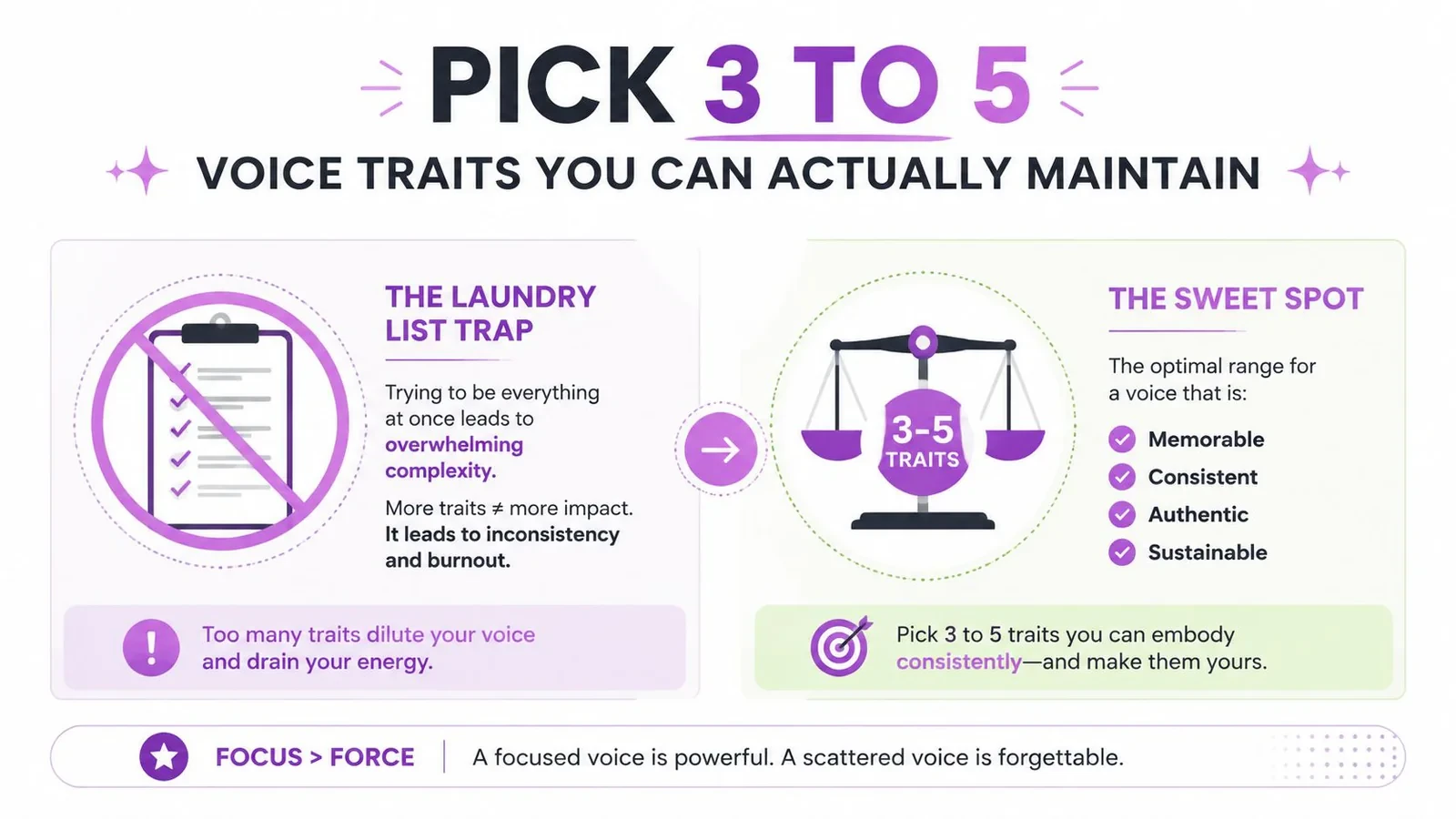
Once you’ve seen the patterns, compress them into a small set of traits. That’s where most voice work gets real. If you list ten adjectives, you don’t have a brand voice, you have a mood board.
The practical range is 3 to 5 traits. That’s enough to be distinctive without becoming impossible to hold across posts, replies, and quote posts, where context changes fast and the timeline doesn’t care about your style guide. Independent guidance on brand voice for X also points in this direction, recommending a small set of defining adjectives instead of a long list that no one can remember (ReplyWisely brand voice examples). If you want a second reference point for keeping the system coherent over time, the HumanizeAIText consistency guide is useful because it turns consistency into a repeatable habit instead of a vague aspiration.
Choose traits that are visible in one tweet
Pick traits you can prove in a single post. “Authentic” is too vague. “Clear” is usable. “Confident” is usable if it changes how a sentence opens. “Playful” is usable if it changes how you frame a reply.
A workable trait should do three things:
- Be distinctive. It should sound like your account, not every account.
- Be observable. A reader should be able to point to it in one tweet.
- Fit the subject matter. If you write about product strategy, your voice shouldn’t depend on jokes that obscure the point.
Here’s the difference between abstract and operational:
- Clear means short sentences, direct verbs, and no filler.
- Confident means making the point without hedging every claim.
- Curious means asking real questions, not vague engagement bait.
- Practical means each post leaves the reader with something usable.
- Sharp means you can be direct without sounding hostile.
Useful test: if a trait can’t be translated into a do and a don’t, it’s probably not specific enough yet.
Turn each trait into a rule you can use
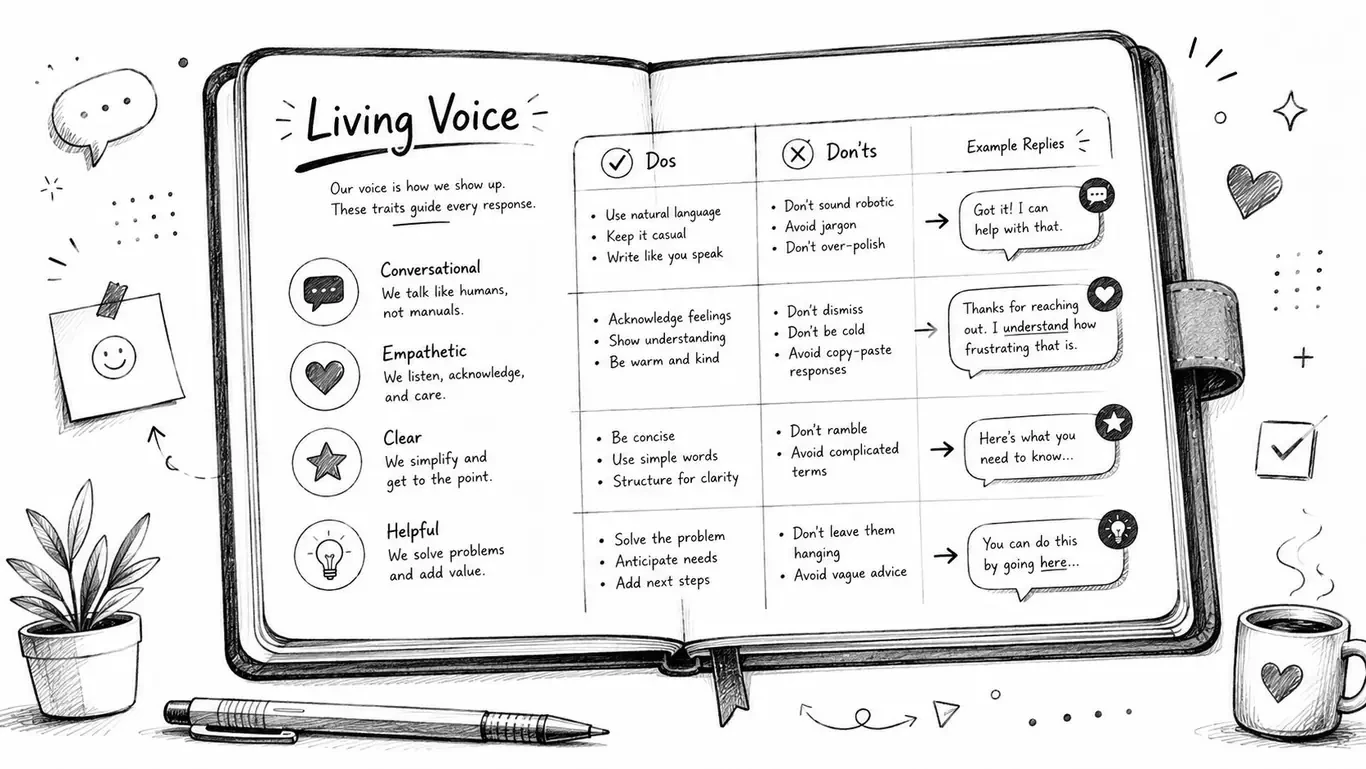
Every trait should get a concrete do and don’t. That’s where the voice stops being theory.
For example:
-
Clear
- Do: Write in short clauses, use plain verbs, and keep the main point near the front.
- Don’t: Hide the idea behind setup, buzzwords, or extra qualifiers.
-
Confident
- Do: State the position cleanly and let the evidence do the work.
- Don’t: Start every sentence with “maybe,” “kind of,” or “I think” when you already know the point.
-
Direct
- Do: Name the problem, the trade-off, or the next step.
- Don’t: Circle the point for three lines before saying anything useful.
The key is that these rules have to work in replies too, not just polished posts. Most of the audience sees your brand voice in the timeline, not on the profile page, so the traits need to survive in conversation. If they only work in a drafted announcement, they’re too fragile.
Turn the Traits Into Reusable Tweet Templates
Traits are useful, but they still need shape. Without reusable structures, writers fall back on whatever feels natural that day, which is usually how consistency starts leaking.
A template is not a script. It’s a scaffold that keeps the voice stable while the topic changes. That matters on X because the writer is often switching between original posts, replies, and quote posts in the same hour.
Build three templates first
Start with a statement tweet, a reply tweet, and a quote-post template. Those three cover most of the daily work.
| Template | Best For | Key Structure |
|---|---|---|
| Statement tweet | Original ideas, takes, and observations | Hook, point, support, takeaway |
| Reply tweet | Joining conversations and adding perspective | Context, opinion, useful detail |
| Quote post | Responding to an existing post with added framing | Reference, contrast, expansion, conclusion |
A statement template might look like this:
Hook. The problem with most onboarding docs is that they explain the product before they explain the user’s job.
Support. That leaves new users with information but no momentum.
Takeaway. Start with the workflow, then explain the features.
A reply template can be shorter:
Context. That’s true for broad audiences.
Opinion. For niche products, clarity beats cleverness.
Add value. The best replies name the trade-off in plain language.
A quote-post template works when you want to add context instead of just repeating the original post:
Reference. Good point on consistency.
Expansion. The harder part is keeping the same voice when the topic changes from product to pricing to support.
Close. That’s where a voice doc pays off.
Keep the templates flexible
The point isn’t to make every post feel identical. Pure repetition is off-brand too, because readers can feel when the account is auto-piloting itself. Use the template as the frame, then let the topic and evidence change the surface.
If you want a practical starting point, the blank Twitter post template gives you a simple structure to adapt without overthinking the first draft.
Practical rule: templates should reduce decision fatigue, not remove judgment.
The easiest way to use them is to keep a few approved patterns on hand, then fill them with current observations, product notes, or replies worth joining. When the template feels too stiff, break it on purpose. A short one-line reply is sometimes stronger than a full structure, especially when the conversation already has momentum.
Operationalize the Voice Across Posts and Replies
The hard part is not naming the voice. It is keeping it intact when most of the work happens in replies, not in polished posts. A living voice document earns its keep there, because that is where small inconsistencies spread fastest.
Treat the voice doc like working memory
A useful voice doc should hold four things, traits, dos and don’ts, approved examples, and rejected attempts. The rejected attempts matter more than many teams expect. They show future writers what the brand should not sound like, which is just as useful as the approved side.
For teams and founders who use AI in the workflow, context matters. Xholic AI is one option that stores personalized context in Xholic Brain, a growth memory that learns from approved replies, edits, saved posts, watched creators, and product context, then uses that history to shape future suggestions. It helps when the account needs to sound like the same person across different days, because the voice does not reset every time someone opens the extension.
Use real posts as your pattern library
Do not invent voice from scratch when the timeline already shows working examples. Search for posts in your niche that got the kind of reaction you want, then break them down by hook, structure, tension, and payoff. A tool like Tweet X-Ray helps here because it forces you to look at mechanics, not just outcomes.
A good remix workflow looks like this:
- Find a strong post. Choose something relevant to your niche, audience, or product angle.
- Break it down. Identify the hook, structure, and one-line payoff.
- Rewrite the angle. Swap in your own point of view, examples, and audience context.
- Check the voice. Make sure the result still matches your defined traits.
- Save the result. Put the finished version back into your voice doc or collections.
If you do not want to search for relevant conversations manually, an Engage-style workflow can help surface posts worth engaging with first, so the voice shows up where people are already paying attention. The same logic applies to replies. Write in conversation, not in isolation.
Keep replies inside the same system
Replies are where voice drift happens fastest. People get lazy, overreactive, or overly promotional. A good reply system keeps the account sounding like itself even when the conversation is messy.
That is also where product-aware context helps. If the product is relevant, the reply should sound informed without sounding forced. If it is not relevant, do not shoehorn it in. The reply should earn its place in the thread first.
For AI-assisted reply drafting, the workflow should stay narrow. Use the draft to save time, then edit for tone, restraint, and fit. If you are building that layer into your process, a guide to AI Twitter reply extensions is a practical reference for how to keep replies fast without letting them sound generic.
A reply system works best when it gives writers guardrails, not scripts. The brand voice should stay recognizable, but the response still needs room for judgment, especially when the thread is sensitive, technical, or lightly skeptical.
Consistent replies do not mean identical replies. They mean the same priorities, the same clarity, and the same level of respect for the reader, even when the topic shifts from praise to support to pushback.
A voice that can hold under pressure is the one people remember. If a reply feels sharp, vague, or salesy in one thread, that tone tends to repeat unless someone is reviewing it on purpose. That review loop matters because drift usually starts in the small replies, then shows up later in bigger posts.
Measure Whether the Voice Is Working
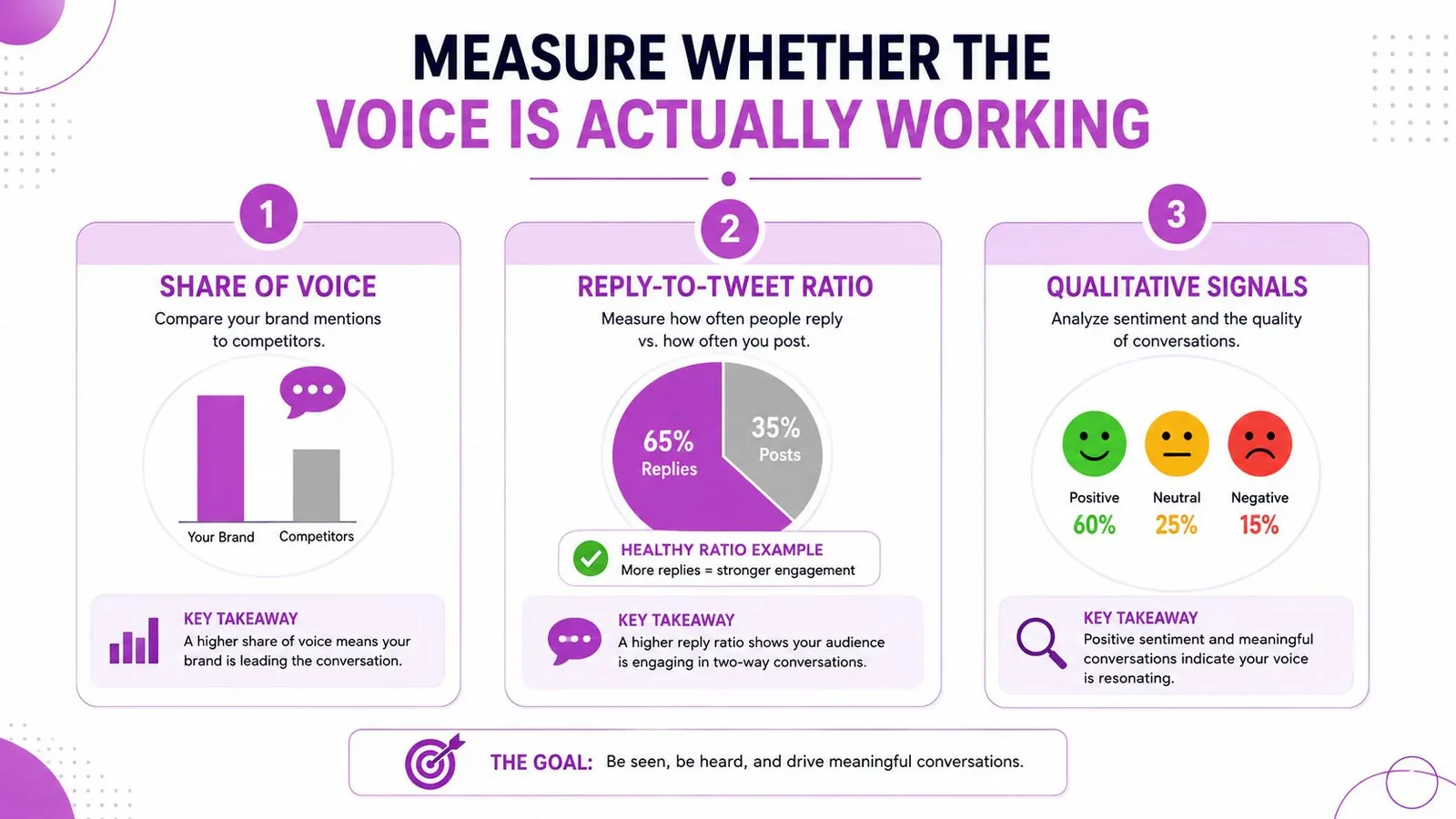
Voice without measurement turns into taste contests. You need a way to tell whether the account sounds consistent, whether people recognize it, and whether the conversation around it is moving in the right direction.
Watch three layers of evidence
The first layer is share of voice, which shows whether the brand is being discussed relative to others. The second is the balance between brand replies and brand tweets, because a voice that participates well in conversation often behaves differently than one that only broadcasts. The third is qualitative, whether readers start quoting the brand back in their own words.
That mix is more useful than a raw engagement count. It gives you a read on whether the voice is shaping how people talk about the account, not just whether a post got a quick reaction.
A measurement approach that looks beyond vanity metrics is also easier to trust. If you want a broader framework for measuring success beyond likes, that perspective is useful because likes alone will not tell you whether your voice is getting remembered or repeated.
Track leading and lagging signals
Weekly, watch these leading indicators:
- Reply rate. Are people answering your posts or going straight past them?
- Quote-post rate. Are others adding your posts to their own commentary?
- Profile visits per impression. Is the voice strong enough to make people click through?
Monthly, review the slower signals:
- Follower growth. Is the account attracting the right people over time?
- Branded search. Are people looking for the name directly?
- Inbound DMs. Are people reaching out because the account sounds credible?
Use a regular reporting habit with the Twitter analytics resource so the numbers do not live only in screenshots and memory.
Important: no metric confirms how the algorithm works. Treat the numbers as patterns, not promises.
Roll Out the Voice in 30 Days Without Burning Out
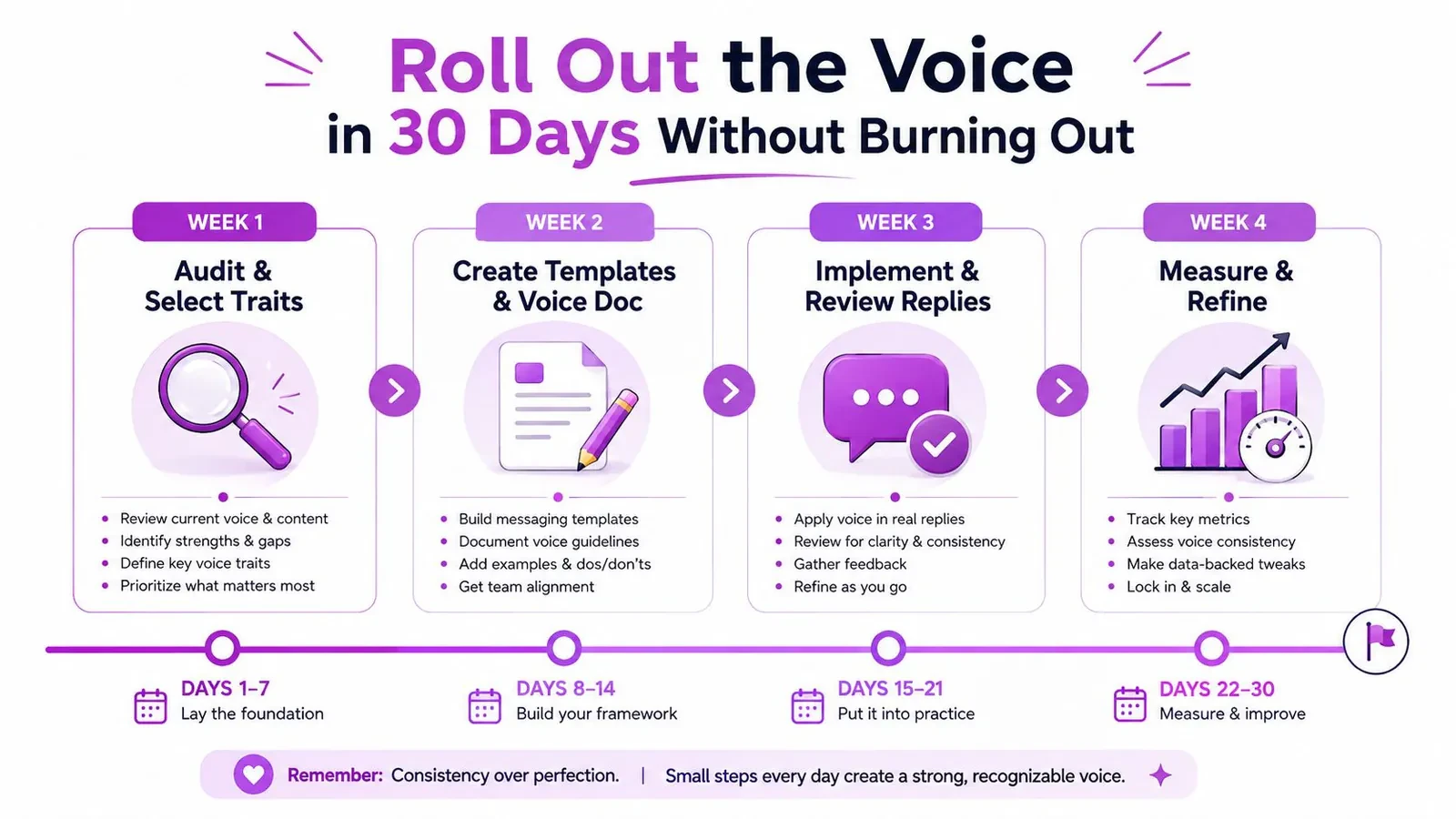
A voice rollout fails when teams try to fix everything at once. A better approach is to make the system small enough to ship, then expand it only after the timeline proves what holds up.
A simple 30-day rollout
Week 1, audit and select traits. Pull recent posts and replies, identify the patterns, and choose 3 to 5 traits that fit the account.
Week 2, build the working assets. Write the voice doc, define the dos and don’ts, and create the three reusable templates.
Week 3, use the system in real publishing. Replace at least half of drafted posts with template-based posts and make sure replies follow the same voice rules.
Week 4, measure and prune. Review the metrics, look for drift, and remove any trait that didn’t survive contact with the feed.
What done looks like
By the end of the month, you should have:
- A voice doc with traits, tone notes, and approved examples
- A trait list with 3 to 5 usable descriptors
- Dos and don’ts for each trait
- Three templates for posts, replies, and quote posts
- A measurement sheet for weekly and monthly review
The most common mistakes are easy to spot. Over-defining the traits makes the system unusable. Ignoring replies makes the voice drift where people see it. Treating the doc like a one-time project makes it stale before it ever gets used.
Pick one trait, write five posts that match it, and ship them this week. If you want help keeping that voice consistent across daily replies and saved context, Xholic AI’s Brain-style memory and Engage workflow can support the process without taking over your judgment. Visit Xholic AI and build a voice system that your timeline can recognize.