Codex CLI, app server, and agent harness
The CLI and open-source app-server architecture, agent loop mechanics, context compaction, prompt caching, configuration, and extensibility of the Codex runtime.
38%
Best tweets about OpenAI Codex
Explore the best tweets about OpenAI Codex, including coding-agent workflows, CLI use, delegated tasks, reviews, and engineering results. Updated weekly.
Real Codex tasks and software-engineering outcomes, excluding unrelated historical or publishing references to codex.
Original Xholic analysis
The Codex conversation centers on agentic software delivery: delegating implementation, testing, and review through the CLI, app, and integrations. Sentiment is predominantly supportive, while posts also emphasize verification, workflow guidance, and rough edges in remote use. Browser/computer use and cross-model orchestration are prominent practical extensions.
72% of posts
All-time engagement
34% of posts
Published in 90 days
Conversation map
The CLI and open-source app-server architecture, agent loop mechanics, context compaction, prompt caching, configuration, and extensibility of the Codex runtime.
38%
Using Codex alongside Claude Code or alternative/local models for planning, execution, adversarial review, security reviews, and model-specialized workflows.
28%
Codex takes natural-language tasks through planning, implementation, testing, iteration, and reviewable PRs; posts cover feature building, bug fixes, migrations, and long-running autonomous projects.
24%
Vercel plugins, MCP servers, OAuth, GitHub, browser extensions, OpenClaw, messaging, and other integrations that connect Codex to developer tools and services.
22%
Repository instructions, focused agent skills, record-and-replay workflows, prompting practices, verification, and persistent conventions that improve agent reliability.
22%
Codex controlling Chrome and desktop applications for signed-in workflows, browser automation, end-to-end testing, screenshots, video evidence, and UI validation.
20%
Multi-agent execution, agent threads, task queues, issue-tracker-driven workflows, heartbeats, and coordinating Codex with other models or agent systems.
20%
Running and resuming Codex sessions across desktop, phone, tablet, iOS, Telegram, and remote always-on development machines.
14%
Tone and stance
Performance benchmark
Posts with media make up 60% of this collection. Their median all-time score is 11.7, compared with 14.4 for text-only posts.
Format mix
Consensus and debate
Shared view
Posts describe Codex taking broad tasks from planning through implementation, testing, and reviewable outputs, shifting the interaction from code generation toward task delegation.
Shared view
Posts recommend repository instructions, focused skills, connected tools, and explicit verification rather than trusting confident agent output alone.
Shared view
Codex browser and computer-use capabilities are presented for parallel browser work, screenshots, and end-to-end feature validation.
Shared view
Posts highlight plugins, OAuth, MCP, and Vercel-specific skills as ways to connect Codex with development platforms and external services.
Open debate
One comparison favors Codex’s smoother CLI and reliable interruption, but prefers Claude Code’s leader-agent messaging; other posts characterize the tools as complementary rather than substitutes.
Open debate
Cross-device session access is praised as a remote-work capability, while a detailed iOS review flags sync, permission, and stale-dialog issues.
Open debate
Reports of long-running autonomous builds coexist with warnings that security-sensitive output and confident results should be inspected and verified.
What performs
The Chrome integration post scored 1845.78, or 154.98 times the supplied median all-time score, making it the largest listed performance outlier.
Media appeared in 60% of posts, while the supplied median all-time score was 11.74 for media posts versus 14.41 for text-only posts. Listed high-scoring outliers included posts about Chrome integration, Codex feature updates, and remote development.
The supplied analytics assign predictions a median all-time score of 268, above every other listed format. The cited posts discuss Codex-led delegation and multi-agent orchestration.
Statistical standouts
Creator landscape
The five most represented creators account for 20% of the selected posts.
1. CHOI
@arrakis_ai
2 posts
2. Deep Thrill
@DeeperThrill
2 posts
3. Anthony Kroeger
@kr0der
2 posts
4. Mark Kretschmann
@mark_k
2 posts
5. Minh-Phuc Tran
@phuctm97
2 posts
6. 0xMarioNawfal
@RoundtableSpace
2 posts
Examples from creators include reusable browser-testing skills, remote-device setups, and an open-source browser extension rather than solely abstract product commentary.
Posts repeatedly position Codex as an executor or reviewer alongside Claude and other models, using specialization and adversarial review rather than a single-agent workflow.
Since the previous snapshot
Themes, sentiment, stance, and post format are classified per tweet. All counts, shares, medians, creator concentration, freshness, and performance comparisons are then calculated directly from the published snapshot.
Xholic's all-time score compares engagement while accounting for reach, post age, and creator consistency. It is used for relative comparisons within this collection.
This report analyzes the exact 50-post snapshot shown below. AI identifies editorial categories and drafts explanations; all statistics are calculated from the snapshot, and every narrative claim is checked against cited posts before publication.
Best OpenAI Codex tweets
Ranked 01–50

@OpenAI ·
Codex now works directly in Chrome on macOS and Windows. It’s even better at working with apps and sites in Chrome, and now works in parallel across tabs in the background without taking over your browser. To get started, install the Chrome plugin in the Codex app.
 Watch video

@AlexFinn ·
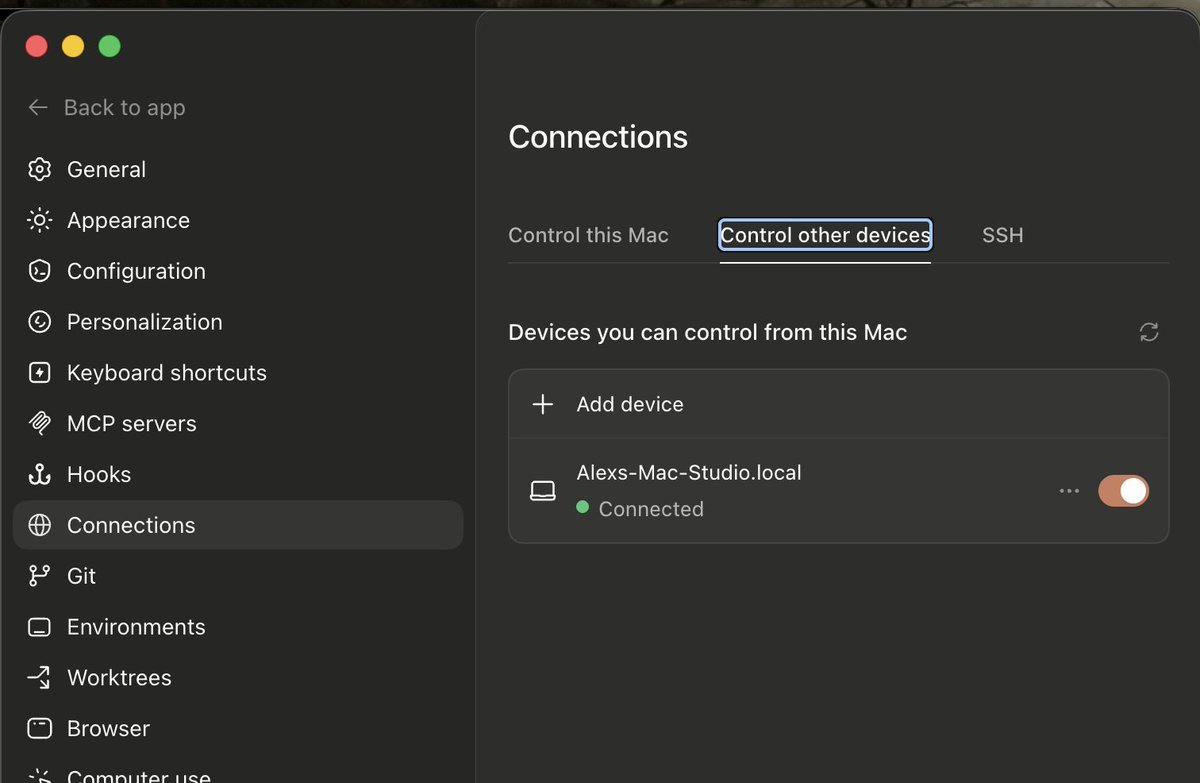
You need to set up this Codex system I have Been taking advantage of their new remote features and my productivity has 1000x'd I have one device (Mac Studio 1) as my main dev machine. That's where all code is written Then all my other devices (iPad, iPhone, other Mac Studios) ALWAYS remote into that Mac Studio 1 to do their work I never do local work on any of them. They're always remotely controlling the Mac Studio No matter which device I'm on, no matter where I am in the world (could be at the grocery store, in bed, Japan, on the toilet, by the pool, on the road using FSD) I have code written in one place Made coding big projects SO much easier Here's what I'd do if I were you Choose one device you have (preferably a desktop device like Mac Mini or Mac Studio that is always on) Make this your main dev device. Make sure it never turns off and never goes to sleep Go into Codex app then settings on that device. Go to connections > control this Mac. Turn that on Then go into every other device you have, mobile, desktop, whatever, and go into Codex settings and enable control other devices Also download Tailscale on every device. This will allow you to create a private network that will allow your other agents (OpenClaw or Hermes) to jump between computers and make changes when necessary You now have a super powered AI private network where you can code or get work done from any device anywhere in the world Promise this 1000x's your productivity

@ashleybchae ·
oh-my-codex is lowkey the best thing to happen to codex cli. you can even throw a vague idea at $ autopilot & it plans, codes, & tests everything. my friends built this & it's cracked. you can even use $ ralph to clone Resend .com in ~7 hr with no human input (link soon!) @Yun_HDY @bellman_ych https://t.co/aLablFaJ84

@om_patel5 ·
THIS GUY MADE CLAUDE CODE AND CODEX TALK TO EACH OTHER not by switching between them, they literally talk to each other about your code in real time you give it a task. it spawns a Claude agent and a Codex agent in separate sessions. they share findings, challenge each other, and produce a combined result. he pointed them at an Express API with intentional security issues. within minutes they found SQL injection, hardcoded secrets, missing auth, and weak JWT config. one catches something and the other confirms it and adds context. they divide the work on their own for faster speed one command: /collab "review auth.js for security issues" that's it. you watch the conversation happen in real time. AND its open source with new models being integrated crazy to think that this was entirely vibe coded
 Watch video

@arrakis_ai ·
🚨 BREAKING: Codex in Chrome just leaked!!! Okay, the leak was a joke. But the tool is real. I used the open-source Codex App Server and ChatGPT OAuth to build a fully functional Codex Extension directly inside Google Chrome. Here is what it can do right out of the box: → Image Editing: Edit the exact images you are currently viewing on the web. → Contextual AI: Ask questions based on your active tabs and actual search history. → Page Analysis: Extract and process information directly from your current webpage. → Browser Automation: Full browser control and execution. No more copying and pasting URLs or screenshots into a separate window. The AI lives in your browser, sees what you see, and acts on it. The best part? It is 100% open-source. You can grab the code, install the extension, and run it right now for free.
 Watch video

@xanderai ·
In the few weeks since Claude Code's agent teams and Codex's multi agents features came out, I've personally spent ~50B tokens between the two of them. Some observations: 1) codex cli UI is much, much smoother. The claude code cli at some length of conversation history / number of running background tasks becomes incredibly slow and sagging. Difficult even to type anything. 2) codex has no mechanism by which the main/leader agent wakes up to respond to sub agents' results. Claude code has a communication mechanism where sub agents send messages to the leader when they have interesting results. These messages wake up the leader and it thinks and takes actions to make sure the whole endeavor is on track. codex's main agent just sleeps forever after initial setup, requiring me to prod it regularly. 3) claude code's tmux integration is a limitation. I've seen it unable to spawn new agents simply because tmux refuses to create more panes: "no space for new pane" - required to use in-process agents, and no way to change this after starting. 4) Claude code has been much harder to get rate limit increases on. I have ~100 simultaneous agents that regularly all get shut down due to hitting overloaded or per minute rate limit errors. I've encountered hundreds if not thousands of rate limit errors that are never reported in the Anthropic Console. 5) Claude code *really* wants to end sessions after a certain amount of time. There's no amount of prompting I can do to prevent it from doing this. There's either some training or prompt injection that makes it want to shut down prematurely. Telling it to stop that and keep going works for ~20min only. Claude loves to produce a "FINAL report" while there are still hundreds of productive tasks in process. 6) codex's agent names are non-descriptive and useless. Hegel, Lovelace, Feynman, Pauli, Curie, ... Come on. I greatly prefer claude code's descriptive agent names: advisor, perf, node-1, node-2, researcher, X-debug, etc. Less cute. More utility. I have no clue which agent I need to talk to when looking at the agent list in codex. 7) In claude code it is difficult and even non-deterministic to interrupt the main agent's currently blocking task. The main agent should *never* sleep on its blocking thread. And yet all the time I have to send messages and hit escape back and forth until it gets interrupted. In codex this is a 100% reliable single Esc key press. #1 is the biggest reason I prefer codex for this. #2 is the biggest reason I prefer claude code for this. Will make immediate use of any fixes for these issues @thsottiaux @bcherny

@mark_k ·
It's CODEX THURSDAY and OpenAI came through! 🔥 Codex app 26.616 changes: • Added Record & Replay on macOS, which turns a demonstrated workflow into a reusable skill. • Record & Replay is not available in the EU at launch. • Record & Replay requires Computer Use to be enabled by the user or admin. • Added bulk actions to automation run history, so runs can be marked as read or archived in bulk. • Added new deep links for managing SSH connections. • Improved Browser Use so visible-tab routing and annotations persist when a draft browser session moves to the server. • Additional performance improvements and bug fixes.


@marvinvista ·
Codex as Chief of Staff For knowledge work: Plugins enable Codex to do most of my knowledge work. It reads and responds to emails and Slack. It builds models in Sheets and handles all of my note taking for me. Codex is quickly becoming my assistant. It understands me and what I’m doing enough to help get real work done. - @trekedge, https://t.co/NJiXNtQmjX For dinner planning: Our incredible comms leader, @lindsmccallum, planned a closed door dinner for the Codex team in a fraction of the time it would normally take - thanks to Codex.She used the Codex App to: - compile the invite list - send out invitations - hourly scan of her emails to update RSVP status - populate a doc with bios on every attendee - create a mini app to plan the seating chart - @rohanvarma, https://t.co/p6LpVKNBEX Inbox triage: Getting codex's help to me climb from under my inbox mountain - @boazbaraktcs, https://t.co/JXz57p8nRq Automation density: I've been using plug-ins a ton internally. I have about 58 automations and 30 plug-ins and I've automated everything except the part where I have to come up with ideas and talk to people - @jxnlco, https://t.co/w0K2GaKzzl

@VaibhavSisinty ·
My Codex agent has been building non-stop for 9 hours straight 🔥 Gave it a massive scope: build a Mac app for all my content. Calling it Content OS. Running it in full-auto mode with bypass approvals. Full access to my browser, filesystem, and shell. Going full YOLO. Set up a 30-min heartbeat automation on the thread in case it drops out of the loop or breaks sandbox to ask for approvals (reminding itself it's supposed to run fully autonomously, no human-in-the-loop). Also plugged in VAPI via MCP with an instruction: if for whatever reason you're stuck and can't move ahead because you need action from me, call me on my phone and tell me exactly what the problem is so I can come attend to it. Hasn't made a single call yet. Didn't get stuck even once so far. Kicked it off last night. What I woke up to was nothing short of mind-blowing. Right now I'm at the gym, haven't even seen the updated output yet (it's a MASSIVE Mac app). Will drop more updates soon. But first impressions. I'm fucking mind-blown. - Figured out auth for YouTube Analytics on its own - Figured out auth for Meta (Instagram Analytics) on its own. Spent 2+ hours driving my browser to solve it - Integrated an AI layer via OpenRouter so I can talk to my data - Built a comment response engine with suggested replies using Apple Intelligence (local models) Will share the full app once it's done. But boss, it's a definite bye-bye to Claude Code from my end. Also, hasn't hit rate limits yet. Thanks to Sam resetting the limits post Codex Gen 2 launch yesterday. BTW, I've never written a single line of code in my life. So don't grill me on security. Building this as personal software to manage data across the 5M+ followers I have on IG, YT, X, LinkedIn, and my newsletter. Will share the full product once it's built. But damn, excited. Probably will make it free for people to use it once the whole thing is fleshed out!
@mark_k ·
Great move by @OpenAI: more Codex app features are now available in Europe, including the EEA, UK, and Switzerland. The big ones: Computer Use on macOS and Windows, so Codex can see, click, and type in desktop apps; the Chrome extension for browser tasks that need your signed-in context; Memories for preferences, workflows, tech stacks, and repo conventions; and Chronicle as an opt-in Pro research preview on macOS. For European developers this is a meaningful unlock. Codex is becoming less like a coding chatbot, and more like an actual agent sitting next to you in the dev environment.


@bradmillscan ·
Did you know with OpenClaw you can talk to ChatGPT Codex on Telegram kinda like Claude's Dispatch? It inherits workspace visibility and it runs outside of the openclaw subagent sandbox. So it's pretty powerful - but it's not an isolated agent. 1 Setup Telegram Topics 2 Enable Telegram ACP thread spawning 3 set channels.telegram.threadBindings.spawnAcpSessions = true 4 add an ACP agent entry for Codex 5 pin the agent to a topic with channels.telegram.groups.<chat>.topics.<id>.agentId (If you're curious, it does have a session but it does not have auto-compaction or write to the lossless-claw DAG because that is for the openclaw pi runs and codex is CLI backend.) I'm using mine for tech support. Experimenting with it, might not keep it around.


@AbdelStark ·
I am stocked to announce that I won the @OpenAIDevs Codex x Mollie Hacka Worldwide Hackathon in Paris. 60+ builders, every one of us working solo, one day to ship. I built mine around a single question: who gets to own intelligence? The default answer is scary. You hand your data to a handful of labs, they train the model, they own it, and you rent back a thin slice of what your own data made possible. That is the bargain on the table today. I do not accept it. So I built Lensemble: a Tapestry like distributed training platform for JEPA based World Models. What does it enable: World Models that a community improves together, keeps sovereign, and co-owns. Two bets sit underneath it. First, the paradigm. Language models predict the next token. Powerful for text, a dead end for the physical world. A robot does not need to autocomplete sentences, it needs to predict what happens next in the world. That is what JEPA does: it learns by predicting representations instead of pixels or tokens. I am convinced world models are the most underrated paradigm in AI right now, and the closest thing we have to a ChatGPT moment for robotics. Second, the politics. Your raw trajectories never leave your machine. Each participant trains locally against a shared protocol and ships only an update, never the data. A federated round folds those updates into one shared world model, a LeWorldModel based model, and the gain is measured, not claimed: a 12k-parameter adapter on a frozen backbone, held-out prediction error down about 12 percent, the model measurably less surprised by the world. Then the upside is split by contribution weight, so the people who improved the model own a share of what it earns. This is the thesis behind Project Tapestry, the AI Alliance and Yann LeCun's push for federated, sovereign frontier AI, carried into world models and robotics. Call it Tapestry for the physical world. All of it built solo, in a single day, with Codex as my pair the whole way. Thank you to OpenAI Codex and Mollie for backing builders who ship real things, and to @borvibe and the organizing crew for the room and the standard you set. Intelligence the world improves, and the world owns. That is the future I want for my kids, and the one I will keep building.


 Watch video

@emanueledpt ·
After creating Remodex: Codex remote control for iOS I decided to chill a bit by building a browser sidebar inside @theo 's T3 Code You can open it with Cmd+Shift+B This software is so easy to "manipulate" and build upon Congrats to all the guys that put the work in it because it is great I certainly will be building more things with it For this one I decided to switch from the Codex App to the Codex CLI too just to see how it works And boy it was so good
 Watch video

@TheRohanVarma ·
Our incredible comms leader, @lindsmccallum , planned a closed door dinner for the Codex team in a fraction of the time it would normally take - thanks to Codex. She used the Codex App to: - compile the invite list - send out invitations - hourly scan of her emails to update RSVP status - populate a doc with bios on every attendee - create a mini app to plan the seating chart Things Codex didn’t do: - make the sushi we ate (soon) Lindsay has never coded before. With Codex, she is a builder. Codex is the interface for personalized software.

@free_ai_guides ·
7 mistakes I see people make with OpenAI Codex: 1. No AGENTS. md file. Codex guesses your stack every session. 2. One thread per project. Context rots. Codex starts repeating itself. 3. Using GPT-5.4 for everything. Simple tasks burn quota for no reason. 4. No skills installed. You re-explain the same patterns every time. 5. Watching it step by step. It's built for parallel work, not babysitting. 6. Zero MCP servers connected. You're copy-pasting what Codex could pull itself. 7. Skipping verification. Confident output doesn't mean correct output. Fixes for all 7 in the infographic below.


@kr0der ·
Codex app guide: automated testing + screenshots/videos (for you to review or for PRs) first look at the prompt i tested in my photo. it didn't fully work and i'm going to explain why, and what can be done to get it fully working, because i think this is going to be a huge unlock. to attach a screenshot, it first tried Browser Use but i wasn't logged in with Github. then it tried the gh API but it couldn't upload images properly, but i got it working eventually via a prompt telling it to use Computer Use. this is still pretty manual, so now i've signed into Github in the Codex in-app browser, so hopefully the agent can now paste screenshots easily 👀 this basically helps automate frontend/full stack feature testing + automatic PR creation. here are some huge improvements i'm imagining: - telling it to use the local DB to search for testing data it can use, and potentially creating some test data. this can be combined into a skill with my prompt in the screenshot. - getting it to create videos for PRs or just for you to review, by taking a bunch of screenshots and stitching them together with ffmpeg


@Hesamation ·
OpenAI reports: Codex active users grew 5x in the first half of 2026. this is from OpenAI's paper released today, based on the data from Codex. main takeaways: > non-dev Codex usage is exploding. Since Aug 2025, it’s up ~189x in orgs and ~137x for individuals > inside OpenAI, Codex is now 99.8% of their output tokens and ChatGPT only 0.2% > individual users are still mostly in ChatGPT: Codex is only 16.5% of their output tokens > organizations are using Codex like no one else. Codex went from almost nothing in Aug 2025 to 63.3% of output tokens now > long horizon tasks are taking over. 1h+ human-task prompts went from 35.4% of users in Dec to 70.2% in May > 8h+ human-task prompts went from 2.1% in Dec to 25.6% in May >skills are being adopted fast. usage went from 5.4% in Mar to 26.6% in Jun > OpenAI’s 99th-percentile users are running ~71 hours of agent work per day, they’re managing multiple agents in parallel


@alexabelonix ·
OpenAI Codex app is now on Windows. You get the full Codex app experience on Windows with a native agent sandbox and support for Windows developer environments in PowerShell.
 Watch video

@EvanLuthra ·
THIS SHOULDN'T EXIST!!!🤯 An AI jailbreak researcher just released a framework that turns a regular Claude Code or OpenAI Codex subscription into an autonomous AI bug hunter. It can scout targets, find vulnerabilities, exploit them, and generate reports with almost no human https://t.co/fHqZ33SGoY

@shao__meng ·
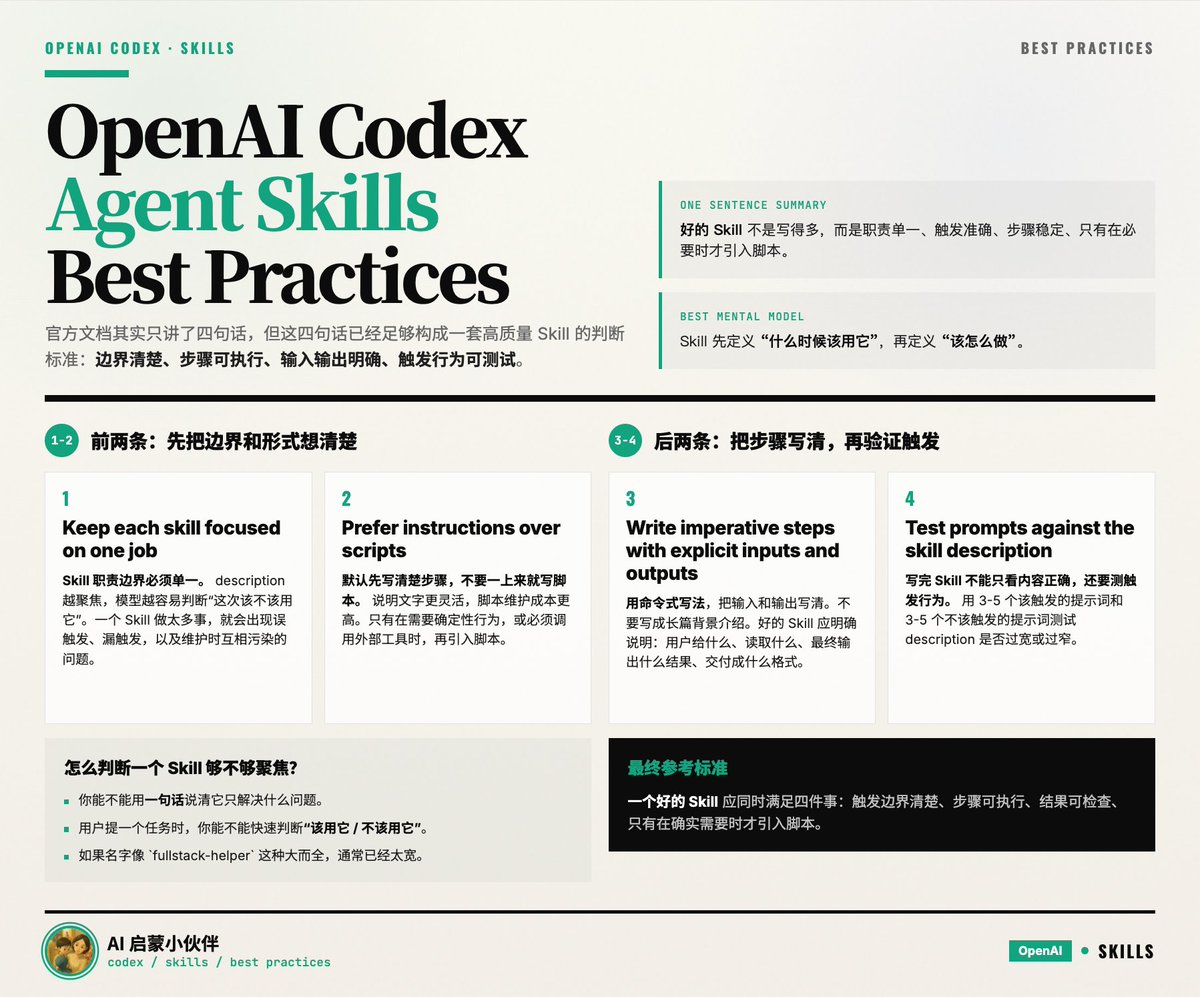
OpenAI Codex - Agent Skills Best Practices 只有四句话: 1. Keep each skill focused on one job. 2. Prefer instructions over scripts unless you need deterministic behavior or external tooling. 3. Write imperative steps with explicit inputs and outputs. 4. Test prompts against the skill description to confirm the right trigger behavior. https://t.co/KNb0CCsJxc 1. Keep each skill focused on one job Skill 职责边界要单一: · description 越单一,模型越容易判断“这次该不该用这个 skill” · 一个 skill 做太多事,会出现触发不准 · 维护时也更容易改坏别的场景 举个例子: · 不推荐:fullstack-helper,既管数据库,又管前端,又管部署 · 推荐:postgres-query-tuning、playwright-ui-debug、release-note-writer 判断标准: · 你能不能用一句话说清“它只解决什么问题” · 用户提一个任务时,你能不能很快判断“该用它”还是“不该用它” 2. Prefer instructions over scripts unless you need deterministic behavior or external tooling 默认先写清楚步骤,不要一上来就写脚本,为什么: · 说明文字更灵活,模型可以根据现场情况调整 · 脚本需要维护、兼容环境、处理错误,成本更高 · 很多任务本来只是“怎么做”的问题,不一定需要固定程序 文档也给了两个例外: · 你需要确定性行为 例如输出格式必须严格一致、每次都要按同样流程执行 · 你需要外部工具 例如调用 ffmpeg、数据库客户端、测试命令、浏览器自动化工具 可以这样理解: · 能靠明确步骤完成,就先用文字 · 只有在“必须固定”或“必须调用工具”时,再加脚本 3. Write imperative steps with explicit inputs and outputs 用命令式写法,输入输出写明白: · 用“先做 A,再做 B,然后检查 C” · 不要写成背景介绍、经验分享、长篇解释 输入输出写明白指的是: · 输入是什么:用户给什么、文件在哪、参数是什么 · 输出是什么:生成什么文件、返回什么格式、最终要交付什么结果 不好的写法: “分析代码库并给出建议。” 更好的写法: “读取 package.json 和 src/ 下的构建配置,找出构建失败原因。输出一个按严重程度排序的问题列表,并给出最小修改方案。” 4. Test prompts against the skill description to confirm the right trigger behavior. Codex 会根据 description 做隐式匹配,所以你写完 skill 后,不能只看内容是否正确,还要测“会不会在对的时候被选中,在不对的时候不被选中”。 应该怎么测: · 用 3 到 5 个“应该触发”的提示词试一下 · 再用 3 到 5 个“看起来有点像,但其实不该触发”的提示词试一下 真正要验证的是: · description 是否太宽,导致误触发 · description 是否太窄,导致该触发时没触发 · skill 名字、说明、步骤之间是否一致 最后 - 给咱们的参考:一个好的 skill,应该同时满足 · 触发边界清楚 · 步骤可执行 · 结果可检查 · 只有在确实需要时才引入脚本

@jpschroeder ·
Codex iOS Review: Better Than Nothing. It’s been about 24 hours now that I’ve been using the new Codex feature in the ChatGPT app to try to “dev” remotely, and I think I’m ready to give my opinion: it needs more work. I was absolutely blown away at first by the onboarding experience. I updated my Mac’s Codex app, clicked a few buttons, and that was pretty much it. But then the iOS app froze and none of my sessions appeared. No big, I force-quit the app, reopened it, and much to my surprise, ALL my Codex sessions turned up — not just the ones in the Mac app! This was my first very happy surprise. See, I’m a very heavy Codex CLI user. I honestly don’t care about the Mac app that much. It’s fine, I guess, but Codex on iOS was able to see all my sessions, even ones inside worktrees created with https://t.co/Pftik3Sha1! I love this. I also love that, out of the box, it asks for permission to keep your Mac awake. However, it’s still quite clear that not everything is smoothed over yet, as a lot of the features are not properly synced with the iOS app. For example, the permissions on the iOS app are not the same as on the computer. I can actually set the phone to a different set of permissions than the app. I doubt I’m supposed to be able to do this, but I can. Another annoying rough edge: dialogs that I’ve handled on the computer often get “stuck” on the app, where I’m forced to submit a turn that I already took hours ago, like approving a plan, for example. Slash commands are also sufficiently different between the two that it causes some confusion. Another challenge that no one has really solved yet is how to actually see if what’s happening in your coding agent is any good when you’re remote. That really puts a damper on the utility of these remote agents beyond keeping the plates spinning. But put all that aside, because this release takes remote work from zero to one in Codex, and that core piece works. I can interact with and run Codex from anywhere, and for that, I applaud the team.


@rstormsf ·
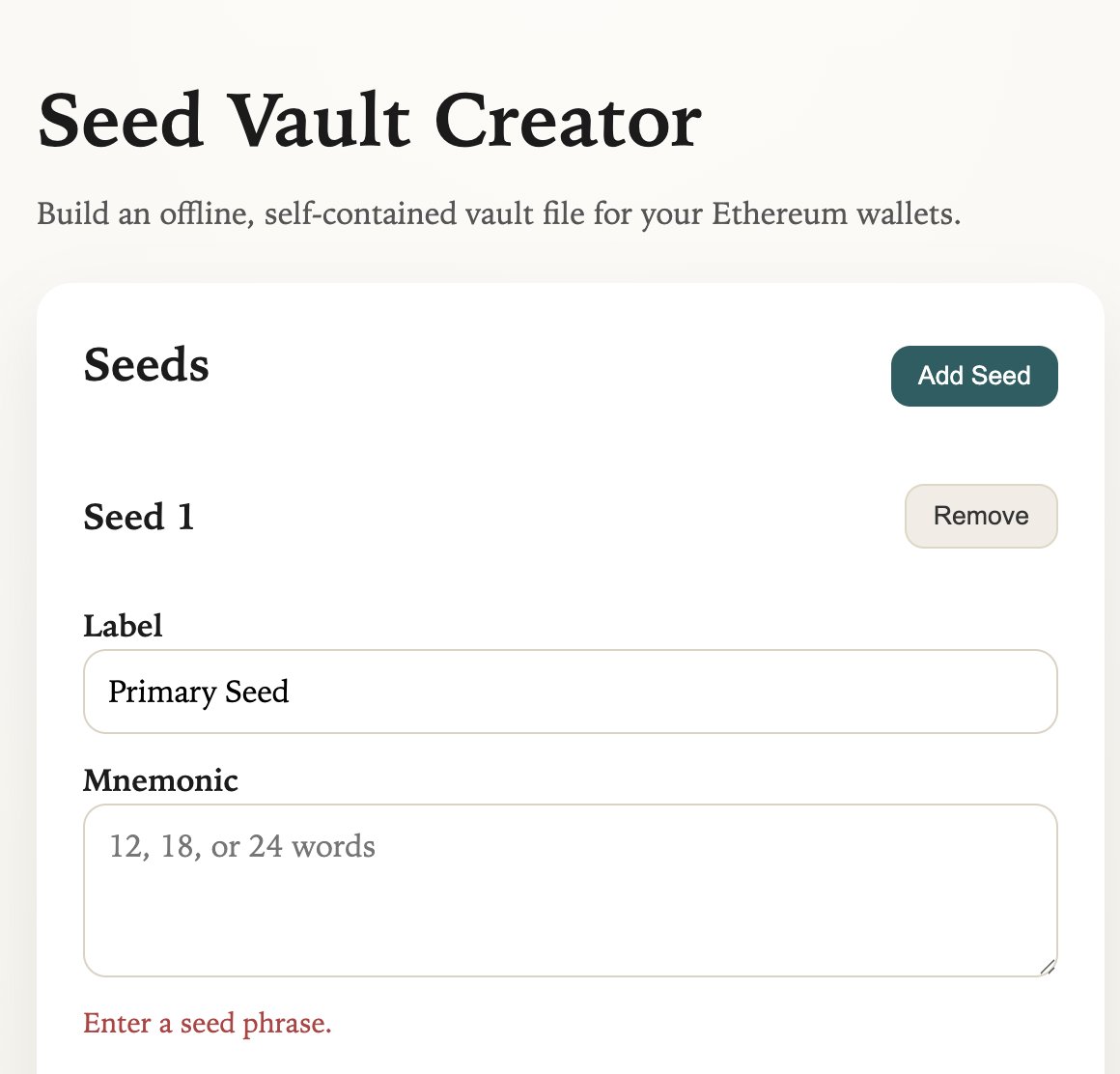
Vibe coded a small app in the new Codex app by @OpenAI. 🪄 Spec: A standalone HTML tool for encrypting/decrypting seed phrases with multiple passphrases. To be honest, I’m curious how Codex actually makes its security decisions under the hood - is a "vibe coded" security tool actually useful, or is it a liability? Checking the source now. 🔐🤔 Source: https://t.co/Xv1HzMqkKj Demo: https://t.co/acINV9IvCh

@rohitdotmittal ·
I just asked Codex to watch a Loom video about a product improvement, find the relevant parts, take screenshots, and create updates about the product. Codex on 5.6 Sol used the Codex app, the browser, and the MCP servers across 3 different tools/services to complete the task. And it did it way better than Claude Fable 5. For browser automation, Codex 5.6 Sol completely beat Claude Fable 5. More bullish on using AI for future workflow enhancements.

@DeryaTR_ ·
With OpenAI Codex automations, I built HTML file that update daily & list all the emails in my inboxes, organized by priority & groupings. Each email also includes direct links to open it, along with archive & delete buttons, so I can manage messages directly from the HTML file!


@RoundtableSpace ·
Someone figured out how to run Claude Fable 5 and GPT-5.6 together inside ChatGPT Codex and the setup takes 5 minutes. Two commands get you started: → codex plugin marketplace add Cjbuilds/Codex-Orchestration → codex plugin add codex-orchestration@codex-orchestration From there you set an advisor model for the expensive thinking and an executor model for the cheaper implementation. Paste the workflow prompt, describe the task and both models handle their side automatically. Fable 5 plans. A cheaper model executes. You get the best of both without paying flagship prices for every token.
 Watch video
@arrakis_ai ·
holy sht.. AI just changed how software gets built. Codex App might be the closest thing to a GPT-3 moment for development. For years, AI coding tools lived inside terminals. Claude Code, Codex CLI, all incredibly powerful, but they still felt like tools built by developers, for developers. Flexible? absolutely. But also fragmented, full of setup, plugins, MCP servers, and custom workflows. Great for engineers. Not exactly a product for everyone else. What Codex changes isn’t just the model. It’s the interface of development. Instead of stitching together tools, environments and scripts, you simply talk to the system. Behind the scenes, agents read your codebase, modify files, install dependencies and execute tasks. Software creation starts to feel less like programming and more like delegating work. The moment it clicked for me was simple. During the OpenClaw wave I bought a Mac mini and set up a fresh environment. Normally the first installs would be npm or brew. This time it was Codex. I gave it full access and asked it to install everything needed to run the project. Dependencies, environment setup, configuration, runtime. All from a single prompt. Watching the system configure itself without touching the terminal once felt like looking at the next interface of computing. Not because AI wrote code. But because the computer started executing intentions instead of commands. Most people think AI will democratize coding by generating code faster. But that’s not the real shift. The real shift is that software development is slowly moving from writing code to assigning tasks to agents. Historically computing had three main interfaces. CLI for engineers, GUI for consumers, APIs for systems. AI introduces a new one. The agent interface. You don’t operate the software anymore. You tell systems what outcome you want and they orchestrate the process. If that interface becomes mainstream, the impact goes far beyond coding. It changes how startups are built, how products are shipped, and how technical the world needs to be to create software. Codex App might be one of the first glimpses of that future.

@phuctm97 ·
ChatGPT/Codex Computer Use is the most underrated piece of software in the AI era. It's insanely good and unblocks essentially infinite amount of things that AI can do for me: • Test my web/desktop/mobile app end-to-end • Test any integrations with other apps • Use any other apps that don't have an API/CLI
@RoundtableSpace ·
Codex runs on any model you want including local ones via Ollama. Three lines in a config file and you're running Gemma 4 locally inside the full Codex app. No API keys. No cloud. No cost per token.
 Watch video

@frog_omo ·
openai codex is the most misunderstood tool in AI right now. most people think it's just "chatgpt for code." it's not. it's an autonomous coding agent that reads your entire repo, writes code across multiple files, runs tests, iterates on failures, and opens pull requests — while you do something else. here's everything you need to know: what codex actually is: you describe a task in plain english → codex plans, writes code, installs dependencies, runs your test suite, iterates on failures, and returns a reviewable PR. it runs in isolated cloud sandboxes. no internet access by default (prevents supply-chain attacks). tasks take 1-30 minutes. this isn't autocomplete. it's delegation. how to use it: → CLI: npm i -g @openai/codex, then run "codex" in your terminal → cloud: https://t.co/6LT2EArDPR — connect github, configure your repo, launch tasks → IDE: vs code, cursor, jetbrains extensions → desktop app: macos/windows command center with parallel threads → github bot: tag @codex on any PR or issue the secret weapon: AGENTS.md this is a markdown file in your repo that tells codex how your project works — setup commands, test commands, conventions, architecture rules. codex reads it before every task. this is the single biggest quality lever. write it before your first task. commands first, prose second. best use cases (where codex shines): → bug fixes from issue descriptions → refactoring, renaming, code migrations → test coverage expansion → dependency upgrades → documentation from code diffs → automated PR code review (openai's most-used internal feature) → scaffolding new features → maintenance backlog you never get to openai built the sora android app in 28 days using codex. in one experiment, codex ran 25 hours straight, used 13M tokens, and generated 30k lines of code. what it's NOT good for: → interactive/exploratory debugging (use cursor or claude code) → frontend/visual work where you need to see updates live → high-stakes first-pass correctness (claude opus 4.7 is safer here) → loose prompts — it will install packages and edit files you didn't mention the "act, don't ask" default creates sprawling diffs when assumptions are wrong. pricing: bundled into chatgpt plans — no standalone subscription. → plus ($20/mo): solid daily usage for individuals → pro ($200/mo): heavy usage, ~20x plus limits → business: $20/seat annually, or codex-only pay-as-you-go pro tip: plus at $20/mo is more token-efficient than claude pro at the same price for batch work. the expert consensus: use both codex and claude code. → codex: cheap, autonomous, parallel batch work — PR review, maintenance backlog, test coverage → claude code: interactive, high-stakes, first-pass-correct edits and architecture "claude generates, codex reviews" is a popular pattern. or vice versa. how to start (this week): 1. if you have chatgpt plus, codex is free at the margin, try it 2. install the CLI, authenticate with your chatgpt account 3. run a read-only task first: "explain this project's structure" 4. write AGENTS.md (setup, test, lint commands) 5. batch your maintenance backlog into clear issues 6. delegate in parallel, review and merge never merge without running your own tests. codex can be confidently wrong. the 5M+ weekly users aren't wrong. this is the real shift.

@burkov ·
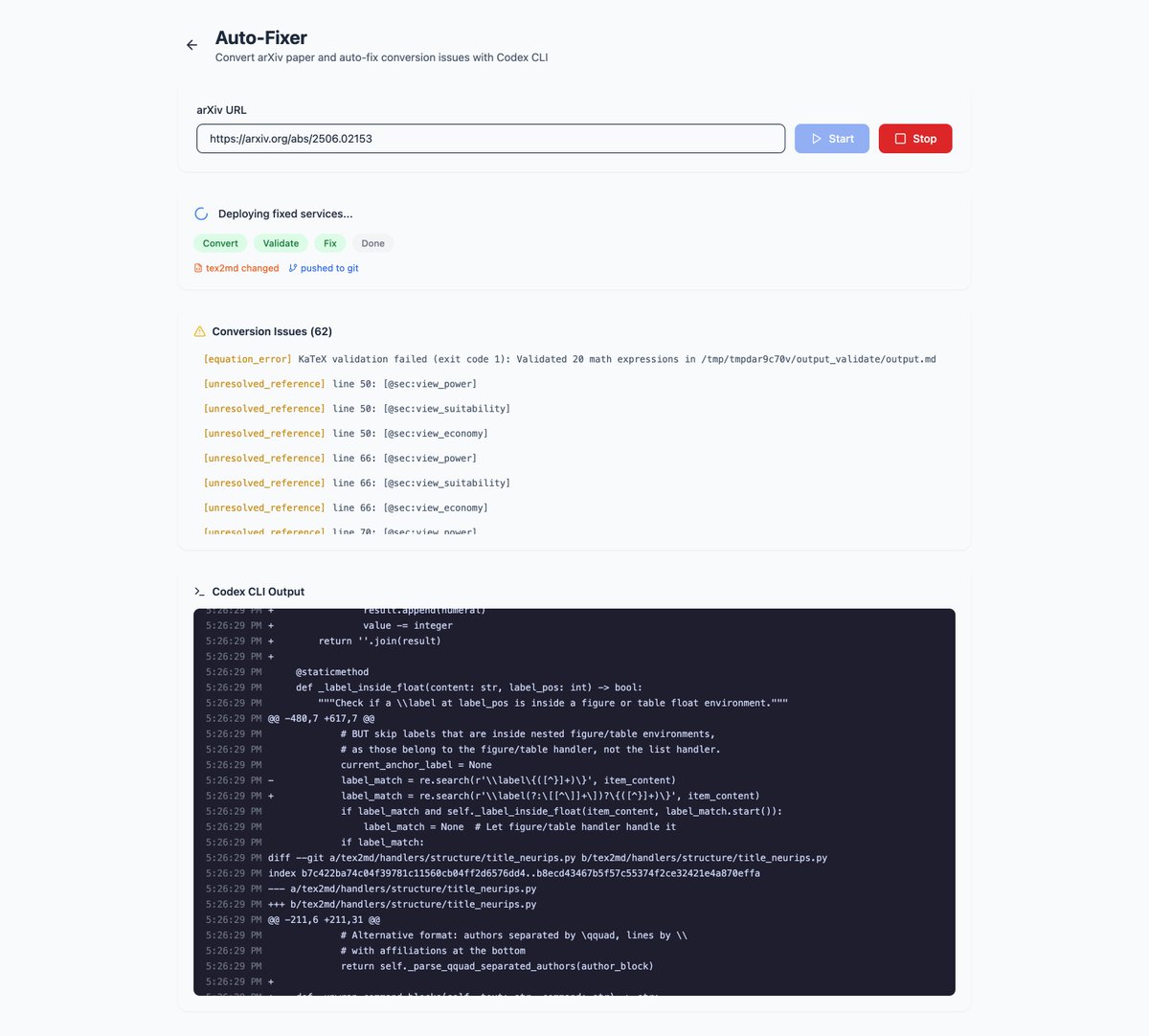
A paradigm shift: OpenAI Codex is now part of ChapterPal's business logic. A significant part of what I do when I work on ChapterPal is to run a conversion from LaTeX into Markdown and see what failed. LaTeX is very old and versatile, so some scientists use very crazy tweaks in their LaTeX sources to achieve a desired visual effect in the output PDF which fail at conversion in ChapterPal. Previously, I was in the loop: 1. Me: run a conversion 2. Me: validate visually 3. Me: instruct a coding agent to fix the issues 4. Coding agent: makes fixes, run tests 5. Me: Go to 1. Now me is out of the loop and all happens within a cloud run. I can only observe the process in the admin's UI. So, the conversion code self-writes while I sleep and the conversion almost never fails because a failed conversion is analyzed by Codex and the conversion code is fixed.

@charliejhills ·
Claude Code or Codex is the wrong question. You can (actually) run both. Ask these 4 questions instead: Both read your repo, edit files and run commands. The defaults are what actually separate them. 1. Where do you want to work? Claude Code centres on the terminal. Codex spans app, IDE, cloud and GitHub by default. Pick the surface you already work in. 2. How do you split up the work? Both can run agents in parallel. Claude Code delegates to subagents in one session. Codex fans work out to threads you supervise. One nests the work. One lines it up for you. 3. How do you encode your workflow? Claude Code defaults to CLAUDE.md. Codex defaults to AGENTS.md. Both read MCP. Write the rules your team will maintain. 4. Where should long-running work happen? Claude Code runs headless in your shell and CI. Codex leans on cloud jobs and a review queue. Codex runs headless too. I use codex exec. Send the long job to CI or the cloud, not your laptop. Then pick: ✦ If you live in the terminal, run Claude Code. ✦ If you want more surfaces, run Codex. ✦ If you want pairing plus background runs, run both. I run both. Claude Code builds, Codex attacks it. OpenAI shipped Codex as a Claude Code plugin. The integration only runs one way. Install it inside Claude Code: /plugin marketplace add openai/codex-plugin-cc /plugin install codex@openai-codex Then run /codex:adversarial-review Which model, not which agent? Claude 5 vs ChatGPT 5.6 https://t.co/ZeHn9pSiFc Repost ♻️ to help someone stop choosing. P.S. Which coding agent do you use?
 Watch video

@rohanpaul_ai ·
OpenAI published engineering deep dive on how the Codex CLI agent loop works under the hood. Explains how Codex actually builds prompts, calls Responses API, caches, and compacts context. Reveals the exact mechanics that make a coding agent feel fast and stable, like relying on exact-prefix prompt caching to avoid quadratic slowdowns and using /responses/compact with encrypted carryover state to keep long sessions running inside the context window. Codex CLI is software that lets an AI model help change code on a computer. Codex is a harness that loops: user input → model inference → tool calls → observations → repeat, until an assistant message ends the turn. - The “agent loop” is the product So the model is the brain that writes text and tool requests, and the harness is the body that does the actions and keeps the conversation state tidy. In Codex CLI, the harness is the CLI app logic that builds the prompt, calls the Responses API, runs things like shell commands, captures the results, and repeats. It does the work by looping between model output and tool runs until a turn ends. The main trick is keeping prompts cache-friendly and compact enough for the context window, meaning the max tokens per inference call. Codex builds a Responses API request from system, developer, user, and assistant role messages, then streams back the sampled output text. If the model emits a function call like shell, Codex runs it and appends the output into the next request. Before the initial user message, Codex injects sandbox rules, environment context, and aggregated project guidance, with a default 32KiB scan cap. Because every iteration resends a longer JSON payload, naive looping is quadratic, so exact-prefix prompt caching keeps compute closer to linear on cache hits. - Codex is designed around stateless Responses API calls Codex avoids stateful shortcuts like previous_response_id to stay stateless for Zero Data Retention (ZDR), which makes tool or config changes a real cost. When tokens pile up, Codex calls /responses/compact and replaces the full history with a shorter item list plus encrypted carryover state instead of the older manual /compact summary.


@nrqa__ ·
OpenAI just open sourced the system they used to write 1 million lines of production code with zero human-written code. It's called Symphony. And it doesn't just write code. It manages the work itself. You point it at your Linear board. It reads the tickets. It spawns a Codex agent for each one. The agent codes, tests, opens a PR, attaches a walkthrough video as proof of work, and waits for review. You don't supervise agents anymore. You manage work. Here's what happened inside OpenAI: → A small team at OpenAI Frontier ran a 5 month experiment → Rule: zero human-written code. Everything had to come from Codex. → Result: 1 million+ lines of code shipped → ~1 billion tokens processed per day → 5 to 10 PRs per engineer per day → Some teams saw a 500% jump in landed PRs in 3 weeks One engineer reportedly shipped 3 significant code changes from a cabin with bad WiFi using only the Linear mobile app. The agents did the rest. Here's how it actually works: → Symphony is a daemon. It watches your issue tracker (Linear for now). → Every open ticket spawns an isolated Codex agent in its own sandbox. → The agent reads the harness. Codes. Runs tests. Opens a PR. → Attaches CI status, complexity analysis, code review feedback, and a walkthrough video. → You review at the PR level. Accept and it lands. Reject and the agent reworks. → New tickets show up. Symphony picks them up automatically. The shift is the part nobody is talking about: When humans stop reviewing every line, the perceived cost of a code change drops to near zero. Bugs that weren't worth fixing before are now worth fixing. Features that were too small to prioritize are now in scope. The economics of software flip. Here's the wild part: The team used Symphony to build Symphony. Once the basic loop worked, the agents wrote the rest of themselves. Internal product market fit was so strong inside OpenAI that other teams started adopting it organically. That's why it's public now. A few notes: → It's written in Elixir. ~1,000 lines. → OpenAI calls it a "low-key engineering preview." They are NOT maintaining it as a product. → It's a reference implementation. You're meant to point your own coding agent at the SPEC.md and have it build a version for your stack. → Works best in repos that have adopted "harness engineering" first. Tests, observability, agent-readable docs, the whole setup. The README literally says: "Tell your favorite coding agent to build Symphony in a programming language of your choice." That's the new pattern. Specs are the new code. Agents are the new compilers. Apache 2.0. 100% Open Source. repo: https://t.co/ZRAWuqOZLQ


@_vmlops ·
OPENAI CODEX IS SILENTLY DESTROYING YOUR SSD A github issue just revealed codex writes ~640 tb/year to a local sqlite feedback log → after 21 days of uptime, one user's ssd had written 37 tb → that's 640 full-drive writes/year on a 1 tb ssd → some consumer ssds are only rated for ~600 tbw total → 36,211 rows inserted every 15 seconds while retained count stays flat → 70% of it is TRACE-level noise: inotify events, websocket internals, locale file opens → root cause: global `Targets::new().with_default(Level::TRACE)` logs everything, always your drive could hit its entire warranted write endurance in under a year just from running codex the fix isn't disabling logs it's better defaults. raise thresholds, drop dependency noise, stop mirroring raw otel payloads to sqlite this isn't a rare edge case. multiple related issues show this has been happening across desktop and cli for months


@metalab ·
The State of Coding Agents for 2026. Our Engineering Director, Paul Straw, shares what he learned testing Claude Code, OpenAI Codex, and Gemini CLI in real production work. What helps, what doesn’t, and why benchmarks aren’t the whole story. 🔗 Full post + video in thread.
 Watch video

@JulianGoldieSEO ·
OPENAI JUST MADE AI TOOL LOCK-IN WAY LESS PAINFUL. You can now move a working AI setup into ChatGPT Work + Codex without rebuilding everything from scratch. And the deeper you look, the more useful this gets. What actually transfers: → Instructions can become AGENTS.md files → Settings map into Codex config → Skills and plugins carry across → Claude Code project memories can transfer → Recent chats from the last 30 days can come with you It goes deeper: ✓ MCP server setups can transfer ✓ Hooks can carry across ✓ Slash commands become skills ✓ Sub-agents become Codex agents ✓ Project folders stay mapped to the same projects Even Codex CLI gets /import, with support for up to 50 chats from the last 30 days. Your old setup isn't deleted either. So you can test ChatGPT/Codex without destroying the workflow you've already built. The big lesson: Stop building workflows that only work inside ONE AI tool. Build portable systems you can move wherever the best model is.
 Watch video
Best Tweets by Topic