

Andy Galpin, PhD (@DrAndyGalpin) X analytics
@DrAndyGalpin
Professor & Scientist of Human Performance PhD Human Bioenergetics & Muscle Phys Perform w/ Dr. Andy Galpin Co-Founder @BioMoAthlete @Absolute_Rest @Vitality_BP
@DrAndyGalpin has 162.8K followers, a median of 12.8K views per post and a 0.93% engagement rate.
Based on 28 recent original posts (high confidence). Updated November 10, 2026.
At a glance
Key stats
- Followers
- 162.8K162,840 followers on November 10, 2026−201 in 7 days
- Median views per post
- 12.8K
- Average views per post
- 23.2K
- Engagement rate (by views)
- 0.93%
- Original posts per week
- 3.1
- Average engagements per post
- 217
Engagement grade
Developing
This is near the lower benchmark range for accounts with 100K-1M followers.
Profile score
85/100
- Profile completeness100
- Audience shape100
- Engagement25
- Consistency100
- Positioning clarity100
Monetization
Estimated X creator earnings
$14–$35 in the last 30 days
From 141.9K views on @DrAndyGalpin's original posts in the last 30 days.
Rewards eligibility: likely
Rough estimate. X publishes no payout rate, so this assumes about $100–250 per 1M original-post impressions, based on real creator payouts. Payouts vary with how many of your viewers have Premium.
Free report
How does your account compare with @DrAndyGalpin?
Get the same report for your own account by email: engagement grade, median views, best times to post and estimated earnings.
Growth
Follower growth
−201 followers in the last 7 days. Tracked by Xholic since October 21, 2026.
| Date | Followers | Change |
|---|---|---|
| Nov 10, 2026 | 162,840 | −119 |
| Nov 6, 2026 | 162,959 | −82 |
| Nov 2, 2026 | 163,041 | −102 |
| Oct 29, 2026 | 163,143 | −98 |
| Oct 26, 2026 | 163,241 | −129 |
| Oct 21, 2026 | 163,370 | – |
Timing
Best times to post
When @DrAndyGalpin's recent posts performed best (UTC).
- #1 slot
8:18 PM
Monday · UTC
- #2 slot
9:12 PM
Tuesday · UTC
- #3 slot
8:23 PM
Wednesday · UTC
What worked
Top recent posts
- 01

@DrAndyGalpin ·
How to undo hours of sitting in 60 seconds: Physical therapist @drjohnrusin uses this tool with clients as a reset between long stretches at a desk or on a phone, and it requires no equipment. Get into what he calls a Superman position: 1. Stand up, put the phone down, take one step away from the desk 2. Extend the upper back, open the chest, lift through the sternum 3. Arms out and back, rotated so the palms turn outward 4. Pull the shoulder blades down and back 5. Look up, letting the neck extend 6. Take a deep breath in 7. Squeeze the glutes hard (Rusin calls this the most important step) Hold, release, and run it a couple of times. That's the whole thing. Why it works is mostly what it's the opposite of. Sitting flexes the spine, rounds the shoulders, drops the head forward, and shuts the glutes off. Every piece of this position reverses one of those. Rusin's framing is that it resets both the mechanical system and the nervous system in under a minute. The practical result is the same: you stand differently afterward, and the next hour at the desk starts from a better place. The best mobility tool is usually the one you'll actually do at 2pm on a Tuesday. This one takes a minute.
 Watch video
- 14Replies
- 99Reposts
- 1KLikes
- 70.7KViews
10.2x average engagementHas a videoLong post (over 200 characters)Posted Wed 21:00 UTC - 02
@DrAndyGalpin ·
The 60 second tool high performers use to keep themselves in peak condition: Performance coach Dan Garner has taught this to Olympic medalists, pro athletes, and military operators. It takes 60 seconds and costs nothing: at the end of the day, before you fall asleep, review what happened. You hit snooze. Because you hit snooze, you skipped breakfast. Because you skipped breakfast the morning felt rushed and you were more stressed than usual. By lunch you were starving, hadn't packed anything, and ate too much of something you wouldn't normally choose. The afternoon brain fog hits. You finally recover around dinner. Look back at that day and the brain fog, the overeating, the stress. All of it started with the snooze. One decision at 6am set the entire day. Ask yourself, "What did I do right, and what did I do wrong?" You can answer that in 60 seconds, and the answer is usually something specific enough to fix tomorrow. It’s especially useful when your schedule breaks. You’re on the road, just had a new kid, or your business is getting busy. Your routine quietly stops happening, and everything downstream of it starts to slip. Instead of just sliding into the next day, use this tool and get back on track.
 Watch video
- 10Replies
- 18Reposts
- 295Likes
- 78KViews
2.3x average engagementHas a videoLong post (over 200 characters)Posted Thu 16:00 UTC - 03
@DrAndyGalpin ·
How to properly do a face pull (and why they’re beneficial): @drjohnrusin's case for the face pull is that it puts you in the exact opposite position of how you text. Texting is shoulders up and rolled in, upper back rounded, head dropped forward. A face pull done well is upper back actively extended, arms out and rotated back, head up. Every joint reversed at once, under load. The technique: 1. Cable stack with a rope or handles 2. Overhand grip, palms facing down 3. Pull toward the face, rotating from thumbs down to thumbs up as you go 4. Return slowly. The way back, thumbs up to thumbs down, is the part to emphasize The rotation is small. A few degrees each direction, not a big sweeping movement. The mistake Rusin sees everywhere: underhand grip, huge exaggerated rotation at the end, then a long hold, pull, crank the hands back, one-two-three-four. It turns a loadable pulling exercise into a shoulder stretch you can't progress. Overhand, thumbs down to thumbs up, slow on the way back. That's the version worth doing.
 Watch video
- 9Replies
- 11Reposts
- 243Likes
- 24.7KViews
2.2x average engagementHas a videoLong post (over 200 characters)Posted Fri 21:00 UTC - 04
@DrAndyGalpin ·
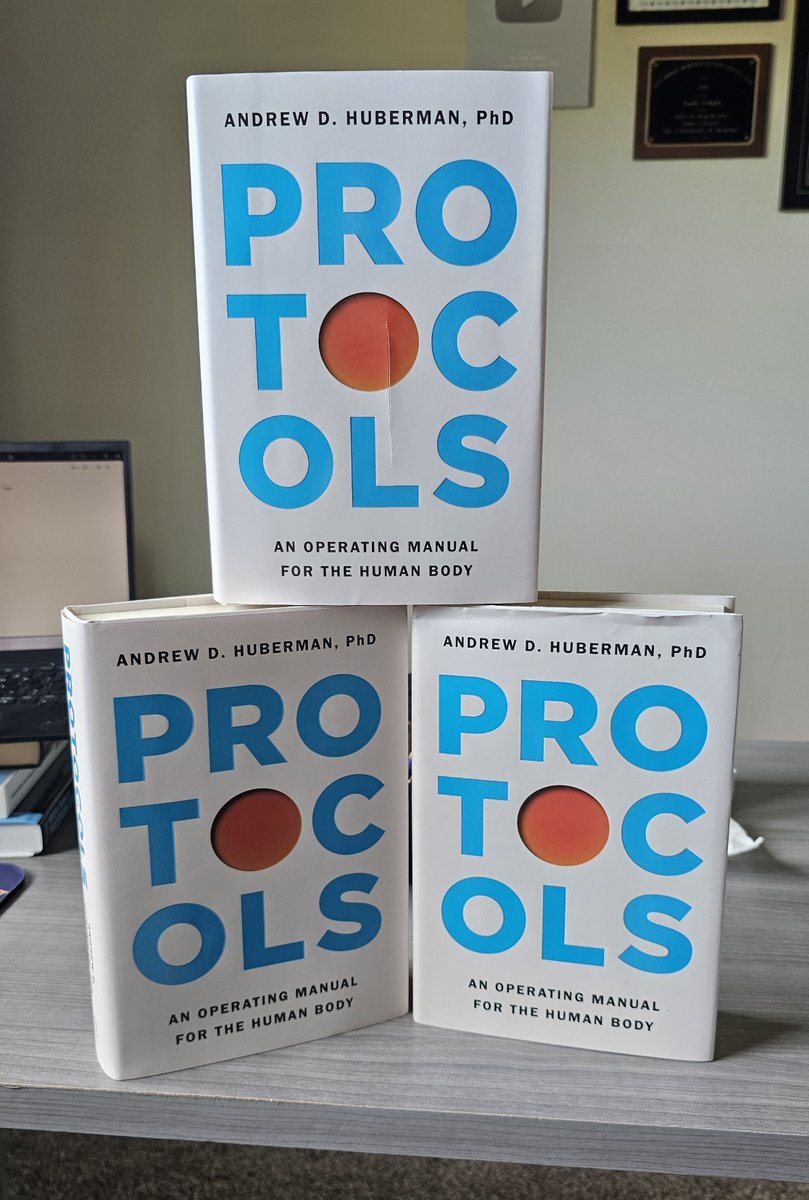
So good, one copy just wasn't enough. (I actually bought 20, 17 already gifted). I watched @hubermanlab literally worked for years on this book. It's not just an AI summary of his podcast - he did this the hard way & the quality shows. #1 book in the world for a reason.
- 29Replies
- 25Reposts
- 1.1KLikes
- 64.6KViews
1.9x average engagementHas an imageLong post (over 200 characters)Posted Sun 16:00 UTC - 05
@DrAndyGalpin ·
Why wouldn't you want your testosterone as high as possible? Dr. Ben House has a good answer. High testosterone upregulates EPO, which tells your body to make more red blood cells. More red blood cells means more viscous blood. You're not pumping blood anymore, you're pumping oil. Now add left ventricular hypertrophy. The heart wall thickens, and it's pushing against more back pressure with every beat. As Ben puts it, your heart is pumping ketchup against a bunch of extra muscle. You don't want to run that for decades, assuming you get decades.
 Watch video
- 47Replies
- 26Reposts
- 360Likes
- 72.4KViews
1.6x average engagementHas a videoLong post (over 200 characters)Posted Thu 13:00 UTCOpens with a question - 06
@DrAndyGalpin ·
Nobody deserves this more than @hubermanlab . He put an ENORMOUS amount of time into this book. He could've thrown some sloppy AI at it and be done in days. He chose the hard path, and literally spent years on it. Couldn't be happier for him.
- 16Replies
- 22Reposts
- 789Likes
- 46.6KViews
1.4x average engagementText onlyLong post (over 200 characters)Posted Thu 00:00 UTCQuote post
Latest
Recent posts by Andy Galpin, PhD
The latest 28 original posts from @DrAndyGalpin, newest first, as of November 10, 2026. Replies and reposts aren't included.
@DrAndyGalpin ·
Goal setting is the first thing every performance book tells you to do. One of the best coaches I know never did it. Les Spellman built his coaching career the opposite way everyone tells you to. No five-year vision. No "I want to train pros." He was coaching seven-year-olds in a park and training moms in the morning so he could afford to get to a coaching event, spending on education while barely making rent. His one rule was to go all in on whoever was in front of him that day. A seven-year-old in a one-on-one session got the same intensity and the same attention to the little details as anyone else. As Les puts it, he transformed his life just from caring more about people, and never thought about the byproducts of what was happening. Full episode with Les Spellman on How to Get Faster (Acceleration, Deceleration, Agility & Strength) is on my YouTube channel.
 Watch video
- 2Replies
- 1Reposts
- 26Likes
- 3.6KViews
@DrAndyGalpin ·
Stop overthinking your recovery. @les7spellman has coached and tracked recovery in hundreds of athletes who have access to the most expensive recovery tools. What keeps showing up isn't glamorous: sleep a lot, eat pretty well, hydrate, do some low-level work, get sunlight early. The two biggest levers he names are early sunlight and consistent bedtimes. That second one is tough in pro sport, where travel, practice and late starts put the schedule all over the place. Les and his team circle the late games and the long flights in advance and builds plan B: eye mask on the plane, earbuds in with no music just to block the noise, magnesium timed right, sleep. What surprised him was how deeply the players bought in. As one of them put it, in college he was doing the light bed every week, and he feels better now than he did then. If a consistent bedtime can out-recover a six-figure machine, you probably don't have a tools problem.
 Watch video
- 28Replies
- 18Reposts
- 159Likes
- 16.5KViews
@DrAndyGalpin ·
Losing body fat raises your testosterone. Until it starts lowering it. @drbenhouse describes this as an inverted U. Coming down from a high body fat percentage can move testosterone 50, 100, even 200 points in the right direction. But once body fat starts getting too low, and you keep pushing that caloric deficit, testosterone starts heading back down. The individual picture is messier than the curve. Population-level data give us a good starting point, but pay attention to individual dynamics. Ben has worked with three clients who lost roughly half of themselves, 300 pounds down to 150, 330 down to 180. One ended up with a testosterone of 850 and was crushing it. One was anemic with testosterone in the tank. One sat around 200. None of the three were under 15 percent body fat. That's why Ben weighs the relative change more than the absolute number. our brain adapts to your norm, so where you came from matters as much as where you are now. The population data guides the…
 Watch video
- 18Replies
- 7Reposts
- 138Likes
- 13.4KViews
@DrAndyGalpin ·
You've been told your testosterone drops 1 to 2 percent per year after 30. @drbenhouse problem isn't with the number. It's with the sample. Ben calls this the race to the bottom on social media. Every narrative gets flattened into one line you can repeat. Sometimes the science really is complex. This one isn't. The counter-narrative to andropause just doesn't make anybody any money, so the simple version never gets told. Look at the prospective longitudinal studies, and yes, it looks like testosterone decreases by 1 to 2 percent a year. But we need to ask an important question: How many of those studies were looking at healthy aging? Almost none of them.
 Watch video
- 20Replies
- 7Reposts
- 45Likes
- 6.7KViews
@DrAndyGalpin ·
New Perform with Dr. Andy Galpin episode: How to Get Faster (Acceleration, Deceleration, Agility & Strength) | Les Spellman (@les7spellman) 0:00 Can You Make People Faster? 5:45 40-Yard Dash Benchmarks by Position 7:30 Sponsor: Momentous 8:57 Defining Speed & Whether a Fast 40 Translates to the Field 13:43 Engines, Brakes & Steering: How Sport Shapes Speed 20:05 Training Speed for Court vs. Field Sports 24:03 Lessons Learned: Speed, Capacity & Conditioning 28:03 Aerobic Work, Post-Game BFR & Recovery Basics 35:39 Linear Speed, Change of Direction & Agility 41:14 Agility Ladders, Deceleration & Injury Risk 50:04 Sponsor: David 51:26 Early vs. Late Deceleration & Cutting Angles 1:00:02 Agility vs. Change-of-Direction Drills; Drill Progressions 1:06:51 Youth Athletes, General Preparation & Free Play 1:10:22 Sponsor: Eight Sleep 1:11:54 Fast vs. Quick, False Steps & the “Stay Low” Myth 1:23:40 Stride Length vs. Frequency & Sprint Archetypes 1:34:49 Sponsor: LMNT 1:36:10 Lifting Weights…
 Watch video
- 4Replies
- 10Reposts
- 117Likes
- 15.2KViews
@DrAndyGalpin ·
Is testosterone actually going down, population-wise? My most recent guest, @drbenhouse, says it looks that way, but there are important limitations to consider. Assays have changed from the 1970s to the 2020s, so it's reasonable to think that some of the decline we are seeing in the data could be due to measurement error or advances in assay technologies. Over 50 years, you would expect some of that. But there is still a signal there. The interesting part is what’s driving this signal. The cause could be environmental, behavioral, or related to disease burden, but it’s likely a combination. For example, sleep apnea and obesity have both been shown to lower testosterone, and the two are often comorbid. As Ben puts it, obesity looks to be number one driver of low testosterone right now. Which leaves the chicken-or-egg question: does that person actually need to be put on testosterone?
 Watch video
- 11Replies
- 2Reposts
- 41Likes
- 12.2KViews
@DrAndyGalpin ·
Featuring new research from our team at @BioMoAthlete !
- 4Replies
- 1Reposts
- 18Likes
- 6.5KViews
@DrAndyGalpin ·
https://t.co/8xXWcoEn3x Androgen receptor webinar is LIVE!
- 0Replies
- 2Reposts
- 9Likes
- 5.3KViews
Show all 28Show fewer
@DrAndyGalpin ·
If you're going to take or recommend testosterone therapy of any kind, you should watch this. Hematocrit is the percentage of your blood that is red blood cells, essentially how thick and viscous your blood is. It costs a couple of dollars and it's on basically every blood panel ever run. When you go on testosterone, your red blood cell count will very likely increase and, consequently, your hematocrit. That sounds great, and it's part of why you feel physically different and might experience an increase in energy. But it can get out of control fast. Once you start getting north of 52 to 54 percent on hematocrit, you increase your risk of developing heart disease or suffering a serious cardiovascular event. This is the cost of doing business with testosterone therapy. Pay attention to it.
 Watch video
- 27Replies
- 11Reposts
- 241Likes
- 36KViews
@DrAndyGalpin ·
New Perform with Dr. Andy Galpin episode: Boosting Testosterone & Understanding Your Testosterone Levels (Aging, Muscle Growth & Nutrition) 0:00 Testosterone & Performance 6:37 Low Testosterone: Lab Results, Symptoms & Obesity 13:31 Underfueling, Calorie Deficits & Low Testosterone 23:05 Testosterone Recovery: Refeeding, Sleep & Stress 30:11 Testosterone & Aging: The Role of Metabolic Health 44:39 New Testosterone Guidelines & Accurate Testing 50:42 TRT: Safety, Fertility, Treatment Targets & Benefits 1:00:01 Daily Testosterone Rhythms & Testing Time 1:03:37 Total vs. Free Testosterone: Understanding SHBG 1:13:12 Does Higher Testosterone Mean More Muscle Growth? 1:21:46 Androgen Receptors & Individual Training Responses 1:25:12 Aging, Anabolic Resistance & How Much Protein You Need 1:34:53 Strength Training With Age & Final Takeaways Includes paid partnerships.
 Watch video
- 13Replies
- 5Reposts
- 140Likes
- 11.8KViews
@DrAndyGalpin ·
Why are participant characteristics so important when interpreting data? It's because what the participant is doing outside of the lab could affect their response to the intervention which, in turn, could affect the results. I've run these studies. Some people enroll for monetary incentives and do the bare minimum. Others enroll because they get eight weeks of free training and lab access, and they dial everything in: eating, sleeping, training. Those are the ones who land way off the chart as hyper responders. And some refuse to give up their own program. They do the minimum with you in the lab, then go train on the side. That's the behind the curtain stuff nobody publishes. It gets labeled a physiological response to the intervention, but it's not the whole picture. None of that comes out in the wash when you only have 12 subjects. That's why it's so important to look at the conglomeration of the data.
 Watch video
- 10Replies
- 2Reposts
- 37Likes
- 5.9KViews
@DrAndyGalpin ·
1 min of great insights on the misunderstood relationship between testosterone and muscle growth (from resistance exercise). Worth a watch.
- 8Replies
- 0Reposts
- 24Likes
- 8KViews
@DrAndyGalpin ·
Our structured narrative review on Testosterone & muscle, led by @drbenhouse , is up on https://t.co/8xXWcoEn3x . So really interesting and novel findings for those interested.
- 2Replies
- 3Reposts
- 58Likes
- 12.4KViews
@DrAndyGalpin ·
Why wouldn't you want your testosterone as high as possible? Dr. Ben House has a good answer. High testosterone upregulates EPO, which tells your body to make more red blood cells. More red blood cells means more viscous blood. You're not pumping blood anymore, you're pumping oil. Now add left ventricular hypertrophy. The heart wall thickens, and it's pushing against more back pressure with every beat. As Ben puts it, your heart is pumping ketchup against a bunch of extra muscle. You don't want to run that for decades, assuming you get decades.
Watch video- 47Replies
- 26Reposts
- 360Likes
- 72.4KViews
@DrAndyGalpin ·
New Perform with Dr. Andy Galpin episode: Testosterone Explained (Low T, Muscle Growth, Aging & TRT) | Dr. Ben House 0:00 Ben House: Testosterone, Health & Performance 3:51 Personal Baselines & Normal Testosterone Ranges 12:00 Total vs. Free Testosterone: SHBG & Albumin 17:49 Accurate Hormone Testing: Methods, Timing & Measurement Error 23:36 Daily Testosterone Fluctuations & Why Repeat Tests Matter 29:33 High SHBG: Interpreting Lab Ranges in Context 32:08 TRT: Informed Consent & Finding the Cause of Low Testosterone 35:04 TRT Monitoring: Hematocrit, Lipids, Estradiol & Heart Health 43:38 Natural Testosterone Production, Testicular Atrophy & Stopping TRT 48:11 The Brain–Testicle Hormone Axis & Training with Low Testosterone 55:16 Calorie Deficits, Body Recomposition & Testosterone 1:00:44 Does Higher Testosterone Predict More Muscle Growth? 1:15:03 Obesity, Leptin & Low Testosterone 1:22:45 Is Testosterone Declining Across Generations? 1:29:52 Testosterone & Aging: The Role of…
 Watch video
- 17Replies
- 12Reposts
- 114Likes
- 13.7KViews
@DrAndyGalpin ·
So good, one copy just wasn't enough. (I actually bought 20, 17 already gifted). I watched @hubermanlab literally worked for years on this book. It's not just an AI summary of his podcast - he did this the hard way & the quality shows. #1 book in the world for a reason.
- 29Replies
- 25Reposts
- 1.1KLikes
- 64.6KViews
@DrAndyGalpin ·
Training smarter doesn't mean lifting less. It means better programming. Physical therapist and strength coach @drjohnrusin says "longevity" has become a reason for people to back off. Someone hears the word, drops the load, drops the intensity, and slow-rolls into a program that's safe but doesn't do anything. The client stays healthy in the sense that nothing hurts, and loses the exact capacities they hired a coach to protect. Power starts declining somewhere around your early thirties, roughly 1 to 2% a year. Muscle is the same story. If you aren't actively building or keeping it, you're losing it. You still have to lift. What smarter looks like instead: - Train what declines. Muscle, strength, power. If it leaves on its own, it has to be actively kept. - Every block should work now and still hold up years from now. - Keep the challenge, change the dose. The stimulus stays. How it's loaded, sequenced, and recovered from is what gets more careful. - The principles that make…
 Watch video
- 15Replies
- 7Reposts
- 96Likes
- 30.6KViews
@DrAndyGalpin ·
Nobody deserves this more than @hubermanlab . He put an ENORMOUS amount of time into this book. He could've thrown some sloppy AI at it and be done in days. He chose the hard path, and literally spent years on it. Couldn't be happier for him.
- 16Replies
- 22Reposts
- 789Likes
- 46.6KViews
@DrAndyGalpin ·
How to properly do a face pull (and why they’re beneficial): @drjohnrusin's case for the face pull is that it puts you in the exact opposite position of how you text. Texting is shoulders up and rolled in, upper back rounded, head dropped forward. A face pull done well is upper back actively extended, arms out and rotated back, head up. Every joint reversed at once, under load. The technique: 1. Cable stack with a rope or handles 2. Overhand grip, palms facing down 3. Pull toward the face, rotating from thumbs down to thumbs up as you go 4. Return slowly. The way back, thumbs up to thumbs down, is the part to emphasize The rotation is small. A few degrees each direction, not a big sweeping movement. The mistake Rusin sees everywhere: underhand grip, huge exaggerated rotation at the end, then a long hold, pull, crank the hands back, one-two-three-four. It turns a loadable pulling exercise into a shoulder stretch you can't progress. Overhand, thumbs down to thumbs up, slow on the…
Watch video- 9Replies
- 11Reposts
- 243Likes
- 24.7KViews
@DrAndyGalpin ·
How to undo hours of sitting in 60 seconds: Physical therapist @drjohnrusin uses this tool with clients as a reset between long stretches at a desk or on a phone, and it requires no equipment. Get into what he calls a Superman position: 1. Stand up, put the phone down, take one step away from the desk 2. Extend the upper back, open the chest, lift through the sternum 3. Arms out and back, rotated so the palms turn outward 4. Pull the shoulder blades down and back 5. Look up, letting the neck extend 6. Take a deep breath in 7. Squeeze the glutes hard (Rusin calls this the most important step) Hold, release, and run it a couple of times. That's the whole thing. Why it works is mostly what it's the opposite of. Sitting flexes the spine, rounds the shoulders, drops the head forward, and shuts the glutes off. Every piece of this position reverses one of those. Rusin's framing is that it resets both the mechanical system and the nervous system in under a minute. The practical result is…
Watch video- 14Replies
- 99Reposts
- 1KLikes
- 70.7KViews
@DrAndyGalpin ·
New Perform with Dr. Andy Galpin episode: How to Train Without Pain (Back, Shoulders, Mobility & Strength) | Dr. John Rusin (@drjohnrusin) 0:00 John Rusin: Bridging Physical Therapy & Performance 7:26 Chronic Pain vs. Acute Injury 17:20 Desk Work, Movement Breaks & Better Posture 23:46 The 10-Minute Warm-Up: Six Phases for Better Training 29:46 Foam Rolling: Technique, Breathing & What Actually Changes 40:49 Tight or Weak? Mobility, Flexibility & Muscle Control 53:17 Back Pain: Surgery, Rehabilitation & Conservative Care 57:11 How to Stretch with Control & Stability 1:11:25 Corrective Exercises & Activation: Bird Dogs to Hip Thrusts 1:21:56 Better Face Pulls: Grip, Angles & Technique 1:29:16 Movement Practice: Turning Better Technique into Habit 1:39:32 Preparing for Heavy Lifting: Power & Explosive Movement 1:43:03 Full-Body Bracing & When to Use a Lifting Belt 1:46:08 What Good Form Means: Your Body, Load & Experience 1:56:12 Deadlift Grip, Jefferson Curls & Training Spinal Flexion…
 Watch video
- 3Replies
- 4Reposts
- 75Likes
- 13.2KViews
@DrAndyGalpin ·
Really simple, but effective coaching tool from a guy who's been there and done that will some of the world's most elite performers.
- 2Replies
- 6Reposts
- 167Likes
- 50.8KViews
@DrAndyGalpin ·
The 60 second tool high performers use to keep themselves in peak condition: Performance coach Dan Garner has taught this to Olympic medalists, pro athletes, and military operators. It takes 60 seconds and costs nothing: at the end of the day, before you fall asleep, review what happened. You hit snooze. Because you hit snooze, you skipped breakfast. Because you skipped breakfast the morning felt rushed and you were more stressed than usual. By lunch you were starving, hadn't packed anything, and ate too much of something you wouldn't normally choose. The afternoon brain fog hits. You finally recover around dinner. Look back at that day and the brain fog, the overeating, the stress. All of it started with the snooze. One decision at 6am set the entire day. Ask yourself, "What did I do right, and what did I do wrong?" You can answer that in 60 seconds, and the answer is usually something specific enough to fix tomorrow. It’s especially useful when your schedule breaks. You’re on…
Watch video- 10Replies
- 18Reposts
- 295Likes
- 78KViews
@DrAndyGalpin ·
Congrats, Robert! Coming in this year better than ever!
- 0Replies
- 0Reposts
- 13Likes
- 7.6KViews
Formats
Content mix
- Text only
- 25%
- With media
- 61%
- With links
- 4 posts
- With hashtags
- 0 posts
Creator style: Visual-led creator
See the full app
This creator report is one small part of Xholic
Click through a sample creator's account in the real app. No sign-up, nothing to install.
- Posts written in your voice and scheduled for your best hours
- Buyers found on 𝕏, with a reply drafted for each one
- Analytics that show which posts grow you
No sign-up or login needed · Takes about 2 minutes
Want numbers like @DrAndyGalpin's?
Xholic writes posts in your voice, schedules them for the hours your audience is active, and tracks what's working every day.
No card needed · Nothing to cancel
Live demo: no sign-up or login needed · takes about 2 minutes
Keep browsing
More in Health & science


Keep exploring
Free tools
- Compare Twitter AccountsPut two public accounts head to head and see who leads on views, engagement, grade and posting pace.
- Twitter Engagement Rate CalculatorCalculate engagement rate from your numbers or a public profile and grade it against your tier.
- X Monetization CalculatorChange the assumptions behind six X revenue models and compare gross revenue with direct contribution.
Guides
- X/Twitter Analytics Glossary: Every Metric Explained (2026)Definitions, formulas, benchmarks, and actions for X/Twitter analytics metrics including impressions, reach, engagement, followers, clicks, and revenue.
- How to Check an X Follower Count Live (and Read the Trend)Watch any public X account's exact follower count update live, read the session and 90-day charts, and see why the number differs from the X app.
From the blog
- X Analytics for Brands & Businesses: A Practical GuideHow brands and businesses use X/Twitter analytics to track reach, engagement, and ROI — with the KPIs that actually matter.
- Good Twitter Engagement Rate by Followers in 2026What is a good Twitter engagement rate by followers in 2026? Sourced benchmarks by account size, sample calculations and tactics to raise yours.
Best tweets on this topic
- Best tweets about Remote WorkThe sharpest, most-shared X posts about remote work, saved so you don't have to dig through the timeline yourself. Updated every two weeks.
- Best tweets about ProductivityThe sharpest, most-shared X posts about productivity, saved so you don't have to dig through the timeline yourself. Updated every two weeks.
- Best tweets about Burnout and Mental Health for FoundersRead 50 of the best tweets about founder burnout and mental health, with honest lessons on startup stress, resilience, and sustainable work.
About this data
- Analytics are inferred from public profile and recent post data. They do not include private impressions, profile visits, link clicks, or follower-source data.
- Deleted, protected, unavailable, or rate-limited posts may be missing from the sample.
- Stats come from public posts Xholic has stored, not private X Analytics. Xholic is not affiliated with X Corp or @DrAndyGalpin.
- Own this account and want it hidden? Email support@xholic.ai — we verify ownership and handle requests within 2 working days.