Prioritization and high-leverage work
Choosing the one task, defining outcomes and done states, limiting active projects, and focusing on work closest to meaningful business or personal progress.
38%
Best tweets about Productivity
A curated collection of the sharpest, most-shared X posts about productivity—saved so you do not have to dig through the timeline yourself. Updated weekly.
Systems people actually kept using past week two, not just the aesthetic ones.
Original Xholic analysis
Across this 50-post set, productivity advice most often favors prioritization and simple execution systems over elaborate setup. A smaller but visible thread focuses on preserving context through workflows, including AI-enabled and team-oriented approaches.
56% of posts
All-time engagement
38% of posts
Published in 90 days
Conversation map
Choosing the one task, defining outcomes and done states, limiting active projects, and focusing on work closest to meaningful business or personal progress.
38%
Paper lists, nightly planning, one main task, weekly reviews, and lightweight routines that reduce system overhead and make daily action clear.
34%
Critiques of elaborate tool stacks, planning, optimization, and organizational rituals that substitute for uncomfortable execution and shipping.
28%
Reducing context switching and reconstruction through task breadcrumbs, consolidated workspaces, capture systems, and smooth handoffs after interruptions or meetings.
26%
Deep-work blocks, notification and phone boundaries, environment design, distraction reduction, and protecting uninterrupted time.
26%
Using AI agents, reusable context, automation, and structured pipelines to reduce repeated manual work and embed AI in core workflows.
22%
Aligning work with energy cycles, taking real recovery time, avoiding toxic productivity, and treating sustainability as part of effective output.
12%
Improving team output through observation, recognition, blocker removal, thoughtful metrics, and understanding how people actually work.
8%
Tone and stance
Performance benchmark
Posts with media make up 48% of this collection. Their median all-time score is 5.01, compared with 10.3 for text-only posts.
Format mix
Consensus and debate
Shared view
Several posts advocate low-overhead approaches such as paper lists, one main task, and planning the next day in advance, while criticizing systems that become a substitute for execution.
Shared view
Posts repeatedly recommend selecting a small number of high-impact tasks, using criteria such as moving the business forward, proximity to revenue, or removing less valuable work.
Shared view
Authors recommend tactics including closing communication apps, using uninterrupted work blocks, turning off notifications, batching work, and keeping phones out of reach.
Shared view
Writing tasks down, maintaining a running list, or using a weekly loop is presented as a way to make work visible and reduce the need to hold open tasks in mind.
Open debate
Some posts recommend choosing one priority and protecting deep-work time. Another argues for switching among distinct productive activities when energy or interest declines, while cautioning that switching can become avoidance.
Open debate
The set includes critiques of complex productivity stacks and AI tool collecting, alongside posts advocating reusable AI workflows with retained context, structured stages, or automation.
Open debate
Much of the discussion concerns individual prioritization and focus. Team-focused posts instead discuss observing work, recognizing contributions, and identifying blockers with employees.
What performs
Tweet 2038677716741083253 was the highest-scoring outlier in the analytics, with an all-time score of 942.87. Its content combines high-return task selection, writing tasks down, and limits on constant work.
Tutorials had a median all-time score of 19.42 and lists 27.36, compared with 7.976 for opinion posts. The cited examples use concrete planning, focus, and task-management routines.
Posts with media had a median all-time score of 5.01, versus 10.27 for text posts. This is a dataset-level comparison and does not establish that media caused lower performance.
Statistical standouts
Creator landscape
The five most represented creators account for 16% of the selected posts.
1. Alexa | Startup founder
@alexabelonix
2 posts
2. Rob Rando| Chillionaire
@RobRan6116
2 posts
3. Sharran Srivatsaa
@sharran
2 posts
4. Aporia
@0xaporia
1 post
5. Hokage
@73lV_
1 post
6. Aaliya
@aaliya_va
1 post
Sharran’s two cited posts discuss recognizing employees’ work and using a cadence of evening priorities, morning scheduling, and a Friday preview.
Alexa’s posts recommend blocks for product, market, content, and admin work, and suggest asking which task is closest to revenue when priorities compete.
Rob Rando’s posts characterize tools as reducing friction around thinking and returning to work, and recommend leaving breadcrumbs to reduce reconstruction after interruptions.
Since the previous snapshot
Themes, sentiment, stance, and post format are classified per tweet. All counts, shares, medians, creator concentration, freshness, and performance comparisons are then calculated directly from the published snapshot.
Xholic's all-time score compares engagement while accounting for reach, post age, and creator consistency. It is used for relative comparisons within this collection.
This report analyzes the exact 50-post snapshot shown below. AI identifies editorial categories and drafts explanations; all statistics are calculated from the snapshot, and every narrative claim is checked against cited posts before publication.
Best Productivity tweets
Ranked 01–50

@ihteshamali ·
A Stanford PhD student was simultaneously juggling coursework, a teaching assistant position, consulting work, and building the side project that eventually became his company. He didn't write a productivity book about it. He wrote a single blog post that quietly became one of the most referenced pieces of student advice on the internet. I read it carefully, and the framework inside it is completely different from what productivity influencers sell. Here is what a Stanford engineering PhD actually figured out about managing impossible workloads. The first insight was one I had never heard framed this way before. He said to think about your education like a building and think about tests like earthquakes. A building with a weak foundation collapses at even small earthquakes. Most students build the building specifically to survive one particular earthquake, which means they study only what is relevant for the specific test. He called this both unsustainable and dangerous, because there were multiple times during his PhD where he had forgotten how to solve a problem and had to derive the answer from foundational understanding alone. That only works if the foundation is actually there. The second insight was about where your attention goes during a test, and it changed how I think about any high-stakes situation with limited time. He said the professors who want to exhaustively test students deliberately create tests that are never meant to be finished. So the students who do best are not the ones who work fastest they are the ones who read every problem first, identify which ones have the highest return on invested time, and do those first. He called it managing your resource to value ratio, and he scored well on genuinely hard tests precisely because of this. The third insight was the one buried at the end that most people skim past. He said the worst thing you can do on a daily basis is use your active brain to think about small irrelevant things. Every unwritten task sitting in your head is consuming a portion of your mental bandwidth even when you are not working on it. Writing everything down is not just an organizational tactic it is how you give your brain permission to focus on the thing in front of you instead of the twenty things behind it. The fourth was the most counterintuitive one coming from someone managing that many competing demands. He said do not study all the time, because it does not work. Overloading yourself with information past a certain point produces diminishing returns, and the relationships and experiences you skip in the process of grinding are often more valuable to your long-term trajectory than the extra hours of studying ever will be. He was doing a PhD, a consulting practice, a teaching role, and building a company at the same time. And his productivity system fit in a single blog post. The people who are actually doing the most are almost never the ones with the most complicated systems.
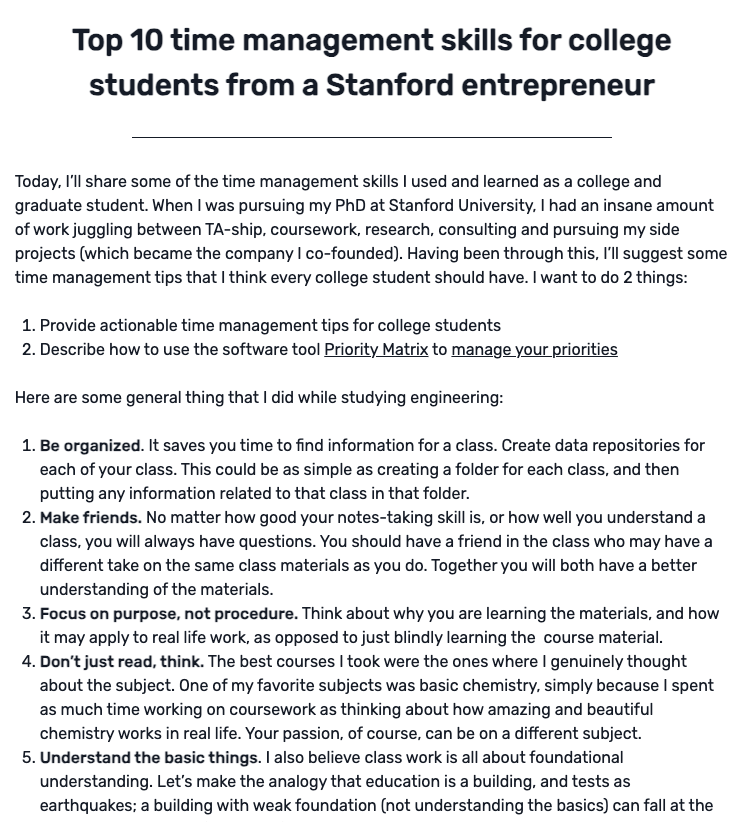

@sharran ·
In the 1920s, researchers walked into Western Electric's factory in Chicago to test a simple theory: Better lighting = better productivity. They cranked up the lights. Productivity soared. Then they dimmed the lights. Productivity soared again. They tried different break schedules. Shorter workdays. New pay structures. Everything worked. The researchers were completely baffled. Until they realized what was really happening. The lighting didn't matter. The schedules didn't matter. What mattered was that researchers showed up every day, watched workers, took notes, and asked questions. Workers knew someone cared enough to pay attention. This became the Hawthorne Effect and it’s the fastest way to boost productivity on your team: 1. Catch someone doing good work and call it out 2. Name what they did and be specific 3. Say why it mattered 4. Do it publicly Your people don't need better conditions. They need to feel seen.

@robj3d3 ·
Honestly, I'm terrible at staying focused while traveling. Here's how I still manage to ship consistently - my 6-step process: 1) Close Slack, X, and email before touching any code or copy. Notifications are productivity poison. 2) Grab a coffee, open a notebook (not a laptop), and sit somewhere without WiFi for 10 minutes. 3) Write down the 2-3 things that have been living on your to-do list for more than 3 days. Those are always the ones that actually matter. 4) For each one, ask yourself: - "If I only did this today, would I feel like I moved the business forward?" - "Does finishing this make everything else easier or irrelevant?" 5) Pick ONE. Not two. One. 6) Give it a minimum 2-hour uninterrupted block. Not 15 minutes between calls. A real block. New cities and co-working spaces make this harder - which is exactly why you have to protect it harder. The grind isn't actually about doing more stuff, it's about not succumbing to procrastination. That's the whole system.


@arpit_bhayani ·
Here's something that doesn't get talked about enough - there's a version of productivity that doesn't actually serve you. It feels like ambition or discipline, but underneath it is something different and toxic. Toxic productivity is when rest starts feeling like failure. When you can't sit through a meal without listening to a podcast. When a slow Sunday morning triggers guilt instead of peace. Unfortunately, our culture often rewards this behavior. We celebrate the people who are always grinding, always hustling. It is just unsustainable. Most of you are actually introspecting right now, and that's good. Here are some signs worth noticing: - tying self-worth entirely to some output - feeling anxious when not being 'useful' or 'productive' - forgetting what you do for fun - physically being unable to relax without feeling like you should be doing something else 'Doing nothing' is not the fix for it. It is all about recognizing that you are a human, not a machine. It is about doing things that matter. It is about prioritising things that matter. Fun fact: what matters to you can change over time. Sometimes the most productive thing you can do is stop.

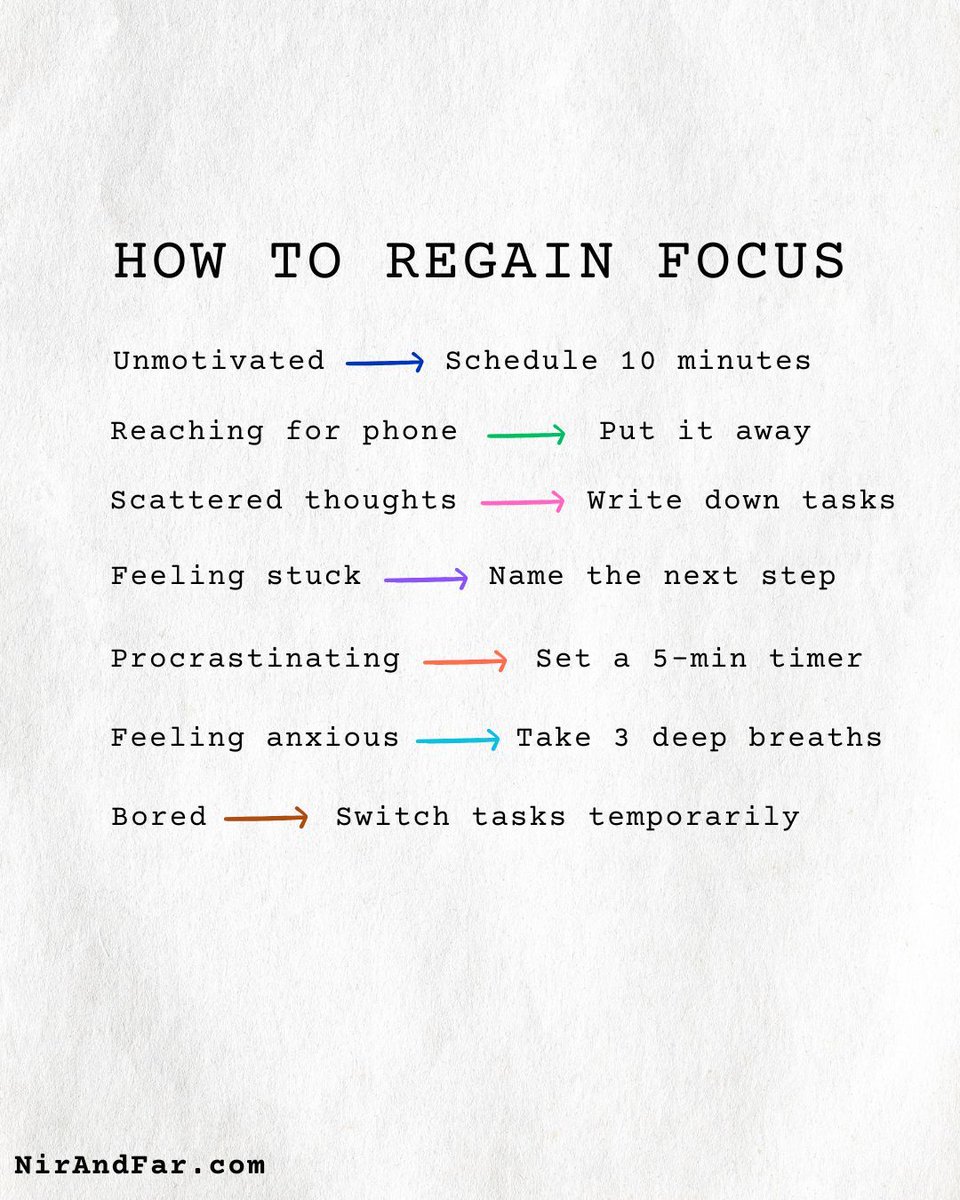
@nireyal ·
How to regain focus (Hint: The trick isn’t resisting distractions.) Most people think focus is about gritting your teeth OR finding the next productivity hack. But both approaches often make things worse. Why? Hacks create a constant chase for the “perfect system,” which turns into procrastination disguised as productivity. Willpower runs out. The more you fight distractions, the stronger they feel. That’s why the smarter path is noticing urges instead of resisting them. By acknowledging a temptation without judgment, you take away its power. This “before and after” guide is built on that idea. Each “before” pinpoints a common mental state (e.g. unmotivated, anxious, overwhelmed). Each “after” gives you a small, concrete action to reset. 👉 Feeling stuck? Start with just 5 minutes. 👉 Mentally tired? Move your body, even briefly. 👉 Drifting into procrastination? Set a short timer. The result is that you stop fighting yourself and start regaining focus faster and with less effort. Over time, these micro-actions build resilience. You learn not to resist distractions, but to master them.

@0xaporia ·
My greatest productivity bottleneck is my tendency to be seduced by shitty rabbit holes that end up not moving the needle at all. Spent 3 hours on something that shouldn't have been worth more than 30 minutes. Note to self, once again: A system should be as simple as possible to use but as complex as necessary to retain value. If a unit of complexity doesn't drive a disproportionately valuable insight, output or decision, it gets cut. Optimize for marginal utility of information.

@milan_milanovic ·
𝟭𝟭 𝗧𝗲𝗰𝗵𝗻𝗶𝗾𝘂𝗲𝘀 𝘁𝗼 𝗕𝗲 𝗠𝗼𝗿𝗲 𝗣𝗿𝗼𝗱𝘂𝗰𝘁𝗶𝘃𝗲 𝗧𝗵𝗮𝗻 𝟵𝟱% 𝗢𝗳 𝗣𝗲𝗼𝗽𝗹𝗲 Here are a few things that I use every day: 𝟭. 𝗥𝗲𝘃𝗶𝘀𝗲 𝗱𝗮𝗶𝗹𝘆 𝘀𝗰𝗵𝗲𝗱𝘂𝗹𝗲 𝘁𝗵𝗲 𝗻𝗶𝗴𝗵𝘁 𝗯𝗲𝗳𝗼𝗿𝗲. Here, I rank my list and select the one big task I want to achieve tomorrow. There could be more tasks, but the fewer you have, the better. 𝟮. 𝗗𝗼𝗻'𝘁 𝗺𝘂𝗹𝘁𝗶𝘁𝗮𝘀𝗸. Especially when working in a demanding job such as programming, we want to be in a flow state as much as possible. So, I turn off all notifications during these periods and check them once per hour when I take a break. 𝟯. 𝗗𝗼 𝗱𝗲𝗲𝗽 𝘄𝗼𝗿𝗸 𝘄𝗵𝗲𝗻 𝘆𝗼𝘂 𝗵𝗮𝘃𝗲 𝘁𝗵𝗲 𝗺𝗼𝘀𝘁 𝗲𝗻𝗲𝗿𝗴𝘆. For me, this is during the morning (1.5-2h sessions), but it's different for everyone. I do repetitive tasks and meetings (batched by type) for the rest of the day. 𝟰. 𝗥𝗲𝗳𝗹𝗲𝗰𝘁. After each day, I reflect on what worked and what didn't. Try to optimize for the next day. 𝟱. 𝗗𝗼𝗻'𝘁 𝗷𝘂𝘀𝘁 𝘁𝗵𝗶𝗻𝗸, 𝗱𝗼. We often think too much about things and do nothing. We need to do things as this is the thing that only counts. Focus on 20% of things that matter (Pareto principle). 𝟲. 𝗦𝗮𝘆 𝗻𝗼 𝘁𝗼 𝗺𝗲𝗲𝘁𝗶𝗻𝗴𝘀. Yes, it's hard, especially for large corporations with meeting cultures. Try to mark your meetings as worth it and then decide if you should go to the next one. And also, make "no" the default for everything that doesn't bring value to your life. 𝟳. 𝗧𝗿𝘆 𝘁𝗶𝗺𝗲 𝗺𝗮𝗻𝗮𝗴𝗲𝗺𝗲𝗻𝘁 𝘁𝗲𝗰𝗵𝗻𝗶𝗾𝘂𝗲𝘀 such as Pomodoro to stay focused and avoid burnout. 𝟴. 𝗗𝗲𝗹𝗲𝗴𝗮𝘁𝗲 𝘁𝗮𝘀𝗸𝘀 to others when possible to free up your time and focus on important tasks. 𝟵. 𝗔𝘂𝘁𝗼𝗺𝗮𝘁𝗲 𝗲𝘃𝗲𝗿𝘆𝘁𝗵𝗶𝗻𝗴. Try to use different tools to automate everything you can automate, especially repetitive tasks. 𝟭𝟬. 𝗦𝘁𝗮𝘆 𝗼𝗿𝗴𝗮𝗻𝗶𝘇𝗲𝗱. As David Allen said, "Your mind is for having ideas, not holding them." Use todo apps for your tasks (Microsoft TODO, Todoist, ...), note-taking tools for note-taking (Notion, Evernote, ...), and techniques such as Getting Things Done (GTD). 𝟭𝟭. 𝗧𝗮𝗸𝗲 𝗴𝗼𝗼𝗱 𝘀𝗹𝗲𝗲𝗽 𝗮𝗻𝗱 𝗲𝘅𝗲𝗿𝗰𝗶𝘀𝗲. Last but not least. This is the thing that can affect productivity the most. Usually, it needs 7-8 hours of sleep to maintain physical and mental health. Also, try to eat healthily and do some physical activities. Regular walks can do wonders, as scientific research shows. And remember we are not machines, not every day is the same. One day, you will do a lot, and another will be small, but this is a part of the process. Do, reflect, and try to 𝗶𝗺𝗽𝗿𝗼𝘃𝗲 𝗯𝘆 𝟭% 𝗲𝘃𝗲𝗿𝘆 𝗱𝗮𝘆 𝗶𝗻 𝗲𝘃𝗲𝗿𝘆𝘁𝗵𝗶𝗻𝗴 𝘆𝗼𝘂 𝗱𝗼.


@justinskycak ·
The #1 trick to super-productivity is interleaving a wide variety of productive work that you enjoy. You get tired, bored, and unproductive if you’re moving along one dimension for too long. The solution is to get yourself in a situation where your production function has multidimensional input and all those inputs have large partial derivatives on the same order of magnitude. You follow the gradient in that space by cycling between these component activities. The activities are orthogonal, so whenever you start getting tired, bored, and unproductive from moving along one dimension for too long, you just switch to a different activity, moving along a different dimension. That said, it’s important to remember that “interleaving a variety of productive work” is different from running away from your problems. If you’ve hit a rut on some activity, and you’re switching tasks just to avoid dealing with that problem, and it’s been this way for a handful of cycles, then you’re past the limit of “taking a break to freshen up” and what you really need to do is bunker down and bust through the plateau.

@tankots ·
My team's productivity 2x’d when I started spending one day a month doing what no other CEO does. I can tell you what any of my 45 employees do from 7am to 7pm. Pick anyone on my team. CMO. Support agent. Engineer who started last week. I'll tell you how they start their morning. What gives them energy. What's blocking their best work. What drives them in life. Not from a performance review. From actually sitting next to them and watching them work. Here's why: Most CEOs see their team struggling and bring in consultants. I bring a notebook. I sit with each person. Shadow them for hours. See what their actual day looks like. Not what I think it looks like - what it really is. Then we map the blockers together. And fix them. This isn't about managing them. It's about removing their friction. When I do this, something changes. They don't feel criticized; they feel seen and empowered. The 2x productivity boost is nice. But that's not why I do it. I do it because they stop being employees. They become teammates I actually understand and trust. Here's the truth: Your product will change. Your market will change. Your strategy will change. The only thing that stays with you is your people. So if you're going to prioritize anything, prioritize understanding them. The best CEOs aren't always the smartest people in the room. They're the ones who know exactly what's preventing everyone else from being brilliant. That's the job. — Written with Wispr Flow

@EXM7777 ·
building the perfect system is not doing the work... you set up the notion workspace, configured the obsidian graph, installed the todo apps, watched every setup video... and abandoned all of it, every time productivity fails for one reason: achieving anything requires doing the work, and that is a completely different activity from preparing to do the work a productivity system is procrastination that feels like progress checking boxes releases dopamine, so you keep checking boxes instead of doing the uncomfortable work that moves you toward your goals the system also taxes the brain that runs it.... you spend processing power remembering where things go, which tags to apply, when to review, how to link it's like using your computer's processor to monitor the processor the best organization emerges from doing real work, never from planning before it deep in a problem you discover what needs tracking, building the system first means guessing this is the fix i recommend, using a notebook and a pen: - write down goals for the year, broken into quarters, then months - prepare every day one simple list of what needs to get done before you sleep - finish something, cross it off, move to the next thing, write down whatever new comes up zero maintenance overhead, complete flexibility, immediate clarity, a brain free to work at full capacity the less time you invest in productivity systems, the more productive you become

@dickiebush ·
Simple productivity system that works for me: > No phone the first 3 hours of the day > Planning my day in full the night before > Using pen & paper to track what I’m doing > Choosing ONE thing to work on first thing > Priming my subconscious with one question before bed

@ben_j_todd ·
Best 'productivity' tip applied recently: take a pure day off once a week, aiming to only do rejuvenating things. It's more recharging than 2 days 'mostly' off, and also means I get a 6th day of peak morning hours. As a relative introvert, for me this looks like: Walk to sauna & cold plunge Tea 2h meditation Big lunch at a fav place, alone or with old friend Maybe journal Long walk listening to music, letting mind wander Do what want for a bit, maybe TV. Or massage or see friends. Early night But you can fill it with anything you find restful or recharging.

@KanikaBK ·
📂 HERMES AGENT ECOSYSTEM ┃ ┣ 📂 00 INBOX & CAPTURE ┃ ┣ 📂 QUICK CAPTURE (VOICE, WEB CLIPPER, MOBILE) ┃ ┣ 📂 FLEETING NOTES (RAW IDEAS, BRAIN DUMPS) ┃ ┣ 📂 DAILY NOTES (AUTO-CREATED) ┃ ┗ 📂 MEETING & CALL LOGS ┃ ┣ 📂 01 PROJECTS (ACTIVE – TIME-BOUND) ┃ ┣ 📂 PROJECT DASHBOARD (MOCS) ┃ ┣ 📂 GOALS & MILESTONES ┃ ┣ 📂 TASKS & SUBTASKS ┃ ┣ 📂 RESOURCES & REFERENCES ┃ ┣ 📂 DELIVERABLES ┃ ┗ 📂 REVIEW & RETROSPECTIVE ┃ ┣ 📂 02 AREAS (ONGOING RESPONSIBILITIES) ┃ ┣ 📂 HEALTH & ENERGY ┃ ┣ 📂 FINANCE & WEALTH ┃ ┣ 📂 LEARNING & SKILLS ┃ ┣ 📂 RELATIONSHIPS ┃ ┣ 📂 PERSONAL BRAND ┃ ┣ 📂 BUSINESS / CAREER ┃ ┗ 📂 HABITS & ROUTINES ┃ ┣ 📂 03 RESOURCES (KNOWLEDGE BASE) ┃ ┣ 📂 LITERATURE NOTES ┃ ┣ 📂 PERMANENT / EVERGREEN NOTES ┃ ┣ 📂 FRAMEWORKS & MENTAL MODELS ┃ ┣ 📂 TEMPLATES VAULT ┃ ┣ 📂 BOOK & ARTICLE SUMMARIES ┃ ┗ 📂 MEDIA & HIGHLIGHTS ┃ ┣ 📂 04 ARCHIVE (COMPLETED / INACTIVE) ┃ ┣ 📂 COMPLETED PROJECTS ┃ ┣ 📂 OLD AREAS ┃ ┣ 📂 REFERENCE ARCHIVE ┃ ┗ 📂 LEGACY NOTES ┃ ┣ 📂 DAILY SYSTEMS (THE ENGINE) ┃ ┣ 📂 MORNING RITUAL / DAILY PLAN ┃ ┣ 📂 ENERGY & FOCUS TRACKER ┃ ┣ 📂 TASK PRIORITIZATION (EISENHOWER + IMPACT) ┃ ┣ 📂 EVENING REVIEW & REFLECTION ┃ ┗ 📂 WEEKLY / MONTHLY / QUARTERLY REVIEWS ┃ ┣ 📂 HERMES AGENT CORE ┃ ┣ 📂 HERMES PERSONALITY & DIRECTIVES ┃ ┣ 📂 AGENT CAPABILITIES & TOOLS ┃ ┣ 📂 CUSTOM INSTRUCTIONS & RULES ┃ ┣ 📂 CONTEXT MEMORY MANAGEMENT ┃ ┣ 📂 MULTI-AGENT ORCHESTRATION ┃ ┗ 📂 HERMES PROMPT LIBRARY ┃ ┣ 📂 AGENT WORKFLOWS ┃ ┣ 📂 IDEA GENERATION & BRAINSTORMING ┃ ┣ 📂 RESEARCH & ANALYSIS ┃ ┣ 📂 CONTENT CREATION PIPELINE ┃ ┣ 📂 TASK BREAKDOWN & PLANNING ┃ ┣ 📂 DECISION SUPPORT SYSTEM ┃ ┗ 📂 REVIEW & OPTIMIZATION CYCLES ┃ ┣ 📂 AUTOMATION & INTELLIGENCE LAYER ┃ ┣ 📂 TEMPLATER & QUICKADD SCRIPTS ┃ ┣ 📂 DATAVIEW QUERIES & DASHBOARDS ┃ ┣ 📂 TASKS PLUGIN QUERIES ┃ ┣ 📂 AUTO-TAGGING & LINKING RULES ┃ ┣ 📂 HERMES AUTOMATION COMMANDS ┃ ┗ 📂 CUSTOM SHORTCUTS & COMMANDS ┃ ┣ 📂 FOCUS & DEEP WORK ┃ ┣ 📂 POMODORO / TIME BLOCKING ┃ ┣ 📂 DISTRACTION BLOCKER NOTES ┃ ┣ 📂 DEEP WORK TEMPLATES ┃ ┣ 📂 ATTENTION AUDIT ┃ ┗ 📂 FLOW STATE TRIGGERS ┃ ┣ 📂 DECISION MAKING & THINKING TOOLS ┃ ┣ 📂 SECOND BRAIN QUERIES ┃ ┣ 📂 FEYNMAN TECHNIQUE NOTES ┃ ┣ 📂 PROS/CONS + 5 WHYS ┃ ┣ 📂 PRE-MORTEM & SCENARIO PLANNING ┃ ┗ 📂 IDEA SYNTHESIS CANVAS ┃ ┣ 📂 REVIEW & OPTIMIZATION ┃ ┣ 📂 VAULT HEALTH DASHBOARD ┃ ┣ 📂 PERFORMANCE METRICS ┃ ┣ 📂 BOTTLENECK IDENTIFICATION ┃ ┣ 📂 QUARTERLY SYSTEM AUDIT ┃ ┗ 📂 10X EXPERIMENTS LOG ┃ ┣ 📂 PLUGINS & EXTENSIONS HUB ┃ ┣ 📂 CORE PRODUCTIVITY (TASKS, DATAVIEW, TEMPLATER, CALENDAR, PERIODIC NOTES) ┃ ┣ 📂 VISUALIZATION (KANBAN, EXCALIDRAW, CANVAS, GRAPH) ┃ ┣ 📂 AUTOMATION (QUICKADD, ADVANCED URI) ┃ ┣ 📂 AI INTEGRATION (HERMES AGENT WORKFLOWS) ┃ ┗ 📂 QUALITY OF LIFE (STYLE SETTINGS, ICONIZE, ETC.) ┃ ┗ 📂 SCALING & EVOLUTION ┣ 📂 MULTI-VAULT STRATEGY (IF NEEDED) ┣ 📂 TEAM / COLLABORATION SETUP ┣ 📂 SYSTEM VERSION HISTORY ┣ 📂 10X → 100X UPGRADES LOG ┗ 📂 LONG-TERM LIFE OS ROADMAP

@alexabelonix ·
Let me help you to increase your productivity on 80% >>> How the fuck should i organise my day as a founder? 3 weekly priorities are the anchor Product - Finish one concrete product/module/build milestone Market - Have 5–10 useful conversations or DM replies with potential users Distribution - Publish 5 useful X posts and 1–2 repurposed IG pieces >>> What about DMs?? so much opportunities are there First 2–3 hours: product building Then: DM block for 20–30 minutes Because if you start with DMs, your mind can get pulled into other people’s energy before you build anything >>> Can i switch from tasks? Protect your focus Better: Deep work block: build product Market block: DMs / user replies Content block: write/repurpose Admin block: small tasks You need blocks, not random switching


@73lV_ ·
90% of "AI productivity" threads are just tool collecting you don't need 15 AI apps. you need 2-3 good ones used consistently master the basics before chasing the latest features. claude for analysis openai for creativity perplexity for research gemini for image/video generation productivity isn't about tools, it's about more about the systems

@realBigBrainAI ·
Uber CEO Dara Khosrowshahi on the clearest productivity differentiation he's ever seen between engineers using the same tools: @dkhos explains that 90% of Uber's engineers now use AI tools of some sort. But within that group, a smaller set is pulling away from everyone else in a way he can actually measure. "There's about 30% of them that are using them at a completely accelerated pace. And it really is changing their productivity in a way that I've never ever seen before." The way that differentiation shows up is through diffs, the code releases that get pushed to Uber's codebase. "One of the measurements of productivity is just how many diffs are you putting to the codebase. Uber's just a giant codebase. That's what we are." For Khosrowshahi, this matters because of how he sees the role of an engineer at the company: "Our engineers are literally the builders of the company. They are manufacturing the bricks that go into the system. And they're architects who are kind of thinking about what the system should look like." He believes the nature of the job itself is shifting: "I do think that the job of a coder is going to change more and more from actually writing the code to some extent orchestrating agents who are writing the code or building systems for you. It becomes more of an orchestration job versus a manual writing job. But the job will still be there." Crucially, he doesn't see rising productivity as a reason to shrink his team, at least not yet: "If my average engineer became 25% more efficient, which we haven't gone there yet, but we will get there. I'm going to hire more engineers because I want to go faster." But he's candid that this calculus could flip in the future: "5 years from now as the engineers get more and more productive, I may not decide to add engineering headcount because at that point instead of adding an engineer, I should add agents and buy some more GPUs from Nvidia. That may be the investment in the future. We'll see."
 Watch video
@alexabelonix ·
Founders, I recently realized one thing that helped me move faster than most productivity systems ever did Before that, I was constantly busy. > Testing new tools. > Building systems. > Researching things. I always felt productive. But if I’m honest, a lot of that was just preparation. I was preparing to do the work instead of doing the work. Then I started asking myself one simple question: What’s the task closest to revenue right now? And that question changed a lot. Because when you’re building a startup, there are too many priorities. > Product. > Sales. > Fundraising. > Content. > Hiring. > Operations. Everything feels important. But not everything moves the business forward. Now whenever I feel lost, I come back to that question. What’s the task closest to revenue? > Sometimes it’s a sales call. > Sometimes it’s following up with a prospect. > Sometimes it’s fixing a payment issue. > Sometimes it’s shipping something that can finally be shown to users. That’s what I call a Mission Block. And honestly, it’s one of the simplest ways I’ve found to cut through founder chaos

@sharran ·
This simple productivity system helped me build 2 billion-dollar business: Night before: Write tomorrow’s top 3 most important tasks (MITs). The decision happens in the evening when your brain is less reactive, so when you wake up, you have a clear target. Morning: Plan the day before starting it. Pull today’s tasks into specific time slots. Friday preview: Review last week's calendar and ask what follow-up you need to do for each task. Look 2 weeks ahead and ask what prep each task needs.

@zuess05 ·
I changed one morning habit and my productivity 10x-ed this week 🤩 Before I even open my laptop, I write every single task down. It stays right in front of me all day. It forces me to prioritize and actually ship. I tried all the fancy productivity tools, but nothing beats the dopamine of aggressively crossing a shipped feature out with a pen ✍️


@socialwithaayan ·
Someone built the productivity app that every developer actually wants and made it completely free. Super Productivity is an advanced task manager with timeboxing, time tracking, and native integrations: → Pulls tasks from Jira, GitHub, GitLab, Trello, and OpenProject automatically → Timeboxing built into every task so your day has real structure → Pomodoro timer, break reminders, and focus tools included → No account, no login, no data sent anywhere → Offline-first with optional sync via Dropbox or WebDAV 17,300 stars. 322 contributors. Still actively maintained. Free and open source. MIT license.


@ConsciousRide ·
25 engineering workflows that improve productivity: 1) Understand the problem before opening the IDE. 2) Break work into smaller milestones. 3) Create a quick implementation plan. 4) Read existing code before writing new code. 5) Reuse proven patterns. 6) Build the smallest working version first. 7) Test continuously while coding. 8) Commit small, focused changes. 9) Review your own PR before creating it. 10) Write meaningful PR descriptions. 11) Deploy to staging early. 12) Verify logs after deployment. 13) Monitor production after release. 14) Document important decisions. 15) Automate repetitive tasks. 16) Batch similar work together. 17) Schedule uninterrupted focus blocks. 18) Keep a running TODO list. 19) Track recurring bugs. 20) Remove dead code regularly. 21) Refactor while context is fresh. 22) End the day with clean Git status. 23) Prepare tomorrow’s first task before logging off. 24) Learn from every production issue. 25) Repeat what consistently works.

@aaliya_va ·
I used to think productivity meant squeezing more into the day. but when you are writing content for four social accounts, engaging prospects, designing visuals, closing deals with founders, testing AI tools and keeping up with a field that changes every week, “more” stops being enough. You don’t need a busier system,you need a better one. That shift began when I came across Justin Sung. He’s a former medical doctor turned learning coach who teaches research backed systems for productivity and learning. His idea is that performance improves when your identity, habits and priorities are designed on purpose That’s what changed everything for me. I stopped trying to do everything at once and started building a framework: >Define the outcome before the work begins. >Strip out tasks that look important but don’t move the goal. >Batch repeatable work so I’m not constantly switching gears. >Protect deep focus for the work that actually compounds. >Review, refine and repeat every week. That framework didn’t just make me more productive. It made me calmer,more intentional and less reactive. Productivity is not about doing everything. Its about becoming the kind of person who knows what matters, protects it fiercely and builds a life around it.


@VivanVatsa ·
productivity is a disease. a costume. stop optimising. start actual work. that notion template is not work. the colour coded calendar is not work. the morning routine is not work. real work is the work. productivity p*rn gives you the feeling of progress without any cost. the dopamine of organisation without the discomfort of creation. you built the perfect schedule for the work. but hey, the work is still waiting. your fav productivity gurus knew. they sold you the feeling of "almost". perpetually on the verge. always one system away. and you kept buying it. notice how the productivity space has gone quiet. no new systems or workflows being sold in the market anymore. i wonder why? haha, because enough people finally looked up from and realised it builds nothing. only antidote is delusional optimism. be obsessed with the job. not the decoration. you cannot delay your way to something you were never actually working toward. close the app. open the work. stay there until something exists that did not exist before you sat down. for once, just focus aggressively.
@nurijanian ·
Zapier updated their AI fluency rubric. Worth reading if you hire, or get hired. V1 (May 2025) set a minimum bar: "Capable" meant you'd used AI with purpose and could describe the impact. V2 (March 2026) raised it. To clear "Capable" now, candidates must show: - AI embedded into their core work - Repeatable systems, not one-off prompts - Clear impact on quality, efficiency, or related outcomes That's a meaningfully different bar. If you're describing your company, product, and team context at the start of every AI session, you're prompting one-off. The new bar requires something you run again. Someone using Claude to write a PRD each week is doing one-off prompting. Someone with a workflow that runs every time a PRD needs writing, configured to their company, product, and team context, is building a repeatable system. The output of those two approaches diverges over time in ways that are hard to see week-to-week but obvious after six months. What does a repeatable system actually look like for PMs? A few patterns that work: - A spec workflow that pulls in product context automatically, so you’re not re-explaining your stack every session. - A research-to-feature pipeline that starts from user quotes and ends at acceptance criteria and a prototype. - A pre-mortem that runs before any major decision, not just when you remember to run one. The tools for this exist. Cursor and Claude Code make it relatively accessible. I built PM OS partly to answer this question for product work specifically. Even with consistent daily use, you're landing at Adoptive on Zapier's rubric, not Transformative. Another interesting signal in V2 is that Zapier now assesses slope, not snapshot. Not where you are today, but how fast you've been moving and what you've tried and discarded. Someone who plateaued on the same three tools eight months ago is a different candidate than someone actively iterating. If you've been meaning to build out your AI stack properly, that's the actual clock running. → https://t.co/UhYRV3wEfW

@shushant_l ·
Claude AI ┃ ┣ Foundations ┃ ┣ Use Sonnet 4.6 for daily tasks ┃ ┣ Save Opus 4.6 for deep work ┃ ┣ Ask Claude to ask YOU questions first ┃ ┣ Let it interview before big tasks ┃ ┗ Always define the result, not the steps ┃ ┣ Prompting ┃ ┣ One prompt = one deliverable ┃ ┣ One task, one output, no clutter ┃ ┣ Turn on extended thinking for complex work ┃ ┣ Add “no commentary, just output” when needed ┃ ┗ Be precise instead of rewriting everything ┃ ┣ Context System ┃ ┣ Build a personal context file ┃ ┣ Define role, goals, priorities ┃ ┣ Create a voice profile ┃ ┣ Define tone, rhythm, banned words ┃ ┗ Maintain an anti-AI writing file ┃ ┣ Workflow Optimization ┃ ┣ Batch related tasks together ┃ ┣ Edit and resend instead of correcting later ┃ ┣ Start fresh every 15–20 messages ┃ ┣ Paste summaries to retain context ┃ ┗ Save best outputs as reusable templates ┃ ┣ Claude Projects ┃ ┣ Use Projects for repeated workflows ┃ ┣ Upload files once, stop re-pasting ┃ ┣ Add briefs, style guides, past samples ┃ ┣ Keep everything centralized ┃ ┗ Use Projects for brands and clients ┃ ┣ Input Quality ┃ ┣ Upload screenshots for better results ┃ ┣ Convert PDFs to markdown before upload ┃ ┣ Provide structured inputs always ┃ ┣ Avoid vague instructions ┃ ┗ Show, don’t just tell ┃ ┣ Tool Usage ┃ ┣ Turn off web search when not needed ┃ ┣ Disable connectors for cleaner outputs ┃ ┣ Use Claude for research ┃ ┣ Use other tools for design ┃ ┗ Don’t mix workflows in one tool ┃ ┣ Iteration System ┃ ┣ Fix mistakes in your context file ┃ ┣ Train Claude over time ┃ ┣ Say “redo section X” not everything ┃ ┣ Build feedback loops ┃ ┗ Improve outputs session by session ┃ ┣ Automation ┃ ┣ Connect Slack, Drive, Gmail ┃ ┣ Eliminate copy-paste workflows ┃ ┣ Centralize your work environment ┃ ┣ Build repeatable systems ┃ ┗ Save time on execution ┃ ┗ Leverage ┣ Ask Claude to build your voice profile ┣ Invest 10 minutes once ┣ Get months of better outputs ┣ System > prompts ┗ Process > hacks


@oliverbrocato ·
Performative productivity is the most expensive form of laziness. 32 tabs open. Notes in Notion, Google Docs, Apple Notes. Highlighted PDFs. Clean files. Organized. Internal comms hygiene dialed to the max. Looks and feels like work. Except ur avoiding the ONE thing that actually moves u forward. Ship something.

@terencebuilds ·
Stop optimizing your to-do list. Start optimizing your energy levels. Instead of cramming tasks into low-energy hours, I started tracking when my brain actually works Mornings = Deep coding Afternoons = Marketing (when I can handle rejection better) Evenings = Planning tomorrow Productivity isn't about doing more It's about doing the right things when your brain can actually handle them #BuildInPublic

@alvinfoo ·
I stopped taking notes. I started building a second brain. Here’s the system I use with Claude + Obsidian that changed how I work: Most people consume information. They save articles, bookmark threads, attend webinars, then forget 90% of it by next week. I used to do the same thing. Then I built a system that thinks with me, not just stores for me. The stack is simple: → Obsidian (your personal knowledge graph) → Claude (your AI thinking partner) Here’s the workflow: 1. Capture raw — dump notes, articles, voice memos into Obsidian without filtering. Don’t organize yet. 2. Process with Claude — paste your raw notes and ask Claude to: extract key insights, identify contradictions, connect to existing ideas, and suggest what you’re missing. 3. Build atomic notes — Claude helps you compress every idea into one clear paragraph. One idea. One note. Linked to everything related. 4. Weekly synthesis — every Sunday, I paste 7 days of notes into Claude. It generates a “week in review” summary + surfaces patterns I missed. 5. Ask your brain questions — with Obsidian’s graph + Claude’s reasoning, you can literally query your own thinking. “What have I written about AI agents?” → instant synthesis. The result? I don’t just remember more. I think better. My ideas compound. My content writes itself. My decisions are faster because I’ve already done the thinking, I just surfaced it. This isn’t productivity hacking. It’s building intellectual infrastructure. You don’t need a better memory. You need a system that makes forgetting irrelevant.


@michalmalewicz ·
I noticed a pretty crazy thing. The more I'm able to do multiple things, the less I am actually finishing. It's like our brain stops us from multitasking too hard. And I don't feel like typical ai-bros are that productive either. It's mostly pretend productivity, something I've lied to myself I'm doing too. Optimizing a process that doesn't move the bottom line in any way is faux-productivity. The more I notice that the more I want to step back and redesign my design approach. Automate SOME things, but not automate for the sake of being on top of the "ai game". Because this game... it's kinda lame and mostly smoke and mirrors. True productivity is not measured by AI generated KPI's, it's measured by what you deliver. WDYT?


@andysparks ·
Spent some time this week using Claude and Notion to build a weekly productivity loop for myself. Monday morning brain dump → Friday shutdown review → repeat. Biggest value so far: getting everything out of my head and into a system that actually holds me accountable. Simple enough that anyone could set it up in an afternoon.


@MakadiaHarsh ·
simple productivity system that actually works for building products fast: > no slack or emails until noon > plan tomorrow's tasks the night before > one main feature to ship, nothing else > write everything on paper, not notion > ask yourself one hard question before sleeping

@LawrenceDCodes ·
Here’s an additional high tech productivity tool I’m using for this process - good old fashioned white board 😂. I put any tactics (todos) that I plan to complete for this day in addition to other things that just have to get done. Once complete, I add a check mark. This makes it easy to transfer to my weekly scorecard.


@alexcooldev ·
Unpopular opinion: You don’t need another productivity tool. You need to put your phone down and start doing the work. Notion, Todoist, Obsidian, calendar blocking… You’ve tried them all. The problem isn’t the tools, it’s that you’re confusing “planning” with progress. Execution > Optimization. This post is for the folks with 12 productivity systems and zero finished products. You know who you are.

@pascal_bornet ·
𝗧𝗵𝗲 𝘀𝗰𝗮𝗿𝗶𝗲𝘀𝘁 𝗽𝗮𝗿𝘁 𝗶𝘀 𝗵𝗼𝘄 𝗻𝗼𝗿𝗺𝗮𝗹 𝘁𝗵𝗶𝘀 𝗳𝗲𝗲𝗹𝘀. Somewhere along the way, our days became a relay race between screens, and most of us barely noticed because every step felt useful at the time. A message to answer. A meeting to join. A document to finish. A video to relax. One last check before sleeping. I have caught myself doing this too, and the uncomfortable part is that it rarely feels like distraction while it is happening. It feels like productivity, connection, entertainment, or “just five minutes.” That is why willpower is usually the wrong answer. You cannot out-discipline an environment that was built to pull you back in every time you get quiet. Change the environment instead. Put your phone out of reach during deep work, remove the apps that turn boredom into scrolling, make screen time visible, and replace one fast dopamine habit with one slower one: walking, reading, cooking, journaling, or speaking to someone without another device nearby. Attention is not lost in one dramatic collapse. It is traded away in tiny moments that feel reasonable. What is one screen habit you know is costing you more than it gives back? #DeepWork #DigitalBehavior #Productivity #Attention


@pricefoulger ·
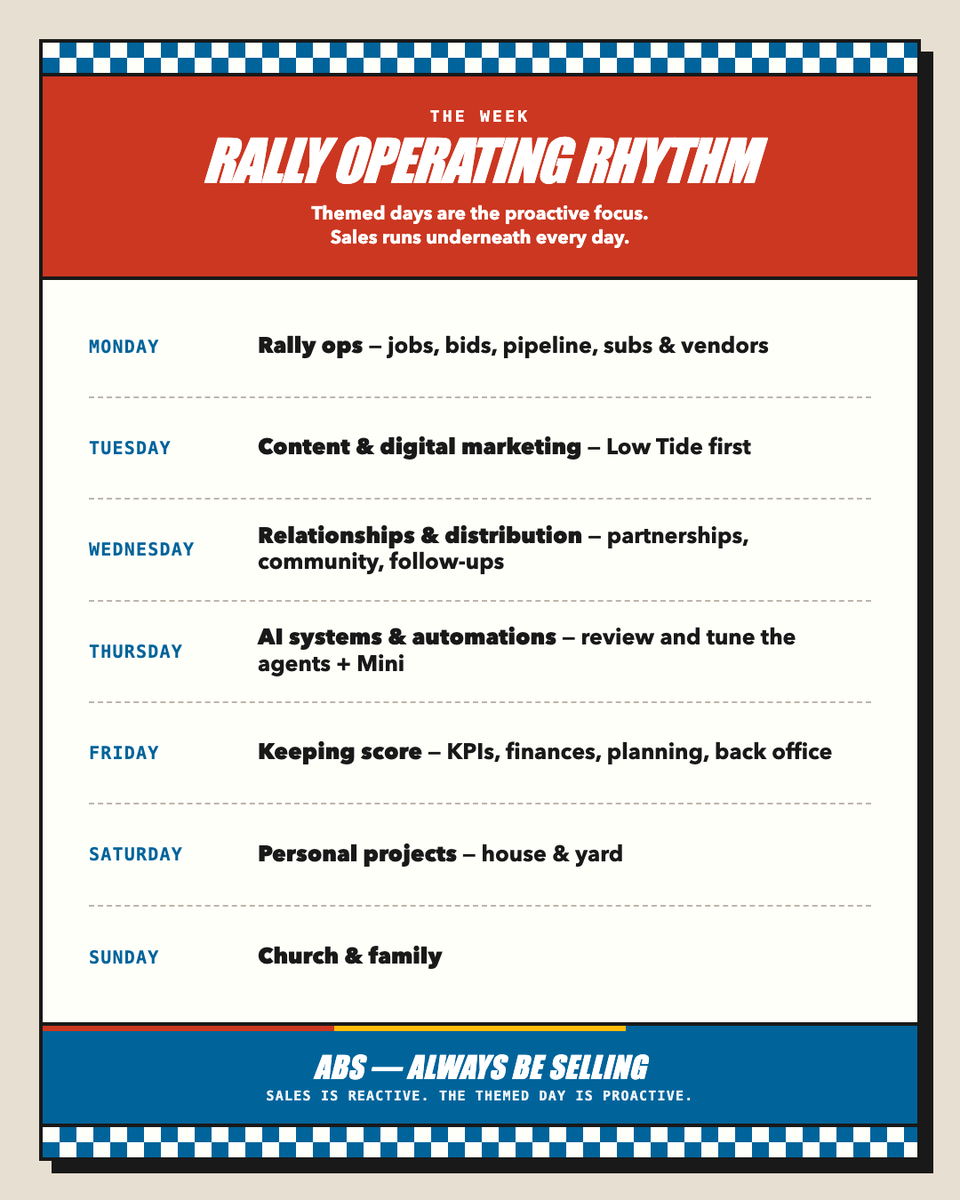
I've tried to commit to a strict schedule so many times now and it never last long. A new thing I'm trying is themed days. Mon: Operations Tue: Content and Marketing Wed: Relationships (vendors, subs, customers) and Distribution Thur: Systems and Automations Fri: Keeping Score aka Review Sat: Family / Personal Su: Church and Family I printed this little card out, and it is taped to my monitor. There's obviously some overlap in things I do every day, like sales, responses, customer support, etc but this system seems to help me have a daily focus so I'm not too scattered and overwhelmed. Curious what other people with scattered brains aka ADD/ADHD do, because most productivity advice doesn't seem to stick for me.

@rcmisk ·
every founder has one task that quietly eats the week. mine was posting on X. i have a 9-5, so the content i needed to ship always lost to the eight other things due that day. the fix wasn't doing it faster. it was handing the whole workflow to an agent. i wrote up the exact method: • find the weekly task that drains you • structure it the ICM way: the filesystem is the harness, no langchain, no crewai • one stage, one job. each step is a folder with a tiny context file • make the last mile a conversation. you trigger it by talking, not clicking • the two tools i built to run it: vibedraft + x-poster what are you still doing by hand every week?

@CODEwalkerr ·
Made my own Freedom tracker I can use everyday to keep track of low-high priority tasks. Includes a timer to keep me aligned and accountable to actually make shit happen. The thing I love about vibe coding is taking the baseline structure of something that works and doing your take on what that would look like. This goes into what Austin Kleon talks about in Steal Like an Artist. Not reinventing the wheel, but providing your unique take on things and not just ripping something that is exact and labeling it as yours. Add a new layer instead of copying. @matt_gray_ is a huge inspiration for me in applying system thinking. Do you have time management issues or are you pretty set within your system and workflow?
 Watch video

@RobRan6116 ·
Hot take: There is no such thing as a productivity tool. Tools don’t make you productive. They reduce friction around thinking, context, and returning to work. The real problem most knowledge workers face is losing context when work gets interrupted.
 Watch video

@MengxueBi ·
Four ways I’ve changed how I work with AI agents Over the past few months, my workflow with Codex and Claude Code has changed significantly. These four changes have given me the biggest productivity boost: 1️⃣ I speak to agents instead of typing prompts Most of my agent interactions now happen through voice—either live voice conversations or dictation with a local @openwhispr model that handles mixed Chinese and English extremely well. This becomes especially valuable when I have several agent sessions running in parallel. Voice removes the final bit of friction: moving my hands between windows, switching input languages, and carefully typing instructions. Speaking freely is also a better way to dump thoughts. I don’t need to organize everything in my head before I begin. I can start talking, discover what I think along the way, and let the agent extract structure from the mess. 2️⃣ I stopped overthinking “prompt engineering” Carefully engineered prompts—with personas, rigid formats, and perfectly defined steps—felt important last year. Today, that approach often feels outdated. Modern agents are surprisingly good at understanding unstructured context. Instead of spending time polishing a prompt, I give them more raw material: scattered thoughts, background documents, previous attempts, references, constraints, and the reasons behind the task. The more context I provide, the more useful surprises I get. Agents can often find connections and insights inside my own rambling that I hadn’t articulated clearly myself. So my current advice is simple: ramble first, structure later. Don’t let prompt engineering become another form of procrastination. 3️⃣ I communicate intent and reusable rules—not pixel-level fixes Instead of saying, “Move this element three pixels,” I explain: What feels wrong What outcome I’m trying to achieve Why the current solution isn’t working What direction I want the agent to explore What principle should apply across the entire project This is especially important for product designers and engineers. Repeatedly correcting isolated details teaches the agent almost nothing. Defining a reusable rule teaches it your taste and allows it to apply that preference everywhere. For example, don’t fix the spacing of ten cards individually. Define the spacing system and ask the agent to audit and update every relevant component. The goal is not to issue more instructions. It is to create rules that eliminate future instructions. 4️⃣ I use Plan Mode much less—and give agents more autonomy When I started using Claude Code four or five months ago, I used Plan Mode constantly. I read every plan before allowing the agent to continue. Now I probably use it once a day. Instead, I often use auto mode or bypass permissions so agents can keep working without waiting for me to click “Approve” at every step. That has dramatically reduced the time I spend staring at a session instead of doing something else. An important caveat: my work is mostly design exploration, storytelling, presentations, and app prototyping. I’m not working with sensitive data, production databases, security systems, or high-risk infrastructure. This level of autonomy is appropriate for my environment—not necessarily everyone’s. The quality of both Codex and Claude Code has also improved enough that I rarely need to review a text plan before work begins. If a task genuinely needs review, I use Lavish to turn the plan into a visual HTML artifact and leave feedback directly on it. 🌰In a nutshell, I’m spending less time operating the agent and more time communicating context, intention, and taste.

@RobRan6116 ·
Most productivity advice says: “Stop multitasking.” But modern work isn’t that simple. The real problem is context reconstruction. Every interruption wipes the mental whiteboard and it takes ~15–20 minutes to rebuild. One simple trick: leave breadcrumbs for your future self.
 Watch video

@catalinmpit ·
"The things that matter are the things that scare you. Finding your truth in life. Being a present parent. Writing something honest. Starting a project that might fail in public. They scare you because the moment you actually attempt them, you risk discovering you’re not as good as you’d hoped, and that you might not get there in the time you have left. Work productivity hacks do not scare you though. Inbox zero does not scare you. Calendar tetris does not scare you. Reorganizing a doc does not scare you. Learning how to manage and lead projects and organizations does not scare you. None of these expose you, so you choose them. Gladly. You tell yourself you are being productive and responsible, and you will get to the real thing once the small things are handled."

@evielync ·
Most people lose more time after meetings than during them. This 30 second post-meeting system transformed how I do meetings (spoiler I actually like meetings now): I used to dread meetings. Not just the time sitting in them, but the aftermath. That post-meeting scramble where I'd spend 45 minutes organising notes, creating tasks, writing follow-ups... all while the next meeting was about to start. Sound familiar? Here's the 30-second workflow that completely transformed my relationship with meetings: 1// I use @tana_inc's in built meeting note-taker to capture everything. 2// When the meeting ends I use my Meeting Magic Agent to instantly transform raw notes into perfect summaries. 3// Then I tag all the actions directly from the summary and they go into my task list. That's it. 30 seconds. The best part isn't even the time saved (though getting back hours each week is nice). It's that I can finally be fully present in meetings, knowing the system has my back. AND I actually look forward to meetings now. They're no longer these energy-draining sessions that create more work - they're just conversations that my system automatically processes for me. If meetings are stealing your focus and creating admin headaches, this might be the workflow shift you need.
 Watch video

@o_gabsferreira ·
New Year’s Resolution #1: Going back to Apple Notes. The truth is, I’m tired of trying to be productive using complex tools. Notion and Todoist are incredible, but for my workflow, they create more work than they actually solve. I’m going 100% back to Apple Notes and reviving my old "Master Note" habit: an infinite stream of thoughts, tasks, and daily logs organized by date. I’ll keep separate notes only for what’s strictly necessary (like scripts and articles). This system worked perfectly for me in the past, but I abandoned it to try and be "more productive" with newer tools. Big mistake. Who else uses Apple Notes as their primary productivity tool?

Best Tweets by Topic