Burnout symptoms and recovery
Loss of motivation, anxiety, panic, exhaustion, sleep disruption, reduced clarity, breaks from work, and recovery through rest, therapy, health routines, or stepping away.
64%
Best tweets about Burnout and Mental Health for Founders
Read 50 of the best tweets about founder burnout and mental health, with honest lessons on startup stress, resilience, and sustainable work.
The honest posts about the cost of building something, not just the highlight reel.
Original Xholic analysis
Across the set, candid founder posts describe burnout as lost motivation, isolation, pressure, and blurred self-worth. Posts discussing recovery commonly point to breaks, rest, health routines, boundaries, support, and changes to how work is organized.
42% of posts
All-time engagement
76% of posts
Published in 90 days
Conversation map
Loss of motivation, anxiety, panic, exhaustion, sleep disruption, reduced clarity, breaks from work, and recovery through rest, therapy, health routines, or stepping away.
64%
Practical ways to preserve energy and decision quality through time off, environment changes, focus, routines, family time, delegation, and limits on work intrusion.
26%
Critiques of glorified overwork, extreme hours, sleep deprivation, nonstop availability, and social-media founder archetypes that equate suffering with ambition.
26%
Loneliness at the top, lack of safe outlets, performing confidence, and the difficulty of sharing the unfiltered reality with cofounders, family, teams, or friends.
24%
Burnout as a systems problem caused by unclear priorities, context switching, founder dependency, broken processes, poor delegation, and unprofitable growth.
22%
The acute stress of accountability, crisis management, financial uncertainty, responsibility for employees, and rapid swings between startup highs and lows.
18%
Untangling personal worth from traction, revenue, company outcomes, and external success; including emptiness after achievement and the search for purpose beyond work.
16%
Exercise, sleep, nutrition, meditation, yoga, and other embodied practices used to manage stress, channel intensity, and restore focus.
14%
Tone and stance
Performance benchmark
Posts with media make up 26% of this collection. Their median all-time score is 10.2, compared with 6.81 for text-only posts.
Format mix
Consensus and debate
Shared view
Posts describe burnout through heaviness around work, anxiety, poor sleep, reduced clarity, and emotional drag—not merely long hours. Recovery accounts describe stepping back and restoring routines.
Shared view
Founders describe carrying uncertainty privately, performing confidence, and lacking a safe place to voice the unfiltered version of business stress.
Shared view
Posts describe protecting family time, changing environments, reducing work intrusion, and setting communication boundaries rather than treating nonstop availability as inevitable.
Shared view
Several posts locate burnout in unclear priorities, context switching, founder dependency, and growth without profit—not solely in individual resilience.
Open debate
One account says it pushed through an acute burnout period while changing its relationship to company outcomes; other posts advocate breaks, recovery, or rejecting suffering as a badge of ambition.
Open debate
One post frames grind as part of startup building, while others argue that seven-day weeks and nonstop work are methods to avoid rather than models to copy.
Open debate
Cofounders are presented as a check against burnout and blind spots, while another post says founders may withhold serious fears because voicing them can unsettle a cofounder.
What performs
The three highest listed outliers are posts about an unhappy move to San Francisco, overwork and loss of motivation, and a lonely pre-traction founder stretch. Their all-time scores are 890.28, 477.12, and 464.47, respectively.
QUESTION posts have a 14.97 median all-time score, above ANNOUNCEMENT posts at 6.7. The cited examples ask readers to reflect on self-worth, founder volatility, and business pressure.
Media appeared in 13 posts (26%) and had a 10.209 median all-time score, versus 6.807 for text-only posts. The supplied data does not establish a reason for this difference.
Statistical standouts
Creator landscape
The five most represented creators account for 20% of the selected posts.
1. Alexa | Startup founder
@alexabelonix
2 posts
2. Big Brain Business
@BigBrainBizness
2 posts
3. Brock Mammoser
@brock_mammoser
2 posts
4. Gabriel Jarrosson
@GJarrosson
2 posts
5. Martin Soorjoo
@martinsoorjoo
2 posts
6. oliverb
@oliverbrocato
2 posts
Alexa | Startup founder describes burnout recovery through psychotherapy, exercise, yoga, meditation, and reducing distractions. oliverb’s posts describe calmer responses as linked to clearer decisions, and contrast a one-person operating model with hiring or outsourcing.
Ryan Deiss’s posts discuss founder dependency, cash reserves, profitable growth, founder compensation, and protecting family calendar time as parts of running a business sustainably.
The set contains 50 tweets from 43 creators. The reported top-five placement share is 20%, so the top five creators account for one-fifth of tweet placements in the set.
Since the previous snapshot
Themes, sentiment, stance, and post format are classified per tweet. All counts, shares, medians, creator concentration, freshness, and performance comparisons are then calculated directly from the published snapshot.
Xholic's all-time score compares engagement while accounting for reach, post age, and creator consistency. It is used for relative comparisons within this collection.
This report analyzes the exact 50-post snapshot shown below. AI identifies editorial categories and drafts explanations; all statistics are calculated from the snapshot, and every narrative claim is checked against cited posts before publication.
Best Burnout and Mental Health for Founders tweets
Ranked 01–50

@Clara_Gold ·
6 months ago, I moved to San Francisco. It’s the best place in the world to build, and one of the worst places to stay human. My unfiltered take: 1. SF is both overhyped and underrated The overhyped part: there are a lot of people with incredible resumes who are deeply unimpressive in real life. They were at the right company, at the right time, in the right market, and got carried by the wave. They made money, got comfortable, and now spend their time “exploring opportunities” over coffee, wasting your time. The underrated part: the top 1% here is insane. But almost impossible to get. Hiring in SF feels like being a guy on a dating app: everyone you want is out of your league, and everyone in your league wants someone out of theirs. The best people have unmatchable packages, endless options, and are optimizing for maximum impact: labs, frontier companies, or startups raising $100M pre-seed rounds. If you raised $10M from Tier 1 investors, you’re not hot shit here. You’re a B-player. It’s humbling. 2. There are fewer mission-driven people than I expected Especially on the application layer. A lot of people are in “secure the bag before it’s too late” mode. And honestly, it gives me the ick. The real religious builders I’ve met are often in labs, hardware, biotech, deeptech, defense — places where the work is hard enough that you can’t fake obsession. 3. The status game favors builders This is what SF does better than anywhere else. It rewards obsession. It rewards weirdness. It rewards people who make building their entire personality. Europe punishes that. SF gives it status. If you’ve felt like an outsider your whole life because you care too much, work too much, think too radically, or refuse to be chill about things that matter, this city will make you feel less insane. 4. The market liquidity is absurd Even if you don’t build a billion-dollar company, if you manage to build a strong product with a great team, someone smart might still acquire you for $ 100M. Yeah I know, it’s not your dream outcome as a founder, but on the days you feel desperate, it helps to keep going. 5. SF does not care about the meaning crisis that’s coming Anyone paying attention here can feel that something massive is happening with AI. But I’m shocked by how little people talk about the meaning crisis coming next. Everyone wants to talk about AI liberating humanity. Almost no one wants to talk about what happens when work — the thing that gives most people identity, structure, dignity, status, and purpose — starts disappearing. The vacuum will not be peaceful. People are underestimating the chaos that comes from humans suddenly having no idea why they matter. And I really feel like no one cares. 6. Personally, I’ve never been more unhappy I moved to SF and entered the matrix. I’ve always been intense. I’ve always worked crazy hours. But here, I lost the last parts of myself that were not about building. I don’t go to events. Most networking events feel like theater for people pretending to be important. The only events worth going to are small, curated dinners with people who are actually alive. I’ve made 0 real friends. I don’t do well with transactionality. I don’t do well with people constantly performing greatness. I don’t do well with rooms where everyone is optimizing and no one is being honest. So yes, SF is lonely, transactional, delusional, addictive, inspiring, boring, extraordinary, and completely insane. But it is still the only place to be right now if you’re a founder trying to build the next wave of humanity. And for now, that’s enough.

@marclou ·
I overworked myself. For the past 5 years, I barely took a day off. I shipped 30 startups, wrote 30,000 tweets, made 70 YouTube videos, and answered thousands of support requests. The weird part is, it never felt like work. It felt like play. Until recently. For the first time in years, I’ve struggled to get things done. I don’t want to open my laptop. The things that used to make me happy suddenly feel heavy. That scares me a bit, because the playful side of work is what got me here. And right now, it feels like I lost it. So I’m taking a break. I’ll still do about an hour of maintenance work a day, but the rest of my time will go to real life. I’m training for Hyrox in Korea on May 25, so I’ll put my energy there for now and train 20 hours a week. I went through a little burnout once before, in 2021. What helped me was going back to basics: training, reading, eating well, and sleeping 8 hours. It brought the hunger back then. I trust it will again!

@hthieblot ·
One of the loneliest and most brutal stretches as a founder is holding unbreakable belief that you'll make it... when you have literally nothing to show for it. 2–4 years of: - Zero traction - Telling people "this is going to be big" and feeling like a fraud the second the words leave your mouth - Shrinking bank account - Friends buying houses / getting promotions while you explain to your mom why you still don't have a "real job" The imposter voice gets loudest at 3 AM: "Am I delusional?" "Can I actually pull this off?" "Am I really built for this?" Everyone around you might doubt it quietly, but the real killer is when you start doubting yourself. The truth: Yes, you can. Yes, you are that guy. But belief has to come before proof. You have to choose to back yourself hard when the scoreboard says zero, because that's exactly when most people quit. Those empty years aren't wasted. They're forging the version of you that can handle the win when it finally hits. Keep showing up. Stay obsessed. Never ever give up. The breakthrough comes after the doubt has tried to kill you a hundred times.

@oliverbrocato ·
I agree with Clavicular 100% on this. Old me got agitated by everything. Slow processes. Employee 5 mins late. Amex rep putting me on hold. Cortisolmaxxed 24/7. The result: Constant reactivity. Zero clarity. Terrible decisions. Then my business coach told me something that changed everything: "Don't react. Respond. Accept what you can't control. Let go of what doesn't matter." Since then? 100x more clarity. Better decisions. Way less burnout. Calmness >>>


@alexabelonix ·
Build in public Last week of recovering from burnout > dive deeper in my goals and started to build a strategy to achieve them > realised that I was soo distractive because I want to have everything at once > success requires focus > currently I cut EVERY damn noise. only me, only my thoughts, preparing for the future executions > my biggest dream is to make a post in the BUILD IN PUBLIC community like “folks, I did it, my MRR is …” —————— 3h of psychotherapy 1h of CrossFit 1h of yoga Sauna Cold shower Meditation —————— protein, creatine, iron, magnesium

@OverdrawGames ·
I’m making a video game solo right now and I have to remind myself of the following: The number of wishlists I have is not tied to my self worth. The game is not for everyone, some will love it, others will hate it and that’s okay. It’s a marathon, not a sprint. Burnout is the biggest danger of not finishing. Community and fan enthusiasm are big motivating factors in keeping up with development. It’s important to stay engaged What do you tell yourself to help you stay sane? #gamedev #indiedev
@alexabelonix ·
running startups, creator-led businesses, SaaS, digital products, agencies… can make you drown in your own thoughts you start overthinking every decision. losing focus. getting irritated. working more but producing less. the problem is not always your workload. sometimes it’s unused aggression. ambitious people carry a lot of internal force. if you don’t give it a physical exit, it turns into anxiety, mental noise, and self-sabotage. sport helps you convert that energy into something useful: clearer thinking better emotional control more focus less stress stronger decisions sometimes the most productive thing you can do for your business is leave your laptop and go train.


@iam_daniiell ·
𝗛𝗮𝗽𝗽𝘆 𝗻𝗲𝘄 𝗺𝗼𝗻𝘁𝗵. Q1 was honestly the least productive I’ve had in over 2 years. I moved. Burnout hit hard in the last couple months . Life was loud. And still… → 8 figures in revenue → Personal projects across analytics and engineering kept moving Not bad for a quarter that didn’t feel like my best. I’m posting it because 2 years ago, I thought a “bad quarter” meant everything was falling apart. It doesn’t. You can feel off, slow down, lose rhythm, and still build something real underneath it. Q2 starts today. 𝗟𝗲𝘁’𝘀 𝗴𝗼. #Datafam



@mbertulli ·
10 things I hate about being a CEO: 1. The Echo Chamber Repeating myself is a daily ritual. It's like Groundhog Day. I've seriously considered recording my key points and playing them on loop. This is probably why I write. It lets me communicate things in one place that can be referenced later. 2. Always On Remember the last time you truly unplugged? I don't. Even when I'm off duty, my brain is like a hamster on a wheel, always running through business scenarios. Work-life balance is a term that's thrown around a lot, but in my experience it's as elusive as a unicorn. 3. Shit Rolls Uphill This might come as a surprise, but in any leadership role, shit rolls uphill. And guess who's sitting at the top of that hill? It's like being the goalie in a never-ending penalty shootout. 4. Pressure Cooker Lifestyle I don’t think about pressure like it’s just a setting on my Instant Pot because what it REALLY is, is in my constant companion. You might think CEOs are wired differently and immune to stress, but we just get better at hiding it. 5. Boardroom Blues Board meetings can be a mixed bag, ranging from insightful discussions to glorified babysitting sessions. Managing a board of directors is like being in Squid Game, except the rules change every time you get together. If you're lucky, you have a great board and they are useful. Worst case, they are self-serving and will create negative value. 6. Days of Mystery Ever get home from work and ask “what the f-ck did I do today?” That's a question I often ask myself. Some days it's all about putting out fires. Other days it's strategic planning. But ask me to describe a typical day and I'd be stumped. 7. Loneliness at the Top They say it's lonely at the top. I don't know who "they" is, but holy sh-t they were right. Sure, I have a team, co-founders, a board, advisors. But at the end of the day, the buck stops with me. It's like being on an island where you're the mayor, the handyman, and the only resident. 8. Decision Fatigue This is the idea that the more decisions you make, the worse they become. My day is a series of decisions, from the mundane to the monumental. Sometimes by the end of the day I can't even decide what I want for dinner. If I'm being honest, I still haven't cracked this one. 9. The Constant Learning Curve The learning never stops. Just when I think I've got a handle on things, the business world throws me a curveball. Staying ahead means being a perpetual student, and it's exciting but also exhausting. This might be one of those parts of the job I love most too. Weird how that works. 10. The Weight of Responsibility Being a CEO means carrying the weight of the entire company on your shoulders. It's about people's livelihoods and their dreams, not just profits. This responsibility can keep you up at night, pondering the "what ifs." Whenever I think I might be an emotionless monster, I remind myself that I have many sleepless nights wondering if I'm letting my team down. I'm not complaining. I chose this. But you should know this before you take the leap.

@kmr_dilip ·
Nothing matters more in entrepreneurship than being honest with your employees, investors, and family. When you screw up, take the responsibility and admit it. You will feel lonely and depressed at times but that’s the cost of being an entrepreneur. The moment you start faking or selectively hiding reality, you create parallel worlds. And trust me, that life becomes suffocating. Most founders struggle because they want the upside of leadership without paying the emotional cost. I've been there and it's not worth. It will be extremely tiring and will disconnect you from the very people who could help. The fear of being judged is normal if you choose to be an entrepreneur. The real danger is in you pretending. Get help from a therapist or someone outside the business who will listen to you without any interruption. You need help but you also need a space where you stop performing and be just you. Honesty isn’t a virtue in entrepreneurship but a survival skill. The title of being an entrepreneur is precious.

@BigBrainBizness ·
Jessica Wu, Co-Founder & CEO of Sola, on the emotional whiplash of being a founder and how to survive it: "Building a startup is really really unimaginably difficult." @jess123555 describes the founder's journey as a compressed cycle of extreme highs and lows that can unfold within hours of each other: "You're on a roller coaster and you're constantly experiencing very high highs and very low lows and then it's also compressed. Morning might be your best day ever and then 2 hours later you're suffering from probably the worst news you've ever heard." And this isn't a rare occurrence. It happens "pretty much every day," maybe every week. So how do founders survive this? According to Jessica, they eventually develop a mental anchor: "As a founder you really just learn that things sort of return to the norm. You have this comfort in your head that things will be okay even if they don't feel okay because they always end up being okay." But she adds two important conditions to this resilience: "Provided that you are building in the right market and also that you have the right people around you." The takeaway: the volatility of startup life never really goes away. What changes is your relationship to it. Founders who persist learn to trust that the lows are temporary, but that trust only holds if the fundamentals are right: a viable market and a strong support network.
 Watch video

@tibo_maker ·
google searches for "burnout" are at an all-time high 😱 we have collectively decided that's just what building looks like and we're still calling it the price of ambition the grind is real, I'm not here to tell you otherwise building a startup requires it, you can't escape it I have 5 products, a fully remote team across multiple countries and every day I have at least 3 fires to stop - some days it's 10 🤯 and somewhere in the back of your head, you're also watching AI companies swallow up entire categories overnight, wondering if your product is next that's the deal you sign when you decide to build but nobody talks about the real cost - burn out, anxiety and other countless mental health issues and most founders hide their stress from the people around them - even from their own co-founders we've made suffering the default setting and we wear it like a badge I refuse to do so 🤷🏻 today I watched my kid navigate an obstacle course in the trees - fully focused, figuring it out step by step, no help needed nothing better than seeing your kid achieving little big things 😍 that moment didn't fix anything on my to-do list, but it reminded me what i'm actually building for that's my way of staying sane 😇 you need to find yours

@ryandeiss ·
FIRST-TIME CEOS ARE BUILDING COMPANIES THAT CAN'T FUNCTION WITHOUT THEM. I learned the hard way and nearly lost everything… TWICE. These are the 10 things I'd do differently if I could be a first-time CEO again. 1. Don't hand out C-level titles. Call them "Head of X" until they earn it. Titles create entitlement. 2. Pay yourself a real salary. A broke founder makes desperate decisions. A mentor looked at my P&L and called me an idiot for not doing it. He was right. 3. Keep 3 months of operating expenses in cash. Open a separate tax account. Fund it monthly before you pay yourself or anyone else. 4. Own the relationship with your customers. If someone else owns the customer, they own you. I made back a $250K tax bill in one week because I owned my list. 5. Practice the Rule of 40. Growth rate plus profit margin should add up to at least 40%. Growth is exciting. Profit is oxygen. 6. Don't hire an integrator. Build the operating system first. Operators run existing systems. They don't fix broken ones. 7. Diversification is for investors, not founders. One business, one market, one offer, until it works. 8. Hire for your strengths, not your weaknesses. Double down on what's already working. There's a reason your business exists. 9. Give the people you love first dibs on your calendar. My wife and I block family time between Christmas and New Year's before a single business event goes in. 10. Don't quit on a bad day. I fired myself in my early 30s out of burnout. Brought in an outside CEO. Company was in a death spiral within a year. You're allowed to quit. Just not on a bad day. What would you add?

@austinxwalker ·
as a founder, my default is to work every waking hour, 7 days/week. it catches up eventually. burnout, relationships slipping, running on 2 hours of sleep and calling it discipline. but taking full weekends off never worked for me either. too much guilt and momentum lost. i love getting shit done on weekends when the world is quiet. recently i've been trying something different. not simply "taking a day off", but changing my environment completely. on saturdays, I drive 2 hours outside san francisco. lunch on a ranch. look at cows. visit a local bakery or cafe. go to random farmers markets. nothing about it feels like my normal life. it feels like a small taste of what i'm actually building towards. and when i’m back, i’m more clear on what actually matters, and i end up working harder because of it.
@ryandeiss ·
New leadership data from Gallup just dropped, and the results are grim: Leaders are +12 on daily anger… +11 on daily sadness… …and +10 on loneliness compared to the people they manage. Some are speculating that modern leaders are just “weak.” I have a different theory… I believe this data reflects what it feels like to win battles while losing the war. When my company made the Inc. 500 list, I was the only person who didn’t celebrate. I remember walking into the office one day and finding the entire team throwing a party. But what nobody else knew was: - We barely had enough cash in the bank to cover payroll. - There were vendor invoices on my desk I knew we didn't have the funds to pay. - The growth they were celebrating was the very thing that was breaking us. Growth didn’t equal profit. Growth had EATEN our profit. Right now, a lot of founders I talk to are in this exact spot… The business is getting bigger, but it's not getting better. That's a recipe for burnout. If that's you, my advice is simple: STOP optimizing for growth. STOP optimizing for scale. START optimizing for profit…specifically, distributable cash. Start by getting your business “default alive.” Put yourself in a position to weather any storm, no matter how long the storm lasts. And pay yourself and your key stakeholders really well along the way. Because no one can lead well when they're working harder than they've ever worked and making less than they've ever made. Most of us aren't Mother Teresa.

@OisinO ·
I’ve been building Recharge for 10+ years. People always ask "Oisin, what would've happened if you burned out?" Guess we'll never know... Jokes aside, I burnt out to the point of almost dying early on. I had panic attacks 3x a day. Constant heart palpitations. Uncontrollable anxiety 24/7. I told my therapist I believed my body was giving up and he agreed lol. That’s real burnout. Not BS like “I need a vacation” or “I’m working too hard” But the fate of the company was on my shoulders so I had two options… 1) Lean in and make it work. 2) Walk away and let it die. $100M+ ARR later and I can say I’m glad I pushed through. But the process was counterintuitive. I had to mentally stop caring if Recharge failed in order to make it succeed. Couldn’t keep tying it back to my own self worth. So I invested more time into my family and the life we'd already built. When I realized we'd already "made it." I didn't have to operate from a place of scarcity or lack. Which gave me 100x more clarity in what I was actually building towards. And this is a major problem I see across the board with founders… Some of you are zombies. You have no clue why you’re still grinding but you keep doing it anyway. Chewing the glass longer than anyone else is a solid trait. But the real superpower is knowing WHICH glass to chew. Develop that and you’ll win.
@BigBrainBizness ·
Ben Horowitz comments on his experience surviving the "worst moment" of building his company: Business Week called his IPO "The IPO from Hell." The Red Herring wrote that he was taking his cash and setting it on fire in his parking lot. Ben Horowitz has been there. And what he discovered is that the hardest part of leading a company through crisis isn't all of the outside noise: "Most of the stress doesn't come from what people in the press think and people on Twitter. It's more how the people in the company start to feel about it. You've brought all these people in, they believed in you, things aren't going as sold — and you feel that." Then the press piles on, and it make everything worse. "What bothered me was people who work for me would go home and their spouse would go, 'You know your CEO is an idiot — I just read it here in Business Week.'" That's the real weight. Not your own ego. The people who trusted you. Ben never found a great outlet for it. His best one was his friend Bill Campbell, who'd been through similarly brutal experiences running a company called Go. They could talk. Bill understood. But even that only helped so much. "It's still a struggle. It's still difficult." So what do you actually do with that? Ben points to a framework from Peter Thiel's startup class — the difference between thinking in statistics versus thinking in calculus: "There's people who believe in statistics and they believe there's probabilities that things happen and all you can do is run a process and it is what it is. And then there's people who believe in calculus and they believe there's a right answer." His conclusion: if you're a startup CEO, you have to be the calculus person. "You have to believe you can find the answer. There's always an answer — and hopefully you have enough time to get to it. That's all you can focus on." And if you try to console struggling founders with your own war stories? "I try to tell entrepreneurs — let me tell you how bad it was for me, it sucked. And they're like: 'That was then, motherfucker. This is now. This is my company. I don't care about you.'" The lesson? There's no real comfort out there. All you can do is focus on what you can control, believe the answer exists, and keep moving toward it.
 Watch video

@Whiskeyatx ·
I don't think there's anything harder than running a business. For all those “employees” out there that think it's easier owning a business than working for one… let me tell you, it ain't. Let me ask you a question. If I paid you to dig a hole in my backyard, do you think you'd be able to dig the hole in the right location, the right size, the right width and the right depth? I'm gonna say, yeah, probably. But now, what if I asked you to hire 10 people to dig 10 different holes ..in 10 different backyards with 10 different locations, 10 different widths, and 10 different depths? How confident are you that the 10 people you would hire followed your directions? Mostly confident, I would say. I think we can all agree that some of the people aren't going to follow the detailed directions you provided, maybe they don't show up for work, etc. But now, what happens when they're digging in Austin and two of the guys happen to hit a boulder because there's a bunch of limestone in the ground here? What do they do? How do they solve it? How do they behave? Do they talk to the owner of the property? Do they just decide to move the hole because there was a boulder there? Do they freeze because there's a boulder there? What do they do? You actually don't know. Yes, you can have protocols, but you actually don't know what they're going to do when a problem arises immediately? So now what do you do if you ask those ten people who work for you to hire ten people who work for them? Step one: pour yourself a whiskey. Step two is up to you, and that is the difference between somebody who is a builder, an operator, a business owner, and somebody who just freezes. Every day is a battlefield. Yesterday, a buddy of mine texted me in the morning. He goes, "My CFO just quit." The day before, another friend said, "My CTO quit, and he took all the code and he's holding it for ransom." True story The week before that, another buddy, his CTO, was about to get fired and then took the laptop, all the source code, and straight-up ghosted Now, this isn't to talk shit on being an employee or an executive or some other senior-level position and comparing them to the CEOs or the C-suite. Everyone started at the bottom, including me, and I've been at the bottom multiple times as I changed industries over the years. This post is just thinking that the guys at the top (not all of them, but some of them) live in a crystal palace where they just make all this money and they don't have any stress and they don't have to work that hard. Really, not only are the people at the top taking all the risk, but they're the recipient of all the pressure. I'm going to say that again. They are the recipient of all the pressure. That is the soft metric that nobody thinks about when running a business and having people you are responsible for - employees you're responsible for, clients you are responsible for, not to mention their families. Not to mention my own family I'm responsible for. It's not an easy job, and I don't care what hormozi told you or what books you have read. There is no clear path. I know a ton of guys with big agencies, and I know even more who own businesses much, much larger than mine in a variety of different verticals. Let me tell you. Nobody has it figured out. If they say they do, they're fucking lying to you. They can help you workshop it, but they don't know the answer. There are only four problems in business: 1. People 2. Process 3. Sales 4. Cash flow The whole reason I'm posting this today is I happen to have a very stressful day. And I want you to remember that if you are starting a business, running a seven-figure business, or even a nine-figure business All the feelings, and most importantly, the pressure you feel... you are not alone. Everyone talks about the win of being at the top of the mountain, but very few people talk about the journey to the top.

@sourceryy ·
.@FoundersPodcast on why the "start, scale, sell" script is making founders miserable: "I've talked to so many founders that started, scaled, sold and are unbelievably depressed—realizing that was my best idea." "How many people can say they built something truly great?"
 Watch video

@brock_mammoser ·
Yesterday was a rough one My nervous system was just completely on edge all day and I couldn't figure out why I went to bed early Woke up this morning feeling like a completely different person Then I checked my phone My mom had texted me a prayer she said for me that morning Specifically asked God to protect me from burnout, stress, and anxiety She sent that right as I was waking up feeling better than I have in weeks I'm not gonna lie, it got me a little emotional It's easy to feel like you're carrying everything alone as a founder This was a good reminder that you're not

@JesseTinsley ·
A lot of companies talk about burnout like its totally normal. But it is usually a leadership problem. Unclear priorities Fake urgency Too many meetings No ownership Constant context switching Leadership changing direction every week and calling it being "agile". You can give people meditation apps and mental health days all you want. But if the operating system is broken people will keep burning out. You do not fix burnout with perks. You fix it by removing the nonsense.

@RobHoffman_ ·
I know a Founder who works 1/10th as much as me but earns 10x as much he thinks about productivity different than most founders if you can relate to this statement from my friend @mike_rama7, you're probably among this tragic majority (like me): "you're addicted to chaos because your nervous system doesn't want peace. It wants what's familiar." this is how I, and most Founders I know, operate: we're fuelled by adrenaline and stress hormones this works great short term because we get a lot done in short bursts so we repeat the cycle and for a while we get results so we get addicted but eventually the stress accumulates and your body rebels you develop unexplainable health issues, exhaustion, anxiety... most importantly: your productivity suffers because you can't think clearly or be consistent the best founders and CEOs get leverage from making great decisions and focusing on the right things lately I've been trying to build habits that fuel clear thinking and consistency...not short bursts of chaotic output my theory: reduce stress to increase productivity let me know if you can relate!

@ItsWillHenry ·
There is a specific kind of burnout that only exists in startups. Especially nowadays where Claude can finish your company with one update. - You are working harder than you have ever worked in your life. - Every day is urgent. Every week is important. Every month is the month everything changes. - nothing feels like it's moving fast enough. Because these days nobody is just shipping a feature. They are changing the whole tech Nobody is just having a bad week. Nobody is tired. They are rebuilding the whole thing. The company runs on adrenaline and somewhere between the all nighters you realise you cannot remember the last time you did something that wasn't for the business. But we keep building.

@Col_ASY ·
nobody really tells you this part you can't fully vent about the business to anyone. cofounder hears it and gets scared, starts doubting the whole thing with you. family doesn't get the context, just gets worried. friends give generic advice bc they've never actually built anything so you just... don't say the real version out loud to anyone not "i'm stressed." the actual thing — "i don't know if this works, i don't know if i'm wasting years, i saw the numbers today and they scared me" that stays in your head. every time and people wonder why founders seem either weirdly calm or randomly explosive. it's bc there's no safe place to just say the real thing at the volume it actually exists in your head

@sexworkceo ·
You can have your most profitable year and still feel alone if you forget to live. This work expands to fill every available hour when you let it. Friends drift. Celebration gets postponed. Inspiration dries up. Making time for real connection refuels creativity and keeps burnout from quietly building. A business in this industry grows better when the person running it (hellooo that's YOU) feels alive.

@terencebuilds ·
Things nobody teaches you about being a solo founder: - Most of the job is emotional regulation, not execution - Confidence is a side effect of work, not a prerequisite for it - Saying no will cost you friends and customers — do it anyway - Your first version of "successful" will change three times - The closer you get to making it work, the louder doubt gets - Most decisions are reversible. Stop treating them like they're permanent - The right user can change the trajectory of your whole product - Burnout doesn't announce itself. It just shows up one Tuesday - You're going to surprise yourself with what you're capable of Save this if you're early in this. #BuildInPublic #SaaS

@pirwot ·
𝗖𝗵𝗮𝘀𝗶𝗻𝗴 𝗯𝗶𝗴 𝘄𝗶𝗻𝘀 𝘄𝗵𝗶𝗹𝗲 𝗹𝗼𝘀𝗶𝗻𝗴 𝘆𝗼𝘂𝗿 𝗺𝗶𝗻𝗱 𝗶𝘀 𝘀𝗮𝗯𝗼𝘁𝗮𝗴𝗲. Founders always think if they slow down, everything falls apart. That was me. Never off. Each ping felt urgent. If I didn't answer, I'd lose ground. If I didn't hold the pieces, we'd collapse. I became the single point of failure. No one could move without me. That's not leadership, that's a trap. The real shift came when I got ruthless about boundaries. I hired a virtual executive assistant, not to pile on tasks, but to get my brain back. Five rules saved me: 𝟭/ 𝗣𝗼𝘄𝗲𝗿 𝗱𝗼𝘄𝗻 𝗼𝗻𝗲 𝗵𝗼𝘂𝗿 𝗯𝗲𝗳𝗼𝗿𝗲 𝗯𝗲𝗱. No exceptions. Sleep isn't optional. 𝟮/ 𝗜𝗻𝗯𝗼𝘅 𝗶𝘀 𝗼𝗽𝗲𝗻 𝘁𝘄𝗶𝗰𝗲 𝗮 𝗱𝗮𝘆. Not 200 times. Your business won't collapse. 𝟯/ 𝗠𝗼𝗿𝗻𝗶𝗻𝗴𝘀 𝗮𝗿𝗲 𝗽𝗵𝗼𝗻𝗲-𝗳𝗿𝗲𝗲. First 30 minutes. Decision fatigue starts early. 𝟰/ 𝗟𝗲𝗮𝘃𝗲 𝗮 𝗴𝗮𝗽 𝗯𝗲𝘁𝘄𝗲𝗲𝗻 𝗰𝗮𝗹𝗹𝘀. Fifteen minutes, minimum. Your energy isn't infinite. 𝟱/ 𝗣𝗲𝗿𝘀𝗼𝗻𝗮𝗹 𝘁𝗶𝗺𝗲 𝗶𝘀 𝗻𝗼𝗻-𝗻𝗲𝗴𝗼𝘁𝗶𝗮𝗯𝗹𝗲. Family comes before deals. Don't wear burnout as a badge. Build a business you can actually enjoy. What boundary changed your life?



@brock_mammoser ·
I'm going to say something that might be unpopular Most "day in the life of a CEO" content is completely BS If I filmed my actual day today, it would be a time-lapse of me stuck to a chair staring at a screen for 9 hours There was no aesthetic morning routine or perfectly timed workout That's the reality of scaling a company fast And I think the reason so many founders burn out is because they're comparing their real life to someone else's highlight reel and wondering why they don't measure up You're not behind The other guy is just lying
@oliverbrocato ·
There are 2 types of ecom founders: #1 “f*ck it I’ll be my own CTO, COO, CFO, CMO, Chief of Staff, and brand protection agent to save money” (malnourished, eye bags, dehydrated, losing their mind) #2 Hire people. Outsource headaches. No LARPing as a one-man army. Founder burnout = expensive stupidity Group 1 thinks they’re the hardest workers alive. Then wonders why the brand dies before it even launches 😂
@floriandarroman ·
Make sure you get inspired by founders who are living the life you're dreaming about. Not just for the MRR. So many "successful founders" are living a mediocre life. Unhealthy habits, no social life, no hobbies, no sport. If you copy their habits, you'll probably end up in the same position. Only a few are able to get a healthy life/work balance. For me they are the only ones I want to listen to. It doesn't mean you should not work your ass off. I love my work and sometime I'm totally unbalanced. But the end goal should not be to grow your revenue as much as you can. Your daily life should become your dream life (work involved). And you should be able to keep that pace for more than a decade without burning out.

@GregoryMcKeown ·
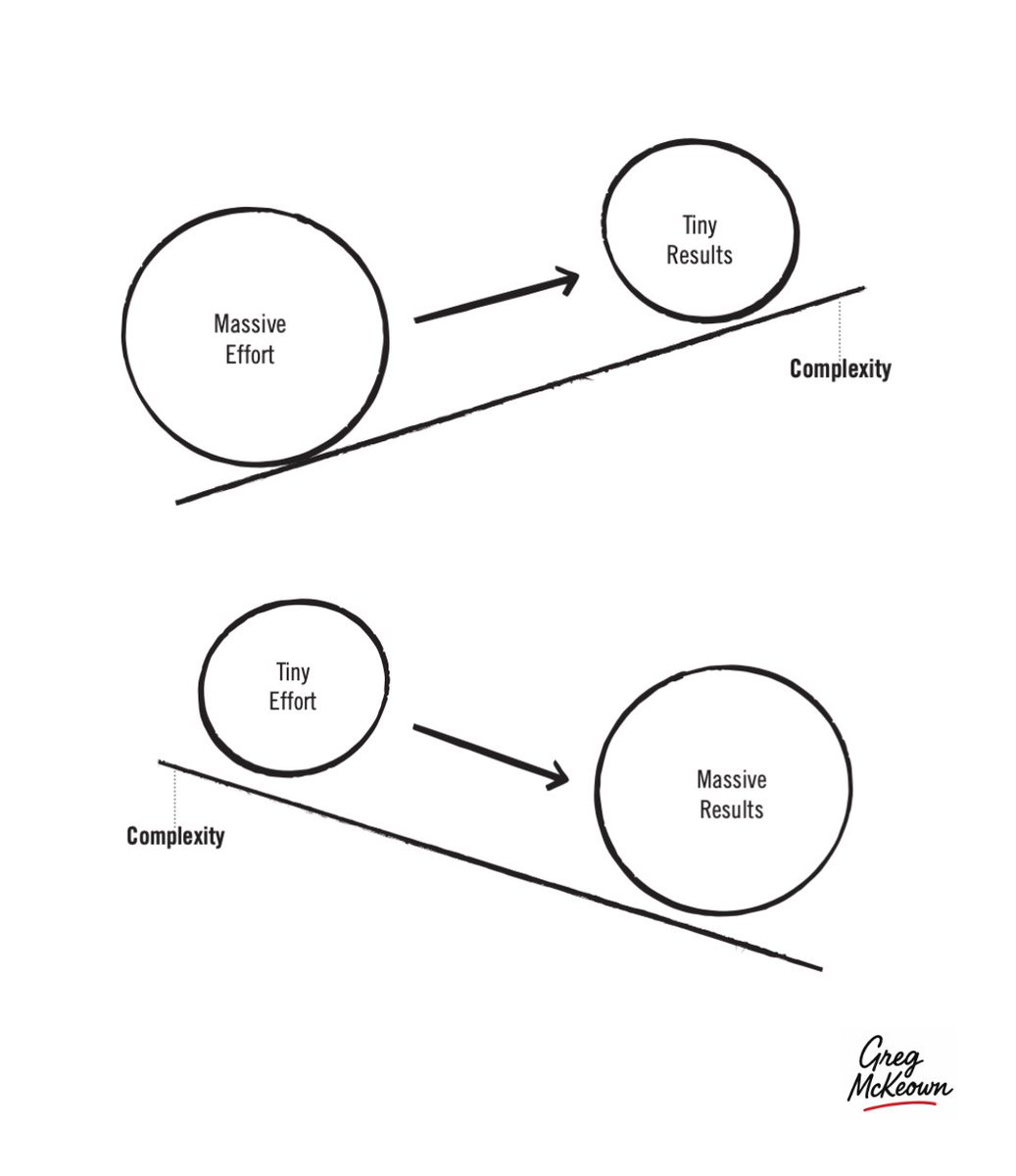
"If you can think about how hard it is to push a business uphill, particularly when you're just getting started, one answer is to say: 'Why don't you just start a different business you can push downhill?'"- @SethGodinBlog @ReidHoffman, cofounder of LinkedIn, said it differently but meant the same thing: "Part of the business strategy is to solve the simplest, easiest, and most valuable problem. And actually, part of doing strategy is to solve the easiest problem." We think that to be extraordinarily successful we have to do the things that are hard and complicated. But what if that's wrong? @ariannahuff used to buy into the notion that anything worth doing required superhuman effort. She has since said she didn't become truly successful until she stopped overworking herself. " It's also our collective delusion that overwork and burnout are the price we must pay in order to succeed." Warren Buffett has described his investment strategy as "lethargy bordering on sloth." He's not looking for companies that require enormous effort to achieve profitability. In his words: "I don't look to jump over 7-foot bars: I look around for 1-foot bars that I can step over." Of course there are hard paths to success. But those stories have created a false impression that pushing uphill is the only path. When a strategy feels like pushing a boulder up a hill — pause. Invert the problem. Ask: "What's the simplest way to achieve this result?" When we remove the complexity, even the slightest effort can move what matters forward.

@mrgadgetstudio ·
9 Hard Lessons From 4 Months of Building a Solo SaaS 💵 ------ (source: dev . to) After four months building a SaaS alone, the author learned that success depends on far more than writing great code. 1. Ship MVPs early instead of chasing perfection, because user feedback matters more than clean architecture. 2. Marketing is just as important as development, 3. Burnout is a real risk without boundaries. Staying organized, documenting everything, and choosing a tech stack you enjoy helps maintain momentum. Pricing is driven by perceived value, not formulas, while having financial runway provides freedom to make better decisions. Above all, progress comes from consistently shipping, talking to users, and improving, not waiting for perfection.
@GJarrosson ·
Stop trying to be Corgi. Everyone points to them as the model to copy. Here's what they don't mention: the team works 7 days a week. Most founders think extreme hours are the price of a great outcome. But burnout kills more startups than slow growth ever will. Admire the results. Don't copy the method.

@OptiMindInsight ·
There's a founder archetype I see constantly on X. Trains before 6am. Works until midnight. Proud of how little they sleep. Heading for a burnout I've watched professional athletes with the same identity. "I don't need recovery. I'm built different." They're always the ones who get injured. The founders version of this is burnout. Or the slow decline in decision quality they don't notice until a bad quarter.

@agazdecki ·
Anna Schramm recently got successfully acquired on @acquiredotcom. She built a brand with great reviews and customers that genuinely loved her products. From the outside the business looked like it was crushing it but running it was a different story. The bigger the company got, the more time it demanded. PPC, rankings, reviews, inventory, account monitoring… Amazon never really lets you relax. She compared it to adopting a tiger - fun when it’s small and slightly terrifying later on. So she sold the business on @acquiredotcom. One thing that she did really well during the process was making the company easy for someone else to understand step into it. She had clear docs, organized operations, and put together a simple handoff. Buyers notice that stuff immediately because most founders keep the entire business stored in their head. A good reminder that sometimes selling a company isn’t about burnout or failure. Sometimes you just want your life back or you’re ready to build something new. That's a huge win too. Check out the full podcast interview here: https://t.co/7An0ERZ1lM

@GJarrosson ·
Everyone points to Corgi as the founder playbook to copy. The hustle, the grind, seven days a week without stopping. It looks impressive from the outside, like pure dedication. But most people can't sustain that pace without burning out completely. Working nonstop doesn't automatically mean working smart. Rest isn't laziness, it's what keeps decision-making sharp. Admire the results. Don't copy the burnout that got them there.

@itsdangoldfield ·
Peer-reviewed occupational health research confirms: 72% of entrepreneurs experience mental health challenges compared to 48% in the baseline population. If you run a business and you’re struggling with stress, overthinking or burnout, I’d love to talk to you for some research of my own. I’ve interviewed 35 entrepreneurs so far. They’ve all found the reflection useful and I’ll be happy to share my anonymized report with you. Comment or DM and we’ll link up.

@CODEwalkerr ·
Founder burnout stats are pretty wild when you take into account that 34-54% of entrepreneurs experience it yearly, and it can lead to 37% revenue drops. Once you close those loops through documentation and owned processes, clarity comes back and the business becomes more predictable.

@thewayofkaizen ·
I left God at 13. Found him again at 40. In between I made a lot of money and felt nothing. Grew up in a Christian household. Church every Sunday. Rules for everything. And by the time I was a teenager I looked around and thought none of this is real. These people are performing. So I walked out. Spent the next twenty-seven years building. Companies. Revenue. The whole résumé. Got the Cisco salary. Got the startup that went viral. Got every external marker that's supposed to mean you've made it. And I was empty. Not broke. Not failing. Empty. The kind of empty where you hit the number you circled three years ago and feel absolutely nothing. Where your body shows up to the office but your soul checked out somewhere around year three and you've been running on caffeine and momentum ever since. At 40 something cracked open. Started studying Gnosticism. Sufism. Started sitting in silence instead of filling every minute with strategy. And for the first time since I was a kid I felt something move inside me that wasn't ambition. It was my actual self. Waking up. That's the part nobody in the founder world wants to talk about. You can optimize your funnel and fix your operations and read every leadership book ever written. None of it matters if the human being underneath the pitch deck left the building years ago. Every founder I work with now, I ask the same question. When did you stop feeling anything while you were doing this? The silence after that question tells me everything. Stories first. Then systems. Then the soul wakes up. That's the order. Skip to systems and you're installing a new engine in a car that's pointed at a wall. I didn't find God again in a church. I found him in the silence after I stopped running. And the company I'm building now comes from that place. If you've hit the number and felt nothing. If the dashboard is green but something inside you went dark a long time ago. That's not burnout. That's your soul telling you the story you've been living isn't yours. It never was.
@martinsoorjoo ·
AI isn’t burning your people out. Managing it is. BCG found heavy AI users report “AI brain fry” — cognitive overload from supervising too many tools at once. Errors jump ~40%. Decision fatigue spikes. Top performers start thinking about quitting. AI can remove work. But unmanaged AI multiplies mental load. Leadership question: Are you increasing output — or increasing cognitive strain? This distinction matters more than most CEOs realise. Link to HBR article in first reply below #Leadership #Founder #CEO #AI #Burnout
@martinsoorjoo ·
The dangerous phase of burnout is not collapse. It is competence. You are still delivering. Still making decisions. Still hitting the number. From the outside, you look solid. Inside, the signal is different: shorter fuse, worse sleep, less clarity, more drag. That is shadow #burnout. #Founder #Leadership
Best Tweets by Topic