Client acquisition through visibility and trust
Using public work, case studies, content, referrals, communities, websites, and thoughtful outreach to generate inbound leads instead of competing on marketplaces.
30%
Best tweets about Freelancing
A curated collection of the sharpest, most-shared X posts about freelancing—saved so you do not have to dig through the timeline yourself. Updated weekly.
Rates, clients, and the freedom-versus-stability tradeoff freelancers talk about honestly.
Original Xholic analysis
Across this 50-post set, freelancers commonly advocate building trust through visible work, referrals, specialization, and outcome-oriented positioning. Posts also describe the tradeoffs behind autonomy: income variability, client-management risk, and administrative work. Several posts frame AI as reducing the value of routine execution while increasing the value of strategic judgment and review. [2028296304233697362, 2049149177607688672, 2044701200717885627, 2086017754801332648]
62% of posts
All-time engagement
28% of posts
Published in 90 days
Conversation map
Using public work, case studies, content, referrals, communities, websites, and thoughtful outreach to generate inbound leads instead of competing on marketplaces.
30%
The autonomy of choosing time and work terms alongside income swings, burnout, isolation, administrative load, dry periods, and the need for financial buffers.
28%
Moving beyond hourly or low-ticket pricing by specializing, proving outcomes, raising rates deliberately, and pricing against client value rather than effort.
28%
Positioning as a strategist or consultant who owns decisions and business results, rather than a replaceable freelancer selling tasks, deliverables, or hours.
22%
Stories and practical paths for moving from employment to independent work, building experience and credibility, landing early clients, and navigating career uncertainty.
22%
Tradeoffs between remaining a high-margin solo operator, productizing expertise, hiring teams, operating agencies, and transitioning toward products or in-house work.
20%
Managing expectations, scope creep, revisions, deposits, late payment, client red flags, communication, and protections against unpaid work.
18%
AI reducing demand for routine execution while increasing the importance of strategic judgment, domain specialization, brand direction, and outcome ownership.
10%
Tone and stance
Performance benchmark
Posts with media make up 24% of this collection. Their median all-time score is 10.1, compared with 8.60 for text-only posts.
Format mix
Consensus and debate
Shared view
Posts describe public work, case studies, referrals, and thoughtful client engagement as alternatives to generic marketplace competition and templated pitches. These are recurring themes in the dataset, though individual experiences with platforms and outreach differ.
Shared view
Several posts recommend specializing, documenting results, and pricing around client value rather than only hours or low-ticket volume. Individual examples contrast many smaller accounts with fewer higher-priced engagements.
Shared view
Posts portray freelancing autonomy as meaningful but paired with scope creep, unpaid-work risk, administrative demands, client communication, and uneven revenue. They recommend protections such as deposits, boundaries, and financial buffers.
Open debate
One account emphasizes control over time and weekends, while other accounts describe isolation, long workweeks, and the burden of covering many business functions. The evidence presents a tradeoff rather than a single outcome.
Open debate
Some posts favor a lean solo or small-client model for direct client relationships and lower overhead. Another recounts growing to a 14-person company after securing an anchor client, while a separate creator describes moving from services to product-building for personal reasons.
Open debate
One post reports replacing some purchased design, coding, marketing, legal, and accounting work with AI tools. Other posts argue that strategic direction, brand judgment, implementation support, and expert review remain valuable.
What performs
Story posts had a median all-time score of 13.41, above the overall median of 9.21 and above every other listed format median. The rejection-to-agency story was an outlier with a 151.95 all-time score.
The AI-and-outsourcing announcement recorded the highest all-time score in the outlier list, at 183.81, or 19.96 times the dataset median. The post uses specific examples of services the author says their organization now handles with AI tools.
Several posts make their advice specific through pricing ladders, client-mix comparisons, deposit terms, or cash-allocation rules. These examples provide operating approaches rather than general encouragement.
Statistical standouts
Creator landscape
The five most represented creators account for 20% of the selected posts.
1. Ayo👋
@akwaabaaa
2 posts
2. Alex Freberg
@Alex_TheAnalyst
2 posts
3. kartikey singh
@askwhykartik
2 posts
4. Harshil Tomar
@Hartdrawss
2 posts
5. Kevin Szabo
@KevinSzabo14
2 posts
6. OKY
@OKYtech
2 posts
Among the listed repeat creators, posts cover visible-work acquisition, pricing and positioning, and client-management lessons. This reflects the dataset’s prominent themes rather than a single shared freelancer model.
Several creators frame their recommendations through their own client outcomes, rate changes, or freelance transitions. These are individual accounts, not dataset-wide proof that the same tactics will produce identical results.
Since the previous snapshot
Themes, sentiment, stance, and post format are classified per tweet. All counts, shares, medians, creator concentration, freshness, and performance comparisons are then calculated directly from the published snapshot.
Xholic's all-time score compares engagement while accounting for reach, post age, and creator consistency. It is used for relative comparisons within this collection.
This report analyzes the exact 50-post snapshot shown below. AI identifies editorial categories and drafts explanations; all statistics are calculated from the snapshot, and every narrative claim is checked against cited posts before publication.
Best Freelancing tweets
Ranked 01–50

@johnrush ·
Golden age of selling hours as freelancer/outsourcing agency is over See it in my org too: - I dont buy design anymore; AI produces good design out of the box - 99% of legal, accounting & fin questions now go to AI; used to pay experts $250/hr - I outsourced most of the coding, now most of it is done by Codex and CC on Max - I paid marketing agencies, now a combo of @seobotai / @listingbott / @indexrusher / @tinyadz_ is my marketing department Ofc some work still requires a human expert, e.g. once I get all my accounting and reporting done by AI i hire a pro human to review it, this year I paid just $1k for such review, while in the past I’ve paid $15k for entire job to be done.


@askwhykartik ·
Got rejected by every company I applied to. Microsoft said no. Amazon said no. Everyone said no. No big college name. No connections. No backup plan. Just a kid from a small town watching his friends land offers while he sat there with nothing. Felt like my story was already written - and I wasn't the main character. Then one random night, I found a guy on Instagram. Regular dude. Freelancer. Making good money. We talked. Something clicked. Started posting daily. Zero traction. Zero likes. Zero DMs. But I kept going. Week 6: "Can you help me build this?" $100. My first project. From there? More projects → higher rates → hired a team. Today: 5-person agency. $8-$10k/month. And 100,000 of you watching this journey. 🙏 Couldn't have written this without every like, share, and DM. If I can do it with zero pedigree and zero connections, you can too.
@askwhykartik ·
Your first $200K as a freelancer? It's not on Upwork or Fiverr. Job boards mean a race to the bottom. Clients there want cheap labor. The real money is where buyers look for experts: → Twitter (build in public) → LinkedIn (case studies + proof) → Your own website (portfolio that sells) → Communities (Reddit, Discord, niche forums) Stop applying. Start positioning.

@darylginn ·
I feel like it’s important for me to say that my choice to go from freelance to a company is a personal one. It was never a case of AI drying up leads or fear that AI will take over design. I thought a pivot into branding from product would heal me with my new studio System as it was something fresh, but after wrapping up a client I realised I’d simply grown tired of services in general. I’ve come to the conclusion that I’m happiest building products with a long-term vision. Whether it’s Visitors or Recent, I’m never thinking about how quickly I can wrap up the project. I’m always thinking about how I can make it better. That process never really ends, and the same applies when you put all your energy into one company. So if you’re freelancing and genuinely enjoying it, don’t take my decision as a signal that you should do the same. This is simply the right next step for me.

@ishverduzco ·
before joining Notion, i was gonna launch a social media agency had the landing page, domain, and was already consulting with a few brands with strong pipeline to grow before commiting, I talked with a few friends who were doing it and ultimately decided not to go down that route it is a fantastic way to make a ton of cash, espeically if you specialize and have an established brand but it didnt seem very fun... - constantly context switching between clients/niches - to scale, you end up managing ppl who do the work (vs doing it yourself) - can't talk about the work you do bc NDA - treated like a replaceable commodity - AI risk - some don't see the value - churn even if you get results I think for those who are like me (and enjoy the work) then there's two options... 1) go in-house for a brand/niche you love 2) do a solo agency or keep it very small so that you just have a few clients and own the relationships, work, & results Of my friends who seem to be enjoying the agency life, they usually have just 2-5 clients who pay them to do very specific work (like run their X account, do community management, own their founder's LI account, create memes for their brand account, etc) And these people usually have very lean teams (if any at all). Usually running solo or have support from a few contractors, but they are still heavily invovled with the work itself. Funny enough, these are the people making the most -- clearing $300-$400k+/yr profit running a lean (or solo) agency vs the bigger agencies with much more overhead and the founder is taking home about half of this. Companies end up paying for you, your reputation, and the peace of mind knowing the work will get done.

@Hartdrawss ·
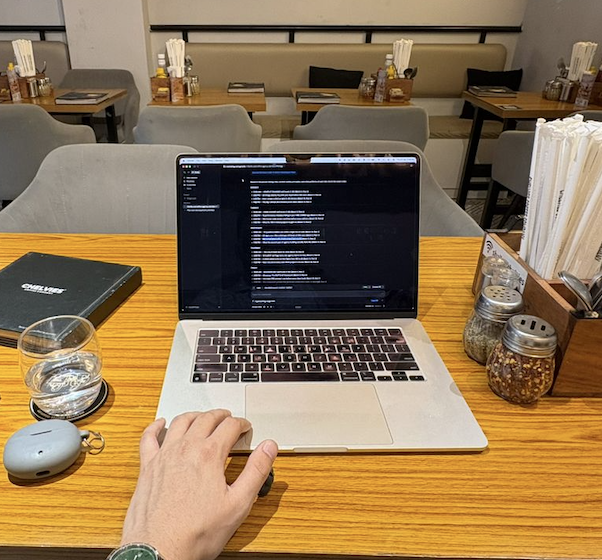
Dreamlaunch recently hit $100k milestone A few months ago, DreamLaunch didn't exist. In this time, a lot has changes Today we've crossed $100K revenue, 50+ MVPs shipped, clients across India, US, Dubai, Saudi Arabia. Here's exactly how we did it, so you can do it too. The core principle that changed everything : We made the work good enough that clients became our distribution. No ads. No cold outreach. No marketplace. Just work that was worth talking about. Here's the breakdown : 1. Pricing (the ladder) Simple rule : after 3 clients said yes without flinching, raise the price. - $500 x 3 clients - $1,000 x 3 clients - $2,000 x 3 clients - $3,500 x 3 clients - $5,000 x 3 clients Every time 3 people said yes, we knew we were still underpriced. Not 10x overnight. One step at a time. 2. Acquisition (what worked) Organic content. Always. Only. - No paid ads - No cold email sequences - No growth hacks Our first $5K client came from a referral. Saudi-based founder. We built their MVP. They were happy. They sent us the next one. That single referral paid more than 6 months of trying every freelancing platform combined. 3. The work itself One client wanted to automate their entire RFP document filing process. 10-15 hours of manual work every month. We built the pipeline. Eliminated the hours. They used that time to close a $40K contract in month one. That was the shift : You don't get paid for the work. You get paid for the value the work creates. Not your hours. Not your effort. The outcome. 4. What didn't work Freelancing platforms. Every single one. - Fiverr : couldn't figure it out - Upwork : same - Contra : closest, but payment friction with Indian clients broke it every time We wasted months trying to force these to work. In hindsight, high trust + high ticket work doesn't come from a listing. It comes from someone seeing your work and deciding they want exactly that. What actually worked : → Delivering so well that referrals came without asking → Raising price after every 3 yes's — not before, not after → Building in public so inbound replaced outbound → Saying no to scope creep early — protected quality, protected reputation → Organic content as the only acquisition channel we actually doubled down on What's not working yet : Outbound is still unstructured. Every client still comes from referral or inbound content. That's great until you have a slow month. Building a proper outbound system now. The path from $500 to $5,000 isn't glamorous. It's lowball clients you deliver for anyway. Watching them win with what you built. And knowing exactly what to charge the next one. Do the right things consistently : Good work. Real referrals. Honest pricing. It compounds. One day you're not the cheapest option in the room anymore. Goal now : $500K revenue by end of 2026. LFG. PS : What's the price you're charging right now that you already know is too low?


@OnatAksaray ·
I used to have 9 clients paying $500/mo on average. Now I have 1 client paying $4k/mo. Same revenue. 90% less work. Here's what changed: Month 1-6: No targeting - 9 coaching clients - $500 average price - 9 onboarding processes - 9 different problems daily - Total: $4,500/mo Sounds good, right? Wrong. The reality: - Working with people that are not serious - Beginner clients - Harder to get client results - Harder to retain the clients - They need results or they can't afford the next month I was confused. Then I met someone charging $10k/mo. Same service I was offering. I asked: "How?" He said: "Different clients, different positioning." Here's what I learned: Low-ticket clients ($300-800): - Question everything - Demand more for less - High maintenance - Low commitment High-ticket clients ($1.5k-5k): - Expect premium service - Trust your process - Value their time (and yours) - Easy to work with - Actually implement The work load is similar. The client profile is completely different. So I tested it: I changed my primary offer from consulting to done for you and increased the prices. Now bad leads filter themselves out. Good leads don't blink. Within 2 months: - Dropped 6 low-ticket clients - Signed 2 clients at $1.5-2.5k/mo - Then 1 at $4k/mo Revenue increased. Workload stayed the same. (or even dropped) Quality went up 10x. Here's the part nobody talks about: High-ticket clients force you to level up. Last month I onboarded a founder with $10M ARR. Normal 60min call. But I learned more in that hour than from 20 low-ticket clients. Why? Because high-level people ask better questions. They have better problems. They expect better solutions. You can't coast with a $10M founder. You have to be sharp. Most people stay stuck in low-price jail because: They think they're "not ready" for premium. Meanwhile someone less skilled is charging 5x more. The difference? Confidence. You can't fake confidence long-term. But you can build it with proof. My confidence evolution: At $350/mo: "Is this too much?" At $750/mo: "Maybe they'll say yes?" At $2k/mo: "This is fair for what I deliver." At $4k/mo: "This is a bargain for the results." What changed? Results stacked. Now when I say the price, I mean it. Here's your move: Stop collecting low-ticket clients. Start positioning for premium. One $5k client > Ten $500 clients. Less stress. More money. Better work. Higher leverage beats higher volume.
@Hartdrawss ·
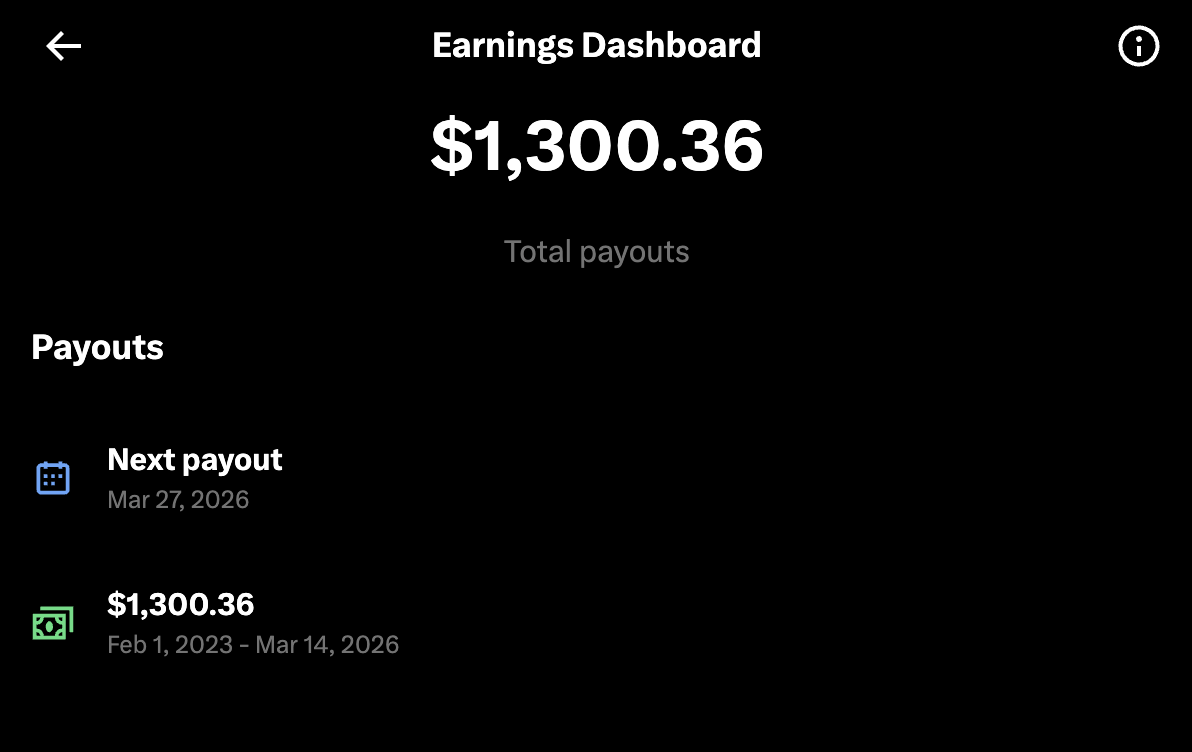
X just paid me $1300 for the first time ! > Not something from agency but for writing things i actually believe in. > When i started posting like 1 year ago i had no idea this was coming. I was simply just trying to document what i was building; I was a college kid who got inspired to post in from 100xdevs > The number isn't massive. I have seen folks make like $10,000/mo just from X. But the fact that it almost coming close to my previous salary > I had got fired when they found out about my side work; started freelancing with no safety net and now a platform is sending me a direct deposit for my words > This is the part of the internet nobody talks about enough you can build leverage with just a keyboard and sharing knowledge Internet is f*cking great man !

@spoilerbull ·
Last year, I got fired for the first time in my career. In the exit interview, HR was emotional and my boss was almost in tears. I told them I was genuinely happy to leave. No more weekend calls. No more constant pressure. Within 15 days, they asked me to come back. I said no. Instead, they hired me as a freelancer at 3x my salary for the same work for few months. Now I choose my time. Weekends are mine. Work is on my terms. My Web2 clients got more of me. Web3 gave me a whole new family. Not chasing millions anymore. Just chasing peace.

@akwaabaaa ·
I got into full-time freelancing in October 2025 with more questions than answers. Up until then, every opportunity I had came through referrals. I’d never gone out to find clients on my own. And this shift came shortly after leaving my role as a UI/UX designer at an AI company, so yeah… it felt was more or less a gamble. Since then, I’ve kept things simple: I show my work. That alone has opened doors to collaborate with incredible founders across health tech, fintech, and AI products. And in just about 5 months, I’ve earned more working independently than I did across the entirety of 2024–2025 in my previous role. I am not trying to brag, but just to show you guys what worked for me. For some, it's Upwork, Contra and Cold emailing. I tried these and got nothing out of them. Freelancing can feel uncertain at first, but sometimes all it takes is putting your work out there consistently and letting it speak. It also helps to post "good work", at least that's what worked for me.

@Charles_SEO ·
Went from charging $50/hr for SEO consulting at 17 to recently increasing my price to $2,499 at 29... The difference wasn't just "getting better at SEO", that only gets you from $50 to maybe $150... What gets you to $1,000+: - Specialization (I stopped being a "generalist SEO" and became THE guy for grey/black hat, iGaming, link building and high ROI campaign building) - Proof that compounds (every case study and golden nugget I release makes the next client easier to sell) - Brand (15 years of content, controversy, and being proven publicly right about things other SEOs denied) - Referrals (I haven't cold pitched a client in years, every single one comes through word of mouth or sees my content and reaches out. When THEY come to YOU, the price conversation is already won) Most SEOs are competing on price because they haven't given clients a reason to compete for THEM, flip the dynamic, even if you aren't an SEO... Become the person clients pitch to, not the other way around.

@itsmarcosruiz ·
The ghostwriting industry is being commoditized and most people in it haven't noticed yet. 3 years ago, finding someone who could write a decent tweet for you was hard. Now every freelancer with a Claude subscription calls themselves a ghostwriter. The supply of "good enough" writing is basically infinite. The barrier to entry is gone. But the thing that didn't get commoditized is brand direction and monetization Which angles to run this month versus last month. When to push social proof hard and when to pull back. How to position one person's expertise so it doesn't sound like everyone else in the feed. That kind of judgment takes years of data and reps. After working with 100+ clients, you start seeing what actually converts versus what just gets engagement. That knowledge is the product now. We've shifted from "we write your posts" to "we run your brand as an acquisition channel." The writing is one part of it. The strategy, the DM systems, the content-to-call pipeline. That's the product. If you're hiring a ghostwriter and the only thing they deliver is writing, you're paying for the part that AI already does for free.
@Alex_TheAnalyst ·
I've been consulting in the data space for about 4 years now. Here are 5 things I've learned that I thought was really interesting: 1. 90% of clients actually do know what they want - just not how to execute it effectively 2. Managing Expectations is half the battle - delivering is the other half 3. Small customers are 5x the work of larger customers and pay half as much 4. Doing good work and getting repeat customers is hard, but the best way to sustain long term growth 5. Project creep happens with almost every project, addressing it and not giving into it should be the norm

@AlfinCodes ·
A freelancer I know lost ₹3.5 lakhs because of one mistake. Here’s what happened. Self-taught developer Quit his full-time job Started freelancing online Got a big international client Project value: $4,000 For him, it was huge. Almost 3 months of income. The client looked professional. Daily meetings. Clear requirements. Good communication. So he trusted him. Worked for 6 weeks straight. Late nights. Multiple revisions. Extra features added. Finally the project was finished. He delivered the full source code. Then something strange happened. The client stopped replying. Messages unread. Calls unanswered. A week later the client’s account disappeared. Payment never came. Six weeks of work. Zero money. That’s when he learned the hardest freelancing lesson: Never deliver the full project before payment. Freedom in freelancing is amazing. But protection is your responsibility. Have you ever been scammed by a client?

@MediaKing ·
Okay I actually dig @intro for consulting. I have two clients that pay me $4K/month. For that they get a call a month, can email me, and chat. People can also do one-off 30-min calls if they want to. Meetings automatically appear on my calendar, and if I don't want to take them, I just cancel the call before it happens.

@brodieseo ·
5 steps to leaving your agency or in-house role and becoming an independent SEO consultant: 1. Experience Ensure you have at least 4 years (longer ideally) of hands-on experience working under someone else before taking the leap. Any earlier than this is too fresh to be managing everything yourself at the level that being self-employed requires. 2. Increase Profile While working for someone else, you should be building up your own profile through thought leadership within the industry. Practice what you preach by putting out high-quality industry research on your own site that attracts links and ranks on Google. Be consistent. 3. Freelance + Full-Time If your full-time gig allows for it, you need to gain experience outside of your day job. This is the hardest aspect to manage, but it will force you to get better at sales, develop business processes, and deliver results for clients all on your own. Do this for a year before leaving your role to make sure you're up to the challenge - consider this a "trial run". 4. Transitional Approach If possible, don't leave your agency or in-house role completely. I can only speak from an agency perspective, but a lot of them will likely want to keep you involved in some capacity, rather than having you leave completely. Your goal should be to convince them to hire you as a contractor, only working on their biggest client. Don't move to part-time employment; you'll want to start getting paid directly to your business, not as an employee. Your LinkedIn should look like you're self-employed - negotiate with them that you won't show that you work for them anymore. Do this for 4-6 months. 5. Specialise + Improve While my approach to consulting has been a bit more unconventional (I work with large eCommerce/Marketplace/Publisher sites mostly), I would suggest narrowing in on a specific niche quickly – either SaaS or eComm are the most sustainable areas to consult within as an individual. Get logos and testimonials up on your site ASAP to help with positioning and build credibility - your goal should be to reflect on your logo/testimonial list every year and see continual improvement. There is a lot of demand for highly skilled consultants in the SEO industry right now. Give prospects the confidence to enquire with you through the consistency of your thought leadership and the reliability of your services. Constantly work on improving your communication and sales skills. Expect there to be challenging and quiet periods along the way - it is not all smooth sailing.

@sandislonjsak ·
I don’t have a fancy story about how I started my agency. The real truth is that I started coding when I was 11 and always knew I’d do this software thingy. Started working on 2nd year of college and barely finished it because I was super uninterested after learning more in 2 months at work than 2 years on college. In the career, I wanted to try out 3 directions: working for corporation, working for a startup and freelance. Those were done in that order, from easier to harder and I was under the impression I am going to pick one and be done with it. The truth is, I never liked any of them. Freelancing was the best, but social life is zero, especially when you try to do multiple projects in parallel like I did. 12 hours of coding for 6 days 2 years in a row without any real vacation was too much for me. Not the work, but I didn’t have the energy to socialise and that was the worst part. Somehow, at the time of me being on a 2nd year of freelance, a big war started and “a company” had to let go one whole team, enormously big one, since they were residing in aggressor’s country. That “company” tried to recruit me as a team lead, which I gladly accepted, but there was one hard requirement from my side: I hire my own team in my company and we provide whole service as an external company. They were kind of in a situation of having their backs against the wall, I smelled it like a giga chad I am and they said okay sure. This is the first and last time I strong armed someone, but I have no regrets. It was never going to last and they told me that 2 years is maximum. For me that was fine since I had plenty of time to get new clients and scale the company which is exactly what I started doing immediately. I had a luck of having good money saved to front run the whole operation and invest in it. Also, had multiple connections and potential buyers from previous companies I worked for/with and a bit of luck in doing outreach. I just started preaching about what I do to people IRL, they liked the story and I had an amazing close rate when I think about it in the retrospect now. After the first client’s contract got fulfilled in 2 years, I already had around 7 employees and multiple clients. From there on it was just “pumping it out” and now we’re 14 people with around 25 clients and projects. We’d have even more employees if it wasn’t for the agentic coding, so I don’t even bother with that number anymore. It’s a pure vanity metric. MRR is also a pure vanity metric. The only real metric is profit and customer and employee satisfaction. I don’t think I am special, super smart or mega intelligent. I think I just can take more of problems, push through them, never give up and have delusional level of self confidence. As you can see, I capitalized on motion and opportunity life presented me. There was some luck involved, sure… but there was also massive preparation and hard work. I would like to say I had a massive lightbulb moment or something similar but I did not. This is my story and I love it anyways.

@KevinSzabo14 ·
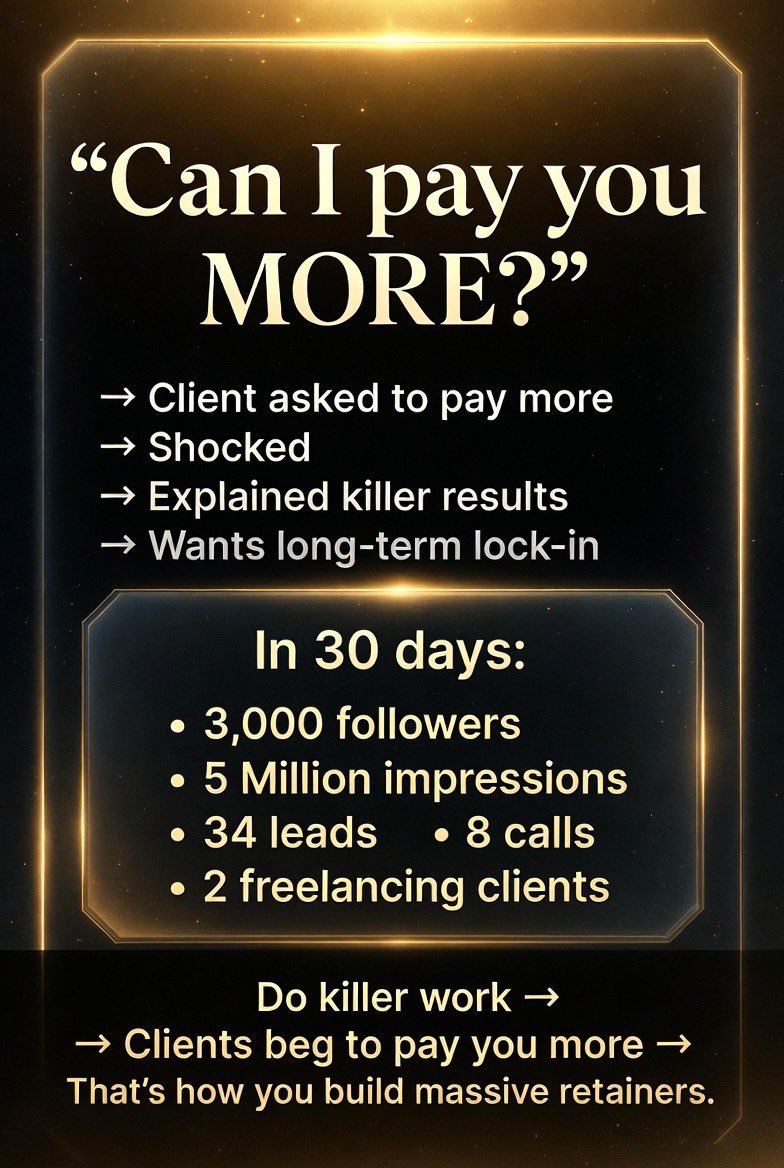
Client just asked: “Can I pay you MORE?” Shocked me. Thought he had extra work. So I asked why. His reply: “Your leads are crushing it way higher returns than I expected.” He wants to lock me in long-term. What did he get? In 30 days: 3,000 followers 5 Million impressions 34 leads 8 of them being calls 2 of them freelancing Not bragging. Just proof: Do killer work → Clients beg to pay you more. That’s how you build massive retainers.

@MahimaJalan2 ·
Saw a freelancer posting about a bad experience working with an Indian client. Sometimes it’s not just freelancers, even companies get played. Last week we onboarded a client. We usually start the work without waiting for the payment to arrive, having full trust in our clients. For the next week, we placed one of our key resources on the project. We did the primary research, built the strategy, planned the content, and finalized the calendar. Then suddenly the client came back and said this would take too much time on their side and they didn’t want to continue. No notice period, nothing. They wanted to end it the same day. We lost a good amount of time, energy, and resources and got paid nothing. In fact, it wasn’t just zero revenue, we actually lost money that had already gone into the work. Experiences like this also affect the team. Next time they will think twice before doing something as a goodwill gesture for a client. Sometimes even goodwill backfires.

@aymanalabdul ·
Best business model at every stage: 0-6 figures: Solo freelancer 6-7 figures: Productized consultant 7-8 figures: Agency 8-9 figures: B2B SaaS Everyone wants to skip to agency at 6 figures. Wrong move At 6-7 figures, deliver one specific thing really well. No team or overhead I know a HubSpot specialist who only builds dashboards. Booked out for 9 months. Just him Hiring is a sign of failure. Delay it as long as possible

@Aje_Dynamicz ·
Freelancer red flags that should have you running. But you never run. 😂 "We don't have a budget but the exposure is great" Sir I cannot eat exposure. "It's a quick and simple task" It is never quick. It is never simple. "The last freelancer did it cheaper" Then where is that freelancer now? Exactly... "We'll pay you after launch" The launch that has been "almost ready" since January. "Can we jump on a quick call?" 47 minutes later you are still on the call. Nothing has been decided. There is a follow up call scheduled. "We just need small changes" 14 revision rounds later. ..you still dey there "We love your work! Can you do this one for free? It will open big doors for you" Every big door this line has ever opened leads to another unpaid job. You see all the signs. You take the job anyway. Every time. Freelancing is a calling. A confusing, underpaid, deeply fulfilling calling. 😅 Which one has happened to you? Be honest 👇
@KevinSzabo14 ·
Client once asked: “Can I pay you MORE?” Surprised me. Thought he had extra work. So I asked why. His reply: “Your leads are crushing it way higher returns than I expected.” He wants to lock me in long-term. He mentioned an article I’ve written in which I mentioned I’ll be working with less clients to focus on building. What did he get? In 30 days: 3,000 followers 5 Million impressions 34 leads 8 of them being calls 2 of them freelancing Not bragging. Just proof: Do killer work → Clients beg to pay you more. That’s how you build massive retainers.
@Alex_TheAnalyst ·
Freelancing and Consulting in Data is still very much alive. With my personal consulting business, I've seen an uptick in the past 2 years. More companies are trying to use AI to accomplish things, can't figure it out fully, but have an idea of what it should look like. They don't want to hire on a full data team yet, so they bring in consultants or freelancers depending on the work.

@mandydesignsng ·
We talk about how to make money and get clients as freelancers but rarely talk about how to manage them; let me fill that gap by giving you my practical steps.. Stay with me… Most young entrepreneurs are not broke because they earn little. They are broke because every payment lands in one account and gets spent like it is all theirs. It is not. 🔺The money that enters your account is not your salary. It is your business revenue. Big difference. Here is the practical split. Every time a client pays you, break it before you spend a naira: 1. Tax, Charges or Tithe: 10%. Set it aside immediately. This is not your money and it was never your money. - For me as a Christian this is tithe 2. Business reinvestment: 20%. Tools, Gadgets, software, ads, learning, better equipment. This is what makes the next payment bigger. 3. Savings and emergency buffer: 20%. This covers the dry times so you never take a bad client out of desperation. 4. Your actual pay: 50%. This is what you live on. Only this. Rent, food, life, charity etc. The other half is doing quiet work in the background. Depending on how complex you earn, Then two rules that hold it together: Pay yourself a fixed monthly salary from that 50%, even in fat months. When 300k comes in, you don’t suddenly live like a 300k month. You pay yourself the same steady figure and let the surplus build. Keep business money and personal money in separate accounts. The day you can see your business as its own thing, you start treating it like a real one. For me I have like 4 separate accounts per task and money source. 🔺A freelancer who manages 1Million well will always beat one who earns multiple and spends blindly. And it starts before the money even lands: manage the client well, communicate clearly, deliver, set boundaries cause a well-managed client pays fully, pays again, and refers you. The clients and the income mean nothing if the money leaks the moment it lands. Earning is skill. Keeping is discipline. [Sha read twice] Okay okay…. your welcome


@TheRobertAvram ·
The bar for getting hired as a freelancer in 2026 is on the floor. And almost nobody is stepping over it. I know because I was on the other side last week, hiring. Posted a job looking for a 3D designer, for my personal Formula 1 project. Super detailed brief, clear context, references but no idea how to get to the end result. 16 people applied in the first hours. 15 sent some version of: "Hi, I have experience in this. I'd love to help. Here's my rate." No questions, no sign they read beyond the title, just a template with a number at the bottom. I get it. Freelancing is a numbers game. Send enough proposals, something sticks. But that approach makes you invisible in 2026. Because from the hiring side all 15 looked exactly the same. Then one person did something radical. He asked three questions. That's it. Three specific questions that told me he'd actually read and thought about what I was building. Then, before talking about himself, before mentioning his rate, he started contributing. A suggestion I hadn't considered. A practical concern that showed real experience. A recommendation that would save me time down the road. He wasn't pitching me. He was thinking WITH me. I hired him that same day. The other 15 never had a chance. Might have been perfectly capable. I'll never know because they gave me nothing to trust. Then it hit me. This is exactly why founders choose to work with me too. When I get on a first call with a founder, I'm not presenting my portfolio or walking through a pitch deck. I'm learning. About the product and the mind behind it. I'm asking hard questions, challenging assumptions, poking holes in the idea while contributing to where it could go. Not because I'm trying to impress anyone. Because that's how you actually help someone build something that works. I've done this on 150+ calls and the pattern is always the same. The founders who hire me don't hire me because of my case studies. They hire me because 15 minutes into the first conversation, they feel like I already care about their product as much as they do. Stop pitching. Start thinking with people. That's how you get hired.

@akwaabaaa ·
A few weeks back, a friend and I took the first step to start our design agency, and we’ve been trying to onboard our first couple of clients. So we decided to try cold emailing. And here’s what I’ve learned so far from cold outreach, I hope this helps other freelancers or designers trying to reach out to clients through emails or DMs. 1. Cold emailing is hard. Like, really hard. Especially when you are trying to send emails consistently, handle client work, and still show up online at the same time became overwhelming. It got to a point where we had to hire someone just to handle outreach for us. 2. It's a numbers game The more emails you send, the higher your chances of getting a response. That’s literally how it works. Consistency is everything here, and it’s not something we could realistically keep up with on our own. 3. From my experience, cold DMs seem to work better. Even a couple of years ago when I tried it, I got more responses and actual feedback compared to what we’re seeing now with emails. I don’t fully understand the logic yet, but it’s something I’ve noticed. We’re still figuring things out, but if you’re trying to reach out to clients this way… just know it’s not as easy as it looks.

@mxochai ·
Dear freelancer, As you go into this new week, slow down just enough to see what actually moves your work forward. Here are a few tips for the week: Client Experience 📝 Respond with clarity, not speed. A clear reply saves you three follow-ups later. 📝 Set expectations early. Timelines, revisions, deliverables. Say it before they ask. 📝 Don’t overpromise to impress. Delivering clean work builds more trust than hype. Money & Pricing 📝 Stop adjusting your price based on fear. Price based on the outcome you deliver. 📝 Break your work into phases when needed. It protects your time and cash flow. 📝 Late payments need structure, not emotions. Have a simple system and stick to it. Productivity & Systems 📝 Your best work comes from fewer tasks done well. Not ten things done halfway. 📝 Build a repeatable workflow for your common projects. It saves mental energy. 📝 Track where your time goes for two days. You’ll see what’s quietly draining you. Skill Growth & Work Quality 📝 Spend time refining what you already know. Depth pays more than scattered skills. 📝 Study your past work. Fix patterns, not just mistakes. 📝 Make one small improvement per project. Over time, that compounds fast. Mindset & Sustainability 📝 Some weeks are quiet. Use them to reset your systems, not panic. 📝 You don’t need to chase every opportunity. The right ones fit your direction. 📝 Protect your energy. Burnout shows up first in your work quality. This week is less about doing more and more about doing things cleaner. When your process is clear, your work feels lighter. And when your work feels lighter, you stay consistent without forcing it. Have a great week ahead!


@eyishazyer ·
Client: 'We'll pay after you deliver.' Freelancer: 'Why?' Client: 'To make sure the work is good.' Freelancer: 'I need deposit to make sure you're serious.' Client: 'We're a legitimate company.' Freelancer: 'Then you have cash flow for deposits.' Client: What if we don't like the work?' Freelancer: 'Contract has 2 revision rounds.' Client: 'What if we still don't like it?' Freelancer: 'Then you pay for what you asked for. Bad brief, not bad work.' Client: 'That seems harsh.' Freelancer: 'Before delivery, I have leverage. After delivery, you do. Deposit balances that.' Client: 'I guess that's fair.' Paid 50% deposit. No deposit = all leverage on client side. Deposits protect both parties.

@IAmAaronWill ·
Don't do more client work. Deliver better client work instead. • List every deliverable you send to clients • Have Claude score the deliverables • Have it rewrite the weakest sections • Build a quality checklist from the feedback • Make a report template explaining what you did & why • Generate a Loom script walking through results • Add a "next steps" section • Send the upgraded deliverable to your next client • Ask for feedback • Feed that feedback back into Claude • Update your template every month Most people lose clients because their work is invisible. You just made every deliverable impossible to ignore.

@AtSynct ·
Doing freelance work for clients is a huge advantage for us 'indie hackers'. Why? * The money meaningfully increases your runway * You get exposure to new and different ideas * You break out of the insular community and are reminded about non-technical people and their thoughts It's basically a great touchpoint for the wider reality out there, beyond just building-in-public and sharing your app on directories. This comment is totally unrelated to the fact that I'll be almost exclusively doing client work all week 😅

@anulagarwal ·
i track every hour I work against the $$ it returns i started doing this ~1 year ago and it's been one of the best indie decisions I've made. time is the only real currency we have - everything else we just convert it into, in some form or the other. some numbers from my own tracking: -last full-time job in Germany: ~$22/hr for 160 hrs/mo -now in India on active-work projects: easily 4-5x that rate but here's the wrong thought process most people fall into: making $5000/mo sounds great - but only until you realize you worked 200 hours for it. that's $25/hr. real richness imo comes from working less and earning more per hour. tracking my hours this way has made me feel way more confident and valuing my time more → and it's made me really easy to say no to work that doesn't clear my time value. (every indie dev / freelancer should be doing this imo)

@remoteoliver ·
being a solo freelancer looks like this: 10% actual work you're good at 15% trying to get noticed 5% admin that makes you want to quit 5% managing yourself (badly) 18% answering the same client questions over and over 12% selling to people who ghost you 10% fixing things that broke for no reason 8% figuring out what to build next 5% staring at invoices hoping they get paid and people wonder why freelancers burn out at £15k months you're not running a business, you're doing eight jobs at once and getting paid for one

@Extrastiv ·
I landed my first gig on Facebook without a portfolio in 2017. It was a ₦5000 ghostwriting gig. On this episode of Creators Diary, I decided to feature myself @Extrastiv I deserve a spot too. Extrastiv is a single & handsome graduate of University of Ilorin with a 2nd class upper. He is a content marketing specialist/ghostwriter for busy professionals. He pursued medicine and surgery for years before he finally settled for one of the most “useless” courses in Nigeria, according to how Nigerians see it 😂. I've been writing online since 2015. Back then I was a very popular writer on Nairaland. I was dropping write-ups every day - news, fiction, gists, stories. If you were active on Nairaland that year, you must have come across my stories because I was always hitting the front page. But I wasn’t making money from it. I was just writing for the love of it. My first official gig came in 2017 on Facebook. It was a 10,000-word ghostwriting project and they paid me ₦5000. Back then Facebook was one of the hottest places to land gigs. You didn’t need a fancy portfolio (many people don't even know the meaning of a PORTFOLIO). Just proof that you could actually write. And I had plenty from all my Nairaland posts. That gig was stressful & crazy, but I was grateful. It changed something in me. I started thinking, “If a stranger can pay me to write for them, then I can do this again. ”Even before that, the signs were there. Back in secondary school I used to write assignments and notes for my mates and they would pay me ₦50 or ₦100, or buy me something. That small thing gave me the quiet conviction that I was good at this. Over the years I've seen platforms come and go. I've tried so many things just to make money online. I did SMM, copywriting, even tried to become a data analyst when things were really rough. Omo, life was crazy mehn. I even picked up coding for a bit but stopped at JavaScript. The wins started coming when I stopped playing small. In 2023 I came back stronger. I started watching, listening & learning from the top creators in my space. I connected with them. I even paid for courses out of my pocket money, even when some of them were not worth it. I learned what I could and kept going. Between 2023 and late 2024 I sent over 3,000 cold pitches. Most of them were trash, over 90% didn’t get replies. But the few that landed paid my bills. That period taught me the power of volume and consistency. Everything started making sense. I transitioned fully into content marketing & ghostwriting. I've worked with brands I never imagined I would reach a few years ago. I've sold over 1,000 ebook copies. I helped one client hit $10k MRR. Even while I was still figuring things out myself, I coached over 200 freelancers and outsourced gigs to many of my peers. We rise by lifting others. I'm still trying to find my way from the trenches to the peak, but I am grateful I'm not begging on the streets. But let me tell you the other side too, because the wins didn’t come easy. In 2021 I lost my only client. I went into serious debt and hit rock bottom again. In 2022 I started posting on Twitter but deleted the account out of pure frustration because the gigs were not coming. I've had seasons where I tried everything & nothing worked. I've lost gigs because I neglected my email. I've had to refund clients money too. These things hurt when they happen. Early 2025 was the darkest. I fell into depression so deep I almost took my own life (This was more than just freelancing. I was going through a lot). Guys, I survived. And since then, the motion has been crazy in the best way. Your connections & willingness to keep showing up are what carry you through those periods. Don’t stop talking about what you do. You never know who is watching. Connect with people genuinely. Don’t let pride stop you from asking for help when you need it. The dry days will come, but your network will help you survive them.


@Mike_Scully_ ·
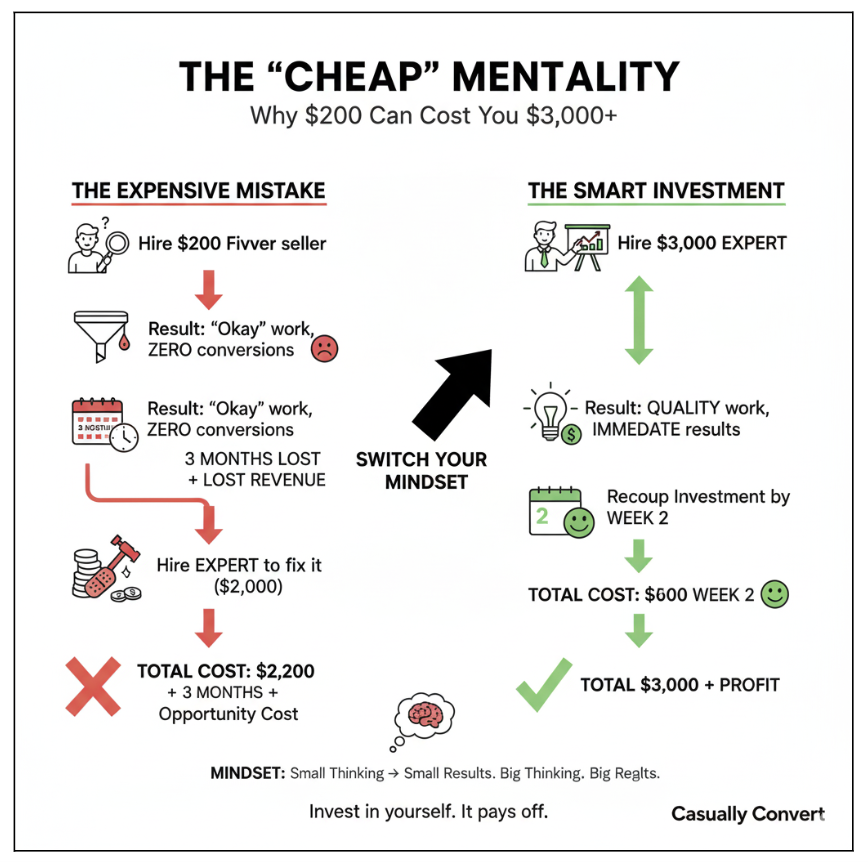
One common thing you’ll hear potential clients say when you’re seeking work is this: "I found someone on Fiverr who can do the same thing for $200. Why should I pay you $3,000?" I find this so interesting that I had to address this. You see, 99% of the time, cheap is more expensive than expensive. Devastatingly more expensive. How? Well, think of it like this: When you hire the $200 Fiverr person, they deliver $200 worth of the thing you hired them for… So they only deliver something that looks "okay" but doesn't convert… You spend 3 months getting zero results. You realize you need to hire someone else to fix it. Now you're out $200 + 3 months of lost revenue + another $2,000 to fix the mess. Total cost: $2,200 + 3 months of your life + opportunity cost. Meanwhile, the person who paid $3,000 upfront got something that worked from day one and made their money back in week 2. But here's the deeper issue… This isn't just about money. It's about mindset. When you make decisions based on what's cheapest, you're programming your brain to think small. And small thinking creates small results. I see this pattern everywhere: The person who buys a $47 course instead of investing in proper coaching wonders why they're stuck in the same place 6 months later. The freelancer who charges $25/hour instead of positioning themselves as a premium service provider stays broke while their "less skilled" competitor charges $200/hour. The business owner who hires the cheapest contractor ends up spending 3x more fixing their work. Here's what I learned from my student Luke: When Luke started, he could've positioned himself as another cheap automation guy competing on Upwork for $15/hour gigs. Instead, we positioned him as "The Zapier Guy" who helps agencies automate their operations and save 10+ hours per week. Result? Luke's now making over $30k/month and closing multiple $8,000-$10,000 deals every month. Same skills. Different positioning. Completely different life. This means your willingness to invest in yourself directly correlates to your income potential. People who think small, spend small, and get small results. People who think big, invest big, and get life-changing results. Even on things like crypto, you only get a big return when you invest big… Not when you invest $50. Because when you're willing to bet on yourself at a high level, you show up differently. You take it seriously… You implement faster… You don't make excuses… You get results. When you're always looking for the cheap option, you're subconsciously telling yourself you're not worth the investment. And if you don't believe you're worth investing in, why would anyone else?

@TheGeorgePu ·
I did consulting for 3 years. Stopped a few months ago. It's still the best way to make money with $0 capital down. But here's the mistake I made early on. I called myself a consultant. The moment you do, you get entitled clients, market pricing, and scope creep. You become a commodity before you've even started. The better play is to sell you. Your story. Your experience. What you've actually built. Educate. Never pitch. When people reach out, connect through DMs. You'll close fewer leads and make more money. The 'consulting gurus' won't tell you this after selling you a $1,995 course. Because they need you to think consulting is the product. You are their product.

@bentenwoodring ·
When I decided to start freelancing for the first time in 2013, I didn't have a computer that could run design software. So I decided to sell one of my old road bikes and bought a 2008 MacBook with a cracked screen from a friend for $400. I would teach myself design in the evenings after work, creating logos for a few hundred bucks and sketching while my newborn son slept. This month NOOON might clear $200k in revenue. We have a core team of four with a bench of incredible contractors. Over my career I've done work for Spotify, Salesforce, Chipotle and dozens of other enterprises. I've had my work featured by Fast Company and others. I'm not saying this to brag. I'm saying it because just a few years ago I could not have imagined any of this. You don't need the right equipment. You just need to start.

@sav_theo ·
Being always reactive to sales, client work and posting made me realise how inefficient I was. Trying to always be there to solve a problem, but all of these problems could go away if you spend a few extra hours by being pro active and build systems. Improve packaging, templates and automations. That is how you build leverage and stop just being a freelancer.

@SatireExecutive ·
Starting an agency is the WORST lie gurus ever told. It has kept more people broke than anything else. You spend years hiring, managing, and firing people just to keep margins at 30% if you are lucky. Working solo with the right client will match that with literally 1 retainer immediately. No payroll. No HR. No diluted relationships. And you keep every penny of the profit. The math on input to output isn't even close. Everyone wants to cope that you trade your time for money as a freelancer... But you trade MORE time for LESS money as an agency owner. The only thing you need to do is understand how to position yourself as an A-Player to land good clients. (I'm not talking about working off Upwork slave wages) And you'll start outperforming agencies immediately, with a far superior lifestyle and freedom. FURTHERMORE if you wish to have a successful agency at some point in the future, working solo first is literally the perfect bridge to achieving that. You work with 100% margins for a few years by yourself, stack cash from $30k/month, learn the ins and outs of the game... THEN if you wish you start an agency when you actually have serious capital and hundreds of thousands in the bank to make it work faster. I have met very few elite elite agency owners over the years, and all of them are ultra killers that have spent all day every day locked inside for the last 5 years solving problems with alien like focus) Analyse the game at hand carefully.

@kylepdotco ·
Why would a client want to pay for a website, when they can just make it themselves for free with tools like: - Wix - Wix Studio - WordPress - etc.? Here's my answer: Platforms like Shopify, Wix and others are great. They make creating sites easy and you can often get good support as well. Who would pay someone else to create websites when they could create it themselves and save the cash? Think of it like this: Why do people eat out when they could just eat at home? There are so many options from: - Fast-food - Fine-dining - Organic - Asian - Indian - etc. Then each subcategory has hundreds of restaurants to choose from as well... It’s like the guy who spends the whole day cutting the lawn so he can say he saved $100. Many people are like this, but you also get a lot of people who wouldn’t mind paying someone to cut their lawn for them. Why did I bring this up? You will ALWAYS get the business owners who want to use platforms like Wix, etc. to save money. Nothing is wrong with this... BUT you will ALWAYS get the business owners who don’t want to use these platforms and don’t mind paying the cash to someone who can do it for them. Look at Mc Donald’s. They don’t care if John goes to Burger King and Chick-fil-A every day, because they know that Jane and Fred always go to Mc Donald’s every day. Now back to the freelancing side: People want outcomes and people pay for outcomes. They don’t care what tool you’re using. If it solves the problem and helps them: a) save time and money b) make money You can charge accordingly… Now go enjoy that spicy chicken sandwich!

@cem_hasoglu ·
I watched a client sign with an agency charging £4,500 a month after telling me my £1,800 quote was too expensive. Found out 3 months later the agency was outsourcing the actual work to a freelancer in the Philippines for about £400 and pocketing the rest. The client was essentially paying a £4,100 markup for a nicer proposal deck and a monday morning status call.

@Dominus_Kelvin ·
The Freelancer, the Client, and the Price That Vanished Once upon a time in the land of Slack DMs and WhatsApp voice notes, there lived a freelancer named Tunde. Tunde was good. Very good. The kind of good where clients say “wow” before they even understand what they’re looking at. One day, a client came. “How much?” the client asked. Tunde stood tall. Chest out. “₦500,000.” Silence. The client squinted. “Hmm… that’s a bit high.” Tunde felt a small tremor in his chest. “Okay… ₦400,000.” The client leaned back. “Still a bit much.” Tunde adjusted his chair. “Alright… ₦300,000.” The client smiled slightly. Not impressed. Just… curious. “Let me think about it,” the client said. Panic entered the room like NEPA taking light. “Wait,” Tunde said quickly. “I can do ₦200,000.” Now the client sat forward. Not excited. Suspicious. “So… which one is the real price?” the client asked. Tunde froze. The room was quiet. The client continued: “If you could drop from ₦500k to ₦200k this easily… then either: the work isn’t worth ₦500k or you don’t believe it is” The deal died there. A week later, another freelancer; Ada met the same client. “How much?” the client asked. “₦500,000,” Ada said calmly. The client did the same dance. “Hmm… that’s high.” Ada nodded. “Yes. Because the problem is expensive.” Silence. No discount. No panic. No chasing. Just certainty. The client paid. Moral of the story: When you lower your price too quickly, you don’t look generous. You look unsure. And nothing kills trust faster than someone who doesn’t believe their own value.

@gannonbreslin ·
I chased the wrong metric for years I used to fight for the highest-paying client possible, when i should've been fighting for the longest retainer possible biggest piece of advice for anyone consulting or contracting in the content space: when you're starting out, optimize for retainer length, not retainer size too many people want as many clients as possible and it backfires when they can't juggle it all you end up with several lower-paying clients you can't actually crush but that's not even the worst part long, stable clients will give you the freedom and financial stability to let you negotiate aggressively with new prospects without the risk of going broke long term clients = better results = higher MRR
Best Tweets by Topic