Distribution over product
Finding customers through niche communities, SEO, Reddit, content, partnerships, and the recurring lesson that shipping alone does not create demand.
44%
Best tweets about Indie Hackers
A curated collection of the sharpest, most-shared X posts about indie hackers—saved so you do not have to dig through the timeline yourself. Updated weekly.
Solo builders sharing real revenue numbers, launch days, and the projects that died quietly.
Original Xholic analysis
The sampled Indie Hackers conversation emphasizes distribution, customer discovery, and revenue reporting alongside stories of failed launches and pivots. Posts also debate whether building in public creates useful audience and relationships or creates competitive and performative risks for small teams.
56% of posts
All-time engagement
32% of posts
Published in 90 days
Conversation map
Finding customers through niche communities, SEO, Reddit, content, partnerships, and the recurring lesson that shipping alone does not create demand.
44%
MRR updates, customer counts, profit, pricing, and the emotional reality of reaching or missing revenue goals.
38%
Public progress logs, sharing wins and failures, audience growth, accountability, and debates over what transparency should include.
32%
Customer conversations, pre-selling, waitlists, complaints and reviews, identifying willingness to pay, and building for genuine problems.
30%
Building small versions of proven products, choosing narrow markets, launching quickly, reaching profitability, and scaling without VC.
28%
Critiques of community norms, unrealistic MRR narratives, courses and influencer culture, peer connections, meetups, and founder identity.
28%
Zero-user launches, abandoned products, quiet shutdowns, pivots, repeated attempts, and learning through failure.
26%
The limits of doing everything alone, hiring help, support and maintenance, spending on growth, and using AI or tools to move faster.
22%
Tone and stance
Performance benchmark
Posts with media make up 36% of this collection. Their median all-time score is 27.1, compared with 11.2 for text-only posts.
Format mix
Consensus and debate
Shared view
Distribution over product is the largest theme, appearing in 44% of the corpus. Posts repeatedly argue that shipping alone does not bring customers and recommend reaching niche users where they already gather.
Shared view
Posts favor customer conversations, observed complaints, and buyer urgency over idea-first building. Several urge builders to identify the customer and problem before committing heavily to development.
Shared view
Posts describe zero-user launches, abandoned products, and repeated attempts as part of an iterative process. They recommend adjusting marketing, pivoting, or applying lessons from unsuccessful launches rather than treating a launch alone as proof of demand.
Shared view
Revenue milestones and transparent numbers account for 38% of tweets. The discussion includes $0 MRR disclosures, reported MRR growth, customer counts, profitability claims, and differing views of what constitutes enough.
Open debate
Some posts present public updates as a source of followers, connections, and reported MRR progress. Others argue that it can expose smaller builders to better-funded competitors or has become less distinctive as more people adopt it.
Open debate
One view emphasizes low-capital, proven-market approaches. A counterview argues that excessive frugality can delay growth and that spending on ads, tools, hiring, support, and maintenance can provide leverage as a product grows.
Open debate
Posts describe community connections and exchanged learning as benefits, while critics challenge course-selling, low-MRR aspirations, anti-marketing attitudes, and selectively polished public journeys.
What performs
The strongest outlier, tweet 2036167184511369326, used a $9,000-per-month micro-SaaS example to make points about niche targeting and distribution. Other leading outliers covered a profitable solo SaaS profile, a proven-market playbook, and the perceived risks of building in public.
Media appeared in 18 tweets (36%) and had a 27.05 median all-time score, compared with 11.24 for text posts. In this supplied set, media posts scored higher at the median.
Announcements had a 30.26 median all-time score, above opinion (11.24), list (13.582), and story (12.33) formats. Examples include public-building milestones and an MRR update.
The sole case-study tweet had a 50.813 all-time score. It described community-based distribution alongside user, revenue, and pricing details.
Statistical standouts
Creator landscape
The five most represented creators account for 20% of the selected posts.
1. Alex Cloudstar
@alexcloudstar
2 posts
2. Alex Nguyen
@alexcooldev
2 posts
3. Andrew Zacker
@andrewzacker
2 posts
4. David Ch
@chhddavid
2 posts
5. Hardik Gohil
@GohilHardy
2 posts
6. Kyle Gawley
@kylegawley
2 posts
Among the listed top voices, Starter Story had the highest median all-time score at 184.31 across two tweets. Its posts included concrete revenue figures and narratives about distribution and customer discovery.
Alex Nguyen’s two posts advocate building a differentiated version of a proven product and adding help as a product grows rather than treating solo work as an end in itself.
Andrew Zacker reported follower and SaaS progress after posting build-in-public updates, and separately highlighted meeting another indie hacker to exchange learnings and goals.
Since the previous snapshot
Themes, sentiment, stance, and post format are classified per tweet. All counts, shares, medians, creator concentration, freshness, and performance comparisons are then calculated directly from the published snapshot.
Xholic's all-time score compares engagement while accounting for reach, post age, and creator consistency. It is used for relative comparisons within this collection.
This report analyzes the exact 50-post snapshot shown below. AI identifies editorial categories and drafts explanations; all statistics are calculated from the snapshot, and every narrative claim is checked against cited posts before publication.
Best Indie Hackers tweets
Ranked 01–50

@starter_story ·
You don't need a BIG idea. @jonathanfishner generates $9,000 per month with a TINY one. 3 lessons from his micro SaaS: 1. Pick a weirdly tiny audience 2. Don’t monetize too early (or too late) 3. Distribute content where that audience hangs out
 Watch video

@alexwtlf ·
Just BUILD IN PUBLIC, they said. A month ago I posted about my SaaS. Last week a well-known startup that raised $10M+ shipped the exact same two features. Maybe coincidence, maybe not. But competing without a budget and a 100k audience feels almost impossible right now. Building in public on X is dangerous when you’re small. But if you build in stealth, how do you get the traction investors want to see?

@marclou ·
I met OG indie hacker @jessethanley in Japan 🇯🇵 He's living such a crazy life, and I don't know where to start, so here are random facts: - He's running his SaaS @Bento solo and makes a ridiculous amount of money - Unlike most founders, he knows how much is enough and works 4 hours/day - He started indie hacking in 2015 - He ran a marketing agency for 5 years before building a product - His SaaS was profitable from day 0 because he built it for his agency. - He designed his SaaS with a real human touch, and it feels like you're entering his world when you sign up - He taught himself how to code (pre-AI) - He speaks Japanese and has lived in Japan for 7 years - Being a dad made him more productive, not less - He bench presses 135kg - He's happy, positive, kind, and a great conversationalist Thanks for showing us around, Jesse 🙇❤️


@alexcooldev ·
If you’re an indie hacker without much capital (like me back then basically $0): Don’t reinvent the wheel. > Pick an app with a proven market > Build a version that’s slightly better, cleaner, more polished > Add small but clear differentiation > Market it on channels they ignore or underuse This path gets you to $5k–$10k MRR way faster. Once cash flow is there → go big on differentiation and scale. Simple. Boring. Works.

@maubaron ·
it took me 3 years to make $100,000 with software because i followed indie hacker advice - invest as little as possible - build everything yourself - focus on building, not selling i lived this way for years i used free zoho emails instead of paying $7/month for google workspace i waited too long to invest in ads and tools that would've 10x'd my results i told myself it was necessary because i was broke the moment i stopped pinching pennies i stopped obsessing over saving and started obsessing over making more funny how that works i've never spent more per month than i do right now i've also never made more


@andrewxroas ·
If you want to build a successful app AVOID indie hackers like the plague You might think it's just a group of people building software like you but they literally have the most anti-business mindset possible For starters: - They believe competition = bad - Their ultimate goal is 10k MRR (such low goal) - They think product > distribution - They avoid all forms of paid marketing - They all glaze the same X creators that made them think this "indie hacking" path is feasible You must unfollow all of these people and get them off your timeline otherwise you'll soon adopt their limiting beliefs

@eliana_jordan ·
If I had a 9–5 and had to start my indie hacker journey from scratch, this would be my exact strategy: • Build a better version of a proven saas/app (1 core feature) • cursor codes while you work on your 9-5 • Ship in 2–3 weeks • Grow on X + SEO in parallel • No code changes until first $ → only marketing • No $ in 2 weeks? Fix marketing strategy • No $ in 4 weeks? Pivot Repeat until it works
@starter_story ·
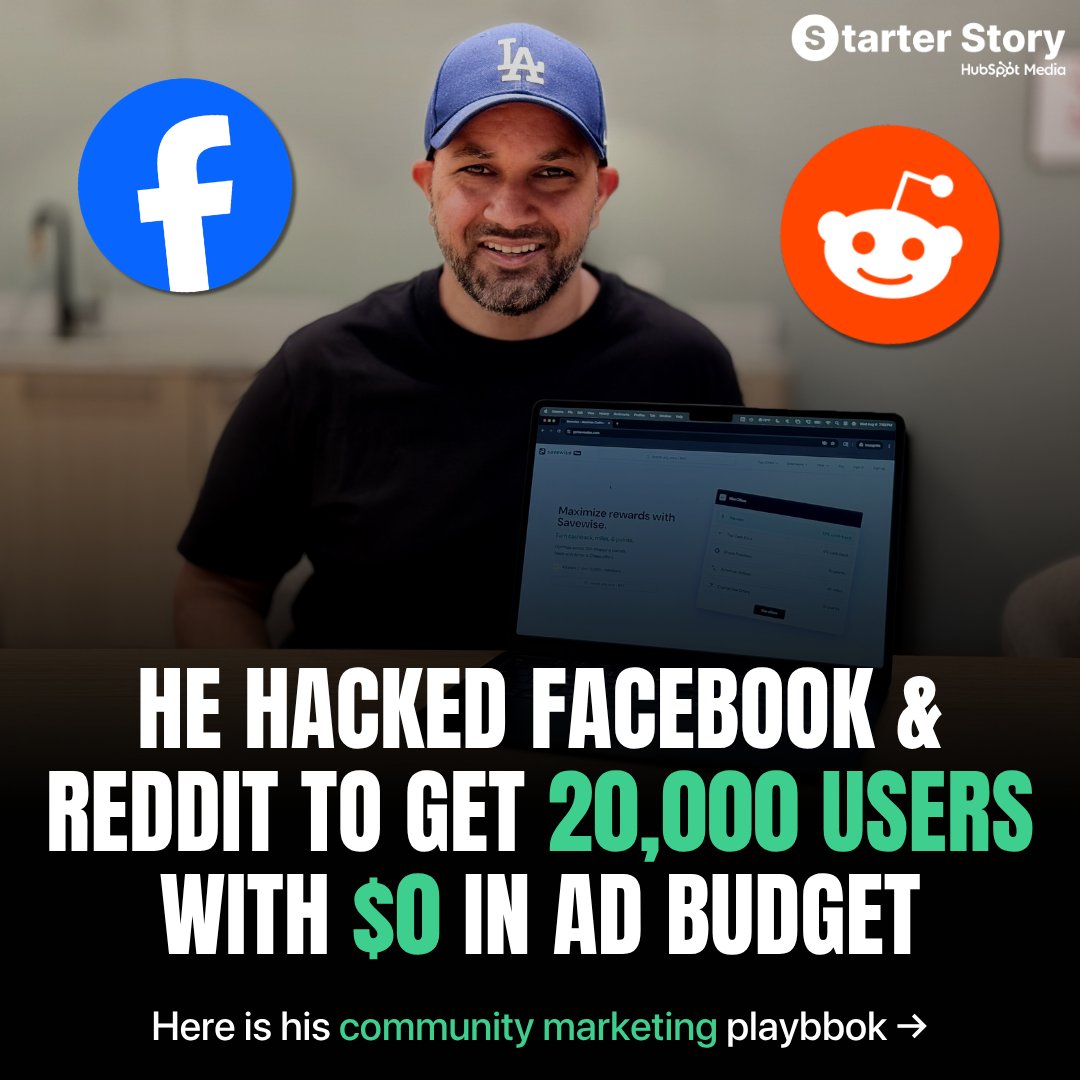
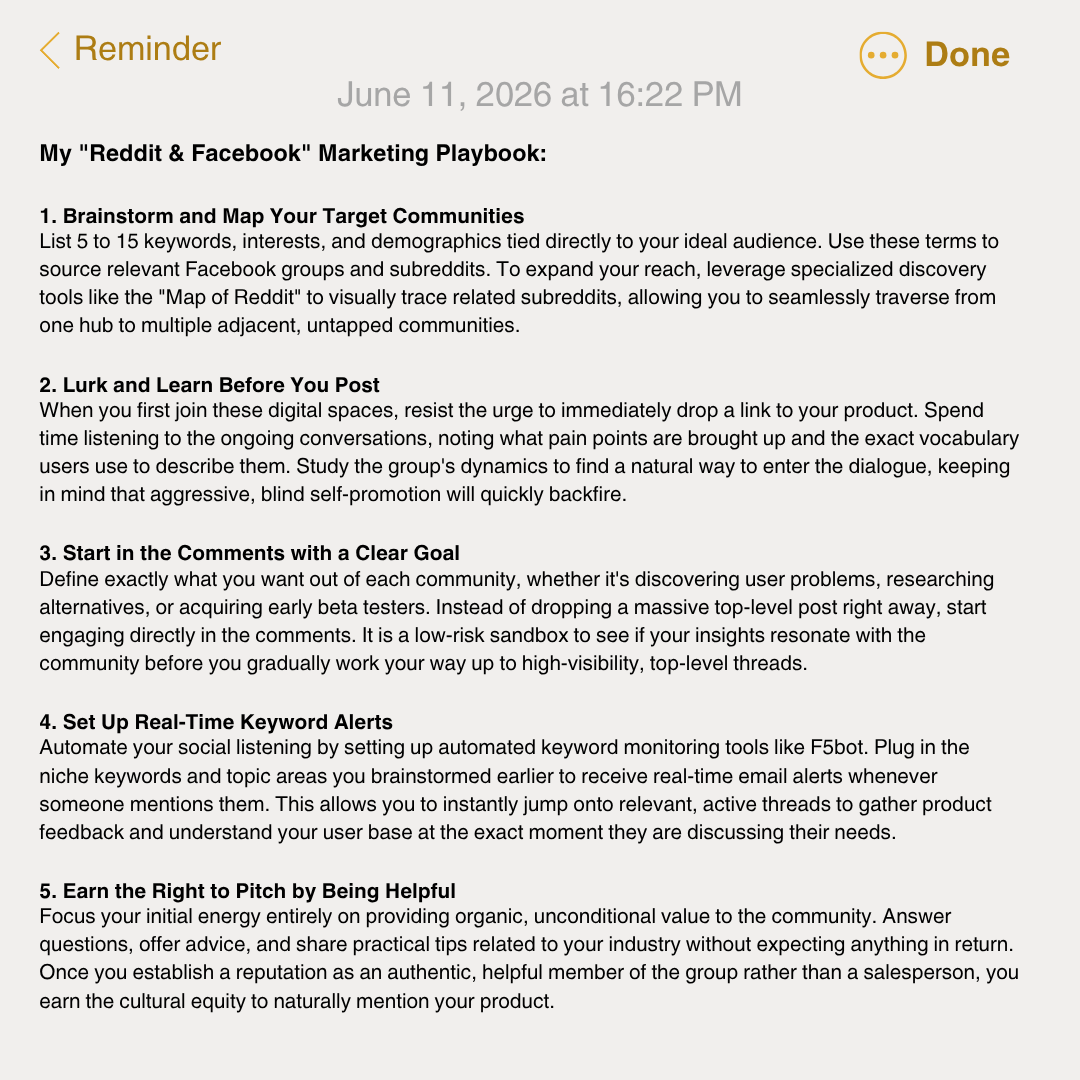
He spent months emailing 300+ influencers and got ONE reply. Then Avneesh found two free platforms that took SaveWise from single-thousand users to tens of thousands - without spending a dime on ads. His product helps people stack credit card points and airline miles on stuff they already buy online. After Product Hunt, Hacker News, and Indie Hackers all flopped (95%+ bounce rate), he flipped his approach: stop posting where founders hang out, start posting where his actual users hang out. Reddit and niche Facebook groups about travel + credit card points. The Facebook unlock: he found a group called “Rakuten Stacks” where thousands of people were manually hunting for offers his app already aggregated. He wrote a SQL query, dropped the spreadsheet (with a link back to SaveWise), and pulled 1,500+ visitors from a single post. The Reddit unlock: he lurked for weeks, posted in weekly Q&A threads in the comments only, built features users were literally asking for over 3.5 months, then DMed the mod for permission to do a top-level post. It blew up. Now SaveWise does $25K/month with ~1,500 paying customers - and 97% of revenue comes from a lifetime plan he only added because users emailed him begging not to subscribe. Takeaway: don’t market where founders are. Market where your customer already is, and earn the right to pitch by being useful first.

@wickedguro ·
Going to reach $120k MRR soon. But here is the thing, it's not exciting anymore. Yes, I know it sounds pretentious, but I definitely understand indie hackers who build many products. Because once you reach that number, it becomes a game of scaling, it's boring, and you know you can't create a new product because you will start losing revenue for your current product. So I guess, let the grind continue.


@andrewzacker ·
Just hit 1,900 followers 🎉 I started posting my build in public updates just 4 months ago, and: • Got accepted to the biggest indie event of the year - Hacker Residency • Found an AMAZING co-founder with 200K followers (@FlorinPop17) • Grew my first SaaS to $1k MRR INSANE what building in public can do to your life. Back to HARD WORK. Next goal: 3K followers and $10K MRR 💪

@joncphillips ·
The fear of building another SaaS that nobody uses is quietly keeping me stuck. I’d rather brainstorm domains than validate ideas because brainstorming feels productive without any risk of rejection or failure. At some point I need to admit that the newsletters are the fucking business, and everything else is me trying to build something that feels more “legitimate” for no good reason. Like, there’s a weird shame in the indie hacker world about making money from newsletters instead of a SaaS. As if it doesn’t count somehow or whatever. $10k/mo profit from a few email newsletters is a solid business by any measure. Why does my brain refuse to accept that? *proceeds to buy one more domain.
@wickedguro ·
Postiz is on $159k MRR. I don't think you should build in public to get customers for your business in the traditional way: talk about your work and make a lifestyle video about your work. Usually, to make money, you need to give value. So if you build in public + teach really valuable stuff, it can work. A few years ago (same as digital nomadism), building in public was not something everybody could do; it was new, and people wanted to try it, so it had a lot of value for people who didn't build in public. Today, everyone is building in public on X, so it's less attractive. So for me: 1. I make money posts to grow engagement, reach, and authority. Don't worry, those posts usually bring no customers; they do tend to bring people who want to interview you, so it's nice. 2. Once a week, I will release a video with tons of value you can implement. 3. Work with other creators to produce valuable articles.


@tibo_maker ·
I flew 10,000km to feel normal 👀 I live in a tiny town in France and the closest indie hacker is 3 hours away by car so I flew to Da Nang, Vietnam to live and work with other indie hackers for a few weeks and it's been amazing 🤩 I still love my remote + no-call policy, but being around sharp people in real life gives you a different kind of energy I just have so many new ideas now new rule: - default remote - but make in-person energy non-negotiable once in a while 🔥


@JoinPond ·
10 podcasts worth listening if you're building in 2026 1. Lenny's Podcast (@lennysan) one of the highest signal shows for builders right now 2. My First Million (@thesamparr + @ShaanVP) business ideas, breakdowns, how real companies got their first traction 3. @ycombinator Startup Podcast: best for first-time founders 4. Startups for the Rest of Us (@robwalling) bootstrapped SaaS, he runs TinySeed & he knows the real numbers 5. Indie Hackers Podcast (@csallen) solo founders talking real revenue, the show that made build-in-public mainstream 6. How I Built This (@guyraz) origin stories of products you use every day, best for context on how long things actually take 7. AcquiredFM (@gilbert + @djrosent) deep company dives Nvidia, OpenAI, Google, long but worth it 8. No Priors (@saranormous + @eladgil ) AI investing and strategy, closest thing to sitting in a room with people who actually fund AI startups 9. Solo Founders (@solofounders) community and podcast built around the idea that solo is a valid path, interviews VCs and builders 10. Sweat Equity Podcast (@onlysweatequity) business brainstorm format hosted by Alex Garcia and Brian Blum for founders building without outside capital Save this to build better products💪


@alexcooldev ·
Being an indie hacker or solo founder doesn’t mean you have to do everything alone just to say “I built it all myself.” When your product is small, sure go solo. But as it grows, hire a few people to help. It frees up your time to focus on higher-leverage work. And remember: time is money. The more you free up, the more your product can grow.

@sflorimm ·
I’m not here to sell you a dream about becoming an indie hacker millionaire overnight. With 15 years in IT, a CS degree, and a decade in PM/BDM roles at places like Cisco, I’ve seen the corporate side of success. It wasn't for me. In January '26, I decided to finally build for myself. I’m currently in the messy middle, somewhere between 0 and 0.5. I’m not sipping coconuts in Bali; I’m in the trenches. Because I’m still "figuring it out," I want to help others do the same. I try to provide suggestions and support to every DM I receive. Helping you helps me stay sharp. My biggest takeaway so far? Change your mindset. Forget the 2-week riches. Start small, identify genuine pain points, and create products that solve them. Most importantly: Ask for feedback. Don't hardsell; just solve problems.

@Hartdrawss ·
INDIE HACKER skill levels (1-20) : Level 1-4 : The Start 1. Subscribed to Indie Hackers. Reads every story. Shipped nothing. 2. Built a landing page. No product behind it. That counts, right? 3. Launched on Product Hunt. 12 upvotes. 8 were friends. 4. First product. 3 users. All from your Twitter following. Level 5-8 : Getting Serious 5. Got to $1 MRR. Actual money. From a stranger. 6. Killed a product that wasnt working. Before it wasted 3 more months. 7. Found a problem you have yourself. Built a solution. Other people had the same problem. 8. Learned that distribution is harder than building. Still shipping anyway. Level 9-12 : Figuring It Out 9. One product generating $500+ MRR consistently. 10. Know your conversion rate from signup to paid. And why it is what it is. 11. Stopped building features for 60 days. Focused only on retention. It worked. 12. First piece of content that brought in users you didn't reach out to personally. Level 13-16 : Starting to Scale 13. Product running with no daily intervention from you. 14. Know your churn number by heart. And the story behind each churned user. 15. First month where revenue from existing users exceeded revenue from new users. 16. Built a waitlist before building the product. And actually used the feedback from it. Level 17-20 : The Real Ones 17. Portfolio of projects. At least one profitable. At least one dead. Learned from both. 18. Can validate a new idea in a week without writing a single line of code. 19. Gets DMs asking for advice from people at level 1-8. Gives real answers, not inspiration. 20. Revenue is boring. Predictable. You're bored. You're already thinking about the next one. What level are you at?

@kylegawley ·
Indie hackers launch loads of products because they're shit at talking to people If you talk to lots of people and build up a network you will learn where the real business problems are It's hard work and it's much easier to just launch a bunch of random stuff, post about it on X and pray BUT the hit rate will be very low because you are now dependant on blind luck for something to take off Get out of your room Get out of your head Go talk to real people with real problems Then you can solve a real problem for people and get customers Much better than launching startup #25 and asking Reddit how to get your first user for a product no-one asked for

@victor_bigfield ·
your marketing plan as an indie hacker is probably "post on twitter and hope" mine was too. for 9 products. the one that actually worked? i went where people were already searching for a solution. not where other founders were posting screenshots of their dashboards reddit > twitter for early users. i'll die on this hill

@elgermerlo ·
For the first 6 months I was selling to indie hackers when my product was clearly built for small agency owners Same pain, completely different willingness to pay Indie hackers would say "cool" and churn after trial. Agency owners paid without blinking and asked for invoices The product didn't change. The customer did. That's where the revenue was hiding the whole time Next time I'm doing 20 customer calls before I write a single line of code — not to validate the idea, but to validate who actually has the money and urgency
@rcmisk ·
how to validate, build, and ship your indie SaaS (fast, with AI): first, i'd kill bad ideas early. use Claude to stress-test your assumptions before writing a line of code. scrape Reddit and X for real complaints in your niche. build a fake landing page. measure clicks, not compliments. if nobody opts in, nobody cares. then i'd ship something ugly but real. spin up an MVP with Cursor or Replit in a weekend. one pain, one fix, one CTA. no perfect branding. no waitlist theater. just a working thing people can poke at. post it publicly. let strangers break it. then i'd automate the distribution. use Claude to turn one insight into a thread, a post, and a short demo video. repurpose your build log into content. every "i just launched X" post is a lead magnet if you frame it right. document the process, not just the outcome. then i'd become a testing machine. ship 5+ hook variations per week. let the algo vote. what gets bookmarked, copy that pattern. what gets ignored, kill it fast. treat distribution like a product. iterate on it. and i'd drop a lead magnet every few weeks. a free tool, a public dataset, a template, a calculator. something useful enough to share. value compounds. vanity doesn't. then repurpose like crazy. one build becomes a tweet, a demo, a blog post, and a microsite. build once. distribute forever. AI lets one indie hacker do what used to take a team. but you still need to know who you're building for and why they'd care. that's how i'd launch a SaaS solo today.

@sandislonjsak ·
Most indie hackers don’t understand that after you build an app there must be someone doing customer support and regular maintenance/regression testing. Building an app that manages itself is super complex and only some of them can actually pull it off. Most of the thing I try from indie hackers is buggy and gets shutdown in a year, which is bad if you actually depend on it. Having a team behind you is much better than being a lone wolf. I am not saying “don’t go for it” and “they all suck”. I am just saying it’s super hard when an app actually becomes a success.
@zmbnski ·
8 mental models i keep coming back to as an indie hacker: - jobs to be done: people don't buy products, they buy solutions - distribution first: a worse product with better reach usually wins - activation > acquisition: getting users in the door means nothing if they don't stick - the aha moment: find it fast, show it fast to your users - ramen profitability: survive long enough to find what works - default alive vs default dead: know which one your product is right now - 10x better or 10x cheaper: if you're not either, you're invisible - ship, measure, iterate: perfection is a distraction, data is the answer
@rcmisk ·
here's the actual irony of indie building: most founders spend 90% of their time on the product and 10% on distribution. but the product can be rebuilt in 3 months. a real audience takes 3 years. you're optimizing for the thing that's replaceable and neglecting the thing that isn't. building in public isn't cringe. it's the only compounding asset most indie hackers have access to without a budget. every week you ship without talking about it publicly is a week of distribution you'll never get back. the founders who win aren't always the best builders. they're the ones who shipped AND shouted, consistently, before they had anything to prove.

@ybouane ·
The biggest lie in the Indie Hacker world: Product Hunt. Today I launched Clawly on Product Hunt… and it got 0 upvotes. Not because nobody saw it — but because nobody could. We like to think PH is merit-based, where the best products rise to the top. In reality, visibility comes first. And visibility is curated. Products featured early get the exposure → exposure drives upvotes → upvotes justify ranking. Everything else gets buried. That’s not a leaderboard. That’s a feedback loop. I’m building an alternative over the next few weeks — one where distribution isn’t gatekept. Stay tuned.


@benvspak ·
32 Tools to Ship Faster as an Indie Founder: 1. Validate: → Typefully → Tally → Loom → Sparked 2. Build: → Cursor → Supabase → Vercel → Railway 3. Monetize: → Stripe → Lemon Squeezy → Gumroad 4. Distribute: → Beehiiv → Kit → Transistor → Typefully 5. Analytics: → Plausible → PostHog → Fathom 6. Support: → Plain → Crisp → Loops 7. Launch: → Product Hunt → Builders → Indie Hackers → Peerlist 8. Automate: → Make → Zapier → n8n → Pick one from each category. Build the simplest version. Ship it. The stack matters less than your momentum.

@nikita_builds ·
The great filter of startups is gone and I find it a little sad we used to be a niche group on the internet called indie-hackers (thank you @csallen) we would grind our asses off to ship half a page in a day, it was fun because no one could do it. We were alone. The cost to start something is basically 0 now The filter that used to kill ideas was effort. Now the filter is quality and distribution. We still live in a time where it matters to be semi-technical, enjoy it while it lasts my friends, soon it wont matter.

@chhddavid ·
day 1: FINALLY ready to build in public (a vibe coding tool for non-devs) today I set two goals: 1/ get to $10k MRR (now it's $0) 2/ start building in public think I finally understand what it's all about: showing up, showing your face (!!), and sharing the good AND the bad, not just the wins. journey's heavily inspired by @robj3d3, @gus_tiffer, @thepatwalls, @SherryYanJiang, and virtually everyone else who shows up every day. (100% encouraging everyone to do it) —— let's start with today's updates then: 1. soft-launched on reddit and... WOW, a complete stranger said they want to pay for my tool 2. cold DM'ing + talking to warm leads via reddit 3. recording a PH launch video 4. well, started building in public ✅ I think that's enough for day 1. more updates coming soon


@sergeynazarovx ·
I don‘t really understand how indie hacking works when you have co-founders Products built by indie hackers rarely reach unicorn valuation or achieve a strong exit. In most cases, scaling a product to that level is extremely difficult without venture capital. Of course, exceptions exist, but they are very rare. Most indie hackers are trying to make a living from their products without focusing on an exit. During the journey, one of the co-founders could lose interest in the product or find a bigger opportunity. What happens if the product generates some money, let’s say $10k/month, and one of the co-founders decides to leave? In an ideal world, the other co-founders should buy out his share. But what if they don’t want to do it, or they don’t have that amount of money? These cases should probably be discussed and explicitly specified in the agreement between the founders. But does it really happen?
@victor_bigfield ·
hot take: the best thing that happened to me was failing 3 times before making $1. most indie hackers ship once, it flops, and they quit. i shipped LearnFast and nobody came. i shipped YTFinder and nobody stayed. i shipped The Visual Hackademy and made some money but couldn't scale. by the time i built RedditGrow i already knew what a bad landing page looked like because i made 3 of them. i knew what no distribution felt like because i lived it for years. all that failure is the reason RedditGrow works. and now i'm building another one. DojoSales. a cold call training tool for french sales reps who want to practice their english pitch and close US deals. people keep asking me why i'd start something new when RedditGrow is working. because that's literally the point. RedditGrow taught me how to build something people actually want. now i get to do it again, faster, with all the scar tissue from the first 4 attempts. i didn't get smarter. i just ran out of ways to mess it up. and apparently that makes you want to build more, not less.


@ericdjav ·
Everyone panicking about Opus 5 killing the indie hacker dream has it backwards. It didn't kill anything. It killed the excuse. For three years, "I can code and you can't" was doing half the work indie hackers took credit for. That's gone now. Good. What's left is the actual hard part: knowing which 100 people want the thing. showing up in their feed before they forget you exist. If a model update ended your business, you never had one. You had a moat made of syntax.


@userluke_ ·
A lot of successful indie hackers started with multiple projects. I don’t think @marclou or @levelsio stopped building other apps when one them was making $100 MRR. They kept trying different ideas to see which one had potential. But we can agree that once you find the one that’s actually gaining traction, you shift your focus there.

@bmykhaylivvv ·
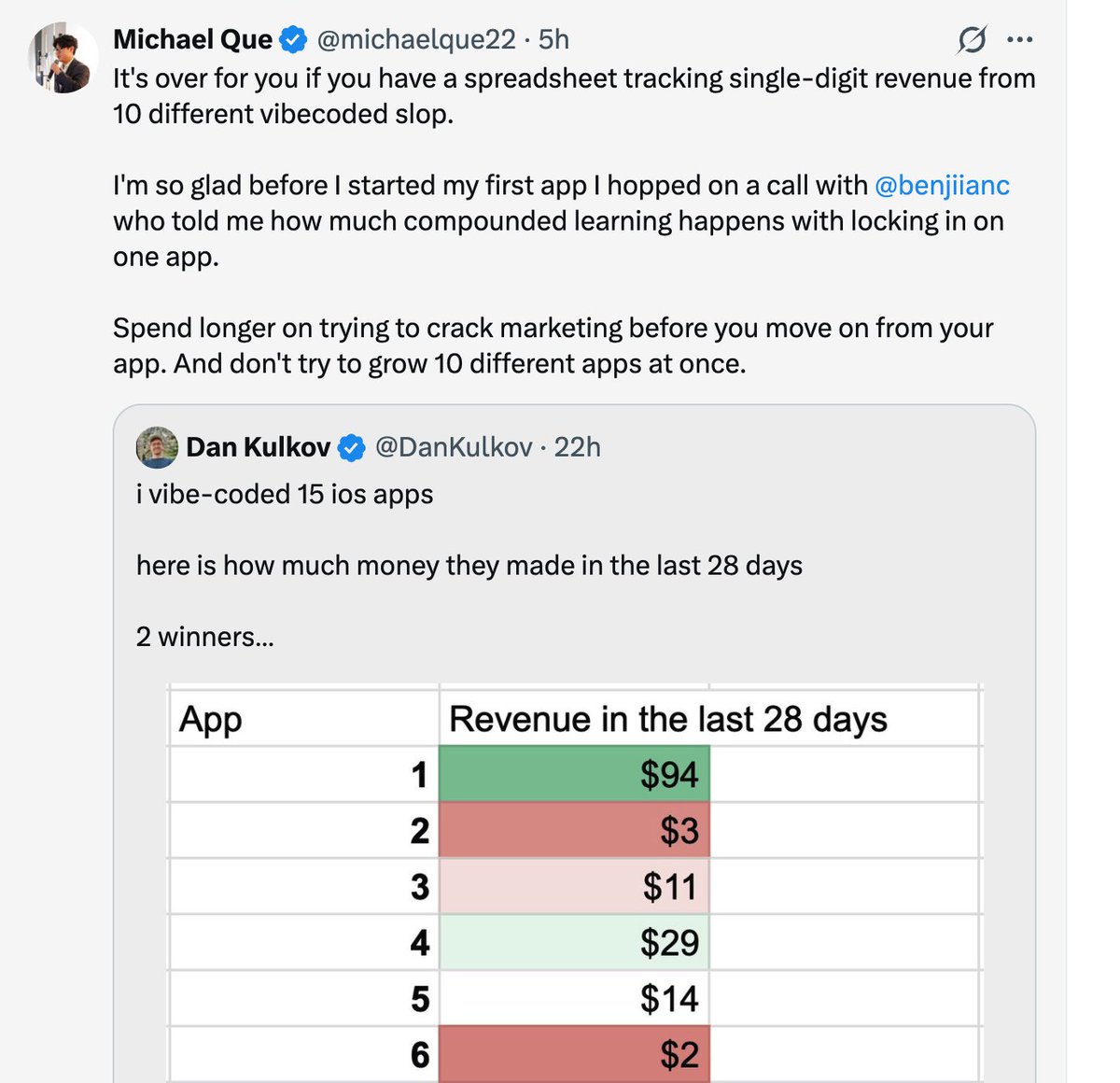
built amplifresh to scratch my own itch - needed better social media automation for my side projects shipped mvp in 2 weeks, now sitting at $500 mrr with 47 paying customers the twitter growth was unexpected but posting daily about building in public really works most users found me through indie hacker communities and word of mouth referrals revenue breakdown: 23 pro plans at $19/mo, 24 starter plans at $9/mo biggest lesson learned - solve your own problem first, then find others with the same pain next milestone is hitting $1k mrr by end of q1, already have the feature roadmap planned the hardest part wasn't coding but learning to price correctly and talk to customers going from 50 to 2000 twitter followers happened mostly from sharing revenue screenshots and build logs amplifresh basically automates content distribution across multiple social platforms with smart scheduling
Best Tweets by Topic