Running the raise
Setting the ask, timing meetings, maintaining momentum, creating competitive tension, and managing rejection and investor behavior.
46%
Best tweets about Fundraising
Browse the best tweets about startup fundraising, including seed rounds, investor outreach, pitch decks, valuation, terms, diligence, and founder lessons.
Startup and venture fundraising, investor outreach, pitches, rounds, valuation, terms, diligence, market conditions, and founder experience.
Original Xholic analysis
Fundraising is framed as both an execution process and a consequential choice of business model. Contributors emphasize traction, clear outreach and investor fit, but dispute whether speed and optics serve founders well. Running the raise accounts for 46% of the sample; the strongest outlier examines investor anti-signals rather than offering a universal playbook.
42% of posts
All-time engagement
40% of posts
Published in 90 days
Conversation map
Setting the ask, timing meetings, maintaining momentum, creating competitive tension, and managing rejection and investor behavior.
46%
How investors assess founder conviction, judgment, preparation, storytelling, pitch delivery, and perceived red flags.
28%
Warm introductions, cold emails, forwardable blurbs, investor research, follow-ups, and relationships built before a round.
26%
When to raise, and the product, customer demand, revenue, metrics, runway, and milestones needed to be fundable.
24%
Finding investors aligned with the company’s stage and ambitions, assessing partner fit, and navigating the founder–investor relationship.
22%
Negotiating future-oriented valuations, choosing SAFEs or priced rounds, and weighing dilution, cap tables, and exit consequences.
20%
Shifts in seed-round sizes, capital supply, investor appetite, hot sectors, and the economics and incentives of venture funds.
20%
Why a raise is not proof of progress, and how VC funding changes growth expectations, founder autonomy, spending, and strategic options.
18%
Tone and stance
Performance benchmark
Posts with media make up 34% of this collection. Their median all-time score is 4.39, compared with 9.26 for text-only posts.
Format mix
Consensus and debate
Shared view
Several contributors urge founders to establish customer demand, know their metrics and define milestones before raising. Their shared advice is to build evidence of a business, rather than use investor meetings to discover what to build.
Shared view
Outreach advice converges on concise business descriptions, concrete traction and credible momentum. Progress updates and forwardable blurbs are presented as ways to keep conversations useful, not simply increase reminder frequency.
Shared view
Critics distinguish capital raised from customer traction and value creation. Founder accounts also describe venture funding as a commitment to growth expectations and future rounds, not an uncomplicated achievement.
Open debate
One playbook recommends a lower initial ask and competitive tension; another warns against treating fundraising as a game when choosing a long-term partner. A founder's fast-round account credits relationships built well before the raise rather than compressed FOMO.
Open debate
Readiness advice stresses a product, demand and an execution plan. Other posts describe pre-PMF fundraising as belief in the founder and storytelling, or angels backing founders before traction. These are competing accounts of what early investors underwrite.
Open debate
Advice to raise only what is needed sits alongside an explicit rejection of blanket limits on capital. A separate process argument says the ask is shaped by market forces rather than budget, separating fundraising tactics from operating needs.
What performs
The investor anti-signals post scores 300.79, or 41.89 times the supplied median. The warning that fundraising is not traction scores 116.31, or 16.2 times the median. Both scrutinize fundraising's meaning and judgment criteria; neither result establishes why readers engaged.
Running the raise covers 23 tweets (46%) with a median all-time score of 9.261. Valuation, terms and dilution covers 10 tweets (20%) but has a median of 12.92, the highest supplied theme median. Topic prevalence and median score therefore tell different stories.
The supplied ANNOUNCEMENT category has 8 tweets (16%) and a median all-time score of 17.14, versus 5.48 for TUTORIAL, also 8 tweets (16%). These are supplied format classifications, not evidence that choosing a format causes stronger performance.
Statistical standouts
Creator landscape
The five most represented creators account for 20% of the selected posts.
1. 1752vc
@1752vc
2 posts
2. Gabriel Jarrosson
@GJarrosson
2 posts
3. Hustle Fund 🦛🌽💛
@HustleFundVC
2 posts
4. Ivan Burazin
@ivanburazin
2 posts
5. Rohit Mittal
@rohitdotmittal
2 posts
6. Steph from OpenVC
@StephNass
2 posts
1752vc's two posts combine a short, momentum-led outreach example with avoidable fundraising mistakes. Its supplied median all-time score is 47.09, the highest among the listed top voices.
Ivan Burazin describes rejection as pitch feedback and subsequent progress updates as a way to reopen investor conversations. The two posts offer a founder's account of iteration and persistence, rather than a guarantee that repeated outreach succeeds.
Rohit Mittal's posts question simultaneous fundraising and acquisition processes, and warn that large rounds can constrain exits when revenue falls short. His contribution emphasizes choosing a strategic path and assessing capital's consequences.
Since the previous snapshot
Themes, sentiment, stance, and post format are classified per tweet. All counts, shares, medians, creator concentration, freshness, and performance comparisons are then calculated directly from the published snapshot.
Xholic's all-time score compares engagement while accounting for reach, post age, and creator consistency. It is used for relative comparisons within this collection.
This report analyzes the exact 50-post snapshot shown below. AI identifies editorial categories and drafts explanations; all statistics are calculated from the snapshot, and every narrative claim is checked against cited posts before publication.
Best Fundraising tweets
Ranked 01–50

@andruyeung ·
I was featured in the @nytimes this week. They asked me what reasons I've seen VCs pass on founders for. There's an unspoken language in startup land called "anti-signal" ... these are the subtle red flags that make an investor not want to invest. I don't agree with all of them, but these are the ones I've seen after talking with hundreds of VCs: 1. You took part in a pitch competition (why are you on a stage competing for $10,000?) 2. Your deck is too polished (signals you are desperate for capital) 3. You're too available (the more available you are, the less valuable your time looks) 4. You reply too slowly (speed is an edge. Slow responses read as low competency.) 5. You have a bad eye for design (in consumer, taste is everything) 6. Your writing is full of AI tells (outsource your voice, and they wonder what else you've outsourced) 7. You don't know your numbers (TAM, CAC, retention, burn. Self-explanatory.) 8. You're "always fundraising" (always fundraising reads desperate, and never building) 9. You say you have no competitors (reads as naive and under-researched) 10. You're raising too late (two months of runway signals desperation and bad planning) 11. You have low energy (early on, the founder is the product. If you can't bring conviction, why should they?) I don't agree with all of these, but this is what I've seen in the field. Part of being a venture-backed founder is learning to play the fundraising game and knowing when to challenge the assumptions behind it. What did I miss? P.S. the good VCs will know how to look beyond these anti-signals ;)


@hthieblot ·
You can raise millions and fail. You can raise almost nothing and win. Investors are not validation. They don't know whether your idea will work. Fundraising is not traction. The market decides. Not investors. Don't confuse it with progress.

@BigBrainBizness ·
Peter Thiel: "The value is never a premium on the past. It's always a discount to the future." Most founders walk into a fundraising negotiation anchored to the wrong number. They point to the last round, list everything built since then, and argue for a premium on that progress. Investors push back. The whole conversation becomes a fight over the past. Thiel thinks this framing is conceptually completely wrong. Investors aren't buying your history. They're buying your trajectory. And the moment you understand that, your entire approach to pitching valuation changes. "The way I always think one should try to pitch a company or the value of a company is by explaining why it will be worth a lot more in the future. The investors are getting to invest at a point that's a lot cheaper than it will be for the share price a year, two, three years from now." He learned this firsthand at PayPal. In late 1999, PayPal closed a round at $45 million. Three months later, they raised again at a $500 million valuation. A 5x jump in a single quarter. The obvious question: how do you convince anyone to accept that? "The way we presented the round was: this is going to be the last round before the IPO." That single reframe changed everything. Investors stopped looking backward and started looking forward. "It doesn't matter what happened three months ago. You're getting in at a discount to the IPO." The founder who can paint a compelling picture of where the company is going will always negotiate from a stronger position than one defending where it's been.
 Watch video
@1752vc ·
Most founders overcomplicate pre-seed fundraising emails. The ones that actually get replies are usually dead simple: “We recently released the product. Growing 20% month-over-month. Half the round is already committed. We have more investor conversations lined up next week and a few openings left — interested?” Short. Specific. Easy to respond to. Investors see hundreds of inbound emails every week. If you can’t establish momentum and credibility in the first few lines, you’ve probably already lost them.

@ItzSuds ·
Founders need to call their shot or get out of the Arena I thought being a founder & raising venture dollars was my pre-destined birthright. I didn’t realize that it was actually a line of credit against my reputation. A few weeks ago I was on call with a long time friend who was going back out to raise for a new co. He had a thesis on an interesting product he wanted to build, but he had no plan. I asked him some basic questions - who’s going to use this, how much would they pay for it, who are you going to hire to build and sell this? “A lot, …hedgefunds?, I don’t know.” I explained to him that as a credentialed second time founder, he will get a chunky seed round, but that’s the last round of funding he’ll ever raise it he raises on his potential instead of his plan. Outside of institutions like YC, we are in a time where you can’t just start a company to follow your curiosity and “figure it out”, that’s reserved for the 18-22 year olds from Stanford. No, as a founder in 2026, you must call your shot. You need to know what you’re going to build, who you’re going to sell to, who you’re going to hire to build/sell it, and the exact roadmap you’re going to execute against to reach $1b ARR in 7-12 years. A lot of founders who are in network and know they can raise take advantage of it, but they’re don’t realize that they’re 12-18 months away from being unfundable & dying when they run out of cash. Don’t raise on potential. Don’t take a line of credit against reputation. Call your shot and swing hard for a homerun, or get out of the arena until you know what you’re playing for.

@tkexpress11 ·
the #1 mistake that founders make in a fundraise process is asking for too much $ out of the gate ALWAYS start with a lower number than you're targeting, work towards collecting the first term sheet, and then build up through competitive tension to your desired amount asking for too much and then circling back to investors who've passed with a lower ask is a death sentence. You're signaling that you don't have interest in the round some founders mistakenly think that the raise amount should be driven by your budget NO - your raise amount is driven by market forces: perceived strength of team, traction/execution to date and how good you are at fundraising

@sohan_zhang ·
one of the most frustrating experiences about the fundraising process is how decent respect gets thrown out the window one VC fund scheduled 3 meetings with myself and the team over 3 weeks, the last of which included an in person meetup that I took the courtesy of meeting them in the hotel they were staying at in SF. after a conversation, they mentioned that they would get back to me at the beginning of next week. cue 5 days later and i ask for an update. ghosted. i sent follow-up updates, as requested, over the span of a week, and still no response. i completely understand rejection, but it's very frustrating to take multiple meetings over weeks and get completely no response. future YCombinator founders, check the Bookface for investor reviews.

@adriannalakatos ·
if a vc fell asleep on your call this week, that’s on them. but here’s how to make sure the next 50 meetings you take are with people who will actually fund you: don’t start til you’re ready. i review hundreds of founder applications a month, and most start fundraising too soon. if you’re using investor calls to figure out what you’re building, you’ll burn 4 weeks and come out more confused than you started. here’s the checklist i’d use to know if you’re actually ready to raise. you’re ready when: → you and your cofounder have shipped together 3+ months → something real exists. ugly demo off localhost counts → proof people want it. 5+ weekly users, LOIs, or a paying pilot → you can name your customer and their exact role in your sleep → one core metric moves weekly (and you know why) → you know your unit economics (CAC, payback, gross margin) → one channel works at small scale → your “why now” is sharp (tech shift, regulation, buyer urgency) → your materials are tight (deck, demo, metrics, milestones) → you have a process ready: target list, warm paths, 4-week calendar you’re not ready when: → you have a deck and nothing else → you’re raising to hire the technical cofounder you don’t have → your customer is “anyone with X problem” → you can’t explain why people churn → pricing is a guess → “we’ll go viral on x” is your channel plan → “AI” is your why now → the core is outsourced → no milestone plan tied to next round unlocks → you need the money to start learning 7+ from the ready list? run a tight 4-week process. don’t drag it out. fewer than 7? spend 30 days flipping 3 items from the “not ready” list first. don’t spend 6 months chasing money you could’ve raised in 6 weeks.

@khushkhushkhush ·
lot of fundraising advice on 'running a really tight process' and creating a ton of fomo to get a deal done. i'll take the counter here. the founders i know that are happiest with their lead investors spent significant time with the partner on their deal to see if it was a mutual fit. not everything is a game. you are entering into a 10 year partnership with someone, it would likely behoove you to get to know them really well before giving them a massive chunk of your company. also, some investors do really well in the first few meetings and then become totally different people after several hours spent together

@arian_ghashghai ·
i've seen a few rounds now where the founders reject a priced round (i.e. every new investor pays the same entry price) to raise on SAFEs with rapidly ascending valuation caps. they end up securing more capital with less (future) dilution than if they had taken the priced round: > early priced rounds being put on the back burner. more net dilution (sometimes) + more admin headache (sucks for VC markups!) > fundraising is a live auction atm > being an auction, priced round term sheets box in how much a company can raise (and at what cost), limiting how much a company can leverage its "hotness" factor to raise cheap capital feels like something needs to be fixed here: > priced rounds are absurdly archaic (administratively) and much too slow/painful vs SAFEs (I'm always bemused it takes a couple of months to go from signed TS to closed round i.e. wired capital). As a pre-seed investor, I'm also not unhappy about founders raising their seed rounds on SAFEs as it kicks the can down the road on my dilution (i.e. potentially better for DPI) = very little incentive to do priced rounds from both sides > schizophrenic VC behavior that disregards the entry price (i.e. paying 2x vs what the VC before me paid yesterday) under the pretense that "wHaT IF its THe nexT FaCeBoOK" is financially irresponsible and unsustainable as fudiciaries of LP capital

@edsuh ·
A tale of two funds: - Fund A invests in a startup's pre-seed round at a $10M cap. The startup goes through an 8 week accelerator. The first few seed investors come in at a $20M cap. Within a day, the round is oversubscribed. A new fund, desperate for allocation, agrees to a new SAFE at a $100M cap with a 50% discount. The pre-seed investor is delighted & marks their position up 10x. The company has not changed meaningfully in 8 weeks and is still pre-launch, zero revenue. - Fund B invests in a startup's pre-seed round at a $10M cap. The company launches & is instantly profitable. They get to $200M of revenue, spit off cash, but never raise again. Fund B keeps the co marked at $10M. On paper, Fund A has much better performance than Fund B: higher TVPI, IRR, more likely to be "top quartile" or "top decile". But are they really? These are made up cases, but based on real world examples. There is a lot more beneath the surface of VC marks.

@tbpn ·
When @travisk was fundraising Uber's round that valued it at $70B, he ran four rooms simultaneously out of their New York office for an entire week, each booked in 90-minute slots across 12-hour days: "This is how we'd fundraise: we had four rooms in our New York office booked for a week with an hour-and-a-half slot on each. So for 12 hours in a day, four rooms going in parallel." "I'm in the $250M-and-over club, that's one room. Then there are these other rooms, down to the fourth room, which is like $25M checks. There's a guy who works for a guy, who works for a guy, who works for me who's doing that room." "But we're oversubscribed. So we started putting multiple investors in the same room. We were like, 'We're just out of slots dude. Let's go.'" "The storytelling we did, anybody on my team could tell that story and make it happen. And that was a big part. It was the story... then there is making it scalable so that there are 10 different people in a company that can pitch it at any given time. And that’s when you take it all the way."
 Watch video
@1752vc ·
8 ways founders destroy their fundraising journey: 1. Raising in August or December 2. Running out of runway mid-raise 3. Cold emailing tier-1 VCs with no warm intro 4. Demanding an NDA before the basics 5. Pitching funds that don’t touch your stage 6. Pitching funds that don’t invest in your industry 7. Attaching a 30+ slide deck 8. Following up daily

@rohitdotmittal ·
talked to a founder recently $3.5M ARR, growing 50% year over year, 90% gross margins, customers who've been around for 4+ years. they raised $18M total. burning about $300K a month. roughly 12 months of runway and they were doing what a lot of founders in this position do parallel tracking exploring a series B on one side, having quiet M&A conversations on the other. keeping all doors open. hedging bets. it's actually one of the most expensive mistakes you can make in this process here's what happens when you try to do both on the fundraising side, investors are pattern matching constantly. they want a founder who is irrationally committed to building something massive. the moment they sense you're also talking to acquirers, the conviction signal breaks. they don't say it out loud. they just get slower. more diligence. more questions. less urgency on the acquisition side, buyers are doing the same thing. if they find out you're raising a round, and they will ask deals need internal champions to push them through. a lukewarm founder kills that energy fast so both processes quietly degrade. you're putting real time and emotional energy into two things and getting half results from each the deeper problem is that the two paths require completely different company decisions as Ben Horowitz says "your story is your strategy" - you have to figure out the right story, and that'll become your strategy if you're optimizing for fundraising, you want to show aggressive growth at almost any cost. burn more, move faster, expand headcount, grow the top line if you're optimizing for acquisition, you want to show a cleaner financial profile. lower burn, higher margins, revenue that looks predictable to a financial or strategic buyer. often that means slowing down in ways that look bad on a fundraising pitch you literally cannot optimize for both at the same time. the decisions conflict so before any tactical work on the acquisition - before you make the list, get the intros, hire the banker, whatever, you have to answer the question most founders skip do you actually want to sell this company not "would you sell for the right price." everyone would. but do you want to sell. is this the path you're choosing because if the answer is yes, the whole posture of the company needs to change. runway management changes. hiring decisions change. which conversations you prioritize changes. you're now building a story for a specific type of buyer, not for a VC partner deck and if the answer is no - if you still believe this can be something big, then commit to that. stop taking the M&A meetings that go nowhere. that will distract your team. raise the round or find a way to grow into profitability and own the path optionality = no progress

@tibo_maker ·
taking VC money is such a headache nobody tells you what actually happens after you take VC money. you stop building a company and start building a story for the next round projections have to be unrealistic, growth has to be aggressive "good business" stops being enough - it has to be venture-scale or you're failing by definition first-time founders chase funding because that's what X, TechCrunch, and every startup podcast celebrates. the raise IS the headline - the proof you made it they don't realize they just signed up for a completely different game I raised hundreds of thousands for my first two startups. both failed I'm now bootstrapping 5 SaaS products, trying to get each to $100K MRR. no board pressure, no forced narratives, 100% freedom - just building things that work for me VC money isn't bad. it's just a different game with different rules, and most founders just don't read them before signing the game you pick matters the most are you building a company or building a fundraising story?


@ValueWithPrem ·
A founder thinks he owns his startup until he takes Venture Capital. Imagine you walk into a high stakes casino. You have ₹10 Lakhs of your own hard earned cash in your pocket. You walk up to the Roulette table. You try to put the raw cash on "Red." The dealer stops you. "Sir, you have to exchange that for chips first." Why do casinos do this? Because human psychology is wired to protect cash. You would never throw your kid's school fees on a single spin. But a blue piece of plastic? You'll throw that on the table without a second thought. Chips detach you from the reality of the money. Venture Capital works the exact same way. When a founder bootstraps a profitable ₹5 Crore business. They protect it. They grow it steadily. They care about every single rupee. Because it is their Cash. But VCs don't want a safe, profitable ₹5 Crore business. Their math doesn't work that way. They need 1 startup to hit a $1 Billion valuation to pay for the 9 that die. So, they give you "Chips." (Millions in funding). Suddenly, you aren't playing with your own money anymore. The VC pushes you to burn cash. Hire 100 people. Run massive ads. Subsidize the product to acquire users faster. They force you to push all your chips to the center of the table for a massive spin of the wheel. If it lands? You ring the bell at the IPO. If it doesn't? The VC writes it off as a portfolio loss. But you? You lose 5 years of your life and the company you built. Bootstrapping is playing with cash. Fundraising is playing with chips. Don't play roulette with your life's work unless you are fully prepared to lose it all.


@ColinGardiner ·
Fundraising urgency comes from momentum, not reminders. Signed contracts, real growth, and credible investor interest are what open the doors.

@gdibner ·
Outstanding post by Ashley Smith at Vermillion Cliffs: "A $5M check into a $40M post-money valuation for a company that is eight weeks old, with pilots that haven’t had time to churn or stick, is a different financial instrument than what we used to call a seed round. The label is the same. The risk profile is completely different. For the big funds writing scout style checks into 10-20 party rounds each cycle, totally makes sense. For YC’s LPs that get exposure to the 2-3 outliers per cycle, totally makes sense. For funds like mine? It’s getting harder to manage that risk. The founders this batch were exceptional. The why behind the companies were exceptional. It is still a hard check to write if you’re a small early stage fund." https://t.co/UgOfE1XYMC

@alexabelonix ·
Fundraising feels very different now. Maybe 10 years ago you could raise serious money on an idea. Maybe 5 years ago a decent MVP was enough. Now? A lot of investors want the MVP, the product, the users, the pilots, the traction, and preferably proof that people are already willing to pay. I learned this the hard way. We had an idea. We had a deck. We had a no-code MVP. We had potential pilots. But when you sit in front of an investor and they say: “Founders come to us with the same valuation, but they already have a product and 30 pilots.” You understand very quickly: the market doesn’t reward potential the way founders hope it will. Of course, there are exceptions. If you’re in San Francisco. If you have a very strong founding team. If you’ve already built and exited something. If it’s friends, family, angels, or grants. But for most early-stage founders, the lesson is simple: traction changes the conversation. So right now I’m less obsessed with “how do I raise?” and more obsessed with: how do I prove this deserves to exist?


@E_Bruxxx ·
Been noticing more and more early-stage (Pre-Seed–Series A) fundraising being led by finance folks. Quite frankly, I don't love it. At this stage, the founder should be raising capital. Not the CFO, outsourced finance consultant, or advisor. Investors aren't underwriting financial performance at Pre-Seed and Seed because, frankly, there isn't much to underwrite lol. They're underwriting vision, conviction, judgment, and the founder's ability to recruit people into a future that doesn't exist. A two-year-old startup doesn't have years of operating history to lean on. The founder is the asset. When I hear, "Our CFO is leading the fundraising process," it's a red flag. By Series B, it becomes much more reasonable—even expected—to have a Head of Finance or CFO deeply involved. Series A? Somewhat. But at Pre-Seed and Seed, the founder should own the narrative. If they can't sell the vision to investors, it's hard to believe they'll sell it to customers, recruits, future executives, or the world.

@JamesonCamp ·
Had coffee with a friend today who's raised venture for three different companies We talked a lot about how some founders find it impossible to raise early on Pre-PMF fundraising has almost nothing to do with your business The TAM slide is made up. The projections are vibes. The spreadsheet is fiction Everyone knows it What's actually being evaluated is one thing: do I believe this person will figure it out no matter what happens? Can you hold a room and make someone irrationally believe in you. That's the whole game. This is why incredible operators who build real businesses sometimes can't raise a dollar. And mediocre operators who can tell a story raise $10M before they have a product. Fundraising is a performance skill. Building is an execution skill. When you find both in the same person it's rare and kind of magical. The KPI is literally vibes.

@StephNass ·
Be careful of the bait-and-switch fundraising scam. Basically, an "investor" contacts you, you get on a call with them, and at some point, during the call, they start to pitch YOU their fundraising services. You got it - they're not investors, they're fundraising advisors. And you're in a sales call you never asked for. I hate this hypocritical, time-wasting practice with a passion. And you should, too.

@hanghuang_ ·
If I were a solo founder, doing Launch Week 2 and fundraising simultaneously would have been impossible. It was absolute chaos. On one side, we were shipping product updates, giveaways, a hackathon, and everything else to make LW2 incredible. On the other side, I was spending most of my time preparing for YC Demo Day and talking to investors. 10-20 meetings every day. It made me appreciate my cofounder (@tonychang430) a lot more. When launching, there are hundreds of things that could go wrong: - Last-minute bugs. - Poor scheduling. - User complaints The list goes on. If I had to focus on all of that while fundraising, I honestly think things would have fallen apart. But Tony held it together. He took over and delivered awesome results for @InsForge Launch Week 2 while I focused on raising the seed round. The best founder advice often sounds very abstract: find a great cofounder. I didn't really understand what "great" meant until that week. A great cofounder is someone you can trust most to move the company forward when you can't possibly do everything yourself. They're someone who you know will always deliver exceptional results, even amongst the chaos. Thank you @tonychang430 for being a GREAT cofounder! 🤝


@ivanburazin ·
Fundraising cliché: "Every no brings you closer to a yes." Sounds like BS when you're getting rejected. Even the conversations that ended in a pass when we were raising our first round helped us in one way or another. - refine the pitch - identify weak points in our story - understand what resonated and what didn't By pitch 50, I could predict which questions would come up and had crisp answers ready. By pitch 100, I knew within 10 minutes whether someone was going to invest, based on their body language and follow up questions. Sent 432 cold emails, 120+ pitches, and hit the valley of death at less than 50% of our target. But we kept going. Refined, adjusted, and pushed through until the round was oversubscribed.

@Hadley ·
There's a supply and demand conflict brewing at the earliest stage of venture, one that's only going to be exacerbated over the next few years. Supply of capital is shrinking. Seed round count is already falling as the VC market consolidates, and as boutique firms come up on their next fund, many are struggling to raise. That thins out the boutique middle, the firms that have traditionally led seed. Demand is moving the opposite way. More founders are entering, and AI made the product cheap to build. But it didn't make customers cheap to win, or revenue easy to earn in an increasingly competitive market. So companies still need capital, just for a different stretch of the journey. Put those together and the early stage could split in two. On one side, $10M seeds led by multi-stage funds chasing hyper-growth and decacorn outcomes. On the other, smaller niche bets taking less money at lower valuations from incubators and micro funds. Two markets, two playbooks.

@louiseivan ·
5 things I wish I knew before raising our first $1M: 1. warm intros aren't optional, they're the game 2. your pitch will be wrong 40 times before it's right 3. a no today is sometimes a yes in 6 months (Tim Draper proved this) 4. momentum is a fundraising strategy 5. the money doesn't solve the real problems save this before your next investor meeting.

@ayushagarwal ·
hot take: most "we raised $X million" posts should say "we now owe someone $X million worth of results." fundraising is not an achievement. it's a deadline with a bigger number attached.

@thisdudelikesAI ·
A founder I know closed a $2.1M seed round last month. His entire investor outreach strategy was built in one Claude session using 4 prompts I'm about to share. Here's exactly what he did (save this):


@Jasielinvests ·
The anatomy of a forwardable blurb: a reference for fundraising founders A forwardable blurb is a short, pre-written note your supporters can send directly to investors on your behalf. Its job is not to close a check. Its job is to get a follow-up call. Here is how to structure one: Line 1: The referrer instruction. Open with a single sentence acknowledging the referrer and making clear you have done the work for them. Reduce their cognitive load to zero. Lines 2–3: The plain-English business description. Describe what you do as if explaining to a curious, intelligent person who knows nothing about your market. Avoid jargon. Avoid acronyms. If it requires a glossary, rewrite it. The traction block with three bullets, no more. Choose your three most credible, time-stamped signals: revenue, signed contracts, pilots with a clear commercial pathway, or a regulatory development. More than three dilutes the impact of each. Founder-market fit: two to three sentences. Logos of past employers say almost nothing. Instead, answer: has this team lived the problem? Spoken to hundreds of customers before building? Spent years in the industry? The answer to at least one of those should be yes, and it should be stated plainly. The close: deck link and direct contact. End with both. A trackable deck link lets you see which investors are engaging and for how long. A direct email removes any ambiguity about the next step. The forwardable blurb is the fundraising equivalent of a warm handshake that happens without you in the room. Build it once, update it as your traction grows, and make it easy for people to champion you.
@ivanburazin ·
Whenever we're raising, I regularly check in with investors (virtually/IRL) who have taken a meeting but haven't yet committed. I share updates/progress on: - features we launched that others didn't have - overall fundraising momentum - new customer traction - product milestones - team additions This keeps us top of mind. When they are finally ready to write a check, we are the obvious choice. Many investors who initially passed came back weeks later after seeing consistent progress and asked, "is there still room in the round?" Staying in the conversation with gradual progress updates has a massive upside vs. just pitching once and forgetting.

@rheejust ·
After raising a $20M Series A in 11 days, some founders have reached out asking, “Justin, how did you raise so quickly?” The truth is, we weren't even looking to raise. About a year and a half ago, David from FirstMark reached out. I'm someone who generally hates talking to investors, so my instinct was to ignore it. But David kept showing up. Instead of sending generic "let's get coffee" messages, he invited me to in-person events where I could meet people doing interesting work. Through FirstMark's programming, I got to chat with the CTO of Duolingo, the founder of DataDog, and countless others. It was mindblowing how much David pushed us forward. And at that point, I wasn't even in FirstMark’s portfolio yet. They were just going out on a limb to build trust. Fast forward to last fall, and we were hiring a lot against revenue growth. We didn't need the money. But the relationship with FirstMark had gotten so strong that when David leaned in, we decided to run a lightweight process. The timeline: 1. Told David we'd consider raising 2. Pitched the partnership a few days later 3. Signed the term sheet within 10 days What made it fast wasn't some secret fundraising hack; it was a year of relationship-building that happened before we ever decided to raise. Whenever another investor came with a term sheet, FirstMark just kept matching or beating. They’d already done the work to understand our business, developed conviction, and were leaning in hard. So, it is possible to raise a Series A in 11 days.. ...if you've spent a long time building relationships with people who you know, believe, and trust. Speed in fundraising isn't about cramming the process or doing crazy FOMO. It's about doing the real work slowly so the last part's fast.


@GJarrosson ·
"Don't raise too much money" gets repeated like gospel in startup circles. Everyone nods along like it's some universal law. It's not. It depends entirely on the business and the moment. Some founders need a small round to stay lean and focused. Others need serious capital to outbuild competitors and move fast. Blanket advice like this ignores context completely. Stop treating fundraising rules as universal truths. They almost never are.
@rohitdotmittal ·
It feels like there will be lots of AI startup exits in the next few years, with founders not making any money. The $10M or $100M rounds and high valuations lead to more problems if revenue doesn't catch up. A big round solves one problem and creates five new ones: - higher expectations - fewer realistic exit paths - more pressure to force venture outcomes - more board power - more ways for founders to work for years and still not get paid The startup world celebrates fundraising as if it were value creation. A lot of the time, it is just deferred pain. The wrong round can look like success for 18 months and feel like failure for 5 years.

@MartinGTobias ·
A KPI more CEOs should be tracking is: Annual Revenue per Employee. What is it today (at pre-seed likely sucky, less than costs) Targets for each quarter going forward (should be going up) Target for each Fundraising (Seed, Series A, etc.) I have a Pre-Seed B2B software company that in the last year increased it from $100K to $1.2M. (crushing it) I have a mature pre-IPO company that is at $13M (God Tier). While early, most companies suck at this number, the whole goal of ANY company is to get to the God Tier. Or at least to the top decile of your competitors (proving you have a more profitable model.). If you are crushing this number for your stage, you will get more meetings and stand out in the fundraising crowd. While your mileage may vary, here is what I am seeing as top decile numbers at each stage. Angel: >$50K Pre-Seed: >$100K Seed: >$200K Series A: >$400K Series B: >$750K

@Selinaliyy ·
.@ycombinator Demo Day is coming up, and let’s be real… fundraising is a full. time. job. to make life a little easier for my fellow batchmates, I built a @bubblelab_ai workflow that does all the investor research automatically. Every morning Pearl drops a briefing into Slack with my daily meetings: • the fund’s info • average check size and investment focus • summary of our previous email threads reminding me of useful tidbits (like reminding me the investor was also competitive golfer ⛳️) Now I walk into every meeting already knowing who I’m talking to, and no more pre-call frantic LinkedIn scrolling!! thank you @fogmb for requesting this super timely usecase!!
 Watch video
@ttunguz ·
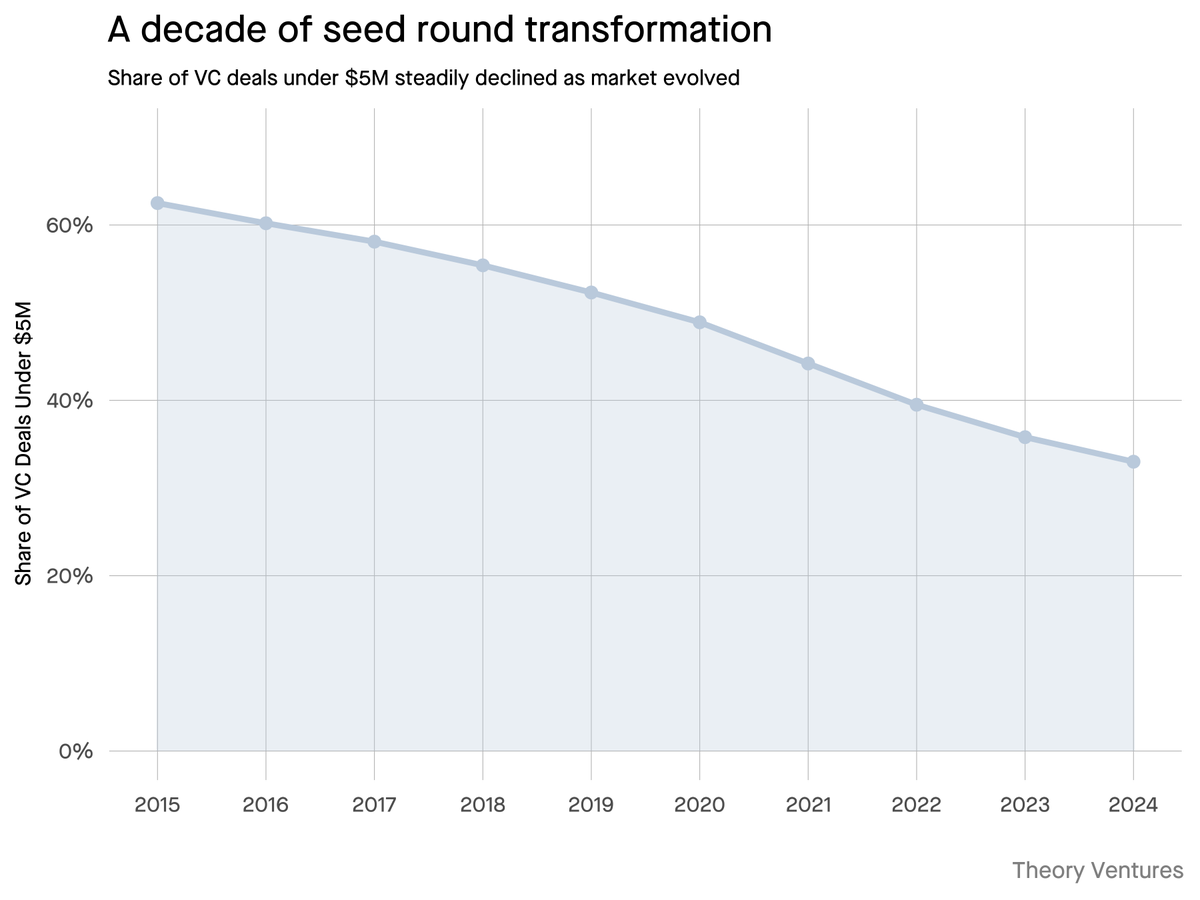
Why is the sub-$5 million seed round shrinking? A decade ago, these smaller rounds formed the backbone of startup financing, comprising over 70% of all seed deals. Today, PitchBook data reveals that figure has plummeted to less than half. The numbers tell a stark story. Sub-$5M deals declined from 62.5% in 2015 to 37.5% in 2024. This 29.5 percentage point drop fundamentally reshaped how startups raise their first institutional capital. Three forces drove this transformation. We can decompose the decline to understand what reduced the small seed round & why it matters for founders today.

@ItsWillHenry ·
You won’t raise VC funding with just an idea. Instead: 1. Solve a real problem that people genuinely care about. 2. Find co-founders who bring complementary skills. 3. Build an MVP and get it into users’ hands quickly. 4. Prove demand with active users, retention, and customer feedback. 5. Generate your first revenue, even if it’s small. 6. Refine your product based on real customer behaviour and show consistent growth. 7. Raise funding only after you’ve built enough traction to make investors compete for the opportunity. That’s when fundraising becomes much easier.

@sabakarimm ·
Before fundraising ask your cofounder and yourself this honestly- If you had $0 more capital how would the company still move forward? That answer will reveal a lot more about your ambition and goals and could become the best part of your pitch

@HustleFundVC ·
Brian Ma has been fundraising every 12 months for 20 years. And his biggest takeaway is that there's no universal playbook. Every raise is different. Different investors, different market conditions, different stages, different versions of you as a founder. What worked last time might not work this time. 20 years of fundraising and he's still learning something new each time. That's the real playbook.
 Watch video
@rebeccakaden ·
One or all of the law firms should build an easy to use agent trained on the docs from all the rounds they've done plus NVCA standards that lets startups and firms close straightforward funding rounds, especially initial funding rounds, completely for free. Acquire your customers for the trickier stuff that way. Alternatively, someone else should build this (maybe us?) But, either way, existing revenue models are breaking. Agents doing the work--from Fred's blog this morning on how we closed the most recent seed round we led:


@GJarrosson ·
Stop polishing your deck. Founders spend weeks on slide transitions and font choices. Investors don't fund decks. They fund traction, team, and speed. Same with "never raise too much" - that's not a universal law, it depends entirely on your business. Fundraising advice on X has turned into a checklist of things that don't matter. Spend that time talking to customers instead.
@StephNass ·
👶 Amateur founders raise when they need cash 👨🏼💼 Pro founders raise when they are fundable Yeah... Fundability is a dead angle for many founders. You don't get to decide when you raise, not really. There are moments you can raise, and moments you cannot. You can raise when: - You have track record - You have traction - The market is hot You cannot raise when: - You don't have at least 1 of those 3 items Fundraising isn't a lottery ticket. Sure, you should optimize with a great deck, a solid process, some intros... But it won't be enough. You need the fundamentals. Pro founders understand that.

@EnisHulli ·
I never saw a deck from half of our portfolio. Two of them are now unicorns. The worst time to fundraise is when you’re actually fundraising. The strongest founders raise when they don’t need to. They build relationships long before there’s a pitch. When it’s time, they compress everything into a tight window, create urgency, and stay in control. This is how deal heat is created. Not a 3 month process. A 10 day sprint. Partner meetings → term sheets. Especially in AI and gaming. In fast moving markets, you don’t wait for perfect conditions. Great founders create their own timing. 70% of our portfolio raises in the past two years happened without a formal fundraising process. When they did raise, it wasn’t a process. It was a moment.


@JesseTinsley ·
Founders in 2026: Your ship is sinking.... Your board says this is "temporary". You raised a few rounds but that was back in 2020 to 2022. Your equity is underwater. You are basically an employee at your own company. Your 7 or 8 figure ARR business is real. But as a standalone company in 2026 with AI changing everything it is not exactly a VC darling anymore. Your investors will not re invest. VCs think SaaS is dead. Private equity says you are too small. You look at debt. Debt looks back and starts laughing. Then you spot another ship. Solid. Growing. Actually afloat. You think: Maybe I should join that one. They make an offer. For the first time in months... maybe years you actually feel relieved. You can breathe again. Maybe you still make millions. Maybe you get to just build product again. No more endless fundraising. No more pretending the finance, HR, and legal mess is temporary. Your cofounder is excited too! This is it. Your board is helpful. Your board always says they are "founder friendly". Of course they will support it. Your board: No... Stay here. Keep plugging holes. We either make it to shore on this ship or die trying. Selling is not an option. Pivoting is not an option. Just keep going. Founder: But you are not even on this ship. Board: Correct. Which is exactly why we can evaluate this objectively. Founder: So what do we do? Board: Have you tried...pivoting morale? Founder: So let me get this straight... I cannot raise. I cannot sell. I cannot pivot. And because of dilution and liquidation preferences, I may not even be worth saving. Board: Exactly. Founder: You are asking me to drown quietly and calmly. Board: We prefer the term "long term thinking". - end PS: This doesn't have to be the end... The real move in 2026 might not be raising another round. It might be finding and joining a platform like Mainstreet and getting on a better ship. And for the record I love VC's. We have 100+ on our cap table who rolled equity into Mainstreet. This post is only about the ones who confuse "founder friendly" with "founder trapped". Because its easy to be friendly when things are good but we see who's actually founder friendly in 2026.
 Watch video
@thisdudelikesAI ·
Soon fundraising will be seen as lazy. 97% of startups won’t be able to justify capital as the #1 constraint. For most startups it will mean you don’t want to work hard, don’t know your market or how to sell. VC will be more about access and compute. They won’t bankroll a runway for founders. They will help them build their own.

@hellowillfan ·
Most founders think fundraising starts with VCs. It usually starts with angel investors. One person writing a small check before the numbers make sense. Before traction. Before validation. Just belief in the founder.
 Watch video
@HustleFundVC ·
The best fundraising tactic most founders skip: practice. Not once or twice. Get 20 founder friends in a room before you ever talk to an investor. Pitch them. Get their feedback. Do it again. Brian Ma's rule: aggregate all the feedback before you change anything. Don't tweak your pitch after every single conversation. Look for patterns across all the feedback, then adjust. It sounds basic. But most founders walk into investor meetings underprepared because they didn't put in the reps. Treat your pitch like a product. Test it before you ship it.
 Watch video
@mernit ·
10 fundraising tips (in no particular order): 1. Speak slowly 2. Wear WIRED apple earbuds (no airpods) 3. Use analogies when describing your company 4. People don’t invest in things they don’t understand 5. Investors won’t help you get PMF 6. Take money from people you vibe with 7. Manufacture urgency 8. Investors smell desperation like a dog smells fear 9. Big companies have messy cap tables 10. Don’t get carried away, raise what you need and get back to building

@sugandhanisa ·
I've been meeting incredible founders at events in London and it's struck me how there is a VAST divide in VC dollars going into picks and shovels agentic startups versus technical builders with world-changing missions struggling to raise money because they just don't know how to create a pitch deck, or how to stand out in a room full of founder pitches, or how to not queue up at all and get cleverer with fundraising. You could say it's part of the game, but PhDs and designers and engineers solving real healthcare problems in novel ways need better than "you just need to learn fundraising/network more". Something's not right about how VC fundraising works versus which startups actually can do something big with the capital and mentorship. You'd think accelerators/incubators would be solving it but many of them seem to be making it worse by creating crowded rooms that serve them more than they serve founders. Every time I meet a passionate founder (I love people whose passion is oozing out of them even at the risk of sounding crazy) I feel a tinge of pain about how the world works. My own position is that funds need to start specialising in specific problem areas and actually have technical theses if they want to focus on catching quality startups at the earliest stages, before even the startup knows they've got something special going on. With new VCs coming every day, the pool of generic capital that chases "hot deals" and "hot founders" (where hotness is a function of the founder's ability to play the optics game) is overflowing. I suspect this a good opportunity for new kinds of VCs to come about. Technical VCs with specific interests and opinionated theses not copied from elsewhere.

@thesakshishukla ·
Chatted with a founder who raised $3M within weeks. Here's her advice for anyone fundraising: "Have utmost clarity on the type of investor you want to partner with." They were clear that they don't want to spray and pray. Instead, she focused only on the investors who would understand her pace, her model, and her ambition. That clarity saved the team time, energy, and countless conversations that would’ve led nowhere (and drained them). She and her co-founders spent months researching investors - how they think, what they back, what they expect, and how they work with founders post-cheque. And when they finally started fundraising, it worked. Everything moved faster because the alignment was already there. Interesting to note that in fundraising tables are turning. Founders will filter investors as hard as investors filter founders.
Best Fundraising tweets
Xholic studies what works in your niche, drafts posts in your voice and schedules them for the hours your audience is online.
$0 today · Cancel anytime
Browse all tweet collectionsKeep exploring