Founder-led distribution
Acquire customers through niche content, SEO, Reddit participation, founder-led outreach, social proof, and building in public.
38%
Best tweets about Micro SaaS
Explore the best tweets about micro SaaS, featuring niche ideas, validation, product building, pricing, distribution, recurring revenue, and founder results.
Specific micro SaaS opportunities, validation, product scope, pricing, distribution, operations, recurring revenue, exits, and transparent founder lessons.
Original Xholic analysis
Discussion in this dataset emphasizes focused vertical workflows, customer validation, and founder-led distribution. AI is frequently presented as a way to reduce build effort, while posts also stress that pricing, retention, operating discipline, customer access, and platform dependence remain important constraints.
76% of posts
All-time engagement
38% of posts
Published in 90 days
Conversation map
Acquire customers through niche content, SEO, Reddit participation, founder-led outreach, social proof, and building in public.
38%
Prioritize marketing, retention, churn management, cost control, and sustainable operations over coding alone.
32%
Find narrowly defined, often boring vertical workflows and solve one painful problem for a specific buyer segment.
28%
Price simple recurring subscriptions around clear time or cost savings, with small customer counts supporting meaningful MRR.
24%
Use AI agents, local models, automations, and agentic integrations to create or enhance narrowly scoped SaaS products.
22%
Validate demand before building through customer interviews, pre-sales, manual delivery, complaint research, and early paid users.
18%
Keep MVPs small and ship quickly using boilerplates, open source, no-code tools, and AI-assisted coding.
18%
Build portfolios of small products, expand within a vertical, and acquire or revive existing micro SaaS businesses.
10%
Tone and stance
Performance benchmark
Posts with media make up 48% of this collection. Their median all-time score is 24.0, compared with 11.3 for text-only posts.
Format mix
Consensus and debate
Shared view
A recurring opportunity thesis is narrow vertical software: solve one painful workflow for a defined buyer rather than offer a broad AI tool. Examples include dental social-media operations, school sports-ground booking, and Shopify-description workflows.
Shared view
Posts commonly frame validation as commercial work before extensive coding: conduct discovery, seek paid demand or manually serve early customers, then build and test a minimal solution.
Shared view
Distribution advice centers on founder-led, niche-specific channels, including long-tail SEO, useful Reddit participation, content, and direct outreach. The dataset’s largest theme is founder-led distribution (38% of tweets).
Open debate
AI is framed both as an enabler for hyper-niche execution and as a force that can intensify competition. One view says niche tools or platforms can remain valuable; another argues that faster building does not create more buyers.
Open debate
An optimistic 30-day build path and modest-MRR target contrasts with posts arguing that “micro” can limit ambition and that visible SaaS outcomes may omit churn, costs, failures, and elapsed time.
Open debate
Acquisition and AI-enabled rebuilding are presented as possible plays, while operators also describe platform dependence as a material risk: policy or API changes can severely damage products reliant on external platforms.
What performs
The strongest outlier is a detailed Postiz-based vertical SaaS playbook. It describes an open-source base, a specific niche, pricing, onboarding, and content-led distribution; its all-time score is 133.88× the dataset median.
List posts are the most common format in the dataset (38%) and have a 28.433 median all-time score. Case studies account for 30%, while opinion posts account for 24% and have an 8.9 median score.
Rapid MVP building has the highest median all-time score among the supplied themes (37.741), followed by AI-native micro SaaS (34.422). The cited posts discuss AI-assisted builds and boilerplates.
Statistical standouts
Creator landscape
The five most represented creators account for 20% of the selected posts.
1. Harshil Tomar
@Hartdrawss
2 posts
2. Hridoy Reh
@hridoyreh
2 posts
3. Justin Butlion
@justin_butlion
2 posts
4. Max 🇮🇪🇱🇻🇨🇾
@maks6361
2 posts
5. Mehul Mohan
@mehulmpt
2 posts
6. Simon Høiberg
@SimonHoiberg
2 posts
Harshil Tomar’s posts advocate simple niche pricing—$15–$39/month in one shared playbook—and a standardized SaaS stack intended to accelerate MVP shipping.
Mehul Mohan’s posts focus on AI-assisted production: one says he shipped a micro SaaS using a large-context model plan, while another describes a one-shot build experiment that cost about $1,000 in credits.
Starter Story covers both portfolio-scale operations and focused customer problem-solving: one case study profiles a portfolio described as 20 apps, while another post advises starting by solving one customer’s pain.
Themes, sentiment, stance, and post format are classified per tweet. All counts, shares, medians, creator concentration, freshness, and performance comparisons are then calculated directly from the published snapshot.
Xholic's all-time score compares engagement while accounting for reach, post age, and creator consistency. It is used for relative comparisons within this collection.
This report analyzes the exact 50-post snapshot shown below. AI identifies editorial categories and drafts explanations; all statistics are calculated from the snapshot, and every narrative claim is checked against cited posts before publication.
Best Micro SaaS tweets
Ranked 01–50
@gregisenberg ·
startup idea for you use postiz (20k+ github stars project) to sell AI social media content/management to 1 niche of SMBs. what's postiz? it's an open source social media scheduler with AI built in. basically buffer + AI and free to download. 1. self-host postiz. use codex/claude code to help you figure this out in an afternoon. 2. pick one niche. dentists, realtors, lawyers. can even go a subniche like orthodentists vs dentists. family law over of lawyers. 2. wrap it in their language. "AI social media for dental practices" 3. add "we write your captions with AI" as the hook. that's what they're actually paying for. 4. plug it into n8n, make, or zapier so posting, scheduling, and approvals run on autopilot. the client approves with one tap. everything else is handled. 5. charge $50/mo-$100 per seat. that's nothing to a business paying $2,000/mo for a social media freelancer. you're 25x cheaper and 10x more reliable because the system runs whether you're awake or not. win-win for everyone. 6. build one landing page. run one onboarding call. that's the whole sales motion. 7. build media to attract customers. post tips for that niche on X, tiktok, youtube. become the "social media for dentists" person. 8. reinvest profits to build other tools that serve that same niche. scheduling, reviews, patient intake. build those tools or plug in more open source projects. now you own the vertical. these businesses KNOW they need to post. they hate doing it. they will never find postiz on github. they will google "someone please handle my social media." that's you open source is the new wholesale. the code is free. the customer relationship is where the margin lives. you can do this as one person. you can do this as a two person team. you don't need funding. you don't need an office. you need a laptop, a niche, and the willingness to start. someone is going to do this. might as well be you.
@tibo_maker ·
if i had to start over in 2026 i'd build a micro SaaS in 30 days here's the exact playbook: find a problem people are already paying to solve don't innovate on the problem innovate on the execution build the MVP in 2 weeks max launch on product hunt get your first 10 customers manually then optimize distribution: SEO for longtail keywords reddit for niche communities twitter for building in public scale what works ignore what doesn't the goal isn't to go viral the goal is to find 100 people who will pay you $50/month that's $5k MRR that's freedom most people overcomplicate this they spend 6 months building then wonder why nobody cares ship fast iterate faster full breakdown here: https://t.co/PWwRPQXhgj...
@starter_story ·
Her 20 app portfolio makes $1.8M per year (on one platform) Most founders bet everything on one product But she suggests you do the exact opposite and let your apps compound on each other. I spoke with @KatieKeithBarn2 for a few hours. Here’s the top 4% of our chat: > Her 19 app plugins and what they do (2:01) > The analytics, numbers, and paying users (2:42) > How she got the first app idea (4:10) > The compounding framework she uses (4:46) > Her entire growth channel strategy (5:36) > Her "secret sauce" for LTV growth (7:53) > If she had to start over today, here's what she would do (9:56)
@mehulmpt ·
I tried Kimi K3 Max on the $99/month 1 million context window plan, and shipped a micro SaaS. Here are my learnings with a full breakdown
@ujjwalscript ·
Right now, every developer with Claude and an API key is trying to build a massive, world-changing generative tool. And 99% of them are becoming OBSOLETE in six months. The actual gold mine in 2026? Using AI to build hyper-niche, painfully boring software for industries that Silicon Valley forgot - Micro SaaS! Here is why the math works for solo developers today: 1. The Execution Gap is Gone Two years ago, launching a SaaS required a frontend dev, a backend engineer, and a DBA. Today, a single developer using Claude or Codex can orchestrate the entire modern stack in a week. You no longer need a team; you just need a problem. 2. Riches are in the "Boring" Niches Don't build a "general productivity app." Build a hyper-specific solution for a physical-world problem. Think about a dedicated venue booking platform specifically designed for local schools to reserve sports grounds. It sounds completely unsexy. It won't get you on the front page of Hacker News. But it solves a massive logistical headache (handling timezones, double-bookings, and admin access) for a specific group of buyers who are thrilled to pay a monthly subscription to make their pain go away. 3. You Compete on Empathy, Not Code When the cost of writing code drops to zero, your only moat is your understanding of the customer. Because the AI is handling the boilerplate and the repetitive syntax, you can actually spend 80% of your time acting like a business partner—talking to users, refining the product, and closing sales. The formula has never been clearer: Find a boring problem in a traditional, messy industry. Use AI to build the solution in weeks, not months. Charge $99/month to 1,000 businesses.
@starter_story ·
Pick ONE customer, and CRUSH their pain. Here’s how $16K MRR micro saas actually gets built: 1. Feel the pain of one person 2. Solve it faster, cheaper, better than anyone else 3. Test it with ONE customer 4. Watch the word of mouth spread like wildfire If you build for everyone, you build for noone.
@1752vc ·
Top Subreddits to Get Your Startup Noticed👇 r/entrepreneur r/buildinpublic r/testmyapp r/sideproject r/indiehackers r/startups r/roastmystartup r/mvplaunch r/growthhacking r/launchmystartup Niche & product-focused communities: r/macapps r/iosapps r/androidapps r/chrome_extensions r/productivityapps r/webdev r/selfhosted Marketing & growth: r/seo r/askmarketing r/growmybusiness r/scaleinpublic Discovery & feedback: r/imadethis r/showmeyoursaas r/producthunters r/internetisbeautiful r/testmyapp Founder & business communities: r/smallbusiness r/startup_ideas r/thefounders r/indiebiz r/saas r/saasbuild Bonus: r/digitalnomad Pro tip: Don’t just drop links—engage, tell your story, and give value first.
@forgebitz ·
indiehackers could build micro saas tools and make a lot of mrr because there were many small inconveniences where you would happily pay 50/m to just get it done that 50/m was fine if it just saved you a day of work now that micro saas gets vibe coded (and integrated) for $50 in tokens is this the end of small saas? no i don't think so; looking at our own spending, besides burning tokens i see a lot of saas platforms and niche tools we still pay a lot for but the key word is platforms and niche tools either you are extremely niche and just the perfect tool for a big enough problem, or you are a platform every saas will become an agent, my agent is better then your agent. so there is a market for agents everybody is looking for the best agent
@yasser_elsaid_ ·
I don't understand why would anyone set out to build a micro saas? The thing won’t work anyway unless you’re putting in 10+ hours a day. Calling it micro from the start puts a ceiling on what you can do and on people’s expectations. No one takes it seriously. I’m not buying anything from someone who’s explicitly building a lifestyle business. That doesn’t mean you can’t build something great with a small focused team. Look at Telegram: ~20 engineers, 0 sales, insane impact, insane revenue. If you’re going to work hard anyway, you might as well make it worth it.
@maheshnani122 ·
Don’t build your SaaS from scratch You’ll waste months on auth, billing & dashboards Use these 18 SaaS boilerplates instead✌️ 1. ShipFast (Paid) 2. Supastarter (Paid) 3. Makerkit (Paid) 4. Divjoy (Paid) 5. SaaS Pegasus (Paid) 6. Laravel Spark (Paid) 7. TurboStarter (Paid) 8. Shipixen (Paid) 9. Bullet Train (Paid) 10. Open SaaS (Free) 11. Ixartz SaaS Boilerplate (Free) 12. Next SaaS Stripe Starter (Free) 13. Supanuxt (Free) 14. T3 Stack (Free) 15. SaaS Boilerplate by Apptension (Free) 16. Makerkit Lite (Free) 17. LaunchFast OSS (Free) 18. NextBase (Free tier) Ship in days, not months Focus on product, not setup Smart devs don’t reinvent, They launch.l
@phuctm97 ·
Alright, enough with the "SaaS is dead" and "indie-hacking is dead". I gotta admit I was lowkey influenced by the negativity too. So I actually went & collected a few recent positive examples in 2026: • Postiz (@wickedguro): ~$17k → $145k MRR in 4 months, now at $2M ARR • Marc Lou (@marclou): his 3 newest ones (TrustMRR + DataFast + Ship or Die) grew passed his breakout success (ShipFast + CodeFast) in 2026 • Sleek (@mattiapomelli & friends): $10k in a few weeks, $25k in 6 months (met them in Bali, solid guys) Plenty more on @IndieHackers: $7k side projects, $50k - $125k businesses running entirely by AI Company formation at all-time highs. Solo founders reach ramen profitability a lot faster. So yeah… SaaS isn’t dead. Indie-hacking isn’t dead. But you gotta change both the product and the distribution big time.
@Hartdrawss ·
The ONLY SaaS stack you need in 2026 (this is what ships products in <30 days ) : I've used this exact stack on 50+ MVP builds. Bookmark this. Frontend → Next.js 15. Stop re-evaluating. The ecosystem won. Auth → Clerk. Full auth in 45 minutes. Not 3 days. Use it. Database → Supabase. DB + auth + storage + realtime. Four tools in one. Payments → Stripe. No second option worth discussing. AI → Claude API via OpenRouter. Cost control + best in class. Email → Resend. Cleanest API. Zero config hell. Analytics → PostHog. Privacy-first. Replaces 3 tools. Hosting → Vercel. Push to main, it's live. That simple. Files → Cloudinary or UploadThing. Dont build this yourself. Ever. Total cost until 1,000 users : $0-60/month This isnt theory. This is what SHIPS real products in 3-4 weeks. I know because I've done it 50+ times.
@uteddy10 ·
Trying to build a massive global SaaS product from Lagos or Abuja to compete with Silicon Valley giants is an uphill battle. The smarter, highly profitable alternative in 2026 is building "Micro-SaaS"—simple, single-feature software tools that solve immediate operational pain points for local business owners. A short write up on building cash-flowing local software tools 1) Identify the Local Friction: Look at the manual workflows around you. Small logistics operators tracking dispatches via WhatsApp, neighborhood pharmacies manually checking stock expiry dates, or local vendors struggling to calculate delivery fees based on fuel updates. These are software opportunities hiding in plain sight. 2)Build Minimal, Execute Faster: Do not spend 6 months building a complex platform. Build a single, clean dashboard or automation script that fixes that one specific problem. Charge a reasonable local monthly subscription that is easily justified by the hours or money your software saves them 3) Showcase the Proof on X: Use your timeline to document the build process, share user testimonials, and break down the metrics of how your tool improved an SME's daily workflow. When other local operators see tangible proof of competency, your inbound user acquisition scales organically. Bookmark this thread to map out your Micro-SaaS.
@JamesonCamp ·
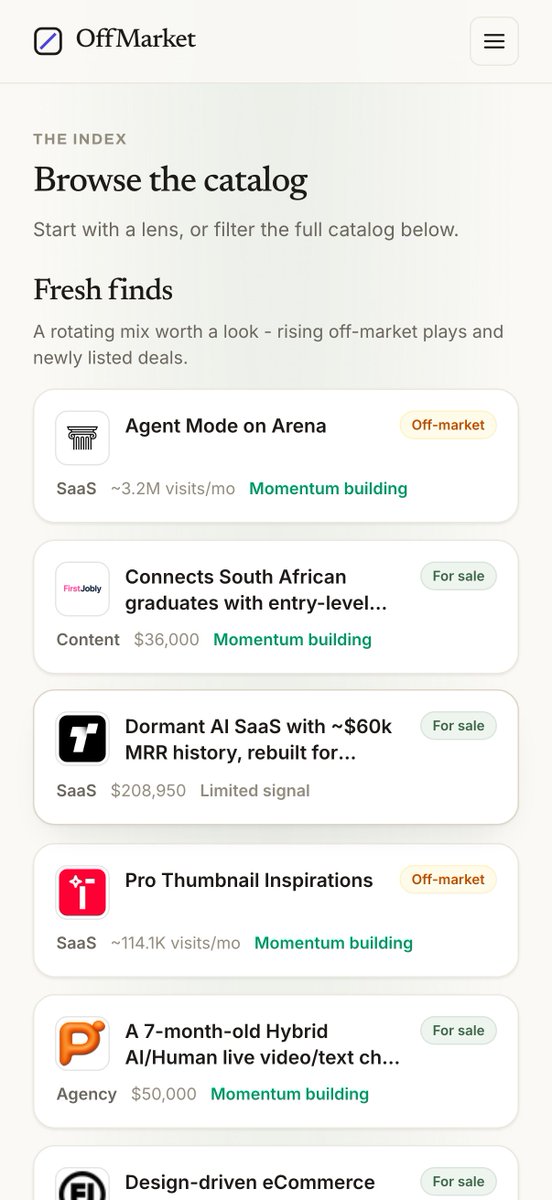
Two years ago I bought a SaaS business for $6k. It had some users and was a great concept. Find saas etc businesses that arent for sale yet, but should be - and provide their contact info. But then the software broke... Devs quoted $20K to fix it. It was only doing a few grand a month. So I shut it down. Wasnt worth it. Then AI changed the math on everything. I rebuilt the whole thing myself with Claude. I don't write code. 9,760 lines across 97 files. A dev shop would've quoted $150K to $220K. I spent mass amounts of coffee and patience. Now it's 10x better than the original. 12,800 businesses indexed daily. An agent that scores them, writes deal memos, runs diligence, finds the owners contact. Adds new business all the time It's everything I wished I had when I was trying to buy a business myself With a little effort it should become a nice little $20k+ a month sidequest. The playbook if you want to steal it: 1. Pixeling everything from day one. Pages, tools, emails, all of it. Before I spend a dollar on ads I want to know exactly who's touching the site and what they care about. 2. Launching to my own email list first next week. Then offer affiliate deals to other newsletters. 3. Dedicated LinkedIn account just for it - Outbound to Brokers, M&A advisors, search fund operators. 4. One Instagram reel a day. Whatever pops, I throw ad dollars behind it. Organic first, paid amplifies the winners. UGC creators next. The whole thing runs on maybe 5-10 hours a week alongside my consulting. I'm calling this side quest maxing. Just maxing a dead product back to life with AI and simple marketing frameworks.
@Hartdrawss ·
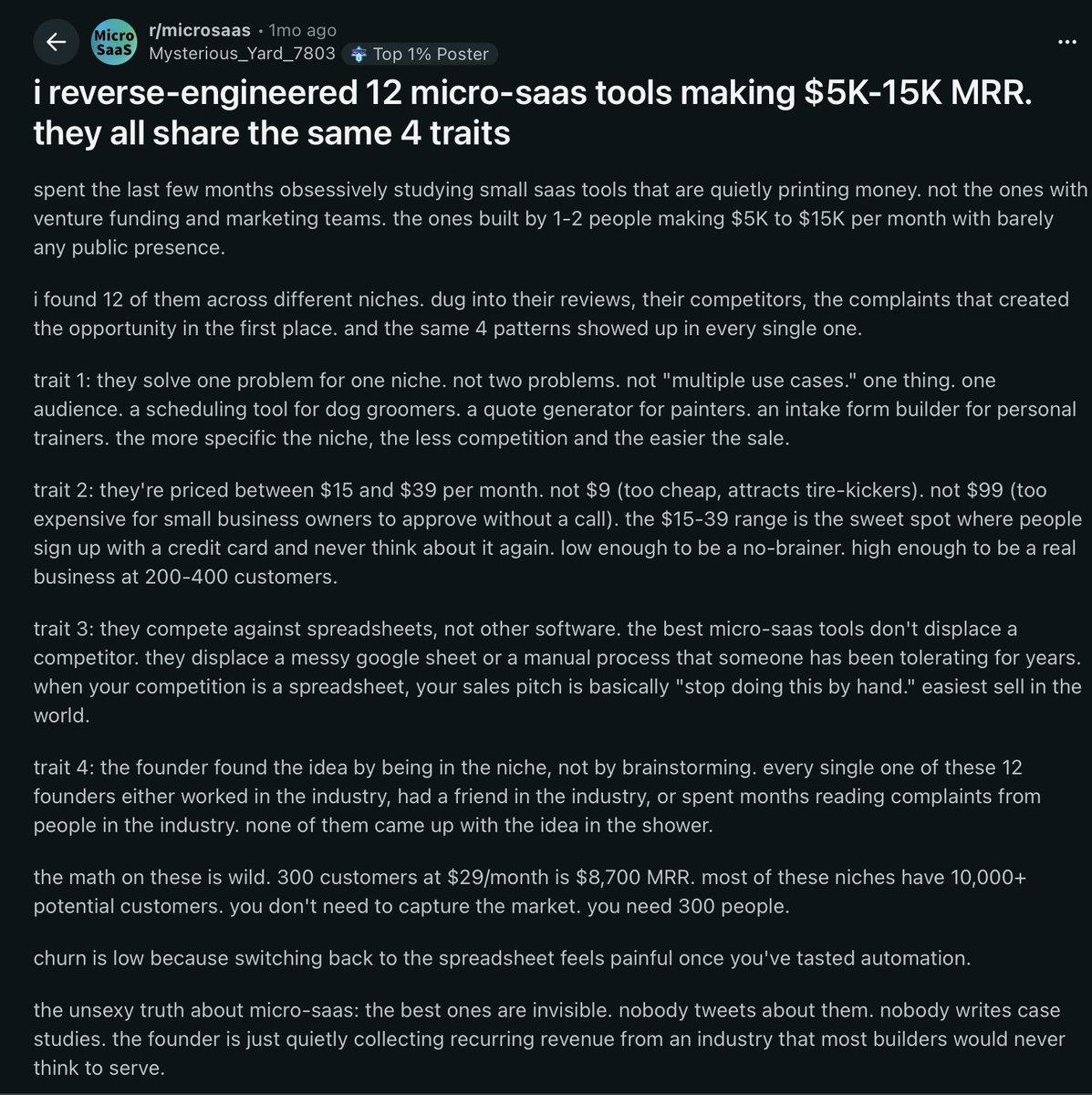
This reddit user found the 10 Step Secret Sauce to hit $15k MRR in <60 Days ! here's the full Playbook ( STEAL THIS ): 1/ every tool solved one niche pain >not multiple use cases or broad platforms >one problem for one specific audience >dog groomers, painters, trainers, boring niches >specificity made selling easier 2/ pricing stayed boring too >most sat between $15 and $39/month >$9 attracted tire-kickers >$99 needed too much approval >$29 worked at 300 customers 3/ spreadsheets were the real competitor >they didn't replace other SaaS tools >they replaced messy manual processes >spreadsheet pain made the pitch obvious >“stop doing this manually” sells fast 4/ ideas came from inside the niche >founders worked in the industry already >or had friends inside the market >or studied complaints for months >none came from shower brainstorming 5/ the math was simple >300 customers at $29 = $8,700 MRR >most niches had 10,000+ possible buyers >they didnt need the whole market >just 300 people with pain the real takeaway: >pick boring niches >replace manual work >price for easy decisions the best micro-SaaS tools are invisible and quietly print.
@SimonHoiberg ·
Build a Micro-SaaS in 7 days. Test the market. Then double down or kill it. Rinse and repeat until you have a working product. 🔹 Days 1-2: Think like a user, not a founder. What makes this necessary? Sketch the data and the screens. Use your favorite boilerplate to get going. 🔹 Days 3-4: Function over form. Drag, drop, wire it up. Draft a clean, functional UI. Add essentials like auth and payment. 🔹 Day 5: Reduce friction. Onboard in one minute. Create a place for feedback. Ship a landing page that promises an outcome, not a feature list. 🔹 Days 6-7: Show, don't tell. A 60-second demo video. Pair it with a simple launch offer and push it everywhere your users hang out. With the right tools, this is possible in 2026. 🔸 Aidbase 🔸 n8n 🔸 Supabase 🔸 Lovable 🔸 Cursor If it doesn't pick up, start over. You can do at least 30 of these in a year.
@alexabelonix ·
just watched a really good video about how to take a SaaS from 0 to 1,000+ users here are the key points: 1. do at least 50 customer discovery calls before coding 2. build the smallest possible MVP 3. don’t scale until you have product-market fit 4. build your founder brand from day one 5. after PMF, activate the “magic triangle”: content → targeted outreach → retargeting 6. make your outreach targeted and conversational the whole process is basically: validate the problem → get people to pay → build the smallest solution → find PMF → scale distribution simple step by step, but honestly such a good reminder
@maks6361 ·
Here’s the result of my marketing agent and SEO for one of my micro SaaS. I launched it almost 2 weeks ago and from day one started posting daily blog posts optimised for SEO. ChatGPT has finally started recommending my SaaS! No subscriptions yet, but I’ve started getting users into it. 4 users yesterday and 8 today so far. Hopefully I’ll start seeing subscriptions soon 🚀
@romanbuildsaas ·
A year ago, I pitched my co-founder a third startup idea. He said no. After shipping two products in two months that both flopped, he wasn't writing another line of code until we had proof people wanted it. Fair. I had a new idea but no developper to ship it. So I opened PowerPoint instead. * Built a 6-slide deck in 10 minutes. * Booked 5–6 demos a day with outreach * Sold the product before it existed. * Delivered every customer myself. It accidentally became a $10k MRR agency. That was all the validation we needed. My co-founder finally built the software. Today, that same SaaS business is doing $3M ARR. The biggest mistake founders make isn't building too slowly. It's building before selling.
@alphabatcher ·
How to make money with AI in 2026: I read dozens of articles about “AI businesses” and filtered out what actually works ↓↓↓ 1. AI agents for businesses ($2,000-5,000) You come in, analyze their workflow, and build a single agent for a specific process: - lead qualification - customer support - reporting automation 2. AI influencer ($500-5k/month) - create an AI character using Arcads - sell ads or promote products for a revenue share - include a clear CTA directly in the video, not just “link in bio” - run the same videos as paid ads after validating them organically 3. Vibe coding and micro-SaaS ($49-$199 one-time payment or $9-$49/month subscription) - Chrome extensions - Telegram / Discord bots - niche-specific automations - internal tools for companies 4. AI workshops for teams ($500-1,500 per team session) Companies bought Claude Team or ChatGPT Enterprise, but no one really knows how to use them You fix that in 90 minutes 5. 24/7 support for SaaS ($200–500/month per client) Most small SaaS founders handle support themselves and it quickly becomes exhausting You come in with a ready solution: - train an AI agent on their documentation - it resolves up to 80% of common questions - complex cases are escalated to the founder - you only get alerts when human input is actually needed 6. Local SEO + Claude for local businesses ($1,500-3,000 setup + $500-800/month ongoing) With Claude + Claude Cowork, you can achieve in a week what used to take a month: - audit competitors’ Google Business Profile categories - analyze review velocity and identify common themes in feedback - ready-to-use review reply templates with relevant keywords - an 8-week content plan for GBP posts - optimized service descriptions and a clear photo strategy CONCLUSION Niche expertise, a strong personal brand, and real client results this is what scales in 2026 And all of these skills you can monetize require nothing but your time
@Joey_Walker82 ·
25 ChatGPT prompts every indie founder and app builder needs right now: [Bookmark this] 1. Validate Your App Idea Fast Prompt: "Analyze the top 20 1-star reviews in the [app category] on the App Store and identify the 5 most common unmet needs." 2. Find Your Niche Market Prompt: "For the [industry], list the 10 biggest pain points, rank them by frequency, and suggest 3 micro-SaaS ideas for each." 3. Write a Cold Outreach DM Prompt: "Write a personalized DM to a potential beta user in [niche] that highlights [your product's core benefit] without sounding salesy." 4. Build Your MRR Growth Plan Prompt: "Using the AARRR framework, create a 90-day growth plan for a [SaaS/app] targeting [ideal customer persona]." 5. Generate App Store Copy That Converts Prompt: "Write an App Store description for [app name] targeting [audience]. Use the AIDA framework and keep it under 170 words." 6. Craft a Launch Email Sequence Prompt: "Create a 5-email launch sequence for [product] using the Customer Value Journey framework." 7. Extract Competitor Weaknesses Prompt: "Compare the top 5 apps in [category] and output a table with: name, rating, top complaints, and gaps I could build into." 8. Build a No-Code MVP Roadmap Prompt: "Guide me through planning a no-code MVP for [product idea], listing must-have features, tools to use, and a 30-day build timeline." 9. Write Scroll-Stopping Headlines Prompt: "Generate 10 punchy headlines for [product/content topic] aimed at indie founders and side-hustle builders." 10. Turn Features Into Benefits Prompt: "Using the value proposition framework, rewrite these [product features] as customer benefits for [target audience]."
@woocassh ·
I like the ladder pricing approach for SaaS Yes I know SaaS is dead, we're cooked, perma underclass awaits but hear me out, if you keep going, keep iterating, I think a few people can still make it, are you gonna try? Anyway, here's my take on price ladders - early users get a forever discount bc they take a chance on an early product - once a stage sells out it might lower churn? - creates some sense of urgency ? still gathering data but will update as I learn keep marketing fam
@RaulOnRails ·
We just launched indie.md, an open knowledge base of real indie hacker case studies with extractable advice. No generic "10 tips to grow your SaaS" lists. Every piece of advice is pulled directly from a real builder's journey: how @zawasp turned a weekend fax project into micro-SaaS, how I built a $5/year anti-hustle job board, and how @vtemian grew an AI video API by abandoning traditional marketing. 29 lessons across SEO, product, distribution, business, and mindset. All open source. Big shoutout to @vtemian for putting this together 🙌 https://t.co/TyKR7Ieang
@adrien_brbr ·
3 Reddit rules that brought paying users to my SaaS: 1. Never post in r/startups or r/SideProject. Your customers aren't there. Find where they actually complain about the problem you solve. 2. Stop creating posts. Start replying. Find someone frustrated with the exact problem you solve. Help them. Mention your product only when it genuinely fits. 3. Same 2-3 subreddits. 3 times a week. Every week. Mods recognize you. Community members start tagging you. Reddit drove 80% of my growth this quarter. Not ads. Not viral posts. Showing up in the same rooms and being useful, over and over.
@justin_butlion ·
I just completed my 5th SaaS acquisition which takes my portfolio to $7.8k MRR across 10 apps. Learn more about the deal below 👇 I started acquiring micro SaaS back in 2022 after establishing my holdco, Hawkeye Ventures. Since 2022 I've completed 5 deals using @acquiredotcom, @agazdecki amazing marketplace. This deal was for 4 @mondaydotcom apps totaling $1.3k in MRR. Here is why I liked it: 1️⃣3 out of the 4 apps were growing every month 2️⃣Low churn (1% - 2% a month) 3️⃣Clear product market-fit 4️⃣Multiple of 2.44X on ARR (16k ARR for 40k) 5️⃣I had previously acquired Monday apps and the ecosystem is strong and growing 6️⃣99% operating margin Check out the post I just published for more details on the deal and an update on my SaaS portfolio. Link in the first reply below 👇
@0x_Kapoor ·
Well, in the coming months and years, we are gonna be seeing a lot of MCP-based or Agentic use case SAAS and it will surely blow up. Why is that?? First of all I would lead with an example of @marclou and @wickedguro, as they both have a SAAS variety with an agentic experience and even Marc launched this as a feature, I guess, 2 days back and that's when I realised how this industry is revolving. They both are doing hundreds of MRR with their SAAS and as time passes by it will only increase just because how convenient it is and how much better it will gonna be in the future. I am a big believer of agentic experiences, and even in the future it will be all about the plug-and-play your agent. And people with this kind of saas will go on to disrupt because it will be like a child's play to integrate their service using Agents and just prompt into different businesses or even individuals. This market is still so empty right now that I can't even fathom of the opportunity this brings. You can literally make the hardest integration possible SAAS and add this agentic feature and just sell it and people will buy it because of the convenience, and that's how a lot of projects or micro saas will differentiate themselves from "Okay, we can also vibe- code this software" People are not even realising this opportunity right now and not even talking about this entire opportunity, even it's something that might be very useful for mobile apps and even hardware startups. When people talk about integrating AI in their businesses, I now see WHY THAT IS and what exactly AI integration means now. Don't waste your time adding immense features into your SAAS just roll out an MVP, add an agentic experience as a feature, and go full on focus on distribution. You'll not go broke and your SAAS will not die. I think I can even write an extensive article on breaking down this entire topic around agents, so yeah, if this is something that gets attraction, then why not? I'll be more than happy to do a bit of my research and write an article of what I think of this experience.
@SimonHoiberg ·
The best SaaS ideas usually sound kind of embarrassing when you say them out loud. Tiny workflow. Weird internal process. Problem only a specific type of customer complains about. That is why founders skip them and chase larger-looking ideas. Then someone else turns the boring thing into a very profitable product.
@maks6361 ·
Weekly update: This week wasn’t as productive as the previous one, but I still made good progress. Pivoted a couple of landing pages of my apps into web apps, so now I have 4 micro SaaS projects in total. I’ve set up a marketing agent for each SaaS to kick off daily blog posts and keep boosting SEO. So I’m going to leave them as they are, let them grow, and check in from time to time. Haven’t had any purchases for the SaaS projects yet, but I’m slowly getting users, so hopefully conversions will come soon. Finally getting back to mobile apps from tomorrow. Going to tackle a couple of features for existing apps that were requested by users. After that, finally back to TikTok marketing. I’ll keep building and refining my Claude skills, then start testing them out.
@ericdjav ·
I grew a SaaS to €1,500 MRR in 3 months. Then LinkedIn killed it with a single email. 7 things I'd tell you before you build on any platform: 1. Build an email list from day one. It's the only audience nobody can take back. 2. Never let one platform be your single point of failure. 3. Run your product on your own infra, not their API and their terms. 4. Diversify your distribution before you need to, not the day you're forced to. 5. Read the TOS like the contract it is. You're the weaker party. 6. Followers are borrowed, never owned. 7. Always be building the next thing. The reflex to restart is the real moat. That green line falling off a cliff is 3 years of work, deleted in one afternoon.
@RoundtableSpace ·
THIS GUY BUILT 3 MICRO SAAS APPS MAKING $4.2K/MONTH WITH ZERO API COSTS USING LOCAL LLMS
@this_is_mhd ·
You don’t need 10,000 users. You need 47 people with a weird problem and a credit card. That’s the entire Micro SaaS playbook. But nobody talks about this. Because it’s not sexy. It doesn’t get likes. It won’t make you Twitter famous. So instead, indie makers chase the same exhausted ideas: → Another productivity app → Another AI wrapper → Another note-taking tool → Another habit tracker Massive markets. Infinite competition. Zero differentiation. And then they wonder why they burn out after 6 months with nothing to show for it. Here’s the truth nobody wants to hear: The best Micro SaaS ideas sound stupid when you say them out loud. Invoicing for mobile dog groomers. Scheduling for freelance tattoo artists. Inventory tracking for small-batch candle makers. Silly? Yes. Profitable? Absolutely. Because when you solve a weird, specific problem, something magical happens: → Competition disappears → Marketing gets easy → Customers find you → Word of mouth actually works You’re not fighting for attention in a sea of 10,000 identical products. You’re the only option for a tiny group of people who desperately need what you built. That’s the game. Not scale. Not virality. Not trend-chasing. Just ownership of a corner nobody else wanted. Here’s the playbook: -> Talk to those 47 people. -> Find the silly problem. -> Charge them money. -> Build the simple fix. -> Ignore the trends. -> Help them daily. -> Keep it tiny. -> Repeat. You don’t need a massive launch. You don’t need Product Hunt. You don’t need to go viral. You need a niche so specific that when those 47 people find you, they think: “Finally. Someone built this for me.” That’s the feeling that prints money. The indie makers who win aren’t chasing scale. They’re hiding in plain sight, solving weird problems, collecting quiet revenue, and ignoring everything the timeline tells them to do. Solopreneurship isn’t about getting big. It’s about staying small on purpose. Own your tiny corner. Let everyone else fight over the crowded ones.
@justin_butlion ·
The image below paints a sad story. A few years ago I acquired a SaaS called Pulsebanner that relied heavily on 2 APIs (Twitch and Twitter). When Elon acquired Twitter and changed their API usage policy, my micro SaaS was massively impacted. At its peak, Pulsebanner was doing over $2k MRR (I acquired it for $45k). Today it's doing less than $200 a month in revenue. The lesson: Platform risk is a real thing and you should try and avoid it where possible. That's hard to do today since having a lot of integrations is the norm. But at least try not be a "middleman" between two APIs. I'm you want to learn more useful lessons from my SaaS failures, check out my latest post on the SaaS Decoded substack (link in my bio).
@Anubhavhing ·
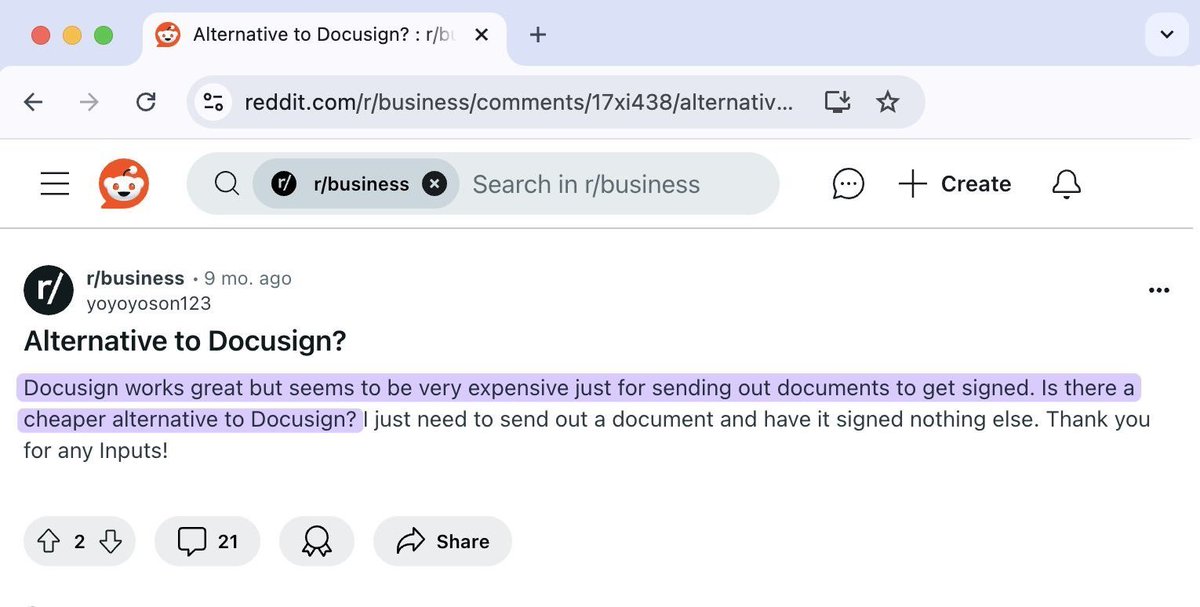
😐Saw this post on Reddit, and found it so misguiding. Referring to Candle, the couples app, I think an important piece of context is missing here. Candle isn’t a typical bootstrapped micro-SaaS. It’s a YC-backed startup with access to significantly more resources and capital than most founders in this subreddit or on X. Building and managing a network of 100+ creators, testing content at scale, and repeatedly pushing winning creatives requires deep pockets that most early-stage founders simply don’t have. The strategy itself is valid, but I don’t think this is necessarily a representative example for the average SaaS founder. It would have been helpful to mention the company’s background, funding, and distribution advantages so readers can better evaluate what’s actually transferable versus what’s unique to this specific case.
@markizeeee ·
Your X timeline is lying to you about SaaS. Not necessarily because every founder is dishonest, but because you mostly see the winners. A study of 7,992 startups with verified payment revenue shows a very different reality: • 68% never exceeded $1,000 in total revenue • Around 17% reached $1K to $10K • Around 10% reached $10K to $100K • Only about 5% exceeded $100K • Just 77 companies, roughly 1%, passed $1 million And the revenue is brutally concentrated: The top 1% collect 77% of current revenue. The top 10% collect 97%. The bottom half make almost nothing. But open X and it looks like everyone launched an AI SaaS last month, reached $10K MRR, quit their job, and now works two hours a day from Bali. That is survivorship bias, and sometimes it is also a customer acquisition strategy. A founder posts a big Stripe screenshot. The screenshot attracts attention. Attention creates followers. Followers become website traffic. Traffic becomes customers. Those customers increase the revenue displayed in the next screenshot. So the “building in public” post is not always just transparency. Sometimes, the revenue post itself is the marketing funnel. This does not mean all revenue screenshots are fake. Many founders are honest and have built excellent businesses. But revenue screenshots rarely show: • Failed products • Refunds • Churn • Advertising costs • API and infrastructure costs • Contractors and salaries • Taxes • Years of unpaid work • The audience that existed before launch The data also shows how slow the real journey can be. Companies in the $1K to $10K total revenue range are typically around 11 to 12 months old. Those between $100K and $1M are typically around 33 months old. Passing $1 million often takes more than five years. Even among businesses currently making money, the numbers are usually much smaller than the viral posts suggest. The median subscription price is only $13 per month. The median successful subscription business has just eight active subscribers. AI is also not an automatic gold mine. The dataset includes 1,780 AI startups, but only 35% reached $1,000 in total revenue. Among the AI products making money, median monthly revenue was around $198. Building a SaaS can absolutely change your life. Software can have excellent margins, recurring revenue can compound, and a small product can become a real business. But SaaS is not guaranteed passive income. It is usually a long process of finding a real problem, reaching the right customers, improving retention, controlling costs, and surviving long enough for revenue to compound. Do not build because someone posted an impressive MRR screenshot. Build because you understand a painful problem, know who will pay to solve it, and can keep going when nobody is liking your progress posts. Revenue screenshots are content. Retention, profit, customers, and time are the real business. Source: Analysis of 7,992 startups with payment verified revenue from the TrustMRR database.

Best Tweets by Topic