Connection, mentorship, and serendipity
Loss of hallway learning and social life, loneliness, junior development, networking, coworking, conferences, and periodic in-person contact.
30%
Best tweets about Remote Work
A curated collection of the sharpest, most-shared X posts about remote work—saved so you do not have to dig through the timeline yourself. Updated weekly.
What working from anywhere actually looks like, good weeks and bad ones both.
Original Xholic analysis
The posts portray working from anywhere as a tradeoff rather than a universal benefit. They describe family proximity, autonomy and access to wider talent pools alongside household-boundary pressure, isolation, mentorship concerns and location restrictions. Across the discussion, fit, team design and management practices are repeatedly presented as important to how remote work works in practice.
42% of posts
All-time engagement
50% of posts
Published in 90 days
Conversation map
Loss of hallway learning and social life, loneliness, junior development, networking, coworking, conferences, and periodic in-person contact.
30%
The practical reality of working from home: dedicated workspaces, schedules, focus, isolation, burnout, and ending the workday.
26%
RTO mandates, geo-fencing, location restrictions, labor disputes, job-posting restrictions, visibility expectations, and trust versus surveillance.
22%
Office-cost savings, global hiring, compensation arbitrage, cross-border opportunity, local cost-of-living advantages, and changing talent markets.
18%
Arguments over productivity, creativity, communication, culture, and which types of work or people fit remote versus in-person setups.
18%
Async work, explicit ownership, writing-first communication, KPIs, hiring, management discipline, and outcome-based organization design.
18%
Working while traveling, remote-work visas, relocation decisions, destination infrastructure, and the realities of location-independent work.
16%
Remote work’s effects on parenting, household life, relationships, time with children, and freedom from office performance and commuting.
16%
Tone and stance
Performance benchmark
Posts with media make up 44% of this collection. Their median all-time score is 6.65, compared with 6.16 for text-only posts.
Format mix
Consensus and debate
Shared view
Posts describe working from home as allowing more proximity to family and relief from performative office expectations. They also show that work done at home may be treated as less visible or more interruptible by others in the household.
Shared view
Posts describe loneliness, missed hallway conversations and reduced access to mentorship. Coworking arrangements, conferences and in-person gatherings are presented by posters as ways to create social or professional contact.
Shared view
Posts about distributed teams recommend explicit ownership, writing down decisions, intentional team cadence, clear goals and performance data. These are presented as practices that can support remote operations, not as guarantees of success.
Open debate
Some posts argue that output should matter more than work location, while others argue that in-person work improves attention, mentorship or creative collaboration. One post explicitly says remote and office arrangements suit different people.
Open debate
Posts criticize geographic restrictions and return-to-office policies as limits on flexibility. Another post argues that senior leaders need physical visibility, while a labor-board report describes a challenge to a state return-to-office requirement.
Open debate
Posts describe expanding remote-work visa options, but also tighter visa documentation requirements, infrastructure disruptions and hiring filters based on applicant location. Together, they portray “work from anywhere” as subject to practical and employer-imposed limits.
What performs
The “Remote vs. office tradeoffs” theme had the highest supplied theme median all-time score, at 7.272. Its evidence includes posts making contrasting cases for in-person work and for matching work arrangements to individual fit.
Question posts had a median all-time score of 7.65, above announcements (6.326), lists (6.79) and stories (6.697). The supplied question examples address the remote-work debate, leader visibility and geo-fencing.
Tweet 2041860175779516804 was the highest supplied outlier, with an all-time score of 331.78—50.5 times the supplied median. The post describes household expectations and the perceived legitimacy of working from home.
Statistical standouts
Creator landscape
The five most represented creators account for 18% of the selected posts.
1. Tommy Thomas
@0xTommyThomas
2 posts
2. Mahima Jalan ماهيما جالان
@MahimaJalan2
2 posts
3. AliceTheTechyChef
@thetechychef
2 posts
4. We Work Remotely
@weworkremotely
2 posts
5. aisauce
@aisauce_x
1 post
6. Alex Cloudstar
@alexcloudstar
1 post
Mahima Jalan’s two included posts contrast a detailed account of household pressure while working from home with a post attributing her remote company’s profitability to a lean team, lower operating costs and global talent access.
Tommy Thomas’s two included posts discuss remote-work visas in Africa and across Southeast Asia, framing mobility around changing regional access.
The two included We Work Remotely posts characterize remote work as potentially lonely or peaceful, and describe relief from the pressure to perform professionalism in an office.
Since the previous snapshot
Themes, sentiment, stance, and post format are classified per tweet. All counts, shares, medians, creator concentration, freshness, and performance comparisons are then calculated directly from the published snapshot.
Xholic's all-time score compares engagement while accounting for reach, post age, and creator consistency. It is used for relative comparisons within this collection.
This report analyzes the exact 50-post snapshot shown below. AI identifies editorial categories and drafts explanations; all statistics are calculated from the snapshot, and every narrative claim is checked against cited posts before publication.
Best Remote Work tweets
Ranked 01–50

@MahimaJalan2 ·
Work from home concept has no izzat in India. It's been 5 years since I started working from home, but even to this day I help my mom with household chores, give full attention to guests, do all the market k kaam even during office hours, give her time, and despite all this, she says, "tum toh pura din laptop pe busy rehti ho". The irony is that if I commuted 2 hours, sat in an office, and came home exhausted, I'd be taken seriously. WFH didn't blur work-life balance. The office was the only proof society accepted that your time had value.

@HillValleyForum ·
"We're not in business so my employee is happy. I'm in business so my customer is happy." JPMorgan CEO Jamie Dimon just ended the remote work debate in 45 seconds. "People on Zoom — they're texting each other. That's not full attention." "They learn by going on a sales call with you. They learn by seeing you make a mistake. They learn by how you deal with the mistake.” “If you go to a meeting with me, you've got my full friggin attention the whole time." The Hill & Valley Forum 2026 @HillValleyForum @jpmorgan
 Watch video

@denk_tweets ·
fully remote over mandatory in-office is a hill I will die on... > I work from a penthouse in Medellin with a private chef and maid (for less than a standard apartment in LA) > the lifestyle arbitrage frees up ~150 extra hours a quarter to focus and build the company > my job as CEO is to make high quality decisions, and my energy and focus are a byproduct of my environment > office leases are one of the largest expenses for most companies (we instead put that cash towards user acquisition) > we hire the absolute best person for the job, regardless of where they live > employees work where they want, when they want, where they are most comfortable > I couldn't care less about where work is getting done as long as we're executing > there isn't an inequality of talent, just an inequality of opportunity @beehiiv has 130 employees located across nearly 20 countries, and remote work is a huge reason we're as productive as we are


@StartupArchive_ ·
Elon Musk on why he slept on the Tesla factory floor for 3 years “I was living in the factory in Fremont and the one in Nevada for three years straight. That was my primary residence. I’m not kidding. Literally. I slept on a couch, and at one point a tent on the roof, but for a while there, I was just sleeping under my desk which was out in the open in the factory.” As Elon explains, he did this for an important reason: “I slept on the floor under my desk so that during shift change, the entire team could see me. This is important because if the team thinks their leader is off somewhere having a good time, drinking Mai Tais on a tropical island [it’s demoralizing]… Since the team could see me sleeping on the floor during shift change, they knew I was there. That made a huge difference, and they gave it their all.” This principle that leaders must be visible is something Elon emphasized in a memo to Tesla employees ending remote work and requiring a minimum of 40 hours per week in person: “The more senior you are, the more visible must be your presence. That is why I lived in the factory so much – so that those on the line could see me working alongside them. If I had not done that, Tesla would long ago have gone bankrupt.” Video source: @BaronCapital (2022)
 Watch video

@TheGeorgePu ·
Dubai just doubled the bank statement requirement for remote work visas. Six months of deposits now. Up from three. Spain tightened. Portugal tightened. UAE wants proof of salary. Everyone sold you the dream. Quit your job. Move to Bali. Figure it out. No country worth living in is buying that anymore. They all want the same thing: proof you own something that pays you.

@girdley ·
Something I did to fix remote work for myself: 1) Found an empty office suite (~8 offices) 2) Leased the whole thing 3) Subleased the offices to other remote workers Downside: • If you don't sublease all the offices -- you're on the hook. The WeWork Problem :-) • It's some work to manage (a couple hours a month) Benefits: • Not as lonely as working from home • I choose the office snacks • Awesome hallway conversations • Get to curate my officemates • We have a tiny train outside the office That's what I know. I recommend trying it.





@sweatystartup ·
Remote work gets a lot of hate. People working less, taking breaks, being lazy, etc. That hasn't been the case in my experience. My best people are throwing down 60 hour weeks and our companies are growing. If you create a culture where you reward high performers it actually accelerates the work. What has worked for me: 1. awesome variable comp plans - the more you produce and the better the company does, the more you get paid. 2. more and more responsibilities for the good people - show me you can hit numbers and make good decisions and I will shovel money and opportunity at you. 3. relentlessly removing low performers from the organization. If you don't hit numbers, you are gone. This takes a ton of work and hiring. 4. clear goals and KPIs. If you don't hit your numbers everyone knows it. If you do it is celebrated in public. If you can run a remote organization two big things happen: 1. You don't need an office that you personally are tied to. This is a massive savings. 2. You can hire executives and leaders in South Africa and Latam. COOs for $8k per month. Killer sales people for $4k. Basically 50-75% less than hiring in the USA. And these people have built massive companies before. I just hired a COO in South Africa for RE Cost Seg. He's a total stud and the company is growing 100% year over year. I can run my real estate PE company on $1.5 million a year and we have 50 employees. My competitors are spending $5 million +. The risks: 1. If you aren't a great manager, this weakness is exposed. It is possible to micromanage in an office. You can't do that overseas. 2. If you aren't good at performance management or getting rid of mediocre performers you will get crushed. 3. If you don't have good data on performance, conversions, revenue then you are toast. It isn't right for most companies, but if you can do it, it can be your superpower and a massive competitive advantage. I'm surprised more PE groups don't do this when they acquire a company.

@quotesdaily100 ·
THE TRUTH ABOUT WORKING FROM HOME: 1. Comfort kills productivity. Working from your bed or couch trains your brain to associate those spaces with distraction. 2. Schedule: Set a clear start and end time. Without boundaries, work bleeds into every hour of your day. 3. Clothing: Getting dressed as if you are leaving the house shifts your mindset into work mode faster than any productivity hack. 4. Breaks: Step outside at least once a day. Staying indoors for long stretches quietly drains focus and mood. 5. Communication: Over-communicate with your team. Remote work punishes people who go quiet for too long. 6. Loneliness: It builds slowly and hits hard. Schedule calls, meet people, and protect your social life the same way you protect your work hours. 7. Snacking: Easy access to your kitchen leads to mindless eating throughout the day. Set meal times the same way you set work hours. 8. Meetings: Back to back video calls are more draining than in-person ones. Block gaps between them to reset your focus. 9. End ritual: Create a signal that work is done. A short walk, closing your laptop, or changing clothes tells your brain the day is over.

@nasdaily ·
I'm giving up on remote work I know this is controversial. But I tried it for 5 years. I built close to 30 different small teams. The ones that perform best are not remote. Media-driven companies simply need to be in the office. You can't remote work a great piece of content. Creativity needs back and forth. It needs building up on top of each other's ideas. You can't do that on Zoom. So for every entrepreneur out there thinking of hiring a team....get an office! https://t.co/FGp8btxa2q
 Watch video

@Hartdrawss ·
Been quiet for a few weeks and honestly didn't know how to come back > 13th march'25, I got fired from my US remote job. it was paying well. things just went sideways for both parties and that was that. > 13th march'26, I completed one full year of doing this on my own. no salary, no safety net, just building. I usually suck at celebrating milestones and rewarding myself but this time I wanted to ensure that I mark it with something I can look back on so I took a trip to Banglore LOL > I've worked remotely since day one of this founder life. > Never had an office, never had a team around me, never had any of that. i always told myself it was freedom and it genuinely is. > But somewhere along the way i missed out on things i didn't even know were such amazing things; people casually playing pool at work. going bowling after a rough week. go-karting with the same people you ship with. > I came here. stayed with friends. met some clients who flew in from singapore. and in 10 days i went > go-karting for the first time, > ate ramen and sushi for the first time, > played pool for the first time and became a little obsessed with it, > Did trampoline, bowling, all of it. Weirdly even after so many things happening I didn't do all this stuff. I work from home and just work on stuff & tbh all this stuff was fun for me With it came along also massive guilt that I am not doing enough. and I will be honest I have been slacking off in a lot of areas, I have found opening my laptop overwhelming. literally directionless at many days, this weird weight of having to "figure" things out and not knowing what to do I had so much clarity in Jan-Feb which seems kinda lost under the moving things. Some victories happened and at the same time I feel I have fallen week I have so many thoughts in my head and so many things that need to be done. An ocean of opportunities to concur and win ! yet I find myself confused what to pick up or not > One year in, i made some money; not a lot; not less but can proudly say I have crossed my salary ! More than that, I have learned more than i expected Here's to the coming adventures and hopes to surviving it all !





@Simon_Ingari ·
Manager: We’re approving your request to work from home. Employee: That’s great, thank you. Manager: Just one thing—we’ve introduced a geo-fencing policy. Employee: Geo-fencing? Manager: Yes. You’ll need to stay within a 50 km radius of the office while working remotely. Employee: So… I can work from home, but not from anywhere? Manager: Exactly. It helps us ensure availability and accountability. Employee: Interesting. Is this about productivity or location tracking? Manager: It’s about maintaining control and ensuring employees remain accessible. Employee: I’ll be online, attending meetings, and delivering work. What changes if I’m 60 km away instead of 40? Manager: It’s company policy. Employee: Right… so remote work, just within a leash. Manager: I wouldn’t call it that. Employee: Of course. It’s just “flexibility” with boundaries. Manager: We still trust our employees. Employee: Then why track where they are? Manager: (Silence) Employee: I’ll work from home. Don’t worry—I won’t wander too far.

@jonahlau_ ·
Remote work flattened salary expectations globally, but that arbitrage window is closing faster than people realize 2020-2022: A senior dev in Vietnam could earn SF-level salary while living at Vietnam cost of living. Free alpha. 2023-2024: Companies realized they were overpaying and started adjusting offers to local benchmarks plus a premium. 2026: The premium is disappearing. Talent value is flowing somewhere completely different. The shift I'm seeing: Geographic arbitrage worked when the rare skill was execution. Companies paid for access to someone who could ship. Now agents handle most execution. The rare skill is judgment on what to build and knowing how to distribute it. That changes where the money goes. Developers in low cost of living markets who were getting premium remote offers are seeing compensation compress toward local rates because the execution premium is basically gone. But operators in those same markets who understand local distribution and have built trust networks are seeing the opposite. Their value went up because they have the context SF teams can't replicate. A developer in Manila who can code well is now competing with agents and other devs globally. Salary gets benchmarked to output now. And that output is getting commoditized fast. But someone in Jakarta who knows how to get a product distributed across southeast asia and has the relationships to actually move it? Thats competing with almost no one. That's not a geography play anymore, it's an information asymmetry play. If you optimized for remote work arbitrage purely based on where you live, you're getting squeezed right now. The people who built leverage around judgment and distribution in a specific market are seeing compensation and equity offers go up. Geographic arbitrage isn't dead. It just looks different now, and most people havent caught on yet.
@MahimaJalan2 ·
We are highly profitable even as a remote company. Here’s why it works best for us: > Lean team > Minimal operational costs > Access to global talent > No office politics > Zero commute cost > Better profit margins (over 50%) While a fancy office looks more promising, remote work lets us take more money home.

@FCNightingale ·
1/2 Remote Work Vermont labor board says state must end return-to-office requirement for employees. The board said that the state has “refused to bargain in good faith and interfered with employees’ exercise of rights” in requiring in-person work. The Vermont State Employees’ Association, for its part, called the decision a “stunning victory” in an email to members. The order, leadership said in that email, protects “the rights of our members to have a say in their conditions of employment.” Labor board order also included a requirement that the state offer to rehire former employees who left their jobs as a result of the in-person work requirements. The board said Scott’s administration will also be required to “make all affected employees whole” through reimbursement for “any monetary losses” caused by the return-to-office policy. -vtdigger #commercialrealestate

@pauliusztin_ ·
Remote work is lonely. 90% of the time is just you and a screen. But when you get the chance to meet your close virtual friends for the first time, it hits differently. Being in the same room with your people is probably the best reason to join conferences. Such as the first edition of the @aiDotEngineer in London. And we badly needed one focused just on hardcore AI Engineering in Europe! Here is the LinkedIn corner I finally had the chance to meet in real life after 2 years of chatting through screens: @Whats_AI, @maximelabonne, @_LouiePeters , and @ThoBustos I expected you guys to be a bit taller! Regretting that I couldn't take a pic with the one and only @nicolaygerold


@mattragland ·
8 things I'm doing to capture the "magic window" of my kid's childhood. For a bit of context: I'm 42 with 4 kids, ages 11 to 2, and run my own content + services business for creators. 1. I work from home Even though I own my business, I used to have an office too. I miss it sometimes (ok at least once a week), but being closer to the kids is a bigger benefit. I get to take breaks to hit golf balls at the park, fish, and play. 2. My wife stays at home Prolly worth a whole post, but this was a shared decision that was led by my wife. We wanted to have one of us available for the kids as much as they needed. She's a nurse, which definitely comes in handy 🤕 Also means she can start work again when she wants. 3. We homeschool I was homeschooled until 9th grade, so this wasn't a hard sell for me. My wife leads the charge here, but I help the older boys with math and other topics. One cool part is they have a desk in my office room too, so we can "cowork" together. 4. I coach their teams If my kid is playing a sport, I'll be coaching. We get to be physical with each other, learn teamwork, he gets to be coached by other dads and see my coach other kids. I also started leading jiu-jitsu classes in the neighborhood for kids and my 11 yr old helps me teach. 5. We exercise together I stopped going to CrossFit a couple years ago and built a simple garage gym so my kids could work out with me. Bodyweight exercises and GORUCK sandbags are the majority of our shared movements, but they also get to see their Dad being active and practicing good habits. 6. We're active in Church Another one that deserves an entire post, but similar to coaching their teams, our kids get to be around like-minded families, mentored by adults who care about them, and build a shared faith that binds us together. We also read the Bible and pray together each day. 7. I create content May not have expected this one, but when I started my YouTube channel a primary motivator was for my kids to be able to watch the videos when they got older. To see what Dad was thinking about, how I solved problems, set goals, etc. In many ways my content is a snapshot of our lives that has value beyond audience or monetization. 8. Leveraging AI AI has made me a lot more productive—I'd say 2-3x what I was capable of just a year ago. But a few months ago I realized I was just putting those "saved" hours right back into more work. If I was twice as productive, why wasn't I working half as many hours? I'm not quite working part-time, but I have cut back and used my new efficiencies for more time with the family instead of working at the same pace. ---- If you're reading this partly because this post is blowing up—https://t.co/UDlnXsfaMj—I hope it gives a little more context to how I'm structuring my life and work to be as intentional as I can with my family while being the provider they need too. It's a constant balancing act, more like walking a tightrope than balancing the scales of family and work. But I'm incredibly blessed to have such a great family and good work to do with cool people. Thanks for reading!
 Watch video

@heynavtoor ·
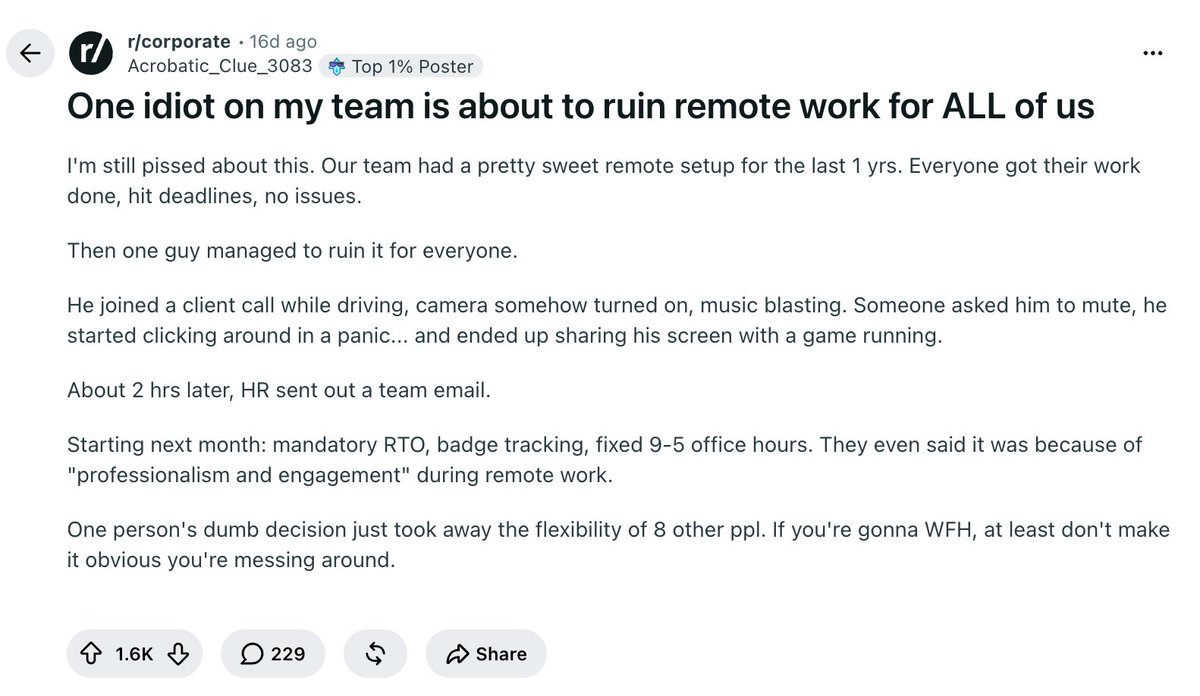
Remote work is becoming one person’s responsibility. A viral Reddit post claims one employee accidentally screen-shared a video game during a client call. Hours later, the entire team was reportedly told to return to the office full time, with badge tracking and fixed hours. One mistake. Everyone pays.

@staysaasy ·
Something I’m seeing a big spike in is small < ~30 person engineer teams at proclaimed hardcore AI companies open up an engineering office on the opposite coast. It’s not remote, it’s the new outpost of our engineering team! What this really means is that you couldn’t hire in SF or NYC and needed to add the other city. Well, now you have a distributed team and you removed pressure from your recruiting problem. You’ve not only not fixed a recruiting issue, you’ve codified your weakness, and you’re created an org design that will start making people ask why they can’t just WFH sometimes. Much of the downside of remote, but not fully embracing the idea of remote and expanding the candidate pool exponentially.

@alieneliane ·
in all these 4 years navigating remote work environments, I've never seen a market where companies so openly lie in job posts for the sake of "visibility" they make you go through a lengthy application process, only to end with the question, "where are you based?" and automatically discard you if you're not located in one of the countries they actually want to hire from it sounds insane, but it's been happening far too often lately and it shows how little they respect the time and effort people put into applying

@SergioRocks ·
A lot of the remote work debate is missing the point. It’s not really about remote vs office. It’s about how work is structured. If your job is: - waiting on others - passing work around - seating in meetings every day Then yes, remote is hard. But that’s also a sign of how the team operates. In the teams I lead: - people own larger pieces of the system - dependencies are reduced - work is more outcome-driven That changes the dynamic. You spend more time thinking, building, shipping. And less time waiting for directions or approval. This setup works very well remotely, and I wrote more about it in my latest newsletter. https://t.co/FkXI7ZcFMB

@satyaki44 ·
meetups and events are super essential for crypto. most of us here work remotely with a distributed team across the globe. sitting infront of our screens 12+ hrs everyday. moreover currently the crypto space is going through certain crisis with layoffs everywhere, liquidity crunch, no funding, unclear regulatory policies, AI takeover, lack of PMF & more. so meeting people IRL becomes even more essential. i am talking about this since i found a few “intellectual” CT folks started rambling that meetups are all shit and zero sum but i feel certain things have intangible returns and can drive strong measurable outcomes. events have many: - meeting real people, knowing their story, connect beyond work - meeting the team first time in a long time, co-work, grow bonding - for most this is the only time they come out of their shell & get to socialise - the IRL conversations can never match gmeet debates - and the trust building becomes 10x - this becomes also a chance to experience a new country + culture, meet someone across the world and find they are no different than you! the above are just a handful but i am sure there’re many more! imo events and meetups hold a key role in crypto. their format can change, budgets can shrink, arrangements can be leaner but the crypto event legacy must continue.

@damianplayer ·
Scott Galloway says “the second WORST thing to happen to young people is remote work.” 1 in 3 relationships start at work. we removed the most important room in a 20 year old’s life. and alcohol is next.
 Watch video

@pascal_bornet ·
AI is automating tasks. Gen Z is stress-testing workplace norms. This clip is satire, but it points to something real. What stands out to me is not the bed, the camera, or the contract. It is the gap between what companies assume and what employees believe they owe. The future of work is not only about AI tools. It is about expectations. Remote work blurred the office. AI is now blurring the job. And Gen Z is asking the uncomfortable question many companies avoided: What exactly are you paying me for? The output? The hours? The camera? The clothing? The performance of professionalism? This is why the next workplace challenge is not just automation. It is clarity. Because if companies do not define outcomes, AI will optimize tasks, employees will optimize loopholes, and culture will become a negotiation. Where do you think the line is between flexibility and professionalism? #AI #FutureOfWork #GenZ #RemoteWork #WorkplaceCulture #Automation #Leadership #DigitalTransformation
 Watch video
@ErikKaiser ·
"Central Park: 15 inches and counting. Long Island: 2 feet. Blizzard warnings across the region. Let's talk about the money moving around during NYC's storm today. **The Damage:** Storms like this extract $3-5 billion daily from the U.S. economy. NYC will spend $20-30 million on snow removal alone. **Winners:** De-icing companies (salt prices jump 20-30%), towing shops, hardware stores, delivery services charging premium rates. **Losers:** Brick-and-mortar retail (40-60% traffic drop), restaurants, construction sites, transportation logistics. **The Unexpected Winner: Remote-Ready Companies** Before the pandemic, a storm like this meant white-collar productivity went to zero. Today? Businesses with remote infrastructure are maintaining 75-85% normal productivity. All that investment in video conferencing, cloud systems, and collaboration tools is paying dividends every time weather disrupts operations. Companies that viewed remote work as a temporary pandemic measure accidentally built permanent weather-resilience. While some businesses are completely shuttered today, others are running almost normally. Same storm, completely different financial impact. What's happening at your workplace today?"

@marcussegal ·
Managing a distributed team works best with strong operating discipline. 3 principles that compound 👇 1. Make ownership explicit Every project has a clear owner. Clarity unlocks speed and momentum. 2. Default to writing Writing preserves decisions, context, and intent. Teams move faster when knowledge compounds. 3. Build cadence intentionally Weekly updates. Clear sprints. Thoughtful 1:1s. Rituals create alignment and trust.

@cem_hasoglu ·
unpopular opinion but remote work has made a lot of people worse at their jobs not because the work suffers but because they lost the random conversations that made them better the hallway chat where you overhear a problem and think "wait i know how to fix that" the lunch where someone tells you about a client situation and you learn something you wouldnt have googled in a million years we optimised for comfort and accidentally killed serendipity i work remotely and i love it but i am definitely worse at reading rooms, reading people, and knowing what my team is actually feeling and i dont think im the only one

@thetechychef ·
I’m sorry but this is ridiculous. If his contract said work from anywhere, then what exactly is the problem? He worked from a cruise ship and still delivered because at the end of the day, what matters is OUTPUT not if he’s sitting in a “proper” home office. If he was meeting deadlines, showing up when needed, and doing his job well for 14 months, then firing him over where he chose to work from makes no sense. This is where companies need to be honest with themselves. Do you want results or do you want control? Because you cannot sell flexibility and then punish people for actually using it. Remote work is not about where you sit. It is about what you produce. If there were no performance issues, then this decision feels more like control than logic and that defeats the whole point of remote work in the first place. Or is there something else behind this? What do you think?


@htmleverything ·
I've been leading async remote teams for almost a decade now. Productivity has always been top notch on all my teams, but that comes with the caveat that every employee hired was vetted and tested to be capable of remote async work. I can confidently say that it's not for everyone and you need the right mindset and buyin org wide to make it successful.
 Watch video

@weworkremotely ·
No one talks about this remote work perk: In the office, going in wasn’t just about working. It was about performing. -Performing professionalism. -Performing intelligence. -Performing confidence. -Always sounding sharp. -Always looking focused. -Always appearing “on.” That’s exhausting in a way no one puts on the job description. Remote work didn’t remove the work. It removed the constant psychological role-playing. And that changes everything.

@NotionCoach ·
I think the work-from-home default is quietly coming to an end. Not because of requirements, but because the increased convenience comes at the cost of human connection. One coffee, one meetup, or one day at a coworking spot makes that obvious. As a dad, I'm grateful for the optionality. But I'm definitely moving toward a balance of working home/away from home.

@aisauce_x ·
> meet Pieter Levels > born in the Netherlands > studied music production in college > dropped out > taught himself to code instead > 2014: burned out, frustrated, going nowhere > packed one backpack > left everything behind > moved to a different country every month > no apartment, no office, no plan > was working from cafes across Asia > kept a spreadsheet of cities > cost of living, wifi speed, weather, safety > shared it on Twitter > 20,000 people showed up in one day > turned the spreadsheet into a website overnight > called it Nomad List > starting cost: $150 > it was his 7th startup attempt > the first 6 failed > set himself a challenge: 12 startups in 12 months > Nomad List was number 7 built Remote OK next > a job board for remote work > then Photo AI > an AI headshot generator > no employees > no investors > no office > just PHP, a laptop, and a backpack > 95% profit margins > works from cafes, beaches, and hotel lobbies > has visited 40+ countries > while running it all > 2024: $5.3M in revenue > one person > absolute silence from Silicon Valley > his response: ships faster than their sprint planning meetings no team. no funding. no permission. absolute legend 🐐

@TheJobfather__ ·
If you want to serve people globally, understand the economic bridge you are trying to build. Remote work is not only about one person working from another country. It can also bring stronger currency, new skills, and broader opportunity into communities that were never given enough local options. For Black professionals especially, options matter because we have seen how quickly a workplace can change once leadership, budgets, or politics shift. Building leverage is not paranoia. It is preparation.

@onu_slim ·
How To Know When Relocation Is Worth It and When Remote Is Better The decision between relocating to another country and staying in Nigeria while working remotely depends on your skills, goals, finances and personal situation. Both paths can work, but they suit different circumstances. Remote work is often the better starting point for many people. It allows you to earn global rates while keeping living costs lower and staying close to family and existing support systems. If you already have in-demand skills and can secure remote clients or employment, the financial advantage can be significant. Earning $2,000 to $4,000 monthly while living in Nigeria often produces a higher savings rate than earning a similar amount in a high-cost city abroad after rent, transport and taxes. Remote work also lets you test international collaboration and build experience without the immediate pressure of visas, housing deposits and cultural adjustment. Relocation becomes worth considering when it offers clear advantages that remote work cannot match. These may include faster career progression in a specific industry, access to professional networks that are difficult to build online, better long-term options for family, or roles that require physical presence. It can also make sense when the salary premium and quality-of-life improvement clearly outweigh the higher expenses and the cost of moving. People who relocate successfully usually have strong skills, some savings, and realistic expectations about the challenges of starting over in a new system. A practical way to decide is to compare concrete numbers and personal priorities. Calculate your expected net income, living costs and savings potential in both scenarios. Consider non-financial factors such as career growth speed, lifestyle preference, family needs and risk tolerance. Many professionals use remote work as a bridge: they build skills, savings and international experience first, then relocate later from a position of greater strength if they still want to. Neither path is automatically superior. Remote work offers flexibility and lower risk for those who can secure the opportunities. Relocation can provide immersion and new possibilities when the conditions are right. Assess your current skills, financial runway and long-term goals honestly. Choose the option that improves your position most clearly rather than the one that simply looks more attractive from a distance.

@Benzinga ·
Jamie Dimon Doubles Down On Work From Home Criticism Jamie Dimon is still not backing away from his criticism of remote work. The JPMorgan Chase CEO has argued that work from home does not fit his business and makes culture harder to build. Speaking to Stanford business students, Dimon pointed out that many workers never had the option to stay home during the pandemic. Restaurants, delivery companies, hospitals, sanitation workers, schools, manufacturers and emergency services still had to show up. His blunt question was simple: where did people get their Amazon packages, food, diapers and other essentials from? Dimon’s point was that a large share of the economy kept moving because in-person workers were on the job. He also said people are free to leave if they do not like JPMorgan’s return-to-office policy. What he pushed back against was employees telling the company how it has to operate. The bigger debate is not going away. Remote work changed expectations, but Dimon is betting that culture, training and collaboration still work better in person. $JPM $AMZN

Best Tweets by Topic