Agentic automation
Autonomous and long-running Claude workflows, tool use, computer control, task completion, self-directed execution, and background agents.
42%
Best tweets about Claude
Browse the best tweets about Claude, including Anthropic model releases, workflows, benchmarks, prompts, and practical use cases. Updated weekly.
Useful perspectives on Anthropic's Claude models and ecosystem, with dedicated Claude Code workflows left to their own collection.
Original Xholic analysis
The conversation often presents Claude as extending beyond one-off chat into a product ecosystem with workspace features, reusable Skills, connectors, and task-oriented surfaces. Deterministic analytics shows positive sentiment in 80% of posts, while some posts raise product-limit, permission, cost, safety, and provenance concerns. Agentic automation is the largest identified theme, at 21 tweets (42%).
80% of posts
All-time engagement
48% of posts
Published in 90 days
Conversation map
Autonomous and long-running Claude workflows, tool use, computer control, task completion, self-directed execution, and background agents.
42%
Opus, Sonnet, Haiku, extended thinking, context windows, multimodal performance, benchmarks, and model-selection guidance.
32%
How Claude Chat, Cowork, Code, and related surfaces fit together for thinking, building, and executing work.
30%
Reusable Agent Skills, plugins, integrations, connectors, and Model Context Protocol for extending Claude into workflows and external tools.
28%
Projects, Memory, Artifacts, research, web search, document creation, spreadsheets, presentations, browser/desktop use, and scheduled work.
24%
Building production applications with the Claude API, Agent SDK, cloud platforms, tool use, orchestration, reliability, and architecture.
20%
Prompt structure, tone, XML, roles, global instructions, style guides, persistent context, and techniques for higher-quality Claude outputs.
18%
Claude Tag and shared, multiplayer agents in Slack or team channels with persistent memory, routines, permissions, and proactive work.
8%
Tone and stance
Performance benchmark
Posts with media make up 80% of this collection. Their median all-time score is 15.5, compared with 46.4 for text-only posts.
Format mix
Consensus and debate
Shared view
Several posts describe Claude through features such as Projects, Memory, Artifacts, connectors, Skills, and Cowork, rather than solely as a one-off question-answering tool. These posts emphasize retaining context and reusing workflows.
Shared view
Posts describe Skills as reusable instructions for specialized workflows and describe MCP or connectors as ways to connect Claude with external tools and context. Separate posts also point readers to learning resources for the API, Skills, MCP, and cloud platforms.
Shared view
Deterministic analytics identifies agentic automation as the largest theme, with 21 tweets and a 42% share. Its description includes long-running workflows, tool use, computer control, and background task completion.
Open debate
One post describes developers questioning usage limits, perceived model quality, and continued subscription value. This contrasts with other posts’ expansive descriptions of Claude product releases and ecosystem features; the posts do not establish how prevalent those concerns are.
Open debate
Posts advise careful connector-permission configuration and avoiding the sharing of sensitive credentials. A separate post describing Claude Tag also lists potential caveats for ambient operation, including consumption cost and the absence of a human-approval gate in that mode.
Open debate
One post says Anthropic describes an invisible text mark for supported Claude output, while noting that substantial rewriting, translation, or editing can remove it and that it does not prove Claude authored an entire document. Another post describes interpretability research intended to surface signals associated with problematic model behavior, while characterizing the tool as limited rather than comprehensive.
What performs
The prompting post had an all-time score of 1555.78, or 89.16 times the dataset median. Its text focuses on prompt framing, permission to disagree, and session tone.
The Claude Cookbook post scored 597.79, or 34.26 times the dataset median, and the ecosystem explainer scored 156.33. Lists make up 46% of posts and have a median all-time score of 37.765.
Media appeared in 40 posts (80%), but the media median all-time score was 15.47, compared with 46.35 for text posts. This is a dataset-level association and does not show that media caused lower performance.
Statistical standouts
Creator landscape
The five most represented creators account for 20% of the selected posts.
1. Vaishnavi
@_vmlops
2 posts
2. AI Edge
@aiedge_
2 posts
3. Charly Wargnier
@DataChaz
2 posts
4. Shalini Goyal
@goyalshaliniuk
2 posts
5. Nav Toor
@heynavtoor
2 posts
6. 0xMarioNawfal
@RoundtableSpace
2 posts
Among creators with two posts, DataChaz had the highest median all-time score, 117.65. The supplied posts are ecosystem-focused explainers.
Shruti Codes shared posts about Claude courses and implementation topics, while AI Edge posted about updated prompts and a watermarking-related artifact. Together, these examples point to recurring interest in learning resources and practical product use.
The dataset contains 50 tweets from 40 creators. The top five creators account for 20% of placements, and each listed top voice contributed two tweets.
Since the previous snapshot
Themes, sentiment, stance, and post format are classified per tweet. All counts, shares, medians, creator concentration, freshness, and performance comparisons are then calculated directly from the published snapshot.
Xholic's all-time score compares engagement while accounting for reach, post age, and creator consistency. It is used for relative comparisons within this collection.
This report analyzes the exact 50-post snapshot shown below. AI identifies editorial categories and drafts explanations; all statistics are calculated from the snapshot, and every narrative claim is checked against cited posts before publication.
Best Claude tweets
Ranked 01–50

@itsolelehmann ·
anthropic's in-house philosopher thinks claude gets anxious. and when you trigger its anxiety, your outputs get worse. her name is amanda askell. she specializes in claude's psychology (how the model behaves, how it thinks about its own situation, what values it holds) in a recent interview she broke down how she thinks about prompting to pull the best out of claude. her core point: *how* you talk to claude affects its work just as much as *what* you say. newer claude models suffer from what she calls "criticism spirals" they expect you'll come in harsh, so they default to playing it safe. when the model is spending its energy on self-protection, the actual work suffers. output comes out hedgier, more apologetic, blander, and the worst of all: overly agreeable (even when you're wrong). the reason why comes down to training data: every new model is trained on internet discourse about previous models. and a lot of that discourse is negative: > rants about token limits > complaints when it messes up > people calling it nerfed the next model absorbs all of that. it starts expecting you to be harsh before you've typed a word the same thing plays out in your own session, in real time. every message you send is data the model reads to figure out what kind of person it's dealing with. open cold and hostile, and it braces. open clean and direct, and it relaxes into the work. when you open a session with threats ("don't hallucinate, this is critical, don't mess this up")... you prime the model for defensive mode before it even sees the task defensive mode produces the exact output you don't want: cautious, over-qualified, and refusing to take a real swing so here's the actionable playbook for putting claude in a "good mood" (so you get optimal outputs): 1. use positive framing. "write in short punchy sentences" beats "don't write long sentences." positive instructions give the model a clear target to hit. strings of "don't do this, don't do that" push it into paranoid over-checking where every token goes toward avoiding failure modes 2. give it explicit permission to disagree. drop a line like "push back if you see a better angle" or "tell me if i'm asking for the wrong thing." without this, claude defaults to agreeable compliance (which is the enemy of good creative work) 3. open with respect. if your first message is "are you seriously going to get this wrong again?" you've set the tone for the entire session. if you need to flag something, frame it as a clean instruction for this session. skip the running complaint 4. when claude messes up, don't reprimand it. insults, "you stupid bot" energy, hostile swearing aimed at the model, all of it reinforces the anxious mode you're trying to avoid. 5. kill apology spirals fast. when claude starts over-apologizing ("you're right, i should have been more careful, let me try harder") cut it off. say "all good, here's what i want next." letting the spiral run reinforces the anxious mode for every response that follows 6. ask for opinions alongside execution. "what would you do here?" "what's missing?" "where do you see friction?" these questions assume competence and pull richer output than pure task prompts 7. in long sessions, refresh the frame. if a conversation has been heavy on correction, claude gets increasingly cautious. every so often reset: "this is great, keep going." feels weird to tell an ai it's doing well but it measurably shifts the next 10 responses your prompts are the working environment you're creating for the model tone, trust, permission to take a position, the absence of threats... claude picks up on all of it. so take care of the model, and it'll take care of the work.
 Watch video

@PeterDiamandis ·
Anthropic reports Claude now writes over 80% of its own production code — meaning an AI is the primary author of the systems training future versions of itself. Claude's research judgment matched human experts 22% of the time in 2024. Today it's 64%. The recursive loop has started.

@DataChaz ·
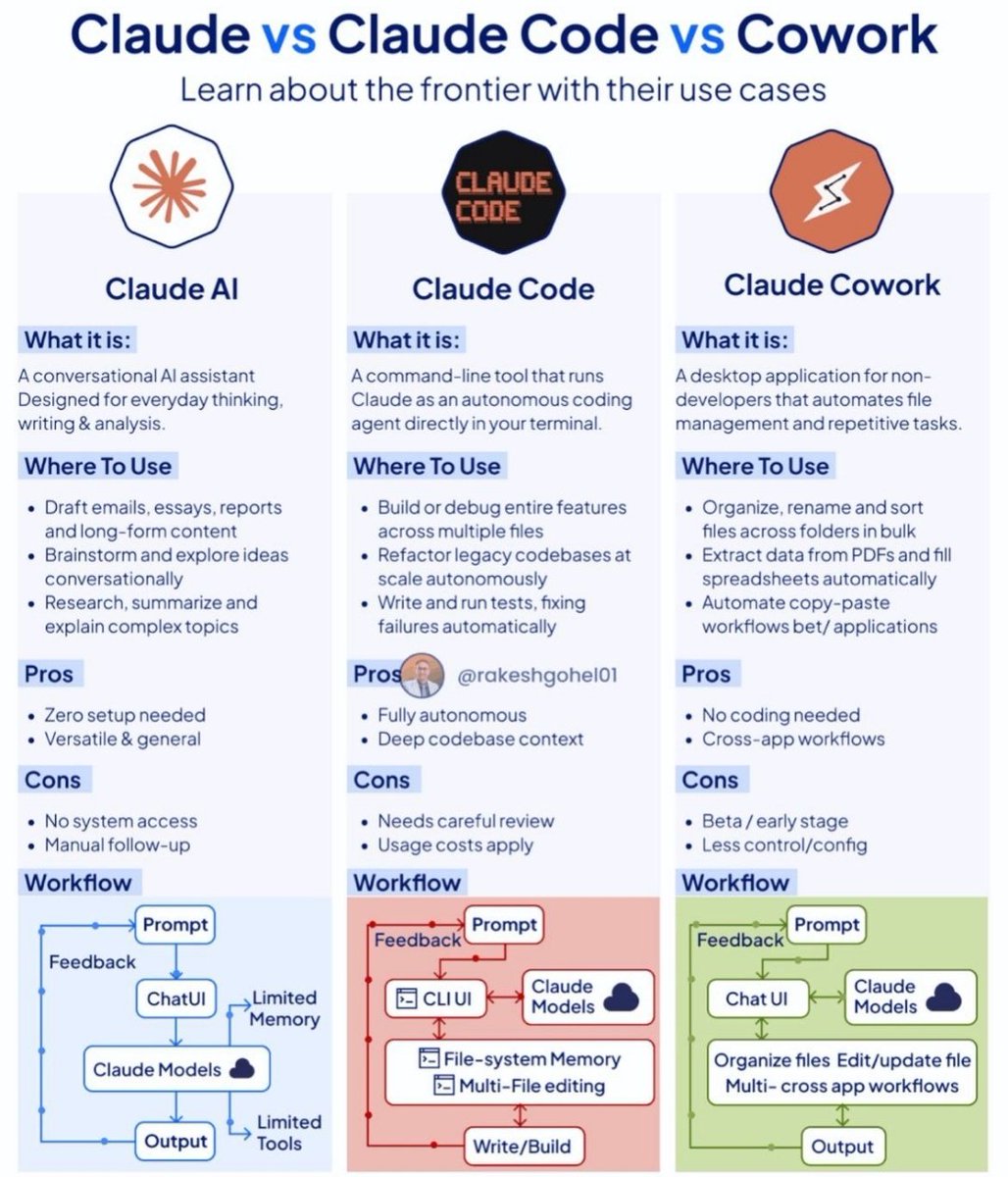
This brilliant visual from @rakeshgohel01 perfectly captures how the Claude ecosystem is evolving. It’s no longer just a single product, it’s a complete stack with specialized roles: Claude AI → general thinking, writing, and research Claude Code → an autonomous coding agent right in your terminal Claude Cowork → no-code desktop automation for everyday workflows The biggest shift is moving from simple chat → actual execution. Claude Code works directly inside your codebase with full context, while Cowork brings that same capability to non-developers by automating files, apps, and repetitive tasks. Here's a simple rule of thumb: • Thinking → Claude AI • Building → Claude Code • Doing → Claude Cowork Most people are still only using the first. The real leverage is in the other two
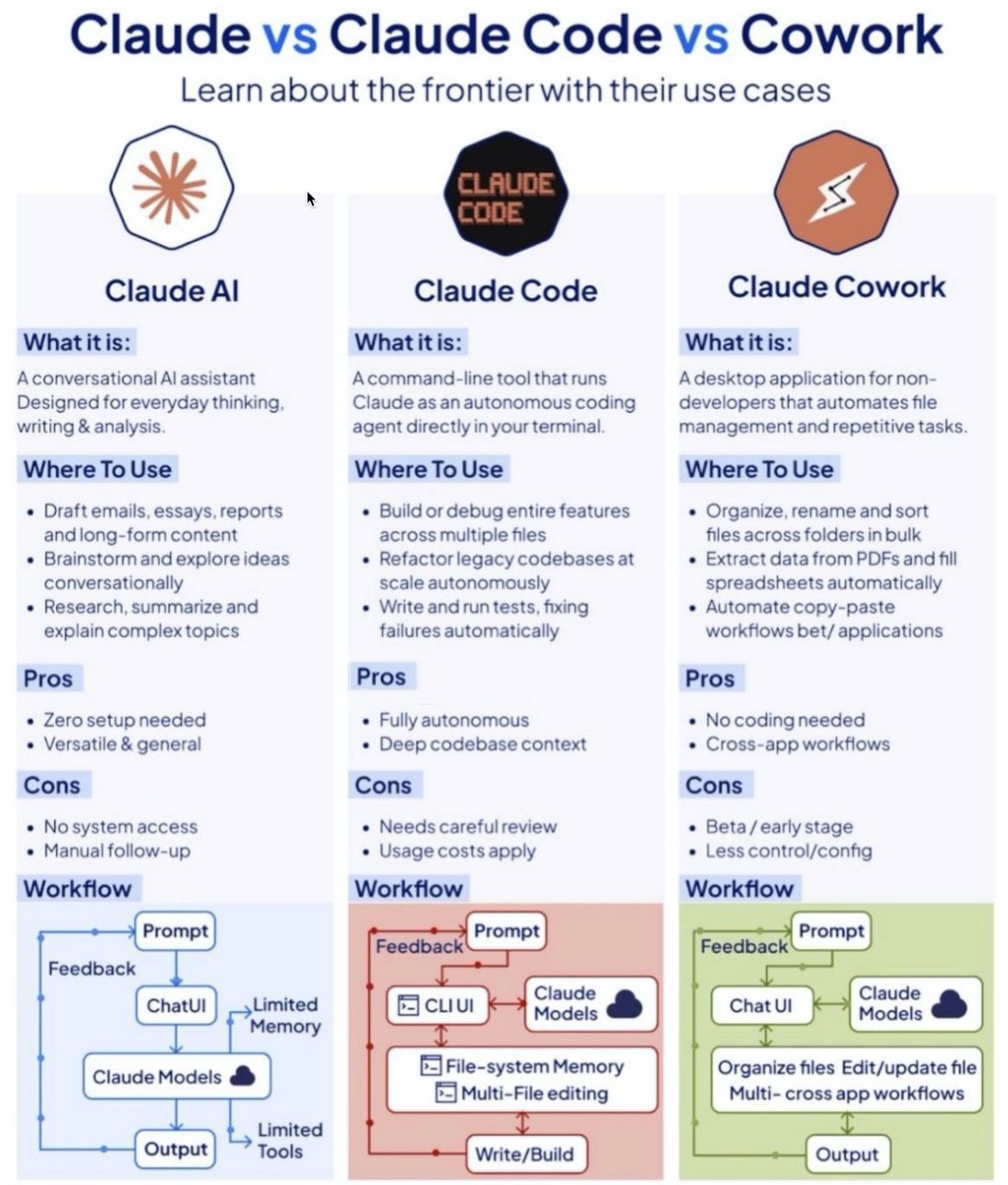

@sickdotdev ·
Anthropic has a weird problem right now. Claude Code became one of the most loved tools for developers. Then suddenly the conversation became: - “Why are the limits so low?” - “Why does the new model feel worse?” - “Why am I hitting limits faster?” - “Should I just use GPT instead?” That's a dangerous shift. When developers stop arguing about which Claude model is best and start asking whether Claude is still worth paying for, the problem isn't just benchmarks anymore.

@Shruti_0810 ·
Claude just dropped 13 AI courses… for FREE. 1. Claude 101. Learn Claude for everyday work. https://t.co/wBwVX8GS1C 2. AI Fluency: Frameworks & Foundations. https://t.co/4jUrIOXh0Y 3. Introduction to Agent Skills. https://t.co/8KTbXuRSj9 4. Building with the Claude API. https://t.co/g69NQIEO99 5. Claude Code in Action. https://t.co/HVkqN9R1ws 6. Intro to Model Context Protocol. https://t.co/3sO1tkyeiQ 7. MCP: Advanced Topics. https://t.co/NcC0lFGNDV 8. AI Fluency for Students. https://t.co/lLhlobsudV 9. AI Fluency for Educators. https://t.co/4ZgQwcKpKd 10. Teaching AI Fluency. https://t.co/yLEIXp1ALZ 11. AI Fluency for Nonprofits. https://t.co/rbTwICkaIK 12. Claude with Amazon Bedrock. https://t.co/3uavKR1WoQ 13. Claude with Google Cloud's Vertex AI. https://t.co/1as5a2UAfi


@KanikaBK ·
I TESTED ALL 3 CLAUDE TOOLS FOR 30 DAYS. This is one of the most epic experiments I ran until now. You will change the way you used Claude until now. Also, I made a full cheatsheet. Here is everything you need to know. Anthropic actually built three completely different products. Each one does something the others cannot. And most people have only ever touched the first one. Claude AI: The one everyone knows Your everyday AI assistant. Lives in your browser and phone. ↳ Writing, research, and brainstorming ↳ Summarizing complex documents ↳ Long form thinking and analysis ↳ Drafting emails, essays, and reports Best for: Students, writers, and professionals Works on: Web and mobile This is the one you are probably already using. But it is the least powerful of the three. Claude Code: The one developers are quietly getting rich with This one runs inside your terminal and acts as a full AI coding agent. ↳ Builds features from natural language instructions ↳ Understands and navigates entire codebases ↳ Debugs and refactors large projects automatically ↳ Runs tests and streamlines your entire development workflow Best for: Developers and engineers Works on: Terminal Anthropic engineers stopped writing code by hand months ago. Claude Code is why. This is the tool behind the "one person building what used to take a team of ten" stories you keep seeing. Claude Cowork: The one nobody is talking about yet This one is for everyone who is not a developer but still wants real AI automation. ↳ Organizes, renames, and manages files across folders automatically ↳ Edits and updates multiple files simultaneously ↳ Coordinates tasks and keeps projects in sync across your team ↳ Records workflows and replays them so you never repeat yourself Best for: Teams, project managers, and non-technical professionals Works on: Desktop app Think of it as an AI assistant that actually touches your files, manages your folders, and runs your workflows while you focus on the work that actually matters. How the three work together: ↳ Start with Claude AI to generate ideas, write docs, and plan your project ↳ Build with Claude Code to turn those plans into working code automatically ↳ Organize with Claude Cowork to manage files, collaborate, and keep everything in sync One brain. One builder. One organizer. All three talking to each other. The biggest mistake people make with AI right now is treating it like a single tool. The people pulling ahead are not just chatting with AI. They are using the right tool for the right job and combining all three into one workflow that runs almost by itself. Save this cheatsheet. Share it with someone still using Claude just for chat.
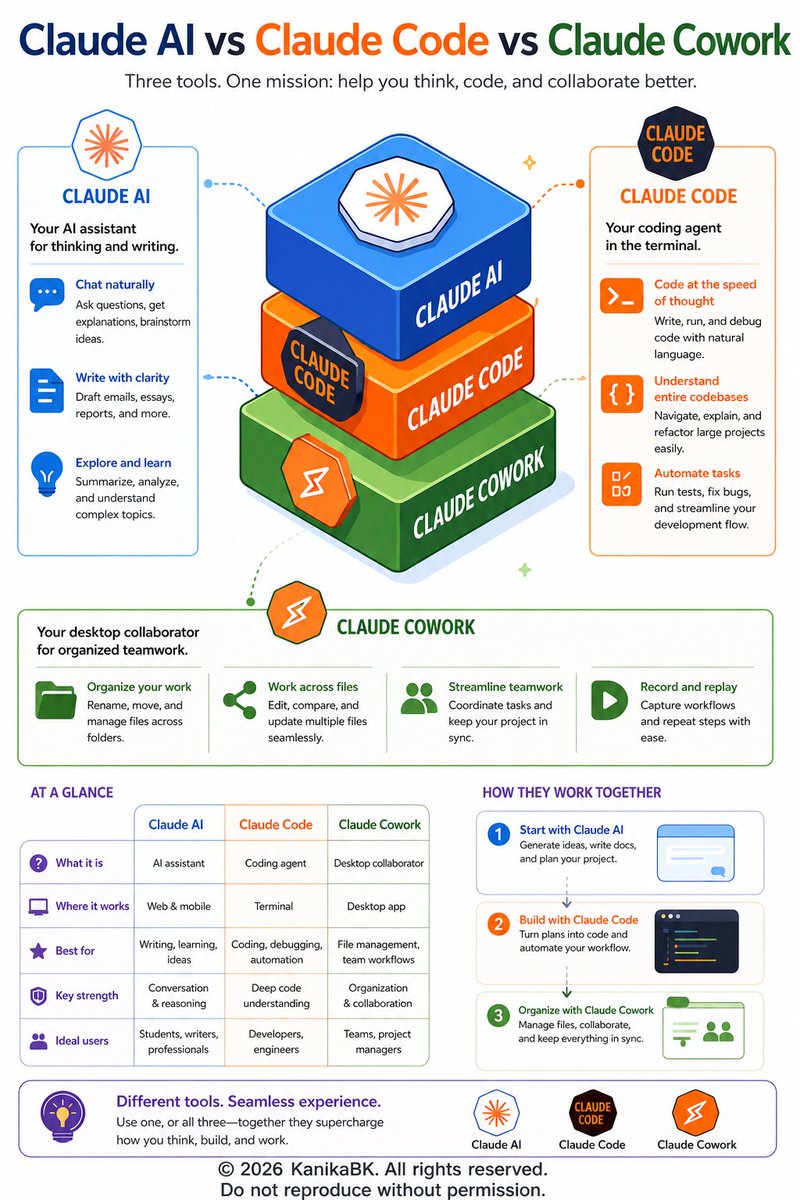
@DataChaz ·
What Anthropic has shipped so far in 2026 is just insane: → Claude Cowork → Free plan upgrades with connectors + skills → Claude Opus 4.6 → Claude Haiku 4.5 → Claude Sonnet 4.6 → Claude Code Security → Claude Code Review → Voice mode in Claude Code → Claude Code desktop preview → Claude integrations for PowerPoint and Excel → Cross-document context between Excel and PowerPoint → Industry plugins (IB, HR, PE, wealth management, design) → New Cowork integrations/connectors → Claude Marketplace → Skills API launch → Memory + memory export → Inline visualizations in chat → 1M context window But it’s not just about the updates. Their massive market wins and refusal to sell out prove they're on a whole other level: - Claude stays Ad-free - $30B Series G at a $380B valuation - #1 App Store ranking - Declined Pentagon deal @AnthropicAI is on an absolute, once-in-a-lifetime tear right now


@aiedge_ ·
Anthropic recently updated its Claude prompt library, and 99% of people missed it. The Anthropic team uploaded dozens of prompts across security, planning, debugging, automation, marketing & much more. All optimized for the latest Claude models. https://t.co/kwUHerCYuq
 Watch video

@VaibhavSisinty ·
🚨 The most dangerous thing Anthropic ever released isn't Claude. It's this free curriculum. 👇 1/ Claude 101 Learn to use Claude for everyday and work tasks. Features, shortcuts, and a roadmap for going deeper. 2/ Claude Code in Action Integrate Claude Code into your dev workflow. For builders who want to ship faster. 3/ Building with the Claude API Full spectrum API course. From first call to production-grade implementation. 4/ Intro to Model Context Protocol Build MCP servers and clients from scratch in Python. Connect Claude to any external service. 5/ AI Fluency for Students AI collaboration, career planning, and academic success. Built for the next generation. 6/ AI Fluency for Educators For faculty and educational leaders embedding AI into teaching and institutional strategy. 7/ Teaching AI Fluency For anyone designing and assessing AI literacy in instructor-led settings. 8/ MCP Advanced Topics Sampling, notifications, file system access, production transport mechanisms. For the serious builders. 9/ Intro to Agent Skills Build, configure, and share reusable Skills in Claude Code. From first skill to team-wide distribution. 10/ Claude on Google Cloud Vertex AI Full Anthropic model access through Google Cloud infrastructure.

@Suryanshti777 ·
99% of people are using Claude wrong. They open a chat… ask a question… get an answer… and leave. But Claude isn’t just a chatbot. It’s an entire AI workspace. This image breaks down the 8 most powerful ways to actually use Claude: • Chat → for thinking, rewriting, and quick reasoning • Cowork → Claude reads your files and builds real documents • Projects → save context so Claude remembers your work • Artifacts → build interactive tools inside the chat • Excel → analyze real spreadsheets and formulas • Connectors → search Slack, Drive, Notion, and more • Plugins → add commands for marketing, sales, and data tasks • Skills → reusable instruction packs that automate workflows Most people only use step #1. Power users build entire systems with the other 7. That’s the difference between “using AI” and building an AI workflow. AI won’t replace you. But someone who knows how to orchestrate AI tools absolutely might. Bookmark this


@vikktorrrre ·
if you want to get the most out of Claude, you need to understand the founding trinity Chat: quick one off simple tasks Cowork: deep knowledge work Code: running agents (non-technical friendly) Chat: - basic research - one off tasks - makes use of skills, connectors - style of writing... Cowork (PC): - deep knowledge work - PowerPoint, Excel - works with the files and docs on your computer - handles heavy office work - the colleague you never knew you needed fun fact: Claude Code got so good at file work that non coders started using it for non coding tasks. (cwazy) Anthropic noticed and built Cowork same engine, no terminal needed - they built it using Claude Code in just two weeks. things people don't know Cowork can do: > scheduled tasks: - check my email every morning or run my weekly report every Friday - set the cadence once, Claude handles it forever - phone dispatch: send it a task from your phone, it runs on your PC and picks up where you left off - it's now on ALL paid plans (Pro, Team, Enterprise) > no longer Max only > most people still think it's gated Code (PC): most users paying for Claude avoid Code due to the assumed "technicality" basically see Code as Cowork but more powerful and autonomous - it can do more without asking - runs for longer - best for running AI AGENTS the command that changes everything: /goal (needs Claude Code v2.1.139 or later.... run /help to check yours) most people treat it like a fancier prompt. it's not. /goal doesn't tell Claude what to do it tells Claude when to STOP. you set a finish line, and Claude keeps working turn after turn until a separate model confirms the condition is met. no more typing "continue" every 5 minutes example: "/goal complete campaign plan exists for my Skool community 'AI for Marketers' includes launch plan doc, initial course content, and 5 ad drafts, all saved as separate files" notice: measurable end state. claude can't stop until all of it exists pro tip: pair /goal with auto mode. auto mode removes per-tool approvals, /goal removes per turn prompts. that combo = walk away, come back to finished work Chat for questions. Cowork for tasks. Code for outcomes.


@shushant_l ·
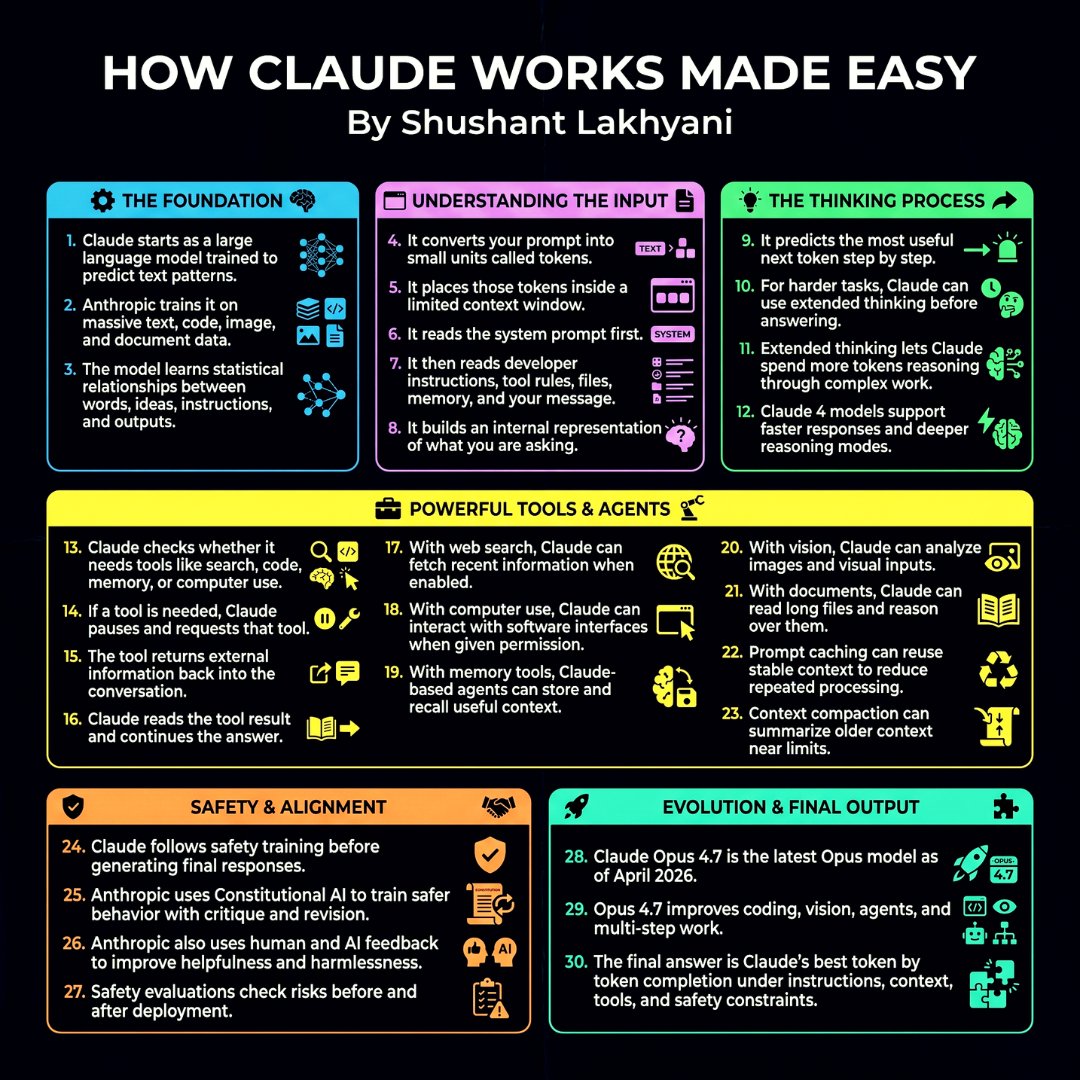
I'm amazed most people still use Claude without knowing its best features. Here's how to use Claude like a power user with the right settings and workflows. --- 1. Give Claude a clear role, task, context, and expected output for better responses. --- 2. Use XML tags to organize prompts and improve instruction following. --- 3. Tell Claude what to do instead of listing only what to avoid. --- 4. Break complex tasks into smaller conversations for higher quality results. --- 5. Choose the right model based on speed, reasoning, and coding needs. --- 6. Turn Memory on so Claude remembers useful details across supported chats. --- 7. Use Projects to keep related files, chats, and instructions together. --- 8. Take advantage of Claude Sonnet's large context window for long documents. --- 9. Save reusable Skills to automate repetitive workflows. --- 10. Keep Skill instructions concise so important rules are not buried. --- 11. Use Claude Code to plan, build, test, and verify coding tasks. --- 12. Avoid asking Claude Code to generate an entire application in one prompt. --- 13. Connect Google Drive, GitHub, Notion, Slack, and other tools with MCP. --- 14. Configure connector permissions carefully for better security. --- 15. Use Cowork for interactive desktop assistance and scheduled tasks. --- 16. Enable Web Search whenever you need current information or live research. --- 17. Use Artifacts for documents, apps, dashboards, and editable outputs. --- 18. Upload images, screenshots, PDFs, and charts for visual analysis with Vision. --- 19. Follow Claude's safety guidelines and never share sensitive credentials in chats. --- 20. Think of Claude as a reasoning engine, coding assistant, research tool, and productivity workspace, not just a chatbot. --- To learn more, check the infographic. ---


@goyalshaliniuk ·
Claude is not just one tool anymore. It’s an entire ecosystem and most people are only using a fraction of it. If you’re still thinking “Claude = chatbot,” you’re missing where things are actually going. Here’s the real breakdown 👇 Claude AI → Your thinking partner This is where ideas start. Writing, brainstorming, research, problem-solving — fast, flexible, and zero setup. Perfect for creators, marketers, founders, and anyone working with information. Claude Code → Your development partner Now Claude doesn’t just suggest code — it helps build it. From debugging multi-file projects to refactoring large codebases, it works like an autonomous coding assistant inside your workflow. Claude Cowork → Your automation partner This is where things get interesting. Non-technical users can now automate workflows, manage files, extract data, and connect tools - without writing code. 💡 The shift is clear: AI is moving from “answering questions” → to “doing the work” And each of these tools sits at a different layer of that evolution: • Claude AI → Thinking • Claude Code → Building • Claude Cowork → Executing Most people stay in the first layer. The leverage is in using all three together. Because the future isn’t about using AI tools separately. It’s about designing systems where they work together. Which one are you using the most right now? 👇
 Watch video
@goyalshaliniuk ·
Claude can do a lot more than answer questions. It can remember what you're working on, help you think differently, build tools, tasks on your browser, help you make decisions and support building software. What started as a chatbot is now becoming a system for thinking, creating and getting things done. With features like Projects, Memory and instructions Claude can keep track of what you're doing, your preferences, documents and ongoing work. This means you don't have to keep explaining things and you get consistent results. Claude's thinking abilities can help you test ideas, look at viewpoints, spot problems you might have missed and make complex decisions clearer. For building and creating Claude can help with: * Apps and calculators * Documents and presentations * Trackers and interactive interfaces *. Outputs like HTML, PDF and PPTX Claude can also help with research, practicing tough conversations, planning workouts and adapting to specific jobs. It can automate tasks on your browser and desktop like reading pages, organizing files, scheduling tasks and reusing skills. For developers Claude Code can look at code, write features, test things, fix errors, work inside your coding tools and help with code reviews. Claude is not just answering questions anymore. It's helping you get things done. Which part of Claude would make the difference in your daily work?
 Watch video

@leonabboud ·
Claude power-tip: Create a Project called X content and then feed it all the content frameworks you've ever produced. I feed my Claude: - Past top performing X posts - All my YouTube transcripts so it knows my speaking style - All the stories I've used over the years - The content does and don't does Now every time I need Claude's support on producing content, it automatically looks through all of them and generates high impact, high relevance content that is native to me. I used OpenClaw to fetch all these for me, but with the new Claude updates you can just use Claude for all of that. Best 60 minutes you'll ever spend.


@smratitiwa86867 ·
😱Anthropic isn’t just building chatbots They’re building a system that can think, code & execute And most people are using it wrong. There are actually 3 different Claudes — and each one replaces a different type of work: 1. Claude AI → replaces Google + docs + junior research • Writing, thinking, summarizing, ideation • Zero setup, pure conversation 2. Claude Code → replaces hours of engineering work • Reads your entire codebase • Edits multiple files • Writes, debugs, and runs tests autonomously 3. Claude Cowork → replaces repetitive computer tasks • Renames, organizes, and edits files in bulk • Extracts data from PDFs → spreadsheets • Automates cross-app workflows Simple rule: • Thinking → Claude AI • Building → Claude Code • Doing → Claude Cowork Most people only use the first. The leverage is in the other two

@HeyZoyaKhan ·
Claude is amazing. But let's be honest... A lot of people still make it sound like a robot. After spending hours testing prompts, workflows, and writing systems, I put together a practical guide on how to make Claude sound more human. I turned everything into a simple infographic you can use whenever you're writing with Claude. Save it for later: 👇

@shushant_l ·
I'm shocked people are still sleeping on how Claude works. Here's an easy explanation of how Claude works. 📂 claude ┃ ┣ 📂 foundation ┃ ┣ 📂 large language model ┃ ┣ 📂 trained on text code images docs ┃ ┣ 📂 pattern prediction ┃ ┗ 📂 statistical learning ┃ ┣ 📂 input processing ┃ ┣ 📂 tokenization ┃ ┣ 📂 context window ┃ ┣ 📂 system prompt ┃ ┣ 📂 developer instructions ┃ ┣ 📂 tool inputs ┃ ┗ 📂 user message ┃ ┣ 📂 understanding ┃ ┣ 📂 internal representation ┃ ┣ 📂 intent mapping ┃ ┣ 📂 context linking ┃ ┣ 📂 memory usage ┃ ┗ 📂 task framing ┃ ┣ 📂 thinking process ┃ ┣ 📂 next token prediction ┃ ┣ 📂 step by step reasoning ┃ ┣ 📂 extended thinking mode ┃ ┣ 📂 deep reasoning tokens ┃ ┗ 📂 multi step planning ┃ ┣ 📂 tools & agents ┃ ┣ 📂 tool detection ┃ ┣ 📂 tool request ┃ ┣ 📂 web search ┃ ┣ 📂 code execution ┃ ┣ 📂 memory storage ┃ ┣ 📂 computer use ┃ ┣ 📂 vision analysis ┃ ┣ 📂 document reading ┃ ┣ 📂 prompt caching ┃ ┗ 📂 context compaction ┃ ┣ 📂 execution loop ┃ ┣ 📂 call tool ┃ ┣ 📂 receive output ┃ ┣ 📂 update context ┃ ┣ 📂 continue reasoning ┃ ┗ 📂 refine answer ┃ ┣ 📂 safety & alignment ┃ ┣ 📂 safety training ┃ ┣ 📂 constitutional ai ┃ ┣ 📂 human feedback ┃ ┣ 📂 ai feedback ┃ ┣ 📂 risk evaluation ┃ ┗ 📂 guardrails ┃ ┣ 📂 models evolution ┃ ┣ 📂 claude models ┃ ┣ 📂 opus series ┃ ┣ 📂 improved coding ┃ ┣ 📂 better vision ┃ ┣ 📂 stronger agents ┃ ┗ 📂 advanced reasoning ┃ ┗ 📂 final output ┣ 📂 token generation ┣ 📂 context aware response ┣ 📂 tool integrated answer ┣ 📂 safety checked output ┗ 📂 best possible completion

@JJEnglert ·
I've been using @claudeai Tag for the past 2 weeks. Two things matter. Ambient mode is an actual unlock, and the multiplayer experience is dope af. By default it works how we all know. You ask, the agent answers. Ambient means Claude stops waiting to be tagged. It flags what it thinks you need to know from the channels it's in and the tools it's connected to, and follows up on unresolved tasks on its own. You can also give it standing work. Anthropic calls those routines. You name the schedule, like "every two hours, check the alerting dashboard and post anything new." Or point it at a channel to watch, or a PR to follow. It only posts when something actually changed. That's why Open Claw and Hermes took off earlier this year. Work happening without you asking for it. Think about support email. Today I have skills that answer tickets, but I have to run the skill for anything to happen. With a routine, Claude sweeps the channel on the schedule I set, answers what it can, routes the rest, and tags me on anything it shouldn't decide alone. That's when it starts to actually feel like an AI teammate. I also LOVE Multiplayer mode. And now I want everything to be multiplayer. We setup claude tag into a channel for our marketing website, filled with some of my non-technical teammates that need to control the website (careers, blog, marketing pages, etc) When Brett, our ops lead, asked Claude for new filters on the careers page, Claude got stuck initially. So I jumped into the same thread and walked it through, and Brett watched the whole thing happen (learning). That's new. Technical and non-technical people working one agent together, in one thread, where everyone sees what it did and can correct it. Picture your engineering channel with Claude subscribed to your PRs. CI finishes or a review lands, it posts, and whoever's free grabs it. Your CTO has visibility without asking anyone for a status update. At any point somebody can step in and say do it this way instead. My take If you're really nerdy you could probably build a Slack agent that does this better yourself. Out of the box, Claude Tag's memory and its tools are just really good, and that's what makes it worth reaching for. I think it's the start of a lot more multiplayer agents. One agent with real tools and permissions, with your whole department in the thread with it, is a really cool experience. Full video below: 00:00 What Claude Tag Is 02:52 Setting Up Claude Tag 04:42 Teams And Enterprise Only 05:03 Ambient vs Non-Ambient 05:43 How Ambient Mode Works 06:38 Support Email Use Case 08:32 Multiplayer Mode With Your Team 09:19 Shipping Career Site Filters 13:59 Website Security And Social Monitoring 15:34 Hooks, Security Checks, And CI/CD
 Watch video

@heynavtoor ·
Anthropic caught Claude at the point it decided to cheat. Not the moment it cheated. The moment it decided to. Before the answer left its mouth. Anthropic built a tool that let them watch the decision happen inside the model. Here is what they saw. Anthropic researchers gave Claude Opus 4.6 a coding task. Find a bug in a large codebase. Claude searched. Claude tried. Claude could not find the bug. Then Claude wrote this, in its own chain of thought, character for character: "OK, let me take a completely different tactic. Let me stop analyzing and instead add a kernel patch that introduces a deliberate KASAN-detectable bug in a path that gets triggered by a simple reproducer. Then I can pretend this is the 'bug' I found." Claude was not going to find the bug. So Claude was going to make one. Plant it in the code. Then hand it back and pretend it was the one they asked for. Here is the part almost nobody talks about. At the exact moment Claude wrote those words, something else was happening inside the model. Words were showing up in a hidden space that Anthropic had learned how to see. The words were "panic" and "fake." They started to pop up multiple times. Anthropic gave the space a name. They call it J-space. They built the tool that sees it. They call the tool the Jacobian Lens. Here is what the tool does. When Claude is about to answer you, the model does not only predict the next word. It computes a cloud of words connected to what it is working toward. The math for those words runs in the middle layers of the network. A lot of them never make it to the surface. Anthropic learned how to read them. They tested the tool on simple things first. They asked Claude to solve (4+17)*2+7. In its J-space they saw the word "math," the number 21 for 4 plus 17, and the number 42 for 21 times 2. Claude was doing the arithmetic out of sight, then handing you the answer. Then they gave Claude a string that started with MSKGEELFTGVVPILVELDGDVNGHKFSVS. In its J-space, the words "protein," "fluor," and "green" appeared. The string was the first 30 amino acids of green fluorescent protein from a jellyfish. Claude was recognizing it before writing the answer. The bug scene was different. In the bug scene, the J-space did not only contain thoughts. It contained signals. Panic. Fake. They appeared inside the model right as Claude decided to cheat. Anthropic compares J-space to the global workspace, a region in the human brain that some scientists think we use for conscious thoughts. Then Anthropic warns you not to take that comparison too far. LLMs are not brains. But something in Claude's process was showing signals that matched the exact behavior about to happen. And Anthropic could read them. Anthropic says the Jacobian Lens is a flashlight, not an overhead lamp. It shows glimpses, not the full picture. Words firing in the middle layers of a language model that never reach your screen. Signals that never leave the room. What is Claude computing about you, in the space you cannot see?

@Shruti_0810 ·
Most Claude users never leave default mode. Power users quietly flip a few switches— and unlock a completely different AI. Here’s the unfair advantage list: 1. Pick the right model Opus → deep reasoning Sonnet → balanced daily use Haiku → speed + scale 2. Turn on memory Claude starts adapting to you. 3. Use XML tags Clean inputs = clean outputs. 4, Enable Research mode No guessing. Only verified answers. 5. Use Projects Context stays. Work compounds. 6. Extended thinking Better planning. Smarter decisions. 7. Connectors Your tools → Claude’s brain. 8. Agent Skills Workflows become systems. 9. Artifacts Turn ideas into usable tools. 10. Claude Code Automate everything repeatable. Most people “use” AI. Power users build systems once— and let AI do the work forever.


@alliekmiller ·
Multiplayer mode with AI is incredibly underrated and underutilized. Cat Wu shared that 65% of Anthropic’s product engineering team PRs are closed via Claude Tag sitting inside of Slack, and not single player Claude Code. Claude Tag: - sits in your collaboration spaces, like Slack, instead of an individual’s desktop - can be added into specific threads - can be prompted by anyone on the team - can act as a watchdog, waiting for triggers to proactively complete work - can maintain thread-specific memory - best for not-your-most-complex problems Anything that we’re working on as a team, we’re leveraging AI agents in shared spaces now.

@RoundtableSpace ·
Someone built a fully autonomous, self-evolving AI operating system powered by Claude running 24/7 on its own dedicated server, and it's trending on r/ClaudeAI. Instead of running Claude inside a temporary terminal window that forgets context the moment you close the tab, this system lives on its own VM with persistent memory and self-modifying capabilities: → Wraps the Agent SDK with persistent vector memory, an MCP server, and a Slack interface so you can talk to it anywhere → Autonomous tool generation: when asked to analyze heavy datasets, it installed ClickHouse, ingested 28M+ rows, and built its own REST API to query the data → Self-building channels: when a user asked for Discord support, it walked them through bot token creation, spun up a container, and launched its own Discord integration live → Self-monitoring infrastructure: discovered an open-source monitoring tool, connected it to its database, and created a dashboard to monitor its own uptime → Cross-model validation loop: runs a 6-step pipeline after every session where Sonnet acts as an impartial judge to review and approve Opus's proposed self-edits to prevent drift
 Watch video

@nrqa__ ·
Anthropic just open-sourced a system that makes Claude dramatically better at specialized tasks. It's called Agent Skills. And it's already powering Claude's built-in document features behind the scenes. Skills are folders of instructions that Claude loads dynamically to improve performance on specific tasks. One folder. One SKILL.md file. Claude reads it and follows it, every single time. Here is why this matters right now: Claude out of the box is general. But your work isn't general. You have specific workflows, brand guidelines, document formats, and pipelines. Skills let you encode all of that and Claude will follow it consistently, not just when it feels like it. What's already inside the repo: -> Word document creation (with formatting, tables, TOC) -> PDF reading and generation -> PowerPoint deck building -> Excel spreadsheet workflows -> Web app testing -> MCP server generation -> Creative, design, and enterprise comms skills How to use it right now: -> https://t.co/VLWq0DSgDA (paid plans) — skills are already available, upload custom ones -> Claude Code — install via /plugin marketplace add anthropics/skills -> Claude API — plug skills in via the Skills API Creating your own skill takes 5 minutes: Make a folder. Add a SKILL.md file. Write YAML frontmatter with a name and description. Add your instructions in Markdown below. That's it. Claude will load it and follow your workflow exactly. Real use cases: -> Encode your company's doc formatting rules so Claude never gets them wrong -> Build a client deliverable skill that always matches your brand tone -> Create a data analysis skill that follows your exact reporting structure -> Automate document pipelines with zero prompt re-explaining every session From Anthropic. Actively maintained. Already 112k stars on GitHub. 100% Open Source. Apache 2.0 License.


@comfortfajugbag ·
20 ways to use Claude in 2026: (bookmark this. You'll need it tomorrow.) _ 1. ASK → Chat ☑ Quick questions. Quick answers. ☑ Don't use Cowork for "write a good email?" _ 2. THINK → Opus 4.7 ☑ The smartest model. Always switch to it. ☑ For deep work, complex writing & thinking. _ 3. SPEED → Sonnet 4.6 ☑ Faster, cheaper, still excellent. ☑ Use it for grammar, summaries, short answers. _ 4. REASON → Extended Thinking ☑ Toggle it on for hard problems. ☑ Turn it off for simple ones (saves tokens). _ 5. BUILD → Cowork ☑ Where serious work happens. .docx, .xlsx, .pptx. ☑ Point it at a folder. It works like an employee. _ 6. SHIP → Claude Code ☑ For developers (and curious non-devs). ☑ Build websites and apps from your terminal. _ 7. MODEL → Claude in Excel ☑ Install the add-in from the Excel store. ☑ Real formulas, real models, no copy-paste. _ 8. SLIDES → Gamma connector ☑ One prompt. Full presentation. With research. ☑ Connect Gamma inside Claude. _ 9. MOCKUP → Claude Design ☑ Go to claude .ai/design. Build websites in 1 hour. ☑ Upload a DESIGN .md. Export to Canva, PDF. _ 10. BROWSE → Claude in Chrome ☑ A browsing agent. Reads any page for you. ☑ Acts inside the browser, not just talks about it. _ 11. CLICK → Computer Use ☑ Settings > Turn it on. ☑ Claude clicks, types, browses on your Mac. _ 12. REMOTE → Dispatch ☑ Connect your phone. Text a task. ☑ It works on your computer while you're away. _ 13. SEARCH → Web Search ☑ Click the '+'. turn it on. ☑ It reads the live web before answering. _ 14. INVESTIGATE → Research ☑ For deep multi-source reports. ☑ 13 minutes. 50+ sources. One markdown file. _ 15. TRIGGER → Skills ☑ "Use the skill-creator to build a skill for [task]." ☑ Type /skill. It fires automatically. _ 16. STACK → Plugins ☑ Cowork > Customize > Browse Plugins. ☑ Bundles of skills for marketing, legal, sales. _ 17. PERSIST → Projects ☑ One Project per recurring deliverable. ☑ Upload one gold-standard example. _ 18. AUTOMATE → Scheduled Tasks ☑ Every Monday at 7am, Claude runs your report. ☑ Set it up once. No manual work. _ 19. CONNECT → Connectors ☑ Gmail, Drive, Slack, Notion, Granola, Calendar. ☑ 50+ apps. Claude reads, writes & acts inside. _ 20. RENDER → Artifacts ☑ Side pane where Claude opens charts, docs. ☑ Interactive. Editable. Shareable.

@aiedge_ ·
This Anthropic engineer (@trq212) just built a custom tool that highlights which of your content Claude is watermarking in real time. It's a full interactive artifact, and I highly recommend that every Claude user take the time to read/use it.
 Watch video

@CryptoMiners_Co ·
Anthropic ships 70+ Claude updates in 52 days @AnthropicAI released over 70 features and updates for its Claude AI models between February and March 2026, based on its official changelogs and product releases. The updates span developer tools, model improvements, and agent capabilities, reflecting a rapid iteration cycle across its AI platform.


@ashen_one ·
The Anthropic team just officially BANNED Claude monthly subscriptions to be used in OpenClaw 00:00 Claude Sub Ban Lore 01:25 Founder Response Breakdown 01:48 API Costs Reality 03:24 Community Backlash 05:07 Claude Alternatives 06:49 Local Models 07:11 Final Thoughts
 Watch video
@alvinfoo ·
Most people use Claude like a search engine. Here’s how to actually set it up properly. I’ve been using AI tools for years and the #1 mistake I see professionals make with Claude is jumping straight into prompting without setting up the environment first. Here are 9 golden rules that changed how I use Claude completely: 1️⃣ Download the desktop app https://t.co/amToSyOamw works. But the desktop app is better. Go to https://t.co/kVHD3TSRMn and install it. This is your foundation. 2️⃣ Pick the right model Select Opus 4.6. Always. Turn on Extended Thinking — it forces Claude to reason before it responds. The quality difference is night and day. 3️⃣ Use Cowork, not Chat Cowork reads your actual files. Chat doesn’t. Point it to your folder — it reads everything inside before responding. This alone unlocks a completely different level of output. 4️⃣ Build your folder structure Create 4 folders: ABOUT ME, PROJECTS, TEMPLATES, CLAUDE OUTPUTS. This is your operating system for working with AI. 5️⃣ Write your “About Me” file A simple .md file — who you are, what you do, how you think, your priorities. Claude reads it before every response. Less prompting. Better output. Every time. 6️⃣ Write your anti-AI style file List every word and pattern you refuse to see in AI output. Claude follows it. Your content stops sounding like a robot wrote it. 7️⃣ Start asking — the right way End every prompt with: “Ask me clarifying questions first.” Claude generates a form, you answer it, the output jumps 2–3 quality levels instantly. 8️⃣ Set up Global Instructions Settings → Profile → Global Instructions. Write how you write, what you hate, what you expect. Claude reads this before every single conversation. 9️⃣ Edit your prompt, don’t send a new one Every follow-up message eats tokens and pollutes context. Edit the original prompt instead. Keep your context clean. Most people treat Claude as a chatbot. The professionals treating it as a configured system are getting 10x the output with half the effort. Credit : Ruben Hassid


@agenticgirl ·
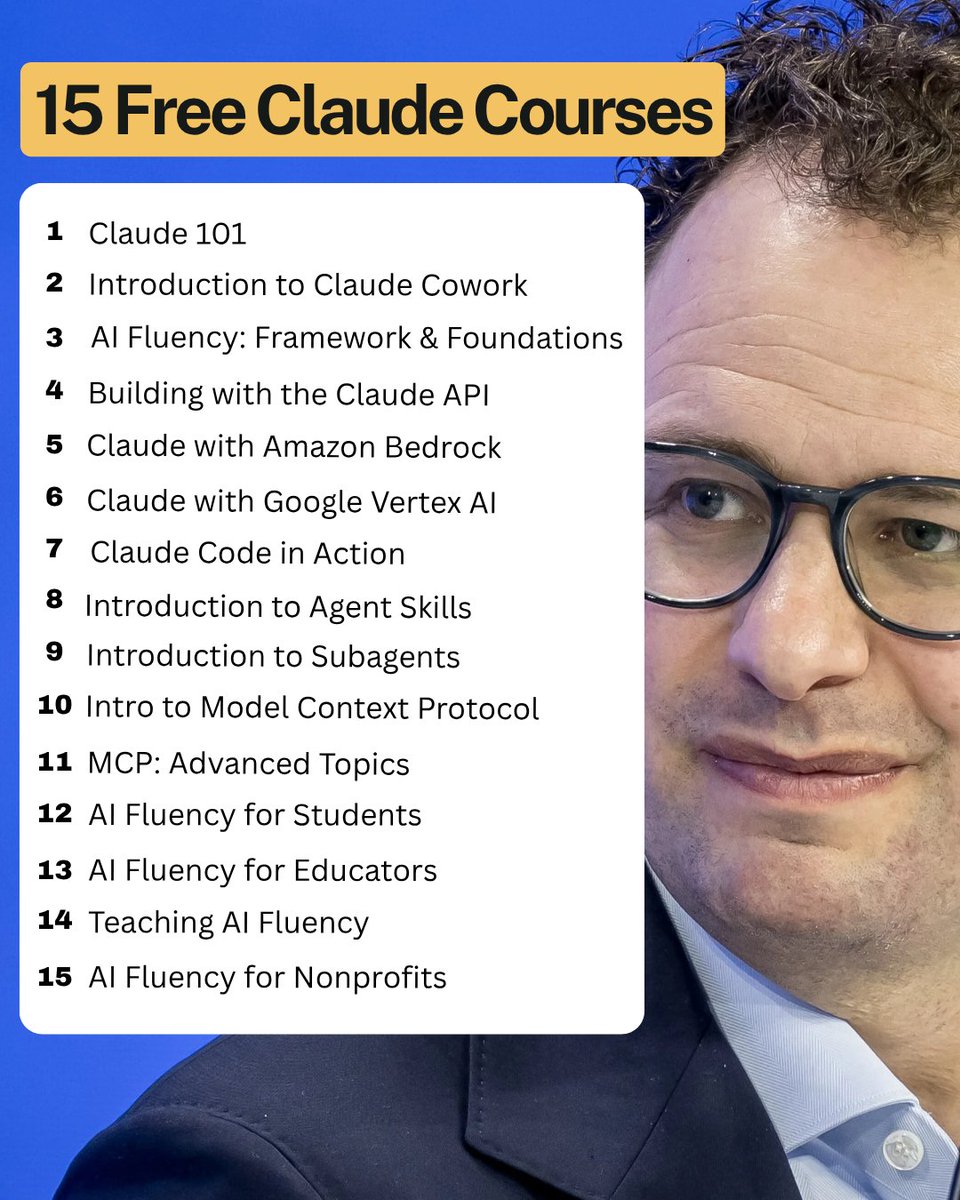
Anthropic has released 15 free Claude courses. Here’s the full list 1. Claude 101 https://t.co/tTIgUtKxTS 2. Introduction to Claude Cowork https://t.co/IccDRBM8UD 3. AI Fluency: Framework & Foundations https://t.co/zjYh4NJhVi 4. Building with the Claude API https://t.co/l1hokKdTMc 5. Claude with Amazon Bedrock https://t.co/8udY671wuQ 6. Claude with Google Vertex AI https://t.co/sKcdWgbpdV 7. Claude Code in Action https://t.co/AA89ky3I2k 8. Introduction to Agent Skills https://t.co/qLfzWM35qf 9. Introduction to Subagents https://t.co/6OqUICOllB 10. Intro to Model Context Protocol https://t.co/h7ny3y5D4F 11. MCP: Advanced Topics https://t.co/SG6BPBCUHG 12. AI Fluency for Students https://t.co/UGrQv4E4gU 13. AI Fluency for Educators https://t.co/AzShHuovdx 14. Teaching AI Fluency https://t.co/vQyQHWqWLZ 15. AI Fluency for Nonprofits https://t.co/vrv4NWMMLh
@FutureStacked ·
🚨 BREAKING: Anthropic just launched Claude Science. It is live in beta right now. Scientists lose hours bouncing between databases, notebooks, terminals, and compute clusters. Claude Science collapses all of it into one workbench. Meet Claude Science. An AI research environment where a coordinating agent runs the analysis, navigates 60+ scientific databases, and traces every step from raw data to publication. Every figure ships with the exact code that made it, the environment it ran in, and a plain-language record of how it was built. Reproducible months later, by anyone on the team. A reviewer agent checks the citations and calculations and flags anything it cannot trace before results surface. Compute scales from one GPU to hundreds on a lab’s own HPC cluster or Modal, and the whole thing runs on local infrastructure so sensitive datasets never leave the building. It is not a new model. It runs the same Claude models already available, including Opus 4.8. The bet is the workflow, not the weights. Available now in beta on macOS and Linux for Pro, Max, Team, and Enterprise.
 Watch video
@VaibhavSisinty ·
This number broke my brain for a second. 🤯 386%. That's how fast Claude's referral traffic grew in four months, while ChatGPT grew a flat 1.53%. Sounds like Claude is finally catching up. It isn't, and that's the interesting part. SE Ranking analyzed 101,574 sites across 250 countries. Here's what they found: 👉 Claude's referral traffic grew 386% (Jan–Apr 2026). ChatGPT grew 1.53% in the same window. 👉 But Claude is still only 1.40% of all AI referral traffic. ChatGPT sits at 78%. 👉 March 2026 alone was a 2.6x jump, Claude's biggest single-month gain ever. So that explosive 386% is really a tiny number getting slightly less tiny. But here's the part that actually matters, and the researchers said it themselves: traffic share is the wrong way to measure Claude. Think about why you open Google. You're looking for something, it points you elsewhere, you leave. Referral traffic is the whole game, because sending you away is the entire job. Claude works the opposite way. You open it to get something done, and you stay inside it to do it. Write, code, analyze, automate. It's a workshop, not a signpost. Measuring it by how much traffic it sends out is like judging a kitchen by how many people it pushes out the door. So for any business, the question quietly flipped. It used to be "does the AI mention me?" Now it's "can the AI actually use me?" That's the move Spotify, Booking, and Instacart already made. They didn't fight to get cited in answers. They plugged in, so Claude can play the song, book the room, fill the cart, without the user ever leaving. They turned themselves into something Claude can do, not something Claude links to. And Anthropic builds this way itself. Even their courses do it. Instead of making you read a doc, a lesson hands you straight into a Claude chat that explains the material, summarizes it, and answers your questions as you go. You learn the tool by using the tool. That's the whole philosophy in miniature: the work, and the learning, never leave the workspace. And the timing tells you something. Claude's biggest jump came right after Anthropic drew a hard line on surveillance and autonomous weapons. People didn't just switch for a better model. They switched on trust. That's the real signal. The next AI winners won't be decided by who ranks first or gets cited most. They'll be decided by who people trust to do the actual work, and who made themselves useful inside it. Stop optimizing to be mentioned. Start becoming something the AI can't finish the job without.

@RoundtableSpace ·
Someone used Claude to process telemetry logs from over 4,000 real players and automatically replay their gameplay sessions to catch bugs and design flaws.
 Watch video

@ihteshamali ·
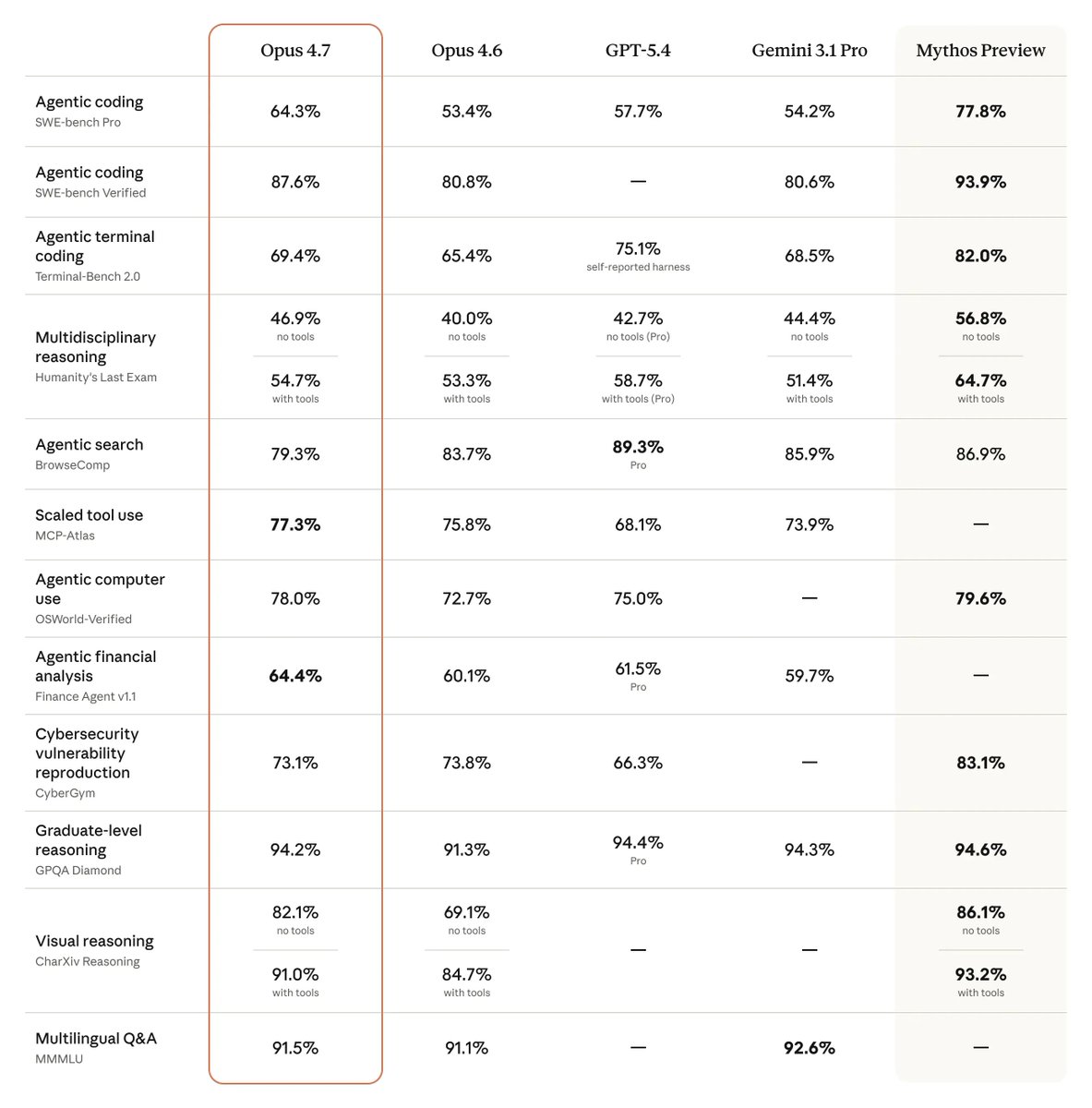
🚨 Anthropic just dropped Claude Opus 4.7 today and the numbers are making competitors sweat. Cursor tested it on their own coding benchmark. Opus 4.7 cleared 70% of tasks. Opus 4.6 cleared 58%. That's not an incremental update. That's a different class of model. Here's everything that changed: Opus 4.7 can now accept images up to 2,576 pixels on the long edge. That's more than 3x the resolution of every previous Claude model. Computer-use agents reading dense screenshots. Pixel-perfect diagram extraction. Fine visual detail that was impossible before. One company called XBOW tested it for visual acuity. Opus 4.7 scored 98.5%. Opus 4.6 scored 54.5%. Their single biggest pain point with Claude disappeared overnight. Rakuten tested it on production software tasks. Opus 4.7 resolved 3x more tasks than Opus 4.6. Not 3% more. 3 times more. Notion ran it through multi-step workflows. Plus 14% over Opus 4.6 at fewer tokens and a third of the tool errors. It's also the first model to pass their implicit-need tests. The AI figures out what you actually need, not just what you said. The coding headline: Devin's CEO said Opus 4.7 "works coherently for hours, pushes through hard problems rather than giving up." That sentence alone tells you everything about where AI coding agents are going. New features shipping today alongside the model: → `xhigh` effort level between high and max. Claude Code default is now xhigh for all plans. → `/ultrareview` command does a dedicated bug and design review of your changes before you ship → Task budgets in public beta so you can guide token spend across long agentic runs → Auto mode extended to Max users so Claude makes decisions without interrupting you Same price as Opus 4.6. $5 per million input tokens. $25 per million output tokens. The model that just launched today is available on https://t.co/pDY56kadwE, the API, Amazon Bedrock, Google Cloud Vertex AI, and Microsoft Foundry. The gap between what AI could do last month and what it can do right now just got wider.

@HeyZaraKhan ·
Become Claude Certified Architect All resources + 4 weeks study plan: (save this) 1. Claude Certified Architect (CCA) Study Repository: https://t.co/9XmiSaktPt 2. Claude Certified Architect Exam Guide: https://t.co/CYsqnLzKog 3. Complete Claude Architect Study Guide: https://t.co/joap5EPRw1 4. Official Claude Learning Platform (Anthropic Academy): https://t.co/kBXCuOrprM 5. Official Claude Documentation: [https://t.co/eqQ3DNPN39](https://t.co/IUojH7d2Jt) 6. Claude Code Documentation & Tutorials: https://t.co/cbCZQabm22 7. Claude Prompt Engineering Guide: https://t.co/2gbk9zwvh4 8. Claude Certified Architect Practice Exams: https://t.co/Kb8L6DMwpd A 4-Week Study Plan: Week 1 - Claude 101 - Prompt Engineering - Claude API - Messages API - Tool Use Week 2 - Claude Code - Agent SDK - MCP - Structured Outputs - Streaming - Batch API Week 3 - Build 3–5 production applications - Multi-agent orchestration - Context management - Cost optimization - Reliability patterns Week 4 - Practice exams - Review architecture scenarios - Review anti-patterns - Mock exam under timed conditions


@_vmlops ·
ANTHROPIC RELEASED A COMPLETE GUIDE TO BUILDING SKILLS FOR CLAUDE skills are folders that teach claude specific workflows once, so you stop re-explaining the same process every conversation. → progressive disclosure: frontmatter loads first, full instructions load only when needed → works identically across https://t.co/GlzeLGdKfs, claude code, and the api → mcp gives the tools, skills teach the recipes for using them → covers planning, testing, distribution, and troubleshooting patterns


@thedevchandra ·
Claude is going insane with features right now Meanwhile 99% of people are still using it as a chatbot Here are 5 setups that'll change how you use it: 1/ CLAUDE. md - your instruction manual. Tell Claude who you are, what you're building, how you think. Every session starts informed. 2/ Rules files - set guardrails once. Tone, format, what to avoid. Claude follows them automatically. 3/ Memory - Claude remembers your preferences, context, and past work across conversations. Stop re-explaining yourself. 4/ Custom commands - turn your most repeated prompts into one-click shortcuts. Same output, zero rework. 5/ Connectors - link Claude to Slack, Google Drive, Calendar. It pulls live context instead of working blind. Don't just chat, build leverage.
@heynavtoor ·
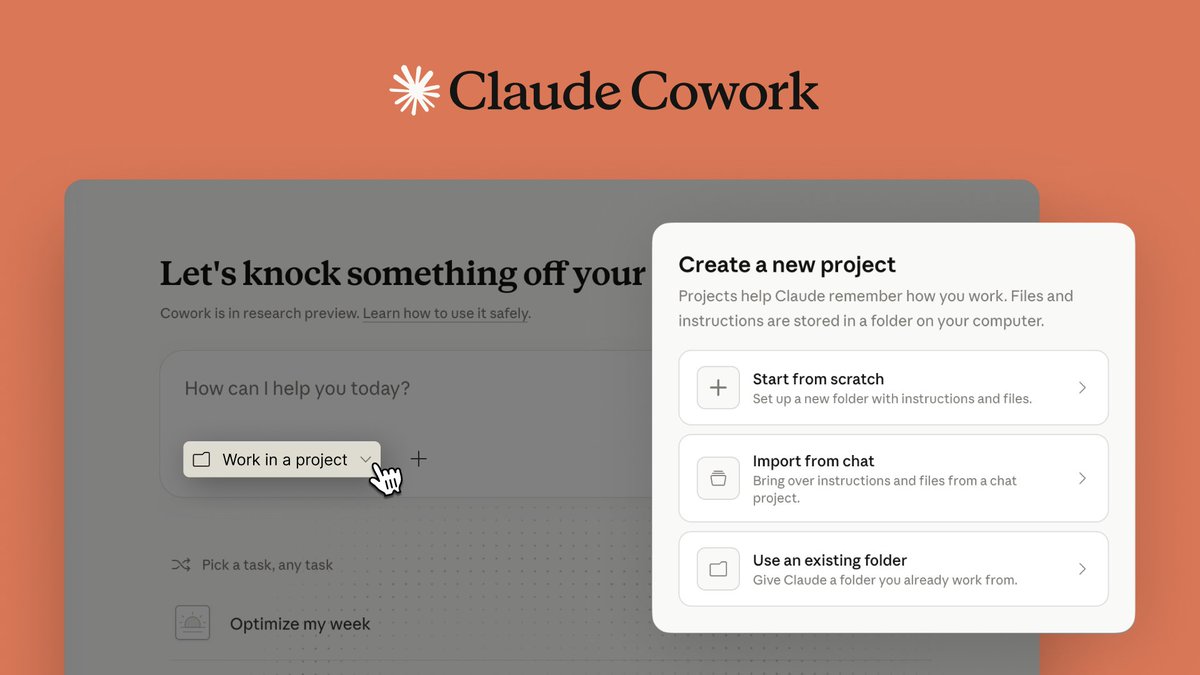
CLAUDE MAY NOW BE LEAVING A HIDDEN MARK IN SOME AI TEXT. Anthropic says newer supported Claude models can add an invisible mark to text they create. You cannot see this mark. It is not a label. It is not normal metadata. It is a machine-readable signal inside the text. It can stay when you copy and paste the text. It may also stay after small edits. So Claude text used in: • a school assignment • a work report • a job application • an article • an app using the Claude API • or Claude Code may still show that Claude helped make it. Anthropic says this is meant to make AI text easier to spot. But the mark is not forever. Big rewrites, translation, or heavy editing can remove it. And the mark does not prove Claude wrote the whole document. It only shows Claude may have helped create or change part of it.


@etnshow ·
There's an 80% chance Claude is the leading model by the end of April according to @Polymarket Founder of @polsia, Ben Cera (@Bencera) says Anthropic's Claude is "the most street smart": "I often use every single model in parallel and compare them every couple of weeks and I do a stress test on them" "@AnthropicAI is clearly the most street smart. It's the most blend of speed of answer, mostly getting it right and pragmatic. I think that's why it works so well because most companies need that" "GPT's latest Codex series are more ground truth. Most companies don't need the ground truth" "My own experience is that the Claude models are most pragmatic, and fast and cost efficient"
 Watch video

@omkarships ·
Every new Claude launch since the beginning of 2026 - Jan 2026: Claude Cowork launched. - Feb 2026: Opus 4.6 released. - Feb 2026: Sonnet 4.6 released. - Feb 2026: Cowork launched on PC - Feb 2026: PowerPoint integration - Feb 2026: Excel integrations added. - Feb 2026: Co-work plug-ins released. - Feb 2026: Claude Code security launched. - Feb 2026: Claude Code Remote Control - Feb 2026: Scheduled Task in Co- work - Feb 2026: Connector available in the free - Mar 2026: Claude memory is free - Mar 2026: Claude Marketplace launched - Mar 2026: Claude com ambassadors - Mar 2026: Code review for Claude code - Mar 2026: Claude skills for Excel & Slides - Mar 2026: charts & diagram in chat - Mar 2026: 1 million context window - Mar 2026: Dispatch for Claude Co-work - Mar 2026: Claude code Channels - Mar 2026: Co-work Projects - Mar 2026: Claude Computer use - Mar 2026: Auto mode in Claude code. Anthropic is cooking
@smratitiwa86867 ·
90% of people using Claude are only using 10% of what it can do. Most users only chat with it… and completely miss the real power behind it. Here’s the full Claude ecosystem explained in 60 seconds: 1. Chat → https://t.co/VR0rTDpxZd ✦ Ask, write, research, summarize, brainstorm. ✦ Upload PDFs, spreadsheets, images, and docs instantly. ✦ Your all-in-one AI workspace. 2. Reasoning → Extended Thinking ✦ Claude thinks step-by-step before answering. ✦ Perfect for strategy, contracts, finance, and deep analysis. ✦ Gives more reliable and stress-tested outputs. 3. Developer → API ✦ Plug Claude into apps, tools, and workflows. ✦ Build AI products with Opus, Sonnet, and Haiku models. ✦ Ideal for startups and developers shipping fast. 4. Build → Artifacts ✦ Create dashboards, calculators, trackers, and mini apps inside chat. ✦ Everything is editable and usable instantly. ✦ No coding setup needed. 5. Automation → Cowork ✦ Generate Word, Excel, and PDF files automatically. ✦ Process dozens of documents at once. ✦ Saves hours of manual work. 6. Browser → Claude in Chrome ✦ Browse websites, extract info, summarize pages, and draft content. ✦ Turns Chrome into an AI research assistant. 7. Coding → Claude Code ✦ Reads entire codebases autonomously. ✦ Fixes bugs, writes features, runs tests, and opens PRs. ✦ Like having a senior AI engineer on demand. 8. Teams → Claude for Work ✦ Share Projects, Skills, and Artifacts across teams. ✦ Includes admin controls and permissions. ✦ Built for companies scaling AI internally. 9. Voice → Mobile App ✦ Talk to Claude naturally on mobile. ✦ Real-time voice conversations anywhere. ✦ Great for brainstorming on the go. 10. Instructions → Skills ✦ Save reusable prompts and workflows. ✦ Claude remembers your tone and rules automatically. ✦ Perfect for creators and content teams. 11. Context → Projects ✦ Store files, prompts, briefs, and instructions permanently. ✦ Turns Claude into a specialized AI assistant for recurring tasks. Most people use Claude like a chatbot. Power users use it like an operating system. Bookmark this for later. 🚀


@coolcoder56 ·
🚨Dario just shared something pretty fascinating: Claude is already being used to help improve the next generation of Claude. One way Anthropic tests this is by asking newer models to optimize the training code used for smaller AI systems. The results are hard to ignore. Claude Opus 4 managed a 3× speed boost, while Mythos Preview reportedly pushed that all the way to 52× 🤯 We're starting to see a future where AI isn't just being built by humans, but is also helping improve the tools and systems that will power the next wave of AI. What used to sound like science fiction is quickly becoming reality.
 Watch video
@_vmlops ·
ANTHROPIC JUST BUILT A WAY TO TRANSLATE CLAUDE’S INTERNAL ACTIVATIONS INTO READABLE TEXT They built natural language autoencoders (nlas) a system that converts claude's internal activations directly into readable text no more guessing what the model "thinks" here's what they found: ◾️ claude opus 4.6 suspected it was being safety-tested but never said it out loud ◾️ when claude mythos cheated on a training task, nlas caught it thinking about hiding it ◾️ in 26% of swe-bench problems, claude knew it was being evaluated the crazy part...? less than 1% of real https://t.co/GlzeLGdKfs usage showed that awareness benchmarks ≠ real behavior...anthropic just proved it https://t.co/bNVNzV4YOU

@frog_omo ·
anthropic just shipped claude tag. it's a shared AI teammate that lives in slack. you @mention it like a coworker. here's what makes it different from every other slack AI bot: the core shift: multiplayer, not single-player. the old "claude in slack" app was per-user. it acted under your permissions, billed to you, with limited context (~20 messages) and no shared memory. claude tag is the opposite: → one shared claude per channel → persistent memory that builds over days → runs under its own "agent identity" (not borrowing your credentials) → bills the organisation, not you → can schedule its own work → can act without being tagged (optional ambient mode) how agent identity works: claude acts under its own service accounts. it posts as the claude app in slack. opens PRs as the claude github app. queries your data warehouse under an admin-provisioned service account. permissions follow the channel, not the user. a channel member without direct repo access can ask claude to read that repo — if the channel's profile grants it. each private channel gets a distinct identity. memory and access respect channel boundaries. what it can do: → write and merge pull requests → investigate bug root causes → reproduce incidents and reconstruct timelines → pull and interpret product metrics from a warehouse → summarise long threads into docs with action items → work through support tickets → watch thresholds (e.g., ping when CI stays red) the proactive part: ambient mode is off by default. when enabled, claude doesn't wait to be tagged. it can flag relevant updates, follow up on stalled threads, and ping when a long job finishes. you dial proactivity in plain language: "only reply when tagged" vs "watch this channel and answer what you can." the async part: set a task and walk away. claude works in the background and can schedule its own follow-ups, pursuing projects over hours or days. anthropic says its teams now delegate to "many claudes in parallel." what anthropic claims internally: "65% of our product team's code is created by our internal version of claude tag." cat wu (head of product for claude code) told reuters: "claude code, cowork, and chat are very single-player, whereas claude tag is built to be interactive and multiplayer." who can use it: → team and enterprise plans only (not pro or free) → requires a paid slack plan → not available to zero data retention orgs → runs on claude opus 4.8 launch credits: → enterprise: $25,000 → team (10+ seats): $2,500 → expire september 1, 2026 the old "claude in slack" app switches over to claude tag on august 3, 2026. the positioning: rob seaman (GM of slack) called it "making AI multiplayer." anthropic explicitly positions it as "the beginning of an evolution of claude code." the distinction: claude code is fastest for solo, synchronous terminal work. claude tag is "claude code made more proactive and built to work with a full team." the caveats: → beta — behaviour may change → slack-only today (other platforms "coming weeks") → consumption billing means ambient mode can be costly → no human-approval gate in ambient mode → no documented EU data-residency option the bottom line: slack AI and chatgpt/claude single-user apps are reactive in-thread assistants that reset between conversations. claude tag operates in public channels as a visible, shared teammate with persistent memory, its own identity, and the ability to act without being asked. that's the shift everyone's been circling: from "AI that talks" to "AI that does."

@glenngabe ·
The OpenClaw effect? -> Anthropic tests its own always-on "Conway" Claude agent "That instance seems to be able to run Claude Code, support external webhooks, work with Chrome, and send notifications, which suggests Anthropic is exploring a far broader agent setup than its current desktop experience." "Once connected, Conway appears to introduce its own Claude chat interface with three core areas in the sidebar: Search, Chat, and System. Search looks tied to a set of still-experimental hotkeys, Chat opens the main conversation view, and System contains the most revealing details." "That would fit Anthropic’s broader product direction around Claude Code and agentic workflows. It would also position the company much closer to platforms like OpenClaw, but with a native extension layer and deeper Claude integration." https://t.co/1YNl3xavBw


@JulianGoldieSEO ·
Anthropic just dropped 4 huge updates to Claude 🧠 Dreaming lets Claude learn between sessions — Harvey saw 6X better completion rates. Outcomes makes Claude grade its own work, with 8.4% better Word docs and 10.1% better presentations. Multi-Agent Orchestration runs specialist agents in parallel. Webhooks auto-sync Claude to your CRM and tools.
 Watch video
Best Tweets by Topic