

Dr. Gabrielle Lyon (@drgabriellelyon) X analytics
@drgabriellelyon
@drgabriellelyon has 34.6K followers, a median of 2.3K views per post and a 2.07% engagement rate.
Based on 30 recent original posts (high confidence). Updated October 21, 2026.
At a glance
Key stats
- Followers
- 34.6K34,580 followers on October 21, 2026
- Median views per post
- 2.3K
- Average views per post
- 2.4K
- Engagement rate (by views)
- 2.07%
- Original posts per week
- 5.3
- Average engagements per post
- 49
Engagement grade
Strong
This is above the baseline for accounts with 10K-100K followers.
Profile score
63/100
- Profile completeness70
- Audience shape100
- Engagement25
- Consistency100
- Positioning clarity20
Monetization
Estimated X creator earnings
$0–$1 in the last 30 days
From 53.6K views on @drgabriellelyon's original posts in the last 30 days.
Rewards eligibility: not yet
Rough estimate. X publishes no payout rate, so this assumes about $5–12 per 1M original-post impressions from reported creator payouts. Only Premium viewers’ impressions count, so real payouts can be much lower.
Free report
How does your account compare with @drgabriellelyon?
Get the same report for your own account by email: engagement grade, median views, best times to post and estimated earnings.
Timing
Best times to post
When @drgabriellelyon's recent posts performed best (UTC).
- #1 slot
8:12 PM
Monday · UTC
- #2 slot
8:18 PM
Tuesday · UTC
- #3 slot
8:34 PM
Wednesday · UTC
What worked
Top recent posts
- 01

@drgabriellelyon ·
Creatine is one of the most extensively researched supplements in the world, and the overwhelming majority of this research uses creatine monohydrate. There’s no shortage of people trying to advertise their own special types of creatine, like creatine HCl, creatine ethyl ester, and buffered creatine. It’s pure marketing. The reality is that every benefit we attribute to creatine supplementation has come from studies using monohydrate, and no other form has been shown to be superior to the tried and true. They don’t have better absorption, greater effectiveness, or fewer side effects (PMID: 35268011). Even if they did, creatine monohydrate is already absorbed extremely well, and most of its benefits come from saturating creatine stores in tissues that need it. There simply isn’t much room for improvement. So my recommendation is simple: Take 3–5 grams of creatine monohydrate daily. You don't need an expensive formula or a loading phase. I also prefer my creatine to be micronized, which is a process that makes the creatine particles smaller so they mix more easily in water. And if you have any GI problems, try using smaller doses across the day (PMID: 18373286). Fundamentals, people. Oftentimes, the simplest option really is the best one, and decades of research with creatine are a perfect example.
- 16Replies
- 9Reposts
- 109Likes
- 5.9KViews
3.4x average engagementText onlyLong post (over 200 characters)Posted Fri 00:00 UTC - 02
@drgabriellelyon ·
Longevity is not primarily genetic. It depends on building and defending the physical capacity to use those extra years. Strength is the input. A long, functional life is the output.
 Watch video
- 13Replies
- 8Reposts
- 115Likes
- 4.1KViews
2.2x average engagementHas a videoMedium length (100-200 characters)Posted Sun 14:00 UTC - 03
@drgabriellelyon ·
Weakness shortens your life, but strength extends it. Strength depends on managing stress, anxiety, and sleep. Skeletal muscle functions as one of the most important organs for long-term health, and obesity is a symptom of unhealthy, underused muscle, not the root problem itself. Save this. Share it with someone chasing the wrong metric.
 Watch video
- 9Replies
- 8Reposts
- 98Likes
- 3.1KViews
2.2x average engagementHas a videoLong post (over 200 characters)Posted Sat 14:00 UTC - 04
@drgabriellelyon ·
No woman should have to wait for an appointment, a prescription, or permission to do what's already in her control. For years this conversation has had one fork in the road: hormone therapy, yes or no. That's an important question, but it is not the only one. The first question is what you are doing for your skeletal muscle, starting today. Today's episode is all about menopause and muscle, where we explore: - Why muscle becomes non-negotiable - Whether weight gain is a fat problem or a muscle problem - Anabolic resistance and why the muscle-building switch can get “sticky” Every woman moves through menopause differently. But training and protein are where most women have the most control. New episode out now: https://t.co/DotewaxCiW #Menopause #Perimenopause #MuscleCentricMedicine #WomensHealth #ForeverStrong
 Watch video
- 13Replies
- 5Reposts
- 58Likes
- 3.5KViews
1.6x average engagementHas a videoLong post (over 200 characters)Posted Thu 20:00 UTC - 05
@drgabriellelyon ·
Protein is everywhere right now. But despite all the confidence you’re seeing in the marketplace, protein researchers are still debating some surprisingly basic questions. I was at Protein Summit 3.0 at Texas A&M, in a room full of the most influential protein scientists debating the most controversial one: How much protein do we need? The answer is different if you are a person trying to avoid deficiency, vs. an older adult trying to preserve function. The same goes for an athlete recovering from training, a patient recovering from illness, or someone losing weight while on a GLP-1 trying to retain lean tissue. But right now, we have one number that we recommend. While the science is not yet precise enough to create a perfect number for every person, it may be precise enough to stop pretending that everyone is the same. Here is what you will learn in today’s solo podcast episode: •The one thing the scientists in that room agreed on •Four examples of amino acids with jobs beyond muscle, including one that matters before it ever reaches the rest of your body •The intake range where one speaker argued metabolic outcomes appear to improve, and why the scientists stopped short of calling it the new number •Who most protein research was done on, and who those findings may not apply to •Why you can’t compare fish and beans on protein alone •How eating nothing but egg whites gave me a deficiency
 Watch video
- 10Replies
- 3Reposts
- 56Likes
- 3.1KViews
1.5x average engagementHas a videoLong post (over 200 characters)Posted Thu 17:00 UTC - 06
@drgabriellelyon ·
Lifespan measures how many years you live. But musclespan measures how many of those years you live with healthy skeletal muscle. Your musclespan begins before you are born, with skeletal muscle already forming by eight weeks of pregnancy. So the earlier children start training and moving their bodies, the stronger they grow up to be. Training early in life means we are not just raising strong children. We are raising strong adults.
 Watch video
- 14Replies
- 4Reposts
- 57Likes
- 2.9KViews
1.5x average engagementHas a videoLong post (over 200 characters)Posted Fri 20:00 UTC
Latest
Recent posts by Dr. Gabrielle Lyon
The latest 30 original posts from @drgabriellelyon, newest first, as of October 21, 2026. Replies and reposts aren't included.
@drgabriellelyon ·
Two carbs can match on a nutrition label and still digest very differently. Dr. Dariush Mozaffarian’s rule of thumb: picture a carb-rich food in water for 2 or 3 hours. Mush digests fast. Intact digests more slowly. Full episode out now: https://t.co/mKFbj9ip2N
 Watch video
- 4Replies
- 0Reposts
- 8Likes
- 729Views
@drgabriellelyon ·
Your diet is a muscle decision. We already know the role muscles play in mobility and bone health, but metabolic health is the key. If you are weak, you are at risk for death, and the stronger you are, the longer you live. Muscle health is what a long life comes down to, and each meal is a chance to feed the muscle you’re building. That’s what I’m really talking about: building stronger, more resilient humans.
 Watch video
- 15Replies
- 4Reposts
- 53Likes
- 2.4KViews
@drgabriellelyon ·
Lifespan measures how many years you live. But musclespan measures how many of those years you live with healthy skeletal muscle. Your musclespan begins before you are born, with skeletal muscle already forming by eight weeks of pregnancy. So the earlier children start training and moving their bodies, the stronger they grow up to be. Training early in life means we are not just raising strong children. We are raising strong adults.
Watch video- 14Replies
- 4Reposts
- 57Likes
- 2.9KViews
@drgabriellelyon ·
The Muscle-Brain Link. Your muscle mass may be the key to staying mentally sharp. Read the full article: https://t.co/qtPXHyETOb


- 4Replies
- 2Reposts
- 33Likes
- 1.6KViews
@drgabriellelyon ·
Creatine is one of the most extensively researched supplements in the world, and the overwhelming majority of this research uses creatine monohydrate. There’s no shortage of people trying to advertise their own special types of creatine, like creatine HCl, creatine ethyl ester, and buffered creatine. It’s pure marketing. The reality is that every benefit we attribute to creatine supplementation has come from studies using monohydrate, and no other form has been shown to be superior to the tried and true. They don’t have better absorption, greater effectiveness, or fewer side effects (PMID: 35268011). Even if they did, creatine monohydrate is already absorbed extremely well, and most of its benefits come from saturating creatine stores in tissues that need it. There simply isn’t much room for improvement. So my recommendation is simple: Take 3–5 grams of creatine monohydrate daily. You don't need an expensive formula or a loading phase. I also prefer my creatine to be micronized,…
- 16Replies
- 9Reposts
- 109Likes
- 5.9KViews
@drgabriellelyon ·
Protein is everywhere right now. But despite all the confidence you’re seeing in the marketplace, protein researchers are still debating some surprisingly basic questions. I was at Protein Summit 3.0 at Texas A&M, in a room full of the most influential protein scientists debating the most controversial one: How much protein do we need? The answer is different if you are a person trying to avoid deficiency, vs. an older adult trying to preserve function. The same goes for an athlete recovering from training, a patient recovering from illness, or someone losing weight while on a GLP-1 trying to retain lean tissue. But right now, we have one number that we recommend. While the science is not yet precise enough to create a perfect number for every person, it may be precise enough to stop pretending that everyone is the same. Here is what you will learn in today’s solo podcast episode: •The one thing the scientists in that room agreed on •Four examples of amino acids with jobs beyond…
Watch video- 10Replies
- 3Reposts
- 56Likes
- 3.1KViews
@drgabriellelyon ·
Friends, fight or flight is only one type of stress response. In 2000, Dr. Shelley Taylor and her team at UCLA described another pattern, which they called "tend and befriend." They originally proposed it to explain how females respond to stress, arguing that the classic fight-or-flight model had been built mostly on males. Tending means protecting yourselt and your young, and befriending means building the social network that helps you do it. Later research has found that men show these responses too. I gravitate towards "tend and befriend" myself. When I feel overstimulated or something goes wrong, I pick up the phone and ask someone how I can help. Regardless of which you lean towards, fear is only the first response. Being courageous is a choice, and it is trainable.
 Watch video
- 3Replies
- 1Reposts
- 19Likes
- 1.4KViews
@drgabriellelyon ·
Who needs more anesthesia: redheads, drinkers, or drug users? Board-certified anesthesiologist Dr. Tiffany Moon has worked for nearly 15 years at a level one trauma hospital she calls “the knife and gun show.” In her words, “Not every anesthetic is the same, because every patient is different.” That difference goes beyond your dose. She says the risk of complications under anesthesia depends on both the individual and the surgery itself. Here’s what you’ll learn in the full podcast episode: - How your risk of dying under anesthesia compares to your risk of getting into a car accident - Which surgery carries the highest risk of cognitive decline afterward, and why surgeons need to be quick - Whether fentanyl during surgery can leave you addicted, and what addicts tell Dr. Moon about their first high - Which anesthesia drug Dr. Moon doses by your lean body mass, and what happens when someone gets it wrong - Whether your body feels pain during surgery while you’re unconscious, and…
 Watch video
- 2Replies
- 1Reposts
- 16Likes
- 1.8KViews
@drgabriellelyon ·
https://t.co/nF1waHU2Tc Good review on preserving muscle during GLP-1 therapy. "Lean mass" ≠ contractile muscle. DXA can't see myosteatosis, counts water/glycogen as muscle, and tracks mass—not function. Qs: Why anchor on DXA..still. Even if it’s the best we have a population level ..
- 15Replies
- 0Reposts
- 10Likes
- 1.7KViews
@drgabriellelyon ·
On September 17, the Defense Health Agency issued clinical guidelines for testosterone deficiency in male service members. They have added a screening for men 30 and older to the annual health assessment, and evaluation and treatment are voluntary. My husband and I are two of the four physicians who wrote these guidelines to change that, along with Dr. Larry Lipshultz and Dr. Mohit Khera. At @StrongNewYork , an audience member asked regarding the guidelines: “What about women?” Several viral accusations claim this policy disregards female service members. This is not true. Hormone health matters for women too. To me, this work is about meaningful change for my fellow man or woman. Both sexes can do well, and we should want that. It is not either/or. Since men’s hormones have been studied more, the evidence supported writing their guidelines first. Optimizing female androgen therapy and overall hormone therapy requires a more nuanced, highly specialized approach than standard…
 Watch video
- 7Replies
- 0Reposts
- 29Likes
- 2.7KViews
Show all 30Show fewer
@drgabriellelyon ·
For the last few weeks, the military and medical communities have been buzzing about a recent Department of War memo. But they have not been buzzing enough. On September 17, the Defense Health Agency released clinical guidelines for the Pentagon's new testosterone screening of male service members. My husband, Shane, and I are two of the four physicians who wrote these guidelines, along with Dr. Larry Lipshultz and Dr. Mohit Khera. Many media outlets ran with a polarized version of the story, implying that the Pentagon is handing out testosterone to build bigger, more aggressive soldiers. The real story is much narrower, highly conventional medically, and long overdue. I have been treating operators for 15 years, and Shane served ten years on active duty as a Navy SEAL and combat medic. I started treating our warfighters because they were not getting the care that they needed, and they were suffering. Until recently, military medicine did not consistently test for this, and the…
 Watch video
- 2Replies
- 1Reposts
- 32Likes
- 2.6KViews
@drgabriellelyon ·
When you look at another person, you cannot see their testosterone or estrogen levels. But you can see the traits hormones may have helped create: skeletal structure, muscle mass, fat distribution, skin, hair, even posture. Some of this was shaped by hormones at puberty, and some by hormones today. Many of these factors are genetic, but many are also heavily modified by training and nutrition. Which raises the questions: • What role do hormones play in building the traits we find attractive? • Do your hormone levels today have anything to do with how attractive you are? • Do women really prefer men with higher testosterone? • Does attraction change across a woman's cycle? • Is any of this modifiable? All of these answers and more are in today's podcast episode.
 Watch video
- 5Replies
- 1Reposts
- 31Likes
- 2.4KViews
@drgabriellelyon ·
When you have musculoskeletal pain, the natural instinct is to try and treat it directly. But the cause of that pain often starts somewhere else in the body. I learned that from Dr. JJ Thomas, who is my physical therapist and good friend. She has practiced physical therapy for more than 25 years and has worked with the Philadelphia 76ers, the Philadelphia Eagles, and athletes from the UFC and US Olympic programs. What you’ll learn in this episode: •Why a chronic tendon injury can come right back, even after eccentric loading or PRP •Whether a frozen shoulder in menopause is a hormone problem, and one of the first movements Dr. Thomas checks •Why she works lying on her stomach, and the 10-minute band routine she wrote for an eight-hour desk day •Why sitting up taller won't fix your posture, and what poor posture tells her about your body •Why she gives patients shoulder blade exercises for their pelvic floor •How much a standard squat does for your posterior chain, and the position…
 Watch video
- 7Replies
- 7Reposts
- 28Likes
- 2.5KViews
@drgabriellelyon ·
Viktor Frankl said, “Between stimulus and response there is a space. In that space is our power to choose our response. In our response lies our growth and our freedom.” I recently had the honor of speaking at the 10th annual @StrongNewYork with my dear friends @DonSaladino and @EvyPoumpouras on what it takes to live a strong life. Thank you, @KennySantucci , for having me. Have you ever made a change that someone told you was impossible?
 Watch video
- 8Replies
- 6Reposts
- 41Likes
- 2.5KViews
@drgabriellelyon ·
We often think about muscle in terms of our looks, strength, and power. But it is so much more than that. Resistance training releases myokines. These are hormone molecules travel throughout the body, affecting and helping to regulate inflammation and brain function. There are over 600 different types of myokines, and I would say the majority of them we still probably don't even know. Skeletal muscle is also your metabolic sink. This is critically important. Because by doing resistance training, you not only improve your immune system, energy foundation, and mitochondria, but also your overall survivability in disease and stress states. There is not one other organ system that we can say does that much.
 Watch video
- 16Replies
- 5Reposts
- 33Likes
- 1.9KViews
@drgabriellelyon ·
Pre-workouts back in the ‘80s were a different kind of animal. Anxiety, heart palpitations, and no sleep were par for the course. (Does anyone else vividly remember reading warning labels on the back about how they might cause liver failure and kidney disease?) Which is why as I’ve gotten older and have learned to care about my organs (because, surprise, you need those), I now I use stimulant-free pre-workouts. BodyHealth has done a wonderful job in making a clean pre-workout supplement. It has an NO2 blend that helps with blood flow, energy, and the essential amino acids that help your skeletal muscle recover. Here’s the link: https://t.co/gAPSOYomMB #PerfectAmino #BHpartner
 Watch video
- 2Replies
- 5Reposts
- 17Likes
- 1.7KViews
@drgabriellelyon ·
I used to believe women needed hormones on board to build muscle after menopause. I was wrong. As an undergrad at the University of Illinois, I worked on early studies with postmenopausal women who didn't use any hormone replacement. I believed these hormones were required to increase or even maintain skeletal muscle. I had so many conversations with my mentor, Dr. Don Layman, about it that he told me, "Gabrielle, you are becoming annoying.” It was an early lesson: just because you can make something make sense mechanistically doesn't mean it will hold up in the science. A meta-analysis of 12 randomized controlled trials found hormone therapy on its own had essentially no independent effect on lean body mass. Paired with training, it appears to amplify the training effect. On current evidence, it is not a standalone muscle preservation strategy. One of the questions I hear most often from women is: “Is it too late for me to start lifting weights and building muscle?” The answer…
 Watch video
- 6Replies
- 2Reposts
- 25Likes
- 2.3KViews
@drgabriellelyon ·
Do you know the story of how Charlie inherited a chocolate factory? Well, his older brother David inherited a DEXA scanner. And he makes the Oompa-Loompas do resistance training 3x/week. All jokes aside: I keep a stash of David protein bars in the house at all times. Not only does my whole family love them, these are the only protein bars my kids will eat. The Gold bars fit 28g of protein into 150 calories, with 0g of sugar, which is the highest protein-to-calorie ratio of any bar on the market with 75% of calories from protein. Most sit near 40% or lower. Here’s the link: https://t.co/rdSD6zV84C @david_protein
 Watch video
- 7Replies
- 2Reposts
- 12Likes
- 1.6KViews
@drgabriellelyon ·
Most of us treat surgery as something that just happens “to” us. But patients may have far more active influence over their surgical outcomes than they’ve been told. Dr. Rebecca Knackstedt joins me on today’s episode of the podcast. She is a plastic and reconstructive microsurgeon at Duke, where she operates on breast cancer patients. Her primary research focuses on surgical prehabilitation with nutrition, supplementation, and exercise. Where rehab starts after surgery, prehab uses the same tools in the weeks before it. She calls it a conversation that all patients should be having with their surgeons, and it's a conversation that isn't happening. Full episode out now: https://t.co/PiZqf4DN6c
 Watch video
- 5Replies
- 2Reposts
- 22Likes
- 2.4KViews
@drgabriellelyon ·
Excited to see the science match the needs of the military and the operators! This will change the way we practice medicine. Baseline T, annual biomarkers of health, paired w/ PFTs and trends over time; great data will come from this, and revolutionize testosterone the way the military revolutionized the understanding and treatment of TBIs. I wouldn’t be surprised if new recommendations come soon … women are next! 💪🏽👊🏽 #military #urology #muscleismedicine #testosterone #strong
- 3Replies
- 3Reposts
- 20Likes
- 3.3KViews
@drgabriellelyon ·
No woman should have to wait for an appointment, a prescription, or permission to do what's already in her control. For years this conversation has had one fork in the road: hormone therapy, yes or no. That's an important question, but it is not the only one. The first question is what you are doing for your skeletal muscle, starting today. Today's episode is all about menopause and muscle, where we explore: - Why muscle becomes non-negotiable - Whether weight gain is a fat problem or a muscle problem - Anabolic resistance and why the muscle-building switch can get “sticky” Every woman moves through menopause differently. But training and protein are where most women have the most control. New episode out now: https://t.co/DotewaxCiW #Menopause #Perimenopause #MuscleCentricMedicine #WomensHealth #ForeverStrong
Watch video- 13Replies
- 5Reposts
- 58Likes
- 3.5KViews
@drgabriellelyon ·
Men don’t talk about erectile dysfunction. They should. It may be the first sign that something is wrong with their heart. For erections to work, everything has to work: blood flow, nerves, hormones, mental health. When something is off, it often shows up there first. That’s why erectile dysfunction is one of the strongest early markers of heart disease, especially in younger men. Dr. Tobias Kohler, who leads Men’s Health at Mayo Clinic, is back on the show. His rule: if it’s failing in the bedroom, it’s a blood flow problem until proven otherwise. For younger men with erectile dysfunction who are at borderline or intermediate cardiovascular risk, the new guidelines say to consider a coronary calcium scan. We get into the Princeton IV guidelines, the ceramide test, testosterone and what happens when you push past normal, GLP-1s, and why men die about five years earlier than women. Men wait until something breaks. That has to change. Be proactive, not reactive.
 Watch video
- 10Replies
- 5Reposts
- 32Likes
- 2.8KViews
@drgabriellelyon ·
The FDA's reporting system captures only 1 to 10 percent of adverse events from GLP-1 medications. The sexual side effects are among the most underreported in all of medicine, and the safety evidence in women is nonexistent. Watch the full solocast on all platforms now.
 Watch video
- 11Replies
- 4Reposts
- 46Likes
- 2.3KViews
@drgabriellelyon ·
@DrDorisDay on Monday! What skin questions do you have? I’m really interested in her work regarding topical estradiol skin quality and aging! https://t.co/QidBbHUkKv
- 2Replies
- 1Reposts
- 6Likes
- 1.3KViews
@drgabriellelyon ·
Most people assume becoming a parent is an emotional change, but a measurable part of it is hormonal, and it happens in fathers too. I sat down with Dr. Aldrich Chan, a neurologist, to talk about what changes in the brain, why the split we draw between mind and body does not hold up, and what decides whether stress reads as manageable or overwhelming when the hormones are identical either way.
 Watch video
- 4Replies
- 2Reposts
- 16Likes
- 1.4KViews
@drgabriellelyon ·
Dr. Aldrich Chan, a neuropsychologist joins me to discuss why 60 to 80% of ongoing brain activity has nothing to do with perceiving your environment, and why intuition may simply be the brain processing complex information outside conscious awareness. We also cover the fear of uncertainty and why real transformation is embodied, not just intellectual. Watch the full episode here on X!
 Watch video
- 1Replies
- 0Reposts
- 13Likes
- 1.3KViews
@drgabriellelyon ·
We've treated obesity as the primary threat to health for two decades. The data says otherwise. Obesity is often a symptom of unhealthy muscle, not the root driver of mortality. Skeletal muscle mass predicts all-cause mortality better than fat mass alone, and losing it with age is riskier than gaining fat. BMI shouldn't be the default screen. Muscle should be.
 Watch video
- 11Replies
- 3Reposts
- 45Likes
- 1.9KViews
@drgabriellelyon ·
Longevity is not primarily genetic. It depends on building and defending the physical capacity to use those extra years. Strength is the input. A long, functional life is the output.
Watch video- 13Replies
- 8Reposts
- 115Likes
- 4.1KViews
@drgabriellelyon ·
Weakness shortens your life, but strength extends it. Strength depends on managing stress, anxiety, and sleep. Skeletal muscle functions as one of the most important organs for long-term health, and obesity is a symptom of unhealthy, underused muscle, not the root problem itself. Save this. Share it with someone chasing the wrong metric.
Watch video- 9Replies
- 8Reposts
- 98Likes
- 3.1KViews
@drgabriellelyon ·
You thought you were changing your body. Turns out, you were rebuilding your life. Training begins as a physical goal but quickly becomes behavioral. Consistency in the gym builds discipline, which reshapes mindset, habits, priorities, and focus. Over time, this influences decisions, social environment, and long term goals. The physical change is only one part of the outcome.
 Watch video
- 4Replies
- 3Reposts
- 47Likes
- 2.2KViews
Formats
Content mix
- Text only
- 7%
- With media
- 87%
- With links
- 13 posts
- With hashtags
- 3 posts
Creator style: Visual-led creator
See the full app
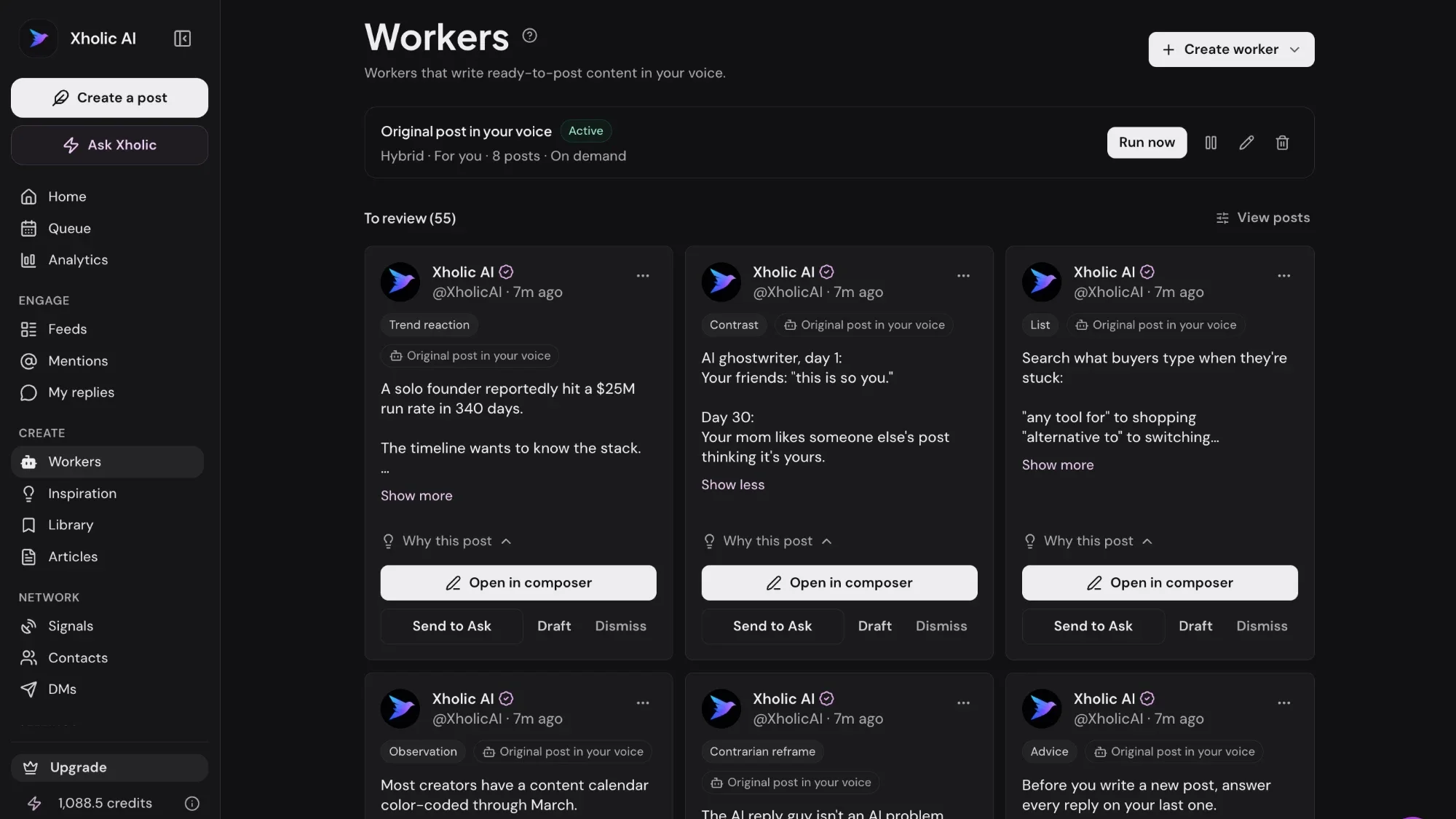
This creator report is one small part of Xholic
Click through a sample creator's account in the real app. No sign-up, nothing to install.
- Posts written in your voice and scheduled for your best hours
- Buyers found on 𝕏, with a reply drafted for each one
- Analytics that show which posts grow you
No sign-up or login needed · Takes about 2 minutes
Grow your own account
Want numbers like @drgabriellelyon's?
Xholic writes posts in your voice, schedules them for the hours your audience is active, and tracks what's working every day.
$0 today · Card required · Cancel anytime
Live demo: no sign-up or login needed · takes about 2 minutes
Keep browsing
More in Health & science
See all of Health & science


Keep exploring
Free tools
- Compare Twitter AccountsPut two public accounts head to head and see who leads on views, engagement, grade and posting pace.
- Twitter Engagement Rate CalculatorCalculate engagement rate from your numbers or a public profile and grade it against your tier.
- X Monetization CalculatorChange the assumptions behind six X revenue models and compare gross revenue with direct contribution.
Guides
- How to Check an X Follower Count Live (and Read the Trend)Watch any public X account's exact follower count update live, read the session and 90-day charts, and see why the number differs from the X app.
- How to Analyze Any X Profile and Read the ReportAnalyze any public X profile and read the report properly: how each metric is calculated, what is measured vs estimated, and three worked readings.
From the blog
- Free Twitter Analyzer Tool: Check Any X Account in SecondsAnalyze any Twitter/X account in seconds with our free twitter analyzer tool. See engagement, growth trends & content insights. No login, no signup.
- Impressions vs Reach Twitter: What Actually Counts on XConfused by impressions vs reach Twitter metrics? Learn how X counts each, why reach is estimated, and which to optimize for growth.
Best tweets on this topic
- Best tweets about ProductivityA curated collection of the sharpest, most-shared X posts about productivity—saved so you do not have to dig through the timeline yourself. Updated every two weeks.
- Best tweets about Burnout and Mental Health for FoundersRead 50 of the best tweets about founder burnout and mental health, with honest lessons on startup stress, resilience, and sustainable work.
- Best tweets about Self ImprovementA curated collection of the sharpest, most-shared X posts about self improvement—saved so you do not have to dig through the timeline yourself. Updated every two weeks.
About this data
- Analytics are inferred from public profile and recent post data. They do not include private impressions, profile visits, link clicks, or follower-source data.
- Deleted, protected, unavailable, or rate-limited posts may be missing from the sample.
- Stats come from public posts Xholic has stored, not private X Analytics. Xholic is not affiliated with X Corp or @drgabriellelyon.
- Own this account and want it hidden? Email support@xholic.ai — we verify ownership and handle requests within 2 working days.