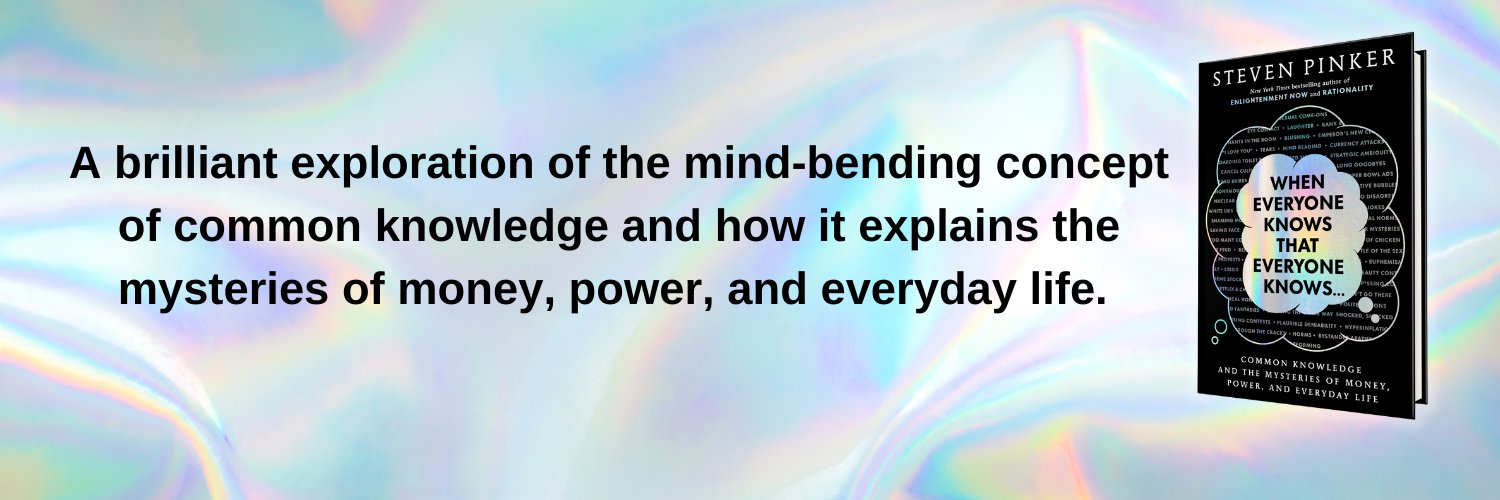

Steven Pinker (@sapinker) X analytics
@sapinker
Cognitive scientist at Harvard.
@sapinker has 860.8K followers, a median of 25.2K views per post and a 0.50% engagement rate.
Based on 30 recent original posts (high confidence). Updated October 21, 2026.
At a glance
Key stats
- Followers
- 860.8K860,770 followers on October 21, 2026
- Median views per post
- 25.2K
- Average views per post
- 28.8K
- Engagement rate (by views)
- 0.50%
- Original posts per week
- 13.2
- Average engagements per post
- 145
Engagement grade
Needs work
This is below the benchmark for accounts with 100K-1M followers.
Profile score
71/100
- Profile completeness100
- Audience shape100
- Engagement25
- Consistency100
- Positioning clarity30
Monetization
Estimated X creator earnings
$16–$39 in the last 30 days
From 3.3M views on @sapinker's original posts in the last 30 days.
Rewards eligibility: likely
Rough estimate. X publishes no payout rate, so this assumes about $5–12 per 1M original-post impressions from reported creator payouts. Only Premium viewers’ impressions count, so real payouts can be much lower.
Free report
How does your account compare with @sapinker?
Get the same report for your own account by email: engagement grade, median views, best times to post and estimated earnings.
Growth
Follower growth
Tracked by Xholic since July 28, 2026.
| Date | Followers | Change |
|---|---|---|
| Oct 21, 2026 | 860,770 | −12 |
| Oct 20, 2026 | 860,782 | −152 |
| Oct 17, 2026 | 860,934 | −185 |
| Oct 10, 2026 | 861,119 | −413 |
| Oct 7, 2026 | 861,532 | +4,296 |
| Jul 28, 2026 | 857,236 | – |
Timing
Best times to post
When @sapinker's recent posts performed best (UTC).
- #1 slot
7:12 PM
Monday · UTC
- #2 slot
7:23 PM
Tuesday · UTC
- #3 slot
7:18 PM
Wednesday · UTC
What worked
Top recent posts
- 01

@sapinker ·
David Deutsch (@DavidDeutschOxf) and I discuss AGIs and subjectivity on the Joe Walker Podcast (@JosephNWalker): David Deutsch: I think it’s inevitable that AGIs will be capable of having internal subjectivity and qualia, because that’s all included in the letter G in the middle of the name of the technology. Me: Well, not necessarily, because the G could be general computational power, the ability to solve problems, and there could be no one at all who’s actually human. David Deutsch: But there ain’t nothing here but computation. It’s not like in Star Trek: Data lacks the emotion chip, and it has to be plugged in. But there’s nothing possibly in that chip apart from more circuitry like he’s already got. Me: But, of course, the episode that you’re referring to is one in which the question arose: Is it moral to reverse engineer Data by dismantling him, therefore stopping the computation? Is that disassembling a machine, or is it snuffing out a consciousness? Because there is an alternative view that subjectivity depends also on whatever biochemical substrate our particular computation runs on. And I think there’s no way of ever knowing. David Deutsch: I think we can answer that question before we ever do any experiments, even today, because there’s no difference in principle between a computer that runs partly by electricity and partly by chemicals and one that runs entirely on silicon chips. Because the latter can simulate the former with arbitrary accuracy. Me: Well, we don’t have to solve the problem this afternoon in our conversation, but, in fact, I think it is not solvable. But the simulation doesn’t necessarily mean that it has subjectivity. It could just mean it’s a simulation; that is, it’s going through all the motions. It might even do it better than we do, but, you know, there’s no one home. There’s no one actually being hurt. David Deutsch: Well, you can be a dualist. You can say that there is mind in addition to all the physical stuff. But if you want to be a physicalist, then there’s this thought experiment where you remove one neuron at a time and replace it with a silicon chip, and you wouldn’t notice. Me: Well, that’s the question. An external observer wouldn’t notice. How do we know that, from the point of view of the brain being replaced—every neuron by a chip—it’s like falling asleep? That when it’s done and every last neuron is replaced by a chip, you’re dead, subjectively, even though your body is still making noise? David Deutsch: That means that when your subjectivity is—there is something happening in addition to the computation. And that’s dualism. Me: I mean, again, I don’t have an opinion one way or another, which is exactly my point. I don’t think it’s a decidable problem. But it could be that that extra something is not ghostly substance. It could be that the stuff that the brain is made of is responsible for that extra ingredient of subjective experience, as opposed to intelligent behavior. I think we’re going to be having the same debate a hundred years from now. David Deutsch: Yeah, maybe one of the AGIs will be participating in the debate by then.
 Watch video
- 1Replies
- 124Reposts
- 766Likes
- 129.5KViews
8.1x average engagementHas a videoLong post (over 200 characters)Posted Tue 19:00 UTC - 02
@sapinker ·
When I surveyed my colleagues on the Council on Academic Freedom at Harvard for examples of how a lack of intellectual and political diversity was distorting scholarship & teaching in their fields, 1 example was avoidance of mentioning one of the most robust findings in happiness research: "Married people are happier. Period." | Why Americans Stopped Falling in Love. https://t.co/PkBDoEu8C4
- 0Replies
- 72Reposts
- 417Likes
- 34.7KViews
2.5x average engagementShares a linkLong post (over 200 characters)Posted Mon 13:00 UTC - 03
@sapinker ·
Interview with the philosophers Dan Williams and Henry Shevlin on AI Doom, Consciousness, and whether the human brain is a LLM. https://t.co/A4sDajWCSG
- 0Replies
- 45Reposts
- 217Likes
- 34.6KViews
2.4x average engagementShares a linkMedium length (100-200 characters)Posted Wed 13:00 UTC - 04
@sapinker ·
Martin Seligman's 1970 paper on the generality of the laws of learning was the first academic paper in psychology I ever read (just 2 years after it came out), and I've followed his ideas with interest and edification ever since. More than 50 years later, here he is in conversation with my former student @AdamOmaryPhD and @johanknorberg (author of an excellent book on progress), exploring the role of human agency in historical progress. https://t.co/EzZ6BJlWFD
- 0Replies
- 43Reposts
- 228Likes
- 34.7KViews
2.3x average engagementShares a linkLong post (over 200 characters)Posted Fri 13:00 UTC - 05
@sapinker ·
From my interview with The New Society @NewStatesman: Headlines are a bit of a misleading way to understand history because, you know, bad things happen, but bad things happened 50 years ago, too, and we tend to forget them. When you actually plot things like poverty, war, homicide, and literacy, most of these are way better now than they used to be. How did that happen? And there are a number of hypotheses that I float as to why cooperation and human flourishing in general have increased. One of them is an expanding circle of empathy, another concept from Singer: as we rub shoulders, as we exchange stories with people who are unlike ourselves, we come to realize that we're not special just because we're us and they're them. You're bound to understand people when you kind of see the world from their perspective. But another could be—and this, again, Singer suggested—that sheer raw reason can make us more moral, more cosmopolitan, more universal, as we realize that there's nothing special about me just because I'm me. There's something that is inherently disinterested and universal about reason. And, of course, I care about me more than I care about other people, but I can't convince you that that is a moral imperative—that you have to care about me more than you because I'm me and you're not. And so, just that symmetry kind of pushes toward a kind of more ethical code: a golden rule, a categorical imperative, or the veil of ignorance, where simply discounting your own proprietary interest in yourself steers you toward a defensible morality.
 Watch video
- 0Replies
- 60Reposts
- 266Likes
- 74.9KViews
1.9x average engagementHas a videoLong post (over 200 characters)Posted Mon 17:00 UTC - 06
@sapinker ·
If all behavior is "caused" by our neurobiology (i.e., a miracle does not occur every time we make a choice), does that mean no one is responsible for their choices? @DamienMorris reveals the fallacies here.
- 1Replies
- 26Reposts
- 181Likes
- 35.3KViews
1.7x average engagementText onlyLong post (over 200 characters)Posted Sat 19:00 UTCQuote post
Latest
Recent posts by Steven Pinker
The latest 30 original posts from @sapinker, newest first, as of October 21, 2026. Replies and reposts aren't included.
@sapinker ·
Lucid article by Seth, Block, & Tononi: Three reasons why AI is not conscious and perhaps never will be https://t.co/UV1i2fdpPQ
- 1Replies
- 5Reposts
- 28Likes
- 4.5KViews
@sapinker ·
I was ashamed to realize that I did not notice at the time when one of humanity's greatest accomplishments was announced: photos of Pluto, taken from the edge of our solar system looking back. Blue Haze is up there with Earthrise and Pale Blue Dot as stunningly beautiful works of art, testimonies to human ingenuity and daring, and opportunities to reflect on our place in the cosmos.


- 0Replies
- 16Reposts
- 156Likes
- 7.4KViews
@sapinker ·
Enjoying the Starmus (Stars + Music) conference in the Canary Islands, where I've met many astronauts, spoke about common knowledge, and took part in a panel on the search for truth with Geoff Hinton ("Godfather of AI") and Christiana Figueres (Costa Rican negotiator of the Paris Climate accords).


- 1Replies
- 2Reposts
- 15Likes
- 4.2KViews
@sapinker ·
Pangburn's Symposium I - San Francisco - General Pass | Pangburn https://t.co/KdM2eHxTJu
- 1Replies
- 3Reposts
- 20Likes
- 10.2KViews
@sapinker ·
The Culture War We Need: Constructive, improvement and reality-based appreciation of progress vs. self-pity and grievance, by @RichardHanania https://t.co/gore5G1Eoh
- 0Replies
- 11Reposts
- 56Likes
- 15.9KViews
@sapinker ·
With Philip Torr (@philiptorr) at Starmus VIII. https://t.co/Zavjprg3pN

- 1Replies
- 2Reposts
- 34Likes
- 20KViews
@sapinker ·
Feature by Sanjeev Kumar on common knowledge https://t.co/zGcy8kv9Gt
- 0Replies
- 0Reposts
- 9Likes
- 19.5KViews
@sapinker ·
Henry Shevlin (@dioscuri), Dan Williams (@danwilliamsphil), and I discuss AI and "superintelligence." You get all of these maladaptive outcomes—all this cruelty and waste and competition and aggression—precisely because there was no designer who wanted to minimize any of these things. Natural selection did its thing. If AI were simply allowed to evolve without any kind of human intervention, then that would be a risk. But in the case of AI, there is intelligent design. I mean, us. These are gadgets. I think it’s illicit to anthropomorphize AI as being like human beings, which are products of natural selection, when AIs are not products of natural selection. They’re products of intelligent design. And so the engineers can think, “Well, these are the goals that we want to optimize. These are the kinds of side effects that we want to minimize. These are the kinds of things that we wouldn’t in a million years allow it to do.”
 Watch video
- 1Replies
- 18Reposts
- 89Likes
- 28.8KViews
@sapinker ·
The Angry Optimist: Another feed of Positive, significant, and underreported news. https://t.co/5mBFG2oDtT
- 0Replies
- 4Reposts
- 18Likes
- 15.3KViews
@sapinker ·
I t Looked Like a New Species. The Trouble Was, It Didn’t Exist. First article by my nephew @ericboodman in his new role of national science correspondent for NYT. https://t.co/cKcXO5UhFy
- 0Replies
- 7Reposts
- 51Likes
- 25.1KViews
Show all 30Show fewer
@sapinker ·
Martin Seligman's 1970 paper on the generality of the laws of learning was the first academic paper in psychology I ever read (just 2 years after it came out), and I've followed his ideas with interest and edification ever since. More than 50 years later, here he is in conversation with my former student @AdamOmaryPhD and @johanknorberg (author of an excellent book on progress), exploring the role of human agency in historical progress. https://t.co/EzZ6BJlWFD
- 0Replies
- 43Reposts
- 228Likes
- 34.7KViews
@sapinker ·
David Deutsch (@DavidDeutschOxf) and I discuss AGIs and subjectivity on the Joe Walker Podcast (@JosephNWalker): David Deutsch: I think it’s inevitable that AGIs will be capable of having internal subjectivity and qualia, because that’s all included in the letter G in the middle of the name of the technology. Me: Well, not necessarily, because the G could be general computational power, the ability to solve problems, and there could be no one at all who’s actually human. David Deutsch: But there ain’t nothing here but computation. It’s not like in Star Trek: Data lacks the emotion chip, and it has to be plugged in. But there’s nothing possibly in that chip apart from more circuitry like he’s already got. Me: But, of course, the episode that you’re referring to is one in which the question arose: Is it moral to reverse engineer Data by dismantling him, therefore stopping the computation? Is that disassembling a machine, or is it snuffing out a consciousness? Because there is an…
Watch video- 1Replies
- 124Reposts
- 766Likes
- 129.5KViews
@sapinker ·
The Financial Times on When Everyone Knows That Everyone Knows . . .: Common Knowledge and the Mysteries of Money, Power, and Everyday Life.

- 1Replies
- 4Reposts
- 39Likes
- 20.7KViews
@sapinker ·
From my interview with The New Society @NewStatesman: Headlines are a bit of a misleading way to understand history because, you know, bad things happen, but bad things happened 50 years ago, too, and we tend to forget them. When you actually plot things like poverty, war, homicide, and literacy, most of these are way better now than they used to be. How did that happen? And there are a number of hypotheses that I float as to why cooperation and human flourishing in general have increased. One of them is an expanding circle of empathy, another concept from Singer: as we rub shoulders, as we exchange stories with people who are unlike ourselves, we come to realize that we're not special just because we're us and they're them. You're bound to understand people when you kind of see the world from their perspective. But another could be—and this, again, Singer suggested—that sheer raw reason can make us more moral, more cosmopolitan, more universal, as we realize that there's nothing…
Watch video- 0Replies
- 60Reposts
- 266Likes
- 74.9KViews
@sapinker ·
A moving report by @mboudry: An Army of Yesterday’s Civilians: Ukraine and the Fight for Freedom https://t.co/KJUb7K7Jjq
- 0Replies
- 4Reposts
- 36Likes
- 28.8KViews
@sapinker ·
The opinions expressed at this event are indeed refutable, but if you're committed to academic freedom, HMS can't be attacked for allowing it to happen. | Harvard Medical School Takes on Weight Loss https://t.co/atW7kr7ia3
- 0Replies
- 7Reposts
- 73Likes
- 22.4KViews
@sapinker ·
When I surveyed my colleagues on the Council on Academic Freedom at Harvard for examples of how a lack of intellectual and political diversity was distorting scholarship & teaching in their fields, 1 example was avoidance of mentioning one of the most robust findings in happiness research: "Married people are happier. Period." | Why Americans Stopped Falling in Love. https://t.co/PkBDoEu8C4
- 0Replies
- 72Reposts
- 417Likes
- 34.7KViews
@sapinker ·
If all behavior is "caused" by our neurobiology (i.e., a miracle does not occur every time we make a choice), does that mean no one is responsible for their choices? @DamienMorris reveals the fallacies here.
- 1Replies
- 26Reposts
- 181Likes
- 35.3KViews
@sapinker ·
Critiques of Progress, Pt. 1: The Revolt against Modernity https://t.co/P8b7DXABYp
- 0Replies
- 8Reposts
- 74Likes
- 20.5KViews
@sapinker ·
What to Make of Trump’s Uptick in Profanity (and the taboo words he still avoids), by @JohnHMcWhorter. John and I have both written about the linguistics (& in my case the psycholinguistics) of profanity, he in Nine Nasty Words, I in "The Seven Words You Can't Say on Television" in The Stuff of Thought. We'll present our analyses at the meeting of the Foundation for Individual Rights and Expression in Philadelphia next month. https://t.co/9cwhNRvp9Z
- 0Replies
- 7Reposts
- 37Likes
- 15.7KViews
@sapinker ·
Population Decline Is Real. So Is the Reversal. Insightful and original analysis, via @fabricegrinda https://t.co/Idf9Qd1II4
- 0Replies
- 21Reposts
- 137Likes
- 32.7KViews
@sapinker ·
CIBOOK™ — A Sealed Record of This Moment in Time https://t.co/UWZI3Aw3xj
- 1Replies
- 1Reposts
- 17Likes
- 28.8KViews
@sapinker ·
Jerry Kaplan on AI Doomers (his take is pretty close to mine). https://t.co/yXC8z66xzN
- 0Replies
- 4Reposts
- 54Likes
- 27.2KViews
@sapinker ·
Insightful Economist cover story on the promise and dangers of EA as it has evolved intellectually and institutionally: Effective altruism is this century’s biggest idea https://t.co/wR1qAbCj0l
- 0Replies
- 13Reposts
- 99Likes
- 25.4KViews
@sapinker ·
Claire Lehmann @clairlemon examines the dark side of "Effective Altruism" and compares their AI doomerism to historical millenarian cults. None of this literally refutes their predictions but it adds insight to what many see as eccentric and unpersuasive lines of thinking. https://t.co/ZgmmzBoQUG
- 1Replies
- 36Reposts
- 204Likes
- 48.3KViews
@sapinker ·
There Was Nothing Victorious About October 7, by John Aziz, in Middle East Uncovered, an irreplaceable source of news and commentary, sponsored by Ideas Beyond Borders @IdeasB2 https://t.co/IAu5wlG7Ok
- 0Replies
- 27Reposts
- 92Likes
- 19.4KViews
@sapinker ·
Interview with the philosophers Dan Williams and Henry Shevlin on AI Doom, Consciousness, and whether the human brain is a LLM. https://t.co/A4sDajWCSG
- 0Replies
- 45Reposts
- 217Likes
- 34.6KViews
@sapinker ·
Life in The Grim Old Days https://t.co/tduuQBxHGU
- 0Replies
- 6Reposts
- 50Likes
- 35.5KViews
@sapinker ·
Analyses of the downsides of AI, whether in self-driving cars or bot psychotherapists, should not fall prey to the status quo bias and overlook the downsides of current practices. | Charlotte Blease @crblease notes: We’re right to worry about AI therapists. But what about human ones? https://t.co/oErEmztXV1
- 0Replies
- 12Reposts
- 118Likes
- 25.4KViews
Formats
Content mix
- Text only
- 7%
- With media
- 23%
- With links
- 22 posts
- With hashtags
- 0 posts
Creator style: Consistent operator
See the full app
This creator report is one small part of Xholic
Click through a sample creator's account in the real app. No sign-up, nothing to install.
- Posts written in your voice and scheduled for your best hours
- Buyers found on 𝕏, with a reply drafted for each one
- Analytics that show which posts grow you
No sign-up or login needed · Takes about 2 minutes
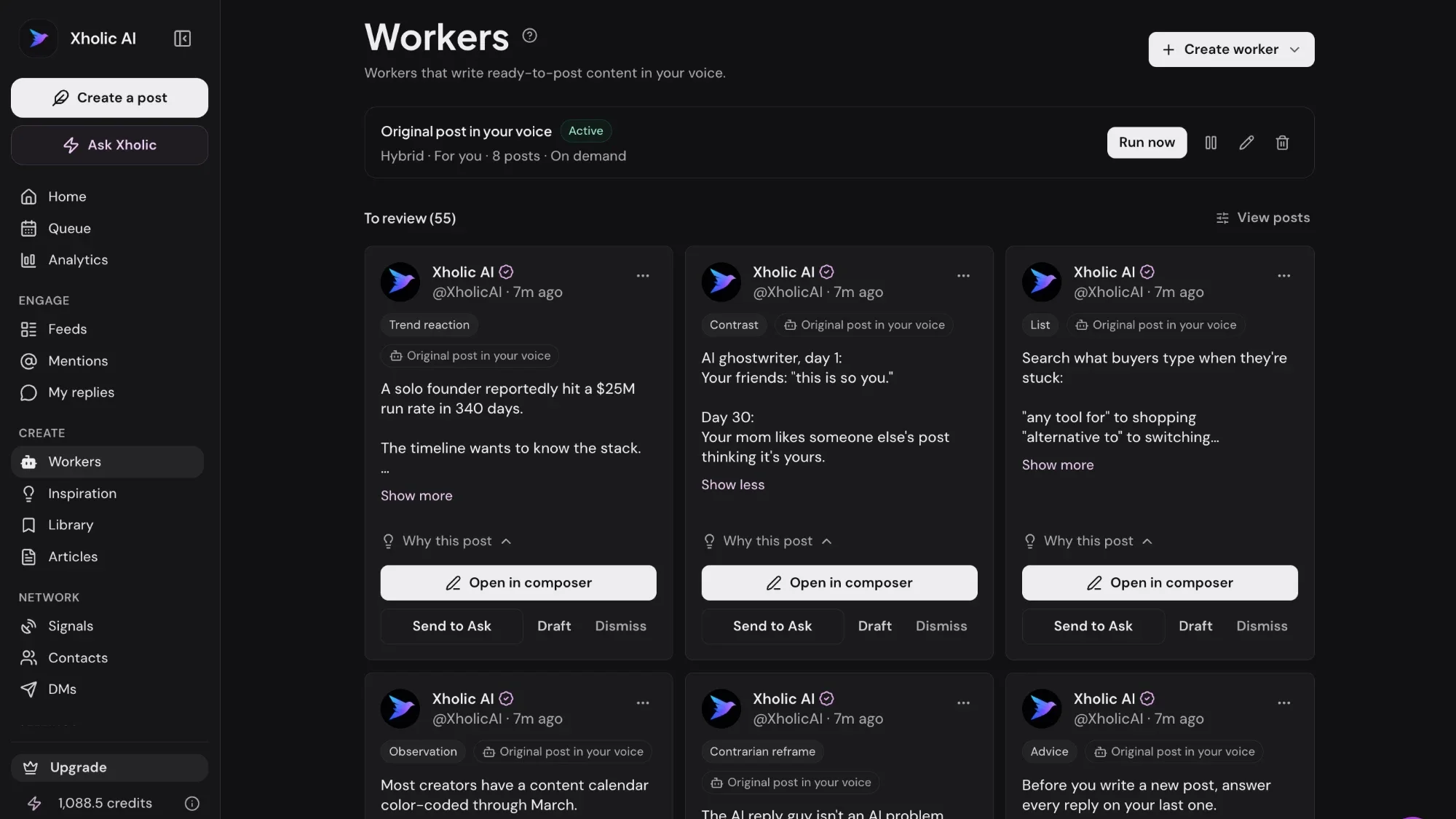
Grow your own account
Want numbers like @sapinker's?
Xholic writes posts in your voice, schedules them for the hours your audience is active, and tracks what's working every day.
$0 today · Card required · Cancel anytime
Live demo: no sign-up or login needed · takes about 2 minutes
Keep browsing
More in Health & science
See all of Health & science


Keep exploring
Free tools
- Compare Twitter AccountsPut two public accounts head to head and see who leads on views, engagement, grade and posting pace.
- Twitter Engagement Rate CalculatorCalculate engagement rate from your numbers or a public profile and grade it against your tier.
- X Monetization CalculatorChange the assumptions behind six X revenue models and compare gross revenue with direct contribution.
Guides
- How to Analyze Any X Profile and Read the ReportAnalyze any public X profile and read the report properly: how each metric is calculated, what is measured vs estimated, and three worked readings.
- How to Check an X Follower Count Live (and Read the Trend)Watch any public X account's exact follower count update live, read the session and 90-day charts, and see why the number differs from the X app.
From the blog
- 7 Free Twitter Analytics Tools That Still Work in 2026We re-checked every free Twitter/X analytics tool in October 2026. Seven still give you real data for free: what each shows, its limits, and which tools shut down or went paid.
- Good Twitter Engagement Rate by Followers in 2026What is a good Twitter engagement rate by followers in 2026? Sourced follower-based benchmarks by account tier, the brand-account median, sample calculations, and tactics to raise yours.
Best tweets on this topic
- Best tweets about Self ImprovementA curated collection of the sharpest, most-shared X posts about self improvement—saved so you do not have to dig through the timeline yourself. Updated every two weeks.
- Best tweets about ProductivityA curated collection of the sharpest, most-shared X posts about productivity—saved so you do not have to dig through the timeline yourself. Updated every two weeks.
- Best tweets about Remote WorkA curated collection of the sharpest, most-shared X posts about remote work—saved so you do not have to dig through the timeline yourself. Updated every two weeks.
About this data
- Analytics are inferred from public profile and recent post data. They do not include private impressions, profile visits, link clicks, or follower-source data.
- Deleted, protected, unavailable, or rate-limited posts may be missing from the sample.
- Stats come from public posts Xholic has stored, not private X Analytics. Xholic is not affiliated with X Corp or @sapinker.
- Own this account and want it hidden? Email support@xholic.ai — we verify ownership and handle requests within 2 working days.