

Jim Fan (@DrJimFan) X analytics
@DrJimFan
NVIDIA Director of Robotics & Distinguished Scientist. Co-Lead of GEAR lab. Solving Physical AGI, one motor at a time. Stanford Ph.D. OpenAI's 1st intern.
@DrJimFan has 605.4K followers, a median of 88K views per post and a 1.30% engagement rate.
Based on 13 recent original posts (medium confidence). Updated November 16, 2026.
At a glance
Key stats
- Followers
- 605.4K605,350 followers on November 16, 2026+2.2K in 7 days+5.9K in 30 days
- Median views per post
- 88K
- Average views per post
- 104.4K
- Engagement rate (by views)
- 1.30%
- Original posts per week
- 1.0
- Average engagements per post
- 1,362
Engagement grade
Strong
This is above the baseline for accounts with 100K-1M followers.
Profile score
77/100
- Profile completeness100
- Audience shape100
- Engagement25
- Consistency60
- Positioning clarity100
Monetization
Estimated X creator earnings
$80–$201 in the last 30 days
From 803K views on @DrJimFan's original posts in the last 30 days.
Rewards eligibility: likely
Rough estimate. X publishes no payout rate, so this assumes about $100–250 per 1M original-post impressions, based on real creator payouts. Payouts vary with how many of your viewers have Premium.
Free report
How does your account compare with @DrJimFan?
Get the same report for your own account by email: engagement grade, median views, best times to post and estimated earnings.
Growth
Follower growth
+2.2K followers in the last 7 days. +5.9K in the last 30 days. Tracked by Xholic since October 7, 2026.
| Date | Followers | Change |
|---|---|---|
| Nov 16, 2026 | 605,350 | +198 |
| Nov 14, 2026 | 605,152 | +537 |
| Nov 11, 2026 | 604,615 | +1,453 |
| Nov 7, 2026 | 603,162 | +100 |
| Nov 3, 2026 | 603,062 | +835 |
| Oct 30, 2026 | 602,227 | −15 |
| Oct 25, 2026 | 602,242 | +2,767 |
Timing
Best times to post
When @DrJimFan's recent posts performed best (UTC).
- #1 slot
8:12 PM
Monday · UTC
- #2 slot
7:18 PM
Tuesday · UTC
- #3 slot
8:34 PM
Wednesday · UTC
What worked
Top recent posts
- 01

@DrJimFan ·
We built a robotics data engine with Astra-level performance at 125x lower cost. And we are open-sourcing the weights today! Introducing Flora, a suite of open models to parse the physical world and turn raw footage into rich training signals. Flora already powers our in-house data engine, labeling 200K hours of videos a day on 500 GPUs. We created it to scale the frontier for robot learning. Now you own the weights too. Flora gives you: - High-quality, timestamped captions to curate and filter human egocentric and robot data; - Dense progress rewards for quality control and RL post-training; - Rubrics scoring for real-world benchmarking Try it today, links in thread:
 Watch video
- 203Replies
- 215Reposts
- 1.8KLikes
- 162.7KViews
2.3x average engagementHas a videoLong post (over 200 characters)Posted Tue 17:00 UTCStarts a thread - 02
@DrJimFan ·
Introducing GR00T 2: our most advanced, open System One model for robotics. It runs entirely on your robot’s onboard compute, fully untethered, and you own every weight of it. GR00T 2 features: 1. Long-horizon tasks: dexterous manipulation and whole-body control chained over 20+ steps and 5+ minutes, such as performing chemistry lab experiments or assembling model airplanes end to end. 2. X-Adapt: adapting from easy data sources (human wearables and simulation) and deploying zero-shot to diverse real robots. 3. Unified Cognition: native integrations with frontier agents for advanced physical reasoning, robust error recovery, and safety monitoring. It's an open-source buffet! We are releasing not only the model weights and X-Adapt recipes (coming December), but also our agentic framework, simulation engine, annotation engine, hardware design, and even training data (100K hours, that's ~11 yrs of experience), all available today! Everything that moves will be autonomous. Anyone can become a roboticist. Lock in, build with us! Deep dive in thread:
 Watch video
- 190Replies
- 259Reposts
- 1.9KLikes
- 145KViews
1.7x average engagementHas a videoLong post (over 200 characters)Posted Tue 16:00 UTCStarts a thread - 03
@DrJimFan ·
The era of System One Vision Model is here! Introducing VFlash: parsing the visual world in parallel at unmatched speeds for Physical AI. Most embodied prediction tasks like object localization, robot trajectory planning, and dense 3D motion are fixed-length float vectors. For example, a bounding box is always 6 tokens, a 10-waypoint robot arm trajectory is 54: we know these beforehand. Instead of decoding one token at a time, we can output the entire geometric shape in one go. VFlash enables up to 12x faster action decoding and a 5.1x overall robot inference speedup on edge GPUs like the Jetson Thor and DGX Spark. What’s surprising is that it ends up even more accurate than the VLM backbone, with up to 61% lower 3D trajectory error. The intuition is that VFlash avoids the cascading errors of autoregressive decoding, where every coordinate is written in ink and every later point loses the chance to backspace. Everything that moves will be autonomous, and everything autonomous will need to think on its own chip. The next inference revolution is physical reasoning at the speed of reflex. And as always, it’s open paper, open source! Link in thread:
 Watch video
- 142Replies
- 134Reposts
- 1.3KLikes
- 73.1KViews
1.7x average engagementHas a videoLong post (over 200 characters)Posted Thu 16:00 UTCStarts a thread - 04
@DrJimFan ·
We are open-sourcing V1.0 of our agentic robotics framework, ASPIRE, with full real robot skill discovery and self improvement capabilities! On the day Astra arrived, our lab switched the backend model and saturated all the benchmarks to ~99% over night. And the frontier is already on the move: - Opus 5.5 slightly edges out Astra on our robot simulation bench. - Sonnet 5.5 hits the Pareto frontier of cost vs. robot capability, $12/task. We first introduced ASPIRE and /robot skill library in June, way before the big models could reliably do robotics. A rising frontier tide lifts all boats, but Astra was a 0->1 tsunami on many tasks. Now you can also feel the Physical Bitter Lesson at home like we did on that fateful day ;) links in thread
 Watch video
- 183Replies
- 190Reposts
- 1.3KLikes
- 113.6KViews
1.6x average engagementHas a videoLong post (over 200 characters)Posted Fri 16:00 UTCStarts a thread - 05
@DrJimFan ·
Seeing a hype wave around GEN-1.5, and rightfully so. Lots of respect to Pete & Andy for executing so well. The secret is in the naturally repetitive motions in human-collected data. There're 2 main sources for such repetitions: (1) Symmetric patterns. Sorting, tidying, and assembling almost never finish in one motion. Open any assembly manual from IKEA, and you find most objects symmetrical. You drive one bolt, then its twin, then the next pair. Every {bolt A, bolt B} pair is a natural continuation in context, and the second instance is a free training signal that imitates the first ("prompt"). (2) Recovery. Humans drop things all the time, but we pick them up so fast, we don’t even notice. That reflex to fix is half of our physical competence. The key insight is to keep the failed first half instead of trimming it away. If the model consumes the full arc, fumble, catch, continue, then recovery shows up organically at test time. It's funny that in-context improvement results from *NOT* over-sanitizing your data. The other critical ingredient is UMI. I've been saying for a while that teleop will not last, and GEN-1.5 is driving the final nail in the coffin. UMI is essentially a human wearing the robot gripper to collect data directly (human → data). Teleop inserts a layer of separation: human → VR/skeletal device → robot → data, which bleeds out all the human "physical intuition". The subtle sleight of hand we perform constantly with objects, the micro-adjustments, the feel of a part snapping into place, is nearly impossible to capture when you can't feel the environment directly. Once you have enough data, many behaviors can actually be zero-shot. For example, you don't even need finetuning to pick up a novel object. The model "just knows" what to do given a similar scene in the training distribution. Whether in-context learning truly works or not also depends on how far away the test is from training. Currently, the demos are still a bit too simple to conclude. I'm cautiously optimistic. Still, it's a great day in robotics.
- 47Replies
- 133Reposts
- 1.1KLikes
- 88KViews
1.1x average engagementText onlyLong post (over 200 characters)Posted Thu 15:00 UTC - 06
@DrJimFan ·
The sense of touch is the most criminally under-explored modality in robotics. Imagine doing sleight of hand wearing thick oven mitts. That's exactly how a robot feels today if it were alive. A magnetic piece snapping into place, a paper cup peeling out of a stack, a USB negotiating its way into the port - all invisible to the camera. Learning how to feel must be a full-stack co-designed effort. We are open-sourcing a principled methodology called "T-Rex": 1. Tactile as first-class citizen of the model. Our mixture-of-transformer runs two clocks asynchronously: a slow visuomotor expert plans the motion, and a fast tactile expert refines it in real time with high-frequency corrections at 4 "touch ticks" per vision tick. Forces change faster than frames arrive, so the architecture had to as well. 2. Open data. The largest tactile dataset ever released to our knowledge: a 50-hour (~5,500 episodes) high-quality, carefully synchronized robot play corpus, collected on SOTA tactile hand hardware with 22 degrees of freedom. Available today on HuggingFace! 3. Training recipe: T-Rex extends our prior work, EgoScale. Human egocentric videos for pretraining, a diverse dose of tactile robot play for mid-training. Our experiments show this bridges contact-free pretraining to contact-rich manipulation remarkably well. Pixels are cheap and everywhere, but they run out of steam at the moment of contact. Tactile will carry the last mile. The next scaling curve will be measured in hours of touch. T-Rex is a great collaboration between NVIDIA and Berkeley: 🧵
 Watch video
- 112Replies
- 135Reposts
- 950Likes
- 187.3KViews
0.9x average engagementHas a videoLong post (over 200 characters)Posted Fri 16:00 UTCStarts a thread
Latest
Recent posts by Jim Fan
The latest 13 original posts from @DrJimFan, newest first, as of November 16, 2026. Replies and reposts aren't included.
@DrJimFan ·
Autonomous, uncut, 1x speed. This is GR00T 2 controlling real dexterous hands to perform a chemistry lab experiment (and clean up after itself) end to end. Episode 1 of a new series! I’ll keep dropping real-time robot videos, with none of the “4x” or “8x” labels you usually see in the corner. No one can speed up reality, except Dr. Strange ;)
 Watch video
- 157Replies
- 92Reposts
- 795Likes
- 56.7KViews
@DrJimFan ·
Introducing GR00T 2: our most advanced, open System One model for robotics. It runs entirely on your robot’s onboard compute, fully untethered, and you own every weight of it. GR00T 2 features: 1. Long-horizon tasks: dexterous manipulation and whole-body control chained over 20+ steps and 5+ minutes, such as performing chemistry lab experiments or assembling model airplanes end to end. 2. X-Adapt: adapting from easy data sources (human wearables and simulation) and deploying zero-shot to diverse real robots. 3. Unified Cognition: native integrations with frontier agents for advanced physical reasoning, robust error recovery, and safety monitoring. It's an open-source buffet! We are releasing not only the model weights and X-Adapt recipes (coming December), but also our agentic framework, simulation engine, annotation engine, hardware design, and even training data (100K hours, that's ~11 yrs of experience), all available today! Everything that moves will be autonomous. Anyone can…
Watch video- 190Replies
- 259Reposts
- 1.9KLikes
- 145KViews
@DrJimFan ·
CoRL Keynote. Hilton Austin. Monday Nov 9, 1:45 pm. 2 days countdown. Something extraordinary.
 Watch video
- 80Replies
- 121Reposts
- 1.4KLikes
- 236.8KViews
@DrJimFan ·
The era of System One Vision Model is here! Introducing VFlash: parsing the visual world in parallel at unmatched speeds for Physical AI. Most embodied prediction tasks like object localization, robot trajectory planning, and dense 3D motion are fixed-length float vectors. For example, a bounding box is always 6 tokens, a 10-waypoint robot arm trajectory is 54: we know these beforehand. Instead of decoding one token at a time, we can output the entire geometric shape in one go. VFlash enables up to 12x faster action decoding and a 5.1x overall robot inference speedup on edge GPUs like the Jetson Thor and DGX Spark. What’s surprising is that it ends up even more accurate than the VLM backbone, with up to 61% lower 3D trajectory error. The intuition is that VFlash avoids the cascading errors of autoregressive decoding, where every coordinate is written in ink and every later point loses the chance to backspace. Everything that moves will be autonomous, and everything autonomous will…
Watch video- 142Replies
- 134Reposts
- 1.3KLikes
- 73.1KViews
@DrJimFan ·
We built a robotics data engine with Astra-level performance at 125x lower cost. And we are open-sourcing the weights today! Introducing Flora, a suite of open models to parse the physical world and turn raw footage into rich training signals. Flora already powers our in-house data engine, labeling 200K hours of videos a day on 500 GPUs. We created it to scale the frontier for robot learning. Now you own the weights too. Flora gives you: - High-quality, timestamped captions to curate and filter human egocentric and robot data; - Dense progress rewards for quality control and RL post-training; - Rubrics scoring for real-world benchmarking Try it today, links in thread:
Watch video- 203Replies
- 215Reposts
- 1.8KLikes
- 162.7KViews
@DrJimFan ·
We are open-sourcing V1.0 of our agentic robotics framework, ASPIRE, with full real robot skill discovery and self improvement capabilities! On the day Astra arrived, our lab switched the backend model and saturated all the benchmarks to ~99% over night. And the frontier is already on the move: - Opus 5.5 slightly edges out Astra on our robot simulation bench. - Sonnet 5.5 hits the Pareto frontier of cost vs. robot capability, $12/task. We first introduced ASPIRE and /robot skill library in June, way before the big models could reliably do robotics. A rising frontier tide lifts all boats, but Astra was a 0->1 tsunami on many tasks. Now you can also feel the Physical Bitter Lesson at home like we did on that fateful day ;) links in thread
Watch video- 183Replies
- 190Reposts
- 1.3KLikes
- 113.6KViews
@DrJimFan ·
It is increasingly clear that humanity will solve the Riemann hypothesis before we pass the Physical Turing Test - you come back to a clean home after a wild Sunday party, and you can't tell whether a human or a robot did the job. We are not Moravec's paradox-pilled enough.
- 117Replies
- 75Reposts
- 1.3KLikes
- 76.5KViews
Show all 13Show fewer
@DrJimFan ·
Good old days at OpenAI in 2016: an agent stares at screen pixels, moves a mouse, and books a flight on United. We called it World of Bits, inside OpenAI Universe. 10 yrs later, Astra is reincarnated in the same universe. Even the naming is astronomically correct 😆 Universe was perhaps the most ambitious AI infra project at the time, but we couldn't quite figure out how to solve it. A policy with zero prior knowledge of what a "submit" button does has to rediscover the entire internet visual lingua by trial and error. In retrospect, RL from scratch against hand-drawn, per-task "artisan" reward functions on a bunch of Pascal Titan X GPUs was completely doomed. To solve computer use agent, the right way turns out to be boiling the ocean first (hillclimb on every general task you can find), and then specialize back down to the screen pixels and keystrokes. Or simply, a "Specialized Generalist". Lessons learned: one step ahead of everyone, you're a pioneer. Three steps ahead, you're a…
 Watch video
- 121Replies
- 78Reposts
- 867Likes
- 89.2KViews
@DrJimFan ·
The sense of touch is the most criminally under-explored modality in robotics. Imagine doing sleight of hand wearing thick oven mitts. That's exactly how a robot feels today if it were alive. A magnetic piece snapping into place, a paper cup peeling out of a stack, a USB negotiating its way into the port - all invisible to the camera. Learning how to feel must be a full-stack co-designed effort. We are open-sourcing a principled methodology called "T-Rex": 1. Tactile as first-class citizen of the model. Our mixture-of-transformer runs two clocks asynchronously: a slow visuomotor expert plans the motion, and a fast tactile expert refines it in real time with high-frequency corrections at 4 "touch ticks" per vision tick. Forces change faster than frames arrive, so the architecture had to as well. 2. Open data. The largest tactile dataset ever released to our knowledge: a 50-hour (~5,500 episodes) high-quality, carefully synchronized robot play corpus, collected on SOTA tactile hand…
Watch video- 112Replies
- 135Reposts
- 950Likes
- 187.3KViews
@DrJimFan ·
Seeing a hype wave around GEN-1.5, and rightfully so. Lots of respect to Pete & Andy for executing so well. The secret is in the naturally repetitive motions in human-collected data. There're 2 main sources for such repetitions: (1) Symmetric patterns. Sorting, tidying, and assembling almost never finish in one motion. Open any assembly manual from IKEA, and you find most objects symmetrical. You drive one bolt, then its twin, then the next pair. Every {bolt A, bolt B} pair is a natural continuation in context, and the second instance is a free training signal that imitates the first ("prompt"). (2) Recovery. Humans drop things all the time, but we pick them up so fast, we don’t even notice. That reflex to fix is half of our physical competence. The key insight is to keep the failed first half instead of trimming it away. If the model consumes the full arc, fumble, catch, continue, then recovery shows up organically at test time. It's funny that in-context improvement results from…
- 47Replies
- 133Reposts
- 1.1KLikes
- 88KViews
Formats
Content mix
- Text only
- 31%
- With media
- 62%
- With links
- 1 posts
- With hashtags
- 0 posts
Creator style: High-reach broadcaster
See the full app
This creator report is one small part of Xholic
Click through a sample creator's account in the real app. No sign-up, nothing to install.
- Posts written in your voice and scheduled for your best hours
- Buyers found on 𝕏, with a reply drafted for each one
- Analytics that show which posts grow you
No sign-up or login needed · Takes about 2 minutes
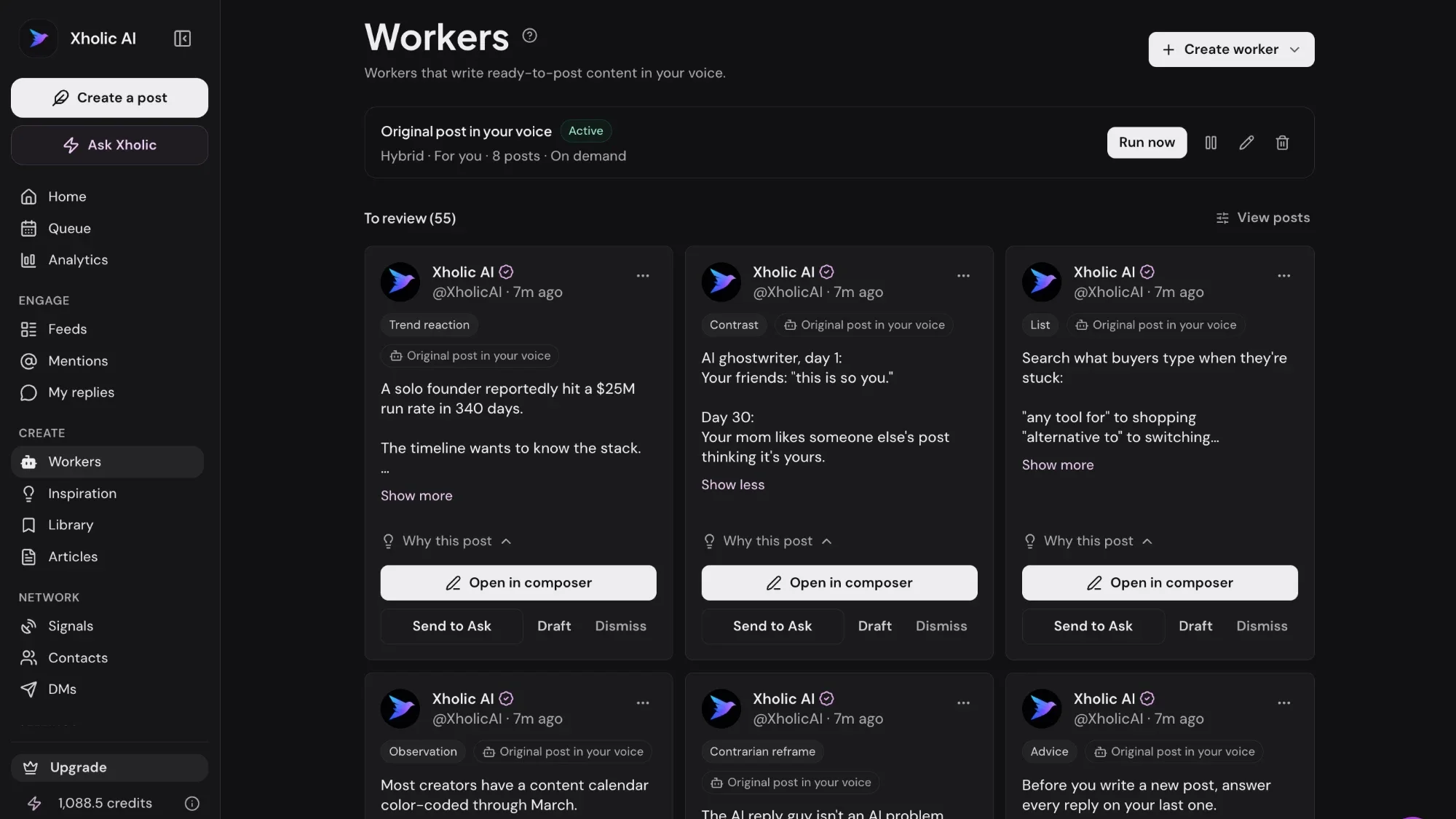
Want numbers like @DrJimFan's?
Xholic writes posts in your voice, schedules them for the hours your audience is active, and tracks what's working every day.
No card needed · Nothing to cancel
Live demo: no sign-up or login needed · takes about 2 minutes
Keep browsing
More in AI & developers


Keep exploring
Free tools
- Compare Twitter AccountsPut two public accounts head to head and see who leads on views, engagement, grade and posting pace.
- Twitter Engagement Rate CalculatorCalculate engagement rate from your numbers or a public profile and grade it against your tier.
- X Monetization CalculatorChange the assumptions behind six X revenue models and compare gross revenue with direct contribution.
Guides
- How to Write a Tweet With an AI Tweet GeneratorTurn a rough idea into a tweet worth posting: write a specific prompt, pick a tone and length, compare three drafts and make the best one sound like you.
- X/Twitter Analytics Glossary: Every Metric Explained (2026)Definitions, formulas, benchmarks, and actions for X/Twitter analytics metrics including impressions, reach, engagement, followers, clicks, and revenue.
From the blog
- 10 X Analytics API Alternative Options for 2026Compare 10 X analytics API alternatives for 2026, from low-cost data providers and custom scrapers to enterprise listening platforms.
- Twitter API Examples: A Practical Guide for BuildersExplore real Twitter API examples with code, auth flows, rate limits, and patterns for posting, streaming, analytics, and growth workflows on X.
Best tweets on this topic
- Best tweets about Open-Source AIBrowse the best tweets about open-source AI, open-weight models, community tools, training, deployment, licensing, and research. Updated every two weeks.
- Best tweets about Claude CodeRead the best tweets about Claude Code, covering terminal workflows, agents, hooks, skills, debugging, and real software projects. Updated every two weeks.
- Best tweets about Google AI StudioDiscover the best tweets about Google AI Studio, covering Gemini API prototypes, prompting, structured output, model testing, and developer workflows.
About this data
- Analytics are inferred from public profile and recent post data. They do not include private impressions, profile visits, link clicks, or follower-source data.
- Deleted, protected, unavailable, or rate-limited posts may be missing from the sample.
- Stats come from public posts Xholic has stored, not private X Analytics. Xholic is not affiliated with X Corp or @DrJimFan.
- Own this account and want it hidden? Email support@xholic.ai — we verify ownership and handle requests within 2 working days.