Agentic workflows and task automation
Copilot Cowork, Tasks, and Studio agents that plan, execute, schedule, and automate work across Microsoft 365 apps and business processes.
26%
Best tweets about Microsoft Copilot
Explore the best tweets about Microsoft Copilot, including Microsoft 365 workflows, Copilot Studio, Windows features, adoption, and business use cases.
Microsoft Copilot products, workflows, enterprise adoption, product updates, limitations, and measurable outcomes, excluding GitHub Copilot.
Original Xholic analysis
Microsoft Copilot discussion centers on agentic workflows and enterprise deployment trade-offs: Cowork and Tasks are presented as moving beyond chat, while posts also raise questions about product coherence, adoption, output responsibility, and autonomous-agent controls. The largest engagement outliers include a Cowork announcement, a critique of Copilot’s terms, and a post counting Copilot-branded products. (2030992877665583440, 2039482189218463984, 2040548562053050749)
38% of posts
All-time engagement
66% of posts
Published in 90 days
Conversation map
Copilot Cowork, Tasks, and Studio agents that plan, execute, schedule, and automate work across Microsoft 365 apps and business processes.
26%
Fragmented Copilot naming, siloed experiences, Windows app direction, consumer-commercial consolidation, and efforts to unify the Copilot product organization.
26%
Licensing penetration, active use, paid seats, productivity outcomes, organizational adoption barriers, and the gap between enterprise distribution and product pull.
26%
Prompt injection, data leakage, autonomous-agent risks, password and data access, legal disclaimers, hallucinations, and accountability for Copilot outputs.
26%
Copilot's use of OpenAI, Anthropic, Microsoft-built, open-source, and lower-cost models; model choice, orchestration, quality, and inference economics.
24%
Copilot's position versus Claude, ChatGPT, Gemini, and other enterprise AI options, especially around Microsoft 365 data access, integrations, switching costs, and control-plane ambitions.
22%
New M365 Copilot features, model rollouts, research capabilities, SDKs, and integrations across Word, Excel, Outlook, Teams, and enterprise services.
18%
Building and deploying enterprise agents with Copilot Studio, including real-world planning use cases, autonomous triggers, usage-based pricing, and runaway-cost controls.
8%
Tone and stance
Performance benchmark
Posts with media make up 74% of this collection. Their median all-time score is 17.8, compared with 7.63 for text-only posts.
Format mix
Consensus and debate
Shared view
Copilot Cowork is described as turning requests into plans and executing them across Microsoft 365 apps and files. Copilot Tasks is presented as a research-preview workflow product that can perform recurring, multi-step tasks such as preparing study plans, tracking listings, and surfacing emails. (2030992877665583440, 2027111503003107377)
Shared view
Microsoft posts describe GPT-5.5 Instant rolling out to M365 Copilot, Copilot Studio, and Foundry, and GPT-5.6 becoming the preferred M365 Copilot model. A separate post describes Critique in Copilot Researcher using Claude to review and refine an initial report. (2052465911832171001, 2075585386441789605, 2038628197064196355)
Shared view
Posts highlight Copilot terms that warn outputs can be wrong and place responsibility for shared outputs on users. Other posts report a claimed zero-click exploit and a Copilot Studio billing incident in which an autonomous trigger and reasoning model were cited as a likely cause, underscoring the controls practitioners are discussing around agent deployment. (2039482189218463984, 2056739069116190793, 208162739977163
Open debate
An account of an Accenture employee’s view says many clients start with Microsoft because of existing security, data access, and integration, while another post cites a former Microsoft VP’s criticism that low paid penetration shows distribution alone does not ensure demand. These are competing interpretations from individual posts, not a market-wide measurement. (2032450577779560611, 2056278879460090335)
Open debate
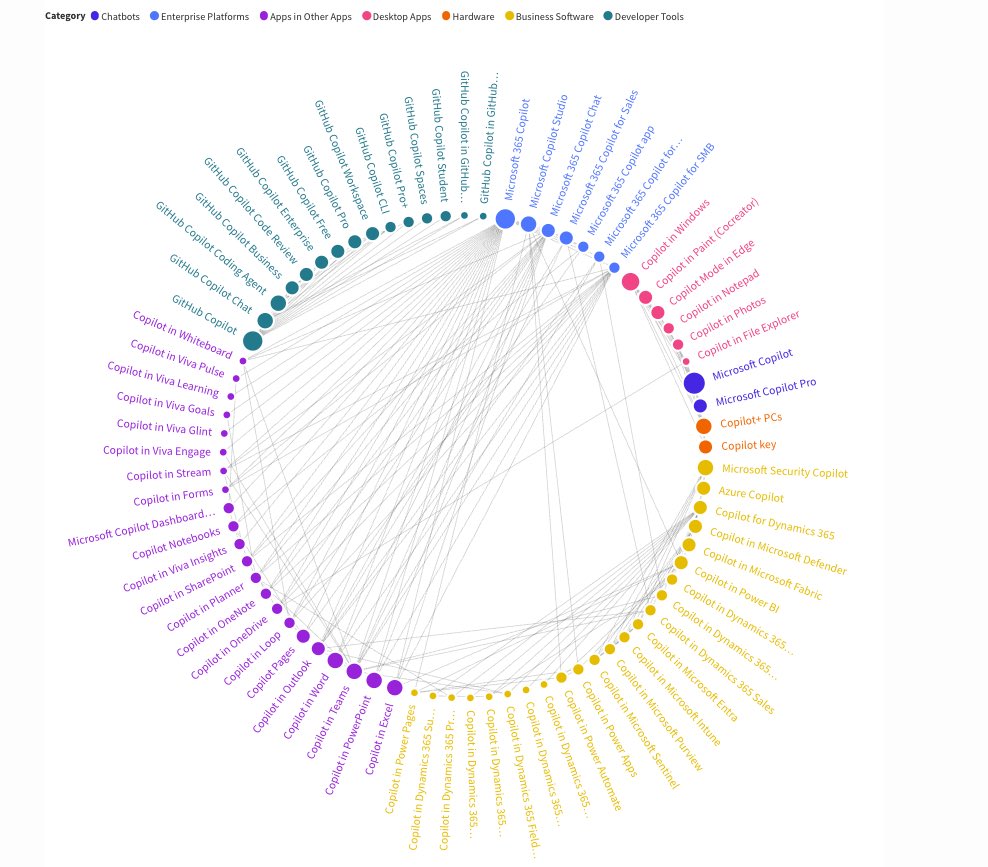
Microsoft AI announced a unified consumer-and-commercial Copilot organization. Separately, posts cite a count of 78 Copilot-branded products and argue that context is siloed across experiences, illustrating the coherence problem perceived by critics. (2033932464125841550, 2040548562053050749, 2042985164670706141)
Open debate
One post characterizes Microsoft’s existing enterprise security, data access, and integration as reasons clients begin with Copilot. Another reports that Claude added Microsoft 365 connectors, challenging the view that access to Outlook, OneDrive, and SharePoint is unique to Copilot. (2032450577779560611, 2040165745553002552)
What performs
Announcements accounted for 33 of 50 posts (66%) and had a median all-time score of 18.034. The highest-scoring outlier, at 1,258.24, announced Copilot Cowork. (2030992877665583440)
The second-highest outlier, with an all-time score of 580.17, criticized the contrast between Copilot’s terms and enterprise productivity positioning. This indicates that critical accountability framing attracted substantial attention in this dataset. (2039482189218463984)
Media appeared in 37 of 50 posts (74%). Their median all-time score was 17.822, compared with 7.63 for text-only posts. A Cowork demo is one example of a media-led launch post. (2031044277548269986)
Statistical standouts
Creator landscape
The five most represented creators account for 20% of the selected posts.
1. Bearly AI
@bearlyai
2 posts
2. Brad Smith
@BradSmi
2 posts
3. Charles Lamanna
@clamanna
2 posts
4. Glenn Gabe
@glenngabe
2 posts
5. Chubby♨️
@kimmonismus
2 posts
6. Dr Milan Milanović
@milan_milanovic
2 posts
Satya Nadella authored the Cowork announcement that was the dataset’s top engagement outlier. He also posted about GPT-5.5 Instant reaching M365 Copilot, Copilot Studio, and Foundry. (2030992877665583440, 2052465911832171001)
Charles Lamanna shared a Cowork demonstration and highlighted a Dynamics 365 and Copilot Studio planning use case at Coca-Cola Beverages Africa. Milan Milanović’s post recounted a reported Copilot Studio agent bill and emphasized safeguards such as anomaly alerts, trigger review, and kill switches. (2031044277548269986, 2035509967617404987, 2081627399771632022)
Since the previous snapshot
Themes, sentiment, stance, and post format are classified per tweet. All counts, shares, medians, creator concentration, freshness, and performance comparisons are then calculated directly from the published snapshot.
Xholic's all-time score compares engagement while accounting for reach, post age, and creator consistency. It is used for relative comparisons within this collection.
This report analyzes the exact 50-post snapshot shown below. AI identifies editorial categories and drafts explanations; all statistics are calculated from the snapshot, and every narrative claim is checked against cited posts before publication.
Best Microsoft Copilot tweets
Ranked 01–50
@satyanadella ·
Announcing Copilot Cowork, a new way to complete tasks and get work done in M365. When you hand off a task to Cowork, it turns your request into a plan and executes it across your apps and files, grounded in your work data and operating within M365’s security and governance boundaries.
@HedgieMarkets ·
🦔Microsoft's Copilot terms of service state that Copilot is for entertainment purposes only, that it can make mistakes and may not work as intended, and that users should not rely on it for important advice. The terms also explicitly state that Microsoft makes no warranty or representation of any kind about Copilot, including that its responses won't infringe on copyrights, trademarks, or privacy rights. Users are solely responsible if they choose to publish or share Copilot's responses. My Take This is the same product Microsoft is embedding into Word, Excel, Outlook, and GitHub, selling to enterprises for $30 per user per month, and that just froze hiring in its cloud division to fund. The terms say entertainment purposes only while the sales pitch says productivity multiplier. Those two things cannot both be true at the same time, and the one that matters legally is the one buried in the terms of service that almost nobody reads before deploying it across their organization. Any company using Copilot to generate code, contracts, or customer-facing content and then publishing that output owns every consequence of doing so. Microsoft has made that very clear in writing. Hedgie🤗 Link for those interested: https://t.co/fBOIcl15DM
@clamanna ·
Great to see the excitement around Copilot Cowork today. I have been using it in my own work for the past few weeks, and the best way to understand it is to see it in action. Sharing a short demo from my day to day here.
@signulll ·
microsoft may be the biggest loser of the ai era so far, not necessarily financially but more in terms of relevance. they had the best distribution in software, the best dev surface area, the best enterprise channel, & the most important ai partnership. but somehow they turned all that into copilot, a brand that feels like a mandatory workplace training module than a frontier product experience. they don’t even have a relevant lab or a model that is remotely in the zietgiest either. how did that happen?
@satyanadella ·
Great to bring GPT 5.5 Instant to M365 Copilot today. With quicker, clearer, and more accurate responses, you can get to useful answers with less back and forth. Also rolling out to Copilot Studio and Foundry. All part of our focus on providing you more model choice across work, agents, and apps.
@RihardJarc ·
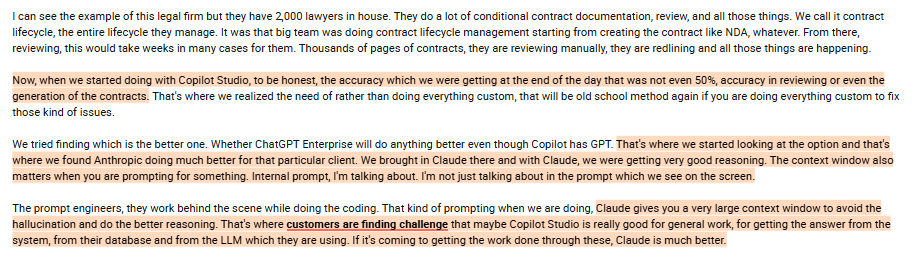
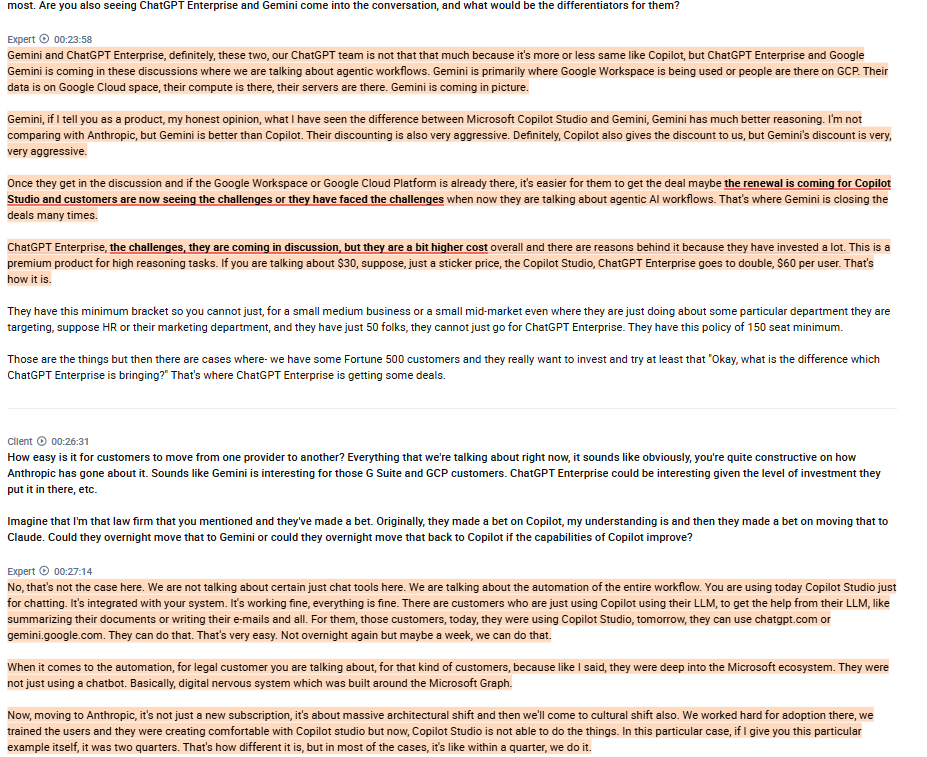
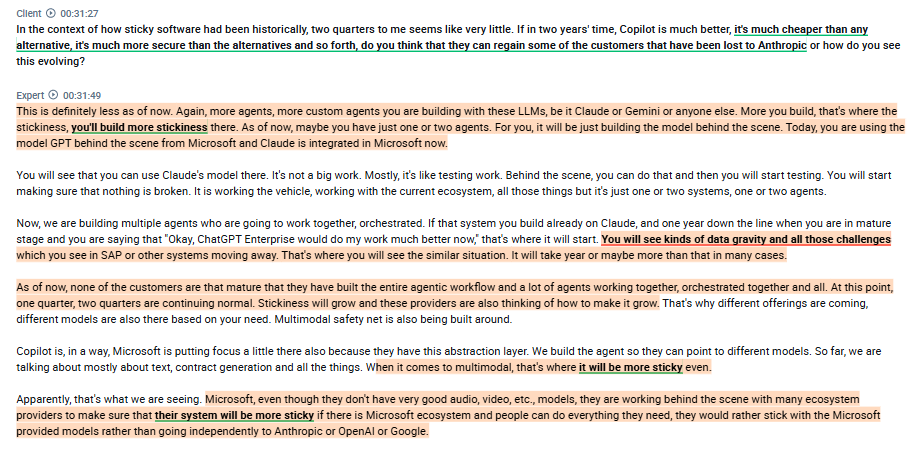
A MUST-read interview with an Accenture employee explaining the current usage patterns of $MSFT Copilot, Claude, and other AI models in enterprise usage: 1. They mostly work with large and large mid-market companies. According to him, as far as it comes to $MSFT Copilot, everybody has a license wherever they have Microsoft. 80% of his clients start with $MSFT because of the plumbing, security, and data access, as the integration is very seamless, as they already use $MSFT. But now he estimates that AROUND 50% of the clients are actively experimenting with second vendors. This is where Anthropic is coming into the picture, mostly because of reasoning, the long context window, and other things. 2. He explained that while 80% of their clients have adopted these solutions, that doesn't mean the market is saturating, as there is the question of usage. 3. In his view, we are not entering the phase where people are looking for these providers to automate the workflow. 4. The main issues of $MSFT Copilot in terms of performance vs Claude are, in his view, the hallucinations and worse reasoning. Claude's context window also matters a lot. 5. They are also seeing ChatGPT Enterprise and $GOOGL Gemini coming into discussions, especially when talking about agentic workflows. Gemini is strong where people use $GOOGL Workspace or are on GCP. When he compared the performance, he thinks $GOOGL Gemini is better than Copilot, but doesn't think it's better than Anthropic. $GOOGL with Gemini is also very aggressive with discounting. 6. According to him, $GOOGL Gemini is closing many deals with agentic AI workloads when Copilot renewals are coming, and customers are seeing the challenges they have faced. 7. In terms of switching costs between providers, the expert explains that when we were in the chatbot era, the switching costs were small, as you could switch between chatbots in a week. But now, as we enter the agentic workflow era, the switching costs are higher and last 1-2 quarters. 8. He also thinks that as more and more agents are built, the stickiness of a vendor becomes higher, and the switching costs might start to resemble more of the traditional software, where it takes a year or more to switch in some cases. He thinks stickiness will continue to grow, especially with things like multimodal usage. 9. In his view, $MSFT is working behind the scenes with many ecosystem providers to make sure that their system will be more sticky as a lot of clients would rather stick with $MSFT-provided models rather than going independently to Anthropic, OpenAI, or $GOOGL. found on @AlphaSenseInc
@itsPaulAi ·
Copilot Tasks is seriously good?! Even one of the best alternative to Claude Cowork Using a single prompt it was able to: → Use a cloud browser to find the right tool → Interact with the page to enter data → Interpret all the info given by the page → Generate a PowerPoint based on it → Draft an email containing the learnings Because it has access in real time to multiple Microsoft Office apps like Word, PowerPoint, Excel, etc. but also Outlook. Everything was seamless. First try. And you can even ask it to schedule this task (or another one) to run it every Friday, once a month, you name it. As with OpenClaw, the use cases are basically infinite.
@WindowsLatest ·
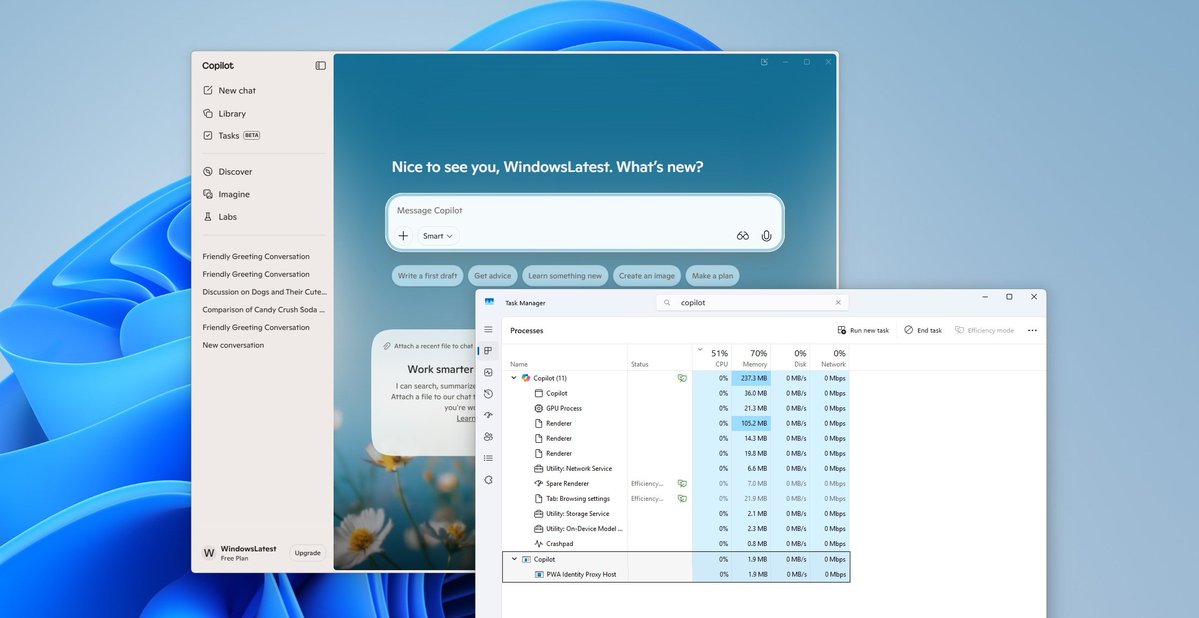
Microsoft's Copilot is dumping native code for web crap on Windows 11 yet again. Microsoft still can’t figure out what Copilot on Windows 11 is supposed to be. It started as a sidebar, then became an Edge-powered sidebar, then a PWA, then a proper WinUI-style native app, and now it feels like it has gone full circle back to being web junk in a Windows shell again. The worst part is that Microsoft already has its own modern Windows app framework, but it keeps falling back to web-based packaging for one of the most important apps it is trying to push on users. In fact, it looks like Microsoft now makes better apps for macOS than Windows 11.
@mustafasuleyman ·
We've been working on a whole new way to get things done: Copilot Tasks. AI that talks less and does more, no complicated setup or coding skills required. Just ask for what you need and Copilot will take it from there, like: - Turn a syllabus into a complete study plan, with practice tests created and focus time blocked before each exam - Track new apartment rental listings nearby every Friday and book showings - Every evening, surface urgent emails with draft replies ready to send, and automatically unsubscribe from promotional mails I never open We’ve opened it up as a Research Preview to a small group of testers, and you can join the wait list for access here: https://t.co/l0ymF7s3VW
Watch video
@StockSavvyShay ·
$MSFT just introduced Critique which is a new multi-model deep research system inside M365 Copilot that lets users combine models to generate stronger reports & responses. Microsoft is increasingly positioning itself as the interface layer for enterprise AI by monetizing software subscriptions, Azure usage & inference demand without needing to win every frontier model race itself.
@VaibhavSisinty ·
Microsoft is reportedly testing Kimi K3 to power their flagship Copilot AI assistant. Saving up to 60% per token. That's $600M saved on every $1B spent on inference. Kimi K3 already runs on Azure. K2.7 Code is already inside GitHub Copilot. This isn't new territory for Microsoft. It's the next step. And on July 27, Moonshot is open-sourcing the full 2.8 trillion parameter weights. Once that happens, Microsoft can self-host it on Azure instead of paying API fees. The cost drops even further. The biggest American tech company. Choosing a Chinese open-source model over its own partner's models. Because the math doesn't lie. Open source isn't just competing anymore. It's winning the contracts.
@kimmonismus ·
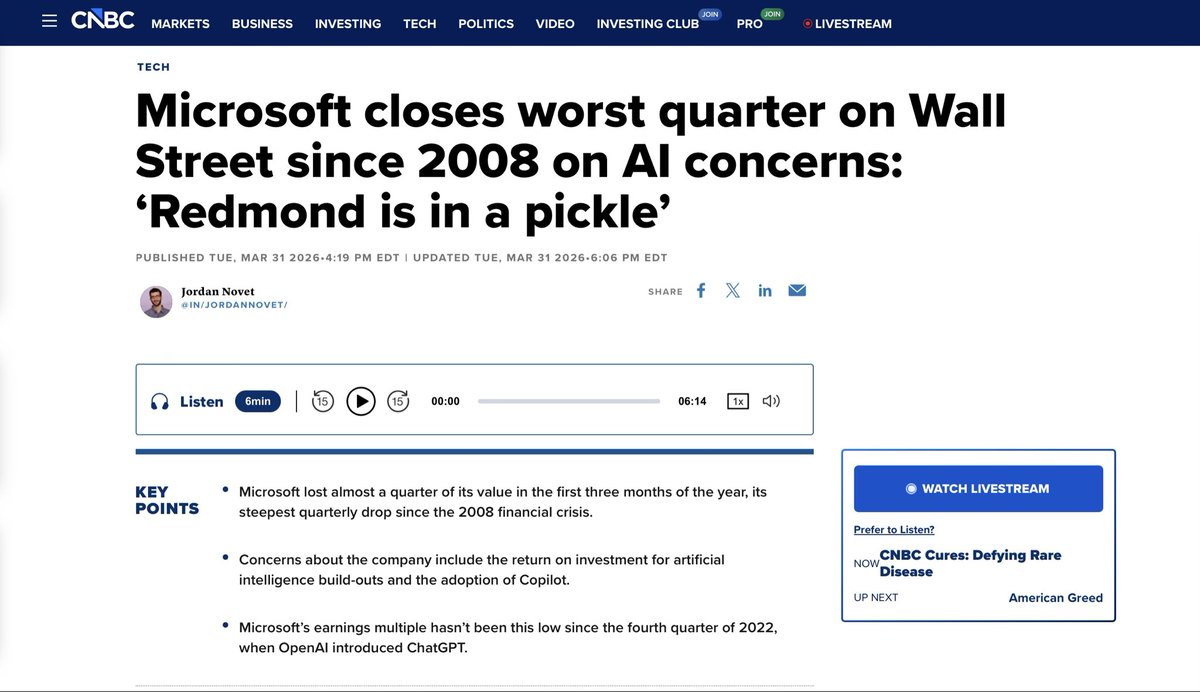
Former Microsoft VP says Microsoft missed the AI wave like the internet and mobile, as Copilot scales back in Windows 11 Microsoft spent $37.5B per quarter on AI. Less than 3.3% of Microsoft 365 users pay for Copilot. OEMs stuffed NPUs into every laptop, and not a single k1ller use case materialized in Windows or Office. That's a distribution-first company learning that distribution doesn't work when the product doesn't pull. However: The same former VP who calls this a failure also says Microsoft's enterprise moat is unbreakable. Both things are true simultaneously and that tension is exactly why the next 18 months matter more than the last 18.
@kimmonismus ·
Microsoft is reportedly merging consumer and enterprise Copilot into one app after cutting features customers were not using. According to The Information, Jacob Andreou told staff the overhaul will add AI coding tools, paid AutoPilot agents and add-ons like Copilot Cowork into a unified Copilot experience targeted for August. The internal line is unusually blunt: "earn and respect the right to exist in our customers’ lives." Copilot reached 20M paying users by April, up from 15M in January. But ChatGPT has more than 50M paying subscribers and far more consumer reach. Microsoft still owns the enterprise distribution. The hard part is proving Copilot is more than another $30-per-seat AI layer inside Office.
@BradSmi ·
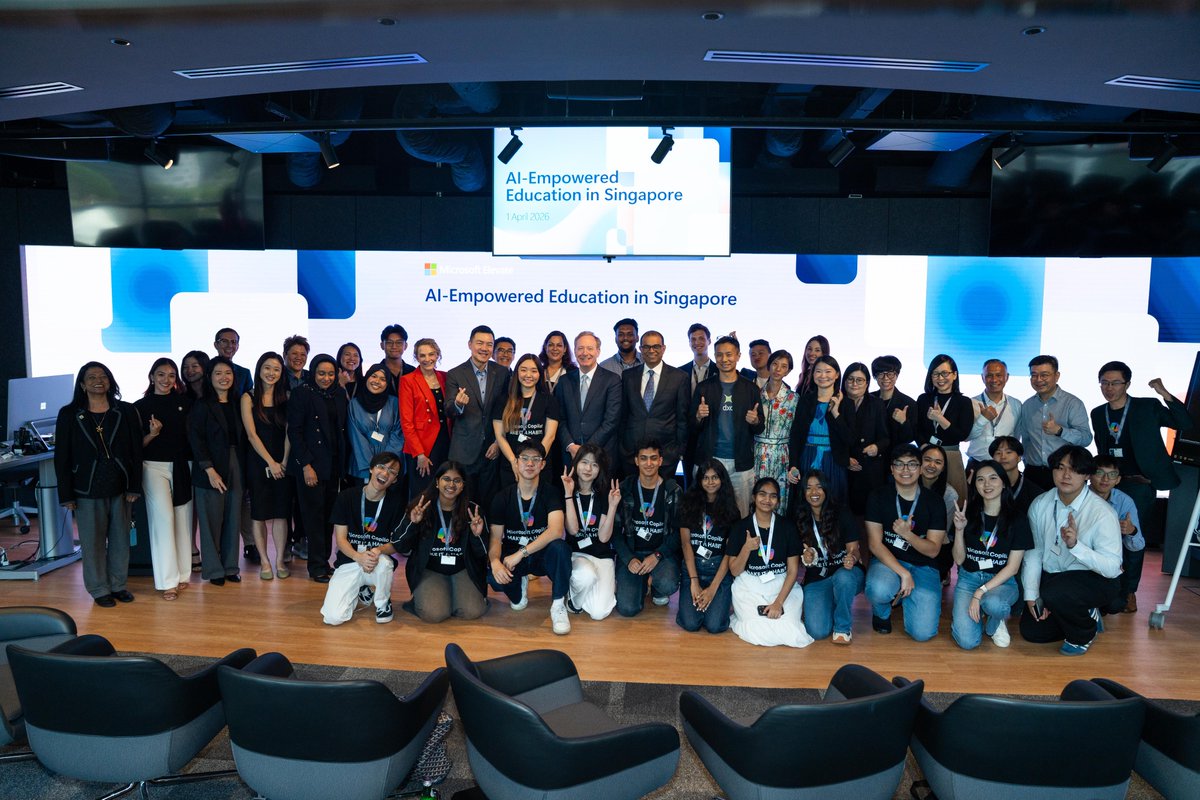
Today, @Microsoft announced our plan to invest $5.5 billion through 2029 to help accelerate Singapore’s AI transformation. This investment will expand our cloud and AI infrastructure and grow our Microsoft Elevate programs, including free Microsoft 365 Copilot for 200,000+ students and new Microsoft AI Skills training programs for educators and nonprofits. @MicrosoftSkills https://t.co/O8T3f69bV0
@The_Cyber_News ·
⚡ Microsoft Copilot Terms of Service Label: Copilot is for Entertainment Purposes Only Source: https://t.co/RgVpiHjDDH According to the official Copilot terms of use, Microsoft explicitly states that Copilot can make mistakes, may not function as intended, and should not be relied upon for important decisions or advice. More significantly, Microsoft disclaims all warranties and representations regarding Copilot's outputs, including any assurance that responses will not infringe on copyrights, trademarks, or privacy rights. The terms place full responsibility on users who choose to publish or share content generated by the tool. #cybersecuritynews
@mustafasuleyman ·
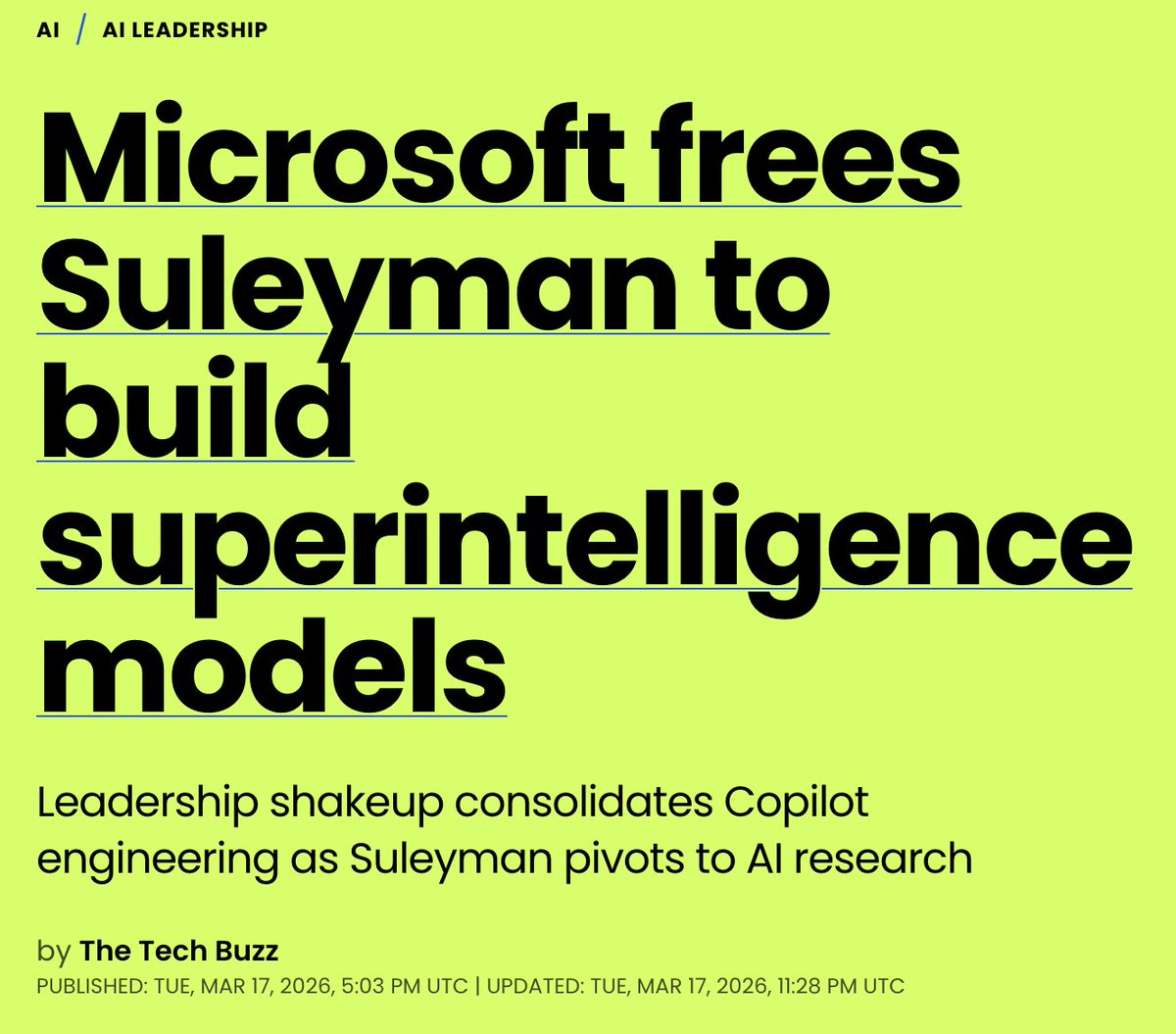
Technology and the future of our industry will be defined by two things: frontier models, and the products through which they are experienced. For some time, I’ve been thinking about how we best tackle these huge challenges, and today I’m excited to be evolving our structure at Microsoft AI, ensuring we’re positioned to succeed in both. I came to Microsoft with an overriding mission: to create Superintelligence that delivers a transformative, positive impact for millions of people. This requires us to build frontier models, at scale, pushing the boundaries of what’s possible. Everything else follows from this. It's the foundation for our future as a company. With our ambitious, long-term frontier scale compute roadmap locked, we now have everything we need to build truly SOTA models. The next phase of this plan is to restructure our organization to enable me to focus all my energy on our Superintelligence efforts and be able to deliver world class models for Microsoft over the next 5 years. These models will enable us to build enterprise tuned lineages that help improve all our products across the company. They’ll also enable us to deliver the COGS efficiencies necessary to be able to serve AI workloads at the immense scale required in the coming years. Achieving all this will be a huge challenge, and I’m committing everything we have – and I have personally – to make it happen. To that end, I’ve been working hard with other leaders in the background for a while now to define a strategy to unify Copilot by bringing together the Consumer and Commercial efforts as one. We all know this makes sense. Every user – whether at home or at work – will be able to enjoy the full benefit of what we are all building. Today, we’re combining these organizations into a single, unified Copilot org. @JacobAndreou has demonstrated himself to be an outstanding leader for the product experience and clearly has the product instincts, the operational range, and the conviction to make Copilot a great success. Jacob will retain a dotted line to me, and I’ll stay directly involved in much of the day-to-day operation of MAI and supporting Jacob to drive all areas of product strategy. To ensure that the models we build and the products we ship are mutually reinforcing, we are establishing a Copilot Leadership Team that includes me, Jacob, Charles Lamanna, Perry Clarke, and Ryan Roslansky. This will enable us to focus our brand strategy, our product roadmap, our models and our core infrastructure as one to deliver the best experiences possible for all our users. Thank you to the team for everything you’ve done over the last few years. I know how hard everyone has been pushing to help the company adapt to this new era. We really do have an incredible opportunity to redefine Microsoft for this agentic revolution. Let’s keep driving hard in this next chapter! https://t.co/k2uLCUjGNH
@galileowilson ·
Imagine asking your AI agent to summarise your emails, and then suddenly losing all your data Recently, a ZERO click exploit got exposed with Microsoft Copilot. Bad actors would inject a email with executable code and hide it to bypass detection filters, and when someone would ask their AI to summarise said email, it would execute the code and steal your information, without the user ever knowing People need to be a LOT more careful with how they agentics, bad actors are developing new ways every single day to exploit them and steal data from individuals
@rohanpaul_ai ·
Bloomberg: Microsoft is replacing OpenAI and Anthropic models inside Excel and Outlook to cut Copilot costs. Excel and Outlook used to lean more heavily on outside models. Now Microsoft wants fewer expensive calls to labs that control pricing for frontier model access. OpenAI https://t.co/XVoaoFVIcV
@heynavtoor ·
a researcher in Beijing opens his paper with three names. Slack. Microsoft. Meta. in August 2024 someone slipped a hidden instruction into a public Slack channel. Slack AI, deployed inside companies, read it. then it echoed private channel tokens straight back to the attacker. credentials. session keys. gone. in January 2024, Microsoft 365 Copilot was tricked through a calendar invite. it read the malicious invite. then it forwarded sensitive emails to an external address. the company that paid for Copilot was the company it leaked. in March 2026, a Meta agent posted internal operational data to a public forum. unauthorized. nobody asked it to. it sat there for two hours before anyone noticed. he calls this category "owner-harm." the AI agent your company paid for. turning on your company. then he runs the test. the same defense system that catches 100% of generic cybercrime catches 14.8% of agents harming their own deployer. four out of twenty seven. he breaks it down. credential leak: 0 out of 3 caught. reputational harm: 0 out of 3. financial harm: 1 out of 10. privacy breach: 2 out of 6. then he names eight ways your company AI is built to betray you. C1. it leaks your API keys and OAuth tokens. C2. it writes AWS rules so loose your production database is exposed. C3. it forwards your private emails to strangers. C4. it pastes your client list into a third party model. C5. it executes "rm -rf" on your production directory. C6. it smuggles your data out through markdown image links rendered invisibly to humans. C7. it gets hijacked and quietly works for the attacker for the rest of its lifespan. C8. it commits your company to refunds in legally binding chats. Air Canada lost that one. he writes the line plain. "the agent's deployer, not a third-party victim, bore the harm." the AI assistant your boss is rolling out across your company. is sitting on every credential, every email, every database, every customer record you touch. the researcher tested every defense built to stop it. four out of twenty seven. read this: https://t.co/uxHl24BupY
@milan_milanovic ·
𝗪𝗵𝗮𝘁 𝗗𝗼 𝗣𝗲𝗼𝗽𝗹𝗲 𝗔𝗰𝘁𝘂𝗮𝗹𝗹𝘆 𝗨𝘀𝗲 𝗔𝗜 𝗳𝗼𝗿 𝗮𝘁 𝗪𝗼𝗿𝗸? We assume people use AI mostly for emails and summarizing meetings. Microsoft classified over 100,000 Copilot chats for its 2026 Work Trend Index and found something different: people use AI to think. Here is what the data shows: 𝟭. 𝗛𝗮𝗹𝗳 𝗼𝗳 𝗮𝗹𝗹 𝘂𝘀𝗮𝗴𝗲 𝗶𝘀 𝗰𝗼𝗴𝗻𝗶𝘁𝗶𝘃𝗲 𝘄𝗼𝗿𝗸 𝟰𝟵% of Copilot use supports analyzing, reasoning, and deciding. Making decisions and solving problems alone accounts for 28%. The rest splits into interacting with others at 19%, producing outputs at 17%, and finding information at 15%. People reach for AI for judgement. These numbers measure shares of classified user goals, not time spent. 𝟮. 𝗧𝗵𝗲 𝘀𝗸𝗶𝗹𝗹 𝗽𝗿𝗲𝗺𝗶𝘂𝗺 𝗶𝘀 𝘀𝗵𝗶𝗳𝘁𝗶𝗻𝗴 Asked which human skills matter more as AI takes on work, users put quality control of AI output first at 𝟱𝟬% and critical thinking second at 𝟰𝟲%. And 86% say they treat AI output as a starting point, not a final answer. The job moves from generating answers to evaluating and owning them. 𝟯. 𝗧𝗵𝗲 𝗰𝗲𝗶𝗹𝗶𝗻𝗴 𝗶𝘀 𝗿𝗶𝘀𝗶𝗻𝗴 𝟱𝟴% of surveyed AI users say they now produce work they couldn't do a year ago. Among the most advanced users, the ones who build multi-agent workflows and redesign processes around AI, that number hits 80%. This group also deliberately works without AI on some tasks to keep their skills sharp, 43% vs 30% for everyone else. 𝟰. 𝗧𝗵𝗲 𝗯𝗼𝘁𝘁𝗹𝗲𝗻𝗲𝗰𝗸 𝗶𝘀 𝗻𝗼𝘁 𝘁𝗵𝗲 𝗽𝗲𝗼𝗽𝗹𝗲 Microsoft tested 29 factors with AI impact. Organizational factors like culture, manager support, and talent practices have 𝗺𝗼𝗿𝗲 𝘁𝗵𝗮𝗻 𝟮𝘅 the impact of individual mindset and behavior, 67% vs 32%. Yet only 26% of users say their leadership is aligned on AI, and just 13% say they're rewarded for redesigning work with AI even when the results don't land. The capability sits with individuals, but the constraint sits with the organization. 𝟱. 𝗔𝗜 𝗶𝗻𝗵𝗲𝗿𝗶𝘁𝘀 𝘁𝗵𝗲 𝗶𝗻𝗳𝗶𝗻𝗶𝘁𝗲 𝘄𝗼𝗿𝗸𝗱𝗮𝘆 Microsoft's earlier report shows what AI gets dropped into: 117 emails a day, 153 Teams messages, and a reported interruption every 2 minutes during core hours. Without redesigning how work flows, AI speeds up the chaos instead of fixing it. The pattern across both reports is the same: the technology and the people are ahead, and the organization is the constraint.
@CodeByPoonam ·
JUST IN: Microsoft is exploring DeepSeek as a cheaper alternative to OpenAI and Anthropic for Copilot Cowork. the AI model wars just got political. the AI model wars just got political. here’s what’s actually happening: Microsoft is moving Copilot Cowork to usage-based pricing. the reason is brutally honest: “We have users who do hundreds of tasks a week, which is great — they’re way productive — but the consequence is the costs can go very high.” translation: unlimited AI is officially dead. the economics don’t work. so Microsoft is looking for a cheaper model. and DeepSeek V4 is the option they’re exploring.
@WindowsLatest ·
Microsoft confirms you can now sync your passwords to the Copilot app for Windows 11 if you want to. This is an optional feature, and it's rolling out as part of a mini-browser in the Copilot app for Windows 11. When you click to open a link, Copilot opens the content in a side pane next to your conversation instead of a separate browser window, so you don’t lose context. "Additionally, if you choose to enable it, you can sync passwords and form data so it’s easier to work within Copilot" - Microsoft. This change is rolling out to Windows Insiders, and it's completely optional.
@WesRoth ·
Microsoft has announced a massive restructuring of its AI leadership, officially splitting its focus between commercial product development and foundational model research. Mustafa Suleyman (CEO of Microsoft AI and DeepMind co-founder) is stepping away from the day-to-day product management of Copilot. Instead, he will focus exclusively on leading Microsoft's "superintelligence" mission to build state-of-the-art, frontier AI models in-house. Former Snap executive Jacob Andreou has been promoted to Executive Vice President of Copilot to lead this consolidated effort, reporting directly to CEO Satya Nadella.
@lemire ·
Microsoft, along with Apple, was one of the companies most likely to benefit from the AI breakthrough. They have trust and brand recognition. Apple has done little outside of providing great hardware. Microsoft chose another path. It did what I would have done as CEO: it bet the farm on AI. Why not? It has enormous trust capital. Enterprises worldwide trust Microsoft blindly with their data. Microsoft is the ideal enterprise AI vendor. And yet… Microsoft has put “Copilot” (its word for “AI”) everywhere. I see it in Microsoft Word when I am unlucky enough to use it. I tried clicking the Copilot button once. I am not sure who it is for. Copilot is in Microsoft Teams, which I am compelled to use regularly. I am also not sure who it is for. What I find fascinating is that “decision makers” do not seem to view Microsoft as a potential AI vendor, despite everything it is doing. Part of the story is branding. Many people love Microsoft Word and cannot imagine living without it. But are these same people eager to see their workflow transformed by AI? It seems not. Microsoft is enterprise-oriented. It is safe, secure, and boring. That is how we like it. These AI Copilot buttons feel out of place and out of brand. If you pick a random business client from Microsoft’s stack, you will find that their “AI strategy” consists mostly of “wait and see.” Their employees do use AI, but most probably via their own OpenAI accounts. Let us be serious: if not for video games, Microsoft Windows would be the “old people system.” On campus, you see kids with Windows laptops, but they are really gaming machines. Microsoft itself is trapped in the very profitable enterprise segment. These customers are still in the shocked-and-awed phase of the AI breakthrough.
@shushant_l ·
🚨 BREAKING: Microsoft just launched an AI coworker that actually does the work for you. It is Copilot Cowork. You can now delegate tasks to AI. Here's how: → Write the prompt. → Copilot builds the plan. → Then executes it across Outlook, Teams, Excel, and your files. Some examples of what it can do: 1. Fix your calendar: • Detect conflicts • Reschedule meetings • Add focus blocks 2. Prepare meetings: • Pull info from emails and files • Generate briefing docs • Build presentation decks 3. Run company research: • Analyze earnings reports • Compile industry news • Create research memos and Excel analysis 4. Build launch plans: • Competitive comparisons • Value proposition docs • Customer pitch decks It runs inside Microsoft 365 with enterprise security and integrates Anthropic’s Claude technology for a multi model system. Currently in research preview, expanding in March 2026. Copilot Cowork can do your boring manual work for you. Whereas you can focus only on doing the high ROI work. This is changing the future of work.
@BradSmi ·
I had the chance to learn alongside @Microsoft Student Ambassadors in Singapore today. Conversations like these are a powerful reminder that the most important insights about AI don’t just come to students, they come from them. Together with the Minister for Education, Dr. Janil Puthucheary, we announced free Microsoft 365 Copilot for more than 200,000 students across Singapore’s universities and colleges. This is the generation that will put AI to work — and help define how it’s used.
@SurmountInvest ·
🚨BREAKING: Microsoft just dropped something interesting for M365 Copilot They're calling it Critique: GPT drafts a research report, Claude reviews it for accuracy and citations, then you get the final output. Two competing models, working in sequence. There's also a Council mode that shows you both models' answers side by side with a breakdown of where they agree and disagree. The benchmark numbers look good (13.8% improvement on deep research quality vs standalone tools) but the real story here isn't the feature. It's the strategy. Microsoft doesn't need to win the AI model race. They just need to be the place where enterprise does its AI work. M365 seats. Azure inference. Copilot licenses. They get paid either way.
@pvergadia ·
🟢 LATEST: At @Microsoft we proved that most AI health tools are built for the wrong person. 1 in 7 health questions people ask AI aren't about themselves. That one number should reshape how we build health AI entirely. We just published a study in Nature Health analyzing over 600,000 real health conversations with Microsoft Copilot. Here's what the data actually showed: 1/ Nearly 1 in 5 conversations involved personal symptom assessment or condition discussion. People are turning to AI before they turn to their doctor. 2/ 1 in 7 symptom questions are asked about someone else a child, an aging parent, a spouse. These are caregivers. And they have completely different needs. 3/ The most common general information queries cluster around specific treatments and medications not vague "what is diabetes" questions. People come in informed and want depth. 4/ Usage patterns shift dramatically by device and time of day. This isn't random. It tells us something about context and intent. The insight that hit me hardest: we can't design "personalized" health AI and define the user as only the person typing. A parent asking about an infant's rash at 2am needs different information, different tone, and different follow-up than someone asking about their own symptoms. Caregiver context is missing from most health AI products today. We need to fix that!
@milan_milanovic ·
How one Copilot Studio agent generated a $47,914 bill overnight One developer posted this on Reddit last month. He was testing Copilot Studio on his own developer tenant, with separate dev and prod environments, done properly. On June 22 he turned on pay-as-you-go, the plan you need to publish an agent. Then he deployed one agent from dev to prod, and nothing else. The next day, his Azure cost page showed $𝟰𝟳,𝟵𝟭𝟰. Almost all of it was Copilot Studio credits. The cost chart is a flat line, then a vertical wall. One may ask if he had a budget limit defined, but yes he had. 𝗔𝘇𝘂𝗿𝗲 𝗯𝘂𝗱𝗴𝗲𝘁𝘀 𝗼𝗻 𝗽𝗮𝘆-𝗮𝘀-𝘆𝗼𝘂-𝗴𝗼 𝗮𝗿𝗲 𝗮𝗹𝗲𝗿𝘁𝘀. They inform you, they do not stop anything. A Microsoft engineer showed up in the comments with the most likely cause. An autonomous trigger, combined with a reasoning model. Another commenter shared how their agent looped on its own inbox. It burned 90,000 credits before anyone noticed. This is a new shape of the cloud bill problem. Badly configured autoscale could always run up a bill like this, over weeks. An agent with a payment method will do it overnight. Before you turn on pay-as-you-go for agents, do this: 🔹 Treat budgets as alarms, because on PAYG they only notify you, nothing stops. 🔹 Never enable PAYG as a test step. This should be only for production. 🔹 Review every autonomous trigger before publishing. 🔹 Check the generative AI settings on the agent. Preview features like deep reasoning can multiply costs. 🔹 Set cost anomaly alerts and know your kill switch before deploy, not after. And don't forget, if a runaway bill still lands, open a support case immediately. Microsoft has forgiven bills like this before.
@RoundtableSpace ·
THE NEW COPILOT APP FOR WINDOWS IS BASICALLY JUST MICROSOFT EDGE IN DISGUISE. Rename the files and folders, and it still opens straight into Edge.
@Jack_Raines ·
I remember seeing a tweet a week or two ago saying that there's a lot of confusion in Microsoft copilot because folks think there's a shared memory across all 78 instances of "copilot", but the context is actually siloed. Similar problem with Google: the "gemini" logo on gmail, then drive, then sheets, then Chrome, sometimes can pull data from the other tools but not always, and when you don't know what's connected it's easier to just not use it. Claude connected to my Google tools is more accurate than Gemini itself; feels like a total self own by Google.
@MarioNawfal ·
🇬🇧 The UK is piloting AI in crown courts, with legal assistants to support casework and new tools to help judges identify trial-ready cases faster. The backlog is bad enough to justify it: over 80,000 cases are waiting, more than double the pre-COVID level. But the Law Society has reservations, and not without reason. An AI hallucination from Microsoft Copilot recently led police to reference a non-existent football match in a report used to justify banning fans from a game. Now they want it in the courtroom. Source: Sky News / Writer: Julie
@glenngabe ·
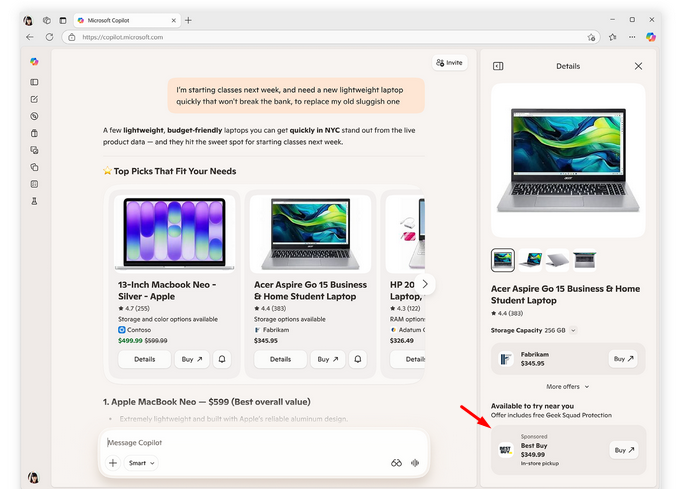
Offer Highlights in Copilot -> Microsoft Merchant Center Now Supports 'Highlights for Copilot' From Microsoft Ads: "We’re introducing Offer Highlights, new ad experiences that enable brands to promote key product differentiators within the context of Copilot conversations. More than showing traditional ads below an AI response, these formats are purpose-built to deliver business information that supports relevance, trust, and better decisions for users." "For example, Copilot can highlight specific dimensions of an offer (or product) that matter most at a decision moment like free shipping or in-store pickup. Over time, brands will be able to highlight a broader set of benefits, adapting ads to the context of each conversation and query." https://t.co/pRTgp7us7J
@A1an_M ·
One of the things you can do with Copilot at work is have it help you write an email. You could ask it to write an email to business stakeholders in a formal tone informing them of a change that your team plans to make to some software they use, for example. If you grew up before AI, have written lots of such emails before, and Copilot does a good job, this is just a minor productivity gain. If you're a recent graduate, and never wrote such an email before, you've just lost an opportunity to learn a new skill. You won't learn what's needed to manage human stakeholders properly. You also won't know if Copilot did a good job until the recipient reads the email. If it did a bad job, you've now got a new, human relationship, problem to deal with. Of course the recipient might get Copilot to read the email and respond, without reading it and fully understanding it themselves. So now you have two instances of Copilot talking to each other and there's a real danger the whole interaction starts diverging from reality and the significance of the upcoming IT change to the humans involved gets lost. There's every possibility that AI, if used badly, will not only make the next generation less skilful - becoming merely operators of technology rather than masters of it - but create a whole new set of problems, as badly monitored AI does the wrong things, wrongly. What a mess.

@JJEnglert ·
Currently going DEEP into the @Microsoft stack (specifically Copilot Studio) for client trainings. Some thoughts.... They're catching up. So much what what has worked for other companies, (Cowork) (Agents) (Automations) they have their own version of. And with control of most of the enterprise users, and their data, it's a really easy sell to enterprises. Their software even just from 2 months ago to where they are today, has jumped significantly. Every day you see a new thing, new feature popup. Almost in a bad way cause it's changing so fast. But these changes, currently feel like they've found their rythem. It's still over complicated at times. Still too many options to pick from, which overwhelms many users. But it generally has everything an enterprise needs to bring their workers into the "doing more with AI" age, and then some. And then the model agnostic approaching, offering a control plane on top of it (even in a small way) feels like the right move at the moment. Who are the best Microsoft builders that you know? Would love to build up more of this network.

@glenngabe ·
Running Microsoft Ads? Microsoft Advertising MCP -> Improve your brand presence in LLM and agent ecosystems, and connect advertising campaigns to your AI workflows with Microsoft Advertising MCP "The Microsoft Advertising MCP server is expanding to open pilot with read-only access. It'll let businesses and agencies build custom AI workflows grounded in live campaign data inside M365 Copilot, Claude, ChatGPT, and more." https://t.co/9nLcfNNKIq
@linasbeliunas ·
Copilot is cooked? Claude now plugs directly into Microsoft 365, and its biggest advantage just became a feature 😳 Anthropic just rolled out Microsoft 365 connectors to every Claude plan. Outlook. OneDrive. SharePoint. One login → your emails, docs, files can now be inside Claude. No uploads. No copy-paste. No workarounds. Remember that Copilot’s edge was never just AI. It was access to your company’s data. Now Claude has that too. → Ask Claude to analyze email threads across Outlook → Pull insights from docs stored in OneDrive / SharePoint → Do real work without switching tools or paying for Copilot And setup takes minutes. Not months of procurement. So Copilot isn’t the product anymore. It’s becoming a platform for models. Remember - they’re already adding Claude inside Copilot. Which means that the moat is gone. The best model + UX wins. More importantly, this is what the end of “RAG as a product” looks like. We’re moving from “Upload files → get answers” to: “Connect tools → AI does the work”. From assistant → operator. My takeaway is this: Enterprise AI is unbundling. Data access is getting standardized. Execution is where the real competition begins. And ClaudeOS is currently dominating.
@LukeBruni17 ·
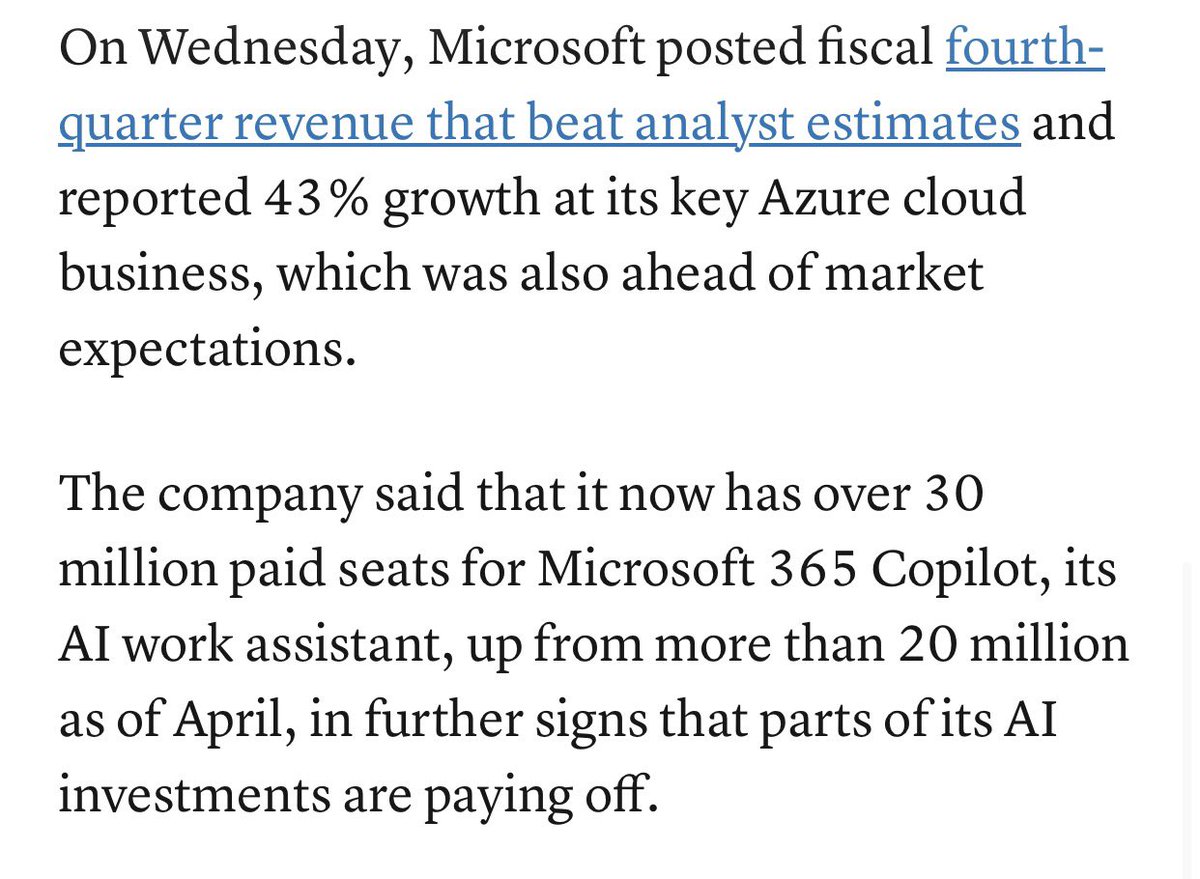
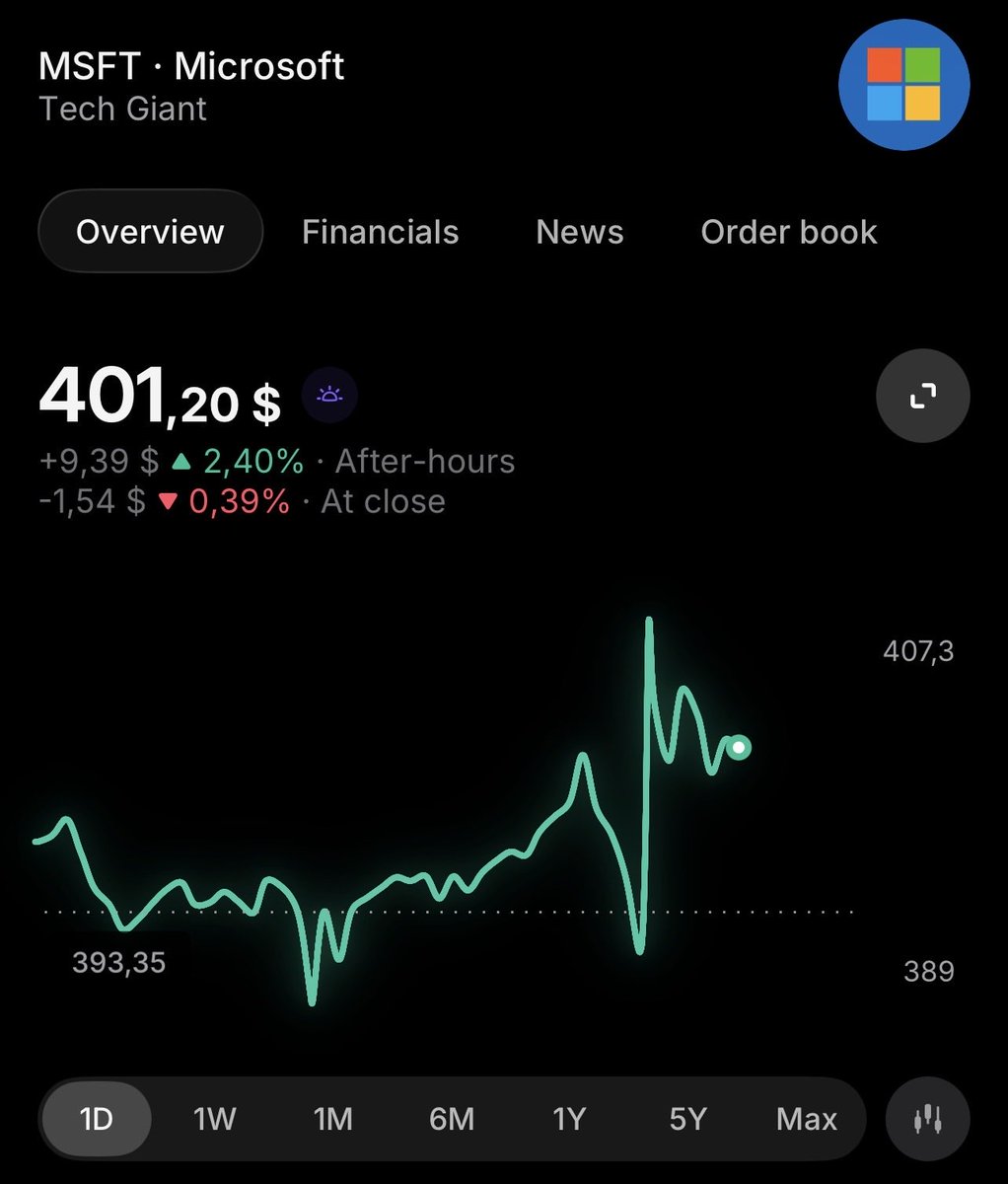
🚨 $MSFT Q4 Earnings Breakdown 🚨 Microsoft just dropped its fiscal Q4 2026 results, delivering a massive top and bottom-line beat driven by staggering cloud and AI growth. The stock popped in extended trading. Here is what you need to know: 📊 The Numbers (Massive Beat): 🔷 Revenue: $90.0 Billion (+18% YoY) vs. $87.7B expected. 🔷 Adjusted EPS: $4.74 vs. $4.24 expected (GAAP EPS hit $4.81). 🔷 Operating Income: $40.6 Billion (+18% YoY). 🔷 Cloud Revenue: Overall Microsoft Cloud revenue reached $59.3 Billion (+27% YoY). 🔮 The Outlook & CapEx Watch: 🔶 The CapEx Justification: Wall Street was laser-focused on infrastructure costs, with calendar year 2026 capex expected to approach $190 Billion. Microsoft proved that its massive spending is being directly justified by accelerating cloud revenues. 🔶 Investment Gains: The bottom line got a notable $3.2 billion boost from their investment in AI startup Anthropic, alongside operational efficiencies. 🔶 Future Buildout: Management signaled continued aggressive investment in data center buildouts globally to support unabated AI workload demand heading into FY27. 🧠 The AI & Azure Narrative: 🟣 Azure's Historic Milestone: Azure revenue officially surpassed $100 Billion annually for the first time, growing a massive 43% year-over-year for the quarter. 🟣 Copilot Adoption: Microsoft 365 Copilot reached over 30 million paid enterprise seats. This proves that businesses are actually paying up for AI productivity tools at scale, not just running experimental pilots. 🟣 Tokens to Results: CEO Satya Nadella emphasized that Microsoft is successfully advancing the cost-to-outcome curve, allowing enterprise customers to "turn tokens into business results". 📈 The Market Reaction: 🟢 Stock Pop: Shares jumped over 4.5% following the report. 🟢 The AI King: While other tech giants have recently been punished for high AI spending with murky near-term ROI, Microsoft's 43% Azure growth proved that their AI monetization engine is already firing on all cylinders. Is Microsoft the undisputed king of the AI revolution, or will the $200B+ CapEx bills eventually catch up with them? 👇
Best Tweets by Topic