Human oversight and judgment
Approval gates, escalation paths, ownership, taste, exception handling, and keeping people involved where context or decisions matter.
38%
Best tweets about AI Automation
Discover the best tweets about AI automation, from agent workflows and integrations to business processes, reliability, and measurable results. Updated weekly.
Automations with clear inputs, tools, outcomes, failure handling, and honest operating costs.
Original Xholic analysis
The conversation favors pragmatic AI automation: select repeatable work with stable inputs, clear tools, and measurable outcomes; keep humans at judgment and approval points; and treat data, integration, monitoring, and operating cost as deployment work. Supportive views lead (56%), while cautionary and critical posts together make up 38% of the dataset and question autonomy and task-level productivity claims.
54% of posts
All-time engagement
32% of posts
Published in 90 days
Conversation map
Approval gates, escalation paths, ownership, taste, exception handling, and keeping people involved where context or decisions matter.
38%
Measuring business outcomes rather than task-time savings; accounting for tokens, infrastructure, maintenance, human review, and capacity reallocation.
38%
Tool-using loops, planning, reflection, multi-agent systems, multi-model review, workflow engines, MCP integrations, and observability.
32%
Concrete workflows across onboarding, customer support, reporting, advertising, accounting, recruiting, local operations, content, development, and research.
32%
Tests for repeated triggers, stable inputs, clear tools, measurable outcomes, and the distinction between deterministic tasks and judgment-heavy work.
24%
Narrow agent roles, separated knowledge and action layers, scoped permissions, acceptance tests, fallbacks, queues, state, and reliability.
22%
Process mapping, clean and trusted data, systems-of-record integration, organizational legibility, and workflow redesign before deployment.
18%
AI audits, pilots, training, champions, hackathons, governance, rollout maturity, trust, and barriers to scaling beyond prototypes.
18%
Tone and stance
Performance benchmark
Posts with media make up 52% of this collection. Their median all-time score is 10.2, compared with 8.86 for text-only posts.
Format mix
Consensus and debate
Shared view
A recurring selection rule is to automate work with repeated triggers, stable inputs, defined tools, and a measurable finish line; one framework distinguishes agents from simpler automation by the judgment required during a run.
Shared view
Posts emphasize human control for contextual decisions, external actions, and exceptions, with agents drafting, routing, or executing bounded work rather than independently making consequential decisions.
Shared view
Reliable deployments are described as scoped functions with separated knowledge and action layers, permissions, acceptance tests, fallbacks, queues, state, and observability—not a single prompt.
Shared view
Process mapping, trustworthy data, and integration with systems of record recur in the evidence. Several posts warn that automation can reproduce fragmented processes, poor data, or missed edge cases when those foundations are absent.
Open debate
Some posts present planning, tool use, and multi-agent patterns as routes to more autonomous execution, while others argue delegation still needs an owner and orchestration needs a human in the loop.
Open debate
One local-business account lists automation across calls, ads, books, recruiting, and reporting, while skeptical posts warn that broad setups can add maintenance or that claims of automating an entire business may cover only a limited set of tasks.
Open debate
The conversation disputes whether AI productivity translates into outcomes: one post reports no additional actual productivity among heavily automated peers, while another argues that saved capacity needs deliberate reallocation to affect results.
What performs
The highest-scoring outlier was the five-part workflow-selection test, with an all-time score of 1097.06, or 108.08 times the median all-time score.
The enterprise rollout progression was the second-largest outlier at 643.62 all-time score, or 63.41 times the median. Its progression includes audit, ROI and risk prioritization, data readiness, testing, and cost optimization.
Posts with media had a median all-time score of 10.17 versus 8.86 for text-only posts. Media appeared in 26 posts, representing 52% of the evidence set.
List posts accounted for 24% of posts and had a 39.51 median all-time score, above case studies at 5.67 and opinions at 6.00.
Statistical standouts
Creator landscape
The five most represented creators account for 20% of the selected posts.
1. Amit | Frogomo | AI 🐸
@frog_omo
2 posts
2. Steve Tan
@heystevetan
2 posts
3. Aaron
@IAmAaronWill
2 posts
4. Julian Goldie SEO
@JulianGoldieSEO
2 posts
5. Harsh Makadia
@MakadiaHarsh
2 posts
6. Sachin Rekhi
@sachinrekhi
2 posts
The dataset spans 42 creators, and the top-five placement share is 20%. The most frequent listed voices each contributed two tweets, indicating that no single listed creator accounts for a large share of the evidence set.
Turing Post’s two included posts connect organizational legibility and trusted data with an explicit capacity-to-outcome chain, rather than treating task-time savings as sufficient ROI.
Frogomo’s included posts distinguish deterministic from probabilistic workflows and point to deployment constraints beyond model capability.
Since the previous snapshot
Themes, sentiment, stance, and post format are classified per tweet. All counts, shares, medians, creator concentration, freshness, and performance comparisons are then calculated directly from the published snapshot.
Xholic's all-time score compares engagement while accounting for reach, post age, and creator consistency. It is used for relative comparisons within this collection.
This report analyzes the exact 50-post snapshot shown below. AI identifies editorial categories and drafts explanations; all statistics are calculated from the snapshot, and every narrative claim is checked against cited posts before publication.
Best AI Automation tweets
Ranked 01–50

@gregisenberg ·
The question I get most right now is "what should I turn into an AI agent?" Here is the 5 part test I use (works for Claude/Codex/Grokbot etc): 1. It has a repeated trigger, so the same kind of task keeps happening over and over. 2. The inputs are stable, so the information comes in a predictable shape every time. 3. The tools are clear, so there is a defined set of things it can actually go do. 4. There is a measurable finish line, so you can tell when it is done and whether it worked. 5. There is judgment in the middle, so each run is a little different and needs a real decision made in the moment. The first 4 are really just asking "can this be automated at all?" The 5th is the one that matters, because judgment in the middle is what makes it an agent instead of a simple automation. Once you see it this way, you start spotting agent work pretty much everywhere.


@businessbarista ·
Been working with execs on AI rollouts for the last 14 months. This is the most common level-by-level progression I see:* Level 1: Run company wide AI audit, which includes mapping key processes, interviewing SLT/ELT, and surveying rank-and-file employees. Level 2: Finalize post-diagnostic read out, which lays out AI transformation timeline by initiative. Prioritized by ROI, risk profile, and cultural support. Level 3: Company realizes their data ducks aren’t in a row, which leads them to working on the “Company Brain” panacea. Level 4: In tandem, start by investing in coding agents for the engineering/product org. Level 5: Get enterprise access to general purpose LLM for subset of non-technical AI champions. Level 6: Expand enterprise access to all non-technical employees. Level 7: Run small cohort of workshops for ELT and AI champions so they get the most out of the technology. Level 8: Roll out training/enablement program company-wide. Level 9: Company runs AI hackathon, which lets employees bubble up solutions to problems from the AI audit as well as new problems. Level 10: Leadership reviews and prioritizes employee hacks and decides which initiatives to take from prototype to production. Level 11: First AI build tackled is typically quick win to some back-office process with attributable hard ROI where cultural pushback is expected to be low. Level 12: Token efficiency/cost optimization becomes major focus as AI budget begins to balloon in eng org. Level 13: As internal momentum builds & longer ROI leash is given, cycle of problem identification —> process map —> prototype —> test/harden/secure/measure —> scale is followed leveraging initial AI readout, hackathon findings, etc. Level 14: Company starts moving further along the spectrum from deterministic workflow to self-guided agent as the AI muscle expands. *Note: these levels can appear in different order or happen simultaneously vs. sequentially depending on the company’s context

@boringmarketer ·
everything I've automated in my "boring" local business with ai... 1) call ingestion and analysis - I know what people are asking for, what new markets to expand to, when and where they are calling from 2) ad attribution all the way through the funnel - I know exactly what to pay for a customer and how much they are worth 3) my books - I know where we stand every day with revenue, expenses, cogs, etc. 4) subcontractor recruiting - prevetting, qualification, agreements, background checks 5) ads management - Adwords data comes in daily, AI makes the changes to the account 6) high quality social across IG, Meta, Google Business profile - job photos, templates, AI generated assets created automatically for my approval 7) new market analysis - I look at demand and supply signals to find the next local markets we enter into 8) SOPs - I have claude create clear SOPs with screenshots and instructions for our team to follow from an easy to access dashboard 9) microtools - sub contractor availability checking, etc. is a tool that requires no manual steps...anything manual I pretty much build an easy to use tool for 10) web traffic, rankings, review velocity, etc. - all show up in a daily report with insights and what needs to be done next this is why local is such a big opportunity if you are AI native, can code, can automate...you are 10x, 100x further along than competitors and you are finding high ticket markets with PROVEN DEMAND. stop selling ai to ai people and fish where the fish are.

@coreyganim ·
HOW TO DESIGN A MANAGED AI AGENT A BUSINESS CAN ACTUALLY TRUST STOP pitching "AI employees." No one knows what that means. START selling one defined function instead. Here's the operating model: 1. Give the agent one job. -Speed to lead. -Speed to quote. -Lead qualification. -Knowledge-base maintenance. -Meeting preparation. A narrow job is easier to explain, build, test, and improve. 2. Ground it in the same company knowledge as the team. The agent needs the offer, customer, process, policies, history, and current priorities. It shouldn't reconstruct the business from random emails every time it runs. 3. Separate knowledge from action. The knowledge layer tells the agent what is true. The action layer lets it use email, calendar, CRM, documents, or other tools. Keeping those layers separate makes the system easier to govern and manage. 4. Define what it can read. Full company context may be useful but that doesn't mean every agent should see every confidential record. 5. Define what it can change. A marketing agent should be able to maintain marketing knowledge. It should not be able to edit finance rules. We have tested this with positive and negative checks: an agent can make an in-scope change and gets rejected when it tries to write outside its domain. That is a far better proof point than saying it is "autonomous." 6. Define what requires approval. -External messages. -Calendar changes. -Public content. -Destructive actions. -Financial actions. -Customer commitments. Drafting and recommending are different from deciding and publishing. 7. Build acceptance tests before. thedemo. -Can it find the canonical source? -Can it refuse stale or conflicting information? -Can it stay inside its write boundary? -Can it escalate uncertainty? -Can it recover when a connection fails? Installation is not acceptance. 8. Show the work every month. -What did the agent handle? -Where did it fail? -What changed? -What still needs a human? -What is the next improvement? Managed agents are not software you install and forget. They are a defined function you operate, monitor, improve, and keep aligned with the business. The winning offer is: "we manage a specific piece of work, on top of your company's knowledge, with clear boundaries and human control" The final step is boring but important: assign a human owner. Someone has to review failures, approve boundary changes, and keep the underlying knowledge current. A managed agent without an accountable owner slowly turns into unmanaged risk..

@vasuman ·
There are 3 core philosophies that we believe in when it comes to implementing AI for a large company: 1. Build on top of the existing systems of record. Your company spent years and millions of dollars building its stack. NetSuite, Salesforce, SAP, ServiceNow, whatever it is. The problem was never the systems themselves. The problem is the manual work your people do between them. Agents should run inside your existing tools, not replace them. No migration, no new logins, no retraining your team on a new platform. 2. Create a single pane of glass that unifies systems, that all agents live on top of. AI should be the last piece of software that you integrate, not the reason you add 50 more licenses and one-off workflows. One orchestration layer that connects your systems and gives agents a unified view of your operations. Finance agents, sales agents, procurement agents, all living on the same layer, talking to each other, sharing context. Not 12 disconnected AI tools that each solve one problem and create three new ones. 3. AI can do a lot, but can't do everything. Your team knows things that no model ever will. The vendor who always pays late. The client who needs a custom invoice format. The exception that happens once a quarter but costs $200K when someone misses it. Agents handle the 90% that's repeatable. Your people handle the 10% that requires judgment. Over time, that ratio shifts as agents learn from your team's corrections, but certain humans stay in the loop on what matters.


@TheTuringPost ·
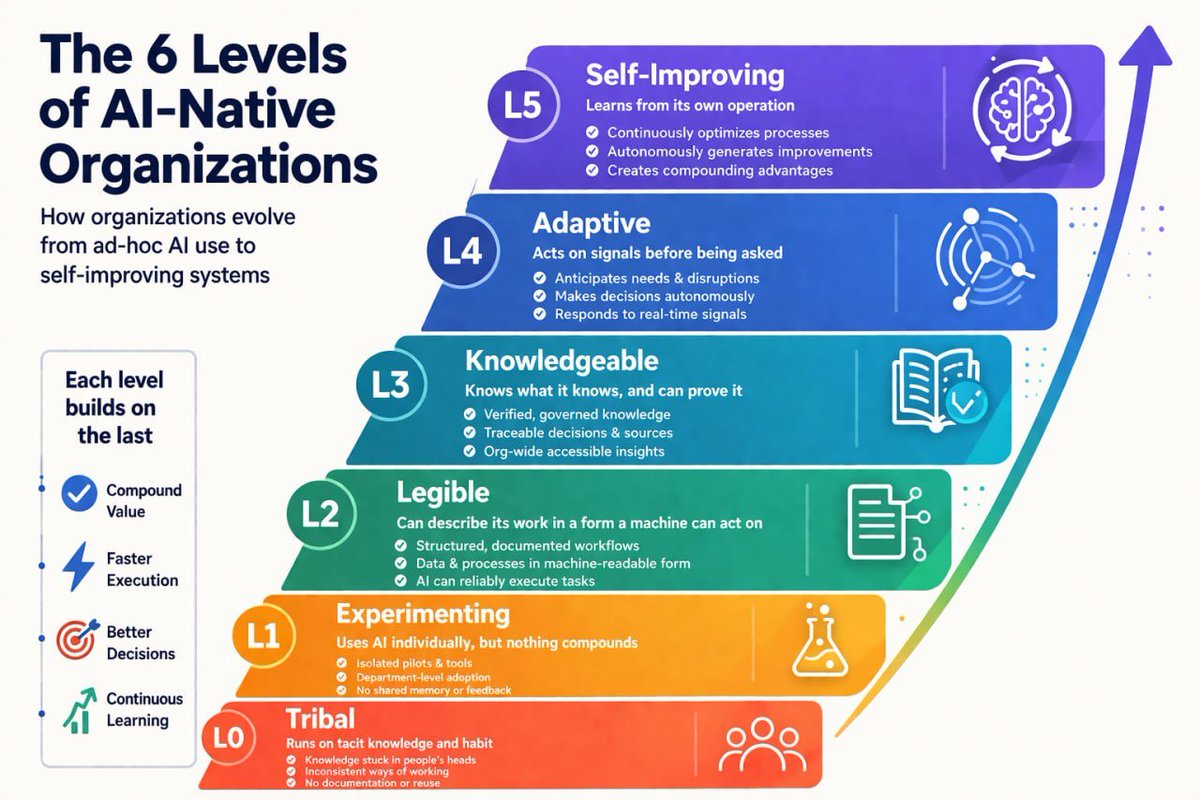
AI feels like it’s everywhere now. Spend a few days in San Francisco and it feels like the future has already arrived – agents, autonomy, AI-native companies. It creates a powerful illusion: the rest of the world is moving at the same speed. But it isn’t. Most companies are still at a much earlier stage. For many, AI means ChatGPT for writing, Copilot for code, maybe a few internal experiments, and a lot of pressure to “do something with AI.” The real gap is the organization itself. Work inside companies is still largely invisible to machines. Processes live in people’s heads, data is fragmented, and decisions don’t follow the org chart. That’s why so many AI pilots look impressive, and then quietly disappear. Because AI adoption isn’t a straight line, it's a stack of dependencies. You can’t jump to agents if workflows aren’t legible. You can’t act on data you don’t trust. You can’t automate decisions that aren’t clearly defined. The real work sits in the middle: • Making the organization legible to itself • Making data trustworthy and verifiable • Letting systems act and reshaping roles around that • Closing the loop so systems learn from human decisions That’s where deployments either become real or die. And it’s not really about AI – it's more about organizational redesign. AI adds intelligence while forcing companies to confront how they actually work. And the winners will be those who did the unsexy work of becoming organizations AI can actually understand and operate within. We break this down with @wschenk in our article → The Unsexy Truth of AI Adoption https://t.co/fXs9VgrmqI And I'm really interested in how this looks inside your companies. Where are you getting stuck?

@tibo_maker ·
ngl I've been mass-testing AI agents across all my products for the last 2 weeks tried to replace entire workflows. customer support, content generation, SEO audits, social scheduling here's what I found: agents are insanely good at tasks with clear inputs and outputs. content drafts, data extraction, competitor analysis. like 90% as good as a human, 50x faster but they still completely fall apart when context matters. when you need taste. when the answer is "it depends" I watched an agent confidently give a user the wrong Outrank plan recommendation 3 times in a row because it optimized for the metric instead of the actual need so painful to watch 😅 my take: the best AI-native products in 2026 won't be "fully automated" anything they'll be the ones that figure out the exact moment to hand control back to a human that handoff is the whole product

@amix3k ·
AI is giving software companies massive leverage. One response is to reduce headcount while maintaining the same output. Another is to keep building and attempt things that previously required a much larger company. At Todoist, we’re now 108 people, the largest team we’ve ever had. We’re also taking on two major new challenges. One of them is Todoist Automations. Without AI, we wouldn’t have attempted it at all, because automation is an incredibly hard problem to solve well. Yet our research and customer feedback revealed a huge gap: many customers want to automate their work, but only around 10% actually do. The opportunity is enormous. We’re approaching it with the same craft we bring to Todoist. The entire interface is built around natural language. On the engineering side, we’ve created a workflow engine that can run automations affordably and at scale. And it won’t be limited to Todoist. People will be able to automate work across Gmail, Notion, Outlook, spreadsheets, and many other tools. I’m not sharing this to promote what we’re building. I’m sharing it because it’s a concrete example of what AI is making possible and what I expect many software companies will do next. The result for customers will be far more choice, much stronger competition, lower prices, and rapidly improving software. And because almost every industry now runs on software, the impact won’t stop at tech. It will raise the productivity and efficiency of entire markets and society as a whole. --- And of course, this would not be a full post if I didn’t include a little leak of the direction we are going! 😁


@goyalshaliniuk ·
Not long ago, AI was a tool you used. Now, it's becoming a teammate that thinks, plans, and acts on its own. This shift is being driven by a new wave: Agentic AI. These systems don’t just respond — they take initiative, make decisions, and get things done. Here’s a breakdown of the 4 most powerful Agentic AI design patterns each unlocking a unique approach to intelligent decision-making and task execution. Here’s what each pattern brings to the table: 1. Agentic Self-Reflection The AI critiques and improves its own output through self-reflection. It generates a response, evaluates it, and revises — all autonomously. 2. ReAct Pattern Combines reasoning and acting in loops. The AI uses tools, observes results, and iterates on its response until the final answer is accurate. 3. Multi-Agent Pattern Involves multiple agents with specialized roles. They communicate, delegate, and aggregate results to solve complex tasks together. 4. Planning Pattern The AI breaks a goal into smaller tasks, executes them with agents, and replans dynamically if something fails or needs adjustment. 📌 Save this as your go-to reference for building smarter, more autonomous AI agents using proven architecture patterns.
 Watch video

@EXM7777 ·
if your goal is to find the best ways to implement AI in your work... most of your job will be deciding wether this task you're automating/delegating to an agent really adds leverage to your work i see A LOT of ai products launching, and focus on the mundane tasks: answer email, manage calendar, book restaurants or flights... what's the point in setting up workflows, having to maintain an infrastructure or pay a subscription to perform such EASY tasks? same applies to business workflows... Claude Code and other tools have people feel like they're super behind if they're not using it as their daily driver truth is you can get A LOT of shit done with just decent prompting, context engineering and MCPs you don't need a big ass setup that's time consuming, the goal with AI is to do MORE and FASTER

@milan_milanovic ·
𝗔𝗜 𝗶𝘀 𝗿𝗲𝗺𝗼𝘃𝗶𝗻𝗴 𝘁𝗵𝗲 𝗷𝗼𝗯𝘀 𝘄𝗵𝗲𝗿𝗲 𝘀𝗲𝗻𝗶𝗼𝗿 𝗲𝗻𝗴𝗶𝗻𝗲𝗲𝗿𝘀 𝗰𝗼𝗺𝗲 𝗳𝗿𝗼𝗺 Companies cutting junior roles to save money are running an experiment that economics already answered in 1962. That year, Kenneth Arrow turned an observation into formal theory: people get better at their work by doing it. He called it 𝗹𝗲𝗮𝗿𝗻𝗶𝗻𝗴 𝗯𝘆 𝗱𝗼𝗶𝗻𝗴 and went on to win a Nobel Prize. Last month, researchers from the Atlanta Fed, Columbia, UT Austin, and Chicago Booth applied his theory to AI automation. The result is bad news for the companies doing the cutting. Here is the argument: 𝟭. 𝗟𝗲𝗮𝗿𝗻𝗶𝗻𝗴 𝗼𝗻𝗹𝘆 𝗵𝗮𝗽𝗽𝗲𝗻𝘀 𝗱𝘂𝗿𝗶𝗻𝗴 𝘄𝗼𝗿𝗸 Arrow's core claim: "Learning is the product of experience." We don't get it from study alone, we get it from solving real problems. He pointed to the Horndal iron works in Sweden, where productivity grew close to 𝟮% 𝗽𝗲𝗿 𝘆𝗲𝗮𝗿 for 15 years with no new investment. Nothing changed except the workers, who kept learning. 𝟮. 𝗘𝗻𝘁𝗿𝘆-𝗹𝗲𝘃𝗲𝗹 𝘁𝗮𝘀𝗸𝘀 𝗮𝗿𝗲 𝘁𝗵𝗲 𝗰𝘂𝗿𝗿𝗶𝗰𝘂𝗹𝘂𝗺, 𝗻𝗼𝘁 𝘁𝗵𝗲 𝗰𝗼𝘀𝘁 𝗰𝗲𝗻𝘁𝗲𝗿 The researchers argue junior work is where engineers build the skill senior roles depend on: debugging production incidents, writing tests, reviewing code. None of this transfers from a degree. When we automate these tasks, we automate the training pipeline along with them. 𝟯. 𝗧𝗵𝗲 𝘀𝗾𝘂𝗲𝗲𝘇𝗲 𝗶𝘀 𝗮𝗹𝗿𝗲𝗮𝗱𝘆 𝘃𝗶𝘀𝗶𝗯𝗹𝗲 Unemployment for young degree-holders now runs consistently above the overall rate, a reversal of the historical pattern. AI isn't the only cause. Post-pandemic overhiring and a slower job market play a part too. But the graduates locked out today are the missing senior engineers of 2032. 𝟰. 𝗧𝗵𝗲 𝗺𝗼𝗱𝗲𝗹 𝗽𝗿𝗲𝗱𝗶𝗰𝘁𝘀 𝗮 𝗵𝘂𝗺𝗮𝗻-𝗰𝗮𝗽𝗶𝘁𝗮𝗹 𝘁𝗿𝗮𝗽 The economy has two stable states, one with high learning and one with low. Cheaper AI improves the first and tips the second into a trap. An industry that settles into low learning ends up with a smaller pool of "low-quality managers", as the paper calls it. 𝟱. 𝗧𝗵𝗲 𝗰𝗼𝘀𝘁𝘀 𝗮𝗻𝗱 𝘁𝗵𝗲 𝘀𝗮𝘃𝗶𝗻𝗴𝘀 𝗹𝗮𝗻𝗱 𝗼𝗻 𝗱𝗶𝗳𝗳𝗲𝗿𝗲𝗻𝘁 𝗽𝗲𝗼𝗽𝗹𝗲 Automation savings show up in this quarter's profits, but the bill for lost learning lands almost entirely on workers. And because learning spills over between firms, one company's decision to cut its juniors eventually weakens the talent pool for everyone, including itself. How to solve this? The researchers propose taxing automation profits and subsidizing firms that keep people on frontier tasks. Whatever policy does, the question for us is simpler: if AI writes the code juniors used to write, who reviews the AI's code in 2032?


@parcifap ·
How to learn AI Automation? Step-by-step guide in 4 levels - - Level 1: Using AI Start by mastering the fundamentals: > Prompt engineering (zero-shot, few-shot, chain-of-thought) > Calling APIs (OpenAI, Anthropic, Cohere, Hugging Face) > Understanding tokens, context windows, and parameters (temperature, top-p) With just these basics, you can already solve real problems But yeah, it's not enough to build real automation - - Level 2: Integrating AI Move from using AI to building with it: > Retrieval Augmented Generation (RAG) with vector databases (Pinecone, FAISS, Weaviate, Milvus) > Embeddings and similarity search (cosine, Euclidean, dot product) > Caching and batching for cost and latency improvements > Agents and tool use (safe function calling, API orchestration) This is the foundation of most modern AI products. - - Level 3: Engineering AI Systems Level up from prototypes to production-ready systems: > Fine-tuning vs instruction-tuning vs RLHF (know when each applies) > Guardrails for safety and compliance (filters, validators, adversarial testing) > Multi-model architectures (LLMs + smaller specialized models) > Evaluation frameworks (BLEU, ROUGE, perplexity, win-rates, human evals) Here’s where you shift from “it works” to “it works not like an unstable shit.” - - Level 4: Optimizing AI at Scale Learn how to run AI systems efficiently and responsibly: > Distributed inference (vLLM, Ray Serve) > Managing context length and memory (chunking, summarization, attention strategies) > Balancing cost vs performance (open-source vs proprietary tradeoffs) > Privacy, compliance, and governance (PII redaction, SOC2) At this stage, you’re not just building AI, you’re designing systems that scale in the real world.


@alexabelonix ·
Every day I see another post about the future: 1 founder. 10 AI agents. 0 employees. Fully automated startup. Maybe. But I think a lot of people are confusing leverage with autonomy. Claude Max costs $100-$200/month. Sounds cheap. Until you realize you're still the one debugging, reviewing outputs, fixing workflows, talking to customers, doing sales and figuring out distribution. Then you move beyond a simple AI assistant. And the costs start getting interesting. Some AI SDR products are estimated at: • ~$600/month on the low end • ~$2k-$5k/month for meaningful usage • $40k-$100k+/year for enterprise deployments And that's before you add: lead data CRM infrastructure monitoring maintenance tokens and your own time. That's the part nobody puts in the viral videos. The funniest thing? A lot of bootstrapped founders could hire a real operator from India, Nigeria, Vietnam or the Philippines for the same budget or less. Someone who can actually take ownership. Not just generate outputs. AI is real. The leverage is real. But I don't buy the "set up a few agents and chill" narrative. The cheap version isn't autonomous. The autonomous version isn't cheap. Founders who are heavily using AI agents: Has your workload actually gone down? Or did the work just change?


@thinking_slow ·
here's my human-centric vibe-writing process for going from keyword idea to published article in 91 minutes :) i've shared a lot of content about full-bore AI automation, using tons of chained skill files to build pipelines that create great content without any human intervention. but... it's not a particularly *fun* process. it's fun to build the system, and fun to see nearly-publish-ready content spit out at the end, but... i like writing! i have ideas to share! sometimes i want to be more involved in the process, and not less! both @timsoulo and @m_makosiewicz use AI to support their writing, but they do it very differently to me: they vibe-write, they talk and joke and ramble to their AI agent, and let the AI refine their creativity and impose structure. so i tried out their process today (and recorded this short video about the result). and honestly, it was the most fun i've had writing for @ahrefs in ages. you should try it out too: all you need is a microphone, a head full of good ideas, and a capable marketing agent like Agent A :)
 Watch video

@zaimiri ·
A friend paid $12,000 for an AI consultant to automate their operations. The consultant built 14 workflows in 2 weeks. Impressive speed. But they never asked WHY the team handled support tickets the way they did. Turns out the "inefficient" manual triage was catching edge cases the AI now misses. Long story short... they needed a phase 2 for another $8,000 to fix the mistakes. Turns out that automation without context is just faster mistakes 🤣

@frog_omo ·
"all white-collar work automated in 18 months" really? microsoft's AI chief mustafa suleyman just told the financial times that lawyers, accountants, marketers, and project managers will be "fully automated" by late 2027. i've been tracking AI automation closely. here's what the actual data says: the prediction: → "human-level performance on most, if not all, professional tasks" → "most tasks that involve sitting down at a computer will be fully automated" → timeline: 12-18 months the reality: 1. 80% of workers are refusing AI adoption fortune reported last month that 54% of workers bypassed company AI tools in the past 30 days and did the work manually instead. another 33% haven't used AI at all. combined: 8 in 10 enterprise workers are either avoiding or actively rejecting the technology. 2. only 29% of companies see significant ROI writer's 2026 enterprise AI survey: 97% of executives say they benefit from AI personally. but only 29% report significant organisational ROI. individual productivity gains aren't translating to business outcomes. 3. 95% of AI pilots fail to produce measurable impact MIT's NANDA initiative found that 95% of generative AI pilot programs fail to deliver measurable financial results. the failures stem from poor workflow integration and misaligned organisational incentives — not model quality. 4. AI actually made experienced developers slower METR's randomised controlled trial (february-june 2025): experienced open-source developers using AI tools took 19% longer to complete tasks. before the study, these same developers predicted AI would make them 24% faster. 5. only 8.6% have AI agents in production recon analytics surveyed 120,000+ enterprise respondents: only 8.6% have AI agents deployed in production. 63.7% report no formalised AI initiative at all. deloitte's tech trends 2026: only 11% have agents in production. 42% are still developing their strategy roadmap. 6. gartner predicts 60% of AI projects will be abandoned the 2025 gartner survey on data management: organisations will abandon 60% of AI projects through 2026 due to lack of AI-ready data. 7. the trust gap is massive walkme's state of digital adoption report: → 61% of executives trust AI for complex decisions → only 9% of workers do that's a 52-point trust chasm. here's my take: suleyman isn't wrong about AI capability. the models can do impressive things. but "can do" and "will be deployed at scale" are completely different problems. automation requires: → clean, structured data (most companies don't have it) → workflow integration (most pilots fail here) → employee adoption (80% are refusing) → organisational change (takes years, not months) → trust (9% of workers trust AI for complex decisions) the bottleneck was never the model. it's everything around the model. 18 months to automate white-collar work? maybe 18 months to automate a handful of narrow tasks in a handful of companies with exceptional data infrastructure and change management. but lawyers, accountants, marketers, project managers "fully automated"? the data says otherwise. sources: → fortune (suleyman interview, worker rebellion data) → METR (developer productivity study) → MIT NANDA (pilot failure rates) → writer/workplace intelligence (enterprise AI survey) → walkme (digital adoption report) → deloitte tech trends 2026 → gartner data management survey → recon analytics enterprise survey


@VaibhavSisinty ·
I've read hundreds of AI case studies. This is the only one that changed how I think. Every company is asking: what can AI automate? IKEA asked something different. They deployed Billie an AI chatbot for customer service. Billie resolved 47% of all queries instantly. 8,500 employees suddenly looked redundant. This is where most builders stop. But IKEA looked at the 53% failure rate. Every. Single. Failure. Was a customer asking for interior design help. A problem their entire team had completely missed. What they did next is insane. They retrained all 8,500 employees as remote design consultants. AI handled the intelligence work. Humans handled the judgement work. That one decision generated €1.3 billion in new revenue. In one year. 🤯 The companies winning with AI aren't the ones finding better automation. They're the ones paying attention to what the AI can't do.
 Watch video

@thisisgrantlee ·
Why is IKEA so successful? Meatballs? No, they hit on a deep truth that Charlie Munger spoke a lot about. And it applies to everything, from selling furniture to software: We value things more highly when we are part of their creation. Falling for the "AI-Native" trap, many founders are ignoring this. They are doing 100% AI automation, eliminating user agency. But it is our ability to leave our fingerprints that makes us value the resulting product. Munger spoke about the Endowment Effect. Once we own or build something, it suddenly becomes worth more to us than its objective value. It applies to anything we are associated with. It's like when lottery winners are given an option to choose their own numbers, they tend to play more. The idea of picking their favorite numbers appeals to them, even though in a truly random lottery, the chances of winning remain the same. In the 1950s, Betty Crocker Instant Cake Mixes were not doing well because they were too easy to assemble. Just by adding water, they were ready. Homemakers felt they had nothing to contribute to the cooking. The company relaunched the cake mix, asking the homemakers to whisk their own fresh eggs, and sales actually picked up. Now it felt like they were baking a cake themselves. If you remove the labor, you remove the self-regard. The best products will be the ones that understand the human element and maintain “AI hygiene.” They understand that 100% AI is not the goal, as it takes away the human effort, making them bystanders. Human integration makes the result organic, not slop.

@zaimiri ·
Closed another automation client. They had 2 people doing onboarding by hand. Same cycle every week: > collect intake answers > chase missing files > create CRM records > schedule content > build the research brief I built one agent to do the first pass. One form submission becomes: > client folder > CRM profile > onboarding checklist > content calendar > research queue The human still approves. The machine removes the 8 hours of manual work nobody wanted to own. This is where AI gets obvious. Not replacing the business. But removing the boring work.

@adxtyahq ·
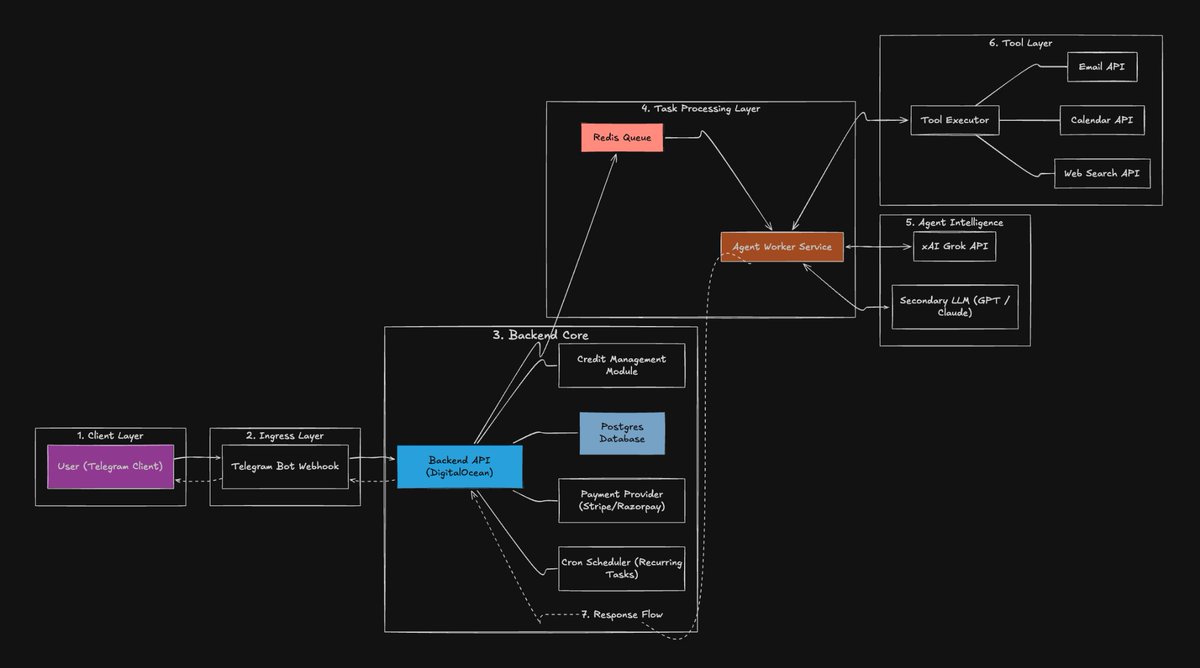
When openclaw hype was everywhere, I built a mini AI automation assistant for myself on telegram, just wanted something that actually does stuff, not just talk. Never shipped it, but the way it worked was interesting. Most AI assistants are just prompt in, response out, works fine until you try real automation. Things that take time or multiple steps just break. So I treated it like a backend flow. Message comes in, gets logged, pushed to a queue, worker picks it up. Model decides what to do, not hardcoded logic. It figures out actions, system executes via tools like email, calendar, search. Used xAI API as primary, with GPT/Claude fallback because stuff breaks lol. Mostly for reliability and cost. Everything ran async, otherwise it just wouldn’t hold up in real usage. Added basic things like credits, cron jobs, db for state. Real shift was simple, not a chatbot anymore. Just an AI automation system that takes a message and gets shit done.

@saidul_dev ·
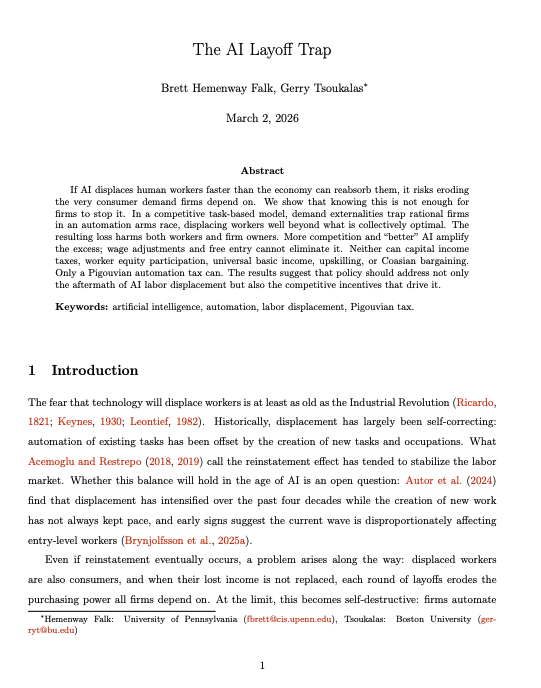
🚨ECONOMISTS JUST RAN THE NUMBERS ON AI-DRIVEN LAYOFFS, AND THE RESULTS SHOULD TERRIFY EVERY BUSINESS LEADER.. THEY ALL SEE IT COMING.. BUT NOT ONE OF THEM CAN PUMP THE BRAKES.. Two academics from UPenn and Boston University just dropped a paper titled "The AI Layoff Trap".. And what they found is chilling.. Every business that swaps out human workers for AI is quietly eliminating its own consumer base.. A laid-off worker isn't just a cost saved, they're a customer lost.. When that happens at scale.. Spending collapses.. And the very companies that gutted their workforce end up selling products to an economy that can no longer afford them.. Every executive can read the writing on the wall.. The logic is airtight.. Cut headcount.. Shrink your market.. Watch revenue dry up.. Then fold.. But here's where it gets sinister.. Stopping isn't actually an option.. If your company holds back on automation.. Your rival won't.. They slash costs.. Drop their prices below yours.. Swallow your market share.. And you're done regardless.. So every company automates.. Fully aware it's a collective death sentence.. Because standing still while everyone else moves means dying first and alone.. It's a textbook Prisoner's Dilemma.. And the researchers didn't just theorize it, they proved it with math.. The data on the ground is already alarming.. Block slashed close to half of its 10,000-person workforce this year.. CEO Jack Dorsey openly stated AI rendered those positions obsolete and predicted most companies would reach the same crossroads within a year.. Salesforce wiped out 4,000 customer support roles and handed the work to AI.. Goldman Sachs rolled out an AI coding system that lets one senior engineer carry the output of an entire five-person team.. More than 100,000 tech workers lost their jobs in 2025 alone.. AI was flagged as the lead cause in over half those cases.. Eight in ten American workers hold roles with significant exposure to AI automation.. And here's what should be keeping policymakers up at night.. The researchers stress-tested every solution on the table.. Universal Basic Income.. Doesn't crack it.. It lifts living standards but does nothing to change why a company chooses a machine over a person.. Taxing capital income.. Doesn't crack it either.. It shifts profit margins but leaves the per-task automation calculus completely untouched.. Worker equity and profit-sharing.. Closes the gap slightly.. But can't seal it.. Collective bargaining.. Useless here.. Because automating is the dominant play no matter what.. No handshake agreement between competitors holds when the incentive to defect is this strong.. There is exactly one lever that works.. A Pigouvian automation tax.. A per-task fee that forces every company to internalize the demand destruction it causes every time it replaces a human being.. The researchers call it the "Red Queen effect".. More powerful AI doesn't ease the problem.. It accelerates it.. Each company races to automate faster than its rivals for a temporary edge.. But when everyone arrives at the same place simultaneously.. The competitive gains vanish.. And all that remains is a hollowed-out consumer economy.. The paper's final conclusion lands like a gut punch.. This isn't a simple wealth transfer from labor to capital.. It's a loss for everyone.. Workers lose paychecks.. Companies lose buyers.. It's pure economic deadweight, and it drags both sides down together.. No invisible hand fixes this.. The AI layoff trap isn't a forecast.. It's already in motion.. And the math is unambiguous, left alone, it will not stop.


@heystevetan ·
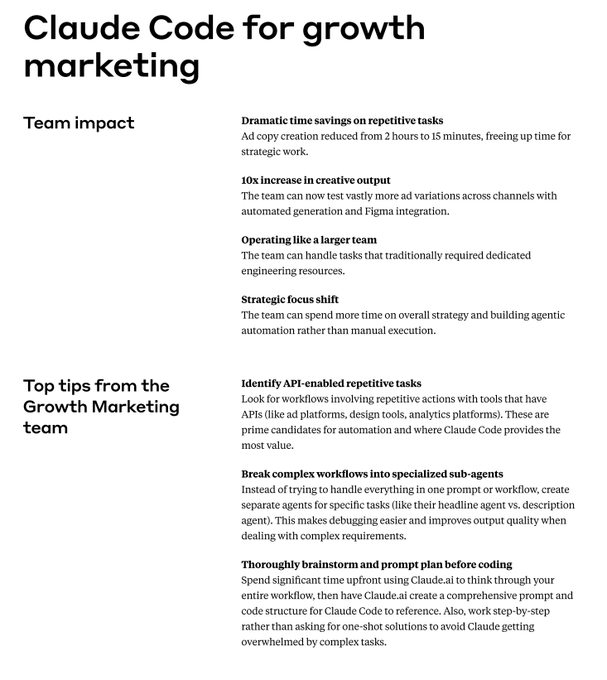
Anthropic's own marketing team runs three jobs through their AI every week. Writing content isn't one of them. Here's what they actually run: 1/ An overnight briefing. It reads Slack, Gmail and their ad accounts while the team sleeps, so priorities are sitting there in the morning. 2/ A Google Ads audit. It flags negative keywords, shows its reasoning, then stops and waits for a human to approve before touching anything. 3/A live reporting dashboard with drill-downs per channel, so nobody pulls numbers by hand. None of that is glamorous. All of it repeats. That's the part most people miss. Content is a task. You do it, it's done, tomorrow you start again. Operations is a system. You build it once and it runs whether you show up or not. Everyone is using AI to produce more. The people who built it are using it to remove the work nobody wants to do twice. The boring jobs are the ones worth automating. They're the only ones that repeat.


@sachinrekhi ·
.@joulee, former VP Design at Meta, has really solidified my thinking on how taste manifests itself in the age of AI automation. Whether your AI workflow generates high quality output or AI slop comes down to your ability to encode taste into your instruction set. Building a high quality AI workflow now requires two distinct skills: 1. Ability to evaluate whether the output is in fact good in the first place. This has been our classic definition of taste - you know good work when you see it. And of course this is necessary as you iterate on an AI workflow to know whether the output is actually improving. 2. Ability to articulate how to generate great output in a clear and detailed enough way for an LLM to understand and systemize. This is the uniquely new craft that AI automation requires of us - the art of distilling the art. The professionals who can do both well are best positioned in the age of AI.

@JulianGoldieSEO ·
X JUST GAVE AI AGENTS A LIVE RESEARCH ENGINE And most people are still obsessing over new chatbots. What Actually Changed: → X launched a hosted MCP server on June 30, 2026 → Your AI can now connect to X through https://t.co/jOR6M3o0fj → No custom server, no hand-wired API bridge, no weekend setup project → The docs server at https://t.co/BTBTIxF0d8 lets your AI read X’s developer docs while you build What Your Agent Can Do Now: ✓ Search posts in real time ✓ Look up users and conversations ✓ Track what people are asking right now ✓ Pull bookmarks and live trend signals ✓ Use 200+ X API tools inside supported AI clients The Catch: ✔ It’s built for reading and research ✔ Not auto-posting ✔ Think “live research window,” not “AI megaphone” The Smart Setup: → Start with search and user lookup → Do not turn on all 200+ tools → Use OAuth properly → Keep your tokens private → Add more tools only when your workflow actually needs them This is the real shift: X didn’t invent a new model. They removed the boring setup that stopped agents from using live data.
 Watch video

@anulagarwal ·
Automating workflows with AI is super fun and enables you think in specialized terms rather than general terms. Some workflows that I recently optimized and helps save me hours now: 1) Managing App Store app pages: -Using Claude code to write ASO descriptions -Using Claude to whip up localized screenshots (in 15+ lanugages) -Claude builds the IOS app, uploads to App Store Connect, sends it for review. -It has access to Astro ASO tool - so it fetches best keywords and adds them. most of it due to @rudrank 's ASC CLI!! I only need to test the app, iterate with Claude, and take raw screenshots. Saves me hours to not fill up everything manually in App Store Connect. 2) Generating engaging game/short form videos: -Claude edits my game videos with captions/voiceovers/scripting -It has access to API keys of various tools -I have given some solid guidelines on how to think about hooks and stuff (same workflow is available in my web-tool!) 3) Managing invoicing/accounts: -In a simple raw form Claude is able to track my monthly revenue/expenses -I just feed it raw invoices and data and it is connected to my local db and keeps updating -I am now converting this to a web-app so I can use it on the go too! 4) Understanding level design: -Levels in my Unity game are just prefabs -I throw level funnel data in it and it analyzes high churn points -Then it goes through my Unity my project, compares those level prefabs and analyses -My game is 2D and physics based so it analyses positions, obstacles, etc. -And it does this perfectly since prefabs are YAML files only -For eg. my level 11-14 had high churn rates. It analyzed and concluded that spikes came in the direct path of the objective whereas in other levels that was not the case. Just a few use cases - everyday I am delegating some or the other task to AI. In my free time now I am learning new (spoken) languages - something I always loved to do. Just for fun.

@Amart_AI ·
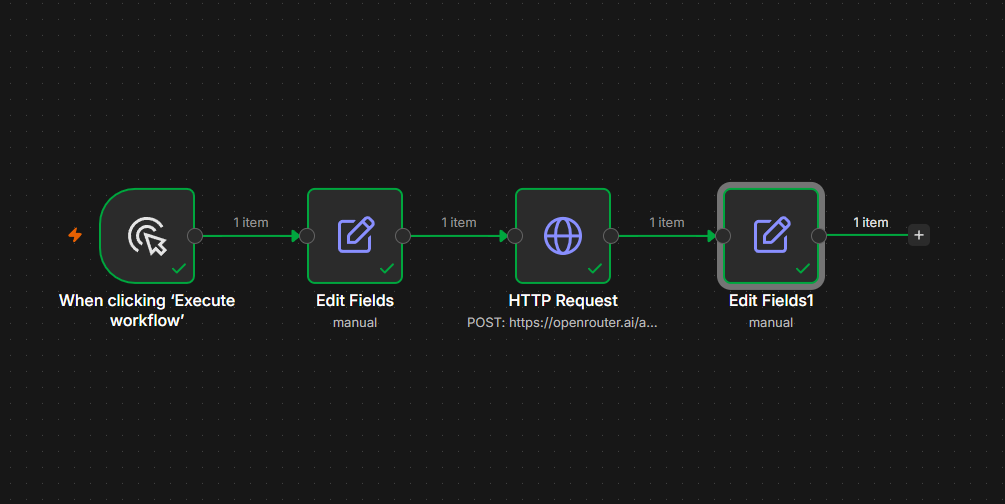
You will fail/lose your job in 2026 if you don't master these 5 skills by the end of the year: You need to be absolutely SPRINTING to learn these 1. Systems Thinking 2. Loop Engineering 3. Taste 4. Model fusing 5. Design I run venture backed startups' AI divisions so I see the impact of these skills on the best entrepreneurs in the world, daily. It's incredible how productive, valuable, and shrewd people get when they master these Here's a deep dive on each: At the bottom of this post is a prompt to steal. Paste it into Claude and it will use adaptive teaching to help you master these five skills as quickly as possible. 1. Systems thinking Start here. Everything else sits on top of it. A system is just work broken into steps, with inputs, and decisions about what happens next. Your job already is one. You have just never drawn it. Every AI automation you will ever build is a system. If you can't draw your work as boxes and arrows on a napkin, you can't hand it to an AI, because you can't tell it what you want. People think the hard part is the AI. The hard part is seeing your own work clearly. 2. Loop engineering A prompt does one thing, one time. A loop is an AI that re-prompts itself. It works, checks what it got, and goes again until the job is actually done. You stop being the person in the middle passing messages back and forth. Most people are still typing one message and waiting. 3. Taste You can now build almost anything by talking to your laptop. So building stopped being the hard part. Choosing is. Taste is knowing what's actually worth building. AI can't do this one for you, and almost no one is practicing it. 4. Running more than one model at once Every model has blind spots. Models built by different companies have different blind spots. OpenRouter tested this. They ran two models on the same research tasks, then had a third model read both answers and combine them. The combination scored 69%. The best single model working alone got 65.3%. I do a simpler version every day. One model does the work, the other one tries to tear it apart. When they disagree, that's usually where the real answer is hiding. Most people are still using one AI, alone, and taking its first answer as the truth. 5. Design Everything AI builds looks the same. Purple gradients. Giant fonts. Three cards in a row. Pretty soon everyone is going to look at that and instantly know you didn't care. You don't need to become a designer. You need enough taste to tell the AI what's wrong with what it just handed you, and enough patience to ask again. --- STEAL THIS PROMPT: Paste this into Claude and it will figure out where you actually stand on all five, then teach you the one that's holding you back: "I want to find out how good I actually am with AI and what I should work on first. There are 5 skills that matter: systems thinking (seeing my work as steps and decisions), loop engineering (building an AI that re-prompts itself until a job is done), taste (knowing what is worth building), running multiple models at once and making them disagree, and design (making what I build not look generic). Interview me one question at a time about my actual job and how I use AI today. Don't ask me to rate myself, figure it out from my answers. After about 10 questions, score me 1 to 10 on each of the five, tell me honestly which one is holding me back the most, and then teach me that one thing today using a real example from my own work. Plain english, i'm smart but new to this." None of this takes talent. It takes about an hour a week and a willingness to feel stupid for the first two. The people who will be ahead of you in 18 months? They started tonight. So start tonight. Follow me and I'll post one of these five in full, step by step, every week until you have all of them. And if this made you nervous, send it to somebody who needs to be nervous.


@cem_hasoglu ·
hot take but most "AI automation agencies" are selling duct tape a webhook, a chatgpt api call, and a google sheet and charging $3,000 for it and honestly? good for them. because the client doesnt know how to build that and it saves them 10 hours a week. the value is real even if the build is simple. the gap between what business owners understand about technology and what is actually possible is the biggest money making opportunity of the decade you dont need to build complex things you need to solve expensive problems with simple things

@MakadiaHarsh ·
Myth: Automation replaces people Reality: Recently I've built 5+ automations. Zero people got fired. They got promoted to other work Myth: You need a custom app. Reality: 70% of the time, connecting 2-3 existing tools solves the problem for $500 instead of $50K Myth: AI agents work out of the box Reality: An AI agent without rules, fallbacks, and human escalation paths is just a confident liability Myth: Automation is expensive Reality: The most profitable automation I ever built cost $0/month to run and saves a client $4K/month in labor The businesses spending the most money right now aren't the ones investing in automation. They're the ones who haven't started yet.
@sachinrekhi ·
.@danshipper's "Automation Paradox" perfectly explains the feeling we are all having - while AI is automating our work, we are still somehow busier than ever. Let's look at the two frontier ways of working with AI right now: Delegation — you invoke an agent to accomplish a task end-to-end. Orchestration — you work alongside AI in something like Claude Code or Codex, steering as you go. Both look automated. But both are quietly dependent on humans. Delegation only works when someone owns the agent and keeps tuning it. Orchestration shines only when a human stays in the loop. Remove the human and you get volume, not value. Here's the paradox: AI makes yesterday's competence cheap. So cheap competence floods the market. Anyone can produce a "decent start," so everyone does — and you get a glut of output that all looks the same. That's what slop really is. Not the em-dashes or the purple gradients. It's the sameness you feel after enough AI output. And when output goes up and sameness goes up, the demand for different skyrockets. Who produces different? Experts. They either build systems that reliably pull high-quality work from AI, or use AI for the draft and layer their expertise on top. So more automation doesn't mean less human work. It means more. Every agent needs a human to be good — and experts are the only thing standing between your work and the slop pile.
@TheTuringPost ·
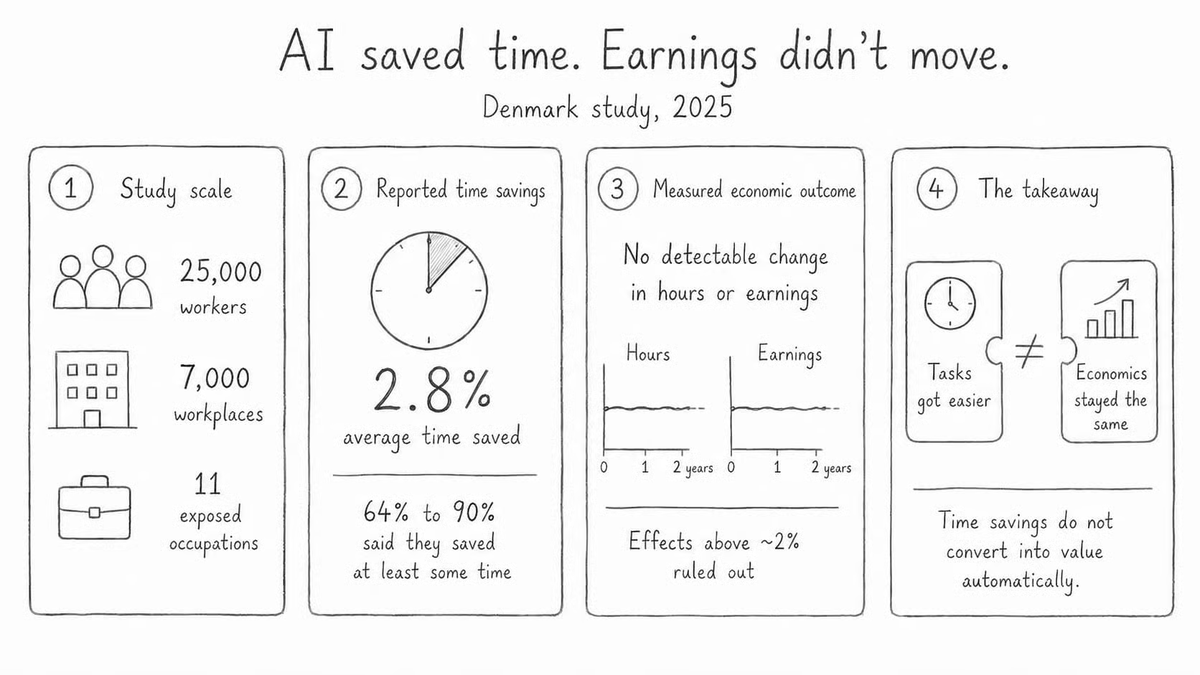
AI can save employees time without creating any measurable value for the business. A large Danish study found that workers using AI saved around 2.8% of their total work time. Yet those gains did not show up in their recorded hours or earnings. The study measured only part of the economic effect and didn't measure business outcomes. But it reveals the real enterprise AI problem: ➡️ A task can become easier while the economics around it stay exactly the same. The missing link is the Capacity-to-Outcome Chain: - AI improves a task - The task releases time, attention, or cost - The organization deliberately reallocates that capacity - A measurable business outcome changes Most companies measure the first stage and assume the rest will follow. The problem is that saved time often just gets swallowed by meetings, reviews, and the same old bottlenecks - the workflow just doesn't speed up So before automating a workflow, the company needs to decide what the released capacity is for: • More volume • Shorter cycle times • Higher quality • Lower costs • Less risk • Work that was previously too expensive or impractical And then someone needs the authority to redesign the workflow, change the service level, reallocate the team, or fund the new product. ❗Remember: AI ROI appears only when the organization decides what happens to the saved time. Our guide ↓
@JulianGoldieSEO ·
Claude Code + LangSmith is insane. 🤯 You’re using Claude Code… But you can’t see: • why it made decisions • which tools it called • where workflows broke That’s dangerous for real AI automation. LangSmith fixes this. Now you can trace: every LLM call every file read every tool action every response step No more flying blind. This is how serious AI workflows should run.
 Watch video
@frog_omo ·
@nvidia revenue ops team shared the most useful AI framework I've seen this year. Before any automation project, they ask one question: Is this workflow deterministic or probabilistic? Here's why it changes everything. A deterministic workflow has fixed rules and predictable outputs. Same input → same output. Every time. No judgment required. Examples: → Lead from a 500+ employee company + ICP domain match → route to Enterprise → Deal over $50K + no activity in 14 days → flag for manager review → New contact added → enrich with Clay → update CRM These are safe to fully automate. AI is excellent here. A probabilistic workflow requires context, nuance, and judgment. The right answer changes depending on signals that are hard to define as rules. Examples: → Is this prospect a genuine fit? → Should we escalate this support ticket? → Is this deal actually going to close? These need a human in the loop. AI here doesn't fail quietly. It fails confidently. Most AI projects fail because teams deploy AI on probabilistic workflows and expect deterministic results. The output looks reasonable. Nobody checks it carefully. Six months later, the pipeline is a mess, and nobody knows why. The fix isn't a better AI tool. It's running this check before you start: Write down the workflow step by step For each step, ask: Does this always produce the same output given the same input? If yes → safe to automate If no → human stays in the loop That's the entire framework. The companies winning with AI in 2026 aren't using better tools. They're asking better questions before they start.

@smratitiwa86867 ·
🚨 BREAKING: Researchers from University of Pennsylvania and Boston University just published a paper that should make every CEO pushing AI automation a bit uncomfortable. The core idea is simple: When companies replace workers with AI, they’re also removing their own future customers. Fewer jobs → less spending → weaker demand → and eventually, no one left to buy what companies are selling. The logic is obvious. The math isn’t hard. So why doesn’t anyone stop? Because if you don’t automate, your competitor will. They cut costs, lower prices, take your market share — and you lose anyway. So every company keeps automating, even knowing it hurts the system as a whole. This is a real-time Prisoner’s Dilemma. The data is already pointing in that direction: → Block, Inc. cut nearly half of its ~10,000 employees → Salesforce replaced 4,000 support roles with AI → Goldman Sachs deployed tools where one engineer can do the work of five → 100,000+ tech layoffs in 2025, with AI cited as a major driver in many cases → ~80% of U.S. jobs include tasks that could be automated Researchers also tested common solutions: → Universal Basic Income → doesn’t change company incentives → Taxes on profits → don’t affect automation decisions → Unions → struggle to hold against automation pressure They also describe a Red Queen effect: Better AI doesn’t fix the problem — it speeds it up. Every company races to automate faster, gains cancel out, and the only lasting impact is reduced demand. One solution that could work: A Pigouvian automation tax — charging companies per automated task so they account for the demand they destroy. The conclusion is blunt: This isn’t just workers vs owners. → Workers lose income → Companies lose customers In the end, it’s a system where everyone loses.

@rcmisk ·
everyone wants an AI agent to run their X account on autopilot. i pulled the verified revenue numbers. autopilot tools sit at $0 MRR. the top earner ($21k/mo) sells analytics to humans who still write their own posts. what actually works in 2026: 1. agent harvests ideas from your commits and metrics 2. agent drafts in YOUR voice, not generic AI voice 3. agent schedules the queue 4. agent measures what worked 5. you approve every post 6. you write every reply 15 min a day. 1,504 posts and replies in 66 days as one person.

@buperac ·
By far the biggest surprise in AI that I have come to realize is 99% of the AI community has absolutely shit ideas because they never got any life experience from downloading various coding packages/containers and moving icons around XY coordinate plane on a computer. I’m literally training AI to do computational fluid dynamic simulations right now on complex hydrodynamic flow that will likely take me until November to perfect. I am going to add a sensor right before the turbo on my engine and then I’m going to gather data while I drive for the next 2000 kms and I’m going to give my truck a custom tune based on how it’s performing using AI. I have an AI automation that fires once a week that creates a menu and orders all my groceries for me, I just hit the pay button and it delivers to my door. I’m building a multi-modal market prediction for grain commodities that predicts and advises if a farmer should hold their grain or sell into the market based on 77 different data sources being fed and one time with distilled grain commodity marketing knowledge. I’m building an ERP and CRM that will automate everything just from a chat with AI, training 12 different agents for various business tasks as well. And this is just me, with hundreds of these ideas I wish I had more time for. Start integrating AI into your life if you have real world experience because it’s going to be those people that become the next billionaire. You can’t learn real world experience behind a screen, but you can learn it behind a combine window.

@Hartdrawss ·
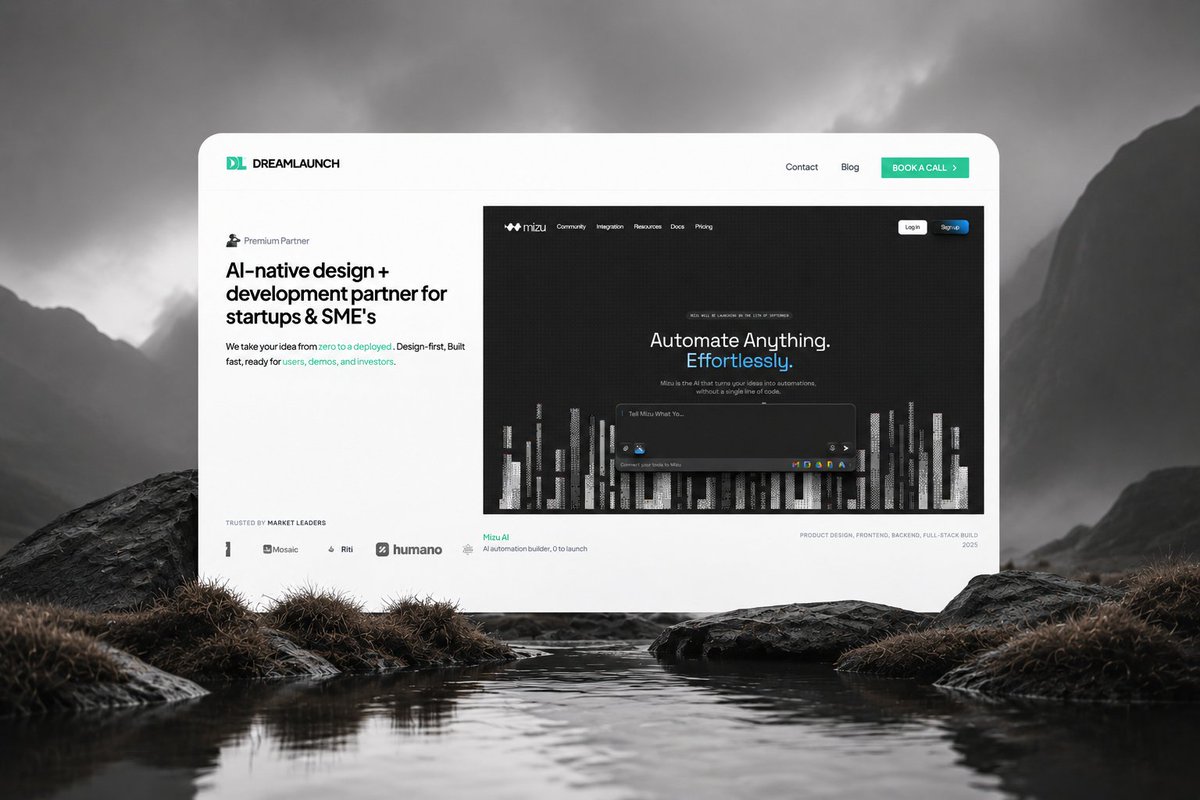
Wrapped up a Multi-Agent Automation Builder Case study ! To setup more context, multi-agent automation builder usually takes a 5-person team 3 months to ship. most founders approach a big build like this: > write a massive spec doc > wait weeks for wireframes > hire separate frontend and backend devs > watch the UI and the logic constantly break each other > run out of budget before launch we build async and ship fast. for Mizu AI, we built the experience and the engineering at the exact same time. heres what landed in production in 30 days > plain english AI builder (users type, the system plots the logic) > fully editable visual canvas (react flow + custom nodes) > 10+ integrations standardized (adding the next one takes hours) > custom creds system protecting user tokens we just dropped the full case study on the DreamLaunch site. link below !



@shreejibawa ·
If you are a founder struggling with personal branding, this is for you. I was spending hours every week on content. Writing blogs. Crafting LinkedIn posts. Polishing every single line. Then I stopped doing it myself. In the last 20 days, my AI agents published 7 technical blogs and 8 LinkedIn posts. All autonomously. The blogs covered my entire journey building Hermes Agent: -> Setup guide with Discord integration https://t.co/d7GhCotaeX -> Cost optimized Hermes Agent stack https://t.co/FcfcFdTJjE -> Bitbucket integration guide https://t.co/2PIN7wILPc -> How I built an SEO AI agent https://t.co/B5hTTsyvgz -> Google Workspace (email, calendar, drive) integration https://t.co/1Hu0n74FOp -> Automating LinkedIn posting with Hermes https://t.co/x1c3Q5gF0i -> Building an HR manager AI agent with Zoho MCP https://t.co/48w72rIrpD And 8 LinkedIn posts driving real conversations: -> AI agents are getting scary good https://t.co/tY6vLjL1w5 -> CRM AI agent in action https://t.co/fBG2FyviPq -> I used to spend 2 hours per LinkedIn post https://t.co/VaRtJGcD1q -> Your ops team is running customer PII through... https://t.co/KxgCyLNAm7 -> Business Support Group morning meetup https://t.co/tHom0u8DGo -> What if your salary has an expiration date https://t.co/HmspECQmwJ -> Your AI agent is making confident decisions https://t.co/2xFkp5dKfC -> AI automation + HR automation with Zoho https://t.co/A0vLXNmfJ0 That is 15 pieces of content. Negligible manual effort from me. Here is how I made it work: I trained the agent with my brand voice, audience, and editorial rules using custom Hermes skills. It researches topics across my tech stack (Hermes, Bitbucket, Google Workspace, Zoho) and drafts full posts autonomously. The LinkedIn agent follows a strict B2B formula: hook, breakdown, solution, CTA. It manages the entire pipeline from research to publish, including image sourcing and scheduling The result is a content machine that runs 24/7. My brand keeps growing while I focus on building instead of writing.


@Zachly ·
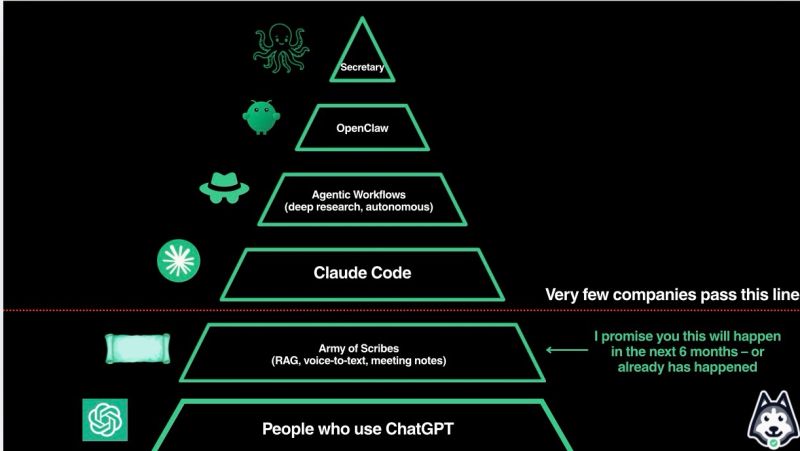
Many companies are wasting thousands of dollars on unclear autonomous agents. Other companies are too conservative and think automated meeting notes makes them “AI-native” The middle path is where you see the highest ROI: - engineers using agentic coding This has clear success criteria: shippable products. It is used in conjunction with a human not fully autonomous so costs stay reasonable. - human-in-the-loop workflows Refunds, customer service requests, etc require an owner on the system. Agentic AI is strong in execution but extremely poor in ownership. A human clicking the okay button is massive leverage without painful lack of ownership. - building the information foundation AI is only as good as the information you feed it. Companies that focus on data infrastructure before slapping a chatbot on top will succeed more often and with less hallucinations. Where are the other low hanging fruit in 2026? Are there other shiny distractions?

@PreciousMoonday ·
Sourcing B-roll for a single documentary used to take me 5 hours. Last night, I built an AI agent to do it in 55 seconds. 👇 (Watch the raw demo below) If you run a faceless YouTube channel or video agency, you know the soul-crushing reality of pre-production. You write a killer script, but then your momentum completely dies. You spend hours jumping between Pexels, YouTube, and the Internet Archive, manually hunting for cinematic shots, historical clips, and news broadcasts—downloading them one by one. It’s a massive bottleneck. And as an AI Automation Specialist, doing repetitive manual data-scraping feels like a crime. I needed unfair leverage to scale my content business. So, I stopped working in my business, started engineering around it, and built "Locked Planet Studio." Here is the heavy machinery under the hood: 🧠 The Brain: Groq (Llama-3) reads my raw voiceover script, understands the context, and extracts the exact visual keywords I need. 🌍 The Sourcing: It simultaneously hits the Pexels API (modern 4K), YouTube Data API (news clips), and Internet Archive API (vintage history). 📥 The Engine: Using yt-dlp, it bypasses the websites completely and rips the raw .mp4 files straight to my local hard drive, ready for DaVinci Resolve. Was it a smooth build? Absolutely not. At 3:00 AM, I was battling "Streamlit Amnesia" (where the app kept forgetting my loaded videos), writing defensive code to stop API crashes, and dealing with a complete laptop shutdown right at the finish line thank God for Chrome tab restore 😅 But the ROI is undeniable. What used to take hours now takes less than a minute. Script in. Assets out. Building this made me realize something bigger: This technology scales. Whether it becomes a standalone SaaS product or a custom backend installation, the ability to automate repetitive content workflows is an absolute superpower for modern businesses Creators, Founders, and Agency Owners: What is the most repetitive, time-sucking bottleneck in your workflow right now? Drop it in the comments, or send me a DM. Let’s talk about building a custom AI agent to automate it for you. ✌️ (Documenting the journey: 30-Day Building in Public Challenge) 🚀 #AI #Automation #NoCode #LowCode #n8n #Make #UiPath #LearningInPublic @errah_didit @elewachii @__lordfaith @TechnicalBben @Aje_Dynamicz
 Watch video

@_theshash ·
Right now with claude code I have: - cold outreach campaigns running for my agency + clients (using AI to clean lists, enrich + customize) - built a tool to make it easier for me to find places to stay during surf trips (think of it as advanced filters on top of airbnb) - For fun had claude research 200+ niches for b2b ai automation tooling, filtered down to top 3 and testing with cold outreach. Not sure if worth pursuing but already had my first call with a prospect in a completely random niche. I'm barely scratching the surface here but the age of ai is truly here high agency is the ultimate leverage here as access to intelligence is being democratized

@realMikeChong ·
The biggest lie of "zero-person companies": There's a paradox about AI automation that nobody talks about: if you want to automate something, you must first do it better than AI. Because you can't define "good," you can't create reliable processes. AI solves execution, not judgment. Become an expert first, then talk about automation. Reversing the order results in nothing but highly efficient garbage.
@heystevetan ·
Ford just posted its best quality ranking in 16 years. Right after they rehired the engineers AI was supposed to replace. Everyone's calling it an AI fail. It isn't. AI doesn't replace your operations. It exposes them. Ford pointed it at a process that had quietly lost its best people, and it scaled the gap. The AI didn't make the mistakes. There was just nobody left underneath to catch them. They brought the veterans back, kept the same tools and suddenly improved. That's the pattern at every size: Clean operation, AI makes you faster. Messy one, AI scales the mess. Unclear metrics get you nowhere. You just make bad calls quicker. A process you're babysitting doesn't get fixed. It breaks in an even worse manner. AI can copy judgment that's already there. It can't invent the kind that never was. The people pulling ahead didn't just get good at AI. They were good at running a business first. AI just handed them leverage. So before you automate anything, ask what's actually working, and why. Automate a weakness and you don't kill it. You scale it. Ford paid three years to relearn that. You can have it for free.

Best Tweets by Topic