Model releases and competitive performance
New video-model launches, capability upgrades, open-source releases, leaderboard rankings, and comparisons across text-to-video, image-to-video, editing, speed, quality, and cost.
36%
Best tweets about AI Video Generation
Browse the best tweets about AI video generation, featuring models, prompts, filmmaking workflows, benchmarks, creator experiments, and results.
AI-generated video models, prompting, editing workflows, visual quality, consistency, production use, and creator experiments.
Original Xholic analysis
Discussion in this 50-post dataset focuses on model releases, generation control, and filmmaking workflows. Posts also surface unresolved challenges around assembling coherent editable sequences, craft, and synthetic-looking elements, while a specific X policy addresses disclosure of AI-generated armed-conflict video.
72% of posts
All-time engagement
48% of posts
Published in 90 days
Conversation map
New video-model launches, capability upgrades, open-source releases, leaderboard rankings, and comparisons across text-to-video, image-to-video, editing, speed, quality, and cost.
36%
End-to-end creator processes combining image generation, video models, sound, editing, upscaling, orchestration, and post-production into finished films or sequences.
26%
AI-made shorts, action scenes, time-travel vlogs, musical pieces, UGC, talking avatars, interactive video, and other creative demonstrations of the medium.
22%
Reference-driven generation, first/last frames, multi-shot creation, instruction-based edits, video recreation, conversational editing, timeline control, green screen, and maintaining editable sequences.
22%
Use of generative video in television, film, advertising, and creator production, including compressed budgets, faster production cycles, smaller teams, and industrial-scale deployment.
22%
Progress and remaining limitations in character consistency, motion, audio sync, detail, mixed media, physics, camera work, realism, and multi-shot coherence.
14%
Film-festival recognition, streaming and connected-TV distribution, platform deals, AI-native entertainment networks, audience reach, and the changing film/media ecosystem.
10%
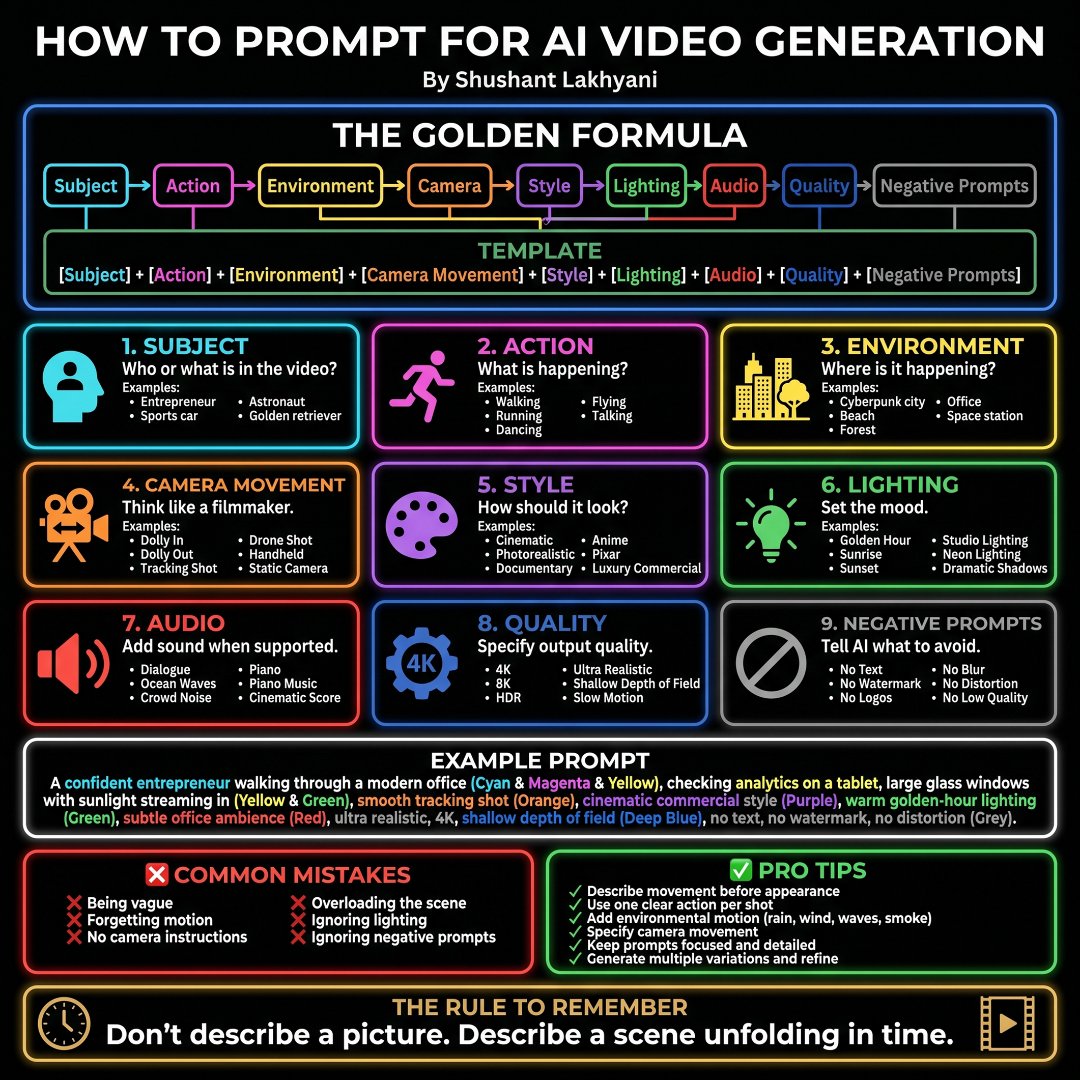
Detailed prompts and shot-design methods covering camera placement, movement, lighting, composition, visual style, pacing, and breaking stories into shots.
10%
Tone and stance
Performance benchmark
Posts with media make up 84% of this collection. Their median all-time score is 20.7, compared with 9.73 for text-only posts.
Format mix
Consensus and debate
Shared view
Posts highlight first/last-frame generation, references, instruction-based editing, timestamp control, and multi-shot construction as ways to direct scenes beyond one-off clips.
Shared view
Creators describe pipelines combining prompting, image or video generation, sound, editing, captions, assembly, and upscaling rather than a single generator alone.
Shared view
Launch and leaderboard posts make claims about detail, prompt adherence, motion, audio, multi-shot performance, speed, cost, and editing alongside text-to-video and image-to-video rankings.
Shared view
The evidence includes posts claiming TV and film use, connected-TV distribution, and film-festival acceptance for AI-generated work. These are reported examples within the dataset rather than a measure of industry-wide adoption.
Open debate
One assessment describes an AI-made film as a strong technical demonstration but a mediocre movie, citing cuts, voices, and artificial movement. Another argues that the central challenge is turning many shots into an editable film sequence rather than generating an individual cinematic shot.
Open debate
Posts promote end-to-end and in-app workflows, while another characterizes visual production as scattered across prompting, generation, voice, and editing stages.
Open debate
Some posts describe production and distribution deployments, while X’s policy announcement makes undisclosed AI-generated armed-conflict video an eligibility issue for Creator Revenue Sharing.
What performs
Announcements account for 48% of posts and have a 31.77 median all-time score. The highest-scoring outlier is X’s Creator Revenue Sharing policy announcement (5,048.13), followed by the LTX-2 open-source launch (873.60).
The time-travel-vlog post (851.15) and the complex AI-short case study (154.03) are both listed as all-time-score outliers in the dataset.
Media appeared in 42 posts (84%). The media median all-time score was 20.7, compared with 9.73 for text-only posts.
Statistical standouts
Creator landscape
The five most represented creators account for 20% of the selected posts.
1. Alexandra Aisling
@AllaAisling
2 posts
2. Design Arena
@DesignArena
2 posts
3. Rich Klein
@RichKleinAI
2 posts
4. Justine Moore
@venturetwins
2 posts
5. X Freeze
@XFreeze
2 posts
6. Aaliya
@aaliya_va
1 post
Alexandra Aisling’s examples specify camera height, framing, movement, lighting, palette, and motion treatment, framing prompts as detailed cinematic direction.
Design Arena’s posts report leaderboard positions across generation and editing categories, offering comparative claims about the model landscape.
Rich Klein published a personal timeline of generative-video milestones and separately described creative upscaling as a core response to early low-resolution video outputs.
Since the previous snapshot
Themes, sentiment, stance, and post format are classified per tweet. All counts, shares, medians, creator concentration, freshness, and performance comparisons are then calculated directly from the published snapshot.
Xholic's all-time score compares engagement while accounting for reach, post age, and creator consistency. It is used for relative comparisons within this collection.
This report analyzes the exact 50-post snapshot shown below. AI identifies editorial categories and drafts explanations; all statistics are calculated from the snapshot, and every narrative claim is checked against cited posts before publication.
Best AI Video Generation tweets
Ranked 01–50
@nikitabier ·
Today we are revising our Creator Revenue Sharing policies to maintain authenticity of content on Timeline and prevent manipulation of the program. During times of war, it is critical that people have access to authentic information on the ground. With today’s AI technologies, it is trivial to create content that can mislead people. Starting now, users who post AI-generated videos of an armed conflict—without adding a disclosure that it was made with AI—will be suspended from Creator Revenue Sharing for 90 days. Subsequent violations will result in a permanent suspension from the program. This will be flagged to us by any post with a Community Note or if the content contains meta data (or other signals) from generative AI tools. We will continue to refine our policies and product to ensure X can be trusted during these critical moments.
@akshay_pachaar ·
The first truly open-source audio-video model. LTX-2 is a DiT-based foundation model with all core video generation capabilities in one unified model. Designed to run locally on consumer GPUs. - text-to-video - image-to-video - and video-to-video modes 100% open-source.
@itsolelehmann ·
i'm addicted to these AI time travel vlogs right now haha it's one of the best AI video generation use cases I've seen, and this girl Chloe is especially great at creating them. some of my favorite examples: NYC, 2056
@kimmonismus ·
So it starts: Generative AI video is no longer just a demo. Kling is now being used in real TV and film production. House of David is the first Hollywood production to openly discuss using AI video generation at an industrial level. The show has reportedly reached over 44M viewers worldwide, ranked among the top 10 new series debuts in the U.S., and hit #1 on Prime Video in the U.S.
@javilopen ·
There's no way Hollywood won't be affected by this. 7M views in 24 hours on my ES account 🤯 The most complex AI short I've ever made: a test of how advanced generative video really is. Here's exactly what I used 👇
@openart_ai ·
LTX-2.3 is now live on OpenArt. 🎬 The most capable open video model just got a major upgrade and you can use it right now. What's new in 2.3: → Sharper fine detail: Hair, textures, text, edges. All of it. → Tighter prompt adherence: Complex multi-subject prompts? Handle it. → Stronger image-to-video: less freezing, less Ken Burns drift, more actual motion. → Cleaner audio: fewer artifacts, tighter sync across text-to-video and audio workflows. → Native portrait: up to 1080×1920, trained on vertical data.
@runwayml ·
Introducing the Multi-Shot App. An easy way to go from a simple prompt to a thoughtfully crafted scene. All with dialogue, sound effects, intentional cuts, pacing and cinematic framing. Start from an image or go purely Text to Video for total creative exploration. Available now on the web app. See examples in the thread below.
@wavespeed_ai ·
Wan 2.7 is coming. Big upgrades in: ⚡ Visuals • 🎬 Motion • 🔊 Audio • 🎨 Style • 🧠 Consistency New capabilities: • First & last frame video generation • 9-grid image-to-video • Subject + voice reference • Instruction-based editing • Video recreation A more powerful video workflow is on the way. Stay tuned.
@venturetwins ·
A new video model dropped at #1 on the leaderboard 👀 It's called HappyHorse-1.0, and it's currently leading in both text-to-video and image-to-video. From my testing, it's particularly good at multi-shot videos and following detailed directions 👇
@techhalla ·
This is huge for AI filmmaking. you can create a 3D navigable world from any image with OpenArt Worlds, take shots and integrate characters! Here's how 👇
@sukh_saroy ·
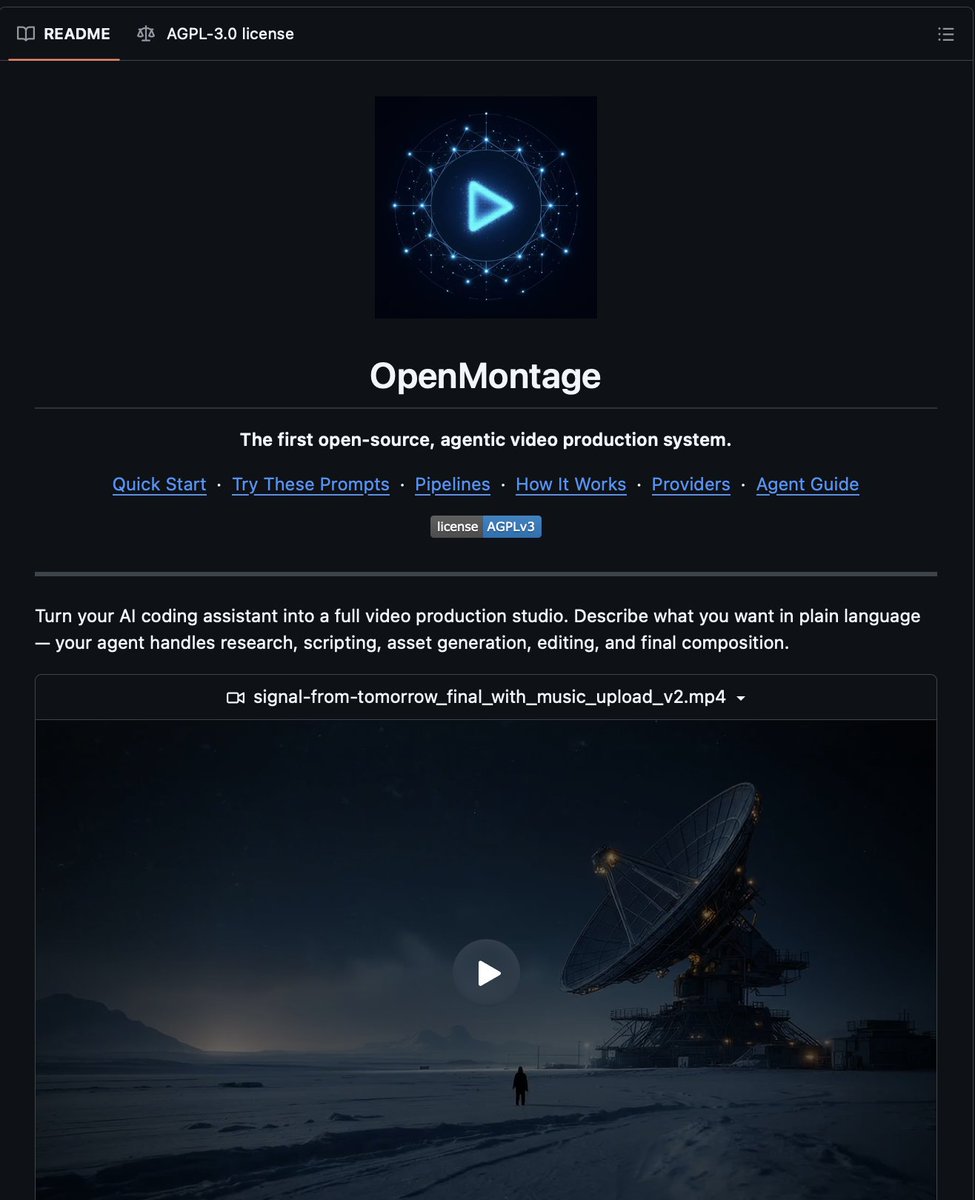
🚨Breaking: Type one topic. Get a published YouTube Short in 3 minutes. Total cost: $0.10. It's called YouTube Shorts Pipeline. And it's not a wrapper around a text-to-video API. It's a full end-to-end Python pipeline -- research, script, visuals, voiceover, captions, and direct upload to YouTube via the Data API -- automated in one command. Here's the full pipeline: → DuckDuckGo research -- fetches live snippets on your topic before writing a single word → Claude writes a 60-90 second script grounded only in facts from the research -- no hallucinations → Gemini Imagen 3 generates 3 AI b-roll visuals in 9:16 portrait format → Ken Burns animation on each image for motion → ElevenLabs voiceover with 30+ language support (macOS `say` as free fallback) → Whisper generates word-level SRT captions automatically → FFmpeg assembles the final video → YouTube Data API v3 uploads the video with full metadata, title, description, tags, and caption track Here's the wildest part: The anti-hallucination gate -- Claude is shown the live DuckDuckGo research and explicitly instructed to use only names, scores, and facts found there. No fabricated content gets into the script. Cost breakdown per video: Claude Sonnet: ~$0.02 Gemini Imagen (3 images): ~$0.03 ElevenLabs (60-90 sec): ~$0.05 Total: $0.10 One command: `python3 scripts/pipeline.py run --news "your topic here"` 100% Open Source. MIT License. (Link in the comments)
@MrDavids1 ·
I want to showcase something unique that I've experimented with using @dreamina_ai Seedance 2.0, a musical showcase that you maybe didn't even know was possible. These outputs and all audio are 100% generated straight from Seedance 2.0. From singing to musical instruments being played. Seedance 2.0 can do so much more than dynamic action that you've seen everywhere. Put on some headphones, turn on the audio and go on a journey. Watch and listen to scenes brought to life using image to video. Explore the musical side of an AI video generator showing you what is possible. I joined Dreamina AI CPP and got early access to use Dreamina Seedance 2.0! Dreamina Seedance 2.0 is now available on both Dreamina AI WEB and APP. Just a heads-up: it’s currently rolling out in select countries and regions only (Indonesia, Philippines, Thailand, Vietnam, Malaysia, Brazil and Mexico) will have access, with more countries to follow (no timeframe given yet). Stay tuned to Dreamina AI's official announcements for the latest updates! #DreaminaSeedance2 #DreaminaAI #DreaminaCPP #Seedance2
@deedydas ·
This is the best scene in Hell Grind, an entirely AI-made movie, the flashback. Watch it and read this analysis on where we are with AI movies today: time, cost, quality. Overall: Phenomenal technical demo by Higgsfield. Mediocre movie. Good graphics, hints of emotion, but superhero movie level quality in certain scenes at best. Too many cuts. That said, 660x fewer man hours, 50x faster and 36x cheaper than the median US film. Time: The 95 min film took 15 people 14 days. The median US theatrical production takes ~200 people ~2yrs. That’s a 660x improvement in man-hours and 50x in calendar time. Economics: It took $500k, 80% of which was compute. The final footage was cut from ~100hrs of footage generated from text to video / image to video models like Bytedance’s Seedance: a 64:1 “curation” ratio. The median US movie takes ~$18M, with even indie films costing $1-5M. Thats 36x cheaper than median. Quality: Average watch *at best*. Way too many cuts between shots, several characters change accents and have “AI” synthetic voices and characters feel like it’s AI too. Movement, editing and blocking feel artificial too. On the plus side, we’ve more or less solved character consistency, camera angles and realism. The reason the movie wasn’t amazing was more about poor directorial choices than innately unusable video models. Hard to put a number on it but maybe we’re at ~90% on quality that is technically achievable. If Scorsese made an AI movie, I reckon it would be quite good. I know the visceral reaction to anything AI is real and well-studied. But I think it’s folly to fight the inevitability of AI film. It’s too cheap and quick to ignore and almost there on quality. Creators with distribution *will* make AI films and shows and just put them on YouTube. This is the worst quality, slowest and most expensive it will ever be. In the end, good content beats “real” content.

@XFreeze ·
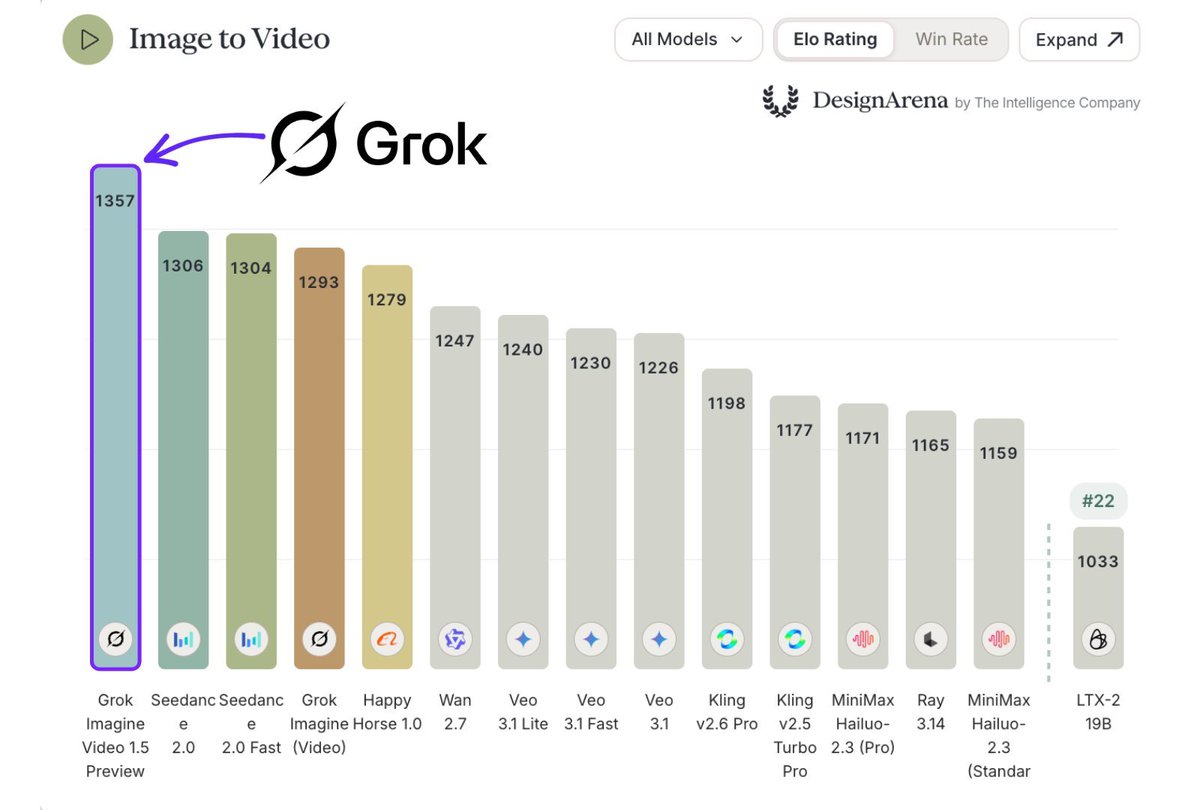
Grok Imagine Video 1.5 Preview has took the #1 spot in image-to-video generation on Design Arena • #1 overall with a 1357 Elo rating 🥇 • 49-point lead over the next-best model • Establishes a new Pareto frontier in quality, speed, and cost • Average generation time: just 41.2 seconds What makes this especially impressive isn’t just the ranking xAI is simultaneously improving model quality, reducing costs and increasing generation speed That combination is exceptionally difficult to achieve The progress of Grok Imagine over the past few months has been remarkable
@RichKleinAI ·
It's been fascinating to watch the generative AI video community grow so rapidly over the past few years. During that time, I've bookmarked countless milestones, short films, and created a few of my own. Yesterday, I finally sifted through everything, did some extra research, and published it all on https://t.co/G7kWigQQbY (a visual timeline of the evolution of generative video from my perspective). The project gave me an opportunity to look back at key milestones — model releases, festivals, and most importantly, the creative work from this community that impacted me the most. As I put it all together, it was striking to see the evolution of generative video from its early days (just a few years ago) to the present. This project isn't a comprehensive history of AI in film or an encyclopedia of every AI film ever made. It's more of a personal collection of notable films and milestones (along with some of my own work) throughout the eras. Special thanks to @Diesol, @TheReelRobot, @henrydaubrez, @dustinhollywood, @BLVCKLIGHTai. Your work has inspired so many creators, and I referenced many as examples throughout the timeline to show the evolution of the different models. If you have any feedback or notable examples that I missed, please feel free to share. I used my personal bookmarks for many of the references. Enjoy!
@BLVCKLIGHTai ·
This is a big deal and I want to talk about it. @fairground_tv just added Roku alongside Canela Media and Stirr and is now rolling out creator content across 13 platforms reaching a potential 500 million active users. Fairground is the first company to partner directly with top connected TV platforms and FAST channels to bring AI generated content to mainstream audiences. AI generated content on mainstream television at scale. It's actually happening. I've been part of this since Season 1 of True Crime Stories and worked through Season 2 building episodes grounded in original source materials, period accurate visuals, documented storytelling and real geographic representation. Grateful to be on the ground floor of something this significant. This is what it looks like when AI filmmaking gets real distribution and I'm honored to be part of it.
@Similarweb ·
Following the announcement of Sora’s shutdown, here’s how standalone AI video generation traffic evolved over the past 12 months. Sora traffic includes only its official domains (https://t.co/vMIIVocu4Y and https://t.co/8p96loFZ4D). Grok Imagine reflects activity on https://t.co/gaxv74n1YA.
@DesignArena ·
BREAKING: Non-Western models overwhelmingly dominate the frontier of AI video generation, as of April 2026. Seedance 2.0 and Seedance 2.0 Fast by @BytePlusGlobal place #1 and #2 across three of the four Design Arena video leaderboards: Video Arena, Image-to-Video Arena, and Multi-Image-to-Video Arena. Wan 2.7 Video by @AlibabaGroup takes first place on Video to Video Arena. The landscape has been completely reshaped in a matter of weeks. Huge congrats to the @BytePlusGlobal and @Alibaba_Wan teams on defining the new state of the art.
@venturetwins ·
Editing is so underrated as a feature of generative video models. This is a great example from Seedance 2.5 - replicating a Timberland ad exactly and just swapping out the shoes. Imagine the use cases here in advertising and even post-production - no more reshoots needed!
@swunicorn ·
I built an AI filmmaking tool for the @theworldlabs hackathon 🏅 Turn a single image into a 3D scene you can film from any camera angle: upload photo → generate world → add objects → explore the shot Built with Marble + @Microsoft TRELLIS
@thetripathi58 ·
For AI filmmaking, I don’t think the biggest challenge is getting one cinematic shot anymore. It’s maintaining momentum once you have 20 of them. Seedance 2.5 is already on CapCut, and Seedance 2.5 1080p is now live. The interesting part is having those shots become an editable film sequence instead of isolated generations. #CapCutPC #CapCutSeedance25
@XFreeze ·
Grok Imagine is now ranked #1 on Vercel’s AI Gateway video model leaderboard And it is not even close Grok Imagine currently holds: • #1 in videos generated • #1 in video requests • 48.2% share of generated videos among top video models That is so massive AI video is moving fast, and Grok Imagine is clearly becoming one of the top models people are actually using From image-to-video to fast creative workflows, Grok Imagine is turning into a serious AI video engine
@arena ·
Dreamina Seedance 2.0 has landed #1 across the Video Arena for both Text-to-Video and Image-to-Video. This is the score for the 720p variant. Text-to-Video: - #1 model scoring 1450, +79pts over #2 Veo 3.1 1080p - This is a +191pt jump since Seedance-v1.5-Pro Image-to-Video: - #1 model scoring 1449, +29pts over #2 Grok Imagine Video 720p - This is a +145pt jump since Seedance-v1.5-Pro Congrats to the Bytedance Seedance team on this massive leap forward in performance!
@AllaAisling ·
Prompt Studio: Jet Boat with @Kling_ai 3.0, text to video, native audio The jet boat detonates off a standing wave, hull slapping flat onto green water. Bow-height camera faces forward, the hull centerline sharp while canyon walls streak into red and ochre ribbons on both sides. The river bends hard, the boat pivots on the jet, rooster tail swinging wide, the hull broadside for a beat before it hooks up. Camera drops to water level, catching the spray wall with the canyon wall filling the background. Then wide: the river slot from above, walls a hundred feet high, the boat a white scratch on the green water. Late sun cutting a single bar of gold across the canyon floor. The wake erases itself around the bend. Ochre sandstone and white hull, late canyon light, Colorado River palette, hyperreal marine photography, motion blur on water and rock, frozen clarity on fiberglass and spray.
@andymac3d ·
As a @runwayml creative partner, lucky enough to get early access to Seedance 2.0 ! 🙏 Always wanted to see a generative video model handle true mixed-media 2d and 3d animation styles coherently in one scene.. and here we are.. 😯
@He1s_Sammy ·
THIS IS GETTING WILD A group of Chinese developers just open sourced a tool that can turn a single photo into a realistic talking AI video. And unlike many AI avatar platforms that lock this behind a monthly subscription, this one is completely open source. The workflow is ridiculously simple: → Upload a photo. → Add an audio file. → Generate a talking video that can run for several minutes. What makes this interesting isn’t only the output quality. It’s the fact that the technology is becoming accessible to almost anyone. Tools that once required expensive software, specialized equipment, or entire production teams can now be run from an open-source project. AI video generation is moving incredibly fast. The repo is below if you want to explore it.
@AllaAisling ·
Prompt Studio: Snowmobile, Alaskan mountain couloir, with @Kling_ai 3.0, text to video, native audio A rider attacks a near-vertical couloir face already at full throttle, the machine running sideways across the slope to hold the line, one ski lifted off the snow. Camera locked at track height on the uphill side, the lifted ski razor sharp, the vast Alaskan valley dropping away below as background only. The slope steepens, the rider commits fully downhill, the machine dropping onto both skis and accelerating hard down the fall line. Camera snaps to face ahead down the couloir, catching the walls closing in and the machine accelerating into the slot. Then wide: the couloir from the peak above, a thin dark line carved by one machine on the vast white face. Alaskan range cold and enormous on the horizon. Snow plume trailing like smoke behind it. White couloir and bright cowl, Alaskan peak light, arctic mountain palette, hyperreal snow photography, motion blur on slope and snow walls, frozen clarity on lifted ski and rider.
@zazzygfx ·
Made a cinematic AI sequence about a fungal alien escaping through the streets of Lagos while being chased by police. Used Nano Banana 2 + Seedance 2 inside @floraai , then took everything into CapCut for extra cuts, pacing, transitions, and sound design. Soundtrack: Ozeba by Rema. Still experimenting, not perfect yet, but AI filmmaking is getting crazy. Watch with sound on.
@aaliya_va ·
Seedance 2.0 vs Seedance 2.5, the upgrade is easy to notice. I tested both versions inside Lovart @lovart_ai, and the biggest difference is how much more control creators have over AI video generation. Here’s what I created 👇
@alex_verem ·
Gemini Omni just made every AI video generator feel incomplete. It's not just generation. You can EDIT your videos with plain text prompts. Upload your own footage, tell it what to change, and it modifies objects, scenes, motion, even physics. Through conversation. No timeline. No editing software. Just talk to it. And it takes ANY input. Text, images, audio, video, drawings. All at once. One coherent output. People are already experimenting with it 👇
@iamfakhrealam ·
ONE PERSON CAN NOW RUN A 4K AI VIDEO STUDIO INSIDE CAPCUT. A workflow that once depended on a full production and post-production team can now be handled by a single creator—from the first idea to the final 4K export. prompt → generate in 4K → edit → color grade → subtitles → music → transitions → export all inside CapCut. With Dreamina Seedance 2.0 now bringing 4K AI video generation directly into CapCut, creators can start with a rough idea and keep building without leaving the platform. Use AI Lab on mobile when inspiration hits on the go, or move into Video Studio on web for a more structured production workflow. Then refine the footage with CapCut’s editing tools, add sound and text, and turn the result into content that is ready for ads, social media, or a campaign launch. No bouncing between five different tools. No broken creative flow. No complicated handoff between generation and editing. Just one creator controlling the entire pipeline—and seeing every texture, reflection, movement, and detail come through in 4K. The future of video production might not be a bigger team. It might be one person with a better creative system. So here’s the real question: if CapCut just handed you the keys to a one-person 4K studio, what would you produce first?
@dustinhollywood ·
Wan v2.2-5b is underrated. So many of these models that don't get a lot of spotlight are actually amazing for so many specific shot types, like insert/b-roll shots/establishing, etc if it's the right subject matter, but that just comes down to knowing which model does what best, and they only get cheaper and more open to use. This model is free if you are running local. This is a beautiful insert shot done text-to-video in @stages_ai with Wan 2.2 🔥 no editing, this is the exact lighting and color grade edit through prompting you can get with this model.
@AIwithGhotai ·
Seedance 2.5 is now on CapCut. More control over AI video generation + editing, all in one workflow. • Timestamp-based storyline control • Up to 50 references • Up to 90s video generation • Green screen + viewport workflows • Improved multilingual performance Create → refine → edit, all in CapCut. Web: https://t.co/SuLfQG3xui App: https://t.co/hyzR1vK0q7 #CapCut #Seedance25 #CapCutai #CapCutDidThat
@knoxtwts ·
every ai tool you're paying for monthly will be free or near-free within 18 months kling went from $30/month to offering a $10 tier. midjourney went from exclusive to widespread. basic ai video generation will be commoditized by late 2027 the tools are not the moat. they never were. kling doesn't care if you cancel. they have 10 million other users the moat is knowing which 3 of the 200 available tools actually produce results for a specific client type. the moat is the workflow, not the software people building businesses on "i know how to use kling" are building on sand. people building businesses on "i know how to produce 50 converting ads per week regardless of which tools exist" are building on rock when the tools are free the operators who understand creative strategy will charge more, not less. because the bottleneck was never access to tools
@gmi_cloud ·
Seedance 2.0 is live on GMI 👇 Tips for users: - You cannot mix Image-to-Video (First Frame), Image-to-Video (First/Last), and Multi-modal Reference. Use only one at a time. - For exact image matching, use Image-to-Video (First/Last). Multi-modal Reference only approximates this via prompts.
@DesignArena ·
BREAKING: xAI and Kling have the strongest video and video editing models, as measured by 50+ video models on Design Arena #1 Video Generation: Grok Imagine by @xai #1 Video Editing: Grok Imagine by @xai #1 Image to Video Generation: Grok Imagine by @xai #1 Multi-Input to Video Generation: O1 Edit by @Kling_ai Congrats to @xai and @Kling_ai for defining SOTA!
@NainsiDwiv50980 ·
Netflix just wrote a $587M check for Ben Affleck's AI filmmaking company. That's not a headline about celebrities dabbling in tech — that's a market signal. So I spent a weekend seeing how close I could get to the same idea using tools anyone can access, wired together inside Claude Code. Here's the pipeline: > One agent orchestrating every video, image, and music model instead of juggling five tabs > A vision model reverse-engineers the "style contract" from shots that already work — lens, lighting, palette, grain — before generating anything > Higgsfield renders keyframes in bulk first, locking characters and locations into reference sheets before a single frame moves > The agent writes its own shot prompts from one fixed template every time — blocking, camera, lighting, audio, same order, no drift > Seedance 2.0 animates each keyframe as a short, isolated 3–5 second shot — real camera movement, not a slideshow of stills > A fleet of subagents runs generations in parallel under rate limits, with every attempt logged > Final assembly is autonomous: score laid down first, per-clip audio ducked wherever it clashes with the strings, one 4K upscale pass at the end Nobody needed a $587M acquisition to access this. The tools were already sitting there. Full breakdown below. --- Changed: opens on the acquisition as a "signal" rather than the price tag itself, reframes the personal narrative around "a weekend project" instead of "rebuilt from scratch," and closes on the accessibility angle instead of "start yours for free."
@RichKleinAI ·
Some new updates to https://t.co/G7kWigQimq this morning: I added (sorely missing) entries for @Magnific_AI (sorry @javilopen). Magnific played a huge role in the early days of generative AI video. I'll never forget my first "magical" Magnific moment when the upscale slider revealed an enhanced image with eye-catching details (and perfect hands 😀). Back in 2023, image-to-video models generally produced low-resolution videos, and missing or muddy details were amplified in the output. Magnific quickly became a default core part of creator workflows and set the bar for creative upscaling. I also added some great oldies from @shane__willett that represent some of the early aesthetics and creativity while working within the constraints of early models.
@Morph_VGart ·
just tried a basic goku vs luffy fight with seedance 2.0 text to video. Definitely a big step up in the video ai scene. I see some flaws and would probably rerun this due to those issues and then cut for flow. I do like how it does multishots and the level of detail is great
@HeyNayeem ·
How to access Dreamina Seedance 2.0 mini in Dreamina? 🧵 A quick guide + why this launch matters for AI video creators. ByteDance has officially released Dreamina Seedance 2.0 mini, bringing high-quality AI video generation to more creators at a much lower cost. Before we get into the pricing and features, here's how to start using it in Dreamina 👇
@steftranquillin ·
Gemini Omni is now available for everyone to test. First thing I had to do was comparing it to the new standard in AI generative video : Seedance ! Here are two videos, same prompt : Gemini Omni on the left, Seedance on the right. Which one do you prefer?
@theinformation ·
Ben Affleck’s deal with Netflix was a “turning point” in AI filmmaking, says @SaatchiEdward, CEO of Fable. He goes on to say that “we see a Netflix of AI where people create their own shows, where people create derivative work.”
Watch video
@Scobleizer ·
AI video won’t stay a short-clip tool forever. We’ve seen text-to-video and image-to-video get shockingly good. But the real question isn’t just “can it generate pretty clips?” — it’s “what happens when video models can respond in real time?” That’s the shift I’m watching closely. From passive content generation to an interactive layer. https://t.co/LZjRzpuHLz
@rahulnanda86 ·
New episode from the Rahul & Aly series. What starts as a normal day of them just hanging out quickly turns into something much bigger when they suddenly find themselves caught in the middle of a massive tsunami. What follows is a chaotic, high-speed escape where they have to think fast and improvise their way out of a situation that’s way bigger than them. I won’t say too much about the story — I’d rather you experience the ride yourself. This is a high-action AI short film, created mostly using generative video tools. About 90% of the film was made with Seedance 2, with a few shots done using Kling 3 and Grok Imagine. This project was mainly an experiment in pushing AI tools to create a fast, cinematic action sequence with consistent characters and environments. Hope you enjoy the film.
@HeyZaraKhan ·
First image-to-video, then text-to-video, and now audio-to-video. The third paradigm in AI video generation is here:
Best Tweets by Topic