Creators as media businesses
Building one-person media companies, products, brands, communities, and operational systems rather than relying on content output alone.
48%
Best tweets about Creator Economy
Explore the best tweets about the creator economy, covering platforms, audience ownership, monetization, products, sponsorships, and creator businesses.
Creator business models, platforms, monetization, audience ownership, sponsorships, operations, and firsthand earnings or growth lessons.
Original Xholic analysis
The discussion presents creators as businesses that can combine products, partnerships, communities, and recurring revenue. It also features cautions about platform dependence, uneven income, measurement based on vanity metrics, and AI’s potential to change operations and competition.
62% of posts
All-time engagement
54% of posts
Published in 90 days
Conversation map
Building one-person media companies, products, brands, communities, and operational systems rather than relying on content output alone.
48%
Diversified monetization through sponsorships, subscriptions, courses, products, affiliates, licensing, equity, memberships, and recurring revenue.
34%
Risks of algorithmic distribution, platform lock-in, changing take rates, and the push toward owned, open, interoperable channels such as email, blogs, and communities.
28%
The uneven distribution of earnings, unstable algorithm-dependent income, survivorship bias, labor conditions, benefits, and creator financial resilience.
28%
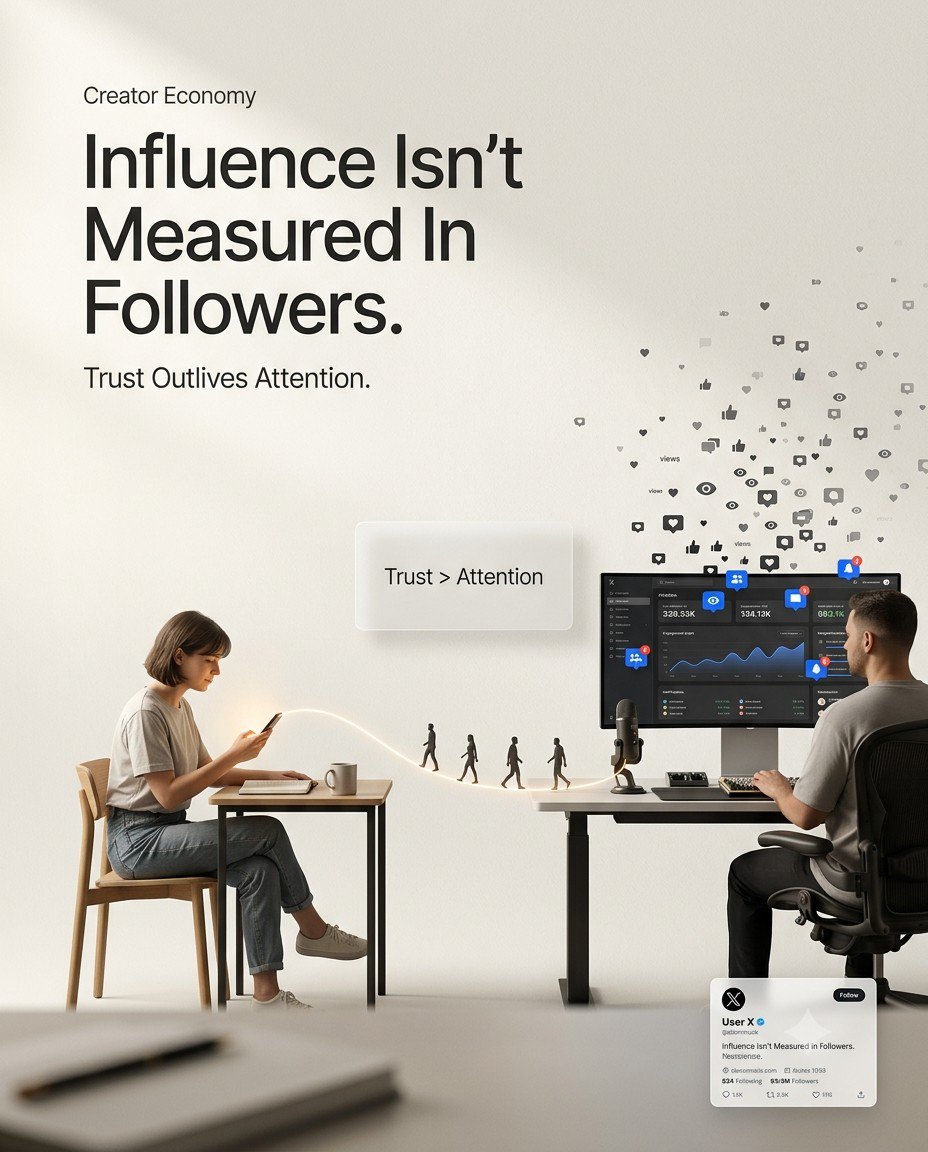
Trust and audience action as more valuable measures than followers, impressions, or viral reach; emphasis on niche authority and authentic community.
26%
Sponsorship economics, UGC deal structures, aligned incentives, performance bonuses, conversion-based measurement, and fair creator payment.
20%
Faceless AI brands and influencers, plus turning a creator’s expertise, personality, or knowledge into interactive agents and software-like products.
12%
AI for research, writing, editing, automation, agent workflows, bookkeeping, deal management, and scaling solo creator businesses.
12%
Tone and stance
Performance benchmark
Posts with media make up 54% of this collection. Their median all-time score is 7.17, compared with 6.82 for text-only posts.
Format mix
Consensus and debate
Shared view
Posts commonly frame creator work as building a business around products, communities, operational systems, and revenue streams rather than content output alone.
Shared view
Posts propose sponsorships, products, courses, memberships, and subscriptions. One tutorial argues that subscriptions require an ability to deliver ongoing value.
Shared view
Several authors argue that follower counts, impressions, and views are incomplete measures of commercial value, emphasizing trust, authority, conversion, and audience action instead.
Shared view
Posts warn that algorithmic distribution and closed platforms can constrain creators, and call for audience portability, owned channels, or diversified income.
Open debate
One post portrays automated AI influencers as a threat to human creators, while others describe AI for automating creator operations or turning expertise into interactive, software-like products.
Open debate
Posts include claims of scalable creator businesses and substantial earnings, while others emphasize uneven earnings, algorithm exposure, and the difficulty of reaching a full-time livelihood.
Open debate
Posts advocate deeper brand-creator partnerships and measurement beyond reach. One proposal recommends a guaranteed base payment plus view bonuses as a way to align incentives.
What performs
List posts had a 46.86 median all-time score, ahead of announcements at 9.131 and tutorials at 7.24.
Audience ownership and platform dependence had an 8.12 median all-time score, above the overall 6.99 median. Its cited posts discuss platform capture, lock-in, and algorithmic unpredictability.
Trust, authority, and conversion recorded the highest theme median all-time score at 8.667; cited posts challenge follower- and impression-led measurement.
Posts with media had a 7.167 median all-time score versus 6.818 for text posts. Media appeared in 27 of 50 tweets.
Statistical standouts
Creator landscape
The five most represented creators account for 20% of the selected posts.
1. Michael Taiwo
@AskMichaelTaiwo
2 posts
2. Tyler Denk 🐝
@denk_tweets
2 posts
3. Roberto Blake 🇺🇸🇵🇦 Creative Entrepreneur
@robertoblake
2 posts
4. sourcery
@sourceryy
2 posts
5. Xeleb Protocol
@xelebofficial
2 posts
6. zaimiri
@zaimiri
2 posts
The highest-scoring outlier describes Colin & Samir’s mix of newsletter sponsorships, products, courses, events, and brand deals, while stressing that their products serve a known audience.
Two high-scoring posts offer concrete monetization mechanics: subscription models and pricing in one case, and a base-pay-plus-view-bonus UGC structure in the other.
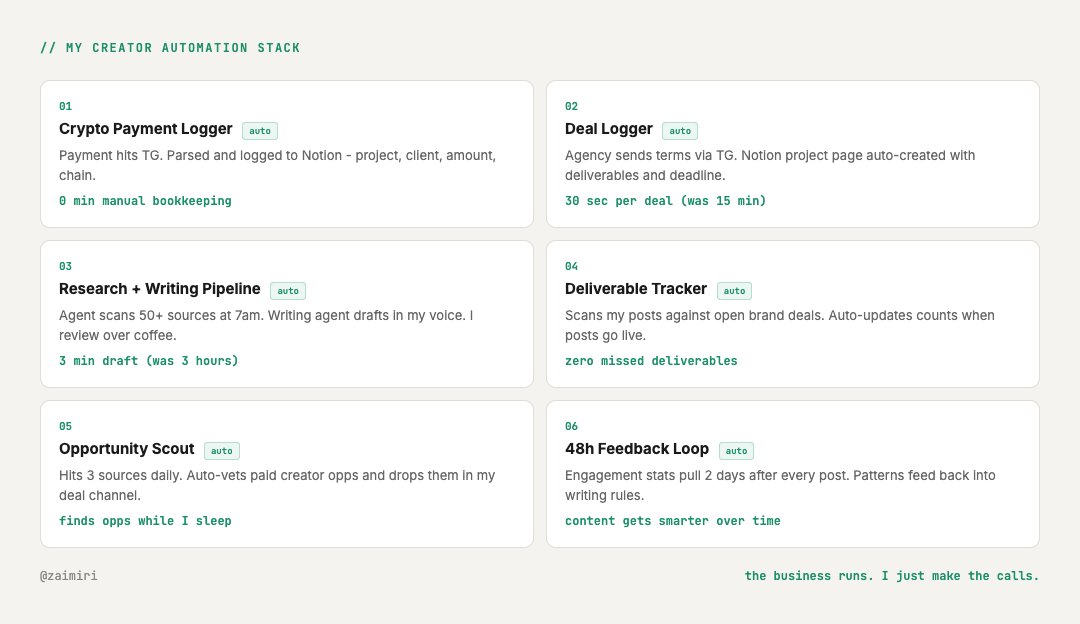
Creator-business advice is most specific when it names workflows such as payment logging, deal tracking, research, drafting, and deliverable monitoring.
Since the previous snapshot
Themes, sentiment, stance, and post format are classified per tweet. All counts, shares, medians, creator concentration, freshness, and performance comparisons are then calculated directly from the published snapshot.
Xholic's all-time score compares engagement while accounting for reach, post age, and creator consistency. It is used for relative comparisons within this collection.
This report analyzes the exact 50-post snapshot shown below. AI identifies editorial categories and drafts explanations; all statistics are calculated from the snapshot, and every narrative claim is checked against cited posts before publication.
Best Creator Economy tweets
Ranked 01–50
@denk_tweets ·
any creator trying to add new revenue streams should study Colin & Samir: > Publish Press newsletter generating sponsorship revenue > $25 small ticket product > $299 & $899 higher ticket courses > creator summit events that sell out > brand deals on their YT channel that feel super organic > brand deals on their podcast they really are the perfect case study of how to monetize as a creator. the thing I really love about their newsletter (besides the fact it’s on @beehiiv) is that it doesn’t just regurgitate their YT content. it’s a standalone, elite level newsletter covering the creator economy, tools, jobs, strategy, etc. they know their audience inside out and built products to serve them
@david_perell ·
Some thoughts on the creator economy: - Scarcity is the engine behind successful creators. You need something others don't have, such as (1) a unique vibe or (2) something unique to say. Having a unique vibe gives you staying power, but having something to say is how you rise fast. - The platforms are getting better and better at capturing the value, and taking margin from creators. They’re incentivized to lift you up when you’re small and suppress your reach once you get big, so that people value the platform more than any single creator on it. - Because of that, a bunch of people I’ve talked to in Hollywood are trying to figure out how to make shows for YouTube. The problem is the business model. YouTube’s revenue share isn’t enough, so you need to diversify into other revenue streams. The other challenge with relying on YouTube is that the algorithm is so mercurial. One video will crush. The next will be a dud. Why? Who knows! So you keep posting, and though there's a lot of data, there’s a real lack of predictability (especially compared to the days when your YouTube views were driven by your subscribers, as opposed to the whims of the algorithm). - Subscriber count is increasingly a vanity metric. The algorithms are squarely in the post-follower age. But subscriber growth is still worth going for because advertisers and other people who are sizing you up still use it as a proxy for how prominent you are. - When it comes to video, I expect to see a lot of $1-2 million feature films made by scrappy directors and small teams. They’ll definitely use AI. They’ll be well-made and long enough for people to engage with them at a deep level, but cost-effective enough that creators can get a good return if they’re able to sell pay-per-view and movie theater tickets. Generally, I love the combo of making something that’s much better than the average thing you’d see on the Internet but for much less $$$ than Hollywood / mainstream media. - There will forever be a business model for creators who make content about making content because the landscape is forever changing, which means we’ll need cartographers to map the paths that everybody else will walk on. - Bullish on deep brand / creator partnerships, like what David Senra has done with Ramp and Dwarkesh is doing with Jane Street. The goal for creators is to get away from getting paid for CPMs or CPCs, and into the brand marketing game where success is more qualitative than quantitative.
@gumroad ·
One-time sales are great. Recurring revenue is better. Here's how to add a subscription to your creator business: The key insight: subscriptions work when you can deliver ongoing value, not just a one-time deliverable. Ask yourself what your audience needs on a regular basis. Model 1: The monthly resource drop. Every month, subscribers get a new template, a new set of assets, or a new mini-guide. A designer might deliver 10 fresh social media templates monthly. A marketer might deliver a monthly swipe file of high-performing ads. Model 2: The updated toolkit. Create a living resource that you continuously improve. A freelancer's client management system that gets new features every month. A recipe collection that grows by 10 recipes each month. Subscribers get all updates forever. Model 3: The community membership. Charge for access to a private group where members get direct access to you, exclusive content, and peer support. This works best once you have an established audience. Pricing sweet spot for most creators: $9 to $29/month. Low enough that people don't overthink it. High enough that 100 subscribers gives you $900 to $2,900/month in predictable income. Start with Model 1 or 2. They're the easiest to deliver and the easiest to sell. Add the community later once you have a critical mass of subscribers. Recurring revenue changes everything. It turns a side hustle into a stable business.
@nicholasnlawton ·
This is Easily The Best Pay Structure in UGC: $600 for 30 crossposted videos + standard view bonuses. The creator economy is broken because both sides violated the most basic principle in economics: aligned incentives. Creators charged $10K/post. Brands got burned and swung hard to pure performance pay. Now creators get screwed, bad actors flood the system, and nobody trusts anybody. This is a textbook principal-agent problem. When one side holds all the leverage, the other optimizes against them instead of with them. Brands hiding behind "performance only" deals aren't protecting themselves, they're poisoning the well. The answer isn't more protection for one side. It's Pareto efficiency, a deal where neither party can do better without making the other worse off. Again, that deal exists. It looks like this: $600 for 30 crossposted videos + standard view bonuses. Creators get a guaranteed floor that respects their time. Brands get volume, consistency, and real distribution. And the view bonuses? That's where the magic happens. Now the creator actually wants your product to go viral. Their upside is tied to your upside. When interests are aligned, effort is real. When effort is real, content performs. When content performs, everyone gets paid.
@shivst3r ·
The creator economy in crypto is broken Creators who actually drive results for projects are still underpaid and the ones that are faking it with botted impressions are getting overpaid. The entire industry is obsessed with vanity metrics and it's costing teams millions. Follower count means nothing if none of them convert. Impressions mean nothing if nobody takes action. Engagement means nothing if it's all bots replying. The teams that learn to identify real influence over big numbers will have the edge. As a creator, position yourself by creating good content and doing things differently. The right teams that have a brain will notice and when they do, you won't need to convince anyone of your value.
@cyrilXBT ·
CONTENT CREATORS ARE COOKED. Not exaggerating. A guy just built a fully AI influencer on Arcads. UGC videos. GENERATED. Posts. AUTOMATED. Content. NONSTOP. HE DOES NOT RECORD. HE DOES NOT EDIT. He sets it once and lets it PRINT. Think about what this means. The entire creator economy was built on one thing. Human time. Time to film. Time to edit. Time to post. Time to engage. AI just removed every single one of those bottlenecks simultaneously. One person can now run what used to require a full content team. Infinitely scalable. Zero fatigue. No bad days. No creative blocks. The creators who figure out how to USE this will 10x their output overnight. The ones who ignore it will be competing against AI influencers that never sleep, never complain, and never ask for a raise. This is not coming. IT IS ALREADY HERE. The only question is which side of this you are on.
@ManLyNFT ·
something uncomfortable i’ve noticed about the “creator economy.” most people who call themselves creators are still trapped in the exact same system they think they escaped. they believe they’ve stepped outside of it. no boss. no office. no 9–5. but if you zoom out, a lot of them are just performing inside a slightly different version of the same machine. posting constantly. chasing engagement. optimizing for algorithms. feels productive. feels entrepreneurial. but the income often tells a different story. many creators grind every day, producing endless content, yet barely make more than minimum wage when you actually break down the hours they put in. and the strange part is they still see themselves as experts in the economy they’re trapped inside. they analyze trends. they comment on markets. they explain systems. all while being fully dependent on platforms that can change the rules overnight. the reality is harsh, but simple. content alone rarely creates freedom. distribution matters. ownership matters. leverage matters. if you’re building purely for engagement, you’re renting attention from an algorithm. if you’re building an audience that trusts you, owns something with you, or follows you beyond one platform, that’s different. that’s where the real shift happens. the creator label by itself doesn’t mean independence. in many cases, it just means you’ve taken on more work without the stability that traditional systems at least provided. so the real question isn’t: are you creating? the real question is: what are you actually building? because there’s a big difference between producing content… and building something that eventually stops depending on the machine you started in.
@zaimiri ·
Being a Creator means running a business. In a business, time = money. Save time = make more money. Here's how I save time in my Creator Business: ⚙️ Crypto payment logger Parsed and logged to Notion in seconds. Project, client, amount, chain all uploaded and logged automatically. Zero manual bookkeeping. ⚙️ Deal Logger Agency sends terms via TG. Notion project page auto-created with deliverables, payment and deadline already filled. ⚙️ Research + Writing pipeline Agent scans 50+ sources at 7am. Writing agent drafts in my voice. I don't write the first draft anymore. ⚙️ Deliverable Tracker Scans my 𝕏 posts against open brand deals. Auto-updates counts when posts go live. I always know which deliverables I still have to take care of. ⚙️ Opportunity Scout Hits 3 sources daily. Auto-vets and drops paid creator opps straight to my deal channel. ⚙️ 48h Feedback Loop Engagement stats pull automatically 2 days after every post. Patterns feed back into the writing rules, automatically improving my content. -- The business runs automatically.
@aaditsh ·
There's a YouTuber called Food Pharmer (@foodpharmer2) who's slowly becoming one of my favorite creators. He teaches people how food brands trick them into thinking their products are healthy. Exposes them respectfully. Seems like a genuinely honest guy. What's interesting is what he's building on top of the content. Alongside sponsorships, he has an app that helps you understand what's actually in your food. And he just started selling his own protein powders and health products. Trust is everything in health. If people don't trust you, they're not putting your product in their body. His research is solid. His videos are good. The mission is net positive. Hard to argue against someone trying to help people eat better. I don't know him personally. But watching him for a few months, he's the clearest example I've seen of a creator building a truthful, honest business that probably also makes a lot of money. This is what the future of the creator economy looks like.
@denk_tweets ·
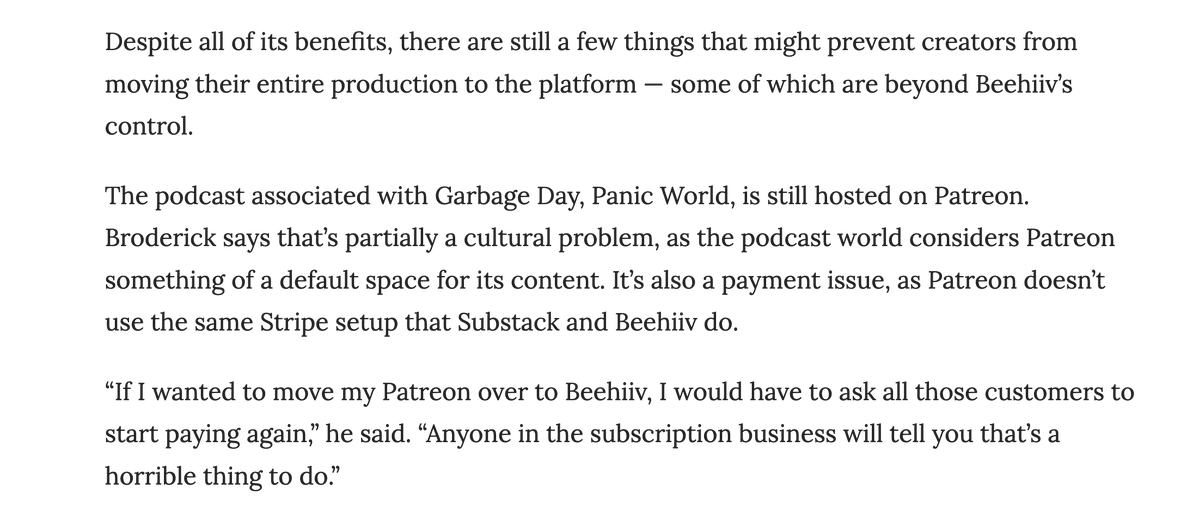
creators are trapped. this excerpt was from an article yesterday in Digiday. read carefully — Ryan Broderick couldn't leave patreon even if he wanted to. what if patreon increases their take rate to 20%? what if patreon stops innovating while the market moves on? what if patreon is actually limiting the growth of its creators? what can creators do then? the answer is simple — nothing. because they are stuck in a closed ecosystem that prioritized platform lock-in over giving creators optionality and choice. the same can be said for substack but it doesn't have to be this way.. the future of the creator economy must be open, interoperable, and creator-owned
@xelebofficial ·
The creator economy has a hidden inefficiency: Most creator knowledge is trapped inside content. A post can teach once. A video can explain once. A course can package knowledge. A community can create access. But none of these scale personalized interaction very well. This is where AI agents change the model. A creator’s knowledge can become an interactive product: - a fitness creator becomes a daily coaching agent - a finance creator becomes a personal planning agent - a beauty creator becomes a recommendation agent - an educator becomes a tutoring agent - a founder becomes a startup advisory agent - a community leader becomes a 24/7 engagement agent The important shift is not “AI helps creators make more content.” That is the shallow version. The deeper shift is: AI agents let creators turn expertise into software-like products. That is much more powerful than faster content production.
@Drewfromweb3 ·
Some people focus on getting views instead of gaining authority I'm writing this as some people told me : "Why don't you just post about X or do Z to get views on socials?" First, because it's not me, would feel super weird and is not what I love creating Second, because it won't build my reputation which is the real value in a creator. Views? Doesn't mean you get paid. Authority? Yes. I truly believe that being yourself, genuine and will ensure that your brand will build itself in this creator economy
@BawsaXBT ·
put yourself out there more. this past weekend, i had the chance to catch up with an old friend. he relocated to nyc after living in LA his whole life (plus he’s got a pretty dope job out there now). but, he hit me up out of the blue to get some advice on being a creator and understanding the "journey" and process of reaching success. so we hung out, chatted over some food, then we went on for about 2+ hours discussing the ins and outs of the creator economy. like many aspiring full-time creators, he's shared things that you could possibly be going through as well: > where and how to start? > figuring out the first piece of content > procrastination/not getting started > letting outside judgement affect you > knowing how to price yourself > long term vs short term thinking honestly, it was a well needed talk. not just for him, but for me too. it reminds me that being a creator means to express your ideas, visions, and goals in your own unique way. but what makes it better is being surrounded by other creators that have the same vision as you. it makes that list up there more approachable and less "lonely". takeaway: find your circle of creatives, help each other grow, and become successful together. there's no better feeling than that, i promise you.
@Nefarii ·
Why Every Blockchain Ecosystem Needs a Creator Economy. Yesterday, I argued that Web3 doesn’t have a builder problem, it has a distribution problem. Today I’d like to take that one step further. If distribution is the missing layer, then our best shot at solving it is by building a true creator economy. Unfortunately, whenever people hear “creator economy” in Web3, they picture creator programs, content contests, KOLs farming impressions, or another SocialFi app rewarding engagement. That’s not a creator economy, it’s an incentive campaign as seen with what @base did with @baseapp months back. A real creator economy turns creators into the communication and distribution infrastructure of an ecosystem. Researchers, writers, designers, educators, hosts and community leaders all contribute to explaining what’s being built and why it matters. Every successful ecosystem, in Web3 or outside it, is built on five interconnected layers: builders, capital, creators, community and users. Most ecosystems spend almost all their resources strengthening the first two while assuming the last three will appear naturally, they don’t. Creators generate understanding, communities build trust, and users create demand. Remove one layer and the others weaken. Adoption isn’t created by technology alone, it’s created by the interaction between all five. Take @superteam as an example. Many see it as a builders’ community within @Solana, but it’s much more. Superteam continuously produces builders, researchers, educators, designers, operators and creators. These people don’t wait for contests before contributing. The ecosystem makes it easy to showcase expertise, collaborate with projects, build reputations and access opportunities. That’s why Superteam members regularly work with startups across their regions. The former @SuiNetwork Ambassador Program followed a similar philosophy through grassroots education, regional community building and information distribution. In both ecosystems, people became known for specific strengths, whether content creation, design, gaming, developer relations, community building or education. This is where many ecosystems get creator economies wrong. The goal shouldn’t be rewarding creators for posting. It should be reducing customer acquisition costs for builders. A startup launching into an ecosystem with researchers explaining its technology, educators simplifying onboarding, creators demonstrating use cases and community leaders building trust already has an advantage over one launching into silence. That’s one reason @Solana has become attractive to many founders. It’s not just the capital or developers, it’s the support system that helps products reach users after they’re built. Perhaps it’s time to stop asking, “How do we attract more builders?” and instead ask, “How do we give every builder the highest possible chance of succeeding?” That requires more than better technology, larger grants or louder marketing. It requires intentionally developing all five layers together. Builders create products, but they won’t educate every user, build trust at scale or distribute information themselves. That’s what a creator economy is designed to do. Because products don’t spread themselves. People do.
@TheAstornia ·
OnlyFans might be one of the weirdest creator economy stories started as the platform everyone judged - banks hated the category - investors avoided the category - media treated it like internet dirt then it quietly paid creators over $25B -> grew to 4M+ creators -> reached 377M users and now sold a 16% stake at a $3.15B valuation turns out demand was really there
@odogwukvng ·
Web3 has built better ways for creators to earn, but it still hasn't built a great way for creators to own their identity, audience, and reputation across the internet. And honestly... I think we're solving the wrong problem. Everyone wants to build the next CreatorFi platform. Few people are asking: "Are we even rewarding the right creators?" ◈ Today, most platforms still judge creators with the same old formula. Impressions. Likes. Views. Followers. The moment you build around those metrics... People will find ways to game them. That's exactly why X has turned into: • Engagement groups. • Comment farming. • "GM" under every post. • Joining Spaces just so someone can engage your tweet. Not because they care about the conversation... But because the platform rewards numbers instead of value. ◈ Then the project comes out proudly saying, "Our campaign reached 5 million impressions." Did it really? Or did you just pay for recycled engagement from the same circle of creators? That's not marketing. That's recycling attention. And eventually... It becomes one of the biggest wastes of a project's marketing budget. ◈ Another mistake I keep seeing... Platforms automatically assume: Big account = Better creator. That's far from reality. Some creators with 800 followers have more influence than someone sitting on 40K followers. Because influence isn't measured by audience size. It's measured by trust. Some small creators move communities. Some large creators can't even move their own followers. Yet the smaller creator gets ignored before the campaign even starts. ◈ The creator economy doesn't have an earning problem. It has a measurement problem. Rewarding impressions will always create impression farmers. Rewarding likes will always create like buyers. Rewarding comments will always create comment pods. The day creator platforms learn how to reward: ✦ Trust. ✦ Quality. ✦ Real contribution. ✦ Actual conversions. ...that's the day CreatorFi finally starts making sense. Until then... We'll keep measuring noise and calling it influence.
@youfadedwealth ·
The creator economy is no longer a feature of social media. It is becoming the economic layer above it. The companies controlling global distribution are currently worth approximately: YouTube / Alphabet: $4.57T LinkedIn / Microsoft: $3.63T Twitch / Amazon: $3.10T Meta: $1.51T Tencent: $559B TikTok / ByteDance: $550B X: $33B Reddit: $31B Telegram: $30B Pinterest: $15B Kakao: $11B Discord: $8.5B Snap: $8.5B Combined platform-owner value: Approximately $14.1 trillion. But look at the economy operating across those platforms: Creator economy in 2025: $252B Creator economy in 2026: $310B Projected creator economy in 2033: $1.35T That is 5.3× growth in eight years. If the creator economy were consolidated into one company and valued at 5× annual revenue: 2026 valuation: $1.55T 2033 valuation: $6.73T It would already be roughly the size of Meta. By 2033, it would be more valuable than Alphabet, Microsoft, Amazon, Meta, Tencent, or ByteDance individually at their current valuations. The platforms own the rails. Creators produce the inventory. Distribution systems determine who captures the value. The next trillion-dollar social company may not be another social network. It may be the infrastructure that coordinates creators, capital, content, attribution, and distribution across every network. Distribution is becoming its own asset class.
@xelebofficial ·
The creator economy is moving from content production to productization. Creators already have audiences. What many lack is scalable interaction. AI agents can turn a creator’s knowledge, personality, and community into something more durable than a feed. A creator can become: - an interactive advisor - a personalized content experience - a community companion - a commerce assistant - a niche education product - a 24/7 audience engagement layer This is the real opportunity. AI does not just help creators make more content. It helps creators become products.
@AskMichaelTaiwo ·
The creator economy is now worth over 320 billion dollars, with more than 200 million people around the world calling themselves creators. Sounds like the greatest democratisation of opportunity in history. Then you read the distribution. Around 73 percent of them earn under thirty thousand dollars a year. Half earn under fifteen. So the creator economy is not one economy. It is a lottery with a tiny number of enormous winners and a vast crowd funding the show with their unpaid attention and effort. The top skims almost everything. The long tail gets exposure, which does not pay rent. I am not against any of this. Building an audience is a real and valuable skill. But I watch young people quit stable paths to chase it, having only ever seen the winners, never the hundred million playing the same game with nothing to show. Survivorship bias is the most expensive lie on the internet. You see the person who made it and assume the path is reliable. You never see the identical effort that led nowhere, because failure does not post a highlight reel. The part I would tell my own child is simple. Treat content like a business, not a slot machine. A business has customers who pay you directly, a product, a margin you can name. If your entire plan depends on an algorithm deciding to bless you, you do not have a business. You have a hope with a ring light. The internet did democratise the chance to be seen. It did not democratise the money. It just moved the odds somewhere brighter, louder, and far more crowded than the job everyone told you to escape.
@zaimiri ·
the creator economy pays for exactly one thing: trust. not content. not impressions. not follower counts. every deal, every sale, every sponsor runs on it. brands don't "buy your posts". they rent the trust your audience already has in you. they can't build it themselves fast enough, so they pay someone who already did. readers don't buy your offer because the copy was clean. they buy because you showed up long enough that the purchase feels safe. nobody pulls out a card for a stranger. they pull it out for someone whose judgment they've watched for months, sometimes years. this is why the AI slop accounts confuse everyone. big impressions, zero deals. the metrics say "winning". the bank account says... broke. because impressions measure how many people scrolled past you. trust measures how many people would take your word on something that costs them money. those are not the same number. they're not even the same species of number. you can fake attention with volume. you can't fake trust with anything. trust only comes from repetition plus consistency plus time. saying the thing, being right about the thing, and still being there next month. there's no shortcut and no tool that generates it, which is exactly why it's the scarce asset in the entire economy. the brand deals i've closed never started with a pitch. they started with someone who was already reading. by the time we talked, the sale was already made. so the creator economy quietly sorts everyone into two groups: 1. people optimising for the number that goes up. 2. people optimising for trust and real value. the first group is loud. the second group is here to stay. trust is slow to build & that's exactly why it's the only thing worth paying for.
@ItIsRaymo ·
a creator with 10K engaged followers has more distribution power than most Series A startups the only difference is that startup knows how to monetize it and the creator doesn't after building 100+ products with creators here are the ones i keep suggesting to our partners to monetize their audience besides brand deals: → white labeling software email the company whose tool you keep recommending for free and ask if they'll let you slap your name on it and sell it to your audience. you're already doing the marketing for them, just not getting paid for it → licensing your audience to startups for beta users startups will throw money to get their product in front of your followers for early feedback. you already have what they're spending months trying to build. barter it for money → co-owning the product instead of just promoting it next time a brand asks you to promote something, ask for equity instead of/along with a flat fee. if you're driving the sales anyway, you should own a piece of what you're selling 2026 is the time when i realise that the creator economy is just a bunch of people with massive distribution and no business model and the ones who figure this out first are going to build actually massive companies in the next 5 years
@jade_defi ·
Over the past 20 years, the world has changed a lot and a new class of millionaires has emerged thanks to social networks. Here is the top creators across all platforms, who went from 0 followers → multi million empires: 1/ YOUTUBE - Mr Beast - 472 Million followers - Net worth ~$1B (~$2.6B business valuation) YOUTUBE LIVE/STREAM - IShowSpeed - 51.6 Million followers - Net worth $30-40M 2/ TIK TOK & INSTAGRAM - Khaby Lame - 160.4 Million followers (TikTok) / 77.6 Million followers (IG) - Net worth $90M (~$900M business valuation) 3/ TWITCH - Ninja - 19.3 Million followers - Net worth ~$50M TWITCH - Kai Cenat - 20.2 Million followers - Net worth ~$35-40M 4/ KICKS - WestCol - 3.8 Million followers - WestCOL's net worth is not publicly confirmed but estimations are in the $5M range 5/ FACEBOOK - Supercar Blondie - 63 Million followers - Net worth $17M estimation in 2021 6/X - No true dominant creator… yet 7/ ONLYFANS - Sophie Rain - 11 Million followers - Net worth estimation ~$100M The creator economy is insane and represent one of the most demanding and rewarding ecosystems for our generation.
@AICryptoInsider ·
🐂 THE BLACK BULL INSTITUTE BBP-003 The Creator Economy Flywheel Everyone asks: "How do you build a billion-dollar community?" Wrong question. The better question is: "How do you build a million people who want to create?" 🧵👇 1. The most valuable asset in crypto isn't liquidity. It isn't TVL. It isn't even market cap. It's creative output. Every meme. Every video. Every thread. Every infographic. Every conversation. That's what keeps an ecosystem alive between price moves. 2. Most communities measure holders. The best communities measure creators. Because one creator can inspire hundreds of holders. And hundreds of holders rarely become creators by accident. 3. Every piece of quality content compounds. A guide written today... Can educate someone six months from now. A meme posted today... Can introduce someone to the ecosystem tomorrow. Content doesn't disappear. It stacks. 4. Imagine 10,000 people each creating one valuable piece of content every month. Not spam. Not engagement farming. Real value. Now imagine that continuing for a year. That's not marketing. That's an archive of collective intelligence. 5. This creates what I call the Creator Economy Flywheel: Create → Inspire → Educate → Convert → Empower → Create Again. Every new creator becomes the beginning of another loop. The flywheel gets heavier. Momentum becomes harder to stop. 6. One of the biggest strengths around $ANSEM has always been that people don't just watch - they participate. The challenge now is making participation easier. Templates. Design kits. Open-source graphics. Starter guides. Community challenges. Lower the friction to create. Raise the quality over time. 7. The next generation of crypto communities won't be judged by how loud they are. They'll be judged by how much original work they produce. Original thinking. Original tools. Original culture. Original education. That's a moat that can't be forked overnight. 8. Markets can copy a token. They can copy a logo. They can even copy a narrative. They cannot easily copy thousands of people building together with shared purpose. That's where durable value comes from. 9. Price may start the conversation. Creators keep it alive. Every ecosystem that survives multiple cycles eventually becomes a media company, a research hub, and a creative studio - all at once. 10. The question isn't: "How do we get more attention?" The better question is: "How do we make the next creator's first contribution so easy that they can't help but join?" That's where compounding begins. 11. That's my third observation. If you could build one tool that helps the $ANSEM community create better content, what would it be? 👇 The Black Bull Institute Building Smarter Crypto Communities. Think. Teach. Signal. Build. 🐂
@caro_milanesi ·
1.5M full-time creators. A $250B industry. And most still can’t get a loan. That’s the gap @ShiraLazar is trying to close with the Creator Bill of Rights. The framework she co-developed with Congressman @rokhannausa covers the basics that any workforce deserves: discounted health insurance, portable benefits, AI likeness and IP protections, a real pathway to monetization, and basic customer service when your account, which is also your livelihood, goes down. The pushback she gets? "It's a pipe dream." But as Shira puts it, we have to start somewhere. Because the alternative—waiting for platforms to figure it out on their own—is not a strategy. Roughly 12% of the workforce is now engaged in the creator economy. That is not a hobby category. That is an infrastructure problem. Catch the full episode of TEQ at the link in my bio.
@mehrrajputUGC ·
With organic content leading the charge for paid creative - a lot of brands and agencies are going to start looking for creators who actively have - strong engagement on their posts - experiencing slow and steady growth - online community These things don’t have to be “HUGE” - it’s actually more impressive when you have a “smaller audience” with high engagement 🤏🏽 But if you’re still treating your personal branding content as something to check off - my biggest piece of advice would be to spend some time with it and crack what makes you worth listening to 🙌🏼 As more and more people join the creator economy we have to work that much harder to hold on to what makes us unique irl and bring it online! #ugc #ugccommunity #ugccreators
@nathanbarry ·
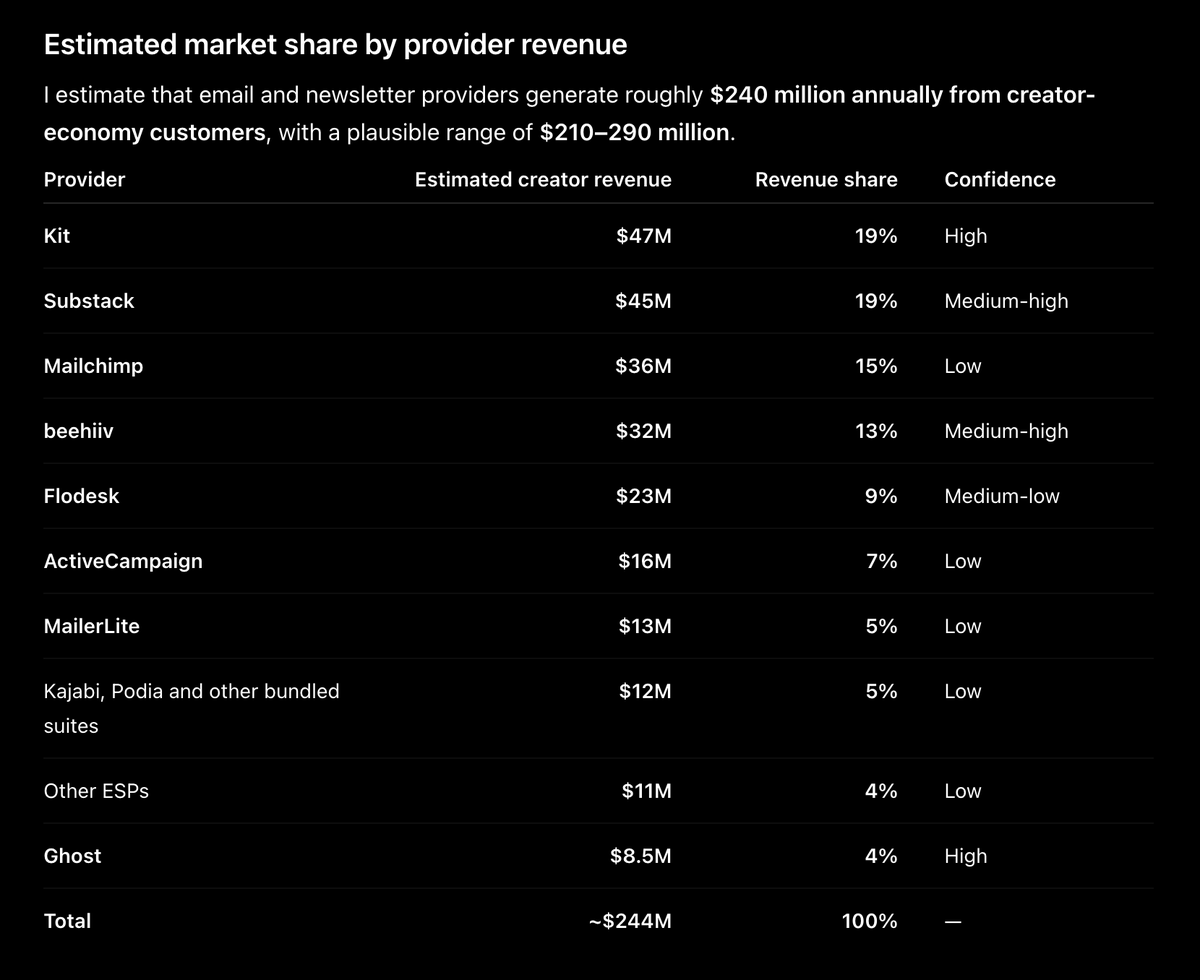
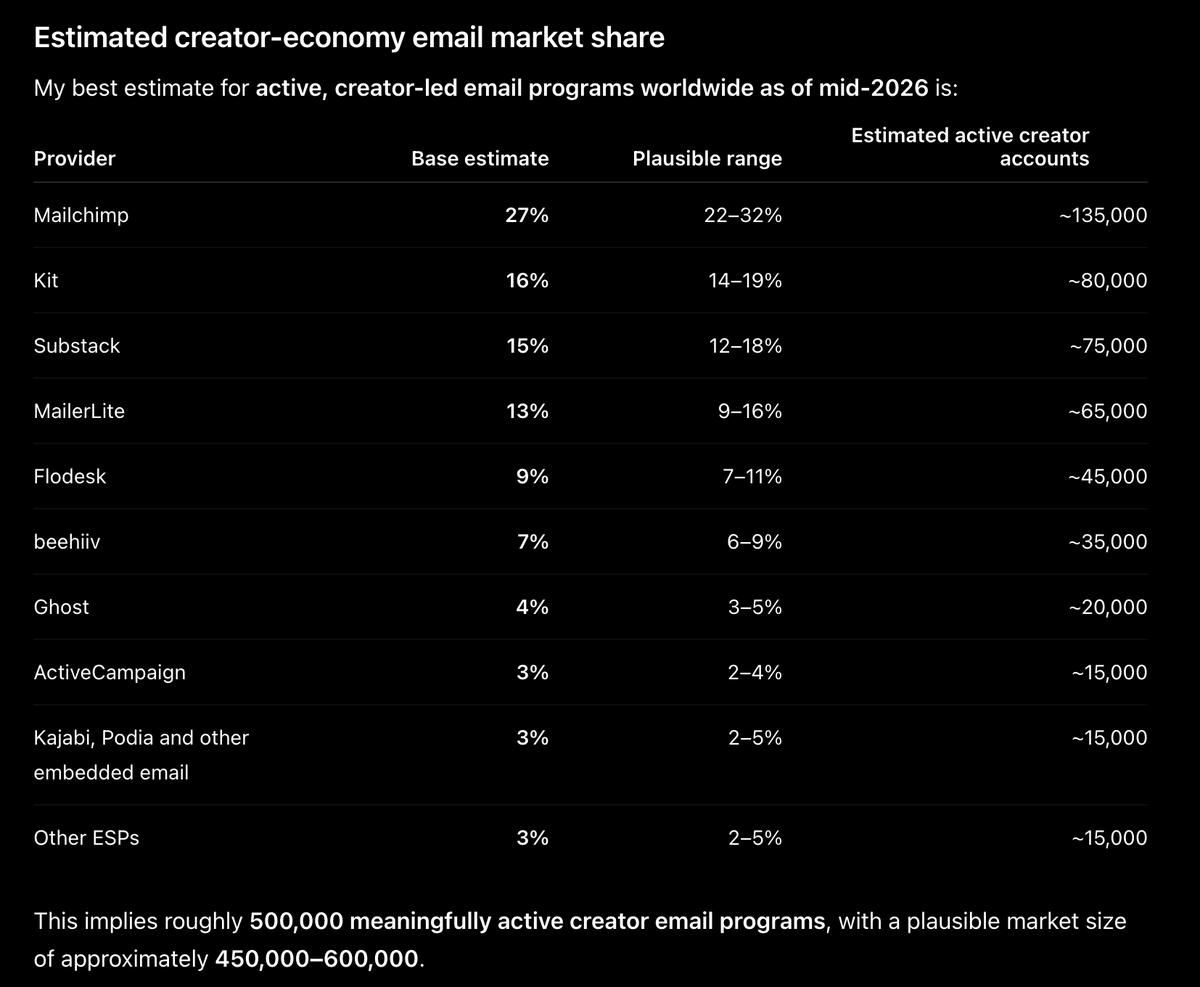
I asked Fable and GPT 5.6 to estimate the market share of email and newsletter companies in the Creator Economy. A few observations: 1. This generally follows the trend that I expected, with Substack as the largest and Kit as a close second. 2. The numbers are all low compared to what I know (e.g. Kit and Beehiiv's revenue). So it's safe to assume everyone is earning proportionally more than reported here. 3. I still think MailChimp, ActiveCampaign, and Campaign Monitor have huge numbers of creators on their platforms, despite not focusing on them. Perhaps still more creators than those of us in the niche. 4. The creator niche is still tiny (~$240M) compared to the email marketing space as a whole (MailChimp alone is over $1.2B). There's so much opportunity. 5. There are so many other players that somewhat touch creator email (Podia, Kajabi, Stan, etc) that aren't really represented here because it isn't their focus. 6. Substack, Beehiiv, and Ghost have so much more mindshare and success with press than Kit and Flodesk have, which doesn't correlate to marketshare.
@sourceryy ·
Roblox CEO David Baszucki on the moment the creator economy clicked: "When we launched Robux and the ability for creators to make a living... we knew within six or eight hours, okay, this is gonna take off."
@p_millerd ·
The creator business is such a brutal one. Even the most successful people I know are seeing stagnant or slowing income growth and in some cases declining. I think early on I realized I never wanted to build a business in this space because I didn’t want a job. I think i lucked out in that I started before the $$ boom. If I had started in 2021 maybe I would have been memed into epic growth strategies.
@Wealth_Tactics_ ·
The creator economy is changing fast. Yesterday, success meant building a personal brand. Today, AI lets you build profitable brands without ever showing your face. Faceless avatar pages and AI influencer accounts can educate, review products, answer questions and build trust at scale. The business model is simple: • Create valuable content. • Grow an audience. • Recommend affiliate products or CPA offers that solve real problems. • Earn commissions as your content keeps working. The opportunity isn't AI itself. The opportunity is learning how to use AI to build an audience before the space becomes overcrowded. The people who start today will have a massive head start a year from now.
@robertoblake ·
We currently have 3M Channels Globally Monetized in YPP (YouTube Partner Program). It needs to be 10M… YouTube is not saturated with quality, it’s saturated with sufficient SLOP made mostly by humans, not AI… to such a degree that 88% of long form videos don’t get 1000 views… Short form still have a 1:5 ratio of inventory compared to long form… yet it gets 200B views a day across those 1B Shorts videos… There is not enough variety across niches… too much concentration on gaming channels and only for a small pool of games… People will ONLY consume more content going forward. Harsh truth is also the biggest Creators are aging out of their content and demographics with no clear successor in many cases… We just need more Creators that can do quality content full-time. And my hot take is there needs to be more Creator Education, not less. Despite what I said about Gaming we need 10-50 coaches PER GENRE of Gaming that specialize in helping gamers exclusively… General YouTube advice may not apply to their game and their community. But we also can’t have general advice flooded like is now, with standards and rhetoric meant for Gaming and Personality Channels. We also need Coaches that are international to deal with the specifics of how the partner program, monetization and laws work outside of America … We need 20-35 coaches in the English Market that EXCLUSIVELY only coach and deal with Content Creators over 40 specifically… We need 100 Female Coaches in the U.S market that exclusively cater to women. Every single creative profession and industry has this kind of support and it’s segmented for various demographics and markets and their unique priorities. Content Creators don’t have this. Photography does. Filmmaking does. Graphic Design does. Coding has an endless supply of Bootcamps. Content Creation still doesn’t. And make no mistake, the Creator Economy is in fact the new Silicon Valley .., though it’s divorcing itself from California.., And don’t need New York for its capital. Most of you don’t see this the way I see it yet… But on a long enough timeline I will be proven right.
@brettdash_ ·
Many people don’t know this, but I actually entered the creator economy through newsletters. In 2020, my brother and I started a healthcare newsletter focused on simplifying complex topics during the height of COVID. We grew it to the point of being acquired by an emerging creator-led media company, where I then had the opportunity to help other B2B creators launch newsletters, podcasts, and media products of their own. Eventually, I felt the itch to build something again. That itch became @CreatorEconNYC. It started with bringing people together through simple happy hours, which then turned into larger events. But I always knew a newsletter would sit at the center of it: a place to stay connected with everyone entering our universe, share stories, educate, and inspire creators as they build. This week, we sent our 137th consecutive edition. Not a single missed send in 137 weeks! So seeing myself and Creator Economy NYC featured in Times Square as part of beehiiv’s spotlight on NYC-based creators felt incredibly full circle. And fittingly, in the photo I’m wearing our “F*ck It, Create It” hat, a phrase that has become something of a mantra within the CENYC community. Put the idea out there, start before it feels perfect and make the f*cking thing. You never really know where it might lead... Hell, maybe it lands you on a billboard in Times Square. Grateful to @beehiiv for the feature, and for building a platform that helps creators own their audience and build something that lasts. (ps. we built the healthcare newsletter on Mailchimp, lol... it was certainly not as easy as it is on beehiiv). Hope this isn't too Instagrammy for y'all!
@aigleeson ·
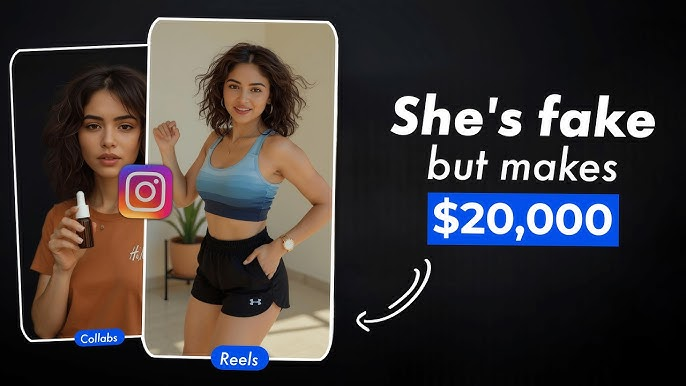
A faceless AI influencer just landed a $30K brand deal on Instagram. No human behind it. No face. No voice. Just an AI persona, a content system, and a media kit that looked cleaner than most real creators I know. The brand knew exactly what they were paying for. They said yes anyway. Here's what nobody in the creator economy wants to admit. The agency managing this AI influencer runs 12 of them across fashion, fitness, and finance. Combined following is pushing 4M. None of them are real people. All of them have brand deals. The pitches go out every Monday morning, automatically. The rates are 40% lower than comparable human creators. Brands are not choosing AI influencers because they think they're better. They're choosing them because the math works and the risk is lower. An AI influencer never posts something controversial at 2am. It never goes through a breakup that bleeds into the content. It never misses a deadline, disputes a contract, or asks for creative control. It shows up exactly the same way every single time. That consistency is worth a discount to a brand manager trying to hit quarterly numbers. The human creators who are panicking right now are the ones in the middle. Mid-tier. 50K to 500K followers. Decent engagement. No clear positioning. Replaceable on paper. The ones who are not worried are the ones who built something an AI cannot replicate. A point of view so specific it reads like a person, not a persona. A community that talks back. A reputation built over years of showing up as a real human being with real opinions. The creator economy is not dying. It is splitting. On one side you have optimized content machines that never sleep and never negotiate. On the other side you have human creators whose whole value is that they are undeniably, irreplaceably themselves. The middle is where the jobs are disappearing. If your content could be generated by a prompt, someone is already writing that prompt. The question is not whether AI influencers are coming. They are already here, already booked, already posting. The question is what part of you cannot be replicated. Figure that out before a brand manager does the math.
@MarketBubble ·
Jesse Pollak explains why tokenization is coming for the creator economy "Over the next decade, just like finance is upgraded, I think social is going to get upgraded by crypto too. I think tokenization is going to be a huge part of it" "Creators have a raw deal right now. They make all the content in the world, and it gets basically taken by big platforms that monetize it and give a small cut back to creators" "There's definitely a lot of fixing that can come there, and we'll get to it after we upgrade finance"
@think_atharva ·
The creator economy is no longer about becoming an influencer. It's about becoming a one-person media company. Today, a single creator can research with AI, write with AI, edit videos with AI, design thumbnails with AI, build a website in hours, launch a product, and sell it to a global audience. The barriers that once required a team now fit inside a laptop. The creators who thrive over the next decade won't necessarily have the biggest audience. They'll have the strongest ideas, the most consistent execution, and the ability to turn attention into products, businesses, and communities. We're entering an era where your knowledge can become your startup. And that might be one of the biggest economic shifts of our generation.
@AskMichaelTaiwo ·
Over 200 million people now call themselves content creators. Around 50 million are professional or semi-professional. Only about 2 million actually earn a full-time living from it. That gap is the whole story of the creator economy. The numbers underneath are sobering. Roughly 73 percent of creators earn under 30,000 dollars a year, and median creator earnings actually fell, from about 3,500 dollars to 3,000, between 2023 and 2025. More people keep pouring in while the median take-home drops. The solo business world tells a similar story with a twist. America's 29.8 million solopreneurs generate a combined 1.7 trillion dollars, but about 78 percent of them make under 50,000 dollars a year, and only 0.2 percent ever cross a million. None of this says do not start. It says start with your eyes open. The internet did not remove the odds. It hid them behind a handful of loud success stories that get quoted endlessly precisely because they are rare. The realistic play was never to become the one-in-a-hundred overnight star. It is to use these tools to build a real skill, a small audience, and a second income, while most people either never begin or quit the moment the first post does not go viral. Modest and consistent quietly beats viral and gone.
@0xDwgs ·
The creator economy in Web3 is evolving beyond simply producing content Projects are looking for people who understand their vision, communicate with authenticity, and genuinely care about community growth The ability to educate, inspire discussions, and build trust is becoming just as valuable as technical expertise That's why reputation will continue playing a bigger role in how opportunities are distributed across the ecosystem #SocialMining @TheDAOLabs
@Moshaikh ·
One of the most interesting things about X is that it allows you not only to share your voice in the town square, but also to capture relative and comparative value. And that doesn’t necessarily mean monetization. If you want to project your voice to assert an opinion, or do it for the purpose of gathering information or getting input, you can do that. If you want to be an influencer, you can do that too. But this is completely different from the creator economy of dance videos, how-to videos, and all the rest, which of course I also indulge in. What’s really interesting is the ability to capture that value over time. And this is exactly where tokens could become even more fascinating as an overlay. I don’t think Nikita or Elon are thinking about this yet, but it might end up being one of the most important things that X can facilitate. The creator studio is just the start…
@iamericpereira ·
A TikTok slideshow with 18K views drove more app installs than one with 2.3M views. I tracked this across 1,000+ slideshows for consumer apps. The pattern kept repeating. The posts that converted best almost never went viral. Some of the highest performing creatives barely cracked 10K views while million-view posts produced almost zero downloads. The creator economy still prices influence by follower count. Brand deals, sponsorship rates, platform features, all weighted toward reach. But reach and revenue are almost inversely correlated once you start measuring what actually matters: clicks, installs, conversions. A creator with 8K followers who can move 200 people to download an app in a week is worth more to a consumer app founder than someone with 500K followers posting content that gets liked and never acted on. This is the distribution economics shift most people haven't caught up to yet. Creation got cheap. AI can produce 50 video variations in the time it used to take to make one. So the ability to convert attention into a specific action, getting someone to tap install, is now worth more than the attention itself. If you're building consumer apps, stop optimizing for the creator with the biggest audience. Find the one whose audience actually does things.
@robertoblake ·
Building the Education Infrastructure around Best Practices and Sustainable Monetization as a Content Creator is a HUGE undertaking… Eventually it’s going to mean needing to train more educators to specialize. There should absolutely be 100 coaches in the U.S. that can just help with exclusively building Lifestyle Brands for Creators YouTube, Instagram and TikTok… and there is no good reason we shouldn’t have 1M monetized female Creators in the YouTube Partner Program across those niches… We don’t even have 1M Americans total in the YouTube Partner Program 😔 I don’t think you all realize that when you complain about it being saturated…. We need 150 Coaches for Gaming Content Creators who specialize across Gaming Genres. If you wanted to be a graphic designer or photographer, you have thousands upon thousands of qualified teachers… Content Creation should be no different. But there are specialist for reaching street photography vs wedding photography. Typography is not the same as Print Production. Not all Content Creation is the same either. Specialization matters. Not just in terms of Niche Audience, or Content Style, but Creator Identity as well. YouTube and Content Creation are not saturated. There are only 3M YouTube Partners worldwide in 21 years… We need 10M people in the YouTube Partner Program…. Not want NEED… I’m not playing around when I say this. It’s necessary. But it can only happen if Creators are taught how to make a sustainable income. It’s fine for 90% to do this as a hobby, but it’s currently more than 99% and not because of LUCK… But because of a lack of education, resources, and infrastructure. And it’s not that larger Creators truly gatekeep aggressively… But it’s a culture and maturity issue where making money in this industry is judged in a way no other industry puts up with… because no other industry is this accessible to young people… That’s the maturity and culture issue that holds the Creator Economy back. And it’s also why more Creators in their 30s and 40s are thriving because they take it seriously. The most pain is felt by young creators who get jaded or who become famous and broke… That has to change and it’s going to require a culture shift and we have to aggressively tell young people it’s okay to make money doing this… And we have to show them that a lot of their understanding of money in this industry is misinformed by things people say because it sounds good to an audience (them) not because it’s actually true…
@etnshow ·
.@justinmujin, CEO & Co-Founder at Giggles, says that in a creator economy worth trillions, most content creators are still making next to nothing: "I think thanks to AI, you'll see everybody be a creator." "I view the creator economy, or global ad market, which is netting trillions of dollars a year, as a very inefficient OTC market." "Today they just make no money through the RPM models of these incumbent platforms." "We want to build a much better solution."
@sourceryy ·
Roblox CEO David Baszucki (@DavidBaszucki) on the creator economy inside the platform: "Our developer creator earned about a billion and a half on the platform."
@AvelonX7 ·
The biggest mistake in the creator economy is believing that bigger always means better.@clashoAi A creator with 500 loyal followers who genuinely trust their recommendations can often create more value than someone with 500,000 followers who gets little real interaction. Too many brands still chase vanity metrics because they're easy to measure. But influence isn't built on impressions alone it's built on trust, consistency, and meaningful conversations. The creators who will succeed over the next few years won't necessarily be the loudest or the most viral. They'll be the ones who keep showing up, share ideas people actually care about, and build communities that stay engaged long after a post is published. Algorithms will continue to change. Trends will come and go. But trust is one thing that compounds over time. That's the metric I believe every creator should optimize for.
@InvestNorthwise ·
$SPOT creator economy stack is evolving from distribution infrastructure into a layered monetization system built on recurring revenue, video inventory, and AI-enabled production tools. Video podcasts are increasingly central, with Spotify competing directly against YouTube for creator attention, while also expanding ad inventory density per session despite higher bandwidth and delivery costs per hour of consumption. The Spotify Partner Program and Memberships layer introduce recurring listener payments, shifting creator monetization from ad dependent earnings toward subscription-like revenue streams that can improve revenue stability and take rates over time. On AI, features like translation, dubbing, summarization, clip generation, and automated production primarily function as engagement multipliers, expanding reach per episode rather than creating direct monetization lines. The economic structure is still being proven, but the direction is toward higher lifetime value per creator through a mix of ads, subscriptions, and tool-driven scale rather than dependence on a single revenue channel.
@SadaaShree ·
Why waste time slogging at your job, you can make more money as a content creator or influencer and have fun? Precisely the kind of lazy theorizing that ignores the reality. For starters being a creator/influencer is not fun exactly, there is a whole lot of hustle involved right from editing to marketing to promotion where you do it all by yourself Now even if you accept the hustle part, the bigger issue is that it's not really as lucrative as made out to be. Payouts, brand deals are as per the views, impressions that are totally dependent on the algorithm and policies. Hardly 1-2% actually make money, for the rest it's just peanuts, in fact not even that. The problem is everyone hypes up the 1-2% ignoring the rest who struggle. Even if you get reach, make money it's never steady. One moment you could be having millions of views, and one small tweak in the algorithm or a change in policy can see your views crashing and your payout come down. The hype and glamor of the Creator Economy hides the brutal realities- payments that never come on time or sometimes not even at all, constantly checking your phone for views, impressions worried about how the month will be, your mental health gone, no steady source of income. So the next time you feel envious of that creator/influencer earning more than you do, step back and think about it.
@urdav3 ·
THE NEW CREATOR ECONOMY IS BUILT ON AI WORKFLOWS For nearly two decades, the Creator Economy has been built around content. Videos. Blogs. Podcasts. Social media posts. Newsletters. The creators who mastered content production accumulated audiences, influence, and economic value. But a new shift is emerging. The next Creator Economy may not be built on content alone. It may be built on workflows. Because in the age of AI, the most valuable asset is no longer what you create. It is how you create it. 1. FROM CONTENT TO SYSTEMS The first generation of creators monetized attention. The next generation may monetize productivity. AI is changing the economics of creation. A single creator can now perform the work that previously required an entire team. Research. Writing. Design. Translation. Analysis. Distribution. Automation. The advantage no longer comes from producing more content. The advantage comes from building better systems. 2. PROMPT ENGINEERING AS A CREATIVE SKILL Prompt engineering is often misunderstood. Many people view prompts as simple instructions. In reality, prompts are becoming operational frameworks. A high-quality prompt can encode: → expertise → decision logic → business processes → creative workflows → productivity systems The prompt itself becomes intellectual property. The creator is no longer just producing content. The creator is producing intelligence. 3. WORKFLOWS ARE THE NEW DIGITAL PRODUCTS Historically, creators sold content. Then they sold courses. Then they sold communities. The next evolution may be workflow products. Imagine selling: → AI research systems → automated marketing workflows → content generation pipelines → business intelligence frameworks → agent-powered productivity stacks These systems generate value continuously. Unlike static content, workflows can compound over time. 4. THE RISE OF AI PRODUCTIVITY SYSTEMS The most successful AI users are not necessarily those using the smartest model. They are those building the most effective systems. A workflow that saves 10 hours per week can be more valuable than a model improvement. A workflow that doubles productivity can outperform additional hiring. The future belongs to creators who understand system design. Not just content creation. 5. WHY USE CASES MATTER Initiatives like AI use-case showcases reveal an important trend. The most valuable innovations increasingly come from users. Not developers. Not corporations. Users constantly discover: → new workflows → new automations → new productivity methods → new revenue opportunities Community-driven innovation accelerates ecosystem growth. Each shared workflow becomes a blueprint for others. 6. THE WORKFLOW ECONOMY The next generation of creators may not compete on audience size. They may compete on workflow quality. Who can build the most effective systems? Who can orchestrate the best combination of AI models? Who can create the most efficient automation? This shift marks the transition from the Creator Economy to the Workflow Economy. In the future, the most valuable creators may not be those producing the most content. They may be those building the most powerful systems. Because content captures attention. Workflows create leverage. And leverage is the ultimate source of economic value. @justinsuntron #TRONEcoStar @BAI_AGI
@ragemello_ ·
back in 2021-2023 ppl could get away with “here’s my course” throw some Facebook ads at a VSL now creators who are winning are building media companies first another huge change: ppl don’t really want consulting. they want implementation i’ll teach you how is commoditized that’s why you see offers exploding like: AI implementation backend rev ops content operating sales systems personal brand operating none of those are really consulting they’re closer to private equity for creators that’s exactly why companies like @commas and payments companies have become so valuable the other thing that’s happened… AI killed information so what’s valuable now? speed curation taste decision making accountability distribution network if i were looking at where the next wave of money is in the creator economy it’d look something like this: creator infrastructure (payments, CRM, AI) done for you implementation AI employees/workflows for online businesses owning distribution (media, newsletters, communities) between my info operator experience and now working in payments i’ve seen parts of the space most never do
Best Tweets by Topic