Long-term, disciplined investing
Index funds, ETFs, dollar-cost averaging, compounding, buy-and-hold patience, and consistent contributions over market timing or frequent trading.
46%
Best tweets about Personal Finance
A curated collection of the sharpest, most-shared X posts about personal finance—saved so you do not have to dig through the timeline yourself. Updated weekly.
Saving, investing, and the money mistakes people only admit to once they are past them.
Original Xholic analysis
The conversation emphasizes long-term investing, spending discipline, and financial resilience, while warning that status spending, complex products, and emotional decisions can undermine progress. A recurring tension is between saving for the future and making room for meaningful experiences now.
62% of posts
All-time engagement
40% of posts
Published in 90 days
Conversation map
Index funds, ETFs, dollar-cost averaging, compounding, buy-and-hold patience, and consistent contributions over market timing or frequent trading.
46%
Budgets, burn-rate awareness, emergency cash, insurance, debt reduction, automation, and liquidity as the base before pursuing wealth.
42%
Building portfolios across equities, bonds, real estate, retirement accounts, businesses, and other productive assets while managing concentration and risk.
36%
Living below one’s means, resisting status spending and social comparison, tracking spending leaks, and protecting the gap between income and expenses.
32%
Panic selling, FOMO, speculative bets, blind investing, financial-product traps, disorganization, emotional spending, and recurring decision errors.
30%
Money as control over time and choices; defining enough, prioritizing peace and purpose, and avoiding wealth-building at the expense of life, health, and relationships.
20%
Increasing earning power through valuable skills, side opportunities, entrepreneurship, deal flow, and using surplus income to acquire assets.
14%
High-net-worth portfolio construction, taxes, manager selection, concentrated-stock diversification, founder exits, and post-liquidity financial inertia.
6%
Tone and stance
Performance benchmark
Posts with media make up 34% of this collection. Their median all-time score is 20.9, compared with 20.5 for text-only posts.
Format mix
Consensus and debate
Shared view
Posts commonly advocate long-term investing, recurring contributions, budgets, and cash management as repeatable practices, rather than frequent trading or market timing.
Shared view
Several posts frame lower spending, resistance to social comparison, and ownership of productive assets as alternatives to looking affluent.
Shared view
Emergency reserves, insurance, debt awareness, and burn-rate knowledge are presented as tools for creating financial breathing room before pursuing wealth-building goals.
Shared view
Posts describe panic selling, FOMO, poorly understood products, and organizational gaps as recurring pitfalls, and point to rules and systems as possible guardrails.
Open debate
One perspective centers discipline and deferred gratification; another argues that aggressive saving can displace experiences, particularly for people on non-linear early-career paths.
Open debate
Index-heavy diversification is presented as a core approach, while other posts describe concentrated holdings or a limited allocation for investments the author believes they understand.
Open debate
Some posts offer broad financial basics, while another argues that people facing immediate survival needs must stabilize before portfolio-building becomes relevant.
What performs
The top two supplied outliers are a lesson list about understated wealth (all-time score 1096.91) and a post about post-liquidity portfolio management (640.38).
Posts about money’s changing trade-offs and the limits of aggressive saving are both listed among the supplied outliers, with all-time scores of 379.72 and 280.58 respectively.
Across the dataset, media posts had a median all-time score of 20.902, compared with 20.458 for text posts.
Statistical standouts
Creator landscape
The five most represented creators account for 20% of the selected posts.
1. Benzinga
@Benzinga
2 posts
2. Jeremy
@Jeremybtc
2 posts
3. Miles Deutscher
@milesdeutscher
2 posts
4. Slim
@onu_slim
2 posts
5. Unfiltered
@quotesdaily100
2 posts
6. Sharran Srivatsaa
@sharran
2 posts
Jeremy’s two posts address money’s changing trade-offs and the opportunity cost of spending, while Toby’s posts cover investing rules and early financial foundations.
Miles Deutscher describes missed opportunities, allocation decisions, and organizational gaps as lessons drawn from his own investing mistakes.
Since the previous snapshot
Themes, sentiment, stance, and post format are classified per tweet. All counts, shares, medians, creator concentration, freshness, and performance comparisons are then calculated directly from the published snapshot.
Xholic's all-time score compares engagement while accounting for reach, post age, and creator consistency. It is used for relative comparisons within this collection.
This report analyzes the exact 50-post snapshot shown below. AI identifies editorial categories and drafts explanations; all statistics are calculated from the snapshot, and every narrative claim is checked against cited posts before publication.
Best Personal Finance tweets
Ranked 01–50

@Techriztm ·
I’ve read The Millionaire Next Door so you don’t have to. Here are 10 lessons that can genuinely change how you think about money: Read till the end⤵️ 1. Most millionaires are invisible. They don’t live the flashy lifestyle social media sells. Many look completely average, which is exactly why they’re able to build and keep wealth. 2. Wealth isn’t income. Making a lot of money means little if you spend all of it. Real wealth is the money and assets you still own after years of earning. 3. Looking rich is expensive. Luxury cars, designer clothes, and constant upgrades often slow wealth creation more than people realize. 4. Freedom is the real reward. The purpose of money isn’t to impress others. It’s to give you control over your time, choices, and future. 5. Small habits create big fortunes. Wealth is rarely built through one lucky break. It’s usually the result of smart decisions repeated for decades. 6. The wealthy budget differently. They know where their money goes. Every naira or dollar has a purpose instead of being spent impulsively. 7. Delayed gratification is a superpower. Many people buy what they want now. Wealthy people are often willing to wait so they can have far more later. 8. Ownership changes everything. The biggest wealth creators usually own businesses, stocks, or assets that work for them even when they’re asleep. 9. Social pressure keeps many people poor. Trying to match the lifestyle of friends, colleagues, or influencers can quietly destroy your finances. 10. Wealth is built before it’s visible. By the time people notice someone’s success, years of discipline, sacrifice, and smart decisions have usually happened behind the scenes. The biggest takeaway from the entire book: Most people spend money to look wealthy. The wealthy spend money in a way that eventually makes them wealthy.



@MollySOShea ·
BREAKING: Inside Marc & Ben's Multi-Family Office — a16z Perennial Chief Investment Officer, Michel Del Buono Why wealth management is broken & how to financially prepare for a SpaceX IPO This is a closer look at how $50M–$1B+ personal portfolios are actually constructed & managed Important: Michel also explains why many founders make critical mistakes immediately after their first liquidity event, & how to avoid them. We cover: • The “no man’s land” between wealth managers & asset managers • How founders should handle liquidity events ($50M–$1B+) • Diversifying concentrated stock without killing upside • Venture returns & why manager selection matters more than exposure • Real estate, taxes, & after-tax alpha • Why volatility is an opportunity, not a risk • How to actually choose (and not get trapped by) a wealth manager Special thank you to Dave Maloney 𝐓𝐈𝐌𝐄𝐒𝐓𝐀𝐌𝐏𝐒 (00:00) Michel Del Buono, CIO @a16z Perennial (01:25) The idea behind a16z Perennial (03:38) What’s broken in wealth management (09:05) How wealth has changed over time (11:57) How fee structures shape portfolios (15:26) Why single family offices are hard to run (19:47) Who wealth management is really for (23:26) What makes Perennial different (22:21) Preparing for massive liquidity events: SpaceX, OpenAI... (24:01) How to choose the right wealth manager (26:39) Why switching firms is so hard (28:01) How portfolios are actually built (31:29) Why volatility is an opportunity (32:47) Why real estate is so powerful (34:55) Taxes and the Billionaire Tax debate (38:46) Should you move to save taxes? (40:59) Chamath : SPAC losses & how they affect taxes (42:21) Secondary deals, fake Anduril SPVs & the risks (46:16) What drives returns in Venture Capital (49:42) Biggest Lesson from Marc Andreessen & Ben Horowitz (51:27) The biggest mistake founders make with money (52:53) How to invest after a big exit (54:16) Concerns around private credit (56:38) What big IPOs mean for markets (58:08) Keeping up with markets (59:35) What’s the focus this year at a16z
 Watch video

@thesamparr ·
Some of my personal finance rules: 1. most all money goes into index funds. virtually 0 stock picking. 2. stick to a monthly budget 3. meet monthly with spouse to review past spending, discuss if we're happy/not about it, any changes we want 4. try to be intentional about stuff i buy. spend on hobbies that i love, buy stuff that lasts, not disposable amazon junk. 5. assume my private company is worth very little or nothing 6. wanted to maxmize time i can spend without income. very conservative. (even though i know i'll keep working). used to have a sheet that counted the months/years. 7. every month, deposit money into index funds. 8. spend little on things that don't bring joy (luxury clothes, owning a home, jewlery, nice hotels) and a lot of stuff that does (weekly cleaner, nice apartment, eBay clothes, services around the house, trainer) 9. tip a lot 10. say no to most all investments 11. remind myself that money's a tool to help get to the end game, not the end game. 12. don't let money be the number 1, 2, 3 reason to do a project. Not for everyone, but these rules help me sleep like a baby.

@Jeremybtc ·
Nobody tells you how money actually changes your life $1k - Survival mode starts to lift. You can handle a flat tyre, a bad month, an unexpected bill without it destroying everything. That alone changes how you think and make decisions. $10k - For the first time you have a choice. Stay or leave. Take the risk or don’t. Money isn’t wealth yet but it’s the first time it gives you actual options. $100k - Reality hits. Tax takes a third, cost of living takes more. You realise saving alone won’t build wealth. This is where people either learn to invest or stay stuck on the hamster wheel for years. $500k - The goalpost moves. You start thinking about how to protect it not just grow it. A market drop that would’ve meant nothing before now keeps you up at night. $1M - Less changes than you expected. The number is real but the day to day is almost identical. What does change is how seriously people take you in rooms that matter. $5M - Decisions get quieter. You stop explaining yourself. You don’t negotiate on things that cost you time or peace. Not because you’re above it but because you can finally afford not to. $10M - You stop worrying about money and start worrying about what to do with it. Where to put it, how to structure it, who to trust with it. A whole new set of problems you were never warned about. $100M - Money stops being something you manage and becomes something that runs in the background. You have a team for that. What you actually spend your time on is decisions, access, and legacy. The lifestyle barely changes from $10M. The power does. $1B - It becomes institutional. Governments, banks, and CEOs come to you. You don’t see bills, you don’t take meetings you didn’t request, and you don’t go anywhere without it being arranged in advance. At this level money isn’t personal anymore. It’s structural. Every level solves the last problem and hands you a new one. That never stops.

@IndraVahan ·
i turned 28 a few days back and one thing i realized is that none of the mutualfund-sip-savingsmaxxing discourse really mattered as much as i thought it did i did not have a linear 20s. apart from salary i made way more money through side gigs and weird internet opportunities. i can confidently say i made more in my 20s than 95% of people around me will in theirs. yet when i look back none of the money i saved feels nearly as meaningful as the things i talked myself out of buying or experiencing i could’ve bought that bmw g310rr at 22. i could’ve gone on that japan trip. instead i saved aggressively for a future where the same amount today barely covers 15 days of expenses i’m not saying saving or investing is useless. i’m saying most people vastly overestimate how much constant saving changes your life. your life usually changes because of one decision that exponentially compounds everything afterwards especially if you’re in your early-mid 20s on a non-linear path, don’t suffocate yourself obsessing over where every rupee goes

@TomolaGroup ·
If you want to build wealth, understand the 7-5-3-1 Rule of Investing: 7 – Stay Invested for at Least 7 Years Time is your biggest advantage. Long holding periods allow compounding to work and reduce the impact of short-term market noise. 5 – Diversify Across at Least 5 Assets or Sectors Never bet your future on one idea. Spread your investments across different sectors (tech, finance, energy, consumer goods, etc.) or asset classes (stocks, bonds, real estate, funds). Diversification protects you from major losses. 3 – Contribute Consistently at Least 3 Times a Year (Ideally More) Wealth is built through consistency, not timing the market. Regular investing smooths out market swings and builds discipline. 1 – Focus on 1 Long-Term Goal Whether it’s financial freedom, retirement, or generational wealth, one clear goal keeps you patient, disciplined, and less emotional during market downturns. Wealth isn’t built fast. It’s built with time, structure, and discipline.

@Nithin0dha ·
When it comes to personal finance, people somehow keep making the same mistakes over and over again. There’s very little creativity in the mistakes people make. Take investing. Pretty much every influencer, every serious finance writer, and the financial media have been screaming for years: don’t mix insurance with investments. ULIPs are usually a bad idea. Endowment policies are usually a bad idea. And yet, ULIP sales continue to grow and endowment plans continue to be sold. People continue to fall for the same pitches, despite all the articles, videos, and excel sheets explaining why these products are bad. The same applies to health insurance, though I have a little more sympathy there. Health insurance is genuinely complicated. There are tiny clauses, room rent caps, waiting periods, exclusions, and conditions that most people don’t fully understand and then they find out the hard way, when they still have to pay out of pocket despite having a policy. But with products like ULIPs and endowment plans, there’s no excuse. These are not impossibly complicated products. Even a cursory Google search will tell you the problem. And today, in 2026, you can just ask ChatGPT or Claude whether a product is a good idea, and they’ll usually show you the math, explain the catches, and give you pointers on what to do. And yet, people still keep falling for the same thing. @PrateekLearnapp from @Zero1ByZerodha has made a really nice video on some of the biggest mistakes Indians make with investing and health insurance. It’s worth watching, and sharing with your friends and family too.
 Watch video

@orangebook ·
There are more and more people with financial freedom who struggle with purpose these days. The problem when you spent your younger years exclusively growing your assets at the cost of your health, your talents, your relationships, your growth as a person, is that you will never be able to buy back certain things that were meant to be experienced at specific timings in life. You thought you were winning until you looked at yourself in a mirror, and saw no joy in your eyes; then you looked around, and saw no genuine friend; then you looked back, and saw no meaningful purpose. You don't want to be old and retired, and start discovering for the first time the joy of living that you should have experienced in your twenties, only to realize that you had been blinded by the illusion that more money would solve everything instead of leveraging the system as a mere tool. It's so ironic that many great "investors" in a financial sense are actually struggling to build real wealth: a confident mind in a high-energy body, a loving spouse and happy kids who make the house feel alive, being useful to a community where you feel appreciated and valued, living in a neighborhood you actually love and not just as a way to maximize your networking opportunities, and a legacy that will make the next generations get a glimpse of what a meaningful life feels like. In a society where money is the new God, always make sure you don't lose track of who you truly want to be, because the richer people are, the more confidently they will assert that their way is the right way, and you yourself will feel that way once you get rich, but that doesn't mean you are on the right path towards true wealth, and that's actually where the real test begins.

@sharran ·
If you're in your 20s and want to build real wealth, here are 3 pieces of advice I'd give my 25-year-old self about money: 1/ Build income, but use it to buy assets Income stops when you stop. Assets keep working after you go to sleep. You need both, but only one of them builds wealth. 2/ Lifestyle inflation is the silent wealth killer Every time your income goes up and your spending follows, you reset the clock. The goal is to grow the gap between what you earn and what you spend. 3/ Your network determines your deal flow. The best investments I've ever made came through relationships. The right room puts you in front of opportunities that never get advertised. Get these right early and you'll skip years of hard lessons.

@Skolex5 ·
If I was 20 today again, I will advise myself with the following. Live below your means. Spend less than you earn, regardless of income level. Invest wisely. Money that sits idle slowly loses value. Productive assets grow it. Build multiple income streams. One salary is fragile. Multiple sources create stability. Avoid bad debt. High-interest consumer debt compounds faster than most investments. Save and invest consistently. Wealth is rarely built by one big win. It is built by repeated discipline. Understand taxes. What you keep matters more than what you earn. Take calculated risks. Every meaningful financial leap requires informed risk. Keep learning. Financial knowledge compounds just like capital. Income alone does not create wealth. Systems do. When your money has direction, discipline, and purpose, wealth stops being accidental and starts becoming predictable.

@noahkagan ·
Been working on my financial plan. Sharing in case it's useful. The frame. You have more than enough. The job now is contentment and not screwing it up, not maximizing. AppSumo is your alpha. Family time is finite. Investing is a hobby with guardrails, not a second career. The attention diet. Mute the AI, semis, and crypto stock accounts on Twitter for 30 days. The feed manufactures the FOMO that drives the dabbling. The 90/10 split. 90% core: Boring, conservative, index-heavy. Rebalanced once or twice a year. You don't have opinions about it. You don't read about it. 10% play account: Concentrated bets only. Things you understand through operating, or your partner sees early. Multi-year holds. No Twitter-feed trades. Two rules for the play account: 1. Position size matters or don't bother. Minimum $25K. If it's not worth $25K, it's worth $0. 2. The bar is "I have an edge." Operating insight, partner conviction, or a thesis you'd be embarrassed to sell in 6 months. The retirement account. 100% equities. Broad index core (VT). Let it compound aggressively for 20+ years. The cash buffer. Keep your 1-year emergency fund amount. That's sleep-at-night money and it's already earned its place in the plan. The cleanup. Every position under ~$10K gets one question: would I buy this today at 5 to 10x the size? Yes → top it up. No → sell, roll into core or a real conviction name. Goal: stop having opinions about positions too small to matter. The actual lever. Getting AppSumo to its profit milestone is worth more than any stock pick you'll ever make. Every hour on semis is an hour off the roadmap and off your kids.
@TomolaGroup ·
If you are in your 20s and you genuinely understand these five things, you are ahead of most people twice your age financially: 1. Compound interest: how small amounts grow exponentially over time. And why starting at 22 beats starting at 35 by a massive margin. 2. Emergency funds: why you need 3 to 6 months of expenses saved before investing in anything volatile. 3. Budgeting: tracking your income and expenses so you know exactly where every naira goes and can direct the surplus intentionally. 4. Assets versus liabilities: understanding that wealth comes from accumulating things that generate income and minimizing things that drain it. 5. Starting early: recognizing that time, not the amount of money, is the most powerful variable in investing. Most people learn these concepts at 40 when they’ve already spent two decades making avoidable mistakes. If you’re learning them now, at 20 or 23 or 27, you have a head start that money literally cannot buy. Protect it. Use it.

@BSAT_Properties ·
10 Best Assets You Must Own to Build Long-Term Wealth If you were not born into generational wealth, you can lay the foundation for lasting wealthy by investing in one or more of these assets: 1. Stocks (Equities) Stocks represent ownership in companies, and over time, they are one of the highest-returning assets in the world. Why they’re powerful: •Companies grow, expand, and generate profits and shareholders benefit. Long-term advantage: •Historically, stocks outperform inflation and most other assets. •Example: Investing in strong companies or index funds over 10–20 years can multiply your money significantly. •Best strategy: Focus on long-term investing, not daily trading. 2. Real Estate •Property is one of the most reliable ways to build generational wealth. •Income streams: Rental income + property appreciation •Why it works: Land is limited, population keeps increasing •Types: Residential, commercial, short-let apartments •Example: Buying a house and renting it out can give steady monthly income while the property value rises. 3. Mutual Funds & ETFs •These are professionally managed investments that pool money from many investors. Why they’re great: •Diversification (reduces risk) Managed by experts •ETFs: Track indexes like the stock market •Best for: People who don’t have time to pick individual stocks. 4. Bonds (Government & Corporate) •Bonds are safer investments that provide fixed income over time. Why they matter: •Stability and predictable returns •Types: Government bonds (safer), corporate bonds (higher returns but slightly riskier) Role: Protect your wealth while other assets grow it. 5. Retirement Accounts / Pension Funds •This is one of the most underrated wealth-building tools. Why important: •Long-term compounding •Often comes with tax benefits •In Nigeria: PFAs and voluntary retirement savings •Key idea: Treat this as your future salary when you stop working. 6. Businesses (Ownership) •Owning a business is one of the fastest ways to build massive wealth. Why: •Unlimited income potential •Examples: Trading, agriculture, logistics, online businesses •Reality: It requires effort, risk, and consistency but rewards are huge. 7. Dividend-Paying Assets These are investments that pay you regularly. Examples: Dividend stocks •REITs (Real Estate Investment Trusts) Why powerful: •You earn passive income without selling your asset •Goal: Build a portfolio that pays you monthly or quarterly. 8. Skills & Human Capital •Your skills are your most important asset, especially early in life. Why: •Skills increase your earning power Examples: •Tech skills (programming, data analysis) Business skills (sales, marketing) •Truth: The more you earn, the more you can invest. 9. Commodities (Gold, Oil, etc.) •Commodities help protect wealth, especially during economic uncertainty. •Gold: Safe haven during inflation •Oil & others: Can rise with global demand Use: Not for fast growth, but for stability and protection. 10. Digital Assets (Carefully Chosen) •This includes things like cryptocurrencies or online income-generating assets. Why they matter: •High growth potential |Risk: Very volatile •Smart approach: •Only invest a small portion (5–10%) and focus on strong, long-term projects. © FlyAlone Which of the assets are you interested in? P.S: Do your due diligence before investing in any business or asset

@pepemoonboy ·
THE ACCOUNT ZERO CHALLENGE Everyone always asks me the same thing: “Knowing what you know now, how would you invest if you were starting fresh?” I could just tell you… But I’d rather show you. So I opened a brand new account. Nothing in it. No old positions. Just a fresh account where I’m documenting how I personally invest using everything I’ve learned over the past few years. Now you get to watch me build it from day one. THE RULES: 1. Day one, I fund it with $5,000. All of it goes straight into $VOO. That’s the foundation. Before any stock picking happens, the core of this account is the entire market. 2. Then I add money every single day. Minimum $100. Maximum $1,000. Every day. No exceptions. 3. Some days I buy individual stocks. Companies I’ve actually done the homework on. Other days I just buy more $VOO. Boring is allowed here. Boring builds wealth. 4. Every single buy gets documented. Ticker. Price. Position size. Good calls. Bad calls. Everything stays up. Nothing gets deleted when it ages badly. 5. Long term only. No options. No margin. No panic selling because the market had a bad week. I’m building a portfolio, not gambling. 6. My personal goal is to try to beat the S&P 500. This account has no history. Whatever it becomes… You watched the entire thing get built. And I’ll be honest with you. Beating the index is hard. Most people don’t. Maybe I won’t either. But that’s exactly why I think it’s worth doing in public. It’s about documenting the process. The thinking. The discipline. The mistakes. The wins. All of it. Account Zero. Day One. Let’s get it. 🚀 Disclaimer: This content is for educational and entertainment purposes only and reflects my personal opinions and investment decisions. Nothing I post should be considered financial, legal, or tax advice or a recommendation to buy or sell any security. Investing involves risk, including the possible loss of principal. Always do your own research and consider consulting a licensed financial professional before making investment decisions.


@andruyeung ·
I just finished reading @morganhousel's new book, "The Art of Spending Money". Probably one of the most impactful books I've read in my life. I think everyone should read it. But if you don't plan to, here are the main points you should know: 1. Money’s highest purpose is control over your time. The best thing wealth can buy is independence: the ability to choose what you do, when you do it, where you do it, and who you do it with. 2. Spend to make yourself happy, not to impress others. We often buy status hoping people will admire us, but people usually admire the thing, not the person who owns it. 3. Expectations matter more than income. Happiness is the gap between what you have and what you expect. Someone with modest wealth and low expectations can feel richer than a millionaire who constantly wants more. 4. The best purchases remove problems from your life. Money is especially powerful when it buys convenience, reduces stress, saves time, improves relationships, or removes recurring annoyances. 5. Know what “enough” looks like. Without a definition of enough, every raise simply creates a more expensive lifestyle. "Wealth" begins when you stop endlessly moving the goalposts and recognize when you already have what you need. 6. Social comparison has no finish line. There will always be someone richer, more successful, or living more extravagantly. If your definition of success depends on outranking others, you’ve chosen a game you cannot permanently win. *** P.S. I also made an infographic summarizing the 15 stages of wealth that is helpful to bookmark.


@joa_ni ·
One decision changed his entire financial future. @aidanskytt asked @AspireShift what got him into investing, and the answer was simple. He just wanted to make money. Finished high school, got a regular job, followed the normal path then realized very quickly it wasn’t for him. Didn’t like the environment. Didn’t like where that path was leading. So he started figuring things out on his own learning investing, getting into business, just trying to understand how money really works. Fast forward 7 years and now he’s managing a fund, but not the typical kind. They built it to do both: take big bets on ideas that could actually change things, while still generating steady cash flow in the background. No picking one over the other.
 Watch video

@StevenBartlett ·
Could buying a house be a mistake? I have been trying to better comprehend how to make smarter decisions with my money. Not just how to earn more, but how to actually use it properly over time because the truth is that most of us were never really taught this stuff. So to help me understand it, Finance Guru Ben Felix joins me on The Diary Of A CEO today. Ben is a portfolio manager for PWL Capital (wealth management firm and multi-family office) who focuses on ‘evidence-based investing’ that debunks financial traps and explains the relationship between money and well-being. We spoke about how most people approach money with assumptions that they have never really questioned. Things like buying a house, chasing higher returns, or believing that more money will automatically improve their lives. I have always found money confusing. Not because the information is not out there, but because there is too much of it and most of it says something different. This episode strips it back and should help you understand what actually matters…
 Watch video

@GrahamStephan ·
The instructions for building wealth are boringly simple: Buy index funds. Wait 10 years. Don’t touch it. It's simple, but not easy. If it were easy, everyone would be rich. The reality is: Most money isn't made in the buying or the selling. It's made in the waiting. And waiting is torture when the market is moving and your brain is screaming at you to "do something." Ironically, the ones who pull ahead are those who resist that impulse. We tend to think of patience as a personality trait – you’re either born with it or you're not. That's totally false. Long-term investing is a muscle. And that muscle can be trained. You don't walk into a gym and bench press 300 lbs on your first day. You don't run a marathon the day you buy your running shoes. In the same way, your resolve might break during your first few years of investing. Sometimes, you'll slip back. I struggle with this too. I sold Robinhood at around $10 to simplify my portfolio, only to watch it climb to the $90s. Did I feel sick with regret? Absolutely. But that doesn't derail me from the bigger picture. If you panic sell or miss out on a rally, you aren't a "bad investor." You're just untrained. The goal isn't to be a robot that never makes a mistake. The goal is to look at that mistake, figure out why you broke, and set better guardrails for next time. You don't have to be perfect to be wealthy. You just have to be consistent.

@Jeremybtc ·
Nobody tells you the real price of things A $5 coffee every day costs $150 a month $150 a month invested from age 25 at 10% returns becomes $1.1 million by 65 You are not buying coffee, you are selling a million dollars one cup at a time A $35,000 car on finance at 7% over 5 years costs $42,000 That $42,000 invested instead becomes $190,000 in 20 years Most people buy the car Almost nobody runs the second number A $500 monthly subscription bundle feels small That is $6,000 a year, $6,000 a year invested for 20 years at average market returns is $380,000 You are not saving money on entertainment, you are spending a retirement Every financial decision has two prices The one on the label and the one you pay in opportunity cost Most people only ever see the first one
@iamrakeshbansal ·
Trading and Investing Are 2 Different Games in the Stock Market Trading is short-term. You buy and sell quickly. You use stop-loss. You try to catch fast moves. Investing is long-term. You buy good companies or ETFs and hold them for years. With more than 25 years of experience in the market, one thing is very clear to me: Big wealth is created by the Buy & Hold strategy in the long term. I personally like to stick with large-cap quality stocks and ETFs. They are more stable and have proven track records. Remember one important thing: Nothing in the stock market moves in a straight line. And straight-line movement is actually not good. Even a straight line on an ECG means the person is no more. Nobody on this planet has consumed Amrit . Similarly, no one has a magic formula that guarantees your share price will never go below your purchase price. If that was possible, then Adani, Ambani, Tata, and Birla would not have built huge businesses, factories, roads, airports and created lakhs of jobs for the nation. They would have simply invested only in the stock market and become richer without doing anything else. If you talk about stop-loss — that is part of trading, not investing. In investing, there are periods when returns are zero or even negative. That is normal. What I want to say clearly: Investing is not easy. It requires patience. Big wealth is created by true investing. But panic selling kills your wealth. Stay calm during falls. Invest in quality stocks and ETFs for the long term. That is how real money is made in the stock market. JAI MATA DI

@balugorade ·
Personal finance in a nutshell: > Enough emergency fund - to survive during tough time. > Health insurance - so you don't need to liquidate your investments to fund hospital bills. > Term Insurance - so your family wont suffer much in your absence. > Equity & Gold - to achieve goals and create long term wealth. Simple. Powerful. Non-negotiable.

@milesdeutscher ·
My 3 biggest investing mistakes ever (learn from my mistakes): 1. Missing the Anthropic round at $67.5b in May 2025 ($100k would = $1.2m now - and that was just the minimum sizing) - I didn't even explicitly turn it down, it just got lost in my DMs (from a reputable source), and I ignored it. I wouldn't care if it was some random DM, but this person was trusted and even followed up twice. That blind spot is on me. 2. Not allocating more to equities or gold in 2024 (I played it too safe, keeping profits in stables instead of re-allocating) - cost me millions in opportunity cost. 3. Not taking enough profits on my shitcoins in November 2024! I thought I was taking profits, but I wasn't ruthless enough - I lost respect for money and learned a hard lesson (this alone cost me $3-5m). All 3 happened for different (and some overlapping) reasons. 1 = lack of organization, systems fault (fixed this since with PersonalOS/AI CRM tracking). 2 = mix of fear (scared of losing what I made, complacency (I didn't execute on my plan), and judgment (I over-weighted the crypto/equities correlation). 3 = complacency (there's some crossover with the prior 2 points) - I wasn't organized/desperate enough to lock in gains - partly due to overconfidence but also due to systems I think it's crucial that we all reflect on our losses and dive deep into WHY they happened. Or they will keep happening again. Something happening once is bad enough, but twice (if it's within your control) is idiotic. The great thing about AI is that it can fix a lot of this stuff (automated reporting alone would've solved a lot of this).

@quotesdaily100 ·
MONEY TRAPS MOST PEOPLE WALK INTO WITHOUT NOTICING: 1. Paying only the minimum on a credit card is one of the most expensive habits a person can have 2. An investment you cannot explain in plain words is an investment you do not actually understand 3. A salary increase that immediately inflates your lifestyle produces zero financial progress 4. Lending money to someone with a history of borrowing and vanishing is simply giving it away 5. A financial life built entirely on next month's paycheck has no foundation at all 6. Buying things on sale that were never on your list is not saving money — it is spending more 7. Ignoring a small monthly subscription you no longer use is how hundreds disappear every year 8. Comparing your financial life to what people display publicly is comparing reality to a highlight reel 9. Waiting for the perfect moment to start saving is the most common reason people never do

@100xDarren ·
People in real life generally know me as the "crypto guy", but most don’t realize I also have a strong background in real estate investing - and that the majority of my current wealth actually comes from properties. When I was younger and working in my first corporate job after university, I saved up a house deposit through strict discipline. I went to many property inspections, private sales, and house auctions. After many failed offers, I finally bought my first property at an auction. I attended it myself and outbid groups of people who were much older than me. A few years later, I met my now-wife, who is also a real estate investor. Before we got married, we decided to buy a place together - and that house has been our home for the past few years. Then, COVID hit. We found a real estate investment opportunity in a different city from where we live. Market sentiment was terrible back then, with huge uncertainty in 2020. Most people didn’t want to invest at all. We hadn’t even visited the property or the city, but I believed it was a great deal, so we pulled the trigger. Luckily, we did. That property has since doubled in value, and the rental income has also doubled. It basically pays for itself now, with very low maintenance required on our end. Best of all, it’s just a 5-minute walk from the beach - and we hope to make it our retirement home one day. And then, during the COVID lockdowns, when people couldn’t travel or go out, many saw it as a wasted couple of years. We took the opposite approach. Since we couldn’t spend money going out, we doubled down on saving aggressively. Combined with some crypto gains (thanks to Virtuals 😁), we managed to pay off our mortgage in just 4 years. To this day, we’re still holding all our properties. We continue to expand our portfolio and regularly attend seminars and networking events in real life to keep learning about property investing. As for me, I’m still unsure what the future holds. I’m currently working full-time in a corporate job, but I’m seriously considering leaving next year to become a digital nomad. I want to focus more on my health, family, travelling, and the things I genuinely enjoy - with crypto continuing to play a big part. I’m not sure exactly what will happen when I take that leap of faith, but I’ll be sure to keep you guys posted. Long post - thanks for reading!

@Skolex5 ·
People like posting long lists of assets. Real estate. Dividend stocks. Private equity. Venture capital. ETF Bla bla bla, you hear things like “Fifteen “ways to grow money.” But wealth is not built by knowing every asset class. It is built by actually buying what works for you and what you know ! Some people understand property. They can analyse location, rent demand, financing ,property works for them. Some understand the stock market. They buy index funds, quality companies, and hold for years. Some build businesses. Their asset is the company they control. Others accumulate bonds, REITs, or dividend portfolios for steady income. The point is not to chase every asset on the list. The point is to choose the vehicles you understand and consistently accumulate them. Wealth is rarely built by touching everything. It is built by owning something meaningful for a long time. Do you Know , what you are Investing in? Can it grow your money ?

@dividendology ·
The story of Ronald Read really is insane. Born in 1921, Read lived one of the simplest lives you can imagine. He was a janitor and and worked as a gas station. To everyone around him, he looked like an ordinary, hardworking man with modest means. But he had a secret. Over the course of several decades, Ronald Read quietly built an $8 million fortune. How? • He lived frugally • He saved consistently • He invested in high-quality, dividend-paying stocks And most importantly… he held them for decades His portfolio included companies like Johnson & Johnson, Procter & Gamble, JPMorgan, and Dow Chemical. These were blue-chip businesses that steadily grew and paid dividends year after year. Read rarely sold anything. He simply let the power of compounding do the heavy lifting. When he passed away in 2014 at age 92, the town was stunned. Ronald Read donated $6 million to the local hospital and $2 million to the public library. Nobody had any idea he had accumulated that kind of wealth. His story is one of the best real-world examples of what long-term investing can do, even for someone who never earned a high income. Ronald Read proved that you don’t need a big salary to become wealthy. You need time, patience, discipline, and the willingness to let compounding work its magic. Most people look at this story and point out that he never 'got to enjoy his wealth'- And to a degree that is true. However, the deeper meaning behind this story is this: Anyone can build wealth when you let compounding work for you.


@BrianNNyandoro ·
Some of the most important lessons about money: Wealth is what you don’t see. The expensive car may signal spending, not financial freedom. People admire your possessions less than you think. Most are imagining themselves owning them. You don’t always need to act. Constantly switching investments, businesses, and strategies can destroy compounding. The greatest financial advantage is often simple: spend less than you earn, avoid the need to impress people, own productive assets, and give them enough time to grow. Money is not just about buying more things. Its highest value is buying control over your time.
@quotesdaily100 ·
Your money situation changes fast when you understand these things. 1. Your income is not the problem in most cases. Your spending habits are. 2. Every coffee shop habit, unused subscription, and impulse purchase has a price over twelve months. Add it up once. You will never look at it the same. 3. The goal is not to look wealthy. The goal is to actually become financially free. 4. One skill that the market pays well for is worth more than three degrees that it doesn't. 5. Buying things to feel better is just borrowing happiness from your future self at a very high interest rate. 6. The richest people you know probably don't look it. That is not a coincidence. 7. Learning how money works is not optional. It is the most practical education most schools never gave you. 8. An emergency fund is not boring. It is what stops one bad month from becoming a catastrophic year. 9. Your net worth is not your self worth. But confusing the two will ruin both. 10. Invest before you lifestyle inflate. Every raise that quietly disappears into a bigger lifestyle is a retirement year lost. 11. Stop lending money you cannot afford to lose to people who have not changed the habits that made them need it. 12. Comparison is the most expensive hobby most people don't realize they have taken up. 13. Time in the market beats timing the market. Start boring. Stay consistent. The results are anything but. 14. Financial freedom is not about having everything you want. It is about never being forced to do something you hate just to survive.

@onu_slim ·
Money is not lost in one big mistake. It leaks slowly through habits you refuse to question. The unnecessary upgrade. The lifestyle you can’t afford but must maintain. The investments you didn’t understand but followed blindly. People think wealth is about what you earn but real wealth is about what you don’t lose repeatedly. A man earning 500k who wastes 100k monthly is poorer than a man earning 200k who protects every naira with discipline. Financial success is not about chasing more. It is about stopping the silent bleeding. Because if you don’t fix the leaks, no amount of income will ever be enough.
@milesdeutscher ·
I have to come clean. Last year, I made one of my WORST financial decisions ever that cost me $1.2M. If I could go back in time and undo just one thing from the past year, it would probably be this. Read this so you don't f*ck up and repeat my mistake... In May 2025, I was approached to invest in the Anthropic round at $67.5b, and I "declined" it. The minimum sizing was $100k (which would be worth $1.2M now). The part where I f*cked up: I didn't even explicitly decline it; it just got lost in my DMs (from a reputable source), and that person even followed up twice. That blind spot is completely on me, and it is a very valuable lesson. Lack of organisation and system faults are silent killers - and you won't realise until something already goes wrong or is missed. Not having proper SOPs and systems is a great way to miss out on potential opportunities (not just in investing but in life in general). Thankfully, I've fixed this system fault with the help of AI (personal OS with AI + better SOPs for checking DMs). Organisation & system-building is one area where AI is extremely good and can yield extremely high ROI if executed correctly. My advice and the TL;DR: fix your faulty systems now and get your organisation in check before something goes wrong or an opportunity is missed - leverage AI to help you in this department; it's one of the things AI is best at right now. If I had taken my own advice here, I could have made millions - don't repeat my mistake!

@NaijaBudgetBro ·
How I Would Start Saving Money From $0 1. Track every dollar first Before saving anything, I’d understand where my money is going. Small daily spending is usually the biggest leak. 2. Cut one unnecessary expense It could be daily takeout, subscriptions, or random online shopping. Even saving a little consistently matters. 3. Start small I’d begin with something simple like $5–$20 a week. The goal is building the habit, not the amount. 4. Save immediately after getting paid Not what’s left over. Saving first makes it easier to stay consistent. 5. Increase savings slowly As income grows or expenses drop, I’d increase the amount. Saving money rarely starts with big amounts. It starts with small discipline repeated every week.

@dannycheng2022 ·
Building My Own Portfolios: Lessons in Conviction, Patience, and Discipline (April 3, 2026) Since late December 2022 and January 2023, I have built and managed my personal portfolios from the ground up. I was fortunate to identify several 10X stocks early in the cycle and patient enough to hold them through significant volatility over the past three-plus years. The daily swings in my portfolio can now reach millions of US dollars, yet I have become accustomed to these fluctuations. This experience has deeply reinforced three fundamental keys to creating lasting wealth: conviction, patience, and discipline. 1. Conviction: My portfolios are heavily concentrated in what I consider the core AI stocks of this cycle — $PLTR, $NVDA, $AMD, and $TSM — which together account for more than 91% of my holdings. 2. Patience: Building real wealth is not a short-term endeavor. It takes years, not weeks or months, and requires the ability to hold through full market cycles that often span 4 to 10 years. 3. Discipline: I adhere to a strict Dollar-Cost Averaging (DCA) strategy, investing bi-weekly or monthly into my conviction stocks — regardless of whether the market is rising or falling. Important reminder: I do not encourage others to copy my trades. One man’s meat is another man’s poison. Some of my friends have suffered substantial losses by shorting $NVDA and $PLTR since the $30 level in 2023, going directly against the charts I shared. If you choose to follow any of my ideas, you must be mentally prepared to hold patiently — not for months, but at least years or a decade. True wealth is built across complete market cycles, not in rushed timeframes. When the AI Cycle Tops, the Broader Market Will Likely Follow When these genuine AI leaders eventually reach their peak one day, the broader stock market is highly likely to follow. History suggests that no major sector or stock will remain completely insulated from the impact.

@iamshackelford ·
I saw "real wealth" at 23, and I realized I hated it. Early in my career, I was exposed to the info/mastermind/affiliate marketing and "make money online" world. I was surrounded by guys with the $25M mansions, neon Lamborghinis, and the gold-plated watches. On paper, they were the dream. Long before I was on twitter cc jordan / jason / burd / fisher / tan bros / etc etc But in reality, they were not what I wanted. Most of them were tied to their dashboards 18 hours a day, terrified that a single algorithm shift would evaporate their lifestyle. They had the luxury, but zero freedom to choose who they spent their time with or when they could walk away. I decided then that I never wanted to be "Luxury Rich." I wanted to be "Freedom Rich." That’s why our life in Orange County looks surprisingly "normal": • We have a standard, manageable mortgage for our area. Not a mansion on the hill. • We don’t do frivolous dinners or high-end excessive products. We aren't trying to be martyrs. • By keeping our overhead low, I’ve kept my ability to say "no" to any client, partner, or opportunity that doesn't align with my values. • Wealth is the number of decisions you get to make for yourself every single day. If your "wealth" requires you to hang out with people you dislike just to keep the lights on in a mansion you don't need, you’re an employee with an even more expensive commute. I’m building a life that allows me to own my time and my speech. Freedom is the only asset that compounds.

@HugoNavarroPer2 ·
Two years ago I started sharing my investment ideas online. For free. I was 17. At 18, the newsletter became a full-time six-figure business. At 19, I started advising a regulated investment fund. 12+ hour days. Full weekends researching companies nobody covers. Flying anywhere to meet management teams and investors. It's crazy what the internet, good ideas, and a lot of hard work can do. The best part? It never felt hard. Because I love investing.
 Watch video
@sharran ·
20 years of investing compressed into 3 lessons: 1. Time in the market > timing the market 2. Taxes matter more than returns 3. Risk = where you sit in line when things go wrong Wealth is built on structure.
 Watch video

@TommiPedruzzi ·
The single best wealth habit: Treating every dollar like an employee. Here's how I do it. Every month, every dollar gets assigned to one of 3 places: 1. Investments → this is money that buys my future. Index funds, assets, anything that compounds without needing my time. 2. Business → this is money that grows my earning ability. Better systems, better people, better opportunities. 3. Cash reserves → this is money that buys peace of mind. It lets me make better decisions because I'm never desperate. Every dollar has a job. It either protects me. Grows me or Pays me.

@onu_slim ·
I haven’t posted about savings and investment in a while to my followers, because most of you are just trying to eat and get through the day. You can’t be thinking about portfolios when your biggest concern is your next meal. Survival will always come first. That’s why some financial advice sounds nice but doesn’t always apply. Different realities, different priorities. You need to stabilize first. Then we can talk about building wealth.

@danielcberk ·
My friend Henrik spent 25 years studying why smart, successful people make terrible decisions with their money. His research has been cited over 7,000 times and covered by the Wall Street Journal, Harvard Business Review, The Economist, Time Magazine, and more. He’s one of the most decorated behavioral finance researchers alive. He ran studies on 38,000 Swedish twins and found that the tendency to panic sell, chase performance, and hold losing positions too long is genetic. And education doesn’t fix it. Reading the investing books doesn’t fix it. Knowing about your biases doesn’t fix it. Every founder I know thinks they’ll be the exception. Henrik has the data that says otherwise. He also found something that matters even more for founders specifically. Whatever you do with your money in the first 90 days after a big exit is probably what you’ll still be doing 20 years later. Financial inertia is permanent. I just talked to him on Moneywise. This episode hits different. Comes out next week.

@MukasaMulya ·
Know Your Burn Rate One habit is almost universal across Africa's informal economy: people know exactly how much they need to earn today to survive (pay for daily expenses). The taxi driver knows how much fuel must be paid for before taking anything home. The market vendor knows the day's sales target before opening the stall. The boda boda rider knows the minimum number of trips needed to put food on the table. When income is uncertain but bills cannot wait, survival demands an intimate understanding of your daily burn rate. Ironically, many people in the formal economy lose this habit. They know their annual salary but have no idea how much value they must create today, this week, or this month simply to sustain their lifestyle. They celebrate a raise, negotiate a bonus, or switch jobs without ever calculating the minimum economic engine required to keep their lives running. This is a dangerous blind spot. Your burn rate is the cost of maintaining your current standard of living. Housing, food, transportation, healthcare, utilities, insurance, education, and every recurring expense combine to form your economic baseline. Once you know that number, you can translate it into a daily, weekly, or monthly income target. Suddenly, personal finance becomes much more practical. The question changes from "How much do I earn?" to "How much value must I create consistently to ensure my survival?" That subtle shift changes everything. It also provides one of the simplest ways to evaluate your skills. If your earning capacity cannot comfortably support your burn rate, the problem is rarely just your paycheck. More often, it is a market-value problem. The market pays for skills that solve problems. Your degree/education matters only if it enables you to solve valuable problems. Your experience matters only if someone is willing to pay for it. Every new skill should therefore be viewed as an investment capable of increasing your economic value and widening the gap between what you earn and what you need. Your burn rate also acts as an excellent filter for opportunities. Many projects are enjoyable. Many businesses are exciting. Many passions are personally fulfilling. But very few are economically sustainable. Knowing your required income forces difficult but necessary questions. Can this business realistically generate enough cash flow? Can this career support the lifestyle I want? Is this a hobby, an experiment, or a genuine economic opportunity? These questions do not suppress ambition. They protect it by directing time and capital toward ideas with a credible path to sustainability. Then comes the most important transition. The day your income consistently exceeds your burn rate, you stop playing defense. Every dollar above your living expenses becomes investable capital. Your focus shifts from simply earning income to acquiring assets that generate income of their own. This is where wealth is built. Income pays today's bills. Capital pays tomorrow's bills. Assets eventually pay bills you have not yet imagined. Viewed this way, personal finance becomes one connected system. Your burn rate defines the minimum income you need. Your skills determine the value you can create. The surplus becomes capital. Capital acquires productive assets. Those assets eventually generate enough income to fund your burn rate without requiring your daily labor. That is financial independence. Wealth, then, is not measured by how much money sits in your bank account. It is measured by how many productive assets are quietly working every day to finance your life. The journey begins with a deceptively simple question: How much must I bring it today to survive?

@nanalyzetweets ·
The three biggest mistakes investors make 1) Stock picking - Thinking you’ll move to a new zip code by picking some winning stock. Research conclusively shows this strategy will eventually hand you your ass. On a rusty platter. Diversify folks. Finding the next $NVDA is not a good retirement strategy. 2)Not considering other asset classes. Sure, people say bonds are return free risk. But that’s because they don’t understand the important of holding asset classes that are not correlated. When you start to accumulate wealth, you’ll understand. Check out $BND and $BNDX. 3) Listening too much to what social media influencers have to say. The fintwats as we call them. Make your own investment decisions based on your own convictions. Stop asking people to tell you what to do. Most these inexperienced Seeking Alpha authors and 25-year-old life coaches do not have your best interests in mind.

@sunilgurjar01 ·
A guy earning ₹20 LPA was told: “Live in a luxury apartment. You deserve it.” He didn’t. Instead he chose👇 • Decent flat, lower rent • Saved ₹25–30k/month • Invested the difference 7 years later… • Wealth ≈ ₹30+ Lakhs 💰 • Emergency fund sorted • Peace of mind > luxury Lesson👇 Lifestyle inflation kills wealth silently. #Investing #PersonalFinance #WealthBuilding

@EllardKing ·
Personal finance tips I ALWAYS follow: 1) Emergency fund eats first (3-6 months living expenses) 2) Get rid of high interest debt 3) Invest every month even if it’s just £1 4) Use one bank for bills, another for spending and another for savings 5) Automate anything that you can 6) Listen to one money podcast a week

@AlanSteinJr ·
Health and wealth are two areas of my life that I’m currently focused on leveling up. That’s because I believe having high levels of health and wealth create the foundation to live a long, vivacious, and fulfilled life as they are the cornerstones of true freedom (no health/wealth limitations). To be clear… I’m not defining health as having six-pack abs and bulging biceps… or defining wealth as having Rolexes and private jets. Nothing wrong with any of those things… I just don’t use them as my barometer… you definitely don’t ‘need’ them to live an extraordinary life. I define a high level of health and wealth as having the capacity (energy and resources) to live a remarkable life on your own terms… doing what you enjoy (and find meaning in) and doing it with those you care about. Having a high level of health and wealth allows you to live the life you love and love the life you live. What I find incredibly fascinating is that there are 11 key similarities between what it takes to build high levels of health and wealth: 1. Both rely on a consistent commitment to the fundamentals. The primary building blocks of achieving health are quality sleep, exercise, nutrition, and stress management. The primary building blocks of achieving wealth are spending less than you make, saving/investing, diversifying, compound interest, and reducing tax liabilities. 2. Both require patience and having the daily discipline to stick to a proven process (even though you won’t see results for a while). The healthiest and wealthiest stick to the process despite minimal short term results. They know you don’t see results after one meal, one workout, or one investment - they respect the fact they are playing the long game. They believe time + consistency = results. 3. Both require you to overcome setbacks and circumstances outside of your control (and be very thoughtful and intentional in how you respond). 4. Both require you to remove emotion, fight off temptation, and make decisions based on standards (not feelings). To do what is best in the long term, not what you feel like in the moment. This is easy when you feel motivated… the biggest separator is how you behave and what you do when you aren’t feeling motivated. This is why proven systems and processes are more effective than fleeting feelings and emotions. 5. Both are undermined by playing the Comparison Game. 6. Both require you to ‘plant seeds’ and do something today your future self will appreciate. 7. Both are heavily influenced by your environment and inner circle. 8. Both require extreme ownership (do the best you can with what you have wherever you are)… no blaming, complaining, or making excuses. 9. Both are built upon the premise that ‘little things make a big difference.’ Every rep matters. Every meal matters. Every dollar matters. With that said - neither requires perfection! Doing right 80-90% of the time will yield incredible results! 10. Both need to be tracked and have a system for accountability. 11. Both recognize that ‘what you don’t do is just as impactful as what you do.’ Saying no to the decisions that undermine health and wealth is essential!


@sexworkceo ·
One of the ideas Nate Mallory shared on the podcast awhile back stuck with me. He compared saving money to losing weight. The formula looks simple on paper. Spend less, eat less, invest what is left over. Anyone who has tried either knows the formula is rarely the hard part. Money carries more emotion than most people want to admit. Fear of losing control. Fear of never having enough. A habit of spending when you are stressed or sad. The programming you picked up watching the adults around you handle or avoid money as you were growing up. None of that disappears because someone hands you a spreadsheet. What stays with me is how often creators are told to fix the math while no one is looking at the relationship underneath it. Discipline will not override a pattern that has been running your entire life. Financial planning that works for you takes your income, your goals, your expenses and your real relationship with money into account. Start there and the numbers start to hold.

@MITSloan ·
AI financial advice encourages people to save more, diversify their investing, and take on less risk as they age. However, the advice often fails to properly adjust to shocks like unemployment, and it allows portfolios to drift rather than actively rebalancing them. https://t.co/eJRWhtbSzO

@siliconvalleymm ·
DANGEROUS idea most people have about money: "I only have $100. What's the point of investing?" The system usually comes before the money, not after it. In 2019 I bought one Apple stock - nervous the whole time, financially tiny 0 but it changed how I thought about investing. Then COVID hit, the market crashed, and because I already had the account and understood how it worked, I invested $10,000+ during the dip. That move happened because I had already built the structure. Most people wait until they have "enough" to start thinking about money systems. That's exactly why the money never stays when it arrives.

@Benzinga ·
Dave Ramsey Says Two Simple Things Help Build A $5 Million Net Worth Dave Ramsey says a lot of millionaires do two basic things over and over: invest consistently in retirement accounts and own a paid-off house. It is not flashy advice, but that is the point. Ramsey’s study found that many typical millionaires had between $1 million and $5 million in net worth. A major piece of that wealth often came from retirement savings and home equity. The paid-off house matters because it reduces monthly expenses and creates stability. Without a mortgage, more money can go toward investing, saving or simply having more financial flexibility. The retirement account piece is just as important. Consistent investing over decades gives compound growth time to do its work. Ramsey’s broader message is that wealth is usually boring before it is impressive. Most people do not become millionaires from one perfect trade. They get there by repeating the same disciplined moves for years.

@Benzinga ·
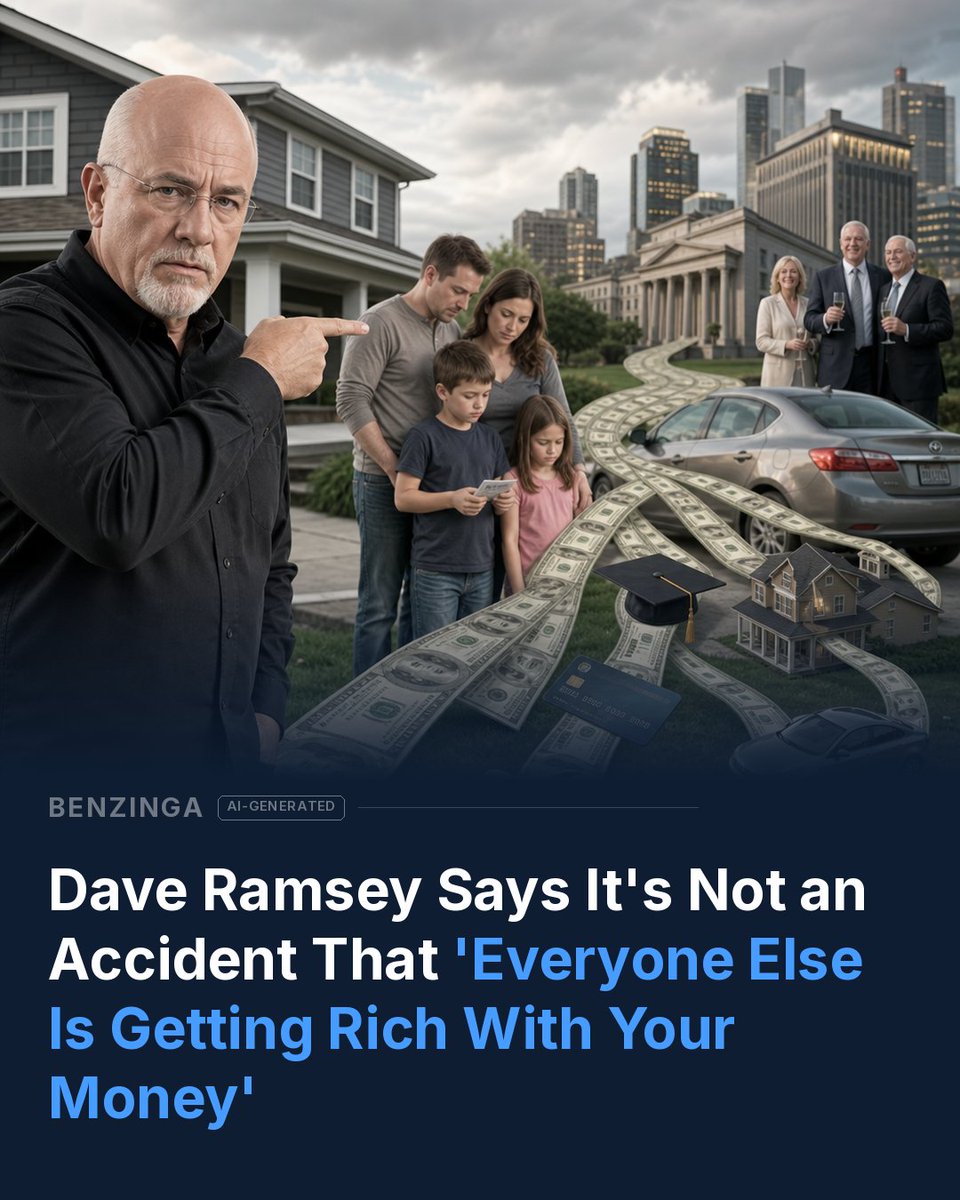
Dave Ramsey Says It's Not an Accident That 'Everyone Else Is Getting Rich With Your Money' Dave Ramsey argues that debt quietly funnels people's paychecks to lenders, retailers and credit card companies, leaving them to enrich everyone but themselves. As he puts it, 'This is not an accident. Everyone else is getting rich with your money, and you're helping them.' His core claim is that Americans have been sold the idea that carrying debt is normal, and that acceptance keeps them stuck. Ramsey says ordinary people drift along wondering why they feel broke while lenders operate with intention, profiting from customers who stay in debt by design. Ramsey ties wealth-building back to income rather than borrowing. He points out that most self-made millionaires build their money by saving and investing what they earn, noting that less than 10% of them inherited it. He also highlights the scale of the problem, saying about 70% of Americans live paycheck to paycheck even in one of the wealthiest nations on earth. He compares that experience to being a rat on a wheel, working constantly without real progress because income is already committed to monthly payments before it can be invested. The bottom line in Ramsey's framing is simple. Every dollar sent to a lender is a dollar that cannot be invested, and over time that steady leak caps how much wealth a household can ever accumulate. Breaking the cycle, he argues, starts with refusing to treat debt as normal.
Best Tweets by Topic

