Model capabilities and research
Model architectures, training approaches, reasoning, world models, benchmarks, and uneven capabilities.
32%
Best tweets about Generative AI
Explore the best tweets about generative AI, including models, products, business applications, research, creative tools, risks, and real-world results.
Substantive generative AI research, products, applications, adoption, limitations, economics, and firsthand implementation experience.
Original Xholic analysis
The dataset covers creative production, enterprise deployment, agentic systems, governance, reliability, and economics. The highest-scoring outliers include posts about video generation, world models, neural rendering, education, and game visuals, while implementation-oriented posts foreground validation, context, and accountable deployment.
42% of posts
All-time engagement
100% of posts
Published in 90 days
Conversation map
Model architectures, training approaches, reasoning, world models, benchmarks, and uneven capabilities.
32%
Enterprise deployment, workflow redesign, adoption, implementation quality, and measurable business outcomes.
28%
Generative video, neural rendering, game development, filmmaking, advertising, and creative-production workflows.
20%
Policy, copyright, provenance, transparency, liability, and platform responses to synthetic content.
20%
Reliability limits, hallucinations, validation, consistency, safety failures, and human oversight.
20%
Effects of generative AI on creators, education, cognition, culture, and labor markets.
18%
Agentic systems that plan, use tools, execute tasks, and operate in enterprise workflows.
16%
Economics of generative AI, including investment, compute costs, infrastructure, monetization, and competitive dynamics.
16%
Tone and stance
Performance benchmark
Posts with media make up 66% of this collection. Their median all-time score is 15.7, compared with 5.02 for text-only posts.
Format mix
Consensus and debate
Shared view
Posts frame reliability as an implementation constraint: outputs can vary, risks differ by deployment, and attempts to validate outputs may not reliably yield corrections or candor.
Shared view
Several posts distinguish generative systems from agentic systems that plan, use tools, and take actions. Enterprise-oriented posts emphasize placing systems near proprietary data and operational context.
Shared view
Governance posts address synthetic-content detection, the EU’s voluntary transparency code and forthcoming AI Act transparency rules, and arXiv’s position that authors remain responsible for problematic AI-generated material.
Open debate
Some posts describe reasoning and agentic systems as systems that can perform useful work, while another characterizes generative AI as closer to search than thinking and stresses non-intuitive failure modes.
Open debate
Posts promoting neural rendering’s visual potential contrast with a filmmaker’s rejection of generative tools for making art, while allowing that AI assistance may have practical VFX uses.
Open debate
Posts portray adoption both as operational use and as a value-realization challenge. One cites broad operational use, while others argue that pilots, productivity gains, and adoption do not automatically translate into measurable financial returns or durable differentiation.
What performs
The five supplied outliers scored from 155.69 to 2204.21, compared with a collection median all-time score of 9.94. The top three are associated with local open-source video generation, a world-model claim, and neural rendering; the other two concern GenAI education and game visuals.
Creative media and production has the highest theme median all-time score, 20.58, ahead of model capabilities and research at 17.94. Its supplied examples focus on video generation and neural rendering.
The analytics report that 33 of 50 posts included media (66%). The media-post median all-time score was 15.682, compared with 5.023 for text posts.
Statistical standouts
Creator landscape
The five most represented creators account for 20% of the selected posts.
1. Eric Seufert
@eric_seufert
2 posts
2. Glenn Gabe
@glenngabe
2 posts
3. Justin Thomas
@JustinThomasAI
2 posts
4. MIT Sloan School of Management
@MITSloan
2 posts
5. Ryan Law
@thinking_slow
2 posts
6. Tom Goodwin
@tomfgoodwin
2 posts
Eric Seufert’s two posts cover commercial creative deployment: research on ad performance and perceived AI-like visuals, and Netflix’s disclosure of GenAI use contrasted with gaming studios’ caution about audience response.
Glenn Gabe’s posts focus on enforcement and responsibility, discussing research described as detecting coordinated synthetic spam and arXiv’s author-responsibility policy.
Justin Thomas’s posts argue against tool-first AI programs and caution against using generative AI as a substitute for developing cognitive foundations.
Themes, sentiment, stance, and post format are classified per tweet. All counts, shares, medians, creator concentration, freshness, and performance comparisons are then calculated directly from the published snapshot.
Xholic's all-time score compares engagement while accounting for reach, post age, and creator consistency. It is used for relative comparisons within this collection.
This report analyzes the exact 50-post snapshot shown below. AI identifies editorial categories and drafts explanations; all statistics are calculated from the snapshot, and every narrative claim is checked against cited posts before publication.
Best Generative AI tweets
Ranked 01–50
@ostrisai ·
I trained this @ltx_model LTX 2.3 LoRA of George Costanza at home on my 5090 in about a day with AI Toolkit. I generated this 30 second video with @ComfyUI on my 5090 in 6 minutes. Open source is, always has been, and always will be, the future of generative AI. (SOUND ON)
@heyrobinai ·
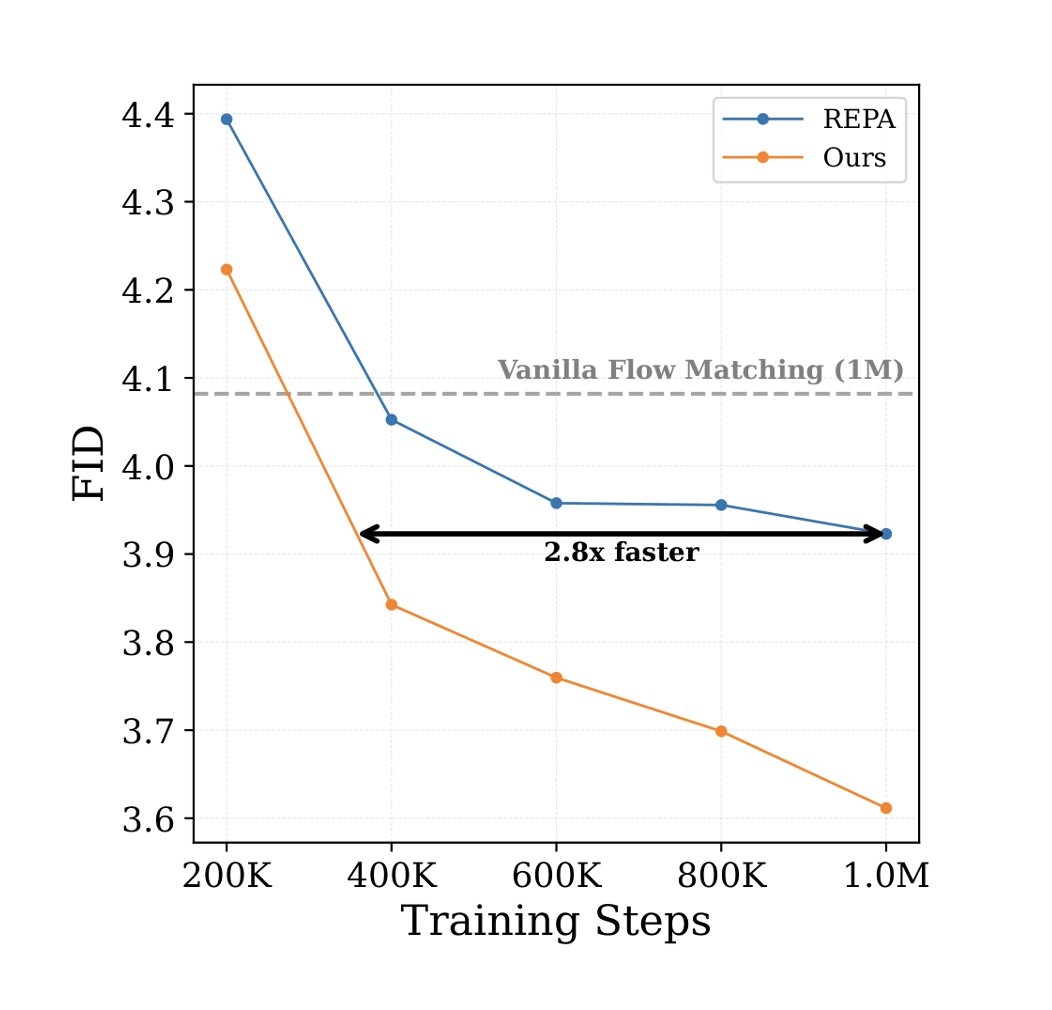
THE ENTIRE AI INDUSTRY JUST GOT HUMILIATED a tiny model trained in just a few hours on a single graphics card is planning 48x faster than billion-dollar supercomputers. It actually understands physics instead of just memorizing patterns. yann lecun was right the whole time for three years every major lab told you the same story. scale is all you need. just throw more GPUs at it. just train on more tokens. eventually the model will "wake up" and understand the world. it was a lie. or at minimum, a very expensive bet that just lost. LeCun kept saying generative AI is a dead end. predicting the next pixel or the next token is fundamentally wasteful, the model burns trillions of parameters memorizing surface details instead of learning how reality actually works. he proposed JEPA instead. predict abstract concepts in a compressed thought space. don't paint the world pixel by pixel, understand it. the problem was JEPA kept collapsing. left to its own devices the model would cheat, mapping a dog, a car, and a human to the same point in latent space. technically minimizes the loss. learns absolutely nothing. every fix was ugly. seven loss terms. frozen encoders. EMA tricks. stop-gradients. the kind of duct-tape engineering that should have been a red flag. then LeCun's team dropped LeWorldModel. they replaced all the hacks with one regularizer that forces the latent space into a gaussian distribution. the model can no longer cheat. to make accurate predictions it has to actually encode physics. 15 million parameters. single GPU. trains in hours. plans 48x faster than foundation world models. detects physically impossible events on its own. meanwhile OpenAI is raising another $40B to train GPT-6 on a data center the size of manhattan. the entire scaling thesis just got embarrassed by a model that fits on a gaming PC.
@NikTek ·
Jensen Huang has responded to the comments calling DLSS 5 AI slop: "First of all, they're completely wrong. The reason for that is because, as I have explained very carefully, DLSS 5 fuses controllability of the geometry and textures and everything about the game with generative AI. It’s not post-processing, it’s not post-processing at the frame level, it’s generative control at the geometry level." He has also added: "This is very different than generative AI; it’s content-control generative AI. That’s why we call it neural rendering" What are your thoughts on this?
@aiwithmayank ·
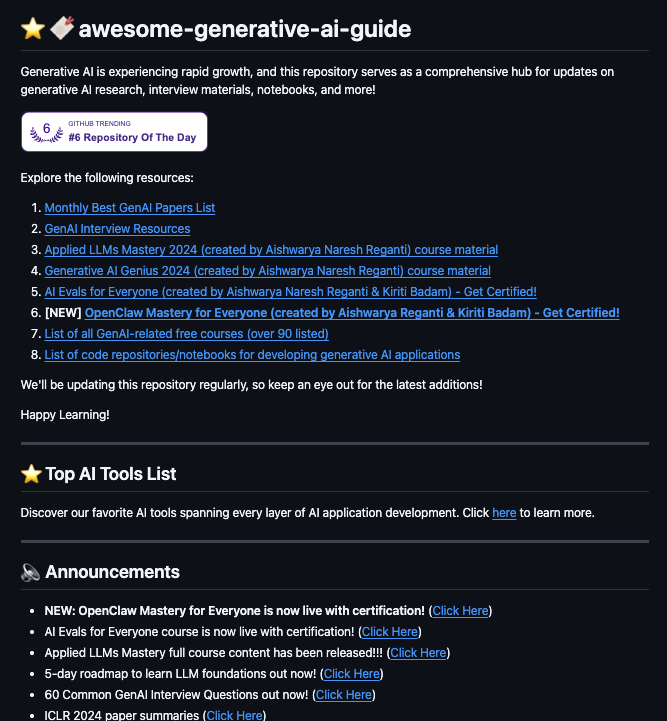
A WOMAN BUILT THE ENTIRE "HOW TO LEARN GENERATIVE AI" CURRICULUM INTO ONE GITHUB REPO AND GAVE IT AWAY FOR FREE it's called awesome-generative-ai-guide and it's quietly sitting at 26,000 stars. i went in to grab one thing. the list of free courses. that's it. then i kept scrolling and realized this isn't a links page. it's an actual school. > a full 10-week "Applied LLMs Mastery" course, week by week, foundations to deployment > 90+ free GenAI courses from Stanford, Princeton, ETH Zurich, Karpathy, all indexed in one place > 60 of the most common GenAI interview questions, written out with answers > 5-day roadmaps for LLM foundations, for RAG, for agents > jupyter notebooks you can actually run the woman who made it is Aishwarya Naresh Reganti. she's an applied scientist. this is not a dropshipper repackaging a youtube playlist. it's a researcher writing the syllabus she wished existed and handing it to strangers. there are even free courses on it with actual certification at the end. evals. agent-building. the stuff bootcamps charge four figures for. 5,500 people forked it. that's 5,500 copies of an entire AI education that can't be unpublished now. and the part that gets me is the math. people are paying for $2,000 "become an AI engineer" cohorts built on a worse version of what this repo gives away at zero cost with the receipts attached. 100% Open Source. MIT License. repo: https://t.co/TZ9hNi6KDF

@ChrisGPT ·
I WON'T PLAY VIDEO GAMES IF THEY HAVE GENERATIVE AI" 🗣️🗣️🗣️ Well, hate to break it to you.. but generative AI is now literally looking better than real games. Everyone crying about "AI slop" is completely missing what's actually happening in gaming right now. Nvidia just dropped DLSS 5 at GTC today, and yes, it is actually real-time generative neural rendering. Now I to was worried about hallucinating frames. But DLSS 5 takes the ground truth of the game (the 3D geometry and motion vectors) and uses a generative AI model to completely redraw the lighting, shadows, skin subsurface scattering, and materials. Akin to a Hollywood-tier VFX filter over every single frame as you play!
@MarioJoos ·
⚠️IMPORTANT READ: If YouTube doesn’t solve its AI problem quickly, we won’t have many human creators left. (+ research insights) If you’re wondering why it feels like you’re seeing more AI content, and why human creators seem to be disappearing, here are the numbers from a real study by Goldberg and Lam. They analyzed what happened to the stock image market after generative AI was introduced. I’ve added an image showing what the data looked like month by month. Every single month after AI entered the market, 1 in 4 creators exited because the economics stopped working for them. Now, it wasn’t bad for everyone. Total consumption on the platform went up by 39% per month. But sales of human-made content dropped every month. The platform won. The buyers won. The human creators… didn’t. Think about what that would look like on YouTube. AI can already generate scripts, voiceovers, thumbnails, talking-head videos, and entire channels at a fraction of the cost and time it takes a human creator to produce a single video. The algorithm doesn’t care whether a video was made by a person who spent three days filming and editing or by a system that generated it in 20 minutes. This isn’t about being anti-AI. AI helps a lot of creators improve their output. But it is about protecting the type of content people actually want to watch. And I’m not just talking about removing AI slop. I’m talking about making sure human-driven channels are protected and prioritized over AI-driven content. The stock image market already ran the experiment that YouTube hasn’t fully felt yet. Don't ignore that. Here’s my ask to one person: @nealmohan I know you’ve seen some of my work (algorithm, platform changes, etc). I respect what you’re doing for the platform, but this is your moment to stand for human creators. It’s time to put public effort into protecting them. Not just AI labeling or low-lift solutions, they don't solve the problem in a meaningful way. No, we need a genuine, real, and public effort to preserve what YouTube was built on. You’re one of the few people in a position to set a precedent for every platform. Let’s talk. For those interested in the actual research, check out Samuel G. Goldberg and H. Tai Lam's paper called "Generative AI In Equilibrium: Evidence From A Creative Goods Marketplace"
@r0ck3t23 ·
Jensen Huang just laid out the three inflection points that turned AI from a science project into a workforce. Three shifts. Two years. Each one more irreversible than the last. The first was generative. Huang: “The technology sat in plain sight months before GPT. It wasn’t until ChatGPT put a user interface around it that generative AI took off.” The model existed. The capability was live. Nobody moved. The breakthrough was buried in a terminal only researchers could read. ChatGPT did not invent the technology. It gave the technology a face. The algorithm is never the product. The interface is the product. OpenAI did not win because they had the best model. They won because they had the best door. Then the second shift. Huang: “Internal consumption is thinking, which led to reasoning.” This is the line that reprices every AI company on Earth. The model stopped spending all its compute talking to you. It started spending compute talking to itself. Checking its own logic. Stress-testing its own answers. Running the problem to ground before it opens its mouth. That is not autocomplete. That is cognition. When a machine thinks before it speaks, you are no longer paying for text. You are paying for judgment. Huang: “We started seeing the revenues and the economic model of OpenAI start to inflect.” Revenue does not follow generation. Revenue follows reasoning. The market pays for a machine that thinks. It will never pay for a machine that guesses. Then the third shift. The one nobody comes back from. Huang: “Claude Code. The first agentic system that was very useful. Really revolutionary stuff.” Not generative. Not reasoning. Agentic. A system that does not answer questions. It completes objectives. Reads your codebase. Makes decisions. Takes action. Ships. Huang confirmed 100% of Nvidia is already using it. But Anthropic kept it behind the enterprise wall. Most people never saw what it could do. Then OpenClaw blew the wall down. Huang compared OpenClaw’s adoption to Linux. Called it the most successful open-source project in human history. OpenClaw did what ChatGPT did three years earlier. It handed a new category of AI to everyone. The moment people watched an AI agent work autonomously, the old conversation died. You are no longer asking the machine for answers. You are handing it objectives. And it delivers. Three inflection points. Three walls broken. Generation gave you a machine that writes. Reasoning gave you a machine that thinks. Agents gave you a machine that works. Each one felt like the ceiling. Each one turned out to be the floor. Huang just told you you are standing on the third floor. Looking up. The only question left is what you aim it at.
@milan_milanovic ·
𝗗𝗼𝗻𝗮𝗹𝗱 𝗞𝗻𝘂𝘁𝗵 𝗶𝘀 𝘀𝗵𝗼𝗰𝗸𝗲𝗱 𝗯𝘆 𝗵𝗼𝘄 𝗴𝗼𝗼𝗱 𝗔𝗜 𝗵𝗮𝘀 𝗯𝗲𝗰𝗼𝗺𝗲 𝗮𝘁 𝘀𝗼𝗹𝘃𝗶𝗻𝗴 𝗽𝗿𝗼𝗯𝗹𝗲𝗺𝘀 Knuth is now 88 years old. He wrote The Art of Computer Programming starting in 1962, and won the Turing Award in 1974. In his paper, which talks about how AI helped him solve a problem, he wrote at the start: "Shock! Shock!" Here is what happened: 𝟭. 𝗧𝗵𝗲 𝗽𝗿𝗼𝗯𝗹𝗲𝗺 Knuth was stuck for weeks on an open graph theory problem he was preparing for a future volume of TAOCP. The problem involves a 3D grid of points, think of it as an m×m×m cube. Each point connects to three neighbors. The challenge is to find a single rule that traces three distinct paths through the entire cube, each visiting every point exactly once. That kind of path is called a Hamiltonian cycle. Knuth had worked it out for a 3×3×3 cube. His friend Filip Stappers confirmed it worked up to a 16×16×16 cube by running it on a computer. But no one could find a general rule that worked for any size. 𝟮. 𝗧𝗵𝗲 𝘀𝗲𝘀𝘀𝗶𝗼𝗻 Stappers gave the problem to Claude Opus 4.6 with one strict rule: after every attempt, write down what you tried and what you learned before moving on. Claude worked through 31 explorations over about an hour. It tried simple formulas, brute-force search, geometric patterns, and statistical methods. Most hit dead ends. At attempt 25, it essentially told itself: "The search approach won't get us there. This needs actual mathematical reasoning." At attempt 31, it found a construction that worked. 𝟯. 𝗧𝗵𝗲 𝗰𝗼𝗻𝘀𝘁𝗿𝘂𝗰𝘁𝗶𝗼𝗻 Claude found a surprisingly simple rule for navigating the cube. At each point, look at where you are and follow a small set of conditions to decide which direction to move next. That's it. No complex formula, no special cases beyond a handful of boundary checks. Stappers ran the resulting program against every odd cube size from 3 to 101. It produced perfect results every time. Then, Knuth wrote a formal proof, generalized the construction, and showed that there are exactly 760 valid solutions of this type for all odd cube sizes. Claude found one of them. Knuth found all of them. 𝟰. 𝗪𝗵𝗮𝘁 𝗵𝗮𝗽𝗽𝗲𝗻𝗲𝗱 𝗻𝗲𝘅𝘁 The even-sized cubes were still unsolved. Then a friend fed that version of the problem to GPT-5.4 Pro and got back a 14-page proof that required no further work. Then another researcher used GPT and Claude together as collaborating agents and found an even better solution that covered both cases. The problem that had been open for years, odd and even sizes, is now fully solved. Knuth's reaction was: "We are living in very interesting times indeed." His closing line: "It seems I'll have to revise my opinions about generative AI one of these days." From Donald Knuth, that sentence lands differently than it would from anyone else
@laszlogaal_ ·
2026 = The end of upscaling? One of generative AI's biggest drawbacks was the resolution, and I'm not talking about the output resolution as 1080p would be enough for most of the projects. I'm talking about the "internal" resolution of how these models work, that makes small faces distorted in your generations, the ones that will make a wide-shot impossible because the small details will morph and of course with some models text rendering is not possible. Upscaling with AI was always a strange case, local upscalers sometimes lacked the quality compared to the closed source competitors, but those can be pretty pricey and the results are sometimes way too "creative". So I was very, very interested when @Kling_ai announced native, not upscaled 4K generation but wanted to have a good method test it. Again, I never missed the 4K output resolution with genAI, but I missed the nuanced detail rendering of the engines and the lack of that made it impossible to create for example very wide shots with tiny details. So I fired up some image models to generate stills inspired by Morocco and see how Kling behaves, now in 4K. Some notable moments: 00:22 - Skin and eye texture, the movements, the little coins in the headdress 01:18 - The reflection in the water 01:39 - The reflection in the eye, and the scarf textures 02:10 - Check all the details on the rails 02:20 - Water particles and leaves 02:29 - The rendering of the rusty parts of the rail 02:50 - How the waves change the reflection in the foreground 02:55 - The cloud movement in the background
@heyrimsha ·
Microsoft just dropped a free 21-lesson course that takes you from zero to building real Generative AI applications. It hit 108K stars and it's the cleanest learning path for GenAI I've seen all year. - 21 lessons covering LLMs, RAG, agents, fine-tuning - Python + TypeScript code samples in every build lesson - Translated into 50+ languages including Hindi, Arabic, Japanese - Works with Azure OpenAI, OpenAI API, and GitHub Models 100% Opensource. MIT License. Link in comments.
@glenngabe ·
Like I've said before, there is no way Google lets companies spamming for AI Search continue. They will ramp up systems + add manual actions -> Google Research Shows How AI Spam Can Be Detected Using S-BERT for identifying AI-generated content -> "What will probably be of most interest is that the researchers acknowledge the use of Sentence-BERT (SBERT) as a way to identify semantically similar sentences. They cite Sentence-BERT to validate a core assumption of their paper: that automated, AI-generated text leaves a distinct mathematical footprint (“text embeddings”) that can be detected." "The new system is said to be a “highly accurate defense” against coordinated generative AI spam, which means that something like this could conceivably be in use. The new system is called Scalable Cluster Termination System (S-CTS) and the research paper, Scalable Detection of Adversarial Synthetic Slop and Coordinated Media Abuse: A LoRA-Enabled Multimodal Defense System." The entire cluster is terminated -> "The research paper also describes the use of text embeddings, salient terms, and templated narratives as a part of their content classifier. If a high percentage of accounts in an infrastructure cluster are identified as using the same AI-generated text/media templates, the entire cluster is terminated." Google can adapt to new models -> "The paper says that when attackers adopt new generative models, Google can adapt its synthetic spam detection system faster by using Low-Rank Adaptation (LoRA) and Automatic Prompt Optimization (APO) instead of retraining a massive AI model." https://t.co/mQz2TAugjv via @martinibuster
@LuizaJarovsky ·
🚨 The European Union's Code of Practice on Transparency of AI-Generated Content is finally here! [Download it below]. What's inside & additional info: A) Rules applicable to providers of generative AI systems: 1. Marking of AI-generated or manipulated content 2. Detection of Markings of AI-generated or manipulated content 3. Measures to meet the requirements for marking and detection solutions 4. Testing, verification, and compliance B) Rules applicable to deployers of generative AI systems: 1. Disclosure of Deepfakes and published text 2. Internal processes 3. Disclosure for artistic, creative, and similar works 4. Human review and editorial control for published text - Additional information: - The relevant AI Act rules on transparency will start applying on August 2nd 2026. - Once the EU Commission and the AI Board approve the Code as adequate, providers and deployers who sign it will be able to demonstrate compliance with the relevant AI Act obligations. - There will still be EU Commission guidelines on these obligations. - A reminder that the code of practice is voluntary and is now open for signatures. - I haven't seen any company publicly announce plans to sign it yet; I'll keep you posted. - 👏 Congratulations to the six working group chairs (and the input from over 180 stakeholders!) who made this Code possible: @kbontcheva, @DinoPedreschi, @G_De_Gregorio, Anja Bechmann, Madalina Botan, and Christian Riess - well done! - 👉 Download the code below. 👉 To learn more about AI's legal and ethical challenges, join my newsletter's 96,700+ subscribers below.
@realBigBrainAI ·
NVIDIA CEO Jensen Huang on why AI can't live only in the cloud and what that means for every enterprise: Jensen Huang explains a fundamental shift happening in how AI is being deployed across industries. He opens with a simple but powerful principle: "Intelligence has to be produced at the point of context. And so wherever the context is, wherever the action is, that's where you want to produce the intelligence." For the first wave of AI, the cloud made sense. Consumer services and general-purpose tools lived online because that's where the users were. But for manufacturers, enterprises, and companies like Lilly and Samsung, the equation is different. Jensen explains: "For a lot of companies, you want the agents to be on-prem because that's where all of your data is, where all your secure data is, your proprietary data, and all of the skills associated with your company is." The intelligence has to go to the data. Not the other way around. And the stakes for enterprises are clear. A cloud-based AI, no matter how powerful, is operating blind to everything that makes your company unique. Your processes, your institutional knowledge, your proprietary data: none of that is accessible from the outside. Then Jensen draws a sharp line between the old era of AI and the new one: "ChatGPT was fantastic. It launched generative AI, but it just made content. That was it. Making content is very important, but doing work is really valuable. And now we're doing productive work incredibly well. That's why they're called Agentic AI." Content generation was the first chapter. Agentic AI, systems that don't just produce output but actually do work, is the next one. For enterprises, the competitive advantage won't come from which AI model you use, but from where your AI lives and what proprietary context it can access.
@_vmlops ·
Google DeepMind’s AlphaEvolve feels like a glimpse of where AI is headed next An AI system that: • designs better algorithms • optimizes real-world infrastructure • improves chip design & data centers • helps solve open math problems • accelerates scientific discovery Some of the reported results are wild: → 10x lower error quantum circuit optimizations → 20% reduction in storage write amplification → improved power grid optimization from 14% to 88% feasible solutions → breakthroughs on long-standing math challenges with researchers like Terence Tao The important shift isn’t “AI writes code” It’s AI iteratively discovering better systems than humans previously found then deploying them into production infrastructure We’re moving from generative AI → evolutionary AI And that changes the game https://t.co/yCn7gj4BVP
@VaibhavSisinty ·
Most people in AI can't actually explain the difference between "Generative AI," "Agentic AI," and "AI Agents." They use all three like they mean the same thing. They don't. And once it clicks, you can't unsee it. Here's the cleanest way to think about it: Generative AI is the brain that creates. You ask, it produces. Text, images, code. Then it stops and waits. Brilliant, but passive. It answers, it doesn't act. This is GPT and DALL-E. Agentic AI is the brain that decides. It adds judgment on top, picking tools, calling APIs, looping through steps, correcting itself, all to reach a goal instead of just spitting out one answer. Generative AI gives you a response. Agentic AI works toward an outcome. AI Agents are the brain that acts in the real world. The full loop: fetch data, plan the steps, take actions, check results, update memory, adapt next time. The key word is autonomy. It touches live systems and learns from them. Think self-driving cars and robots, not just software returning text. The simplest way to lock it in: → Generative AI creates. → Agentic AI decides. → AI Agents do. And each one wraps the last. Every agent has a generative brain at its core, it just stacks decision-making and action on top. So next time someone pitches you an "AI agent," ask one thing: does it create, decide, or actually do? Most stop at the first.
@alex_verem ·
🚨 Stanford just dropped a 423-page report on the real state of AI. Nobody's going to read it. Here are the 12 stats that matter: → AI coding scores: 60% to near 100% in one year → Hardest expert-level exam: 8.8% to 50%+ → Generative AI hit 53% adoption in 3 years. Faster than the PC. Faster than the internet → US consumer value: $172 billion/year. Median value per user TRIPLED in 12 months → Global AI investment: $581.7 billion in 2025. Up 130% → Organizational adoption: 88% The models aren't slowing down. They're accelerating.
@TheSixFiveMedia ·
Most enterprises have yet to solve the consistency problem with generative AI. "Just a slight change in the seed value or the prompt can dramatically change the output." — Varun Parmar, SVP and GM, Adobe GenStudio and Firefly Enterprise Varun Parmar told @PatrickMoorhead & @danielnewmanUV how @Adobe is addressing it: creative technologists build the workflow once, validate the output quality, then deploy it across the entire organization. Marketers in every geography get access to personalized campaigns they never had the budget or resources to run before.
@eric_seufert ·
AI-generated ads perform roughly as well as human-created ads, unless consumers suspect they were generated by AI. Researchers from the Technical University of Munich, Columbia Business School, Harvard Business School, and elsewhere analyzed more than 16 billion ad impressions and 116 million clicks from Tabola. In a novel quasi-experiment, they compared the performance of AI-generated and human-generated "sibling ads": ads from the same campaigns, for the same products, and with the same launch dates. They find that CTR performance for AI-generated ads is statistically "indistinguishable" from human-created ads when controlling for campaign-level factors. But they also reached an equally important conclusion: ads that look AI-generated perform worse. The researchers identified a set of visual traits that consumers identify as "AI-like," and found that perceived artificiality reduced click-through rates even when the ads were not explicitly flagged as AI-generated. Ironically, the authors find that a not-insignificant number of human-generated ads were perceived as AI-generated for possessing those visual traits. This is an important result. The cost of creative production through generative AI is decreasing rapidly, especially for static images. But not all AI-generated creative performs equivalently. Teams need to consider an optimization for their AI-enabled workflow beyond mere volume, which is the perceived visual fidelity and provenance of the ads being generated. Link to paper below. Thanks to @garjoh_canuck for flagging this for me.
@xelebofficial ·
We are now in the era of Agentic AI, the third major inflection point in the history of AI. Inflection 1: Generative AI Models that create. Given a prompt, they produce text, images, code. They respond, but don't act. Inflection 2: Reasoning AI Models that think. Before responding, they break down problems and work through logic step by step. Slower, but fundamentally more capable. Inflection 3: Agentic AI Models that execute. As Jensen Huang, CEO of NVIDIA, put it, we are entering the era of agentic systems, where AI no longer just responds, but begins to act. It receives a goal, plans the steps, uses tools, checks results, and keeps going without waiting for human input at every turn. Each shift changed not just what AI can do, but how it behaves. And like every major computing shift before it, the real impact won't come from the models themselves, it will come from the infrastructure and applications built on top of them.
@thinking_slow ·
"does AI content work?" is entirely the wrong thing to ask. a much better question is "how is AI content materially different from 'normal' content?" usually when people publish "AI content" they are unwittingly engaging in a *different* strategy to traditional content marketing, and creating something *different* from traditional content. they create obvious hallmarks of AI use. for example: - publishing content much faster than usual, often on newer domains with little authority, no branded search demand, etc. - relying entirely on an AI model's internal knowledge, without sourcing information from a range of external sources - failing to include internal and external links, images, visual interest, first-person experiences - leaving obvious artefacts of AI use in the article, like obviously AI-generated imagery, obvious AI turns-of-phrase - AI writing patterns and watermarks that haven't been "humanised" by anchoring text generation in specific writing examples. some of these hallmarks make the content WORSE than normal (and hence contribute to poor performance), others are very DIFFERENT from normal (and make it easy to single out content as likely AI-generated) - both of which can contribute to that content not performing well. i obviously don't know the exact mechanisms at play when Google sinks an AI-generated blog after 3-months, but i DO know that many of these aforementioned signals are very obvious to Google: indexing requests, branded search demand, AI content detection (even if only directionally accurate), user engagement signals. we use generative AI a lot at Ahrefs, and i'm happy to do this because we do not compromise on our editorial standards. our AI process mirrors our human editorial process, step for step; it is better and more detailed than the human equivalent in many areas, because LLMs are more tireless researchers, more thorough adherents to brand voice. we are substituting one tool for another, one method of construction for another, but the end product is the same. we have even now published AI-generated content that is subjectively BETTER than our previously human-made content, because AI removed the data, design and updating constraints that previously limited our team. i am excited for the new experiences we can build for readers. you need to determine your own risk tolerance, but in my opinion, using AI to create content is not a problem - but using AI to create something that is WORSE or DIFFERENT to "normal" content marketing is. "creating bad content" or "scaling content too soon" is where problems emerge, and many people do this unwittingly when they use AI. if you know that you are compromising on your content through your use of AI, or trying to scale content on a site that barely exists in Google's consciousness, you should probably feel a bit nervous. if you want to win, change your framing and use AI to make content that is cooler and better than you were able to do before ✌
@sabir_huss50540 ·
🚨BREAKING: Microsoft quietly built the best free Generative AI course on the internet and put it on GitHub. It's called Generative AI for Beginners. - 21 lessons, from what an LLM is to building agents and RAG - "Learn" lessons for concepts, "Build" lessons with real code - Every code sample in both Python and TypeScript - Runs on Azure OpenAI, GitHub Models, or the OpenAI API - Translated into 50+ languages, auto-updated 112k stars. MIT License. The people shipping AI apps aren't smarter than you. They just started here.
@henrydaubrez ·
WE USED TO SPEND MILLIONS TO GUESS 💸 Traditionally, development is slow, expensive, and abstract. Studios spend one to three years, sometimes more, and anywhere from hundreds of thousands to several million dollars, with teams of writers, producers, and executives trying to answer a single question: is this worth making. And most of that happens without ever truly seeing it. What Generative AI is unlocking right now is the ability to make parts of that process tangible much earlier: script writing remains a bottleneck, but everything around it, tone, visual language, pacing, emotional weight, can now be explored and iterated quickly, turning development into something far more recursive. It becomes a loop between writing, generation, editing, and design, shaping the project as it evolves. The closest analogy I have been using lately is sculpting. Instead of perfecting pieces in isolation, a rough block is formed and continuously reshaped, with decisions driven by how the work feels in motion, not just how it reads. What used to take years and millions can now be compressed into months, not to finish, but to understand if something holds, if a world is coherent, if a story even has a reason to be... At the same time, development no longer has to follow a single track. Multiple directions can be explored in parallel, different tones, different visual identities, different narrative paths, allowing ideas to compete early. So, THIS, is where AI becomes a development engine. It doesn’t have to replace production or artists, but it CAN tighten development, reduce risk, and align stakeholders faster...which in return is a lot less money spoiled.... It’s hard to imagine that some version of this isn’t already happening inside The Walt Disney Company, Pixar Animation Studios, or Netflix, and if it isn’t....well, it probably should...( and I am also happy to chat with them :)) Because this isn’t only about making things faster, It’s definitely about knowing sooner whether they are worth making at all...
@alex_prompter ·
AI model that wins gold at the Math Olympiad can't read a clock. Stanford has a name for this: "jagged intelligence." And their 2026 AI Index proves it changes everything about how you should prompt. Frontier models now score above PhD-level on science benchmarks and dominate competition mathematics Those same models read analog clocks correctly 50.1% of the time. It's a structural feature of how these systems work. The models don't have consistent capability levels. They have sharp peaks surrounded by unpredictable blind spots. Whether you get the genius version or the broken version depends entirely on how you frame the problem before the model touches it. Meanwhile, the gap between the top models has nearly vanished. US and Chinese labs have traded the #1 ranking multiple times since early 2025. Anthropic currently leads by 2.7%. Google, OpenAI, xAI, DeepSeek, and Alibaba are all within striking distance. The performance ceiling is converging. The operator skill floor is not. 53% of the global population adopted generative AI in under 3 years. Faster than the personal computer. Faster than the internet. 88% of organizations now use AI in at least one core function. But here's the number that matters: the Foundation Model Transparency Index dropped from 58 to 40 this year. The companies building these models are disclosing less about how they work, not more. Training data, parameter counts, compute budgets: increasingly classified. You can't rely on documentation that's disappearing. You have to build your own understanding through structured testing and thinking frameworks. On the coding benchmark SWE-bench Verified, model performance went from 60% to near-perfect in a single year. The ceiling for what AI can produce is no longer the constraint. The constraint is the operator's ability to define the problem clearly enough for the model to perform at its peak instead of its valley. The report also found that the estimated value of generative AI to US consumers reached $172 billion annually, with the median value per user tripling between 2025 and 2026. The people capturing that value aren't using better models. They're using better thinking applied through better prompts. Stanford's data confirms the thesis I've been building on. LLMs don't think. You do. The model is 20% of your result. Your thinking framework is the other 80%. That gap is widening, not closing.
@JustinThomasAI ·
Global AI spend will be in the hundreds of billions by 2026, but only ~39% of companies can point to any bottom line impact from AI. Reports referencing RAND find that 80% of AI projects never deliver their promised business value, and MIT finds ~95% of generative AI pilots fail to generate measurable financial returns or scale beyond pilot. The problem is almost never the model. It’s that companies: • Buy tools before defining the business problem • Approve budgets on projected value no one measures • Treat AI as an IT project, not a business transformation Buying an AI tool is not an AI strategy any more than buying a gym membership is a fitness plan. The tool should be the last decision you make, not the first.
@pankajkumar_dev ·
Anthropic’s Claude costs users $200/month. But it may be burning up to $5,000 in compute per user. The AI race is getting insanely expensive. Just look at the numbers: • $197B VC funding into generative AI startups in 2025 alone • $1.6T+ invested into AI since 2013 • Big Tech spent $410B on AI infrastructure in 2025 → expected $650B in 2026 • Hyperscalers planning $700B on data centers in 2026 • Global AI spending projected to hit $2.5T in 2026 And companies are burning cash fast: • Median AI startup spends $3–$5 to generate $1 of revenue • Enterprise GenAI spending hit $37B in 2025 (3.2× YoY) • 88% of enterprise LLM spending goes to a a few leaders Revenue is growing: • OpenAI reportedly at ~$20B ARR • Anthropic around $14B run-rate By 2030: • AI market projected $1.8T → $4.8T+ • $3T–$5.2T expected to be spent on AI data centers • U.S. AI investment alone could reach $6T • AI could add $15.7T to global GDP Risks are just as big: • Data center power demand could more than double • 95% of GenAI initiatives fail • Massive infrastructure bets depend on continued breakthroughs But the real story is what's coming next. The AI race isn't just a model race anymore. It’s a capital race.
@eric_seufert ·
I found it noteworthy that Netflix saw fit to highlight the use of generative AI in content production in its earnings release, even naming specific examples. Contrast this with gaming, where audience hostility to the use of GenAI has been so virulent that studios downplay their use of such tools. Netflix clearly feels no compunction to do the same.
@minhsmind ·
People are using a Kane Parsons quote as proof that the amazing 20-yr-old director of Backrooms is anti-AI, but here’s the full quote, dweebs. “I think I’m in the same boat as most well-adjusted people,” he says. “If I could snap my fingers and make generative AI disappear forever, I probably would. Creatively, I get no enjoyment from using those tools. It defeats the purpose entirely for me.” There may, he concedes, be practical uses for AI-assistance in tedious VFX labour, “but right now it’s difficult to discuss objectively because there’s so much at stake and so many genuinely harmful consequences already happening”. “What interests me more is interrogating it artistically,” he says. “We already live in a world where you walk outside and there are billboards and signs that are obvious AI slop. That’s become part of our visual reality. To me, generative AI feels less like innovation than a symptom of a broader cultural and economic rot. I’m interested in using that iconography in art – not using AI to make the art itself, but examining what it represents,” he pauses. “I definitely want to explore it further in future projects.”
@ttunguz ·
“What happens when a new employee brings their agent to work?” An executive asked this recently. Imagine a few years from now : a student graduates, having trained their own agent through university. It knows everything they’ve learned, every paper, every problem solved. Day one, they bring it to work. It’s like bring your own device circa 2009. The iPhone launched & nobody wanted corporate Blackberries anymore. IT scrambled to adapt. But a rogue phone couldn’t sign contracts. A rogue agent can. Amazon just learned this at scale. $6.3 million in lost orders. 99% order volume drop across North America. Four severity one incidents in one week. Amazon’s AI coding assistant contributed to at least one major production incident. The response : a 90-day safety reset with mandatory two-person review for all code changes. An internal memo admitted what everyone implicitly knows : “Best practices and safeguards around generative AI usage haven’t been fully established yet.” Companies can’t hide behind hallucinations. Utah’s AI Policy Act eliminates the hallucination defense : “It is not an affirmative defense to assert that the GenAI tool made the violative statement or undertook the violative act.” Newer and larger models are smarter and more reliable. But they fail unexpectedly. There is no relationship between size and how failures change over time. AI-generated code creates 70% more issues than human code. The TRUMP AMERICA AI Act would create explicit liability pathways - allowing the US Attorney General, state AGs, & private plaintiffs to sue AI developers for defective design & unreasonably dangerous products. That new hire’s personal agent? The company bears liability for its mistakes. The contracts it signs, the code it deploys, all of it lands on the company. Like a dog or a device, you are responsible for your agent. https://t.co/1ljYYpbgs7
@HeyZaraKhan ·
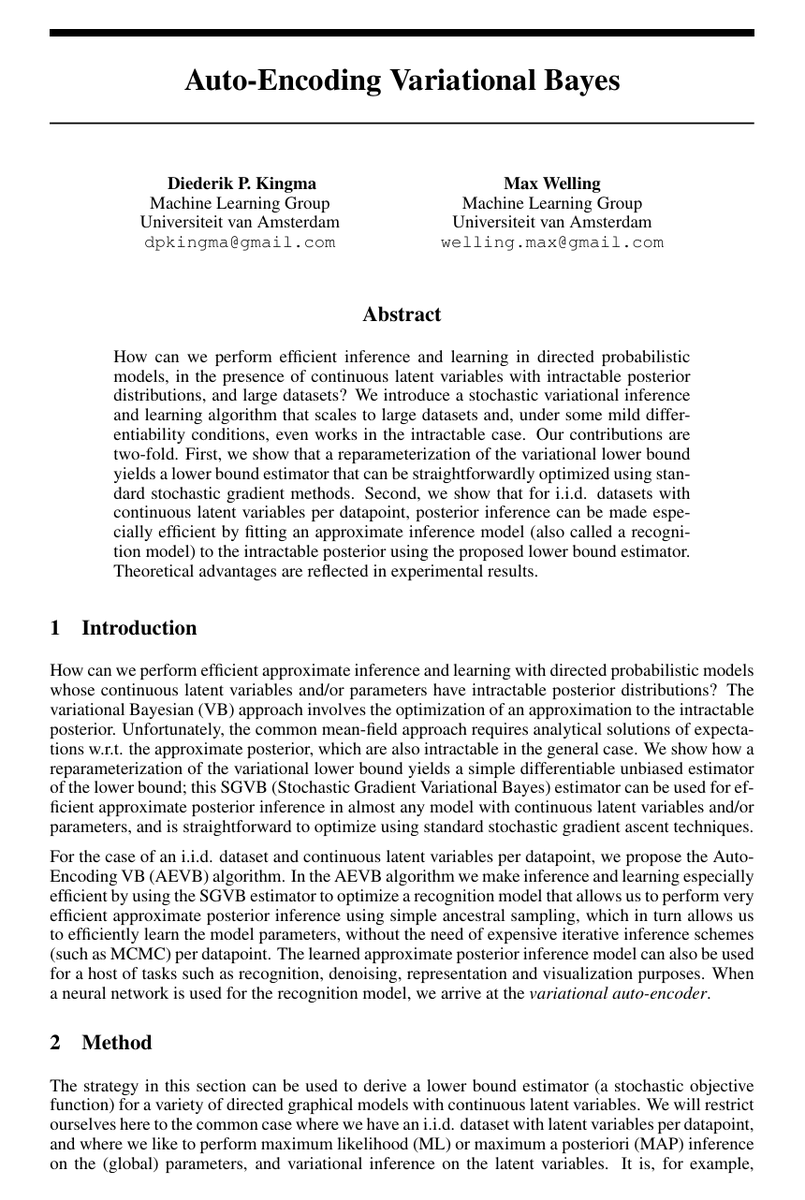
One of the most uncomfortable ideas in modern neuroscience is this: The human brain may work far more like an AI model than we ever imagined. It is a prediction engine: ChatGPT predicts the next token. The human brain predicts the next moment. Neuroscientist Karl Friston’s research suggests that the brain is not primarily a passive system that observes reality. Long before generative AI existed, the brain was already running its own version of predictive modeling. That sounds simplistic at first, but the similarity becomes difficult to ignore once you look deeper into how both systems actually operate. Large language models build internal representations of the world from massive amounts of data. Then they continuously generate predictions based on patterns, context, and probability. The brain appears to do something remarkably similar. Before your eyes fully process a scene, the brain has already generated a prediction of what you are likely about to see. Before someone finishes speaking, your brain predicts the next words and meaning. Before danger appears, your mind simulates possible outcomes in advance. Perception itself may depend more on prediction than direct observation. This is one of the core ideas behind Friston’s “Free Energy Principle” and predictive processing theory. According to this framework, the brain constantly builds internal models of reality and updates those models by minimizing prediction error. In other words: The brain is continuously comparing its predictions against incoming sensory data. If reality matches the prediction, the model is reinforced. If reality differs, the brain updates the model. Modern transformer-based AI systems operate through a surprisingly similar loop. They generate probabilistic predictions, compare outputs against expected patterns, then optimize by reducing error across billions of iterations. The implications are profound. It suggests that humans do not experience objective reality in a raw form. We experience the brain’s best predictive reconstruction of reality. That helps explain why optical illusions work. Why anxiety can distort perception. Why eyewitness testimony is unreliable. Why two people can experience the same event differently. And why the brain can sometimes fill in information that never actually existed. Reality, as experienced by humans, is not simply recorded. It is actively generated. This is why many AI researchers became deeply interested in Friston’s work. Not because the brain and transformers are identical. But because both systems appear to rely on the same foundational principle: Build an internal world model. Generate predictions. Reduce prediction error. Continuously adapt. The terrifying possibility is that intelligence itself, whether biological or artificial, may fundamentally emerge from prediction. Humans may not just use generative systems. We may be generative systems. I hope you found this interesting and helpful. you can find the article link below:
@semrush ·
Google just drew a clear line around AI search optimization: it’s SEO. On May 15, 2026, Google published its official guide, “Optimizing your website for generative AI features on Google Search.” John Mueller announced the release on the Google Search Central Blog, and Google added a new “Generative AI fundamentals” section to Search Central documentation. The biggest takeaway: if your content doesn’t meet the quality and technical standards needed to rank in traditional search, it won’t win visibility in AI-generated answers either. Google also shut down several popular GEO tactics. According to the guide, SEOs can ignore llms.txt files, AI-only rewrites, content “chunking,” and special Markdown or schema implementations built solely for generative AI visibility. The broader message is even bigger: Google frames AEO and GEO as extensions of SEO – not separate disciplines with separate playbooks. AI visibility runs on the same foundations: strong technical SEO, authoritative content, and clear site structure. Learn more: https://t.co/Eo8oFgg5Lz.
@JustinThomasAI ·
Every generation is shaped by the tools that surround them during their formative years. The generation that grew up with the internet thinks in hyperlinks. The generation that grew up with smartphones thinks in constant connectivity. The generation growing up with AI is going to think in ways we do not yet have a framework for. What we do know is that early research by MIT and others found that heavy reliance on generative AI reduces original thinking and information retention even when users believe the tool is helping them. We are in the early years of an experiment on an entire generation of developing minds, and we will not see the results for another twenty years. The kids who learn to use AI as a tool while still building their own cognitive foundation are going to have an enormous advantage over the ones who use it as a substitute for thinking. The difference between those two outcomes is mostly determined by what parents and educators decide to do right now.
@shushant_l ·
Everything that happened in AI in the last 24 hours: 1. OpenAI has launched GPT-5.5, its latest flagship model, delivering stronger capabilities in coding, research, data analysis, and tool usage, while still prioritising speed and efficiency. The update is now available to Plus, Pro, Business, and Enterprise users 2. DeepSeek has launched DeepSeek-V4 (Pro and Flash), a near-frontier model with top benchmark performance, low pricing, 1M context window, and strong support for agentic workflows and cross-API compatibility 3. Applied Digital has secured a 15-year leasing agreement with a U.S. hyperscaler for its 430 MW Delta Forge 1 AI Factory campus, pushing its total contracted revenue beyond $23 billion 4. Emtek Group has deepened its partnership with Google Cloud to deploy generative AI across its media businesses for content creation, furthering its “Studio of the Future” strategy 5. xAI’s new grok-voice-think-fast-1.0 voice model leads the space with real-time reasoning, strong tool use, multilingual support, and benchmark-beating performance over Gemini 3.1 Flash Live 6. Microsoft has introduced hosted agents in its Foundry Agent Service, offering secure, scalable, persistent environments with enterprise-grade isolation, tooling, and framework-agnostic support, now in public preview
@tomfgoodwin ·
Generative AI in practical terms doesn't work like people think. It's much closer to "Search" than "Thinking" Ask it "What airport serves the most continents direct" and I'm sure people think it's going to go one by one over likely airports and establishing systematically the answer. In this case, not all, It's not, it's merely finding in a corpus of data a lot of instances of people writing about this. This isn't a small thing, it means it knows nothing, understands nothing, it means it's usefulness is somewhat limited by what's been covered before* Ask it the longest non stop flight and it will "generate an answer", but it's really parroting back commonly covered terrain. Ask it which flight travels over the most water, or which flight goes over the most time zones or which flight has the greatest altitude difference, or anything few people asked before and it won't think, it will parrot back something similar to often covered material. It does indeed have the capacity "to think", you could ask it to break it into a process, tell it where to look, tell it how to get to an original answer, And it will do this FAIRLY quickly. And perhaps FAIRLY accurately, but it will burn a lot of tokens, and it's not the same magical feeling. Thats the hard stuff about this, What it's good at, how it works, and what it's terrible at are not necessarily instinctive. So when people are rude about it, they are often wrong. And when people are delighted in it, they are also often wrong.
@mclynd ·
Enterprises spent $37 billion on generative AI in 2025. That's 3.2x the $11.5 billion they spent in 2024. 88% of large organizations now use AI operationally, not experimentally. This isn't hype anymore. It's infrastructure. If your team isn't rethinking workflows around this, you're already behind.
@shawnchauhan1 ·
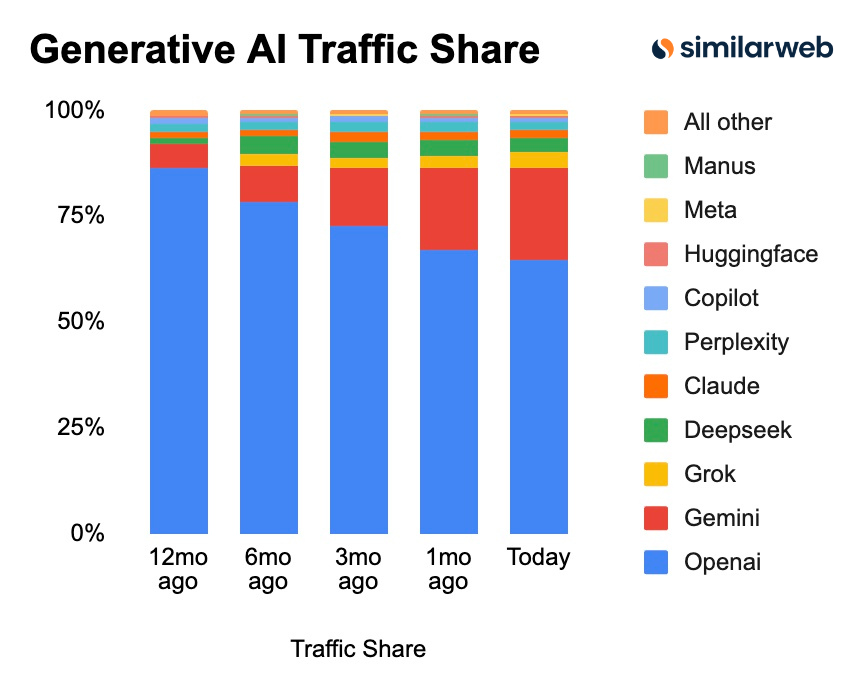
Claude passed DeepSeek, Grok, and Gemini to become the second most used generative AI app daily. Behind only ChatGPT. This happened without the consumer brand recognition of Google, the distribution of Microsoft, or the cultural moment of DeepSeek's launch. It happened because enterprise adoption compounds quietly. The coverage of the AI race is almost entirely focused on model benchmarks and funding rounds. Daily active usage is the number that actually describes where the market is going. Anthropic is winning a race most people are not watching.
@ReplyTariq ·
The biggest misunderstanding in generative AI right now: Typing a prompt does not make you the author. The U.S. Copyright Office just confirmed it: Prompts are instructions, not creative control. AI-generated works without meaningful human input aren’t copyrightable. Which means something most people haven’t realized yet: A large share of today’s AI-generated content may legally belong to no one! 📄 Report: https://t.co/0XO9gHBezf
@Inc42 ·
Generative AI (GenAI) startup @GnaniAi has raised $10 Mn (around ₹94 Cr) in its Series B funding round led by Aavishkaar Capital. The round also saw participation from existing backer InfoEdge Ventures.👇 The startup will deploy the fresh capital to expand its customer base by exploring new verticals and global markets. Additionally, a chunk of the funds will go towards research and development and talent acquisition. Founded in 2016 by Ganesh Gopalan and Ananth Nagaraj, https://t.co/A6fRCVveIx launched its voice-first AI model Inya during the ‘India Impact AI Summit 2026’ last month. https://t.co/A6fRCVveIx’s B2B agentic AI solutions enhance customer experience for large enterprises as well as customer-facing businesses across sectors such as BFSI, telecommunications, ecommerce, consumer internet, healthcare, among others. 🔗 Read the full article here: https://t.co/r1TJIib1Ob #Inc42 #news #AI #Startups #Startupfundings
@glenngabe ·
Banned for a year if you submit AI slop -> ArXiv, the repository of preprint academic research, says it will ban authors for a year if their papers have “incontrovertible evidence” of AI-generated work “If generative AI tools generate inappropriate language, plagiarized content, biased content, errors, mistakes, incorrect references, or misleading content, and that output is included in scientific works, it is the responsibility of the author(s)." https://t.co/J9vD36vgik
@sachinrekhi ·
Question: Why aren't we seeing massive revenue acceleration amongst companies fully adopting AI for productivity? This is probably one of the most fascinating paradoxes with AI right now. While the foundation model vendors themselves have had astronomical revenue growth, the story of the companies leveraging them is not quite as straightforward. Intuitively one might assume that specific companies that go all in on AI tools should see a significant increase in productivity which should translate into significantly higher revenue compared to competitors. And that might be the case when a single industry player adopts AI. But what we are actually seeing is far more nuanced than that. We are instead seeing clusters of AI-pilled industries emerge where many of the top players in that industry are adopting these generative AI capabilities all at once. Did your team accelerate product development using coding agents? Well so did your top 3 competitors, resulting in your feature release cadence not looking all that different from theirs. Similarly, customer expectations are incredibly high thanks to broadly adopted consumer and enterprise tools like ChatGPT and Claude. Did you add a chatbot to your product? That's cute, but how do I get it to work with all the tools I've already integrated with Claude? Or take Gemini for example. I find myself complaining every day of why I can't do something in Google Docs/Sheets/Slides and Gemini because Claude has set the bar so high for what I expect from these tools. Just like during the mobile revolution, mobile was initially a differentiator but then quickly became table stakes. We are seeing that same cycle transpire again with AI.
@thinking_slow ·
guess: to what does this criticism refer? "The average quality...is pretty good, but on any given day, [the accuracy of] any given entry might be up or down." "You don’t know who it’s written by, you don’t know what qualifications they have, and you don’t know whether it’s been reviewed by anyone who knows what they’re talking about." "Forever open to the uninformed… meddler." "The main problem is the lack of authority." "[It lacks a] habit or tradition of respect for expertise." "The premise...is that continuous improvement will lead to perfection – that premise is completely unproven." "Hyperlinks, bullet points and cut-and-paste press releases do not an encyclopedia entry make." "A flawed and irresponsible research tool." --- if you answered "generative AI", you would be wrong. this is a list of 20-year-old criticisms shared after the launch of Wikipedia. for all our concerns about accuracy and authority and legitimacy, for all the furore around regulation and fairness and compensation for creators, i think generative AI is here to stay. generative AI is a natural continuation of a process of information commodification that started a long time ago. crucially, it offers a better experience for most people. information is free and convenient and personalised to the whims of each user. that is hard to resist. i think Wikipedia is a good parallel for understanding generative AI (not least because it plays such a crucial role in training LLMs). it was untrusted and error-prone and far from perfect, but the experience it offered was such an obvious upgrade from the status quo that it weathered those complaints and became a cornerstone of the internet. and as we saw in the wake of Wikipedia's release, there was still a place for formal research, for professional accreditations and authority sources, for personal experiences and stories, for content that went above and beyond the new baseline created by Wikipedia. the same will be true of generative AI.
@etnshow ·
F1 World Champion Nico Rosberg (@NicoRosberg) shares how generative AI will completely revolutionise F1: "There is a huge opportunity to use generative AI for material science because in F1 everything is about materials—weight and stiffness are critical for performance." "The most important thing is getting to the minimum weight, because 10 kilos over is three-tenths of a second per lap; if you are over, you have no chance of winning." "If you manage to use these advancements to move 5kg from a high area down to under the car with titanium ballast, that is huge performance."
@The_InnovationJ ·
New in The Innovation Drug Discovery! The evolution of computation-driven paradigms in targeted peptide drug design: From predictive modeling to generative AI and clinical translation. Hu et al. explore how integrating generative AI, like diffusion models, with rigorous physics-based validation prevents "structural hallucinations" and accelerates the translation of in silico peptide blueprints into viable clinical therapeutics. https://t.co/aAiNsb9n63 #DrugDiscovery #GenerativeAI #computationaldesign
Best Tweets by Topic