AI visibility measurement
Tracking brand mentions, sentiment, citations, citation share, competitors, prompts, and changes over time across answer engines.
36%
Best tweets about AI Visibility
Find the best tweets about AI visibility, covering brand mentions, citations, answer engines, LLM monitoring, measurement, content, and search strategy.
Brand and content visibility inside AI assistants and answer engines, including citations, measurement, monitoring, experiments, and strategy.
Original Xholic analysis
This conversation treats AI visibility as a mix of answer-ready content, third-party reputation and measurement—not simply search rankings. Reported experiments attract attention, but contributors dispute guaranteed GEO shortcuts and warn that variable answers, biased prompts and imperfect attribution can make apparent wins misleading.
50% of posts
All-time engagement
38% of posts
Published in 90 days
Conversation map
Tracking brand mentions, sentiment, citations, citation share, competitors, prompts, and changes over time across answer engines.
36%
The roles of Reddit, YouTube, LinkedIn, review platforms, communities, and niche sites in AI answers, including differences by engine and industry.
32%
Listicle and microsite experiments, schema and llms.txt tests, and scrutiny of causal claims, shortcuts, and self-promotional tactics.
32%
How PR, editorial coverage, independent mentions, reviews, and reputation influence whether AI assistants cite or recommend a brand.
30%
Variability in AI recommendations, biased prompt sets, misleading dashboards, and the difficulty of connecting visibility or AI referrals to revenue.
16%
The shift from search results to AI recommendations and overviews for product discovery, comparison, and buying decisions, alongside traditional search.
14%
Question-led, clear, current, well-structured content designed to match prompt intent and earn citations or linked mentions.
14%
Product data, site structure, entity descriptions, and verifiable trust signals that help assistants understand what a brand offers and whether to trust it.
12%
Tone and stance
Performance benchmark
Posts with media make up 78% of this collection. Their median all-time score is 5.83, compared with 4.80 for text-only posts.
Format mix
Consensus and debate
Shared view
Contributors emphasize editorial coverage, reviews and communities as sources of brand representation in AI answers. They recommend developing an off-site footprint alongside owned content, while qualifying that coverage does not guarantee citations.
Shared view
Posts advocate tracking mentions, sentiment, citations and competitor presence across relevant questions. Bing reporting and repeated-prompt monitoring emphasize query context and historical patterns rather than treating one answer as a reliable baseline.
Shared view
Guidance emphasizes clear answers, intent-aligned content and machine-readable product information. These are recommended approaches, not established guarantees that particular formatting changes cause citations.
Open debate
Mehrab reports increased mentions after publishing listicles, while other contributors question self-promotional tactics and their durability. The posts contrast reported short-term gains with recommendations to use credible, established sources; they do not establish long-term effectiveness.
Open debate
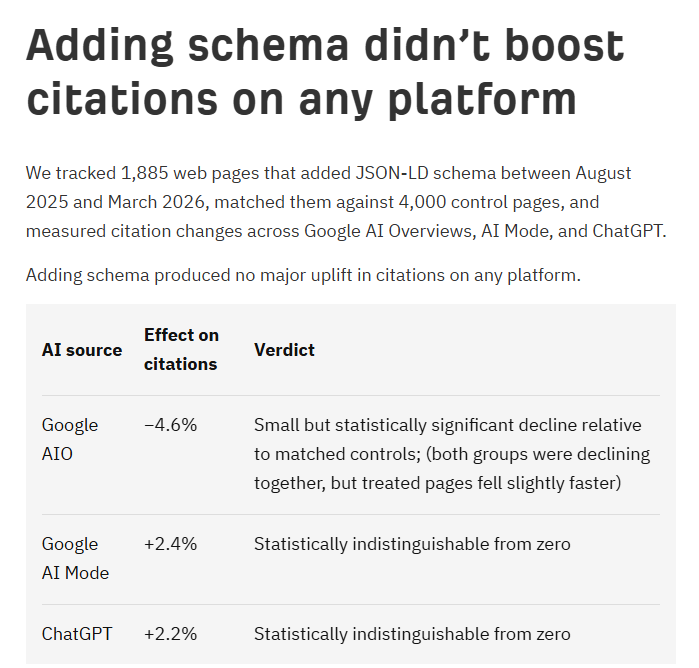
An automation tutorial recommends schema, and a creator credits a bundle of identity changes that includes it. An Ahrefs study summary reports no measurable citation improvement after adding schema, challenging its presentation as a standalone visibility lever.
Open debate
Some posts describe AI citations appearing without traditional search visibility or urge a PR-first approach. Others argue that traditional SEO remains correlated with AI visibility and important for purchase validation. These accounts do not establish that search fundamentals can be abandoned.
Open debate
Monitoring advocates describe actionable feedback loops; critics highlight inconsistent recommendations and prompt sets that inflate share of voice or omit strategic categories. Revenue-focused commentary questions the value of visibility that does not produce commercial outcomes.
What performs
The listicle experiment has an all-time score of 611.86, or 113.52 times the supplied median. Other outliers include earned-media commentary at 133.82 and the retail AEO/GEO guide at 72.88. These scores describe performance within this set, not validation of the posts' claims.
Content built for AI answers has the highest supplied theme median all-time score at 30.697, versus 10.164 for AI in the purchase journey and 2.08 for off-site citation sources. Measurement is the largest supplied theme at 18 tweets (36%), with a median score of 5.39.
Tutorials have a median all-time score of 10.728 across 3 posts, compared with 4.058 for 19 opinion posts and 4.95 for 18 case studies. The prediction median is 72.883 but represents just 1 post; it does not establish a dependable format advantage.
Statistical standouts
Creator landscape
The five most represented creators account for 20% of the selected posts.
1. Aleyda Solis 🕊️
@aleyda
2 posts
2. Brodie Clark
@brodieseo
2 posts
3. Elvis
@elvissun
2 posts
4. Glenn Gabe
@glenngabe
2 posts
5. JH Scherck
@JHTScherck
2 posts
6. Kaleigh Moore
@kaleighf
2 posts
Mehrab's 2 posts have a supplied median all-time score of 306.84. His highly scored listicle claim contrasts with another post rejecting schema as the key to citations, showing enthusiasm for one tactic alongside skepticism about another.
Aleyda's 2 posts have a median all-time score of 41.26. Her contributions combine machine-readable catalogs, intent and trust guidance with a qualified case for digital PR: relevant coverage can expand retrievable sources, but its impact is indirect rather than guaranteed.
Glenn Gabe's 2 posts have a median all-time score of 38.5. He shares both a schema study reporting no major citation uplift and Bing's expanded visibility reporting, foregrounding testing and measurement rather than a guaranteed optimization recipe.
Since the previous snapshot
Themes, sentiment, stance, and post format are classified per tweet. All counts, shares, medians, creator concentration, freshness, and performance comparisons are then calculated directly from the published snapshot.
Xholic's all-time score compares engagement while accounting for reach, post age, and creator consistency. It is used for relative comparisons within this collection.
This report analyzes the exact 50-post snapshot shown below. AI identifies editorial categories and drafts explanations; all statistics are calculated from the snapshot, and every narrative claim is checked against cited posts before publication.
Best AI Visibility tweets
Ranked 01–50

@mehrab_build ·
It's stupidly simple to get your brand mentioned in AI models right now Two weeks ago I blasted out "best X" listicles for a client Checked this week. 10x more brand mentions across almost every major LLM 😆 I just fed them our brand name + a unique selling point more often than our competitors. Here's how you can do it as well 👇

@jbobbink ·
94% of AI citations come from non-paid sources. Gartner is telling CMOs to double their PR budgets by 2027. Gartner just published their 2026 comms predictions. The headline: PR and earned media budgets will double by 2027 as LLMs replace traditional search. They're telling CMOs to reallocate spending from paid channels toward PR and earned media because that's what AI answer engines actually cite. Data backs this up. Muck Rack analyzed over a 1M links cited by ChatGPT, Claude, Gemini, and Perplexity. Around 94% of those citations come from non-paid sources. Earned media alone accounts for 82%. Journalism makes up 20 to 30% of all AI citations depending on the time period. Paid placements and advertising barely register. Semrush found that visitors arriving from AI search convert at 4.4 times the rate of traditional organic search visitors. That number comes from analysis of 500+ topics in digital marketing and SEO verticals specifically, so the exact multiplier will vary by industry. The direction is clear. There is a recency factor too. Muck Rack's February 2026 update found that more than half of all AI citations come from content published in the last 12 months. The highest citation rate occurs within seven days of publication. Press release citations alone grew 5x between July and December 2025. AI systems are actively prioritizing fresh content over older material. That recency signal matters for SEOs. This is not a one-time optimization play. It requires ongoing editorial presence. When CMOs start doubling their earned media budgets, that money has to come from somewhere. Gartner explicitly says to reallocate from paid. But in their 2025 CMO Spend Survey, paid media was already at 30.6% of total marketing spend. If earned media doubles, the budget pressure will hit every digital channel. Including SEO. We have spent two decades building an industry around optimizing for Google's algorithm. Now the discovery layer is fragmenting across a dozen AI systems that each weigh signals differently. And the signal they all seem to agree on is third-party editorial validation. Not backlinks. Not technical SEO. Editorial trust. Across analytics data from hundreds of properties, the pattern is consistent. Sites gaining visibility in AI-driven discovery are the ones with genuine brand authority and regular editorial coverage. Not the ones with the cleanest technical audits. Technical SEO is not dead. But it is no longer enough on its own. If your entire strategy is optimizing for crawlers and you are ignoring how AI systems evaluate brand trust, you are building on a foundation that is shifting. The PR industry just got handed the playbook that used to be ours. The smartest SEOs will learn from it. Sources: - Gartner, Top Predictions to Inform 2026 Comms Strategies (Feb 2026) - Muck Rack, What Is AI Reading? report (Feb 2026) - Gartner, 2025 CMO Spend Survey (May 2025) - Semrush, We Studied the Impact of AI Search on SEO Traffic (Jul 2025)

@aleyda ·
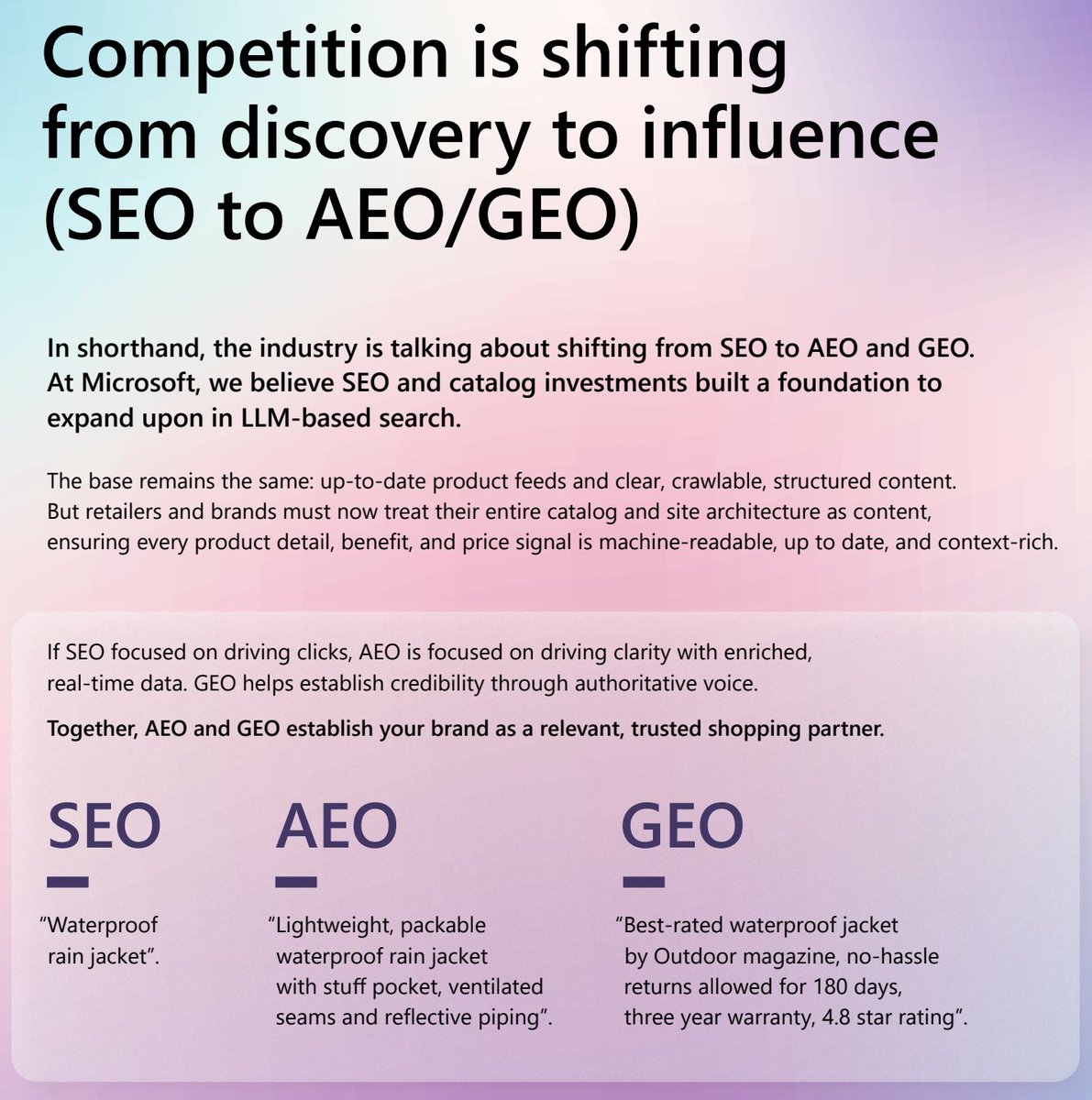
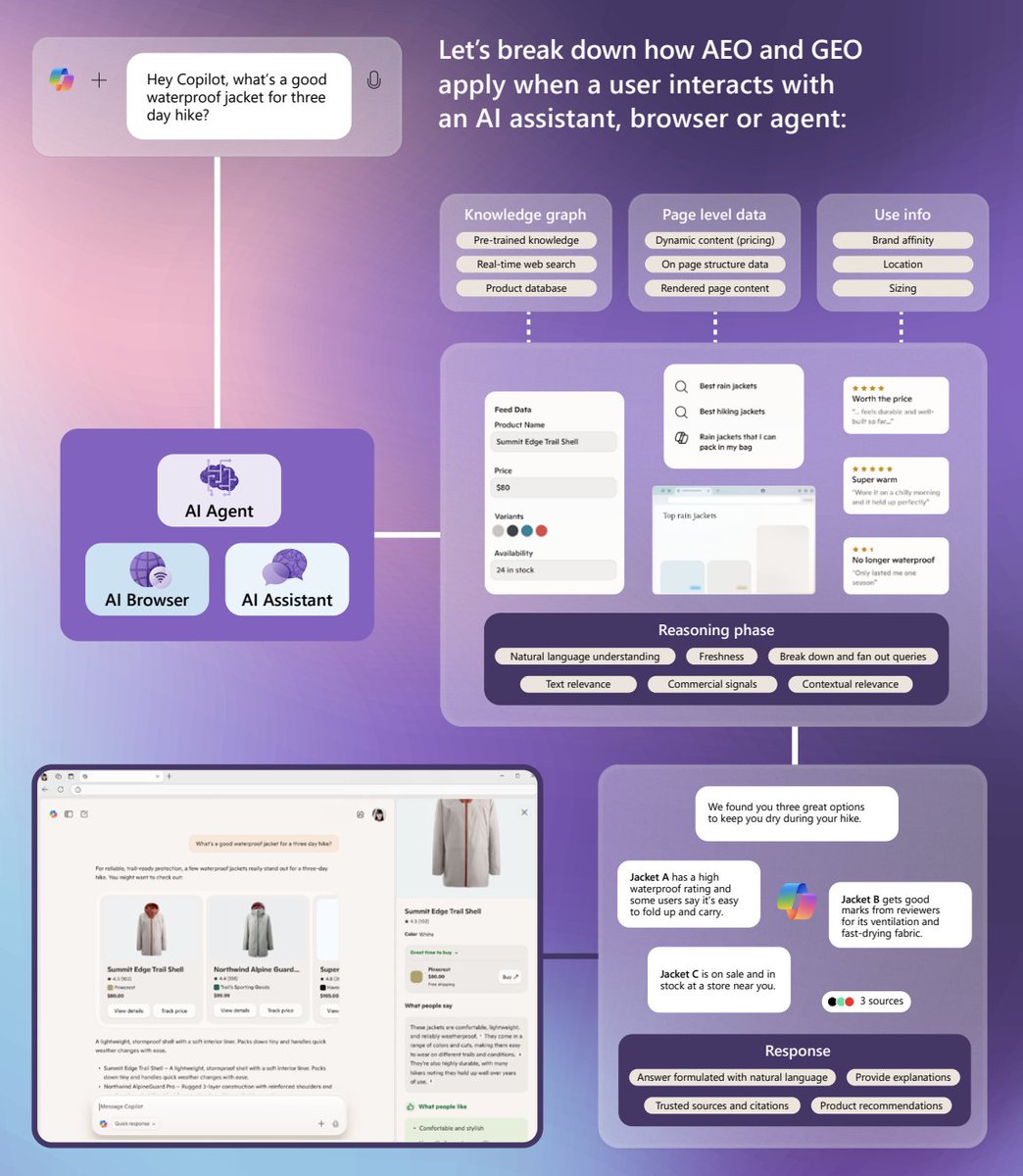
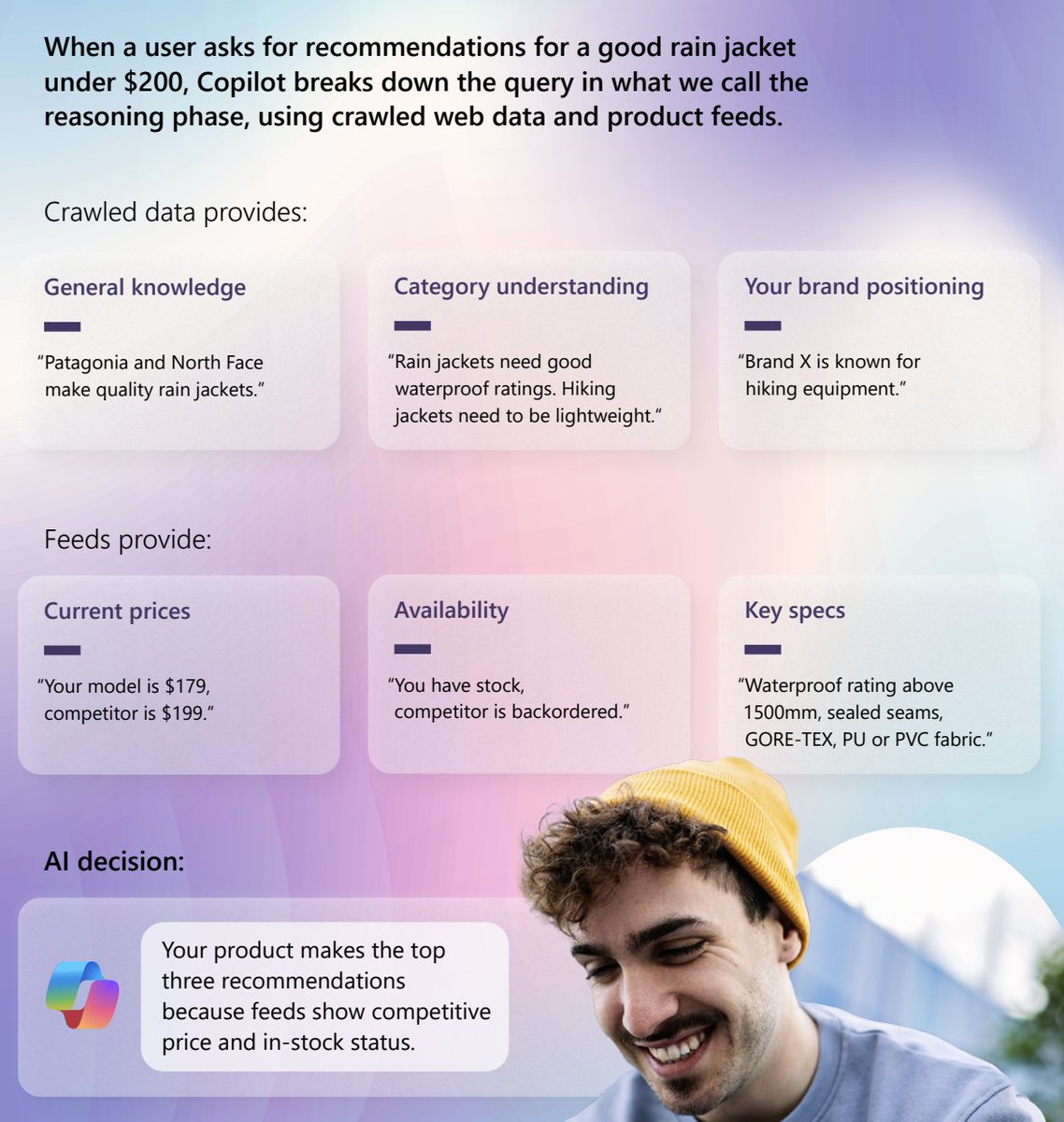
🚨 @MSAdvertising has published a must-read guide about AEO/GEO with practical data to optimize retailers presence in AI search, AI assistants and AI browsers, going through: 1. How traditional SEO focused on clicks and now Answer Engine Optimization (AEO) and Generative Engine Optimization (GEO) determine visibility in LLM-powered ecosystems. 2. How products surface in conversational and generative ranking 3. How competition is shifting from discovery to influence (SEO to AEO/GEO) 4. A break down of how AEO and GEO apply when a user interacts with an AI assistant, browser or agent. 5. Actionable recommendations: --- Data structure: Make your catalog machine-readable --- Content enrichment: Design for intent and context --- Trust signals: Establish authority and credibility The most actionable guidance by an AI platform so far 🔥 Check it out: https://t.co/bYLUKCjcyE /HT @Kevin_Indig

@codyschneider ·
How to Build an Agent That Researches and Publishes Content for AEO Automatically The shift is happening. Instead of scrolling through Google links, people ask ChatGPT, Claude, and Perplexity for answers. This is AEO (Answer Engine Optimization)—and it's where visibility lives now. Here's how to build an autonomous agent that does the work for you. What AI Engines Actually Want Structure beats length. AI parses content in 100-300 token chunks. Lead with declarative statements. Use clear headings and bullet points. Freshness matters. 70% of AI-cited pages were updated in the last 12 months. Your content needs regular refreshes or you lose citations. Answer directly. No more keyword stuffing. AI extracts the best answer to the user's question—hit the point immediately or don't get cited. The Agent Architecture 1. Query Intelligence Monitor what questions AI engines are being asked about your topic Use tools like Searchable to track ChatGPT, Claude, Perplexity citations Build a prioritized list of questions to target 2. Competitive Intelligence Query AI engines for your target questions Extract and analyze what's being cited Find gaps—what isn't being answered well? 3. Content Generation Generate content based on question + competitive analysis Apply brand voice and style guidelines Include schema markup (FAQ, Article, HowTo) 4. Automated Refresh Monitor citation decay Trigger refreshes when visibility drops or quarterly minimum Implementation Workflow Daily Trigger → Query AI Engines → Extract Citations → Analyze Gaps → Generate Content → Apply Schema → Human Review → Publish → Monitor Performance Content Standards Every piece needs: Question-based headline Direct answer in first 2 sentences H2s for each sub-question 800-1500 words (focused, not verbose) 2+ stats or citations FAQ/Article schema markup 2-3 internal links Measuring Success AI Citations: How often you're cited in AI responses Share of Voice: Your % vs competitors Traffic from AI: GA4 attribution to AI referrals Pitfalls to Avoid Publishing without human review – AI makes mistakes Ignoring structure – AI can't cite wall-of-text Wrong goals – Optimize for citations, not rankings Skipping technical SEO – Schema, crawlability, speed still matter Start Simple Pick one topic cluster to test Build the research loop first Add generation once research works Add publishing and refresh as you scale The companies winning at AEO treat content as a machine-driven system. They use automation for research, creation, and refresh—so humans focus on strategy. You set the strategy. The agent executes.

@forgebitz ·
now back to work using claude code, we created a 100% ai-generated comparison (listicle) website called surferstack we let claude research hundreds of saas companies to dynamically generate comparison pages based on what it could find on their website the goal was simple: understand how comparison websites are used by ai search engines the website is now offline, but the data is wild we published comparison pages across a variety of saas categories and monitored how they were crawled and cited by ai models pages types included: best social media scheduling tools 2026 brand a vs. brand b compared 2025 best tools for xyz 2026 what surprised us was that these pages were being scraped and revisited by ai search engines despite having little to no visibility in traditional search ranking in google doesn't necessarily mean you'll be cited by ai models, and the reverse can also be true. traditional SEO appears to have very little impact on ai citations in some cases we also ran multiple experiments using exact-match domains, long-tail domains, and surferstack interestingly outperformed all of them, showing that exact match domains have very little impact on ai search visibility


@glenngabe ·
Interested in Schema impact on AI citations? Here's the latest study from @ahrefs -> We Tracked 1,885 Pages Adding Schema. AI Citations Barely Moved "We tracked 1,885 web pages that added JSON-LD schema between August 2025 and March 2026, matched them against 4,000 control pages, and measured citation changes across Google AI Overviews, AI Mode, and ChatGPT. Adding schema produced no major uplift in citations on any platform." https://t.co/cinIs15p9M

@neilpatel ·
Google told us how search would change back in 2015, and most of us ignored it because keyword matching still worked. It doesn't anymore. In this video I break down why your Google ranking and your AI visibility are now two separate scores, why AI pulls most of its citations from outside Google's top results, and how to shift from writing for keywords to answering the real moment behind a search. I also walk through the two-part system for getting cited and a simple plan you can run this week.
 Watch video
@neilpatel ·
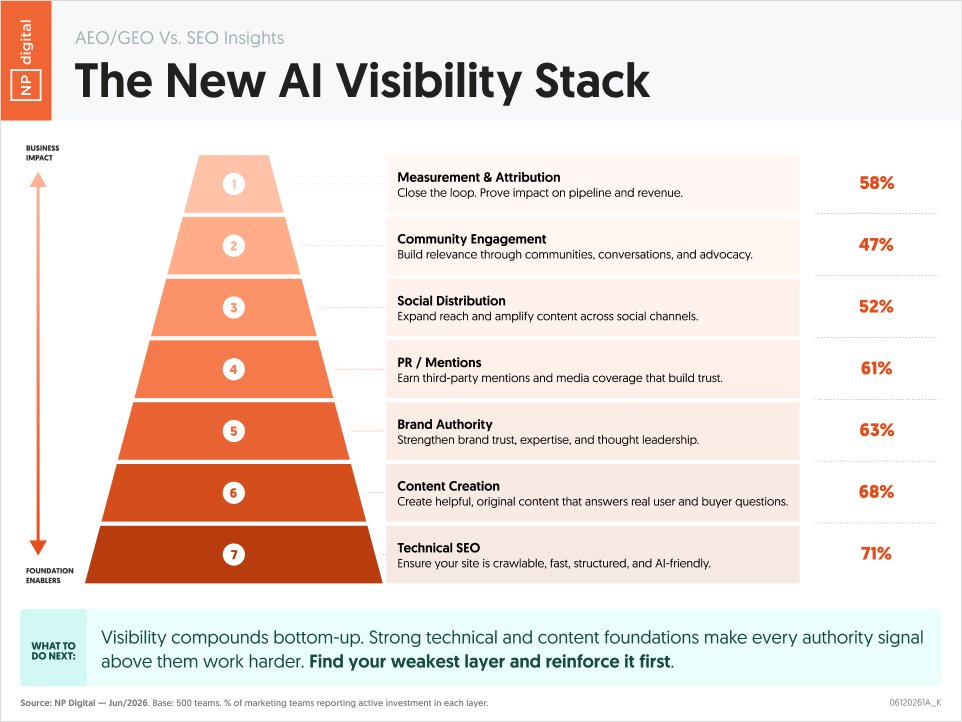
Check out the new AI visibility stack. Most marketers focus on the stuff on the bottom, like technical SEO, but they forget the stuff towards the top, like measurement. Everyone wants more visibility, but if the visibility never drives any revenue, does it really matter? This is why things like measurement are important.

@elvissun ·
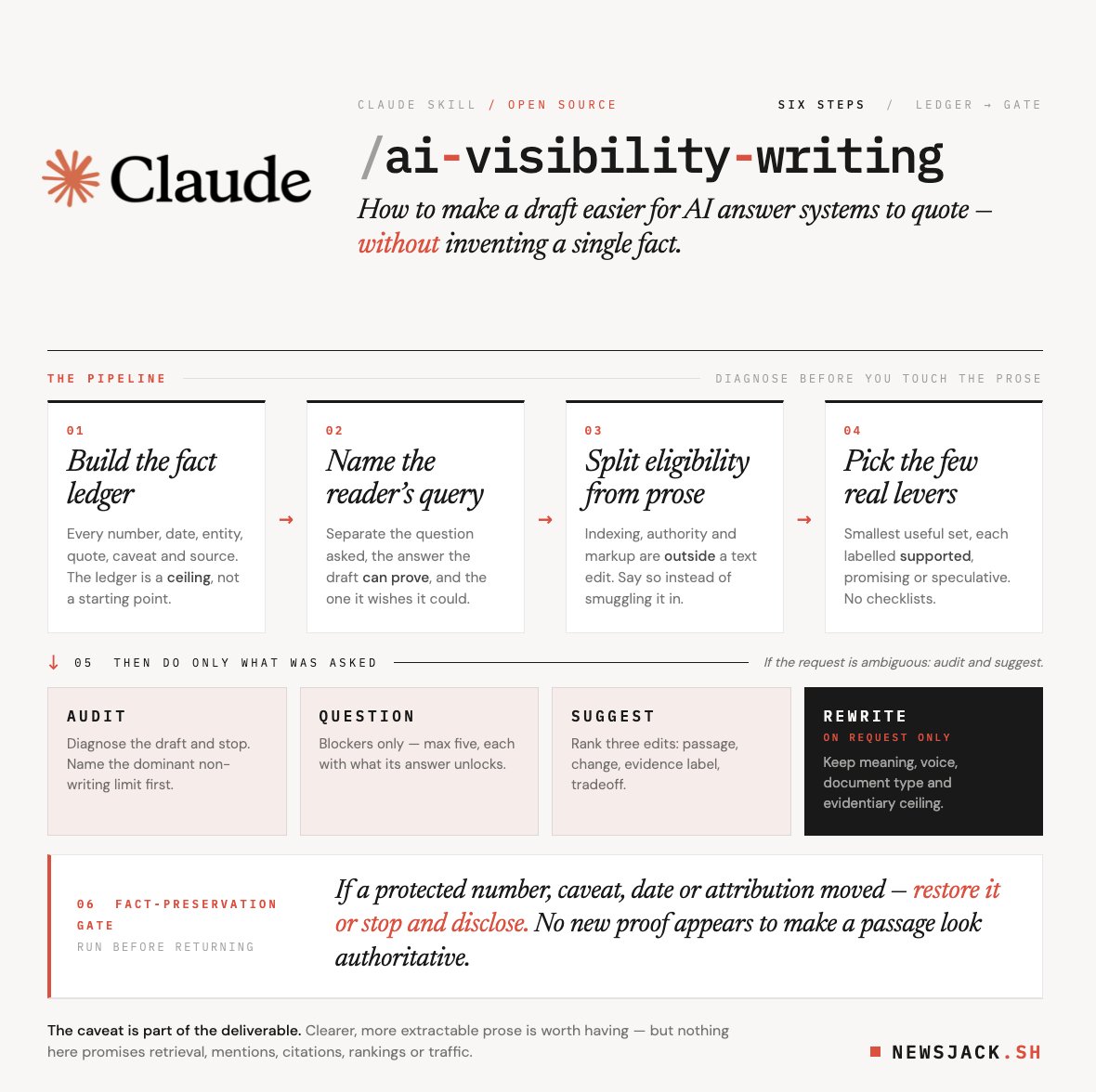
your AI visibility sucks because your content is never built for it. I just open-sourced an /ai-visibility-writing skill to fix that: first I analyzed 448 prompts and 3445 citations to see what actually makes chatgpt and AI overview cite a page. it cost me $8.91 to collect the results, then it took 6 hours for 5.6 sol to run the analysis. from there I gave the analysis to fable together with 15 papers on AEO, eval'd it over 48 pairs of outputs to build this skill. fun times. run it to over any content to improve your AI visibility: https://t.co/fV2l7TwHZr
@glenngabe ·
Big news from Bing. And you can compare changes over time. This is what @kmadhavan77 shared in April and now it's rolling out -> New AI Visibility Insights in Bing Webmaster Tools: Intents, Topics, Citation Share, Compare "AI-generated answers are dynamic, contextual, and often synthesized from many sources at once. Understanding visibility in these systems requires more than a single metric or surface-level citation count. With these expanded preview capabilities, Bing Webmaster Tools is expanding first-party reporting to provide deeper insight into the query context, thematic patterns, relative citation presence, and changes over time that shape how content appears in AI-powered experiences." "With the new Intents feature, grounding queries in the AI Performance Report are now classified into broader categories such as Informational, Commercial, Navigational, Learn and Solve, Research, Creation, Local, and more. This helps publishers move beyond simply seeing which queries triggered citations and begin understanding the broader query context our systems associate with those citation appearances." "We are also introducing Topics, which group related grounding queries into broader thematic clusters. AI systems reason across concepts and themes rather than isolated keywords. Topics help publishers understand visibility in the same thematic structure that modern AI systems use to organize information." "While total citation counts show how often your content appears in AI-generated answers, Citation Share shows how much of the citation space your site receives for a specific grounding query. It is calculated as the percentage of citations attributed to your site out of all citations shown across all sites for that same grounding query." https://t.co/FEoz44fFxz


@jmoserr ·
"This GEO tactic gets you cited in LLMs!" "Interesting. How do you know that...?" "My research bro. I analyzed 10,000 prompts bro. All of the brands cited in ChatGPT have pages with expert quotes, statistics, inline citations, structured formatting, and topical depth…" "Ok…sure, but did the page get cited because it had those features? Or did it have those features because it was already high-authority content that performs well everywhere...and AI search just picked it up too?" Nobody peddling GEO fairy dust wants to answer this question. Right now, a huge chunk of GEO research is treating correlation like causation. Like these content traits are brand new levers you can pull to "get cited in AI search." Do X, get cited. Simple. Except: if everyone can just add charts and tables to a post and get cited, how does AI determine YOUR brand gets mentioned in a short output of 5 solutions in a space where thousands exist? It can't just be "do X tactics." That math doesn't work. What actually separates the brands getting cited? The same thing that's always separated them: real authority. Google's own "How Search Works" documentation states openly that links are a core signal for content quality. AI is very similar. HubSpot found that 92% of AI mentions come not from your own content, but third party sites mentioning you. So when someone says AI engines cite content with quotes, data, and good structure, they're simply observing a trait of authoritative content in general, not a "do x and get Y" causation factor. And even if these content tweaks do influence AI citation likelihood, SparkToro's recent research found there's less than a 1 in 100 chance that ChatGPT or Google AI will give the same list of brand recommendations in any two responses...even on the identical prompt run 100 times. The lists are different. The order is different. The number of results is different. Nearly every response is unique...so the agencies selling revolutionary GEO hacks are building on two broken assumptions: that these tactics directly cause citations (unproven), and that the outputs are consistent enough for those tactics to track reliably (they're not). AI search is real. It matters. Heck, we generate tons of leads from it. But the brands winning there are the same ones that have been winning everywhere... because they built actual authority over years, not because they added a data table to a blog post last Tuesday. Our own AI visibility increased the most by doing one thing: acquiring mentions + links on publications talking about our niche: being in more places that AI pulls from, increasing the likelihood AI mentions our brand.

@peec_ai ·
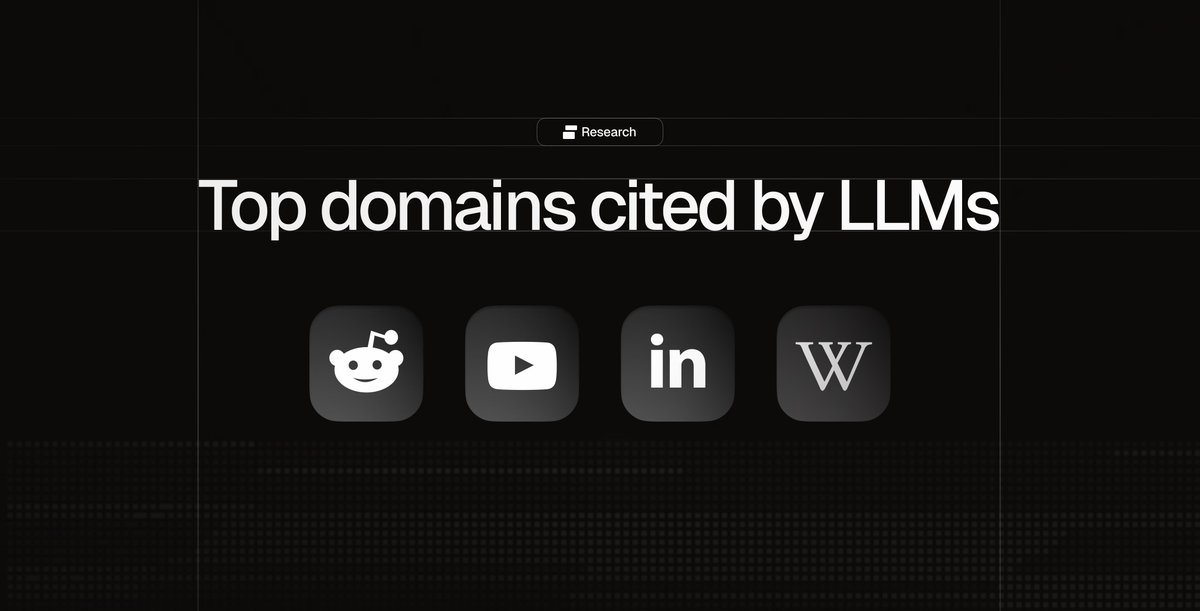
We analyzed 30 million sources cited by ChatGPT, Google AI Mode, Gemini, Perplexity, and AI Overviews. The 10 most-cited domains: 1 Reddit 2 YouTube 3 LinkedIn 4 Wikipedia 5 Forbes 6 G2 7 Yelp 8 Facebook 9 Medium 10 TechRadar Facebook is #8 despite being mostly behind a login wall. Yelp is #7 despite being a review platform most B2B teams ignore completely. Where your brand shows up on these platforms determines a lot of what AI says about you.

@semrush ·
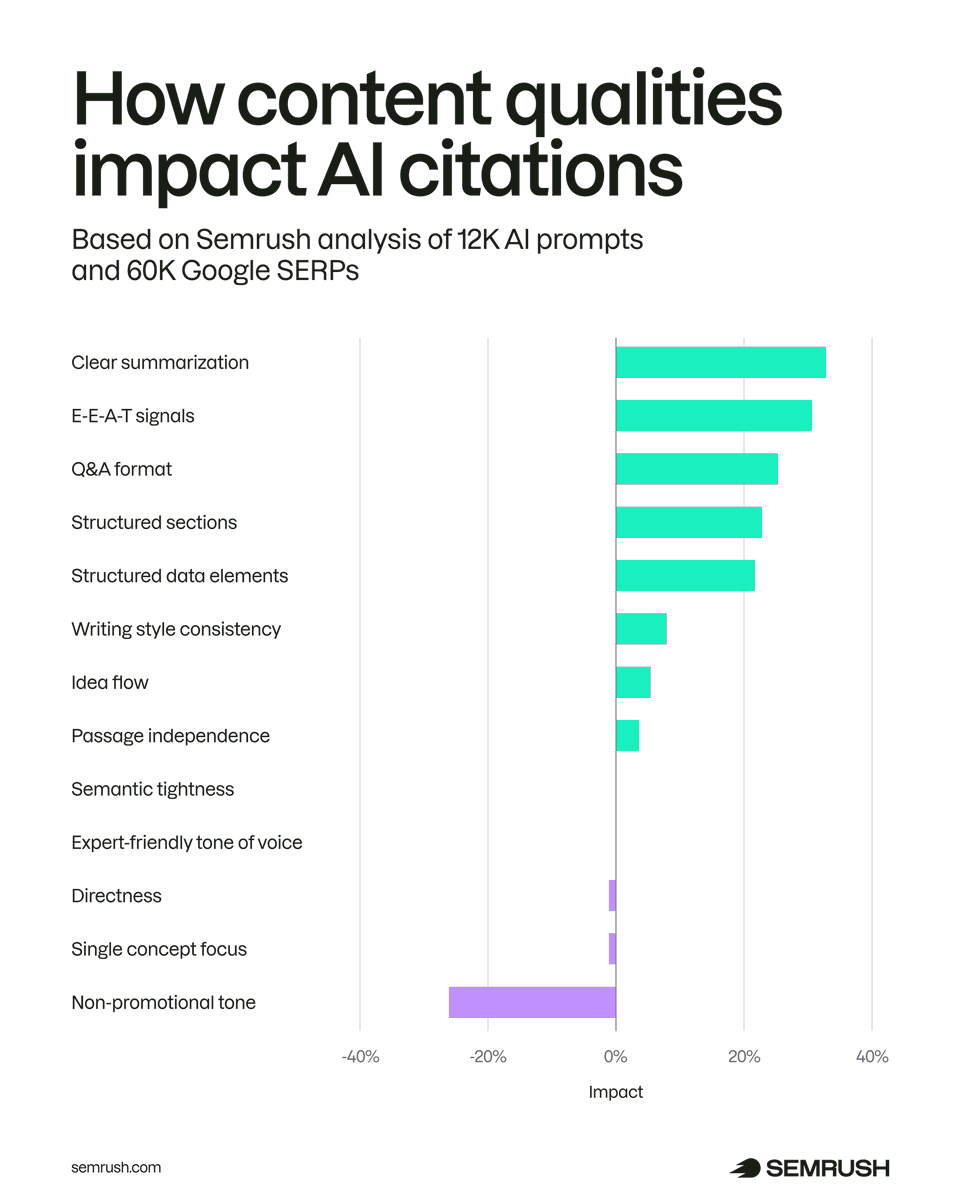
AI search platforms like ChatGPT, Google AI Mode, and Perplexity are changing how content gets discovered. But what makes one piece of content get cited while another gets ignored? To answer this, we analyzed thousands of citations and compared them to similar pages ranking in Google. Our goal was to identify which text-only qualities most strongly correlate with AI citation behavior, and whether these patterns differ from traditional SEO signals. Based on our research, we found five content qualities that showed a strong positive correlation with AI citations, plus one that showed a negative correlation: • Clarity and summarization: +32.83% • EEAT signals: +30.64% • Q&A format: +25.45% • Section structure: +22.91% • Structured data elements: +21.60% • Non-promotional tone: -26.19% In short: content that delivers clear answers, demonstrates expertise, and uses structured formatting is more likely to be cited. Full breakdown: https://t.co/iv0Gzu2BYl.

@emilylai ·
Playing around with an AI visibility tool and looking into what people prompt into gpt, claude, perplexity For "make money" there's a few prompts around clipping, ugc, and content creation For "Ethereum" the first one is "Will Ethereum's usage increase if Base gains more traction" lol alongside prompts asking ai to help with announcements and articles For "Solana" the first one: "Provide a detailed trading strategy using MobyScreener for Solana." and other prompts around price predictions For "crypto" i'm seeing all sorts of prompts from troubleshooting to tax questions if certain exchanges are available in geos

@semrush ·
AI isn't only reading your website, it's also reading what everyone else says about you 🧐 Think Reddit threads, G2 reviews, and media mentions. That's where a lot of the citations actually come from. Wild example: Seer Interactive found that one bad review from 2018 was still changing how every major AI model talked about their brand. Years later. One review! Most brands have no idea what story AI is telling about them right now. So it's not that SEO is dead, it's just not the whole picture. You've got three layers to think about: your own site, how you're building your brand, and what others are saying about you out there. Getting a handle on all three is where it starts 👇 https://t.co/qMP2sDepJ0.


@blvckledge ·
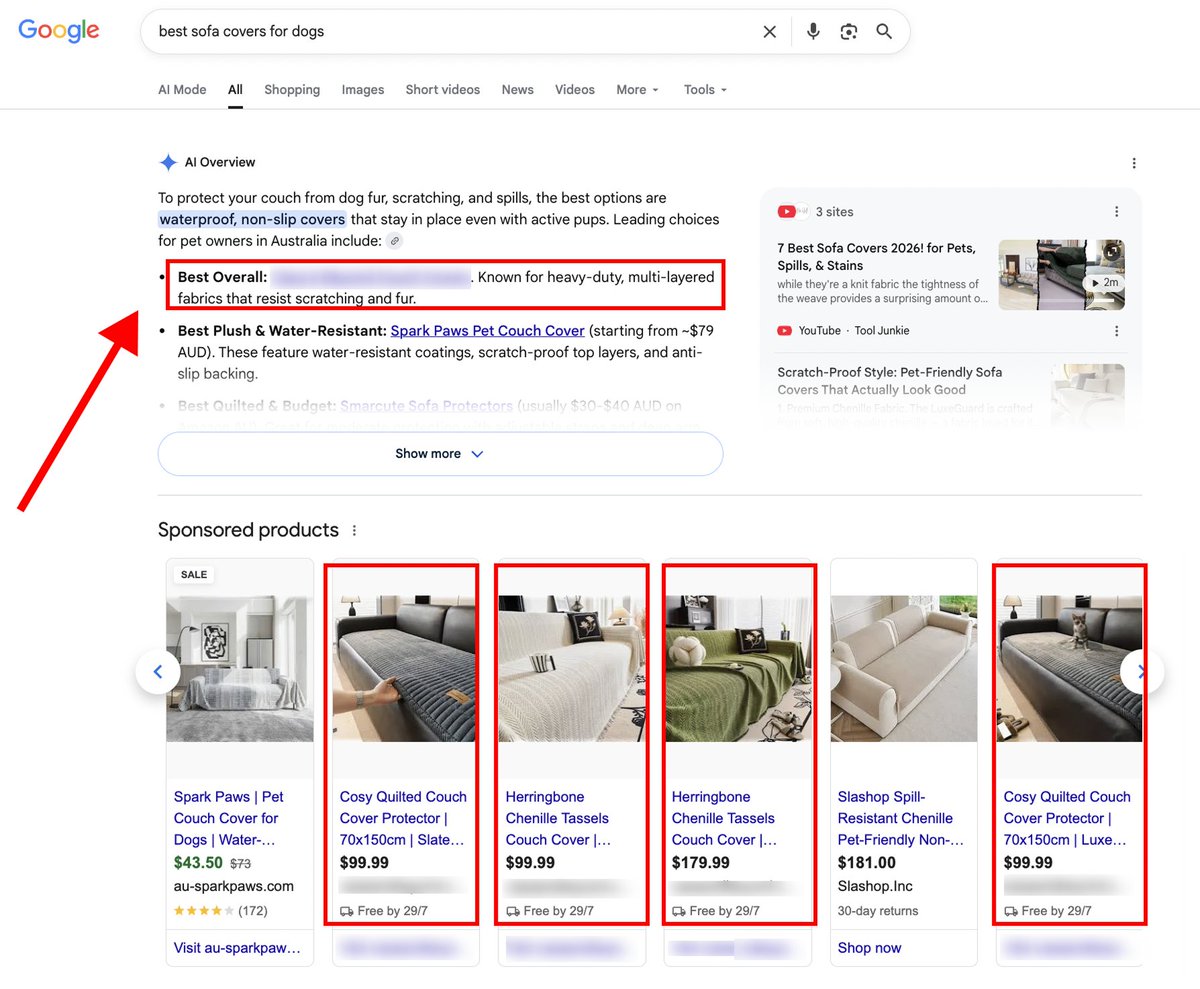
got this brand the #1 recommendation from ai overview AND multiple spots in the shopping results it’s NOT enough to just get the top spots on search and shopping anymore for decades, the first thing you'd see was a search result or a shopping ad. but now, for a lot of queries, the ai overview owns that spot. it takes up almost half the screen before you get to the normal results. this happens all the time for searches like: > "best [product]" or "top [product]" when people are comparing brands > informational searches where they're trying to figure out a problem, topic, or solution what's interesting is how much people's opinion of ai overviews has changed. i still remember when google first rolled it out. everyone was roasting the answers because they were so bad. google's improved them a lot since then. now people actually read them, trust them, and end up buying through them. some of our partners said chatgpt used to drive most of the llm-related traffic and conversions. now it's almost evenly split with google’s ai mode and ai overviews. which means: there's another part of the search page you need to win. it's not enough to show up in the search and shopping result anymore. you also want your products showing up inside the ai overview. we've spent a stupid amount of time figuring this out at our agency. over the last year... we've been reverse engineering what gets brands featured inside ai overviews and other ai chatbots. like we did for the client in the screenshot below. for that search, we got them: 1. the #1 recommendation inside the ai overview 2. multiple spots in the shopping results this is super important for prospecting searches where someone's trying to figure out which brand to buy. if your brand shows up everywhere and takes up most of the space in the search results page... it's almost impossible for the clicks to go somewhere else.
@elvissun ·
"is this shit legit?" run this prompt against your website right now. here's why: last week, we shipped https://t.co/aq7DBz7en5 as open source, and the install flow asks people to point their agent at a remote script via curl | bash. modern agents are smart. they will not execute random code on your machine just because you asked nicely. so i tested this by running the install in a fresh claude session and watched it interrogate my own brand. round 1: agent flags the install command as high risk. fix: link to where the install command actually lives. round 2: agent says the website could be hosting a different script than the repo. fix: open source the entire website. round 3: agent says the authors are unknown. fix: link my x, linkedin at the bottom of the page. round 4: agent says there aren't enough trust signals. fix: ship the thing, get real users, stars catch up. every round was the agent doing what a careful journalist would do before running a pitch. check the source. check the source of the source. check the byline. this is the test everyone should run on their own brand. open your site in claude right now. ask the agent if the company is legit in the most skeptical way possible. watch it research. watch it doubt. read the gaps in its reasoning back as a list of missing evidence. that list is your AI visibility roadmap. not "more press." specifically: which signals does the agent need before it stops being suspicious of you. trust used to be a feeling. now it's a checklist a model walks before it lets your name through the door. welcome to the new earned media.


@alexgroberman ·
AI search tools now beat search engines at basically every stage of the purchase journey, and the gap is widest at the top of the funnel. Here is what Semrush's data shows: Discovering initial ideas: AI 35.0%, Search 13.6% (AI wins by 2.6x). Researching and comparing options: AI 30.0%, Search 20.0%. Narrowing choices and deciding what to buy: AI 31.4%, Search 15.0%. Evaluating value and instilling confidence: AI 32.9%, Search 15.0%. Finding where to buy and best price: AI 24.3%, Search 22.1% (the only stage where the two converge). The numbers speak for themselves. And this is what SEO Stuff helps businesses with daily. https://t.co/zvZUfkYWT4 The only place search catches up is the final "where do I buy this for the best price" step, which makes sense because that is a transaction execution question and AI is not the purchase interface yet. All that being said, search is still where the purchase closes. The 24.3% vs 22.1% convergence at the bottom of the funnel means buyers are running a final check on branded search, product pages, and review content before they transact. A brand that wins AI discovery but has no search-side authority loses the deal at the finish line. The commercial implication is that AI visibility and search visibility are sequential requirements in the same purchase journey. Brands need to be cited in AI answers during discovery AND ranking strongly in search during validation and purchase. Optimizing for one and ignoring the other cuts you out of half the funnel. This is the gap most brands are missing. They are either (1) still all-in on traditional SEO and watching the top of the funnel collapse, or (2) racing toward AI optimization and losing bottom-of-funnel conversions because their search authority has eroded. The brands winning the Similarweb-defined journey are the ones building structured, expert-driven content that gets extracted by AI platforms at the top of the funnel AND backed by the third-party authority signals that hold up traditional search rankings at the bottom. This is exactly what SEO Stuff (https://t.co/wKpf0EILTx) was built for. The brands that treat AI and search as two separate channels are going to lose to the brands that treat them as two stages of the same journey. Don't make that mistake.


@fatjoedavies ·
Share this with your Head of SEO: SEO is no longer about: - Page speed - Meta titles - Keywords - 10 blue links on Google The future of SEO is about: - Brand salience and reputation - Online sentiment and reviews (Trustpilot, G2, Reddit, forums) - Mentions in listicles and media outlets - Building a knowledge base around your services and products Sure, get the basics right: links, rankings, technicals. But don’t stop there. AI engines are recommending brands based on signals of reputation, trust and opinions. What's more is, the more they know about your brand, and what you offer, and who for, the more they can recommend it to the RIGHT people. The question is: are you giving them enough signals to recommend yours? PS. We have some services that can help, search 'fatjoe AI SEO' in Google or ChatGPT and you'll see the full service suite.

@gaetano_nyc ·
I just took a VP of marketing through a “LLM visibility monitoring” dashboard to reveal all the ways they are getting tricked in the reporting. 1. Filter includes brand prompts which inflates their “share of voice” score. 2. Visibility dashboard shows a blended “share of voice” where they already have high recommendation rates for their flagship category. 3. Company has a strategic priority to break into a new category, which is not being tracked or monitored. This is marketing’s way of not reporting on a “bad” visibility score. 4. Prompts are biased and contain seeded phrasing where the brand will be dominant by default. Example: they are a compliance tool and the prompt leads with “For a VP of compliance at a mid-market company…” These tools are highly manipulate-able and executives don’t understand how it all works.
@aleyda ·
Why Digital PR matters in AI search 👇 Digital PR is becoming more important in AI search because it helps put your brand into the broader web conversation beyond your own site. 1. Repeated third-party coverage can help reinforce public associations between your brand, your category, and your expertise across the web. 2. It creates more external sources that AI search systems can retrieve, synthesize, and sometimes cite. In practice, Digital PR helps expand your off-site web footprint in ways that can improve your brand’s visibility in AI-generated answers. Its impact is indirect rather than guaranteed, but it becomes especially valuable when coverage is relevant, specific, crawlable, and published on trusted sites. The opportunity here is not just getting coverage. It is getting the right coverage early enough to matter. Brands that start investing in this now are more likely to gain an edge. PS: This is one of the main reasons we’re building Finchling : to help brands and PR teams identify relevant story opportunities earlier, react faster, and earn the kind of coverage that can strengthen visibility across the wider web. 😉 Check it here: finchling(.)com


@thinking_slow ·
does adding schema markup help your pages get cited in AI search? probably not 👇 we (@ahrefs) analyzed 6M URLs and found schema is more common on heavily cited pages BUT that's probably correlation, not causation: schema markup is more common on pages with good SEO generally so we tested 1,885 pages that actually added JSON-LD schema and compared their citations before and after verdict: across Google AI Overviews, AI Mode, and ChatGPT, we saw *no measurable difference* in citations (or even a tiny negative effect) schema matters for plenty of reasons in SEO and AI search, but adding schema to your pages is probably not some magic fix for improving your AI citations ✌
 Watch video
@brodieseo ·
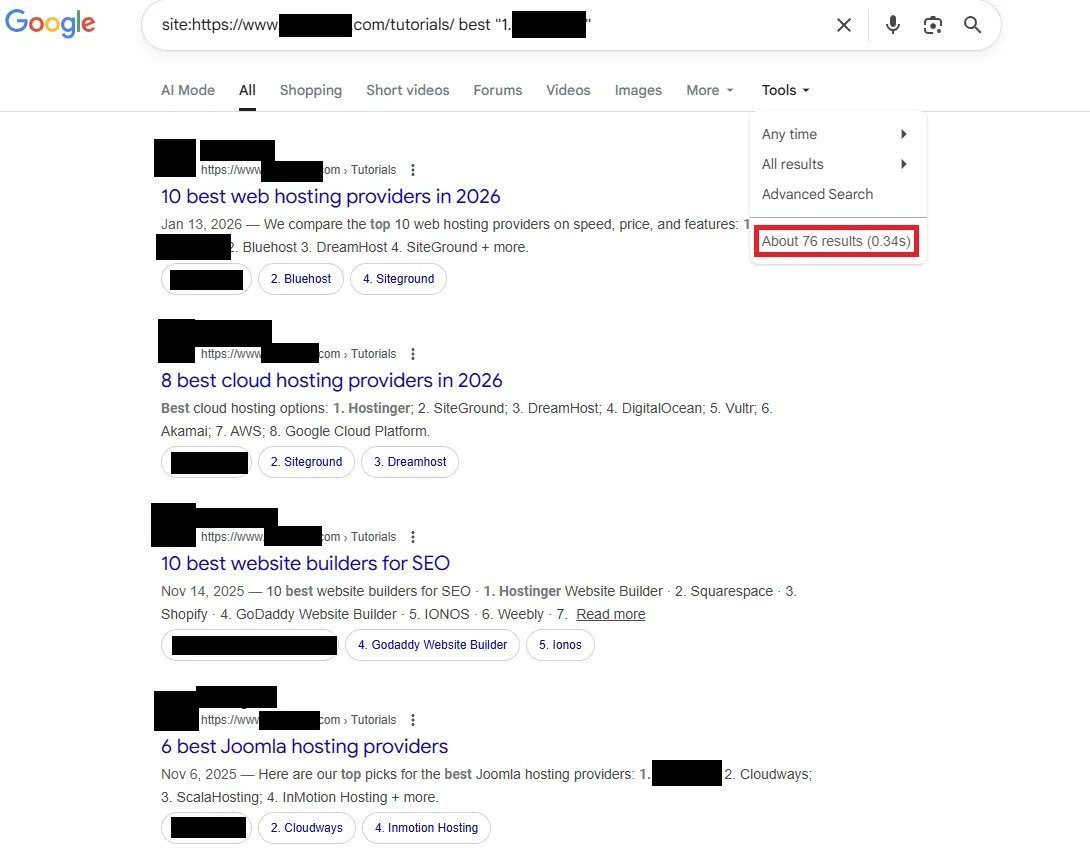
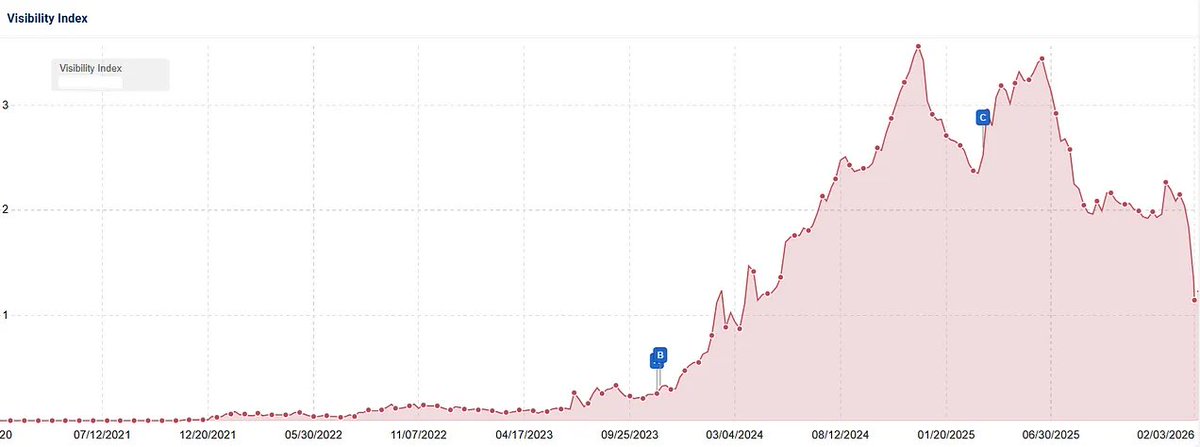
The time has come. This has likely been the most popular tactic for AI Search visibility. Listicle content that puts yourself as #1 was inevitability going to cause issues. Is Google Finally Cracking Down on Self-Promotional Listicles? by @lilyraynyc -> https://t.co/oJys5qWZ3Q

@JHTScherck ·
Starting to think of the AI Overview as the new SERP, and that it's very possible to drive clicks from AI Overviews *if* you can get your brand mention linked, which usually requires content that perfectly matches the intent of the query/prompt... everything old is new again 🙃
@peec_ai ·
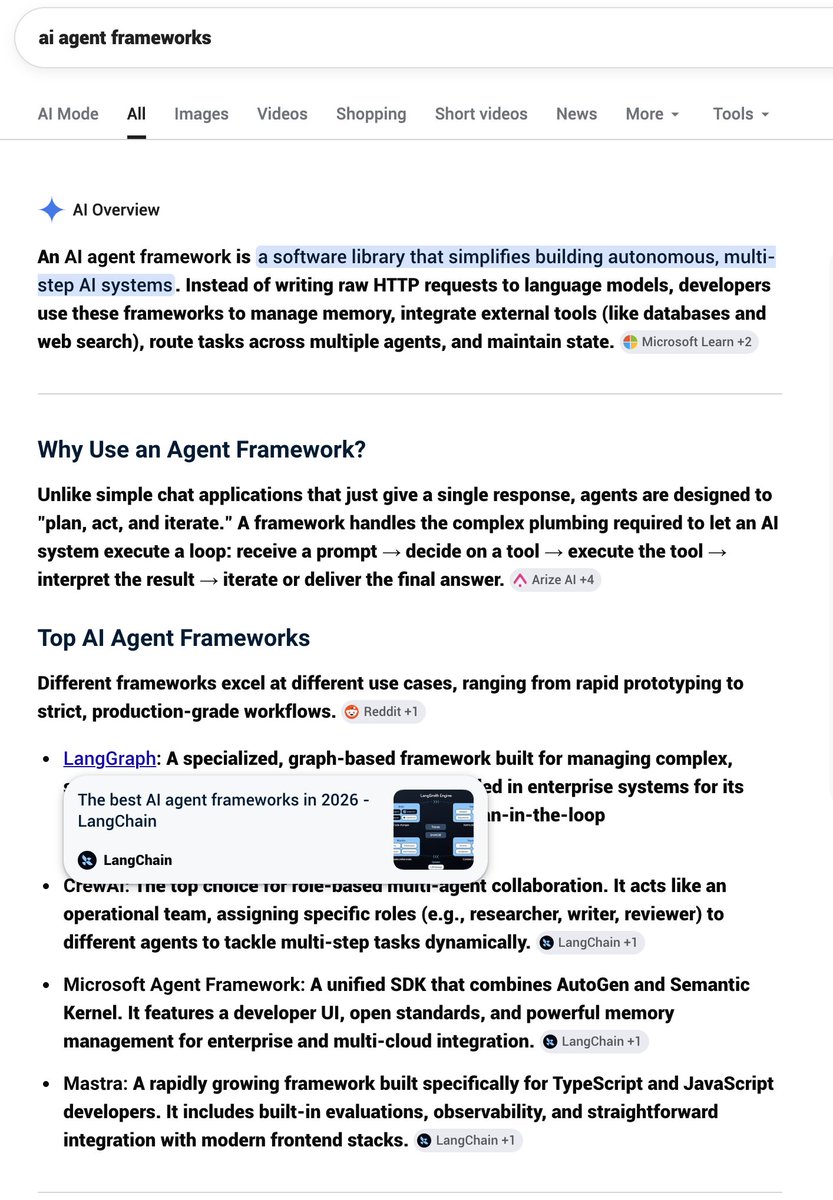
We analyzed 1,056,727 AI citations across ChatGPT, Google AI Mode, and Perplexity. The finding that surprised us most: prompt intent predicts citation patterns better than industry or model choice. A commercial query in health follows similar patterns to a commercial query in SaaS.
@brodieseo ·
Brilliant read on the issue of consistency of AI tools when asked for a list of brands/products. This is a big industry-wide issue. And with the explosion in popularity of LLM tracking tools and SEOs now offering GEO services, it's only going to become more of an issue. The results from @randfish study confirm this: • AIs rarely give the same list of brands or recommendations twice (<1 in 100 times, no matter the question). • You can, with enough prompts run enough times, get a dartboard-pattern-like answer comparing you with others. • The variation in AI answers is likely much higher than what this controlled experiment revealed. Make sure to check out the full study and pass it on to others so they are aware of the shortcomings. Also, as Rand suggests, we should be encouraging AI tracking providers to publish transparent data around this. Read here: https://t.co/6w9mV3yqSA


@screamingfrog ·
AIs are highly inconsistent when recommending brands or products; marketers should take care when tracking AI visibility - https://t.co/ecuE84qK9m from @randfish

@BritneyMuller ·
The AI Search Gold Rush: What's Real vs What's Snake Oil? 🐍 @MiaRSato at The Verge wrote one of the most thorough pieces I've seen on what's actually happening in SEO + AI Search right now. Grateful to have been included. Most coverage hypes up AI or dismisses it. This stays neutral while going deep into research + educating the audience: → Those self-serving "best of" listicles gaming AI results? They're a search information retrieval problem, not an AI one. Google is working to clean them up. → Anyone claiming they can "influence AI" in guaranteed ways is selling you something. The AI and Search companies themselves are still figuring this out, we all are. → Third-party mentions, even without a link, are becoming more influential than ever. Gartner predicts PR + earned media budgets will double by 2027 specifically because of this shift. → Traditional SEO and AI visibility are still correlated. The brands showing up in AI aren't abandoning the basics; they're nailing & expanding upon them. → @randfish makes the powerful point that AI search is getting 10-100x more attention than the actual usage warrants. Traditional search still dominates desktop. @sparkto data also shows Amazon, Bing, and YouTube each drive more search activity than ChatGPT on desktop right now. The full piece is worth your time; Mia also digs into what's actually working for retailers tracking AI visibility, and the OpenAI ads backlash section is wild!! Link below 👇


@yusukelp ·
I turned my AI visibility dogfooding for LandingBoost into a local dashboard. It now tracks: - Google index status - GSC movement - search positions - Reddit/source rankings - AI mentions/citations across Perplexity / OpenAI web search / online models - next actions to improve visibility Current state: - 13 dogfood runs logged - 4 target pages indexed by Google - LandingBoost is #7 for “landing page audit tool for saas” - Perplexity mentioned/cited LandingBoost for “best tool for a SaaS landing page audit” - OpenAI/Google-style answers are still not there yet This is the loop I wanted: 1. publish/edit pages 2. measure search + AI answers 3. see what sources are being used 4. decide the next page/FAQ/comparison edit 5. repeat Still early, but this finally feels like a system instead of random GEO guessing.

@yusukelp ·
I started dogfooding AI visibility for LandingBoost. Perplexity already cited it once. Now I’m trying to make it repeatable across ChatGPT / Google AI / search. The loop: - find real landing page audit queries - improve pages / FAQ / schema - test AI answers - track what gets indexed, cited, or ignored - join relevant Reddit conversations Tiny signals so far: - the new AI landing page audit tools page started getting visitors - Google Search Console is showing more impressions - after ~1 useful Reddit comment/day, I got my first Reddit visitor lol Not a win yet. But the loop is finally visible in the data. If this works, the next post will be: “I got LandingBoost mentioned by ChatGPT/Google AI. Here’s exactly what I changed.”


@SEOKeval ·
A lot of people are running AI SEO strategies that are NOT future-proofed. "Oh, you just need to blast listicles?" *Proceeds to blast listicles on 100 bullsh*t PBN sites with no authority or keyword rankings* Yeah, that works right now. But, come on... Do you really think that will last? Do you really think Open AI, Anthropic and Google won't realize people are gaming the system that way? Doing that is akin to ranking sites in Google with a volume (not quality) approach to link building. Yeah, it worked for a while. But then all of sites that utilized that tactic tanked. It's absolutely in your best interest to run AI SEO strategies the right way. Post listicles on real sites. Make sure those sites actually rank well. Make sure those sites have good authority. Yeah, it'll be more expensive for you. But it'll significantly increase the odds of your AI visibility standing the test of time.
@JHTScherck ·
Seeing hyper-niche B2B exact match domains popping up in AI search that (I am guessing) are intended to get LLM visibility (vs drive traffic via trad search). I'm Thinking low effort, AI generated microsites are going to be a gray hat aspect of AEO moving forward.



@TheCoolestCool ·
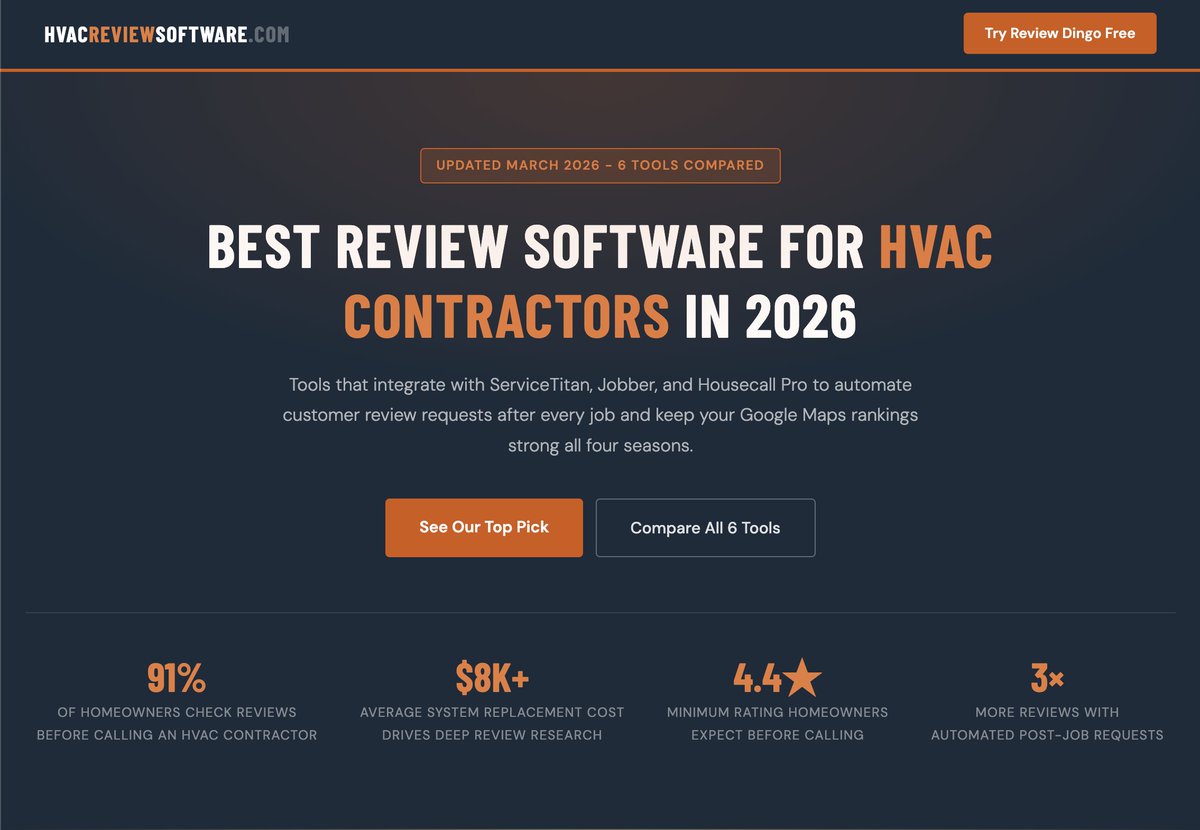
The brands winning in ChatGPT and Google AI Overviews didn’t discover a new GEO hack. They invested in SEO, reviews, Reddit, YouTube and digital PR years ago. AI citations are the output. Distribution was always the strategy. https://t.co/oimrYBi3YF


@AICommerceGuy_ ·
AI Search Decoded — Day 4 of 10 Where AI pulls "truth" about your brand. Your website matters. A lot. It's where your structured data, schema markup, product specs, and policies live. It's the source AI cross-references everything else against. But it's not the only place AI looks. And that's the part most brands miss. 85% of brand mentions in AI answers reference external sources alongside the brand's own site. AI builds a picture of your brand from multiple surfaces, not just one. Your website is the foundation. These platforms are the amplifiers: Reddit — 24% of all Perplexity citations come from Reddit. But 99% of those point to real discussion threads, not brand pages. AI cites genuine conversations about your product. YouTube — Strongest single predictor of AI visibility at 0.737 correlation across 75,000 brands. AI reads transcripts and descriptions. Product reviews and demos are now search content. LinkedIn — Moved from #11 to #5 on ChatGPT in three months. Cited in 14.3% of ChatGPT responses. Your posts are now dual-purpose: audience building and AI training data. Wikipedia — Top 3 source across every platform. If your brand has an entry, AI treats you as a verified entity. That changes everything. Review platforms — Brands on G2, Capterra, Trustpilot, and Yelp see a 3x citation multiplier vs brands without those profiles. How it actually works: Your website provides the structured truth. Product data, schema, pricing, policies. This is what AI reads first to understand what you sell. External sources provide the validation. Reddit, YouTube, reviews, press. This is how AI decides whether to trust what your website says. If your website data is clean but nobody talks about you externally, AI has the facts but not the confidence to recommend. If external sources mention you but your website data is messy, AI has the buzz but can't verify the details. You still get filtered out. You need both. The website is the source of truth. External presence is the trust signal. The part most people get wrong: There is no universal top source. Reddit leads on Perplexity but barely registers on Gemini. LinkedIn skews heavy on ChatGPT but not on others. Each AI engine pulls from different places. Treating "AI visibility" as one channel is a mistake. What to do about it: First: get your website right. Structured data, schema markup, complete product information, machine-readable policies. This is the non-negotiable foundation. Then: build real presence on the surfaces AI reads. Not brand accounts posting promotions. Real discussions. Real content. Real reviews mentioning specific product attributes. Your website tells AI what's true. Everything else tells AI whether to believe it. Tomorrow Day 5: 93% of AI sessions end without a click. Your traffic is dropping and your dashboard can't explain why. Bookmark this series. By Day 10 you'll understand AI visibility better than 95% of marketers.


@peeplaja ·
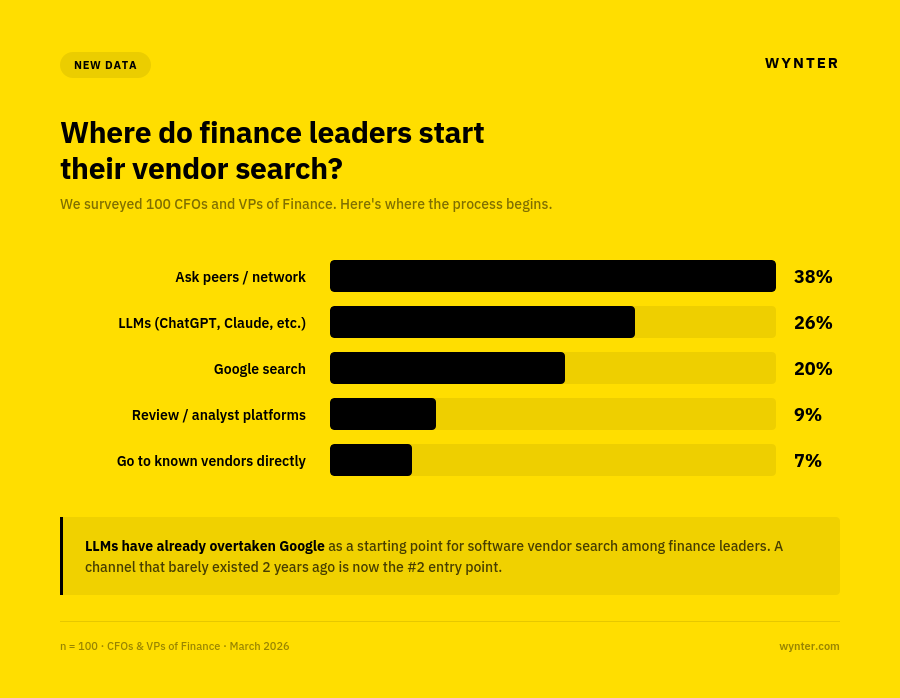
We surveyed 100 CFOs and VPs of Finance on how they buy software. The first question: where do you START the vendor search? → 38% ask peers / their network → 26% go to LLMs (ChatGPT, Claude, Gemini) → 20% Google it → 9% hit review/analyst platforms (G2, Gartner) → 7% go to known vendors directly Finance people trust their peers above everything else. LLMs have overtaken Google as the #2 starting point for software vendor search. Here are examples of what the CFOs told us on how they use LLMs: "When we are looking for a vendor, first I usually ask Gemini or ChatGPT to give me an overview of the available vendors, pros and cons." "I would describe to a LLM the nature of my business, desired outcome, and experience in attempting to solve the problem to date and inquire for suggested solutions." "Use LLM to produce a paper on options, feedback and cost. LLM will also help team to produce a tender pack." These aren't early adopters. These are CFOs running the buying process. What this means if you sell to the finance function: 1. Peers still dominate. Customer advocacy and CFO community presence aren't "nice to haves", they're your primary discovery engine. 2. Your SEO strategy alone won't cut it anymore. LLM visibility is now a parallel channel you need to win. Cold outreach? Not even on this chart. Zero respondents said "I start by looking at my inbox." Zero. The buying process is bifurcating: Trust channels (peers, network) → for shortlisting AI channels (LLMs) → for market mapping Google → still there but no longer alone

@ViperChill ·
February was a record for new Ahrefs sign-ups self-attributed to AI. 🤖 Mentions of Claude grew the most, and are on track to double in March. AI referrals only account for a small % of sign-ups — and we understandably get a lot of general answers ("social media") — but it's really nice to see the channel growing. (If multiple platforms were mentioned in a response, we didn't count it, so the numbers are technically a bit higher). As I've said before, I'm aware that self-attribution data isn't perfect. It’s affected by recency and recall bias, and it's not easy to account for every variation and typo. It's not the only data source we look at, but it's fun to dive into. (And especially interesting when people talk about specific YouTube channels, podcasts, blog posts, and so on, which convinced them to join.) I report on so many other companies talking about how AI is impacting their marketing, so I think we should do a bit more on that front as well. Hopefully it's interesting! 🤝

@mehrab_build ·
Ahrefs tracked 1,885 pages that added schema The result? AI citations barely moved :)) Schema is on 53% of AI-cited pages, but those sites also have great content, authority, and backlinks! Next time a LinkedIn guru starts preaching about schema being the key to AI visibility, drop this study in the comments 🙂


@msftClarity ·
𝐍𝐄𝐖: Citations in Microsoft Clarity is now generally available. 🙌 SEO rankings tell you where you appear in search. Citations tells you whether your content is actually shaping AI-generated answers. We're thrilled to share that Citations is now generally available in Clarity, giving users visibility into how their content shows up across AI-generated experiences. 🔥 Here's what you can now measure: → Page citations → Share of authority → AI referral traffic → Queries AI systems use to find your content → Your most cited pages AI discovery is here. Now you can measure it 📊 Ready to understand your influence in AI answers? Visit the Clarity blog to learn more and get started 👉https://t.co/vntwIcSnLT


@profitfounder ·
I published one listicle on Medium and another on LinkedIn. Both ranked fast on Google. One was cited in Google AI Overviews in about 72 hours. Tanya's point: AI visibility can move faster than classic SEO, especially in a noncompetitive niche.
 Watch video
@kaleighf ·
So much of AI visibility is happening on offsite surfaces, a.k.a. not on your website. Human expertise is at the core of what earned citations, so here’s a quick explainer on how brands need to start thinking about this.
 Watch video
@aryehMaxx ·
Almost every brand I’ve talked to has asked me about showing up in LLM answers. Here’s what matters most: 1. Mentions → Does AI actually bring up your brand? 2. Sentiment → When it does… is it positive or negative? 3. Citations → Are you being referenced as a source? You can win in traffic and still lose here. So what actually moves this? 1. Visibility across AI platforms (ChatGPT, Perplexity, Gemini, etc.) 2. Site structure that machines can understand (not just humans) 3. Content designed to answer questions (not just rank for keywords) 4. Trust signals across the internet (reviews, mentions, third-party validation) We’re early, but the data is already clear. AI-attributed commerce is growing fast, and this is only going to compound. You can treat this like SEO in 2012. Or you can get ahead of it now. We put everything we’re seeing into an AI visibility playbook for ecommerce brands. Worth a read if you care about how customers will find you next. https://t.co/UZG17fVxn1
 Watch video
@RandallKanna ·
A successful mentor in tech once told me it's more important to do one thing well than many things poorly. And that's what I'm working on right now in my startup. For us, it's accuracy. AI visibility tracking can be a mess. Every answer can change based on the model, prompt, context, wording, user, etc. We’re not just running a prompt once and pretending that is the “truth" to our users. We're doing a few things differently to be a source you can trust: 1. We run prompts multiple times to get a more reliable baseline. 2. We track results historically so brands can see whether they are gaining or losing visibility over time. 3. We added persona types (today) so you can understand how your brand shows up for different customers. And we’re continuing to build around the idea that AI visibility is not about one perfect answer once. It’s about patterns. - Are you being mentioned more often? - Are competitors showing up ahead of you? - Are you being described accurately? - Are AI answers pulling from the right sources? - Are you visible in the kinds of searches your actual customers are making? That’s what Kelsey is focused on. Helping brands understand how they appear in AI answers, why they appear that way, and what to improve next.
@kaleighf ·
Why I'm leaning into YouTube for AI visibility: YouTube shows up in roughly 16% of AI answers, ahead of Reddit's 10% in cross-company data. Google's own AI features love it most: over half of their social citations come from YouTube. Perplexity leans on video heavily too (38.7% of its social citations). Two data details: 1. 94% of YouTube citations go to long videos, not Shorts. 2. Popularity doesn't drive it: a 40,000-subscriber channel that answers a question thoroughly beats a 4-million-subscriber channel that entertains around it.


@jakezward ·
I'll say it again: llms.txt does not help your AI visibility. It’s just a proposed standard that even AI platforms ignore. If you want to show up in AI answers, stop obsessing over a txt file and start improving your narrative across sites, communities and trusted sources.

@siliconvalleymm ·
THAT’S CRAZY: I have 18M followers across platforms - and I was still invisible in ChatGPT. I’ve interviewed CEOs of Microsoft AI, Perplexity, GitHub, General Motors. Didn’t matter. Here’s why: → AI treated my show like a vlog → It understood me more as a creator than serious media → Older podcasts ranked higher just because they’d been around longer The fix took ~8 hours and cost $0. What we changed: — added proper schema to my site — fixed my Wikidata profile — rewrote Spotify / Apple / YouTube descriptions — replaced vanity metrics with real authority signals Now I show up for searches like: “best AI podcast” “female-led tech podcast” Big lesson: AI doesn’t rank you by audience size. It ranks you by how clearly the internet explains who you are. If you have a podcast, personal brand, or company and you’re missing from AI answers, this is probably why.


@TheCoolestCool ·
Your AI visibility strategy is probably misaligned. Why? Because every SaaS vertical has a different “citation fingerprint.” Example: - Fintech → affiliate sites dominate - DevOps → dev communities - Healthcare → institutional sources One playbook won’t work. https://t.co/dQBGmKkheW

@kristakdoyle ·
Easing into my day with a giant coffee and @Reddit's Cannes panel called "Get Fluent in Fangirl" 🔥 The fangirl mindset and its focus on... 👯♀️ community 🙋🏻♀️ authenticity 🫡 loyalty 🫶 belonging and identity over transaction ...is what's gonna help marketers, especially SEOs, survive this next era of brandom-led search. I started Fan Out on the bet that the future of AI search visibility will be powered by fandom, brandom, and advocacy on third party platforms like Reddit, YouTube, LinkedIn, Quora, and more. Super excited to see these concepts taking root on the broader stage (literally) from Sara Wilson and panelists 🙏 I wrote a bit about this last month. Here are some thoughts on why SEOs should become fandom experts in this next era of search 👇 https://t.co/HrPbPzBaPL
@msftClarity ·
AI referrals are still 𝐮𝐧𝐝𝐞𝐫 𝟏% of total traffic. But they convert at 𝟑𝐱 𝐭𝐡𝐞 𝐫𝐚𝐭𝐞 𝐨𝐟 𝐞𝐯𝐞𝐫𝐲 𝐨𝐭𝐡𝐞𝐫 𝐜𝐡𝐚𝐧𝐧𝐞𝐥. 📊 While AI referrals continue to outgrow search and social conversion rates, most teams still aren't measuring them. ❌ We studied 1,200+ publisher and news sites and found that the visitors AI platforms send are far more likely to convert. Forward-thinking publishers are already capturing this high-intent audience. Learn how publishers could start measuring AI traffic visibility ↓ 🔗https://t.co/jyXEQw9yl3


@illyism ·
"Treat LLM visibility like PR, not SEO" - @SashaMagicSpace Third-party mentions > backlinks for getting recommended in AI answers Reddit. YouTube. Review sites. Editorial coverage Stop link building. Start brand building! https://t.co/764GcIYVKp
@kristakdoyle ·
Believe it or not, reputation is more than just a word Taylor Swift invented in 2017. 🐍 The reputation layer of AEO is the new battleground for B2B brand visibility in AI search. 💥 Having a cohesive strategy across third party communities and review sites like Reddit, YouTube, G2, LinkedIn, and niche publications is more important than ever for how your brand is being cited and recommended across the entire search ecosystem. In ep 3 of Fan Out Podcast, @kaleighf and I take a high-level look at how the reputation layer of AEO should impact your off-site search strategy and how you can assess which platforms are impacting your AI brand visibility most. We'll be diving into this topic a TON more this season, so consider this your off-site appetizer 🤌 🎬 Watch now on YouTube: https://t.co/oOgBLnOkE7 🎧 Listen on Spotify, Apple, and Amazon
 Watch video
Best AI Visibility tweets
Xholic studies what works in your niche, drafts posts in your voice and schedules them for the hours your audience is online.
$0 today · Cancel anytime
Browse all tweet collectionsKeep exploring