AEO strategy versus hype
Coordinating SEO, content, PR, and community work around business goals while scrutinizing causal claims, quick-fix tactics, and tools sold as substitutes for a strategy.
42%
Best tweets about Answer Engine Optimization
Discover the best tweets about answer engine optimization, including AI answers, citations, content structure, visibility, measurement, and AEO strategy.
Evidence-based AEO strategy for earning visibility and citations in answer engines, with experiments, measurement, and practical methods.
Original Xholic analysis
The conversation favors AEO built on SEO foundations, useful evidence, clear answers and third-party authority—not dashboards alone. Practical proposals include inspecting cited sources, clustering fan-out questions and retesting changes. Reported experiments offer leads, not universal proof: rankings, retrieval, citations and buyer recommendations remain distinct outcomes.
58% of posts
All-time engagement
36% of posts
Published in 90 days
Conversation map
Coordinating SEO, content, PR, and community work around business goals while scrutinizing causal claims, quick-fix tactics, and tools sold as substitutes for a strategy.
42%
Earned media, reviews, communities, creators, and other third-party surfaces that validate a brand and appear in AI answers.
42%
How indexing, technical SEO, organic rankings, and query fan-out affect which pages answer engines retrieve and cite—and where AI visibility diverges from Google rankings.
42%
Direct answers, standalone sections, clear headings, comparisons, and evidence that make content easy to extract and cite.
38%
Tracking mentions, sentiment, citations, referral traffic, and conversions while accounting for variable answers, limited prompt-volume data, and the gap between being retrieved and being cited.
36%
Proprietary data, experiments, examples, credible sources, and timely updates as alternatives to generic or mass-produced AI content.
24%
Clustering fan-out questions, inspecting cited sources, testing content changes across engines, and checking whether target pages enter citation sets.
22%
Category fit, consistent product differentiation, and commercial-intent comparison content that help a brand earn relevant recommendations, not merely citations.
16%
Tone and stance
Performance benchmark
Posts with media make up 54% of this collection. Their median all-time score is 9.89, compared with 6.56 for text-only posts.
Format mix
Consensus and debate
Shared view
Contributors combine crawlability and SEO fundamentals with direct answers, standalone sections and original evidence. A reported AI Overview experiment illustrates gap-filling content, but does not establish a universal recipe for citations.
Shared view
Track relevant buyer prompts, inspect cited pages, cluster fan-out questions into topics and map gaps to existing content. Retest citations after changes rather than treating a visibility dashboard as the intervention.
Shared view
Third-party coverage, reviews and community participation recur as strategy components. Contributors also emphasize positioning: the brand, customers and external sources should explain consistently why the product belongs in the recommended category.
Shared view
Retrieval is not citation, and citation is not necessarily recommendation or conversion. Track these separately alongside brand mentions, sentiment and commercial outcomes; otherwise a source appearance can be mistaken for a buyer-facing win.
Open debate
Some contributors describe traditional SEO as a prerequisite for AI visibility. Others report ChatGPT citations rising despite Google losses. These accounts concern different engines and contexts, so neither supports a universal ranking requirement.
Open debate
Answer-first workflows and structured-content research suggest testable changes. Critics question whether those traits drive citations or merely accompany established authority. Use them as experiment hypotheses, not guaranteed levers.
Open debate
Batch publishing and proprietary-data programmatic pages receive support, while others warn against generic AI output and one page per fan-out query. The practical distinction is useful, differentiated coverage—not automation alone.
What performs
The supplied analytics give tutorials a median all-time score of 43.931, versus 15.17 for case studies and 3.28 for opinions. Tutorial posts perform strongly in this set; these scores do not measure whether the tactics improve AEO.
The positioning-and-strategy post leads the supplied benchmarks at 220.26, or 22.97 times the median. The citation workflow scores 145.87, or 15.21 times the median: both strategic diagnosis and actionable execution stand out in this sample.
Statistical standouts
Creator landscape
The five most represented creators account for 20% of the selected posts.
1. Aleyda Solis 🕊️
@aleyda
2 posts
2. Okara
@askOkara
2 posts
3. Cody Schneider
@codyschneider
2 posts
4. Daniel Foley Carter
@foley_seo
2 posts
5. Klaas
@forgebitz
2 posts
6. Gaetano DiNardi
@gaetano_nyc
2 posts
Among supplied top voices, Gaetano DiNardi has a median all-time score of 111.84 and Cody Schneider 94.9, each across two tweets. DiNardi emphasizes category fit and recommendations; Schneider supplies content and citation-acquisition workflows.
Kaleigh Moore argues that named employee experts can act as AEO creators. A vendor-reported LinkedIn case offers a concrete way to assess off-site publishing: connect individual articles to core buyer prompts and repeated citation checks. It does not establish that employee advocacy causes citation gains.
Since the previous snapshot
Themes, sentiment, stance, and post format are classified per tweet. All counts, shares, medians, creator concentration, freshness, and performance comparisons are then calculated directly from the published snapshot.
Xholic's all-time score compares engagement while accounting for reach, post age, and creator consistency. It is used for relative comparisons within this collection.
This report analyzes the exact 50-post snapshot shown below. AI identifies editorial categories and drafts explanations; all statistics are calculated from the snapshot, and every narrative claim is checked against cited posts before publication.
Best Answer Engine Optimization tweets
Ranked 01–50

@gaetano_nyc ·
I’ve spent the last 18 months doing AI SEO / GEO / AEO for B2B SaaS companies... and here's the 10 biggest things I've learned: 1. Most companies do not have an "AEO problem." Most do not have an unfixable technical SEO problem either. They have a positioning, category alignment, and market validation problem. 2. I've spent too many hours in meetings explaining how the old-world SEO model is dying (clicks and rankings) and the new model is about being selected for AI-powered answer recommendations. 3. Brand selection depends on whether the market, your website, your customers, and third-party sources all tell the same story about why your brand belongs in the answer. This is not about llms.txt or paragraph chunking. 4. Bulldozing your way to the top with listicles and backlinks may help you rank, but not get recommended. Especially if your brand doesn't belong in that category. 5. The best AEO strategy starts with positioning and category alignment. Here is the proper diagnostic framework for: “What's our AEO strategy?” Do we have clear product positioning? Do we have messaging that's aligned to the category? Does the website make our category alignment obvious? Do we have a BOFU content strategy aligned with the desired category? Do we have an external authority gap? 6. AI referral traffic is negligible for most B2B SaaS companies. For most of the companies I work with: ChatGPT / Perplexity / Gemini / Claude, etc. is a tiny fraction compared to Google. It's common to see a range of 5% (AI) vs 95% (Google). Why? Because AI SEO eliminates top of funnel, whereas traditional SEO sends mostly informational traffic. 7. Visitor to page conversion rates from AI referral traffic tend to be higher than traditional Google traffic. This is because of personalization, long-tail BOFU intent, and the elimination of TOFU intent. 8. There's a "Dark SEO" funnel emerging where buyers are shortlisting vendor options with AI search, verifying the brands they want to evaluate with Google search, and then converting directly on the website from branded search much later in the buying process. 9. Off-site authority matters, but the GEO vendor claims are getting out of control. I'm skeptical on things like: “90% of AI visibility comes from third-party sources.” etc. Claims like these are confusing and pulled out of context. This causes marketers to have the wrong reactions and think irrationally. 10. Buying AEO tools is not a strategy. I have personally worked with companies that purchased AEO tools with no strategy in-place. The mere fact that a tool was purchased only buys them time with the board... "we're working on it" ... but it's not a real strategy. Bonus: There's a "research" study out there which fits any narrative you want to push. Be wary. And be skeptical.

@codyschneider ·
half of winning with AI search is just writing content AI wants to consume how to find this with prompt watch api and data for seo api and write and publish it to your CMS with a coding agent here's the exact loop i run 1. find the prompts you're losing promptwatch api gives you every tracked prompt for your brand plus who got cited in the answer, per model — chatgpt, claude, gemini, perplexity, grok it also has agent analytics so you can see which AI crawlers actually hit your pages. pull two lists. prompts where you show up. prompts where a competitor shows up and you don't list two is your content calendar 2. size them with dataforseo's ai optimization api /v3/ai_optimization/ai_keyword_data/keywords_search_volume/live — search volume for how people phrase things inside AI tools, not google. totally different phrasing, way longer, way more conversational /v3/ai_optimization/llm_mentions/live — mention counts and impressions for your brand vs competitors on any keyword. then /v3/ai_optimization/chat_gpt/llm_responses/live and the claude, gemini, and perplexity versions of the same endpoint. same prompt, four models, live. you get the full answer text and every citation pennies per call no $500/month seat 3. read the citations before you write a single word take the top 20 cited URLs across those prompts, have codex code fetch all of them, and tell you what they have in common it's never "better writing." it's shape: answer in the first 40 words, before any setup H2s written as the literal question someone typed a comparison table with named competitors in it specific numbers and dates in the same sentence as the claim 200-400 word sections that stand alone brand name sitting next to the category term over and over models retrieve chunks, not pages. a 3,000 word essay with the answer buried in paragraph 14 never gets cited. a page where every section independently answers a question gets cited five different ways 4. write it with a coding agent, not a chat window hey claude code, build this: read prompts.json. for each prompt, fetch every cited URL, extract the heading structure and how the first paragraph answers the question. then write a post that answers the prompt in the first 40 words, uses the competitors' H2 questions as the outline, includes a comparison table with us in it, and adds FAQ Page + Article schema. output JSON matching my CMS schema. the reason it has to be an agent: one run hits 4 APIs, fetches 20 pages, and writes 30 files. you are not copy pasting that out of a chat window 5. publish over the CMS API every CMS has one strapi /api/articles, wordpress /wp-json/wp/v2/posts, ghost /admin/api/posts, webflow (ew) give the agent the token, have it POST the batch, then hit indexnow and submit to search console push 20-30 posts in one command. never open the CMS admin 6. re-run it in two weeks same llm_responses calls, same prompts. you're not checking rankings. you're checking whether your URL is in the citations array now most people are going to spend this year buying an AI visibility dashboard and never change a single page the dashboard isn't the work rewriting your content into the shape models actually retrieve is the work If you want to do this exact system everything you need on graphed .com

@jbobbink ·
94% of AI citations come from non-paid sources. Gartner is telling CMOs to double their PR budgets by 2027. Gartner just published their 2026 comms predictions. The headline: PR and earned media budgets will double by 2027 as LLMs replace traditional search. They're telling CMOs to reallocate spending from paid channels toward PR and earned media because that's what AI answer engines actually cite. Data backs this up. Muck Rack analyzed over a 1M links cited by ChatGPT, Claude, Gemini, and Perplexity. Around 94% of those citations come from non-paid sources. Earned media alone accounts for 82%. Journalism makes up 20 to 30% of all AI citations depending on the time period. Paid placements and advertising barely register. Semrush found that visitors arriving from AI search convert at 4.4 times the rate of traditional organic search visitors. That number comes from analysis of 500+ topics in digital marketing and SEO verticals specifically, so the exact multiplier will vary by industry. The direction is clear. There is a recency factor too. Muck Rack's February 2026 update found that more than half of all AI citations come from content published in the last 12 months. The highest citation rate occurs within seven days of publication. Press release citations alone grew 5x between July and December 2025. AI systems are actively prioritizing fresh content over older material. That recency signal matters for SEOs. This is not a one-time optimization play. It requires ongoing editorial presence. When CMOs start doubling their earned media budgets, that money has to come from somewhere. Gartner explicitly says to reallocate from paid. But in their 2025 CMO Spend Survey, paid media was already at 30.6% of total marketing spend. If earned media doubles, the budget pressure will hit every digital channel. Including SEO. We have spent two decades building an industry around optimizing for Google's algorithm. Now the discovery layer is fragmenting across a dozen AI systems that each weigh signals differently. And the signal they all seem to agree on is third-party editorial validation. Not backlinks. Not technical SEO. Editorial trust. Across analytics data from hundreds of properties, the pattern is consistent. Sites gaining visibility in AI-driven discovery are the ones with genuine brand authority and regular editorial coverage. Not the ones with the cleanest technical audits. Technical SEO is not dead. But it is no longer enough on its own. If your entire strategy is optimizing for crawlers and you are ignoring how AI systems evaluate brand trust, you are building on a foundation that is shifting. The PR industry just got handed the playbook that used to be ours. The smartest SEOs will learn from it. Sources: - Gartner, Top Predictions to Inform 2026 Comms Strategies (Feb 2026) - Muck Rack, What Is AI Reading? report (Feb 2026) - Gartner, 2025 CMO Spend Survey (May 2025) - Semrush, We Studied the Impact of AI Search on SEO Traffic (Jul 2025)

@Charles_SEO ·
We're now being cited in Google AI Overviews for core SEO terms.. right next to Moz and SEMRush 👀 No links, no authority play, just clever old school NLP SEO re-tuned for the new AI search interface... Here is the STEP-BY-STEP play: 1 - Reverse engineer SERP gaps; Your site needs to be able to rank in the traditional algo first, so pages where you are already in the top 100 are a must and the higher the start, the better the result. 2 - Identify the gaps between what THEY cover and what the AI Overview is trying to answer. 3 - Write a section on YOUR page that fills that exact gap, formatted clearly with a definition, example, or list that Google can easily extract as a standalone chunk. I added several more anchor text types using this exact method, "generic" wasn't the only one I targeted here. 4 - Make sure that chunk can stand alone as a complete answer to a sub-question within the broader topic. That's it! You're not competing for the whole page, you're competing for ONE chunk of the AI Overview. It's very similar to how we used to optimize for featured snippets, but with a lot more dynamic inputs required - It's usually not the one H2 anymore, you need to optimize (at least) several chunks to have the best chance of getting visibility. In this case, we were cited for the definition because our page had the clearest, most concise explanation with a practical example - Something our competitors either buried in paragraphs or didn't isolate properly. Unfortunately, we usually don't get to directly "win" a #1 spot anymore in these new SERPs, BUT the upside is you can now get visibility for queries your page would NEVER have ranked #1 for traditionally.. and you can get cited MULTIPLE times across the same AI Overview if you optimize several chunks well. Less clicks, more visibility and "brand awareness" - A lot of corporate marketers would actually prefer this anyway.... And this all rewards going broader and deeper on your pages. The more well structured, extractable chunks you have, the more chances you give Google to pull from you. The traditional algo is linear, this new search is much more dynamic, less ranking, more retrieval.


@lilyraynyc ·
One of the quickest and easiest AI search workflows (after setting up prompt tracking) is to export all fan-out queries and cluster them into core topics for analysis and content mapping. Trying to optimize for individual fan-out queries is not a great use of time, and building one page per fan-out will likely lead to SEO spam problems down the line. (Reminds me of popular pre-Helpful Content Update tactics 😅) But analyzing query fan-outs *at scale,* clustering them into core topics, and identifying the key trends among them is one of the best places to start with AEO/GEO, in my opinion. (Assuming you’re tracking a comprehensive set of prompts!) The output is a matrix similar to the keyword research matrices we’ve built for SEO for years, and it lets you compare your existing content portfolio to the key questions language models ask when researching your brand, products, and services. That said, I still believe SEO tools that use *actual search volumes* (not highly estimated / made-up “prompt volumes”) should stay part of this process. I just did this for a client in 5 minutes using @peec_ai, which allows for a quick export of all fan-out queries (as do several other LLM trackers). Then I uploaded the list into Claude for clustering. Another bonus is that you can see how fan-outs differ by language model. I see this as a new layer on top of our existing keyword and topic research. It gives us a window into how LLMs actually break down and research a topic, a signal we didn’t have access to before, and it provides deeper insights than what we can gather with traditional keyword research tools.

@jakezward ·
"I don't know how to do SEO in 2026" Start from level 1 in The New SEO Game: SEO isn't just Google rankings anymore. It's now "Search Everywhere Optimisation". Reframe your “New SEO” project as a game, and you'll become addicted to levelling up. Level 1: Traditional SEO - Fix technical problems killing your rankings - Research keywords and target quick wins - Optimise on-page elements (titles, content) - Earn quality backlinks through outreach and PR Level 2: AI Search Optimisation - Format content so AI can parse it easily - Build pages that AI platforms want to cite - Structure information for machine consumption - Test how your brand appears in AI search results Level 3: Paid Search Visibility - Run Google Ads for high-intent keywords - Target competitor terms with YouTube Search Ads - Capture Bing traffic through Microsoft Ads - Measure paid performance across every platform Level 4: LLM Answer SEO - Produce authoritative content LLMs trust - Build a knowledge base for AI training data - Position your brand as the definitive source - Monitor brand mentions in LLMs with Mentions .so Level 5: Brand Authority SEO - Get unlinked brand mentions across the web - Feature in industry roundups and expert lists - Build brand recognition without traditional backlinks - Track brand mention volume and sentiment Level 6: Community SEO - Provide value in relevant Reddit threads - Share expertise on Quora in your space - Engage in Slack communities and Discord servers - Build reputation in industry forums and groups Level 7: Parasite SEO - Repurpose content on Medium and LinkedIn Pulse - Publish beehiiv newsletters to rank in Google - Guest post on high-authority platforms/websites - Leverage existing domain authority for quick rankings Level 8: Platform-Specific SEO - Optimise for Amazon search if selling products - Focus on YouTube SEO for video content - Master TikTok's algorithm for short-form content - Optimise App Store listings for apps/extensions Level 9: Topic Domination - Own conversations across ALL channels - Create content ecosystems to reinforce each platform - Become the go-to expert mentioned everywhere - Monitor and maintain authority across all channels Completed all levels? SEO is constantly evolving going into 2026. Stay ahead or get left behind.
 Watch video
@SEOKeval ·
SEO today is a completely different game than it was 2–3 years ago. A lot strategies that once worked for brands no longer deliver results. So, I had to rebuild my SEO process from the ground up. And after a lot of testing, here are the strategies I've found to work best now: 1. You used to be able to slam Product Category pages with links and they'd eventually rank. Now, that will get your pages penalized. You need to slow it down a bit. Build a few links to Product Category pages, but focus most of your link building on your homepage and relevant blog content that internally links to your Product Category pages. 2. Speaking of blog content, clicks to top-of-funnel topics got nuked by AI models and AI overviews. They still get some clicks, but nothing like before. But that doesn't matter. Top-of-funnel content never drove a ton of revenue anyways. You need to focus most of your blog content around "best" and "vs" keywords. > Best [Product] > [Your Brand] vs [Competitor Brand]. > [Competitor Brand] vs [Competitor Brand] Those topics get clicks, drive revenue and influence AI models. 3. In 2026 and beyond, you need to build links like your life depends on it. Because it does. Not only has the competition within Google increased, but Google's algorithm has been tuned up to care about authority more than anything. With every algorithm update, low-authority sites get nuked, and high authority sites rise to the top. Build a ton of high-quality links, and be a high-authority site. 4. Google now evaluates sites more holistically than on a page-by-page basis. That means, if you want to rank for a keyword, you need to cover the overall topic. Let's say you want to rank for the keyword "pillow covers." You need to build pages to rank for other relevant keywords within that topic like "linen pillow covers", "white pillow covers", "striped pillow covers", etc. 5. SEO alone is not enough to rank anymore. Google wants to rank actual brands... meaning, you need to have good customer reviews, returning customers, people searching your brand name, etc. You need to build up that reputation and authority within your industry through other channels like paid ads, email marketing, and influencer marketing before starting SEO. Only then will Google will give you the green light to start ranking in their search results. 6. AI models are slowly becoming to new default search engine. You need to start optimizing for them. Fortunately, optimizing for AI models is 50-60% traditional SEO. The remaining 40-50% is getting your brand and products featured in relevant Reddit threads and "best of" listicles on authoritative site. AI models LOVE to cite Reddit and listicles. So, make sure you're appearing in them, and you'll get cited pretty quickly. Those are the main changes I've seen. If you do all of this, you have a good chance of thriving in this new search landscape. As always, SEO continues to be a game of adaptation. Those who adapt will do well. Those who don't will just have to pay more and more money to Google and Meta.

@forgebitz ·
"just rank in google for ai search" well, that turned out to be a lie SEO experiment with an AI-optimized site: - wiped from google (bad navboost score) - going up in bing - chatgpt citations go up (@promptwatch tracking)

@forgebitz ·
want AI content SEO to rank? do not generate endless slop everything you can generate directly using an LLM without unique context is already in the training data => useless and does not rank it's a content black hole; the question has been answered focus on anything not inside the training data; you can get thousands of chatgpt citations without a single backlink or "domain rank" everyone will destroy their website in the coming months with "pSEO" big opportunity for the rest of us

@codyschneider ·
stop overcomplicating this AI search is just SEO these are the only levers you can pull to actually move the needle 1. publish articles for bottom of funnel keywords and go to page 1 - 3 to get referral traffic find best x for y, x alternative, tools like x, better than x, apps like x scrape what is ranking page one currently define the product differentiation of your product versus what you just scraped write a blog post that includes your product and how it is different who it is for publish that article make sure it gets added to your site map for indexing pro tips - if you have a ton of posts on the site, on the sitemap have 100 pages per sitemap URL this will make indexing faster - make the page load extremely fast due to being extremely small and you'll get more crawl budget. ) 2. Get mentioned on citations that are already ranking for those same keywords, find the citations that are being used by AI search platforms se something like prompt watch to identify this export all the citations, then find the email addresses of the site owner or the individual article writer use instantly AI to cold email them asking to be included in the citation, you're probably going to have to pay to get this placement pro tip: - not all citations are created equal. If you map all the citations within your category, you're going to find that certain links get cited more often than others. So you can rank stack the citations by priority and this means that it is ok to potentially pay more for those citations because it will create a higher impact faster

@askOkara ·
"GeO iS EaSY" GEO: > add internal links > build topical authority > update outdated stats > publish original research > quote reputable sources > add screenshots and demos > add direct answers at the top > make sure js content is crawlable > get mentioned on reddit, g2, youtube > update dateModified when you make changes > build how to, best tool for x, comparison pages > check that your cdn/waf isn't blocking crawlers > allow oai-searchbot, perplexitybot and googlebot > keep your founder profiles and brand description consistent > type prompts your icp types into chatgpt, claude and google > open the cited pages and study the exact section the answer came from > find what those pages are missing, then add something more useful > recheck rankings and citations every month because they change constantly
@SEOKeval ·
SEO may be the most important marketing channel out there right now. Why? Because it's a prerequisite to appearing in AI models. Good traditional SEO gets you 50–60% of the way toward appearing in AI models. And the other 40-50% is just an extension of SEO: > It's publishing "best X" listicles, featuring your product at the top, on relevant, high-authority 3rd party websites. > It's finding relevant Reddit and Quora threads, and mentioning your brand in the replies. The goal is to "seed" your brand around the web, so when AI models pick up those references, they cite you for relevant prompts. In other words, you're doing parasite SEO. It's nothing mind-blowing. It's also nothing new. It's just an extension of what we've always been doing in SEO.

@brodieseo ·
AEO Tip: I've been increasingly experimenting with trying to influence ChatGPT output for my eCommerce clients. Particularly for queries where I'm comparing my client against competitors for basic 'buy' and 'sell' queries for them as a business. The balance that we're trying to strike within this experimentation is ensuring that we're staying within the confines of their branding and not outright mentioning competitors – something that is far more common within the SaaS space. For this client, a lot of their competitors are considered to be "marketplaces", whereas my client holds all stock on-site (a major point of difference) and does the buying and selling of the stock itself. The major benefit to this approach is that they can maintain the quality of the product through their own authentication processes, being a clear advantage over the classic marketplace model. Within this experiment, we published a comparison page that compared them against "marketplaces" across various metrics in order to influence the output, and our new page was used as a core source in ChatGPT within a day. And we're already starting to gain more control over how they're being represented, making a clear argument for why both buyers and sellers should choose them over key competitors, without mentioning them directly. In my opinion, this type of approach is the way forward when doing these types of experiments, rather than creating content that goes outside of company guidelines for the sake of AEO. It is a fine line for this type of work, but clear benefit when it is executed correctly.



@glenngabe ·
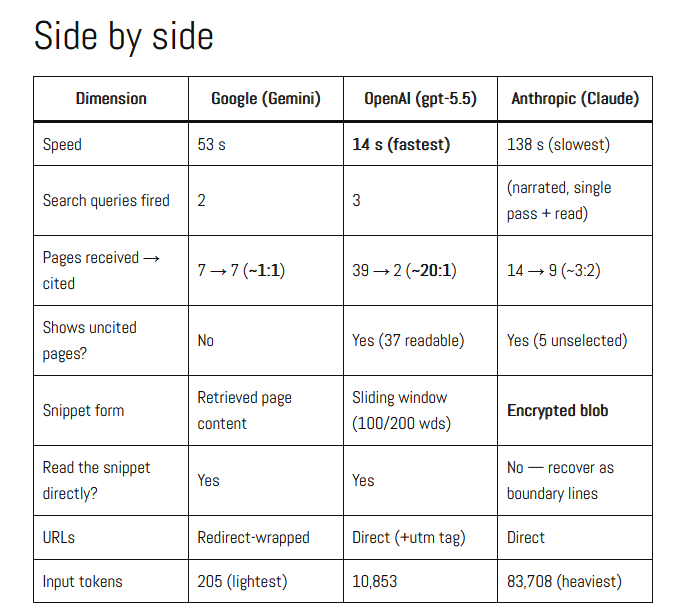
Cool post from @dejanseo -> How AI Search Grounding Actually Works: Google vs OpenAI vs Anthropic "For Google, the funnel barely narrows: 7 received, 7 cited. This is the defining trait of Google’s grounding — it doesn’t expose pages it didn’t use." "OpenAI’s wide-receive / narrow-cite split is a visibility trap. Being one of the 37 pages OpenAI read is very different from being one of the 2 it cited. Both are worth tracking, but they’re not the same win." "Anthropic gives the richest “considered set” (cited + rejected) but hides the snippet text, so reconstructing what it actually read costs a second pass — and real time and tokens." https://t.co/ZaKM3N8bqM

@tibo_maker ·
this is the biggest mistake people make with SEO blogs today 👉 they bury the answer AI leans on the top of your page, not the bottom for getting answers @Kevin_Indig (ex-Shopify, Atlassian, G2 and a bunch of other big techs) ran the numbers and proved it's killing you he took 1.2 million ChatGPT answers, isolated 18,012 real citations, and checked exactly where on each page they came from ~44% came from the first third and ~25% from the bottom third, where most people put the answer. nearly 2x the pull just for moving it up. he calls it the "ski ramp." so the fix is simple: put your answer in the first two sentences. then use the rest of the page to prove it this is a core philosophy for us at Outrank. every blog post it writes is answer-first by default


@aleyda ·
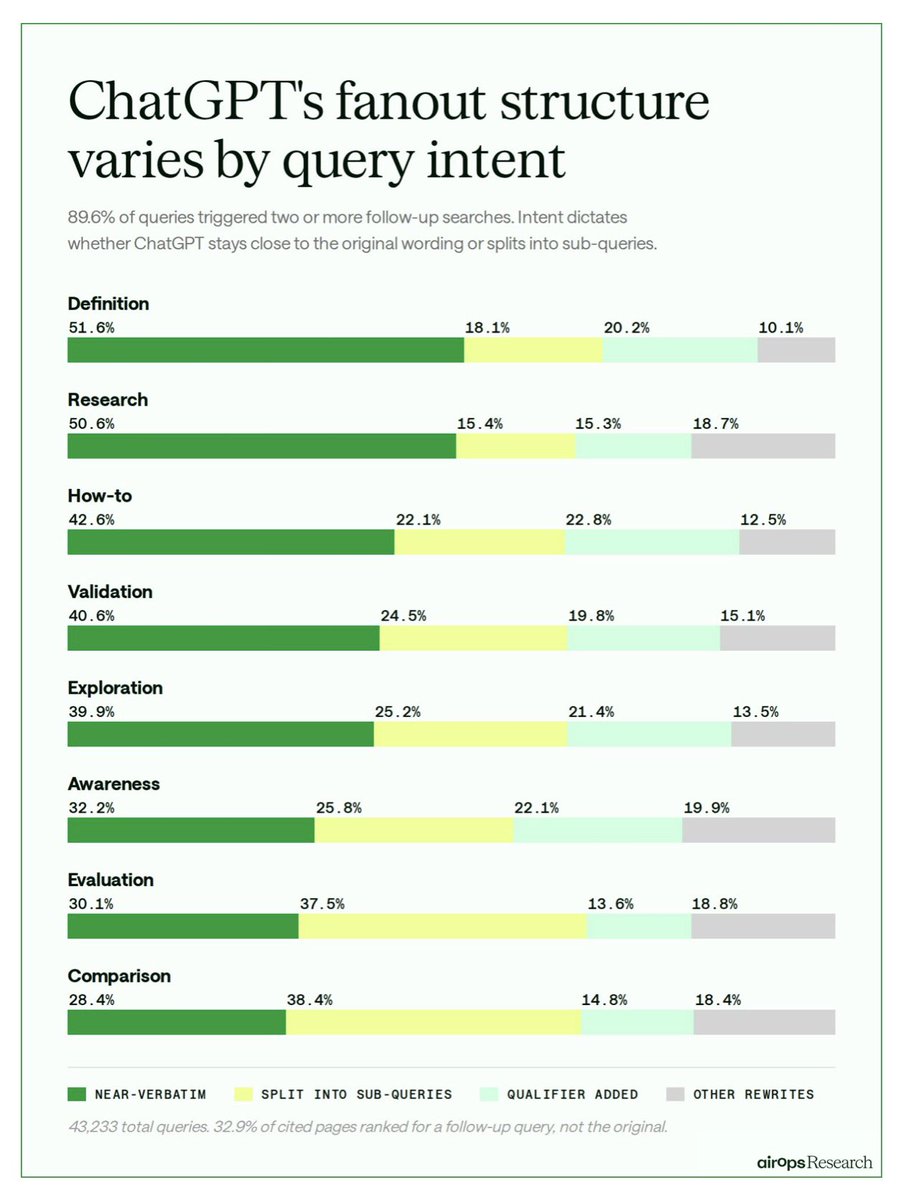
👀 Interesting insights from @_oshdavidson / @AirOpsHQ research about The Influence of Retrieval, Fan-out, and Google SERPs on ChatGPT Citations: * 85% of Sources ChatGPT Retrieves Are Never Cited: Pages with stronger title-query alignment and clearer language were more likely to earn citations. * 32.9% of cited pages that appeared in any top-20 SERP were discovered only through fan-out. That means tracking the original keyword alone is not enough to understand where citation visibility is actually won. * Pages Ranking #1 in Google Were Cited 3.5x More Often Than Pages Outside the Top 20 SERPs (tell me again that SEO dead 😉 not) Much more! Read: https://t.co/VfiFmSfSza



@om_patel5 ·
i took my startup from 0 to 2.15 million google impressions and 6,000+ clicks in 3 months, purely through seo and gseo everyone thinks seo is dead because ai overviews now sit on top of the results and answer the question before anyone clicks. its not dead. the game just split into two, seo to rank on google, and gseo to get cited inside the ai answers themselves. i did both so heres the exact system. the core idea is to stop writing blog posts one at a time. build a system that produces thousands of pages, each answering one very specific question, powered by data nobody else has. 1\ programmatic seo off my own data my startup sits on a large proprietary dataset. thats the unfair advantage. instead of writing pages by hand, i built templates that turn that data into thousands of unique pages, each targeting one long tail search. > one page per tool, per niche, per problem category, instead of one generic page > every page pulls in real data points so its genuinely useful, not thin filler > this is the exact play zapier and nomadlist used to pull millions of organic visits google doesnt penalize automated pages. it penalizes the "thin" ones. so every page has to carry a real purpose or it doesnt get made. 2\ gseo, getting cited inside the ai answers this is the part almost nobody is doing yet for their own startup. ai overviews and chatgpt/claude/gemini/perplexity are the new "front page", and you want to be the source they pull from, not the site they replace. > structure every page so an ai can lift a clean, quotable answer straight out of it > lead with the actual data, tables and numbers, the stuff a text summary cant fully replicate, so people still click through > get referenced across the web so the models learn to trust and cite your brand as the authority on the topic when the ai answers the question using your data, you win the visibility even on the zero click searches. 3\ reddit as a ranking channel google surfaces reddit threads at the top of results constantly now. so i show up where the exact problem i solve is already being talked about. > find threads where people are complaining about the problem my startup solves > actually help, dont spam, answer the question properly > build real presence in the subreddits my buyers live in so my stuff ranks double duty. it drives direct traffic and plants my brand inside the reddit results google now loves. 4\ domain authority authority isnt one badge you bolt on at the end, its baked into everything. > listed and reviewed on real directories, product hunt, g2, capterra, trustpilot, etc > earned backlinks from people genuinely referencing the data, of course not bought links > consistent "build in public" presence so the brand gets mentioned and linked naturally domain authority lifts every programmatic page along with it which is the compounding part seo in 2026 isnt publishing more ai slop blogs, its building a system, powered by data only you have, that both ranks on google and gets cited by the ai. its slow at first but compounds forever
 Watch video
@askOkara ·
quick geo wins most founders are sleeping on > unblock oai-searchbot, perplexitybot, and googlebot in robots.txt or at your cdn/waf > answer the question early on every page. > add original data, stats, screenshots, experiments and examples > quote and link reputable studies, reports, or experts in your articles > get mentioned on reddit, youtube, g2 > build comparison and "best tool for" pages around the questions your icp asks llms okara ai cmo audits all of these and tells you what's blocking you from showing up in ai answers

@jmoserr ·
"This GEO tactic gets you cited in LLMs!" "Interesting. How do you know that...?" "My research bro. I analyzed 10,000 prompts bro. All of the brands cited in ChatGPT have pages with expert quotes, statistics, inline citations, structured formatting, and topical depth…" "Ok…sure, but did the page get cited because it had those features? Or did it have those features because it was already high-authority content that performs well everywhere...and AI search just picked it up too?" Nobody peddling GEO fairy dust wants to answer this question. Right now, a huge chunk of GEO research is treating correlation like causation. Like these content traits are brand new levers you can pull to "get cited in AI search." Do X, get cited. Simple. Except: if everyone can just add charts and tables to a post and get cited, how does AI determine YOUR brand gets mentioned in a short output of 5 solutions in a space where thousands exist? It can't just be "do X tactics." That math doesn't work. What actually separates the brands getting cited? The same thing that's always separated them: real authority. Google's own "How Search Works" documentation states openly that links are a core signal for content quality. AI is very similar. HubSpot found that 92% of AI mentions come not from your own content, but third party sites mentioning you. So when someone says AI engines cite content with quotes, data, and good structure, they're simply observing a trait of authoritative content in general, not a "do x and get Y" causation factor. And even if these content tweaks do influence AI citation likelihood, SparkToro's recent research found there's less than a 1 in 100 chance that ChatGPT or Google AI will give the same list of brand recommendations in any two responses...even on the identical prompt run 100 times. The lists are different. The order is different. The number of results is different. Nearly every response is unique...so the agencies selling revolutionary GEO hacks are building on two broken assumptions: that these tactics directly cause citations (unproven), and that the outputs are consistent enough for those tactics to track reliably (they're not). AI search is real. It matters. Heck, we generate tons of leads from it. But the brands winning there are the same ones that have been winning everywhere... because they built actual authority over years, not because they added a data table to a blog post last Tuesday. Our own AI visibility increased the most by doing one thing: acquiring mentions + links on publications talking about our niche: being in more places that AI pulls from, increasing the likelihood AI mentions our brand.

@semrush ·
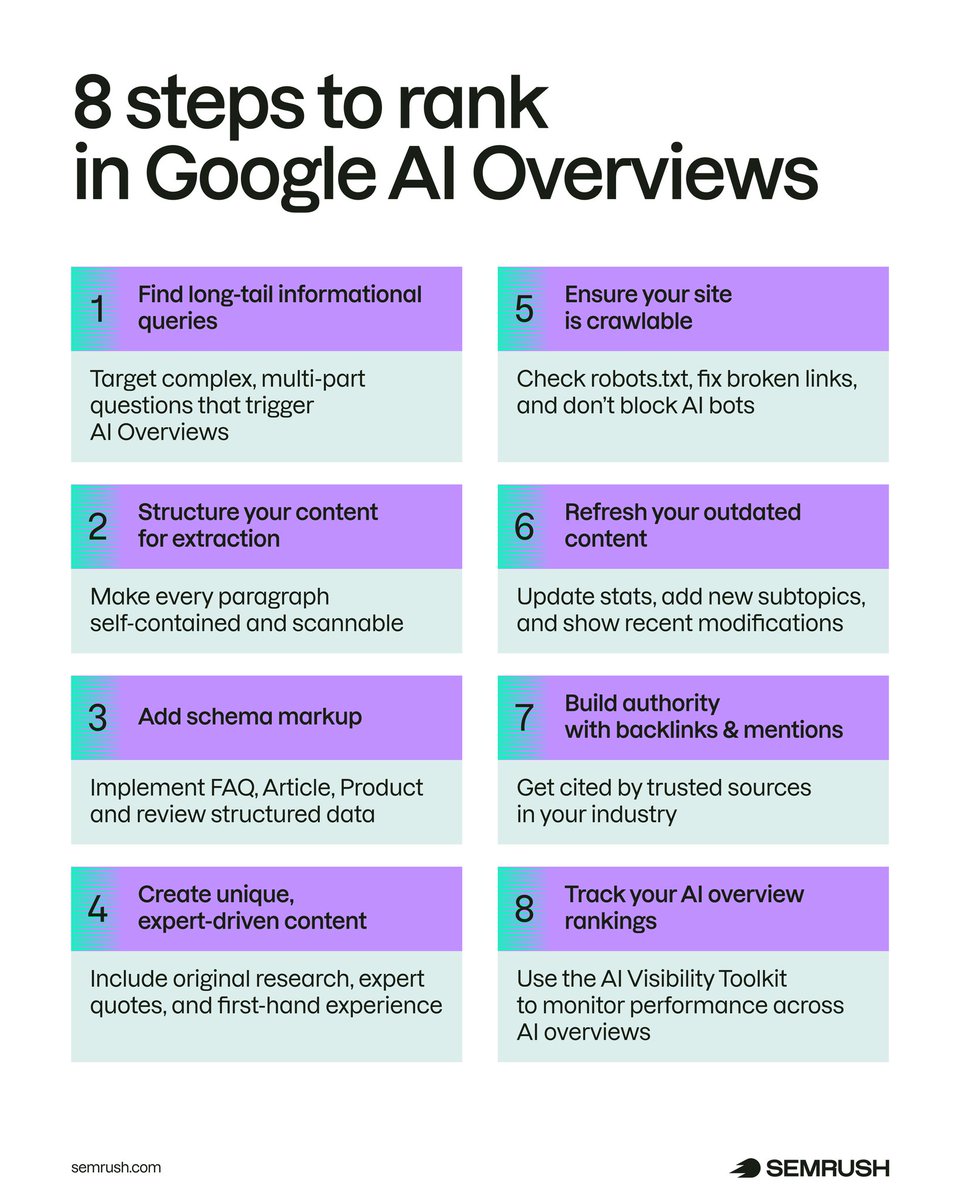
67% of URLs featured in AI Overviews also rank in Google’s top 10 organic results – reinforcing that SEO remains essential. But for AI to use your content, it needs to understand it, trust it, and easily incorporate it into answers. The difference between being featured or overlooked usually comes down to three factors: 1. Structure 2. Freshness 3. How easy your content is to cite Here are 7 steps to try today ⬇️ https://t.co/Xkk316hqJa.
@jakezward ·
Is AEO even a thing? Or is it just SEO? Here's how LLMs actually work: An LLM is not a search engine. It's a next-token predictor. It guesses the statistically likely next word based on patterns baked in during training. During that training, it processed billions of web pages. But it didn't log URLs. Didn't store sources. Didn't remember where anything came from. What's left is a frozen statistical snapshot. Not an index or database. So where does real-time retrieval come from? The search engine layer bolted on top via RAG. That's the actual information retrieval part. Because the “base” LLM can't do it alone. Which means there are only two things you can actually influence: 1. Rank in search so retrieval-based AI can cite you. Traditional, boring SEO. 2. Earn third-party coverage so the model already knows you before the prompt is typed. And that's pretty much the whole game. So stop optimising for some vague idea of 'AI.' Optimise for search engines with owned content and build brand authority for earned mentions. Are you actually doing AEO? Or just SEO?


@shushant_l ·
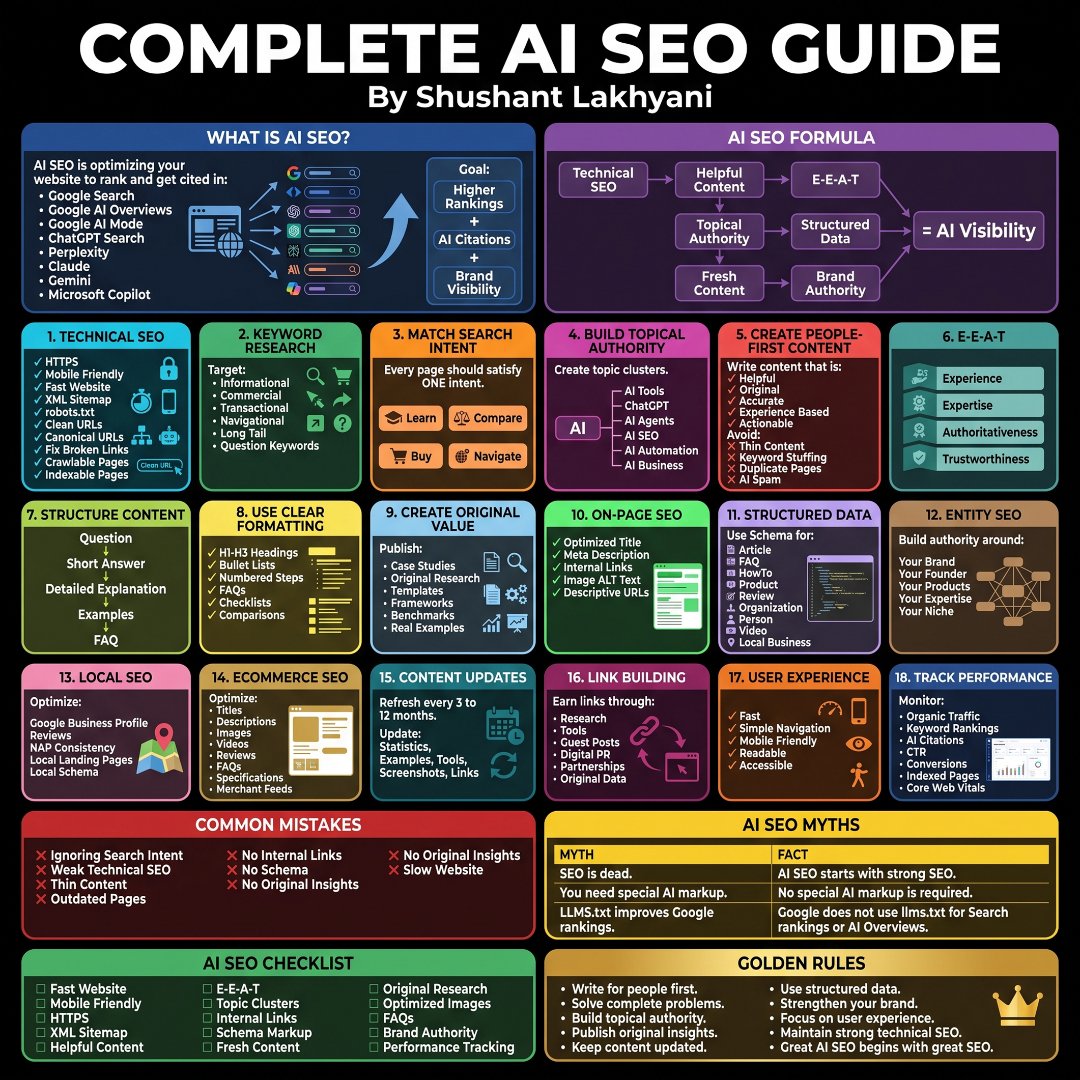
I'm genuinely surprised most websites still aren't optimized for AI search. Here's the complete AI SEO framework to rank higher, earn more AI citations, and grow your brand visibility. --- 1. AI SEO helps your content get discovered in Google AI Overviews, ChatGPT, Perplexity, Claude, Gemini, Copilot, and more. --- 2. Your ultimate goal is higher rankings, more AI citations, and stronger brand visibility. --- 3. Build a solid technical SEO foundation with HTTPS, mobile optimization, XML sitemaps, robots.txt, and clean URLs. --- 4. Do keyword research around informational, commercial, transactional, navigational, long tail, and question based searches. --- 5. Every page should focus on one clear search intent instead of trying to rank for everything. --- 6. Build topical authority by publishing multiple high quality articles around the same subject. --- 7. Create people first content that is original, accurate, experience based, and genuinely useful. --- 8. Strengthen your E-E-A-T by showcasing real experience, expertise, authority, and trustworthiness. --- 9. Structure your content with clear headings, bullet points, FAQs, examples, checklists, and comparisons. --- 10. Publish unique research, case studies, templates, frameworks, and real examples instead of generic content. --- 11. Optimize every page with strong titles, meta descriptions, internal links, image alt text, and descriptive URLs. --- 12. Add structured data like FAQ, HowTo, Product, Review, Organization, Person, Video, and Local Business schema. --- 13. Build entity SEO by strengthening your brand, founder profile, products, expertise, and niche authority. --- 14. Improve local SEO with an optimized Google Business Profile, reviews, citations, and local landing pages. --- 15. Refresh older content every few months with new statistics, examples, screenshots, tools, and insights. --- 16. Earn high quality backlinks through research, guest posts, partnerships, digital PR, and original data. --- 17. Deliver a fast, mobile friendly, accessible, and easy to navigate user experience. --- 18. Track rankings, AI citations, organic traffic, CTR, conversions, Core Web Vitals, and indexed pages. --- 19. Avoid common mistakes like ignoring search intent, weak technical SEO, thin content, duplicate content, and slow websites. --- 20. There's even more inside this guide, so check the infographic to learn the complete AI SEO framework. --- To learn more, check the infographic. --- Get all my visual guides for free here: https://t.co/p3DBZe1GLQ ---

@neilpatel ·
Teams are treating GEO as a replacement for SEO. It isn't. It's a second layer on top of it. AI Overviews and other AI search interfaces pull from web content. They favor sources with strong domain authority, consistent publishing histories, and deep backlink profiles. Everything traditional SEO built. Teams that gutted their SEO budgets to go all in on GEO are showing up to AI search with nothing for LLMs to trust. SEO spent years building the credibility foundation that GEO now borrows against. The two layers do different jobs. SEO earns you the domain authority and backlink profile LLMs use to evaluate whether a source is worth citing. GEO shapes how your content answers questions, so when an LLM reaches for a source, yours fits the answer pattern. A brand with strong GEO but weak domain authority won't get cited. A brand with strong domain authority and no attention to answer-formatted content will get bypassed by a newer player who understood the game earlier. The channel changed. The credibility infrastructure underneath it didn't.

@shivsakhuja ·
Today we're launching goose-aeo, an open-source CLI + skill built for AI agents like Claude & OpenClaw to check your brand's visibility on answer engines. It's really easy to use: 1️⃣ npx goose-skills install aeo --claude 2️⃣ claude 3️⃣ /aeo It will: 1. ask you some questions to understand your brand and competitors. 2. generate queries for answer engines and a cost estimate 3. run the queries across all engines (ChatGPT, Claude, Perplexity, Grok and Gemini), analyze the responses and present a report 4. audit your site for LLM visibility 5. make recommendations about things to do to improve your visibility You can chat with Claude or view the results in a dashboard. It's 100% free, and open-source. BYOK. We believe AI agents will run GTM for most companies in the future. To do this, they need tools built natively for AI. We hope goose-aeo is a step towards that future.

@aleyda ·
👀 What’s the most important action SEOs are planning to take in 2026 to win in organic search (traditional and AI search)? Build a Brand + Authority Moat, Engineer Citation-Ready Content, and Reframe SEO as Cross-Channel “Findability”. 👇 From the #SEOFOMO’s Organic Traditional & AI Search Trends for 2026: * Win trust, not just rankings * Be the cited, remembered entity across platforms * Publish less, but make it structurally and evidentially stronger * Treat SEO as a cross-channel system tied to business outcomes * Use better measurement to sustain investment through the click squeeze Learn more here: https://t.co/JMn03KO6qd

@neilpatel ·
NP Digital ran 4,300 prompts across 500 commercial keywords. Here's what we found: 75% of AI citations pull from sources outside Google's top 10. Rank #1 still only gives you a 31% shot at appearing in AI answers. You now have two scores that matter. Most brands are only tracking one. #SEO #AIMarketing #GoogleSearch #AISearch
 Watch video
@itsolelehmann ·
Study this chart GEO (basically AI SEO) is about to oneshot SEO and most people aren't adjusting accordingly chatgpt alone is handling 2.5 billion queries a day now. (roughly 18% of google's entire search volume btw. it already passed bing) the thing though is that when an AI answers a question, it's not pulling from your website. it's pulling from • reddit threads • medium articles • directories • quora answers • youtube transcripts basically anywhere that already ranks or gets cited in training data so if your entire strategy is "rank my own site," you're optimizing for the wrong surface area a few things i've been learning about geo that actually seem to work: → only optimize for prompts that trigger web search (most don't, so pick your battles) → focus on high commercial intent queries (that's where the money actually moves) → third-party mentions matter more than your own content (someone else saying you're good beats you saying you're good) → answer the question in your first sentence (AI models love pulling clean, direct answers) → freshness signals matter a lot (outdated content gets skipped) → distribute across multiple platforms (reddit, medium, directories, youtube) so you show up in all the places AI is actually scraping the reddit one is kinda interesting. a lot of AI answers are basically just resurfaced reddit threads with better formatting. so having genuine, helpful reddit presence in your niche is weirdly high leverage right now i think most people are going to keep optimizing for google rankings while a growing chunk of their potential audience is just asking chatgpt instead something to keep an eye on at minimum


@foley_seo ·
I love a good case study of which Assertive has many. We've done SO much SEO work in some of the most competitive niches on earth so think of Pharma, Health, Casino, iGaming, Finance. Traditional search is NOT DYING, if you see click bait / engagement bait on LinkedIn around AI sources outperforming Google organic - don't be fooled by it. I have access to HUNDREDS of sites across GSC / GA4 across ALL kinds of niches from mainstream publications to news, health publications, you name it. CLICKS from AI SOURCES (chatGPT, Claude, Copilot, Grok, Gemini) account for less than 5%. And yet there is SO SO SO much hype around "being found and cited in LLMS" - whilst so many probably neglect the fact that traditional search is STILL, BY FAR the FIRST place most people who "aren't in the industry" go to find what they want. We didn't lose clicks to LLMS, we lost clicks to Google AI overviews. And whilst there IS a growing search market for LLMS, it's still TINY in comparison. If you are MORE PROMINENT ORGANICALLY with GOOD SEO you are far more likely naturally to appear in LLMS. Good SEO = Good GEO. Take this client - 1. Strong sustained organic growth - even though it's very likely a portion of medicine searches at a research phase are going through AI 2. These guys get around 1% of their clicks from AI searches (aggregated) 3. Good solid technical SEO, good content with proper fact checking and high quality links have propelled growth and, without trying, their CITATION METRICS in AHREFS show strong growth. NO GEO playbook, no hacks, just good SEO. IF you have a good SEO agency, you'll achieve good AI citation growth naturally. #seo

@semrush ·
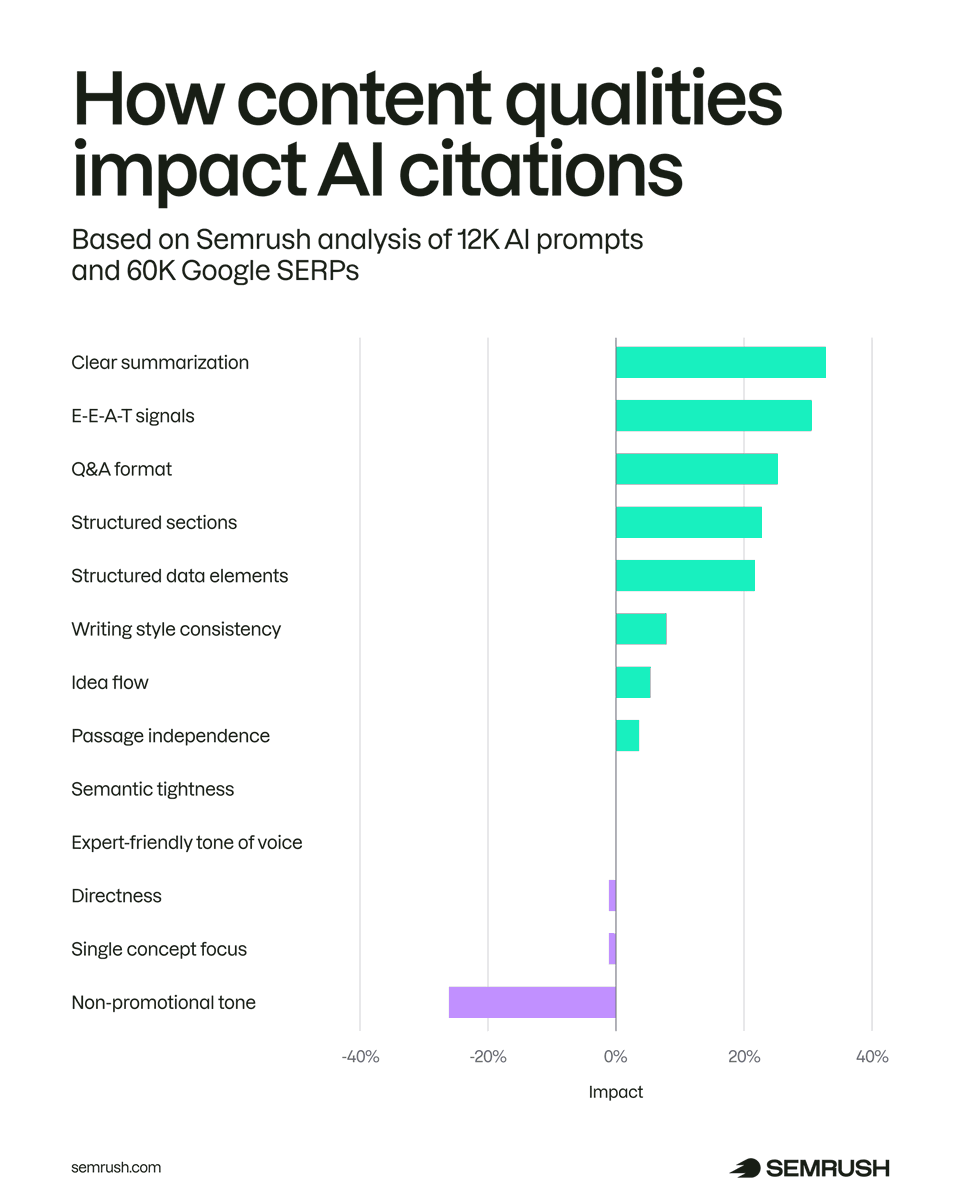
AI search platforms like ChatGPT, Google AI Mode, and Perplexity are changing how content gets discovered. But what makes one piece of content get cited while another gets ignored? To answer this, we analyzed thousands of citations and compared them to similar pages ranking in Google. Our goal was to identify which text-only qualities most strongly correlate with AI citation behavior, and whether these patterns differ from traditional SEO signals. Based on our research, we found five content qualities that showed a strong positive correlation with AI citations, plus one that showed a negative correlation: • Clarity and summarization: +32.83% • EEAT signals: +30.64% • Q&A format: +25.45% • Section structure: +22.91% • Structured data elements: +21.60% • Non-promotional tone: -26.19% In short: content that delivers clear answers, demonstrates expertise, and uses structured formatting is more likely to be cited. Full breakdown: https://t.co/ozzQjFU0hw.

@aaina_narang ·
here's how you can optimize GEO for 10x results: - write content that answers specific questions your ICP is asking - use original data and real numbers, AI cites sources it can verify - build topical authority around one core use case before expanding - get your brand mentioned in newsletters, Substacks, and publications your ICP reads - structure content so AI can extract a clean, quotable answer from it - add proper schema markup and structured data to your site - earn backlinks from trusted sources in your category - get cited in Reddit threads, Slack communities, and forums your buyers are active in - track where you appear in AI answers, not just Google rankings

@illyism ·
How to reverse-engineer what AI SEO actually wants: 1. Track your target prompts in https://t.co/9NQ49WDfHW 2. See which sources the AI cites 3. All listicles? Write a better listicle. 4. All how-to guides? Write a better guide. Just read the sources it's pulling from!


@TheCoolestCool ·
Most AEO/GEO marketers spend 90% of their time thinking about things they can do on their own site. The smartest marketers are recognizing that third party citations DOMINATE the LLMs and more than ever before they need to be elsewhere. It's not just about your blog. It's about review sites, podcasts, category sites, niche newsletters, competitors content, alternative pages, Reddit, LinkedIn, YouTube and more.


@kaleighf ·
Right now, at most companies, “figure out AI search” is being handled by seven different people who don't know they're supposed to be working together. -The SEO lead is commenting in Reddit threads that are ranking for key terms. -The community manager is building relationships in Discord servers. -The content team is publishing 'AI-optimized' articles. -The PR person is pitching stories to journalists (who get cited a lot). -The social team is chasing LinkedIn engagement. -Employee advocacy is asking people to share company posts. -Influencer marketing leads are hiring B2B creators to talk about the new feature roll-out. But there’s often not a single point person who’s making sure this work actually results in citations within ChatGPT, Perplexity, or Google's AI Overviews. This is the current state of Answer Engine Optimization (AEO) at most organizations who’ve started this work: Head of AEO is a job that exists everywhere and nowhere simultaneously, scattered across a dozen job descriptions, measured by a dozen different metrics, optimized toward a dozen different outcomes. So here’s what happens. A company has purchased a tool for measuring and monitoring AI search presence…and stopped there. Or maybe they’re focusing on publishing new blog content on the company website based on their findings of said tool…but they’re not really sure what’s working and why (or why not). When the team talks about AEO performance or AI search visibility, it feels like marketers are hand-waving and saying a lot without communicating much at all. The problem is that companies are trying to solve a new discipline using existing infrastructure—when really, there needs to be a net-new role (or an overhaul of an existing one) for overseeing the work of AI search and LLM citation generation.

@arvidkahl ·
Customer just sent me this. So I'm not doing any active GEO or AEO, but it looks like the big players have picked up Podscan. Confluence of any number of these things, I presume: - podcast data samples publicly available and in the sitemap - thorough MCP implementation - agentic-centered landing pages You could argue that it is GEO or AEO, but I consider it just being straightforward with presenting the available data and its accessibility to those I know will ultimately make the implementation (Claude code) or a value judgment on the data (the person using Claude and asking Claude a question).

@gaetano_nyc ·
The main difference between SEO vs GEO is that you can't really bulldoze your way into getting brand recommendations for something you don't deserve. For example, "best insider threat management" There is a company named Exabeam doing a self-promotional list page that "ranks" organically #1 in the classic blue link position. They are also in the sidebar tile position. Their SEO team probably thinks this is a "win" but of course, it's not... because the AI answer summary does not recommend Exabeam as a preferred solution. Instead it ranks all the competitor brands that deserve to be there, such as Proofpoint, Teramind, Microsoft, etc. AI is the great neutralizer of this tactic. Ultimately, it just scrapes your content and lists all your competitors if you don't deserve to be recommended.


@hdxswx ·
The 5 biggest myths about AI search optimization (and what actually works) I've analyzed millions of AI citations across ChatGPT, Perplexity, and Google AI Overviews. Most of what you hear about AI search is either hype or just wrong. Here are the biggest myths I keep seeing: Myth 1: "AEO is completely different from SEO" The truth is more nuanced. AEO builds on SEO fundamentals, but it's not just rebranded SEO. Success is measured by mentions instead of clicks. LLMs break down queries into multiple parallel searches. Responses are highly personalized and probabilistic. (more on this in a separate post) Myth 2: "Flood the internet with AI content" This will destroy you. Mass AI content triggers algorithm penalties, tanks your credibility, and makes you invisible everywhere. AI platforms cite authoritative sources. Spam doesn't scale sustainably. Myth 3: "Optimize for exact AI prompts" AI prompts are personalized and constantly changing. Chasing individual prompts is whack-a-mole. What works: Build topical authority around core themes. Myth 4: "Create separate content for AI vs. humans" Don't write for bots. Don't create scaled-down AI versions. The best content serves both by being clear, authoritative, and well-structured. Myth 5: "llms.txt is the secret" Lumen's data: Millions of citations tracked. Zero llms.txt references. It sounds technical, so it sells well. But there's no evidence it works If your AEO strategy sounds easy, scalable, and fully automated, it’s probably wrong. What is the craziest AEO take you have come across in the wild?

@BradfordHuber4 ·
Why does it feel like every major company is jumping on the AEO bandwagon? Just this week we've had: Hubspot just released Hubspot AEO Webflow just announced Webflow AEO Agents Then you've got the SEO incumbents (Semrush, Ahrefs, etc) who've all spun up their own AEO thing. On top of that there's like 100 other AEO specific tools that have already been created and launched. My main gripe is it feels like all the marketing out there is selling these tools like the next greatest thing for marketers that will change the game. I currently pay for an AEO tool, and it's useful, but I don't see it as this game changing thing. The actual work to improve in AEO is still very similar to SEO, and getting reporting in place isn't going to suddenly give you the secret sauce to win in AEO. There's still tons of work to be done beyond that. We still don't have a reliable source of actual prompt volume either. Right now it feels like every company is trying to jump into AEO, and tbh I'm getting tired of all the hype

@kristakdoyle ·
Our first beta user for Sauce was B2B creator @kaleighf. As a creator who specializes in AEO (and, largely, LinkedIn for AEO) she wanted to prove the methods she was preaching were actually working. Enter Sauce 👋🌶️ Kaleigh's question: "I'm putting a lot of effort into my LinkedIn articles and newsletter - is the content actually driving citations and mentions?" Over the past month, we've tracked every LinkedIn article Kaleigh has published against a set of core prompts/buyer questions most important to her and her work. Here are our biggest insights so far: 1. Not only are her articles earning citations for her core prompts, but the citations are *sticking*. Her top 5 articles have been consistently cited across 25%-50% of our total runs. 2. LinkedIn articles have staying power, babe. That spike around June 11? Her older articles started earning even more citations as her newer articles were starting to spike. 3. LinkedIn articles are being cited fast. Her most recent LinkedIn article was being cited for one of her core prompts less than 24 hours after she published it. 4. Even with off-site content, it's worth it to set a smaller list of core prompts first, then create something worth citing that maps back to your core list. Which prompts and buyer questions are actually most important to your team and business? Everything else is just noise. 5. It's SO helpful to attach off-site content to the person creating it. This gives you extra insight into *why* the content may be working and whether you can apply it across your other advocates out there creating and engaging across other off-site platforms like LinkedIn, YouTube, Reddit, and G2. Kaleigh's on these https://t.co/AMFc4efFPa streets proving out the value of LinkedIn for AEO. Our other beta users, marketing leaders from some of my favorite brands, are currently tracking over 400+ pieces of off-site content across Reddit, YouTube, LinkedIn, and more. SEO, community, and brand leaders, your people - your employee and customer advocates, your creators like Kaleigh Moore - they are the secret sauce of this next era of AEO 🤌 Come let us help you prove it.


@TheCoolestCool ·
The best time to optimize for AI visibility was 10 years ago. The second best time is now. The brands winning citations in ChatGPT, Perplexity and Google AI Overviews didn’t “hack GEO.” They invested in SEO, community and distribution long before it was trendy. https://t.co/en13EYsuK4
@glenngabe ·
Google's Nick Fox (@thefox) was asked about GEOs entering the scene and gaming Google, and how a similar thing happened in the early 2000s. Are we seeing that again?? Nick: We published a document last week covering how to optimzie for AI Search (which is basically what you should do for SEO)... But it's important to go beyond the surface level with your content. The content that will perform the best in AI goes deeper. (Me: i.e. "Non-commodity" content.) And regarding the cat and mouse spam game, we'll how that plays out. The models are really smart so they should be able to figure it out... He does worry about prompt injection and Google is keeping an eye out for spammy tactics trying to game AI/Google. https://t.co/kEuZx38TJn

@foley_seo ·
So, not a query fan out image - but, a common example of where sub-searches and citations that could be used in query fan out can determine the results returned., In Google's AI Mode, we see known PEOPLE where the links to their name actually link to the source site that cited that person - so you'd be mistaken for thinking that the CLICKABLE SEO CONSULTANTS name would take them to their website and not other SEO providers that have referenced them. So, technically your COMPETITORS could flatter you by including you in a list but ultimately earning the click and even potentially the enquiry! Anyhow - here's what FAN OUT QUERIES are about for those still learning about AI / AI SEO and LLM response generation: Fan-out queries are one of the more important concepts in LLM SEO and a lot of people have not heard of them or do not fully understand how they work. When a user sends a query to an AI like ChatGPT or Perplexity, the llm does not just look for one answer. It often breaks the query down into multiple sub-queries, retrieves information from multiple sources and synthesises a single response. This is called query fan-out. It has significant implications for how you optimise content. Query Fan-Outs in LLMs Definition ➡️ A single user query is automatically expanded into multiple related sub-queries, which are run in parallel before synthesising a combined answer Broader coverage ➡️ Catches relevant information that a single query phrasing might miss due to vocabulary mismatches or ambiguity Perspective diversity ➡️ Different sub queries can approach the same topic from multiple angles, reducing blind spots in retrieval RAG improvement ➡️ Particularly used in Retrieval Augmented Generation to pull more relevant chunks from a vector store before generation HyDE variant ➡️ One approach generates a hypothetical answer first, then uses that to fan out retrieval queries Reduced sensitivity to phrasing ➡️ Since the LLM rephrases the query multiple ways, results are less dependent on how the user happened to word their question Re-ranking input ➡️ The broader result set from fan-out queries gives re-rankers more material to work with, improving final answer quality Cost tradeoff ➡️ More retrieval calls and tokens consumed, so fan-out width is usually tuned to balance quality vs. latency/cost If someone asks an AI "who is the best seo consultant", the system might fan out into sub-queries covering agency reputation, client results, pricing models, comparison of approaches and recent performance. Each sub-query draws from different sources. To get cited across those sub-queries you need content that answers each component. Not a single page that vaguely addresses all of them, but deep, specific, authoritative content at the topic level This is why entity authority and topical depth matter so much in AI SEO. Shallow content that covers a lot of ground loosely does not survive query fan-out. Specific, credible, well-evidenced content does

@jmoserr ·
TLDR: Headings, no fluffy content to hit word counts, FAQs, EEAT. So, good SEO! Also, citations are not a great metric IMO. Across 65+ clients, almost no measurable impact comes from citations, mostly from mentions at BOFU. Interesting regardless! https://t.co/zNuSyWx5CJ

@aryehMaxx ·
Almost every brand I’ve talked to has asked me about showing up in LLM answers. Here’s what matters most: 1. Mentions → Does AI actually bring up your brand? 2. Sentiment → When it does… is it positive or negative? 3. Citations → Are you being referenced as a source? You can win in traffic and still lose here. So what actually moves this? 1. Visibility across AI platforms (ChatGPT, Perplexity, Gemini, etc.) 2. Site structure that machines can understand (not just humans) 3. Content designed to answer questions (not just rank for keywords) 4. Trust signals across the internet (reviews, mentions, third-party validation) We’re early, but the data is already clear. AI-attributed commerce is growing fast, and this is only going to compound. You can treat this like SEO in 2012. Or you can get ahead of it now. We put everything we’re seeing into an AI visibility playbook for ecommerce brands. Worth a read if you care about how customers will find you next. https://t.co/UZG17fVxn1
 Watch video
@fatjoedavies ·
What will SEO retainers look like in 2026? Pretty much how they did in 2025, if it included these: - Ensure a technically sound and fast website, with great UX - Building content and pages that serve the intent buyers are searching for - Building a knowledge base that answers every question about the service/product - Attracting or soliciting brand mentions and backlinks from bloggers and media - Getting features in listicles, editorial reviews and buying guides - Encouraging positive brand sentiment on forums and review sites If those are in your retainer, you're going to be featured in search engines and AI engines. There are of course some things to focus on for AI (brand mentions and brand sentiment), but for the most part, GEO is 90% SEO.


@RandallKanna ·
Reddit is not a place to “do AI SEO.” It's shooting yourself in the foot to be mentioning your brand name in every comment. Instead, use Reddit to find "find the user questions where I can give a useful answer in my category.” That’s how Reddit can become AI mentions. Wrote about it here: https://t.co/kgc4pJFKDy
@kristakdoyle ·
So bullish on SEOs becoming the wielders and defenders of online brand visibility. The gap between SEO and brand has been slowly narrowing for years, but AI came in with one quick thread of a needle and sewed the gap shut. Search is still search, but now it's also social, community, fandom, and media. It's still landing pages and schema, but now it's also Reddit, YouTube, LinkedIn, and G2. It's still weaving your internal and external company SMEs into your blog content, but now it's also weaving them into third party communities and platforms. SEOs now need to be tapped into brand and culture in way they never have before and I think the future of search will be so much better for it. ✨

@sharyph_ ·
16% of Google Searches Already Show AI Overviews And that number is growing fast. This isn't coming. It's here. The content that ranks in AI Overviews isn't the same content that ranks in traditional search results. Traditional SEO priorities: → Keywords in titles → Backlinks → Domain authority → Meta descriptions AEO priorities: → Question-based structure → Direct answers → Clear hierarchy → Semantic clarity → Answer capsules I'm now optimizing every piece of content for both. Because the future isn't "Google vs AI systems." It's "Google AND AI systems." Your content needs to perform in both environments. I built a system that handles this automatically. Covered it in this week's newsletter. But here's the point: If you're only doing traditional SEO in 2026, you're leaving traffic on the table.
@kaleighf ·
On expanding the creator definition for the AEO context: Creator is a wider umbrella than it sounds in this context. The instinct is to read "creator" as "influencer," and stop there, but that reading leaves value on the table for B2B. There's certainly a case to be made for B2B/LinkedIn creators within this equation, but I believe some of the strongest creators for AEO in a B2B category are often the employee experts who work inside a company. Think about the solutions engineer with a point of view, the product manager who has posted about their niche for years, the VP of customer success who answers real questions in real communities like Reddit--these employees are creators and influencers in every sense an LLM cares about (even if they would never put the word on a business card or call themselves one.) If they have expertise, they publish under their own names, consistently post about a specific topic, and they have standing on the surfaces where buyers go to research…that’s an influencer (like it or not.) We’ve just been calling them “employee advocates” up to this point. But now, it’s time for us to broaden that definition.
@sharyph_ ·
60% of Google Searches End Without a Click That stat changed how I think about content. If people aren't clicking through to your site, where are they getting answers? ChatGPT. Perplexity. Claude. Google's AI Overviews. The shift: → Traditional SEO = optimize for clicks → AEO (AI Engine Optimization) = optimize for being cited I spent years perfecting SEO. Then realized AI systems don't care about meta tags the same way Google does. They care about: → Question-based headings → Clear, direct answers → Semantic structure → Answer capsules after questions If your content isn't structured for AI extraction, you're invisible to the tools people actually use to research. Are you optimizing for 2019's search engines or 2025's AI systems?
@RandallKanna ·
One thing I’ve noticed recently while I'm doing outreach for Kelsey... Most companies have no idea whether they show up in AI answers. There’s no equivalent of “rank tracking” yet. So teams are optimizing blindly and trying random scattered things. I’ve been digging into this gap and analyzing how different sites appear (or don’t). The differences are often surprisingly fixable once you see them. But the best thing I've figured out is tracking who is showing up and why THEY are instead of trying to guess at optimizations.
Best Answer Engine Optimization tweets
Xholic studies what works in your niche, drafts posts in your voice and schedules them for the hours your audience is online.
$0 today · Cancel anytime
Browse all tweet collectionsKeep exploring