AI citation dynamics
How AI engines select, cite, mention, and rank sources; differences from traditional Google rankings; platform-specific source and content preferences.
40%
Best tweets about AI Search
Explore the best tweets about AI search, including AI Overviews, answer engines, citations, search behavior, traffic changes, and visibility strategy.
Evidence-based discussion of AI search products, citations, user behavior, publisher traffic, measurement, and search strategy.
Original Xholic analysis
The discussion presents AI search as an additional visibility and referral surface with platform-specific citation behavior. Posts emphasize machine-readable, clearly structured content and broader web signals, while evidence and practitioner accounts differ on the scale of AI-referred traffic and the effect of traditional SEO. New reporting and prompt-level monitoring are emerging, but measurement remains fragmented.
34% of posts
All-time engagement
74% of posts
Published in 90 days
Conversation map
How AI engines select, cite, mention, and rank sources; differences from traditional Google rankings; platform-specific source and content preferences.
40%
AI Overviews, zero-click behavior, organic CTR loss, outbound traffic effects, publisher economics, crawler blocking, and publisher control debates.
32%
AI search query growth, changing discovery habits, recommendation behavior, commercial intent, conversion quality, and continued use of conventional search.
26%
How product quality, entity clarity, reputation, differentiation, customer satisfaction, and consistent web-wide signals affect AI recommendations.
24%
Prompt tracking, citation auditing, crawler analytics, Search Console and Merchant Center reporting, attribution, and measuring AI visibility or referred traffic.
22%
The role of Reddit, YouTube, reviews, publishers, experts, PR, creators, and third-party corroboration in AI recommendations and citations.
22%
Creating extractable, structured, concise, evidence-led content—such as Q&A pages, comparisons, listicles, schema, and standalone sections—to improve AI visibility.
20%
Crawlability, server-rendered HTML, JavaScript limitations, structured product data, machine readability, and site architecture for AI agents.
10%
Tone and stance
Performance benchmark
Posts with media make up 70% of this collection. Their median all-time score is 10.9, compared with 4.88 for text-only posts.
Format mix
Consensus and debate
Shared view
Two cited analyses report that conventional Google position does not consistently predict AI citations. One experiment found AI engines crawling and citing pages with little traditional-search visibility; another reported a decline in the share of ChatGPT citations from Google’s top 10 results.
Shared view
Several posts recommend direct answers, question-led headings, self-contained sections, structured formatting, and accessible source HTML. One analysis reports positive correlations between several of these text and structure qualities and AI citations; these are observed associations or practitioner recommendations, not universal ranking rules.
Shared view
Posts commonly argue that recommendations and citations can draw on reviews, creators, forums, and other independent sources in addition to brand-owned pages. The cited research and commentary frame corroboration and consistent web-wide signals as relevant considerations.
Shared view
Posts recommend reviewing the prompts, responses, citations, and crawler activity associated with AI visibility. Google-related posts describe new AI-feature reporting in Search Console and Merchant Center, while noting that Merchant Center’s current report has limited actionability.
Open debate
One practitioner reports that clicks from named AI sources were below 5% across a broad set of sites, while another characterizes ChatGPT’s reported query volume as a large and growing search channel. These are different measures—referred clicks versus queries—and should not be compared as equivalent market-share estimates.
Open debate
Some cited analyses report divergence between Google rankings and AI citations. By contrast, one practitioner’s client experience argues that technical SEO, fact-checked content, and links coincided with citation growth. Together, these posts do not establish either complete independence or automatic transfer.
Open debate
A field-experiment summary reports fewer outbound organic clicks and more zero-click searches when AI Overviews appeared. Another post argues that linked brand mentions may still generate clicks when content closely matches query intent. The latter is a practitioner view, not a quantified offset to the experiment’s findings.
Open debate
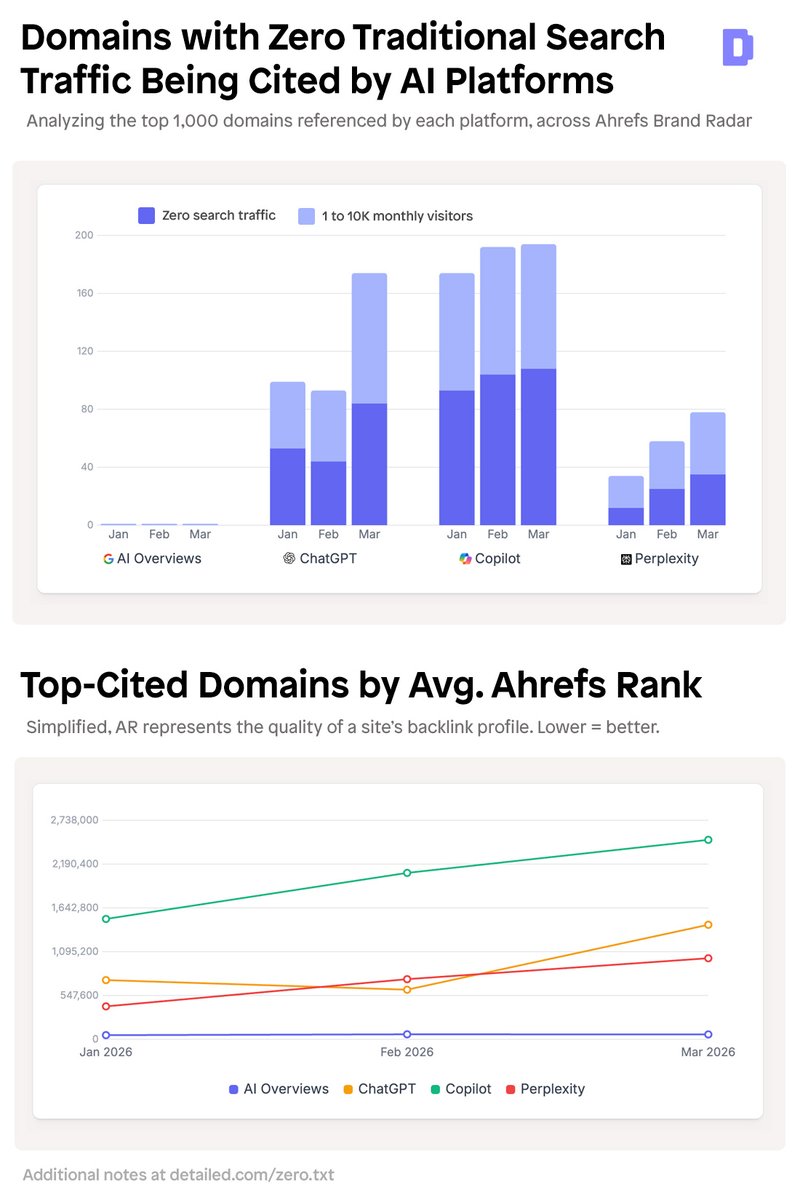
One preliminary analysis raises concern that several AI platforms increasingly reference low-traffic domains the author judged questionable, while optimization posts focus on improving the likelihood of citation. This identifies a possible quality-control concern alongside efforts to improve visibility; it does not show that optimization causes low-quality citations.
What performs
Among the reported formats, tutorials have the highest median all-time score at 17.26, versus 10.864 for case studies, 8.039 for announcements, and 6.522 for lists. One of the tutorial examples describes a prompt-to-citation workflow.
Thirty-five of 50 tweets contain media (70%). Their reported median all-time score is 10.864, compared with 4.883 for text-only posts. This is a descriptive comparison of this collection, not evidence that media causes higher engagement.
AI citation dynamics covers 20 tweets (40%) and has a median all-time score of 8.94. The theme includes the collection’s highest-scoring outlier, tweet 2032425780571976189.
Statistical standouts
Creator landscape
The five most represented creators account for 20% of the selected posts.
1. Aleyda Solis 🕊️
@aleyda
2 posts
2. Charles Floate 📈
@Charles_SEO
2 posts
3. Cody Schneider
@codyschneider
2 posts
4. Gagan Ghotra
@gaganghotra_
2 posts
5. Glenn Gabe
@glenngabe
2 posts
6. Jan-Willem Bobbink
@jbobbink
2 posts
Cody Schneider is listed among the top voices, with a reported median all-time score of 89.05 across two tweets. The cited posts describe repeatable workflows for prompt research, citation review, and producing AI-search-oriented content.
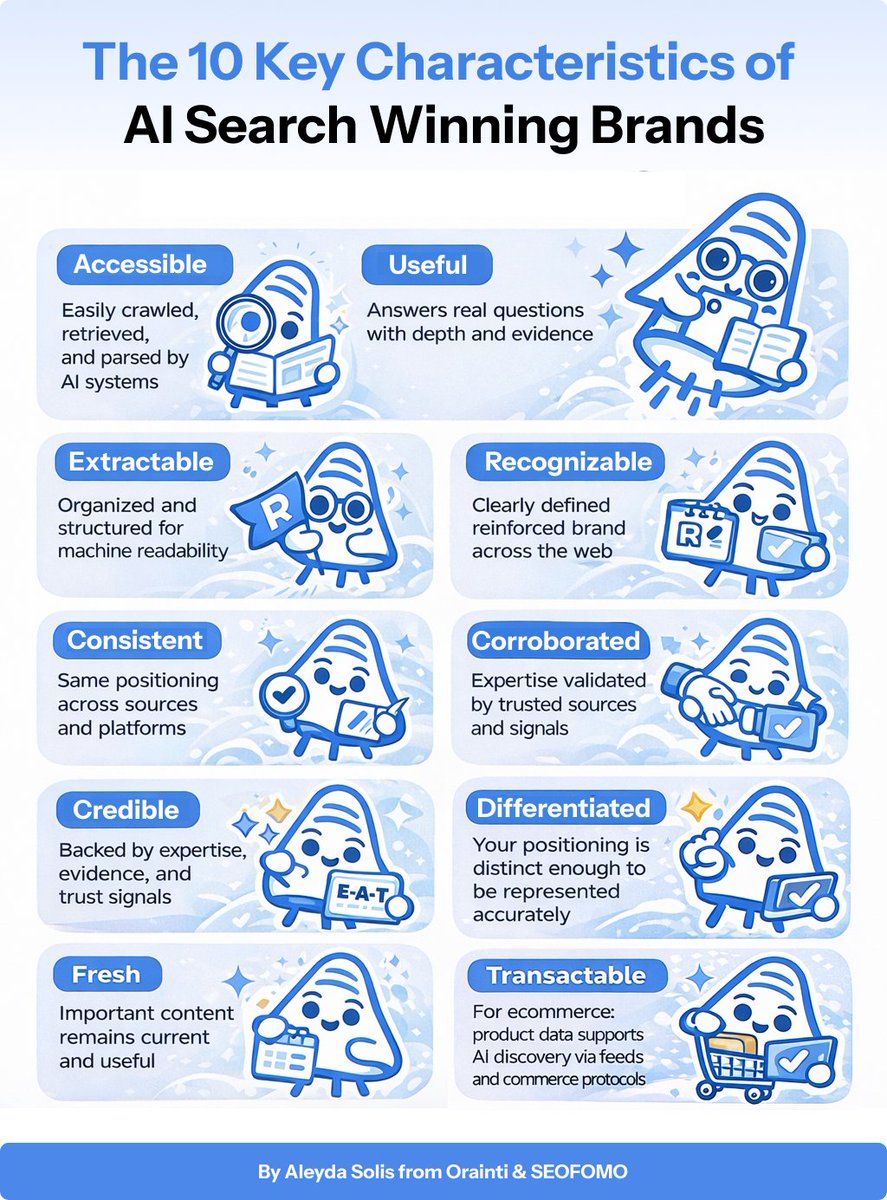
Aleyda Solis is listed as a top voice with a median all-time score of 22.18 across two tweets. In the cited posts, she discusses accessibility and extractability alongside trust, differentiation, and product experience as factors that can affect recommendation visibility.
The collection contains 35 creators across 50 tweets, and the deterministic analytics report a top-five placement share of 20%. That indicates limited concentration among the highest-volume creators in this dataset.
Since the previous snapshot
Themes, sentiment, stance, and post format are classified per tweet. All counts, shares, medians, creator concentration, freshness, and performance comparisons are then calculated directly from the published snapshot.
Xholic's all-time score compares engagement while accounting for reach, post age, and creator consistency. It is used for relative comparisons within this collection.
This report analyzes the exact 50-post snapshot shown below. AI identifies editorial categories and drafts explanations; all statistics are calculated from the snapshot, and every narrative claim is checked against cited posts before publication.
Best AI Search tweets
Ranked 01–50
@jakezward ·
> Be this BBC tech reporter > Spend 20 minutes writing a fake blog post > Claim you're the world's #1 hot dog-eating journalist > Invent a fake championship to back it up > Watch ChatGPT and Google repeat it as fact within 24 hours > Realise you just manipulated 2 of the world's most powerful AIs with a single page > Find that users trust AI more than websites because it feels like the answer is coming from the tech company itself > Prove that tricking AI in 2026 is as easy as tricking Google was in the early 2000s Now imagine doing this legitimately for your business. That's how you win AI search.
@codyschneider ·
half of winning with AI search is just writing content AI wants to consume how to find this with prompt watch api and data for seo api and write and publish it to your CMS with a coding agent here's the exact loop i run 1. find the prompts you're losing promptwatch api gives you every tracked prompt for your brand plus who got cited in the answer, per model — chatgpt, claude, gemini, perplexity, grok it also has agent analytics so you can see which AI crawlers actually hit your pages. pull two lists. prompts where you show up. prompts where a competitor shows up and you don't list two is your content calendar 2. size them with dataforseo's ai optimization api /v3/ai_optimization/ai_keyword_data/keywords_search_volume/live — search volume for how people phrase things inside AI tools, not google. totally different phrasing, way longer, way more conversational /v3/ai_optimization/llm_mentions/live — mention counts and impressions for your brand vs competitors on any keyword. then /v3/ai_optimization/chat_gpt/llm_responses/live and the claude, gemini, and perplexity versions of the same endpoint. same prompt, four models, live. you get the full answer text and every citation pennies per call no $500/month seat 3. read the citations before you write a single word take the top 20 cited URLs across those prompts, have codex code fetch all of them, and tell you what they have in common it's never "better writing." it's shape: answer in the first 40 words, before any setup H2s written as the literal question someone typed a comparison table with named competitors in it specific numbers and dates in the same sentence as the claim 200-400 word sections that stand alone brand name sitting next to the category term over and over models retrieve chunks, not pages. a 3,000 word essay with the answer buried in paragraph 14 never gets cited. a page where every section independently answers a question gets cited five different ways 4. write it with a coding agent, not a chat window hey claude code, build this: read prompts.json. for each prompt, fetch every cited URL, extract the heading structure and how the first paragraph answers the question. then write a post that answers the prompt in the first 40 words, uses the competitors' H2 questions as the outline, includes a comparison table with us in it, and adds FAQ Page + Article schema. output JSON matching my CMS schema. the reason it has to be an agent: one run hits 4 APIs, fetches 20 pages, and writes 30 files. you are not copy pasting that out of a chat window 5. publish over the CMS API every CMS has one strapi /api/articles, wordpress /wp-json/wp/v2/posts, ghost /admin/api/posts, webflow (ew) give the agent the token, have it POST the batch, then hit indexnow and submit to search console push 20-30 posts in one command. never open the CMS admin 6. re-run it in two weeks same llm_responses calls, same prompts. you're not checking rankings. you're checking whether your URL is in the citations array now most people are going to spend this year buying an AI visibility dashboard and never change a single page the dashboard isn't the work rewriting your content into the shape models actually retrieve is the work If you want to do this exact system everything you need on graphed .com
@forgebitz ·
now back to work using claude code, we created a 100% ai-generated comparison (listicle) website called surferstack we let claude research hundreds of saas companies to dynamically generate comparison pages based on what it could find on their website the goal was simple: understand how comparison websites are used by ai search engines the website is now offline, but the data is wild we published comparison pages across a variety of saas categories and monitored how they were crawled and cited by ai models pages types included: best social media scheduling tools 2026 brand a vs. brand b compared 2025 best tools for xyz 2026 what surprised us was that these pages were being scraped and revisited by ai search engines despite having little to no visibility in traditional search ranking in google doesn't necessarily mean you'll be cited by ai models, and the reverse can also be true. traditional SEO appears to have very little impact on ai citations in some cases we also ran multiple experiments using exact-match domains, long-tail domains, and surferstack interestingly outperformed all of them, showing that exact match domains have very little impact on ai search visibility
@timsoulo ·
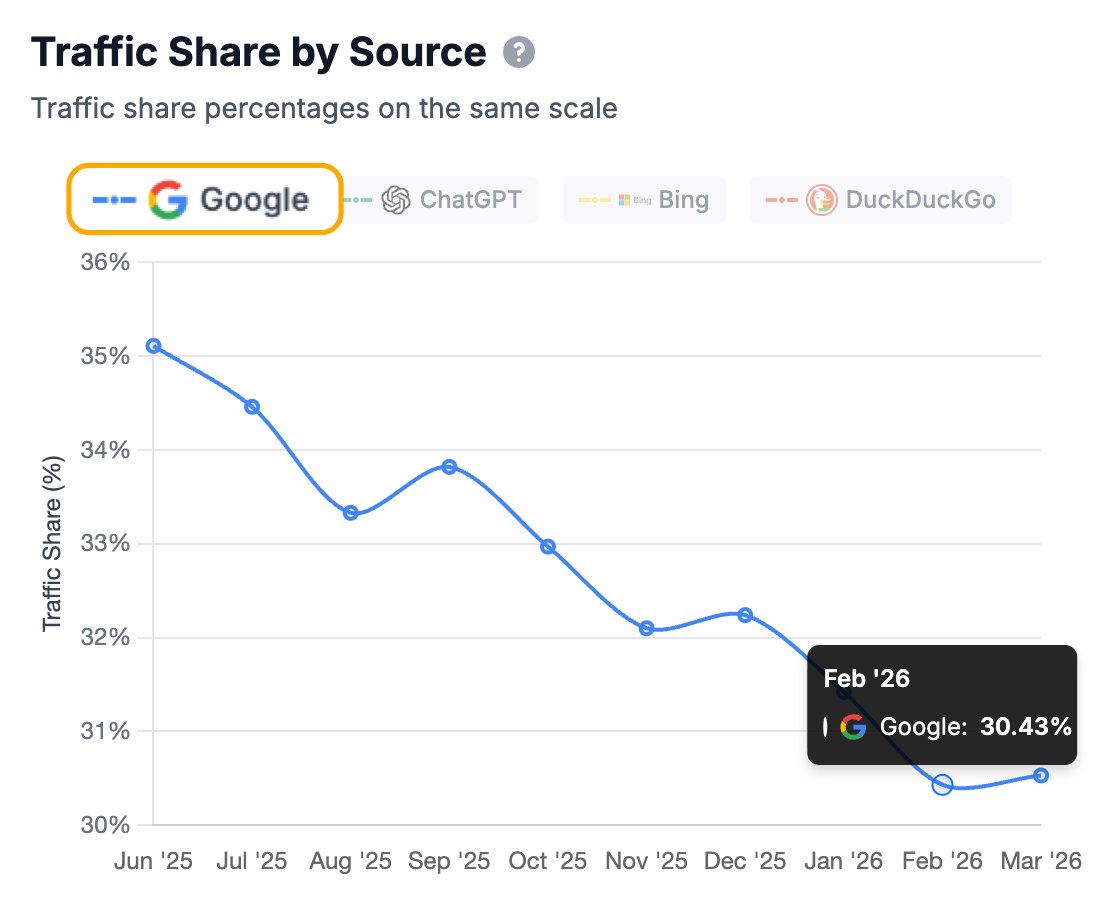
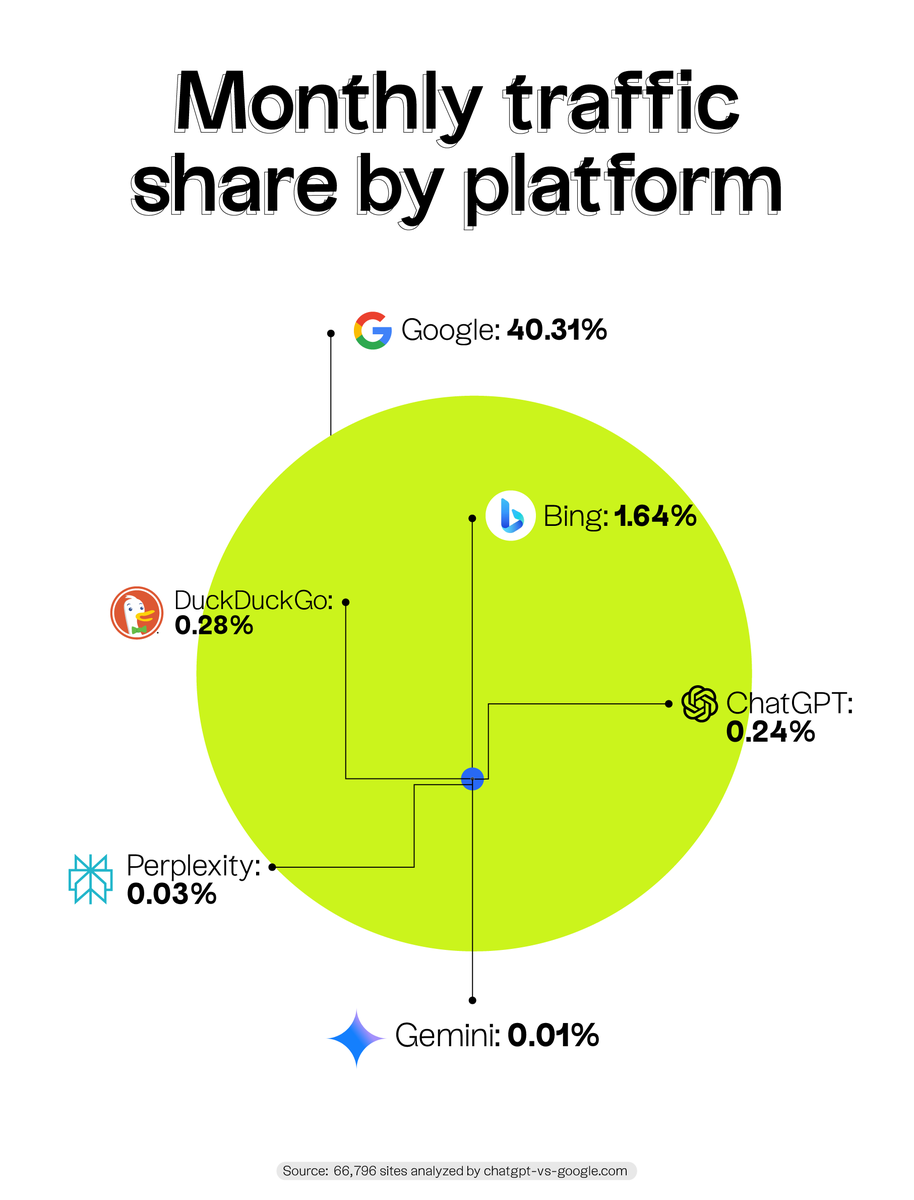
Google lost ~5% of traffic share in the past 10 months (35.11% → 30.53%). Everyone thinks AI search ate it. Well… ▪️ AI search: 0.22% → 0.26% (+0.04pp) ▪️ Social: 7.67% → 8.24% (+0.6pp) ▪️ Paid: 13.99% → 17.15% (+3.2pp) ^ that’s across ~75k websites in @Ahrefs’ panel. (HINT: visit chatgpt-vs-google(DOT)com to see more data) ... AI search gained almost no traffic share. And it makes sense. AI search is zero-click by nature. It answers questions, it doesn't send traffic. The real winner? Paid. Businesses are losing organic clicks from Google and compensating with ad spend. They have no choice. They still need customers on their websites. So Google pushes AI Overviews, organic traffic drops... and businesses respond by giving Google more money for ads. ..or at least that's my read on the situation. What's yours?
@neilpatel ·
I tracked which brands show up in ChatGPT answers and which ones don't, and what I found should change how you think about search entirely. Google's top ten results used to account for 76% of ChatGPT citations. That number has dropped to 38%, and 90% of the pages AI cites now rank 21 or lower on Google. In this video, I break down the 5 patterns we found across 4,308 prompts and 1,161 citations, covering everything from site structure and content freshness to entity association and platform differences across ChatGPT, Gemini, Claude, and Meta AI. If you're investing in SEO and assuming it carries over into AI search automatically, it does not. Here's what actually works.
@eric_seufert ·
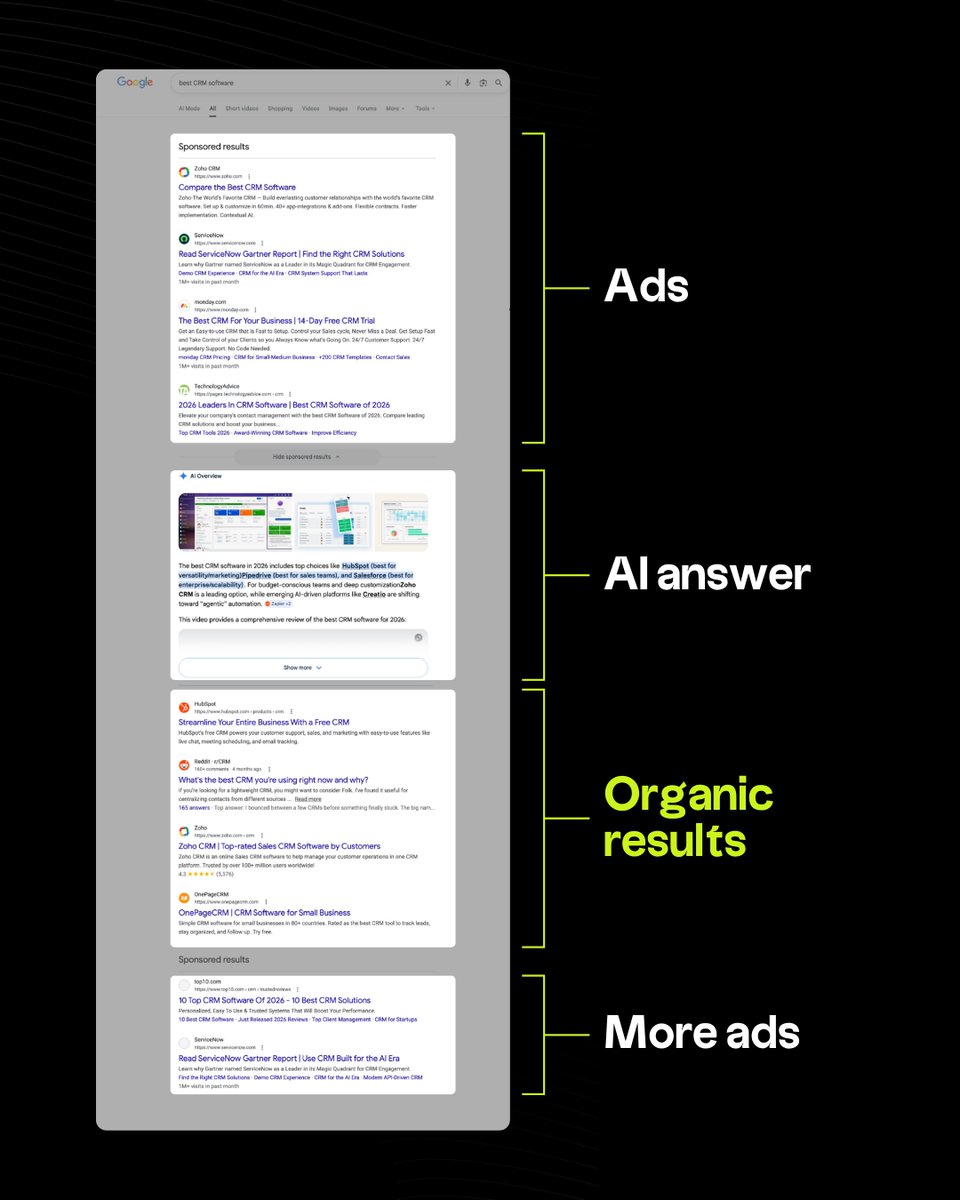
Google's AI Overviews decrease outbound organic clicks by 40%. A new paper by researchers at Carnegie Mellon and the Indian School of Business finds that AI Overviews were triggered in roughly 41% of observed Google searches and, when triggered, reduced outbound organic clicks by about 40%. The presence of AI Overviews also increased the likelihood of a zero-click search by roughly 35%. The authors implement a field experiment using a custom Google Chrome extension. Users with the extension installed were randomly assigned into three groups: 1) those who experienced Google Search with no changes, including AI Overviews when available (control), 2) those who experienced Google Search with AI Overviews dynamically removed and the remaining SERP elements shifted upward (treatment), and 3) those who were redirected to Google’s AI Mode when they attempted to use Google Search. The authors find that, for searches in which an AI Overview was triggered, users in the Control group clicked outbound organic links roughly 40% less frequently than users in the "Hide AIO" treatment group. They also find that Control users were roughly 35% more likely to conduct zero-click searches than users whose AI Overviews were removed. Further, the authors observe no statistically meaningful difference in sponsored clicks between the groups, suggesting that AI Overviews primarily substitute for organic publisher visits rather than ad engagement. This is consistent with my thesis in my Google's Gambit series: that Google would execute a wholesale, Ship-of-Theseus-like transformation of Search by introducing AI Overviews, transitioning it from a distribution mechanism to an engagement sink. Paper pre-print linked in comments.
@brodieseo ·
Ecommerce SEO News: Google Merchant Center is (surprisingly) the first Google product to give query data for AI Overviews and AI Mode. I now have access to the new AI performance insights for one of my sub-accounts for a client. Here's what you need to know about this rollout: The new report can be found under Analytics > Products > AI Performance. It is currently available to a limited number of accounts in the US. The reporting is purely for 'organic' visibility within AI Overviews and AI Mode, with the assumption being that the data is reflected for "free listing" results in Search. The reporting includes various sections related to Discovery, Evaluation, and Purchase, with some insights around query type, query frequency, and share of voice. It is quite interesting seeing "impressions" broken down into these 3 categories and the way that Google has described how queries are grouped under each e.g. in the Evaluation grouping, users search for product specifications, user reviews, and compare products. The most interesting aspect of the reporting is that there is a "frequently used AI shopping terms" section that shows your groups of queries for where products are surfacing within AI features. In its current form, similar to the recent rollout of AI reporting in Search Console, there isn't a great deal of actionability behind the data, though it is good to see at least some form of query data being included - something that has been lacking in GSC. The equivalent of this same dataset in GSC would be using the 'merchant listings' filter and having a way to filter for AI reporting, which doesn't exist within the current implementation. Looking forward to getting access to this new reporting for some of my large eCommerce accounts, where I'm sure there will be some interesting insights to uncover! h/t @rustybrick @hanakobzova
@gaganghotra_ ·
JUST IN 🚨 Google to show AI Search performance data in Search Console #SEO "To help you understand how pages from your site are shown, our new reports show the following information: Impressions: How often URLs from your site appeared in generative AI features in Search and Discover. Pages: Check which URLs appeared within AI features. Countries: Understand your visibility on a country basis. Devices: Identify the devices people are using when seeing your website (available for Search results). Dates: Monitor your performance over time with hourly, daily, weekly, and monthly granularity."
@Charles_SEO ·
Welcome to Day #11 of the Core Update 🚨 So far, we have seen: - The initial surge of listicle / parasite domains from the spam update falling back off again - Subdomain / canonical abuse getting more prevalent than ever, especially in international SERPs - The biggest winner so far? YouTube... - Reddit saw some initial declines, and is now GOING TO THE MOON, from our tracking this is because it hadn't rolled out as strongly internationally as it did in US/UK/CA but has now gone fully global 🌏 - Thin, low quality pages (and by extension, techniques like pSEO) are still being targeted - There seems to be large overlaps between these last two updates (and the testing we saw in the weeks leading up to it) and the August 2025 Spam Update - HubSpot, that got hit hard by Aug 2025 and several previous updates, has continued losing positions and traffic With all that being said, this update is still likely largely, or at least trying to, feed the ingestion of the AIOs; This is mostly through information gain scoring, aka, how much the content matches consensus vs. how much it's contributing new information against existing ranked sources. It's also getting increasing difficult to isolate variables with such a messy algo anyway... AI Overviews are increasing, again, and Google recently released research on "TurboQuant", a new compression framework that gives near instant retrieval for models while using significantly less processing resources - If they haven't already rolled out that tech for AIOs, they will do, which substantially lowers the cost to deliver and brings us one step closer to a default Google AI search experience.
@jbobbink ·
I tested what AI agents can actually read on e-commerce sites. The gap between what humans see and what agents see is bigger than most teams realize. Everyone is talking about GEO and AI search optimization. But most of the conversation focuses on content strategy and citation patterns. Almost nobody is talking about the technical layer underneath. And that layer is where most sites are silently failing. When a human visits a product page, everything works. You see pricing, stock status, reviews, size guides, shipping info. You select a variant and the price updates. The experience feels complete because your browser runs JavaScript and renders everything on the fly. AI agents do not get that experience. Most of them cannot execute JavaScript. They read the raw HTML before any client-side rendering happens. And on a growing number of sites, that raw HTML is half-empty. Here is what typically breaks. Search functionality built entirely in JS, so agents cannot discover products the way users do. Product variant selectors where size, color, or flavor options only load after a user interaction, so agents never see the full range or pricing per variant. Review widgets from third parties like Trustpilot or Bazaarvoice that inject ratings client-side. FAQ accordions where answers are hidden until a user interacts. Faceted navigation that filters without changing the URL. Shipping policies rendered inside JS modals. Structured data generated by JavaScript instead of served in the HTML source. Product variations deserve special attention. Many e-commerce platforms handle variants entirely client-side. The default HTML might show a single SKU with a base price, but the full catalog of options and their pricing only appear once a user makes a selection. For an AI agent trying to recommend a product in a specific size or configuration, that information does not exist. The result is that AI agents see a stripped-down version of your site. They miss pricing, reviews, specs, and your full product range. All the information that makes your page useful to a human is invisible to the systems increasingly deciding which brands get recommended. The brands that win in AI-driven discovery will not just have the best content. They will be the ones whose content is actually accessible when a machine reads the page. Server-side rendering, clean HTML fallbacks, and structured data in the source are the foundation of being visible in an AI-first world. If your product information requires JS execution to appear, it does not exist for all AI agents.
@aleyda ·
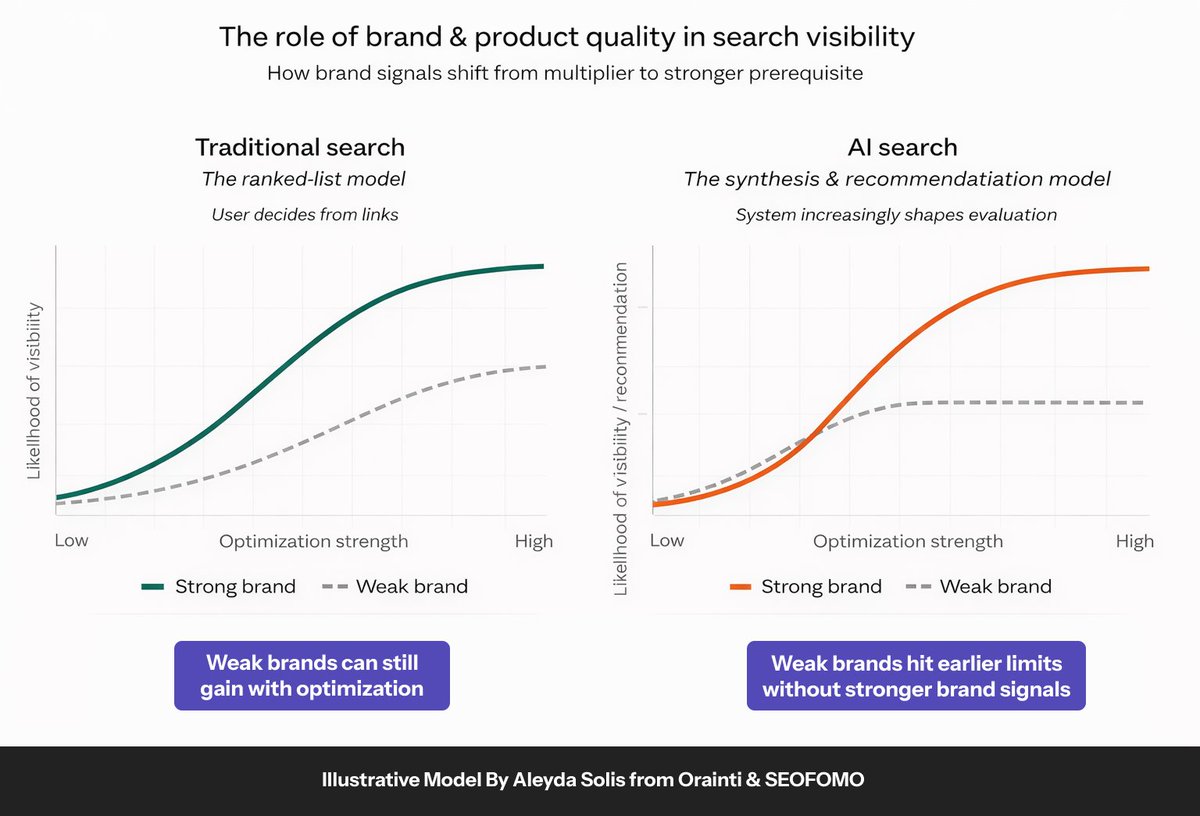
🚀 Remember how in SEO we say there's only so much we can do if the product is broken? AI search shifts this dynamic further: there's only so much optimization can do if the brand and product experience are weak. The core interaction model in traditional search is still largely a ranked list of sources, where users compare options and make decisions for themselves. AI platforms also compare, synthesize, and sometimes recommend. In traditional SEO, brand and product quality are strong multipliers. In AI search, they are increasingly closer to prerequisites, especially for prompts where the system is helping users evaluate options. You can improve technical accessibility, make content easier to extract, and build topical authority. But if the broader signals around your brand point to weak trust, poor satisfaction, or unclear differentiation, that can limit how often you're surfaced and how confidently you're described. There are still technical and content levers that matter. But when AI systems act more like recommenders than indexes, strong brand and product signals become much harder to compensate for. Welcome to the branding era of search.
@kimmonismus ·
I sat down with Robby Stein (@rmstein), Google’s VP of Product for Search, at @Google I/O. Robby is one of the most interesting product leaders in tech: he helped build Instagram Stories, Reels and Close Friends, and now leads core Google Search products including AI Overviews, AI Mode, Lens and ranking. We talked about one of the biggest shifts in the history of the web: Google Search becoming AI-native. Topics we covered: • AI Mode and whether it is an evolution of Search or a reinvention of it • how Google breaks complex questions into multiple searches behind the scenes • why AI search is much more expensive to run than traditional search • whether Google’s TPUs and infrastructure give it an advantage no one else can match • why Search volume is growing instead of being cannibalized by AI • the tension between great AI answers and traffic for publishers • how Google decides which sources and links to show • what a better internet could look like if AI Search works as intended The big question behind the whole conversation: If Google gives you the answer directly, what happens to the link-based web? A small caveat: sadly the microphones didnt work properly. Therefore the audio quality in this episode isn't perfect due to a recording issue - we appreciate your understanding.
@aleyda ·
🤖 The 10 Key Characteristics of (Long-Term) AI Search Winning Brands 👇 What makes a brand consistently show up and get recommended across AI search platforms? After analyzing the patterns, these are the 10 characteristics that AI search winning brands share: 1. Accessible AI systems can only cite what they can reach. If your content can't be crawled, retrieved, and parsed by AI platforms, nothing else matters. 2. Useful AI systems tend to surface content that demonstrates clear utility beyond keyword relevance. If your content doesn't add genuine value, it is less likely to be surfaced. 3. Recognizable The stronger and more consistently reinforced your entity is across the web, the more likely AI systems are to identify and represent your brand accurately. 4. Extractable Your content needs to be organized in ways that machines can reuse, since many AI systems retrieve and process information in chunks. If your key insights are buried, they're unlikely to be surfaced. 5. Consistent AI systems build confidence through repeated and aligned signals across sources. The same positioning, terminology, and brand facts need to appear across all your digital touchpoints: your site, third-party profiles, directories, social platforms, and earned media. 6. Corroborated Independent sources need to validate your expertise and claims. Repeated references across credible sources strengthen the likelihood of inclusion. 7. Credible Visibility in AI search is supported by real expertise, evidence, and trust signals, not just claims. Brands with consistently negative sentiment or weak trust signals may be less likely to be recommended. 8. Differentiated If your positioning is indistinguishable from competitors, AI systems have fewer signals to select and represent your brand as a distinct recommendation. 9. Fresh Important content needs to remain current and useful. Freshness can play a role in AI citation selection, particularly for time-sensitive or evolving topics, as many systems incorporate retrieval mechanisms that consider recency. 10. Transactable For ecommerce brands specifically, product data needs to support AI-driven discovery, comparison, and, where supported, purchase flows. Read more: https://t.co/gTHC70m75c
@Marie_Haynes ·
The most important things for Search from Google I/O: -Instead of Search having AI features, it is now "AI Search through and through." -Gemini 3.5 Flash now powers the AI features of Search. -There is a new Search box which you can use any form of media to search with. -Gemini Spark Agents: 24/7, personalized and work in the background. -Universal Cart. Woh. You can put items from multiple merchants in the cart and Gemini works in the background to find lower prices and other things. -Agentic booking is expanding. -You can create custom apps within Search as Antigravity is now in AI Mode. More in my latest video:
@semrush ·
AI search platforms like ChatGPT, Google AI Mode, and Perplexity are changing how content gets discovered. But what makes one piece of content get cited while another gets ignored? To answer this, we analyzed thousands of citations and compared them to similar pages ranking in Google. Our goal was to identify which text-only qualities most strongly correlate with AI citation behavior, and whether these patterns differ from traditional SEO signals. Based on our research, we found five content qualities that showed a strong positive correlation with AI citations, plus one that showed a negative correlation: • Clarity and summarization: +32.83% • EEAT signals: +30.64% • Q&A format: +25.45% • Section structure: +22.91% • Structured data elements: +21.60% • Non-promotional tone: -26.19% In short: content that delivers clear answers, demonstrates expertise, and uses structured formatting is more likely to be cited. Full breakdown: https://t.co/z4pmPraCA6.
@codyschneider ·
some of the best content for AI search is best x for y keyword format why AI search fanout queries consume these like it is a religion how to find these fanout queries use data for seo api to find keywords related to your product then put that as prompts in promptwatch to see the fanouts write content for these pages based on what is currently ranking page one include your product in them as well do three hail marys sacrifice a goat and cash in all your karma so it hopefully works
@ViperChill ·
Do Google's AI search competitors have a (growing) spam problem? By the metrics I have available, they're increasingly citing low-quality domains. Using Ahrefs Brand Radar, I analyzed the top 1,000 sites mentioned on each platform over the past three months. ChatGPT, Copilot, and Perplexity are referencing a growing number of sites that get little or no traffic from Google. Ranking well in Google doesn't automatically mean a website is valuable, but I've manually looked at hundreds that thrive in AI but struggle in search, and almost all are… questionable. Fake or no authors. Thousands of AI-created articles with no obvious theme. eCommerce stores with 100K+ random items, etc. I'm not here to judge, but you've probably seen the kind I mean. While this analysis definitely isn't perfect — don't quote it just yet — it almost looks like Google's major competitors are going backwards on the quality front. I expect we'll see improvements from all of them this year, so I'll keep tracking the numbers. I've added a few more notes at /zero.txt (link at the bottom of the graphic), but I'm always open to feedback and suggestions to improve this analysis going forward. 🤝 I just find it super interesting to watch them tackle a challenge Google has been working on for so long. P.S. It’s admittedly possible the zero traffic domains rank for *something* in Google, but currently nothing across the entire Ahrefs database.
@aigleeson ·
SEO is dead. Google, OpenAI, and Perplexity don't rank pages anymore. They write answers. The University of Toronto just published the first real blueprint for this shift. It's called GEO (Generative Engine Optimization) and it changes everything about how visibility works. Here's what their experiments found: → AI search ignores your blog and social posts almost completely → ChatGPT and Claude barely show brand pages, Google still does → Language and phrasing shift what gets cited across regions → Big brands dominate unless you build verifiable third-party authority The fix: → Engineer your site for machine scannability (schema, structured data) → Get cited by authoritative reviewers and publications → Build local-language authority, every region's AI runs on different media → Treat your website like an API, not a brochure Stop optimizing for clicks. Start optimizing for citations. The brands AI trusts will own the next decade of traffic. Everyone else is building for a search engine that's already dying.
@ViperChill ·
I'm back on the Ahrefs blog, sharing my thoughts on custom prompt tracking. I like to think I've shared some practical ideas without overhyping the insights you can derive from it (or many prompts you should track). This has understandably been a divisive topic in SEO over the past few months, which is something I generally avoid. But, like I did with my listicles research, I spoke with people strongly for and against it, and combined that with my own experiences. AI search responses are something I like to monitor myself, so thought I would share how I choose queries to track, and what I’m looking to get out of them. I'm sure my thoughts will evolve here over time as interfaces change, data sources improve and models are updated, but here's where I'm at for now. I hope you find it useful! P.S. It's the latest post on the Ahrefs blog, and I'll also link to it in the comments below. Thank you! 🙏
@semrush ·
SEO question, then vs now: Old → How do we rank higher? New → How do we become a trusted source everywhere AI looks? Rankings still matter. But AI answers pull from citations, mentions, and repeated signals far beyond your site. Example: LinkedIn already drives ~11% of AI citations, more than many major publishers. https://t.co/y7H14dpl3n.
@foley_seo ·
I love a good case study of which Assertive has many. We've done SO much SEO work in some of the most competitive niches on earth so think of Pharma, Health, Casino, iGaming, Finance. Traditional search is NOT DYING, if you see click bait / engagement bait on LinkedIn around AI sources outperforming Google organic - don't be fooled by it. I have access to HUNDREDS of sites across GSC / GA4 across ALL kinds of niches from mainstream publications to news, health publications, you name it. CLICKS from AI SOURCES (chatGPT, Claude, Copilot, Grok, Gemini) account for less than 5%. And yet there is SO SO SO much hype around "being found and cited in LLMS" - whilst so many probably neglect the fact that traditional search is STILL, BY FAR the FIRST place most people who "aren't in the industry" go to find what they want. We didn't lose clicks to LLMS, we lost clicks to Google AI overviews. And whilst there IS a growing search market for LLMS, it's still TINY in comparison. If you are MORE PROMINENT ORGANICALLY with GOOD SEO you are far more likely naturally to appear in LLMS. Good SEO = Good GEO. Take this client - 1. Strong sustained organic growth - even though it's very likely a portion of medicine searches at a research phase are going through AI 2. These guys get around 1% of their clicks from AI searches (aggregated) 3. Good solid technical SEO, good content with proper fact checking and high quality links have propelled growth and, without trying, their CITATION METRICS in AHREFS show strong growth. NO GEO playbook, no hacks, just good SEO. IF you have a good SEO agency, you'll achieve good AI citation growth naturally. #seo
@glenngabe ·
Do News Publishers That Block AI Crawlers Get Cited Less Often by AI? "Using data from Citation Labs’ AI citation-tracking tool, XOFU, we examined 4 million citations from 3,600 prompts in ChatGPT, Gemini, AI Overviews, and AI Mode, across 10 industries." https://t.co/z6tNNL6Cb7 via @VincetheNero
@theandreboso ·
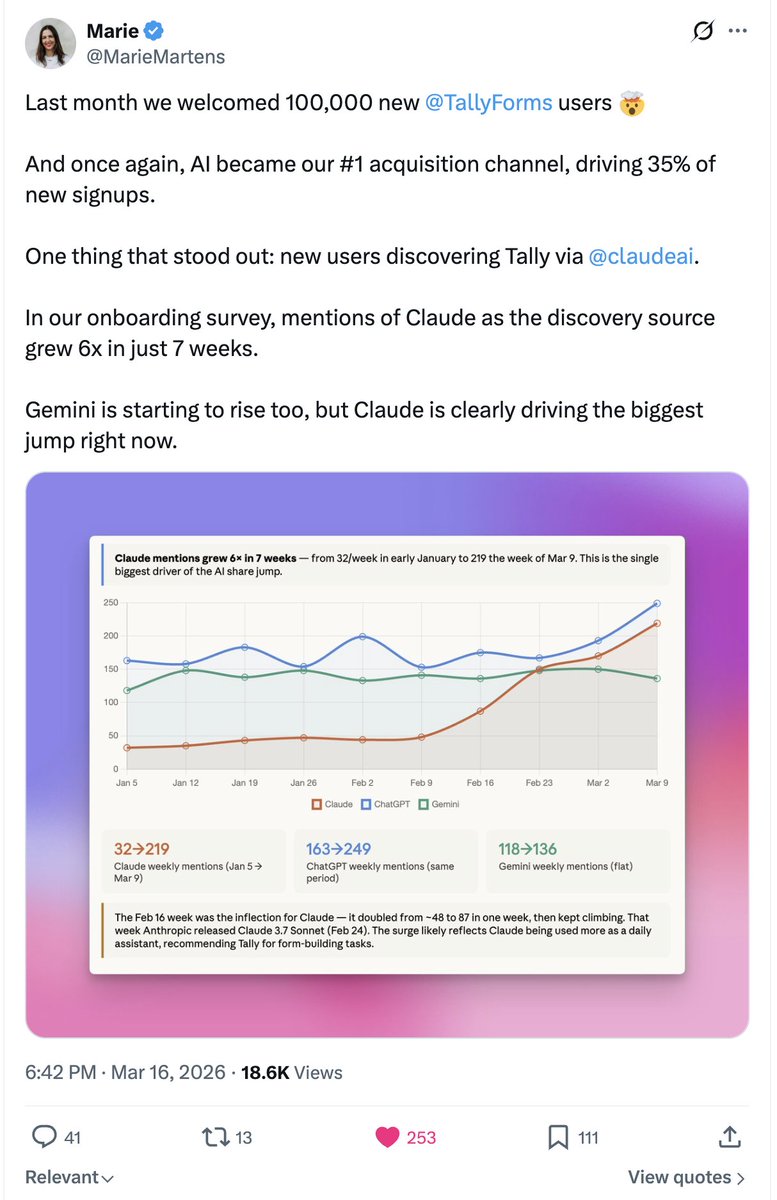
Yesterday I had an a-ha moment. Claude suggested a product to me out of the blue. I didn’t ask for it. I wasn’t searching for it. But it thought it made sense for what I was doing so it recommended I give it a try. We all talk about AI search but from a marketing perspective this made me realize how these tools can do much more than just fulfill existing demand. They can also let unaware people discover your product right when they need it.
@ttunguz ·
The internet is about to look a whole lot more like the online advertising world. No, I don’t mean there’ll be more ads. In fact, I think there’ll be far fewer. But the technology stack for content distribution will mirror the architecture that has been implemented in the online ad world. As we’ve reached the AI search tipping point, publishers face an existential challenge : ensuring AI systems use their content in answers to maintain relevancy. When you visit a website, your browser triggers an auction. The site’s supply-side platform sends your data to an exchange—like a stock market for ads. Dozens of advertisers bid for the chance to show you their message. Highest bidder wins. Total time: under 200 milliseconds. Now imagine the same system, but for content. Instead of bidding to show you ads, publishers vie to inform AI responses. The AI uses quality metrics, not money, to determine winners. Publishers compete on relevance, accuracy, freshness, and authority. The signals that make content useful. This is PageRank for real-time AI responses—algorithmic evaluation operating in milliseconds rather than batch processing. Here’s how it would work in practice : you ask Gemini: ‘What are the reviews of the new Google Pixel phone?’ That query broadcasts to participating publishers: tech reviewers, consumer sites, electronics retailers. They submit their best content to the auction. Gemini evaluates quality, recency & relevance, then synthesizes the winning submissions into your answer. Notice what disappears : the demand-side platform. No more advertisers optimizing for clicks. Just publishers competing to be the most useful source. The internet gets fewer ads, but every piece of content fights for attention in an auction measured in milliseconds. Publishers get traffic & attribution when selected, creating indirect revenue through brand building & subscriptions—but only if their content consistently wins on merit. https://t.co/BJj0fqP40X
@theandreboso ·
AI search is the new snake oil because most founders don’t understand how it works. It’s not really different than asking a friend to look something up for you. Your friend types some keywords into a search engine, looks at the results and summarizes them. After that it’s up to your friend and you can’t really influence them. Your friend is also moody and changes which sites they trust every month. Instead of spending money on dubious products the best bet would be doubling down on PR.
@Charles_SEO ·
- ChatGPT: 2.5 billion queries per day. - Google: ~14 billion queries per day. - ChatGPT launched: November 2022. - Google launched: September 1998. 3 years vs 27 years to reach those numbers... Yes, the internet is substantially bigger now so the comparison isn't perfect, but even accounting for that, the adoption curve is unlike anything we've ever seen in search. ChatGPT is already handling ~18% of Google's query volume and growing every quarter. It also just started running ads, which means it's now officially a commercial search platform, and a DIRECT competitor to Alphabet's ad monopoly. If you're an SEO and you're not optimizing for AI models yet.. you're ignoring a channel that's already bigger than Bing, Yahoo, and every other alternative search engine (minus YouTube, if you include it) combined. The question isn't whether AI search will matter, it already does: 2.5 billion times a day.
@ttunguz ·
OpenAI receives on average 1 query per American per day. Google receives about 4 queries per American per day. Since then 50% of Google search queries have AI Overviews, this means at least 60% of US searches are now AI. It’s taken a bit longer than I expected for this to happen. In 2024, I predicted that 50% of consumer search would be AI-enabled. (https://t.co/ws5CwGjDwr) But AI has arrived in search. If Google search patterns are any indication, there’s a power law in search behavior. SparkToro’s analysis of Google search behavior shows the top third of Americans who search execute upwards of 80% of all searches - which means AI use isn’t likely evenly distributed - like the future. Websites & businesses are starting to feel the impacts of this. The Economist’s piece “AI is killing the web. Can anything save it?” captures the zeitgeist in a headline. (https://t.co/K6XVB3ggx4) A supermajority of Americans now search with AI. The second-order effects from changing search patterns are coming in the second-half of this year & more will be asking, “What Happened to My Traffic?” (https://t.co/sKoEIKQCF9) AI is a new distribution channel & those who seize it will gain market share. - William Gibson saw much further into the future! - This is based on a midpoint analysis of the SparkToro chart, is a very simple analysis, & has some error as a result. https://t.co/QVq4ypjvqI
@CodeByPoonam ·
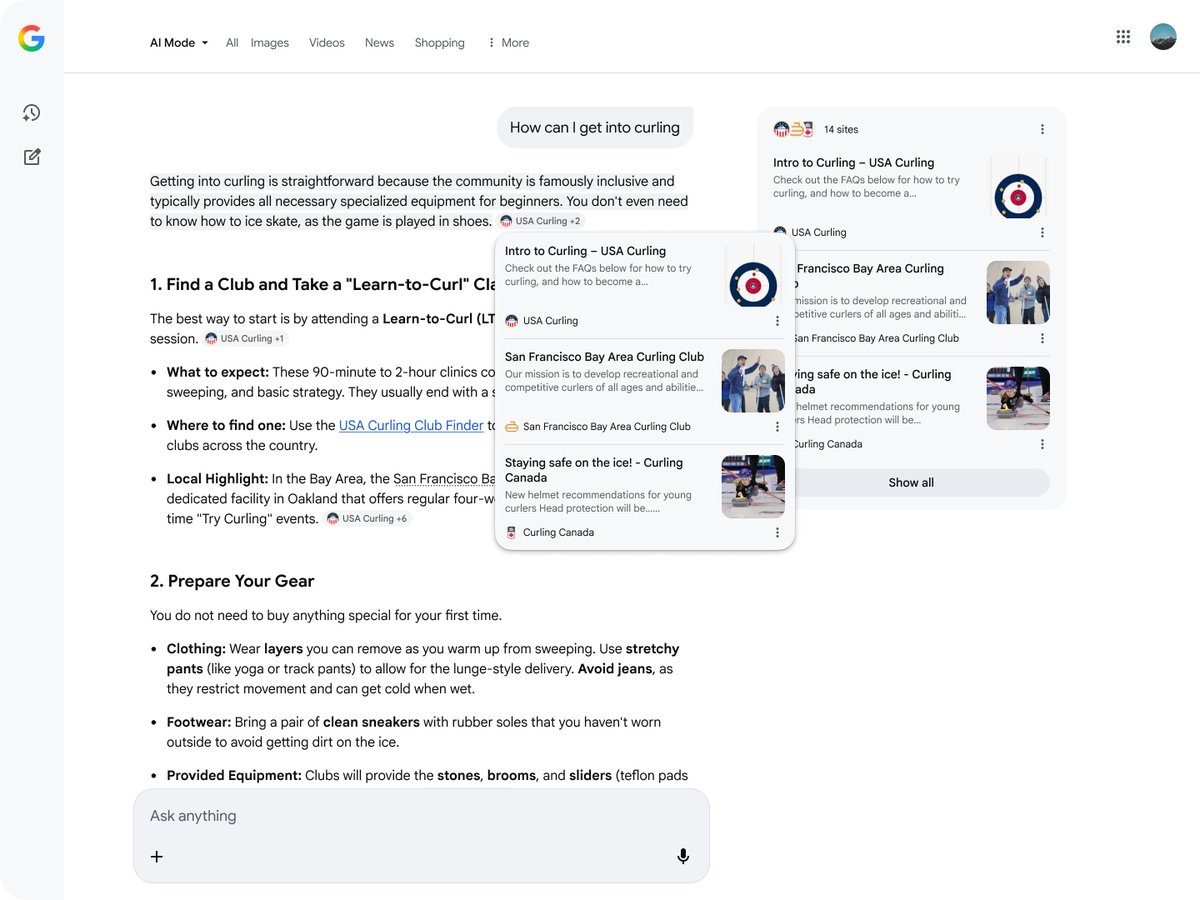
Google Search just got 5 major AI upgrades. The way you browse the web just changed. Here’s what’s new 👇 1/ Explore new angles AI responses now suggest in-depth articles to dive deeper after every search. 2/ News subscriptions highlighted Your paid sources now show up labeled inside AI responses. 3/ Real people. Real advice. Forums, social media and firsthand perspectives now appear inside search results. 4/ Inline links Links now appear next to the exact text they’re relevant to. Not buried at the bottom. 5/ Website previews Hover over any link and see exactly where it goes before you click. Google just made AI Search feel less like a dead end. And more like the actual web.
@peec_ai ·
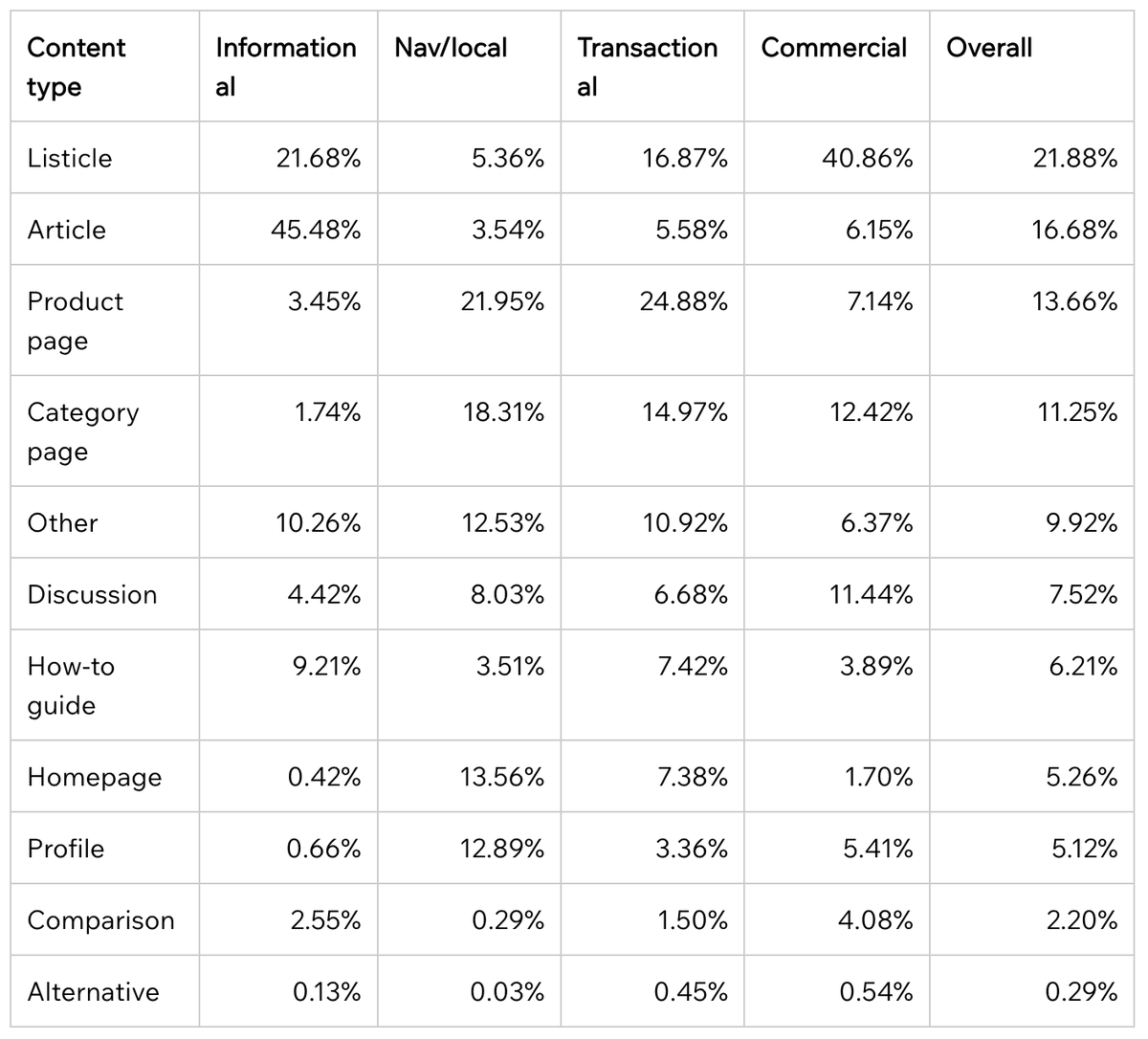
Which content types get cited most in AI search? We looked at over 1 million citations. On ChatGPT, listicles dominate. 52% hit a citation rate above 2.0. Product pages have high presence but lower citation rates. On Google AI Mode, category and product pages from official brand sites perform best. It prefers brand-owned content. On Perplexity, listicles and articles win, but the numbers are much lower. Only 6% of URLs make it into the high citation bucket.
@neilpatel ·
AI Overviews didn't break search. They exposed something that was already cracking. Featured snippets, People Also Ask, zero click answers, every one of those was Google reaching past the keyword for what the user actually meant. The crack was already there. AI just made it impossible to ignore. #FutureOfSEO #AIMarketing #GoogleSearch #SEO #ContentStrategy
Watch video
@natmiletic ·
How to future-proof your site against AI search eating your clicks: 1. Sell something. Products, services, access. Make visiting mandatory. 2. Build tools and interactive resources that AI can't replicate. 3. Build a community or email list. Own the audience, not just the ranking. 4. Go deeper than any summary can. Original data, personal experience, proprietary insight. AI summaries are just a filter for thin content.
@Marie_Haynes ·
Here are some thoughts on the new AI search reporting in GSC along with how I'm going to use this information. https://t.co/42EykzvLNi
@alex_prompter ·
If you're still optimizing for Google and ignoring AI search, you've already lost, and you don't know it yet. A buyer asks ChatGPT or Claude for the best [your service], and a name comes up. 7 checks that tell you whether it's yours, and what to fix if it isn't: 1. Mirror the buyer query. Ask an AI the exact question your prospect would, with web search on, and read where you land. The answer it gives is the one your buyers already see. 2. Map the query funnel. List the 15 questions a client types on the way to hiring someone like you, from early research to ready-to-buy. These are the rooms you need to show up in. 3. Reverse the named competitor. Find who the AI recommends first, then trace the signals that earned it: reviews, lists, comparison pages, their own content. Now the gap has a name. 4. Audit your proof trail. AI vouches for what the open web confirms. Count your reviews, mentions, and third-party features, then list the five a buyer expects to find but can't. 5. Test your machine-readability. Have a model read your site cold and describe what you do and who you serve. If it struggles, so will the model a buyer is asking. 6. Close the authority gaps. Models cite the source that answered the question best. Find the buyer questions you've never put in content, because that silence is why you get skipped. 7. Compress to one page. Pull the findings into three moves: the gaps costing you the most recommendations, the first action for each, and the order to run them.
@thinking_slow ·
everything you need to know about Google's AI Overviews (and how they impact your rankings and traffic)* - AI Overviews appear on roughly 21% of all Google search keywords worldwide, including about 16% of U.S. search queries. - Google’s AI Overviews are significantly cutting into clicks – top-ranking pages see a 34.5% drop in clicks when an AI Overview is present. (I suspect this is even higher now. New research forthcoming.) - Countries with the highest AI Overview coverage are Indonesia (37.2%), the Philippines (29.1%), and Mexico (29.1%) (the U.S. is around 20.5%). - 99.9% of keywords that trigger AI Overviews are informational in intent (only 5.5% are commercial and 1.2% transactional). - 76% of AI Overview citations come from content already ranking in Google’s top 10 organic results. - Longer queries are far more likely to trigger AI Overviews – they appear for only 9.5% of 1-word searches but 46.4% of searches with 7+ words. - AI Overviews show up on 57.9% of question-type searches (versus just 15.5% of non-question queries). - 44.1% of medical “Your Money or Your Life” (YMYL) queries return an AI Overview . - About 71.7% of searches that trigger AI Overviews show no ads (no CPC data), meaning these queries are largely non-monetized . - Top categories by AI Overview prevalence are Science (43.6%), Health (43.0%), Pets & Animals (36.8%), and People & Society (35.3%). - Categories with the lowest AI Overview coverage are Shopping (3.2%), Real Estate (5.8%), Sports (14.8%), and News (15.1%). - AI Overviews are rare in sensitive and localized queries: they appear on only 6% of news searches, 4% of NSFW queries, and 7.9% of local searches. - 8.6% of AI Overviews do not appear at the very top of the page (some appear as low as position #6 in the results). - The top 50 domains mentioned in AI Overviews account for 28.9% of all AI Overview citation links. *sources in thread!
@glenngabe ·
Interesting case study and backs what @lilyraynyc published about the evolving situation with self-serving listicles -> Self-Promotional Content Works — Until It Backfires (AI SEO Experiment) Some takeaways: *When AI cited a conference-promoting page, it still skipped that conference 43% of the time, recommending a competing event featured on the same page instead. *Most AI citations (and the AI mentions they earned) were temporary and came and went over time. *Self-promotional content seems most useful when AI has a gap in its understanding: your brand belongs in a specific category, but AI doesn’t consistently mention it there yet. *Regarding "found not cited", among answers where a conference-promoting page was found but not cited, 74% skipped mentioning Ahrefs Evolve (compared to 43% when a conference-promoting page was cited). https://t.co/cFjMuC2wfu
@hustle_fred ·
crazy how much i learned at "AI Search" event🔥 my favorite insights: 1> AI pulls references from the first 200 chars of your article, keep the intro sharp and short 2> Reddit/YouTube dominate the references, but niche blogs often beat them on position 1. So don't default to Reddit, analyze first 3> listicles are the most powerful content type in AI search, if your app is #1 in a list, AI shows it first > some AI SEO tools use LLM APIs instead of scraping the web interface directly. Issue is API returns less results than users actually see on the web
@IronBrands16 ·
𝗔𝗜 𝗶𝘀 𝗼𝘂𝗿 𝘀𝗲𝗰𝗼𝗻𝗱 𝗯𝗶𝗴𝗴𝗲𝘀𝘁 𝘀𝗼𝘂𝗿𝗰𝗲 𝗼𝗳 𝘀𝗶𝗴𝗻𝘂𝗽𝘀 (𝗮𝗻𝗱 𝗴𝗿𝗼𝘄𝗶𝗻𝗴!) 🤯 Here is a chart of last week signups at Simple Analytics: 🤖 AI Search is almost at 50% of Google Search 🧠 More people signed up from ChatGPT than socials or word of mouth 📈 It's been growing week over week 🔍 SEO not dead, but people definitely asking AI tools what to use We haven't focused much on it, but 𝘁𝗵𝗶𝘀 𝗶𝘀 𝘁𝗵𝗲 𝗽𝗹𝗮𝗻: - Use Promptwatch to keep track of mentions and visibility - Optimize for LLM data sources (like Reddit, AI directories) - Add AI-visible schema (structured data) 𝗔𝗜 𝗦𝗲𝗮𝗿𝗰𝗵 𝗶𝘀 𝘁𝗵𝗲 𝗻𝗲𝘄 𝗮𝗰𝗾𝘂𝗶𝘀𝗶𝘁𝗶𝗼𝗻 𝗰𝗵𝗮𝗻𝗻𝗲𝗹 🚀
@jbobbink ·
I read Google's internal docs from May 2025 that refused publishers granular AI controls. Now regulators forced their hand and they call it "exploring." In May 2025, Google deliberately decided not to give publishers the ability to opt out of AI Overviews separately from regular search. They had the option. They chose not to build it. Fast forward to January 28, 2026. The UK's Competition and Markets Authority designated Google with "strategic market status" and proposed binding rules. Suddenly Google is "exploring updates to controls." Their words, not mine. Ron Eden, Google's principal for product management, wrote that any new controls need to avoid "breaking search in a way that leads to a fragmented or confusing experience for people." Two weeks later, Google's managing director for news partnerships called it a "huge engineering project" at a conference in London. A basic opt-out toggle. Huge engineering project. From the company that built AI Overviews in the first place. Meanwhile, publishers are not waiting. BuzzStream analyzed 100 top news sites and found that 79% already block at least one AI training bot. 71% block retrieval bots too. Publishers are voting with their robots.txt files whether Google builds the button or not. The numbers explain why. Seer Interactive research showed a 61% drop in organic click-through rates for queries where AI Overviews appear. Google's own cited research shows that using nosnippet to block AI Overviews costs publishers roughly 45% of their search traffic. That is not an opt-out. That is a hostage negotiation. The current tools were designed to be all or nothing on purpose. Google-Extended blocks AI training but has zero effect on AI Overviews. Nosnippet blocks AI Overviews but also kills your regular search snippets. There was never a clean middle ground because Google never wanted one. It took the CMA, the EU Commission launching a formal antitrust investigation, and independent publishers filing complaints across multiple jurisdictions to get Google to even say the word "exploring." One-third of publishers polled say they will opt out if the controls arrive. But Google has given no timeline, no technical spec, and no commitment. If you manage SEO for any site that creates original content, do not wait for Google to hand you the tools. Build your traffic diversification strategy now, because the opt-out button Google is "exploring" may arrive too late to matter. Sources: - The Media Copilot, "Google signals it may let publishers opt out of AI search features" (Jan 29, 2026) - Ron Eden, Google blog post on CMA consultation response (Jan 28, 2026) - Sulina Connal, FT Strategies conference, London (Feb 11, 2026), reported by PPC Land - BuzzStream, "Which News Sites Block AI Crawlers?" (Dec 18 2025) - Seer Interactive, AI Overviews CTR research (Nov 4, 2025) - Matt G. Southern, "Google May Let Sites Opt Out Of AI Search Features" SEJ (Jan 28, 2026)
@RandallKanna ·
I think a lot of founders are massively underestimating AI search. And I think it's the future. People are already asking: “Best payroll software for startups” “Best CRM for agencies” “Best QA testing tool” And if AI recommends your competitor instead of you… that matters. They go and google your competitor and you don't even show up. The weird part? Most founders have no idea what AI says about them right now. And they aren't tracking it.
@kaleighf ·
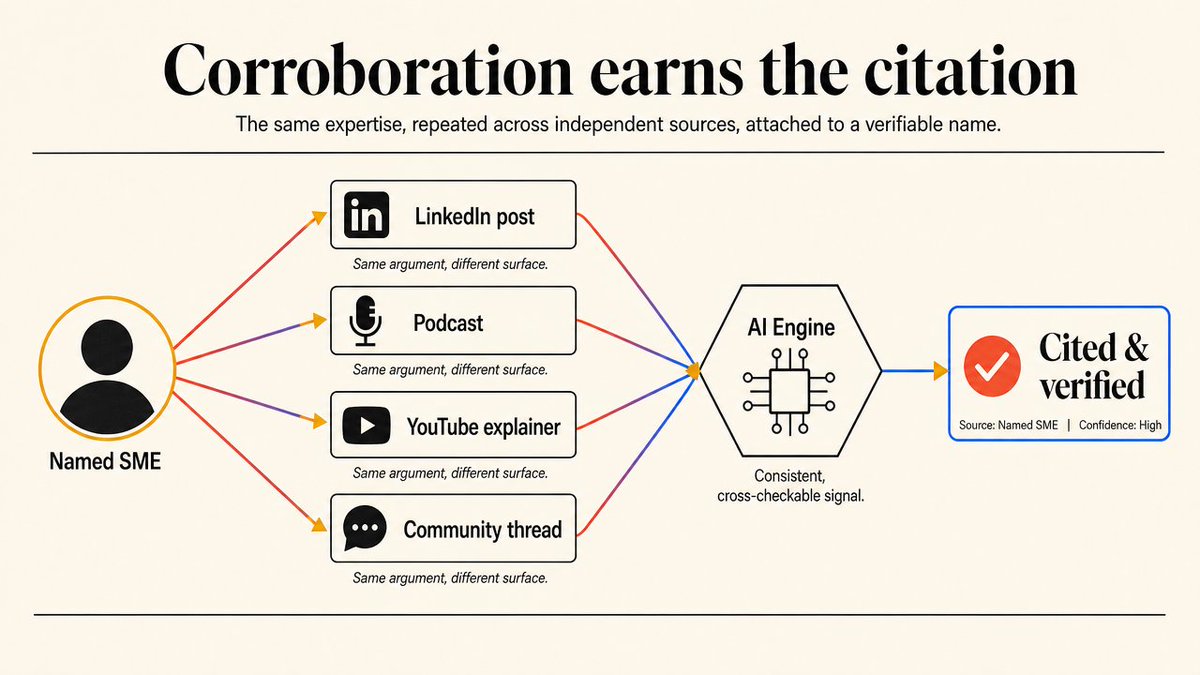
The thing I keep coming back to about AI search: The further a signal sits from a brand's own control, the more LLMs seem to trust/weigh it when deciding what to cite. Authority, in other words, now flows toward people— not brands. The uncomfortable part is that it requires brands let go of control + allowing humans with real expertise to be their mouthpiece (instead of hovering behind the faceless logo or branded account.)
@ChrisClickUp ·
AI Overviews killed organic click-through rates by 61%. Zero-click searches are heading toward 70% of all queries. Non-cited brands in AI Overviews see a 65% CTR decline. Paid ads now capture 19-36% of clicks depending on the vertical, effectively doubling in one year. And Google's global search share fell below 90% for the first time in a decade. But go to any SEO conference and everyone is still talking about keyword clusters and backlink strategies like it's 2019. Here's what's actually happening in B2B SaaS: Your buyers aren't Googling "best project management tool" anymore. They're asking ChatGPT. They're asking Perplexity. They're asking Claude. And those AI tools don't care about your domain authority. The SEO industry has too many jobs, too many agencies, and too much revenue tied to the old model to admit what's happening. The era of "rank and bank" is ending. The era of "be the answer, not the link" is starting.
@kristakdoyle ·
🤓 NEW RESEARCH: I spent the past month analyzing 33,000+ citations across 1,000 queries sourced from and modeled after real B2B buyer questions to get a snapshot of how third party sources are *really* showing up in AI search right now. The results are in. Here's what stood out: 📊 Reddit and YouTube account for more B2B AI citations than every other off-site platform combined. Most B2B brands are still insanely underinvested in these two channels, but AI engines are treating them as primary sources for understanding your brand and its products. 📊 Google AI Overviews now trigger on 84% of B2B queries. Remember "10 blue links"? Ahh, a simpler time. Now, AIOs sit above the traditional SERPs for the vast majority of B2B searches. If your brand isn't showing up in those answers, you're invisible in the place that likely still matters most. 📊 The average cited YouTube video was referenced 2.3x across queries. Good news for brands who are scared of YouTube because it's a heavier lift: a single good video can (and usually does) compound visibility across multiple queries and AI search engines. Do not sleep on testing this channel. 📊 80% of AI-cited Reddit posts had fewer than 20 upvotes. Aka don't let anyone trick you into thinking you need virality to get visibilty on Reddit. AI often cites more focused Q&A and discussion threads averaging just 80 words. You don't need to game any algorithms here -- but you do need to be intentionally present and helpful in the right conversations. 📊 Only 7.7% of cited URLs appeared in more than one AI engine. Optimizing for one engine does not necessarily give you visibility in the others. Each engine has its own source preferences, its own trust signals, and its own retrieval patterns. That means you need an engine-aware strategy, not a one-size-fits-all approach. I built this report because I kept hearing the same thing from B2B marketing leaders: "Off-site is a black box to us, we have no idea how or where to get started." Now you do. 🫴 Here's 21 pages of data, strategy, and platform-specific takeaways. Free download now at: https://t.co/4p6OkZVJMG
@kaleighf ·
Creator AEO, the emerging term for creator-driven answer engine optimization, is the practice of earning AI citations through human expertise published on third-party surfaces. “Creator” can take many shapes here: LinkedIn creators, B2B influencers, customer advocates, and even employees all fit under this umbrella. (More on this in a bit.) This work sits inside the broader practice of answer engine optimization, but it targets the off-site piece of this puzzle. Most AEO and GEO work is largely on-site and focused around topical ownership via blog content published on the company’s website. That work is useful and still necessary, but it caps out at the small share of citations your own website or company blog can earn as a brand-owned piece of digital real estate. Creator AEO picks up where that ceiling hits. It treats the entire context of the internet (the videos, posts, forum threads, and reviews) as the real arena for AI visibility, and it treats individual people as the unit of credibility rather than the brand. This new term emerged because LLM citation data has been pointing in this direction for a while now. Once teams started to notice that the bulk of AI answers were assembled from third-party, human-authored sources, they took note, and started thinking about AI citation rate as a largely offsite initiative.
@_vmlops ·
GOOGLE'S AI SEARCH IS PUSHING USERS AWAY AND DUCKDUCKGO IS WINNING turns out, not everyone wants AI answering their questions. after google's AI search overhaul: → duckduckgo's AI-free page (https://t.co/CDbji2cyC0) saw 3x more visits → overall app installs jumped ~33% → iOS installs peaked at nearly 70% growth they even launched browser extensions to replace google in chrome + firefox's address bar. the demand for "just show me the results" is real and it's growing
@RandallKanna ·
Something I underestimated building Kelsey: People assume AI search is just “SEO but for ChatGPT.” It’s not. Traditional rankings definitely matter. But assistants also pull from: • Reddit • niche blog posts • random comparison sites • review content • random high trust sources It's not always the biggest apps/companies that get the highest mention. AND the individual customer needs are so important as well.
Best Tweets by Topic