To find what’s trending on Twitter in the USA, open X (Twitter), go to Explore, and check the Trending section with your location set to the United States. If you want to use trends for growth instead of just watching them, you also need outside tools that show location-based topics and help you track whether a trend is accelerating.
Users often get stuck at the same point. They open Explore, see a few topics, maybe post a fast opinion, then wonder why nothing happened. The problem isn’t access to trends. The problem is not knowing which trend matters, how early you are, and whether you should reply, publish an original post, or stay out completely.
That matters because U.S. trends on X aren’t a single national scoreboard. X says trends are algorithmic and personalized by who you follow, your interests, and your location, and the platform is designed to surface topics that are popular now, not topics that have been popular for a long time. If you treat trending topics like a static list, you’ll consistently react too late.
This guide is the practical workflow for trending on Twitter in USA. Find trends, filter noise, judge momentum, and choose the format that gives you the best chance of getting attention without forcing your way into the wrong conversation.
Why Just Watching Trends Is a Wasted Opportunity
Seeing a trend is easy. Using it well is where creators, founders, and social teams separate themselves.
A U.S. trend list can tempt you into thinking the job is just to spot a hashtag and post something fast. That’s usually what produces low-quality tweets that feel late, generic, or disconnected from your audience. Real growth comes from treating trends as distribution opportunities, not entertainment.
X’s own help center makes the core point clear in its trending topics FAQ. In the United States, trends are algorithmic and personalized based on who you follow, your interests, and your location. X also says it surfaces topics that are popular now. That means visibility is tied to recency and local behavior, not just massive national volume.
What this changes for your workflow
If trends are personalized, then “what’s trending on Twitter in USA” isn’t one universal answer. Your Explore tab is useful, but it’s incomplete.
You need two mental shifts:
- Stop asking what is trending. Start asking whether the trend is gaining speed in the audience you want.
- Stop reacting at the topic level only. Start looking for the specific posts and sub-conversations where your angle can earn replies, profile visits, and follows.
Practical rule: A trend is only useful if you can connect it to your audience faster than everyone else can repeat the obvious take.
There’s also a hard trade-off here. The broader the trend, the more attention it gets. But broad trends also attract more noise, more repetition, and more risk. A founder talking about product lessons through a live sports or entertainment trend can work. A forced brand joke inside a sensitive geopolitical topic usually backfires.
What trend watching misses
Passive watching creates three common failures:
| Habit | What happens | Better move |
|---|---|---|
| Refresh Explore and lurk | You consume attention instead of capturing it | Save trends worth monitoring and decide on action quickly |
| Chase every big topic | Your account looks random | Join only when the trend intersects with your niche, tone, or audience |
| Post the same take as everyone else | You blend in | Add interpretation, humor, context, or a specific example |
The goal isn’t to become a newswire. It’s to build a repeatable habit where you notice momentum early, choose the right angle, and publish in a format that fits the moment.
How to Find USA Trends on X and Beyond
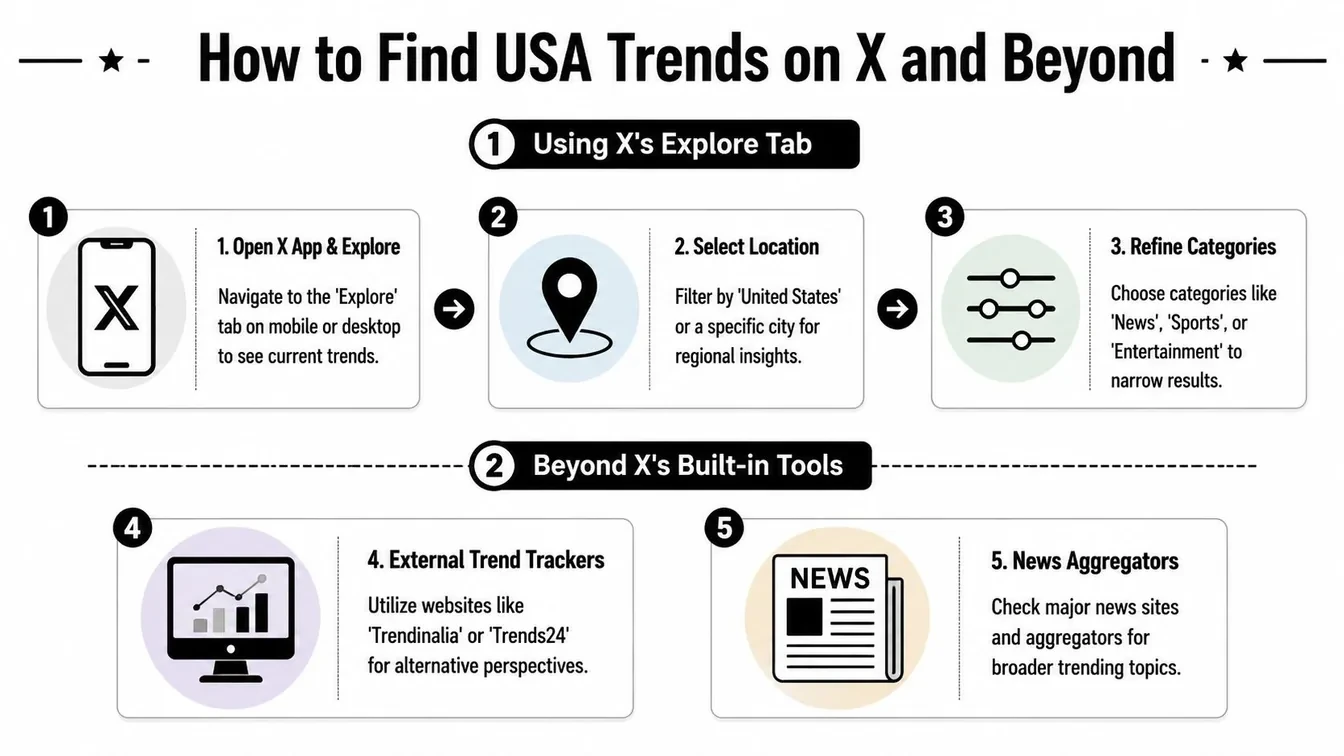
If you only use one source, use X first. If you want cleaner signal, compare X with external trackers.
Use X first
On desktop or mobile, open X and go to Explore. Then:
- Check the Trending area and confirm you’re seeing U.S.-relevant topics.
- Review location settings if the list looks too local or too personalized.
- Open the trend itself and inspect the top posts, latest posts, and related conversation.
- Look at category context if the topic is clearly tied to news, sports, or entertainment.
- Judge freshness by how active the newest posts feel.
This gives you the platform-native view. It’s the fastest place to see what X is surfacing right now.
The catch is personalization. Your feed may overrepresent your existing interests. If you follow builders, you’ll likely see trends differently than someone deep in sports or politics.
Use outside trackers to escape your filter bubble
Public trackers help you compare your personalized feed with a broader U.S. snapshot. One useful example is Trends24’s United States page, which shows how varied U.S. trends can be. Topics like #HouseOfTheDragon can appear alongside Cape Verde, Colombia, and Father’s Day, which is a good reminder that the U.S. trend list is not one unified public conversation.
That’s why trend literacy matters. If you need a plain-English glossary for platform terms, this guide to trending social media terms is worth bookmarking.
For your own workflow, compare at least two views:
- Your Explore tab for what X is surfacing to you
- A public tracker for a less personalized U.S. snapshot
- Your analytics context so you know whether your audience responds better to replies, standalone posts, or threads. If you need a refresher, this guide to free Twitter analytics helps connect trend activity to actual account decisions.
A trend list is raw input. The useful output is a ranked shortlist of topics you can actually use.
What to look for in the list
Don’t just copy the top item. Scan for:
- Live-event topics such as sports, show premieres, and award moments
- News topics that may move fast and carry more reputational risk
- Cultural topics that are easier to remix into creator-friendly posts
- Regional angles that matter if your audience is U.S.-specific or city-based
Many creators make a subtle mistake. They think the biggest trend is automatically the best opportunity. Often the better move is the trend that’s active, relevant, and still open enough for new voices to get noticed.
How to Analyze a Trend Before You Engage
You spot a topic climbing, open X, and see thousands of posts. That alone does not make it a good growth opportunity. The core question is simpler. Can you enter the conversation while people are still rewarding new angles?

Volume is not enough
Trend analysis starts with momentum, not size. A published approach summarized in this study overview defines trends as sharp increases relative to a topic’s normal activity, not just large total volume.
That lines up with how X works in practice. A topic that has dominated the feed for hours often has low room for discovery. A smaller topic that is accelerating can produce better reach because the conversation is still forming and people are still looking for useful interpretations.
Use this quick screen before posting:
| Signal | What it suggests | How to act |
|---|---|---|
| High volume, low freshness | The conversation is mature | Reply only if you have a distinct angle or firsthand insight |
| Rising post frequency | Attention is still building | Move fast with a reply or a short original post |
| Multiple adjacent posts from relevant accounts | The trend is crossing into your niche | Join with context your audience cares about |
| Confusing or fragmented conversation | The topic is noisy or risky | Hold, research, or skip |
If you want a more technical view of structured monitoring, this guide on how to analyze social media content with APIs is useful.
A simple trend filter before you post
I use four checks before I touch a trend. If a topic fails two of them, I usually pass.
-
Relevance
Can your audience see the connection in one glance? If you need three sentences to justify why you are talking about it, the fit is weak. -
Timing
Are new posts still getting traction, or has the conversation flattened into recycled jokes, copied summaries, and late brand takes? -
Risk
Is the topic sensitive, political, tragic, or still unclear? Fast engagement can cost more than it gains if the facts shift after you post. -
Format fit
Does this trend reward a reply under a breakout post, a standalone opinion, or a thread with added context? Choosing the wrong format wastes the moment even if the topic is right.
A trend is usable only when your audience gets a clear benefit from your take.
Then inspect the conversation itself, not just the keyword. Open the top posts and look at who is setting the tone. Journalists create a different opening than fan accounts. Meme pages create a different opening than founders or operators. If quote tweets are adding substance, there is still room. If everyone is repeating the same line, the window is probably closing.
This is also where account-level data matters. Your own history tells you whether your growth usually comes from fast replies, standalone posts, or threads. For that kind of decision-making, review your deeper Twitter analytics before treating every trend the same.
Tooling can help narrow the field. Xholic AI can surface narrower, higher-signal conversations through Engage, then help draft contextual replies inside the X feed with its Chrome extension. That is useful when a broad trend is too crowded and the better opportunity sits inside a specific sub-conversation.
The goal is not to join every trend early. The goal is to join the right trend at the right stage with the right post type. That is where growth usually comes from.
A Creator’s Playbook for Joining Trending Conversations
Once you’ve found a usable trend, choose the format that fits the moment. That decision matters more than people think.
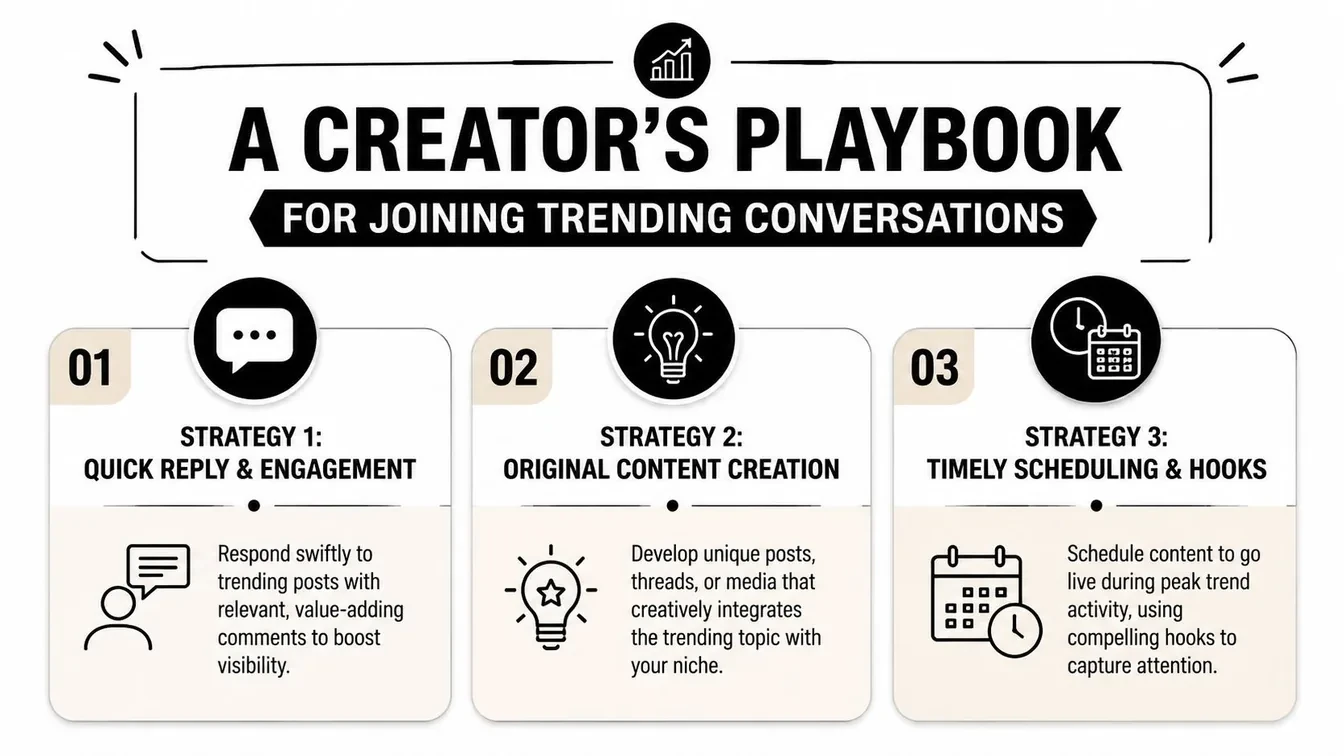
The quick reply play
Use this when a trend is still opening and you can add value in one sharp response.
This is the highest-speed option. You don’t need to own the conversation. You need to attach your account to a post that is already pulling attention.
Good replies usually do one of four things:
- Add context people missed
- Translate the moment for your niche
- Make a sharper joke than the original post
- Disagree clearly without sounding performative
Example reply angle for a product builder during a trending launch moment:
“This is the part people miss about launches on X. Attention goes to the team that already has distribution when the moment hits, not the team writing from scratch after it starts.”
That works because it doesn’t just echo the trend. It reframes it for builders.
A related skill is knowing when not to turn a reply into self-promotion. If your product mention feels bolted on, leave it out.
If you want more ideas on why certain posts spread while others stall, this guide on how to make a tweet go viral is a useful companion.
Here’s a short walkthrough worth watching before you build your own workflow:
The remix play
Use this when the trend has a recognizable format, joke pattern, or structure that can be adapted.
This is common in entertainment and sports trends. A meme, recurring phrase, or post structure emerges, and creators who remix it quickly can still win attention without being first to the topic itself.
A clean remix process looks like this:
| Step | What to do |
|---|---|
| Spot the pattern | Identify the hook, contrast, or punchline structure |
| Keep the frame | Preserve what makes the format recognizable |
| Change the payload | Insert your niche, product, or audience pain point |
| Tighten the wording | Remove anything that makes the remix feel explained |
Sample original post using a trend format for a founder audience:
“Watching founders react to trends on X is always the same:
Day 1: ‘Should we post about this?’
Day 2: ‘We should’ve posted about this.’“
This works best when the trend’s tone is already conversational or comedic. It fails when the topic is sensitive or fact-heavy.
The fastest way to sound late is to explain the meme before using it.
The original post play
Use this when you have a point worth owning.
Sometimes the trend is just the hook. Your real goal is to publish a standalone post that connects the live topic to your expertise. This is the strongest route for consultants, analysts, operators, and founders who want to build authority, not just collect quick engagement.
The structure is simple:
- Name the moment
- Extract the lesson
- Apply it to your niche
- Close with a clear opinion
Example:
“Today’s trend is a reminder that attention on X is rarely won by being generally good. It’s won by being timely, legible, and easy to react to. Most accounts don’t need more content. They need better timing and sharper framing.”
That kind of post can drive better profile visits than a throwaway joke because it creates a reason to follow you beyond the moment itself.
The trade-off is speed. Original posts take longer. If the window is narrow, a reply may outperform a polished post because it gets there earlier.
Common Mistakes and Best Practices
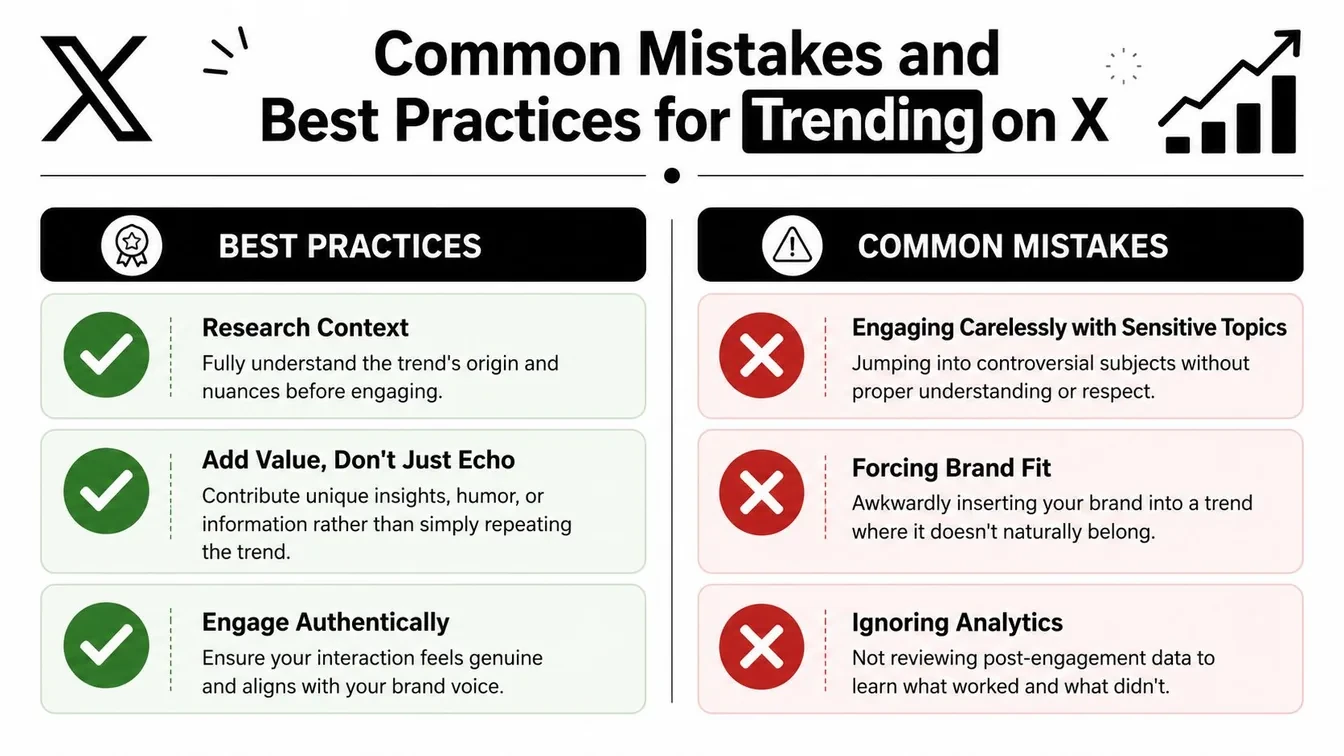
A lot of trend-based posting fails for reasons that are avoidable. Usually it’s not because the idea was terrible. It’s because the timing, context, or execution was off.
Mistakes that kill trend-driven growth
A useful benchmark for why speed matters comes from MIT. In a real-time prediction study, a weighted-vote algorithm forecast trending topics with 95% accuracy, an average lead time of about 1.5 hours, and a 4% false-positive rate, as reported in MIT News. The practical point isn’t to build the same model. It’s to respect how much advantage exists in getting in early.
The common mistakes:
-
Posting after the feed has hardened
Once the same summaries and jokes dominate, your post has to be unusually strong to break through. -
Forcing brand fit
If the connection between the trend and your niche takes too much explanation, people feel the stretch immediately. -
Ignoring context on sensitive topics
News, politics, and tragedy require restraint. Fast is good. Careless is expensive. -
Writing generic replies
“So true,” “wild,” and “this is huge” don’t create curiosity or authority.
Best practices that actually help
Pair each mistake with a stronger habit:
| Instead of this | Do this |
|---|---|
| Chasing every major trend | Build a small watchlist of trends that overlap with your audience |
| Posting the obvious take | Add a niche-specific angle, interpretation, or lesson |
| Using the same format every time | Match the moment with a reply, remix, or standalone post |
| Treating trend engagement as random | Review what drove replies, profile visits, and follows, then repeat the pattern |
One more best practice matters more than is typically realized. Trend participation works better as a system than as a one-off burst. If you only jump in occasionally, you won’t build the instincts that help you recognize timing, tone, and format fit. If you need a framework for that broader habit, this article on why many X growth tools fall short is useful because it focuses on repeatable workflows rather than random feature lists.
Strong trend execution looks obvious after the fact. Before posting, it usually feels like making a fast decision with incomplete information.
That’s normal. The answer isn’t to wait for certainty. It’s to develop a consistent filter, then post with discipline.
Frequently Asked Questions About USA Twitter Trends
How often do trends change on X in the USA?
Often. X describes trends as surfacing topics that are popular now, so the list is built around freshness rather than evergreen popularity. In practice, that means your window can be short, especially for event-driven topics.
Are U.S. trends all part of one conversation?
No. Public U.S. trend snapshots show a mix of entertainment, geopolitics, sports, and culture in the same list. You’re not looking at one shared discussion. You’re looking at many separate attention pools competing at once.
How long does a U.S. trend usually last?
It varies widely. Public U.S. trend archives show some topics can stick around much longer than people expect. For example, U.S. trend archive examples include “Fauci” lasting 24 hours and “Juneteenth” lasting 19 hours, while other event-based trends are much shorter. That’s why trend duration should affect whether you reply immediately or take time to craft an original post.
Can I make my own tweet trend?
You can increase the odds of joining or shaping a conversation, but you can’t force a topic into the trend list on demand. The better practical goal is to enter relevant conversations early enough that your post benefits from the trend’s momentum.
Is it safe to engage with political or sensitive trends?
Sometimes, but only if you understand the context and have a reason to contribute. If your account isn’t built for that kind of topic, the safer move is usually to skip it. Attention is not always good attention.
What’s the best format for trend-driven growth?
Use the format that matches the moment. Replies are best when speed matters. Original posts are better when you have a strong perspective. Remixes work when the trend has a recognizable structure and a lighter tone.
If you want a cleaner workflow for turning trends into actual posting decisions, try Xholic AI. It’s built for discovering high-momentum conversations, drafting contextual replies, remixing proven post structures, organizing saved research, and scheduling approved posts so trend engagement becomes a habit instead of a scramble.