Here’s a situation that plays out constantly in the indie hacker and creator world, and almost nobody talks about it honestly.
Someone decides to get serious about X. They’ve watched enough accounts blow up to believe it’s real. They sign up for TweetHunter or SuperX, pay a monthly subscription, spend a weekend setting everything up, and then three months later, they’re still stuck at the same follower count. Maybe they’ve gained a few hundred. Maybe they’ve lost some. Either way, the number doesn’t match the invoice.
So they cancel. And then they either quit on X entirely, or they go looking for the next tool, convinced the last one was just the wrong fit.
This cycle isn’t a you problem. It’s a design problem. And understanding why it happens is the first step toward actually breaking out of it.
The Core Problem: Most Tools Were Built for the Wrong Job
When TweetHunter launched, it solved a real problem. Creators were staring at blank screens every morning, unable to write consistently, watching their follower counts stagnate. A searchable library of three million viral tweets, organized by topic, filtered by engagement, broke through that blank page problem in a way that felt almost magical.
But here’s what happened next: the tool became popular, then dominant, and then everyone started using the same library. The same hooks. The same structures. The same “unpopular opinion:” openers and “here’s what nobody tells you about” thread formats.
The most common complaint users report about TweetHunter across Reddit, Product Hunt, and Trustpilot is that content feels generic and template-based, tweets sound robotic and lack the personal voice that makes X content compelling.
That’s not a bug in the tool. That’s what happens when thousands of people drink from the same inspiration well. The content pool homogenizes. And the accounts that were supposed to stand out because of these tools start blending into each other instead.
SuperX has the same problem from a different angle. The platform is polished and ships features quickly, but its AI learns your tone at a surface level without the deep voice matching that personal brands actually need in 2026.
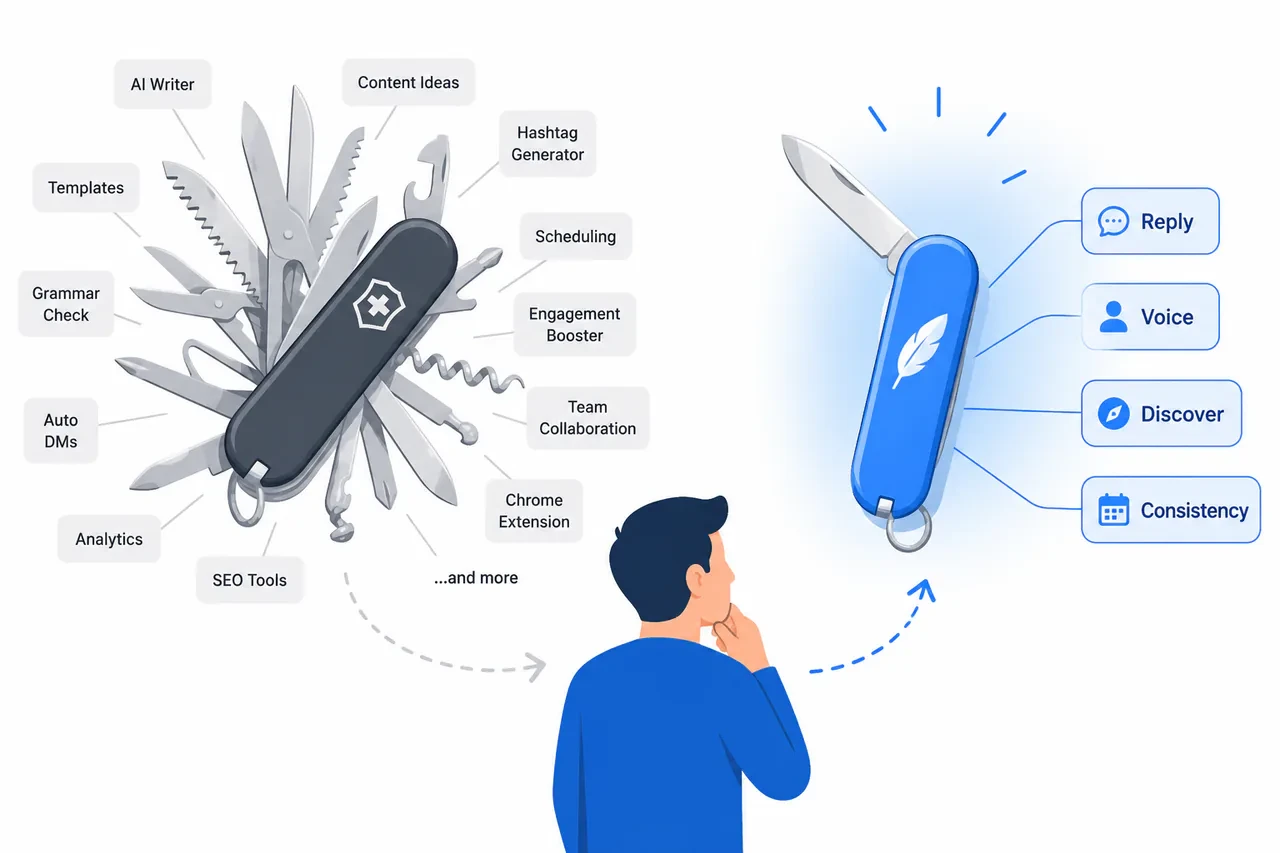
Both tools are solving the volume problem. Neither is solving the voice problem. And in 2026, voice is the moat.

Problem One: The AI Doesn’t Know Who You Are
This is the one that stings the most because it’s not obvious until you’ve used the tool for a few weeks.
You pay for AI-powered writing. You open the tool, paste a topic, and the AI generates something. It’s structured well. The hook follows a proven format. It might even get a few likes. But then someone who knows you reads it and asks: Did you write this?
And you know immediately that it doesn’t sound like you.
With TweetHunter, you often have to fight the tool to sound authentic. That’s a real quote from a real user, and it captures something important: when a tool requires you to work against it to sound like yourself, the tool is adding friction, not removing it.
The reason is architectural. TweetHunter generates content based on viral templates and GPT models without truly learning your individual writing patterns over time. SuperX does voice matching to a point, it picks up on general tone, but it doesn’t build a model of how you specifically construct sentences, what level of formality you naturally use, whether you lean on rhetorical questions or declarative statements, or what humor sounds like coming from you.
The most consistent complaint is that AI suggestions feel repetitive and formulaic over time, requiring users to spend significant effort editing posts to match their authentic voice.
That editing time doesn’t disappear. It just gets hidden inside the subscription cost. You’re paying for first drafts that require so much rewriting they barely save you time.
What actually solves this: a tool that learns from your actual replies, not a generic model of what performs well, but a model of how you specifically engage. Xholic AI does this through the Chrome extension. Its reply drafts draw on your real past replies and posts, your style guide, and the edits you make to drafts before posting. It’s not instant, but after a few weeks of real use, the gap between what it generates and what you’d actually write becomes meaningfully smaller. The goal isn’t zero editing. It’s editing that takes 15 seconds instead of five minutes.

Problem Two: You’re Managing X From Somewhere That Isn’t X
Think about the actual workflow when you use TweetHunter or SuperX for reply-driven growth.
You’re reading a tweet. Something catches your eye. You think: I should reply to this. And then you either:
a) Open a new tab, navigate to the tool’s dashboard, copy-paste the tweet, generate a reply, copy-paste it back to X, and post it.
b) Give up and scroll past because the friction cost is too high in the moment.
Option b wins. Every time. Not because you’re lazy, but because human attention doesn’t survive unnecessary friction when there are a thousand other things competing for it.
When your main bottleneck is replying and quote-tweeting in the flow, extra dashboards and price tags slow you down.
This is the tab-switching problem, and it’s endemic to almost every tool in this category. They were designed as dashboards, places you go to plan content, not places that live inside the platform where you actually make it.
Scheduling dashboards are useful when you already know what you want to post and you’re working ahead. But the best reply opportunities on X are time-sensitive. A high-momentum tweet from someone in your niche doesn’t wait for you to open another tab. That window is narrow. Maybe 30 minutes. And if your workflow requires three steps before you can post anything, most of those windows close before you ever get to them.
What actually solves this: the Xholic AI Chrome extension adds a reply wand to every reply box on X. You open the reply, click the wand, and the AI reads the tweet’s context and writes one draft straight into X’s editor, without you ever leaving X. You review it and press Reply yourself. No tab switching. No copy-paste. The context window is still open, the thread is still visible, and the draft is in front of you in seconds. That’s the only workflow that actually sustains the reply habit at scale.
Problem Three: The Pricing Is Not What It Looks Like
This one gets people because the damage happens after signup.
SuperX’s pricing page shows a $49/month “Pro” plan near the top. It sounds reasonable. But Pro is not the plan to evaluate if the job is AI writing, AI post generation, viral post research, or AI thread writing. Those start on Advanced, which currently shows a $49/month launch price and is normally $99/month, and Ultra is $199/month. That distinction only becomes clear when you compare what each plan unlocks.
TweetHunter’s pricing page has also shifted. As of October 7, 2026, its public page shows Discover at $29/month, Grow at $49/month with AI Writer and CRM, and Enterprise at $199/month for higher-scale needs such as custom trained AI, smart AI reply generation, and unlimited AI use. If you came for AI writing and relationship tracking, you’re not really evaluating the lowest tier. You’re evaluating Grow or above. All three plans come with a 7-day trial.
To be direct about the math, based on competitor pricing pages checked on October 7, 2026, with Xholic pricing updated in October 2026:
| Tool | Lowest visible monthly plan | Plan to evaluate for the relevant AI workflow |
|---|---|---|
| TweetHunter | $29/month Discover | $49/month Grow for AI Writer and CRM; $199/month Enterprise for custom AI and unlimited AI |
| SuperX | $49/month Pro | Advanced for AI Post Writer, AI Thread Writer, and viral post library ($49/month launch price, normally $99); $199/month Ultra for 10 accounts |
| Xholic AI | $29/month Pro | Pro is $29/month, Max has a $29/month launch price with $49 crossed out, Ultra is $149/month, and every plan includes a 3-day trial; quarterly billing includes 10 free days and yearly billing includes three months free |
This isn’t just about money. It’s about the trust gap. When you feel like you were shown one price and discovered another, the relationship with the tool starts on the wrong foot. You’re using it defensively, watching for the next catch, rather than just getting on with the work.
As of October 2026, Xholic’s Pro plan is $29/month, Max has a $29/month launch price with $49 shown as the crossed-out comparison price, and Ultra is $149/month. Every plan includes a 3-day trial. Quarterly billing includes 10 free days, while yearly billing includes three months free. The pricing page lists Pro, Max, and Ultra clearly. Verify the live pricing page before buying any tool, including Xholic, because SaaS packaging changes often.
Problem Four: The Automation Risk Nobody Talks About Upfront
Both TweetHunter and SuperX lean heavily on automation as a selling point. Auto-DM, auto-retweet, auto-plug, auto-delete. On the surface these sound like time-savers. And some of them are, used carefully.
But some users report receiving Twitter/X account warnings when using auto-DM and aggressive automation features. X has been tightening its automation policy, and the line between “useful scheduling automation” and “behavior that looks like spam” has gotten narrower.
The issue is structural. When a tool offers one-click automation for things like sending DMs to everyone who liked a post, or auto-plugging a product link every time a tweet hits a certain engagement threshold, the system is optimized for volume, not context. And volume without context looks like spam to both the algorithm and real people.
Tools that automate replies, follows, or DMs through click simulation can violate X’s automation rules and put the account at risk. That’s not a corner case. That’s a real risk people absorb when they enable features without reading the fine print.
This matters even more for smaller accounts. A large account can absorb a warning or a temporary restriction and recover. A 2,000-follower founder account that gets flagged can lose months of work in a week.
The safer approach: every action that goes out under your name should have human review before it publishes. This isn’t just a philosophical position, it’s practical risk management. Xholic is intentionally built around this: the tool generates and suggests, you approve and post. Smart Scheduler publishes at configured times, but only posts you’ve explicitly approved end up in the queue. The automation rules, auto-retweet, and auto-delete apply to your own content under conditions you set, not mass engagement actions toward other accounts.
Problem Five: There’s No System for Showing Up Consistently
This is the one that doesn’t get enough credit.
The accounts that grow fastest on X aren’t necessarily the ones with the best content. They’re the ones who show up every single day, in the right conversations, without burning out. Consistency beats quality, at least in the short term, and consistency without a system is almost impossible to sustain.
Most X growth tools are content tools. They help you write things. Some help you schedule things. Almost none of them close the loop on the habit itself, the daily accountability structure that makes consistency a default behavior rather than a willpower exercise.
The problem is implementation and having a proven system to follow, information isn’t the bottleneck. That applies directly here. You can have 50 scheduled posts and a viral tweet library and still stop opening the tool after three weeks because there’s no pull keeping you in the habit.
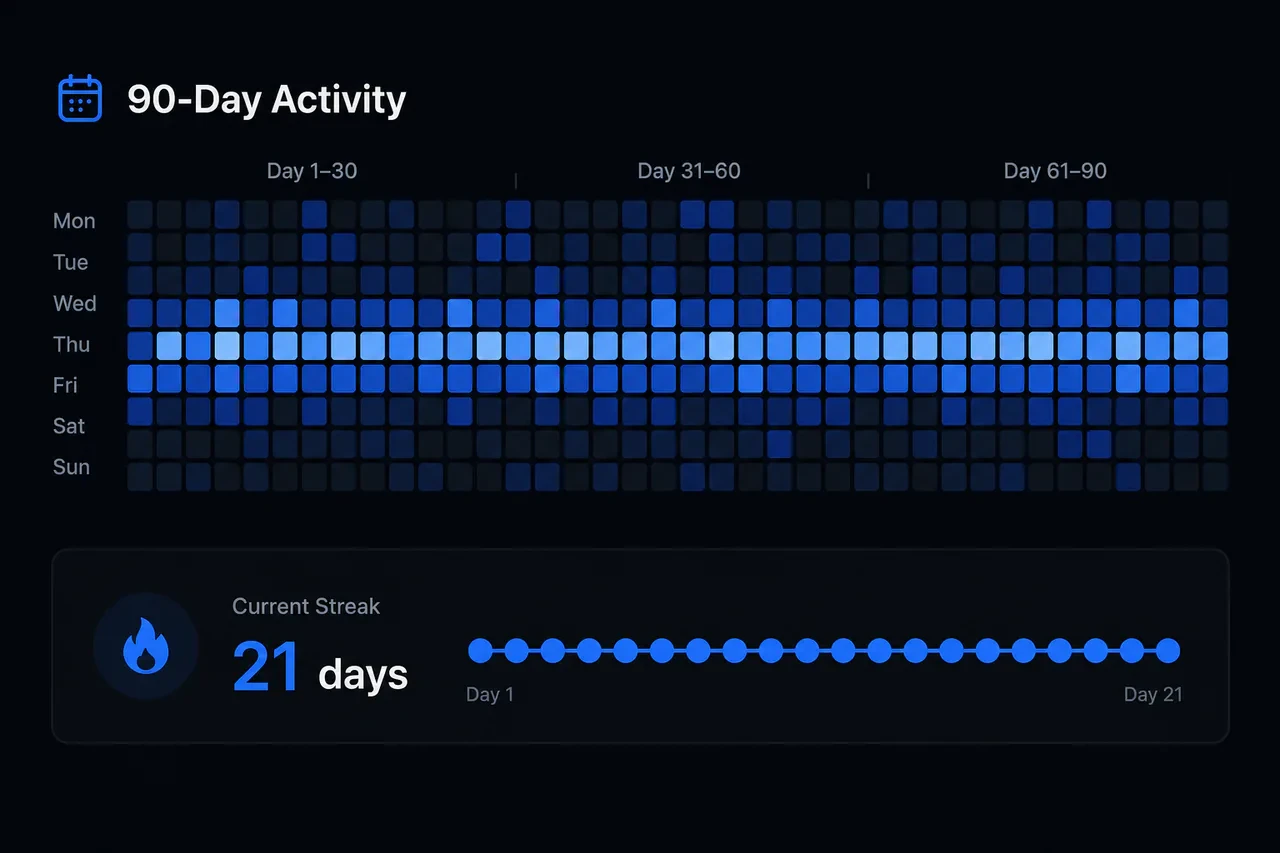
Xholic builds the accountability loop directly into the product. The daily streak heatmap in Analytics shows your posting history in one visual, exactly the kind of feedback loop that turns sporadic effort into ingrained behavior. In the extension, the My Replies feed shows views and likes on the replies you sent, so you can see which ones actually landed.
Aim for 3 to 5 quality posts per day, spaced at least two hours apart. Batch your content creation and use a scheduling tool to maintain consistency without being chained to the platform all day. That’s sound advice, but it only works if the tool you’re using actually helps you sustain it, not just enable it once.
Who Should Still Use TweetHunter
This needs to be said plainly, because the goal here isn’t to tell you every other tool is worthless.
TweetHunter is genuinely good at specific things. If you’re a consultant or agency managing multiple client X accounts, TweetHunter’s multi-account support from one dashboard is strong and well-designed. The CRM features, creating lists of prospects, tracking relationships, and running targeted engagement campaigns, are built specifically for people who treat X as a lead generation and sales channel. If that’s your model, TweetHunter’s Grow plan at $49/month is probably worth it for the CRM alone.
The viral tweet library is also genuinely useful for inspiration, not for copying, but for understanding what structures perform in your niche before you try to use them. TweetHunter’s inspiration sources are one of its strongest features, though there’s a real risk that as more people use the same library, X fills with repetitive content.
Use TweetHunter if you’re managing content for multiple clients, you use X specifically as a sales/CRM channel, and the $49/month Grow plan or $199/month Enterprise plan matches your budget.
Who Should Still Use SuperX
SuperX is actively improving, the founders ship quickly and respond to feedback. For creators who want multi-account management with Bluesky cross-posting, the platform covers more surfaces than Xholic currently does. The analytics layer is genuinely good. If you’re managing a team or want comprehensive platform analytics across multiple accounts, SuperX’s Advanced plan at its $49/month launch price (normally $99/month) is competitive.
The Chrome extension also surfaces profile analytics when you hover over any X account, which is useful for research and competitive intelligence, even if it doesn’t give you an AI reply composer inside the tweet thread itself.
Use SuperX if you manage multiple accounts, want Bluesky cross-posting, and care more about analytics depth than in-feed reply workflow.
What Xholic AI Is Actually Built For
Xholic AI isn’t trying to be TweetHunter with a cheaper price tag. It’s built around a different belief: that the highest-leverage moment on X isn’t when you’re planning content in a dashboard, it’s when you’re already reading the feed and a conversation opens up that you should be part of.
The full feature set covers the complete growth loop:
Discovery first. Engage surfaces high-momentum tweets from creators in your niche, scored by real-time traction. You’re not just scrolling your existing feed hoping something relevant appears, the tool is actively finding conversations where your reply can reach new people.
Reply in your voice. The Chrome extension’s reply wand writes contextual, voice-matched replies directly in X’s reply box. Add a quick note or pick a tone, then edit and post it yourself.
Content from structure, not templates. Send any high-performing tweet to Ask Xholic to break down its pattern, hook, tension, and payoff, then Remix it into an original draft in your voice. You’re learning what makes content work, not copying what someone else already said.
More than 12 million posts, meaning-based search. The Inspiration feature uses semantic search, not keyword search. You describe a concept and the engine finds tweets that match the meaning, which surfaces things you’d never find by typing a keyword.
Drafts that sound like you. Workers draft batches of review-ready posts in your voice, a chosen creator’s style, or a hybrid, on demand or on a schedule. You review, edit what needs editing, and post what’s ready.
Scheduling without friction. Smart Scheduler queues approved posts at exact times or in recurring slots you set, so a week of posts takes one sitting.
The habit loop. The daily streak heatmap in Analytics closes the feedback cycle. The consistency doesn’t depend on motivation, it depends on the system.
The core paid workflow currently starts at $29/month, and every plan includes a 3-day trial.
FAQs: Real Questions People Are Asking
Why do X growth tools produce generic content?
Most X growth tools generate content using large language models trained on general data, combined with libraries of high-performing tweet templates. The problem is that these templates reflect what worked for other accounts in the past, not your specific voice, writing style, or audience. The better tools try to solve this through voice matching, but even those work better over time, not on day one. The key question to ask any tool: does it learn from your actual writing history, or does it apply a generic “make it sound human” layer to a template?
Is TweetHunter worth it in 2026?
It depends on what you need it for. TweetHunter is worth it if you’re using X as a CRM and lead generation channel and need the combination of tweet research, AI writing, and relationship tracking in one place. It’s harder to justify if you mainly want in-feed AI replies and consistent posting support. For that workflow, there are better-value tools in 2026. As of October 7, 2026, TweetHunter’s public pricing page lists Discover at $29/month, Grow at $49/month with AI Writer and CRM, and Enterprise at $199/month with higher-scale AI features, all with a 7-day trial.
Is SuperX better than TweetHunter?
SuperX and TweetHunter are strong in different areas. SuperX has better Chrome extension analytics, more responsive shipping, and Bluesky cross-posting. TweetHunter has a larger viral tweet library and a more developed CRM layer. Neither has a true in-feed AI reply composer that lives inside the X feed itself. If your bottleneck is replying consistently without leaving X, neither solves it directly. For a plan-by-plan view, see Xholic vs SuperX.
What’s the best X growth tool for founders building in public?
Founders building in public need three things a standard scheduler doesn’t provide: the ability to spot relevant conversations early, a way to respond with product context without sounding promotional, and enough consistency support to keep showing up even on product-sprint weeks. Xholic AI’s Engage, product-aware replies that mention your product only when you ask, and the Analytics streak heatmap cover all three specifically.
Why am I not growing on X even with a tool?
The most common reason is a mismatch between the tool’s job and your actual bottleneck. Scheduling tools help if the problem is consistency and time. Voice tools help if the problem is blank-page paralysis. Reply tools help if the problem is engagement and discovery. Many people subscribe to the most popular tool rather than the tool that addresses their specific failure point. The best X growth tool is the one that supports your real growth motion without making your account sound automated, generic, or spammy.
Does using an AI tool for X replies violate the platform’s terms?
Tools that assist your writing, generating drafts that you review and approve before posting, are generally different from unattended automation. Tools that auto-post, auto-reply, auto-follow, or mass-DM without human review are where the risk lies. X has been increasingly strict about behavior that resembles spam or bot activity. Any tool that promises “hands-free” engagement is worth scrutinizing carefully before connecting it to an account you care about.
What’s a cheaper alternative to TweetHunter that actually works?
Xholic AI at $29/month is a direct alternative for creators who want AI-assisted X growth without the CRM layer. It covers discovery, in-feed AI replies, voice-matched content generation, tweet remixing, semantic search, scheduling, and consistency tracking. The Chrome extension is included in every plan, and the 3-day trial lets you test in-feed replies before paying. For more options, see our list of Tweet Hunter alternatives.
The Pattern Behind Every Good X Growth Story in 2026
If you go through accounts that have genuinely grown this year, not the ones that bought followers or ran giveaways, but the ones that built real engaged audiences from scratch, there are consistent patterns.
They replied strategically, not randomly. They found the right conversations before they went stale, not hours later when a post had already peaked. They wrote in a voice people recognized as theirs, which means readers remembered them across encounters. And they showed up consistently enough that the algorithm had data to work with.
None of that is a feature set. It’s a system. And the best tool is the one that makes it easier to run that system, day after day, without burning out.
Posts that cause users to scroll to replies, click through to threads, or visit profiles are getting significantly more distribution than posts that simply get liked and scrolled past. The implication is direct: engagement quality matters more than ever, and the reply is where that quality gets demonstrated most visibly.
A tool that helps you write one better reply per day, consistently, in your voice, in the right conversation, is worth more than a tool that can generate fifty average posts that sound like everyone else.
The Bottom Line
Most X growth tools fail not because they’re badly built but because they’re solving a problem that isn’t actually your problem. They solve blank-page fear with template libraries. They solve scheduling friction with dashboards. They solve publishing consistency with automation.
What they mostly don’t solve: sounding like yourself, staying inside the feed where the real work happens, maintaining the habit when motivation dips, and knowing which conversations are actually worth joining before the window closes.
If any of those are your actual friction points, that’s worth testing before paying another monthly invoice to a tool designed for a different job.
The Xholic AI Chrome extension is free to install and works with any Xholic plan, and the 3-day trial gives you a focused way to test the workflow. The question worth answering is whether the workflow it enables is the one you’ve been missing.