You’re probably already doing the work, posting consistently on X, watching your own numbers, and still wondering why one rival keeps pulling ahead. Twitter competitor analysis solves that problem when it goes beyond follower counts and engagement rates and starts showing you who shapes attention, which conversations matter, and what your competitors are doing before their feed posts make it obvious.
If you’re comparing rivals on X (formerly Twitter), the useful question isn’t just “what did they post?” It’s which accounts keep showing up in the same conversation network, which replies reveal their real positioning, and which paid messages they’re pushing through X’s ad visibility tools. A lot of teams stop too early, so they miss the signals that matter. For SEO-minded teams, the same pattern shows up on the search side too, which is why resources like competitor analysis for SEO teams are worth studying if you want a broader competitor mindset.
Why Most Twitter Competitor Analysis Stalls Out
A creator posts three times a day, runs threads, replies to people, and keeps a steady cadence. Then a rival with a smaller, less polished feed starts winning attention anyway. The easy explanation is that the rival has better content, but that usually misses the point. More often, they’ve built a stronger conversation footprint, and the feed is only the visible layer.
That’s where most twitter competitor analysis goes sideways. Teams compare follower counts, posting frequency, and likes, then file the spreadsheet away until next month. Those metrics matter, but they do not explain why an account keeps showing up in discovery, replies, or shared conversations. X is increasingly conversation-led, so the attention often lives in comment threads, quote posts, and recurring names that keep circling the niche.
The practical fix is to treat competitor work like a living map, not a monthly audit. You want to see what competitors publish, how often they publish, how the community reacts, and which people repeatedly interact with them. That makes the analysis useful for founders, creators, and small product teams who need to decide what to say next, not just record what already happened. For teams that also manage organic discovery outside X, competitor analysis for SEO teams gives a useful reference point, because the discipline is the same, identify who matters before you study the data. If you need a way to pull patterns from X itself, advanced search operators for X help you find the posts, replies, and recurring accounts that a basic feed scan misses.
The gap most guides miss is simple. Static metrics tell you who is visible. Conversation mapping tells you who is influential. Those are not the same thing. If you keep benchmarking only the surface, you will keep reacting late.
Practical rule: if a rival’s post gets the likes but your niche keeps talking about their replies, the replies are the actual asset.
Choosing the Right Competitors to Track
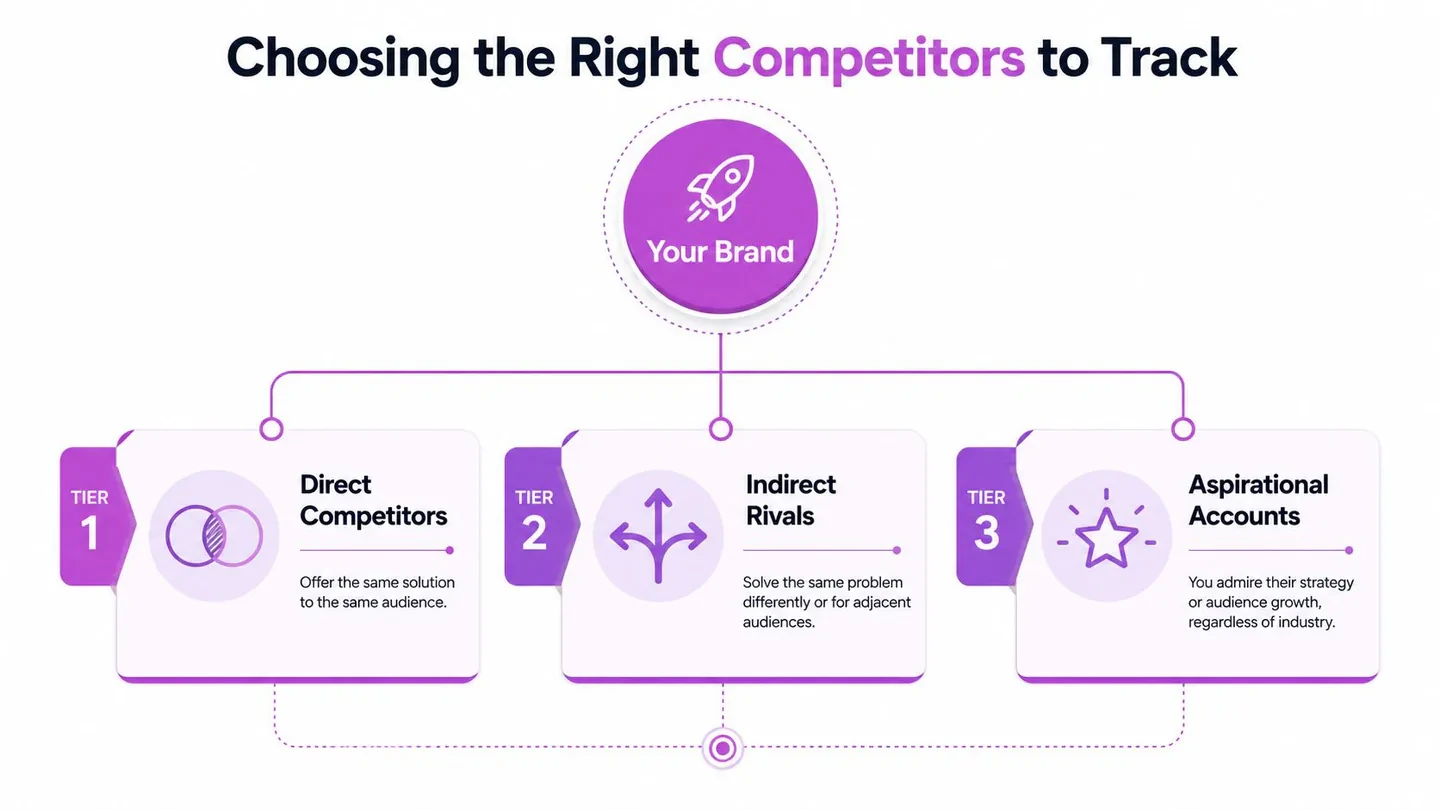
Start with five to ten accounts, not fifty. A small, clean list forces you to pay attention to the right patterns instead of drowning in spreadsheets. The best set usually includes direct competitors, indirect rivals, and aspirational accounts. That mix gives you both immediate benchmarks and fresh ideas you wouldn’t find if you only studied obvious peers.
Build the list in three buckets
Direct competitors offer the same solution to the same audience. If you’re a creator tools startup, that means other creator tools with similar users and similar value propositions. These accounts are useful for comparing tone, format, and cadence, but they’re not always the richest source of strategic insight because everyone is already watching them.
Indirect rivals often teach you more. They solve the same problem differently or speak to an adjacent audience, which means they can expose content angles, language, and positioning moves you’d miss if you only watched direct peers. For X growth, that might be a media account, a newsletter operator, or a creator in a related niche whose audience overlaps with yours.
Aspirational accounts are the people you admire even if they’re outside your category. Maybe they’re better at community building, maybe they structure posts more clearly, or maybe they’ve built a sharper reply habit. They’re not there for direct benchmarking. They’re there to show you what stronger execution looks like.
Use simple criteria to decide who stays
A candidate makes the cut if at least one of these is true:
- Audience overlap: Their followers or engaged users look like your likely buyers, readers, or peers.
- Format similarity: They publish the same kinds of posts you want to improve, such as short takes, threads, or reply-led content.
- Posting cadence: They post often enough that you can see a pattern.
- Monetization angle: They sell the same type of outcome, even if their product is different.
Drop an account when it stops teaching you anything new. If you can’t point to a recent decision it helped shape, it’s probably just noise. For search-style querying and discovery on X, advanced search operators for Twitter can help you find candidates faster than scrolling your timeline.
Data Sources and Signals Worth Watching
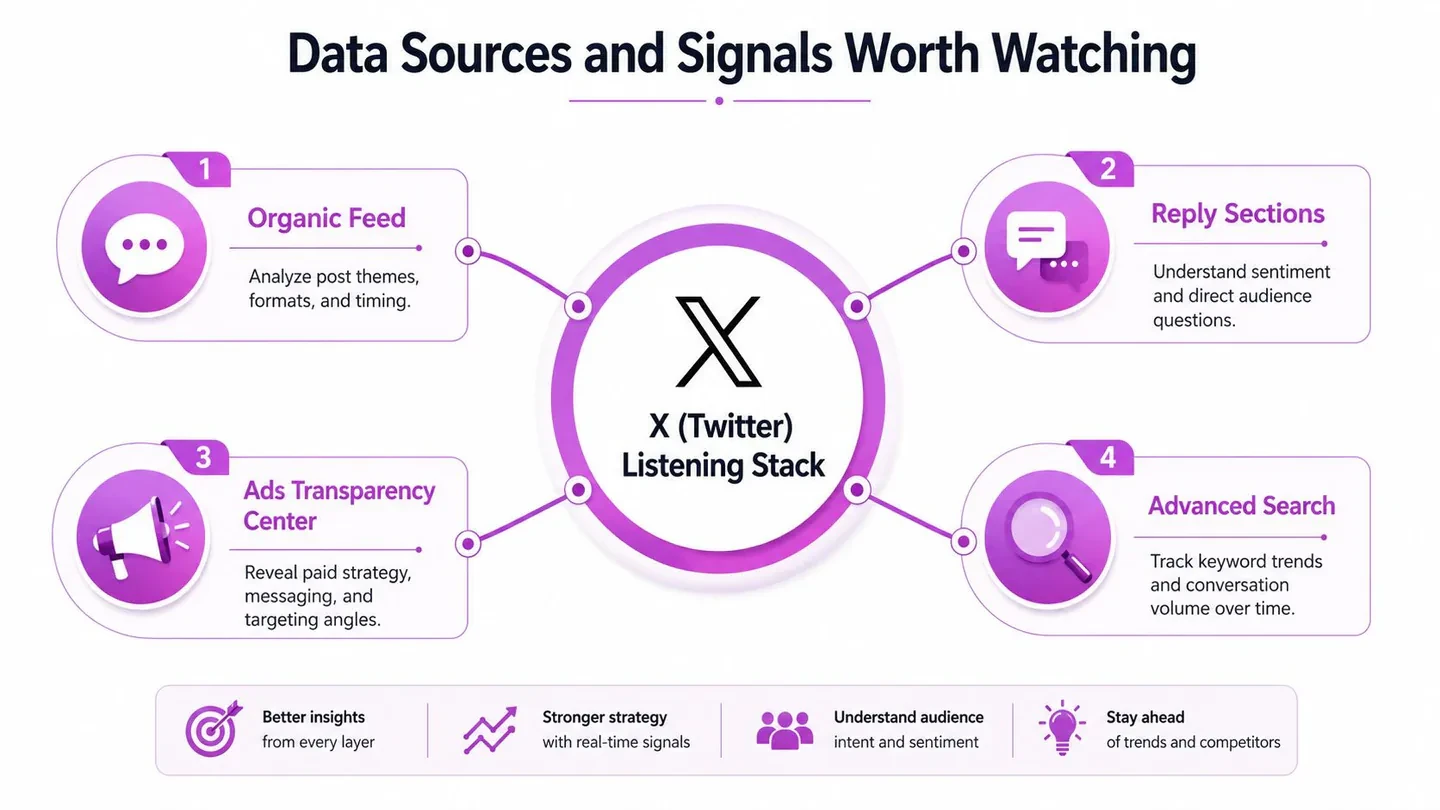
The cleanest way to think about competitor monitoring is as a listening stack. Each layer answers a different question. If you only watch feed posts, you’re seeing the polished version. If you also watch replies, ads, and overlap signals, you start seeing the actual strategy.
Watch the organic feed first
Feed posts tell you what a competitor wants to be known for. Look at themes, formats, hooks, and timing. Review whether they lean on text-only posts, threads, quote posts, polls, or media. Content patterns matter as much as raw performance because they reveal what the account keeps repeating. In practice, that’s where you spot the ideas they believe are working.
Treat reply sections as a separate research surface
Replies often surface the core conversation earlier than feed posts do. Competitors announce, clarify, argue, and test positioning in reply threads long before they package it into a polished post. That makes the reply section a strong place to detect audience questions, objections, and shifts in language. If you’re only auditing the main feed, you’re missing the less curated evidence.
Add paid messaging through ad visibility
X’s Ads Transparency Center makes paid messaging a relevant part of competitor analysis because it lets you inspect a brand’s ads directly. That matters when a competitor is testing a new offer, a new promise, or a new angle. Organic and paid messages don’t always match. When they diverge, that gap often tells you what the team is trying to learn.
Use overlap and search together
Follower overlap tools show who your audience shares with competitors. Advanced search helps you track keywords, conversation volume, and recurring terms over time. If you want a broader account view, Twitter analytics for another account is a useful way to think about the workflow without limiting yourself to a single feed snapshot.
Useful filter: if a signal doesn’t change what you’d do next, don’t keep tracking it.
A practical stack looks like this:
- Organic feed: what they publish publicly.
- Reply sections: what people ask, praise, resist, or amplify.
- Ads: what they’re willing to pay to repeat.
- Follower overlap: who already shares attention across accounts.
Metrics to Track and a Cadence That Actually Works
The fastest first pass is the 3 C’s, content, cadence, and community. That framework is a practical way to compare five to ten accounts without overbuilding the process. Use it to orient yourself, then layer in the metrics that help you make decisions.
| Competitor tracking cadence and metrics | |||
|---|---|---|---|
| Tier | Review cadence | Core metrics | Best use |
| Primary | Daily | Engagement rate, likes, reposts, replies, follower growth, content themes, posting frequency | Catch fast positioning shifts and new experiments |
| Secondary | Weekly | Engagement rate, content themes, posting frequency, audience interaction patterns | Spot consistent patterns without over-monitoring |
| Aspirational | Monthly | Content themes, posting frequency, language around offers or roadmap, visible engagement patterns | Study broader strategy and long-term direction |
Build your sheet around decisions, not vanity metrics
Track engagement rate, follower growth, content themes, and posting frequency. Then add a notes column for what happened in the replies. A spreadsheet that only stores numbers is just a log. A spreadsheet that stores what changed, what repeated, and what looked new becomes a decision tool.
Use the idea of primary, secondary, and aspirational accounts to set the rhythm. Check primary rivals daily, secondary rivals weekly, and aspirational accounts monthly. That cadence keeps you close to the accounts that can affect your positioning right now while still giving you room to study bigger strategic patterns. A tool or dashboard such as Twitter analytics guidance can help you structure those fields if you don’t want to build the template from scratch.
Add roadmap language as a separate tag
Look for forward-looking terms like “future,” “roadmap,” or “next-gen” in posts. Those phrases often point to where a competitor wants the audience to expect movement next. Don’t overread a single post, but do mark repeated language. That’s how you move from “they posted something” to “they’re signaling direction.”
A simple review rhythm keeps the work sustainable:
- Daily check-in: scan primary rivals for new posts and replies.
- Weekly pass: compare secondary rivals and update notes.
- Monthly review: capture the strategic direction of aspirational accounts.
If you want the discipline to stick, keep the sheet short. Too many columns turns the process into admin work, and admin work gets skipped.
Reading the Conversation Network Around a Competitor
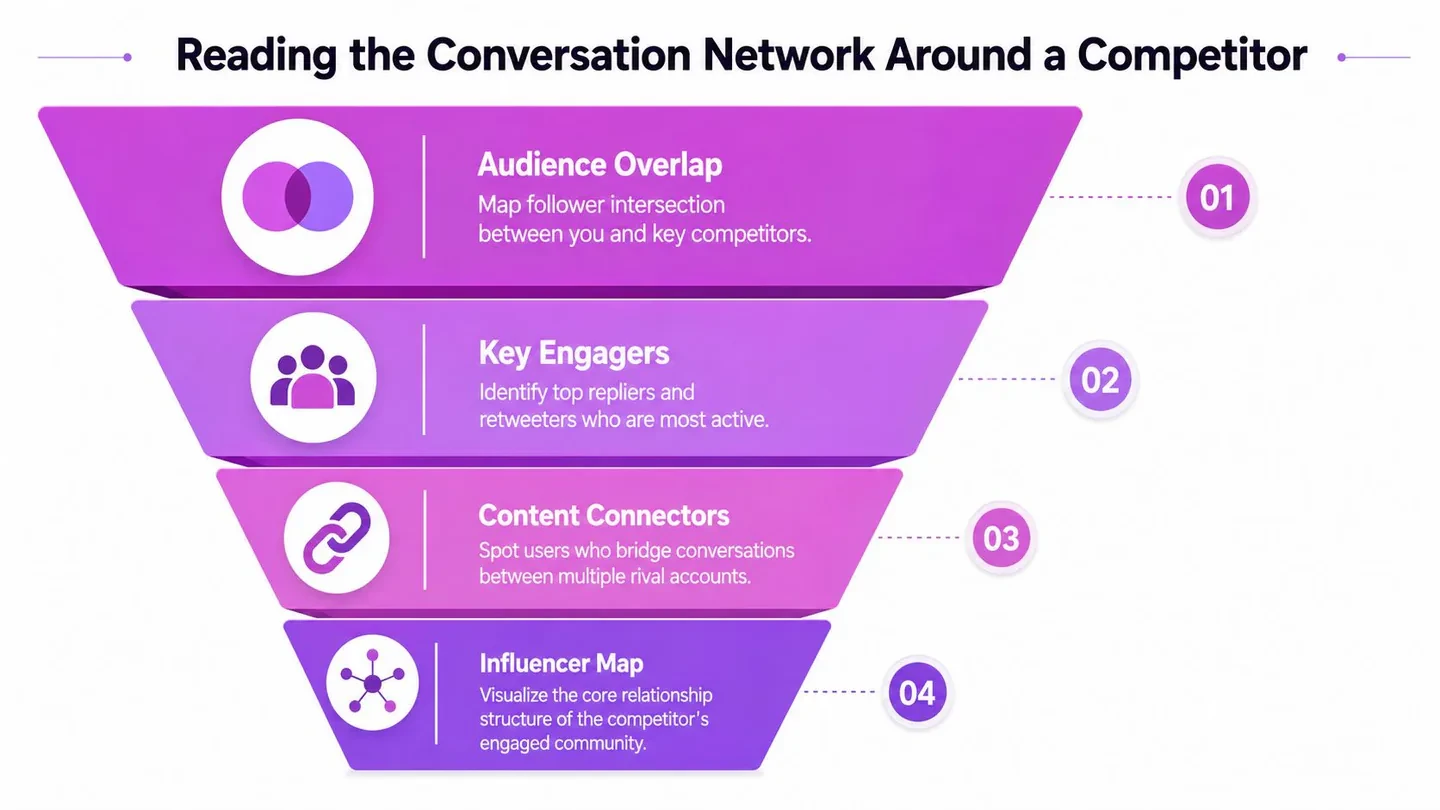
The most overlooked part of twitter competitor analysis is the network around the account. Follower counts and likes can make a competitor look bigger or smaller than they really are. What matters more is who keeps showing up in the same orbit, who replies often, and which accounts bridge multiple discussions in your niche.
Start with overlap, then move outward
Begin by checking follower overlap between your account and a competitor’s account. Then look at the people who consistently reply, repost, or quote post them. Those users are often stronger signals than a raw engagement total because they show where attention repeats. A useful way to think about this is to treat the competitor’s community like a graph, where some users are isolated and others connect several clusters. For a deeper technical lens on that kind of mapping, graph algorithms for finding connections in complex networks is worth a look.
Watch for recurring interlocutors
The most valuable names are usually the ones you keep seeing. If the same people appear in the reply section across multiple posts, they’re part of the audience’s memory, not just one-off commenters. That matters because those recurring voices often shape what gets normalized in the niche. They can also signal where your own content should enter the conversation.
Here’s how that looks in practice. A competitor starts posting more about a new product angle, but the feed doesn’t make it obvious. In the replies, though, a small cluster of repeat engagers keeps asking the same kind of questions and reinforcing the new framing. That’s the positioning shift. You’d miss it if you only looked at the main timeline.
Turn the map into an outreach list
Once you’ve identified overlap, key engagers, and content connectors, convert the names into action. Some people are worth following, some are worth replying to, and some are worth studying because they connect multiple communities. For relationship building, the goal isn’t to scrape a list. It’s to understand which accounts help discovery happen in your niche.
If you want a workflow that helps organize this kind of research inside a broader analysis stack, the Twitter analyzer tool is a relevant companion topic to study. The bigger point is simple. Network mapping tells you who influences the room. Feed posts only tell you who spoke first.
Turning Findings Into a Weekly Action Plan

Research only matters if it changes what you post next week. The easiest way to make that happen is a one-page report with three columns, observation, evidence, and next action. That format keeps you from turning competitor audits into a pile of screenshots with no decision attached.
Here’s a practical way to fill it out:
- Observation: what changed or repeated.
- Evidence: the post, reply pattern, overlap signal, or ad cue that supports it.
- Next action: the specific test you’ll run on your own account.
A competitor might be getting strong reactions from short, direct posts about a narrow topic. Your next action could be to test a tighter hook on the same theme. Another competitor might be winning replies because they ask sharper questions in comments. Your next action could be to reply more selectively instead of posting another feed update. That’s the whole point, turn the signal into a move.
If you want a broader framework for audience growth tied to your own account, increase your Twitter audience is a useful companion read because it keeps the focus on action, not just observation. For ongoing organization, save the strongest posts, replies, and hooks into a Collections-style library so you can revisit them later instead of hunting through bookmarks.
The reason this matters is memory. If you’re studying competitor content one week and drafting from scratch the next, you lose the context you just paid attention to. A personalized memory layer like Xholic Brain can keep approved examples, rejected ideas, niche context, and past judgments connected across drafts, replies, and remixes so the research doesn’t disappear after the review meeting. That doesn’t replace judgment, it preserves it.
You can also use a simple weekly loop:
- Review the five to ten accounts you’ve chosen.
- Log only the patterns that would change a decision.
- Pick one writing, reply, or positioning test.
- Save the evidence you’ll want to revisit later.
Keep the output small. One strong action from one week of research is worth more than twenty observations you never apply.
Common Mistakes and Your Next One-Hour Step
The most common mistake is chasing vanity metrics. A post can rack up visible engagement and still tell you almost nothing about audience influence, relationship depth, or positioning. The next mistake is ignoring replies, which is where a lot of strategy becomes visible before the polished post does. Copying a format without the context is another dead end, because the same structure can fail if the niche, timing, or voice is different.
A fourth mistake is treating competitor research like a one-off project. X changes too quickly for that. If you only audit once a quarter, you’ll miss the conversation shifts that define what people remember about a niche. The fix is not a giant dashboard. The fix is a short cadence you’ll consistently keep.
Your next step should fit inside one hour.
- Pick five competitors: include at least one direct rival, one indirect rival, and one aspirational account.
- Fill out the 3 C’s sheet: content, cadence, and community.
- Add one network note: who keeps showing up in replies or overlap.
- Choose one action: a post idea, a reply pattern, or a positioning test.
If you want the process to stay warm between audits, Xholic AI can help keep saved posts, watched creators, reply opportunities, and product context organized so the next review starts from memory instead of a blank sheet.
Xholic AI helps you keep competitor research connected to the work you publish. It can surface relevant conversations, organize saved examples, and use personalized context to help you decide what to say next on X. If you want a workflow that keeps your analysis, replies, and drafts in one place, visit Xholic AI and see how it fits your X growth process.