Experimentation and rapid iteration
Shipping low-cost tests quickly, cutting losers, scaling validated winners, and using AI or agentic coding to shorten experimentation cycles.
38%
Best tweets about Growth Hacking
A curated collection of the sharpest, most-shared X posts about growth hacking—saved so you do not have to dig through the timeline yourself. Updated weekly.
Unconventional tactics that actually moved a metric, told by the person who ran them.
Original Xholic analysis
Across the supplied tweets, growth is most often framed as rapid testing paired with measurement: operators describe manual early distribution, creative and channel tests, and retention work. Several posts also caution that views, platform attribution, blended ROAS, and first-order acquisition can obscure signups, new customers, incrementality, or repeat purchase.
78% of posts
All-time engagement
34% of posts
Published in 90 days
Conversation map
Shipping low-cost tests quickly, cutting losers, scaling validated winners, and using AI or agentic coding to shorten experimentation cycles.
38%
Using viral hooks, repeatable content formats, creator partnerships, launch videos, build-in-public updates, and coordinated engagement to create demand.
36%
Using UTMs, cohorts, holdouts, new-customer metrics, channel dependency tests, and causal measurement instead of vanity metrics or platform ROAS.
32%
Improving onboarding, activation, post-purchase experience, repeat purchase, churn, winbacks, and lifecycle flows to make acquisition compound.
24%
Winning customers through helpful participation in Reddit, X, Discord, Slack, Hacker News, niche communities, and competitor conversations.
22%
Running and scaling Apple Search Ads, Meta, TikTok, Google, influencer, and UGC campaigns through creative testing, bidding, and budget control.
22%
Hands-on customer discovery, manual onboarding, demos, targeted outreach, and finding early adopters before attempting scalable channels.
20%
Building referral incentives, sharing mechanics, creator-builder loops, community programs, case-study flywheels, and other repeatable product or advocacy loops.
18%
Tone and stance
Performance benchmark
Posts with media make up 46% of this collection. Their median all-time score is 8.47, compared with 13.9 for text-only posts.
Format mix
Consensus and debate
Shared view
Multiple posts recommend starting with limited tests, stopping weak variants, and increasing effort or spend on approaches that perform. Examples include testing channel approaches before scaling, allocating small creative budgets, and concentrating resources after validation.
Shared view
Posts describe direct outreach, onboarding calls, demos, and helpful participation in niche communities as ways to identify early users, learn from objections, and refine positioning before scaling a channel.
Shared view
One self-reported case says repeat purchase rose from 13% to 29% after post-purchase, winback, SMS, and cross-sell changes; a separate account compares a 16% repeat-purchase rate with a peer at 40%. These posts argue that post-purchase performance warrants measurement alongside acquisition.
Shared view
The tweets recommend UTMs tied to signup and payment outcomes, cohort analysis, channel holdouts, and new-customer measures. They specifically question relying on views, clicks, blended ROAS, or in-platform attribution alone.
Open debate
Some posts provide prescriptive launch, paid-ad, and TikTok playbooks. In contrast, another argues that each product and market requires its own thesis, while still emphasizing experimentation.
Open debate
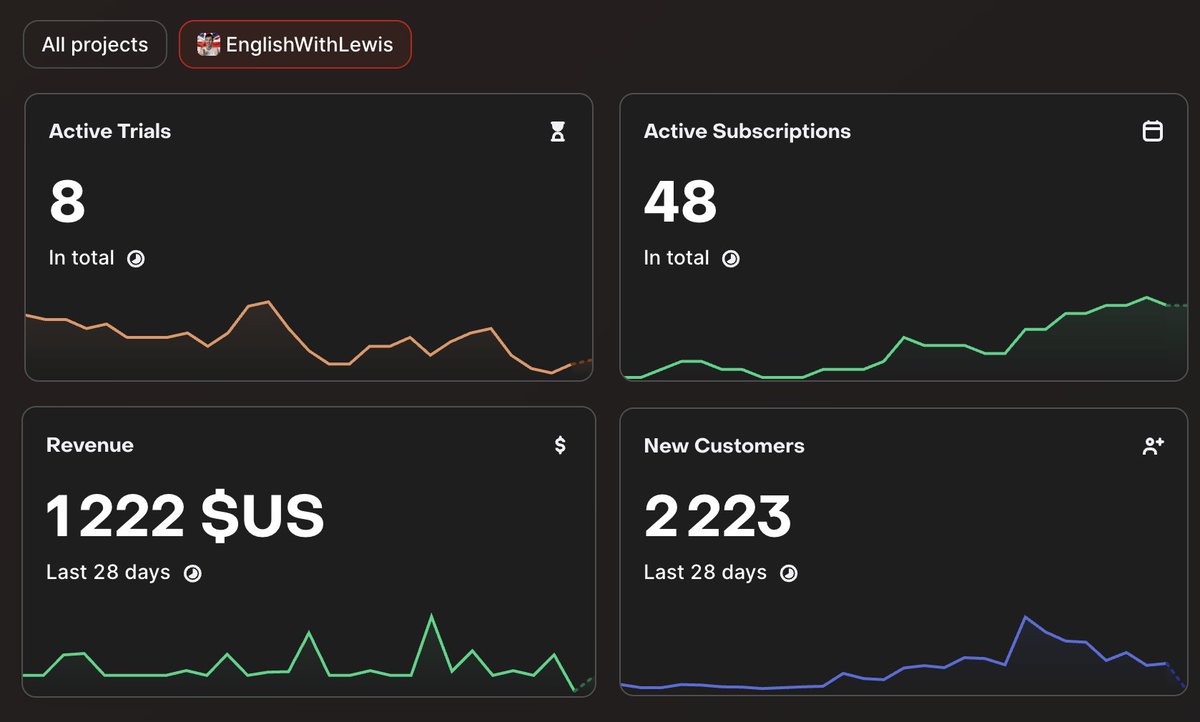
One creator-builder account reports new users increasing from 859 to 2,223 in a month through a video, download, notification, and repeat-content loop. Other posts argue that social content needs an aligned CTA and functioning funnel to convert attention into outcomes.
Open debate
One operator reports using Apple Ads and TikTok creative tests while pursuing revenue growth. Other accounts report community, affiliate, Reddit, and creator tactics that they say worked without paid acquisition spend.
What performs
The deterministic analytics identify five outlier posts: launch-video distribution (985.83 score), founder-led early distribution (598.04), mobile-app ads (288.44), a Zapier launch-and-growth story (198.03), and a TikTok playbook (191.26). Their scores range from 16.99x to 87.55x the dataset median.
Among the supplied themes, paid acquisition scaling has the highest median all-time score, 16.452. Its cited posts cover launch-video promotion, mobile-app ad testing, and TikTok distribution tactics.
Posts with media represent 23 of 50 tweets (46%), but the supplied media median all-time score is 8.466, compared with 13.925 for text-only posts.
Statistical standouts
Creator landscape
The five most represented creators account for 20% of the selected posts.
1. AdrienBrb
@adrien_brbr
2 posts
2. Germán Merlo 💻 🇦🇷
@elgermerlo
2 posts
3. Finn Mallery
@fin465
2 posts
4. Jude || Happyful
@HappyfulofWeb3
2 posts
5. Yahia Bakour
@mynameisyahia
2 posts
6. Sarah Carusona
@sarah_carusona
2 posts
Among the listed top voices, Finn Mallery has the highest supplied median all-time score: 791.93 across two posts. Those posts are the launch-video distribution playbook and founder-led early-customer lessons.
The deterministic analytics count 41 creators across 50 tweets. The supplied top-five placement share is 20%, indicating that the dataset is not composed solely of posts from the most frequently represented listed voices.
Useful operator-led examples include an app founder reporting $7.8K/month while describing ad tests, a build-in-public creator reporting growth from $0 to $100K/month over 2.5 years, and a growth lead reporting post-launch distribution metrics and $0 paid acquisition spend. These are self-reported results, not independently verified causal estimates.
Since the previous snapshot
Themes, sentiment, stance, and post format are classified per tweet. All counts, shares, medians, creator concentration, freshness, and performance comparisons are then calculated directly from the published snapshot.
Xholic's all-time score compares engagement while accounting for reach, post age, and creator consistency. It is used for relative comparisons within this collection.
This report analyzes the exact 50-post snapshot shown below. AI identifies editorial categories and drafts explanations; all statistics are calculated from the snapshot, and every narrative claim is checked against cited posts before publication.
Best Growth Hacking tweets
Ranked 01–50

@fin465 ·
I might regret posting this cuz it's one of our best growth hacks and anyone can do it, BUT here's how to get 250k-5m+ views on your launch video its OP cuz if you crack the formula, you can ship a new vid each month and drive insane inbound. We make 1/month and clear 200k+ views every time 1. make a launch video. either record it yourself with a screen-capture tool like Borumi or find good editor to put it together for you (i use @flowjamhq ) 2. open your tweet with a hook that kills the scroll. think "the first ever ___" or "today we're replacing ___." 3. personally, I do a search for viral X launches in the last 60 days on @origamichat and try to use the same formats (bc these formats are already proven by the algo, so you’re not guessing) 4. After finding these super viral launches (10m+ views) try to replicate the X post opening line, video format, quote tweets that worked best, etc. when you launch 5. ping your network (investors, friends, people you used to work with). give them the exact date and time you're going live. 6. once you're live, blast an email to everyone who agreed to help. drop in your launch tweet plus clear directions on what you want from them. 7. in those directions, spell out your core message and show sample quote-tweets you'd love them to mirror. (follow X's rules on disclosed posts) 8. push everyone to interact with the post inside the first hour if they can. 9. You can also run paid ads on the video after the first day or so to boost engagement 10. launch every time you make a big new feature that could be framed as a standalone product ------ the best part is that if you flop, it means no one saw it anyway. So swap the hook and relaunch the next week. ppl will literally ‘launch’ 3-5x/month and it works Hoping to see more great launch vids on X Will be posting more playbooks to go viral every week on here
@fin465 ·
The “unfair tricks” YC tells every founder on day 1 to get their first 100 customers ASAP: 1/ When someone says "sure, I'll try it," average founders say "great, I'll send you a link." Stripe's founders said "give me your laptop" and set it up on the spot (the infamous Collison installation) 2/ If someone won’t adopt your tool, be the product manually (even fake it). When merchants wouldn't build their own stores, @paulg (Viaweb) built them by hand using their own software. 3/ Charging less will often lose you the deal. Early adopters aren't price sensitive - they care more about beating competitors. Price too low and they assume something's wrong with you 4/ Price off value, not cost. The gap between your price and the value delivered is literally the customer's incentive to buy. Widen it on purpose 5/ Every discount you give trains the customer to devalue you. One-off "just this once" pricing becomes the permanent expectation 6/ A fast "no" is almost as valuable as a "yes." Early on, optimize for speed of decision, not size of logo. The prospect dragging you through 4 calls costs you the bandwidth to find 4 real buyers 7/ You're not targeting your entire market. You're hunting the top ~1% of companies who are "innovators." Your job is to sift fast enough to find them. You can use tools like Origami or Clay to build hyper targeted lists of these 1% adopters 8/ Your only 2 unfair advantages as a founder-seller are passion and domain expertise, not technique. You will never out-technique a real salesperson, so lean entirely on the two things they can't fake People on X love to dunk on these "hacks" But when anyone can build anything and you've got 100+ competitors, getting off the ground takes every trick in the book

@frederickjames ·
My app just hit $7.8k/m in revenue. This is how I'm running ads for mobile apps. To hit 10k/m before I quit my job & fly to Vietnam 🇻🇳 Part One: Apple Ads (First $1k/m). • Repeated this a lot so to summarise: 1. $100 free ad credits, ez mode. 2. Run strict keywords on competitor names. 3. Split into tiers for countries & scale the max bid. 4. Use @RevenueCat or @Superwall for attribution. 5. Give ad spend & transactions to claude: find winners. 6. Measure the onboarding: tighten funnel. 7. Daily budget can be low at first, like $20. 8. The max bid is the important variable here. 9. This will get you to $1k/m. Part Two: TikSl0p Ads ($1k to $10k) • This is much harder to make profit. • But when you do, it's exponential. • Read @carlmonkft's guide on this first. 1. Make ~6 formats, ~12 creatives. 2. Leave campaign targeting super broad. 3. I do $70/day of campaign budget spend. 4. No demographic or interest settings. 5. Let the algorithm find your perfect user. 6. Give each creative $50 of ad spend. 7. After $50, if (close to) profitable then scale. 8. If no profit, then stop the posts. 9. Use realised LTV to begin with. 10. Simple: revenue / paid customers. 11. 400 IQ chad: aim for profit on initial transaction. 12. Ask Rico for unrealised LTV. Can be hard to calculate. 13. Expect to burn a few hundred $$ to find profit. Notes: If you none of your creatives are profitable, then go back to the drawing board and try again. You're taking $50 gambles each time. When you find a winner, it'll repay the initial investments 100x! This is a game of pain tolerance. You need to be able to stomach losing hundreds of $$$ without seeing any returns. Part Three: Scaling. 1. If you're consistently getting > 2x ROAS. 2. Up your campaign budget by 15%. 3. Do NOT increase more than 30%. 4. Otherwise I will be very very cross with you. 5. You'll kill performance. 6. Performance can be volatile. • Measure ROAS over weeks, not days Notes: When you've found a winning creative, create multiple variations of it. We're talking 100 different kinds. I'm being lazy and need to do this more!! Part Four: Experimental Ad Spend ($10k +). • This is the next level: I've gone 0-1. • I've not seen much sauce on X about scaling past this. • So, this is where I'm at now. I'll share it with all of you. My current position is: 1. Trying out other platforms: Meta, IG, etc 2. Continue reinvesting the profits from previous ads. 3. I'm trying multiple new avenues right now: • Paid influencers, UGC, slideshowmaxxing, etc. Keep pushing, we're all gonna win.
 Watch video

@wadefoster ·
It was May 2012, and we hadn't yet launched @Zapier. Two YC office hours changed everything. The first was with @GarryTan. He had one question: "Have you launched?" We said no. We had users. People had paid us. But in our minds, the product wasn't good enough. Garry didn't care. He said launch now. We did and realized we were dumb to wait. Our second office hours was with @PaulG. Same question: "Have you launched?" This time we got to say yes. So he gave us an assignment: "Grow revenue 10% week over week. 10% is great. 20% is fantastic." So we set off to grow 10% a week. And we did. Last week PG posted this thread, and it brought all this back. 10% a week is 142x a year. Even at scale, growth rate is the signal. Focus on growth rate and you'll find the future.


@alexcooldev ·
This is my TikTok growth playbook every B2C founder should know 👇 What actually works (with me) in 2025-2026: > TikTok first. The algo is totally different from IG or YT Shorts. Small accounts can still go viral → distribution is real. > Quantity > perfection. Work with 25–50 micro creators (<10k subs). Post 1–2 videos daily. Test fast. > Cross-post everything. TikTok → IG Reels → FB → YT Shorts. Same content, more surface area. > Don’t reinvent formats. Clone what already goes viral. Strong 3-second hook or you’re dead. > Find 1 viral format → double down. Post it repeatedly until it dies, then move on. > Hook + CTA must align. Otherwise you’ll get millions of views and 0 downloads. > Pay for views, not upfront. Align incentives. Keep only creators that convert. > Track everything. UTMs → views → clicks → installs. Cut fast. Scale faster. > Warm new accounts. Seed them with non-marketing content first before pushing ads or product videos. > Reality check: Not every product works on TikTok. Best way to find ideas? Search viral pain points on TikTok / IG / YT → then build an app that solves that exact pain. Marketing > coding. Test fast. Learn faster. Ship what converts. 🚀

@Carles_Reina ·
Over the past 3.5 years at @ElevenLabs, I've done unconventional things in GTM. Let me tell you why: - I hate hiring people that come with playbooks. In interviews, when someone tells me about their "playbook", I reject them immediately - Each company is different. Entering a market selling support agents is different from selling legal tech or ERP replacers. - Each market & product requires a unique thesis and approach. If you don't understand the market, you can't craft a narrative that will be sticky - AI has changed all dynamics. Experimenting is the only path forward - Thinking big and placing bets yearly delivers outsized returns. I only need 1 bet to work to smash the target for the year - Aligning the team in a Vision is the glue. Not many companies have a crazy Revenue Vision each year; mostly because leaders fear getting fired if something doesn't pan out. I can't be bothered - You build a startup to do impossible things. Unconventional leads to making possible the impossible Doing things unconventionally isn't easy - you face rejection internally & externally. But, hey, "this is the way". An example: I came up with the "Global hyper-local" concept in 2024. Let me tell you that most people didn't want to open markets, have teams on the ground, adapt product (incl translations) or stop being US-first, amongst many things. Today, we are global, +$500m in ARR, 50% of revenues come from outside the US, Enterprise is larger than Self-service, I have teams in +25 countries and have cracked the most difficult markets. Being unconventional works. Just be creative, driven, hands-on, pushy and jump through obstacles. But don't be silly; if a company doesn't value it, find a new challenge. We are lucky to live the best period in history to build companies.

@seraleev ·
I’m taking a break from X. I don’t know how long it will last. I’m a bit tired of the constant focus on reach, monetization and being public all the time. I want to spend some time in silence, focusing on my business. Over the last 2.5 years of my build-in-public journey, I grew from $0 to $100K/month. Here are 10 short lessons I’ve learned: 1. If you want to build a personal brand, X is the perfect place to start. Some of the most well-known people in tech might end up reading your posts. I was shocked that people I looked up to not only read my posts, but also replied and supported me. 2. X is the perfect place to bring attention to a problem. Things can go viral and even large corporations may start responding. I’ve experienced this firsthand. 3. If you’re building products for developers, X is an amazing launch platform. Your audience can help you with Product Hunt launches and be your first supporters on Reddit. 4. If you’re a mobile developer and become popular on X, be prepared for a lot of copies. And I mean a lot. Names, icons, screenshots, internal models, UX, paywalls. Accept it early and understand that it’s simply part of the journey. 5. You can grow without hard paywalls. You can let customers actually try your product. This approach works surprisingly well. 6. Filter all advice. Seriously, filter everything. Some of the advice you read on X can get your developer account terminated. I’ve helped many developers who shared harmful advice on X, gained huge reach, and later ran into serious issues with Apple themselves. 7. Design matters. People have learned to distinguish AI slop from products built with care. Don’t be afraid to put a piece of yourself into every app you create. 8. Learn paid acquisition. It’s a reliable and controllable growth channel. I’ve been growing this way consistently for the last 2.5 years. 9. If you don’t have a budget, learn ASO, localize your app and pricing, create videos about your products, and publish them on Reels, TikTok, and Shorts. You can grow without money too. 10. Stay true to your principles. That’s something I’ve carried throughout this entire journey. Sometimes people will hate you for it (and that’s okay). It’s still better than changing your beliefs every single day. Thank you to everyone who followed my journey. See you soon ❤️


@AlexIsBuilding ·
This founder is making $158,000 per month from his vibe coded app. Today I'm speaking with @wickedguro, The solo founder who used one simple idea To create an app that's now doing almost $2m per year. Chapters: 0:00 The $158K/month app (Postiz) 0:54 Standing out in a crowded market 9:23 What customers love most about the app 16:58 Hacking GitHub's trending feed 23:43 Going from open source to paying customers 27:42 Using existing communities to grow MRR 36:11 The Reddit playbook 40:17 Growth hacking X using influencers 48:24 The next big growth hack 56:39 App ideas you can steal
 Watch video

@gaganbiyani ·
Growth marketing was perhaps the most important trend in tech in 2010. Chamath literally got 1% of Facebook and became a billionaire for starting the first ever growth team at Facebook. I ran a conference called “Growth Hackers Conference” and it was sold out multiple years in a row. By 2020, growth marketing was practically dead. Nobody was talking about it and most growth teams folded fully into product orgs. In 2026, I believe growth hacking will make a strong comeback (likely without the cringey name). Growth used to be a cool art where super high IQ and high EQ practitioners leveraged consumer insight, data and product to create unique ways to grow their products. They built crazy referral loops using Facebook or LinkedIn connect, created SEO-friendly pages en masse for marketplaces, and built spammy viral apps as customer acquisition tools. Eventually, most of those acquisition channels closed up - and so most growth marketers became "user acquisition" or product managers. With a new disruptive force like AI, growth opportunities have opened up again. We have at our fingertips an extremely broad set of new tools that are still developing: - Vibe coding allows you to build micro-products and micro-workflows from scratch, without having to suck up engineering resources. Experimentation can explode, if you figure out how to pull it off. - AI can ingest massive amounts of data and therefore help create new insights. - AEO will become a massive growth opportunity that will require inventive solutions to trick LLMs into recommending your product. And I’m fairly confident OpenAI/Anthropic will offer an “App Store” for ChatGPT and Claude. (The current version OpenAI released is just the beginning). - Content marketing will look totally different in the age of unlimited creativity (and productivity) from AI-generated content. There are tons of fresh opportunities for growth marketers to play with and innovate on. The intersection of data, product, and marketing is going to have a rebirth. Game on.

@omarships ·
Distribution is where most startups quietly die. Everyone talks about it like it’s some growth hack. Almost nobody does it right. People ask me: “How did you distribute Agently?” It's Simple. Unsexy. Boring. No playbook. No magic channel. Here’s what actually works: 1) Before you even think about picking a channel → Draft who your ideal customer might be (don’t overthink it speed > perfection) → Make sure your landing page speaks directly to their pain and outcome (nothing else matters) → Find 10–20 real people that match this profile (LinkedIn is easiest) → DM them manually: no templates, no automation, just real conversations → Pay attention to which conversations actually convert and why Now you have your first real ICP signal. 2) From there: → Figure out where these people actually spend time (Discord, Reddit, X, Hacker News, etc.) → Double down on the one place that shows the most engagement → Keep it manual: you’re still learning, not scaling → Once you start seeing consistent conversions, you’ve validated a channel 3) Now it gets interesting: → Test 3–4 different approaches within that channel → Let them run long enough to matter → Kill what doesn’t work, double down on what does At this point, you have: → A real ICP → A proven channel → A strategy that converts Now you can scale. Content, automation, growth loops: all of it works after this. Most people try to skip this and distribute to 10 channels at the same time and wonder why it isn't working. That’s why most people never crack distribution. No playbooks. No gated threads. No “10 hacks”. Just what actually works.

@VaibhavSisinty ·
One more AGI like moment today thanks to Codex 🙏 We connected Codex to all our data sources. PostHog, our DB, Meta CLI, everything. Yesterday we ran one prompt. An "opportunities finder" with ultra mode on, plus some direction on where to look for gaps. Few hours later? It surfaced gaps that could potentially DOUBLE revenue from our existing users. Not with some crazy new feature With very very basic product optimisations. Honestly, a great data science team would've caught these long ago. But guess what, startups our size don't have one 😅 The team was mindblown. We now have 11 experiments lined up to recover lost revenue and fix these leaks going forward. Even if a few of them work, that's roughly a 100x ROI on our lifetime AI spend. The unlock is unimaginable 🤯 Thanks @sama @gdb @thsottiaux for doing what you guys do 🙏

@HappyfulofWeb3 ·
Career Update; Last Friday (Feb 20th) Was My Last Day at SP3ND! Over the past 11 months at @SP3NDdotshop , I’ve led Growth & Marketing efforts focused on building early-stage distribution for a crypto-commerce platform aiming to enable users to shop global retail using digital assets. This involved: > Developing and executing GTM strategy > Scaling acquisition through Beta > Launching the SP3ND Pioneers program > Positioning the brand with a consistent voice and real-world usage messaging > Identifying and targeting early adopter user segments > Securing and orchestrating strategic ecosystem partnerships In the first 5 months post-launch, these efforts contributed to: > Growth from ~20 to 3.3K+ followers > 10K+ connected wallets > 1.2K+ completed orders > $110K+ in checkout volume > at some points, retention rate was 90-100% “All achieved with $0 CAC or paid acquisition spend.” Other notable wins; > Ecosystem Credibility > Multiple Grant wins > Solana Mobile x Radiants DAO Hackathon win > Placed 5th in the Stablecoin track for the Cypherpunk Colosseum Hackathon > MonkeFoundry Accelerator If you’ve ever: > chased 2x SP3ND points through a limited-time partnership > shared a purchase to unlock bonus points > or participated in voucher-based campaigns, you’ve likely interacted with one of the growth loops I helped deploy. As I wrap up this chapter at SP3ND, I’m particularly taking some time to reflect and refine my experience, and how it shapes me going forward. Onwards.


@VaibhavSisinty ·
Shopify's CEO Tobias Lütke told an AI to run experiments on his model overnight. The next morning he woke up to a smaller model that outperformed one twice its size. All thanks to Andrej Karpathy's new framework: Autoresearch. Here's what it actually does. You write one plain text file telling the AI what "better" looks like & go to sleep. While you're out, the AI runs experiments on its own, tests one idea, checks if it worked, keeps it or kills it, then moves to the next one. And this isn't just for ML researchers. A marketer can point this at their ads & say "best click rate wins." A founder can point it at their landing page & say "highest signups win." A sales team can point it at cold email subject lines. The average team runs 30 experiments a year. This runs 36,500 while everyone's asleep. But the craziest part is that Karpathy ran it on his own codebase, a project he'd spent years manually optimising himself. AI came back with 20 improvements he had missed. Things sitting in plain sight for years that one of the best minds alive never caught. For the longest time, the people who ran the most experiments won. Effort was the proof of intelligence & the hardest workers took home the biggest rewards. That era just ended. The only competitive advantage left is knowing what to ask for. Everything else is now automated.



@emilylai ·
Thinking about how crypto incentives on retail apps skew user behavior. This makes traditional metrics like LTV more difficult to measure and affects user acquisition marketing downstream When targeting new users on CT, there’s two distinct user types: 1. Those who actively use your product for its main use-case (e.g. want to trade gold and think you’re the best venue to do it, so continually trade on your platform) 2. Those who only use your product to farm it for a potential airdrop (may drive revenue but out of speculation) LTV and payback period are common metrics used in traditional marketing. If you know the average revenue a user drives, you have a cost you’re willing to pay to get a new one - this helps give you a benchmark for CPA targets To get “real” LTV in crypto retail products when incentives are involved though, you have to cohort “top” users based on retention and revenue, and measure it there Even that doesn’t feel fully accurate though; I find LTV in crypto a lot more elastic as the audience size is small whilst new competitors pop up and vampire attack each other through incentives - it makes metrics like LTV less durable Downstream from all this as well, LTV from a high-revenue-over-time type quality user captured from CT also may not be comparable to non-crypto native users you capture on other channels, so you a margin is needed to have a target CPA when running growth experiments What does this mean for crypto apps? For one, I particularly would want to build or work somewhere with a mission bigger than CT. To get there most quickly means: 1. Focus on retention and lifecycle, crypto-native TAM is small, maintain easiest targetable revenue 2. Product teams should focus on new features and baseline being competitive to crypto apps (helps with retention and UA) 3. Onboarding and onramp flows optimizing for conversion rate for non CT users, can even segment these based on different channels 4. Measurable experiments that growth teams can quickly scale, cut, and optimize

@StartupArchive_ ·
Drew Houston on the growth hacks Dropbox used to acquire millions of users Dropbox founder Drew Houston reflects the distribution challenge most startups face in the early days: “You can buy all the AdWords in the world but if nobody’s searching for what you’re making, you have a problem.” Drew eventually landed on a two-step solution to solve Dropbox’s cold start problem. Step 1: make a product that people really love to use. “Good engineering and good design are part of it, but one of the ways I think about it is maximizing the probability that your customer ends up with a solved problem. That’s why Craigslist — which was started in the 1990s and doesn’t appear to have been updated since the 1990s — is by far the most successful business of its kind. You show up at Craigslist and you leave with your concert tickets or your casual encounter or whatever you’re looking for. Even though the design isn’t that great and it isn’t that hard of an engineering problem, it was unbelievably successful . . . [Distribution] starts with a great product and all of the marketing or tricks in the world won’t help you push a rock uphill.” Step 2: give people tools to spread the word “Two things drove the vast majority of our signups today. The first was we created this incentive-referral program where if I tell you about Dropbox you get some extra storage and I get some extra storage, which gave us this kind of currency to work with and people were just doing it for its own sake. People weren’t even using the extra space. They were just referring their friends because they got points. We’d now call it a gamification mechanic, even though I’m not sure that word was even around back then.” Drew continues: “The other thing we did was create this idea of shared folders where if I’m working on a shared project at work or if I want to share photos with my family, then all these new users are brought into the fold just by using the product . . . Now there’s whole body of art and science on how to do that, how consumer internet companies grow, and how viral growth works, but these things were instrumental to how we got started.” Source: @ECorner (Jun 2012)
 Watch video

@danmartell ·
growth hacking isn't a tactic. it's one question: who already has my customers? here's how it plays out: wealth manager friend: "my best clients have jets." ok.. who sells the list of every private plane at an airport? turns out, someone does. that was his whole channel. payroll software client burning cash on cold dials. i asked what was true about his 100 customers. "they all use google apps for domains." that meant early adopters. so instead of dialing 300k businesses, he filtered to the 20k that matched. done. find the unique angle nobody else sees. that's the moat. if everyone knew it, it'd stop working.
@HappyfulofWeb3 ·
Was talking to a founder of a Web3 product with 220M users. I shared a bunch of growth ideas. He replied with one line: “Cool. How to monetize?” That question hit harder than anything else. Because it exposes a truth most people in crypto avoid: If your growth strategy doesn’t drive revenue, it’s just noise. We’ve normalized: > Vanity metrics > “Community building” with no value capture > Campaigns that look good but don’t pay But real operators think differently. They’re not asking: → “Will this go viral?” They’re asking: → “Does this increase revenue per user?” Every growth idea should map to: Acquisition → Activation → Retention → Monetization If you can’t clearly answer: > What user action increases? > How that action makes money? > How often it repeats? Then it’s not a strategy, It’s fluff. If you’re a founder or operator, change how you think about growth; > From: “Let’s get more users” > To: “Let’s get more valuable users doing profitable actions” Different game entirely.

@ToriiRowe ·
Meta is combining awareness and sales into a single campaign type in Q2, and I think it’s the most significant structural change to paid social prospecting in the last few years. This is different from Customer Lifecycle Strategy! Here’s what’s actually happening. The new campaign runs sales optimization as the primary objective while simultaneously pulling in reach optimization to expand into new audiences at lower CPMs. You’re not running two campaigns anymore. You’re running one that does both, and Meta is handling the allocation. The reason this matters for brands spending $100K or more per month isn’t the CPM drop. It’s what this signals about where Meta’s entire ad system is heading in 2026. Every tool they’re building right now points in the same direction: new customer acquisition percentage is becoming the primary metric the platform is optimizing toward at the infrastructure level. Not ROAS. Net new buyers as a percentage of total purchases. Most brands in the $5M to $50M range are running prospecting and retargeting in silos and measuring everything through a blended ROAS number that makes the account look healthier than it is. What that blended number is hiding is how much of your “acquisition” spend is actually just recycling warm audiences you already paid to build. Meta is building a system that makes that problem visible whether you want to see it or not. We’re in beta on this at DREAMLABS. What I’m watching isn’t ROAS. It’s the new customer rate inside the purchase mix. If that number isn’t climbing, the campaign isn’t working, full stop, regardless of what the dashboard shows. The brands that come out ahead in this environment will be the ones with the margins and the CLTV to absorb a higher CAC on new customers and let those customers compound. The ones that don’t will be the ones who realize too late that they’ve been running retention campaigns with acquisition budgets. Q2 is going to make that distinction very clear

@mynameisyahia ·
The talk that completely changed the way I think about growth was @nathanbarry at the OOO conference in NYC a year ago He talked about flywheels The premise is: You do something really hard that makes the next time you do it a tiny bit easier You repeat this over and over until it becomes super easy to keep the flywheel going I have a super simple flywheel that changed my business > I ask customer for case study > I use case study to get new customer > repeat At first, it was VERY hard since no one trusts you to become a customer, and you have no customers to land other customers with But i managed to get a case study after a few months of asking, and then used that to get another, and now my entire outbound is basically just this message "Hey, these 250+ companies trust us, here's proof, do you wanna give us a shot?"


@SchmelebeckPPC ·
If you're spending $200K/month on Meta and $30K on Google, you're not diversified You're exposed Here's the test that proves it: Go to GA4 → Acquisition → User Type (New vs Returning) (or Triple Whale, Northbeam, Wicked Reports, etc) Filter by Google Ads traffic What percentage is NEW traffic? If it's under 75%, your "second channel" is a lie You're running two channels but getting new customers from ONE Here's what's actually happening: Meta drives awareness → Person doesn't buy → Googles your brand 3 days later → Clicks your Google ad → Converts Google credits itself with the sale Your dashboard shows: Meta: 250% ROAS Google: 700% ROAS Total: "We're killing it on both channels!" But the reality: 95% of NEW customers came from Meta Google intercepted the conversion Meta created You have ZERO acquisition independence THE REAL TEST: Turn off Meta for 7 days (I know, terrifying) if you cant stomach that, just watch next time you pullback on Meta then watch what happens to Google revenue In accounts I audit before we setup true TOF prospecting campaigns, it's not far fetched to see Google revenue drops 40-60% when Meta gets pulled back Why? Because Google was just catching what Meta threw When Meta stops creating awareness, Google has nothing to harvest That's not diversification...it's just dependency with extra steps. THE FIX: Separate your Google campaigns into three buckets: BUCKET 1: DEFENSE (Branded Search) Keywords: [Your brand], [brand] reviews, [brand] discount Purpose: Protect your house (cheap CPCs, block competitors) Budget: 5-10% of total Google spend Expectation: 10x+ ROAS BUCKET 2: SUPPORT (Retargeting) Audiences: Website visitors, cart abandoners, subscribers Purpose: Close people Meta warmed up Budget: 10-20% of total Google spend Expectation: 200-400% ROAS (still mostly Meta's work) BUCKET 3: OFFENSE (Cold Acquisition) Keywords: Category terms, competitor alternatives, problem searches Audiences: Lookalikes, In-Market, ZERO overlap with existing customers Purpose: Find people who've never heard of you Budget: 70-80% of total Google spend THIS is diversification. THIS is what protects you when Meta has a bad week or if your creatives start dying off but here's what I see in 90% of accounts I audit: Bucket 1: 60% of spend (massive brand tax) Bucket 2: 30% of spend (retargeting Meta's work) Bucket 3: 10% of spend (barely testing cold) Then brand owners who i talk to wonder why turning off Meta kills the business You should only care about ONE question when diversifying: What happens to overall revenue when Channel A goes to zero? If the answer is "Revenue drops 90%," you don't have two channels. Check your New visitor % If you don't like the number, DM me. I'll show you the exact account structure that fixes it

@jonahlau_ ·
Most companies mistake content for growth The result is budgets spent on people who can build an audience for themselves but not for a product. Those are different skills, and almost nobody talks about the gap. Real growth is picking two or three channels that can reach the right users, running them at a volume that feels unreasonable, and tracking what moves until something does. Most of that work happens in spreadsheets, not on timelines. Social presence and viral content are real channels, but they sit on top of a working funnel. Without the funnel, they generate noise that looks like traction. The companies that grow fastest this year will probably be the ones whose growth people nobody has heard of.

@ericdjav ·
My app went from 859 to 2,223 new users in one month. No ads. No VC. No Product Hunt launch. Here's the exact growth loop. → Lewis posts a video → Viewers download the app → App sends a streak notification → Users come back daily → Lewis posts again The creator x builder model is the cheat code.

@LoganTGott ·
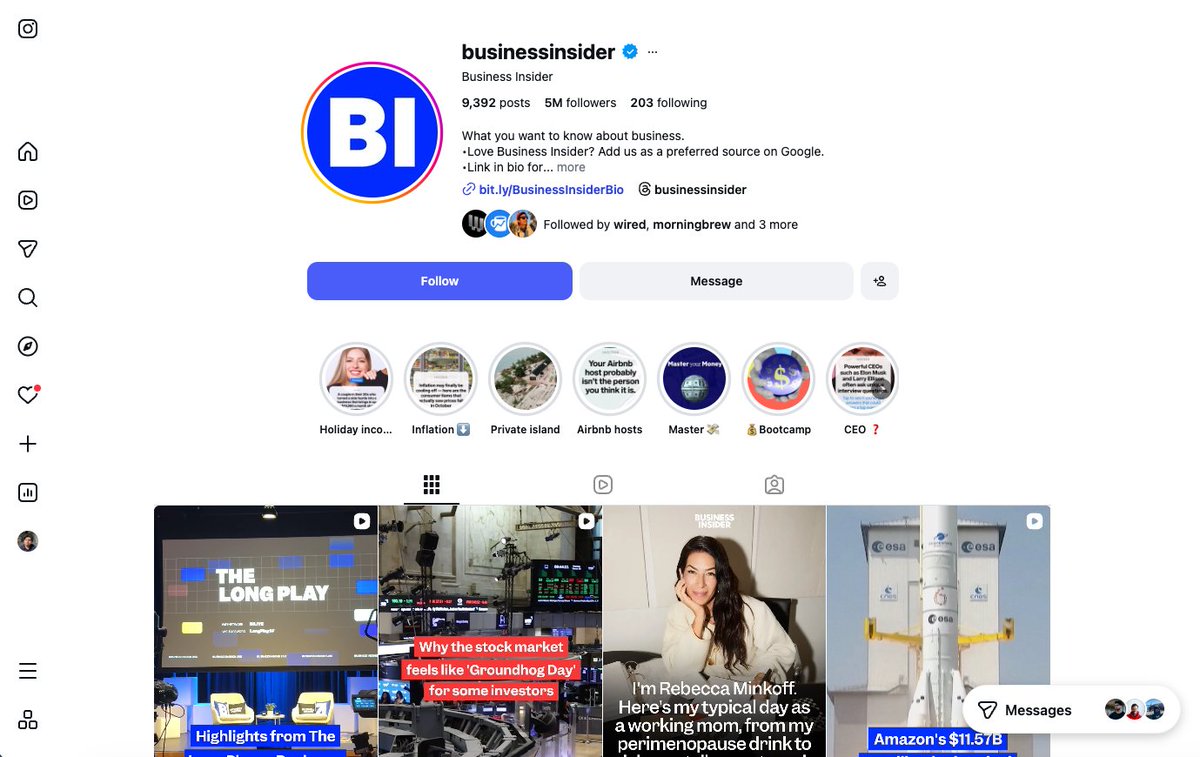
Saw this post as I was scrolling the other day So I went and broke down their LinkedIn strategy for driving over 6 figures in pipeline from LinkedIn last month. Here's what's actually driving it: 1. He's got a head start. Around 30k followers. A decent following isn't the whole game, but it definitely doesn't hurt. 2. His profile is barely optimized. No link to the company in his featured section, nothing to book a call, nothing like that. His posts are carrying almost all the weight, which means pipeline is leaking everywhere. 3. The content is obviously human. Behind the scenes of building the company, live videos, podcasts, actual photos of the team. You can tell a person is writing it, and that's a big reason it converts. 4. His hooks make you stop. One of the best is about giving every new hire a $5,000 company card on day one, with one rule: spend it like it's your own. You read that and go "wait, what?" and then he explains why. That's how he pulls attention to the product and holds it. 5. He stacks proof. Featured on Business Insider, stuff like that. That kind of authority does a ton of the selling for him before he ever asks for anything. 6. Distribution is where the leverage is. Every post clears 100+ likes, and his team is posting and commenting to drive early engagement. Combined, that's a machine probably pulling a few million views a month across all their accounts. 7. It all rides on a good product. Bad product and none of this works, nobody cares. An interesting product plus an interesting founder makes it easy to go behind the scenes and talk about it every day. The part most people miss is that he's winning on content and distribution alone, with basically no funnel behind it. Build the funnel on top of what he's already doing and it's a completely different number. @vitaliidodonov anything I missed?


@natiakourdadze ·
I recently discovered a new growth hack that SaaS startup founders use on X, Product Hunt, Hacker News and Reddit: 1. They set up Google Alerts, F5bot, ReplyGuy or BrandWatch for the competitors' products 2. Then, using these social listening tools, find discussions that mention their competitors 3. And leave comments that follow this framework: "Any reason why not using X instead of Y (competitor’s product)? Way better if you do not want to {problem agitation and/or unique selling proposition}" 4. People get curious and start googling the alternative 5. As a result, this improves SEO, gets them mentions, backlinks and customers
 Watch video

@sarah_carusona ·
Let's talk about the Head of Growth (HOG) role. Who needs one. What they do. And what they don't. 𝐖𝐡𝐨 𝐭𝐡𝐞 𝐇𝐎𝐆 𝐢𝐬 𝐟𝐨𝐫 Most brands don't need a Head of Growth until they're somewhere between $8 - 15M. Before that? IMHO (most) founders should run growth themselves. Learn Shopify. Learn Meta. Learn Google. Get into the numbers. You'll understand your business in ways no hire can shortcut for you. You'll know which levers matter, what to prioritize, and when something's off before it shows up on a report. But at a certain point, that founder's bandwidth maxes out, and they are spending way too much time managing agencies, marketing calendars, and day-to-day operations. They can no longer focus on the product and larger strategic levers. That's when you bring in a Head of Growth. Because not doing so will hold you back. 𝐖𝐡𝐚𝐭 𝐭𝐡𝐞 𝐇𝐎𝐆 𝐨𝐰𝐧𝐬 Some companies say the HOG "owns the P&L." And they do, if you consider that owning top-line and bottom-line growth... and everything in between. On the topline they own total revenue, new and repeat, AOV, and units shipped. In the middle they own the team and costs around: - acquisition (media spend, agency costs, influencer partnerships) - retention (email/sms, loyalty, subscription) - conversion (CRO, landing pages, offer structure) They also own a certain level of the OPEX and content creation budget. They should have strong input on inventory (because stockouts and overstocks kill growth). They need a seat at the table on shipping cost and return programs (because these kill margin). And they are part of the discussion on new product launches based on opportunity they see in the numbers. Because they live in the numbers. They know the relationship between what you're paying to acquire a customer and what that customer is actually worth. They know what lever affects what KPI. And they know, based on data, where the team's focus needs to be. 𝐖𝐡𝐚𝐭 𝐭𝐡𝐞𝐲'𝐫𝐞 𝐧𝐨𝐭 They're not your CEO. And they aren't your brand, product, ops, creative, HR, 𝘢𝘯𝘥 growth person rolled into one. They care deeply about every aspect of the business, because they know they can't grow the company without it. But caring about something isn't the same as owning it. (A HOG who tries to own everything ends up owning nothing well.) It's your job as a founder to give them what they need to win. The right team around them. Clear ownership. And the trust to actually do the job. The Head of Growth is an operator at their core. Set them up for success.

@M__Operators ·
Where is our next dollar best spent? In paid media, that’s your north star. @connorrolain (Head of Growth, HexClad) answers that question with a 3-step testing process: 1️⃣ Channel Holdout Split your audience into two groups. One keeps seeing your ads as normal. The other gets nothing from the channel you’d like to test. If the dark group buys just as much, those customers would have bought anyway. The channel was taking credit for sales it didn't cause. Every ad platform does this (they all have an incentive to overclaim). A holdout bypasses all of it and asks: does revenue drop when we turn this off? 2️⃣ Scale-Up Test Great, it's incremental. But at what spend level does it stop being incremental? Run three cells. One cell at normal spend, one at +50%, one at +75%. The cell where incremental returns drop off — that's your ceiling. 3️⃣ Optimize the Channel Now you're testing inside the channel itself. - Brand videos vs. direct response - View content vs. purchase Which tactic gets you the best cost per incremental order? Not the best in-platform ROAS, but the best real-world result … As Connor Rolain puts it: “That's all incremental really means. It's additional. You would not be getting that outcome — or that audience, or that conversion — if you were not doing that tactic.” Check out episode 103 of Marketing Operators where Connor Rolain (Head of Growth, HexClad), @codyplof (CEO, Jones Road Beauty), and @couuor (CMO, Ridge) break down their entire incrementality playbook.
 Watch video

@iamfra5er ·
THIS GUY NICHED DOWN SO HARD HE WENT FROM $0 TO $23K/MO IN ONE VIRAL POST stefano spent a year pivoting his design tool 3 times and barely made any money then he noticed something weird: the only people actually happy with his product were the ones designing mobile apps so he said screw it, deleted everything else, and rebuilt the entire tool to do ONE thing: generate mobile app designs with AI posted a demo to reddit. got some conversations going. then dropped it on X with a simple hook: "comment sleek for early access" that post hit 1M views their AI costs went so high during the launch they panic-deployed a paywall. conversions died instantly. they had to roll it back within hours day one revenue: $2,500 that was already more than the previous product made in an entire year the unfair advantage wasn't the tech or the AI, it was that he stopped trying to optimize a mediocre product and just found a problem people actually cared about solving most founders keep adding features to products that don't matter. stefano just started over and picked the right problem now they're at $23.4k/mo with 90% margins because acquisition cost is basically zero all organic. all X and reddit. no ads goal: $200k/mo in 12 months


@adrien_brbr ·
Things that actually moved the needle for my SaaS: - Hard paywall from day one (free tier = $0 revenue for weeks) - Affiliates at 40% commission (beat all my own marketing combined) - Reddit 3x/week in niche subreddits (not r/startups) - TikTok 2x/day, reverse-engineered from viral trends - IndieHackers website 3x/week Things that wasted my time: - Product Hunt - Generic startup subreddits - Posting on 5 platforms at 20% effort each What's working for you that nobody talks about?

@oliverbrocato ·
Something I taught myself founding and scaling Tabs to $11M at 21: Growth in ecom is NEVER clean. Sometimes u even catch a RUN of steps back: Week 1: Spent $20k, made $90k (5x ROAS) Week 2: Same ad dies, CPA up by $25 (1.4x ROAS) Week 3: Burn $15k testing, nothing hits Week 4: Random UGC we almost cut does 10x If u zoomed in on Week 2–3, u'd think ur cooked. But zoom out to 90 days? Net positive. The problem: most founders judge progress in 7-day windows. They hit a run of bad weeks and think they're failing when they're just catching variance. U need a window big enough to see the actual trend. That's what separates quitters and winners.
@adrien_brbr ·
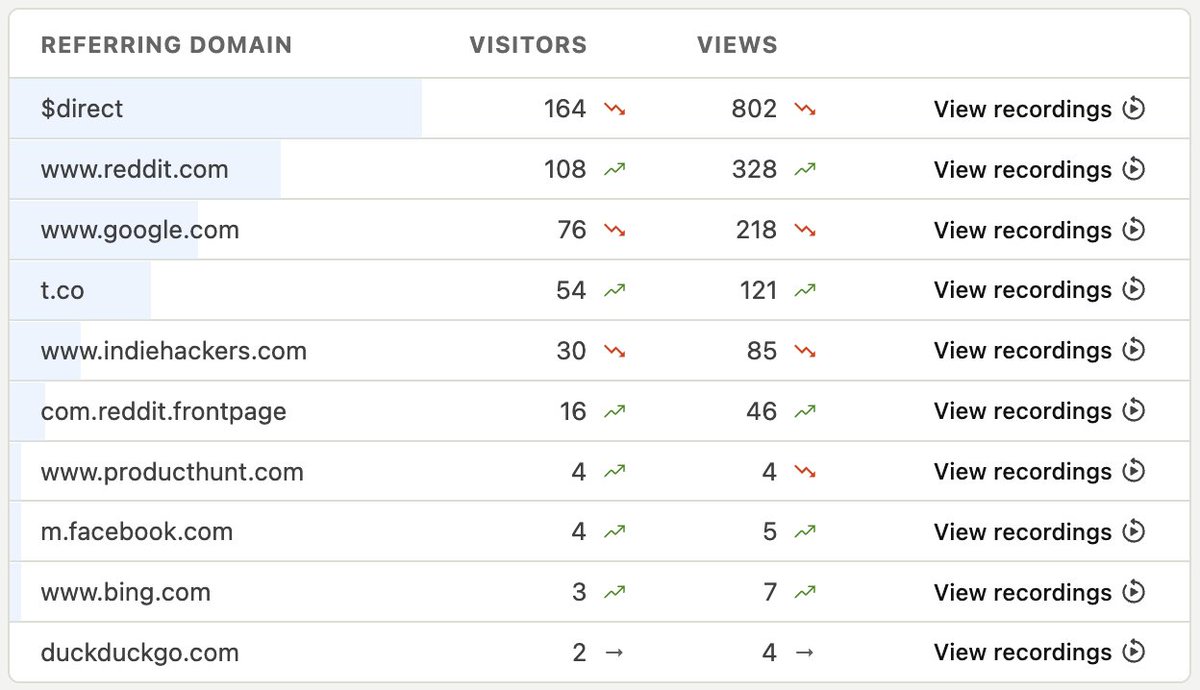
Added UTM tracking to every link this week. Every tweet. Every Reddit post. Every IndieHackers article. Every bio link. utm_source on all of them. Took 20 minutes. Used PostHog. Now I know exactly which platform brings real signups. Not views. Not clicks. Actual users who create an account and pay. Before this, I was posting on 7 platforms and guessing which ones worked. That's not a strategy. That's hope with a spreadsheet. PostHog is powerful. Maybe too powerful. I use maybe 10% of it: session replays, event tracking, web analytics. That's enough. You don't need 47 analytics tools. You need one that answers: where did my last customer come from?

@TheecomMike ·
was having dinner with a guy in dubai last month. runs a supplements brand. doing ~$250k/month. been stuck around that number for almost a year. we got talking about growth and he said something i hear constantly at this level. "we're profitable. product is great. ads are working. but it feels like the business isn't really building. like every month we're starting from zero again." i knew exactly what he meant before he finished the sentence. i asked him one question. "what's your repeat purchase rate" he paused. "around 18% i think" i asked for his analytics. it was 16%. i broke it down for him. he was acquiring ~1,600 new customers a month at a $34 CAC. that's ~$54k/month on acquisition. out of those 1,600 customers only ~256 would ever buy again. the other 1,344? gone. paid for. acquired. lost. every single month. "now look at this" i showed him another brand in the same category. similar revenue. similar pricing. similar traffic. repeat purchase rate: 40%. same ~1,600 new customers. but 640 of them come back. that's 384 extra repeat purchases at near zero acquisition cost. at a $90 AOV that's ~$34k/month in revenue they don't pay to generate. "that's the gap between your business and theirs. not the product. not the ads. not the traffic. just what happens after someone buys." he just stared at the screen. "so i've built a machine that acquires customers and then just releases them" "yeah" "for a year" "yeah" most brands at $200k–$300k/month are here. they've built elite acquisition systems. and almost nothing to keep the people they paid for. every month resets. every month they rebuy their own growth. and then wonder why scaling feels heavy. the ceiling you're hitting isn't an ads problem. it's what happens after the click. and it's been right in front of you the whole time.
@TheecomMike ·
a friend’s store was stuck at $180k/month. for months, he couldn’t push it past it. ads were healthy. product was strong. team was solid. so he told himself what everyone tells themselves: “it’s a creative problem.” his solution? new angles. more UGC. different hooks. he spent ~$55k trying to prove it. didn’t move. one day we sat down at a cafe and pulled up the numbers. cohort data by acquisition month. 18 months. repeat purchase rate: 13%. flat. didn’t matter what he did on ads. 87% of customers bought once… and never came back. he was spending ~$42k/month acquiring customers and losing almost all of them after the first order. every month was a reset. same bucket. same leak. we looked at the post-purchase experience: thank you email. shipping notification. review request at day 30. that’s it. no reason to come back. no timing. no path to the next product. we rebuilt retention from the ground up: – post-purchase flows by SKU – winbacks based on actual repurchase behavior – SMS that felt human – cross-sells based on what customers actually bought next repeat purchase rate went from 13% → 29% in a quarter. that $180k ceiling disappeared. he hit $260k within 60 days. no increase in ad spend. he thought the problem was acquisition. it wasn’t. the growth was sitting in retention the whole time. untouched.

@joulee ·
The art and excellence of growth Most companies think growth means running more experiments. DoorDash Chief Growth Officer Brian Hale sees it very differently. When I asked him what separates excellent growth teams from okay ones, his answer surprised me. Excellent growth teams are not obsessing over A/B tests or marketing channels. They’re obsessing over every moment a customer hesitates. At DoorDash, for example, customers sometimes hesitated to place an order because they were worried about delivery fees. Even when the app already offered zero delivery fees. As Brian put it: “We were like, ‘but there’s zero fees. What do you mean you’re worried?’” The problem wasn’t the offer; the problem was people didn’t know about the offer. And that lack of knowledge was a key growth lever. Most growth teams run experiments; the great ones hunt friction. Listen to our full conversation, and read up on my takeaways for the 7 biggest contrasts between okay growth teams and excellent ones after our conversation here: https://t.co/yUts8Vb0ED
 Watch video
@sarah_carusona ·
In 2026 my team will oversee almost $100M in revenue for 𝐬𝐮𝐛𝐬𝐜𝐫𝐢𝐩𝐭𝐢𝐨𝐧 𝐜𝐨𝐦𝐩𝐚𝐧𝐢𝐞𝐬. I've seen the good, the bad, and the ugly. And at this point, we know exactly what works. While I'm not launching my own brand anytime soon (one day....) But if I did, here's exactly what I'd do 👇 1. 𝐌𝐚𝐤𝐞 𝐬𝐮𝐫𝐞 𝐭𝐡𝐞 𝐩𝐫𝐨𝐝𝐮𝐜𝐭 𝐢𝐬 𝐚𝐜𝐭𝐮𝐚𝐥𝐥𝐲 𝐬𝐭𝐢𝐜𝐤𝐲. Dog food = sticky. Pasta subscription = not so much (unless it's really good pasta). You've got to be honest with yourself >> Is it likely the consumer will cancel because they can find an easier/cheaper/better alternative? How long will the consumer get benefit from the product? Is there a layer of belief in what the product does (think supplements) that needs constant reinforcement? 2. 𝐁𝐞 𝐩𝐫𝐞𝐩𝐚𝐫𝐞𝐝 𝐭𝐨 𝐥𝐨𝐬𝐞 𝐦𝐨𝐧𝐞𝐲 𝐨𝐧 𝐚𝐜𝐪𝐮𝐢𝐬𝐢𝐭𝐢𝐨𝐧 >> 𝐨𝐧 𝐩𝐮𝐫𝐩𝐨𝐬𝐞. Subscription brands are built on acquisition volume and LTV. If you have real confidence in your product, give yourself room to break even or even lose 5-10% on that first order. It opens up your ability to test creatives, messaging, and offers at a pace you can't afford otherwise. 3. 𝐎𝐛𝐬𝐞𝐬𝐬 𝐨𝐯𝐞𝐫 𝐭𝐡𝐞 𝐩𝐨𝐬𝐭-𝐩𝐮𝐫𝐜𝐡𝐚𝐬𝐞 𝐞𝐱𝐩𝐞𝐫𝐢𝐞𝐧𝐜𝐞. Not just the email series. The unboxing. The insert that educates them about what your product does. The little things that make them feel like a part of something. Those are the things that move LTV beyond just product stickiness. 4. 𝐋𝐞𝐚𝐫𝐧 𝐟𝐫𝐨𝐦 𝐜𝐚𝐧𝐜𝐞𝐥𝐥𝐚𝐭𝐢𝐨𝐧𝐬 𝐟𝐚𝐬𝐭. If you're betting on losing money upfront, you better know exactly why people are churning. What are they telling you on the way out? How fast can you use that to tighten the experience or improve/adjust the product? The strategy is simple: sticky product, calculated risk on acquisition, obsessive post-purchase. Execution is where it gets hard 😉
 Watch video

@aigleeson ·
The most followed accounts in every niche figured something out that nobody is teaching. They post every single day. Sometimes twice. I spent 3 weeks going through the top 50 accounts in 6 different niches on Instagram. Not to scroll. To study. I tracked posting frequency, caption length, content format, and engagement rate across every single account. What I found broke everything the "post less, post better" crowd has been telling people for years. The accounts with the highest follower growth were not the ones carefully curating one perfect post a week. They were posting every single day. Some of them twice. And the growth gap between them and the weekly posters wasn't small. It was embarrassing. So I went deeper. The algorithm has one job: keep people on the app. And it does that by showing people content from accounts they already engage with. The more you post, the more chances you give the algorithm to put you in front of your own audience. The more chances it puts you in front of your audience, the more chances they engage. The more they engage, the more it pushes you to new people. Frequency is not the enemy of quality. Disappearing for a week is. The second thing I found was about what daily posting actually does to your skill. The accounts posting every day were not just growing faster. They were getting visibly better every month. Their hooks got sharper. Their captions got tighter. Their content sense got stronger. You cannot think your way to better content. You have to post your way there. The weekly posters were treating every post like a performance review. The daily posters were treating every post like practice. And practice compounds in a way that careful deliberation never does. The third thing was the hardest to accept. Consistency is not just a growth strategy. It is a trust signal. When someone finds your account and sees you posted yesterday, and the day before, and the day before that, they follow you because they know you will show up tomorrow. When someone finds your account and your last post was eleven days ago, they keep scrolling. The most followed accounts are not more talented than everyone else. They just never gave the algorithm a reason to forget them. Volume without quality is noise. But quality without volume is a secret. Post like you mean it. Post like tomorrow depends on it. Because on Instagram, it does.
@mynameisyahia ·
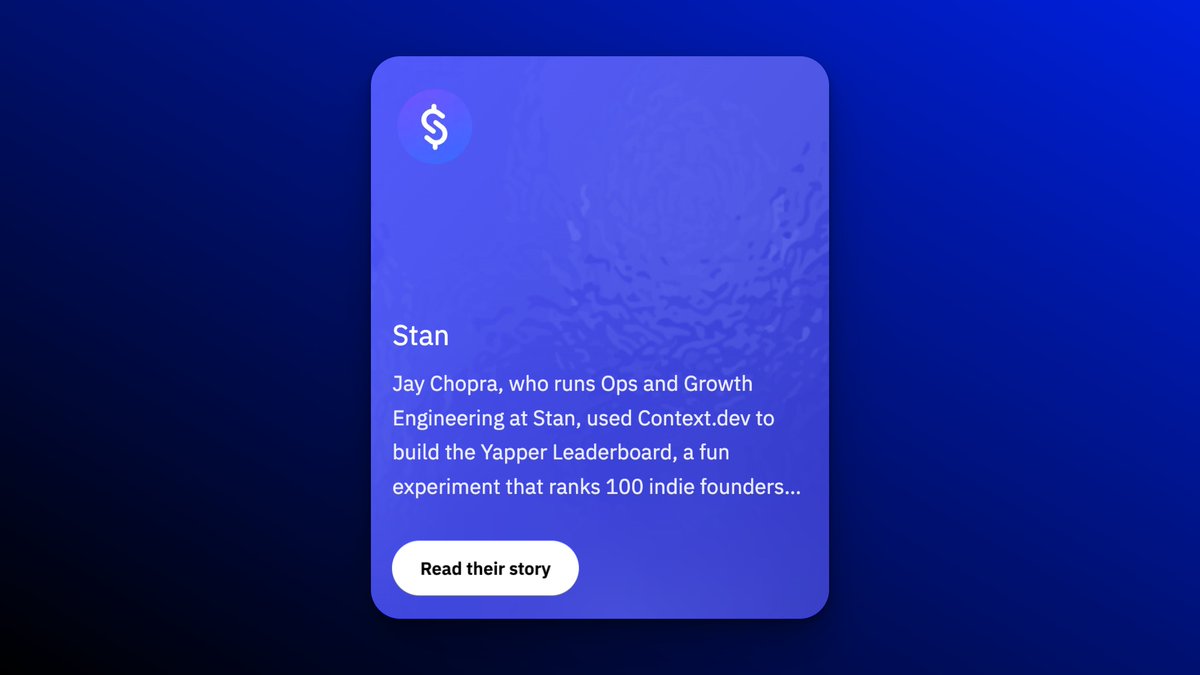
Case study unlocked 🔓 @JayChopra_ saw a leaderboard we built on X and decided to build one of their own for @stanleybystan A few API calls later, they launched the Yapper Leaderboard: 100 indie founders ranked by how much they post. “Didn't take long at all, was a simple addition and it got to work.” - Jay Growth experiments should take minutes to ship, not weeks of building scraping infrastructure.

@Hartdrawss ·
This reddit user SaaS hit 0 → $25K MRR and exit in < 2 years his advice? painfully simple. here's the breakdown : 1/ PLG didn't get him from 0 to 1 >clean signup meant nothing without buying intent >he called almost every trial user early >most calls were awkward and useless >a few completely changed his positioning 2/ demos became the learning loop >self-serve didnt mean skipping the call >demos dont scale, but learning does >confused users exposed hidden product gaps >live objections made the product sharper 3/ content worked late, not early >he wrote zero content early, big mistake >old posts generated inbound near the sale >specific articles became long-term acquisition assets >content felt useless before it compounded 4/ specific content beat polished advice >generic startup advice got ignored fast >exact failures made the lessons believable >wrong assumptions created the strongest posts >founders trust scars more than frameworks 5/ boring problems made the business >B2B finance teams were leaking money >not sexy, but expensive enough to fix >clear ROI made buying easier >boring pain created real willingness to pay the actual lesson: >talk before automating >demo before scaling >write before ready 0 to 1 is uncomfortable. thats why founders avoid it.


@oliviaakory ·
We simulated a year of marketing decisions 36 million times, and we are now sharing everything we found. I thought about not posting this on a Saturday but no need to pretend that we aren't thinking about causal inference 7 days a week over here at Haus... First, why do we invest so much in our estimators and improving experiment precision at Haus? Because an experiment doesn't create value just because it produces a lift estimate. It creates value when that estimate leads to a better decision – scale the channel, pull back, hold, retest. If the signal behind those decisions is noisy, doing more of them doesn't average you toward the truth, it means you make more wrong turns, faster. We've watched this play out anecdotally for years. But anecdotes aren't numbers. So Patrick Hillery built a simulation that modeled a full year of experiment-driven budget decisions, varying only the two levers a team actually controls: how precise their measurement is, and how often they test. What we found: - Acting on noisy results left the business worse off than doing nothing 38% of the time, more than twice as often as the precise approaches. - You can't test your way out of noisy signals with higher testing volume. Brands running noisy experiments finished ahead no more often at 15 tests a year than at 6. - A strong experimentation program is worth double digits. The precise, high-cadence approach delivered a 13.2% average revenue lift, more than double the noisy approach's payoff (5.6%) at the same cadence and limit. - A tight confidence interval can be manufactured. Some methods look precise by hand-picking a few well-matched markets, but the result only holds for those markets. In these cases, precise results aren’t necessarily accurate ones. I'm linking in thread the full article, methodology walkthrough and companion spreadsheet we are calling Monte Carlo, and we are making it available to all.


@nrmehta ·
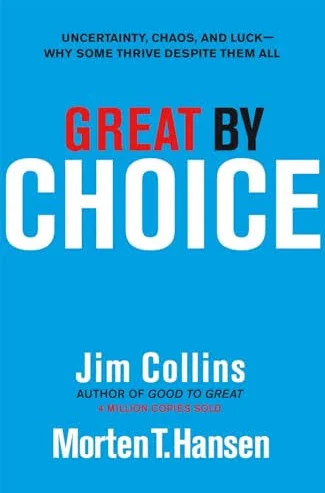
Agentic Coding Might Let Us "Fire Bullets, Then Cannonballs": Jim Collins, the legendary business author of "Good to Great," wrote about an approach to experimentation in companies to avoid what many get wrong: "First, you fire bullets (low-cost, low-risk, low-distraction experiments) to figure out what will work—calibrating your line of sight by taking small shots. Then, once you have empirical validation, you fire a cannonball (concentrating resources into a big bet) on the calibrated line of sight." When I read that years ago, it resonated with me so much. At Gainsight (and in past companies), we would come up with a "brilliant idea" (the non-brilliant ones usually came from me!) and go all in on it. This led to dozens of failed experiments and a team feeling disheartened by the indecision of the company. The truth is that we had a long list of ideas, but the brittle nature of pre-AI companies meant that the work to test was so significant that we could only do one at a time. Building a prototype, launching a website, iterating - all took too much effort. And worse yet, we often bailed on the experiment before we truly gave it enough time. One view of agentic coding tools like Claude Code and Codex is that you can execute on all of your ideas. I think that's misguided. The truth is that most ideas are bad. A different view is that these tools reduce the cycle time for testing. You can prototype, build, launch, etc. rapidly and with limited resources. And then you can run these experiments in parallel. There are of course still constraints (e.g., if you have a B2B sales force, you can't throw all experiments at them). But the ability to test and fail fast could radically change the way companies work. For me, when I fired cannonballs, I missed like 99% of the time! Here's to hoping agentic harnesses let us get more precise with our aim.

@elgermerlo ·
How I get my first 100 users without ads: - Find 3 Reddit threads where your problem is being complained about. Comment with actual help, not a pitch - DM every person who liked a competitor's launch post on X - Post in niche Slack/Discord communities — not product spam, just "who deals with X?" - Write one SEO post targeting a very specific pain point, not a broad keyword - Do 5 manual onboarding calls. Embarrassingly hands-on. Worth every minute Distribution isn't a strategy you set up once. It's a habit.

@bmykhaylivvv ·
Just crossed $500 MRR with Amplifresh after 3 months of building. Started as a weekend project to solve my own content amplification problem - now helping 200+ creators automate their social media workflows. The growth loop was simple: build in public, ship fast, listen to users. Every feature request became a validation signal. The hardest part wasn't the code - it was saying no to features that didn't move the needle. Twitter followers went from 100 to 2000 in 40 days by sharing real metrics, failed experiments, and technical decisions. No growth hacks, just consistent updates on the journey. Turns out people love following along when you're transparent about both wins and losses. Next milestone is $2K MRR by Q1. Already seeing patterns in user behavior that suggest a premium tier could work. The beauty of indie development is you can pivot based on real data, not boardroom theories. --- Hit a weird bug today where Amplifresh was posting content twice for some users. Spent 4 hours debugging only to find it was a race condition in the queue processor. Classic distributed systems problem. The fix was adding a simple idempotency key, but the real lesson was about monitoring. Now I'm tracking every queue operation with proper observability. Sometimes the simplest bugs teach you the most about your architecture. This is why I love building products solo. You feel every edge case, understand every user flow. When something breaks at 2am, there's no pointing fingers - just you, the code, and a strong cup of coffee. --- Amplifresh users are asking for analytics dashboards. Part of me wants to build it - the engineering challenge looks fun. But I keep asking: does this move the core metric? Right now, 80% of churn happens because onboarding is clunky. Analytics won't fix that. Better UX will. It's tempting to build what excites you as a developer vs what users actually need. Staying disciplined about the roadmap is the hardest part of indie development. Every feature feels important when you're deep in user feedback. But focus wins. --- Three lessons from getting Amplifresh to $500 MRR: Ship before you're ready. My first version was embarrassing but it validated the core hypothesis. Users care more about solving their problem than perfect UI. Pricing is a product feature. Started at $9/month, raised to $19 after week 2. Higher price attracted better customers who gave better feedback. Technical debt is fine early on. My code is messy but the product works. Clean code doesn't pay the bills - happy customers do.
@ToriiRowe ·
Buckle Up, This is a Fun One! ⬇⬇⬇ We took over a brand in October 2025. Before we came on, the previous 18 months told a clean story. And not a good one. Jan through Sept 2024, they averaged: $1.76M a month. Same period in 2025: $1.63M a month. Revenue down 7.5% year over year. New customer acquisition cut nearly in half. Ad spend up 22% the whole time. More money in, less business out. By the time we took over, quarterly revenue had been declining for three straight quarters. The account was not maintaining. It was bleeding. We rebuilt the creative and account structure from scratch, identified where real customer acquisition efficiency was hiding, and scaled into it. - - - The 5 months since, excluding BFCM in November: $2.70M average monthly revenue. 25,003 new customers per month. 82% more acquisition on 46% more spend. - - - January and February tell the real story on ROAS. January 2026 vs January 2025: We doubled ad spend, $238K to $533K. ROAS compressed, 7.63x down to 4.89x. Revenue grew $784K year over year. Profit dropped from $338K to $193K. Most agencies see that and start pulling back or making excuses. We held. February answered it. ROAS 7.05x to 6.06x, still compressed from the scale. Spend up 72%. Revenue up $814K. Profit went from $192K to $633K. January and February combined: $530K in profit in 2025. $826K in 2026. $296K more in the two slowest months of the year, off double the spend. March is not done yet. Already up 83% year over year. The brand did not get slower. We absorbed a down month in January knowing February would cash it in and March would confirm it. That is not a dashboard decision. That is a business decision. Q1 2025 total: $5.6M. Q1 2026: on pace to close well above $9.1M Same slow season. Different team. That is the difference between an agency that runs paid media and an agency that has built the businesses which they now scale.

@victor_bigfield ·
unpopular opinion: reddit is a better acquisition channel than twitter, linkedin and product hunt combined. here's why nobody talks about it: reddit users hate self-promo. so 99% of founders spam and get banned. but if you actually help people in threads where they're asking for solutions? they buy. i built redditgrow because i was doing this manually for hours every day. now AI does it: → finds threads where people need what you sell → writes replies that sound human → you approve, post, get clients → get cited by ChatGpt 10 projects failed before this one. this is the one that stuck.


@NFX ·
How to move faster: Adopt a mindset of rapid experimentation. Your seed round is a bank of experiments. The goal is finding product-market fit. Years ago, a typical startup might run 5-10 experiments during its seed stage. Today, we see some running 50-100. More experiments mean a wider scope of ideas tested. You discover what actually works, not what should work. Perfect it from there according to real data, taste, and vision. The market rewards learning from doing.


@rfunk82 ·
Tracking growth publicly as I build #Talo. 1 week update 👇 Current user acquisition: Building Talo | User Acquisition: ▓▓░░░░░░░░ 53/300 Goal: 300 companies. Current: 53 companies. +23 companies in the last week 🚀 Top acquisition channels: • Organic TikTok content • Partnerships with mentors & coaches What's been most exciting is that many of these users are coming through word of mouth and community referrals. Also, Talo was built entirely on @Replit, which has allowed us to move from idea to product faster than anything I've used before. 17.7% of the way there. #buildinpublic #replit #saas #startup #cleaningbusiness #smallbusiness #talo #replit @zhenthebuilder @MannyBernabe @raymmar @amasad @HL3rd_ @nickco @amapel @samuel_spitz @agi2asi
@elgermerlo ·
Distribution moves that actually worked for me at zero ad spend: — replied to niche subreddit posts where my product solved the exact problem being described (no spam, genuine answers) — posted the same content on X and LinkedIn same day, LinkedIn consistently outperformed on reach — turned support conversations into public content — real questions, real answers — found one person with a small but engaged audience and asked them to try it for free None of this is glamorous. All of it compounds.

@SSage38676 ·
Most founders treat growth like a launch. Build. Ship. Push hard for a few weeks. Then it slows — so they plan the next one. That's not growth. That's a treadmill. Real growth is a system. You build the machine: funnel, messaging, campaigns, landing pages, tracking, conversion fixes. Then you make it repeatable with one simple weekly loop: → Run a few focused experiments → Watch the right metrics → Review what worked → Ship one real improvement Every week. Without fail. Small wins stack. That's the whole point.

@MehulFanawala ·
Everyone loves talking about growth. Until you ask about churn. Over the last few weeks, I have been meeting founders, some in person and some online, asking a simple question: “How is growth going?” Almost everyone had a good answer. But when I asked the next question “What does your churn look like?” The energy in the room changed. Here is a simplified version of what I kept seeing: Founder A 10% churn, 12% growth Founder B 12% churn, 10% growth Founder C 15% churn, 16% growth Founder D 5% churn, 10% growth Founder E 3% churn, 9% growth At first glance, Founder C looks like the winner. Highest growth. But when you look closer, something interesting appears. The founders chasing growth the hardest are also losing customers the fastest. And the founders growing slower? They barely lose customers. The reason is simple. Most founders are obsessed with acquisition. Very few are obsessed with customer experience. When growth becomes the only goal, teams start ignoring the product gaps, the support tickets, the onboarding friction, and the small frustrations customers feel every day. Revenue comes in through the front door. Customers quietly leave through the back. But the founders who focus on customer experience build something different. They grow slower. But they keep their customers. And over time, that compounds. Lower churn means: • Higher lifetime value • More referrals • Less pressure to constantly chase new customers • More predictable revenue In the long run, the founder growing at 9% with 3% churn often makes more money than the founder growing at 16% with 15% churn. Because growth without retention is just temporary revenue. The real growth engine is not acquisition. It is keeping the customers you already worked so hard to earn.
Best Tweets by Topic