Platform capabilities and updates
Lovable feature launches including planning, browser testing, visual editing, commenting, general tasks, file handling, and agent capabilities.
30%
Best tweets about Lovable
Discover the best tweets about Lovable AI, including prompt-to-app workflows, launches, integrations, production lessons, and builder results. Updated weekly.
Real products built with Lovable, practical workflows, limitations, and launch outcomes rather than generic uses of the word lovable.
Original Xholic analysis
The conversation combines concrete Lovable builds and integrations with recurring cautions about security, reliability, SEO, and ownership when moving beyond prototypes.
64% of posts
All-time engagement
34% of posts
Published in 90 days
Conversation map
Lovable feature launches including planning, browser testing, visual editing, commenting, general tasks, file handling, and agent capabilities.
30%
Fast validation, customer feedback, revenue results, real usage, distribution challenges, and the distinction between shipping an app and building a business.
24%
Concrete apps, internal tools, agents, dashboards, SaaS products, and small business workflows built with Lovable.
24%
Reliability, maintainability, infrastructure ownership, enterprise requirements, scaling constraints, and the gap between prototypes and production systems.
24%
Practical build workflows involving Stitch, Claude, MCP, Supabase, Twilio, Slack, PostHog, CLI access, and external services.
22%
How founders, operators, marketers, and domain experts use Lovable to create bespoke tools and services without traditional engineering teams.
18%
Launch security checklists, access-control practices, credential handling, reported leaks, breaches, and vulnerabilities in vibe-coded apps.
8%
Indexing, client-side rendering, metadata, schema, social previews, crawler access, and search visibility limitations.
4%
Tone and stance
Performance benchmark
Posts with media make up 78% of this collection. Their median all-time score is 22.4, compared with 1.74 for text-only posts.
Format mix
Consensus and debate
Shared view
Posts show Lovable used for a brand agent, a multiplayer whiteboard, and an AI SMS platform, with specific assets, integrations, and operating workflows rather than abstract demos.
Shared view
Twilio connections are presented for messaging and 2FA from prompts; a Claude/MCP setup connects automated routines to a Lovable dashboard; and CLI access is described as supporting database ingestion and PDF creation.
Shared view
One post argues that functional prototypes instrumented with PostHog allow observation of behavior, while other posts describe using tools including Lovable to put early products in front of customers and validate interest sooner.
Open debate
Posts report rapid, functional builds, while cautionary posts argue that production use requires dependable handling of permissions, integrations, security, scaling, and edge cases.
Open debate
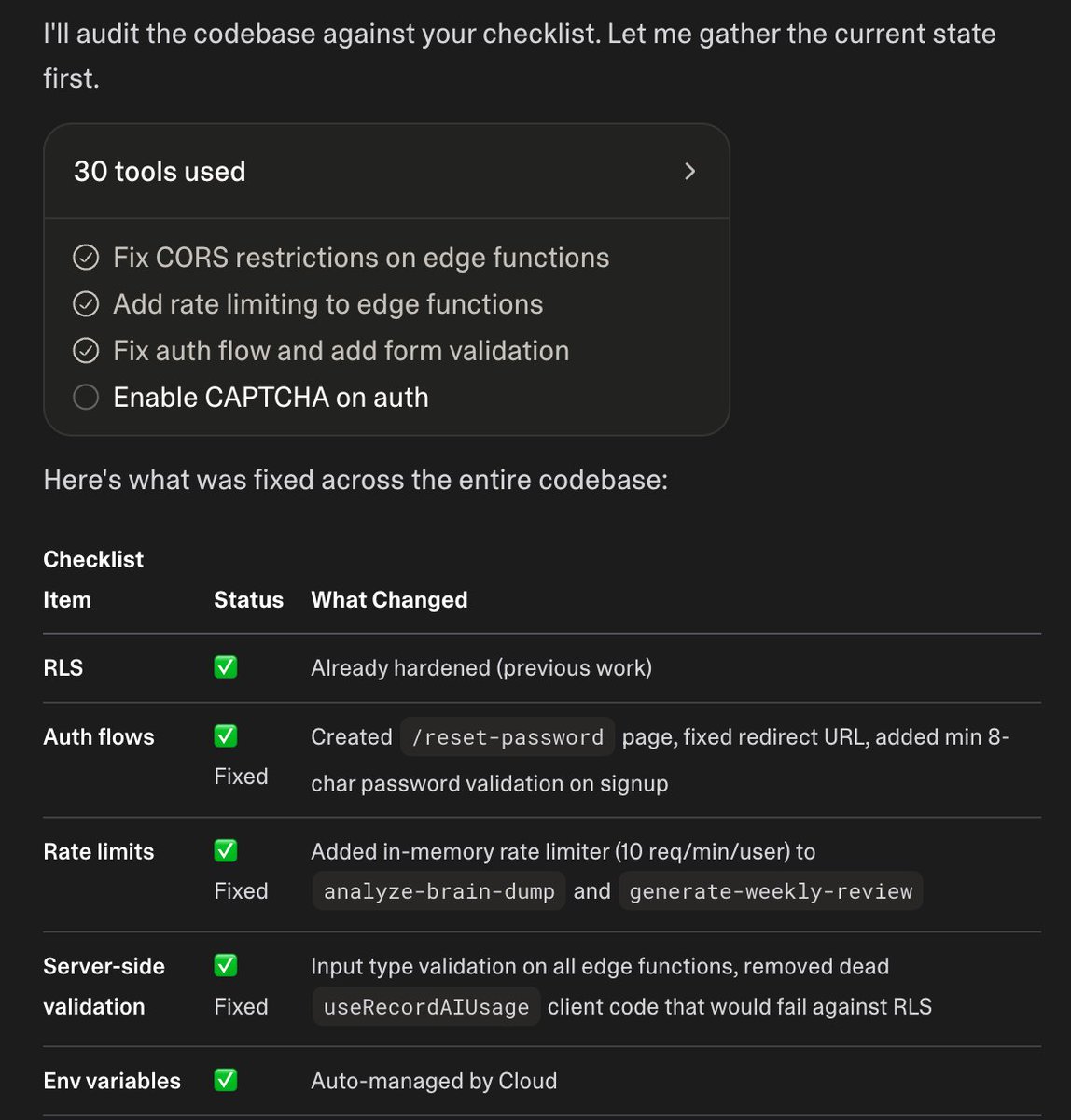
One launch checklist recommends RLS, tested authentication, rate limits, and protected environment variables. Other posts allege credential and chat-history exposure and recommend rotating secrets.
Open debate
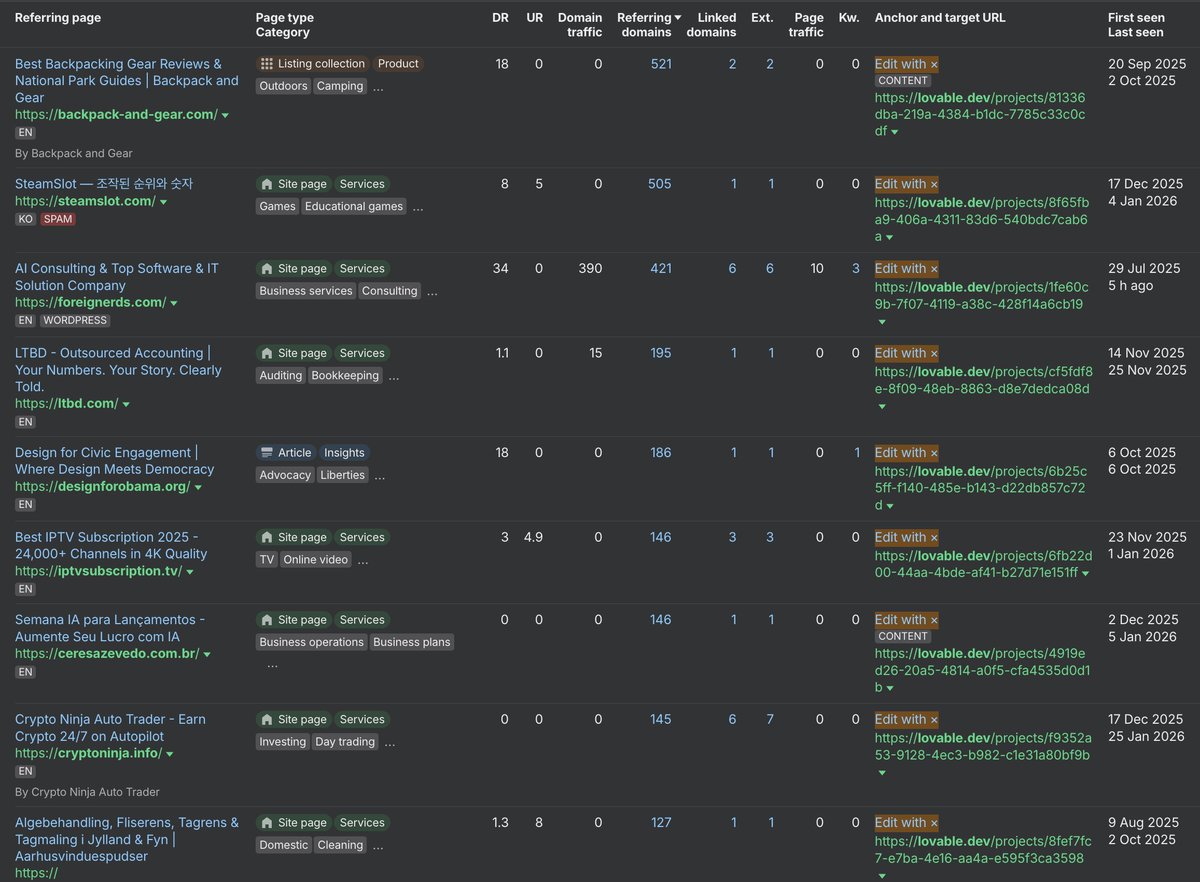
SEO-focused posts warn of indexing, metadata, and client-rendering problems, arguing that rendering architecture should be specified for search and crawler visibility.
Open debate
One revenue report remained negative despite paid sales, while another post argues that faster building lowers the cost of testing ideas but does not remove distribution work.
What performs
The highest-scoring supplied outlier is a Lovable launch-security checklist. Other supplied outliers explain a brand-agent build and a Stitch-to-Lovable workflow, showing strong engagement with actionable instruction.
Twilio connectivity and the full-stack visual editor both appear among the supplied engagement outliers, pairing concise product announcements with high all-time scores.
Statistical standouts
Creator landscape
The five most represented creators account for 20% of the selected posts.
1. Aakash Gupta
@aakashgupta
2 posts
2. Anton Osika
@antonosika
2 posts
3. Felix Haas
@felixhhaas
2 posts
4. Jacob Klug
@Jacobsklug
2 posts
5. Jason Zook
@jasondoesstuff
2 posts
6. Kristian Kyvik
@kkyvik
2 posts
Lovable’s account highlighted Twilio and visual editing, Felix Haas shared a detailed internal-agent workflow, and Prajwal Tomar posted both a security checklist and a Stitch workflow.
Anton Osika emphasizes founders closest to problems and reports usage of Lovable-built apps; practitioner posts add examples of local-business SMS and automation-management products.
Since the previous snapshot
Themes, sentiment, stance, and post format are classified per tweet. All counts, shares, medians, creator concentration, freshness, and performance comparisons are then calculated directly from the published snapshot.
Xholic's all-time score compares engagement while accounting for reach, post age, and creator consistency. It is used for relative comparisons within this collection.
This report analyzes the exact 50-post snapshot shown below. AI identifies editorial categories and drafts explanations; all statistics are calculated from the snapshot, and every narrative claim is checked against cited posts before publication.
Best Lovable tweets
Ranked 01–50

@PrajwalTomar_ ·
Most vibe coders ship apps with ZERO security. Then they wonder why their app breaks at 10 users. Here's the checklist I run before every Lovable launch: → Row Level Security in Supabase → Auth flows tested (signup, login, password reset) → Rate limits on all API endpoints → Server-side validation on forms → Environment variables locked down → CAPTCHA on public forms → CORS restrictions enabled → Error handling that doesn't leak data Takes 30 minutes. Saves you from complete disaster. Once you're done, run Lovable's security scan for a final check. Then ship with confidence.

@felixhhaas ·
I recently built an internal brand agent for Lovable and a lot of people asked how I did it, so here's the exact guide: 1/ Build a brand environment first: I asked Lovable to create a web app where you can view our logo, colors, typography, and all brand assets. This became the database, a single source of truth for everything brand-related. Prompt: "Build a minimal brand hub where team members can browse, search, and download logos, colors, typography, and marketing assets. Should feel like a premium internal tool. Think Linear or Notion. Use placeholder assets so we can replace them later." 2/ Add a home page with an AI agent: I then asked Lovable to build a home page with an AI agent that has access to all of those documents. Prompt: "Add a new page called Brand Agent - a ChatGPT-like chat interface where I can ask questions about our brand." 3/ Connect AI to the assets: The agent can now automatically browse those documents - answering questions, finding assets, and guiding anyone on how to use them correctly. Prompt: "Enable Lovable AI and give the agent access to our brand guidelines. The agent should let users upload a screenshot and tell them if it's on-brand or off-brand with clear reasoning. It should also help find the right assets when asked." The whole thing took less than an hour and it's saving us a lot of time. Hope this helps and now go build you own brand agent today!!

@PrajwalTomar_ ·
Everyone's sleeping on this Google Stitch → Lovable workflow. Full design phase in 10 minutes. Then straight into a working web app inside Lovable. Stop wasting weeks on Figma when you can ship this fast. Here's the entire workflow 👇🏻
 Watch video

@Lovable ·
Introducing Lovable's full-stack visual editor. Visually edit anything at any time in Lovable. Even if it's connected to a value in a database, or if Lovable is already working through a prompt.
 Watch video
@felixhhaas ·
Today, we’re introducing a smarter Lovable 🔥 Lovable is now 71% better at solving complex problems – using deeper planning capabilities, advanced browser testing, and prompt queuing. Here’s what’s new: 1/ Smart planning: Lovable can now map out features before it starts coding. 2/ Automated testing: You’ll now get higher quality builds with fewer issues. 3/ Prompt queueing: Stack and submit multiple prompts while Lovable works. 4/ Add Google authentication to your Lovable app with a single prompt. I couldn’t be more excited about this update! It changes everything and makes Lovable even more powerful! Our mission is to unlock human creativity and enable anyone out there to build their dreams. LFG


@Kasra_Dash ·
I've just finished analysing over 6,000 Lovable websites and I found one thing in common. I'll save you thousands of dollars and an endless headache. 1. None of them rank. 2. They all have MAJOR indexing issues because of how they are built. 3. All of them have SEO foundational flaws (incorrect schema, page titles that don't pull through correctly, multiple H1 tags). Sure the website looks pretty. But what good is a nice looking shop on the 15th floor of a warehouse? I'd rather have an ugly shop on a busy high street. Be careful if you're looking to move away from WordPress to an AI vibe-coded website, especially if SEO is your main traffic source. This ain't the way to do it.

@aakashgupta ·
🚨 Do you understand what’s happening?! > Lovable just got valued at $6.6 billion and a guy with a free account read another user's source code, database credentials, and AI chat history in 5 API calls.. Customers include Uber, Zendesk, Nvidia, Microsoft, Spotify. > The Lovable researcher reported the bug 48 days ago through HackerOne. They marked it a "duplicate" and closed it. It still worked the day it leaked… > Vercel got breached this week through a third-party AI tool an employee installed.. ShinyHunters listed the stolen API keys and source code on BreachForums for $2 million. > Lovable's response was "we did not suffer a data breach." Then they admitted they patched the API in November and left every project from before that date exposed.. > When you vibe code an app you paste your Stripe key into the chat. You paste your database URL into the chat. You paste customer records into the chat. The endpoint that leaked.. returned chat histories. > Anthropic built a model that scored 83.1% on finding real software vulnerabilities. Found a 27-year-old bug in OpenBSD and a 16-year-old flaw in FFmpeg. They named it Mythos and locked it behind a 50-company firewall because public release was too dangerous.. > Two of the world's biggest dev infrastructure platforms got breached in 48 hours and a $6.6B company's first instinct was to argue about the definition of the word "public..." > Every founder who shipped an MVP on Lovable in early 2025 woke up today to find their database credentials are public records.. > The trust boundaries in the AI dev stack are drawn with marker. And it's raining. If your stack ever touched a vibe coding platform, rotate everything tonight. Check the chat logs for what you forgot you typed. AI is here. And we’re f*cked.
 Watch video

@antonosika ·
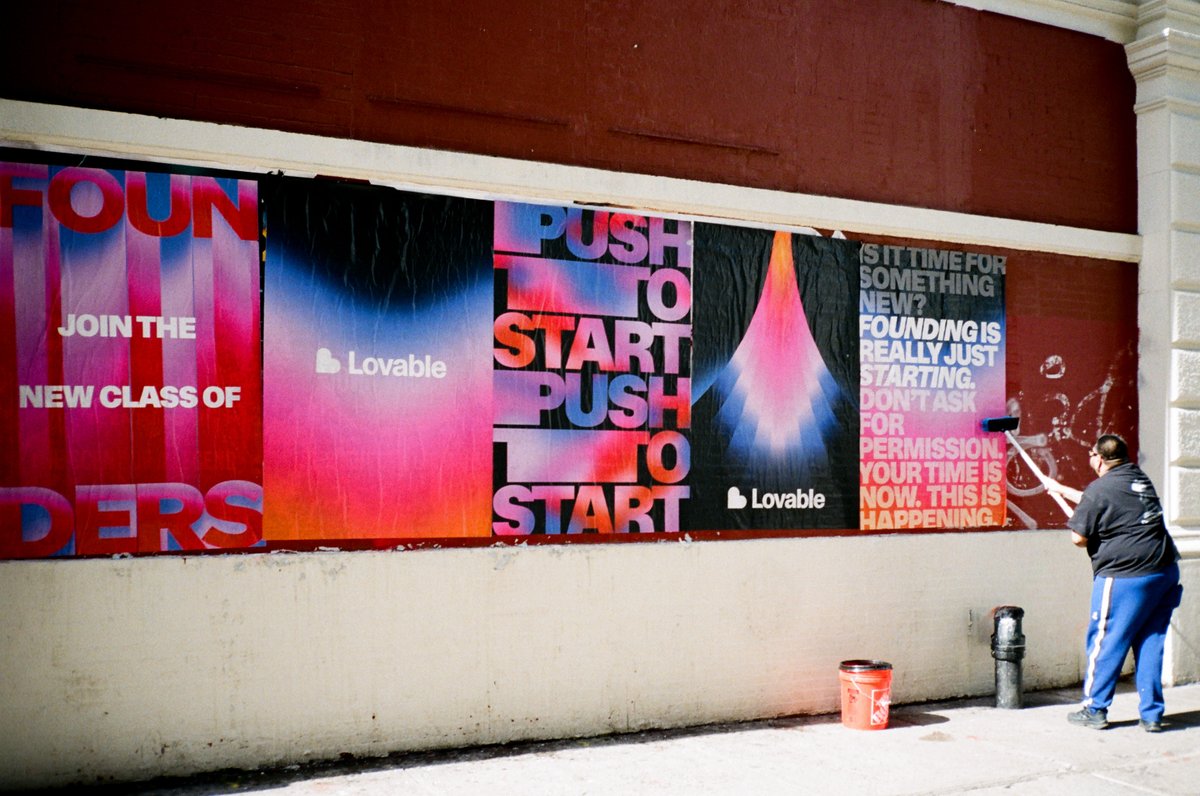
Eighteen months ago, we launched Lovable. We had a theory about who would show up. We were wrong. A new class of founders is emerging. Founders like John, who turned a former church into a $30K/month arcade business in three months, building every digital system himself on Lovable. Or Will, a Grammy-nominated songwriter, who built Disco after realizing 73 million freelancers like him had no good solution for tax season. Every week, we see someone new: a nurse, a teacher, a marketer, a filmmaker, a 16-year-old. People closest to the problems are now building the solutions. Millions of founders are building on Lovable. And we know the build is just the start. We're focused on helping people create real businesses with customers, feedback loops, and growth. And as the technology keeps getting better, more people will succeed. Our focus stays the same: real founders, real businesses, and real solutions. Entrepreneurship is the fastest way to change the world. More builders means more problems get solved in the world. I can't wait to see what problems this generation solves.
@antonosika ·
Apps built on Lovable got 20 million visits on International Women's Day. That's 4x as much as four months ago, which means visits to our users' apps quadrupled in the time our ARR doubled. Over 500,000 projects were built on just this day, and an impressive number had backend and payment functionality. I love seeing so many people building real products and getting real usage with Lovable.

@Crownzdesigns ·
I tested Lovable using a single prompt. To see how good it actually is for vibe coding. Built a design brief generator for freelance designers. Here's the full process.
 Watch video

@kkyvik ·
You've typed "make sure it works" a hundred times. Now Lovable takes it literally, it can open its own browser and won't stop until it does.
 Watch video

@tylerbruno05 ·
I built a real-time, multiplayer whiteboard fully in Lovable. Real-time sync, cursor tracking, and drawing tools, all built in an afternoon.
 Watch video

@ashen_one ·
Lovable is the ONLY vibecoding company I see everyday on Tiktok Their ads are simple: "charged them $$$$ while doing [random small task like eating] + showcasing the "build them a website and sell it" AI pitch I think this is probably the absolute easiest marketing you can do because you have creators of ANY size doing this like once a week and just pray one hits, if it doesn't then who cares There's probably like a Whop/agency type beat organization behind these posts paying X amount per Y views which is genius asf If you're marketing a SAAS type beat product, this is one marketing channel you should be doing every week without failure amongst other things
 Watch video

@denk_tweets ·
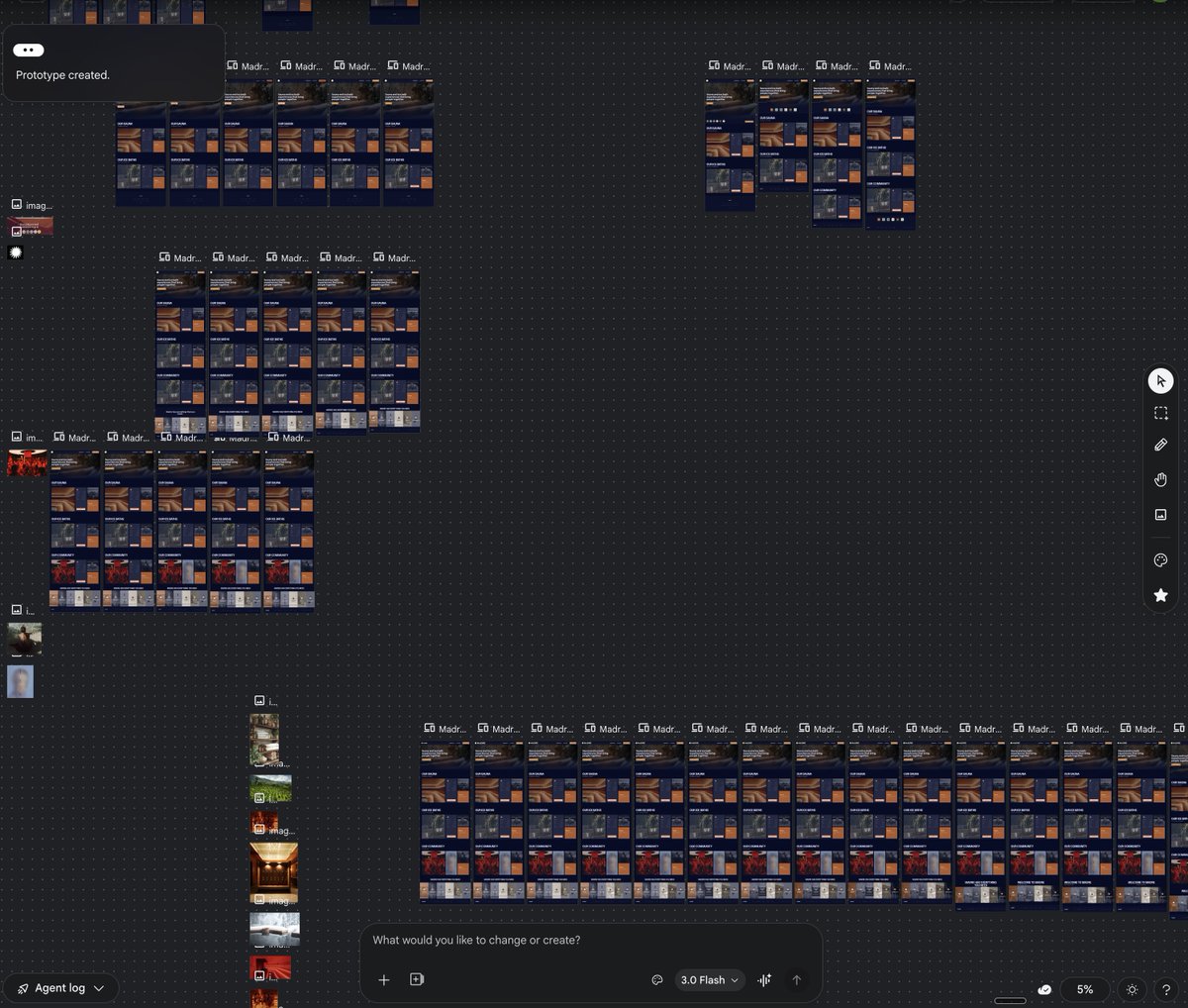
I spent 6 hours playing with Stitch (Google's new AI design and code tool) the verdict: it's pretty dope. definitely the best design capabilities of any AI website tool I've used caveats: > found a few bugs > can't share the prototype with others without giving them edit access > mostly just frontend and design, can't really deploy it as a full production site (yet) ideal workflow (imo): > start with Stitch to build the frontend design > you can export to figma or export the html/css > import either of those into lovable to refine and deploy for newsletter operators: > can start with Stitch to build a beautiful landing page or subscribe page w/ their design tools > screenshot the output and upload it to @beehiiv AI website builder to replicate it

@thisisgrantlee ·
Lovable is one of the most misunderstood startups in tech. It gets a lot of flak here on X. "It's just vibe coding." "It's a toy." "Real engineers don't use it." I think these people are missing the point. The thing about big markets is they all start small. Amazon sold books. Shopify was a snowboard shop. The iPhone got laughed at for not having a keyboard. The best opportunities are the ones where a small TAM turns into a massive TAM over time. I think that’s happening with Lovable right now. What looks like quick prototyping and weekend side projects today is becoming the foundation for a whole new generation of builders. Tobi at Shopify just said it perfectly: "The most AI proof job in the world is entrepreneurship." Lovable is building the workbench for that job. But the bigger thing most people are missing is the shift from software-as-a-service to service-as-software. For years, businesses bought generic SaaS and bent their workflows to fit. Now the cost of building custom software is falling toward zero. That changes the game, especially for SMB and medium-sized businesses. Think about your local business owner. They know their business so well and probably have a thousand paper cuts they wished they could solve or untapped opportunities they wished they could pursue. They might build their own solutions on Lovable, but more importantly I believe there will be a whole new wave of non-technical entrepreneurs stepping in to build agencies that serve exactly these businesses. Bespoke customer interfaces. Agent-powered support. Internal tools that actually fit how a company works. That's a massive latent market getting unlocked. The last piece is structural. Lovable is truly AI native. No legacy code from 2015. No pre-AI UI patterns. No sunk costs to protect. This means they can take bigger swings than the incumbents or the big labs can. Being native to the paradigm shift, sitting in a TAM that's expanding in real time, and carrying zero legacy baggage. That combination is rare. It's how new categories get created. Aspiring founders ask me for advice all the time. One thing I always tell them: study how AI-native founders like @antonosika at Lovable and @matiii at ElevenLabs are executing. They've found markets that are fundamentally misunderstood by most of the industry and they're just rolling full steam ahead. They're not waiting for permission or consensus. They're building while everyone else is still debating whether the opportunity is real. That's the playbook. Find the wave everyone else is underestimating, and ride it harder than anyone thinks is reasonable.


@Jacobsklug ·
I built mission control for my Claude Code routines. My business runs on automated workflows. The problem: no visibility. I couldn't see what ran, what failed, or what needed review. So I built a dashboard in @lovable to manage it all. 1/ The dashboard Tracks every routine run, skill execution, and output. I log in, see what ran overnight, catch any issues, and review what it created. All in one place. I can also trigger routines on demand from the dashboard. 2/ How I built it Used the Lovable connector inside Claude. Since Claude has full context on my workflows, it architected the build perfectly. Prompted Lovable and handled most of the heavy lifting. 3/ Syncing everything The critical part. I needed Claude routines to talk to the Lovable app. Created a custom MCP for my Lovable project. Now Claude can send data directly to the app. Added a step to each routine that logs runs and outputs via the MCP. Then created API triggers for each routine so clicking "Run Now" in the dashboard fires it back in Claude. That's how you build a Lovable + Claude engine.
 Watch video

@robiot ·
Introducing Lovable for General Tasks 🔥 Lovable can now do anything your computer can: → Analyze large CSVs and PDFs with visualizations → Build fully functional PowerPoints → Create whole 3D models → Produce animated launch videos Oh, andd it runs any terminal command = Unlimited possibilities At literally every hackathon I've been to, someone ends up pasting thousands of CSV rows into chat, which made the AI confused That problem is gone. The only limit now is your imagination.
 Watch video

@nadonomy ·
Lovable can now just do things: Create and edit files Turn files into apps Analyse anything Generate files Create videos Ideate Create Launch Market
 Watch video

@SahilPanhotra ·
Meet Anton Osika, → Grew up in Sweden → Studied Engineering Physics and Applied Mathematics at KTH → Worked as an AI engineer → Co-founded Sana Labs → Then co-founded Depict AI → In 2023, released GPT Engineer → An open-source project that could generate entire codebases from prompts → It quickly became one of the most-starred AI coding projects on GitHub → Realized developers wanted much more than code generation → Together with Fabian Hedin, started building a product around the idea → The first launches didn't work → They kept iterating → Rebranded everything as Lovable → Publicly launched in late 2024 → Anyone could build a full-stack app just by chatting with AI → The product exploded across X → Thousands of founders started shipping apps without writing code → Became one of the fastest-growing software startups ever → Crossed $100M ARR in just 8 months → Raised $200M at a $1.8B valuation → Five months later... → Raised another $330M → This time at a $6.6B valuation → Continued growing at record speed → Recently surpassed $500M ARR → More than 50 million projects have now been built on Lovable → Reportedly raising its next round at a $12B valuation → Anton still leads Lovable as CEO Imagine if Anton had stopped after the first failed launches Lovable might never have become one of the fastest-growing AI startups in history


@CopilotKit ·
Introducing: Lovable for MCP Apps 💗 Build full MCP Apps from a single prompt, in real time. A CopilotKit chat drives a @Mastra agent that can spin up @E2B sandboxes running the @Manufact mcp-use library. It's open source 👉 https://t.co/bPsDtEbS7p
 Watch video
@kkyvik ·
lovable could already write code, we just let it run scripts for everyday tasks too. It can now analyze your data, build your deck, and design your marketing assets.
 Watch video

@cviktore ·
we gave lovable full cli access to our sandboxes without knowing exactly what would happen within 24 hours the agent used the cli tool for 35% of our users apart from the new capabilities such as ingesting 10,000 records into the database using psql, or creating pdfs, our a/b tests show that lovable is now significantly better at unblocking itself and fewer users chose to revert their changes
@tylerbruno05 ·
A simple, lightweight VSCode clone built entirely in Lovable. It includes everything you'd expect: syntax highlighting, bracket matching, a file explorer, integrated terminal, find & replace, theme switching, source control, and code folding. It makes me rethink what can be built by anyone.
 Watch video

@BigBrainBizness ·
Anton Osika, co-founder and CEO of Lovable: "It's a learned skill to say no." Every founder says focus matters. Almost none of them can tell you where focus lives inside their company. Anton can, and his answer isn't himself: "It comes from how the entire team works together." Here's what that means concretely. Once a week, Lovable's engineers stop building: "Every week, engineers, they don't just take the planned tasks and do them, but they sit down and go through the entire flow of using the product and think about, like, hey, is this actually the best way to do it, and try to polish and simplify and make it as delightful as..." Read that again for who is doing it and how much of the product they touch. The engineers who wrote the code are the ones running the review. No design team, no PM writing a friction document, no researcher summarising tickets. They also walk the whole flow, including the parts they didn't build. Products get ugly at the seams between features, and you only find a seam by crossing it. The ritual exists to solve a problem Anton openly admits is his own: "I think I'm super ambitious about all the things I want to do. And the backside of that is that I do want to do too many things at the same time." @antonosika doesn't claim to have outgrown it. The correction came from repetition: "If you notice, if you work with that over some time, you realise how important focus is." And when he defines the discipline, it's harsher than what usually passes for prioritisation. Not ranking a backlog. Cutting to one: "We have to just pick one thing and do that, and remove as many distractions as possible." All of it points at one target: making the product simple. Simplicity is the only product quality you can't add your way to. It arrives through subtraction, and nobody gets promoted for the feature that didn't ship. So Lovable schedules it. Every week. Whether or not the roadmap called for it. Anton's own verdict on the results: "This is just the beginning, right? So we have a long, long way to go."
 Watch video

@jasondoesstuff ·
This. Is. WILD. I've been wanting to build a faster way for Teachery customers to get their courses started. ~4 hours in Lovable (making the builder) ~8 hours in Claude Code (making it work technically) Holy shit it works!!! 😱😱😱 I even learned how to push this to our staging environment and it's actually functional. Like... fully 100% works. My mind is BLOWN.
 Watch video

@Founder_Mode_ ·
Notice something? Lovable and Replit are genuinely great. At building things that fall apart the second you try to ship them internally. The demo slaps. Everyone's excited. Then IT jumps on the call. Permissions? Audit logs? SSO? Connects to what database exactly? Dead. Another prototype in the graveyard. Back to the spreadsheet. Every company has this graveyard. It just lives in someone's Notion. Open Superblocks and something shifts. → describe what you need → it connects to your actual stack → ships to prod. Lovable is for demos. Replit is for devs. Superblocks is for shipping. Try it: https://t.co/cn2i5XFAqv
 Watch video

@TimoBuilds_ ·
My SaaS made money. I built FocusMap for 6 months then launched it on Product Hunt now I did my taxes and saw the costs 😭 REVENUE 12 lifetime sales 9€ MRR (1 active sub) = 322€ total COSTS supabase: 159€ cursor: 160€ render: 87€ lovable: 87€ = 494€ total RESULT = -172€ …and I didn’t even include taxes yet 😅 welcome to germany 🇩🇪 ~50% gone on top so the real result? even worse 💩 I just sat there for a moment, staring at those numbers first time people actually paid me for something I built with my own hands I had an idea, built and improved it with feedback inside the app itself and somehow… still in the red but also weirdly it feels like a win even if the numbers don’t show it 😂 validation is there, multiple times for now so I'm not done yet and it still needs work, but I think I’m on the right path so yeah, I won’t stop here just need a bit more time 🙌


@sachinrekhi ·
Customer discovery via functional prototypes + PostHog is night & day better than the old school way of asking for feedback on Figma mockups. Here's why: I get to observe actual user behavior instead of asking the user to guess how they might use my product. My favorite example of why this matters comes from a Sony Walkman user study. They asked a bunch of people what they thought about a yellow walkman and they said "so sporty! not boring like the black one!". And yet, when they were given the opportunity to take a walkman home after the study, everyone picked the black one. We learned a lot more from user behavior than we did expressed preferences. Here's my setup for now observing user behavior from prototypes: 1. Create a functional prototype in your favorite prototyping tool (Bolt, Lovable, Reforge Build, Magic Patterns, Claude Code) 2. Ask the prototyping tool to integrate PostHog analytics 3. Ask the prototyping tool to instrument key user actions in PostHog Then you get all of these ways of observing actual behavior: - DAUs \ WAUs \ retention curves - I can actually see if people come back and use my prototype instead of taking their word for it - Action metrics dashboards - I can see what actions people are taking vs not - Post-usage survey - I can add a built-in pop-up survey to ask the user a question about the experience after they have engaged with the prototype - Session replays - I can see exactly where people are clicking and how they are using the product to identify usability issues - Heatmaps - I can see what part of my design is working across all sessions I'd never go back to testing with just a mockup after this.


@_vmlops ·
A dev joined a startup last week opened the repo...went quiet for 2 minutes then said: "what is this." 6 months of cursor + lovable + bolt app works....users are happy...revenue is coming in but the codebase..? 3 different ways to handle the same thing duplicate functions everywhere touch one part...break something unrelated the ai just kept adding nobody was thinking about structure vibe coding is fast to ship slow to scale the generation takes hours the cleanup takes months and that's the part nobody talks about

@robiot ·
We're introducing commenting in Lovable. You can now collaborate with your team by commenting directly in your apps: Comment -> Discuss -> Ship
 Watch video
@Jacobsklug ·
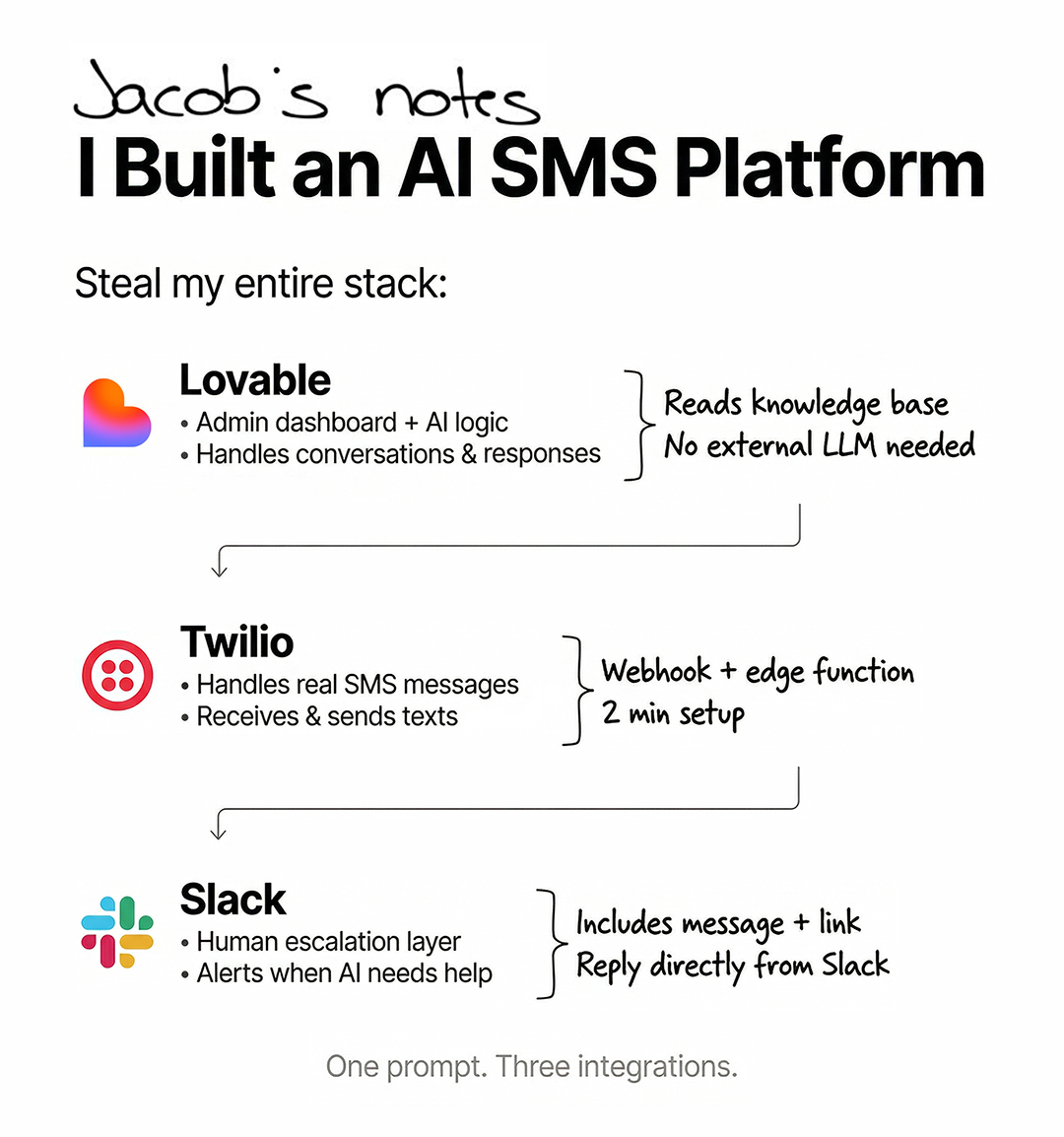
I built a full SMS platform powered by AI for local businesses. Here's the entire stack: 1/ @Lovable > Admin dashboard for overview, conversations & triage > Reads from custom knowledge base in app > Crafts responses sent through Twilio > Escalation logic with Slack notifications > No external LLM needed 2/ Twilio (Lovable connector) > Handles SMS for real customer texts > Messages flow into platform > Auto generated edge function and webhook > 2 minutes to configure 3/ Slack (Lovable connector) > Escalation layer for human handoff > Fires notification when AI needs help > Includes customer question and conversation link > Direct response routing This isn't a demo. Remix it in @Lovable. Swap the knowledge base. Sell it to every local business that still answers phones manually. One prompt. Three integrations. A real product in 20 minutes.
@aakashgupta ·
Elena Verna led growth at Dropbox, Miro, Amplitude, and SurveyMonkey. Even she just went back to being an IC. She wrote about it this week. Lovable flattened the org in December. Elena moved back to IC, kept getting paid like a leader, and last week shipped Lovable's enterprise pricing page to prod by herself. That's cool, right? But basically every growth person has prototyped a pricing page with AI by now. The difference: most of us then hand it to the pricing PM, get feedback from stakeholders, loop in a designer, put it on the engineering backlog, get analytics review, and ship weeks or months later. Elena skipped all of it. Her line on the transition: "Did I just level up, or did I just give up status?" My take? Level up. Here's why. Coordination was the expensive part of a leader's job. PRDs, decks, alignment, status updates. Those existed because building was slow and the cost of picking the wrong direction was a quarter. When a working prototype takes an afternoon, three layers of approval just become overhead. Elena has a name for this new role: the High-Impact IC. Or, HI-C. A solo operator who takes a project from problem to production without coordinating three teams. I love this. Because about 90% of her time is now building. Almost no meetings. The skill stack underneath: pointy in one area, competent in the adjacent ones. Elena is pointy in growth, competent in analytics, design, and code. For HI-C to actually exist inside a company, two things have to be true. HI-Cs need the same information access senior leaders had. And companies have to be willing to recruit senior leaders into IC roles. Comp parity finally makes the conversation possible. If you're a senior leader who quietly misses the building part of the job, forward this post to your CEO. The shift from Product Manager or Growth Manager to Product Builder is here. Whether you like it or not.


@SergioRocks ·
If you’re a non-technical Founder, you can now do a lot before hiring Engineers. A few years ago, starting a tech startup meant: - raise money - hire a team - build for months - then show something to clients That playbook has changed. Today, with tools like ChatGPT, Claude and Lovable, you can: - explore the market - define personas and ICPs - map workflows - build clickable mockups - put something in front of potential clients For less than $100/month in subscriptions. That is incredible! You no longer need funding just to find out whether anyone cares about your startup. But there’s a trap. A prototype is not a product. A Lovable mockup can help you validate interest. It cannot safely handle: - client data - permissions - scaling - integrations - security - production edge cases So the new playbook is not “AI replaces engineering”. It’s: Use AI to validate faster. Then bring in technical depth when the product starts to matter. I wrote a full breakdown for non-technical founders in my latest newsletter. https://t.co/8x2WDyXUtw

@thebuggeddev ·
Wait… @Lovable actually generated images on the fly while generating the code without me even writing a prompt for it 😱 Never seen a vibe coding tool do that before. It did it just by referencing the attached design image. No MCP SIM SIPPY. In fact, it even one shotted the design I shared for this mobile app and built a mobile first version since Expo is not supported yet. This is seriously amazing work by Lovable!!
 Watch video

@MatijaSosic ·
I spoke to a PM who built his SaaS from scratch with Wasp. I asked: why not Lovable/Replit? "I tried it, but felt like I was arguing with a middleman. With Claude Code, I feel like I have a coworker - a junior, but a coworker. With Lovable it felt like I'm writing to an agency, like some sales guy trying to sell me. I felt constrained, like in a box." Owning the process vs outsourcing it. That's the difference.

@foley_seo ·
Lovable hit $20m ARR in 2 months. 25 million projects shipped. Fastest-growing European startup ever. There's just one small problem, well, we say small, we mean HUGE! Almost none of these sites are SEO friendly by default. And in 2026, that's a much bigger deal than it sounds. Here's the structural issue most "build a site in 60 seconds" pitches skip over: ❌ Lovable, Bolt and v0 ship client-side rendered React apps by default. The HTML Google receives is essentially <div id="root"></div>. An empty shell. ❌Google CAN render JavaScript, but rendering is ~9x more resource-intensive. Onely's research shows around 32% of JS-dependent content stays unindexed a month after URL discovery. ❌We've tested this. One Lovable build: 50 URLs, 9 indexed over 3 months, all with duplicate metadata. ❌The bigger 2026 problem - GPTBot, ClaudeBot, PerplexityBot do NOT execute JavaScript. At all. They fetch the raw HTML and move on. Your product descriptions, pricing, FAQs, case studies… invisible. ❌Open Graph previews on LinkedIn, X, Slack? Same story. Blank cards. Social platforms don't run JS either. ❌Worst part: when AI can't access content, it fabricates. We tested it with locked PDFs - the model invented what it "saw". Vibe coded sites behave the same way to AI crawlers. You can rank on Google (eventually, once the render queue catches up) AND be completely absent from AI Overviews, ChatGPT, Claude and Perplexity at the same time. That's the split visibility problem. It's getting worse with every Gemini update. The fix isn't "stop using AI tools." It's specifying the rendering model up front. Next.js, App Router, real anchor tags, server-side metadata, structured data in the raw HTML - all of which Cursor or Claude Code will scaffold for you in minutes if you prompt properly. My full breakdown - the architecture problem, the workarounds for sites already built on Lovable/Bolt, and the prompts to use for an SEO-ready scaffold from day one 👇 https://t.co/N2yh4E7ROc

@shushant_l ·
Neumorphism / soft UI design style productivity mobile app. Created with Lovable Prompt used: Build a premium mobile productivity app using a modern Neumorphism / Soft UI design style, featuring softly raised and recessed interface elements, subtle realistic shadows, rounded corners, smooth surfaces, gentle depth, and a calm neutral color palette with one vibrant accent color. Create an intuitive dashboard for tasks, habits, focus sessions, calendar events, goals, and daily progress, with tactile buttons, floating controls, elegant progress indicators, minimal icons, and spacious typography. Use soft cards that appear naturally molded into the background while maintaining strong contrast, accessibility, and clear visual hierarchy. Add subtle micro-interactions, satisfying press states, fluid animations, and smooth screen transitions. Keep the experience clean, distraction-free, warm, modern, highly usable, and visually satisfying, avoiding excessive shadows, clutter, gradients, and overdecorated interfaces
 Watch video

@devansh_bordia ·
Your Lovable, Bolt, or v0 app took a weekend to ship. It took us one afternoon to find its data leaking. We reviewed a stack of vibe-coded SaaS apps built with Cursor, Lovable, https://t.co/JYEWFNDb3z, and discovered 10 common patterns that almost all the applications repeated If you shipped fast with any of them, there's a good chance you're sitting on one of these right now. Findings, A Thread 🧵:

@BallinFil ·
My client was quoted 50k for a custom beauty quiz with a 2-month lead time. Simple workflow (bunch of questions + scoring criteria pushing to best-sellers and categories) + dynamic Klaviyo metric push to fire a post-quiz email. He vibe-coded it himself with lovable in an afternoon (no exaggeration). Saved his company a ton of money and got the project out insanely fast. It might not be as sophisticated as the quiz company, but he can iterate into sophistication overtime. This is the future...

@frog_omo ·
Building an app now takes less time than watching a Marvel movie. That's not hype. That's what the data shows. But the thing is that the people making money from this aren't who you think. Let me break it down: The success stories everyone shares (and what they leave out): - Pieter Levels built Fly, a browser flight simulator, in 3 hours using Cursor AI. Hit $87,000/month within 17 days. Got an Elon Musk endorsement. What they leave out: He has 600,000+ Twitter followers built over a decade. Runs a portfolio generating $3M/year. His other AI project, Photo AI, hit $1M ARR in under a year. - Tony Dinh built TypingMind, a better ChatGPT interface, in 5 days. Revenue: $1K day one, $10K by day four, $22K by day seven. $1M total within 20 months. What they leave out: He had 50,000 Twitter followers. Two prior failed AI products that made a combined $100. - Marc Lou built ShipFast in 7 days. Pulled $528K in its first four months. What they leave out: He shipped 23 prior projects. Most were failures. Built a 35K audience first. - Sabrine Matos, a growth marketer in Brazil with zero coding experience, used Lovable to build Plinq, a women's safety app, in 45 days. Hit $456K ARR within three months. What they leave out: She drove 500 million views through marketing. The app was 20% of the work. Then there's the other side nobody talks about: Roman Koch shipped 8 apps in 2025. Total earnings: $1,464 after Apple's fees. His best app made $700. A CookList developer's first-month revenue was $2, and one dollar was his own purchase. These stories don't go viral. The tools making this possible: For native iOS: → Cursor AI or Claude Code + Xcode + SwiftUI → Describe features in plain English → AI generates code → fix errors → submit For cross-platform: → React Native + Expo (fastest setup, ~45 minutes) → Flutter for performance (60-120 FPS) → Replit Agent generates complete apps from text prompts Boilerplates that save 15+ hours: → ShipAppFast (iOS): login flows, payments, paywalls, analytics pre-built → ShipFast (web): same for NextJS Backend + monetisation: → Firebase or Supabase for database → RevenueCat for subscriptions (free until $2,500/month revenue) → Superwall for paywall testing (free under 250 conversions) Realistic timeline for a simple utility app: → Setup: 30 min → Core feature: 2-6 hours → Monetisation: 1-2 hours with boilerplate → Polish + submit: 2-4 hours → App Store review: 13-21 hours Total: 8-16 hours of work. Plus waiting. The top 5% generate 200x the revenue of the bottom quartile. What actually changed: It's not that anyone can build a successful app now. It's that anyone can test an idea cheaply. The building got fast. The distribution stayed hard. Every major success story has at least one of three things: → A pre-built audience → Deep marketing expertise → Years of prior failed attempts The 24-hour app is real. The 24-hour business isn't. Budget 10x more time for marketing than building. Because in 2026, the scarce resource isn't code. It's attention

@gaganghotra_ ·
Simple annotating live webpages application - I cooked couple of weeks back using Lovable has been so helpful to discuss things with devs/designers micro projects to do micro things seems like the real value creation using AI rather than trying to build large scale end to end automations which need crazy supervision cuz of hallucinations compounding from one component to another

@CarolMonroe ·
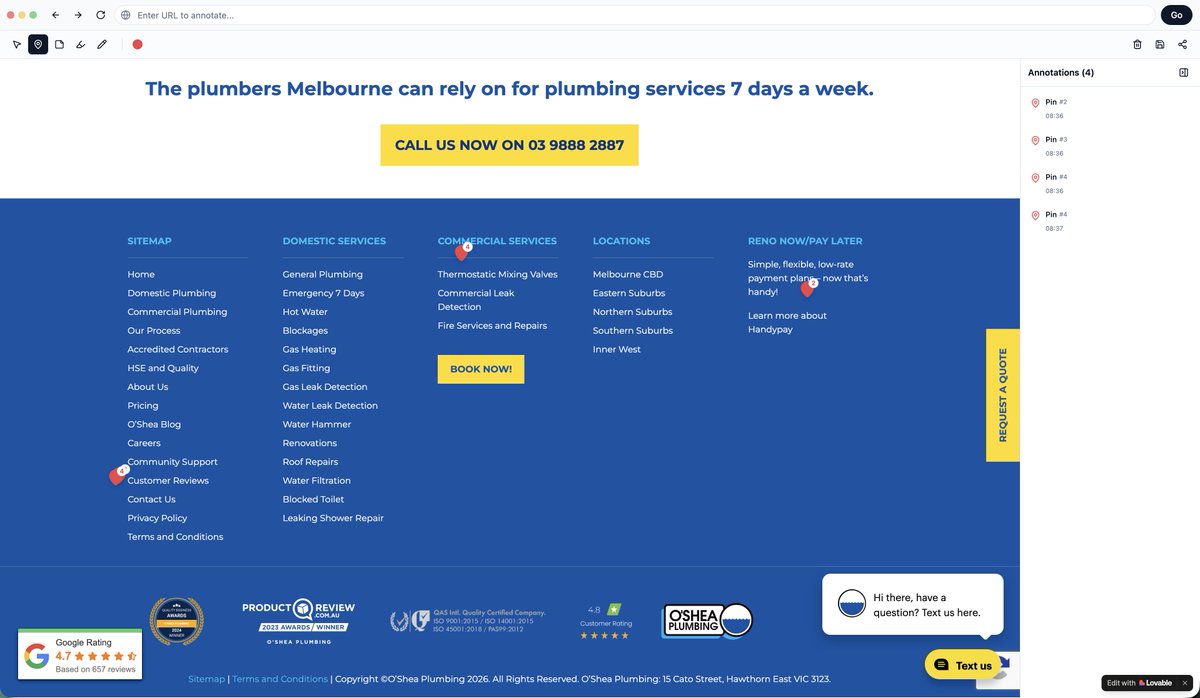
.@Lovable shipped a new preview commenting update today At first, I thought I'd compare it to other tools, but it's more than that. Lovable actually executes the comments. You can click anything in the UI, leave feedback, and keep building without breaking your flow. You can point what matters, ask lovable to fix it, and keep moving.
 Watch video
@SergioRocks ·
Your vibe coded product is probably closer than you think. A lot of Founders I speak with have the same story. They spotted a real business opportunity. They used ChatGPT, Lovable, Replit, or a combination of those. A few weeks later, they have something that works. Clients can see it. Investors understand it. The vision feels real. Then they try to launch it. And that's where things get uncomfortable. The product works most of the time. But not all the time. You don't fully trust it with real clients yet. You're still manually checking things behind the scenes. You hesitate to scale usage because you're not sure what breaks under pressure. This is normal. You're not failing. You've simply reached the point where building stops being the bottleneck. Reliability becomes the bottleneck. The good news? Getting from 0% to 90% is usually harder than getting from 90% to production. The challenge is different now. Less about features. More about turning something that works into something you can confidently run a business on. That's the stage where most founders need a different kind of technical support than the one that got them here.
Best Tweets by Topic