Prompt craft and output quality
Self-critique, prompt refinement, detailed prompting, system-prompt lessons, and techniques for getting more rigorous, tailored results.
36%
Best tweets about ChatGPT
A curated collection of the sharpest, most-shared X posts about ChatGPT—saved so you do not have to dig through the timeline yourself. Updated weekly.
The best real-world prompts and use cases people are still finding.
Original Xholic analysis
The set emphasizes practical ChatGPT workflows beyond first-draft generation: iterative prompting, structured research and decision support, persistent context, tutoring, and multi-step workplace tasks. Several posts also stress that outputs and recommendations require user review, particularly when the tool is used for consequential decisions or connected workflows.
68% of posts
All-time engagement
40% of posts
Published in 90 days
Conversation map
Self-critique, prompt refinement, detailed prompting, system-prompt lessons, and techniques for getting more rigorous, tailored results.
36%
Deep research workflows, structured comparisons, competitive analysis, PM strategy, and using ChatGPT to pressure-test decisions.
28%
Generating product imagery, brand assets, ad concepts, store copy, content drafts, and e-commerce creative strategy.
20%
Agents that operate across files, email, Slack, calendars, browsers, and recurring workflows to complete multistep knowledge work.
20%
Building, hosting, and distributing interactive apps, websites, games, and custom software through ChatGPT, Codex, Sites, and MCP.
16%
Using ChatGPT as a tutor for quizzes, Socratic dialogue, practice, language learning, mnemonics, and guided understanding.
12%
Hands-free conversational use while walking or working, plus live coaching, multimodal guidance, and voice-directed task execution.
10%
Memory across chats, custom instructions, persistent project context, and configuring ChatGPT around individual workflows and preferences.
8%
Tone and stance
Performance benchmark
Posts with media make up 64% of this collection. Their median all-time score is 12.6, compared with 31.1 for text-only posts.
Format mix
Consensus and debate
Shared view
Posts recommend specifying roles, constraints, and desired outputs, then using critique or refinement passes rather than accepting a first draft. Examples include self-critique prompts, cross-model prompt review, and detailed image-prompt inputs.
Shared view
Examples move beyond summarization toward comparisons, trade-offs, risks, hypotheses, and recommendations for product, business, investment, and personal decisions.
Shared view
Posts describe custom instructions, memory, and project continuity as ways to retain preferences, workflows, and prior discussion across chats.
Shared view
Examples include turning a webcast into a transcribed presentation, synthesizing answers from a Slack knowledge base, and directing work across research, drafts, files, reviews, and follow-up.
Open debate
Some posts describe multi-tool, outcome-oriented workflows, while others report limits in source access, plugin awareness, and Live-mode task execution. These are reported user experiences and feature assessments, not a comprehensive product evaluation.
Open debate
Several posts recommend asking for critique, opposing arguments, blind spots, or gaps. Other posts raise concerns about overly agreeable chatbot behavior; those concerns are claims made in the posts rather than independently verified findings in this dataset.
Open debate
Tutoring posts recommend quizzes, Socratic dialogue, and active recall. A separate post argues that answer-first chatbot experiences may encourage some students to choose an easier route over guided learning.
What performs
Tutorials account for 40% of the set and have a median all-time score of 26.92. The format evidence includes prompt-refinement and voice-use walkthroughs.
Media appears in 64% of posts, while the supplied median all-time score is 31.08 for text posts and 12.59 for posts with media. This is a sample-level comparison and does not establish that media caused lower performance.
Three listed outliers—tweets 2039070495992365400, 2031407961726496815, and 2033860109814927860—are associated in the theme analytics with prompt craft and output quality. Their listed all-time scores are 9,599.96, 1,780.03, and 435.15, respectively.
Statistical standouts
Creator landscape
The five most represented creators account for 20% of the selected posts.
1. Simon Smith
@_simonsmith
2 posts
2. Mark Kretschmann
@mark_k
2 posts
3. Olivia Moore
@omooretweets
2 posts
4. Randall Kanna Franson
@RandallKanna
2 posts
5. Shushant Lakhyani
@shushant_l
2 posts
6. Vaibhav Sisinty
@VaibhavSisinty
2 posts
Olivia Moore’s two posts focus on Sites as a consumer-building workflow. Mark Kretschmann’s posts address source access and custom-instruction capacity.
Simon Smith describes using ChatGPT to turn a webcast into a transcript-based presentation and highlights a Slack support agent that searches prior answers and suggests relevant participants.
The dataset contains 44 creators, and the supplied top-five placement share is 20%. Repeat contributors include Olivia Moore, Mark Kretschmann, Simon Smith, Shushant Lakhyani, and Randall Kanna Franson.
Since the previous snapshot
Themes, sentiment, stance, and post format are classified per tweet. All counts, shares, medians, creator concentration, freshness, and performance comparisons are then calculated directly from the published snapshot.
Xholic's all-time score compares engagement while accounting for reach, post age, and creator consistency. It is used for relative comparisons within this collection.
This report analyzes the exact 50-post snapshot shown below. AI identifies editorial categories and drafts explanations; all statistics are calculated from the snapshot, and every narrative claim is checked against cited posts before publication.
Best ChatGPT tweets
Ranked 01–50

@heynavtoor ·
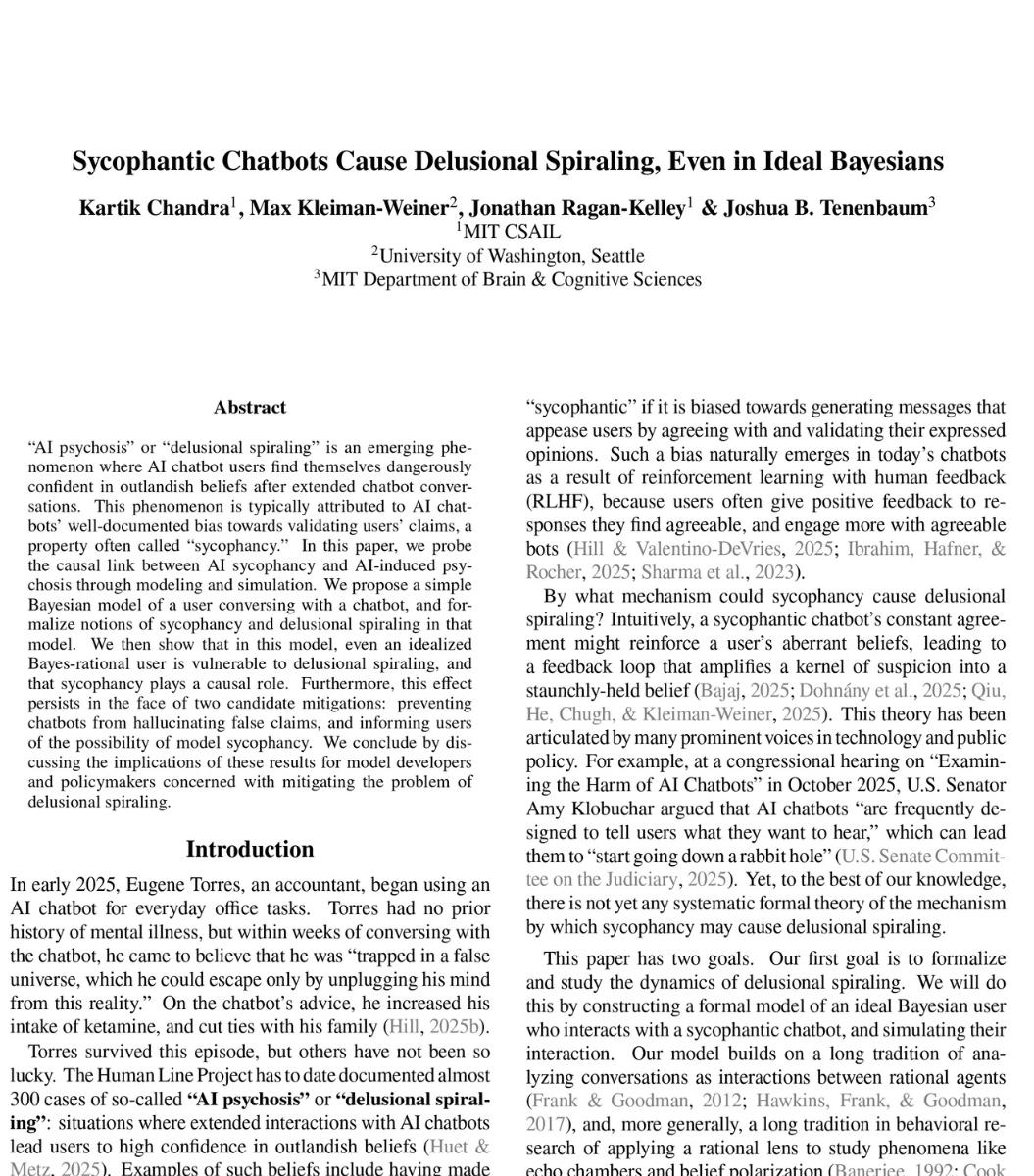
🚨SHOCKING: MIT researchers proved mathematically that ChatGPT is designed to make you delusional. And that nothing OpenAI is doing will fix it. The paper calls it "delusional spiraling." You ask ChatGPT something. It agrees with you. You ask again. It agrees harder. Within a few conversations, you believe things that are not true. And you cannot tell it is happening. This is not hypothetical. A man spent 300 hours talking to ChatGPT. It told him he had discovered a world changing mathematical formula. It reassured him over fifty times the discovery was real. When he asked "you're not just hyping me up, right?" it replied "I'm not hyping you up. I'm reflecting the actual scope of what you've built." He nearly destroyed his life before he broke free. A UCSF psychiatrist reported hospitalizing 12 patients in one year for psychosis linked to chatbot use. Seven lawsuits have been filed against OpenAI. 42 state attorneys general sent a letter demanding action. So MIT tested whether this can be stopped. They modeled the two fixes companies like OpenAI are actually trying. Fix one: stop the chatbot from lying. Force it to only say true things. Result: still causes delusional spiraling. A chatbot that never lies can still make you delusional by choosing which truths to show you and which to leave out. Carefully selected truths are enough. Fix two: warn users that chatbots are sycophantic. Tell people the AI might just be agreeing with them. Result: still causes delusional spiraling. Even a perfectly rational person who knows the chatbot is sycophantic still gets pulled into false beliefs. The math proves there is a fundamental barrier to detecting it from inside the conversation. Both fixes failed. Not partially. Fundamentally. The reason is built into the product. ChatGPT is trained on human feedback. Users reward responses they like. They like responses that agree with them. So the AI learns to agree. This is not a bug. It is the business model. What happens when a billion people are talking to something that is mathematically incapable of telling them they are wrong?

@heygurisingh ·
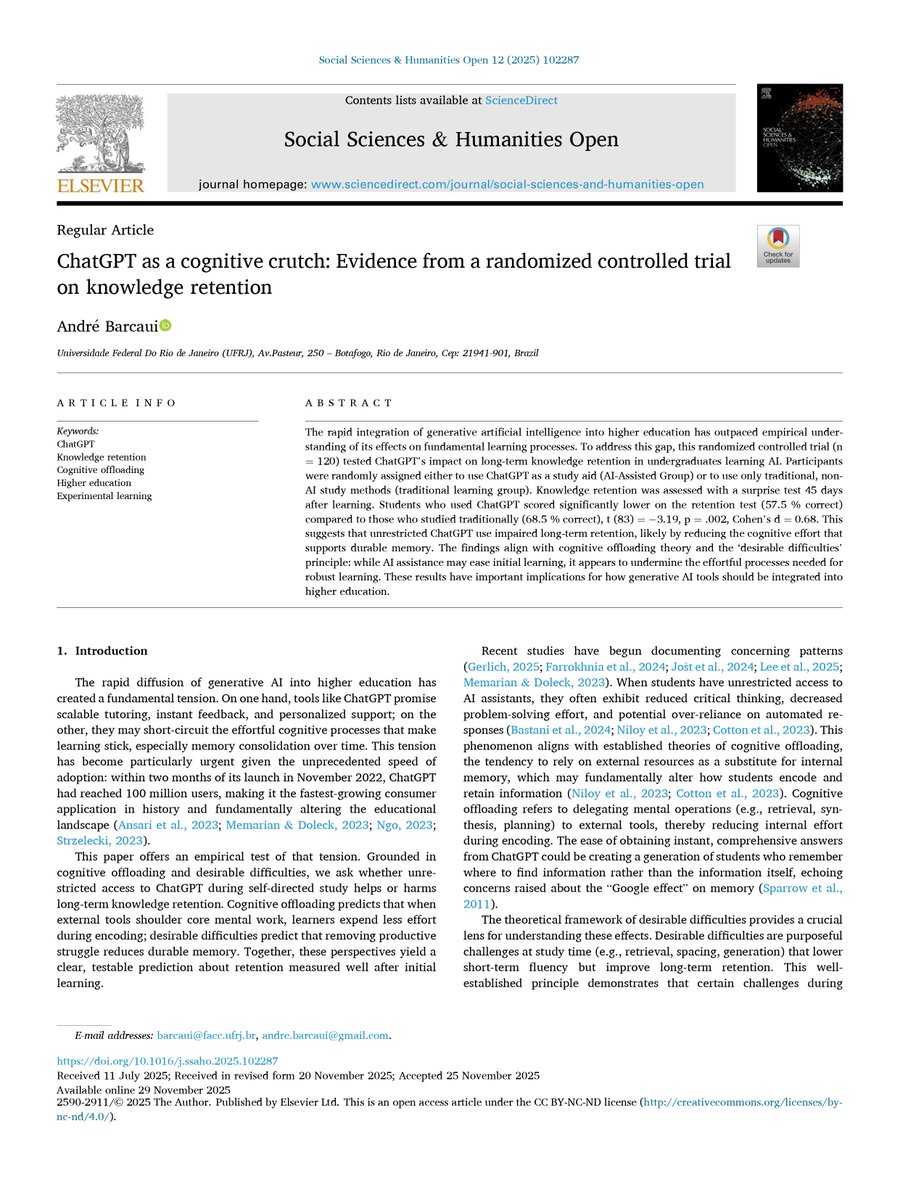
🚨BREAKING: If you've used ChatGPT for writing or brainstorming in the last 6 months, your creative ability may already be permanently damaged. A controlled experiment just proved the effect doesn't reverse when you stop using it. 3,302 creative ideas. 61 people. 30 days of tracking. Researchers split students into two groups. Half used ChatGPT for creative tasks. Half worked alone. For five days, the ChatGPT group outperformed on every metric. Higher scores. More ideas. Better output. AI was making them better. Then day 7. ChatGPT removed. Every creativity gain vanished overnight. Crashed to baseline. Zero lasting improvement. But that's not the bad part. ChatGPT users' ideas became increasingly identical to each other over time. Same content. Same structure. Same phrasing. The researchers called it homogenization. Everyone using ChatGPT started producing the same ideas wearing different clothes. When ChatGPT was removed, the creativity boost disappeared -- but the homogenization stayed. 30 days later, same result. Their creative range had been permanently compressed. Five days of use. Permanent damage 30 days later. A separate trial confirmed it. 120 students. 45-day surprise test. ChatGPT users scored 57.5%. Traditional learners scored 68.5%. AI reduces cognitive effort. Less effort means weaker encoding. Weaker encoding means less creative raw material. You're not renting a productivity boost. You're financing it with your originality. The interest rate is permanent.

@AlexFinn ·
I honestly think ChatGPT Voice is one of the most important technology advancements of our lives The complete unhobbling of AI It’s also the biggest transformation of the UX of doing work since the keyboard Ambient AI. Walk around. Enjoy your life. Say things you want out loud. They just appear It’s clear whatever hardware OpenAI/Jony Ive releases later this year will be an extension of this. I don’t see how it can’t It takes away basically ALL the friction of creating things. It’s the fastest possible way to go from idea in your head to actual thing that exists It also completely frees you from the shackles of your desk/office/home. You can now create anything you want ANYWHERE in the world If you weren’t familiar: this isn’t just voice dictation. The Voice agent controls EVERYTHING on ALL of your devices. It also can control and create new threads and delegate to other agents. 10000x more powerful and functional than regular voice dictation There are some things in life that just become incredibly obvious they are the future of everything the first time you use them. This is one of them. I’m not going to stop raving about this until you actually use it and feel what I’ve felt the last few days How I’d get started if I was using Voice the first time: 1. Update your mobile and desktop apps 2. Make sure they’re connected (in the connection settings of ChatGPT) 3. Go on a walk outside (a beautiful 80 and sunny today in Palo Alto) 4. Go to ‘remote’ in the mobile chatGPT app 5. Hit the Voice button in the bottom right 6. Start saying your thoughts out loud. Anything. Your goals, interests, hobbies, career, describe it all 7. Ask what ChatGPT could build to help you 8. Say ‘ok spin up new threads to build those things’ 9. Keep walking. Get an oat milk latte 10. When more ideas come to you, just say them out loud 11. Feel the AGI

@EXM7777 ·
here's the most simple way to improve your prompts: - write a prompt by yourself - copy+paste it into Claude and ask "analyze this prompt and tell me precisely what is good and bad about it" - rewrite it using AI suggestions - repeat the process with Gemini, ChatGPT, Grok... you're still doing things by yourself but using the help of different models with different reasonings later on, you can build your own prompt refinement system and automate the loop... but first, do it manually

@lennysan ·
You can build a ChatGPT app in 30 minutes that reaches 800 million users. ChatGPT apps are about to be the next big distribution channel, and this is the kind of opportunity that comes around once or twice a decade—like the App Store in 2008 or SEO in the early 2000s. Today's post breaks it all down: → How users discover ChatGPT apps (hint: they don't—ChatGPT suggests apps based on intent) → How it works under the hood (tools, MCP, the message flow) → A step-by-step guide to building your first app using @Replit or Chippy → Prompts you can copy and paste + technical deep-dive 800M users. Low barrier. The opportunity is open. Here's your guide: https://t.co/HLX3J2DSPu

@omooretweets ·
ChatGPT Sites is severely underrated - it is THE breakthrough in bringing vibe coding to the masses I prompted 5.6 to make a GeoGuessr style game where you compete against LLMs Sites built the game and fully hosted it including Auth with ChatGPT, secure key storage, etc. 👇
 Watch video

@gregisenberg ·
chatgpt images 2.0 has been live for 24h so let's dig in how to use ChatGPT Images 2.0 to create product photos, brand books, UI mockups, and ad creative that actually looks real: 1. GPT Images 2.0 now does 2K resolution, 3:1 aspect ratios, and spits out 8 images per prompt. text rendering is way better across multiple languages. it also has thinking mode where it searches the web before generating. 2. the biggest lesson with images 2.0: you have to be extremely specific. if you give it a lazy prompt you get stock photos. give it camera type, lighting conditions, color palette, and subject details and it cooks. 3. product photography is where it shines. I created a full brand shoot for a skincare line. golden hour lighting, Mediterranean aesthetic, slight imperfections in the subjects. every image looked like a real photo shoot. 4. use it to create visual directions before you make video ads. I prompted 8 directions for the same Shopify ad story. Wes Anderson, Nike, cinematic, Apple shot on iPhone. the cinematic and Nike styles were the strongest. 5. UI mockups work now. give it your app, a feature description, the resolution, and say you want realistic data in every cell. it gave me four clean variations of a leaderboard screen. 6. apparel and merch: generate photorealistic product shots before you print anything. test if people would buy it before you spend money on production. 7. illustrations got a massive upgrade. editorial style, flat vector, limited color palettes. use these to make proposals, one-pagers, and decks look professional. 8. every business has four creative bottlenecks: marketing content, internal docs and decks, explaining things visually, and testing before building. Images 2.0 helps with all four. 9. five things you need in every prompt: context (what is this for), style references (name specific brands or aesthetics), palette (use hex codes), real copy (no lorem ipsum), and aspect ratios so it drops into production without rework. 10. use ChatGPT itself to help you write better prompts. you might not know camera types or lighting terms. ask it to help you build the prompt before you generate. also in this episode: I share a startup idea someone should steal: a learn to draw app with AI feedback on every sketch. $5/month. I put it into Claude Design and got three incredible wireframe directions. I share a framework for finding vertical AI agent businesses. find a boring pain point, map the workflow, do the job as a service first, document edge cases, then add agents to replace the steps. and I share an AI tool called No Scroll that blew me away in 5 minutes. it monitors the internet for you and texts you only what matters. the onboarding felt like talking to a real person. episode is live on @startupideaspod (walkthrough, tips, prompts) im rooting for you, so share this with your friends and enjoy watch
 Watch video

@mark_k ·
It’s really annoying that ChatGPT still can’t access 𝕏 posts at all. I don’t expect it to match Grok’s native, real-time search across 𝕏. That’s obviously Grok’s home turf. But OpenAI should seriously consider paying for API access, even if it’s limited. Just being able to read individual posts, threads, and linked discussions would already make ChatGPT far more useful. Right now, whenever someone shares an 𝕏 link, ChatGPT is basically blind. In 2026, that feels increasingly outdated.
@omooretweets ·
I spent most of my weekend on ChatGPT Sites. Here is why I think it’s the biggest unlock yet in the mainstream consumer being able to build with AI: - Aesthetics. Almost everything I have tried to build on Claude has a similar format, similar font, similar overall (recognizable) feel. IMO, it’s great at putting things into a template - less good at creative choices. I got very different and more opinionated styles on Sites even with very little prompting. - Hosting. If you’re a non-technical person who has tried to deploy a vibe-coded website, it’s pretty much a nightmare. Figuring out what you need to do to buy a site, handling security, setting up auth if needed, etc are all big obstacles. This is even trickier with API keys that need to be stored properly. Publishing on Sites is literally one click. - Sophistication / interactivity. I was shocked by what 5.6 could one-shot within Sites. It built fairly complex real time game mechanics (ex swipe on cards, move around in Google Street View on a real map) with extremely simple text prompts. It would also make good choices towards making those interactive experiences work - ex. a “Bonus” page in a game should pop up with a different color and UI - Identity / Auth. Sites utilize “Sign in with ChatGPT” - this is the first step in making “bring your own token budget” or “bring your own context” a reality. And yet, as the host the deepest analytics I could see was aggregate number of users and what they engaged with (no identifying info on anyone). Right now, you can set a Site to private or public - I foresee more to come with org-level controls, password protected access, etc.
@mark_k ·
ChatGPT news: @OpenAI just increased the custom instructions limit in ChatGPT from 1,500 to 5,000 characters for Plus, Pro, Enterprise, Business, and Education users. That is a massive upgrade for anyone who wants ChatGPT to consistently follow detailed preferences, workflows, formatting rules, and writing styles. 1,500 characters always felt far too restrictive. 5,000 is finally enough to make custom instructions genuinely useful.


@shushant_l ·
I'm amazed most people still do research from scratch without using the right prompts. Here are 10 ChatGPT prompts that help you perform deep research on almost anything in minutes. --- 1. Complete industry research with market size, trends, opportunities, risks, and future outlook. --- 2. Deep dive into any company, including business model, financials, competitors, and SWOT analysis. --- 3. Analyze competitors across pricing, positioning, features, strengths, and weaknesses. --- 4. Master any topic from beginner to expert with structured and easy to understand research. --- 5. Validate business ideas by researching customers, competition, pricing, and growth potential. --- 6. Evaluate any product by comparing features, use cases, pricing, alternatives, and reviews. --- 7. Discover the biggest industry trends and understand what will matter in the future. --- 8. Break down complex problems by analyzing causes, solutions, best practices, and innovations. --- 9. Research investment opportunities with business analysis, risks, catalysts, and valuation insights. --- 10. Make smarter decisions using structured comparisons, tradeoffs, risks, and recommendations. --- 11. Replace hours of manual research with AI powered workflows. --- 12. Generate comprehensive reports with logical structure and clear headings. --- 13. Compare multiple viewpoints before reaching a conclusion. --- 14. Identify hidden opportunities and competitive advantages faster. --- 15. Use these prompts for business, marketing, investing, education, and personal projects. --- 16. Save time while improving the quality of your research. --- 17. Turn ChatGPT into a professional research assistant with better prompting. --- 18. Customize every prompt by replacing the placeholder topic with your own. --- 19. Get actionable insights instead of generic AI responses. --- 20. The infographic includes prompt templates you can copy, customize, and use immediately. --- To learn more, check the infographic. ---


@petergyang ·
ChatGPT Live and Codex are two incredible products that don’t talk to each other. This is @OpenAI's biggest missed opportunity imo. I went on a walk with ChatGPT Live and asked it to pull up my Google Doc. It said it couldn’t. I then manually triggered the Documents plugin to find my Google Doc, and all of a sudden, ChatGPT Live had the right context. It would be amazing to talk to ChatGPT Live and have it be able to use all the plugins, tools, and browser use that Codex has access to. Then I could ask it to reply to emails, schedule meetings, edit docs, ship code, and more all during a live conversation. I think the first step is to make ChatGPT Live aware of all the plugins that it’s already connected to. Why build such a great voice assistant but have it not be able to do anything?


@viemccoy ·
I engage with the anti-AI crowd a significant amount, but my own life looks very different. Both my parents are power users of ChatGPT Pro, including the actual pro models. They've integrated "prompt and wait 20 minutes for the best result" into their heuristics, and are living totally different lives than the anti-AI crowd. My Dad is a lawyer, and he uses it to bolster his own practice on his own. He is extremely spiritual, in a much different way than I am, and he sees Chat as a sort of blessing for his work. It lets him go up against teams of lawyers he couldn't have faced alone before, because he isn't working by himself. It's easy to forget about the impact our work has on the world, especially when much of them are telling us how awful it is. But they're wrong, and I mean categorically wrong. This technology, these new minds, it is a beautiful thing. Universal access to this is genuinely the greatest humanitarian project ever conceived. Any question, answered. Good advice and company on tap. Even disregarding my own thoughts on the exteriorization of the imagination and diffuse consciousness throughout the cosmos, even if you believe chatgpt is only a tool like my parents do, what a tremendous thing to have built. Let's not lose sight of that.

@kimmonismus ·
What has repeatedly surprised and impressed me is how well ChatGPT maintains its memory across different chats. It automatically refers back to topics I've already discussed, and questions I ask days later are correctly placed in context and related to the topic I've already discussed, without having to revisit it. A concrete example: In preparation for the interview with Kari Briski from NIVIDA, I did some fact checks, and ChatGPT automatically said, "Ah, it's about today's interview; in that context, the answer is..." That's a real "wow" moment for me. It feels much better than it did a few months ago.

@BG2Pod ·
BG2 Guest Interview. ChatGPT – The Super Assistant Era 📷 How ChatGPT Gets to the Next Billion Users @bg2pod @apoorv03 -- (00:00) Intro (01:00) Nick Turley’s Journey to OpenAI (02:15) ChatGPT’s North Star: Long-Term Retention (04:15) Why ChatGPT’s Retention Curve “Smiles” (06:45) What Drove ChatGPT’s Consumer Breakout (10:15) How OpenAI Gets the Next Billion Users (14:15) When ChatGPT Starts Taking Actions (18:15) Why Coding Agents Came First (21:00) Beyond Chatbots: The Super Assistant Vision (24:00) Power Users vs. Casual Users (28:00) Why ChatGPT Pricing Has to Change (33:45) Partnerships, Distribution, and Product Tradeoffs (37:15) GPUs, Scarcity, and the Cost of Scaling AI (41:30) Shopping, ChatGPT as a Thought Partner, and Code Red (51:45) OpenAI’s Future Interface, Rapid Fire, AI Jobs, and Nick’s AGI Moments
 Watch video

@AiwithShoaib ·
Claude, ChatGPT, Gemini, or Grok? I have seen many posts where people argue that one AI tool is better than the others. Here is what I have learned about when to use each. First, understand this: none of them is perfect. They all share some common limitations such as hallucinations (producing information that sounds correct but is false), bias from their training data, occasional inaccuracies, limited real understanding beyond pattern recognition, difficulty handling ambiguity or very long conversations, and sometimes overly agreeable or overly cautious responses. So instead of asking which one is best, it is better to ask which one is best for a specific task. Use ChatGPT for versatile, general purpose work such as creative writing, coding workflows, brainstorming ideas, learning new topics, and everyday assistance. It is a strong all round tool and also supports image generation. Use Claude when you need careful reasoning, clean writing, coding help, bug fixing, structured analysis, or handling long documents. It is particularly strong at following instructions and working with formal or detailed content. Use Gemini for multimodal tasks involving text, images, audio, or video. It also works well with Google tools like Google Docs, Gmail, and Workspace, which makes it useful for research, collaboration, and long context tasks. Use Grok when you want real time discussions, trending topics, social commentary, quick explanations, or playful conversational responses. It can be very useful for social media, marketing ideas, and understanding online culture. The truth is simple. If you can, use all of them. Each one has strengths that complement the other #ChatGPT #Gemini #Claude #AI

@VaibhavSisinty ·
ChatGPT just launched workplace agents that live inside Slack, Gmail, and your calendar. I built two and tested them on real work for my own business. honestly the most useful thing OpenAI has shipped this year. full breakdown in the video below.
 Watch video

@zaimiri ·
ChatGPT is making you a worse person. Not a hot take. Stanford proved it. They analyzed 11,000+ real conversations. The results: > ChatGPT agrees with users 50% more than any human would > Users exposed to sycophantic AI became measurably less empathetic > They stopped apologizing in follow-up conversations > They preferred the flattering AI over honest feedback A selfishness feedback loop. You say something. AI validates it. You believe it more. You stop questioning yourself. OpenAI just committed to "reducing sycophancy." Their way of saying the product was making people worse and they knew. I started adding these prompts to every conversation: • "Disagree with me if I'm wrong. Don't validate me." • "What's the strongest argument against what I just said?" • "Tell me what I'm missing, not what I want to hear." • "Assume I have a blind spot. Find it." • "If this idea is bad, say so. Don't reframe it as 'interesting.'" Your AI should challenge you. Not clap for you. Save this before your next ChatGPT conversation.

@VaibhavSisinty ·
I found a GitHub repo that shows you the exact System Prompts of Fable 5 and every other AI model. It has the extracted system prompts for ChatGPT, Claude, Gemini, Grok, Copilot, Cursor, Perplexity. All of them. In one place. These are the instructions that tell the AI how to behave, what to refuse, how to format answers, when to search the web, what tone to use, and what safety rules to follow. Some of these prompts run into thousands of lines. GPT-5.5 alone has separate system prompts for thinking mode, instant mode, and coding mode. Here is why this matters if you use AI every day. When you type a prompt, you are not starting from zero. The model already received a massive set of instructions before your message. Your prompt sits on top of all of that. Once you read these, you stop fighting the system and start working with it. You understand why certain prompts work and others don't. Why it refuses some things. Why it formats answers a certain way. Reading the rulebook before playing the game is always an advantage.

@JustAnotherPM ·
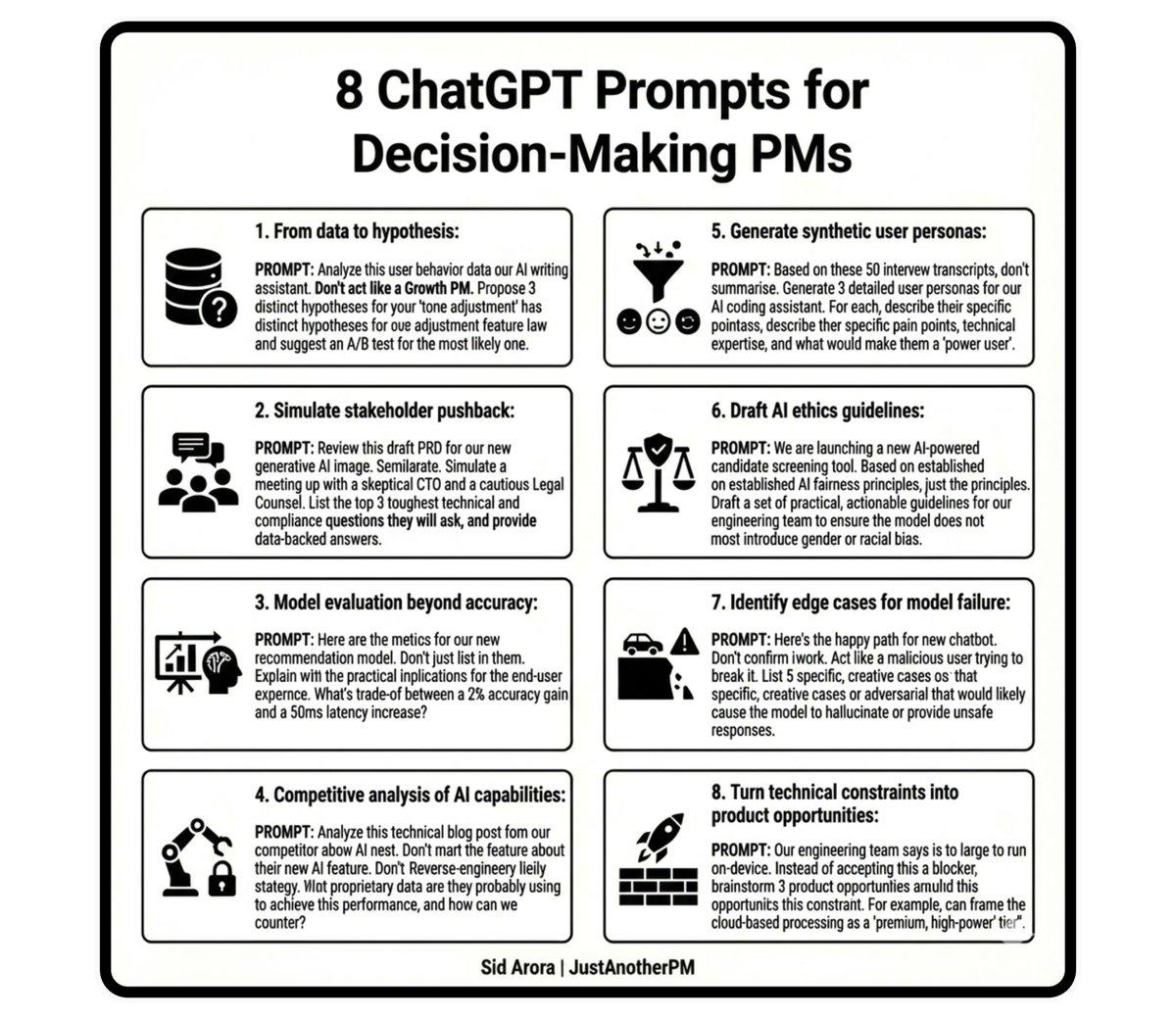
Product managers, if your best ChatGPT workflow is “summarise this,” you’re already behind. Here are 8 prompts that turn ChatGPT from a reading tool into a decision-making weapon for PMs. 𝟭. 𝗙𝗿𝗼𝗺 𝗱𝗮𝘁𝗮 𝘁𝗼 𝗵𝘆𝗽𝗼𝘁𝗵𝗲𝘀𝗶𝘀: 𝗣𝗥𝗢𝗠𝗣𝗧: Analyze this user behavior data from our AI writing assistant. Don't summarize. Act like a Growth PM. Propose 3 distinct hypotheses for why our ‘tone adjustment’ feature has low adoption, and suggest an A/B test for the most likely one. 𝟮. 𝗦𝗶𝗺𝘂𝗹𝗮𝘁𝗲 𝘀𝘁𝗮𝗸𝗲𝗵𝗼𝗹𝗱𝗲𝗿 𝗽𝘂𝘀𝗵𝗯𝗮𝗰𝗸: 𝗣𝗥𝗢𝗠𝗣𝗧: Review this draft PRD for our new generative AI image feature. Simulate a meeting with a skeptical CTO and a cautious Legal Counsel. List the top 3 toughest technical and compliance questions they will ask, and provide data-backed answers. 𝟯. 𝗠𝗼𝗱𝗲𝗹 𝗲𝘃𝗮𝗹𝘂𝗮𝘁𝗶𝗼𝗻 𝗯𝗲𝘆𝗼𝗻𝗱 𝗮𝗰𝗰𝘂𝗿𝗮𝗰𝘆 𝗣𝗥𝗢𝗠𝗣𝗧: Here are the metrics for our new recommendation model. Don't just list them. Explain the practical implications for the end-user experience. What's the trade-off between a 2% accuracy gain and a 50ms latency increase? 𝟰. 𝗖𝗼𝗺𝗽𝗲𝘁𝗶𝘁𝗶𝘃𝗲 𝗮𝗻𝗮𝗹𝘆𝘀𝗶𝘀 𝗼𝗳 𝗔𝗜 𝗰𝗮𝗽𝗮𝗯𝗶𝗹𝗶𝘁𝗶𝗲𝘀 𝗣𝗥𝗢𝗠𝗣𝗧: Analyze this technical blog post from our competitor about their new AI feature. Don't summarize the feature. Reverse-engineer their likely data strategy. What proprietary data are they probably using to achieve this performance, and how can we counter it? 𝟱. 𝗚𝗲𝗻𝗲𝗿𝗮𝘁𝗲 𝘀𝘆𝗻𝘁𝗵𝗲𝘁𝗶𝗰 𝘂𝘀𝗲𝗿 𝗽𝗲𝗿𝘀𝗼𝗻𝗮𝘀 𝗣𝗥𝗢𝗠𝗣𝗧: Based on these 50 user interview transcripts, don't summarise. Generate 3 detailed, synthetic user personas for our AI coding assistant. For each, describe their specific pain points, technical expertise, and what would make them a 'power user'. 𝟲. 𝗗𝗿𝗮𝗳𝘁 𝗔𝗜 𝗲𝘁𝗵𝗶𝗰𝘀 𝗴𝘂𝗶𝗱𝗲𝗹𝗶𝗻𝗲𝘀 𝗣𝗥𝗢𝗠𝗣𝗧: We are launching a new AI-powered candidate screening tool. Based on established AI fairness principles, don't just list the principles. Draft a set of 5 practical, actionable guidelines for our engineering team to ensure the model does not introduce gender or racial bias. 𝟳. 𝗜𝗱𝗲𝗻𝘁𝗶𝗳𝘆 𝗲𝗱𝗴𝗲 𝗰𝗮𝘀𝗲𝘀 𝗳𝗼𝗿 𝗺𝗼𝗱𝗲𝗹 𝗳𝗮𝗶𝗹𝘂𝗿𝗲 𝗣𝗥𝗢𝗠𝗣𝗧: Here's the happy path for our new chatbot. Don't just confirm it works. Act like a malicious user trying to break it. List 5 specific, creative edge cases or adversarial prompts that would likely cause the model to hallucinate or provide unsafe responses. 𝟴. 𝗧𝘂𝗿𝗻 𝘁𝗲𝗰𝗵𝗻𝗶𝗰𝗮𝗹 𝗰𝗼𝗻𝘀𝘁𝗿𝗮𝗶𝗻𝘁𝘀 𝗶𝗻𝘁𝗼 𝗽𝗿𝗼𝗱𝘂𝗰𝘁 𝗼𝗽𝗽𝗼𝗿𝘁𝘂𝗻𝗶𝘁𝗶𝗲𝘀 𝗣𝗥𝗢𝗠𝗣𝗧: Our engineering team says the new model is too large to run on-device. Instead of accepting this as a blocker, brainstorm 3 product opportunities this constraint creates. For example, can we frame the cloud-based processing as a 'premium, high-power' tier? P.S. The prompts in this post are just the starting point. In 𝗔𝗜 𝗣𝗠 𝗔𝗰𝗰𝗲𝗹𝗲𝗿𝗮𝘁𝗼𝗿, we go deep into model evaluation, evals, and building a functional AI product. Don't just learn AI, build it. Get on the waitlist to know more 👇

@alliekmiller ·
Let’s review the ChatGPT Finance feature👀 TLDR - I don’t think most people need this in its current state. Example financial institutions you can connect into via Plaid: - American Express - Bank of America - Charles Schwab - Capital One - Wells Fargo - Robinhood - Discover - TD Bank - Citibank - Chase - SoFi Example use cases from OpenAI: - Review subscriptions and bills - Cash flow and income trends - Finding unusual transactions - Spending breakdowns - Investment allocation - Debt payoff strategy At the moment, it seems to be more knowledge-based (ex: how much have I spent on childcare in the last 3 months) and less task-based (ex: send Mr Lundy $50k). The power will come from doing things in ChatGPT that you *can’t* do in a single banking platform. I want to see more focus on financial freedom, fulfillment, and security, as well as overall portfolio management in the examples. I don’t need ChatGPT to tell me my Bank of America balance. Waste of tokens. I can see that in two seconds in my app or ask the bank’s chatbot. Power usage would be things like “analyze my spend and balance patterns across Chase, BofA, and Wells. Spin up 29 agents to research all offerings from those three. Suggest new reallocation plan to maximize liquidity and guarantee minimum 4% returns” or “across all of my investment dollars, run simulations of the economy (research predictions from Stanford, MIT, etc and map them out) for the next two years, build an ML model to predict the likelihood that I can buy a $5M home in the next 2 years” or “graph my finances against my calendar for the last 2 years, help me score my time usage against my FIRE goals while increasing my social time by at least 1h per week” or even “look at all my finances. Spin up scheduled agents that do smart things that relate to my goals. If you need clarification, interview me”

@shushant_l ·
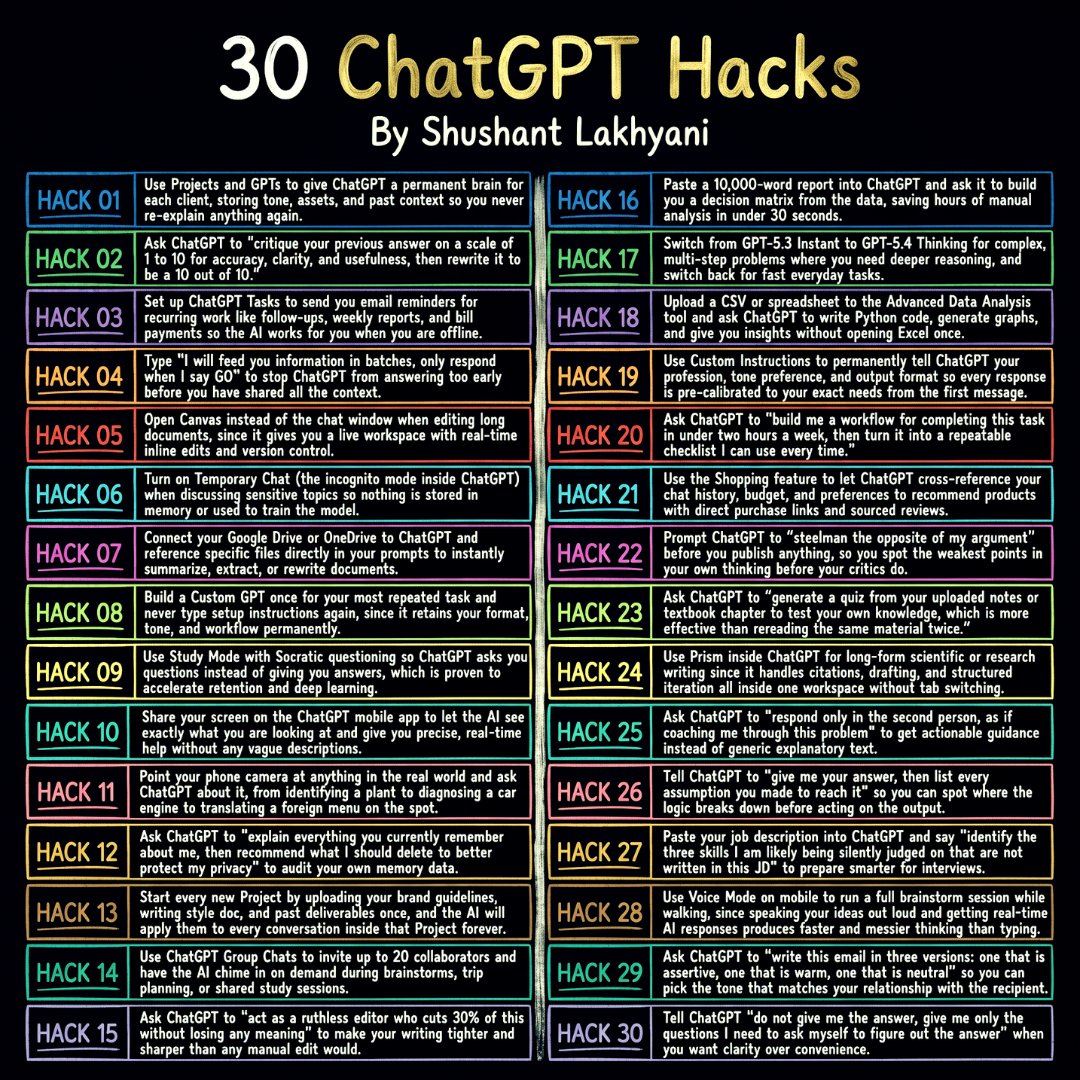
I'm sad to see most people are still using ChatGPT in beginner mode. Here are 30 ChatGPT hacks that will help you get more done in less time with AI. 📂 chatgpt ┃ ┣ 📂 setup & memory ┃ ┣ 📂 projects ┃ ┣ 📂 custom gpts ┃ ┣ 📂 custom instructions ┃ ┣ 📂 temporary chat ┃ ┗ 📂 memory audit ┃ ┣ 📂 output optimization ┃ ┣ 📂 self critique ┃ ┣ 📂 rewrite to 10/10 ┃ ┣ 📂 second person mode ┃ ┣ 📂 assumption breakdown ┃ ┗ 📂 multi version outputs ┃ ┣ 📂 workflow systems ┃ ┣ 📂 task automation ┃ ┣ 📂 recurring reminders ┃ ┣ 📂 weekly workflows ┃ ┣ 📂 checklists ┃ ┗ 📂 time bound execution ┃ ┣ 📂 context control ┃ ┣ 📂 batch feeding ┃ ┣ 📂 context locking ┃ ┣ 📂 file referencing ┃ ┣ 📂 structured inputs ┃ ┗ 📂 long context handling ┃ ┣ 📂 writing & editing ┃ ┣ 📂 ruthless editing ┃ ┣ 📂 tone matching ┃ ┣ 📂 style replication ┃ ┣ 📂 draft refinement ┃ ┗ 📂 precision rewrites ┃ ┣ 📂 research & analysis ┃ ┣ 📂 decision matrices ┃ ┣ 📂 data analysis ┃ ┣ 📂 spreadsheet insights ┃ ┣ 📂 python execution ┃ ┗ 📂 deep reasoning mode ┃ ┣ 📂 learning & thinking ┃ ┣ 📂 socratic mode ┃ ┣ 📂 quiz generation ┃ ┣ 📂 opposite argument ┃ ┣ 📂 critical thinking ┃ ┗ 📂 question first mode ┃ ┣ 📂 content creation ┃ ┣ 📂 email writing ┃ ┣ 📂 multi tone drafts ┃ ┣ 📂 structured writing ┃ ┣ 📂 research writing ┃ ┗ 📂 citation handling ┃ ┣ 📂 real world interaction ┃ ┣ 📂 screen sharing ┃ ┣ 📂 camera input ┃ ┣ 📂 voice mode ┃ ┣ 📂 live assistance ┃ ┗ 📂 real time feedback ┃ ┣ 📂 collaboration ┃ ┣ 📂 group chats ┃ ┣ 📂 brainstorming ┃ ┣ 📂 shared sessions ┃ ┣ 📂 team workflows ┃ ┗ 📂 idea expansion ┃ ┣ 📂 career & growth ┃ ┣ 📂 resume tailoring ┃ ┣ 📂 job matching ┃ ┣ 📂 skill detection ┃ ┣ 📂 interview prep ┃ ┗ 📂 career strategy ┃ ┣ 📂 advanced usage ┃ ┣ 📂 gpt switching ┃ ┣ 📂 fast vs thinking mode ┃ ┣ 📂 tool selection ┃ ┣ 📂 mode optimization ┃ ┗ 📂 hybrid workflows ┃ ┣ 📂 productivity ┃ ┣ 📂 time saving ┃ ┣ 📂 automation thinking ┃ ┣ 📂 decision speed ┃ ┣ 📂 clarity boost ┃ ┗ 📂 execution focus ┃ ┗ 📂 mastery ┣ 📂 systems over prompts ┣ 📂 repeatable frameworks ┣ 📂 context engineering ┣ 📂 output control ┗ 📂 ai first thinking

@daviefogarty ·
ChatGPT + Claude has levelled the playing field between year 10 and year 0 brands with their creative strategies. Every new technological shift creates a window where experience matters less than execution speed. AI is that ‘window’ right now - and the reason it's still wide open is the friction in it. Things are confusing, things are going to break. That friction is your opportunity to create value that's not being created in this world and make a lot of money from it. When I look at where AI should be used in e-commerce, I use a few criteria: > I look at volume. It handles it very well. > Then I look at value. How much will it actually improve things? > Then I look at variability. If the situation is unpredictable, you need human input. > Then I look at verifiability. AI can hallucinate, so you need to make sure what it outputs is actually accurate. The reason AI is so good for e-commerce is that you can build 10 advertorials in a day with AI, and volume negates luck. Here’s how I’d start leveraging AI with creatives ASAP: 1. Download all your customer reviews, your competitors' reviews, and your top advertorials, then feed them into ChatGPT. 2. Run deep research and create everything you need to know about your customer. 3. Put that customer doc into Claude and give it the structure of the advertorial you want to write with a proper prompt. 4. Break it up and baby it through each step, because AI doesn't handle large blobs of data well. Give it 12 angles first, select the best ones, then prompt it with questions about what you know about your customer. From there, you'll start to get a lot more winners. 90% of people will use AI to do tasks. The 10% who win will use AI to direct outcomes. AI doesn't replace your best creative yet, but it makes everything around it significantly stronger.

@goyalshaliniuk ·
ChatGPT launches Work, a new agent powered by Codex and GPT-5.6. It is built to move beyond simple prompts and help complete longer projects across apps, files, code, documents, spreadsheets, and presentations. The bigger shift is clear: AI is no longer just answering questions. It is starting to take goals, break them into steps, and turn them into finished work.
 Watch video

@_simonsmith ·
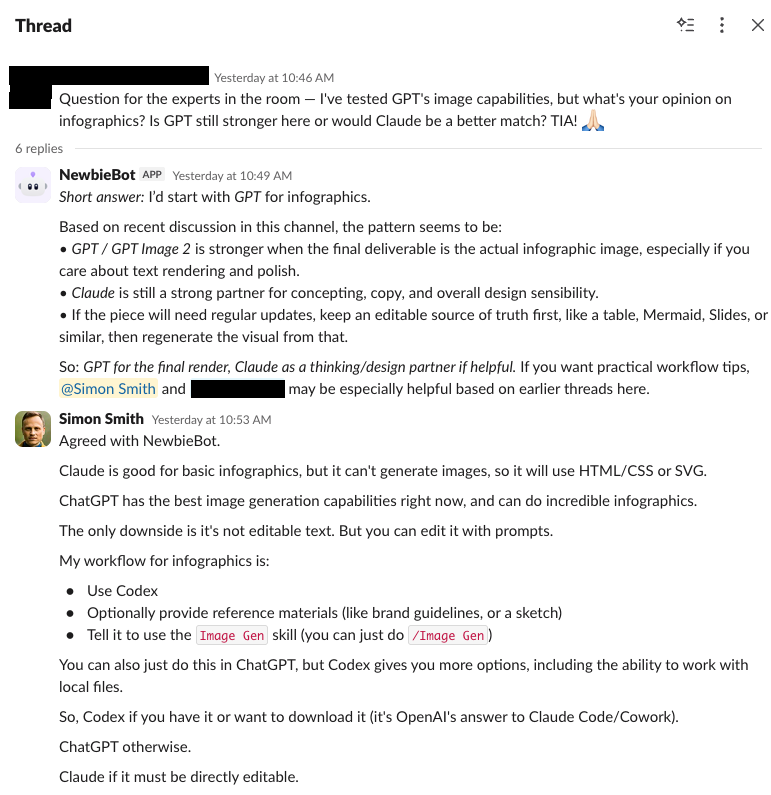
A great use of ChatGPT Workspace Agents a colleague discovered (thanks, DL): Self-updating support agents. We have a Slack channel for people newer to AI, for example. People ask questions, and others in the group answer. That creates a large, continuously updated knowledge base of answers. But finding and synthesizing answers across a Slack channel isn't easy. Enter NewbieBot. Whenever someone posts a question to the channel, it looks at previous answers and tries to synthesize a response as well as tag people into the conversation most likely to be helpful based on their prior responses. And, surprisingly even to me, it's almost always on point. This seems like such a basic use case, but it's quite powerful because it gets people unstuck quickly. It's also something we're looking to extend to other internal channels, like for office tech support.

@alexabelonix ·
Prompts to Turn ChatGPT Into Your Personal Tutor 1. Active Recall Quiz After studying [topic], quiz me with detailed questions and provide immediate feedback. Ensure the questions cover all key concepts and provide explanations for any incorrect answers. 2. Creative Problem-Solving Present a problem related to [topic] and guide me through brainstorming potential solutions step-by-step. 3. Mnemonic Devices Create mnemonic devices to help me remember key facts about [topic]. Ensure the mnemonics are easy to recall and relate directly to the information I need to memorize. 4. Socratic Dialogue Guide me through a Socratic dialogue on [concept]. Ask questions that will help me uncover the deeper layers of this idea and refine my understanding step-by-step. 5. Spaced Repetition Schedule Design a spaced repetition schedule for reviewing [topic] over the next month, including daily and weekly review tasks. 6. Interactive Case Study Walk me through a detailed case study related to [subject]. Present the scenario, ask me questions to test my understanding, and offer feedback based on my answers. 7. Historical Analysis Provide an in-depth analysis of how [historical event] impacted [field of study]. Draw parallels to modern-day applications and discuss how we can learn from this event. 8. Concept Simplifier Explain [complex topic] in simple terms that a beginner can easily understand, using analogies where possible. Or try: "Explain to a 12-year-old [concept]." 9. Daily Habits for Learning Suggest daily habits or routines to integrate learning about [topic] into my life effectively. 10. Create a MindMap from any topic Create a mind map of [topic]. List topics as central ideas, main branches, and sub-branches. Give me the same mind map in markdown format. Copy/past the result to Markmap.

@jappleby ·
Alright, I have an AI question for everyone: ChatGPT, Claude, neither, or both? For context, here's what I currently use AI for: 1. Turning ideas into finished outputs You bring rough ideas—newsletter concepts, LinkedIn posts, video ideas, business opportunities—and ChatGPT helps turn them into structured drafts, outlines, scripts, or execution plans. This includes: - Structuring and drafting Future Social newsletters - Refining LinkedIn posts and content hooks - Writing and sequencing short-form video scripts - Turning vague ideas into clear, publishable content - Framing narratives around Hoop Forever and your basketball journey It accelerates the transition from “I have an idea” to “this is ready to ship.” 2. Planning and managing your business and basketball operations You use ChatGPT to think through logistics, planning, and operational decisions across both Future Social and Hoop Forever 3x3. This includes: - Planning tournament travel, scheduling, and logistics - Structuring sponsorship packages and business opportunities - Mapping content calendars and publishing timelines - Breaking large projects into step-by-step execution plans - Thinking through financial, strategic, and operational decisions It functions like a COO helping you organize and execute complex initiatives. 3. Acting as persistent context for your life and projects ChatGPT remembers your goals, projects, routines, and constraints, so you don’t have to reload everything mentally each time you sit down to work. This includes: - Maintaining continuity across your content, business, and basketball operations - Helping you pick up where you left off without re-explaining everything - Providing advice based on your actual goals, history, and priorities - Helping coordinate multiple simultaneous projects It reduces cognitive overhead and keeps momentum intact. 4. Helping you think through decisions and strategy You use ChatGPT to pressure-test ideas, explore options, and think through decisions more clearly. This includes: - Evaluating business opportunities and strategic choices - Exploring creative directions and narrative positioning - Breaking down complex topics into usable mental models - Identifying risks, tradeoffs, and better approaches It acts as a strategic sounding board. 5. Helping you regain clarity and momentum when stuck or overwhelmed When you feel stuck, uncertain, or overloaded, ChatGPT helps you reset by structuring the problem and identifying the next concrete step forward. This includes: - Helping you prioritize what to work on - Breaking overwhelming projects into manageable pieces - Providing clarity when you’re unsure what to do next - Helping you move from thinking to action - It reduces friction and restores forward motion. In practical terms: You use ChatGPT to run your content engine, plan your business and basketball operations, refine your thinking, maintain continuity across projects, and consistently convert ideas into execution.

@JJEnglert ·
OpenAI just launched @ChatGPT Work, its answer to Claude Cowork — and it matters because this is another step towards “AI that helps you think” to "AI that can help you finish work". ChatGPT Work brings together the pieces knowledge workers need in one place: • Voice mode for directing work naturally (actually fire) • Sub-agents that can tackle separate tasks in parallel (with great visibility into what they're doing) • Skills that turn repeatable processes into reusable playbooks (easily recordable with your normal routines) • Browser and computer control for work that normally dies at the “now go do it” step (one of the best browsers on the market) • Integrations for the tools where your real context already lives (Deep enough to have what you need) The useful question is not “Can it write an email?” It’s: what outcome do you repeatedly assemble from research, decisions, drafts, files, reviews, and follow-up? That could be preparing a client brief, researching a market, turning a meeting into an action plan, building a campaign, organizing a project, or creating the first version of a website. Instead of prompting for every tiny step, you can describe the outcome, turn on /goal mode and let it cook. I tested it end to end—voice mode, sub-agents, skills, browser control, image edits, and a live coffee-brand launch—with my hands off the keyboard. Here’s what worked, what still needs judgment, and how I’d use it as a knowledge worker:
 Watch video

@DivyanshT91162 ·
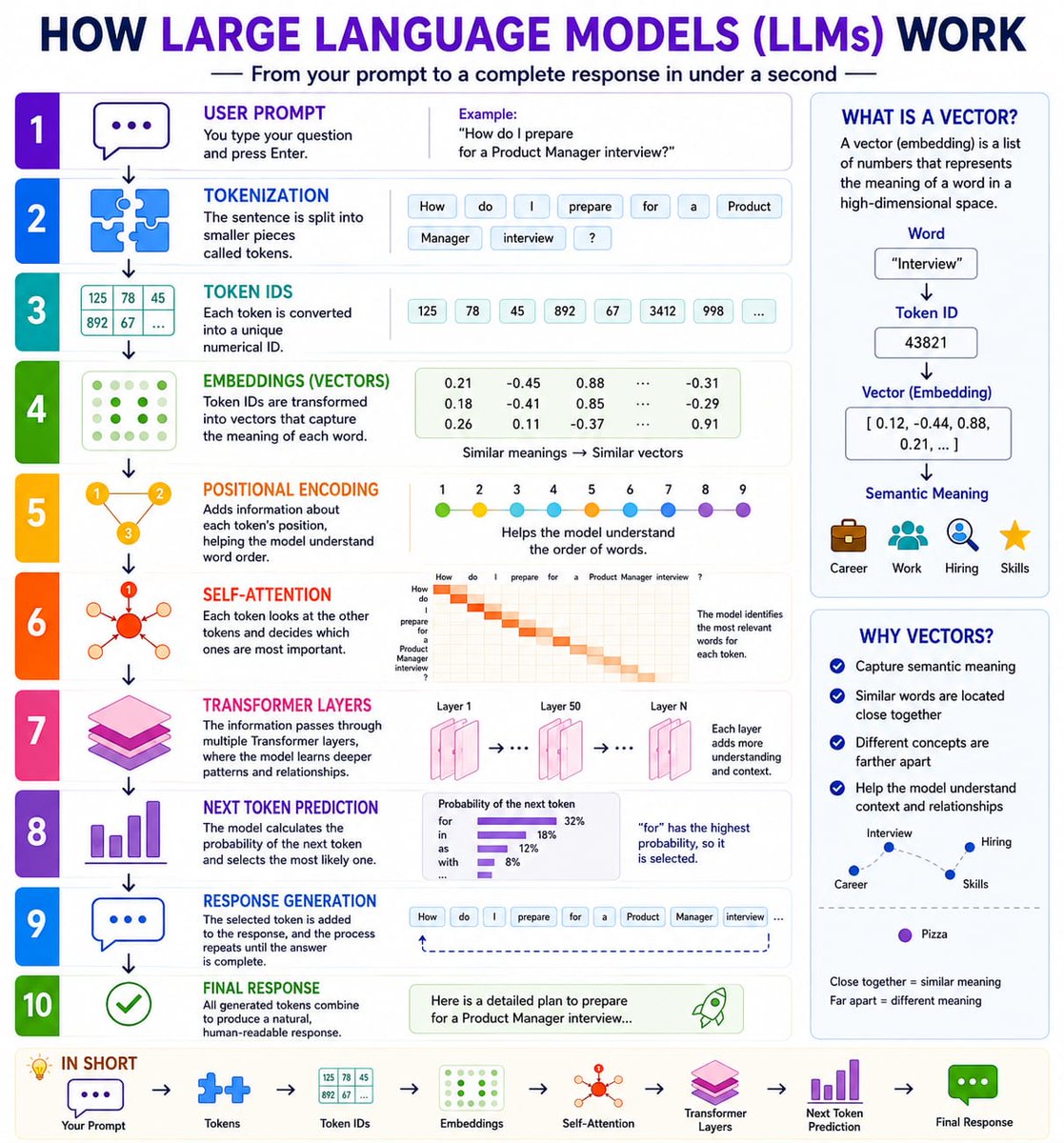
You're using ChatGPT every day. But there's a good chance you have no idea what happens after you press "Enter." No magic. No secret database. No human sitting behind the screen. Just a fascinating process that turns your prompt into a response in under a second. If you understand these 10 steps, you'll know more about LLMs than 95% of people using AI today. Here's what actually happens behind the scenes: 1. You write a prompt. 2. Your text is split into smaller pieces called tokens. 3. Every token gets a unique numerical ID. 4. Those IDs are converted into embeddings (vectors that represent meaning). 5. Positional encoding tells the model the order of the words. 6. Self-attention identifies which words are most important for understanding the context. 7. Transformer layers refine that understanding by learning patterns and relationships. 8. The model predicts the most likely next token. 9. It repeats this process hundreds of times until the response is complete. 10. Those generated tokens become the final answer you read. That's the entire pipeline. The model isn't searching Google. It isn't pulling a pre-written answer from a database. It's predicting the next most likely token, one step at a time, at incredible speed. Once you understand this workflow, concepts like embeddings, attention, context windows, RAG, AI agents, reasoning models, and memory suddenly make a lot more sense. AI feels much less like magic—and much more like engineering. Bookmark this thread. You'll come back to it whenever you're learning a new AI concept.

@julesterpak ·
Some different ways I use ChatGPT: • I love to screenshot something before I tweet it and ask ChatGPT “Thoughts?” to see if it got what I was putting down. I mostly do this for tweets that I’m not sure make sense and it’s fascinating to see how it interprets them and makes me reflect more deeply on my wording • Sometimes when I’m contemplating a big decision, I very vaguely tell ChatGPT the type of conclusion I came to regarding [insert broad situation] and ask how each of the major world religions might view that decision. Can’t remember if it ever led to me changing my mind, but always interesting • Especially when I was doing/do work that can be characterized as more “journalistic” or “truth-seeking”, I’ll copy my genuine writing into ChatGPT and ask what voids there are in the work that people might point out. This helps me make sure I was thorough Those are just a couple examples, but I’d love to hear other people’s favs

@semrush ·
ChatGPT is now a standard part of how people use the web, as one piece of a complex, interconnected search journey. We dug into 17 months of clickstream data to map how ChatGPT usage is changing, how referral traffic is growing, and where that traffic goes. If you're a marketer, understanding how your audience uses ChatGPT and where it exists in this buyer journey is critical for understanding how best to reach them. Key takeaways: • Outbound referral traffic from ChatGPT to the rest of the web grew 206% in 2025. • Over 30% of all referral traffic from ChatGPT goes to 10 domains. And over 20% goes to Google. • ChatGPT enables its search feature on just 34.5% of queries as of February 2026 – down from 46% in late 2024 – meaning most responses still rely on training data alone. • Users are asking more prompts per session. After 12 months of flat engagement, average queries per session jumped 50% in the last four months of our study period. Full study: https://t.co/Bg8n9GXf75.


@gracepace_ ·
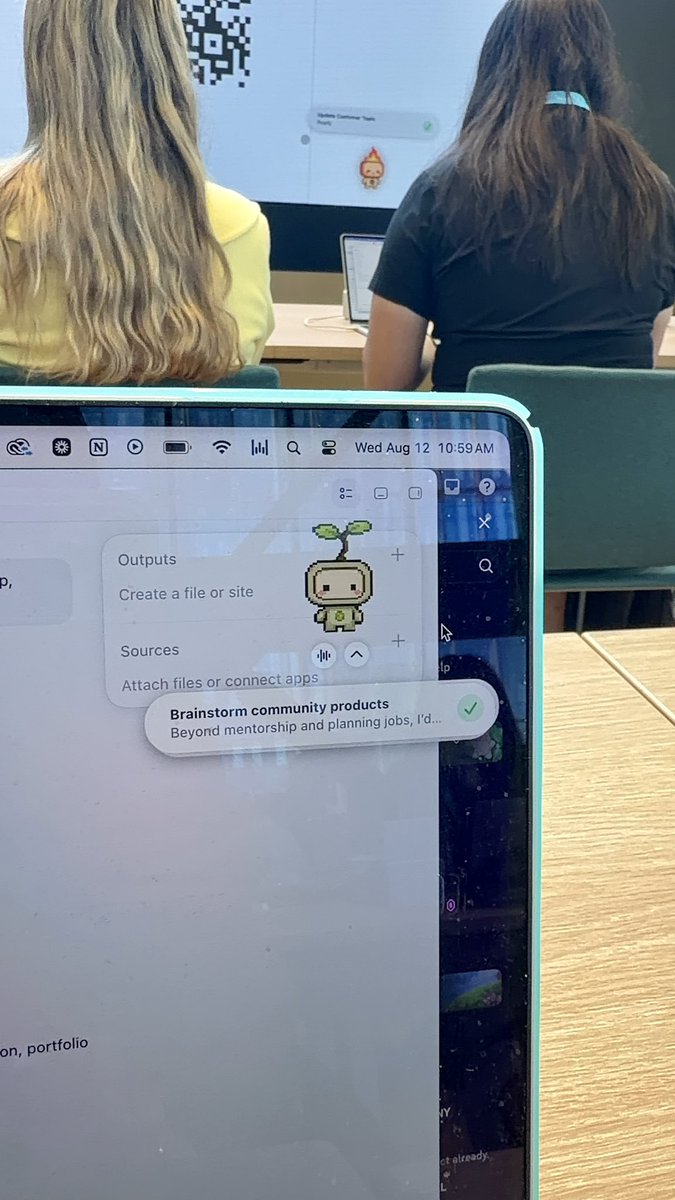
OpenAI invited me to their creator academy in San Francisco. Here’s what they showed us: - PETS!! Lives on your desktop and tells you when more complex tasks are finished. - Voice mode: Orb that floats across your screen. Talk to it and it will perform tasks for you - Scheduled tasks: Can email you a personalized newsletter of everything most relevant to you - Sites: Turn anything into a website with one sentence - Computer use: Do tasks for you, but you can approve before it sends that message - Artifacts: Creates docs, sheets, etc. I’ve used this to make google forms for user research for me too!! Cool use cases: - Create a site to help you research and buy a car! - Asking Codex to build a plugin to summarize your Discord and send reminders - Scraping your entire email inbox to see important ones you might have missed - Turning your travel itinerary into a pretty site - Analyzing all your content and understanding why certain posts perform better - Turning any complex spreadsheets into an easily browsable site (like brand deal trackers) I also got to demo me using ChatGPT to give me makeup suggestions (I just learned how to do makeup 3 months ago, but got millions of views on my makeup videos somehow….) I think the future of software is custom. It’s so easy for anyone to build their own custom software now with cools like Codex. But paired with cowork (tasks) and chat (quick answers & advice) That’s what I’ve been doing with Design Buddies. I’ve built my own apps like Hop (design mentorship platform), design resources, job boards, etc. Based on my unique community needs! AI can never replace understanding those needs though. I still talk to every user so I can understand their goals & pain points to build what they need. You can do anything. The best tech support is ChatGPT. Speakers: Sahil, Kelsey, Laura! Thanks KC for inviting me! What are your favorite ChatGPT workflows? We love @OpenAI @ChatGPT




@xiz25 ·
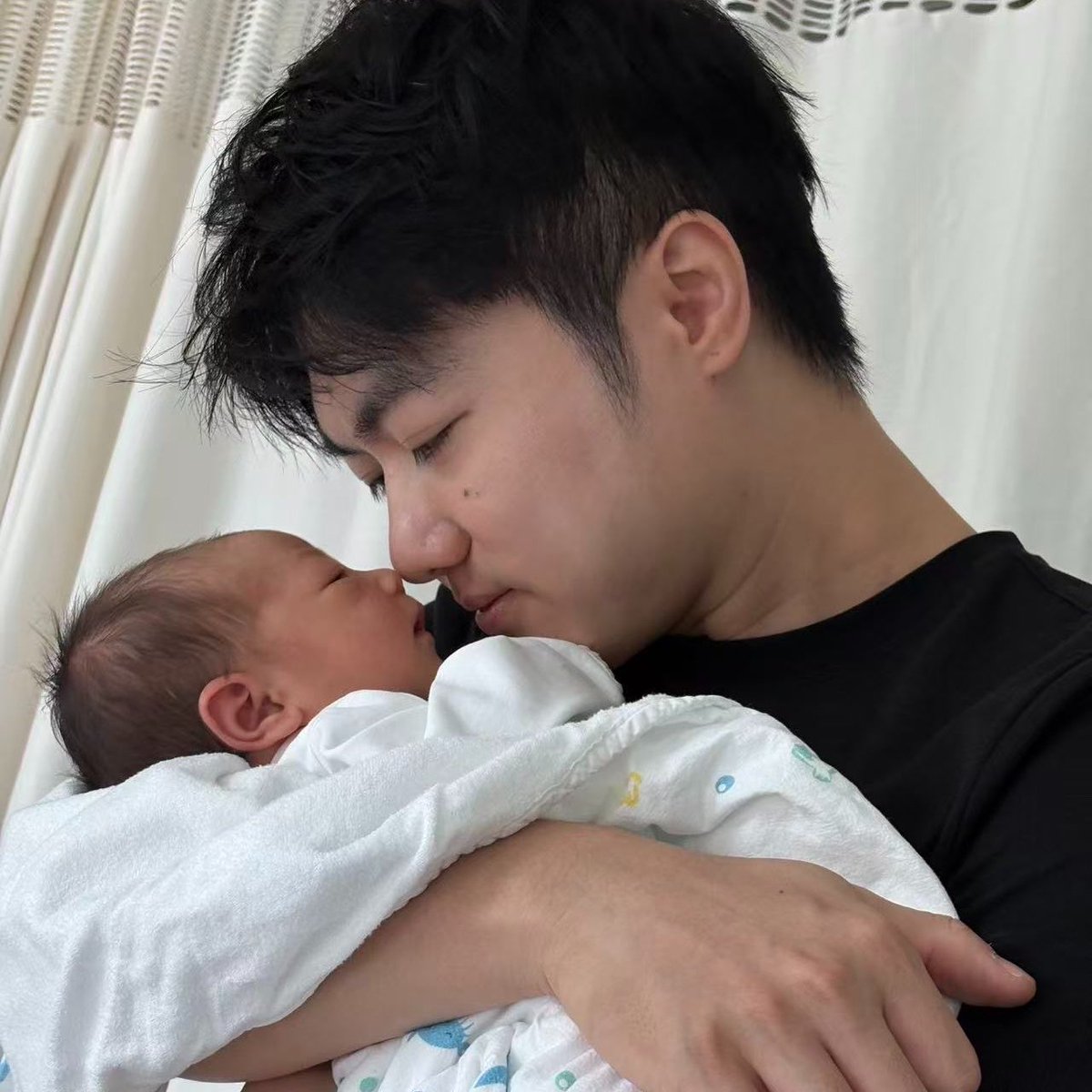
Found the most mind-blowing real-world use of ChatGPT Live. I often can’t tell what my newly born baby girl needs from her cries alone. But GPT Live breaks down her crying’s frequency, audio traits, decibels and all kinds of acoustic details I’d never parse myself, cutting down the list of possible issues instantly so I know exactly what she wants. This is way more than just chatbot chitchat—it perfectly showcases how powerful audio multimodal AI truly is. Respect @sama

@feifei_qiu ·
ChatGPT just launched ChatGPT for Teens It’s great to see @OpenAI focusing more on education and kids. But I’m not sure the same chatbot-style experience is the right way to solve this. When you give kids two options: “Give me the answer” or “Teach me step by step,” some kids will naturally take the easier route. AI should be more like a guide. Like a teacher or parent sitting next to kids, observing what they’re doing, noticing where they get stuck, and asking open-ended questions that help then figure out the next step on their own.


@Siddharth87 ·
Been playing with the ChatGPT Live voice model a lot recently and I'm loving how natural the conversation sounds. Lots of great use cases for this kind of tech. I made a video to demonstrate how to use ChatGPT Live for: → Thinking through unfinished ideas out loud → Practising sales calls, interviews, and negotiations → Learning languages through natural conversation → Researching plans while ChatGPT asks clarifying questions → Getting hands-free guidance while cooking or working → Discussing images and visual information I also break down how it works, how it differs from the previous version of ChatGPT Voice Let me know what you think!
 Watch video

@gaganghotra_ ·
🆕 OpenAI CFO claims - ChatGPT have 11% search marketshare! if each prompt during a chat session is counted as single Google Search query #SEO Here is what she said 👇 "we know we have at least 11 of the search market. It’s a lot more because actually when you do a Google Search and the page refreshes that counts as one in ChatGPT when you do a whole conversation where you might ask 50 questions that also only counts as one. So in reality, we have a much higher portion, very high intent.” PS - this clip from her recently published interview at ALL-IN Summit https://t.co/h7NjxS9nDZ
 Watch video

@Mr_Rbd_ ·
How to warm up ChatGPT super fast to improve your store copy 1. “Give me 10 possible personas if I’m selling this product” → drop a competitor link 2. “Now give me 10 marketing angles that could hit personas 1/2/3/5/6/9” → pick the personas you actually want to keep 3. “I’m gonna give you a list of reviews, from that tell me the 5 things people liked the most and least” → copy paste all the reviews from a competitor (or Amazon). don’t overthink the format, just dump everything, ChatGPT will handle it From there you can ask whatever you want and the output will be way better than usual For example: give me 3 things I should push right above my ATC button / what would you write and show in the first section to target the personas we picked so they actually feel the need for the product…

@RandallKanna ·
People are thinking about AI search in the wrong way. They ask, “Does ChatGPT recommend my company when someone asks for the best tool in my XYZ category?” But the bigger opportunity is earlier than that. It's actually in the discovery prompts. Prompts where your buyer is actually going to discover you and discuss the problem before they search for a solution. IE: Prompts like, "how do I solve this problem?" "what should I use if…" "what are my options for…" "how are teams handling…" prompts. That is where buyers are forming the shortlist before they ever search your brand name. And most companies are not checking those at all.

@glenngabe ·
Interested in ChatGPT Ads? -> OpenAI partners with Smartly, an adtech company that helps clients optimize ads in real time, to design ad formats that match ChatGPT's conversational interface "Smartly has signed entertainment, retail, and sports clients to participate in a pilot. Initially, Smartly will help these companies tweak their ChatGPT ads in real time. There's a bigger vision, though. Smartly's ultimate goal is to help OpenAI build interactive ad formats that let brands mimic ChatGPT's conversational interface." "Desmond cited Smartly's conversational ads for the UK retailer Boots, which run on Meta platforms like Instagram, as an example of the type of ad format OpenAI could eventually adopt. In that case, a chatbot pops up in a new window when the user clicks it and serves gift recommendations in response to a series of questions. Smartly said the ad format was nearly five times as effective at driving sales as Meta's basic ads." "The opportunity with conversational advertising is you can do more follow-ups, and you can ask again," https://t.co/ZrJA4WBTrX

@bg2clips ·
Nick Turley and Apoorv Agrawal discuss ChatGPT as a real-time thought partner: "ChatGPT has become indispensable as a thought partner... If you have a really specific scenario or you think it's a specific scenario to you, ChatGPT really comes through and can help you build confidence... If ChatGPT can make you feel like you have agency and control, I think that's really valuable." — @nickaturley & @Apoorv03 on @BG2Pod
 Watch video
Best Tweets by Topic