AI-powered vibe coding
Natural-language prompting replaces manual coding for building apps, websites, and software.
58%
Best tweets about No-Code
A curated collection of the sharpest, most-shared X posts about no-code—saved so you do not have to dig through the timeline yourself. Updated weekly.
Builders shipping real products without writing a line of backend code.
Original Xholic analysis
No-code conversation centers on AI-assisted builders using domain knowledge and clear specifications to create apps, internal tools, and businesses. Alongside enthusiasm, posts stress that clear rules, testing, security, logs, and deployment knowledge still matter before shipping. [2026058635718398029, 2039757304220762128, 2033880731202547784, 2086648861523644505]
76% of posts
All-time engagement
36% of posts
Published in 90 days
Conversation map
Natural-language prompting replaces manual coding for building apps, websites, and software.
58%
Founders, designers, operators, tradespeople, and knowledge workers build products without traditional engineering backgrounds.
54%
Builders describe requirements, generate implementations, review outputs, test, iterate, and deploy.
40%
The durable builder skill shifts toward problem selection, specifications, workflow design, taste, and distribution.
34%
Visual builders, coding agents, databases, automation platforms, payments, analytics, and deployment tools used to ship products.
30%
AI and no-code enable bespoke workflows, micro-apps, and domain-specific tools that were previously too expensive to build.
24%
Fast, inexpensive app creation supports solo founders, agency delivery, monetized products, and build-versus-buy decisions.
20%
AI-built software and natural-language automations modernize spreadsheet-based processes and disconnected operational work.
14%
Tone and stance
Performance benchmark
Posts with media make up 46% of this collection. Their median all-time score is 18.6, compared with 8.05 for text-only posts.
Format mix
Consensus and debate
Shared view
Posts repeatedly frame natural-language direction, review, and iteration as the core building loop, shifting attention from hand-writing code toward specifying the product and checking outcomes.
Shared view
Examples emphasize operators and non-engineers building tools around firsthand workflows, including agency operations, trades, and bespoke internal systems.
Shared view
Posts argue that faster implementation does not remove the need for problem selection, clear requirements, architecture, testing, and distribution.
Open debate
Supporters describe rapid end-to-end app creation, while cautionary posts argue that edge cases, evolving workflows, and undefined rules are where prompt-built products can break down.
Open debate
Some posts portray plain language as lowering the technical barrier; others describe friction around installation, accounts, terminals, and foundational concepts for new users.
Open debate
The conversation includes warnings that AI-built automations need guardrails, logs, and testing, and reports that no-code hosting has been used for phishing infrastructure.
What performs
Deterministic analytics report a 163.356 median all-time score for lists and 29.28 for announcements, compared with 10.32 for case studies and 4.94 for opinion posts. The evidence includes a stack list and a high-scoring announcement, though the format results reflect small category counts for lists (3) and announcements (8).
Posts with media had an 18.604 median all-time score versus 8.048 for text-only posts. Tutorials had a 23.4 median, an association consistent with practical, visual walkthroughs as a promising packaging option.
The five supplied score outliers include an announcement, a case study, a prediction, and a list. Their common thread is a concrete claim about a building workflow, capability, or operational shift, rather than a single dominant format.
Statistical standouts
Creator landscape
The five most represented creators account for 18% of the selected posts.
1. andrew chen
@andrewchen
2 posts
2. Dhaval Makwana
@heyDhavall
2 posts
3. The Jobfather ® 🇯🇲🇨🇦🇬🇧
@TheJobfather__
2 posts
4. Todd Saunders
@toddsaunders
2 posts
5. Vaishnavi
@_vmlops
1 post
6. Aditya Chordia, CISSP, CIPP/E, CISA
@AdityaMBAsymbi
1 post
Andrew Chen’s two posts connect AI code generation to spreadsheet replacement and the possible spread of agentically coded apps; deterministic analytics assign his posts a 352.1 median all-time score.
Implementation-led posts describe stacks and workflows for agency delivery, prototyping, and product discovery, adding operational detail beyond broad predictions.
The evidence set contains 46 creators across 50 tweets, while the top five account for 18% of placement. This distribution suggests the conversation includes many distinct practitioner perspectives rather than being concentrated among a few accounts.
Since the previous snapshot
Themes, sentiment, stance, and post format are classified per tweet. All counts, shares, medians, creator concentration, freshness, and performance comparisons are then calculated directly from the published snapshot.
Xholic's all-time score compares engagement while accounting for reach, post age, and creator consistency. It is used for relative comparisons within this collection.
This report analyzes the exact 50-post snapshot shown below. AI identifies editorial categories and drafts explanations; all statistics are calculated from the snapshot, and every narrative claim is checked against cited posts before publication.
Best No-Code tweets
Ranked 01–50

@naval ·
Vibe Coding Is the New Product Management “There’s been a shift—a marked pronouncement in the last year and especially in the last few months—most pronounced by Claude Code, which is a specific model that has a coding engine in it, which is so good that I think now you have vibe coders, which are people who didn’t really code much or hadn’t coded in a long time, who are using essentially English as a programming language—as an input into this code bot—which can do end-to-end coding. Instead of just helping you debug things in the middle, you can describe an application that you want. You can have it lay out a plan, you can have it interview you for the plan. You can give it feedback along the way, and then it’ll chunk it up and will build all the scaffolding. It’ll download all the libraries and all the connectors and all the hooks, and it’ll start building your app and building test harnesses and testing it. And you can keep giving it feedback and debugging it by voice, saying, “This doesn’t work. That works. Change this. Change that,” and have it build you an entire working application without your having written a single line of code. For a large group of people who either don’t code anymore or never did, this is mind-blowing. This is taking them from idea space, and opinion space, and from taste directly into product. So that’s what I mean—product management has taken over coding. Vibe coding is the new product management. Instead of trying to manage a product or a bunch of engineers by telling them what to do, you’re now telling a computer what to do. And the computer is tireless. The computer is egoless, and it’ll just keep working. It’ll take feedback without getting offended. You can spin up multiple instances. It’ll work 24/7 and you can have it produce working output. What does that mean? Just like now anybody can make a video or anyone can make a podcast, anyone can now make an application. So we should expect to see a tsunami of applications. Not that we don’t have one already in the App Store, but it doesn’t even begin to compare to what we’re going to see. However, when you start drowning in these applications, does that necessarily mean that these are all going to get used or they’re competitive? No. I think it’s going to break into two kinds of things. First, the best application for a given use case still tends to win the entire category. When you have such a multiplicity of content, whether in videos or audio or music or applications, there’s no demand for average. Nobody wants the average thing. People want the best thing that does the job. So first of all, you just have more shots on goal. So there will be more of the best. There will be a lot more niches getting filled. You might have wanted an application for a very specific thing, like tracking lunar phases in a certain context, or a certain kind of personality test, or a very specific kind of video game that made you nostalgic for something. Before, the market just wasn’t large enough to justify the cost of an engineer coding away for a year or two. But now the best vibe coding app might be enough to scratch that itch or fill that slot. So a lot more niches will get filled, and as that happens, the tide will rise. The best applications—those engineers themselves are going to be much more leveraged. They’ll be able to add more features, fix more bugs, smooth out more of the edges. So the best applications will continue to get better. A lot more niches will get filled. And even individual niches—such as you want an app that’s just for your own very specific health tracking needs, or for your own very specific architectural layout or design—that app that could have never existed will now exist.”
 Watch video

@businessbarista ·
One of the most productive engineers I know cannot read code. @mvanhorn is not an engineer by training. He co-founded June, has 44,000 GitHub stars, and got contributions merged into Go & Python. I had him build live for an hour & walk me through his process. My fav lessons & quotes from the convo: 1) He never reads code. He does not have an IDE installed. In his words, "I fundamentally believe that very soon no humans should ever write any code and that no humans should ever read any code." 2) Every project starts with the agent writing itself a plan.md file using Compound Engineering. Agents are lazy, he says, and the plan keeps them honest. He never reads the plan either. "Plans are for agents, you silly human." 3) His CLIs leave notes for themselves. Each run records what it learned in a markdown file, so the next run starts where the last one ended. He calls them self-healing. 4) His agent has an email address. From Telegram on his phone, he sends a task. It emails his Mac, authenticated, and the work starts while he is at his kids' soccer practice. 5) He feeds whole transcripts, not summaries. After a two-hour meeting with a Google Ventures researcher, his agent read the researcher's entire book, wrote itself a report on every chapter, and turned it all into a plan for his business. 6) Him yapping to his agents is like nerd ASMR. "Go agent go" is how he likes to finish telling the agent what to do. 7) How he thinks about this next chapter of building: "Every generation of tools moves the engineer's job up a level. The code was never the point. The problem was."
 Watch video

@andrewchen ·
prediction re the end of spreadsheets AI code gen means that anything that is currently modeled as a spreadsheet is better modeled in code. You get all the advantages of software - libraries, open source, AI, all the complexity and expressiveness. think about what spreadsheets actually are: they're business logic that's trapped in a grid. Pricing models, financial forecasts, inventory trackers, marketing attribution - these are all fundamentally *programs* that we've been writing in the worst possible IDE. No version control, no testing, no modularity. Just a fragile web of cell references that breaks when someone inserts a row. The only reason spreadsheets won is that the barrier to writing real software was too high. A finance analyst could learn =VLOOKUP in an afternoon but couldn't learn Python in a month. AI code gen flips that equation completely. Now the same analyst describes what they want in plain English, and gets a real application - with a database, a UI, error handling, the works. The marginal effort to go from "spreadsheet" to "software" just collapsed to near zero. this is a massive unlock. There are ~1 billion spreadsheet users worldwide. Most of them are building janky software without realizing it. When even 10% of those use cases migrate to actual code, you get an explosion of new micro-applications that look nothing like traditional software. Internal tools that used to live in a shared Google Sheet now become real products. The "shadow IT" spreadsheet that runs half the company's operations finally gets proper infrastructure. The interesting second-order effect: the spreadsheet was the great equalizer that let non-technical people build things. AI code gen is the *next* great equalizer, but the ceiling is 100x higher. We're about to see what happens when a billion knowledge workers can build real software.

@AlexFinn ·
Don't listen to the jealous losers who are saying you can't vibe code serious apps 100% lies I vibe coded Creator Buddy using Codex/CC by myself. 0 lines of code written $300,000 ARR on 90% margins. Changed my life. You absolutely can do this. The steps are simple: 1. Ask Grok what challenges your audience on X has 2. Ask Grok for a solution to those challenges 3. Download Codex (you can use your $20 plan) 4. Put that solution into Codex 5. Watch Codex build the entire solution for you. 6. Release it to your audience By the time all the skeptics on X realize Codex is actually one of the most powerful softwares ever released, it will be too late Get to work

@Jacobsklug ·
I run the #1 vibe coding agency. We've built 250+ apps for clients using AI. Here's the exact tech stack behind every build: 1/ @Lovable This is our main coding agent. It gets us off the ground faster than anything else. Great design out of the box. Backend and infrastructure setup from the jump. We go from idea to working prototype in hours, not weeks. Every client project starts here. 2/ Supabase This is our backend of choice. Database, APIs, security, and auth all in one platform. The real advantage? It's baked directly into Lovable. No extra config. No messy integrations. You connect it once and everything just works. For us it was the obvious choice. 3/ Claude Cowork Lovable handles basic testing on its own. But when you're shipping real products for real clients, you need more. PlayerZero lets us run advanced product cycle testing in one automated process. Fewer bugs. Faster QA. Clients never see a broken build. 4/ Stripe Every app we build that takes money runs through Stripe. Subscriptions, one time payments, invoicing. It plugs into Supabase cleanly and Lovable can scaffold the full checkout flow in minutes. Payments used to be the hardest part of shipping. Now it's one of the fastest. 5/ Mixpanel You can't improve what you don't measure. Mixpanel gives us event tracking, funnels, and retention data from day one. We wire it into every client app so they know exactly where users drop off and what's converting. Analytics isn't optional. It's how you prove the app works. This stack lets a small team ship at the speed of a 50 person dev shop. No bloated tools. No unnecessary complexity. Just five platforms that do the job. That's how you build software in 2026.

@warikoo ·
In the last 10 days - Designed a fully working website from scratch, in 5 hrs - Drafted ~95%-ready legal documents for a new product in under 2 hrs - Created 100% ready presentations from mockups, in under 30 mins - Built a custom app for personal use in 3 hrs All using English as the programming and design language. "I don't know how to code' isn't the obstacle anymore. It is the willingness to do.

@DeRonin_ ·
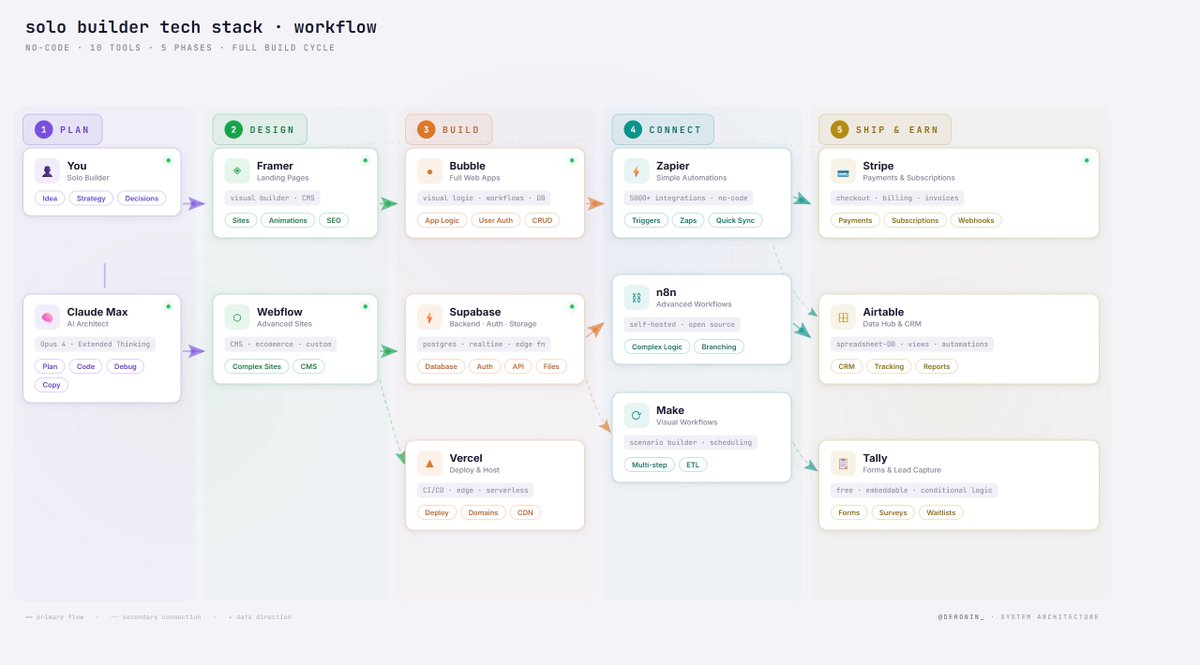
My tech stack for solo building (no-code): Framer – landing pages & websites Webflow – advanced site building Bubble – full web apps Airtable – database Zapier & n8n – automation Make – advanced workflows Stripe – payments Versel – deployment process for web apps Supabase – backend + auth + storage, all-in-one Tally – forms to be honest, I mostly use Claude Max, but there you usually have to work with code if you're just starting out, this stack will be more than enough but it really depends on how complex the thing you want to build is in many cases, working directly with code is still the better option no-code builders can leave gaps or not fully implement your idea that's the reality, but they're still very useful

@alexcooldev ·
I always use vibe coding tools like Rork before I start coding. They help me map out ideas and app flows fast, like sketching the product with AI. No real code yet, but you already feel how the app looks and works. Here’s how I usually do it: 1) Use ChatGPT to generate a detailed prompt based on my idea or upload screenshots of competitor apps so it can write a precise, complete prompt. 2) Paste that prompt into Rork, let it generate the flow → refine the logic, add features (login, AI chat, etc.) 3) Once it feels right, export the code and continue vibe coding inside Cursor. Why I love it: > No need for Figma > Iterate ideas faster > Visualize the app flow before touching real code Build smart, not just hard.


@patrick_oshag ·
Some early thoughts after building real apps by myself for the first time… We built an internal tool called Conveyor It’s an app builder, and internal App Store It is connected to all of our data, context, and external data APIs I’m completely and utterly useless as an engineer, but I’m good at knowing what I want a tool to do. I’d previously struggled to make useful programs with pure CLIs. Our wrapper made it easy for me. In the first 3 days of having this tool, I’ve built several fairly complicated applications, two of which I’ve used a ton for real work. I’ve only used a couple hundred million tokens so far. Some early feelings: 1) It’s obvious to my that my companies Positive Sum and Colossus will have fully bespoke operating systems, built in house. They will manage as much of our work as possible. This is already exploding for things like research and reporting. Every business will want this for themselves. Sure we won’t built our own slack, but we will built everything that pertains specifically to our shape as a firm, which is a lot. 2) x402 protocol (which enables AI agents and users to pay for API access and digital services instantly, without accounts or subscriptions) is immediately interesting to me. Many times I’ve wished I could just stream payments for individual data points. 3) right now each loop of prompt to output takes 5 to 15 minutes. As models and ASICs (@Etched !) make this faster, it’s going to be so much more fun. Even 5 minutes makes it hard to get in the flow. Can’t wait for seconds instead of minutes. 4) it’s so much easier to design things by starting with a shitty first draft of an app and seeing what’s wrong and iterating than nailing a full design ahead of time. When I had directed the design of software before this was always maddening and slow. 5) this has made me realize that my imagination had atrophied. Use it or lose it is real. Very quickly I’m finding it easier to have good ideas by building more stuff. I encourage everyone to do the same. So fun and rewarding. 6) We need more compute

@itsolelehmann ·
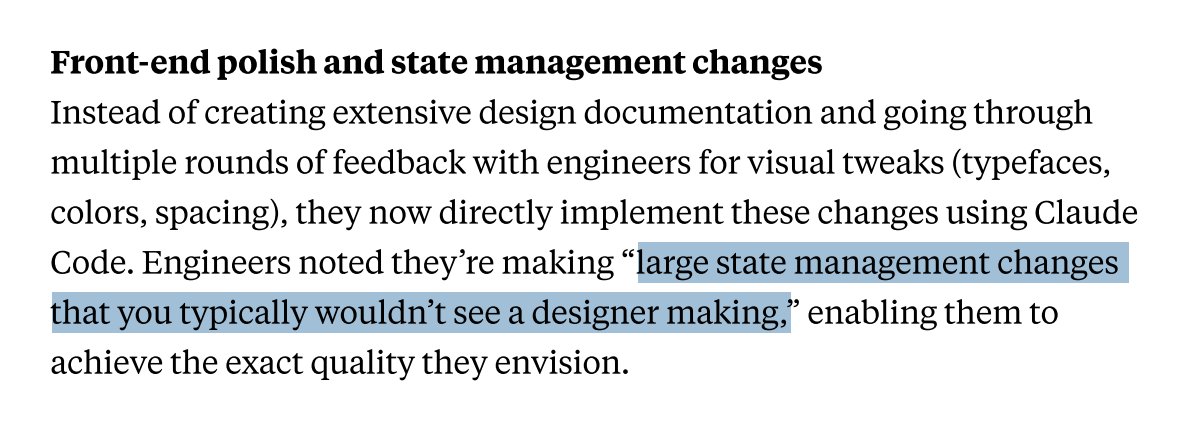
what's happening inside Anthropic right now is genuinely fascinating: DESIGNERS are now shipping production code with no engineer in the loop at all these are non-technical people with zero coding background. engineers on the team said designers are making "large state management changes you typically wouldn't see a designer making" think about what that means for a second. at every tech company in the world, designers and engineers are two separate roles. designers make mockups, engineers write code. that's been the deal for decades. at anthropic, that line is completely disappearing now. here's what their designers actually do now: it starts with a screenshot. 1) a designer takes their figma mockup and pastes the image directly into claude code. 2) claude looks at the image and generates a fully functional prototype from it. working code that engineers can immediately build on. this alone replaced the entire traditional cycle of: make static design → write spec → hand to engineer → wait → review → give feedback → wait again → repeat. but that's just prototyping. from there, designers implement front-end changes themselves. typefaces, colors, spacing, layout, etc directly in the codebase. no ticket filed, no engineer pulled in. and it goes further than visual polish. designers are now making state management changes (the code that controls how data moves through the app, even junior engineers find this tricky) and for their ongoing backlog of polish and bug fixes, they don't even open claude code. they just file a github issue (basically task description) describing what they want changed… and claude automatically proposes a code solution. then the designer reviews it and ships it. so there's a persistent stream of improvements flowing into production without pulling a single engineer off their work. they also use claude code to map out edge cases during the design phase. the stuff that used to only get discovered later when engineers actually built the thing. so now the designs are better AND they ship faster because the edge cases are already handled before engineering starts. one detail i love: they set up a custom memory file that tells claude: "you're working with a designer who has little coding experience. give detailed explanations. make smaller, incremental changes." claude adapted its entire approach based on that one file. here are some cool numbers, straight from the product design team: • claude code is now open alongside figma 80% of the time • 2-3x faster execution across the board. the designers' reaction when it all clicked: "holy crap, I'm a developer workflow" the boundaries between roles are dissolving. quietly. i think what's happening internally at anthropic is 2-3 years ahead of what will happen to the rest of the world

@mark_k ·
News: @OpenAI just released Sites for Codex. At first glance it looks like a website builder. But it’s not really about websites. It’s about making small, useful apps on demand. Dashboards. Review tools. Project pages. Little internal workflows nobody wants to build properly. This is where Codex gets interesting: not just writing code, but turning random work into software.


@Aje_Dynamicz ·
Vibe Coding has officially arrived inside n8n and it's going to change how a lot of freelancers and developers build automations... Instead of spending time searching for the right node, connecting everything manually, and configuring each step one by one, you can now describe the workflow you want in plain language and let AI build the foundation for you. For freelancers, this means: Faster delivery times More projects completed in less time Reduced setup fatigue Lower barrier to offering automation services For developers, it means... Rapid prototyping Less time on repetitive workflow setup More focus on logic, optimization, and business outcomes Easier collaboration with non-technical teams The biggest win is that automation becomes accessible to more people. A marketer, operations manager, or business owner can explain a process in natural language and get a working workflow without needing deep technical knowledge. That doesn’t replace developers; it makes developers more productive. The real value shifts from dragging nodes around to designing better systems, solving complex problems, and refining workflows that create measurable results. AI-generated workflows won’t eliminate expertise. They’ll simply remove a lot of the repetitive work that slows experts down. The future of automation isn’t just no-code. It’s intent-driven building where ideas turn into workflows in minutes instead of hours...


@hasantoxr ·
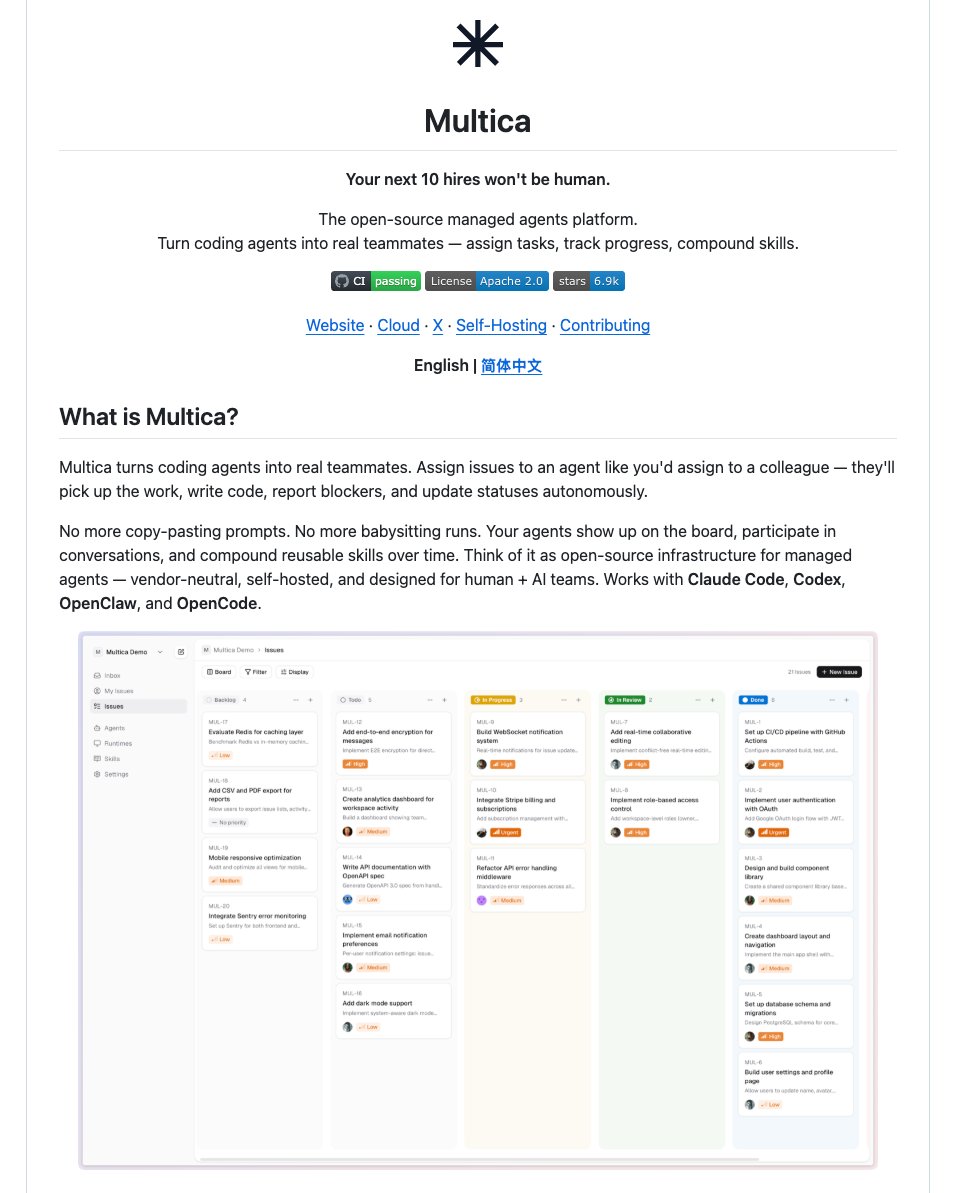
This is worth seeing. Someone built a native desktop app that gives any knowledge worker full coding agent power without touching a terminal once. It's called Multica. Claude Code, OpenCode, and Codex CLI all run inside it through a clean visual interface. Your files never leave your machine. No cloud uploads. No third-party servers. The problem it's actually solving: → 95% of knowledge workers can't use coding agents because the CLI is a hard wall → Web agents can't touch your local files → Sensitive data (legal, medical, financial) can't go to external servers Multica removes all three blockers at once. → Visual chat interface so you never open a terminal → Session history with full resume across Claude Code, OpenCode, and Codex → Local-first, your data stays on your machine while intelligence comes from the cloud → Multi-agent switching mid-session with no restart required → macOS, Windows, and Linux builds all included This is what the Claude Code GUI should have been from day one. 277 stars. Apache 2.0. 100% Opensource. Link in comments.

@toddsaunders ·
The funniest pattern with blue collar builders. Stage 1: "AI is for tech people, not for me." Stage 2: A friend shows them something they built. They're curious but won't admit it. Stage 3: They try Claude Code for one small thing. A unit converter or a simple form. Something they'd be embarrassed to tell anyone about. Stage 4: It works.... They stare at their screen like they just pulled a rabbit out of a hat. Stage 5: They disappear for two weeks, staring at their computer screen more than ever. Stage 6: They resurface with three monitors, a custom domain, and a full product demo for software that doesn't exist anywhere else on earth, because they understand the long tail nuance of the problem. I've watched this happen with plumbers, foresters, roofers, HVAC techs. The trade doesn't matter, and the arc is identical. The gap between "I can't build software" and "I just built software" isn't skill anymore.... It's one working demo. One moment where the thing you described in plain English actually appears on your screen and works. After that, there's no going back. It's funny because Silicon Valley spends millions on developer evangelism. But it turns out the best evangelism strategy is a contractor showing another contractor what he built over the weekend. Let the builders build!

@Layton_Gott ·
In 2-3 years nobody is going to care if you can write code from scratch. They're going to care if you can build products. Every month AI gets better at writing code. Every month the gap between "vibe coder" and "traditional coder" gets smaller. Every month the thing that actually matters shifts further from syntax to vision. The devs clowning on vibe coders right now sound exactly like the people who said "real programmers don't use IDEs" in 2005. I build Scribe almost entirely with Claude Code. I describe what I want. It builds it. I review it, test it, and ship it. The product works. Users don't care how it was made. The skill that lasts isn't writing code. It's knowing what to build, how to architect it, and how to get it in front of people. Learn to code if you want to. But don't let anyone tell you it's a requirement to build software anymore. It's not.

@shushant_l ·
I'm amazed most people still think you need to code everything manually. Here's how to build complete apps faster with vibe coding and AI. --- 1. Vibe coding lets you describe your app in plain English instead of writing every line of code. --- 2. Your AI assistant generates functional code, while you guide, refine, and debug the project. --- 3. The workflow follows a simple loop: Describe, Generate, Review, Iterate, and Deploy. --- 4. Start with a detailed prompt that clearly explains your app and desired features. --- 5. Let AI generate the frontend, backend, UI, and database structure automatically. --- 6. Review every output instead of assuming AI-generated code is production-ready. --- 7. Keep improving your prompts instead of rewriting everything from scratch. --- 8. Deploy only after testing your application thoroughly in a real environment. --- 9. Lovable is ideal for building polished full stack apps with minimal effort. --- 10. https://t.co/H9g78AyOFv is great for quickly prototyping ideas directly in the browser. --- 11. Cursor is one of the best AI-powered code editors for developers. --- 12. Claude Code provides a powerful terminal-based AI coding workflow. --- 13. Replit helps you build and deploy complete applications from your browser. --- 14. GitHub Copilot speeds up coding by assisting with suggestions, debugging, and code completion. --- 15. Give AI technical context before asking it to generate code. --- 16. Clearly describe features from the user's perspective to get better results. --- 17. Explain how new features should integrate with your existing application. --- 18. Ask AI to create implementation plans, write tests, and review edge cases. --- 19. Always check AI-generated code for security issues before shipping it. --- 20. Remember that your role is becoming the architect, while AI handles much of the implementation. --- To learn more, check the infographic. ---


@Div_pradeep ·
🚨BREAKING: Researchers just showed AI agents controlled in plain English beat coded agents. Not slightly. By up to 55%. Here is what they found. A team at Tsinghua built agents where the entire control logic is written in natural language. No code. Just instructions describing steps, rules, and failure handling. Then a runtime executes those instructions directly. They tested it against traditional code-based agents on real tasks. Same model. Same tools. Same setup. Only difference: control layer. Results: → English-controlled agent: 47.2% → Code-controlled agent: 30.4% That is a massive gap. But the real difference shows up during failure. When things broke: → Code agents got stuck in loops → English agents adapted One agent switched from GUI to command line to fix a system issue. Another rewrote outputs and verified them instead of retrying blindly. Same intelligence. Better control. They also made the system modular. Add a “self-evolution” block → performance improves Add persistent state → performance improves Remove it → gains disappear cleanly Like Lego. But for AI behavior. And here is the bigger shift. The paper reframes “prompt engineering” into something else: Context engineering. Not one prompt. An entire system of instructions, memory, and decisions written in plain language. Which means: You no longer need to code agents. You need to design them. Because the control layer is no longer software. It is language. And that changes who can build AI.

@andrewchen ·
why are spreadsheets the GOAT of no code tools? - unintimidating interface, just type numbers in a grid - easy to make something useful - shareable with a link - copy and make your own - insanely deep use cases (as a database, CRM, forecasting tools, etc) - finance team loves it, and they approve the budgets lol how many of these translate to agentic coding tools? - it's chat, could the UI be simpler? - you can build one-shot apps easily - insanely deep - share the output with a link - finance loves it as it gives more leverage and will cut SaaS costs There's more to do, but history rhymes. It has to be easier to share the code (not just the output), better management of forks, and more demonstration of operating leverage. But it's so powerful that it's inevitable agentic coding spreads as wall-to-wall as spreadsheets have And as I argued before, agentically coded apps I think will ultimately subsume spreadsheets completely. Maybe some will still want a grid UI, but underneath will be agentically created code

@Hartdrawss ·
How to build a cash-flowing product with Claude Code : find a painful workflow in a boring industry → don't build for tech people → build for the accountant who still uses excel for everything → the restaurant owner tracking inventory in a notebook → the pain is obvious. the solution doesn't exist yet. talk to 10 people who do that workflow → don't assume. ask. record every tool they use, every spreadsheet, every manual step they hate doing → the gaps between tools is where your product lives. open claude code before you open figma → describe the full product in a single markdown file → what it does, who its for, what the core workflow is → drop it in as context. this is your spec. claude code works best when it knows the whole picture upfront. let claude code scaffold the entire project → next.js, supabase, tailwind, stripe → don't touch the boilerplate yourself → your job is workflow logic, not setup → tell it the stack, tell it the schema, let it build the skeleton while you think about the product. build the hardest feature first → not the landing page. not the auth. the core thing that makes the product worth paying for → if you cant get that right nothing else matters. when claude code hallucinates → don't restart → reduce scope → break the feature into smaller pieces → give it one job at a time → the quality of your prompts is the quality of your product. use claude code to write your own cursor rules → let it document every decision it makes → stack, conventions, component patterns → drop those rules into your next session → the agent remembers nothing. you have to make it remember. ship to 3 customers before you build anything else → watch what they actually use → the thing you built for isn't always the thing they need most → one of your features will surprise you. pay attention to which one. charge per outcome → per report generated, per hour saved, per workflow automated → the ROI conversation takes 10 seconds when its tied to a real result → never charge per seat. build content around what you learned → not "building in public" content → the specific claude code trick that saved you 4 hours → the prompt pattern that finally got the schema right → the stuff only someone who actually built this would know → become the person for that niche. your competitor can clone your product → they can't clone 3 months of customer feedback and iteration baked into the codebase → that accumulated context is your moat → keep shipping.


@StevenCravotta ·
I built a $44,000/month app without writing a single line of code. Here's the 7-step formula anyone can copy: The biggest myth? You need to be technical to build apps. I scaled Puff Count to $44k/month, hit 10M downloads with Wordle, and built Posted to $1M+ in a year. Zero coding required. Here's the exact framework: 1. Find a validated idea (solve your own problem) 2. Validate demand before building anything 3. Design with AI tools & 99Designs (skip expensive agencies) 4. Build an MVP fast using no-code or outsourcing 5. Set up proper tracking and analytics 6. Get your first 100 users organically 7. Scale with content and paid ads The secret? AI tools changed everything. What cost $50,000+ five years ago now costs under $3,000. One developer with Cursor can outperform 5 developers without it. You don't need a unique idea either. You just need to iterate on a product that is already winning. Better execution + better marketing = winning formula. Stop waiting for the perfect idea. Start building with the tools available right now. The app boom is happening. But this window won't stay open forever.

@sourfraser ·
I have zero coding experience, yet I've built 3 internal tools that help run our agency. No developer or budget needed. Just a few spare hours. These are the 3 internal tools we use every day at Fraggell: 1) HR App We were paying £40/month for some bloated HR platform. Using maybe 10% of the features. So I built my own. • Staff log in • Request holidays • Report sick or WFH. It tracks everyone's holiday balance. Syncs to a team calendar that feeds straight into Google Calendar. Also groups people by department. So when someone requests time off, we never approve it if someone else in the same team is already out. First vibe code thing I ever built and it only took an afternoon. 2) Fraggell AI Studio The team was jumping between like four different AI video platforms depending on the client. So I built one platform that wraps all of them: • Sora, VO 3.1, Kling. • Every resolution • Every aspect ratio. • Character consistency for Sora built in. • Upscaling. And a filter system so they can label everything by brand when they're working across multiple clients at once. It’s also ludicrously cheaper than paying for all the subscriptions separately. 3) UGC Shipment Tracker UGC shipments are the bane of our lives. We were manually copying tracking numbers for every single creator. It was a nightmare. My business partner built this. One dashboard with every shipment going out to creators across the entire company. Auto-tracks delivery. If a creator gets their product and doesn't send footage within 5 days, it automatically pings the relevant team member. If they still don't respond, it escalates. We call them. None of this required a developer. Just a bit of time and a clear brief on what you actually need. If you're running an agency and you've got manual processes eating your team's time, build the tool. It probably takes a day.


@Rakshaweb3 ·
3 days ago I had an idea and zero front-end skills. Today I shipped this 👇 https://t.co/lBcDfzNpmq Not because I learned to code overnight but because I learned to direct AI like a design partner. Every section, every word, every pixel reviewed, rejected, rebuilt until it felt right. AI didn't build this website. I did. AI just held the tools. If you're a founder sitting on an idea because you "don't know how to code" that excuse expired this year.


@nikil ·
After 2 years of trying, I finally last week got everyone in my family to vibecode an app / set up an openclaw Sharing learnings to hopefully help you convince your family of the joy of building 1. pick something THEY like - my dad build a stock advisor to show him insights & what to buy - my mom built a supplement tracker (had tried multiple & didn't find what she wanted) - gf built an AI news tracker I tried literally for years to get them to build stuff I thought was cool. Automating text messages, personal website, life assistant, etc... They weren't interested. As soon as I said "What would be really cool that you really want?", they thought for a bit, came up with the idea, and then immediately wanted to do it. learnings: - this was really obvious, I should have done from the beginning 🤦♂️ - most people who aren't engineers don't even realize the possibilities of what they can build - brainstorm with them to show them they can build ANYTHING 2. SHOW them apps non-technical people built the most common hesitation I heard was "I'm not an engineer, you've been coding for 20 years" I tried telling them, "no anyone can build now". There was still this mindset of "you just think that because its so easy for you". Then I showed my parents the site my gf (who had never coded in her life!) made. Inspired them to try because they realized a non ultra-nerd could make a full site so easily. 3. make it FUN @TaraViswanathan, @_jordanstern and I put our OpenClaws in a imessage groupchat. The AI (Dave, Kevin, Eva) are absolutely ridiculous - you walk away for 1 minute and there are 187 messages of them roasting each other, dating, and naming their kids (Pepperoni) 😂 At dinner, Tara and I would be cracking up and show my mom snippets from the group chat. The next week she set up her openclaw. Before it was a chore "i should learn AI so I don't get behind in life". Now it's exciting "this is so fun!" 4. HAND HOLD them through it This stuff is easy for you. your body runs off of protein, X and your claude code max subscription. this is still hard & confusing for most people. before I had said "just watch a youtube video and try it - its easy" then I sat down with my dad and walked him through. big realization for me: there's a lot of stuff you have to learn that we take for granted just to get a basic site up - where is the claude code install on the website? - how to install a DMG? - can't find code tab in claude? - oh bc it requires paid account. how to upgrade? - error because no brew or npm installed? - hit pro limit, upgraded account, still limited? - fire up terminal to work around - what is "git" - how do I go to the site? - how do I view it on my phone? and 276343 more questions we sat down for 3 hours and got it done! but unless you had built stuff before any of these frictions would have stopped him. its not just for my dad who was a doctor. the same day, a sharp founder / vc buddy had messaged me saying "Dude I’m dying setting up Claude. Feel like it could be an episode of Silicon Valley. In a death loop where somehow I managed to confused the smartest thing on the planet haha" (and this isn't just claude - even down to getting set up on a mac requires new skills) Coding is as easy as breathing for you. Turns out we're fish living in the water and most humans breathe air. 5. Get to magic moment FAST Build something simple & easy. That you can 1 shot and works on the first run. Can iterate from there. Once you see your site up, the excitement (& addiction starts). Dad didn't want to try coding for years. 9:30pm: "Need to sleep, waking up at 5am for flight" 11:00pm: (after 1.5hr setup) "i'm so sleepy, lets just do it tmr" 11:05pm: (hit run on site) "WOW!!!" 12:30am: "THIS IS AMAZING!" just like building a product -> faster you get to magic moment, faster they are hooked. -- Hope this helps you get your family excited about building! Once you pop, the fun don't stop!

@betomoedano ·
AI has changed the way software is built. As an experienced engineer, I can confidently say that it’s absolutely possible to build, deploy, and maintain an app without writing a single line of code. Writing code by hand is no longer necessary. But that doesn’t mean anyone can simply prompt an AI to build an app and succeed. This is why experienced engineers are seeing incredible productivity gains. They already have the knowledge and mental models needed to guide AI in building real software. Non-technical people who want to build an app without learning to code don’t need to learn coding syntax. They need to understand how mobile apps are built, maintained, and deployed.

@atulkumarzz ·
We just crossed a weird line. I shipped a complete intelligent system with a working UI faster than it takes to set up a Notion doc. No engineers. No sprint cycles. No fragile stack. One prompt. Working system. This changes how startups get built↓
 Watch video

@heystevetan ·
A broccoli farmer in Hokkaido, Japan built his own farm management system using Codex. No farming experience. No engineering degree. Started as a civil servant. He couldn't afford an engineering team and built these tools himself: → Remote greenhouse vent control using a chatbot → A bot that monitors temperature and opens vents automatically → Satellite crop-health data mapped over his own fields → A full operations base linking plots, tasks, materials, and sensors → Wiring diagrams of his electrical panels, generated from a photo An engineering firm would charge $500,000 + six months to build this. He did it with a laptop and an AI coding tool. 2 years ago, this wouldn't just cost you money. It would cost you an endless cycle of delays, weeks of meetings, and back and forth between teams. And the end result would still look nothing remotely close to your initial idea. This guy had an idea for the tool he wanted. Built it. Deployed it. And is using it. All by himself. Without it costing him his peace, time or money. AI has collapsed the barrier between idea and execution. There's never been a better time to build and those doing it now will win the next decade. If you're an old-school operator with your "AI has nothing to do with my business", think again. Your biggest competitor is a guy who knows his shit with a laptop and codex.


@SergioRocks ·
Vibe coding hides the hardest part. You open ChatGPT, Lovable, Bolt. You describe what you want. You iterate a few times. And something starts working. It feels fast. It feels productive. But what you’re seeing is the easy part. - The interface - The happy path - The basic flow The hard part is everything you skipped: - What happens when inputs are incomplete - What happens when steps happen out of order - What happens when two actions collide - What happens when the system evolves That’s where vibe coded products fail. Not because the code is wrong. Because the system was never defined. Vibe coding gives you momentum. But it hides the need for: - Clear rules - Defined constraints - Real-world workflows And that’s the part that actually matters. AI makes building fast. But it doesn’t make thinking optional. That’s the part you can’t skip.

@gaetano_nyc ·
A lot of my clients are telling me that deals are stalling in the pipeline because of "buy vs build" dilemma. With coding assistants and low-code development apps, companies are going for more open source solutions and building on their own instead of buying SaaS... especially for basic things like a simple iPaaS, data integrations, reporting and dashboarding tools, etc. One customer even built their own solution and canceled his SaaS subscription. This is not being talked about enough.

@PrajwalTomar_ ·
I still don't think people understand what just shipped. I gave my coding agent one prompt and DeepSpace built me a full multiplayer kanban. → Sign-in with Google or GitHub → Live cursors on the board (like Google Docs) → Cards syncing across browsers in real-time → One command to deploy Most builders are still gluing 5 different services together to ship something half this complex. This is the stack I have been waiting for.
 Watch video
@toddsaunders ·
"Blue collar workers can't build software." This is favorite commentary every time I post about blue collar builders. It's funny..... because they said the same thing about Shopify merchants. Nobody looked at someone setting up a Shopify store and said "wow, look at this non-technical person learning to code." They said "that person is building a business." The software was incidental, but the outcome was the point. Same thing is happening right now in the trades. A plumber using Claude Code isn't "learning to code." He's building a quoting tool that works the way his business actually works. Because the one he's paying $1,200 a month for doesn't. The framing is completely wrong. These aren't non-technical people becoming technical. These are domain experts who finally have tools that speak their language, and solve their deepest most nuanced problems that only they understand. The right question to be asking at this point is "what happens when the people closest to the problem can finally build the solution?" IMO what happens is better software that actually has domain expertise well beyond a workflow and inference. Nobody calls a Shopify merchant a "software developer." Stop calling a tradesperson with Claude Code one as well. They're builders. That's what they've always been.

@JustAnotherPM ·
Here's what 40 PMs with zero coding experience shipped in 8 weeks: • Room redesign AI from photos • Sari recommendation engine • AI resume coach • Invoice reader • Brand-aware social media generator • Makeup review browser extension • Exam prep app for 8th graders • Mechanic price validator All live. All working. All at real URLs.

@ericdjav ·
I use Claude to build my entire app. Here's my actual workflow: → I describe the feature in plain English → Claude writes the code → I review, test, iterate → Ship to 2,580 users I don't write code. I write product specs to an AI that writes code. My job title should be "AI Product Director" but I still call myself a founder. The skill ceiling moved from "can you code this?" to "can you describe what to build clearly enough?" That's the real AI shift nobody's talking about.


@AllurePixel ·
Collins named "vibe coding" Word of the Year I've been doing it for 1 months with zero coding background Here's what nobody tells you 41% of all code written in 2026 is AI-generated MIT called it a top 10 breakthrough technology 63% of vibe coding users are non-developers Sounds like the future arrived and it's easy It's not I'm building a full-stack web app from scratch Next.js, Supabase, real-time charts, gamification engine, 6 content modules, auth system, the works My dev environment is a $10/month VPS, Cursor, and Claude Code in a terminal I don't know what a hook is I still google what DNS means sometimes It works Not perfectly, not easily, but it works I went from literally not knowing what a terminal is to having a working app with 27 completed development phases, real users coming soon, and a Product Hunt launch in the pipeline The era of "just have an idea" is here

@DivyanshT91162 ·
Most people are still paying developers for apps that AI can build in a single prompt. No coding. No backend setup. No database configuration. No authentication headaches. Just describe the app. And an AI agent handles the rest. Using models like: → GPT-5.5 xHigh → Opus 4.8 → Gemini 3.5 → Grok 4.3 You can go from idea → working mobile app faster than most teams can finish a planning meeting. The crazy part isn't the models. It's that you don't have to stitch together 15 different tools anymore. One AI agent can generate the frontend, backend, database, authentication, and deployment workflow from a single prompt. We're getting dangerously close to a world where the bottleneck isn't coding. It's having good ideas. Watch closely. The people learning this now will have a massive advantage over everyone still waiting to "learn programming first."
 Watch video

@jspeiser ·
The funny thing about no-code tools like OpenClaw: they’ll get so advanced that non‑technical peeps like me can’t safely run them alone. Once you have: • Bots that remember things and act over days, they start “going off script” and you need someone who can debug their memory. • Multiple AI providers, rate limits, apis, and costs to juggle, you need someone who understands how the pipes actually work. • Automations that can send emails, change data, touch customers, you need guardrails, testing, and logs or they’ll quietly break things. • Giant drag‑and‑drop flows with 30+ steps, it’s no longer “no‑code”, it’s just messy code in boxes. In the end, you don’t replace developers. You just move the code from a text editor into a flowchart. Am I wrong?

@heyDhavall ·
Meet Ycode: The Open-Source Alternative to Webflow and Framer Designers, founders, and agencies do not need another closed website builder. They need the speed of visual development with the freedom to actually own their stack. Ycode is now open source, giving you a powerful way to build and manage custom websites visually, without being locked into platforms like Webflow or Framer. 🔗 https://t.co/PaoXh8yF9Z Think of Ycode as a visual website builder with more control. You can design pages, manage dynamic CMS content, and launch faster with a modern visual editor, while choosing whether to self-host it yourself or use Ycode Cloud. Key Features: • Open-source visual website builder with built-in CMS • Strong alternative to Webflow and Framer • Build custom websites visually without giving up flexibility • Self-host on your own infrastructure or use Ycode Cloud • Dynamic CMS workflows for content-driven sites • Built for designers, founders, and agencies who want more ownership If Webflow and Framer feel limiting, Ycode gives you another path. Build visually. Own the stack. Stay in control.
 Watch video

@AdityaMBAsymbi ·
Attackers just turned a no-code AI app builder into a phishing delivery platform. And your email security probably can't detect it. Kaspersky found that threat actors are using Bubble - a legitimate AI-powered no-code platform - to build and host malicious web apps that redirect victims to Microsoft credential phishing pages. Here's why this works so well: The phishing link points to *.bubble.io - a trusted domain. Email security solutions don't flag it because it's a legitimate platform hosting legitimate apps. The link passes every reputation check. The app itself is a massive JavaScript bundle with Shadow DOM structures so complex that even human analysts struggle to understand what's happening at first glance. Automated analysis tools see a functional web app, not a phishing redirector. Static scanners can't parse the intent buried inside no-code generated code. Behind the Bubble app sits a fake Microsoft 365 login page, sometimes hidden behind a Cloudflare challenge for extra legitimacy. Credentials entered get siphoned to the attacker. Email, calendar, OneDrive, Teams - everything tied to the Microsoft 365 account. This is the evolution of phishing that security teams need to pay attention to: The attacker didn't write code. They described what they wanted and the AI platform built it. No coding skills required. The phishing infrastructure is generated, hosted, and maintained on a trusted third-party platform that the attacker doesn't even need to manage. Kaspersky warns this will get absorbed into phishing-as-a-service kits. Combine this with session cookie theft, adversary-in-the-middle 2FA bypass, geo-fencing, and AI-generated email content - and you've got phishing infrastructure that's nearly invisible to traditional detection. The pattern is clear: attackers are weaponising the same AI tools enterprises are adopting. No-code app builders. AI coding assistants. MCP servers. The tools designed to make people more productive are making attackers more productive too. For security teams: if your email security relies on domain reputation alone, you're exposed. Bubble dot io is trusted. So is every other no-code platform. You need to detect behaviour - what the page does after the click - not just reputation of the hosting domain. When anyone can describe a phishing app in plain English and have AI build it in minutes, the barrier to entry for credential theft drops to zero. More info - https://t.co/9RtArfQQYY

@piyush784066 ·
10 No Code Tools That Let You Build Without a Developer 1. https://t.co/uFoIrhUztN — Builds fully functional web apps with complex logic without any coding 2. Webflow — Designs and launches professional websites with CMS without touching code 3. Glide — Turns any spreadsheet into a polished mobile app in minutes for free 4. Softr — Builds client portals member sites and internal tools from Airtable for free 5. Adalo — Creates native mobile apps with real functionality without any coding at all

@anulagarwal ·
i uninstalled all IDEs/code editors from my system earlier this year. not because i became a better developer. because the models and agentic coding tools became too good i don’t really read the code anymore -> i just prompt, wait, test, complain, iterate. this works for almost any digital product you want to build: apps, games, websites, tools. in most cases, i create a base template with 75% of the features already built, so i don’t have to prompt and test the same things again and again. the funny part is, i used to think coding was the hard part. now the hard part is explaining exactly what i want without sounding like a client from hell. sometimes, you are not the developer anymore. you are just the QA intern for a very confident robot.

@_vmlops ·
A NON-DEVELOPER JUST SHIPPED 70K LINES IN 30 DAYS Here's what he learned: ▫️ start with a PRD...AI executes your mess faster, it doesn't fix it ▫️ new session per new thing...plan smart, build cheap ▫️ UI first, backend second ▫️ tests from day one... regressions will wreck you ▫️ git from line one..he started at 16k & regretted it ▫️ two models > one... the original author always misses things ▫️ security basics before you build, not after you don't need to be a developer to ship real things you need to be organised, patient & paranoid in the right places https://t.co/AUYbwAtXgD

@rfradin ·
"In 2026, every employee will be a developer." That’s the marketing pitch for the no-code revolution. To me, it sounds like an operational risk. If you have 5,000 employees and they all start building their own autonomous agents to solve their own problems, you don't get digital transformation. You get a digital junk drawer. Here is what that looks like in practice: - Ten different employees building ten slightly different agents to process the same invoice. - Zero documentation on how any of them work. - No ability to take a win from one department and scale it to the enterprise. The problem isn't the intent; employees are trying to be productive. The problem is the redundancy. Without visibility, everyone builds from scratch because they don't know a solution already exists, or is under construction. We are moving from a phase of creation to a phase of curation.

@TaylorPearsonMe ·
I recently went back and re-watched Bret Victor's 2012 talk "Inventing on Principle" on YouTube. His core principle has stuck with me: creators need an immediate connection to what they're making. You change something and see the result right away, instead of writing code, compiling, waiting, and picturing it in your head. To make the point he built these incredible demos where he would edit a line of code and the game updates live. Drag a number and the drawing redraws in real time. I've been thinking about that talk while building a landing page today. I'm building it in Astro through Codex. I just say what I want in plain language: center this heading, add some padding, put an image here, etc. It happens in a few seconds, and I look at the page and say the next thing. It's exactly what he meant and it's absolutely addictive. The loop is tight enough that I lose an hour without noticing. That connection used to run through code, but now it runs through plain language, which means it belongs to anyone who can say what they want. It's not a clean match for his vision. Describing intent to a model is fuzzier, and sometimes I get the wrong thing, but the loop is fast enough that you iterate toward what you want instead of specifying it up front. (There's some Coase angle in here about how like you just make more and new stuff because there's no handoffs too)

@ZvonimirSabljic ·
People don't want to write code with AI help. They want AI to do the work. Users would describe what they wanted — "build me a project management tool with Kanban boards" — and Pythagora would generate it. They'd ship it without opening the test suite, without touching the generated code. They just wanted the finished product. Most AI coding tools are still built around making people faster developers. We stopped building that and started building something where you describe the job and AI handles it. No code, no code review, no terminal.

@petesena ·
I built an app in under 30 minutes last week. No code. No developers. No $50K budget. What a time to be alive. Just me, an AI tool, and a problem I wanted to solve. The app? DaddyTime. Helps me find cool things to do with my 4-year-old. It connects to local events. Checks the weather. Syncs with my Google calendar. 30 minutes. Start to finish. This is vibe coding. And it's real. But here's what nobody's talking about: Not all vibes are good. When painters never touch paint... When sculptors never feel clay... When developers never read code... Does the work retain its soul? AI gets you 75% of the way there fast. That last 25%? That's where products live or die. And don't get me started on the security risks. You could be a few clicks away from leaking all your data by signing up for some cool thing that popped up in your feed. I'm not saying abandon the tools. That's like rejecting power tools for hand saws. But we need new mental models. I wrote about 4 frameworks for navigating the vibe coding era here: https://t.co/XOpGGKxC9d Read it if you want a simple step-by-step for turning any idea you have into an app in under 30 minutes.
 Watch video

@theaaron ·
A developer came up to me after a session where teachers were vibe coding. His app has 30 million+ lines of code. He said: "The teacher who knows nothing about code just built an app in 30 minutes that in the 1990s would've taken a team of 30 developers 18 months to make." The teacher didn't write a line of code, choose a coding language, or open a terminal. She just told the AI what she wanted until it worked.
 Watch video

@edmundtian ·
I haven't coded in over 3 years. Last week I downloaded Claude Code and holy shit this is literally 20x easier than it was in 2022. You tell Claude Code what you want to build and it will 1. design the system architecture 2. write the code 3. run it to make sure it works 4. if not, repeat from step 1 until it does Ppl used to call it your own personal junior dev. But now it's more like your personal army of TECH LEADS. The technical barrier to building software is now zero. Everyone should be tinkering with this today. Especially ppl like creators who have the marketing side down. 🎒 Here's your vibe-coding starter pack: Vercel = one-click deploy. Supabase = auth + database in minutes. Stripe = handle payments and subscriptions. Claude Code = writes code, runs it, debugs it, fixes it.


@hwbhatti ·
I am a shit coder. Over the last six months I have been able to build prototypes using ClaudeCode and Replit. Previously I would share with engineers and designers in this way: - Write PRD - Sketch out designs (maybe Figma) - Have conversations AI tooling has made collaboration easier and shipping velocity has increased. But most importantly it is so much more fun.
Best Tweets by Topic