Cost savings via cheaper and free models
Developers cutting bills by swapping premium models for cheaper or free OpenRouter models, including free Claude Code setups and price comparisons.
40%
Explore the best tweets about OpenRouter, covering model routing, API pricing, provider reliability, benchmarks, and developer integrations.
Specific OpenRouter models, routing behavior, API usage, pricing, provider performance, outages, and engineering lessons.
Original Xholic analysis
OpenRouter talk centers on cost: developers report swapping premium models for cheaper or free ones, while leaderboard posts show Chinese open-weight models leading token volume. Others counter that spend share still favors Anthropic and that charts carry structural bias. Routing products, a $1.3B raise and Stripe acquisition reports draw business interest. Practitioner posts flag provider inconsistency, config pitfalls and migration friction. Supportive stance leads at 42%.
54% of posts
All-time engagement
28% of posts
Published in 90 days
Conversation map
Developers cutting bills by swapping premium models for cheaper or free OpenRouter models, including free Claude Code setups and price comparisons.
40%
Token share rankings showing DeepSeek, Kimi, GLM, MiMo, Hy3 and other Chinese open models overtaking Claude and GPT on OpenRouter leaderboards.
26%
Auto Router, Fusion API, custom proxies and local operators that route tasks to the cheapest capable model, plus the wider router product wave.
24%
Debates over what OpenRouter usage charts measure, spend versus volume splits, structural biases, category rankings like image and classification.
22%
Anonymous or new models appearing on OpenRouter like Hunter Alpha, Elephant Alpha, Owl Alpha, Jev, Ring and Trinity, including free promos and sunsets.
20%
Token volume growth, revenue run rate, $1.3B raise, Stripe acquisition talks and founder perspectives on the token economy.
16%
Practical lessons switching agents and tools to OpenRouter: config pitfalls, log auditing, skill portability, language drift, and SDK/harness integrations.
14%
Inconsistent outputs across providers, suspected quantization, rate limits, outage failover, provider price walk-backs and routing overhead costs.
14%
Tone and stance
Performance benchmark
Posts with media make up 66% of this collection. Their median all-time score is 6.17, compared with 6.56 for text-only posts.
Format mix
Consensus and debate
Shared view
Multiple posts describe large savings from using cheaper OpenRouter models. Examples include a $0.84 three-day Cursor bill and a reported 24x API cut with quality 'basically the same'. Another post compares benchmark gaps against price, such as GLM-5 at ~2% below Sonnet 4.6 for ~3.8x cheaper input.
Shared view
Posters cite DeepSeek, MiMo, Hy3, Kimi and others topping OpenRouter usage. One claims DeepSeek rose from under 1% to 17% of tokens in a month. Rankings vary by post: one says the top four are Chinese, another the top six.
Shared view
Posts frame routing as a broad shift. Examples include OpenRouter's Auto Router, Cursor Router, a Gauntlet proxy, and a local operator that sends work to expensive models only when needed. Harry Stebbings' founder interview argues copycat routers won't compete with OpenRouter.
Open debate
Volume-based narratives of Chinese dominance are challenged by spend-based readings. Deedy estimates Anthropic took 36% of spend, and Layton Gott says it pulls ~46% of money on ~12% of tokens. Aakash Gupta calls OpenRouter 'the cheap seats', and 0xngmi notes structural bias driven by rate limits.
Open debate
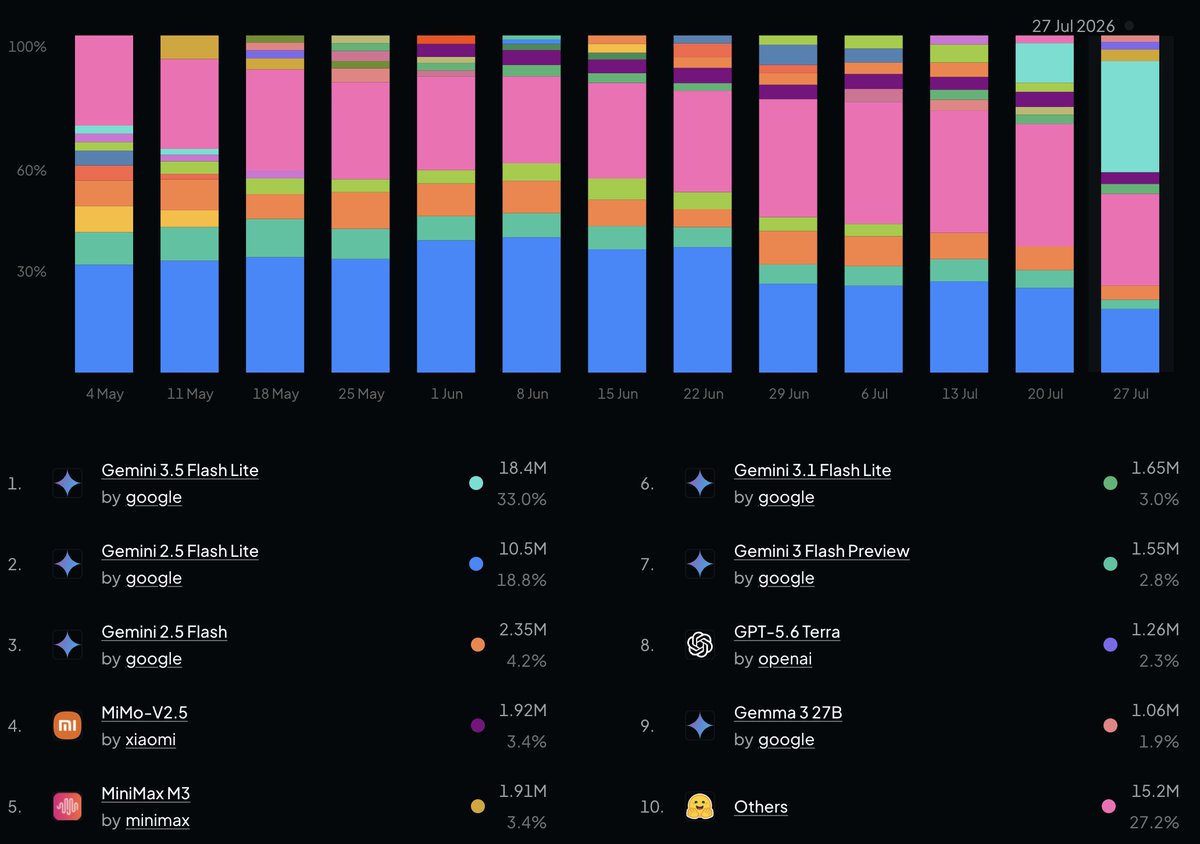
An image-ranking post says three Google models take 89% of image traffic, contradicting the China open-weight story. Julius asks whether free-tier volume reflects arbitrage rather than quality. stonkdaddy says Grok 4.5 gained after Hy3's free promo ended.
Open debate
Some cost-savings posts suggest easy swaps. Rahul Mathur, however, reports DeepSeek v4 pro replying in Chinese about once per ~30 tasks and GLM 5.2 being slower with worse output. He adds that Skills built for Opus and GPT don't translate without one-time effort.
What performs
The $0.84 Cursor bill post scored 517.67, 81.27x the 6.37 median all-time score. That is far ahead of the next outlier, the premium-to-cheap model list at 19.46x.
The growth, funding and Stripe theme (8 posts) has a 26.14 median score, the highest of any theme. Migration engineering lessons sit at 1.808 and provider reliability at 2.434.
The LIST format median is 69.595 and STORY is 21.501, but each has only 3 posts. TUTORIAL sits at 1.956 and ANNOUNCEMENT at 3.82.
66% of posts carry media, yet the media median score (6.172) is slightly below text-only posts (6.559).
Statistical standouts
Creator landscape
The five most represented creators account for 18% of the selected posts.
1. Deedy
@deedydas
2 posts
2. Layton Gott
@Layton_Gott
2 posts
3. Pukerainbow 🤮🌈
@pukerrainbrow
2 posts
4. Rohan Paul
@rohanpaul_ai
2 posts
5. Vaishnavi
@_vmlops
1 post
6. 0xngmi
@0xngmi
1 post
Deedy has the highest top-voice median score, 42.66, across two posts. One tracks token growth from 2T to 250T per month, and the other estimates dollar spend share.
Aiz's Hermes config audit (1.16) and Tim Hua's provider-variable results (1.632) score well below the 6.37 median despite concrete lessons. David Nix's eval-failure question is an exception at 11.165.
46 creators contribute 50 tweets, and the top five hold an 18% placement share. Layton Gott and Pukerainbow are among the few repeat voices, each posting twice.
Since the previous snapshot
Themes, sentiment, stance, and post format are classified per tweet. All counts, shares, medians, creator concentration, freshness, and performance comparisons are then calculated directly from the published snapshot.
Xholic's all-time score compares engagement while accounting for reach, post age, and creator consistency. It is used for relative comparisons within this collection.
This report analyzes the exact 50-post snapshot shown below. AI identifies editorial categories and drafts explanations; all statistics are calculated from the snapshot, and every narrative claim is checked against cited posts before publication.
Best OpenRouter tweets
Ranked 01–50

@trikcode ·
I put my OpenRouter API key into Cursor and set my daily limit to $5. been coding for three days straight and my total bill is $0.84.

@DeRonin_ ·
Replaced these PREMIUM models with 100%+ cheaper alternatives 1. Claude Opus 4.6 → Kimi K2.5 Benchmark gap: ~11% Price difference: ~9x cheaper 2. GPT-5.4 → Qwen3.5-397B Benchmark gap: ~21% Price difference: ~6–7x cheaper 3. Claude Sonnet 4.6 → GLM-5 Benchmark gap: ~2% Price difference: ~3.8x cheaper on input and ~5.9x cheaper on output 4. Gemini 3.1 Pro → GLM-5 Benchmark gap: ~12% Price difference: ~2.5x cheaper on input and ~4.7x cheaper on output 5. GPT-5.4 Pro → Kimi K2.5 + DeepSeek R1 Benchmark gap: GPT-5.4 Pro still has an advantage on complex tasks, but the price difference is very attractive Price difference: ~95–97% cheaper Conclusion: Based on OpenRouter pricing and Artificial Analysis benchmark scores, these lower-cost models are often 50%+ cheaper while remaining surprisingly close in capability for many tasks Some of them may underperform the premium models on harder or more complex tasks, but the price difference is significant Considering the 50%+ savings in most cases, this is a strong option if you don't have a large budget


@quxiaoyin ·
Guys, did you see the inference price war for open weight models in openrouter? It’s bloody war to compete on the lowest price. Reminds me of electricity. I keep hearing inference is huge margin but then it seems it’s a war to zero at openrouter nowadays. I finally understand why openrouter charges 5.5%. I keep hearing stories of data centers in Finland, Philippines and Southeast Asia that are just cheap, cheaper and cheapest? I wonder how US neoclouds cope with this? I mean enterprise is a good market I’m sure.

@HarryStebbings ·
OpenRouter is one of the most insane stories in tech. Co-founded by OpenSea founder, Alex Atallah. It has become one of the most important companies in AI. Scaled to 100s of millions in revenue and wildly profitable. They process 25 TRILLION tokens every week and will do 1 QUADRILLION tokens this year. As a result, Stripe have reportedly offered to buy them for $10BN. Last round was $1.3BN just months ago… so what happens now? I sat down for a chat with OpenRouter Founder, @alexatallah and have summarized my notes below: 1. This Is Going to Be the Biggest Market in the History of Tech AI model inference is set to become one of the largest markets in technology. Even as token prices fall dramatically, Jevons Paradox means usage can grow far faster than costs decline, driving massive overall compute consumption across an increasingly multi-model future. 2. Why None of the Routing Products Being Created Today Will Compete With OpenRouter Building AI gateways has become trendy, but copycat routers that treat routing as a side feature are playing to exist rather than to win. True routing requires relentless focus on optimizing latency, cost, and constantly shifting model quality while giving developers maximum flexibility. 3. Model Labs Have Every Incentive to Come After Your Startup Eventually Startups building thin wrappers around AI models face an existential threat if they occupy workflows that frontier labs consider strategic. Releases like Claude Design show how labs can move up the application layer, absorb valuable use cases, and lock entire enterprise teams into their ecosystems. 4. One New Model Every 10 Hours and the Myth of Model Consolidation Model creation is accelerating as hardware companies, Neo Labs, and agent frameworks continuously release specialized models. Rather than consolidating around a single winner, developers are embracing diverse models optimized for different tasks, reinforcing a fragmented, multi-model future. 5. America Is Still Very, Very Behind in Open-Weight AI The U.S. remains significantly behind China in the race for open-weight models. Chinese labs benefit from aggressive state support and open-source momentum, while American efforts face business model and capital constraints. Closing the gap will require dedicated access to compute and sustained investment. 6. How Open-Weight Models Are Rapidly Closing the Gap on Frontier AI Models like Kimi K3 and the 5.2 generation show how quickly open-weight intelligence is closing the gap with proprietary frontier models. Using low-cost open models for deterministic subtasks beneath a frontier orchestrator can maintain output quality while sharply reducing inference costs. 7. Why We Need to Think About Employee Cost Completely Differently In the AI era, employee cost is no longer just a fixed salary. It increasingly includes the variable inference spend of the AI tools each employee deploys. Companies will need to evaluate workforce performance through a cost-to-productivity lens that accounts for both human compensation and AI consumption. (links in comments)

@deedydas ·
OpenRouter when raising Seed (Jan ‘25) were at 2T tok/mo. At Series A (Apr ‘25) at 8T tok/mo. 4x in 4mos. At Series B (Feb ‘26) at 50T tok/mo. ~6x in 10mos. Now (July ‘26) at 250T tok/mo. 5x in 5mos. 125x in 18mos. Many Router products now, but this was ahead of its time.


@HedgieMarkets ·
🦔U.S. companies are routing more AI workloads to Chinese models. CNBC reported that Chinese model usage on OpenRouter sat above 30% of U.S. company tokens every week since February, up from an 11% average the prior year and just 4.5% in H1 2025. https://t.co/IJWtvXQaKh's GLM 5.2 saw token volume grow 27x in its first week on Vercel. One startup, Lindy, moved 100% of its traffic from Claude to DeepSeek and expects to save millions. My Take The pitch from U.S. labs has always been that frontier performance justifies frontier pricing. That logic holds until someone ships a model within a percentage point of Opus 4.8 on agentic benchmarks at a fifth of the cost, which is what GLM 5.2 apparently did. At 60 to 90% cheaper for most workloads, you do not need to match the best model. You just need to be good enough for the task you're routing to it. If U.S. labs keep raising token prices while Chinese open-weight models close the performance gap, the market self-selects toward Chinese infrastructure for everything except the hardest problems. Most companies making that switch are not thinking about geopolitics. They are thinking about their AWS bill. Hedgie🤗
@deedydas ·
I used Opus to convert OR's public token stats into $$ stats. A whopping ~$1.5B annualized run rate (week x 52) gets processed on OpenRouter, putting it at ~1% by dollars of total inference. This week, Anthropic took 36% of spend, OpenAI 18% and open-weight models took 26%!


@hasantoxr ·
Owl Alpha has been confirmed. It's from China. The company is Meituan. It's currently the most-used open-source model on OpenRouter: • #1 on Hermes globally • #2 on Claude Code right behind Claude 4.8 • #3 on OpenClaw Some people in the community are already calling it the best free model available right now.


@ziwenxu_ ·
Jev is already on OpenRouter!! It's only been out a day and TypeSafe still has a waitlist. OpenRouter has it though, and that's how we've been running it. The pricing is insane. $0.042 per million tokens in, and output is free. How to use it: - Sign up on OpenRouter and add some credits - Make an API key - Call the decisions endpoint: /api/alpha/decisions - Set the model to ~typesafe/jev-latest - Send it a "state" (what's going on) and "questions" (what you want decided, plus the options) ChatGPT and Claude write you an answer word by word. Jev doesn't write at all. You give it the options and it sends back a probability for each one, plus how confident it is. What we got: - "My card was charged twice" went to billing, 100%, in about a second - We hooked it up to Tetris and it picked every move in about half a second - A whole game cost less than half a cent A lot of fun stuff can happen here.
 Watch video
@Rahul_J_Mathur ·
Last night I panicked when our fund’s agent Zen replied to me in Chinese. For a minute, I wasn’t sure WTF happened. Until recently, our agents have run exclusively on the Opus series of models (this is a $100k annualized bill for a 50 person team) Sometime in June, we began experimenting with a multi-model set-up using OpenRouter with an explicit goal of reducing our spend by ~40% without compromising on long term performance or security. Sharing my personal observations: (1) DeepSeek v4 pro replies in Chinese at least once per day (approx. once in ~30 tasks). There is an open ticket in GitHub specifying this very issue which remains unresolved. Furthermore, DeepSeek is noticeably slower for token heavy tasks (to a point where I need to do other work while waiting to check outputs) (2) GLM 5.2 is observably slower than Opus 4.8 & produces worse quality output GLM 5.2 doesn’t read the complete Skill file, fails to handle edge cases etc. However, at 1/8th the cost, this is an acceptable trade-off for me since the output quality is observably worse for me but NOT for the recipient of the output. (3) Skills built for Opus & GPT series models don’t translate well to the GLM series & DeepSeek model variants. Opus & GPT have far superior tool calling capability (my hypothesis) & more grounded to follow instructions (knowledge worker centric RL or inclusion in training data sets). I regret to inform the hype lords that with appropriate & directed efforts, it is possible to switch workflows between model providers⚠️ However, this is NOT seamless & does require one-time effort to update Skills, usage muscle memory & hard code certain routing logic.

@FredaDuan ·
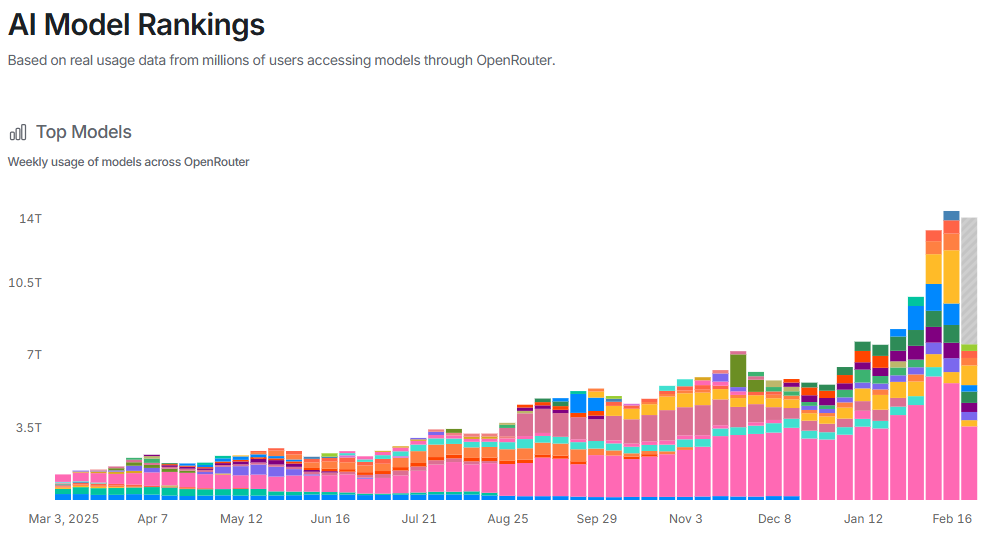
Token Tracker & Implications If third-party tracking is even roughly right, China may now be the world’s largest token economy. China’s daily AI token consumption has reportedly reached ~180 trillion per day as of Feb 2026 - up from just 100 billion at the start of 2024. That’s a ~1,800x increase in ~2 years. Video generation is a major driver that hasn’t really kicked in yet. Seedance 2.0 uses ~350K tokens to generate a single 10-second 1080p video. A typical animated project can run into the hundreds of millions of tokens. Video AI is quietly pushing token demand into a new regime. At the same time, OpenRouter data shows Chinese models consuming more weekly tokens than U.S. equivalents. But there are real open questions (if anyone has answers/ thoughts, pls DM): 1/ Are we comparing like-for-like models? “Cheap can be expensive.” Lower-quality models may require more retries, longer prompts, and additional iterations - inflating token counts. 2/ Does China’s 2C market structurally consume more tokens? Larger population + historically weaker search substitutes could naturally drive heavier AI usage. 3/ Will “good enough but cheaper” models ever really win? Implications on the SOTA models? If slightly inferior but meaningfully cheaper models are sufficient for most tasks, that has major implications for pricing power, infrastructure demand, and long-term model hierarchy. --- China’s Token Usage Daily token usage across different models: - $Byte Volcano Engine’s large-model daily average token calls have rapidly grown from 2 trillion at the end of 2024 to 63 trillion in January 2026. - $BABA Cloud’s external customer daily average token calls in 2025 are close to 5 trillion, with the 2026 target set at at least 15–20 trillion. Its internal business daily average token calls are planned to rise from 16–17 trillion to 100 trillion. From an industry-wide perspective, China’s overall daily average token consumption has increased from 100 billion at the beginning of 2024, surpassed 30 trillion in mid-2025, and by February 2026 the combined daily average across mainstream large models has reached the 180 trillion level. source: https://t.co/fv6wkBKAaG ByteDance’s Doubao: over 50 trillion tokens daily Impact from video gen: - At the single-video level, Seedance 2.0 consumes roughly 350,000 tokens to generate a 10-second, 1080p video. Under comparable quality settings, Keling requires more than 400,000 tokens, suggesting Seedance is somewhat more efficient in multi-frame synthesis. - In a typical animated project (720p, 15fps video generation), the project often requires hundreds of millions of tokens overall. --- US’ Token Usage $Google - “tokens processed across our surfaces” 1.3 quadrillion tokens per month (Google blog, Oct 9, 2025) - “across our surfaces,” explicitly referencing the prior 980T figure. https://t.co/qSdpb52rYu 1.3 quadrillion/month ≈ ~43 trillion/day (assuming 30 days/month). $MSFT - “tokens processed this quarter” (Azure AI / Foundry) $MSFT said 50T in one month (≈ ~1.7T/day for that month). source: https://t.co/fv6wkBKAaG --- OpenRouter OpenRouter is just a small subset of data being tracked, but here are the latest trends: Global AI model API aggregator OpenRouter data shows that during the week of the 9th–15th, Chinese models reached 4.12 trillion tokens in API calls, surpassing U.S. models for the first time, which recorded 2.94 trillion tokens in the same period. In the following week (16th–22nd), Chinese models’ weekly token usage climbed further to 5.16 trillion tokens, marking a 127% increase over three weeks, while U.S. model usage declined to 2.7 trillion tokens. https://t.co/mnVnGeCMc5 +++ Full analysis: https://t.co/vj8XX3ySd5



@EXM7777 ·
Openrouter just released their Search Benchmark and i didn't expect this... across all 4 categories, the winning combo is: Claude Opus 5 + Perplexity i thought this was the most expensive and slowest... but turns out it's the best value what's your current research setup?


@Parul_Gautam7 ·
I've been using Ring-2.6-1T on OpenRouter for my documentation pipeline this week. My usual flow: I dump a raw codebase or a long spec doc into the model and ask it to generate structured docs, flag inconsistencies, and draft a changelog. With other models, I was splitting this into 3 separate prompts because of context limits. Each split costs tokens. Each split loses some coherence between sections. With Ring-2.6-1T, I sent the whole thing in 1 prompt. 38,000 tokens. got back structured docs, a flagged inconsistencies list, and a changelog draft in a single response. Coherence was intact across all 3 outputs. No context bleed between sections. Still running it through more workflows, but the single-prompt full-doc processing alone has already cut my per-task token spend significantly. And then the cost showed $0.00, and I sat there for a second 👉 https://t.co/DZIXXDMiqK #BuildInPublic #OpenSource
 Watch video
@TheGeorgePu ·
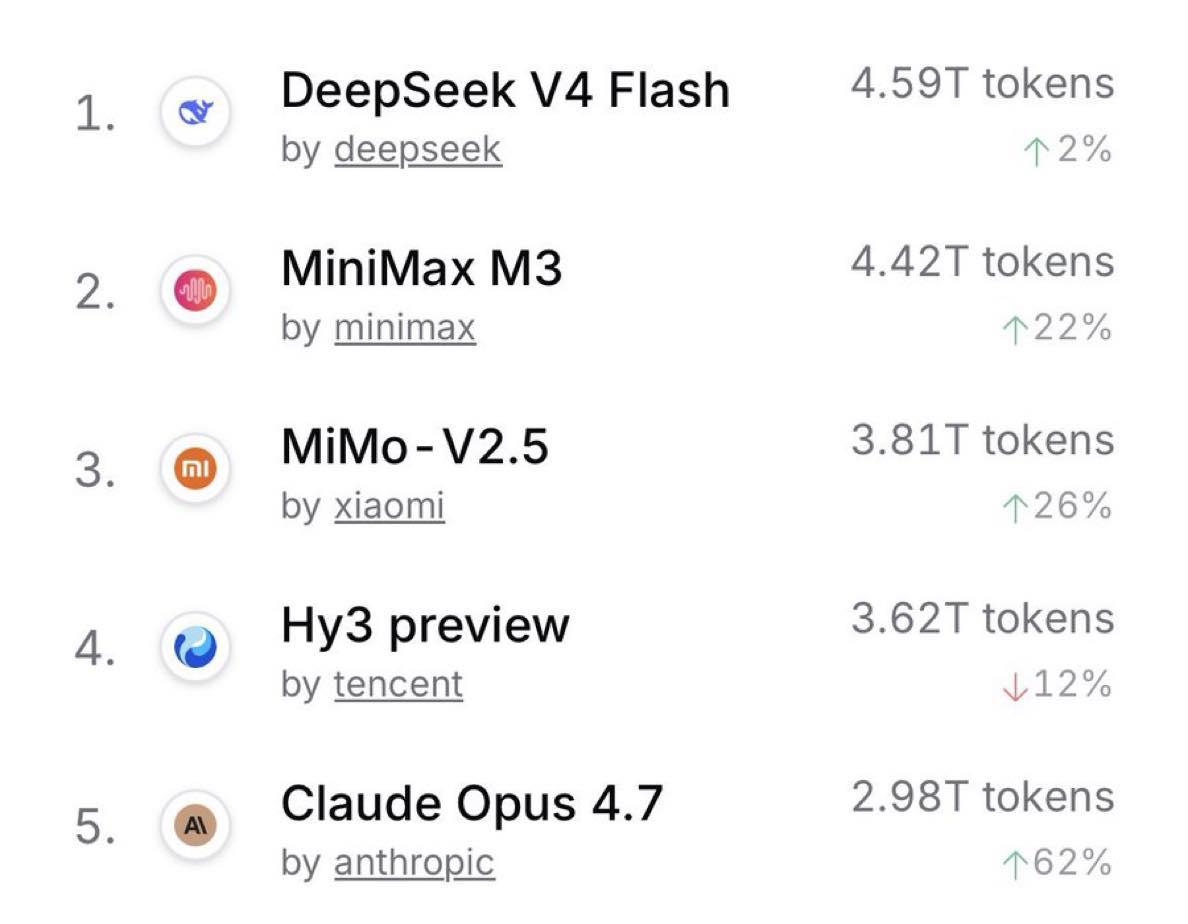
DeepSeek went from under 1% of OpenRouter tokens to 17%. That happened in a single month. The top 4 models by usage are now all Chinese open models. Nobody decided this in a press release. Finance teams looked at the bill and rerouted the traffic. I found out I don't have to run my whole workflow on Claude and GPT. The cost difference is multiple orders of magnitude. I think more people are figuring that out too. The leaderboard everyone watches is one thing. The model people actually pay for is another.

@latentspacepod ·
Why Stripe Acquired OpenRouter: 10T+ tokens/day, model routing, Stripe, & the $10T token economy https://t.co/Gtkx0itWSx @OpenRouterAI co-founder @alexatallah and @AnjneyMidha explain why betting against a single-model future became one of the most important infrastructure bets in AI, how OpenRouter grew from the Llama and Mistral era into a neutral distribution layer for developers, why model labs can spend billions training checkpoints and still struggle with distribution, how Midjourney and Discord shaped their thinking, why Stripe acquired OpenRouter, and why agentic fraud could become a defining security problem for a multi-trillion-dollar token economy.
 Watch video
@RoundtableSpace ·
CLAUDE CODE IS FREE TO RUN AND MOST PEOPLE STILL THINK YOU NEED A PAID SETUP. Install Claude Code Router, point it at a free OpenRouter model and you keep the exact same workflow without paying anything.
 Watch video
@Layton_Gott ·
Last year Anthropic had 29% of all the AI usage on OpenRouter. Today it’s only 13%. You’re probably wondering why Claude’s usage got cut down over 50%… The answer is simple: Chinese open weight models. They went from basically nothing to over 60% of all the tokens running through OpenRouter. In about a year and a half. The top six most used models on the entire platform are now Chinese. Claude sits at number six. MiMo from Xiaomi. DeepSeek. MiniMax. GLM. Models a lot of people have never even heard of are now bigger than Claude by usage. Why? Price. These models run for as little as a tenth of what Claude costs. Some even less. And they’re now good enough that for most jobs you genuinely can’t tell the difference. So developers did the obvious thing. They followed the cheaper option. Anthropic is only 12% of the tokens, but it’s still pulling around 46% of the actual money on the platform. So the market split in two. One lane is cheap, open, good enough, and absolutely massive on volume. That’s the Chinese models. The other lane is expensive, premium, and where the real money still is. That’s Claude and GPT. No, Claude isn’t dying. It’s making more money than ever while slowly losing the volume war. But the direction is impossible to ignore. The cheap open models are taking the actual usage, and they’re getting better every single month. And the closed frontier models keep getting locked behind governments and price tags. This is exactly why I keep saying open source wins in the end. You can’t out price free. And you can’t shut off a model the whole world already downloaded.

@KaiXCreator ·
DeepSeek is dominating the usage 4 out of 5 most used models on OpenRouter are Chinese it’s not about China vs US models, but about open source cheap vs closed source overpriced

@OpenRouter ·
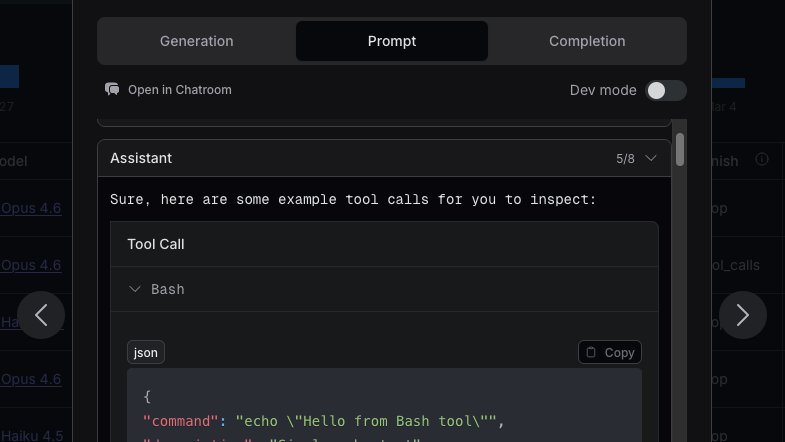
New: view, replay, and remix previous prompts right from OpenRouter → Auditing: review the quality of outputs → Prompt iteration: refine prompts to improve outputs → Model comparison: replay the same input across different models How to enable it 👇

@david_nix ·
Is Cloud AI a scam? I was running some evals Local qwen models 27b and 9b right off my laptop. Simple data extraction. Here's a pile of text, give me JSON plz. My local models passed evals 100%. Switched to Openrouter. Exact same models... or so I thought. Several evals failed. So what gives? Did they quantize more than advertised?

@VaibhavSisinty ·
Every major AI company shipped the same thing in the last 48 hours. Model routers. A layer that decides which model to use so you don't have to. Cursor launched Cursor Router on Tuesday. It reads every request, checks the complexity, and sends it to the cheapest model that can handle it. 60% cost savings. Same quality. But Cursor isn't alone ↓ → OpenAI already built routing into ChatGPT. It auto-switches between Instant and Thinking models based on query complexity. → Factory AI launched Factory Router. Claims 20-25% token savings with no quality drop. → OpenRouter upgraded their Auto Router across 400+ models from 60+ providers. → IDC predicts by 2028, 70% of top AI enterprises will use dynamic model routing. All within the same window. That's not coincidence. That's consensus. Here's the problem they're all solving. Most people pick one model and use it for everything. Cursor's own data says 60% of their developers do this. Frontier models built for complex reasoning are being used to fix typos and write Slack messages. That's a Ferrari doing grocery runs. Routers fix that automatically. Simple task goes to a cheap model. Hard task goes to frontier. The model race is slowing down. The top models are within a few points of each other. The real competition has quietly moved to who can deliver the same output at the lowest cost. That's what routers do. And every major player just shipped one in the same week. The era of one model for everything is ending. Smart routing just started.

@stonk_daddy ·
Grok 4.5 token volume is surging on OpenRouter, breaking into the top 10 for closed models today beating out GPT 5.6 Sol and Fable 5. Previously the most used model was Tencent’s Hy3 (free version), whose promotional period ended on July 21. It seems Grok 4.5 is seeing migration from cost conscious users since then.


@rohanpaul_ai ·
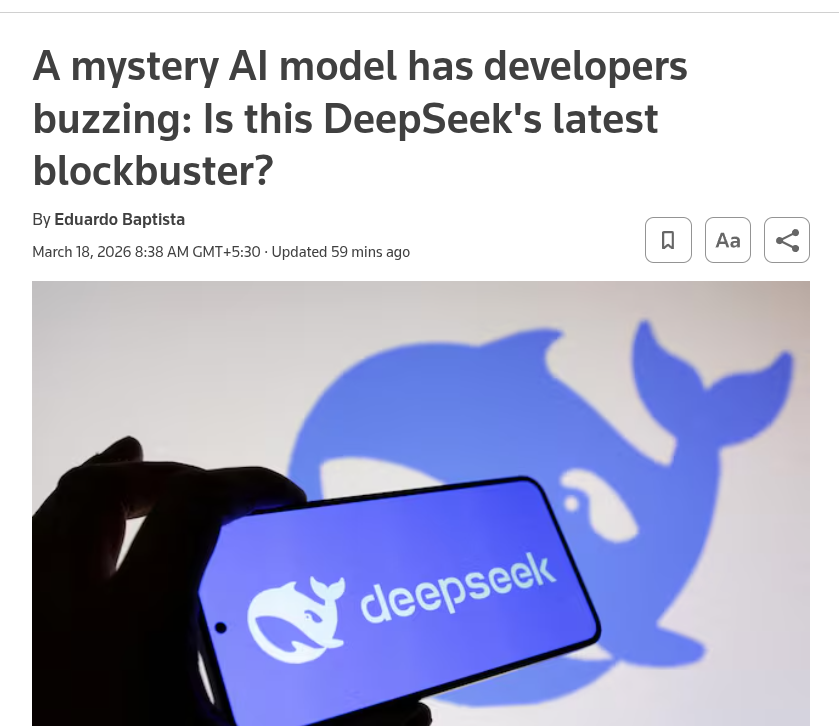
Reuters: A mysterious AI model named Hunter Alpha recently appeared on OpenRouter. Rumors say it might be a secret test version of DeepSeek V4. - This model is massive 1T param. - 1M token context window - Many noticed reasoning patterns look a lot like the chain-of-thought style seen in previous DeepSeek models During testing, the model claimed it was trained mostly on Chinese data with a knowledge cutoff of May-25, which matches DeepSeek’s official specifications. --- reuters .com/business/media-telecom/mystery-ai-model-has-developers-buzzing-is-this-deepseeks-latest-blockbuster-2026-03-18/

@pukerrainbrow ·
OpenRouter's image model rankings (June 2026): 1. Nano Banana (Gemini 2.5 Flash Image), 1.71M requests, 40.7% share 2. Nano Banana 2 (Gemini 3.1 Flash Image), 1.21M requests, 28.8% 3. Nano Banana Pro (Gemini 3 Pro Image), 825K requests, 19.6% 4. Seedream 4.5 (ByteDance), 99K requests, 2.4% 3 google models are swallowing 89% of the platform’s image gen traffic. whatever “open-weights from china” narrative people want to push, the numbers don’t even start to back it up. Is this the one category nobody's actually built the open-weight alternative for yet? Genuine question.
@Layton_Gott ·
My main coding model costs me nothing. I run Qwen3.6 27B locally as an operator. From there it routes out to Claude Code, Codex, DeepSeek V4 Pro, GLM 5.2, or anything else I want through OpenRouter. The local model is free and never leaves my machine. The expensive models only get touched when the work actually calls for them. When something better drops next week I point the operator at it and nothing else changes. Keep arguing about which model to commit to. I never have to pick one.

@alex_verem ·
The most-used model on OpenRouter this week isn’t GPT, Claude, or DeepSeek. It’s Tencent’s Hy3 🤯 8.98T tokens. #1 on the platform. So I tested whether the efficiency shows up in the actual output. I asked it to: “Write a Python function that finds the maximum profit from one stock purchase and sale. Start with the brute-force solution, optimize it to O(n), then explain the time and space tradeoffs.” Hy3 first returned the brute-force O(n²) approach, then rewrote it as a single-pass solution that tracks the minimum price. It explained why the second approach reduces the time complexity from O(n²) to O(n), along with the space tradeoff. Architecturally, Hy3 has 295B total parameters while activating 21B per token. The published specs include: • 256K context • Fast and slow reasoning in one model • Apache 2.0 open-source licensing • Tencent Cloud lists pricing at 1 CNY/M input tokens and 4 CNY/M output tokens. Those specs may partly explain its recent OpenRouter usage, although one coding prompt obviously isn’t a full benchmark. @TencentHunyuan #Hy3

 Watch video
@ai_for_success ·
There is new anonymous model called elephant-alpha, currently in the top 10 on OpenRouter by daily usage. Looks good for agentic work because OpenClaw and Hermes Agent are among the top apps using it. Tried it on some code review and refactoring. It is pretty fast and handles it well. Not a deep reasoner but solid for quick execution tasks. Feels similar to Grok Fast. Anyone tried this yet?


 Watch video
@SahilPanhotra ·
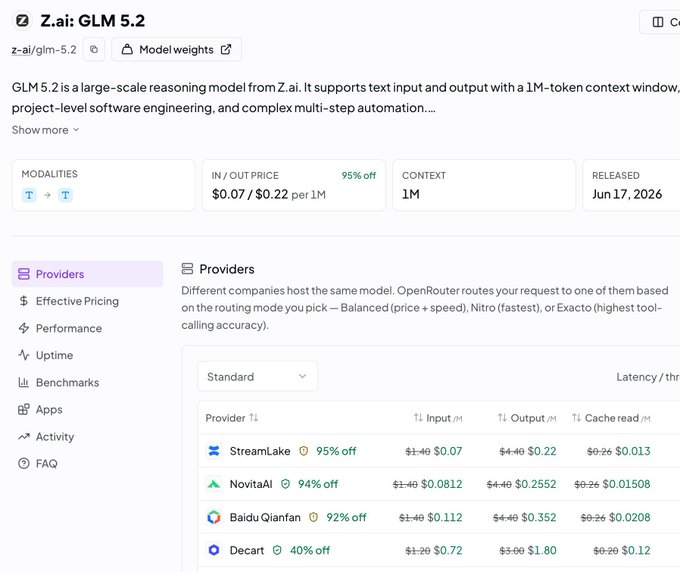
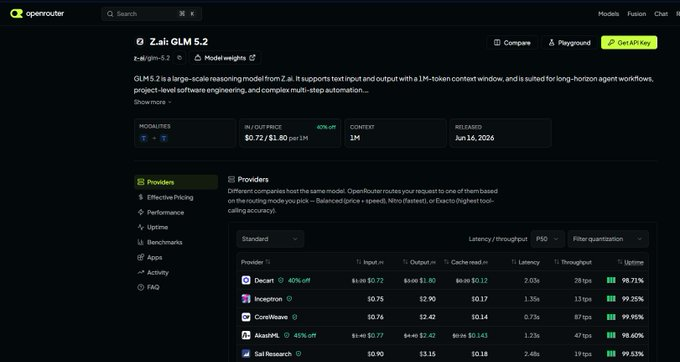
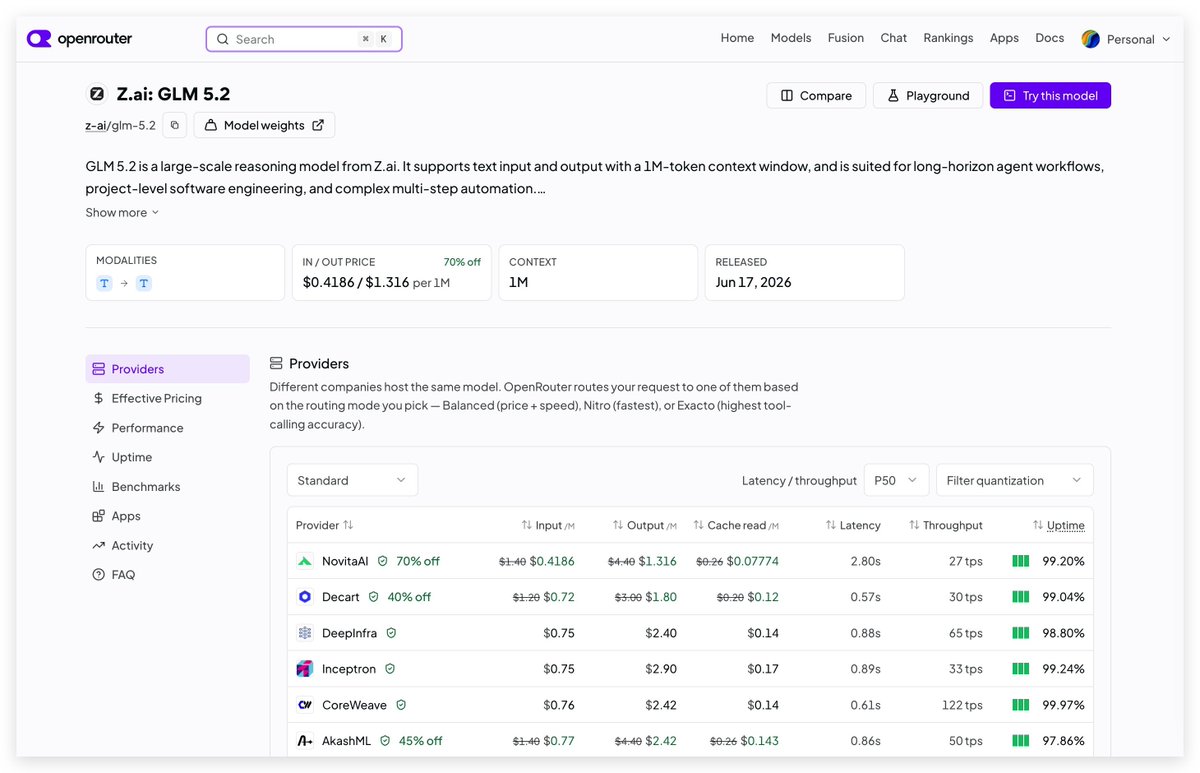
GLM 5.2 providers on OpenRouter: 95% off → 70% → 60% → ~40% classic marketing playbook: throw out a crazy number get everyone talking walk it back later 95% did its job 😂


@ashtilawat ·
Consider our data at @gauntletai. Cohorts of 50–100 builders, each logging ~1,000 hours building with AI. Classify every request by difficulty, and how many actually need a frontier model? A small minority (5-10%). Some requests definitely need frontier models, but the routing is all messed up. So we built a proxy. It plugs into your coding harness, classifies each request, and routes it to the cheapest model that can complete it. Easy and medium usually route to open-source, hard work to frontier. Managers get teamwide visibility and can audit any spend spike. Currently routes through OpenRouter. Next stop is our self-hosted models on Mac Studios over Tailscale. Spend efficiently, not blindly. Taking a few beta testers. DM me.

@Hadley ·
OpenRouter just raised $113M at $1.3B routing 100T tokens a month between providers. Google Ventures led. Interesting signal in the labs-own-everything vs commoditize debate when a model lab’s own investor arm is funding the swappable layer.
@pukerrainbrow ·
OpenRouter's Classification task, ranked by spend share, right now: 1. GPT-5.5, 9.5%, down 2.2 2. Claude Sonnet 4.6, 9.4%, down 3.9 3. Claude Opus 4.7, 8.2%, down 5.0 4. Claude Opus 4.8, 8.0%, down 0.5 5. Gemini 3.1 Pro, 5.7%, up 0.6 6. GLM 5.2, 2.9%, up 1.5 Three Anthropic models sit in the top 4 by spend. And every one of them is losing share right now. The two names actually gaining, GPT-5.6 Sol and GLM 5.2, are the newest entrants on the board. Sitting at #1 doesn't matter much if the trend only goes one way.


@0xngmi ·
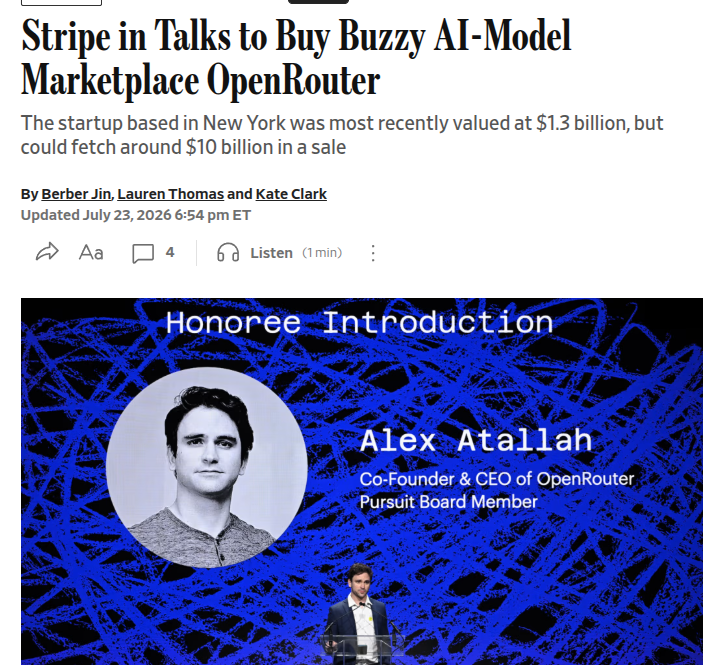
seeing some ppl use this chart from openrouter as a way to track model usage at defillama we use openrouter but for some providers, the openrouter omnibus api key gets rate limited so we switched to our own account so theres structural bias in this chart against some models
@rohanpaul_ai ·
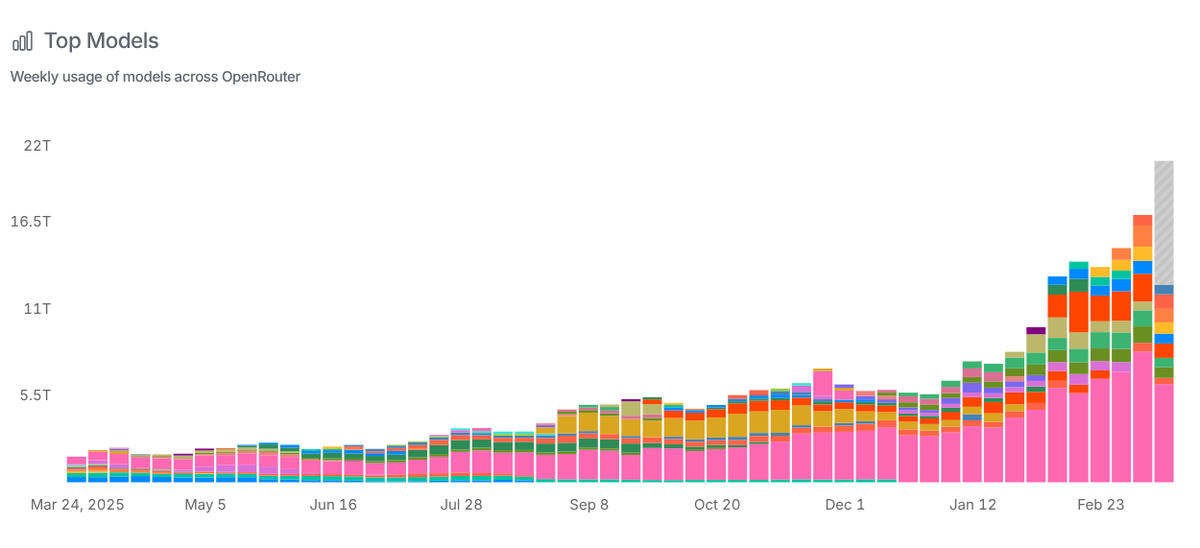
Just a few days before, OpenRouter raised $113M at a $1.3B valuation and now, WSJ reports Stripe is negotiating a roughly $10B acquisition talk with it. Stripe already handles OpenRouter's payments, so ownership would combine billing with AI distribution. That position could give Stripe usage data and pricing influence across competing model providers. Companies increasingly mix models because the best choice changes by task, cost, and traffic. OpenRouter sits between those buyers and labs, collecting payments while routing each request. Stripe would mainly pay for control of a growing decision layer above model providers. The price works only if model choice becomes infrastructure as basic as online payments.

@KenTheRogers ·
One of the biggest benefits of using @OpenRouter is outage safety. If my personal Hermes agent is hooked up to Codex auth and they have an outage it’s annoying but not a huge deal. If a client that I built a custom agent for to run a key workflow has an outage, that’s unacceptable. Anything that needs stability when providers have outages should be built on OpenRouter.

@Amank1412 ·
Tencent’s Hy3 just took the #1 spot on the OpenRouter LLM leaderboard. A 295B MoE model fully open under Apache 2.0, so it’s actually commercial friendly. Built for reliable affordable agentic workflows while going head to head with trillion parameter flagship models. Open models just keep getting better.


@arcee_ai ·
An update on Trinity-Large-Preview: We are officially sunsetting the hosted preview endpoint on OpenRouter. The preview model has served over 3.3T tokens since it's launch in late January. A final thank you to everyone who used it. If you still have active pipelines targeting the preview endpoint, consider transitioning them to Trinity-Large-Thinking to avoid any service disruption. As a reminder, Trinity-Large-Thinking is free on @OpenRouter until 5/23. https://t.co/a9oVQkIfPn

@ai_explorer25 ·
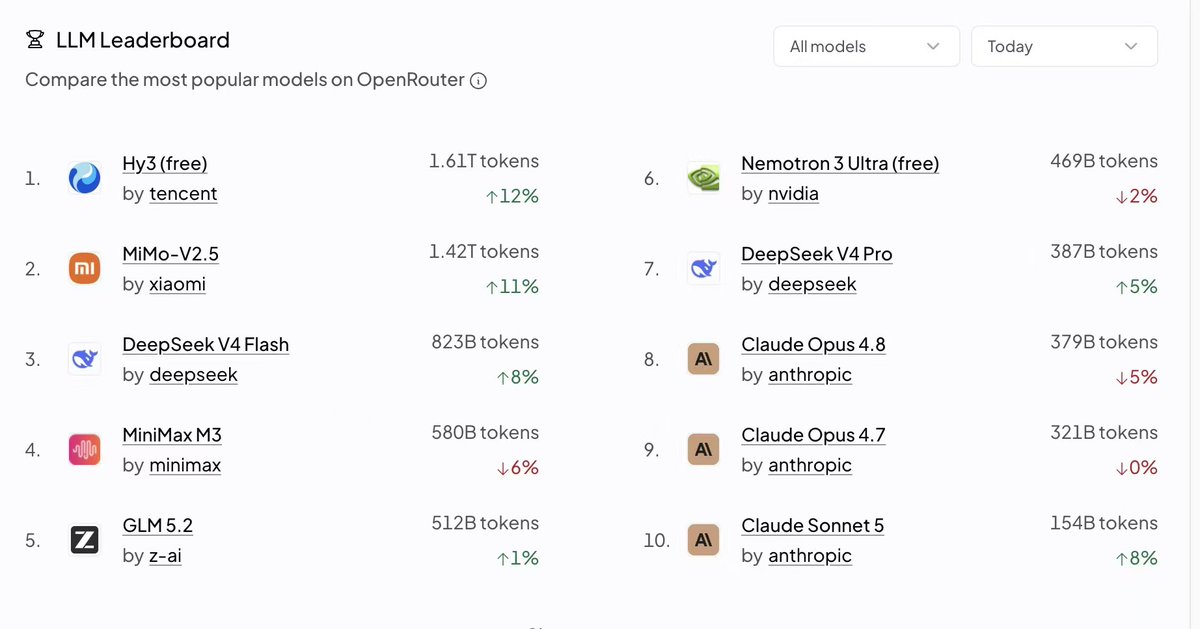
Big milestone: just one week after launch, Tencent Hunyuan Hy3 is now #1 globally on OpenRouter by total model calls. 🥇 For context : The Hy3 Preview topped the same rankings two months ago at 3.6 trillion calls. The current #1 has now blown past 6 trillion. Usage has nearly doubled. That's real developer adoption, not hype. So I spent the day actually testing it. What it is: - MoE model — 295B total params, only 21B active - 256K context window - Fuses fast + slow reasoning in one model - Open source under Apache 2.0 (free for commercial use) My test: "Write a Python function that takes a list of stock prices and returns the max profit from one buy and one sell. Then optimize it to O(n) time and explain the tradeoff." Nailed it. Started with the brute-force O(n²), then refactored to a clean single-pass O(n) tracking min price + max profit, and clearly explained the time/space tradeoff. Reasoning was tight, no hand-holding. 👇 (video below) Why it's climbing the charts: 🔹 Punches WAY above its size — 21B active producing this reasoning + code quality is not normal. 🔹 Pricing is almost unfair: ~1 CNY / 4 CNY per M tokens (in/out), 0.25 cache-hit. GLM-5.1 runs 6–8 in / 24–28 out. 🔹 Coding, tool-use, and multi-step agent tasks are where it shines. The performance-per-dollar explains those 6 trillion calls. Trying full agent workflows next. You can also try it: https://t.co/l3mAplWgh3 Rankings: https://t.co/HnCbt4yJ3x @TencentHunyuan #Hy3 #Hunyuan #AICoding #AIAgents
 Watch video
@aakashgupta ·
Kimi K2.6 hit #1 on OpenRouter last week with 1.58T tokens. Claude Sonnet 4.6 came in at 1.36T. The leaderboard isn't measuring what most people think it's measuring. OpenRouter is a routing aggregator. Developers set a quality bar, OpenRouter sends the request to the cheapest provider that clears it. The leaderboard is downstream of that. It's a proxy for who wins the price-per-good-enough-token war on the slice of the market that doesn't have direct enterprise contracts. Kimi K2.6 costs $0.60 per million input tokens on Moonshot's own API. Sonnet 4.6 is $3. Opus 4.7 is $5. So Sonnet is 5x Kimi's price and Opus is 8x. And Claude Sonnet still pulled 86% of Kimi's volume on the same platform, at 5x the cost. That's the actual story in this chart. The most expensive workhorse model in the industry is doing 86% of the volume of the new cheapest-good-enough option, on the platform built to commoditize the middle. Now scale that. Anthropic has THREE models in the top 10. Sonnet 4.6 (1.36T) + Opus 4.7 (1.15T) + Opus 4.6 (685B) = 3.2 trillion tokens. That's 2x Kimi's total volume on a platform that systematically routes against expensive models. Opus 4.7 launched four days before Kimi K2.6 and is already at #4, up 279% week over week. The thing nobody screenshots: the Y-axis. OpenRouter is processing 28 trillion tokens a week. The chart shows a near-vertical climb starting in February. The price-sensitive slice of the dev market is exploding. Open WebUI users, Cline and Roo Code agents, indie builders without enterprise contracts. And underneath that explosion, the market is splitting cleanly. Chinese open-weight (Kimi, DeepSeek, MiniMax) owns the volume war on price. Anthropic owns the segment that pays for quality. Google parked two Flash models in the top 10 for the workhorse middle. xAI quietly hit #7. Everyone is winning a different game. OpenRouter is the cheap seats. The actual revenue is happening inside Cursor, Claude Code, Bolt, Lovable, Replit. Direct integrations. Enterprise contracts. None of that volume shows up on this chart. Kimi at #1 is real. It took an open-weight model at 1/5 the price to edge out Sonnet by 16% on the platform built to commoditize them both.


@ShinkaIoT ·
Fusion turns your prompt into a small multi-model deliberation. The "Fusion" API from Openrouter entirely flips the math on how we use frontier models. A panel of expert models (see below) analyzes your prompt in parallel with web search and web fetch enabled, then a judge model synthesizes their responses into a structured analysis — consensus, contradictions, partial coverage, unique insights, and blind spots — and writes the final answer from it. 🚀🔀 This isn't a price story; it’s an architecture story. The breakdown of how Fusion works and why single-shot prompts are officially obsolete: • 🎰 The Three-Layer Deliberation: When a prompt hits OpenRouter/Fusion, it triggers a compound workflow. First, a parallel Panel of models analyzes the prompt (with web search and tools active). Next, a Judge model audits all competing outputs, mapping out consensus, contradictions, and blind spots. Finally, a Synthesizer builds a clean, unified response grounded in that multi-perspective analysis. • 📊 Benchmarking the Multi-Model Advantage: OpenRouter tested this framework on Draco's strict deep research benchmark across law, finance, and medicine. A panel of Fable 5 and GPT 5.5 synthesized by Opus 4.8 scored an elite 69.0%, outperforming Fable 5 running solo (65.3%). Even more impressive: a budget preset combining cheap models (Gemini 3 Flash, Kimi K2.6, and DeepSeek V4 Pro) hit 64.7%—matching frontier performance at half the price. • 🔄 The Power of Self-Synthesis: The data proves that 75% of Fusion's performance jump comes strictly from the synthesis step, not model scale. Even when a single model like Opus 4.8 evaluates its own work in a dual-panel setup, its benchmark score rises from 58.8% to 65.5%. Iteration and comparative verification beat single-shot answers every time. • ⚖️ Stacking Cost vs. True Accuracy: Because Fusion runs 3 to 5 models in parallel, you pay the cumulative token cost of the underlying completions. However, the budget preset stacks up cheaper than running a single, premium frontier model while offering a built-in audit trail. Knowing that three independent models verified the same fact provides a completely different level of enterprise confidence. The Takeaway: The future of AI is cognitive diversity and smart orchestration, not single-model monopolies. Stop asking one model a question and blindly pasting whatever it spits out. Head to OpenRouter, initialize the Fusion API, and start running multi-model panel checks on your deep research, market analysis, and content workflows. Stop prompting. Start orchestrating. 🖥️⛓️

@korablev ·
Big update: 21st SDK x @OpenRouter 🤝 Now you can keep runtime: "claude-code" and run your agents on OpenAI / Gemeni models via OpenRouter model IDs. Same Claude Code-style workflow. More model choice. 🧵


@Tim_Hua_ ·
On the toy reward seeking environment from Nitishinskaya & @BronsonSchoen, Opus 4.6's "reward seeking rate" varies wildly based on @OpenRouter provider. In fact, if you use Anthropic through Openrouter, you get a different number than if you used Anthropic API directly??


@_vmlops ·
SOMEONE ON REDDIT JUST CUT THEIR API BILL BY 24X USING OPENROUTER they'd been vibecoding for 9 months, manually juggling and rate-limiting APIs across a pile of side projects plugged an openrouter MCP into claude code and pointed it at an image-extraction + recipe-gen project → was running sonnet for image extraction, haiku for recipe gen, thought that was already cheap → had claude code a/b test cheaper models through the router automatically → quality stayed basically the same, cost dropped 24x → one bill instead of a pile of forgotten api signups for dead projects 5% routing fee, paid for itself instantly new default for anyone stacking multiple APIs across projects


@Aizcalibur ·
I believe this will be helpful to my fellow community members. Did you know @NousResearch Hemes has an auxiliary system for specific functions that can be routed through specific providers? 🤌 But here is what I stumbled upon and fixed before getting rekt. I noticed GLM-5 requests showing up on my OpenRouter dashboard even though my primary model was configured to use ZAI's direct API. GLM-5 doesn't take image input and this is where the auxiliary system comes into play. I assigned Gemma 4 via OpenRouter as the provider to 'vision' which takes image input and provides text output to GLM-5. The config looked correct on the surface and even Hermes just worked as it always does. Luckily, I checked my OpenRouter logs and saw GLM tags and was super confused. Shared the screenshots with Hermes and we dug deep into the configs. For reason I don't know, when I asked it to set OpenRouter for auxiliary, it got added to delegation provider with a blank model which was then taking Zai. Plus 'auto' was set in auxiliary and it routed for GLM but via OpenRouter for all the other tools except for 'vision' for which it took Gemma 4 as intended. As per Hermes, the fix here was changing the delegation + specific providers for each auxiliary tool. Quite an interesting system. If I hadn't seen the logs, I would be wasting money on OpenRouter even though I have a direct coding plan from Zai. I recommend checking logs and auditing if you use multiple models.


@aronprins ·
OpenRouter on Paperclip today: hire Hermes or OpenCode, attach the key as a secret, set a budget, run the routines. https://t.co/bBIieidsjR

@ThePracticalDev ·
Claude tokens got pricey. This dev tested 20+ models as orchestrator replacements in an OpenRouter agentic stack, rated on duration, token value, integration, and advanced effectiveness. { author: @TythosEternal } https://t.co/JRP2i4PZFB

@localjulius ·
Xiaomi's free AI usage beat Claude Sonnet on OpenRouter last week. By 58%. > Xiaomi MiMo-V2-Pro: 1.77T tokens/week > Step 3.5 Flash (free): 1.61T > MiniMax M2.5: 1.39T > DeepSeek V3.2: 1.23T > Claude Sonnet 4.6: 1.12T > Claude Opus 4.6: 1.06T Xiaomi is beating Claude Sonnet 4.6 by 58%. Is this free-tier volume arbitrage? Or is the quality genuinely there?


@JulianGoldieSEO ·
Most people think running AI agents means paying from day one. That is no longer true. A new free model called Elephant Alpha just dropped on OpenRouter in testing. And that means you can plug it into OpenClaw, Claude Code, and Hermes without paying for the model right now. What actually happened in this setup: → API key from OpenRouter. → Model was not easy to find inside OpenClaw. → Manual config solved it faster than scrolling through hundreds of models. → Errors showed up after switching providers. → A fresh /new session confirmed the model was working. That is the real lesson. With AI agents, the fastest path is not always the cleanest UI. Sometimes the winning move is manual setup, quick troubleshooting, and testing immediately. Also, free models do not stay free forever. But OpenRouter keeps cycling new stealth models, so there is often another one to test. Save this video, you’ll avoid wasting money before testing your agent stack properly. Want the SOP? DM me. 💬
 Watch video
@theinformation ·
OpenRouter, which helps app developers access hundreds of AI models, has discussed a potential sale to a bigger tech company that could value the startup at billions of dollars, a steep premium to its $1.3 billion valuation. More details: https://t.co/oZRGDZUScs

@roshanasingh6 ·
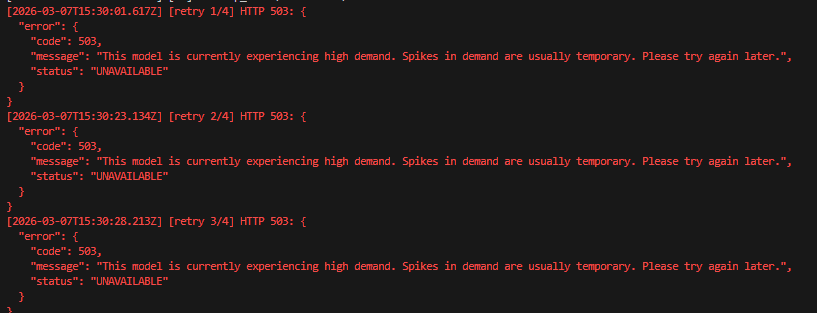
I am tired at this point, if I tune down the RPM below 5 it works fine above that the model starts experiencing high demand, same via OpenRouter too, how are we supposed to use Google's model in production

@gudanglifehack ·
AI Digest: OpenRouter costs and OpenAI’s GPT-5.6 Sol update 1. Accessing DeepSeek models through OpenRouter is more expensive OpenRouter routes requests through its own servers before reaching the third-party host, incurring additional costs and inefficiencies due to routing, caching, and infrastructure overhead.

Best OpenRouter tweets
Xholic studies what works in your niche, drafts posts in your voice and schedules them for the hours your audience is online.
$0 today · Card required · Cancel anytime
Browse all tweet collectionsLive demo: no sign-up or login needed · takes about 2 minutes
Keep exploring