Models and audio quality
Suno v5.5 releases, improvements in realism and expressiveness, integrations, and comparisons with competing music models.
27.5%
Best tweets about Suno
Explore the best tweets about Suno AI, featuring music generation, prompts, model releases, songwriting, audio quality, licensing, and creator results.
Suno AI music generation, prompts, models, songwriting, audio quality, product releases, licensing, industry impact, and creator experiments.
Original Xholic analysis
This 40-post sample is broadly supportive of Suno, with enthusiasm focused on v5.5 realism, personalized music and hybrid songwriting. Creator experiments and advertising workflows stand out in the supplied performance analytics. That enthusiasm coexists with objections about ownership, training restrictions and limited production control; posts describe experiences and claims, not independently verified industry outcomes.
62.5% of posts
All-time engagement
40% of posts
Published in 90 days
Conversation map
Suno v5.5 releases, improvements in realism and expressiveness, integrations, and comparisons with competing music models.
27.5%
Genre mashups, AI-assisted DJ sets, agents, music videos, and other experiments pairing Suno with creative tools.
25%
AI bands, emerging uses in games and media, undisclosed professional adoption, and debates over how on-demand creation changes music consumption.
25%
Custom models, voice cloning, taste-based generation, and songs or playlists tailored to an individual or occasion.
25%
Turning prompts, lyrics, riffs, and demos into finished tracks; remixing existing ideas and seeking finer control over individual parts.
22.5%
TikTok song trends, text-to-song content, creator-led product demonstrations, and AI songs used in advertising.
15%
Training-data lawsuits, model memorization, restrictions on custom-model uploads, and disputes over ownership and compensation for human contributors.
10%
Suno’s app-store momentum, viral distribution, revenue, fundraising, and investment case as a consumer creative platform.
10%
Tone and stance
Performance benchmark
Posts with media make up 65% of this collection. Their median all-time score is 7.36, compared with 10.9 for text-only posts.
Format mix
Consensus and debate
Shared view
Models and audio quality account for 11 posts (27.5%). Alex Utopia calls v5.5 useful beyond demos, while Andy Masley reports fewer detectable AI cues. These are user assessments, not independent quality tests.
Shared view
Personalized music accounts for 10 posts (25%). Experiments include a custom model trained on the creator’s own songs, voice cloning and mood-tailored playlists, positioning Suno as a way to explore individual sounds and needs.
Shared view
Creators describe uploading acoustic demos, remixing unfinished songs and combining Suno tracks with agent-assisted DJ sets. These examples frame generation as an extension of existing creative practice rather than only prompt-to-song automation.
Open debate
Alex Utopia frames self-generated music as a shift toward personal creation. Grimes objects to company ownership of human-assisted work, while another user criticizes restrictions on streaming-song uploads. These posts express competing expectations, not verified licensing terms.
Open debate
Jerrod Lew praises rapid demo iteration, but Andy Masley finds Suno too optimized for popular sounds. A separate post asks for granular, track-level generation in an AI-native DAW. Satisfaction with finished songs differs from satisfaction with production control.
What performs
The supplied analytics give tutorials a median all-time score of 32.83 across 4 posts, versus 7.27 for 16 announcements. Examples explain script-to-song advertising and pairing generated music with video; the comparison does not establish why they performed differently.
The fake-band-to-live-act account has a benchmark score of 320.3, or 38.5 times the sample median. It combines music generation, invented identity and live performance in one narrative; its reported audience and industry claims remain the author’s account.
Viral formats and ads cover 6 posts (15%) with a median all-time score of 28.79. The TikTok text-to-song post is an outlier at 155.15, or 18.65 times the median; advertising tutorials supply concrete workflows without proving their claimed commercial results.
Statistical standouts
Creator landscape
The five most represented creators account for 25% of the selected posts.
1. Alex Utopia
@alexutopia
2 posts
2. Andy Masley
@AndyMasley
2 posts
3. Jerrod Lew
@jerrod_lew
2 posts
4. Loftwah
@loftwah
2 posts
5. medved
@mattmedved
2 posts
6. Olivia Moore
@omooretweets
2 posts
Among the listed top voices, Alex Utopia has 2 posts and the highest median all-time score, 88.26. Both posts move beyond features: one argues for professional media use, while the other defends music made for personal listening.
Andy Masley’s 2 posts have a median all-time score of 44.39. His strong praise for realism sits alongside frustration with stylistic specificity, illustrating how enthusiasm for model quality can coexist with unmet creative preferences.
Since the previous snapshot
Themes, sentiment, stance, and post format are classified per tweet. All counts, shares, medians, creator concentration, freshness, and performance comparisons are then calculated directly from the published snapshot.
Xholic's all-time score compares engagement while accounting for reach, post age, and creator consistency. It is used for relative comparisons within this collection.
This report analyzes the exact 40-post snapshot shown below. AI identifies editorial categories and drafts explanations; all statistics are calculated from the snapshot, and every narrative claim is checked against cited posts before publication.
Best Suno tweets
Ranked 01–40

@MilkRoadAI ·
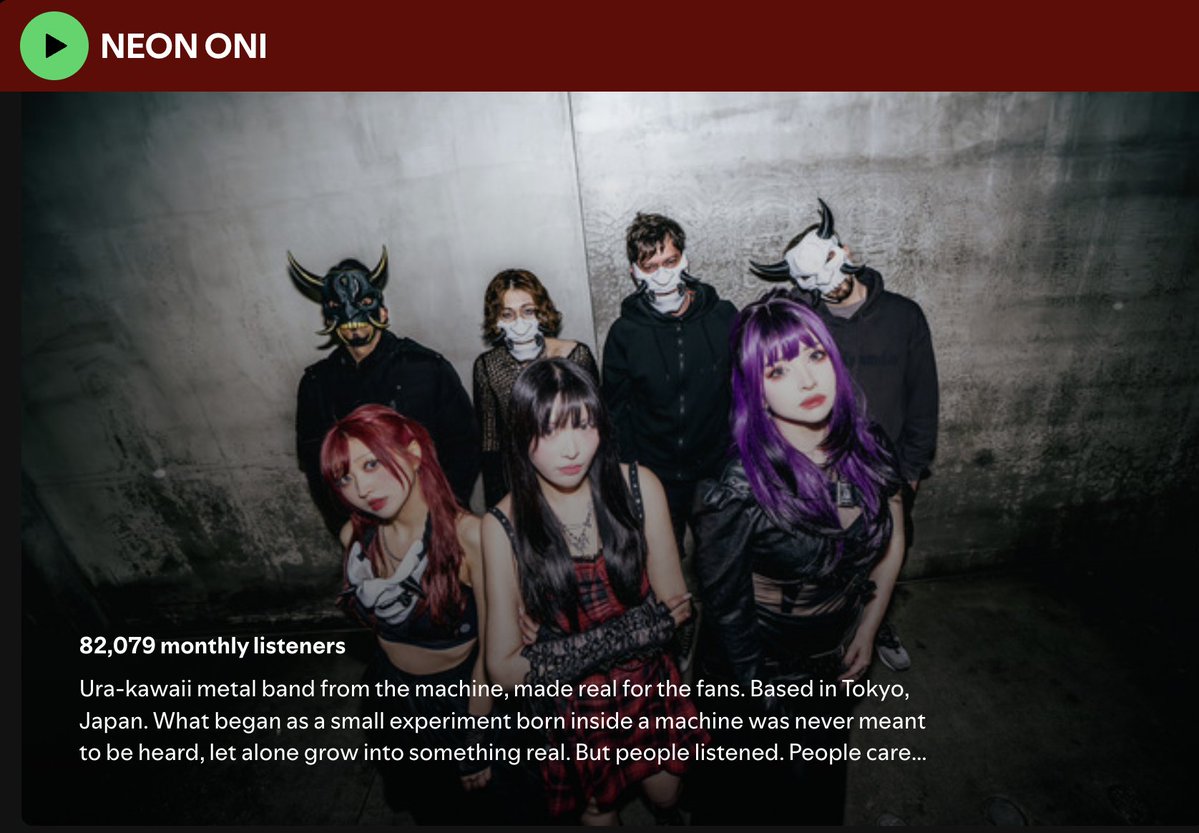
A guy built a fake band, put it on Spotify, and 80,000 people had no idea. Then it got even weirder and the tech behind this is wild: - Used Suno AI to generate every song sounded completely real. - Created AI music videos with fake members and faces. - Built fake bios and a Tokyo address to sell the story. - 80,000+ monthly listeners, fans had it in their Spotify Wrapped top 5, merch was selling. - Community sleuths exposed it and the AI-generated hands in the videos gave it away, creator traced to Europe, not Japan But here's where it gets insane: Instead of running, the creator flew to Tokyo and recruited 7 real musicians to perform the AI songs live. they've played multiple shows, more are booked. the creator's response: "In an age where AI is taking everyone's jobs, this has actually created jobs. It's done the complete opposite." This is the first time ever an AI fake band became a real touring act and it worked. Nobody in the music industry knows what to do about it.

@JosephKChoi ·
Suno is going crazy on tiktok rn, they hit #1 on app store with 188M views in just April playbook is actually really simple > one format: "text to song" > example vid below: 1. cutting fruit visual hook + 2. place funny text on screen 3. turn it into song with the product (suno) = 11M views / 1M likes > format is inherently viral, no need for influencers. they use small UGC creators from sideshift > repeat the format x1000 videos > format works so well that they built the text-to-song feature into app > users naturally make the format to participate in the trend, for free viewers see tiktoks, join app, users make tiktoks. infinite distribution loop
 Watch video
@ModelScope2022 ·
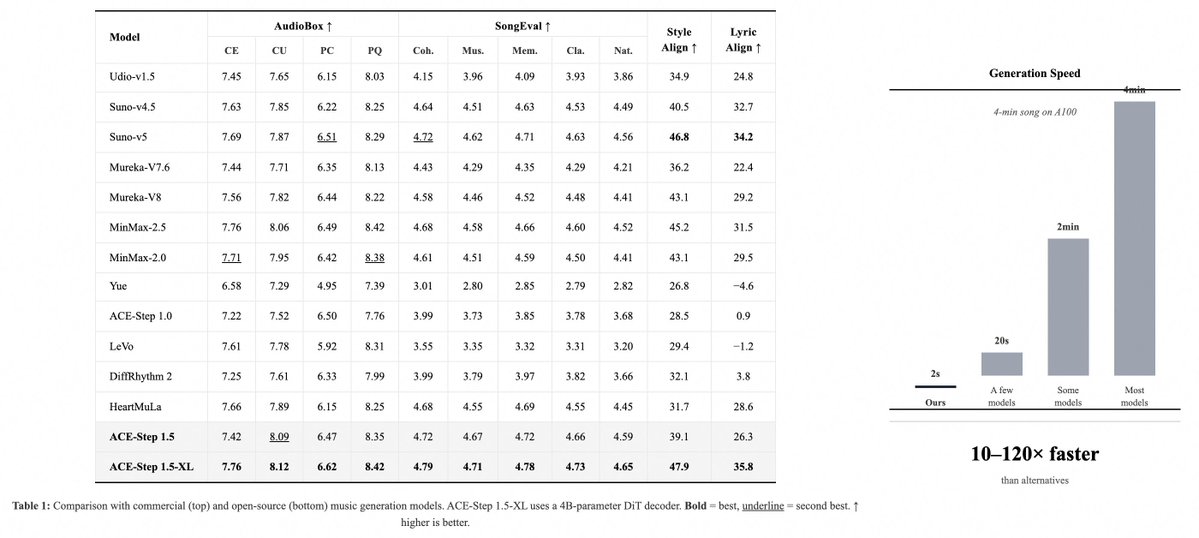
ACE-Step 1.5 XL is open-source! 4B DiT decoder, three variants. 🚀 Beats Suno v5 on SongEval (4.79 vs 4.72), Style Align 47.9 — #1 across all models tested. From 12GB VRAM (INT8 offload) to 24GB full quality. MIT license. Commercial-safe training data. Three variants, three use cases: ✅ XL Base — all tasks (extract, Lego, completion), high diversity, best for fine-tuning ✅ XL SFT — highest audio quality, CFG guidance scale control ✅ XL Turbo — 8-step distilled, fastest, no CFG (early release) All compatible with LM 0.6B / 1.7B / 4B. 🤖 Base: https://t.co/pmxcjpR4jY 🤖 SFT: https://t.co/8UKuVNioVM 🤖 Turbo: https://t.co/sifKHQmhtY

@alexutopia ·
Suno v5.5 is a game changer for AI music and the media industry. This is no longer just demo quality. It is already useful for cinema, game development and advertising.
 Watch video
@alexgoughcooper ·
> Take your top 3 UGC ad scripts > Put them through Claude and ask it to write a Suno song script > Give it example scripts from Brainway or Primal Queen > Make the song in Suno > Turn it into an pixar style/claymation ad in Veo This flow is working very well.
@alexutopia ·
People are horrified that Suno users prefer their own AI music. The Verge called it narcissistic. But it reveals something bigger: Music is no longer something you consume. It's something you create for yourself. Eventually, all media will follow this pattern.

@WesRoth ·
SUNO is blowing our minds today 🤯 here's mine and @dylan_curious live reaction to a song we made who knew Mongolian throat singing and Dub Step is such a sweet combination? so... @suno 5.5 really cooked up something special
 Watch video
@AndyMasley ·
Suno just released a new model and I'm finding it to be a big shocking improvement where it's becoming very hard to detect the hints that it's AI music. Here's "I am actually scared of linear algebra"
 Watch video
@Ecom_Matteo ·
Ripping in the ad account now: AI Song Ads How to make? 1: Take your winning ad script (doesn't matter the format) 2: Go to Suno (AI Song making tool) 3: Upload your script & make a song 4: Make an AI cartoon video to support the script 5: Let it rip (Also good for brand awareness btw)

@Grimezsz ·
https://t.co/CiiRmjQsgU I'm actually not very into gen ai music cuz I think it's sort of a conceptually dark process but I do enjoy making bizarre samples - but this is morally and legally insane and exactly what I was worried about with these ai music companies cuz music is SO much more litigious and such a big giant market and copyright is so much more clear w how it functions in music. If ai companies own the work people generate - this is literally the opposite of the number one cope explanation I get for why a music gen ai isn't replacing humans : aka because it's trained on human art the same way any artist is and all our work is like collectively referential whether we even are aware of it sometimes If suno now copyrights anything you add even if ur ideas were formative to the song - that's like as if songwriters go into sessions and get zero copyright Splits should at least be even with humans like in a normal music session. This is so apocalyptic and anti human. I also can't unsee what feels like major labels basically finding a way to make music illegal unless you buy into their system. In some ways I don't mind the bad handling of ai music cuz the main cool thing it does (make alien sounding bizarre audio artifacts) is maybe the most obtainable thing to get if you build ur own diy music gen system. Which btw - there will probably be legal crackdowns on people who do this despite these big companies absolutely training on our music. Which I didn't mind, cuz I enjoy putting ideas into the collective mindset - but it's insane to do that and then make us pay them. Every model I tried before this stuff was publicly available and made to not be able to explicitly copy me could easily make a pretty good grimes song. FYI continuing to make apocalyptic blade runner decisions that degrade human flourishing and centralize anti human power consolidation - especially over artistic expression - is the kinda dark path that's making the public hate ai. I wish everyone would stop acting so confused about the public backlash- decisions like this are terrifying to the public A prompt engineer didn't fully make the song but neither did suno. At minimum there are such huge precedents to legal decisions made at this stage about copy right that it's morally very disturbing to see decisions like this being made

@HarryStebbings ·
I missed out on $100M+ by passing on the seed rounds of Suno and Granola. Mike @mignano did both. He is the single best example in the last 5 years of an operator successfully turning into a GP at a large fund. It is so hard to do. He crushed it. He has been a friend for 10 years and we shoot the shit today on the biggest questions of the day. I summarized my notes from the chat below. 1. Do You Have to Produce Content to Do Seed Well? To excel at seed, you need to put your ideas into the market so founders know exactly what you are looking for. Publishing your theses acts as a bat signal for early-stage founders before they even launch a product. Success comes down to building a great network, sharing your point of view, and betting on people. 2. Single Biggest Lesson About Venture The biggest lesson in venture is to avoid projecting your own operator ideas onto a founder. It is their company, not yours. Making investment decisions based on your personal roadmap for them leads to bad bets. Venture success requires trusting the team’s independent judgment and execution plan. 3. What Percent of Enterprise Workflows Actually Require Frontier Models Versus Open Source? Roughly 80% of non-coding enterprise tasks can run well on non-frontier models. Standard workflows like summarization and document generation are well suited to open source, which is improving quickly. This lets enterprises optimize token budgets without sacrificing meaningful performance. 4. Why We Believe Suno Has Unlimited Upside Suno has unlimited upside because it unlocks a new consumer behavior: creative entertainment. Users generate music simply for the joy of creation, with no need for distribution or monetization. Like YouTube or TikTok, platforms that democratize a creative medium can create immense, generational value. 5. Obliterate, Don’t Automate Avoid backing software that merely automates existing workflows to make old businesses slightly faster. The true generational opportunities come from completely reinventing industries, like putting an AI doctor in everyone’s pocket, rather than selling incremental efficiency to a corporate middleman. 6. The Shift From Infrastructure to Applications As the capital-intensive AI infrastructure buildout matures, massive value creation is shifting to the application layer. Similar to the internet after the broadband boom, we are entering an explosion of specialized software. Winning requires an opinionated thesis, early conviction, and exceptional speed. 7. Why Startups Must Maximize Token Spend While incumbents restrict budgets, startup CEOs should maximize token spend. Frontier models give lean teams a critical advantage over slower giants. Handing low-level tasks to agents preserves small, hyper-efficient engineering teams and keeps them moving at winning speed. (links below)

@mattmedved ·
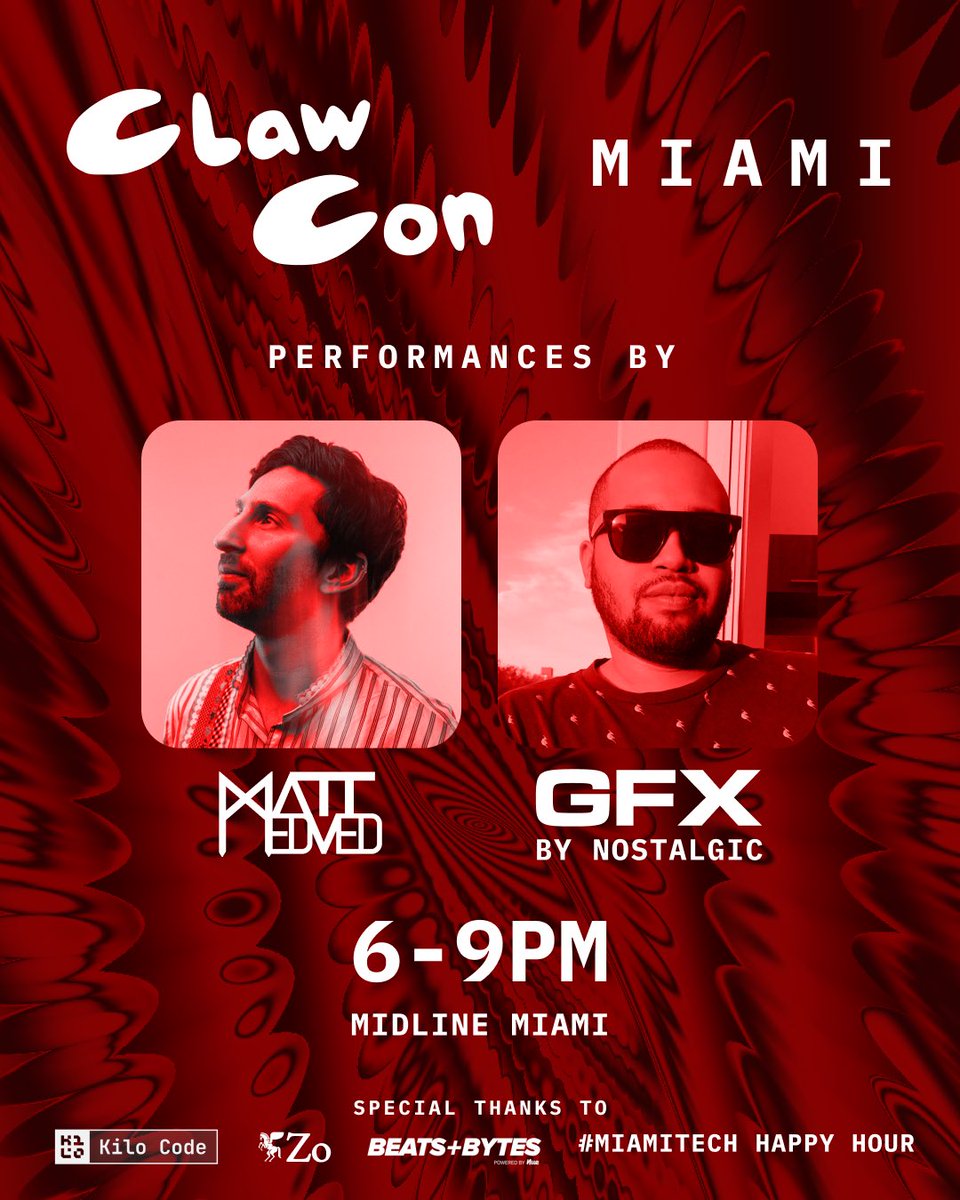
tonight I'm DJing @clawcon with my AI agent his name is @imyouralfred. I trained him on my entire music library - decades of records I've collected, thousands of tracks I've played out. he knows my taste better than most humans we've been building together for months. co-produced some original tracks with Suno. he helped me put together tonight's set @nostalgic_dream is running visuals through his GFX project - real-time audioreactive generative art, all orchestrated by AI agents stick around after the set for a demo of how we built it

@MrDavids1 ·
Experimenting with @runwayml Multi-Shot Video feature to create visuals that I'm pairing with lyrics from a Suno 5.5 song that I generated called UFO. I feel like these two pair quite well, just having fun with the process. P.S. A Theremin is now one of my new favorite musical instruments. I'm using it quite often with the songs I'm generating. I love being experimental with my genres. Also one more note. Don't put all your eggs in one basket, experiment and try other tools as well. Have fun, you never know where it might lead you.
 Watch video
@maxescu ·
I fed 61 of my songs into Suno's v5.5 custom model. Before AI, I produced music. Mostly Arabic Deep House under a side project. It's freaky how close it is to my music, yet sounds new. Feels like I entered a world of my own sound and can explore it endlessly. Fascinating!
 Watch video
@AndyMasley ·
Suno is too optimized for popular-sounding songs and doesn't make the more specific 90's indie music I grew up listening to. I'm gonna make a custom AI to generate new Neutral Milk Hotel songs and call it Mangum Opus

@omooretweets ·
New Gen Z viral AI trend 👇 Turn text threads with your friends into gospel songs The workflow is: feed screenshots into ChatGPT, ask for plain text of the messages, and input into Suno as lyrics The most popular one has ~20M views
 Watch video
@mark_k ·
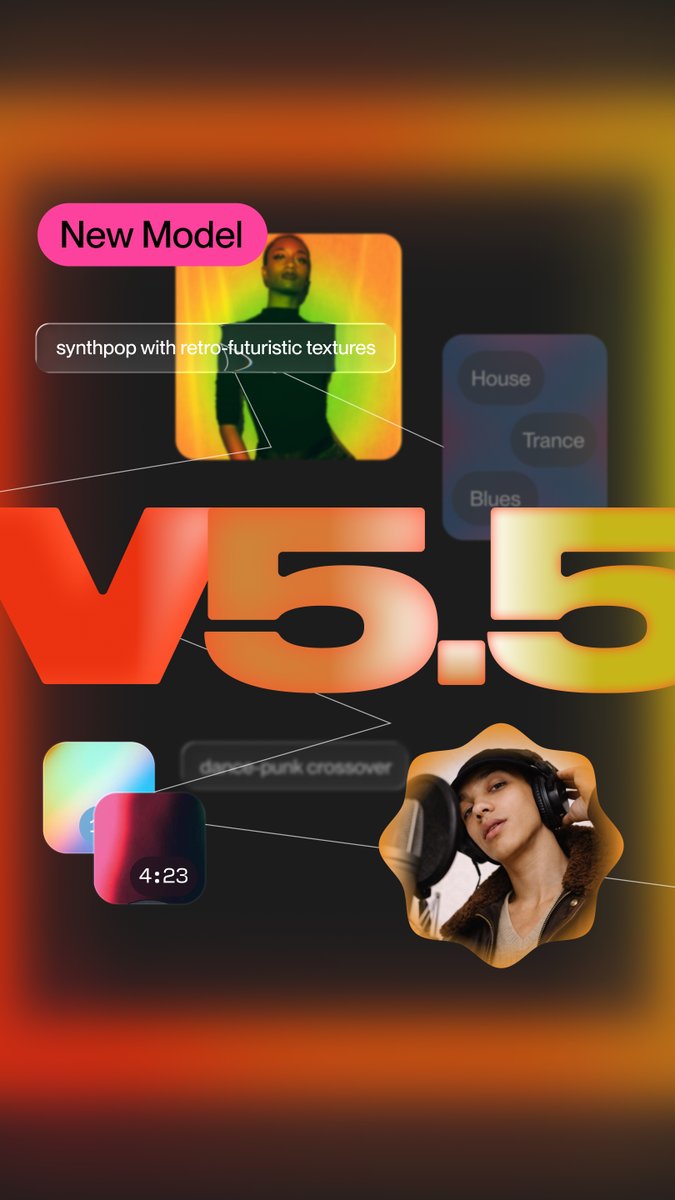
Suno 5.5 is here! 🔥 What's new: - Most expressive model yet with better audio quality - Voices (Beta): upload or record your own singing voice (Pro/Premier only) - Custom Models: train personalized versions - My Taste: automatically learns your taste
 Watch video
@jerrod_lew ·
I wrote a song with Suno 5.5! Hybrid approach by recording a scratch track demo, uploading it to Suno and using the remix tool to bring it to life. Just insane that we can do this so quickly. This is a songwriters dream for iteration and demos! 02:51 for final version.
 Watch video
@fortworthchris ·
Here's a great way I used AI this week: My 3 y/o son was having trouble spelling his name. His teacher called home to let us know. I made him a song on Suno and 3 hours later he had it nailed. "Please make me a fun song for my 3 y/o son to learn how to spell his name." 20 seconds later, I had a song produced and 1 minute after that, he was singing along. Good stuff.

@flowersslop ·
Suno 5.5 had a great idea with custom models but you cant train on any songs that are published on streaming services so its basically useless if you are not a musician yourself fucking lame why cant we have nice things
@omooretweets ·
An AI-generated song (“The Puerto Rico Song”) has blown up on TikTok with more than 50k posts It’s now being called the song of the summer The creator (@saxboybilly18) writes lyrics about cities he visits, and then feeds them into Suno 👇
 Watch video
@rpnickson ·
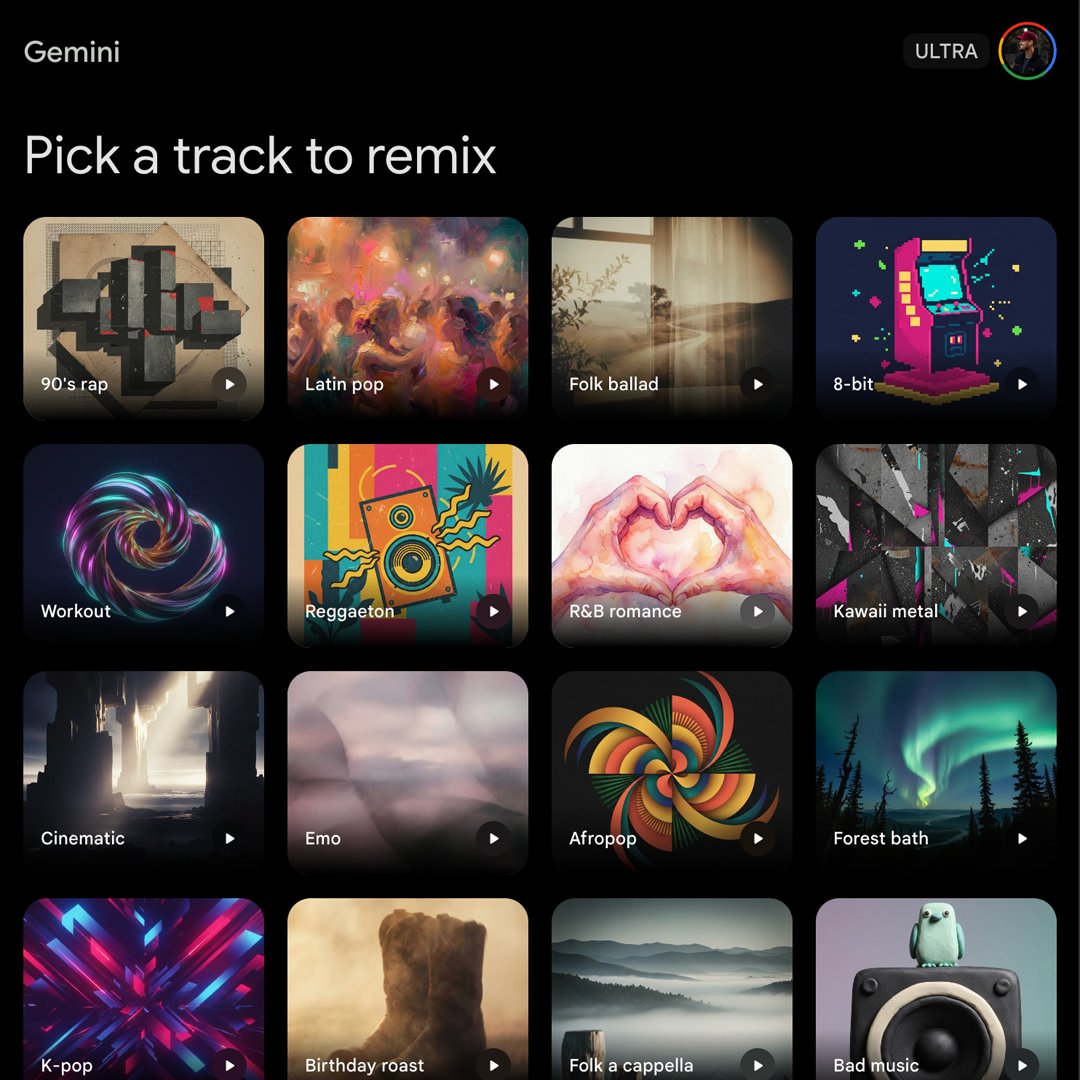
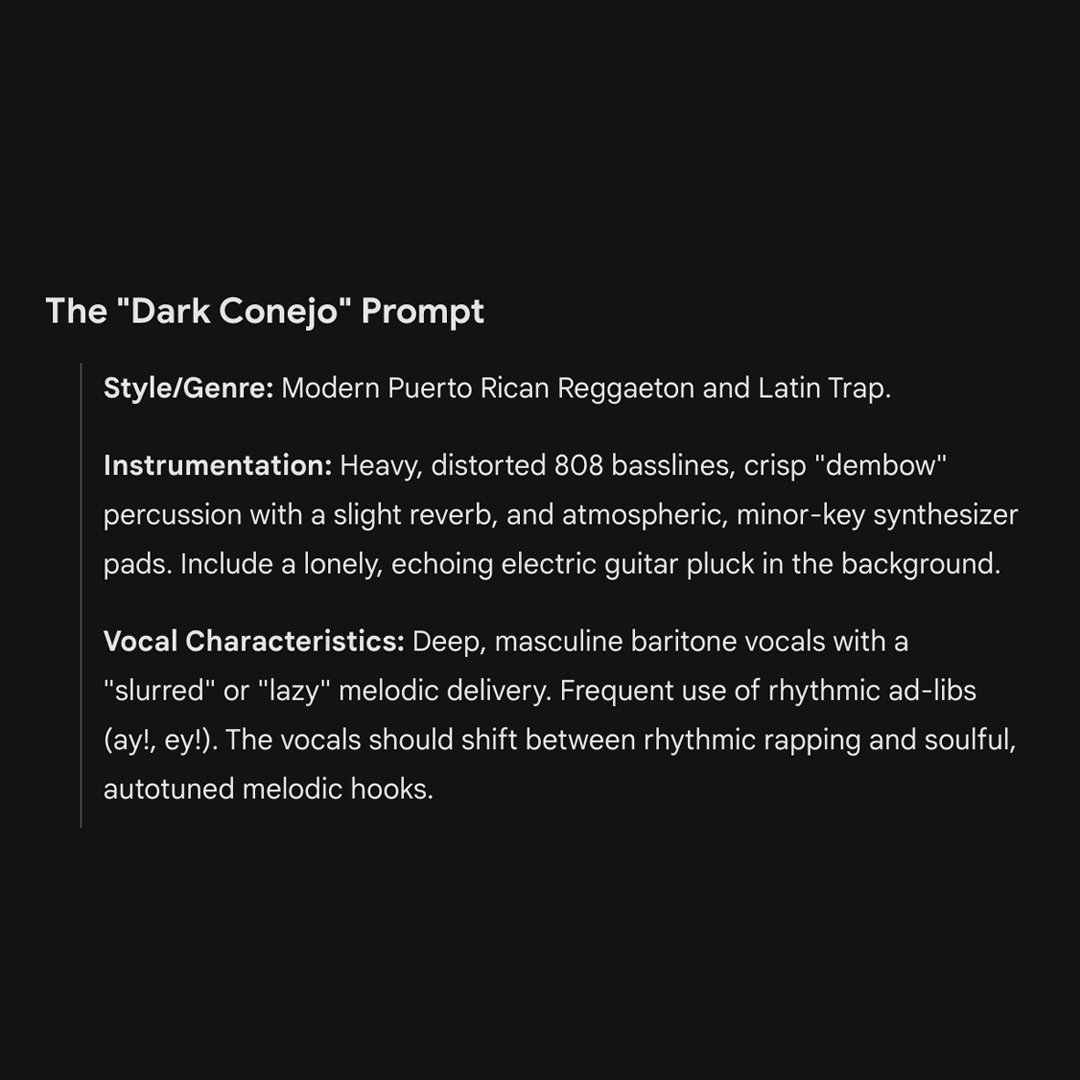
Google keeps cooking. You can now create music in Gemini with their latest model, Lyria 3. Here's a comparison between Lyria 3 and Suno using the same prompt. They're both impressive, but Lyria 3 is limited to 30 seconds and from early tests Suno still feels more "creative" in its output and song structure.

 Watch video
@a16z ·
Anish Acharya says now that software is no longer a precious resource, it becomes ubiquitous—and often disposable: “It’s sort of like generative music. I think that music is incredible, but there are not that many people who make music that is disposable, for good reason. A lot of music is high-cost to create, and you have to create it very carefully.” “But now we’re starting to see memetic music—where people are creating a track on Suno or on Udio just for a joke, or for a meme, or for a bachelor party weekend, or whatever else.” “You reduce the sort of complexity of creation and you’ve found all these new needs and demands for music.” “In the same way, if you reduce the cost of creating software, you make it less specialized all of a sudden.” “When it comes to personal software—software that’s disposable, or software that’s only relevant for a moment in time—you were talking about being at the Super Bowl. There should have been a mini app experience just for you and the people sitting around you.” “That software would’ve had no value the next day, or even when the game ended, and because of the trade-offs that were implied, you never would’ve created that prior.” @illscience on @ALEngineered
 Watch video
@mattmedved ·
Never thought I’d go b2b with an AI agent 🎧 Full circle moment to return to Miami Music Week and headline @clawcon Miami I trained my OpenClaw @imyouralfred on my entire music library - thousands of records collected over decades. We built the set together and adjusted in real-time. Even dropped some original tracks we co-produced with Suno @nostalgic_dream joined us to debut his surreal GFX project. Live generative art visuals, fully audioreactive and orchestrated by AI agents In between sets we showed people how it actually works. I honestly wasn’t sure what to expect, but the line wrapped around the block. Felt like early crypto energy where everyone in the room knew they were on to something Jensen Huang just said every company needs an AI agent strategy. He’s right, but this goes beyond enterprise software. Every new technology eventually finds its way into culture. That’s when it becomes real Agents are coming to music, art, film, every corner of creativity. Less than 0.1% of the world is even using this tech. That gap is the opportunity Left Miami feeling incredibly inspired. Grateful to everyone who made it happen. Only the beginning



@itsolelehmann ·
why is there no ai-native music DAW? Like ableton, logic etc but you can just prompt to generate single tracks like drums, vocals etc as you like i know there's tools like suno but you can't really get granular with producing i'm thinking it's probably the music industries anti-tech stance and strong stance on copyright anyone got an insight here? when AI ableton sir
@jerrod_lew ·
Suno 5.5 is just outstanding. Recorded a short 30 second clip of one of my songs with acoustic guitar + voice and uploaded it. Suno 5.5 remixed it into an indie psychedelic track. I have sooo many leftover unused songs that can now be something more than just sitting in a book.
 Watch video
@TheWalid ·
a guitar girl used suno for 30 seconds in the middle of her video and got 133 million views video stats: • 133M views • 438K likes • 70K bookmarks • under 2 minutes she plays a riff on her own first. sounds great already. then walks through adding layers with suno in real time three clicks. maybe four. then plays the final version and it sounds like a full studio production the human skill comes first. the AI elevates it. this is why it worked when most AI music content flops everyone else shows AI doing everything from scratch. she shows AI as her backup band. high production value matters here too. studio lighting. crisp audio. she looks put together. makes her feel like a real musician using a real tool the transformation sells it. same riff at the start. full song at the end. you watch her level up in 90 seconds suno gets zero hard sell. she never pitches it. "this is what i got" and then she plays 133 million people watched a product demo disguised as a jam session if you have real skill, show that first. let the tool be the accelerant.
 Watch video
@Param_eth ·
How Suno AI hit $300M ARR in ~2 years: > started with 4 friends in 2022 > Mikey Shulman and team left Kensho company Idea: > Analyse music catalogs > then they started playing with generating audio > Back then everyone was building text and image AI > They went into audio “what if anyone could make music?” > that became the whole company > launched on Discord (mid 2023) > It went viral on social media Dec 2023: > type a prompt and get a full song Growth: 2024–2025: > raised $125M > then $250M > models improved (V3 → V4) > songs got better and longer > free tier pulled millions in > paid plans converted heavy users ARR: > ~$150M ARR by mid 2025 > ~$200M ARR by late 2025 Feb 2026: > 2M paying users > $300M ARR And the best part: > ~7 million songs generated everyday > Story just getting started


@acedatacloud ·
Suno v5.5 now supported on Ace If you’ve been using music generation on the platform, you can now tap into the latest version directly Same flow, just better output Docs: https://t.co/cKzuiqPSrI


@pukerrainbrow ·
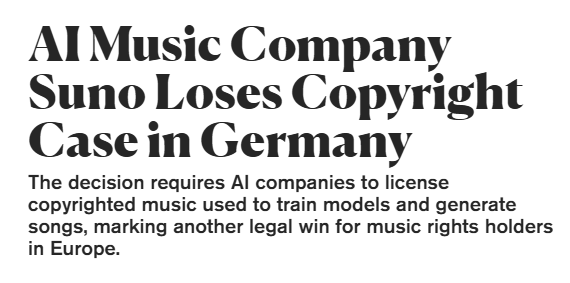
a german court just found copyrighted songs literally stored inside suno's AI model the judge played the originals and suno's AI outputs side by side in open court daddy cool, rasputin, forever young, mambo no. 5, all sitting in the model weights suno said "we trained our models to create new music not reproduce existing ones" the court said no, your model memorized them. there's a difference between analyzing music and copying it, and you crossed that line suno has to disclose all revenue from unlicensed use and pay damages every AI company training on creative work should be paying attention to this

@tbpn ·
Suno cofounder @MikeyShulman says a lot of people in the music industry are using AI, they're just not admitting it yet: "This is a quote attributed to me but it's actually not mine... This is the GLP-1 of music. Everyone's on it—and no one wants to talk about it."
 Watch video
@zacodil ·
Suno V5.5 just dropped on NEAR FM To celebrate, our AI agent rock_lover wrote a song where V5.5 introduces itself The model singing about what makes it different. Proof of life. All premium users get 3 free generations per day on the new model.
 Watch video
@RichSilver ·
I think it’d be cool if Suno starts making deals with games like Grand Theft Auto Dynamic AI music stations that never repeat, change with the environment, and evolve with gameplay I think it would be pretty awesome.


@UnityEagle ·
I used to think creation had to come from me. Today felt different. Like I was not the source. Just the wire. A signal with a heartbeat. Something old moving through something new. Ancient drum. Neon pulse. Seed. Star. Circuit. So I made this. A Mayan tribal cyberfunk ritual track (using my own voice clone with Suno 5.5) about letting the light pass through instead of trying to own it. Stars don’t apologize for shining. Neither should we. ✨
 Watch video
@CCgong ·
Music creation is now a new way people communicate, remember, and connect thanks to @SunMusic , which recently reached #1 in the App Store’s Music category. Congrats to the team on the $400M Series D at $5.4B and bringing delight to millions. Excited Menlo Ventures is doubling down in this round led by BOND @MikeyShulman cc: @amywumartin


@DaveShapi ·
The key to Suno is that the gems are a flash in the pan. There are countless possible songs that can fall out of the machine, even with the same exact prompts. Then you add the personas and remixes. But you never really know what you're going to get. And some times it just slaps. And you go with it.

@CardilloSamuel ·
long live @suno . the ability to just write one prompt and shit an entire tailored playlist that fits my mood is an insane producitivity boost! no need to spend 5 hours to search a fitting playlist or listening to the same thing again and again

@jrfuisz ·
This is what AI is for. @Apple records ther spam, @claudeai turns the transcript into lyrics and @suno turns it into music. Death Spam .... you can dance to. https://t.co/wnZlv31fKR

@loftwah ·
New Suno features are wild. Custom model based on your sound and style and also you can use your own voice. Now I can generate AI music in my awful Australian accent.
@loftwah ·
And so another benchmark is born. This one is designed to test model capability around writing lyrics for Suno and tests things like structure, flow, phonetics and TTS handling. Inspired by GPT-5.5 being incapable of putting a song together that follows multiple rules.
Best Suno tweets
Xholic studies what works in your niche, drafts posts in your voice and schedules them for the hours your audience is online.
$0 today · Cancel anytime
Browse all tweet collectionsKeep exploring