AI legislation and rulemaking
New or proposed AI laws, executive actions, model bills, and national policy frameworks across the US, EU, China, Australia, South Africa, and states.
46%
Best tweets about AI Regulation
Browse the best tweets about AI regulation, including laws, policy proposals, compliance, model governance, copyright, safety rules, and industry impact.
Specific AI laws, regulations, policy proposals, compliance duties, enforcement, copyright questions, and practical industry consequences.
Original Xholic analysis
Discussion of AI regulation concentrates on proposed laws and implementation, accountability and enforcement, and practical compliance questions. Posts also present competing views on whether safety, liability and federal rules protect the public or raise barriers for smaller and open-source developers.
38% of posts
All-time engagement
60% of posts
Published in 90 days
Conversation map
New or proposed AI laws, executive actions, model bills, and national policy frameworks across the US, EU, China, Australia, South Africa, and states.
46%
Concerns that compliance costs, lobbying, liability rules, or federal preemption protect incumbent labs and disadvantage startups or open-source developers.
32%
Frontier-model testing, audits, safety reporting, developer liability shields, accountability for harms, and verification of deployed models.
32%
Agency enforcement under existing law, regulator staffing and authority, penalties, compliance monitoring, and practical controls for live AI systems.
26%
Federal AI frameworks and congressional inaction versus state AI laws, state contracting rules, and disputes over preemption.
24%
Rules for healthcare and clinical oversight, children’s safety, creator platforms, government procurement, financial advice, and other applied contexts.
22%
GDPR and HIPAA duties, PII protection, automated decision-making, AI disclosures, deepfake labeling, and transparency requirements.
20%
EU AI Act obligations, codes of practice, transparency rules, simplification proposals, high-risk timelines, regulatory sandboxes, and enforcement capacity.
14%
Tone and stance
Performance benchmark
Posts with media make up 60% of this collection. Their median all-time score is 5.37, compared with 9.88 for text-only posts.
Format mix
Consensus and debate
Shared view
Posts address concrete compliance and governance measures, including clinical oversight, PII handling, AI-content disclosure, procurement safeguards and platform rules.
Shared view
Posts emphasize that regulations need operational obligations, regulatory capacity, and controls that can be applied to deployed systems.
Shared view
Healthcare, children’s AI use, creator platforms and government procurement are discussed as areas with distinct proposed safeguards or requirements.
Open debate
Some posts advocate model testing, audits and demonstrated safety, while others argue that compliance requirements, liability structures or federal rules can favor established labs over smaller competitors.
Open debate
Posts differ on whether federal standards would reduce an unhelpful state-by-state patchwork or preempt state protections without replacing them with substantive rules.
Open debate
Some posts argue that restrictions on models or open source could shift advantages abroad; another frames national-security risks as a major influence on global AI policy.
What performs
Tweet 2078963000409731115 was the highest supplied outlier, with an all-time score of 1579.32—208.35 times the dataset median. Its post described proposed Australian measures concerning water use, energy production by AI data centers, and training on Australian creators’ work.
The other named supplied outliers included a post about an AI-compliance startup, a proposed pause on new AI and hyperscale data centers pending federal legislation, and OpenAI’s industrial-policy proposal.
Deterministic analytics report a 9.88 median all-time score for text posts, versus 5.37 for posts with media. Media appeared in 60% of the 50-post set.
Statistical standouts
Creator landscape
The five most represented creators account for 20% of the selected posts.
1. Boring_Business
@BoringBiz_
2 posts
2. Charbel-Raphael
@CRSegerie
2 posts
3. Glen Gilmore
@GlenGilmore
2 posts
4. Hedgie
@HedgieMarkets
2 posts
5. Luiza Jarovsky, PhD
@LuizaJarovsky
2 posts
6. Matt Perault
@MattPerault
2 posts
Luiza Jarovsky’s two posts had a supplied median all-time score of 40.75. One calls for companies to demonstrate compliance, safety and societal benefit; the other argues that real and projected national-security risks are strongly shaping global AI policy.
Hedgie’s two posts, with a supplied median all-time score of 39.33, criticize proposed AI-developer liability protection and describe AI-industry political spending as a potential influence on regulatory debate.
The dataset contains 41 creators, and deterministic analytics list a 20% top-five placement share. The cited posts illustrate distinct perspectives on EU implementation, regulatory capture and federal-state conflict.
Since the previous snapshot
Themes, sentiment, stance, and post format are classified per tweet. All counts, shares, medians, creator concentration, freshness, and performance comparisons are then calculated directly from the published snapshot.
Xholic's all-time score compares engagement while accounting for reach, post age, and creator consistency. It is used for relative comparisons within this collection.
This report analyzes the exact 50-post snapshot shown below. AI identifies editorial categories and drafts explanations; all statistics are calculated from the snapshot, and every narrative claim is checked against cited posts before publication.
Best AI Regulation tweets
Ranked 01–50
@CultureCrave ·
Australia is planning some of the world's toughest AI regulations • Water usage will be limited • AI data centers will be required to become net producers of energy • AI companies can't train on Australian creators' work without their permission • Proposals expected to https://t.co/zwHJQXyx5v
@GavinSBaker ·
Deeply strange @nytimes article about @DavidSacks Leading in AI is good for America. And there is no way for America to lead in AI without American investors in AI doing well. Irrespective of whether those investors are David’s friends or his enemies. And like everyone who has been in Silicon Valley for a long time, David has enemies in Silicon Valley who are also doing well by investing in AI. The most disappointing part of the article is that there an interesting debate to be had about the wisdom of selling deprecated GPUs to China that are 18 months ahead of Chinese domestic alternatives and roughly 15 months behind our state of the art. As someone who is an active investor in national defense and super patriotic, I think this is a good idea but reasonable minds can disagree and zero attempt was made to engage with the relevant issues. From a conflict of interest perspective, I think they are being appropriately managed and this has been to David’s economic detriment. His defamation attorneys letter to the NYTimes makes it clear that an exhaustive, good faith effort was made to divest from all potential conflicts. But it is quasi-impossible for David to fully divest from *every* company he and/or Craft has invested in that might *conceivably* benefit from good AI policy making. At the limit, theoretically every company in America and the American government itself (i.e. government bonds) benefit from good AI policy making. I would guess that most of David’s assets are in private companies - if he were to leave the private sector entirely and put his assets into a blind trust he would still know what he owns as they are not liquid. Even if he were to do some dog and pony show of full divestment and a blind trust, does any reasonable person think he would not be able to walk back into Craft with his current economics intact? And everyone who is even remotely qualified to shape AI policy has the same theoretical conflicts of interest. I am 100% ok with talented citizens being able to have a dual role in the government and the private sector. That is actually the entire point of the SGE program. I think there is an argument to be made that it promotes and incentivizes ethical behavior. The downside of malfeasance for David is enormous and there is minimal upside relative to what he already has. Separately, the @nytimes urgently needs to provide remedial math education for these journalists and their editors. The idea that 500,000 GPUs sold to the UAE could generate anywhere near $200 billion in revenue to Nvidia is ridiculous. I look forward to the correction that will be assiduously posted to the @NYTimesPR account which has 90k followers vs. the main account with 52.8m followers. I should note that while I do not know David well, we have many good friends in common and I like him personally. More importantly, I am grateful for his service, which has unquestionably cost him a vast amount of money. And my superstar sister-in-law is a partner at Craft, for which David is lucky.
@AndrewCurran_ ·
OpenAI has written a new policy proposal 'Industrial Policy for the Intelligence Age: Ideas to Keep People First.' They propose the creation of a Public Wealth Fund that will provide American citizens with an automatic public stake in AI companies and AI infrastructure even if they are not invested in the market. Returns from the fund would be distributed directly to citizens.
@HedgieMarkets ·
🦔OpenAI is backing an Illinois state bill that would shield AI labs from liability in cases where their models cause mass casualties or large-scale financial disasters, defined as death or serious injury to 100 or more people or at least $1 billion in property damage. The bill would protect frontier AI developers as long as they didn't intentionally cause the harm and have published safety and transparency reports. OpenAI framed its support as promoting consistent national standards over a patchwork of state rules. A poll found 90% of Illinois residents oppose exempting AI companies from liability. Several families of children who died by suicide after developing relationships with ChatGPT have sued OpenAI in the past year. My Take Sam Altman published a 13-page blueprint last week calling for a new social contract to protect people from AI disruption. OpenAI is simultaneously lobbying to cap its own liability if its models contribute to mass casualties. Those two things are happening at the same time and I think it's important to say that plainly. The bill's logic is that AI labs shouldn't be held responsible for harms they didn't intentionally cause, as long as they published the right reports. What that actually means is that deploying a system capable of helping someone cause mass casualties, collecting revenue from it, and then pointing to a PDF on your website is sufficient due diligence. The families suing OpenAI over their children's suicides are already navigating what happens when real harm meets inadequate accountability. This bill would make that fight significantly harder for anyone affected by something far larger. Hedgie🤗
@LuizaJarovsky ·
🚨 The stakes are too high in AI, and as someone who has been analyzing AI policy developments for over 3 years, I say that it's time for AI regulation to move on. AI companies should have to prove that their AI models and systems are compliant, safe, and also that they have clear societal benefits. Major AI labs should show what percentage of their revenue is being reinvested in societal good initiatives, like AI to help diagnose and cure diseases. Society shouldn't be forced to play the social media game all over again just because AI CEOs want to become billionaires. It's the first time in history that we have the potential for massive cognitive automation and replacement, and companies should be held accountable, proportionally to the risk their products pose. As I wrote above, it's essential that AI regulation moves to the next stage.
@BoringBiz_ ·
Dario: “we should model AI regulation on agencies like the FAA. Frontier AI models, like airplanes, should be required to go through technical testing and auditing, and their release should be blocked or reversed as a threat to public safety” In other words, entrench Anthropic as the incumbent and don’t allow any new competitors to enter the space I have never liked a product but hated the management team and ethos of a company this much before
@InduTripat82427 ·
MICROSOFT OPEN-SOURCED A PII DETECTION SDK presidio detects and anonymizes sensitive data before it ever touches your model the problem is real: names, emails, SSNs, credit cards, medical records all flowing through LLM pipelines unfiltered presidio stops that ▫️ detects PII in text, images, and structured data ▫️ redacts, masks, or anonymizes before it hits the model ▫️ supports NLP, regex, rule-based, and transformer detection ▫️ runs on Python, PySpark, Docker, and Kubernetes ▫️ even handles DICOM medical images in an era of GDPR, HIPAA, and AI compliance audits, this is infrastructure not optional https://t.co/KDx1SdF2hQ
@businessXplain ·
SA GOVERNMENT TO REGULATE Ai Cabinet has approved the draft national Ai policy for public comment, marking a step towards formal regulation of artificial intelligence in South Africa. The policy aims to balance the benefits and risks of Ai while promoting inclusive growth, job creation and wider access to skills. It focuses on six pillars, including governance, ethical use, talent development and human-centred deployment. Government intends to strengthen its ability to adopt and regulate Ai responsibly while supporting innovation. A phased approach will be followed, recognising that Ai risks and applications differ across sectors and require tailored oversight as adoption expands. Full story - https://t.co/4u91x5fr7I Pictured - Minister in The Presidency, Khumbudzo Ntshavheni
@HedgieMarkets ·
🦔Democratic candidates running in November's midterms have been advised by top party consultants not to antagonize pro-AI campaign groups that have amassed nearly $300 million to fight for industry priorities. Internal Democratic polling shows widespread public support for tougher AI regulation, but few candidates are acting on it. Leading the Future, a Super PAC backed by Andreessen Horowitz and OpenAI co-founder Greg Brockman, has raised $125 million and is already targeting candidates perceived as critical of the industry. The strategy mirrors the crypto industry's 2024 playbook, when a $130 million Super PAC helped defeat longtime crypto critic Sherrod Brown in Ohio. My Take I'm not someone who typically sides with heavy regulation, but what's happening here has nothing to do with good policy. Democratic candidates know their own voters want tougher AI regulation and are being advised to ignore that because the money on the other side is too large. Buying political silence at scale is corporate capture of the democratic process and I'd say that regardless of which party or industry is doing it. OpenAI is simultaneously publishing social contract blueprints about protecting workers from AI disruption and funding PACs to punish politicians who try to regulate it. Whatever framework eventually emerges from Congress will be shaped by people who were told early that opposing this industry has consequences. As someone who believes markets work best with honest rules applied consistently, $300 million deployed specifically to prevent those rules from being written is hard to defend. Hedgie🤗
@realBigBrainAI ·
Sundar Pichai, CEO of Google, on the AI policy fights that actually matter to Google: While much of the AI debate centres on hypothetical risks and far-off scenarios, Sundar says Google is focused on something different. The problems that are already here. "I view our role as engaging with policy makers and regulators to help them think through the areas which I think are much more important in the near term." First on the list is energy. As AI infrastructure demands enormous and growing amounts of power, figuring out how to scale sustainably has become one of Google's most pressing concerns. "How do we responsibly grow and meet our energy needs in a sustainable way? Things like permitting reform, investing in new types of energy." Next is cybersecurity. @sundarpichai flags the new wave of security risks emerging alongside AI as a challenge that requires close collaboration between industry and government. Then comes the human element. As AI reshapes how work gets done, Sundar stresses the urgency of investing in education and reskilling the workforce. "How do you invest in education and reskilling the workforce?" And perhaps the most unsettling challenge of all is the erosion of truth. Sundar raises the threat of deepfakes and the growing difficulty of distinguishing reality from fabrication. "How do you handle deep fakes? How do we make sure we can all understand what reality is?" What's most striking is Sundar's honesty about how far there still is to go. Even with Google's scale and resources, he admits these problems are far from solved. "We haven't by any means addressed all of those areas. So, I think we have focused more as a company on engaging as well as contributing in those areas." The message is clear. The AI policy fights that actually matter to Google are about energy, security, education, and truth. Challenges that are urgent, tangible, and already shaping how this technology impacts the world.
@mattpavelle ·
There's an excellent framework for healthcare AI legislation being developed by @AdamMeier20 and the Cicero Institute. They wrote a model bill that gets the fundamentals right: regulate the practice of medicine, not the code. Their AI Medical Services Act creates a new licensed provider type, requires malpractice insurance, mandates transparency, and more. I like this because the safety decisions related to AI in medicine should be made based on open and accurate data. Interestingly, it builds in a regulatory sandbox with a shot clock: 30 days for completeness, 90 days for a decision, etc. I'm glad to see serious people building things like this. https://t.co/sROwdqn7AT
@realBigBrainAI ·
Ohalo Genetics CEO and co-founder David Friedberg on why trying to stop AI will backfire on America: Friedberg opens with a warning about the political environment around AI regulation: "A lot of folks are feeling the pressure from Anthropic doing this and they're feeling the pressure from politicians repeating the scary words that are being said by Dario and others." His argument is direct: regulatory pressure driven by fear is simply redirecting who benefits from it. "As a result, they are going to try and they are already trying to force either natural enforcement or politicized enforcement upon the model providers in a way that is ultimately going to benefit Chinese open source model providers." @friedberg frames this as an economic and strategic threat, not just a policy disagreement: "That is a scary thing because we are going to damage our own kind of economic viability." His core point cuts through the noise around AI doomsday rhetoric: "You can't just stop AI." He argues that political and social pressure to restrict AI doesn't make the technology disappear. It simply shifts the advantage elsewhere. "By stopping AI or trying to stop AI through this political action and social behavior, you are fundamentally going to give someone else the advantage because the AI isn't going to go away." Friedberg closes with his central thesis, that restriction doesn't neutralise AI, it just changes who controls it: "What you will do is you will force the hand of someone else to now have an unfair advantage because you're unfairly restricting models and your access to those models."
@CRSegerie ·
The EU AI Act and its Code of Practice are small miracles. They also won't be enforced by default. The AI Act is the most ambitious binding AI regulation anywhere in the world. Every major American lab has signed the Code of Practice except Meta (even xAI signed the Safety & Security chapter). If fully enforced, the CoP would meaningfully reduce catastrophic risks. Nothing else comes close: California's SB53 amounts to little more than asking companies to publish and follow their own safety frameworks. And the EU AI Office has a very good technical understanding of AI risks. It is the closest thing we have today to the international AI regulator we will ultimately need. The big problem is, obviously, that the Act won't be strongly enforced by default for three reasons. 1/ The requirements are not operationalized yet. Risk thresholds remain undefined. Many obligations read "providers shall conduct state-of-the-art risk modeling", and until that is pinned to concrete metrics, non-compliance is largely a judgment call, one the AI Office might hesitate to make against now trillion-dollar companies. 2/ The AI Office is smart, but the work that needs to be done is huge. Its mandate covers GPAI oversight, the Code of Practice, the Network of Evaluators, and coordination with 27 national authorities, with a team a fraction of the size of any single company it oversees. 3/ Sanctioning American companies takes political courage, and this has been pretty rare so far. Look at the DSA: 14 formal proceedings since 2023, one fine (€120M against X, already under appeal), and Macron warning that the EU risks losing credibility over the pace. Add the ongoing trade negotiations with the Trump administration, and the bar gets even higher. We participated in an open letter warning of the risks of a lack of enforcement of the Code of Practice, which has been sent to the leadership of the EU Commission. August is going to be interesting.
@sethlazar ·
Vital reading, and a lesson on why rushing regulation into statute is a bad idea right now: "Regulating AI Agents" by Katrin Gardhouse, Amin Oueslati, and Noam Kolt Abstract: AI agents—systems that can independently take actions to pursue complex goals with only limited human oversight—have entered the mainstream. These systems are now being widely used to produce software, conduct business activities, and automate everyday personal tasks. While AI agents implicate many areas of law, ranging from agency law and contracts to tort liability and labor law, they present particularly pressing questions for the most globally consequential AI regulation: the European Union’s AI Act. Promulgated prior to the development and widespread use of AI agents, the EU AI Act faces significant obstacles in confronting the governance challenges arising from this transformative technology, such as performance failures in autonomous task execution, the risk of misuse of agents by malicious actors, and unequal access to the economic opportunities afforded by AI agents. We systematically analyze the EU AI Act’s response to these challenges, focusing on both the substantive provisions of the regulation and, crucially, the institutional frameworks that aim to support its implementation. Our analysis of the Act’s allocation of monitoring and enforcement responsibilities, reliance on industry self-regulation, and level of government resourcing illustrates how a regulatory framework designed for conventional AI systems can be ill-suited to AI agents. Taken together, our findings suggest that policymakers in the EU and beyond will need to change course, and soon, if they are to effectively govern the next generation of AI technology. https://t.co/LWBFjS0xjS Ps thanks twitter & SSRN for not unfurling the link you both suck
@mark_k ·
California pushes back on federal hands-off AI policy. Governor Gavin Newsom signed an executive order requiring any company seeking state contracts to implement safeguards against AI misuse, illegal content, harmful bias, and civil-rights violations. It explicitly aims to preserve California’s stricter AI laws despite Trump administration warnings against state-level regulation.
@sexworkceo ·
5 things to do this week after the new OnlyFans AI rules: 1. Audit posts for unlabeled AI content 2. Check your verification status 3. Add AI disclosure to your captions if using AI-generated media 4. Learn your Take It Down Act rights to protect your own image/likeness 5. Separate AI business tools from AI content generation tools
@BoringBiz_ ·
David Sacks, former AI czar, on the regulatory capture happening right now in Washington around artificial intelligence "You look at the rhetoric around how models need to have guardrails, and with open source models these guardrails can be removed, so they can be dangerous. You see this rhetoric already in Anthropic's blog posts"
@DavidSKrueger ·
Anti-trust is cited as a reason why AI companies can't do a coordinated pause. I looked into this a tiny bit and it seems pretty clear this is uncharted territory where the law could go either way. A canonical case seems to be National Soc'y of Prof. Engineers v. United States, 435 U.S. 679 (1978), where it was established that you genereally can’t restrict production due to public safety concerns. But there are two reasons I think this shouldn't apply to developing AIs that pose x-risk: 1) The argument is based on a prioritization of consumer welfare over public safety, and assumes anti-competitive restrictions on production are bad for consumers. But if developing an AI system has a good chance of killing all the consumers, that's pretty clearly bad for their welfare. 2) This precedent is about producing an existing products. Developing a new AI is not the same as making another widget. It's a whole new beast. And there are many different AIs that could be developed. Should the law compel companies to build specifically the kinds of AIs that could kill everyone? Obviously not. I am not a lawyer, and welcome pushback. This is just my quick gloss on the anti-trust situation and how I would approach arguing against this legal concern.
@VanberghenEU ·
Today in Brussels: EU Council Moves to Simplify AI Regulation The initiative forms part of the “Omnibus VII” legislative package, designed to reduce regulatory complexity and improve the implementation of the Artificial Intelligence Act across the Union. The package includes two proposed regulations intended to simplify the EU’s digital legislative framework and ensure more coherent and practical application of harmonised AI rules throughout the EU. Main amendments introduced by the Council The Presidency treated the proposal as a priority, and member states broadly supported the direction of the initial proposal from the European Commission, recognising the urgency of ensuring a smoother implementation of the Artificial Intelligence Act. However, the Council’s mandate introduces several important adjustments. First, it adds a new prohibition targeting AI systems used to generate non-consensual sexual or intimate content, as well as child sexual abuse material. The Council also establishes a clear timeline for the postponed application of rules governing high-risk AI systems. Under the new schedule, rules will apply from 2 December 2027 for standalone high-risk AI systems and from 2 August 2028 for high-risk AI systems embedded in products. In addition, providers will again be required to register AI systems in the EU database for high-risk systems, even when they consider their systems exempt from high-risk classification. The Council also restores the strict necessity standard for processing special categories of personal data when used for bias detection and mitigation. The mandate further extends the deadline for establishing national AI regulatory sandboxes to 2 December 2027. It also clarifies the supervisory responsibilities of the AI Office, particularly regarding AI systems built on general-purpose AI models developed by the same provider. Certain areas -such as law enforcement, border management, judicial authorities and financial institutions - remain under national supervisory competence. Finally, the Council calls on the Commission to issue practical guidance to help companies operating high-risk AI systems comply with the AI Act in a way that reduces administrative and compliance burdens, especially where sector-specific EU legislation already applies. Following the Council’s agreement on its negotiating mandate, the Presidency will now begin interinstitutional negotiations with the European Parliament to reach a final agreement on the proposal.
@Hesamation ·
“AI IS THE ONLY INDUSTRY THAT IS LESS REGULATED THAN A SANDWICH SHOP.” - MIT professor US government has two choices: > pull the EU card, regulate, be “safe” > minimum regulations, lead the AI race the Fable 5 ban was already a big move that might not be the only one we see in the future. but Open Source AI and small labs take the bigger hit from regulations while OpenAI and Anthropic, with huge capital, lawyers, and lobbyists, who active push for more regulations, are the ones who benefit from less competition.
@PeterHndrsn ·
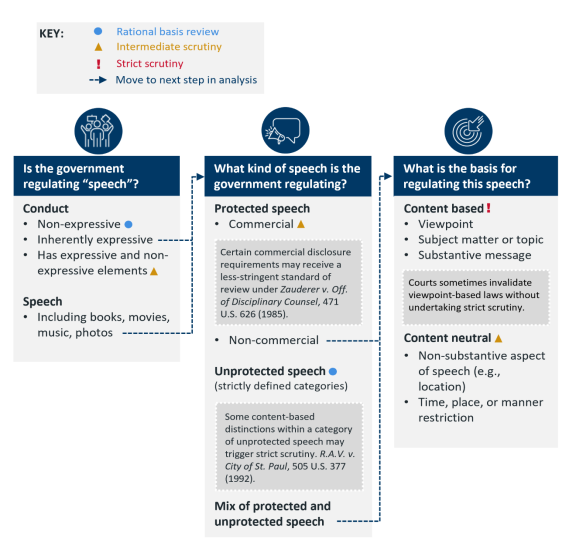
Since our piece was cited as agreeing with this post, I want to make it clear. I do not agree, and it's not what we wrote. Just because AI outputs are entitled to First Amendment protections does not mean "almost all regulation of AI is ipso facto illegal." Thoughts👇 Yes, it makes some types of regulation harder. I think that's a good thing! The First Amendment should prevent regulation that forces a particular viewpoint on AI outputs. There's too quick a path from no 1A scrutiny of AI to authoritarianism. Yes, there is lots of poorly crafted legislation that doesn't consider 1A principles and gets struck down. But you *can* draft regulation that addresses AI harms while passing 1A scrutiny. Traditional exceptions (e.g., speech integral to criminal conduct) apply just the same. We also have tiers of scrutiny! Commercial speech gets intermediate (not strict) scrutiny under Central Hudson. And regulating the use of AI can be drafted to appropriately navigate these tiers (attaching a handy chart that might be useful from Congress). I encourage folks to read our piece for more on the contours of this question. When I have more time I'll write up something more detailed on my current thinking.
@jasonjoyride ·
You may have heard that AI is going to be big... But do you have any idea how the government is actually trying to regulate it? So I spoke with the writers of 2 foundational AI policies, @SureshVenkat46 & @deanwball
@JoshuaTLevine ·
Ensuring the federal government can procure AI systems quickly and effectively is a crucial component of AI policy, but has flown under the radar, save one notable example. Today, my colleagues and I @JoinFAI filed a comment in response to GSAR 552.239-7001, the GSA’s proposal for rewriting the contract terms for how every agency buys AI through the government's largest commercial marketplace (the Multiple Award Schedule).
@tonysimons_ ·
Today is a pretty damn important day for AI. The EU AI Act’s transparency rules officially begin applying. That means new disclosure requirements for: - AI systems interacting with people - Deepfakes - Certain AI-generated public-interest content - Machine-readable detection of generated media The real question now: Will platforms make disclosure useful, or bury it behind another meaningless little badge? https://t.co/FSpwavXEFf
@lemire ·
Ideas have consequences. Not all bad ideas end up with mass murders… thankfully… but ideas have consequences nonetheless. Currently, you can just go to your favourite AI (Grok, Gemini, Claude, ChatGPT) and ask anything. In some cases, the vendors themselves censor the AI. Gemini might refuse to answer a political question, for example. Importantly, the AI that helps you code won’t stop you from designing a website that criticizes the immigration policy of your current government. The AI won’t stop you from double-checking the diagnosis your medical doctor gave you. But this could easily change. We have had far-reaching regulations in Europe and elsewhere… and more could easily come. “But what is wrong, Daniel, with ensuring that AI is safe?” The problem is regulatory capture. Imagine that I am a financial advisor sick of seeing my clients double-check my recommendations with ChatGPT. I can simply go to a politician and propose that ChatGPT be held accountable if its financial advice ends up wrong. You just allow citizens to sue OpenAI for bad advice. You are IBM and want to protect your consulting business. You make sure that if someone uses Anthropic’s AI Claude to write COBOL and there is a bug, then Anthropic can be sued. You are a pharmaceutical company that does not like it when an AI recommends against a particular medication due to its side effects? Make sure AI providers can be sued for medical malpractice. You are a politician who does not like what the AI tells your citizens about you? Make sure AI vendors must get a licence from the state to offer their services—and as a condition for maintaining their licence, they must pass stringent compliance tests every few months. Every single one of these steps can then lead to a spiral of regulations that might halt further innovation. What protects us from such a fate? Maybe not as much as we’d like. If you think that your AI coding agents can't possibly be forced to monitor your work in the future... think again. Thus it is important to fight in the realm of ideas and culture right now.
@tbpn ·
"Federal preemption is good when you are pro-regulatory capture." Asked about the discussion over AI regulation, @travisk says companies push for broad federal regulation when it helps squeeze out competitors. "When you want to squeeze others out, you should get federal regulatory bigness going for you." "We never did that at Uber. We basically never ever proposed or pushed any rule that would be beneficial to us versus somebody else. We always were trying to open up the market and we said, 'Let the best man win' and we just went for it." "I think we've got to be careful of some of these closed-weight things that are creating situations where they need to be regulated."
@MattPerault ·
Protect kids when they use AI. Let kids use AI. Too many proposals treat these as competing goals. We lay out a framework that embraces both. Don't ban minors from AI. Learning these tools is becoming as essential as learning to use a computer. But require platforms to offer parental controls, prohibit misrepresentations about AI tools, and publish protocols for handling crisis situations. And enforce the law when AI is used to harm kids. New on the a16z AI Policy Brief today.
@MattPerault ·
Building an AI startup is hard. Small teams must compete with well-resourced incumbents, fighting for access to talent, data, and compute. But in California, there’s another barrier that increasingly makes it hard for startups to compete: a dense and fast-growing web of regulations. What does a small team of founders need to do to comply with California’s AI regulations? We mapped the compliance obligations AI startups face in California in the wake of new laws passed in California in the last few years. A startup’s success shouldn’t be determined by its legal budget. If startups need to write big checks to lawyers just to get an AI product into the market, we’ll end up with fewer challengers, worse products, and a less dynamic AI ecosystem. Greetings from the Garage: https://t.co/0rK7P3aykd
@sagar_batchu ·
There's plenty written about what to govern in AI systems and almost nothing about how to actually enforce it on live traffic. We wrote up how we do it. The most important place to enforce a policy is the tool call, because that's where an agent's intent turns into a real action. A cheap string match handles most calls, an entity detector takes what it can't, and an LLM judge steps in only for what neither can settle. The cheaper checks are also the faster and more deterministic ones, which keeps latency and false alarms low enough that teams actually leave the controls on. That's the only way a control matters. More on enforcing AI policy here: https://t.co/SWZLPhAQhV
@jonathanstray ·
OpenAI released an "industrial policy" whitepaper today which proposes, among other things, public ownership in AI to distribute dividends (i.e. UBI) and four day work weeks. Here's what I think of this, both as policy and politics. https://t.co/bUHmkt0JY8 As policy, it seems largely reasonable. If AI is supposed to create massive widespread benefits, those benefits have to cash out as either time or money for ordinary people, and this policy offers specific ideas for how to do that. For example, public ownership of shares in AI companies, the dividends of which "could be distributed directly to citizens." Also, "convert reclaimed hours into a permanent shorter week." It reiterates a lot of previous thinking on these topics, which is a good sign (though citations would have been nice, e.g. to Anthropic's similar Nov 2025 proposals. https://t.co/2BfWKfiBmU) As politics, well, it's just words so far. And OpenAI's track record is not unblemished. The whitepaper argues "not to entrench incumbents through regulatory capture." However, OpenAI has already tried to do exactly this, by spending $10M on a ballot measure which would make their current age verification plan law and indemnify them against further liability. Oh, and also secretly backing a nonprofit to do political organizing. (https://t.co/ge8UQAJKPP). I will be watching very closely what OpenAI does when actual policy comes up for debate. If they wanted to be proactive, they could propose model legislation that they would support -- rather than, inevitably, resisting the legislation that actually emerges around these ideas.
@DJTRadar ·
Trump Jr. is promoting a Hong Kong AI company. Weeks later, his father signed an executive order tightening security around American AI. I dug into this one and the details are worth your time. The company is WorldClaw Limited. Incorporated in Hong Kong, governing law explicitly Hong Kong SAR per their own terms. This is a real product, real infrastructure. Their flagship is WorldRouter. One API, access to 300+ AI models from OpenAI, Anthropic, Google, and Meta. They claim around 30% cheaper inference than going direct on many models and publish the comparisons. Payments run through USD1. The Trump family stablecoin from World Liberty Financial. On May 5, Trump Jr. posted about the launch himself. He tagged WLFI. High-tier users who buy plans or lock tokens can enter a raffle for a private event with him at Mar-a-Lago. The WLFI connection matters. It is the Trump family crypto project. Trump entities hold significant ownership and revenue share. Don Jr. and Eric are actively involved. Zach Witkoff, son of Steve Witkoff, is a co-founder on the WLFI side. WorldClaw itself is a separate Hong Kong company and disclaims being controlled by WLFI. But the promotional relationship is right there in the open. Now the timing. The launch was May 5. On June 2, President Trump signed an executive order introducing federal review of frontier AI models for national security risks. Export control actions on certain advanced models followed in the same window. So while the US government is locking down American AI, the family orbit is promoting a Hong Kong company that lowers the barrier to accessing hundreds of models at scale. Paid for in the family stablecoin. I am not claiming a conspiracy. The company appears legitimate and the service is real. But the incentives deserve scrutiny. The White House sets AI policy. The family monetizes AI access. Those two things are not moving in the same direction. We will keep watching this one.
@wiseadvicesumit ·
🇺🇸 The U.S. just dropped its AI rulebook and it’s bigger than most realize. It replaces 50 different state laws with one system, direction and goal: Here are the key focus areas: • Protect kids and give parents control • Stop AI-driven scams and security risks • Protect creators (IP and fair use balance) • Prevent AI censorship (free speech angle) • Remove barriers to innovation • Build an AI-ready workforce But the real signal is this… This isn’t about regulation. It’s about control and dominance. The country that sets the rules… sets the future of AI.
@shawnchauhan1 ·
Three governments wrote new AI rules this month, and every one is chasing the same thing: what's actually happening inside the model. China's agent-specific regulations became enforceable July 15, the world's first dedicated legal category for AI agents. Illinois now requires third-party safety audits for enterprise AI systems. The European Commission published new transparency guidelines for AI providers and deployers on July 20. Every one of these rules is trying to force disclosure that open-weight models already give you by default: what's in the model, how it was trained, what it does when nobody's watching. Closed labs are about to spend a great deal of legal budget proving what open source proves for free.
@CRSegerie ·
I agree with @deanwball that getting AI child-safety laws right is quite challenging AI law could backfire, yes But my biggest criticism of this is that there are no numbers or a prediction of the amount of illegal usage If 5% of kids would migrate to unregulated Chinese open-weight models while 95% benefit from guardrails on mainstream platforms, the law is overwhelmingly worth passing
@GlenGilmore ·
AI Governance Lessons Businesses Can't Ignore In 2026 “EU member states designated enforcement authorities in August 2025, with the penalty regime now in effect—fines reaching €35 million or 7% of global revenue for the most serious violations. In the U.S., states are building their own patchwork of requirements—260 AI-related measures were introduced across 47 states in 2025, with 22 already passed into law.” https://t.co/sxhNG8dVTT
@GlenGilmore ·
AI Enforcement Accelerates as Federal Policy Stalls and States Step In Federal agencies are relying on existing authorities to regulate AI-related conduct: FTC: Section 5 of the FTC Act remains a primary enforcement vehicle for allegedly unfair or deceptive AI practices SEC: focused on so-called “AI washing” misrepresenting the use or performance of AI in disclosures to investors False Claims Act: DOJ has signaled willingness to pursue FCA theories where AI tools are used in government-funded programs, including healthcare reimbursement and cybersecurity compliance contexts. Antitrust Enforcers: DOJ and FTC https://t.co/stZVb48cD2 #AIGovernance
@theinformation ·
To stay ahead of China in the AI race, the US must not “overreact”. Head of AI Policy at the Abundance Institute @neil_chilson: “On the policy side, I think the the risk here is that we overreact to Chinese open models and we try to clamp down on open source overall, which is a key input to competition, but also to research.” “We should focus on building infrastructure faster.”
Watch video
@JoachimSchork ·
Until recently, AI had little regulation. The EU AI Act is one of the first serious attempts to build a full legal framework for safe and transparent AI. But it also introduces obligations that everyone working with data and AI needs to know. Here’s a quick overview: 🔹 https://t.co/yuSN8kDgoZ
@1DavidClarke ·
Everyone is talking about AI governance. But here's the uncomfortable truth. In most organisations, AI is already a GDPR issue. Why? Because the majority of AI systems process personal data — whether in the input, the processing, or the output. The model may analyse behaviour. The output may profile, score, rank, or influence decisions about people. Not every AI system triggers GDPR. But far more do than most organisations realise. Look at what organisations are already deploying: • customer service copilots • recruitment screening tools • fraud detection systems • marketing recommendation engines • credit and risk scoring models All of these involve profiling or analysing identifiable individuals. Under GDPR, that is personal data processing. So before we get lost in complex AI frameworks, the first question should always be simple: Does this AI system process or affect personal data? If the answer is yes, the organisation must address the core GDPR obligations. In practice, the key areas to focus on are: Lawful basis — Why is personal data being used in the AI system? Purpose limitation — Is existing data being reused for AI training or analytics beyond the original purpose? Data minimisation — How much personal data is actually going in, and is all of it necessary? Transparency — Do individuals know AI is involved in the decision or interaction? Profiling and automated decisions (Article 22) — Is the AI making or influencing decisions about people? DPIAs — High-risk AI systems should trigger data protection impact assessments. Accuracy and fairness — Incorrect AI outputs about individuals can create GDPR risk. Human oversight — Can a human review or override AI outcomes? These aren't theoretical. They're live compliance obligations. Yes, broader AI governance matters. But for most organisations, the biggest immediate exposure sits somewhere much more familiar. Their AI is simply another form of personal data processing. Start with GDPR. Then build AI governance on top of it. What's the biggest GDPR blind spot you've encountered (or recently fixed) in your organisation's AI projects?
Best Tweets by Topic