Market cycles and risk management
Sober reads on crypto drawdowns, leverage and liquidation stress, macro and ETF flows, consolidation, mean reversion, patience, and capital preservation.
44%
Best tweets about Crypto
A curated collection of the sharpest, most-shared X posts about crypto—saved so you do not have to dig through the timeline yourself. Updated weekly.
Builders and traders on the market, the technology, and the cycles—kept strictly to the sober takes.
Original Xholic analysis
Across these posts, contributors emphasize caution around drawdowns, leverage, and timing while arguing that longer-term progress depends on useful products, clearer economics, and continued building. [2069972518899990863,2071536552123994203,2082150915201519793]
46% of posts
All-time engagement
78% of posts
Published in 90 days
Conversation map
Sober reads on crypto drawdowns, leverage and liquidation stress, macro and ETF flows, consolidation, mean reversion, patience, and capital preservation.
44%
Stablecoin payments, tokenized real-world assets and equities, onchain settlement, crypto cards, institutional infrastructure, and crypto fading into mainstream fintech.
38%
Critiques of extractive speculation, memecoin casinos, scams, weak consumer innovation, developer attrition, and calls to build useful, durable, sovereignty-oriented products.
36%
Arguments for judging tokens and protocols by real usage, revenue, sustainable economics, demand, retention, and defensible product value rather than narratives.
26%
Systematic trading edges, momentum and carry, perpetuals, funding, liquidity, token listings, market makers, and the mechanics behind price behavior.
26%
Programmable money for agent economies, decentralized AI infrastructure and compute, AI-agent transactions, and the competition for builders between AI and crypto.
20%
Building outcome-driven consumer apps with hidden crypto complexity, excellent UX, lifestyle fit, culture, collectibles, and real user needs.
20%
Ethereum upgrades and ecosystem shipping, Solana and Hyperliquid growth, interoperability, privacy, scaling, and the case against chain maximalism.
18%
Tone and stance
Performance benchmark
Posts with media make up 48% of this collection. Their median all-time score is 24.5, compared with 35.0 for text-only posts.
Format mix
Consensus and debate
Shared view
Several contributors favor capital preservation, attention to liquidity and leverage, and waiting for clearer opportunities rather than calling bottoms or trading every move.
Shared view
A recurring standard is real usage, revenue, retention, viable token economics, and product-market fit rather than attention cycles or broad promises.
Shared view
Posts on stablecoins, cards, and consumer apps argue that products work best when they deliver a concrete user outcome and minimize attention to the underlying crypto stack.
Shared view
Several voices criticize extractive launches, memecoin-style gambling, and recycled incentives, while calling for useful, sovereignty-oriented, culturally relevant, or otherwise durable products.
Open debate
One post characterizes the sell-off as a repair phase alongside continued development, while others describe limited innovation, layoffs, and movement of builders toward AI as signs of industry strain.
Open debate
Some contributors frame crypto as cyclical and anticipate a renewed period of belief, while others expect the next cycle to be harder and question simple calendar-based positioning.
Open debate
One account presents momentum, carry, volume, and listing mechanics as potential systematic trading approaches; other posts emphasize uncertainty, defensive positioning, and avoiding premature entries.
What performs
The strongest outlier was a detailed post about counterparties and systematic trading mechanics, with an all-time score of 406.49, or 15.93 times the overall median.
Other outlier posts covered consumer crypto and sustainability, Ethereum ecosystem activity, and capital preservation amid adoption. Their scores place them among the dataset’s five reported outliers.
Opinion accounted for 39 of 50 tweets, compared with 7 announcements and 4 predictions.
Media appeared in 24 tweets (48%). Its median all-time score was 24.51, compared with 35.03 for text-only tweets.
Statistical standouts
Creator landscape
The five most represented creators account for 20% of the selected posts.
1. ALTF4
@0xALTF4
2 posts
2. Backseats
@backseats_eth
2 posts
3. TECA
@CryptoTeca__
2 posts
4. Defi Rocketeer
@Defi_Rocketeer
2 posts
5. MR SHIFT 🦁
@KevinWSHPod
2 posts
6. Route 2 FI
@Route2FI
2 posts
The dataset contains 43 creators, and the reported top-five placement share is 20%, a distribution measure that does not indicate that a small group accounts for most placements.
The listed top voices include posts on market conditions and builder continuity, full-time crypto risk planning, trading mechanics, and public-market performance of crypto companies.
Posts about working full-time in crypto recommend savings, an existing edge or track record, downside planning, relationships, and proof of work before leaving conventional employment.
Since the previous snapshot
Themes, sentiment, stance, and post format are classified per tweet. All counts, shares, medians, creator concentration, freshness, and performance comparisons are then calculated directly from the published snapshot.
Xholic's all-time score compares engagement while accounting for reach, post age, and creator consistency. It is used for relative comparisons within this collection.
This report analyzes the exact 50-post snapshot shown below. AI identifies editorial categories and drafts explanations; all statistics are calculated from the snapshot, and every narrative claim is checked against cited posts before publication.
Best Crypto tweets
Ranked 01–50

@game_for_one ·
Listened to a pretty interesting podcast, guest is a mid-frequency trader describing all the stupidity and his edges from that in the market. His core argument is simple: crypto has the worst counterparties in the world, by design. In equities humanity's full effort goes into correct pricing. Best math kids, best unis, best training, million $ salaries, multi-million bonuses. Competing against that as a trend follower gets you Sharpe 0.2 on a good day. Barely worth doing. And in crypto you're choosing between the XTX autist from Holland or the guy with an ape pfp in a boomer Facebook group who thinks Bitcoin replaces fiat. > Hist words. "There's no second-worst counterparties than crypto." Then 3 structural reasons the dumb money stays dumb: 1) Sticky capital. Money comes in, goes up 20-30%, now you've got a bunch of guys on house money playing loose at the casino. That money sloshes around within crypto but almost never leaves. Pull 100 friends who are in crypto, ask how many have an off-ramp plan. Vast majority don't. 2) Siloed capital within chains. Once you're in the Phantom wallet on Solana you're not bridging back to MetaMask and paying ETH fees. That capital is trapped in the ecosystem, sloshing between whatever horses are running, creating massive reflexive swings. 3) Price insensitive buyers and sellers on both sides. Bitcoin cultists buying at $120k because today is always the best day. That's your edge on the long side. VCs who got in at $5m valuation and are sitting on a $400m coin, slowly bleeding exit liquidity into thin markets for 90 days. That's your edge on the short side. North Korea who just hacked a bridge and needs to sell before anyone freezes the funds - doesn't care what price they get. Short that too. Now his edges, just simple stuff I think most of us know here but probably the majority doesn't execute on well or systematically. - Top 20 momentum Buy anything in the top 20 by market cap within 5 days of making a 20-day high. Sell when it goes 5 days without a new 20-day high. Equal weighted. Sharpe 1.3 through bull, bear. - Stack three things together That trend system plus cross-sectional momentum (rank everything, long top 50%, short bottom 50%, market neutral) plus carry (long highest funding rate coins, short most expensive to hold). Equal weighted. Daily execution from a spreadsheet. Comes out Sharpe 2. - Volume predicts price (volume attention price loop) Rank all coins by volume after stripping market noise. Long increasing volume, short decreasing volume. "Well over Sharpe 2." Known effect, reflexive, provable statistically. Higher volume predicts higher prices. Lower volume predicts lower prices. Sounds like nothing. - Short small caps that pump Momentum works on large caps. Flips negative by the third or fourth decile. Bottom 20% of Binance perps makes a 20-day high - short it. Strong edge because it's the market maker Dubai pump and dump lifecycle playing out mechanically every single time. - New Binance listing short Market maker contract is 90 days. Strike price set off 7-day VWAP after launch. From day 7, delta hedging mechanically pushes the coin down. Short it for 90 days. Every time. Edge comes entirely from understanding how the game is structured, not from any signal at all. Another case of simplicity winning. Will drop the podcast in the replies, worth listening.

@AndrewAsksHow ·
Episode 76 with Uri from Endless During this episode we talked about the future of finance, digital collectibles and AI Consumer crypto is the next biggest wave as the newer generations collect more online Hype cycles fail and we get in to what sustainability looks and feels like Timestamps 1:59 @uriferruccio Background and getting into crypto 12:13 Early crypto narratives, why fundamentals broke and how @EndlessProtocol fixes it 25:35 Why hype cycles fail and what sustainable crypto actually looks like 37:55 Infrastructure, decentralization, and what builders still get wrong 48:45 NFTs, collectibles, and why the first wave failed mainstream adoption 59:47 @the_andydandy on culture, fandoms, and how digital communities form real value 1:14:00 AI, automation, and how economics are changing underneath crypto 1:25:30 Long-term thinking, generational shifts, and building for the future 1:42:50 Final reflections on consumer crypto, IP, and what comes next
 Watch video

@ethereum ·
Ethereum is for shipping. Here are 22 things the Ethereum ecosystem launched, upgraded, and announced over the past month. 0/ Ethereum hit a new all-time high of 72.8 Million monthly transactions, the highest in network history. 1/ @ethereumfndn, @chainlink, and @Nethermind launched a $1M audit subsidy program to help Ethereum builders access high-quality security reviews. 2/ South Korea’s largest crypto exchange, Upbit, announced plans for GIWA Chain, an Ethereum L2 built on @Optimism. 3/ @AragonProject introduced Permissions Audits to help protocols secure roles, multisigs, and admin systems. 4/ @fileverse shipped Comments v2, improving the collaboration experience, with privacy by default. 5/ The Ethereum Applications Guild (@EthAppsGuild) launched to support Ethereum-native apps and real-world adoption. 6/ Privacy went live on @Optimism with confidential computing support on OP Mainnet. 7/ @StarkWareLtd brought native proof verification to Starknet mainnet with Shinobi, enabling private trading flows and OTC settlement. 8/ @worldcoin launched World ID 4.0, expanding proof of human credentials across apps, enterprises, and AI agents. 9/ Applications on Ethereum hit ~$310B in user deposits. 10/ @l2beat released a new interactive interoperability map showing how value moves across Ethereum’s expanding ecosystem. 11/ @AlchemixFi launched V3, the latest version of its self-repaying, non-liquidating loan product, with higher capital efficiency and improved peg mechanics. 12/ @OfficialMoonDAO raised $172k + from 157 contributors to send the man who coined the “overview effect” to space. 13/ @ethereumfndn announced the Road to @EFDevcon 8 Academic Program, supporting regional research and academic events ahead of Devcon. 14/ Ethereum core contributors gathered in Svalbard for Soldøgn Interop, a week-long event focused on hardening Glamsterdam implementations to help scale Ethereum securely. 15/ @basepaint_xyz hit 1,000 straight days of onchain art creation, with 121M+ pixels painted and $1.5M + distributed to 4,000+ artists. 16/ New Ethereum community hubs launched in Hong Kong and Floripa, growing local coordination and ecosystem activity across Asia and Latin America. 17/ The EF’s ETH Rangers public goods security program wrapped after helping recover or freeze $5.8M, reporting 785+ vulnerabilities, and identifying ~100 North Korean IT workers targeting Web3 teams. 18/ @centrifuge launched a tokenized S&P 500 fund on @base, bringing 24/7 onchain index exposure to non-U.S. users. 19/ @0xcatalysis launched Covered Vaults on Ethereum, DeFi vaults with built-in onchain risk coverage backed by delegated capital. 20/ @Uniswap processed $3T in all-time volume on Ethereum mainnet. 21/ @RAILGUN_Project hit $5 billion of total all time private volume.

@santiagoroel ·
Not many predictions, just a reiteration of a few core ideas: > Stop trying to look into a crystal ball. Be present and understand what’s happening now. If you understand the present, you can see the future > Markets are not cheap and there’s a lot of hype. Everyone’s high on techno optimism and confusing skepticism with pessimism. When things are priced to perfection it leads to disappointment (and capital destruction) > You can’t escape mean reversion > Crypto is in its adoption phase. 2025 was about legitimacy; 2026 is about exponential adoption - but not exponential prices > Prices will lag adoption. The Nasdaq fell ~80% from its peak and took 15 years to recover, while internet users grew ~7x over the same period > Crypto prices eventually recover once we have ~10x more active users (at least 500 million) > We’re facing an affordability and loneliness crisis. Understand that, and clear themes and investable areas emerge > Capital preservation is key. Wait for the fat pitch. It usually comes with forced sellers. That’s not today. People feel the pinch, but markets have delivered a phenomenal decade > You don’t have to bet. You shouldn’t play every hand you’re dealt. > Go deep on supply and demand dynamics. It’s surprising how few people can explain businesses through this lens. In crypto, we have an oversupply of blockspace and insufficient demand. Prices won’t break new all time highs until that happens > Competition is for losers. Avoid highly competitive industries. Focus on niche areas, find PMF, and dominate. First-mover advantages are overrated. Read Zero to One > “Commodity” products can still earn a premium. Anyone who disagrees hasn’t walked through a supermarket: it’s Tide, not detergent; Kleenex, not tissue May 2026 be a great year for you all!

@XNXX_EN ·
Been looking through a bunch of market data today and ngl... this sell-off feels bigger than just crypto. At first I thought bitcoin:native and ethereum:native were simply getting hit harder than everything else. Then I looked at ethereum:0x68749665ff8d2d112fa859aa293f07a6227 82f38 . Gold had a crazy run earlier this year, climbing close to 30% before giving a big chunk of it back. Right now it's actually sitting below where it started the year. At the same time, BTC is down almost 38% from its yearly high, ETH more than 50%.. That kinda changed how I'm reading the market. Maybe this isn't just another crypto correction. Maybe it's a broader risk-off phase where people are cutting exposure almost everywhere. The other data doesn't really make me want to get overly bullish either. > Fear & Greed is sitting in Extreme Fear. > ETF flows have stayed negative for weeks. > SOPR is still below 1, which usually means plenty of holders are realizing losses instead of taking profits. > Funding hasn't fully reset yet either. Could things keep going lower? Yeah... they probably could. Nobody knows where the exact bottom is, and pretending otherwise usually ends badly. For me this still looks more like a repair phase than the start of a fresh bull run. The interesting part is that price isn't the whole story. Even with markets pulling back, I keep seeing builders ship. RWA projects are still expanding partnerships. AI protocols are still launching products. Teams are still raising, integrating and building. Price action slows down a lot faster than development does. Maybe that's why I'm not bearish on crypto long term, even if I'm pretty cautious over the next few weeks. I've learned not to confuse a bad chart with a dead industry. Sometimes the market just needs time to repair before capital starts flowing back again. For now I'd rather stay patient than convince myself every red candle is "the bottom." Missing the first part of a recovery has never really bothered me. Buying too early just because I wanted to be right... yeah, I've done that before 😅 #RWA #AI #XAU #BTC #ETH (Market data compiled from multiple public sources with research assistance from @SurfAI . The views above are my own interpretation of the current market. Always DYOR.)


@binji_x ·
How to build a great crypto consumer app in 2026. The Thesis: The real opportunity is not to build better crypto apps but to build apps where crypto is the substrate and the access point to new experiences. The Four Tenets: Any bet made under this thesis should clear four tests. 1. Think in terms of outcomes: Stablecoins are not applications but infrastructure, and, depending on the user, they can be a way to do business cheaper, or a way to flee a tyrannical government. Applications are what gets built on top of this infrastructure, e.g a payments app. You cannot just “build an app for stablecoins,” you must build an app that serves a specific user set with a specific outcome. This is my hunch as to why crypto wallets have largely failed outside of crypto: they are far too general purpose. If I tell a friend to download a wallet, there is no outcome I can share with them. B2B businesses have it better, if we look at Bridge which got acquired by Stripe for $1B in cash, it's clear that their outcome as a business was simple: “Businesses choose Bridge as the only platform they need to easily receive, store, convert, issue and spend stablecoins.” So, if your were to build something, it would be prudent to build for an OUTCOME for a user you narrow down. While working, any feature addition, any marketing spend idea should be delivered with an attached outcome, otherwise it is just vibes based work. 2. Real users from day one: The product has to meet an existing need vs manufacture a new one. Crypto has spent a decade building solutions in search of problems. The user base on day one should be people who already do the behaviour in question and would switch to a better version of it, and it must be ten times better, not 10% better. 3. 10x better, not 10% better UX is the moat! The internal ordering of future teams, from the engineering priorities, the roadmap, all of it has to flow from user experience rather than raw protocol capability. This is how Revolut out-executed every incumbent bank in Europe despite having a weaker balance sheet and a narrower product range for years. Marginal improvement does not move users off an incumbent. A crypto card that is slightly better than Revolut loses, it does not disrupt user behavior. But, a crypto card that does something Revolut structurally cannot, eg lets say, introduce user-programmable bill splitting or private settlements, might actually stand a chance. 4. Catching key lifestyle trends Many winners rarely invent categories, they tend to catch a shift in user behaviour of an existing category. BeReal did not invent photo sharing but it caught the moment when curated Instagram felt exhausting. Aave did not invent lending but it caught the moment when permissioned finance became more restrictive and less globalized and when decentralized currency holdings created whales locked out of permissioned finance. Revolut did not invent banking but it caught the moment when old boomer banks felt hard to use and an online native younger generation started to have more disposable income. The ideas are out there, AI accelerates the ability to execute them, but an idea is only as good as the user need it serves at a given time. — The real power lies in using crypto as a substrate to power new experiences and having the product discipline and user empathy to build for a real audience with a real need.

@beniaminmincu ·
Yesterday was likely the largest market liquidation event in crypto history, and the most significant one I have experienced. For context, during the Covid crash, liquidations reached about $1.2 billion. During FTX crash, it was around $1.6 billion. Yesterday, a record of over $19 billion got liquidated. It was a cascade. Some of the biggest exchanges failed under pressure, freezing, crashing, DDoSed, overwhelmed by a wave of simultaneous user actions. Top altcoins fell over 90%. A few, like ATOM, TON, and others, briefly touched near zero. For everyone, it was (and still is) soul-crushing. During these moments people lose the quiet belief that tomorrow could be better. But the world doesn’t stop here. It moves forward, it heals, and rebuilds. And it will get better. If you have friends in crypto, reach out. Some kindness will go a long way. So what seem to be the causes? (a) The trigger: President Trump’s new tariff announcement on China, seemed like a macro shock that rattled markets. (b) The dynamite: massive structural leverage. Built up quietly over time, turned out to be dynamite waiting for a spark. (c) The reaction: "rumors" point to some big overleveraged exchange or market maker collapsing under the weight of their own overleverage, amplifying the entire effect. It's hard to overstate how much more susceptible the hyperconnected markets have become asymmetric butterfly effects. Moments like these remind us of vital things that are easy to forget: Build something that cannot disappear overnight. No market flush, no black swan, should be able to erase what you’ve built with substance. Own only what you truly believe in. Pain becomes bearable when there’s a good reason, tied to conviction. Think in longer time horizons. Everything that truly matters, takes time to build. Give yourself the space to see the fruit of your labour. Lastly, if you’ve found the thing you believe in, this moment is a gift. Use it wisely. We are here to build a better, more robust system for global finance, that lasts. A system that becomes stronger, with every new challenge. And in times like these, we see more clearly than ever why it must exist. So, don't get distracted. Go touch some grass, get some fresh air. Better days will come. Effort and patience will be rewarded. The future is still bright, and it's ours to build.

@GemeWallet ·
🗞 Weekly Crypto News Digest 📉 Market & Sentiment — Bitcoin remained volatile: dipped below $65,000, rebounded above $70,000, then corrected again. — Fear & Greed Index dropped to 5/100 - one of the lowest historical readings. — Spot BTC ETFs saw over $315M in outflows. — @Google searches for “How to buy Bitcoin” hit a 5-year high. 🪙 @ethereum & ETFs — $ETH moved with the broader market, briefly near $1,850 before recovery. — Spot ETH ETFs recorded ~$80.46M in net inflows. — New Ethereum Strawmap roadmap published. — @VitalikButerin proposed new transaction protection approaches. 💵 Stablecoins & Infrastructure — @circle ($USDC) reported: • Q4 revenue: $770M (+77% YoY) • Net income: $133M • 2025 revenue: $2.7B (+64%) • Annual transaction volume: $11.9T (+247%) — @CryptoRank_io : Base leads in stablecoin transaction volume among networks. The market continues to operate in a high-volatility environment with noticeable capital flow shifts. What caught your attention this week?

@AlexisYellow ·
Who is trading crypto right now? Bitcoin has been in a sideways trend for almost two months. Uncertainty extends beyond the broader market, with factors like Fed decisions and the resolution or escalation of Iranian conflicts playing both positive and negative roles. But zooming out reveals a different story. BTC just printed a positive monthly close for the first time in half a year. This is a rare market structure we haven't witnessed since the August 2018 to January 2019 cycle bottom! You might find a hint in the fundamentals events: 1. Larry Fink, the CEO of Blackrock, continues to champion tokenization in his latest investor letter. This letter essentially serves as a directive for traditional companies and corporations. 2. Large capital continues to enter the market with the likes of Franklin Templeton (with $1.7 trillion under management) who acquired a division of CoinFund and is increasing its crypto presence. 3. Stablecoins are gradually taking over and are no longer just a tool for crypto speculation (researched by @Delphi_Digital). 4. Founders and their teams are changing their token models in a positive direction. As this trend grows, I expect incrementally more people to recognize the value of being a part of the @Yellow community (shoutout to our XRP supporters!) You remained focused on longevity while others were distracted by the noise. 5. Perps dominate spot with 3-5X higher volume, which complicates the market for the new, and reduces inefficiencies for short-term traders. Vibe coding has brought a wealth of opportunities to funding rate arbitrageurs, prediction market farmers, and other enthusiasts. For those who have read this far, the key takeaway is this: sideways markets test discipline long before they reward conviction. Will you let boredom shake you out? One thing I know for sure; when momentum re-enters the market, the window for price discovery is usually very tight.


@0xaporia ·
Looking back, I think one of the bigger flaws I saw in crypto trading is something most people never quite name. People come to crypto because of trend. That's the entire appeal. They see a coin go from $1 to $20 and they want to be on that ride. Whether they've ever used the phrase "trend" or not, that's what drew them in: the possibility of catching a massive, life-changing move. But then they sit down to actually trade it, and what do they do? They set targets. They put a ceiling on the exact thing they came here for. Think about it. You showed up to this market because it produces enormous trends. And then your first instinct is to cap your upside at some arbitrary level you decided on before the move even started. You've kept all the chaos, but you've removed the payoff that justifies enduring all of it. The goal is staying in the trade as long as the trend is intact. Targets are fundamentally flawed when applied to a strategy whose edge depends on open-ended winners. With targets, you've chosen a game defined by asymmetry and then eliminated the asymmetry.

@WorldOfMercek ·
Every cycle there is a moment when people start thinking about quitting their job for crypto. Usually not at the top. Usually somewhere in the quiet part of the market. And I understand why. Crypto still feels like one of the few places where a single good decision can change your trajectory faster than most traditional paths. But 2026 is not 2021. Token supply exploded. Airdrops are smaller. Hiring is slower. And “I’ll just trade” stopped being a strategy a long time ago. So before someone makes that jump, there are a few things worth thinking about honestly. Do you already have savings that can carry you for a while? Have you actually earned money inside crypto before in any way? Do you have a network here yet? And maybe the most important one: what happens if nothing works for longer than expected? Because crypto full time sounds like freedom from the outside. In reality it often means building your own structure from zero every day. Some people thrive in that environment. Some people quietly burn out. There is no universal answer here. But I still think if you are young, have real savings, already found some kind of edge, and built relationships inside the space, trying full time crypto can make sense. If not, the smarter move is simple. Stay close to the space. Keep building your edge. Then make the jump when it becomes obvious.

@DeRonin_ ·
From time to time, people ask me: "Ronin, how do you get a job in crypto right now? CT is almost dead…" first, I want to share an unpopular opinion: a job in Web3 is not a bad path, it's often the most effective one I'll explain this using the example of @Rakib_Web3, who I started working with just a few months ago, and who has already achieved very strong results especially now, when most opportunities in the market are just gambling with an unjustified risk & reward ratio, and most people are simply lying to themselves and wanting to believe in new narratives The story of Rakib, who grew from an assistant into an accelerator employee: i have a friend, Rakib, who messaged me a few months ago and offered to help he didn't look for a job in the traditional way, and immediately showed initiative and sent what he had already done His first actions: - he messaged me saying he wanted to be useful and asked, "how?" - i replied and thought about what i could delegate to him - he started helping me with small but real tasks that genuinely unloaded my workload Over time, this turned into: - regular collaboration - trust - and eventually, a role in the accelerator alongside me, someone he initially just helped there was no CV and no LinkedIn, only high initiative and a real willingness to do quality work however, there were a few points that really caught my attention, and yes, i'm ready to share them [Points that help you stand out when looking for a job in Web3]: I. building a personal brand on X (as early proof of work and mindset) II. your previous experience, or at least a clear direction you’re aiming for (most importantly, that you’re not a gambler with short-term goals) III. first actions and initiative before you even start working with someone IV. realistic salary expectations based on your experience, or lack of it V. willingness to work full-time and long-term, which is rare right now [What a reasonable path to finding a Web3 job should look like]: 1. define your real strengths and what you want to do (research, content creation, marketing, etc.) 2. start building your X presence and look for people you'd genuinely like to work with 3. analyze what this person actually needs right now and complete a test task before messaging them 4. reach out immediately, sharing your goals and the completed test task 5. find people with the same mindset, together, you'll be stronger i want to leave one important and honest take here: the speculative side of crypto is NOT a career, it's risk lol but if you look at crypto as the future of finance or infra projects, it's a very strong niche with a solid future ahead soon, it won't be much different from traditional fintech big players are entering the space, and that's also part of the growth you either use your time and experience here as leverage, or you move on to other niches so, what do you choose???

@drwconvexity ·
Over the past few months, we’ve seen crypto prices fall, MSTR trade at a discount to NAV, and institutions step in as weaker hands exit. Back in December, I discussed these as plausible outcomes on an @ARKInvest podcast I recorded with @CathieDWood. The underlying dynamic is that public blockchains, like most financial innovations, move in waves. Trump’s pro-crypto campaign pulled in indiscriminate capital, FOMO, and leverage. That energy expressed itself through inefficient, duplicative DAT structures and new forms of off-chain leverage. At the same time, many large-cap tokens have failed to demonstrate product-market fit or a credible economic model. I expect the market to become more discriminating. Despite recent underperformance, BTC has established itself as digital gold in the minds of many — mine included — and I expect that view to continue to grow. For everything else, the question is straightforward: what purpose does this token serve? If it’s an L1, what are its characteristics, and how do the economics work? It’s not surprising that two relative outperformers in this period — HYPE (Hyperliquid) and CC (Canton) — are L1s with clear product-market fit and viable economic models.

@Route2FI ·
Should you quit a 9-5 job to focus 100% on crypto? This is a topic I've touched on earlier as well, but crypto is changing all the time, so here are my current thoughts: Tbh, it has become substantially harder to make it in crypto since I started full time in 2021. Mainly due to the massive inflation in tokens. 1. First of all, do you have enough money saved up on the side? If not, how are you planning on earning money for a living? Just saying that you're going to trade won't be enough in 2026. 2. Do you have a proven track record of making anything in crypto so far? Either through trading, airdrop farming, marketing, web3 job, etc. If not, could you apply for a job? Just a side note here: airdrops have been shit lately and not many companies are hiring. Yes, it's a deep bear market. 3. Let's say you have saved up some money on the side and that you've been able to earn money from crypto so far. Now, what if you were to lose it all? Think through the worst-case scenarios, would you be able to pay the bills still? Can you go back to your old job if shit hits the fan? What is the opportunity cost of not being full-time in crypto? Is there some upside you miss from your old job? 4. Are you sure you want to sit in a basement with greasy hair, unshaven, watching charts all day, scrolling Twitter, TG, and Discord? You can say it is freedom, but is it really? Personally I am an introvert and handle this kind of lifestyle well, but like 8/10 of my IRL friends would go mad from this kind of life. It can be lonely, and while you ofc can treat it as a 9-5 job, this is way easier said than done in a casino that is open 24/7. 5. Are you disciplined enough to work on your own? Don't underestimate the comfort in routines and been given tasks. Working by yourself is magic for some, but could be pure pain for social people (unless you optimize, getting coworkers etc.) 6. Do you see an upside in income from quitting your job? It's easy to think you will 10x your net worth in crypto, but 99% of people won't make that. In fact they will end up losing money. Could you apply for a web3 job first, and then quit your 9-5 job when you have it? If so, that will be recommended. 7. Do you have a network in crypto already? If not, you should definitely get one. Having friends in here is how you get to know about the airdrops worth farming, coins that might have upside, and the people you discuss thesis with ++ If you don't have a CT profile already, what are you waiting for? There is no universal answer to this question, but if you are young, have some money on the side to cover all expenses for at least some years + you have some kind of edge and a network in here I would definitely try (assuming you can go back to your old job or something similar if you lose everything). If you don't have an edge already, you should 100% not quit until you have an edge.
@Route2FI ·
It's weird times, man. On one hand I feel like we're in a time where you'll get handsomely rewarded for buying the dip now, but on the other hand I feel like there isn't many good news to wait for. We have the ETFs, the institutions are here, the tech works perfectly, but yet, finding pmf for most protocols is really hard. As everyone else I am thinking about if the 4-year cycle is real or not. Can it really be this easy that we all buy $BTC at the bottom between the summer and October this year, and then ride happily into ATH together? In my opinion it won't be this easy. I think the next cycle will be even harder than the one we just had, and let's be honest, retail is barely here at all, it's just CT, whales, and institutions fighting with each others. Many CT people from 2021 are pivoting to AI/Claude-experts, and I don't blame them for skating to where the puck is going. Personally I've been enjoying that the market has been more quiet than usual, and I've spent some time traveling and catching up with friends IRL. So what am I doing in crypto atm? Some trades on Hyperliquid and Lighter (oil/SP500, delta neutral on LIT), xStocks on Kamino paired with shorts, still farming some perp DEXes like 01 and Reya, but I almost hope they delay launch until conditions are better. Some stables deployed in Aave, but most stables earning 0% yield atm. Sounds crazy, but the plan is to deploy it during the year when the right opportunity arises. I don't know what that is yet, but I am patiently waiting. Just reading a lot (books, newsletters), scrolling on Twitter and observing. It should be a good time to sharpen your edges and being ready when the time is right.

@ASvanevik ·
Many of us who experienced the “Ethereum Killers” of ca 2018 wrote off other blockchains prematurely. We thought Ethereum would be the only game in town after EOS, Tezos, etc failed. I held this belief up until 2021. Others took longer to realize they had fooled themselves. Some haven’t even realized yet. Fortunately for me, I run Nansen so: 1/ I see what people do onchain, and 2/ I hear what chains our users demand from us. Solana is the clearest case study. Ethereum maxis should have re-underwritten their “hurr durr ethereum killers” thesis. Instead Solana was ridiculed for being only for memecoins. (Anyone who has used Solana knows this is a reductionist take.) Solana is here to stay. Ethereum is also here to stay, but not as the only game in town. Now we find ourselves at a point in time when certain people refuse to face another truth: Hyperliquid is here. And it is here to stay. I’m reminded of the people who kept sticking their heads in the sand with Ethereum. Wake up and smell the coffee. Clinging to your bags is holding you back. Use the tech, engage with the ecosystem, be curious. The only thing that’s always true in crypto is that nothing ever stays the same. Maximalism is intellectual laziness. Ethereum is here to stay. Solana is here to stay. Hyperliquid is here to stay. (Alongside a handful other chains.) Every asset will be tokenized. Billions of people will be owners. Chains are the financial fabric of the future.
@XNXX_EN ·
Just finished listening to the @KoloHub Space about crypto cards and honestly… there were a lot of interesting insights beyond just “spend crypto with a card.” A few key takeaways that stood out to me: > Crypto cards are slowly evolving into full neo-bank experiences, not just payment tools anymore. > The biggest demand isn’t only from crypto traders. A lot of users simply want access to USD accounts and smoother international payments. > Latin America, MENA, and underserved regions are becoming huge adoption markets because local banking systems still create a lot of friction. > Most “0 fee” cards still hide costs inside spreads, FX fees, ATM fees, or conversion layers. Transparency matters way more than flashy cashback numbers. > Stability > hype. One of the strongest compliments a crypto card can get is simply: “It just works.” > Whales care far more about high limits, reliability, and seamless UX than small cashback campaigns. > The real competition now feels less like “crypto cards vs crypto cards” and more: who can become the most trusted crypto-native neo bank. > One insight I really agreed with: - the best crypto products slowly become invisible. - People stop thinking about “using crypto” and just focus on living normally. Lowkey feels like crypto cards are becoming one of the first real bridges between Web3 and everyday life.


@0xSunRun ·
Markets are cyclical: For crypto, 2017 - 2021 was the era of believing in something. You didn't have to play every day tactically because there were fundamental breakthroughs, and liquidity was washing in. A rising tide lifted all boats - everyone who was positioned wins. What followed was the era of extraction, cynicism, nihlism, and depression from 2021 to 2025 post LUNA/FTX. The VC unlocks led to a tsunami of tokens hitting markets with no structural bid. If you weren't defensive and aggressively protecting your bags/positions, you lost miserably. 2026 - 2030 will be the era of believing in something again.

@satyaki44 ·
this is the most difficult period i’ve seen in crypto. i’m in the industry for 5 yrs since 2021. > hardly anyone building something innovative & problem solving > everyone is building the same gambling apps or infra for Trad-Fi > hardly anyone raising at seed/series a level > layoffs all around > the core cypherpunk ethos is dead > great minds are leaving the space for AI but i love crypto. it has given me everything (identity, freedom, purpose). and i’ve realised the importance of self sovereignty, user privacy, censorship resistance. only & only crypto can enable this. i wanna dedicate my life towards the og crypto cause. gonna stick to this space till the end. “there’s always the brightest dawn after the darkest nights”

@milesjennings ·
People wildly underestimate how damaging bad regulation is to innovation. The lack of clear rules in crypto didn't just slow progress—it fundamentally distorted what got built, who benefited, and how markets functioned. Specifically: 1⃣Anti-Transparency—The weaponization of US securities laws meant that transparency became a liability. Builders were told to avoid speaking openly and plainly about their systems, economics, or roadmaps. They were told to avoid marketing altogether. How can startups succeed when they can’t talk about what they’re building? The forced opacity in crypto undermined trust, slowed adoption, complicated partnerships, and prevented the ecosystem from maturing as other tech sectors do. Innovation doesn’t thrive in the dark. 2⃣Adverse Selection—In an enforcement-by-ambiguity regime, trust in the rule of law diminishes. The result is the creation of powerful short term incentives for value extraction. Careful, good-faith builders moved slowly and deliberately, trying not to cross any lines, but would still get targeted by regulators. Meanwhile, profiteers moved quickly to capture attention, capital, and users, and then would disappear before the regulators knew what happened. Naturally, products were optimized for greed and product market fit became an afterthought. That's unsustainable for any industry, not just crypto. When regulations incentivize bad outcomes over good, that’s exactly what happens. 3⃣Structural Contortions—When no one is playing by the same rules, the lowest common denominator becomes the default. Shortcuts to decentralization, dubious Cayman Island foundation structures, token distributions optimized for legal superstition, and governance systems excluding the people actually building all became the norm. These contortions eroded all of crypto’s strengths—openness, decentralization, and shared ownership—and made the alignment of incentives impossible. Innovation doesn’t happen without incentive alignment. 4⃣Inefficient Markets—Capital efficiency and rational pricing don't emerge organically in distorted markets. Crypto might be the largest experiment ever to demonstrate that without a baseline regulatory framework, markets drift towards vibes over fundamentals. They become less rational, not more. The disastrous U.S. regulatory approach is what drove cycles of memecoins and nihilism instead of innovation. Markets need rules. ———— Given the above, what’s striking, is not that crypto hasn’t yet delivered on expectations. What’s striking is that it made it to this point, where it sits on the precipice of overcoming all of these distortions. The GENIUS Act has already legitimized dollars onchain. Project Crypto at the SEC and CFTC are legitimizing securities, derivatives, and other assets onchain. And the CLARITY Act will legitimize the building of the blockchain networks that underpin all of these and other use cases. With CLARITY, builders can speak plainly. Economic models can be pursued. Roadmaps can be published. Governance can include builders. And guardrails against profiteers, rugpulling, and self-dealing become the norm. Innovation can happen without distortion. CLARITY doesn’t guarantee success. But it does create the world’s first regulatory framework for building open networks rather than companies—It creates a legal architecture that finally matches crypto’s technical architecture. Once that happens, crypto can finally use its strengths at scale. In that world, crypto's opportunity looks a lot more obvious.

@Defi_Rocketeer ·
Q2 Crypto Market Review: Weak Market, Selective Growth Just finished reading the Q2 data from CoinGecko. Tbh, performance wasn’t as good as I expected, but I think something more selective is happening under the surface. The core numbers first: - total market cap down 12.6% to $2.1T . - stablecoin supply slipped 1.6% to $305.1B (first decline since 2023 Q3). - yield-bearing stables like USDS and USDe got hit harder as yields fell below risk-free rates. On the exchange side the picture is more interesting than pure decline: - overall volume down 8% to $16.5T . - but spot actually rebounded from $3.3T to $4.5T . - derivatives fell from $14.6T to $12.0T . - open interest stayed near cycle lows the whole quarter. I see traders still active, just less willing to run heavy leverage after the previous liquidation cycle. Risk is still being taken, just in a more defensive size. And the real growth showed up here: - TradFi perps monthly volume from $52B in January to $268B in June . - equity perps alone jumped from $45B to $141B in May–June . - prediction markets notional volume +48.7% to $113.8B, with June hitting an all-time high on sports . - @Collector_Crypt tooks 62.8% of tokenized collectibles volume in June, mostly via gacha mechanics rather than secondary trading . The weekend-to-weekday volume ratio on TradFi perps still stands out to me. That pattern feels closer to traditional market hours than classic 24/7 crypto behavior. I think this is an early sign of the market are moving closer to real adoption. Looking ahead to Q3, I think the key question is whether this TradFi perp momentum can hold without a strong equity or commodity catalyst. If Nasdaq or gold keeps grinding, I expect the volume to stay elevated and exchanges will keep pushing more products (more Pre-IPO, more indices, tighter spreads). Imo, Q3 might be the quarter where tokenized equity really starts to get exposed, and the projects shipping that product well could grab the most attention (@OndoPerps, @xStocksFi, @HyperliquidX,..) I believe that’s where the edge will be. Wdyt?



@galileowilson ·
Crypto is in a great spot right now. Almost every smart person I know is either building in crypto or building something AI adjacent that touches it. And the overlap is where it gets interesting. Agents are going to keep growing/improving, AI systems are going to keep growing, and the only tech that can actually finance that world natively is crypto tech. You can't run an agent economy on stripe and bank transfers. It has to be programmable money. It reminds me of when double entry bookkeeping was invented. Sounds hella boring but it allowed modern capitalism to thrive. Crypto is that kind of invention, just visible in real time. Crypto is the same kind of jump. We're inventing entirely new monetary primitives in real time and most people still don't realize what that actually means longer term. Go build.

@thegaboeth ·
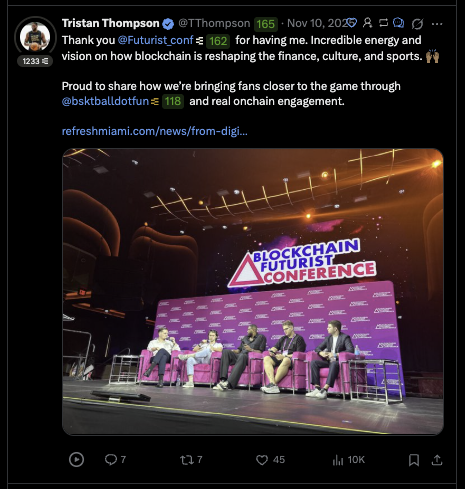
Today I want to share a reflection about Web3, KOLs, and responsibility. Five quick points: ➫ KOLs and responsibility ➫ Scams, red flags, and green flags ➫ The new paid promotion disclosure on X ➫ The @bsktballdotfun discussion ➫ Why DYOR still matters more than ever Web3 is still a frontier. Like every frontier, it brings innovation, opportunity… and mistakes. Many people assume KOLs have certainty about the projects they talk about. The reality is simpler. If you read my bio, I’ve always been clear: "I’m not a financial advisor. Always DYOR." But I also know who I am and what I’ve built in this space. I trust my community. This post is not about defending my reputation. I’m not a stranger in this industry. After more than 7 years in Web3, my work and track record speak for themselves. What actually concerns me is something bigger: the reputation of Web3 itself. From the outside, people rarely see the good things. Negative stories travel faster, louder, and further. And often, many of those stories are driven by one simple thing: Greed. ➫ The greed of a founder who manipulates a project and turns it into scam. ➫ The greed of an agency or a KOL who prioritizes payment over the community. ➫ And the greed of an investor who doesn’t read, doesn’t research, and follows FOMO instead of reason. Web3, at the end of the day, is a small ecosystem created and inhabited by humans. And because of that, it reflects both the best and the worst parts of human behavior. "I never justify scams. I condemn them completely." But we also shouldn’t forget something important: risk is always present, especially in young industries and early-stage projects. Sometimes something even more uncomfortable happens: projects get labeled as scams simply because they failed to execute a good idea correctly. A bad execution can destroy a legitimate idea. Web3 moves extremely fast. Many people come here looking for quick narratives and quick profits. But very few are here for the long term. I am. Seven years might not sound like much in the real world, but in Web3 it can feel like several lifetimes. ➫ About @bsktballdotfun When I first looked into Basketball fun, I did what I always do. I researched it. One of the people associated with the project was NBA champion @TThompson (Tristan Thompson), publicly speaking about the project and participating in Web3 conferences discussing its vision. From a due diligence perspective at the time, those were visible signals that many would reasonably interpret as green flags. But Web3 teaches you something quickly: Green flags can change over time. Even when you do your homework When I entered crypto more than 7 years ago, I wasn’t a KOL. I was just an investor. Like many others, I researched TERRA LUNA carefully. We all know how that ended. Research reduces risk. It does not eliminate it. Final thought Responsibility exists at multiple levels in Web3. ➫ Founders. ➫ Agencies ➫ KOLs. ➫ Investors. But ultimately, every person decides where they place their attention, trust, and capital. Sometimes things work. Sometimes they don’t. That’s true in crypto, and it’s true in life. After seven years in this space, my conclusion hasn’t changed: ➫ Research. ➫ Question. ➫ Learn. And most importantly: Make your own decisions. DYOR.


@Defi_Rocketeer ·
The Biggest Crypto Upgrades to Watch in Q3 2026 I believe Q3 2026 could become the most important quarter of the year for crypto. Not because of market sentiment alone, but because many of the industry's biggest ecosystems are preparing major upgrades that could reshape capital flows throughout the second half of the year. A few developments are sitting at the top of my watchlist. 1/ @ethereum - Glamsterdam Hard Fork This could become Ethereum's biggest upgrade since The Merge. Features such as ePBS, Block-Level Access Lists, and a significant increase in the gas limit toward 200M aim to improve scalability, reduce transaction costs, and dramatically increase network throughput. If execution goes smoothly, Ethereum could strengthen its position against high-performance Layer 1s while making the ecosystem far more attractive for developers and institutions. 2/ @solana - Alpenglow Alpenglow completely redesigns Solana's consensus through Votor and Rotor, reducing network finality from roughly 13s to around 150ms while improving reliability and throughput. #Solana already dominates consumer crypto through memecoins, AI, DeFi, and payments. This upgrade targets one of the network's biggest remaining bottlenecks and could unlock another wave of applications requiring near-instant settlement. 3/ @HyperliquidX - $HYPE Hyperliquid continues expanding far beyond perpetual trading. Upcoming developments such as HIP-3, HIP-4, prediction markets, tokenized commodities like gold and silver, alongside Ripple Prime integration for institutional perpetual trading, continue strengthening its position as the leading onchain derivatives ecosystem. Among all the projects I'm watching, Hyperliquid feels like one of the strongest candidates to surprise the market during Q3. 4/ @SuiNetwork Sui continues building toward a more complete ecosystem through its S2 Platform, protocol-level privacy, USDsui stablecoin, and the continued expansion of DeepBook. Combined with the Move programming language and a developer-friendly architecture, these upgrades could accelerate both consumer applications and DeFi adoption. The next major milestone for $Sui will likely come from attracting more high-quality applications capable of bringing fresh liquidity back into the ecosystem. I think Q3/2026 will be defined by technology delivery rather than pure speculation. The market has reached a stage where execution matters more than promises. Protocols shipping meaningful upgrades, attracting developers, improving user experience, and capturing real liquidity are the ones most likely to outperform. That's exactly where my attention will be throughout the coming quarter. DYOR.


@Nick_Researcher ·
➥ Crypto is dead and it hits me I’ve been in this industry long enough that crypto is dead feels personal I survived ICO mania, DeFi summer, NFTs, points farming, memecoins, L2 wars… I built my network here, my income came from here, a part of my identity is here So when I say this, I’m not farming engagement: Crypto as a self-contained world is dying ➊ The uncomfortable truth For years, they built crypto for crypto natives - interfaces assuming you’re fine moving 6-fig size through a browser wallet - GTM playbook: token → points → airdrop → liquidity mining → referral codes → Discord → repeat In reality, it was just recycling the same wallets ➋ What I actually mean by dead Crypto startup becomes: - a payments company that happens to use stablecoins - a prediction market that happens to settle onchain - a fintech product that uses blockchain rails in the backend - institutions tokenize their products for global reach Most users won’t care, they just want faster settlement, dollar exposure, protection from inflation, 24/7 trading So in my brutal opinion, Crypto wins when nobody needs to be crypto-native at all Given that they can put this in anyone’s hands, what are they choosing to build? The casino will always exist and let’s be honest, it funded a lot of the infra But the casino isn’t the entire city ➌ If crypto matures, it dissolves into 3 layers: [1] Infra = quiet, boring, massive - stablecoin rails for cross-border flows - onchain settlement for specific markets - shared state for collateral and ownership [2] Products = not “crypto apps,” just apps - compete on price, speed, UX, trust - hide complexity aggressively - market value, no tokenomics [3] Speculation = still here - memecoins, derivatives, degen markets If you’ve been here for years, this shift feels like losing something But honestly, we’ve been speaking a language outsiders didn’t understand So I believe when a tech disappears into the stack, that’s success Market already shows us with @CantonNetwork, @LayerZero_Core, RWAs, Stabelcoins, PerpDEXs, Prediction Markets… you just don’t accept it yet, but believe me or not, you’ll be there soon

@0xALTF4 ·
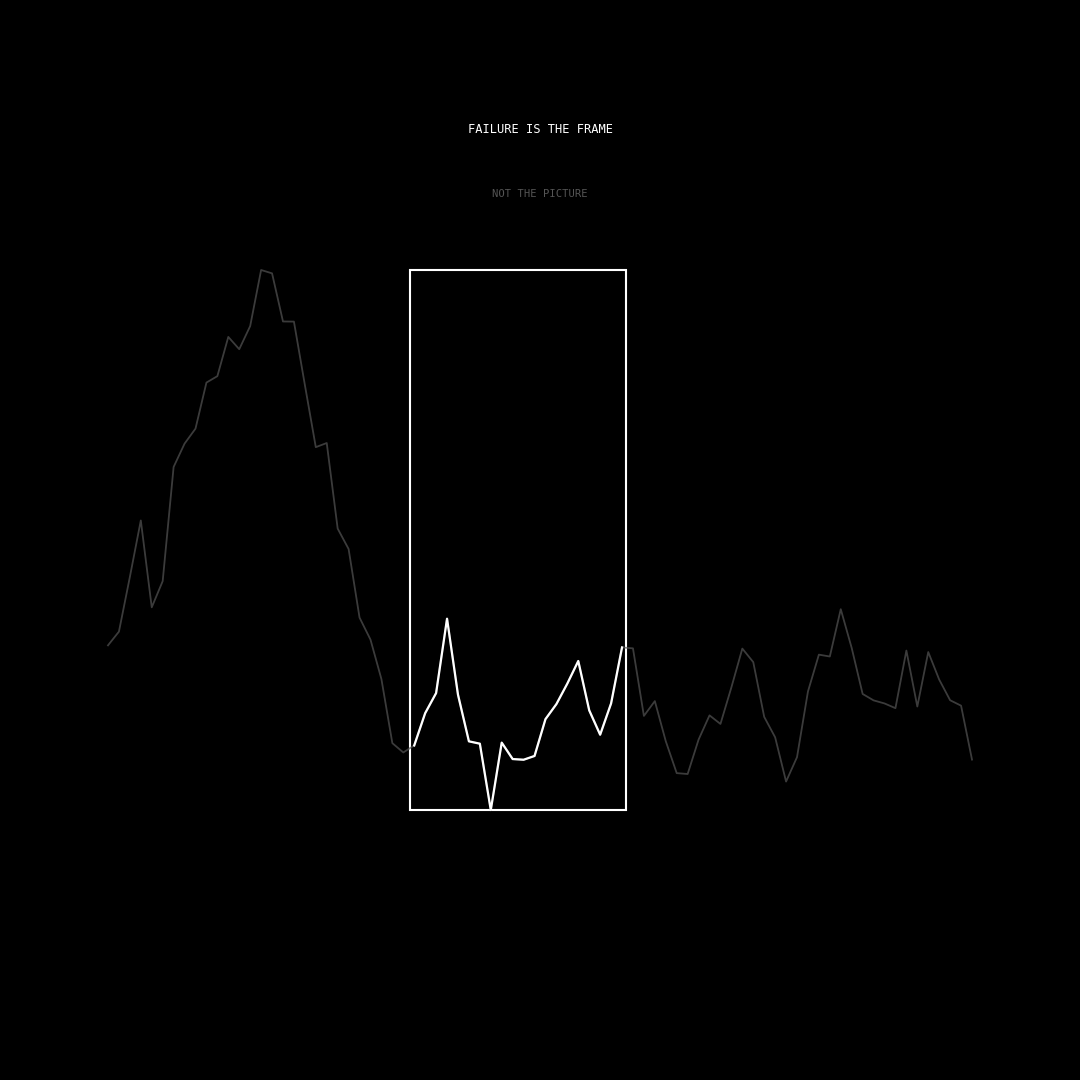
every major crypto company that went public in the last two years is underwater. every single one. let that satisfactionk in for a second. during the biggest institutional infrastructure buildout in crypto history, the companies building that infrastructure went public and got destroyed. ❯ here's the damage report. Gemini Space Station listed on Nasdaq in September 2025 at $37. it's trading at $4.19 today. that's -89%. the Winklevoss twins took one of the most recognized brands in crypto public and watched it lose nine-tenths of its value in ten months. BitGo went public in January 2026 at $22.43. it's down 77%. this is the custody infrastructure that holds billions in institutional assets. the clients are still there. the stock isn't. Bullish debuted in August 2025 at $90. down 71%. a Peter Thiel-backed exchange with former NYSE president Tom Farley as CEO couldn't hold its opening price for more than a few weeks. eToro listed in May 2025. down 42%. the social trading platform that was supposed to bridge TradFi and crypto retail got caught in the middle of both selling off simultaneously. Circle went public in June 2025. down 6%. the best performer on the list and it's still red. this is the company that issues base:0x833589fcd6edb6e08f4c7c32d4f71b54bda02913, arguably the most important stablecoin in DeFi. even the winner is losing. Figure Technology Solutions. down 14%. Securitize just hit NYSE this week. the pattern is clear before the first trade even settles. ❯ what makes this so uncomfortable. the narrative during 2025 was simple: crypto is becoming institutional. ETFs are live. banks are building on-chain. the companies enabling all of this should be the biggest beneficiaries. the stock market disagreed. completely. every single metric these companies pointed to in their S-1 filings growing users, increasing AUM, expanding product lines, regulatory clarity turned out to be irrelevant to public market investors who looked at one thing: are you profitable at scale right now? most of them weren't. and in a 5%+ rate environment where capital has a real cost, "growing into profitability" isn't a thesis anymore. it's a liability. ❯ the irony is brutal. crypto spot ETFs pulled in $107B in AUM. Schwab and Morgan Stanley opened direct trading to 50M+ users. Fannie Mae accepted crypto as mortgage collateral. CLARITY Act cleared committee. the infrastructure story was real. and the companies that built that infrastructure saw their stocks collapse anyway. Gemini at $4. BitGo at $5. Bullish at $26. the market is telling you something: using crypto and owning crypto company equity are two completely different trades. the users showed up. the shareholders got wrecked. ❯ the one question worth asking. if Gemini is down 89% and still operating, if BitGo is down 77% and still custodying billions, if Circle is down 6% and still processing $150B+ in USDC volume monthly are these broken companies or broken stocks? because in a rate-cut environment, the answer changes fast. and the June jobs report just printed 57,000 against a 113,000 forecast. the same stocks that got destroyed by higher-for-longer could snap back the hardest when the cycle turns. or they could keep bleeding if crypto winter extends into 2027. either way, the scoreboard right now is brutal. -89%. -77%. -71%. -42%. "crypto infrastructure is the future" was the pitch. the stock market's response: "prove it with earnings, not narratives."


@JesusMartinez ·
It's been 5 days and most of CT has floored their TAO. I haven't sold a single coin. And I wanted to explain why. I'm not a traditional trader. I don't do futures 24/7. I don't 300x leverage everything. When the trend is favoring my direction I just keep twisting the knife in. TAO is complicated. The average person getting into crypto came because of memecoins or Bitcoin. Easy narratives. But when something is technical and hard to understand, that's an arbitrage opportunity for people who actually do the work. I came from gaming. Challenger League of Legends. In 2021 I gave my brother $700 and it turned into mid-5 figures because of my edge. TAO is the same thing for me. I use AI heavily in my workflow. I've talked to some of the most influential people in the Bittensor ecosystem. I understand it at a level most people don't. That's my edge. Instead of bouncing to 300 different coins I'd rather go deeper into one ecosystem I actually understand. I've made hundreds of thousands doing exactly that. Deep knowledge. Real capital. Chasing that edge. I still see an enormous amount of upside here. And I'm not going anywhere until I get it.
@0xALTF4 ·
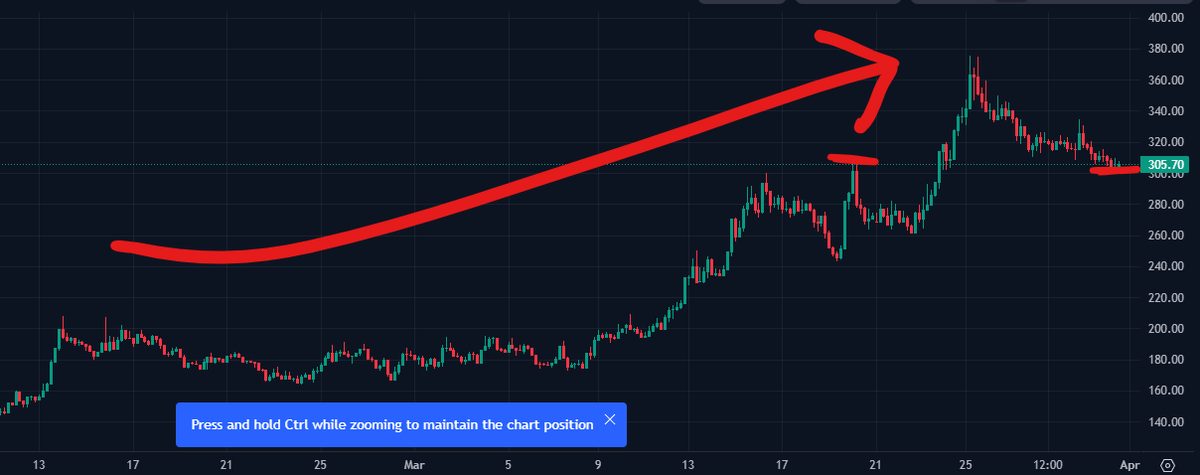
Crypto prices are falling. Crypto adoption is not. bitcoin:native is back near $62K. ethereum:native is trading below $1.7K. Fear is dominating the market again. But underneath the price action: • stablecoins are becoming payment rails • tokenized assets are moving onchain • institutions are building settlement infrastructure • AI agents are beginning to transact autonomously • crypto apps are finally competing on product and UX This is the divergence most people miss. The speculative layer is repricing. The infrastructure layer is still expanding. Price tells you how traders feel today. Adoption tells you where the market is going next.

@CryptoTeca__ ·
Crypto spent years rewarding whoever could create the loudest narrative. This cycle changed the game. The protocols still growing through volatility are the ones solving real problems, generating usage and becoming critical infrastructure. By category, it's becoming obvious who's winning: ▸ RWA: @Ondo | @BlackRock BUIDL | @FTI_US BENJI | @centrifuge | @maplefinance ▸ Perps & Trading: @HyperliquidX | @GMX_IO | @Uniswap | @JupiterExchange ▸ AI Crypto Infrastructure: @bittensor | @rendernetwork | @akashnet | @ASI_Alliance | @NEARProtocol ▸ Prediction Markets: @Polymarket | @Kalshi ▸ BTCfi: @Stacks | @babylonlabs_io | @Lombard_Finance | @TheTNetwork | @rootstock_io ▸ Stablecoins: @tether | @circle | @SkyEcosystem ▸ Lending: @aave | @Morpho | @sparkfinance | @compoundfinance | @eulerfinance | @0xFluid | @kamino ▸ Liquid Staking & Restaking: @LidoFinance | @ether_fi ▸ Synthetic Dollars: @ethena ▸ L2 & Consumer Scaling: @base | @arbitrum ▸ Oracles & Data: @chainlink | @PythNetwork ▸ Privacy: @Zcash The interesting part is that most of these protocols are not winning because of incentives. They're winning because the fundamentals keep improving. + Ondo now manages roughly $3.5B-$3.6B+ in tokenised assets, while the broader RWA market has expanded into the tens of billions. + Hyperliquid continues controlling 60%+ of decentralised perpetual volume, with trading activity remaining strong even during a weaker market. + Bittensor continues building an open AI marketplace through specialised subnets, while Render and Akash are expanding decentralised compute infrastructure. + Stacks has reached 1.6M users, 110K new wallets (+50% QoQ) and 55% DAU growth, while BitFlow has processed over $5B in cumulative transaction volume. + Aave remains around $14B TVL, while Morpho has grown into the $7B-$11B+ TVL range through modular lending markets. + Babylon has pushed native BTC staking beyond $4B TVL, proving demand for trust-minimised Bitcoin yield. Meanwhile, stablecoin supply has crossed $300B, making USDT, USDC and Sky some of the most important settlement layers in crypto. The pattern is clear. The market is moving away from short-term extraction and toward protocols with: ▸ Real usage ▸ Sustainable revenue ▸ Institutional demand ▸ Strong retention The next cycle will likely belong to the builders who survived this one.


@backseats_eth ·
I’ve spent the better part of the last year wrestling with my place in crypto and whether to stay or go among the bad PR, the grifts, the scams, the pump and dumps, and the vaporware. What I’ve come to is that I simply have to trust my gut and moral compass and build great things that speak to me and simply shut out the rest. When pitching to people outside of our bubble, I have to meet them where they are in our shared disgust for much of crypto and then show them something rad that happens to be built on an open database with infinite remixability and composability. Lead with fun and culture and entertainment and let the moneyness take care of itself.

@KevinWSHPod ·
E164 - @GSR_io - $30 trillion is coming on-chain @xinsong86 is CEO of @GSR_io - 12 years in, bootstrapped with $20K, still standing after FTX - and he thinks in decades, not quarters. A masterclass in market structure, what's actually broken about token launches, and why the $30 trillion tokenization opportunity still needs a demand side. Timestamps: 0:00 Introduction 2:02 Sleep & Age Banter 3:15 Advantage Of Age & Maturity 7:33 Who Is Xin Song? 9:23 What Did You Learn From Your Parents 12:47 Partnerships: @JupiterExchange @KASTxyz 13:27 What’s Happening With Crypto Right Now Considering The Market 16:12 What Broken Market Structure Means 19:18 Why Crypto Companies Shouldn’t Be Competing With Each Other 21:27 What Shocks You That People Don’t Understand With Crypto vs TradFi 26:42 What’s The Incentive To Make These Changes 28:41 GSR Explained To Your Mom 32:51 Partnerships: @Ethena @sumsub 33:53 Why Do Market Makers In Crypto Have Bad Reputations 36:48 How To Fix The Crypto Market Makers Reputation 40:09 What Does It Mean That GSR Wants To Become The Goldman Sachs Of Crypto 42:05 Example: Goldman Sachs Worked With Coca Cola & How GSR Reflects That In The Web 3 World 44:50 Why Is It Necessary For GSR To Become The Goldman Sachs Of Web 3 48:34 You Made 2 Major Acquisitions, Why? 51:49 Partnerships: @Trezor @Bitwise @SuiNetwork 52:45 Why Is Now The Best Moment For Focusing On Tokenization 56:24 What Must Happen For 10% Of $300 Trillion To Be On Chain 59:20 @katana Explained Simply 1:12:18 Closing Thoughts
 Watch video

@Web3Alex_ ·
Every cycle produces the same conversation in the bear market. "Crypto is dead." "Web3 was a scam." "Nobody's building anymore." And every cycle, the people who said that miss the next wave entirely because they were too busy being right about the short term to stay positioned for the long term. The projects that matter are never the loudest during the downturn. They're the ones you suddenly notice everywhere when the market recovers and realize they never stopped building. Pay attention to what's being built. Not what's being said.


@TheAstornia ·
🚨 Explaining what happened in crypto so you can lose money with more context - Memes on RobinHood Chain going parabolic - Trump memecoin buyers are deep underwater while Trump’s crypto ventures reportedly made over $1.4B - Kalshi and Polymarket are still caught between market rules and gambling laws. - Bitcoin bounced after the June flush, but ETF outflows are still heavy. - Quantum risk is becoming a real Bitcoin debate because of Satoshi’s old coins. - Whales reportedly bought billions in BTC while ETFs kept bleeding. - Zcash is pushing privacy and quantum resistance while privacy coins stay weird.


@Tanaka_L2 ·
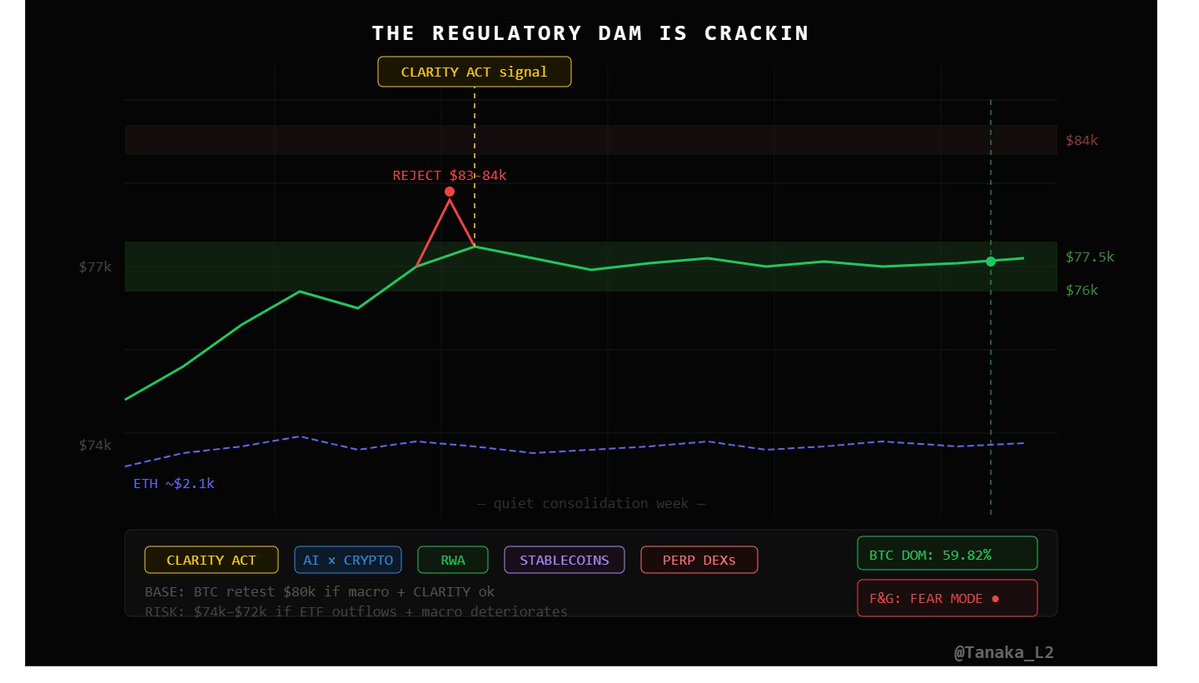
➥ Crypto is quiet, but I don’t think the market is dead here $BTC has been moving around the $76k-$77.5k zone after rejecting the $83k-$84k area last week That tells me one thing, market is not in full risk-on mode yet. It is waiting for the next clear catalyst. $ETH looks weaker atm, still trading around $2.1k and failing to break the $2.4k resistance for months. Altcoins are under more pressure, ETF flows are negative, and Fear & Greed is still sitting in Fear mode. But I wouldn’t call this a strong downtrend, this looks more like classic consolidation after a strong move. Narratives I’m watching right now: → Regulatory clarity: CLARITY Act is the biggest signal this week. If U.S. crypto regulation keeps moving forward, I think $ETH, $SOL, $XRP, stablecoins and RWA infra will benefit the most ($LINK $ONDO). → AI x Crypto: AI agents, private inference, chain abstraction and agent wallets are getting more attention again. This is still one of the strongest 2026 narratives on my watchlist $TAO $VIRTUAL $NEAR $FET → RWA & tokenization: Wall Street is not slowing down here. Tokenized bonds, private credit, real estate and equities are slowly becoming real market infrastructure. ($ONDO $CFG $LINK $MKR) → Stablecoins: Stablecoins are moving from “crypto narrative” to actual payment and settlement rails. This is why I keep watching USDC, stablechains and yield-bearing stable assets. → Perp DEXs: $HYPE remains one of the clearest names in DeFi because the market still rewards revenue, liquidity and real usage. My base case: If macro data is fine and CLARITY momentum continues, BTC can retest $80k. If ETF outflows continue and macro gets worse, $74k–$72k is the zone I’m watching. In my experience, quiet weeks like this usually decide where the next rotation starts. Ofc, NFA.

@brave_raf ·
narratives worth paying attention to 1. prediction markets The most obvious bet here is @Polymarket, everyone pretty much knows them and the airdrop is most likely going to feed those who are well aligned. The playbook for Polymarket is simple Use the platform for your predictions (sports, crypto, politics etc) Provide LP and earn fees @DidiTrading and @a are peeps whom you'd love to pay attention to as regards this. Personally, I think it is worth paying attention to we've also seen two prediction markets launch in the last 6+ months (@trylimitless and @opinionlabsxyz) other projects worth paying attention to @predictdotfun @MyriadMarkets (good way to have abstract exposure) 2. Perps Not a new narrative tbh but I think this is one of crypto's proven usecase. The opportunity with perps is similar to CEXs. After Binance, Coinbase and big giants, we had many others like MEXC whom have been quite handy in the space. I think something similar is brewing with Perps but you have to becareful cos most projects will straight up extract you. The @paradex launch was a clear example. The notable projects here are @HyperliquidX,@Aster_DEX and @Lighter_xyz Projects yet to do TGE which are promising are @variational_io @etherealdex @extendedapp @pacifica_fi @edgeX_exchange @grvt_io skin in the game but beware so you don't get skinned. 3. casinos Now, this is probably going to be the weapon fashioned against man of us in this bear market. Most of the projects here are yet to tokenize and they really look promising @yeet @MetaWin (TGE is coming) @Realbet @megapot Another avenue to get burned. play it wisely. others to really focus on are robotics and AI. I believe we'd have an AI run again since crypto has a way of mirroring the real world. Keep grinding, stay brave and see you on the side that prints.

@TheDeFiAngel ·
If you follow my post closely, you will know that i have been looking at the perpetual futures market again, and I think we've reached the point where comparing platforms by trading volume alone isn’t the right approach. Market is splitting into different specialisations. @HyperliquidX still dominates where it has always been strongest. With roughly $190B in 30-day volume and open interest fluctuating between $7B and $12B, it has become the liquidity hub for crypto-native perpetuals. The scale is difficult to replicate, and the depth of its order books continues to attract both retail and institutional flow. What draw my attention wasn't Hyperliquid's numbers though, It was what the data on @OndoPerps is starting to show. For a platform that's only been public for a few weeks, processing around $3.1B in monthly volume against just $50M in open interest is unusual. This is a very high turnover ratio, which tells you capital is moving through the platform. Part of that is almost certainly incentives. Part of it is traders exploring a market that simply didn't exist on-chain before. The other interesting development is what happens when traditional markets close. Majority of crypto traders are used to funding rates changing throughout the day, but perpetuals tied to equities create a different dynamic. With underlying stock exchanges shut over the weekend, funding can drift far enough to create opportunities that don't normally exist during regular market hours. I've seen more traders paying attention to those dislocations than to the price moves themselves. At the same time, Hyperliquid isn't standing still either. Its expansion into RWA markets through HIP-3 suggests that even the largest crypto-native perp venue sees tokenized real-world assets as an area worth building around. It’s not a race where every platform is trying to become the next Hyperliquid. Some are competing on liquidity. Others are experimenting with how capital behaves once traditional assets become fully on-chain. That's a much more interesting market to watch.


@panditdhamdhere ·
Crypto lost 56% of its developers in a year. Yes, you read it right. Weekly code commits across Blockchain projects are down by 75% & continue down. More than half active Blockchain Engineer already gone. This ain't rumor or bear market vibe, this is GitHub's clear data. If you see GitHub data of all crypto developers. The comfortable read is they will come back, when the market pumps. Well, I don't think ( personal thoughts ) they left because prices drop. They left because ai getting intresting day by day. The Engineers in Blockchain who were writing smart contracts in 2024-25, now building ai agents, shipping LLM tools, training models & so on. Crypto is just no longer where the smart curious, people come together & want to spend nights. The terrifying thing for crypto founders is the true builders stoped showing up. Here's the thing. Those who stayed and actively building ain't tourists. They're real builders, who actually solving problems & shipping quality projects. So crypto ain't collapsing, its consolidating. The hyper layer evaported & exposed who was actually building on chain & trying to solve problems using this phenomenonal technology. Welcome to new era of crypto industry.


@CryptoTeca__ ·
The current selloff is creating a split market. On one side, $BTC proxies and leveraged structures are being aggressively repriced. On the other, a small group of altcoins continues to attract buyers and outperform the broader market. At first glance, it looks like decoupling. But crypto has a habit of reminding participants that outperformance during calm conditions and resilience during liquidity stress are often very different things. The broader backdrop is becoming increasingly hostile to risk assets. This no longer feels like an isolated crypto correction. A stronger US $DXY, weakness across commodities, and signs of fatigue in equities are creating an environment that has historically pressured speculative assets. Bitcoin remains the anchor. The recent correction appears driven by familiar forces: ETF outflows, heavy long liquidations, and growing caution ahead of key macro data releases. Yet the more interesting story is the stress test unfolding beneath the surface. Some assets are simply correcting. Others are beginning to break. The clearest example is in leveraged Bitcoin trades. Strategy and related instruments are showing that a bullish long-term view on Bitcoin can coexist with a bearish view on Bitcoin proxies. As liquidity tightens, balance-sheet risk, refinancing concerns, and potential dilution begin to matter more than BTC exposure itself. When leverage works, these vehicles can dramatically outperform Bitcoin. When conditions reverse, the same leverage amplifies downside in ways many participants underestimate. The weakness in $STRC reinforces this. Market participants appear to be reassessing risk across the entire structure, and once confidence weakens, selling can become self-reinforcing. At the same time, a handful of altcoins continue to stand out. Names like $ZEC, $NEAR, and $HYPE have held up far better than much of the market. The question is whether we're seeing genuine decoupling or simply a delayed reaction. From previous cycles, I've found that relative strength during corrections deserves attention, but also skepticism. During bullish periods, markets reward narratives. During stressful periods, markets reward liquidity. Still, not all resilience should be dismissed. $HYPE appears supported by meaningful on-chain activity and fee-driven demand, while $ZEC continues to benefit from privacy-related demand. Both may possess stronger foundations than purely narrative-driven assets. That distinction matters. Outperformance can mean two very different things. Sometimes it reflects accumulation. Other times, it's simply the final stage before distribution. Markets usually reveal the difference only after liquidity disappears. What this selloff is reminding me is that Bitcoin remains the cleanest macro expression within crypto, while many of its proxies and high-beta alternatives still behave like leveraged venture bets trading on public markets. For now, the more important exercise may not be predicting the next bounce, but identifying which assets continue attracting genuine demand under stress. Historically, those are often the names worth revisiting once the broader deleveraging cycle finally runs its course.


@OnlyHades_ ·
WHAT HAPPENED IN CRYPTO LAST WEEK? While we wait for the market to bounce, it's essential to keep track of what the major players/protocols are doing: 1. Increase in Bitcoin Activity. $BTC spent most of the week trading around $58k–$60k, but on-chain activity was heating up. Daily transactions crossed 820k for the first time in over two years, largely thanks to renewed interest in Runes. (Be honest, you probably didn't even know this happened) 2. Ethereum Foundation Cuts Cost. Vitalik announced that the Ethereum Foundation will cut its operating budget by 40%. The goal is to make the Foundation leaner and less central to Ethereum's development after several researchers moved on. Dw, I'm still holding my $ETH so you have nothing to worry about. 3. Aave Gains Institutional Interest. Aave had a strong week. Standard Chartered started research coverage with a bullish long-term outlook, and reports say Kraken is exploring a 15% stake in the Aave company. Whether or not it actually happens, we have a good sign that TradFi is looking seriously at DeFi again. 4. Solana Expands Adoption Solana partnered with a major South Korean bank to support global settlement services. Like I've repeated in my previous posts, Solana is slowly but surely maturing into an infrastructure that financial institutions are actually willing to build on. 5. Europe Enforces MiCA MiCA goes into full enforcement on July 1, and plenty of crypto firms still aren't fully licensed. The next few weeks could force some tough decisions across Europe. Meanwhile, Indonesia is taking a different approach by introducing certification for crypto influencers to improve accountability in the industry. Definitely was an interesting week.


@ttunguz ·
If I have a dollar to invest in a stock or a crypto token, how do I decide? I need to compare across the two. Historically, that comparison was impossible. Crypto traded on a potent cocktail of hype, narrative, & the promise of a decentralized future. Perception drove valuations. That’s changing. The word “revenue” is no longer verboten in the world of crypto. It’s becoming the goal. This trend will unlock the next wave of institutional capital because investors can compare the risk/reward of crypto with the same metrics as other software companies. Look at Hyperliquid, a decentralized options/perpetuals exchange. It’s on a $650M+ annualized revenue run rate, trading at a 60x multiple. This valuation is rich compared to public fintech companies like Coinbase (13x) or Robinhood (24x), but it’s based on comparable tangible financial performance. The same is true for blockchains: Optimism & Arbitrum trade at 40-60x revenues. Amazon Web Services or Azure, if they were to be spun out as separate entities, would trade at 20-30x. Phantom, a brokerage app, has generated $394m in lifetime revenue, most of it in the last 6 months. The list is still small. Fewer than 40 apps generate more than $1m. But the ones that do can generate hundreds of millions. This is the future of crypto. A future where revenue generation is the goal. This does not mean the attention economy is dead. Hype will always be part of crypto. But the projects that attract the next wave of capital will combine a compelling narrative with a sustainable business model. They will show a clear path to revenue & trade on revenue multiples - likely elevated relative to the rest of software because of the explosive growth potential. The message for builders is clear: focus on fundamentals. Build a product people want, that solves a real problem, & that generates real revenue. That revenue provides the capital to fuel crypto’s next chapter. Read the original post that inspired this one here : https://t.co/7GWski5EgI I know it’s called a wallet, but I suspect wallets will be renamed brokerages as Robinhood & Coinbase fuse stocks & crypto. https://t.co/ZKkwoGk20e


@rish_neynar ·
something crypto did that doesn't get talked about enough: it made global market creation accessible to anyone. getting something listed before meant lawyers, compliance teams, exchange relationships - essentially, building the market manually. most people had no path in. nfts were one expression of this new primitive, markets around digital assets. memecoins are another, markets around ideas and attention. physical asset markets don't work this way because you need access to the actual asset to trade it. local and slow by default. now it takes 20 seconds to create one. what gets built first with that kind of access is always messy. what comes after, from people who just got in for the first time, is what i'm actually curious about.

@seeksahib ·
CT and Crypto markets are two different sides of a coin. CT rewards presence and public building. markets reward execution and shipping. It exhausting +when founders try to impress both that's where they fall apart. Andre Cronje never played this attention game. He shared concepts that quietly rewrote entire DeFi categories. By the time CT noticed, the protocol was already live. That's the pattern nobody wants to admit: attention economy and the execution economy run on completely different clocks. If you try to overlap between the two, you'll shrink fast.

@0xsatoshisarah ·
A rant… The startup and accompanying venture space in consumer crypto has been incredibly bleak. So much money continues to circulate through narratives that have been proven to not work, or new products with no real edge trying to compete against a monopoly (usually some sort of marketplace). It’s evidently demoralizing for builders who are often directed to building the wrong thing for a short term chase. The thing I love most about this industry is its experimental nature, but there are very few real experiments being done anymore. I’ve been an active part of a lot of shiny new hyped phases (like bitcoin L2s or NFT niches). When the sharks smell a trend, capital is poured excessively into startups trying to grab a slice of the new meta. And when the markets bleed, as they always do, the entire vertical is abandoned and in rotates the next Big Thing. Sometimes, this is just how it goes. However… This last run of memecoin mania undeniably set our industry back. It is embarrassing that the only thing we’ve normalized is on-chain gambling. Crypto has become a tourist attraction, a digital Vegas. And now, venture trends have focused onto stablecoin plays. That’s fine, it’s obviously the next step in the transition out of traditional global banking, but that’s not experimental at all. If you’re building in this space, you should be building because you know crypto rails are just better than the Web2 status quo. Not because you see it as an easy way to line your pockets. Crypto has turned into an extractive space only driven further down in degeneracy, in part thanks to mindless trendy venture capital allocation. It feels like we’ve collectively forgotten how cool our tech is. No new ideas. Too many infrastructure companies struggling to find too few apps to serve. The old version of the crypto space is cooked, actively dying a painful death. I say all of this as a user who hasn’t found anything in the last few years that I would use as a normal person or show my friends. But as a builder, somehow it’s even sadder that I can’t point at any consumer startup and go, “I want to be them. I want to beat them.” There’s genuinely so little to be inspired by. I will say some of the new tools (especially in wallets) have done a lot of great heavy lifting, but we can only have so many shovels. I’m sure a lot of this suppressed experimentation was thanks to the old SEC. But we’re not in that environment anymore. I’m really hoping people use this bear market to build or fund something new and interesting.

@mscode07 ·
Crazy how a 19-year-old looked at Bitcoin and thought: “Why should blockchain only be used for money?” That teenager was Vitalik Buterin. He discovered Bitcoin in 2011 and started writing about it. But the more he explored Bitcoin, the more he became interested in something bigger: What if blockchain could run programs, not just transfer money? So in 2013, at just 19 years old, he published the idea for Ethereum. Instead of building only digital money, Ethereum would allow developers to build applications using smart contracts. The idea sounded extremely ambitious. But developers joined him. The project raised about 31,000 BTC, roughly $18 million at the time, through crowdfunding in 2014. And in July 2015… Ethereum went live. Today, the idea that started with a teenager questioning what blockchain could do became infrastructure for DeFi, stablecoins, NFTs, games, and thousands of applications. 5 things I take from Vitalik's story: Question existing limitations. Being young doesn't mean your idea is too early. Learn deeply before trying to build differently. Don't just improve the existing product; rethink what's possible. A powerful idea can start as a document before it becomes technology. And my favorite part? Vitalik didn't create another Bitcoin. He asked what Bitcoin couldn't do and built around that. That's today's crypto story.

@KevinWSHPod ·
If you are a Bitcoin and crypto investor, you should use your level of interest and enthusiasm as a counter indicator on when to buy // accumulate When you are excited and optimistic, you should probably buy less or sell some When you (or your normies friends) are disinterested or bored or dont want to look at your portfolio much, it’s probably a decent time to accumulate That’s why (crypto) investing is hard and that’s why very frequently actually make it - despite all the headlines that celebrate crypto memecoins millionaires (forgetting to write another article when those same people went broke)

@naruto11eth ·
a little bit rant on the current state of crypto: the one thing i really hate about CT is that -> we love to hate when prices are down. during the bull, everyone said "oh tom lee is best bet and bull that ethereum got" "saylor is fkn god for MSTR and BTC" but now that we are in bear, everyone's trolling them. imho saylor selling 32btc doesnt put a dent and it's just a business. maybe it gives wrong social signal, but apart from that it wouldnt affect the prices just because he sold 32 btc. same goes for tom lee and ethereum. these are cycles. people are tired. they didnt take profits, but funds and big investors did. war affected the prices. IPOs will suck more liquidity. but on the brighter side, we have come a long way. from upgrading ethereum multiple times, solana not being down even once in 2026, HYPE/fomo and other perps doing well and prediction markets getting most volume during WC is insanely bullish. prices matter, and you should take profits. but we have come a long way from an ecosystem that was supposed to be shot dead by the banks.

@lucainweb3 ·
Pantera's Bitcoin Fund has returned over 1,000x since 2013, but nothing would have happened if Coinbase didn't improve their infra for them Went to a conference in Bangkok last week listening to Pantera's managing director walk through how the fund got started. The story has been sitting with me all day. Dan Morehead wasn't an early Bitcoin believer who got lucky. He was a Wall Street macro trader before crypto, with years of watching currencies break and new assets get absorbed into the system. When he first looked at Bitcoin he knew he was reading a bet traditional finance hadn't woken up to yet. At $65 average the fund accumulated heavily, and what made the room go quiet was the infrastructure itself. Coinbase at the time couldn't even process a 30,000 Bitcoin buy in one go. Pantera had to call the company and negotiate limits manually, building the position through phone calls. Every major Pantera fund since traces back to that window, including early seed checks into Ripple and Circle along with a long list of US crypto names that came after. What hit me listening to this live was how ordinary the edge was. He'd seen this kind of pattern play out before, and recognized the shape when something new showed up. Smart plus timing is what builds a fund like this, and sitting in that room I kept thinking about the moments I've been around when a similar pattern was forming and I didn't see it. A lot of the biggest crypto bets of the last decade didn't come from crypto people. They came from people trained in markets before crypto, who recognized a genuinely new opportunity when it walked into the room. The ones I respect most weren't the loudest or the earliest, they had been somewhere else long enough that when something unusual showed up, they could tell.


@Pranit ·
I didn't get into crypto for prediction markets. Ethereum gave us smart contracts in 2015. Solana made them scalable. We've had the tools to build the cypherpunk vision for 7 years before ChatGPT even existed. AI had 2 years. Yet, It dwarfed everything crypto built in 7. Claude Code, OpenClaw, ChatGPT. Tools that changed how millions of people work overnight. And what did crypto build with its 7 year head start? DeFi yield farming. Chase the highest APY, hope you don't get rugged. Stablecoins. Cool. A better dollar. Useful for the underbanked, but still just a wrapper on the existing system. Memecoins. Pump Fun. Prediction markets, pitched as the future of news, the future of truth. We keep packaging gambling in new, different ways and calling it innovation. That's not what made crypto interesting. I got into crypto for financial sovereignty. Censorship resistance. Freedom tech. A way for anyone to participate regardless of where they were born. I'm still here because I believe this technology can deliver on that. But that means building those products. Not the next casino with a new coat of paint.
@backseats_eth ·
One way to look at crypto today is that it went through many bootstrapping phases (icos, defi, NFTs, memes, pms) and each of them brought a mania and a bubble about the technology itself, not really what you could do with it Now we have most of it, plus fast networks and wallets like privy, and time to build real things for real people

@DiaryofaMadeMan ·
Crypto just exhaled: a trade truce hint nudged bitcoin past 113,000 and lit up majors. Talks between the US and China showed real progress on export controls, fentanyl, and shipping levies. The most aggressive tariff threat was walked back, and that eased the mood across markets. Stocks firmed, gold cooled, and crypto rode the shift. Plain version for newcomers: when big tensions ease, people take more risk. Money rotates from safety into growth, so coins that trade a lot tend to move first. Still, the path is not clear. The next Fed meeting looms, and a sharp headline can undo the calm in a heartbeat. After choppy weeks, nerves are thin and liquidity can vanish fast. Under the surface, I see something stronger than a one-day relief bounce. Market tone improved in both US and Asian hours, and depth looked better across majors. Sellers looked less urgent, and bids actually stuck. Here’s the piece most folks miss: clarity on shipping rules may matter more than tariff talk right now. Smoother freight frees cross-border money, which often lifts coins that jump fastest when cash shows up. Why that matters: miners, market makers, and builders move gear, chips, and compliance kits through those lanes. Less friction means faster hardware flow and fewer delays on ramps, which supports steadier liquidity and better fills. That tends to make up-moves behave more like trends, not spikes. If I’m wrong, it’s because the Fed tone turns tighter or tariff fears snap back before real trades settle. In that case, patience beats chasing headlines. Use a 3-step check today: look for calmer trade headlines, steady equity futures, and a see-saw between majors and gold. That trifecta tells you risk appetite is real, not just bots reacting to a headline. If all three hold for 1 full session, treat the move as durable. If they crack, assume it’s noise and reset. Give yourself a 5-minute morning scan to run that checklist and write one sentence on what would change your mind. Small habits beat hot takes. Equities and crypto do not always move together, but on days when trade risk cools, they often rhyme. Gold easing is the mirror image of that switch. I’m also watching stablecoin inflows, breadth across top coins, and spot volume that shows up without outsized wicks. Those tell me real money is active, not just algos. For teams building in the space, clearer trade lanes help with shipping hardware, hiring across borders, and getting approvals done faster. Less friction compounds in quiet ways. For newcomers, it helps to name your plan in plain words. Decide what event would make you more cautious, and what would make you more optimistic.
Best Tweets by Topic