Most advice on how to build twitter followers is backwards. It tells people to tweet more, chase virality, and optimize surface details before they’ve earned any distribution. That’s why so many accounts post constantly and still stall.
Follower growth on X comes from a system, not a burst of motivation. The system has four parts: a sharp position, a repeatable content engine, a reply workflow that borrows attention, and a measurement loop that tells you what to keep doing. If one part is missing, growth gets noisy fast. You might get impressions, but not followers. You might get followers, but not the right ones.
The accounts that grow predictably usually look less creative from the inside than people expect. They’re running tight feedback loops. They know who they’re for, what conversations they show up in, which post formats earn profile visits, and what causes a stranger to follow instead of scroll past.
Build Your Foundation for Follower Growth
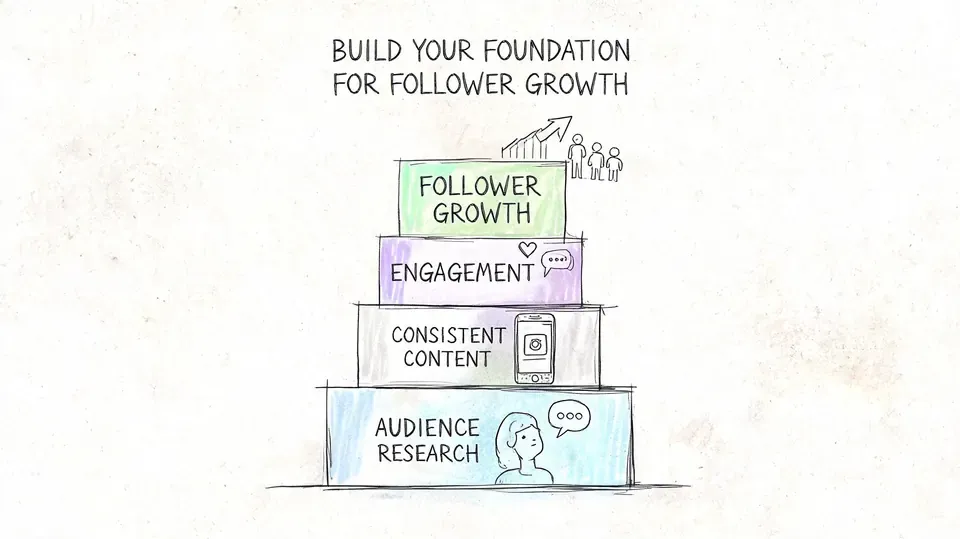
Most accounts don’t have a content problem. They have a positioning problem.
If a stranger lands on your profile and can’t tell who you help, what you talk about, and why you’re worth following, the rest of your effort leaks. Broad targeting is expensive. A Copyblogger guide on getting more followers notes that broad targeting often caps growth at less than 1% monthly, while creators who pivot to a specific niche report 15-25% follower growth within 30 days. The same guidance says broad avatars can drive 40% unfollow churn in 90 days because the content feels irrelevant.
Narrow the audience until the message gets obvious
A good niche on X isn’t just a topic. It’s a topic plus a pain point plus a type of person.
“Marketing” is too broad. “SEO” is still broad. “Trust-building SEO for dentists” is useful because it tells people what bucket to place you in. That clarity improves follows, replies, and referrals because people know when to think of you.
Use this filtering process:
-
List your real edges
Write down what you know from doing, not just consuming. Operator knowledge beats borrowed insight. If you’ve built SaaS onboarding flows, traded a niche market, or shipped AI tools for small teams, start there. -
Find the sharpest pain
Don’t ask what’s interesting. Ask what hurts. Audiences follow accounts that help them avoid mistakes, make decisions, or understand a fast-moving space. -
Choose one primary audience
Early on, one clear audience wins over multiple adjacent ones. It makes your timeline feel coherent.
Practical rule: If your bio could apply to five different kinds of followers, it’s too wide.
This growth pyramid is the right mental model before you post anything.
Build the three assets that convert visitors into followers
A profile that grows has three onboarding assets working together.
| Asset | Job | What to include |
|---|---|---|
| Bio | Explain the promise | Who you help, what problem you solve, what kind of content to expect |
| Pinned tweet | Sell the follow | Your best ideas, proof of thinking, and a reason to stay |
| Welcome thread | Set expectations | Your story, your framework, and the topics you’ll keep covering |
Your bio should be plain and specific. Avoid trying to sound impressive. A strong bio reads like a value proposition, not a resume. If you want examples, this guide to Twitter biography ideas for 2026 is a useful reference for formats that make your positioning clearer.
Your pinned tweet should act like a landing page. Don’t waste it on a random viral post unless that post perfectly represents what people will get by following. A better pinned tweet usually does one of these jobs:
- Explains your thesis so the right people self-select.
- Curates your best work into one place.
- Shows your operating style through practical observations, not hype.
Your welcome thread is where you expand. Keep it skimmable. Introduce the problem space you cover, your point of view, common mistakes you see, and the kinds of threads, posts, and replies people can expect from you.
If your profile is clear, your content has somewhere to land. If it’s vague, even a great post wastes attention.
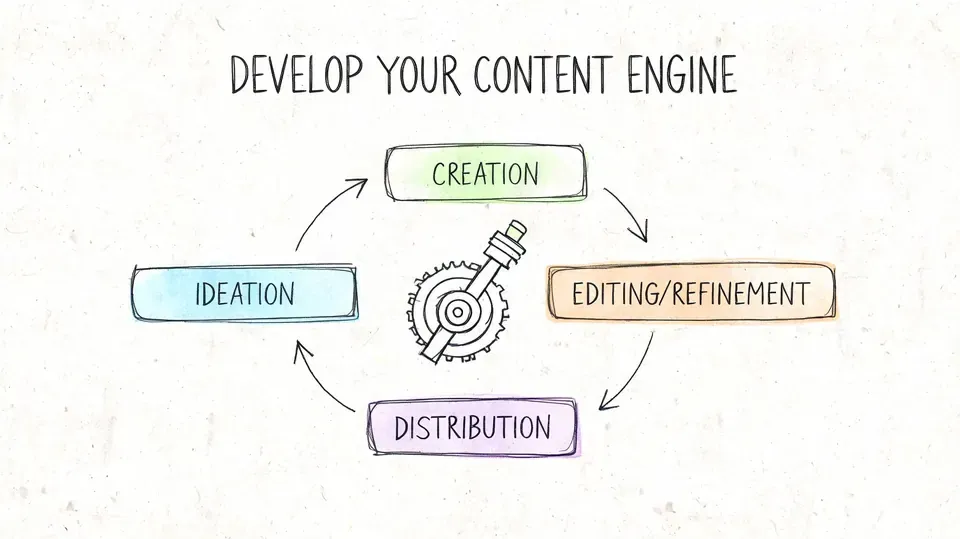
Develop Your Content Engine
People burn out on X because they treat content as inspiration-driven. That works for a week. It fails as soon as life gets busy.
A content engine removes the need to invent from scratch every day. It gives you a way to create relevant posts on demand, while staying consistent enough to build recognition. A Tweet Archivist guide to analytics best practices makes the key point clearly: analyzing your top 10% of posts and remixing those formats can help you target a 1.5-2.5% engagement rate benchmark, while inconsistency can drop algorithmic reach by 50%.
Choose a small set of content pillars
Most strong accounts have a narrow set of recurring themes. Not because they lack range, but because repetition builds association.
Use 3 to 5 content pillars tied directly to your niche. For example, an indie hacker account might use:
- Build logs with lessons from shipping
- Distribution observations from launches and experiments
- Tool breakdowns for workflows and stack choices
- Founder psychology around decision-making and trade-offs
The point isn’t variety for its own sake. The point is to make your account legible. Followers should know what lane you occupy.
Steal the structure, not the idea
Most “originality” problems on X are formatting problems. Good ideas fail because they’re packaged badly.
Study posts in your space that got attention and ask what structure made them easy to consume. Then reuse that structure with your own insight.
Common blueprints include:
-
The sharp list
Short lead, numbered lessons, compact close. -
The contrarian take
Open with what most people believe, then explain where it breaks in practice. -
The operator memo
One direct statement followed by mechanics, constraints, and trade-offs. -
The mini case
A before, an intervention, and the result in qualitative terms if you don’t have clean data.
Ideation tools can help. A resource on the best content ideation tools for 2026 is useful if you need prompts, structure references, or a faster drafting workflow.
Use a simple content matrix
Don’t let your feed become one-note. Use a content matrix so your posts vary by both topic and format.
A simple matrix looks like this:
| Format | Best use |
|---|---|
| Single tweet | Fast opinion, observation, or lesson |
| Thread | Breakdown, process, or argument |
| Poll | Audience input and lightweight engagement |
| Visual post | Frameworks, screenshots, diagrams |
A good engine doesn’t ask, “What should I post today?” It asks, “Which pillar and which format are underused this week?”
That shift matters if you’re serious about how to build twitter followers without relying on random bursts. You’re not trying to be endlessly inventive. You’re trying to be repeatedly useful in recognizable formats.
Amplify Your Reach with a Reply Strategy
For smaller accounts, original content is overrated. It matters, but it’s rarely the fastest path to discovery.
Replies are where early growth happens because they place your thinking inside an existing distribution stream. Instead of waiting for your own audience to form, you show up in conversations that already have attention. A guide to growing on X from Creator Economy states that replies are the dominant method for early growth, that top growers can see 15-25% follower growth from replies alone on the path to their first 1K followers, and that retweets of replies can expose your profile 5x more than a post in your own feed.
Why replies beat original posts early
An original tweet from a small account starts cold. A reply to a relevant, high-traction post starts warm.
That doesn’t mean replying with “great point” under big accounts. Low-effort replies train people to ignore you. Strong replies work because they add a second layer to the original post. They sharpen, challenge, extend, or operationalize the idea.
Three things make replies disproportionately effective early:
- They borrow distribution from larger or faster-moving conversations.
- They reveal your thinking quickly because there’s context already on the screen.
- They create repeated exposure to the same audience when you reply in the same niche consistently.
Stop treating replies as engagement chores. They’re one of the highest-leverage acquisition channels on the platform.
How to build a reply workflow that compounds
A reply strategy needs a workflow or it turns into random lurking.
Start by creating a focused watchlist of accounts in your niche. These shouldn’t all be celebrity-scale creators. Include peers, specialists, and operators whose audiences overlap with the audience you want.
Then build a daily rhythm:
-
Scan for live conversations
Look for posts that are getting engagement quickly and fit your topic lane. -
Reply while the conversation is still forming
You want your comment near the top while people are reading and reacting. -
Use a few repeatable reply types
Don’t improvise every time. Save formats that consistently get likes, profile visits, and follows. -
Review which replies resulted in new followers A reply with vanity engagement but no profile clicks isn’t as useful as it looks.
Useful reply categories include:
- Insightful question that pushes the discussion forward
- Data-backed counterpoint when the original post is too broad
- Helpful resource that adds a missing method or example
- Operator add-on that explains how the idea works in practice
If you want help speeding up that loop, this overview of an AI tweet reply tool shows one way teams draft faster while keeping replies closer to their normal voice.
What a strong reply looks like
Weak reply:
- agreement with no added angle
- generic praise
- self-promo pasted into someone else’s thread
Strong reply:
- short
- specific
- useful without being needy
- understandable even if someone only reads your reply and glances at your profile
Try patterns like these:
“True for large teams. For solo builders, the constraint is usually distribution, not product quality. That’s why documenting decisions often works better than polished launch posts.”
“One thing missing here is retention. You can get the click with novelty, but if the account theme isn’t clear, the follow won’t stick.”
“I’d split this into two cases: accounts with authority already, and accounts still earning discovery. The second group usually needs replies and narrower positioning first.”
These work because they sound like someone who’s paying attention, not someone farming attention.
Turn Followers into a Community
A follow is a weak signal. Community is stronger because it changes how people interact with your posts after they follow.
Accounts with staying power don’t just broadcast ideas. They create recurring participation. People reply because they expect a response. They vote because polls feel connected to future posts. They join Spaces because the account has become a place, not just a feed.
Move from posting at people to hosting them
The easiest transition is simple. Ask narrower questions.
Bad audience prompts are broad and lazy. They ask for opinions with no frame. Better prompts invite people with a shared problem to compare approaches, trade-offs, and mistakes. That creates better replies, which then creates better future content because you’re working with live language from your audience.
A useful community loop looks like this:
- Post a specific observation from your niche
- Ask a constrained follow-up question that advanced people can answer
- Quote or reply to strong responses so contributors feel seen
- Turn repeated audience themes into future posts
This changes the tone of the account. Instead of “watch me post,” it becomes “join the discussion I’m curating.”
Community starts when followers can recognize themselves in the conversation.
Use DMs and Spaces with restraint
DMs work best after public interaction. If someone replies thoughtfully more than once, a short message can deepen the relationship. Thank them for a useful point. Ask one follow-up question. Send a resource if it’s relevant. Don’t force a pitch.
Spaces are useful when your topic benefits from nuance, disagreement, or live breakdowns. Keep them tight. A rambling Space weakens authority faster than a short, focused one strengthens it.
Two habits help:
-
Invite participants, not spectators
Ask a few people with clear points of view to join instead of opening with chaos. -
Use the Space as content input
Good live discussions usually produce clips, summaries, and follow-up posts.
The right followers become much more valuable when they feel involved. They reply sooner, share more often, and defend your positioning by explaining your account to others.
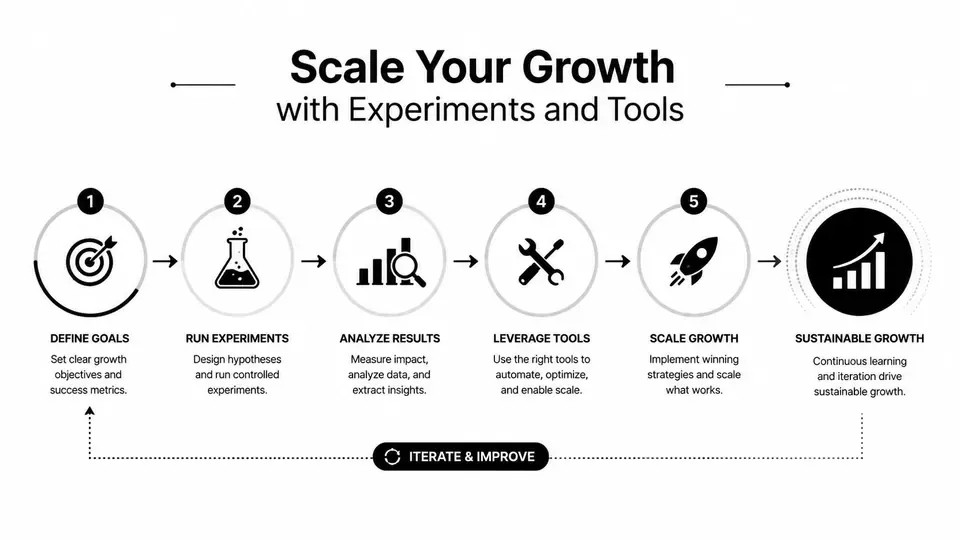
Scale Your Growth with Experiments and Tools
Once the basics are in place, follower growth becomes an operating system. The question stops being “How do I get bigger?” and becomes “Which actions reliably create qualified follows?”
That answer comes from measurement. A Tweet Archivist guide on tracking follower growth says tracking daily follower acquisition is essential for attributing growth to events like viral tweets or campaigns, notes that native analytics provide a 28-day summary, and reports that accounts that consistently analyze and refine their strategy see 15-25% monthly follower growth rates.
Track the right signals daily
Many users focus on impressions because they’re easy to notice. Impressions matter, but they’re incomplete. A post can travel widely and still bring low-value attention.
Track a small set of signals in a spreadsheet:
| Signal | Why it matters |
|---|---|
| New followers | Core outcome |
| Profile visits | Tells you whether curiosity exists |
| Top posts and replies | Shows what triggered attention |
| Notes on context | Launch, thread, Space, mention, trend participation |
Keep it manual if needed. The act of logging forces pattern recognition. You’ll notice that certain themes generate conversation but not follows, while others produce fewer likes but better audience fit.
Run experiments that are small enough to finish
Most creators fail at experimentation because they change too many variables at once.
Run one clean test at a time. Good examples include:
- threads versus single tweets for the same pillar
- educational takes versus contrarian takes
- direct replies versus question-led replies
- morning posting versus evening posting
Use a fixed review window and compare against your normal baseline, not someone else’s account.
A practical testing cycle:
- Pick one variable
- Run enough posts to see a pattern
- Review follower and profile-visit impact
- Keep, kill, or modify
The fastest-growing accounts aren’t always the most talented writers. They’re often the ones that learn faster from their own data.
Use tools to compress the workflow
Tools should reduce friction, not replace judgment.
Useful tool categories include:
- Native Twitter Analytics for the basic dashboard view
- Spreadsheets for daily notes and attribution
- Audiense Connect if you need more granular follower evolution
- Xholic AI if you want one workflow for momentum discovery, structure remixing, reply drafting, saved research, and consistency tracking without auto-posting
The trade-off is straightforward. Tools can speed up scanning, drafting, and pattern spotting. They can’t decide your position, your standards, or your taste. If your account is broad or your point of view is weak, more tooling just helps you produce vague content faster.
Conclusion: Your First 90 Days to Growth
The first month should center on positioning and engagement. Tighten your niche, rewrite your bio, build a pinned tweet, publish a welcome thread, and start replying in your lane every day.
The second month should center on consistency and pattern recognition. Lock in a small set of content pillars, publish on a predictable cadence, and review which topics and formats earn profile visits and follows.
The third month should center on experiments and community. Test a few format and reply variations, ask better audience questions, start stronger DM conversations with engaged followers, and host one focused live discussion if your topic supports it.
That’s the answer to how to build twitter followers. Not hacks. Not volume for its own sake. A system you can run long enough for trust and recognition to compound.
If you want a faster way to run that system, Xholic AI helps with the practical parts: spotting high-momentum conversations, drafting replies in your voice, remixing proven tweet structures, and staying consistent without auto-posting.