Follower growth on X rarely comes from posting harder. It comes from building a repeatable system that turns attention into profile visits, and profile visits into follows.
The strongest accounts I know are predictable in the best way. They study a narrow set of conversations, publish in formats their audience already responds to, and show up in replies where attention is already concentrated. That approach scales better than chasing inspiration, and it is far easier to sustain if you run a business, lead a team, or create alongside a full schedule.
Volume still matters, but only when it sits inside a process. More posts without audience fit produce noise. More posts with clear positioning, structured formats, and disciplined engagement produce compounding reach.
That is the gap this guide addresses.
Instead of another list of disconnected tips, this article lays out a practical growth system for founders and creators who want steady follower growth without burning out. It also shows how tools like Xholic AI can speed up each step, from finding the right conversations to drafting posts, organizing winning ideas, and keeping reply workflows consistent enough to matter.
Beyond Random Tactics A System for Real Twitter Growth
Founders and creators usually fail on Twitter for one of two reasons. They either post when they have time, or they engage when they feel motivated. Both approaches break as soon as work gets busy.
A better model is a five-part growth system. It is simple enough to run every week and disciplined enough to compound:
- Discovery. Find where your audience already gathers.
- Content. Publish posts people follow for, not posts that merely fill the feed.
- Engagement. Show up in active threads where attention already exists.
- Library. Save what works so you stop starting from zero.
- Measurement. Track signals that show whether growth is healthy.
Practical rule: Don’t ask, “What should I tweet today?” Ask, “What part of my system needs input today?”
This shift changes everything. Instead of chasing occasional spikes, you build repeatable momentum. Instead of trying to be everywhere, you focus on a narrow set of accounts, topics, and post formats that match your expertise.
The biggest trade-off is obvious. A system feels less exciting than chasing virality. But virality is hard to repeat. Systems are boring in the best way. They let you show up on days when you are tired, busy, or not particularly creative.
There is also a quality trade-off. If you optimize only for follower count, you can attract the wrong audience. If you optimize only for perfect nuance, you will publish too slowly to matter. Good growth sits in the middle. You publish useful ideas at a steady clip, then refine based on response.
Why random tactics stop working
Posting more can help, but posting more without a frame creates noise. Hashtags can help discovery in some cases, but they will not fix weak positioning. Engagement matters, but generic replies like “great point” do not convert.
What works is alignment. The topic, the angle, the format, the reply strategy, and the profile all need to point at the same audience.
If someone sees three of your posts and two of your replies in one week, they should know exactly why your account exists.
That is how to gain new followers on twitter without treating the platform like a full-time job.
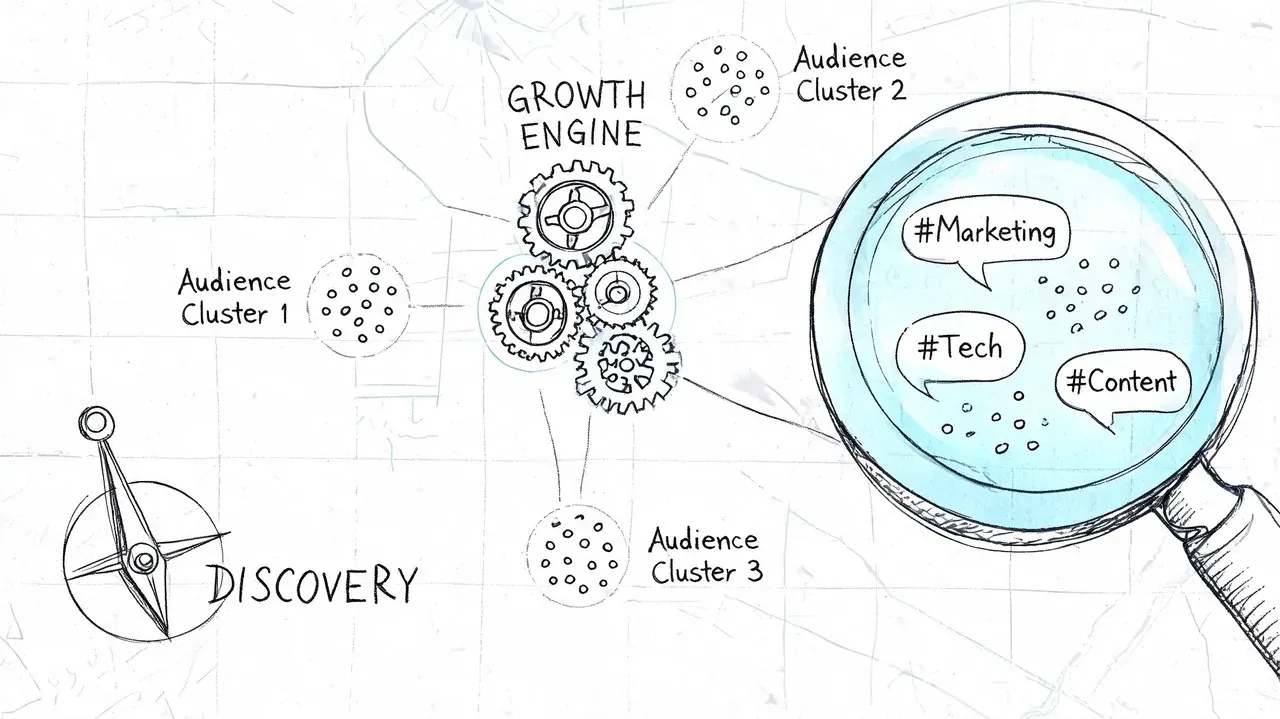
Find Your Growth Engine with Audience Discovery
Most creators write first and research second. That is backwards. The easiest way to miss is to create content in isolation, then hope the market cares.
Audience discovery is where your growth engine starts. You need to know which accounts shape opinion in your niche, what topics repeatedly trigger conversation, and what kind of language your audience already uses.
Map the accounts that already hold attention
Start by identifying three groups:
- Authority accounts. These are the obvious names in your space. Their posts shape the conversation.
- Bridge accounts. They are smaller, but they connect sub-communities. Their audience is often more responsive.
- Peer accounts. They speak to the same people you want to reach, often with a more relatable voice.
Your job is not to copy them. Your job is to understand where attention is already concentrated.
A practical way to do that is to build a private list of accounts in your niche and review it daily. Keep the list tight enough that you can monitor it. The point is signal, not feed overload.
Research on strategic engagement found that accounts that engage daily with larger niche accounts grow at about 3 to 5 times the rate of accounts posting sporadically. That same workflow recommends identifying 20 to 30 accounts with audiences 2 to 10 times larger than yours and aiming to be among the first 3 to 5 replies within 30 minutes when they post (strategic niche engagement research).
Track conversations before you write content
Once you know the accounts, study the recurring conversation types. You are looking for patterns such as:
- Repeated pain points. Questions people ask again and again
- High-friction debates. Topics that create disagreement without collapsing into noise
- Emerging narratives. Ideas that keep showing up from multiple respected accounts
- Practical requests. Posts where people ask for tools, workflows, examples, or decisions
This part matters because good content rarely starts as “an idea.” It usually starts as a reaction to something your audience already cares about.
A founder can do this by scanning startup operators. A trader can do it by tracking analysts and market commentators. A creator can do it by watching which educational posts keep getting bookmarked, quoted, and discussed.
Build a discovery routine you can sustain
The best discovery workflow is short and deliberate. Mine looks like this:
- Scan your list for active posts, not the full home feed
- Save threads and tweets with strong hooks, clean structure, or unusually good replies
- Note recurring phrases your audience uses to describe problems
- Flag source posts that attract smart discussion, because those are reply targets later
Discovery is not scrolling. Discovery is collecting evidence.
If you skip this step, you will spend too much time publishing content nobody asked for. If you do it well, your posts feel timely without chasing trends for their own sake.
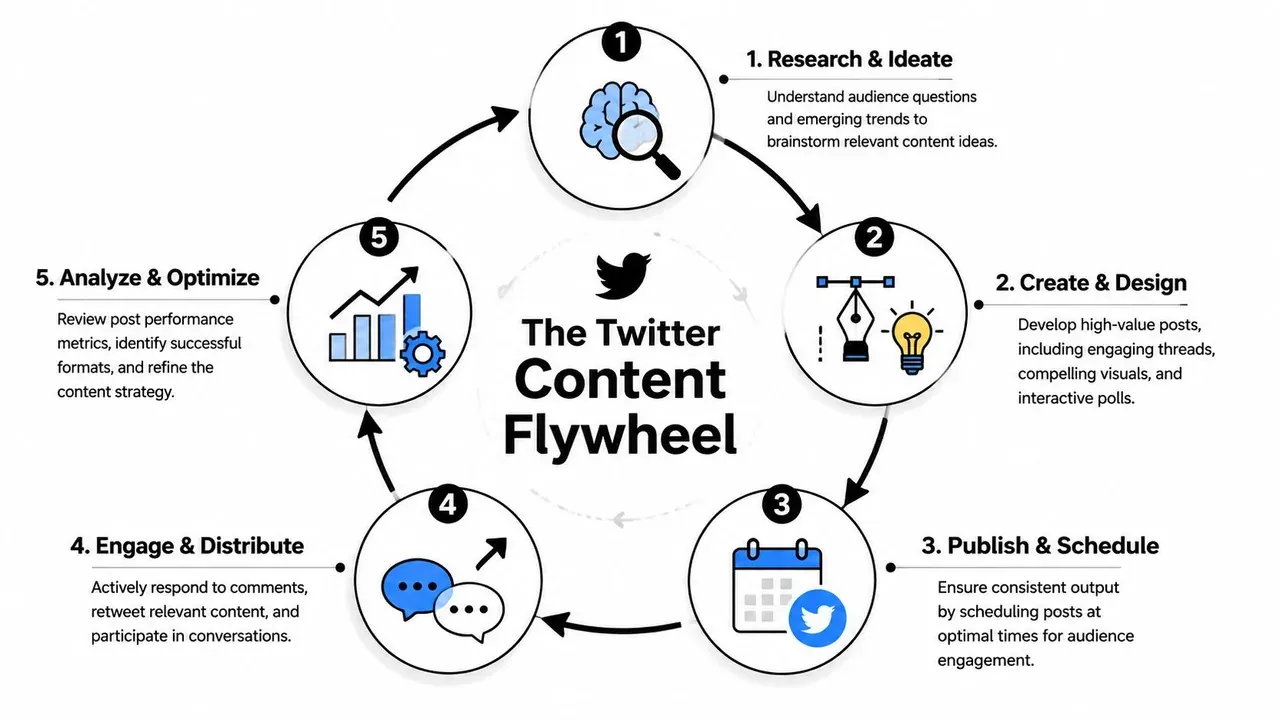
Design Your Content Flywheel for Consistent Output
Content is still the core lever. But not all content earns followers equally. Some posts get likes. Some get clicks. Some get replies. The posts that grow accounts usually make a clear promise to the reader: “Follow me and you will keep learning this.”
Build around formats people follow for
If you want sustainable growth, center your output on educational content. A cited analysis states that informational and educational content attracts followers at rates 30 times higher than self-promotional or personal commentary tweets, with strong formats including step-by-step instructions and tactical breakdowns with quantifiable results (educational content performance analysis).
That lines up with what experienced operators already know. People may like hot takes, but they follow accounts that repeatedly make them better at something.
The most reliable formats are:
- Step-by-step posts that solve one defined problem
- Tactical breakdowns that explain why something worked
- Contrarian clarifications that challenge lazy consensus
- Short threads that organize a messy topic into a usable sequence
A self-promotional post can still work, but it usually performs best after you have already built trust. If every tweet is about your product, your launch, your newsletter, or your achievement, people may notice you, but they will not have a reason to stay.
Use structure reuse instead of idea theft
Many people get stuck because they think every post needs an original structure. It does not. Original thought matters. Original scaffolding matters less.
What you want is a content blueprint. That means reusing a proven structure while changing the substance completely.
For example:
- “3 mistakes founders make when hiring”
- “3 mistakes analysts make when reading market sentiment”
- “3 mistakes creators make when trying to grow on X”
Same frame. Different insight. Different audience relevance.
That is a much better use of your time than waiting for inspiration. If you want examples of structures that keep working, this collection of tweet examples that actually work is a useful reference point.
Strong creators don’t protect themselves from templates. They protect their voice inside the template.
Turn one insight into multiple posts
A single idea should produce more than one asset. If you learn something useful from a client project, campaign, launch, or failed experiment, turn it into a mini flywheel.
One insight can become:
- A punchy single tweet with the core lesson
- A short thread with the steps
- A reply under a larger account’s relevant post
- A quote tweet with a sharper opinion
- A saved note for future remixing
This is how you keep output high without lowering quality. You are not repeating yourself. You are adapting the same raw material to different contexts.
Keep the bar simple
Most content systems fail because they are too heavy. If your process requires long research blocks, perfect formatting, and fresh concepts every day, you will not keep it up.
Use a basic weekly rhythm:
| Content type | Purpose | When to use it |
|---|---|---|
| Educational singles | Build trust fast | Most days |
| Threads | Show depth | When a topic needs sequence |
| Opinion posts | Sharpen positioning | After trust is established |
| Reply-based posts | Extend live conversations | When a topic is already active |
The blank page is the enemy. A flywheel fixes that.
Master the Art of High-Value Engagement
Replies are the fastest growth channel on Twitter for those who are not already famous. That is not because replies are magical. It is because they put your thinking in front of a warm audience that already cares about the topic.
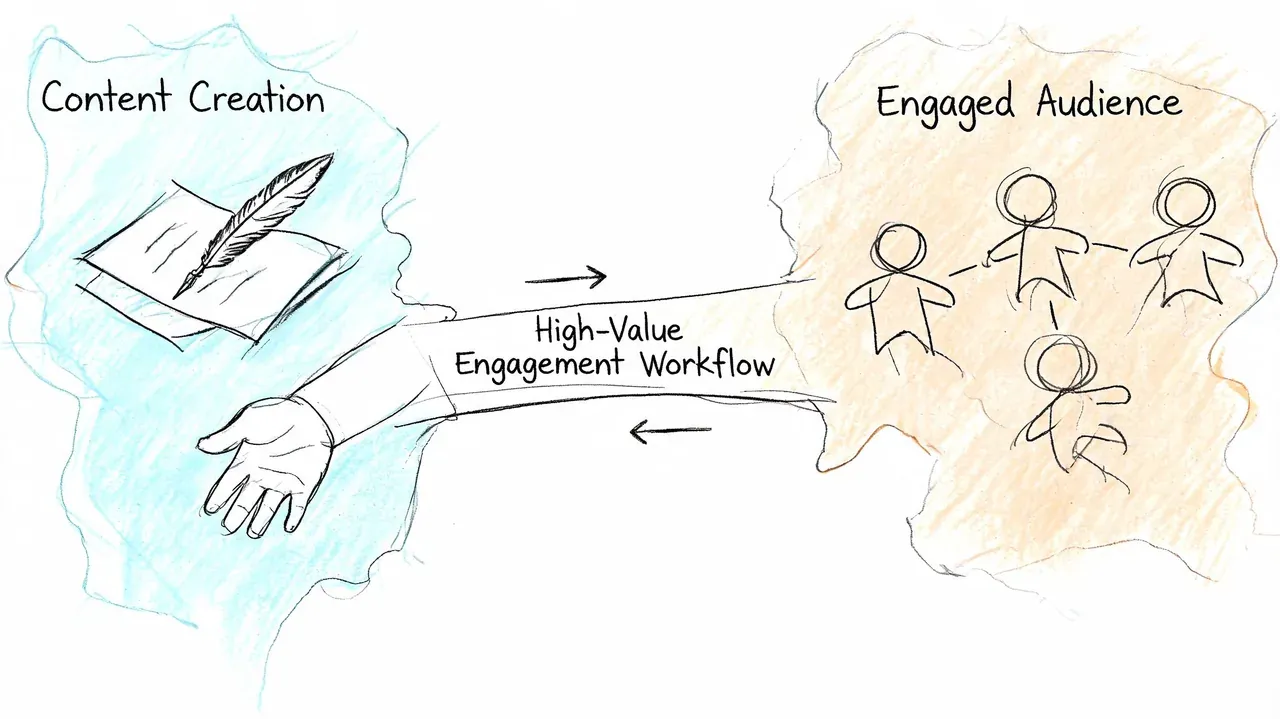
If you are asking how to gain new followers on twitter, the gap typically involves people either posting into the void or replying with filler. Neither builds authority.
Why replies beat isolated posting
A good original post depends on distribution. A good reply borrows distribution that already exists.
When a larger account publishes a tweet that takes off, the replies become a second feed. Smart people read them. They look for additions, disagreement, examples, and clarity. If your reply improves the conversation, people click your profile.
That is the key distinction. You are not trying to be visible anywhere. You are trying to be visible in the right room.
The fastest replies usually do one of three things:
- They add a missing practical layer
- They disagree cleanly and explain why
- They summarize the implication for a specific audience
Generic praise does not convert. Neither does trying too hard to sound clever.
What high-converting replies look like
Here are the reply types I see convert best:
Insightful question
This works when the original post is broad. Ask the question that moves the discussion from opinion to application.
Respectful challenge
A contrarian reply can do well if it is calm, precise, and useful. You are not trying to win. You are trying to show judgment.
Specific example
If someone posts a principle, add the operating example. Concrete examples signal real experience.
Compact framework
When a thread gets messy, a short framework stands out because it organizes the topic.
If you want a practical look at speeding up this part without sounding robotic, this guide on using an AI tweet reply tool for faster replies is relevant.
The best reply is not the smartest thing you could say. It is the clearest useful thing the audience did not already get from the original post.
A short visual walkthrough helps here:
A daily engagement workflow that stays manageable
You do not need to reply all day. You need a compact routine with standards.
Try this workflow:
- Pick a small set of target accounts you know well.
- Check for fresh posts with active early engagement.
- Reply only when you can add value. Skip low-fit topics.
- Stay close to your niche so profile visitors understand why to follow you.
- Revisit strong threads later if your first reply gets traction and there is room to deepen the conversation.
This is also where burnout can creep in. If you force yourself to respond to everything, quality drops. If you only wait for perfect opportunities, you do not show up enough. The sweet spot is selective consistency.
Another trade-off is tone. Sarcasm and sharp one-liners can attract attention fast, but they also shape your audience. If you want thoughtful founders, operators, or analysts following you, write replies that make that audience trust your judgment.
Build a Reusable Library of Content and Replies
Growth gets easier once your best ideas stop disappearing into the timeline.
Creators who stay consistent usually have a private operating system. They save hooks that earned clicks, structures that made people read to the end, and replies that started the right kind of conversations. That archive removes decision fatigue. It also protects quality on days when you have limited time or low creative energy.
A strong library gives you two advantages. It speeds up production, and it raises your average post quality because you are building from proven parts instead of guessing from a blank page.
Create assets once, then refine them through use
As noted earlier, follower growth usually takes more output than people expect. That is exactly why starting from zero every day is a bad system.
Store the pieces that already worked:
- Hooks that earned strong opens and profile visits
- Tweet structures that helped you explain ideas clearly
- Evergreen observations you can revisit from new angles
- Reply templates that fit recurring conversations in your niche
This is not about posting the same thing on repeat. It is about keeping your best thinking in circulation.
I treat every good tweet as raw material for three more posts. A strong thread opener can become a single tweet. A good reply can become a standalone post. One clean framework can support months of variations if the audience keeps responding to the underlying problem.
Four reply archetypes worth saving
Replies are easier to systemize than people think. The format changes less than the topic.
| Archetype | Purpose | Example Structure |
|---|---|---|
| The Data Point | Add specificity | ”One practical signal here is [observation]. That changes the decision because [reason].” |
| The Framework | Simplify a messy topic | ”I would break this into three parts: [part one], [part two], [part three].” |
| The Personal Lesson | Add earned credibility | ”I ran into this with [situation]. The fix was [change], and the result was [lesson].” |
| The Clarifier | Remove confusion | ”People often mix up [thing A] and [thing B]. They look similar, but they lead to different choices.” |
Save the replies that get bookmarks, profile clicks, follows, or thoughtful responses. Those are not throwaway comments. They are tested proof of voice.
Organize the library so retrieval is instant
A cluttered swipe file creates friction. Keep the system simple enough that you will still use it three months from now.
Tag saved assets by:
- Topic: SaaS, creator growth, hiring, product, crypto research
- Format: single tweet, thread opener, reply, hook, contrarian take
- Use case: awareness, authority, engagement, conversion
That structure matters because speed matters. If a founder you follow posts about hiring, you should be able to pull up your best hiring-related reply patterns in seconds. If you have fifteen spare minutes and need a post, your best hooks should already be filtered and ready.
Tools help here. A good workflow uses a simple database or notes app for storage, then adds analytics so you know what deserves to be saved in the first place. This roundup of Twitter analysis tools for better engagement and stronger posts is a useful reference if you want to tighten that feedback loop.
Use Xholic AI to turn scattered wins into a repeatable system
Here, AI becomes useful in a practical way. Not as a replacement for judgment, but as a speed layer on top of it.
Use Xholic AI to capture strong posts, rewrite them into new formats, draft reply variations for different tones, and resurface old ideas when your queue runs dry. That reduces the mental cost of showing up. It also helps you keep a consistent voice across posts and replies, which matters more than people realize once your account starts compounding.
The primary trade-off is originality versus efficiency. If you save everything and reuse it carelessly, your account gets predictable. If you refuse to reuse anything, you waste energy rebuilding ideas the audience would have happily heard again in a sharper form. The middle ground works best. Keep the insight. Refresh the framing.
Review your library every week. Cut weak material. Promote proven material into templates. Rewrite half-finished ideas that still have a strong core. Over time, you stop chasing content and start running a system.
Measure What Matters and Maintain Momentum
Follower count matters, but by itself it tells you almost nothing about quality. A healthy account attracts new people and keeps them active enough to signal relevance back to the platform.
That is why measurement should sit at the end of your weekly loop. Not to obsess over numbers, but to make better choices.
Use follower growth rate correctly
The cleanest benchmark here is monthly follower growth rate. It is calculated as (New Followers in Month / Followers at Start of Month), and an example cited by Social Status shows 2.56% monthly growth when an account moves from 5,293 followers to 5,428 in a month (Twitter growth rate benchmark and formula).
The formula matters because it forces context. Gaining followers sounds good until you compare it to starting size. Growth rate lets you compare one month to another without fooling yourself.
A simple weekly review should include:
- Posts that drove profile visits
- Replies that earned meaningful engagement
- Topics that produced follows, not just likes
- Formats worth repeating next week
If you want a practical overview of platforms that help analyze this work, this roundup of Twitter analysis tools for better engagement and stronger posts is a useful starting point.
Watch for vanity growth
Fast growth is not always good growth. The weak version of growth looks impressive on paper but does not deepen conversation. You gain followers, but fewer people reply, retweet, or engage with substance.
That usually happens when content is too broad, too sensational, or too detached from your actual expertise. You attract attention from people who were curious for a moment, not people who want your ongoing perspective.
The correction is simple, but not always comfortable. Narrow the promise of the account. Repeat the themes you want to own. Keep asking which posts brought in the right people.
An engaged audience is harder to build than a large audience, but it is far more useful.
Momentum also depends on habits. A good system protects your floor. Even if this week does not produce a breakout post, your process should still generate discovery, replies, saved ideas, and a few solid tweets. That is enough to keep compounding.
Your Path to 10000 Followers and Beyond
Twitter growth gets easier when you stop treating it like a stream of isolated actions. This shift happens when discovery, content, engagement, reuse, and measurement start reinforcing each other.
That is the system. You find live conversations. You publish educational content that earns follows. You place strong replies inside existing attention flows. You save what works. You measure what produced progress. Then you repeat.
This is what separates accounts that stall from accounts that steadily build authority. Not hustle for its own sake. Not tricks. Not a temporary spike from one lucky thread.
If you want to know how to gain new followers on twitter, start with the smallest repeatable version of the system. Build one list of target accounts. Publish a few educational posts each week. Write better replies than the average person in your niche. Save every hook and reply worth reusing. Review results weekly.
Do that long enough and follower growth stops feeling mysterious. It becomes operational.
If you want help running that system faster, Xholic AI is built for exactly this workflow. It helps you find high-momentum conversations, draft stronger replies, and keep your content pipeline moving without the usual burnout. For founders, creators, analysts, and solo builders, it is a practical way to stay consistent while keeping your voice intact.