You’re probably doing what most founders and creators do on X. You post when you have time, reply when you remember, check follower count too often, and wonder why good tweets don’t reliably turn into growth.
That’s the trap.
If you’re asking how can you get twitter followers, the answer isn’t one trick. It’s a system that turns profile visits into follows, content into discovery, replies into relationships, and analytics into better decisions. Busy operators don’t need more random tactics. They need a workflow they can repeat without spending half the day on the app.
Optimize Your Profile for Follows Not Just Views
Many users don’t lose followers because their tweets are bad. They lose them because the profile doesn’t close the deal.
Your profile is the conversion layer between attention and commitment. If someone likes a reply or a post and clicks through, you have a few seconds to make the follow decision easy.
Treat the profile like a landing page
Five profile elements matter more than everything else around them.
| Element | Weak version | Strong version |
|---|---|---|
| Profile photo | Logo, cropped screenshot, distant face | Clear face shot or recognizable personal brand image |
| Banner | Decorative image | One visual promise about what you talk about |
| Bio | Broad identity statement | Specific value statement for a specific audience |
| Link | Random homepage | One next step that matches your content promise |
| Pinned tweet | Old launch post | Best proof of value, clarity, or authority |
A good profile photo answers one question fast. “Is there a real person here?” For personal brands, a face usually converts better than abstraction because people follow people, not vague positioning.
Your banner shouldn’t be art for art’s sake. It should reinforce what the account is about. If you post for founders, analysts, or creators, the banner should make that obvious.
Practical rule: If a new visitor can’t tell who you help and what you post about in a few seconds, the profile is leaking follows.
Write for the right follower not every follower
The bio is where most profiles get lazy. “Building cool stuff” sounds harmless, but it tells the right follower nothing and attracts the wrong one just as easily.
A stronger bio does three things:
- Names the audience: founders, indie hackers, analysts, creators
- States the outcome: clearer writing, better distribution, stronger audience growth
- Signals the lens: operator, builder, researcher, designer, trader
That last part matters. It filters your network. You don’t want everyone. You want people who will engage with the kind of work you already plan to publish.
If you need inspiration, study these Twitter bio examples for 2026 and notice how the strongest ones qualify the reader instead of trying to sound clever.
A pinned tweet should finish what the bio started. Don’t pin a weak announcement. Pin one of these:
- A flagship thread: useful if your account teaches
- A personal story with a lesson: useful if your account builds trust
- A concise proof post: useful if your account is niche and technical
One more trade-off. A profile built for mass appeal often gets more empty follows. A profile built with sharper positioning gets fewer casual follows and more relevant ones. For most operators, that’s the better deal.
Build a Content Engine That Attracts Your Audience
You sit down to post, lose 20 minutes deciding what to say, then publish nothing. That pattern kills more growth than weak writing.
A content engine fixes the core problem. It gives you a small set of repeatable post types, a clear publishing rhythm, and a way to keep shipping even when the rest of the business gets noisy.

Use three repeatable content types
A practical growth account usually runs on three formats because each one solves a different job.
First, educational threads. They organize what you know into something useful and save your best thinking in a format new followers can share. PowerIn’s follower growth analysis notes strong engagement around educational threads, points to personal stories as another high-engagement format, and argues that steady daily posting plus reply activity outperforms sporadic posting over time.
Second, personal stories. These posts build trust faster than polished advice because they show judgment under pressure. Founders and creators follow people who reveal process, mistakes, and what changed after the lesson.
Third, insightful questions. Questions are less about instant reach and more about research. They surface objections, language, and recurring pain points you can turn into stronger posts later.
That mix works because the feed stays balanced:
- Threads teach
- Stories build trust
- Questions collect market intel
Cadence beats inspiration
Consistency matters more than occasional bursts of brilliance. A week of silence usually breaks momentum, especially on smaller accounts where repetition is how people remember what you stand for.
The fix is simple. Reduce the number of decisions.
A working content engine can look like this:
- One core post each day: thread, lesson, opinion, or story
- One lighter post: question, observation, or reframed insight
- A running idea bank: screenshots, notes, customer questions, failed experiments
- A weekly review: keep the formats that drive profile visits and follows, not just likes
That last point matters. Vanity engagement can mislead you. A post that gets fewer likes but sends the right people to your profile is often more valuable than a broad post that attracts curiosity and nothing else.
I usually treat content as a production system, not a creativity test. The goal is to remove blank-page friction so publishing stays easy enough to maintain for months.
Longer posts with clear hooks and clean formatting are easier to scan. Visuals can help hold attention, but they are optional. Strong structure matters more than decoration.
If idea generation is the bottleneck, use a prompt bank or an ideation tool to keep the pipeline full and your voice consistent. A good starting point is these tweet examples that work in 2026. Study the structure, then adapt it to your niche instead of copying the surface style.
That is the system mindset. You are not trying to come up with a genius post every day. You are building a repeatable machine that attracts the right followers week after week.
Master the Reply Strategy That Turns Conversations into Followers
If your account is small, your own feed isn’t your only stage. The fastest visibility usually comes from participating in someone else’s audience.
That’s why the reply strategy works. But most advice about it is incomplete.
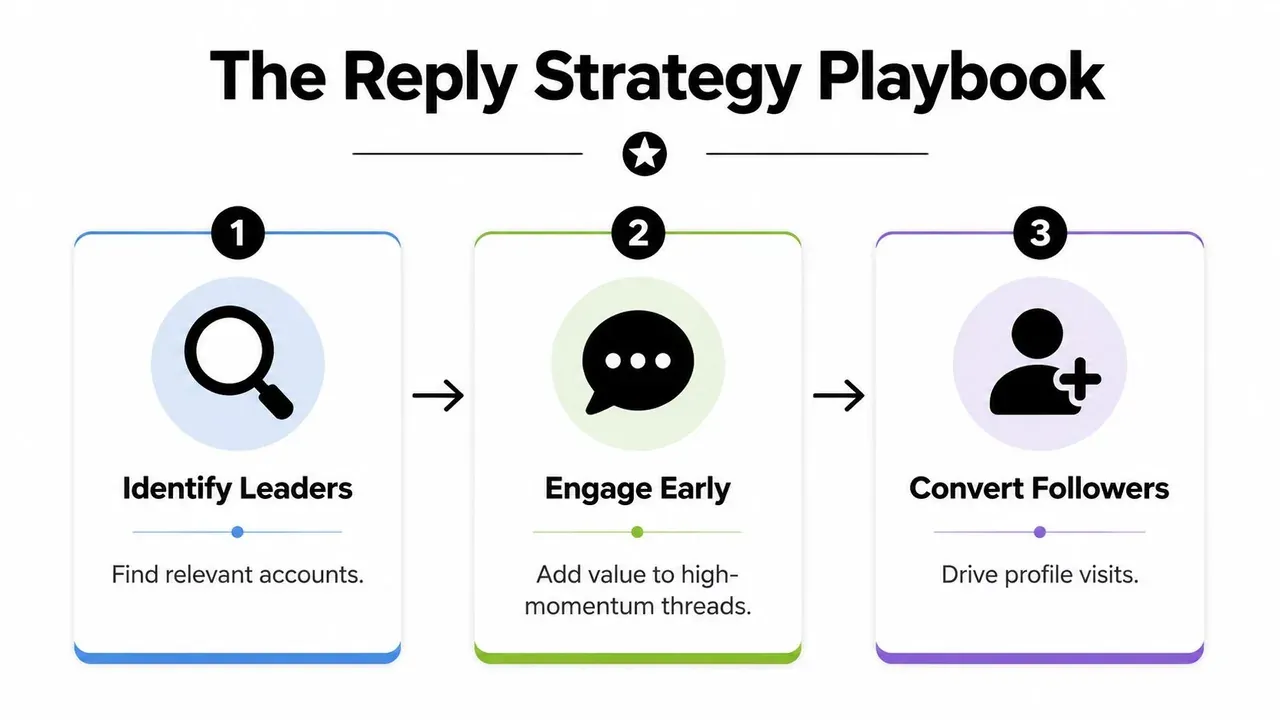
Borrow attention the right way
The practical version is simple. Pick a small set of leaders in your niche and become a recognizable high-signal participant in their threads.
A strong reply does one of four things:
- Adds a tactical detail the original post skipped
- Introduces a respectful counterpoint
- Shares a short relevant story
- Clarifies the idea for readers who don’t have the same context
Generic praise is almost useless. “Great post” doesn’t make anyone click your profile. A useful addition might.
There’s also hard evidence that interaction sequencing matters. MIT research, summarized by Search Engine Journal, found that the follow plus retweet combination reached a 30% conversion rate for acquiring new Twitter followers. That research also found users with high friend-to-follower ratios were more likely to follow back.
For operators, the lesson isn’t “follow everyone.” It’s to be selective. Retweet someone’s good post. Follow accounts in your niche that are socially active and still growing. Then keep showing up where they already engage.
Why most reply strategies break
The common advice says to do high reply volume every day. The hidden problem is quality collapse.
The bottleneck isn’t understanding that replies matter. It’s maintaining authentic, individualized replies at scale. As described in Tweetfull’s guide about follower growth in 2026, creators are often told to publish 10 to 15 daily replies, but that guidance rarely addresses the burnout and cognitive load involved.
That’s where most founders fail. They can do it for a few days. They can’t sustain it while also building product, selling, hiring, or writing.
A better operating model looks like this:
- Choose fewer targets: focus on relevant leaders and peers, not every big account
- Reply early when you can: not because “first” is magic, but because visibility is higher when the thread is still moving
- Keep a swipe file: save your strongest past reply structures so you’re not starting from zero each time
- Batch context gathering: read several posts in one sitting, then write with context while the topic is fresh
For people who need help scaling without sounding robotic, AI reply tools for fast tweet responses can reduce drafting time. The useful standard isn’t “fully automated.” It’s “faster first draft, then human judgment.”
If your replies feel interchangeable, they won’t earn follows. If they sound like you and add context, they will.
Discover and Remix Momentum to Accelerate Growth
The most effective growth move on X is joining conversations that are already gaining traction.
Starting from zero on every post is slow. You’re asking the platform, and the audience, to care before there’s any signal. A better approach is to find topics, formats, and arguments that already have movement, then contribute something specific.

Stop waiting for your own post to carry everything
Many smart people stay stuck here. They think originality means beginning with a blank page every time.
In practice, growth comes faster when you act like a curator and remixer. Watch what your niche is discussing. Notice which post structures keep resurfacing. Pull the underlying angle out of the winning tweet, then rebuild it with your own experience.
That matters even more if you’re already feeling the strain of high-volume engagement. The reply workload can become a real bottleneck for solo builders, especially when every response has to be crafted from scratch. A system for spotting active discussions and responding with context reduces that load.
A simple momentum workflow:
- Scan for active themes: launches, takes, mistakes, debates, market reactions
- Save posts with structure worth reusing: list posts, contrarian posts, teardown posts, before-and-after posts
- Reframe instead of copy: keep the architecture, replace the substance
- Publish while the topic is still warm: speed matters more than polish in many live conversations
Remix formats not identities
There’s a right and wrong way to remix.
Wrong way: copy a viral tweet with minor edits and hope nobody notices.
Right way: borrow the frame. Keep your own examples, opinions, and evidence. If a certain structure makes a complex point easier to read, that structure is fair game. Your job is to bring your own substance.
This is also where discovery tools can help. Xholic AI is one example. It indexes high-momentum posts, helps users search for relevant conversation patterns, and supports remixing structures into a different voice. Used correctly, that kind of tool shortens research and drafting time. It doesn’t replace judgment.
If you want to see the broader idea in action, this walkthrough is useful:
The key shift is mental. Don’t ask only, “What should I say today?” Also ask, “What is already moving that I can improve, challenge, or clarify?”
Build a Sustainable Growth System and Avoid Spam Traps
A lot of accounts look active for two weeks, then disappear. The problem usually is not effort. The problem is they built a sprint, not a system.
Follower growth on X holds when the work is light enough to repeat and structured enough to review. The operating loop is simple: publish, engage, review, adjust. What matters is sticking to it without drifting into behavior that makes the account look manufactured.
Track signals that help you make better decisions
Follower count matters, but it is a delayed result. It does not tell you which post format worked, which replies pulled people into your profile, or whether attention is turning into actual audience growth.
Use a small set of operating metrics instead:
- Views-to-followers ratio shows whether posts are reaching beyond your current audience
- Engagements per post helps you spot which ideas are worth expanding
- Profile visits show whether your posts and replies create enough curiosity to earn a closer look
- Follows after spikes in activity help you identify what converted attention into audience
- Link clicks measure traffic intent, which is different from follow intent
Native X analytics are useful, but they leave gaps. X does not give you a clean historical record of follower changes over time. Followerwonk’s follower tracking overview explains why outside tools archive follower movement separately.
That gap matters in practice. If a post performs well on Tuesday and your follower count rises over the next two days, you want a record you can review later. Otherwise, your analysis turns into guesswork.
This is why a system beats hustle. A system stores the evidence.
For busy founders and creators, that usually means keeping a simple weekly log or using a tool that captures post performance, profile activity, and follower movement in one place. Xholic AI can fit that workflow if you use it as an operations layer, not a shortcut. The value is consistency. It reduces manual tracking and makes pattern recognition faster.
Build a repeatable cadence that does not trigger spam signals
Sustainable growth usually looks boring on the calendar. That is a good sign.
| Cadence | What to do |
|---|---|
| Daily | Publish one strong post, add one lighter post if you have something useful to say, and spend a focused block of time on thoughtful replies |
| Weekly | Review top posts, note which topics drove profile visits or follows, and update your content bank |
| Periodically | Refresh your pinned post, tighten your bio, and review whether the accounts you engage with still match your target audience |
The trade-off is straightforward. Aggressive activity can increase reach, but low-context activity lowers trust. If every reply looks templated, every follow looks random, or every post sounds like it was produced by the same machine, people notice quickly.
Use these guardrails:
- Reply with context: add an example, disagreement, clarification, or useful question
- Follow selectively: relevance beats volume
- Mix your actions: post, reply, repost, and start original conversations in a natural pattern
- Use automation carefully: scheduling is fine, blind engagement is not
- Keep records: save standout posts and follower changes so reviews are based on evidence
A lot of spam problems come from trying to compress months of trust-building into a few days of activity. That usually backfires. Reach may spike, but conversion to quality followers drops, and the account starts to feel noisy.
Steady systems win here. The goal is not to look busy. The goal is to make follower growth repeatable, measurable, and safe to maintain next month too.
Frequently Asked Questions About Getting Twitter Followers
A founder posts for two weeks, sees a few likes, gains five followers, and starts wondering whether organic growth on Twitter is just luck. It usually isn’t. In practice, follower growth comes from a repeatable system: strong positioning, consistent posting, smart replies, and enough operational support to keep doing all three without burning out.
Should you buy followers
No.
Bought followers don’t create conversations, useful replies, or credible demand signals. They also corrupt your read on what is working. If the follower count rises while engagement stays weak, the account looks less trustworthy to real people and harder to diagnose for you.
If the goal is authority, audience quality matters more than headline size.
How fast can a new account grow
It varies, but the pattern is predictable.
The answer depends on consistency, post quality, niche clarity, and whether the account is participating in live conversations instead of only broadcasting. New accounts often feel slow at first because they have not built enough surface area yet. Once posting and replying happen on a steady cadence, growth usually becomes easier to measure and improve.
Judge progress over months, not a weekend sprint.
How often should you post
Post often enough to stay familiar to your target audience and rare enough to keep standards high.
For busy founders and creators, one strong post a day plus focused replies is a solid baseline. Some accounts can handle more. Many would grow faster by publishing one less weak post and writing ten better replies.
Volume helps only when quality survives.
Is follow for follow worth it
Usually no.
It can raise the number on the profile, but it often weakens audience fit. That creates a downstream problem: lower engagement quality, noisier feedback, and less confidence about which topics are attracting the right people. A smaller relevant audience is far more useful than a larger indifferent one.
What metric should you watch most closely
Follower count alone is too blunt to guide decisions.
Engagement rate is still useful, especially if you calculate it consistently across original posts and exclude replies and reposts, as noted earlier. But the more practical view is a small set of metrics working together: profile visits, follows per profile visit, and engagement from the right accounts. Those numbers show whether content is attracting attention that converts, not just attention that scrolls past.
A post can get plenty of likes and still bring in few followers.
Do you need tools to grow
You can start manually. Staying consistent usually requires a system.
The hard part is not posting once. The hard part is keeping idea capture, drafting, publishing, replies, and review running while the rest of your business is competing for attention. Some people do that with notes apps, spreadsheets, and saved searches. Others use software. The trade-off is simple: manual workflows cost less in cash and more in time, while tools reduce friction but only help if they support a thoughtful process.
That is where products like Xholic AI fit. Not as a shortcut or a spam layer, but as operational support for the parts that tend to break first: finding conversations worth joining, drafting faster, and maintaining a consistent workflow without handing the account over to blind automation.