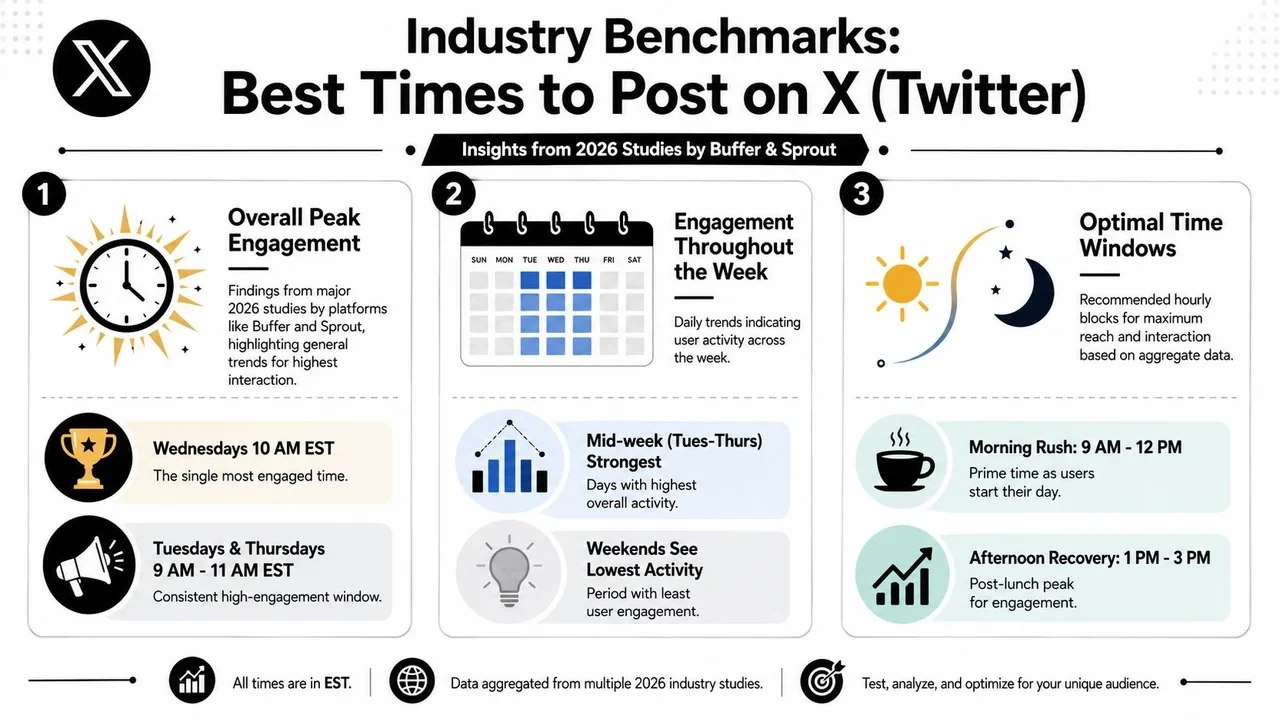
The best time to post on X (Twitter) is usually midweek, from late morning into early afternoon. The clearest benchmark data points to Tuesday at 9 a.m. as the strongest single slot, while Tuesday through Thursday consistently outperform weekends.
That’s the part most articles get right. The part they miss is that generic timing advice is only useful until you have enough data to stop using it.
A founder posting product lessons, a creator posting hot takes, and a media account posting breaking commentary do not win in the same windows. Even when benchmark studies agree on midweek strength, they still disagree on exact hours. That’s the clue. You’re not looking for one magic posting time. You’re building a system that starts with market-wide patterns, then adjusts to your audience, your content type, and your account’s own response curve.
If you want the short version, start with midweek morning to midday slots. Then test, compare, and keep the windows that produce replies, profile visits, and quality engagement for your account.
Your Quick Answer and Why It Is Not Enough
If you need a starting point for the best time to post on Twitter, use Tuesday through Thursday, with priority on morning to midday local time. That gives you the highest-probability zone without pretending one universal hour works for everyone.
What’s not enough is stopping there. Generic charts are averages across massive datasets. Your account is not an average. If your audience is concentrated in one geography, reacts more to replies than standalone tweets, or prefers educational threads over quick opinions, your best slot can drift away from the benchmark.
Practical rule: Treat industry timing data as a default schedule, not a final schedule.
A lot of X users make the same mistake. They copy a popular “post at this exact time” chart, schedule a week of content, then conclude timing doesn’t matter when results stay flat. Usually the problem isn’t timing alone. It’s that they never matched time to audience behavior and content format.
The better approach is simple:
- Start with benchmark windows so you’re not guessing from zero.
- Watch your own analytics for patterns in impressions, engagement, replies, and profile visits.
- Keep only the slots that repeat with solid performance.
- Re-test regularly because audience behavior shifts.
That’s how timing becomes an operating system instead of a superstition.
General Posting Benchmarks from Industry Data
Large studies are still useful. They give you a strong default when you don’t yet have enough account-level data to trust your own pattern.
What the benchmark studies agree on
Buffer’s 2026 analysis of 8.7 million tweets found that Tuesday at 9 a.m. was the best single posting window on X, with Wednesday at 10 a.m. and Wednesday at 9 a.m. close behind. The same study found Wednesday, Tuesday, and Thursday were the highest-performing days overall, while Saturday and Friday had the lowest engagement, and 6 p.m. to 11 p.m. was the weakest period (Buffer’s X timing analysis).
That gives you one clear pattern. Midweek wins. Evenings usually don’t.
But benchmark data is not unanimous. Different datasets use different methods and weight different outcomes. Some focus more on engagement rate. Others reflect broader interaction patterns across industries and geographies. That’s why the exact “best time” moves around depending on the study.
The useful takeaway isn’t one perfect hour. It’s the repeated midweek cluster.
If you want a practical baseline, use benchmark windows to create your first recurring schedule, then track whether your audience behaves similarly. If you need help interpreting the metrics after you post, this guide on how to calculate Twitter engagement rate is a useful companion.
Benchmark table you can actually use
| Study/Source | Best Days | Best Time Window | Worst Day(s) |
|---|---|---|---|
| Buffer 2026 | Wednesday, Tuesday, Thursday | Tuesday at 9 a.m.; Wednesday at 10 a.m. and 9 a.m.; weak period is 6 p.m. to 11 p.m. | Saturday and Friday |
| Sprout Social 2026 | Tuesday through Thursday | 12 p.m. to 6 p.m. on Tuesdays, Wednesdays, and Thursdays | Saturday and Sunday |
| Apaya summary of large studies | Tuesday through Thursday | Roughly 8 to 11 a.m. through 11 a.m. to 5 p.m. local time | Qualitatively weaker outside the consensus band |
The main tension is obvious. Buffer leans earlier. Sprout leans more toward the middle of the day. Apaya’s synthesis points to a wider morning to midday probability band instead of a single exact slot.
That’s why “post at 9 a.m.” is too rigid for most accounts. A better default is this:
- First choice: midweek, late morning
- Second choice: midweek, early afternoon
- Avoid by default: weaker days and late evening windows unless your own audience says otherwise
Key Factors That Influence Your Personal Best Times
Generic timing breaks down fast once you look at the account behind the post. The best posting schedule for a solo founder isn’t the same as the best schedule for a meme page, analyst account, or creator who lives in replies.
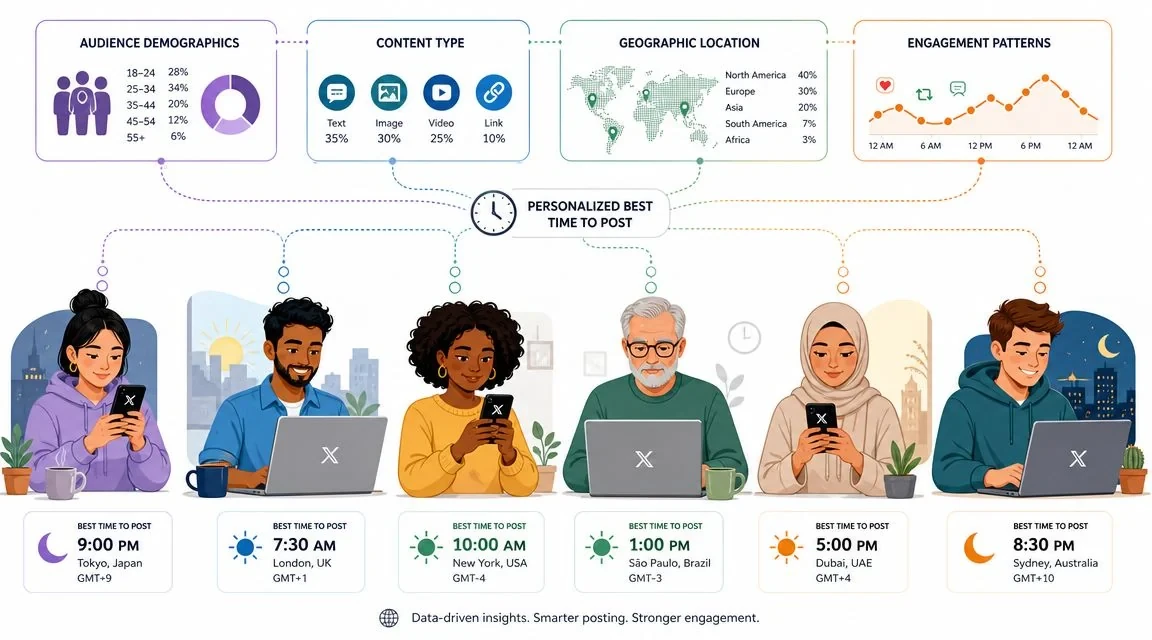
Audience location changes everything
Sprout Social’s 2026 data reached a different conclusion from Buffer. It found the strongest engagement on X came from 12 p.m. to 6 p.m. on Tuesdays, Wednesdays, and Thursdays, with the best overall days being Tuesday through Thursday and the worst being Saturday and Sunday (Sprout Social’s X timing data).
That difference matters because it shows how platform-wide timing is a pattern, not a law. If your audience is spread across North America and Europe, midday can catch overlap better than early morning. If most of your followers are local and check X before work, earlier windows might still win.
A simple example:
- B2B founder audience often responds when people are settling into work, taking a break, or catching up on industry chatter.
- Consumer entertainment audience may engage later because the content is lighter and less tied to workday rhythm.
- Global audience usually needs overlap windows, not one local peak.
Content type has its own timing logic
Not every tweet deserves the same slot.
A strong thread that teaches something usually needs enough attention span to earn early dwell time, replies, and reposts. A short reaction tweet can work in faster-moving windows. A product announcement often performs better when you’re available to answer replies quickly after posting.
Use this mental model:
- Threads and educational posts fit windows where readers have more attention.
- Opinion tweets and quick hooks can survive busier feed conditions.
- Reply-first growth depends less on your posting slot and more on when high-momentum conversations start.
A post time is only “best” if it matches the behavior required for that post to spread.
Account stage and audience habit matter more than people think
Smaller accounts often need timing that increases the chance of immediate interaction. Larger accounts with loyal followers can post in more varied windows because distribution is less dependent on a small opening burst.
The same goes for habit. Some audiences are trained to expect your posts at certain times. If you’ve posted consistently in one window and built regular readership there, changing your schedule too aggressively can muddy the signal.
Look at three things before changing your calendar:
- Where your followers are
- What kind of tweets you’re posting
- What action you want after the post
If you want replies, your best hour may not match the hour that gets the most passive impressions. If you want clicks, the winner may be different again.
A Repeatable Workflow to Find Your Optimal Schedule
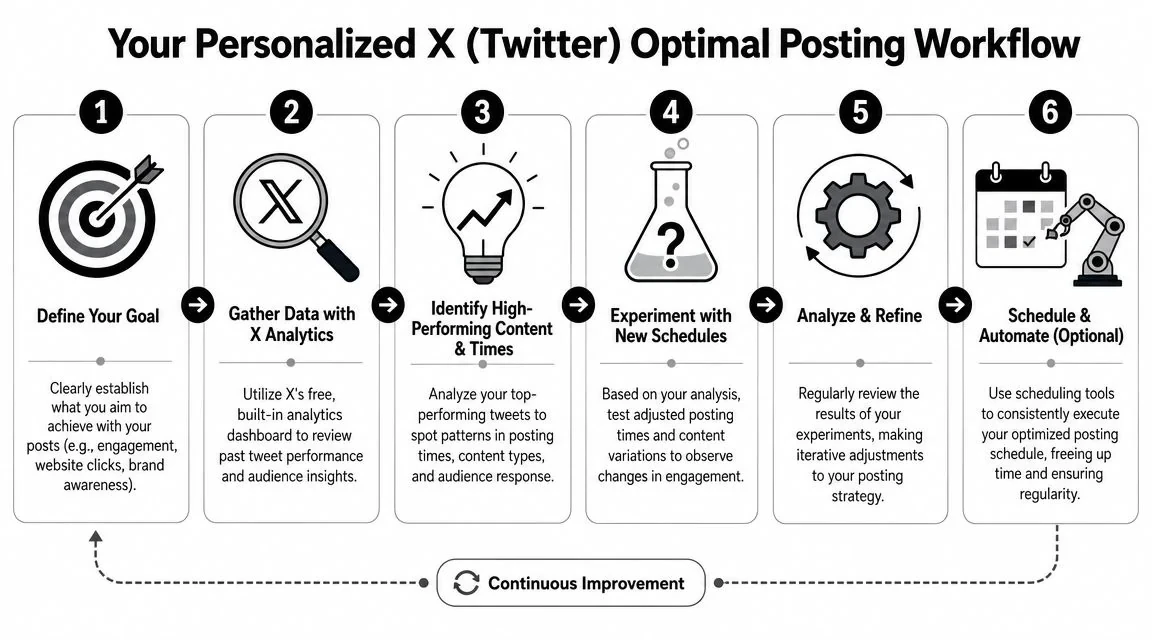
At this point, timing stops being generic advice and becomes a process. The goal is to identify a small set of posting windows that your account can trust, then keep refining them.
Start with one goal, not five
First decide what you want the post to do. Don’t evaluate every tweet by the same standard.
Use one primary objective per test cycle:
- Reply growth if you’re trying to build visible conversations
- Profile visits if you want more account interest
- Link clicks if you’re distributing a product, newsletter, or article
- Engagement quality if you care more about strong responses than raw impressions
If you test posting times while also changing format, topic, and call to action, the result won’t mean much. Keep the experiment tight.
A practical setup is to choose one content lane for a short testing period. For example, test educational single tweets in a few recurring windows before you test threads.
Review your winners for timing patterns
The best benchmark-level evidence points to a midweek morning to midday cluster, not one fixed universal hour. Apaya summarizes several large studies and reports that Buffer analyzed more than 1 million tweets, Hootsuite analyzed over 1 million posts across 118 countries, and Sprout Social drew from 2.7 billion engagements. Across those datasets, the consensus is Tuesday through Thursday and roughly 8 to 11 a.m. to 11 a.m. to 5 p.m. local time, with the exact peak shifting by method and metric (Apaya’s summary of X timing studies).
That supports a better workflow than “pick one hour and hope.” Think in candidate windows, not fixed moments.
Review your recent posts and ask:
- Which time bands repeat among strong posts
- Which formats overperform in which windows
- Which posts got fast early engagement
- Which slots produced quality replies instead of empty likes
If you need a refresher on where to find the numbers inside the platform, this walkthrough on how to see Twitter analytics covers the basics.
Here’s a simple manual tracker you can keep in a sheet:
| Post | Day | Time | Format | Topic | Primary goal | Result |
|---|---|---|---|---|---|---|
| Post A | Tuesday | Morning | Single tweet | Industry opinion | Replies | Strong discussion |
| Post B | Wednesday | Midday | Thread | Tutorial | Profile visits | Good follow-through |
| Post C | Thursday | Afternoon | Product post | Launch update | Clicks | Mixed |
Run controlled posting tests
Now test deliberately. Don’t scatter posts randomly across the week.
A good manual workflow looks like this:
- Pick three candidate windows from your benchmark and account review
- Keep format similar across the test period
- Post consistently enough to get signal
- Log outcomes quickly while context is fresh
Here’s one X-specific example.
Sample tweet for testing:
How I decide whether an X thread is worth writing
- Is the pain specific?
- Can I teach one real process?
- Will someone save this for later?
If the answer isn’t yes to all three, I don’t post the thread.
You could post that style of educational tweet in three separate windows across comparable days and compare the quality of the response. Not just volume. Quality.
A short video walkthrough may also help if you want a more visual explanation of scheduling and analysis:
Decide what stays in your schedule
Once a window repeatedly performs, promote it into your recurring schedule. Once a slot consistently underdelivers, stop forcing it.
Decision rule: Keep the windows that produce the outcome you care about, not the ones that merely look busy.
Your final schedule doesn’t need to be complex. For many accounts, a few trusted windows are enough:
- Primary slot for your highest-value posts
- Secondary slot for tests and format variation
- Flexible slot for real-time commentary or opportunistic posts
That’s the system. Start with probable windows. Test them. Keep the winners. Re-run the process as your audience changes.
How to Automate Discovery with Xholic AI
The manual workflow works. It also gets messy fast once you’re posting often, replying daily, saving examples, and trying to remember what worked.

Where manual scheduling breaks down
Many users don’t fail because they lack posting advice. They fail because they can’t maintain the operating rhythm needed to learn from their own data.
Common friction points show up quickly:
- Ideas arrive at the wrong time and sit in drafts
- Good tweets aren’t reused or remixed
- Reply opportunities get missed because discovery and writing are disconnected
- Testing breaks down because no one wants to babysit a spreadsheet forever
That’s where a workflow tool helps. Not by replacing judgment, but by reducing drag between idea, draft, schedule, and review.
How an AI assisted workflow helps
Xholic AI fits this process best when you use it as a system for discovery and execution, not a magic button. The Xholic AI homepage gives the full overview, but the practical value is in how the parts connect.
A few examples:
- Inspiration helps you study high-momentum tweets by meaning, not just keywords, so you can see what kinds of posts in your niche are getting attention.
- Saved & Collections gives you a place to organize examples by format, topic, campaign, or writing style.
- Tweet Remixer and Steal the Structure help turn proven formats into drafts that fit your voice.
- Reply Deck surfaces conversations worth joining earlier, which matters because replying at the right moment can outperform posting into a dead window.
- Goals & Streaks helps maintain consistency long enough to gather usable timing data.
- Smart Scheduler is useful after review, because scheduling works best when approved posts are placed into recurring slots you already trust.
The Chrome extension also matters more than it sounds. If you can save, remix, reply, and track activity inside the X feed, you’re more likely to stick with the habit. This is a key advantage. Less tab-switching. More usable repetition.
Good scheduling software doesn’t guess for you. It helps you run the same good process more consistently.
Common Scheduling Mistakes to Avoid
Bad timing hurts. Bad habits hurt more.
Mistakes that hurt more than bad timing
Posting only in “peak” hours is one of the most common mistakes. If you only publish when everyone else is chasing the same benchmark windows, your strongest posts compete in crowded conditions. Keep a few trusted slots, but leave room for tests and opportunistic posts.
Scheduling and disappearing is another problem. X rewards interaction. If you publish a strong tweet and vanish, you miss the replies that help the post keep moving. Schedule posts for times when you can still check in and engage.
Judging success by impressions alone leads people into bad decisions. A post can pull broad reach and still do little for growth. If another post gets fewer impressions but drives better replies, profile curiosity, or stronger audience fit, that may be the better slot.
Changing too many variables at once makes your analytics useless. If you change day, hour, format, topic, and hook together, you can’t tell what caused the result.
Running a set-it-and-forget-it calendar usually drifts into stale performance. Your audience changes. Your topics change. Your account mix changes. Revisit your timing regularly.
Ignoring the reply layer leaves growth on the table. For many accounts, thoughtful replies to relevant posts create more momentum than another scheduled standalone tweet. This guide on using social media management tools to go viral on Twitter X is useful if you’re trying to connect scheduling with broader growth execution.
A better rule set looks like this:
- Schedule core posts in proven windows
- Stay available after publishing
- Track outcome quality
- Retest periodically
- Use replies as part of the schedule, not as an afterthought
Frequently Asked Questions About Posting Times
Is posting frequency more important than timing
Usually, consistency beats perfect timing. A decent schedule you can maintain is better than a perfect one you follow for four days and abandon. Timing matters most after you’ve established a repeatable posting habit.
How often should I re-evaluate my best posting times
Re-check your patterns whenever your audience, content style, or goals shift. If you start posting more threads, target a different geography, or move from thought leadership to product content, your best windows can change with it.
Is it bad to post outside peak hours
No. Peak hours are starting points, not restrictions. Some accounts find strong performance in less crowded windows, especially when the content is timely or the audience has different habits than benchmark studies suggest.
Should I schedule everything on X
No. Schedule the posts that benefit from consistency. Leave room for live commentary, replies, breaking topics, and reactive ideas. X still rewards relevance and participation.
Do replies have their own best time
Yes, in practice they do. The best reply timing is often tied to when the original post starts gaining momentum. Early, thoughtful replies on relevant tweets can outperform carefully scheduled standalone posts.
Can mockup tools help with planning posts
Yes, especially for approvals, visual planning, and campaign previews. If you need a safe way to preview tweet concepts before publishing, a fake tweet generator can help. Mockups should be labeled clearly when needed and should never be used to impersonate people, fabricate evidence, or mislead viewers.
Conclusion From Benchmarks to a Personal System
The best time to post on Twitter isn’t one magic hour. It’s a short list of windows that your account has earned through testing. Start with the benchmark consensus. Midweek, morning to midday. Then narrow it using your own analytics, your content mix, and the kind of response you want.
The accounts that grow fastest don’t just post at popular times. They build a repeatable scheduling system, keep learning from performance, and stay active in the conversation around each post.
If you want to turn that process into a daily workflow, try Xholic AI. It helps you discover high-momentum conversations, save and study winning tweet structures, draft better replies, organize ideas, and schedule approved posts without turning your X growth process into spreadsheet maintenance.
Run a Two-Week Posting-Time Test
Turn generic benchmarks into account-specific evidence with a simple experiment:
- Choose two posting windows that are practical in your timezone.
- Alternate the windows across comparable weekdays for two weeks.
- Keep topic and format reasonably balanced between the two groups.
- Compare median impressions, meaningful engagements, profile visits, and follows.
- Keep the stronger window and test it against one new candidate.
Do not declare a winner from one viral post. Use medians and repeat the test when the audience, content mix, or timezone changes.