Most emoji advice is wrong for X.
Generic guides treat smileys like fixed dictionary entries. On X, they behave more like tone modifiers in a live room. The same face can read as friendly, tired, ironic, passive-aggressive, or socially fluent depending on who posted it, what they replied to, and how fast the conversation is moving. If you’re a founder, analyst, trader, or creator joining high-momentum threads, that difference matters.
A smiley doesn’t just decorate a reply. It changes the social meaning of the sentence around it. Used well, it softens sharp opinions, signals humor, and helps you match the room. Used badly, it makes you look out of touch, fake-friendly, or weirdly defensive. That’s why emoji smileys meaning can’t be learned from a static list alone.
Your Favorite Smiley Might Be Killing Your Engagement
The biggest mistake I see is assuming a “positive” emoji creates a positive impression. On X, that isn’t reliable. Some smileys that look harmless in a group chat can make a public reply sound stiff, smug, or accidentally sarcastic.
That shift happened fast. Modern emoji smileys began with Shigetaka Kurita’s 1999 set, and by 2026 emojis appear in over 6 trillion messages monthly worldwide, according to this history of emoji adoption. Once usage reached that scale, smileys stopped being cute add-ons. They became part of how people signal status, irony, alignment, warmth, and distance.
X makes the stakes higher because replies are public, compressed, and judged in seconds. A founder replying to customer praise with 😀 can sound polished or fake. An analyst dropping 🙂 under a bad macro take can read as measured or condescending. A creator using 😂 in the wrong thread can look like they’re chasing tone instead of adding value.
Practical rule: If a smiley changes how your sentence would sound out loud, treat it like part of the argument, not decoration.
That matters more in high-momentum threads where people are scanning fast and inferring intent even faster. The safest approach isn’t “use fewer emojis.” It’s “use the right emoji for the room.”
If you’re trying to improve reply quality in fast-moving conversations, it’s worth studying how stronger posts are structured in public threads and how tone choices affect response quality. This breakdown of ways creators improve Twitter engagement with better post and reply mechanics is useful because it focuses on execution, not vague branding advice.
How to Decode Any Emoji Smiley A Universal Framework
You don’t need to memorize every smiley. You need a repeatable way to interpret them.
I use a simple framework for emoji smileys meaning on X. Check context, then audience, then platform. In that order. Most misreads happen because people jump straight to the literal definition and skip the social layer.
Context comes first
Start with the subject of the post and the emotional temperature of the thread.
A smiley under a product launch means something different from the same smiley under layoffs, a market drawdown, or a joke thread. 😭 in a meme reply often signals “this is peak comedy.” The same emoji under bad news can still read as grief or overwhelm. 🫠 can mean embarrassment, fatigue, or “the algorithm is cooking me again,” depending on what triggered it.
Ask two questions before interpreting anything:
- What is happening here: Is the post celebratory, technical, combative, reflective, or absurd?
- What job is the emoji doing: Is it softening, amplifying, deflecting, or signaling in-group fluency?
If you can’t answer both, don’t use the emoji yet.
Audience changes the meaning
The second filter is who will read it. Age, geography, and professional culture matter.
A startup founder audience often reads 🤠 as “holding it together while things break.” A corporate audience may still read it at face value or as playful Americana. Gen Z often uses some smileys with more irony than older users expect. In business-heavy threads, literal readers and ironic readers are sitting in the same mention stack.
Read the replies before you write one. The room usually tells you how literal or ironic it is.
A practical cue is repetition. If several people are using the same smiley in a similar way, that thread has already defined the tone for you.
Platform decides the final meaning
Emoji usage on X doesn’t map cleanly to Instagram, Slack, iMessage, or LinkedIn. X compresses language, rewards fast pattern recognition, and develops its own micro-dialects around niches like indie hacking, crypto, media, and AI.
Use this quick decoding checklist:
- Read the original post directly.
- Read the top replies for tone.
- Check whether the emoji is softening or weaponizing the sentence.
- Remove the emoji mentally. If the sentence becomes colder, the emoji was adding warmth. If it becomes clearer, the emoji may have been adding ambiguity.
- Decide whether your goal is clarity or social fit. In high-stakes threads, clarity usually wins.
Static definitions help. But on X, interpretation is always situational.
The Core Smiley Glossary Positive and Sincere Emojis
Most creators overcorrect after learning about sarcastic emoji use. They stop using smileys altogether. That’s a mistake too. Some smileys still work well on X when the intent is clear and the sentence earns them.
One useful reminder comes from platform-specific tweet analysis. Data from over 2.5M viral tweets found that even “positive” emoji can develop niche meanings on X, including 🤠 signaling “smiling through the pain” in founder threads, as noted in this discussion of uncommon emoji meanings and X usage. That’s why this glossary focuses on practical use, not generic sentiment labels.
For more examples of how tone lands in actual posts, this collection of tweet examples that work in 2026 is worth studying alongside your own niche.
Warm emojis that usually stay warm
These smileys are the most reliable when you want to sound human without sounding overeager.
| Emoji | Formal name | How it usually reads on X | Good use case | Creator tip |
|---|---|---|---|---|
| 😊 | Smiling Face With Smiling Eyes | Warm, thankful, grounded | Thanking someone for feedback or support | Works best after a complete sentence, not as a standalone reply |
| 😄 | Grinning Face With Smiling Eyes | Cheerful and open | Celebrating someone else’s win | Better for community energy than for serious analysis |
| 😇 | Smiling Face With Halo | Light self-awareness | Joking about being “innocent” after a cheeky comment | Use sparingly. Too much and it starts to feel performative |
| 😎 | Smiling Face With Sunglasses | Relaxed confidence | Casual wins, shipping updates, playful bravado | Fine in founder threads. Risky in customer support or apology contexts |
A clean example:
- “Appreciate you taking the time to test it. That feedback helped a lot 😊”
That reads better than:
- “Thanks 😊😊😊”
The first has substance. The emoji adds warmth. The second asks the emoji to carry the whole message.
Friendly but easy to misuse
Some positive smileys are useful, but only when the sentence around them is stable.
😀 Grinning Face
This one is tricky. In some circles it still reads as straightforward friendliness. In others, especially younger audiences, it can look stiff or fake-cheerful. If your reply includes critique, urgency, or disagreement, skip it.
😁 Beaming Face With Smiling Eyes
This reads bigger and more animated than 😊. Good for shared wins, launch moments, and obvious excitement. Bad for nuanced replies where too much brightness makes you seem unserious.
😂 Face With Tears of Joy
Still common, but not universal. It works best when you’re clearly reacting to humor already present in the thread. If you use it under a semi-serious post trying to force meme energy, people can smell it.
Don’t use 😂 to manufacture a vibe. Use it when the room is already laughing.
🥰 Smiling Face With Hearts
Useful for affection and strong appreciation. It’s usually too intimate for cold replies unless your brand voice is openly affectionate. Works better for community builders than for analysts.
The founder-thread special
🤠 Cowboy Hat Face deserves its own note.
On general emoji lists it looks upbeat or whimsical. On X, especially in founder and builder circles, it often carries a more specific tone: “everything is slightly on fire, but I’m still posting.” That makes it useful when you want to acknowledge difficulty without sounding defeated.
Examples:
- “Shipped the fix at 2am. Billing bug is gone now 🤠”
- “Three bugs, one refund request, one cold brew left 🤠”
What works is the tension between the sentence and the emoji. What doesn’t work is dropping 🤠 into a normal thank-you or polished announcement where no struggle exists. Then it feels borrowed.
A fast rule for sincere smileys
Use positive smileys when the sentence already stands on its own.
- Good pattern: clear thought + one smiley that sharpens tone
- Bad pattern: vague sentence + smiley trying to invent personality
- Best pattern for creators: gratitude, acknowledgment, light celebration, restrained confidence
If the thread is technical, default to fewer smileys and more clarity. If the thread is social, one well-chosen smiley often does more than a longer sentence.
The Core Smiley Glossary Sarcastic and Ambiguous Emojis
The majority of engagement mistakes happen.
Ambiguous smileys are powerful because they compress mixed intent into one character. They can signal irony, exhaustion, skepticism, deadpan humor, social awareness, or contempt. That makes them useful for sharp writers and dangerous for everyone else.
If you use one of these in a high-visibility reply, you’re asking the reader to infer your tone. Sometimes that works. Sometimes it subtly kills trust.
High-Risk Emoji Smileys Quick Reference
| Emoji | Common Interpretation | Potential Sarcastic/Negative Meaning | Guidance for Creators |
|---|---|---|---|
| 🙂 | Polite smile | Passive-aggressive, forced niceness, restrained irritation | Avoid in conflict, correction, or customer-facing replies |
| 🙃 | Playful upside-down humor | Irony, annoyance, “this is nonsense” | Use only when irony is obvious from context |
| 🫠 | Melting, overwhelmed | Cringe, defeat, public discomfort | Good for self-own humor, bad for authority-building replies |
| 😐 | Neutral reaction | Disapproval, boredom, unimpressed silence | Usually too cold for engagement-focused replies |
| 🤗 | Hug, warmth | Overeager, awkward, “jazz hands” confusion | Keep for existing rapport, not first-touch public replies |
| 🫡 | Respect, acknowledgment | Can read as mockery in some cross-cultural settings | Use carefully with international audiences |
| 🫣 | Peeking, nervous curiosity | Voyeuristic, messy, “this is risky” energy | Good for hot-take threads, not clean professional replies |
The passive-aggressive trio
🙂 Slightly Smiling Face
This is one of the most misunderstood smileys online. In private chats, it can still be neutral. On X, it often carries tension. The sentence “Thanks for clarifying 🙂” can read less like gratitude and more like “that explanation was weak and I noticed.”
🙃 Upside-Down Face
This one is built for irony. It works when the thread already contains contradiction, absurdity, or resigned humor. It fails when the reader doesn’t know whether you’re joking. Founders use it after product pain. Analysts use it after policy chaos. Strangers using it in direct disagreement often look snide.
😐 Neutral Face
A deadpan tool. Good if your whole voice is dry and controlled. Bad if you want replies, rapport, or warmth. It often closes a conversation instead of opening one.
Ambiguity gets expensive in public
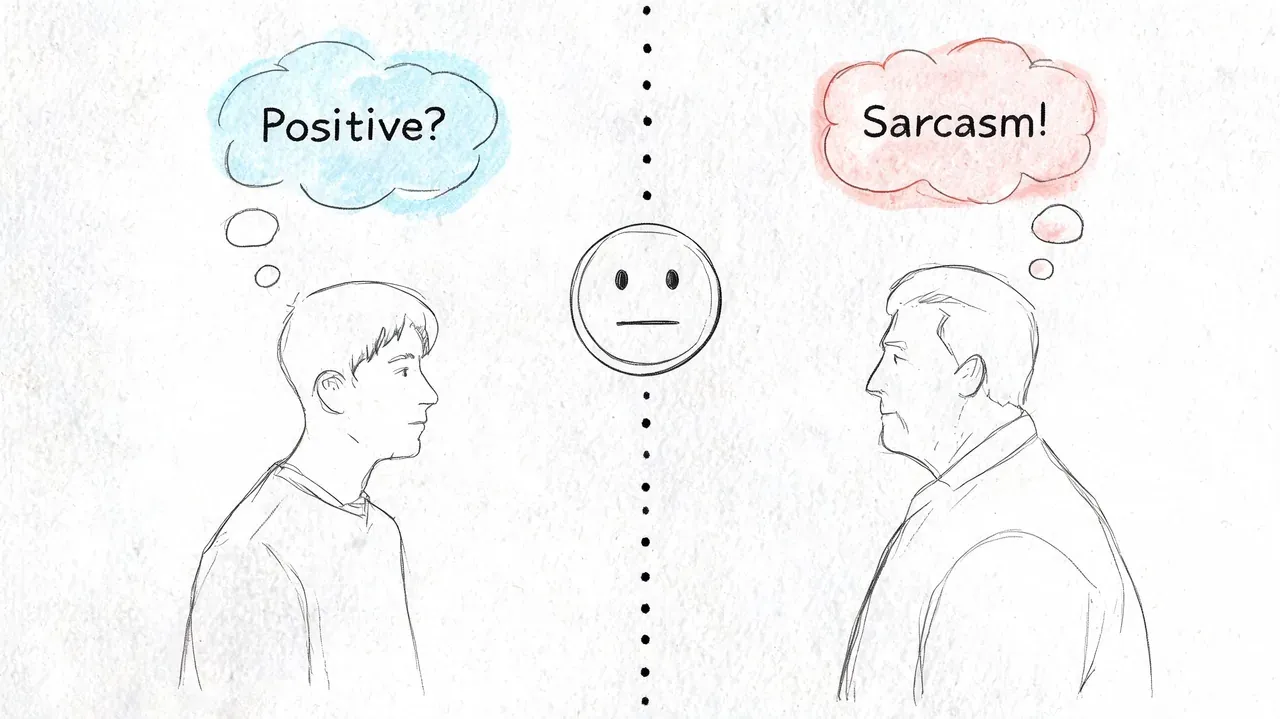
A lot of emoji smileys meaning problems come from public context, not personal intent. You may mean warmth, but the audience may see superiority. You may mean “I’m laughing at the situation,” but someone reads “I’m laughing at you.”
That gap matters more when the thread includes disagreement, status imbalance, or mixed audiences.
Use this filter before posting a risky emoji:
- Would the sentence be clearer without it
- Could a stranger read this as contempt
- Am I relying on shared context that only I have
- Is this a public reply where screenshots would strip away nuance
If you answer yes to any of those, rewrite.
Best uses for the messy smileys
These emojis still have value when used deliberately.
🫠 Melting Face works for self-aware overwhelm. It helps when you’re laughing at your own situation, not framing someone else as the problem.
🤗 Hugging Face can land well in community-heavy spaces. But in professional threads, some readers don’t see a hug. They see theatrical friendliness. Pair it with real substance if you use it at all.
🫣 Face With Peeking Eye fits “this is a spicy take” energy. Useful in playful, observant replies. Less useful when you need to project steadiness.
The risk isn’t that people won’t understand the emoji. The risk is that they’ll understand a different version of you.
When the topic is sensitive, skip cute ambiguity. Choose words that survive outside your niche.
Why That Smiley Looks Different On Your Phone
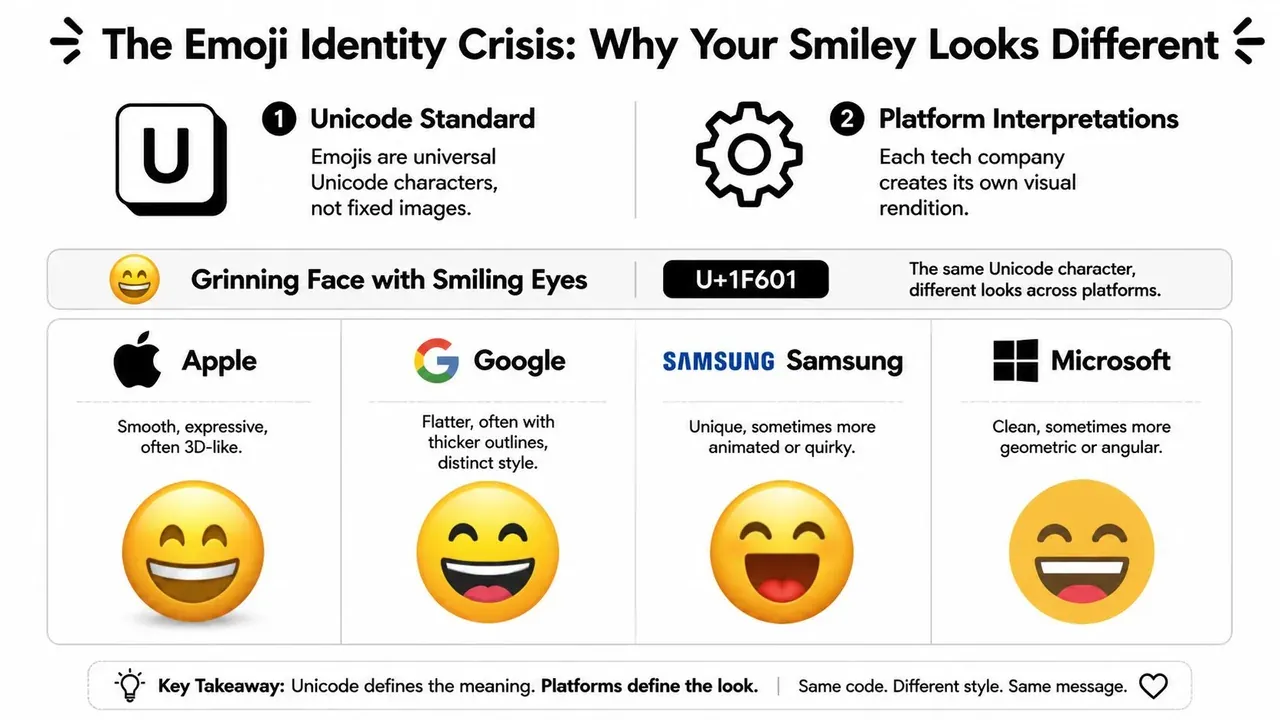
A lot of emoji confusion starts with a technical fact that often goes unconsidered. Emojis aren’t fixed images. They’re characters.
The Unicode Consortium standardizes emoji as code points, and a smiley like U+1F60A for SMILING FACE WITH SMILING EYES is a technical character definition, not a universal picture. Platform vendors then draw their own version of that character. The result is one emoji code with multiple visual interpretations, as described in NAJIT’s guidance on emoji in digital communication.
Unicode sets the identity, platforms set the face
Think of Unicode as the naming system and platform vendors as costume designers.
Unicode says “this is the smiley.” Apple, Google, Samsung, and Microsoft decide how that smiley looks on their systems. One version may look soft and warm. Another may look tighter, flatter, or slightly awkward. If you’re posting from one device and your audience reads on another, the emotional impression can shift.
That matters most for borderline emojis. A friendly smile on your screen may appear more strained elsewhere. With already ambiguous smileys, even a small design difference can push interpretation in a different direction.
What creators should do with that information
You don’t need to memorize render differences. You do need to account for them when tone precision matters.
Use these habits:
- Favor clearer smileys: If a smiley is already socially risky, visual variation makes it riskier.
- Avoid relying on face shape alone: Let the sentence do the main tonal work.
- Be careful in sensitive replies: Customer support, conflict, apologies, and corrections need language that survives across devices.
- Test with platform diversity in mind: If your audience includes both iPhone and Android users, assume they won’t all see the exact same emotional expression.
Why this matters more on X than in private chat
Private conversations build context over time. Public threads don’t. Readers bring less patience and more projection.
That’s why emoji smileys meaning on X depends partly on rendering. You aren’t just choosing a symbol. You’re choosing a symbol that different companies will visually reinterpret before your audience sees it.
If the wording is sharp, skip the risky face. If the wording is warm, choose the smiley that adds the least ambiguity.
Navigating Cultural and Generational Emoji Divides
A smiley can feel obvious to you and strange to someone else. That’s not a fringe problem on X. It’s normal.
One founder uses 👍 to mean “got it.” A younger builder reads it as dismissive. One US-based operator uses 🫡 to show respect. A European reader sees mockery. Both think they’re reading the emoji correctly.
The salute problem is a real business problem
Cross-cultural mismatch isn’t theoretical. Analysis cited in this breakdown of emoji interpretation differences shows 🫡 reads as “respect” in 82% of US contexts but draws a 61% negative sentiment score in many European markets, where it can be perceived as mockery.
That’s the kind of gap that changes how a public reply lands.
If you’re building in public, hiring globally, or talking to customers across markets, a smiley that feels harmless in your home timeline can add friction somewhere else. Not because people are oversensitive. Because emoji are cultural signals, not universal math symbols.
Generational drift changes fast
Some smileys have drifted so far that shared understanding barely exists.
Older users often interpret smileys more directly. Younger users often use them with more indirection, irony, and social coding. That’s why something like 😀 can feel straightforward to one person and fake-cheerful to another. The same thing happens with 👍, 💀, and sometimes 😭, depending on the community.
A common X scenario looks like this:
- Founder posts a hard update: “Server melted, fixed now, onward.”
- Peer replies with 🤠: reads as resilient humor inside founder culture
- Outside observer sees it: reads as random cowboy energy
- Customer sees it: may read it as minimizing a real issue
Same emoji. Different social map.
If your audience is mixed, write for the least insider interpretation first.
How to avoid cross-audience mistakes
You don’t need to flatten your personality. You need to know when niche shorthand stops being useful.
Try this decision rule:
| Situation | Better move |
|---|---|
| Talking to your own niche in a familiar thread | You can use community-specific emoji shorthand |
| Replying to a broad audience or international account | Use fewer ambiguous smileys |
| Responding to customer frustration | Skip irony altogether |
| Posting a joke to people who know your voice | A riskier emoji can work if the joke is clear |
The more public and mixed the audience, the more your words need to carry the load.
Emoji Reply Templates for High-Momentum X Conversations
Templates help when the thread is moving fast and you don’t want your smiley choice to sabotage a good reply. The goal isn’t to sound templated. It’s to use structures that keep tone stable under pressure.
If you want a faster workflow for drafting and refining replies, tools built for generating fast tweet replies with AI assistance can help you pressure-test tone before you post.
Acknowledge praise without sounding smug
Use this when someone compliments your work, product, or insight.
Template
”Appreciate that. [Specific detail you value] helped more than people realize 😊”
Why it works
The sentence carries gratitude first. The emoji just softens the close.
Example
”Appreciate that. The note about onboarding friction helped more than people realize 😊“
De-escalate a negative comment
Use this when someone is frustrated but not abusive.
Template
”Fair point. [Short acknowledgment]. We’re fixing [specific issue] now.”
Emoji choice
Usually none. If you must add one, choose 😊 only when the message is clearly constructive and calm. Never use 🙂 here.
Example
”Fair point. The delay was frustrating. We’re fixing the export issue now.”
Join a meme-heavy thread without forcing it
Use this when the room is already joking.
Template
”[Short reaction]. [One line that adds to the joke] 😂”
Why it works
You join the existing energy instead of trying to create it from scratch.
Example
”That chart needed a warning label. Absolute cinema 😂“
Add value to a technical discussion
Use this when the original post is analytical, tactical, or product-specific.
Template
”One thing I’d add. [specific observation]. [brief implication].”
Emoji choice
Usually none. If the tone is collaborative, 🤔 can work in some contexts, but words matter more here.
Example “One thing I’d add. Retention usually breaks before traffic does. That’s why top-line growth can hide the true problem.”
Signal resilience without pretending everything is fine
🤠 can work in the right niche.
Template
”[What went wrong]. [What you did next]. 🤠”
Example
”Checkout broke right after launch. Patch is live and refunds are processed 🤠”
This works best in founder-to-founder threads where the tension is understood. Don’t use it in direct replies to unhappy users.
A good reply template gives the emoji a job. A bad one makes the emoji do all the work.
React to risky takes carefully
When someone posts something bold and you want to engage without endorsing it too hard:
- Safer version: “Interesting angle. I think the stronger point is [your view].”
- Playful version: “You’re going to start a fight with this one 🫣”
Use the playful version only when the thread is already informal. Otherwise it reads like performance.
Frequently Asked Questions About Emoji Smileys
What’s the difference between an emoji and an emoticon
An emoticon is made from keyboard characters, like :-) or ;). An emoji is a standardized digital character. The classic :-) was posted by Scott Fahlman on September 19, 1982 to mark a non-serious tone in plain text, according to this history of the first smiley emoticon. That distinction still matters when you’re thinking about emoji smileys meaning, because emoticons feel more text-native and often less visually loaded.
How many emojis are too many in one X post
For most creators, one is enough. Two can work in playful posts. A string of smileys often makes the post feel less precise.
If the post is analytical, customer-facing, or controversial, fewer is better. If you remove the emoji and the post gets clearer, keep it removed.
Do emojis affect the X algorithm
There’s no verified data here showing that smileys alone improve distribution. What they clearly affect is human interpretation, which changes replies, trust, and whether people want to engage with you.
That’s the practical lens to use. Don’t ask whether an emoji “boosts the algorithm.” Ask whether it improves the sentence.
Can I use smileys in my X bio or profile name
Yes, but use them as brand cues, not filler. A single relevant emoji can sharpen positioning. Several can make the account look noisy or trend-chasing.
In bios, clarity beats decoration. In profile names, readability matters more than personality flourishes.
Which smiley is safest when I’m not sure
😊 is usually the safest positive option when your message is already clear and warm. No emoji is often safer than the wrong emoji.
If the audience is mixed, the topic is sensitive, or your authority matters more than friendliness, skip the smiley and write the tone directly.
Should I use sarcastic smileys to sound more native on X
Only if that tone is already native to your voice. Borrowed irony is easy to spot.
Creators get into trouble when they copy emoji style without understanding the audience around it. A plain sentence with strong judgment usually outperforms a fuzzy sentence hiding behind 🙃 or 🙂.
If you want to write sharper replies, spot high-momentum conversations earlier, and keep your tone consistent without sounding AI-generated, try Xholic AI. It helps creators, founders, analysts, and operators find the right threads, draft faster, and stay context-aware before they hit post.